行政院國家科學委員會專題研究計畫 成果報告
隨意智能電子服務之基礎資訊技術、經濟模式、與創新服
務應用(第 2 年)
研究成果報告(完整版)
計 畫 類 別 : 個別型 計 畫 編 號 : NSC 95-2221-E-004-011-MY2 執 行 期 間 : 96 年 08 月 01 日至 97 年 07 月 31 日 執 行 單 位 : 國立政治大學資訊管理學系 計 畫 主 持 人 : 苑守慈 計畫參與人員: 博士班研究生-兼任助理人員:YH Hsieh 報 告 附 件 : 出席國際會議研究心得報告及發表論文 處 理 方 式 : 本計畫涉及專利或其他智慧財產權,1 年後可公開查詢中 華 民 國 97 年 09 月 28 日
行政院國家科學委員會補助專題研究計畫
▇成果報告 □期中進度報告(計畫名稱)
隨意智能電子服務之基礎資訊技術、經濟模式、與創新服務應
用 (2/2)
計畫類別: ▇個別型計畫 整合型計畫
計畫編號:NSC 95- 2221 -E - 004 - 011 – MY2 - 執行
期間: 95 年 8 月1 日至 97 年 7 月 31 日
計畫主持人:苑守慈 共同主持人: 計畫參與人員:
成果報告類型(依經費核定清單規定繳交):▇精簡報告 □完整
報告
本成果報告包括以下應繳交之附件: □赴國外出差或研習心得
報告一份 □赴大陸地區出差或研習心得報告一份 ▇出席國際
學術會議心得報告及發表之論文各一份 □國際合作研究計畫國
外研究報告書一份
處理方式:除產學合作研究計畫、提升產業技術及人才培育研
究計畫、列管計畫及下列情形者外,得立即公開查
詢
□涉及專利或其他智慧財產權,□一年□二年後可公開查詢
執行單位:政大資管系
i-Trust: Exploring Collective Wisdom for Ubiquitous Trust
e-Service
Astract. Ubiquitous e-service is one of the most recent links in the chain of evolution that has characterized the different eras of the internetworking environment. In order to leap the trust barrier for the user to embrace these ubiquitous e-services, we present a collaborative iTrust e-service for exploring collective wisdom in the ad-hoc ubiquitous environment. Simulation outcomes for trust decision quality enhancement show significant improvement over traditional designs. The iTrust e-service makes it possible for users to collaborate with the nearby user groups for establishing a reliable and trustworthy interaction environment. It also facilitates and empowers the potential benefits of various ubiquitous e-service applications.
1. Challenges for Ubiquitous e-Service
The ongoing, rapid developments in information systems technologies and networking have generated significant opportunities for streamlining decision-making processes and maximizing productivity through distributed collaborations that facilitate unprecedented levels of sharing of information and computational resources. We have witnessed the necessity of collaboration and resource sharing in many massively distributed computing systems such as the P2P file sharing for fast information dissemination, cooperative caching for Web content delivery, enterprise collaboration in E-commerce, and so on. Emerging collaborative environments need to provide efficient support for seamless integration of heterogeneous technologies such as mobile devices and infrastructures, web services, grid computing systems, various operating environments, and diverse products. Such heterogeneity introduces, however, significant security and privacy challenges for distributed collaborative applications. In such a loosely-coupled open computing system, trust management has become essential, together with traditional cryptography techniques, for building a healthy collaboration among participating peers (or agents). Hence, ensuring trust in an ubiquitous environment is one of the most important tasks of the new networking paradigm. Recent work [10] suggests that reputation based trust systems as an effective way for nodes to identify and avoid malicious nodes in order to minimize the threat and protect the system from possible misuses and abuses by malicious nodes in a decentralized overlay networks. Such systems typically assign each node a trust value based on the transactions it has performed with others and the feedbacks it has received.
However, the ubiquitous environment is different from a traditional static environment. It presents significant challenges for users in determining which users are trustworthy. The notion of ambient e-services is proposed to identify a new scope of ubiquitous e-service, which addresses dynamic collective efforts between mobile users (enabled by Mobile-P2P technology), dynamic interactions with ambient environments (envisioned by Location-Based Services), moment of value, and low cost service provision [3]. Since the ubiquitous identities are not designed for long-term lived and historical information is also seldom available in the ad-hoc
service environment, previous solutions may not be applied to the ubiquitous environment. Environmental constraints and computational limitations make it more difficult to execute the process for determining which users are worthy of trust. There is no centralized or trusted 3rd party/agency to manage that task, and guarantee the trustworthiness of each identity. These new challenges complicate trust determination.
Since the ubiquitous e-service is highly correlated to user’s current position, if the invasion of privacy is considered risky by users, users may resist the potential benefits of e-service. Since identities are short-lived, historical records may not available. Therefore, in an ad-hoc e-service environment that changes identity rapidly, there little information available for others to determine whether users should be trusted. Without a trustworthy mechanism that can support user privacy protection and maintain transaction security, e-services may not attract enough participants to encourage e-services providers to enhance their service quality. By the same token, once the user perceives they are well protected from possible fraud or malicious transactions, the benefits of various e-service applications will increase significantly.
To solve the problem of creating trust in the ubiquitous environment, we propose a collaborative trust e-service for exploring the collective wisdom in the ubiquitous environment, called “iTrust”. The iTrust e-service is an ambient e-service application that may obtain value-added information through the interactions of surrounding environments and/or users. The iTrust e-service allows users to choose and cooperate with trustworthy partners for executing transactions in the risky ubiquitous environment. The iTrust design integrates the concept of privacy protection, reputation management, and trust estimation in the ad-hoc ubiquitous environment. It is proposed to provide a feasible solution for quality decisions in the dynamic and distributed environment in which identities are short-lived and the computational abilities of mobile devices are limited. The iTrust e-Service highlights the collective effort focused on collecting the user group’s power as the reference for ubiquitous trust decisions.
The remaining sections of this paper are organized as follows: In section 2, we describe the collaborative strength of iTrust e-service which relies on the experience co-creation from proximal user groups. In section 3 we present iTrust e-service in terms of its design concepts and platform designs. In addition, we illustrate the evaluation results for iTrust e-service in the ubiquitous environment in section 4. Significance and contributions of iTrust are elaborated in section 5. Finally, a conclusion and the directions of our future work are provided in section 6. 2. The Collaborative Strength of iTrust e-Service
Unlike the client/server commercial environment in which centralized databases or 3rd parties manage all trust related information, the only available information sources are from users themselves and the people around them. The major benefit of ambient e-Service was based on the collective effort, by combining everybody's strength to build up a trustworthy environment that respects security, privacy and encourages the convenience of exerting mobile peers’ e-service in the vicinity. Since there is no authorized information sources in the ad-hoc ubiquitous e-service environment that guarantee which identity is trustworthy, the decision must rely on the users themselves. The iTrust e-service highlights the collaborative power to eliminate potential risks and provide appropriate estimation for trust decisions. Various kinds of available information may increase the heterogeneity and raise the system loading especially for mobile devices with a limited computational capacity. Increasing information heterogeneity implies complex computation, but it also creates significant collaborative power. According to Govier
[2], social trust is not blind, but derives from personal or interpersonal experience, and those experiences are gathered from the informal groups that constitute our daily life. Users may retrieve various experiences as the decision resource, but how are those experiences obtained from the ubiquitous e-service environment?
2.1 Experience co-creation approach
Experience co-creation occurs when users perceive powerful events from interaction experiences with other users. Reputation estimation is performed by aggregating these perceived experiences. For most commercial scenarios, reputation data is defined as transaction-based experiences. That is, when a transaction process is executed, reputation data will be established and recorded. Whether the transaction process is completed or abandoned, a reputation record from the transaction will still be generated (abandoned transactions usually have a negative effect on reputation). If reputation data is accessible, others may also take reputation data into their decision considerations. Experience co-creation in the iTrust e-service highlights the co-creation process and the shared experience of collective effort, which provides meaningful information for collaborative interactions.
In an unknown environment, users may not be familiar with the other people around them. They may not understand who is reliable or trustworthy. There is seldom information available for trust decision in an ad-hoc ubiquitous environment. The iTrust e-service extends the information sources from traditional commerce scenarios that consider the transaction-based experience only. Instead, interaction-based experiences are also considered as another heterogeneous data source.
Researchers have defined trust as an expectation. The expectations and determinations for trust are all related to the concepts of competence, benevolence and responsibility. Those are the major factors for satisfying the “Cognitive-based trust” and the “Affective-based trust” in interpersonal trust [8]. When applying emotional measurement factors to judge provided services, interaction-based experiences are desirable information sources for trust estimation -- the judgment of whether the service provider has the ability to give the needed service. Does the buyer can comprehend whether the service provider really cares for their needs in providing the service? More importantly, do the provided services actually fulfill the buyer’s urgent needs for all requirements? The following table (Table 1) indicates how those emotional factors are used for trust measurement in related research. The interaction-based trust is unfolded into those three the concepts as an alternative information sources. In addition to personal experience, available information sources also include the interpersonal experiences from one’s social network. Heterogeneous interaction-based trust estimations are collected from the proximal user groups which represent experience co-creation process for contributing the collaborative trust decisions.
Table 1. Interaction-based trust: definition concepts and related works.
Concepts Operational definition Related work
Competence Sellers should have the ability and have enough service resources for providing users their desired services. [1],[5],[6],[7],[8] Benevolence Seller should really care about the customer’s urgent needs and supply them appropriate services [5],[6],[8]
Responsibility
Provided services satisfy the original expectation. Service provider is able to reach the goal they promised
to accomplish. [1],[5],[7],[8]
2.2 Collaborative Trust estimation
In order to deal with the changes originating from the ad-hoc ubiquitous e-service environment, the solution must explore other possible data sources in addition to the transaction-based information, and seek out alternative evidences for trust estimation. However, experience data obtained from the surrounding environment or evidence chains over the social network may entail risks. If the obtained information cannot provide enough reliable evidence for better trust estimation results, then the tradeoff between data usability and efficiency should be taken into consideration. Since all of the available trust experience and other heterogeneous information sources should be taken into account for trust estimation, the limitations of mobile devices make the selection for comparative valuable information sources an important issue. Users have to decide the level of risk they are willing to endure from weighted heterogeneous data sources.
In iTrust e-Service, a credibility investigation module is designed for experience sharing collaboration. Detailed descriptions of iTrust components are illustrated in the Section 3.2. After the credibility investigation process is completed, users may have possession of three types of information sources for trust estimation. Including:
• Personal interaction-based experience from self-owned interaction pseudonyms. (Personal Local Trust, PLT)
• Interpersonal interaction-based experience from credibility investigation. (Nearby Peer’s Local Trust, NLT)
• Transaction-based global reputation for specific target peer. (Global Reputation, GR)
The interaction-based experience estimation involves two dimensions. The first requires determination of the trustworthiness from the interactions by demander (customer) to justify whether the provided service satisfies their expectation. The second is responding to the credibility investigation by consolidation of the available personal experience as a trust evaluation value and send back to the investigation demander.
The determination of how a peer can recognize whether the various received service package information will satisfy user expectation will involve the cognitive-decision for each communication message. In order to facilitate mutual understanding for each peer, an ontology is essential for effective communication. In our study, the ontology-based search has great potential to facilitate the interaction parties matching their desired resources and comparing the received service package information in order to determine the candidate service provider. The fitness will be matched by comparing the demanded task and supplied services. Utilizing an ontology-based search for task matching can understand how the service provider understands the customer’s needs and determines which service packages are the best candidates with highest fitness.
Users may have various needs and reliability concerns for different information sources, these heterogeneous sources may be applied with different importance for the user’s final decision. The balance between heterogeneous information sources can be adjusted in the iTrust Profile Management module. The following three weighted parameters are used for the sake of aggregating heterogeneous information sources as the final score for trust candidate decision. WPLT represents the weight of personal interaction-based experience from self-owned
interaction pseudonyms. WNLT represents the weight of interpersonal interaction-based
experience from credibility investigation. WGR represents the weight of transaction-based global
reputation. The final score computation for trust candidate selection is shown as formula (1).
GR NLT PLT GR NLT PLT FinalScore W W W GR W NLT W PLT W Trust + + ⋅ + ⋅ + ⋅ = (1)
The final score for trust candidate selection represents the aggregate results from obtained heterogeneous data sources. A higher score means the information source is more trustworthy. A risk parameter β is also set up by the user in the User Profile as the trustworthiness threshold. Once the TrustFinalScore is lower thanβ, the corresponding interaction pseudonym is removed
from the transaction candidate list. The best candidate will be the first priority for further service exchanges.
3. iTrust e-Service Design
We have identified the major challenges in an ubiquitous environment and the urgent needs for collaborative iTrust e-service. We use an iTrust platform that considers privacy design, reputation management, and trust management as the central concepts for establishing an autonomous trust model for exploring the collective effort in the ubiquitous environment. Different from traditional architecture, the iTrust e-service highlights distributed peer-to-peer interaction under ad-hoc network composition, and accommodates the dynamic short-lived identity characteristics and the limited computational capacities of mobile device. Also, the iTrust e-service provides seamless unlinkability to ensure user protection and adopts heterogeneous data sources to enhance quality for trust collaboration. Classical method designs may be used for partial solutions to the problem, but require heavy computations that are difficult to carry out in a mobile device. But most previous designs cannot be applied to our problem as their architecture is not suited to an ad-hoc ubiquitous environment and their design concepts do not address the challenges of the ubiquitous environment.
3.1 iTrust Privacy and Security Design
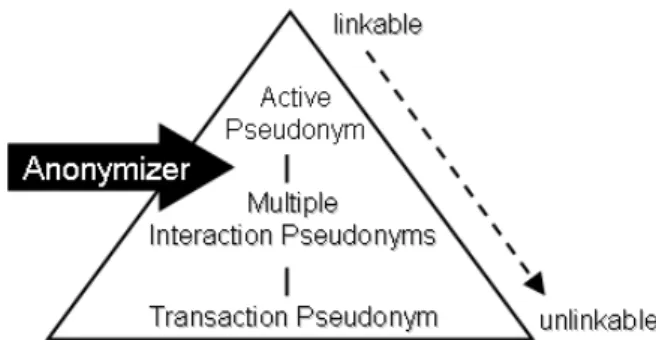
The privacy protection design of iTrust is illustrated in Hwang and Yuan 2006 [4]. The iTrust privacy design concept is based on multiple layered pseudonyms to ensure identity security and unlinkability. The iTrust privacy design excludes a unique personal pseudonym for interactions to protect users from possible tracking and profiling. It uses multiple interaction pseudonyms to enhance the complexity of identity tracing by abstracting the design of role/relationship pseudonyms for service version selection and delivery. (i.e. versioning the services by specific types for performance consideration.) For transaction security, iTrust design uses a transaction pseudonym to ensure safety for a one time payment.
Fig. 1. A multiple layered pseudonym design for privacy protection
Before any interactions can be executed, peers require an identity for the service environment. We use the Interaction Pseudonym as an agent identity for the user. It should be noted that a user may possess several different agents for various e-services. An agent’s identity is produced according to the service. A user can activate an agent identity or discard a specific identity based on their needs. Even if the user has many agent identities, all identities still share the same global reputation data. When an identity is created, it inherits the concurrent reputation from user’s global reputation data. The reputation data for each identity does not exist separately. No matter how many identities belong to the user, he can keep only one global reputation. The diagram (Fig. 1) represents the general design concepts and the relationships of three kinds of pseudonyms. Only the Interaction Pseudonyms appear in the interaction environment. Interaction pseudonyms are generating through the same Active Pseudonym but without any linkage relationship. Interaction pseudonyms are cost-free (i.e. cheap pseudonyms); user can generate/discard them freely. However, user can not change their active pseudonym without cost.
3.2 iTrust platform
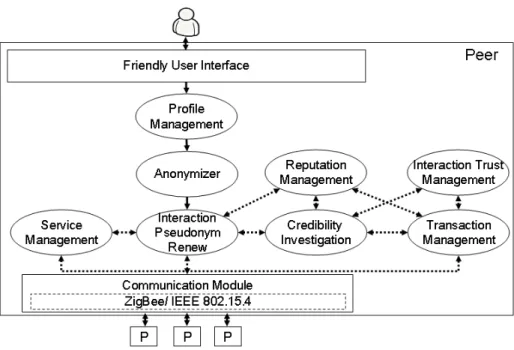
Fig. 2. Macro view of the Collaborative iTrust platform
• Profile Management
In the iTrust e-service platform, mobile users can manage their profile settings through a friendly user interface. The profiles includes their preferences and the roles they would like to play, and various attributes such as user's willingness to participate, the will to disclose their interaction experiences, the risk level they can tolerate, and the reliability threshold for determining whether to interact with nearby peers. Once an identity has been generated, those settings will be assigned to the interaction pseudonym automatically.
• Anonymizer
In the iTrust e-service platform, all interactions within the ubiquitous e-service environment are using the “Interaction Pseudonyms” instead of user’s real identity or personal pseudonyms. The main function for the Anonymizer is to generate diverse occasional interaction pseudonyms based on their given identity for various kinds of e-services. Those interaction pseudonyms are valid for a short period, and are localized to the corresponding e-service acquired. Because the randomized interaction pseudonyms are not linked to real personal identities and are valid for a limited range, others will be unable to trace their real owner via the interaction pseudonyms. Those interaction pseudonyms are generated by the Anonymizer and will inherit the attribute parameters automatically through the Profile management module. They are able to execute the versioning process and cope with the service management module to reduce irrelevance transmission and improve the efficiency of interaction.
• Interaction Pseudonym Renew
As mentioned in previous sections, iTrust e-service has overcome the problem of the dynamic composition of surrounding peers that may change rapidly. The Interaction Pseudonym Renew module is used to update the list of current nearby users, which exhibits all available nearby peer interaction pseudonyms. Users can interact with peers around themselves through the Communication module. The Interaction Pseudonym Renew module is connected
with the Reputation Management module, which may immediately update the global reputation of peers so that all devices in range may access it. Each exchange and transmission within the Service Management module, as well as information inquiry when performing credibility investigation, is targeted to those identities obtained by Interaction Pseudonym Renew module. • Service Management
Service management in the iTrust e-service platform includes two major interactive function modules: the “Acquire sub-module” that acquires service and forwards peer requests to nearby peers within the e-service environment; and the “Acknowledge sub-module” that responds to or acknowledges the service request received from surrounding peers. Both of the sub-modules are equipped with a matching function that facilitates the assessment for service information exchange. The Acquire sub-module gathers all the responses provided by nearby peers who receive a user’s request. Those responses include service package information offered by nearby service providers. For further interaction or transaction decisions, the reputation data of those service providers are also attached to the service package information, shown as a received service list. The Acknowledge sub-module complements the Acquire sub-module. After receiving the requests forwarded by nearby users, service providers can take into account their own behavior style settings and determine appropriate responses. Service providers may decide to provide services identical to those of the request, or offer a substitute. After consulting the requester’s public attributes, a suitable service package is created. The service package information attached with provider’s reputation is delivered to the requesting peer through the Communication module. If the received services match the requesting peer’s needs, the peer can decide follow-up interactions based on their perishability, or degree of urgency. In urgent situations, users may execute immediate transactions directly to those candidates, which will link to the Transaction module. Otherwise, they can obtain the trustworthy analysis result via the Credibility Investigation module for advanced decision-making.
• Credibility Investigation
By comparison with current mobile e-services, there may be little available data for credibility and trust estimation of unfamiliar users due to the natural limitations of ad-hoc ubiquitous e-services. In the iTrust e-service platform, the traditional transaction-based experience is considered for decision-making, along with the interaction-based experiences. For credibility investigation, there are two information sources available. The first source is similar to the current e-service’s global reputation but without the linkage to the user’s personal identity or detailed transaction histories. The second source is exploration of the collective effort of the social network and its most recent interaction experiences. Empowered by the characteristics of iTrust e-service, investigated data are concurrently updated and highly related to their location at the moment. After consideration of the various heterogeneous data sources against the user risk tolerance setting in the Profile Management module, the Credibility Investigation module filters out credible candidates for further transaction management.
• Transaction Management
After the user has determined the target peer for transaction, a transaction pseudonym is created automatically in the iTrust e-service platform. This transaction pseudonym is put to use for the payment process, which is also unlinkable to the user’s real identity. That is, the transaction pseudonym is only valid for the specific service transaction for that period of time. Next, the reputation management module is launched to update the global reputation’s of both seller and buyer.
Once the users have accomplished the transaction, a reputation evaluation token is exchanged. According to the feedback result recorded in the reputation evaluation token, the summarized global reputation data is updated automatically. The reputation evaluation tokens are blind-signed and enable unlinkability for keeping the reputation data from revealing the referee’s true identity. This Reputation Management module not only acts as the information source for credibility investigation, but is also linked to the Interaction Pseudonym renew module for global reputation updates.
• Interaction Trust Management
In contrast to the reputation management module that records the transaction histories, the interaction trust management module places emphasis on a user’s direct interaction experience. It highlights the perceived value from the interaction’s target peer and treats the interaction-based experience as another vital information source. In cooperation with the Credibility Investigation module, it provides heterogeneous information based on user experiences stored in the social network for trust estimation of unfamiliar users.
• Communication Module
The ZigBee based communication module makes use of the security services that are already present in the 802.15.4 security specification. ZigBee infrastructure security includes network access control, integrity of packet routing, and prevention of unauthorized use of packet transport. ZigBee application data security includes message integrity, authentication, freshness, and privacy [9].
4. Effect of Collective Wisdom
In this simulation scenario, the goal is to verify whether the collective wisdom gathered from ubiquitous environment could improve the decision quality for estimating the trustworthiness of unfamiliar user. Two different reputation mechanisms are available for trust estimation: the traditional reputation mechanism allows users to estimate from the global reputation data and his/her owned personal transaction experience; the iTrust e-service equipped with credibility investigation module that can explore the collective wisdom of the ubiquitous environment as well as the global reputation data, and the user’s personal experience.
In the ubiquitous environment, user’s perishability and their anxiety level may strongly affect their interaction behaviors. User behaviors can be distinguished from the two dimensions and sorted into 4 stereotypes. Perishability represents the level of urgency the user brings to completion of the task, the desire to obtain the service as soon as possible. With higher perishability, users prefer to consume their resources (eq. time and processing capability, etc.) in service discovery rather than comparing which user is more reliable. Instead, once the service provision is acceptable and the provider’s reliability fulfills their basic trustworthiness threshold, a transaction begins. The anxiety level represents the user’s mental perception of security protection and how they view the probability of privacy intrusions and security breaches. Users with lower anxiety levels may consider various received service information as an alternative choice even though the provided services may not be related to their request. By contras, users with a high anxiety level are serious about whether the provider cares about their needs. Since accepting messages consumes a user’s limited resources, spam messages or irrelevant service messages will be considered inimical actions.
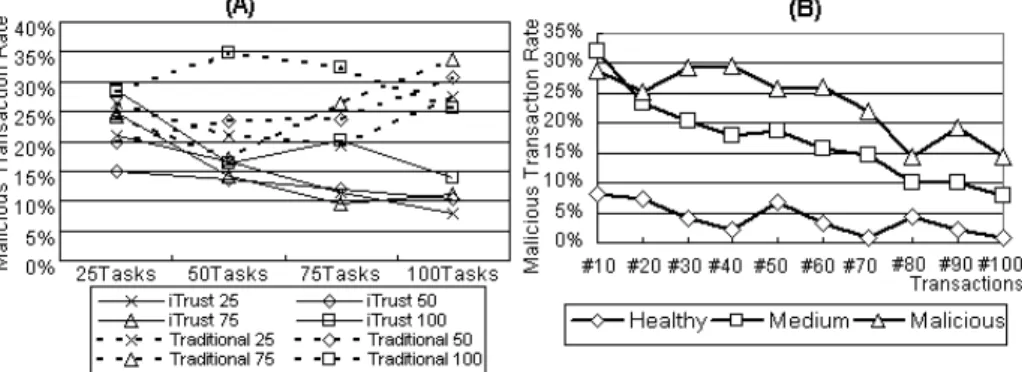
The simulation experiment result is shown as the following diagrams: Figure 3A represents the transaction cheat rate in the iTrust e-service and Traditional designs. Up to 100 transactions were executed by users with different group size. In testing the performance of collaborative trust, we have considered practical factors such as the population of malicious hosts and good hosts; the available peer numbers to simulate realistic conditions for real applications.
For the overall performance, we can see that iTrust improves the trust estimation of unfamiliar users and reduces the rate of transactions involving cheating to 15.83% in a risky environment that contains 50% cheaters, while Traditional designs can reduce the average cheat transaction rate to 25.92%.
Fig. 3. (A) Cheat Transaction Rate in iTrust e-service and Traditional designs (B) Cheat Transaction Rate in Healthy/Malicious environment
In the ubiquitous e-service environment it is lack of information available for users to estimate which user is trustworthy. This problem is more serious when a new market is opened since the global reputation of each identity is zero and may not satisfy the user’s trustworthiness threshold. This will lead to a desolate e-service environment since users may be afraid to transact with unfamiliar users. As the number of transactions increases, more interaction experience is stored in the environment. At the beginning stage the average cheat rate of iTrust is 22.28% while the Traditional is 24.68%. After 100 transactions, the average cheat rate of iTrust falls to 10.79% while the Traditional remains high at 29.45%. We can see that the cheat transaction rate of iTrust decreases significantly when the number of transactions increases. But the cheat rate of the traditional design still remains at the initial levels.
To evaluate the performance of iTrust collective wisdom, different kinds of environments have been established which contains varied proportion of users. The healthy environment contains 80% honest users and 20% cheaters. On the contrary, the malicious environment contains 80% cheaters and 20% honest users. Figure3B represents the power of collective wisdom in various environments. The experience co-creation approach could retrieve heterogeneous information sources to help users identify malicious node and prevent cheating. In the malicious environment, even in the initial stage, iTrust reduces the rate of transactions involving cheating to 28.67% in an extremely risky environment that contains 80% cheaters. After 100 interactions, the malicious transaction rate could be decreased to a level below 15% for all kinds of environments. The simulation results clearly show that iTrust e-service makes it possible for users to collaborate with the nearby user groups for establishing a reliable and trustworthy interaction environment. The iTrust e-service realizes the collective wisdom and provides a feasible solution for quality decisions in the dynamic and distributed environment.
5. Significance & Contribution
Considering the natural limitations of ad-hoc ubiquitous e-service environment, our iTrust design has several significant improvements and contributions. The collaborative iTrust platform accordingly is empowered to realize the vision of ubiquitous iTrust e-service in terms of the following perspectives:
• Deliberation of short-term lived pseudonyms: Revises existing long term identity design concepts and ensures the unlinkability of identities.
• Distributed data process consideration: Each interaction record within the iTrust e-service environment relies on the computational loading and data storage in the mobile device instead of the centralized server database.
• Lightweight consideration: Different from the existing works of centralized gradational
pseudonym design (the quantity of interaction data will be expanded in exponential growth), our design method integrates a user’s conceptual role information and relationship information into an abstract public information attached to the user’s identity. This attached abstract information can then provide hints to filter out inadequate service information that will reduce unnecessary data transmission. Since the required feature of lightweight computation for mobile devices is emphasized, our design reduces considerable expansion and makes it adequate to the ubiquitous e-service. Moreover, the adoption of the time stamp design is exerted to omit those overdue historical interaction data, which will further improve the strength of interaction pseudonym’s unlinkability.
• Convenience requirement: Under the versioning scheme, irrelevant service information is filtered out. Only highly correlated services are delivered to the requester. The versioning design reduces communication costs and system loading while improving service efficiency.
6. Conclusions
Trust has been considered as a top criterion for the acceptance of e-service adoption. This paper proposes a ubiquitous iTrust platform that exerts the identity design to deliver the visions of collaborative trust e-service with an integrated consideration of trust, reputation and privacy requirements. It is proposed to provide a feasible solution for quality decisions in the dynamic and distributed environment. iTrust e-Service highlights the collective effort focused on collecting the user group’s power as the reference for ubiquitous trust decisions. We have implemented the iTrust e-Service platform, and our on-going works include the evaluation of the design and the platform from different perspectives (trust, reputation, privacy, efficiency, usability, etc.). Preliminary evaluations results indicate the iTrust design can eliminate potential risk and provide appropriate estimation for trust decision in the ad-hoc ubiquitous environment.
References
1. Earle, T. C., Cvetkovich, G. T.: Social Trust: Towards a Cosmopolitan Society. Praeger Publishers, Westport, CT. (1995)
3. Hwang, Y., Yuan, S.: A Roadmap for Ambient E-Service: Applications and Embracing Model. International Journal of E-Business Research.Vol.3 No. 1 (2007) 51-73
4. Hwang Y.C., Yuan S.T.: Technical Report: A Privacy-aware Identity Protection design in ubiquitous e-Service Environment: Implementation Method and Evaluations. National Cheng-Chi University, Taiwan (2006)
5. Mayer, R. C., Davis, J. H., Schoorman, F. D.: An integrative model of organizational trust. Academy of Management Review, Vol.20 No.3 (1995) 709-734
6. Singh, J., & Sirdeshmukh, D.: Agency and trust mechanisms in consumer satisfaction and loyalty judgments. Academy of Marketing Science, Vol.28 No.1 (2000) 150-167
7. McAllister, D. J.: Affect- and cognition-based trust as foundations for interpersonal cooperation in organizations. Academy of Management Journal. Vol.38 No.1 (1995) 24-59
8. Lewis, J. D., Weigert, A.: Trust as a social reality. Social Forces 63 (1985) 967-985 9. ZigBee Org.: ZigBee Specification Ver. 1.0. http://www.zigbee.org (2005)
10. Xiong, L., Liu. L.: PeerTrust: Supporting Reputation-Based Trust for Peer-to-Peer Electronic Communities. IEEE Transactions on Knowledge and Data Engineering, Vol.16 No.7 (2004) 843-857
出席國際學術會議報告
2008 International Conference on Business and Information (BAI 2008) Seoul, S. Korea, July 7-9, 2008/7/8
出席會議經過
BAI 2008 於韓國首爾舉行。會中共有來自 39 個國家 ( 包括 Australia, Bangladesh, Canada, China, Czech Republic, Egypt, Fiji, Germany, Hong Kong, India, Indonesia, Iran, Japan, Jordan, Macao, Malaysia, Mauritius, Myanmar, Nigeria, Norway, Pakistan, Philippines, Portugal, Russian Federation, S. Korea, Saudi Arabia, Serbia and Montenegro, Singapore, South Africa, Sri Lanka, Sweden, Taiwan, Tajikistan, Thailand, Turkey, United Kingdom, United States, and Viet Nam.)的學者 一同參與,與會人事逾五百多人。BAI 研討會共計有 55 個 sessions,主要包括 Accounting, Business Administration, Business Policy and Strategy, Economics Electronic Commerce, Entrepreneurship ,Financial and Banking, Health Care Administration, Human Resource, Information System and Technology, International Business, Management and Organization Behavior, Management Education , Management Information System, Managerial Consultation, Marketing, Operations Management, Organizational Development and Change, Non-Profit Sector Management, Research Methods, Social Issues in Management, Technology and Innovation, Web Technology and Management, Other Relevant Topics 等相關學術議 題。
出席會議心得報告
會議中所提若干重要研究方向茲分述如下: z Future research for marketing area:
Innovative services design
Relationship between customer loyalty and repurchase Effective measurement for customer loyalty
Brand building up Digital marketing Customer psychology
z The subjects of service science will include as follows in the future: Verification, validation and evaluation of SOA systems
SOA systems are developed based on services viewpoints which are different from general systems, so SOA systems need particular approaches to verify, validate and evaluate.
The effective and standard verification, validation and evaluation mechanisms of SOA systems are essential for system development. Service analysis, design, development and test
The important elements, such functions of service systems, information technology, service quality, providers’ needs, should be considered. For service analysis and design, realizing customer needs is still
necessary to match their expectations. Service orchestration and composition
The main issue is to integrate existed services effectively and choose accurate services that can immediately solve the problems in terms of SOA.
Technology within service connection
Information technology plays a supportive role, like a communication platform, to delivery services intelligently.
Intelligent agent will be still the main stream for service systems. Wireless technology applications will be in depth.
SOA applications in practice
E-Healthy application (people) E-Exhibition applications (industry) E-University applications (education) E-Government applications (government) Other applications
z Researchers’ comments for our presentation on 7/8 session
Service design combines with customer expectation concept by IT is feasible to generate innovative services.
To implement a real system is essential that will result in a lot of contributions in practice.
To analysis and comprehend what determinants of expectation management will be helpful to the research.
建議事項 此次 BAI 國際研討會議規模如此盛大,除大會主辦單位努力籌畫外,韓國的大 學或會議中心之相關軟硬體設備齊全,都使所有參與者在研討會過程之中,感到 十分舒適與便利。因此,望政府能投入資源於國際會議所需之相關軟硬體設施, 以利爭取更多國際型重要會議。 攜回文件 大會論文集電子檔。
A Framework for Analyzing Customer Expectations within Service
Science
Yen-Hao Hsieh,
Department of Management Information Systems, National Chengchi University, No. 64, Sec 2, ZhiNan Rd., Wenshan Distric, Taipei City 116, Taiwan ROC
[email protected] Yi-Syuan Chen,
Department of Management Information Systems, National Chengchi University, No. 64, Sec 2, ZhiNan Rd., Wenshan Distric, Taipei City 116, Taiwan ROC
[email protected] Yu-Ting Lin,
Department of Management Information Systems, National Chengchi University, No. 64, Sec 2, ZhiNan Rd., Wenshan Distric, Taipei City 116, Taiwan ROC
[email protected] Hsiao-Chen Liu,
Department of Management Information Systems, National Chengchi University, No. 64, Sec 2, ZhiNan Rd., Wenshan Distric, Taipei City 116, Taiwan ROC
[email protected] Ruei-Lin Kuo,
Department of Management Information Systems, National Chengchi University, No. 64, Sec 2, ZhiNan Rd., Wenshan Distric, Taipei City 116, Taiwan ROC
[email protected] Soe-Tysr Yuan,
Department of Management Information Systems, National Chengchi University, No. 64, Sec 2, ZhiNan Rd., Wenshan Distric, Taipei City 116, Taiwan ROC
ABSTRACT
Understanding customer expectations is an important and essential issue in the field of service science. For instance, what factors would particularly affect the desired service level and the adequate service level of customer expectations? How can producers fulfill the variable needs for customer satisfaction? Hence, this study based on the domain knowledge of expectations is to propose a framework which aids in producing the service tactics for service providers. Our research aims to fit in different industries and leads the variety of providers to a better course of customer expectation management. This study
employs application scenarios focusing on product-based service industries in order to demonstrate the utility of the framework proposed.
Keywords: customer expectation, service encounter, zone of tolerance.
INTRODUCTION
Nowadays, businesses begin to understand the importance of the relevance between customer satisfaction and customer expectations in service encounters. Furthermore, service science that intends businesses to have efficient services via IT is a new development academic field recently. Understanding what customers expect, what factors influence customer expectation and how producers can fulfill the variable needs for customer satisfaction are becoming important issues in service science. There were researchers exploring the issues about customer expectation and the factors influencing the customer expectation so as to realize the reasons that would result in the sweat spots or fail points of the services. However, customer expectations are multifaceted and capricious, and thus it has yet to obtain a clear course of actions about how to practice services in terms of the states of customer expectation. Since the last thing service providers would like to do is to disregard the customer expectations, it is necessary to develop a framework that can provide service providers with the development guidance on their operational strategies to deliver exactly what they should serve in accord with the fluctuations of customer expectations. In other words, there is a strong need of explicit methods for providers to utilize the existing findings for establishing strategies of service operation that can facilitate their business in accelerating the degree of the customer satisfaction.
Previous studies have provided a concrete conceptual model of expectation. Theories explicating the nature of expectations, such as the zone of tolerance, elicited arguments about the factors affecting the size and the position of the zone (i.e., determinants of expectation). However, even then it was still a tough task to deliver the services matching right to various customer expectations. Service providers consequently must find a way to develop their operational strategies (so-called tactics) flexible enough to satisfy each customer without violating the service strategy (namely, the goal of business). This study based on the knowledge of expectations previously developed aims to propose a new framework that can aid in developing the service tactics for service providers to get out of the dilemma.
For the purpose of assisting in the tactics of business operations in correspondence with customer expectations, it’s important to understand that customers engage
themselves in the process of service production and delivery (i.e., service encounters). Customer participation in service encounters makes service tactics that are variously formed so that producers can develop particular a service episode (aiming at an individual customer) when delivering the service. Herewith, we define service tactics as the combination of customer efforts and producer efforts (i.e., continuity of co-production). Through manipulating the expectations (by engineering the factors which influence the expectations), businesses can then gain the capability of providing services swinging with customer expectations accordingly (or vice versa) and then reach an all-win situation (what is so called eco-efficiency). Generally, our research aims to fit in different industries and leads the variety of providers to a better course of developing the service episodes. Nevertheless, in the paper we will focus on service episode scenarios for product-based service industries. These scenarios will be demonstrated by applying the framework we propos.
The rest of this paper is organized as follow. Section 2 introduces the theoretical background on customer expectation. Section 3 presents our analysis framework. The last section concludes the research and gives directions for future studies.
LITERATURE REVIEW Service Encounter Satisfaction Model
James L. Walker (1995) proposed that the conceptualized service encounter satisfaction model which is divided into three separate stages of disconfirmation. This model considers “how zone of tolerance” and core and peripheral service performance influence customer satisfaction.
In the first stage evaluation, the customer encounters the peripheral service, before he/she consumes the core service. The appearance of a physical evidence of services plays a critical role on the consumers’ willingness. Peripheral service performance is a vital part of the total service offering. In the second stage evaluation, the core service is more anticipated by the consumer. Levitt (1983) and Hill (1986) argued that service consumers expect the core aspect to be paramount and marketers must understand that precluding dissatisfaction (with the core service) is a prerequisite for satisfying customers. Czepiel et al. (1985) suggested that only small deficiencies in the core service performance can be overcome. The conceptualized service encounter satisfaction model separates the second stage from the first stage and third stage evaluation. In the third stage, it’s for the post-core-service delivery interaction; it’s also a peripheral component in the overall offering service.
post-consumption comparison standards are different. Bitner et al. (1990) found that it was not necessarily the failure of the core service alone that led to dissatisfaction, but it was the employee’s response to that failure. In this stage, service provider can save the dissatisfying core service to satisfied one through doing the effort. The third stage evaluation can influence the overall service encounter evaluation. In the overall encounter evaluation, it is a function of the three separate evaluation stages, and it’s the final evaluation to define the overall service encounter is satisfaction, dissatisfaction or neutrality.
Service Encounter Triad
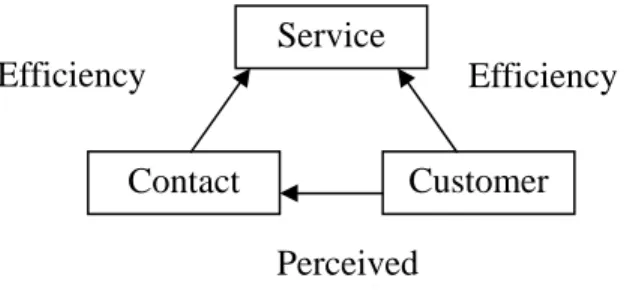
Active participation of the customer in the service production process is one distinctive feature of services. The service encounter means that a moment of truth occurs during every customer-employee interaction. The services encounter triad catches the relationships among in the service which three parties involved and shows possible source of conflict (as shown in Fig. 1). In order to control service delivery, the contact personnel fallow normal rules and procedures, which are made by service providers, to restrict contact personnel’s autonomy and judgment while serving customers. However, customers could feel unsatisfied because of the restriction in service encounter. Eventually, the customer and contact personnel are in the interactive relationship.
Figure 1. The service encounter triad
Source: M. R. Solomon, and C.F. Surprenant
Service Contact Customer Perceived l Efficiency Efficiency Customer Expectation
In the beginning of a service delivery process, customers are looking forward to their service encounter with eager anticipation; in other words, what customers expect to acquire from the service provider defines customer expectation. Moreover, expectations are viewed as desires or wants of customers, i.e., what they feel a service provider should offer more than what would offer. Owing to a standard of comparison in the expectations, customers could judge service providers’ performance (Parasuraman et al., 1988). In 1991, Parasuraman et al. proposed that understanding customer expectations of service played an important role for delivering superior service. Previous researches had presented that how customers assess the performance of a service provider was based on
the single level of expectation standard, which meant customer felt a service provider should offer. However, recent researchers kept evolving and extending the conceptual model of expectations, putting a lot of effort to pinpoint the critical element within customer expectations. These researchers offered multi-levels of customer expectations (Parasuraman et al., 1991; Zeithaml et al., 1993; Walker & Baker, 2000). According to their propositions, multiple standards would be more likely to completely understand the customer expectations of service.
Parasuraman et al. (1991) proposed that customer service expectations comprise two levels: desired and adequate. Desired expectations represented the level of service a customer hopes to receive, defined as the level at which the customer wanted the service to perform. It was a combination of what the customer believed “can be” and “should be,” while adequate expectations, a lower level of expectation, considered to be customer’s acceptable level of performance. It was relied on the customer’s assessment of what the service “will be” (Zeithaml et al., 1993). The latter was the basic expectation level for customers to determine the service performance, whereas the former expectation level, which was higher than adequate expectation, could attract the customers, i.e., customers might be surprised and overwhelmed while the service providers were reaching or exceeding customer expectations. These actions directly made the customers tend to think the performance better and be satisfied with the service. In addition, in each service delivery process, customer service expectations were dual-level and dynamic. The level of desired and adequate expectation could vary from customers to customers and, potentially, from one situation to the next for the same customer (Zeithaml et al., 1993). Those situations differed from various industry sectors might even cause different expectation levels, enlarging the complexity of customer expectation.
Antecedents of Zone of Tolerance
Zeithaml et al. (1993) noted that the zone of tolerance of a customer would be influenced by several complex and multiple factors within service encounters. In other words, the desired and adequate service levels could change spontaneously because customers have physical and mental vibrations about services. Accordingly, the zone of tolerance would become wide or narrow naturally.
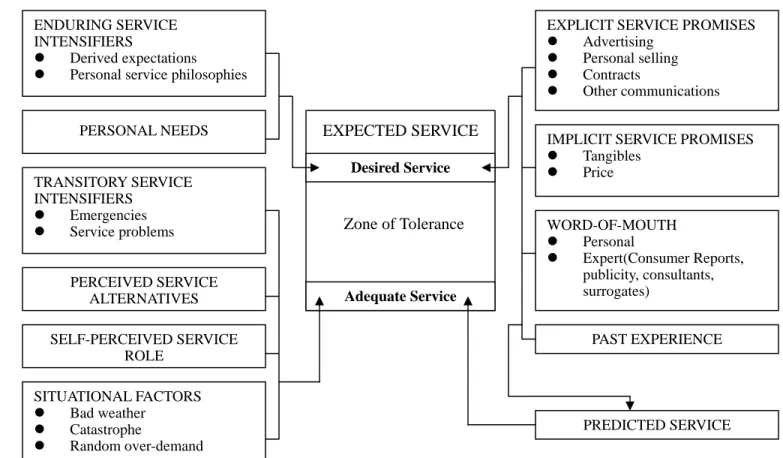
Zeithaml et al. (1993) proposed a comprehensive framework of service expectations and clarified customer expectations by eleven antecedent factors which could affect the desired service level and the adequate service level (as depicted in Figure 2). Zeithaml et al. (1993) addressed that desired service expectations are determined by enduring service intensifiers and personal needs. Enduring service intensifiers are stable and individual factors that lead customers with a high sensitivity to be served. One factor of enduring
service intensifiers is the derived service expectations. For example, customers’ expectations will be affected and thus derived by other parities. Another factor is the customer’s personal service philosophy which is the customer’s attitude about what “perfect” service means and adaptable service during service encounters. Personal needs are conditions or states necessary to customers’ physical and psychological well-beings. For example, a patient with high social or dependency needs could have high expectations concerning assurance and professional capability for the hospital staff.
There are five factors about adequate service of the customer’s expectations: transitory service intensifiers, perceived service alternatives, customer self-perceived service role, situational factors and predicted service. Transitory service intensifiers are individual, provisional and short-range factors that lead customers with a high sensitivity to be served. For example, a patient could have higher expectations to care about responsiveness of the hospital staff when he is anguished in an emergency. Perceived service alternatives are the feelings of customers which they can acquire services from other provides. For example, if customers can choose alternative service provider or types of services, their levels of adequate service could get high determinately. Customer self-perceived service role are “the customers’ perceptions of the degree to which they themselves influence the level of service they receive.” Customers’ normative expectations are partially influenced by how well they believe that they are performing their own roles. Situational factors are service-performance contingencies in which customers are perceived to be beyond the control of the service provider. For example, when catastrophes happen, such as earthquakes or typhoons, customers would recognize that insurers are full of service demand. Customers would decrease their service expectations in this moment. The last factor that affects the level of adequate service expectations is predicted service. For example, when customers could know what service they acquire, their levels of adequate service would be changed by different qualities of services. There are two categories of information searching about product quality which are divided into external and internal searching factors. However, not only the desired service level but the predicted service would be affected by external and internal factors. The external factors include three types which are explicit service promises, implicit service promise and word-of-mouth communications. Explicit service promises, such as advertisements, personal selling or contracts, are communications about services which are made to customers by providers. Zeithaml et al. (1993) stated the influence of explicit service promises on service expectations based on the intangibility of services. The second factor is implicit service promises which “lead to inferences about what the service should and will be like.” The important elements of implicit service promises are
price and tangibles. For example, a customer wants to buy an insurance form several firms which have different charges. The customer may consider that firms with high prices must provide them perfect service in high quality. Word-of-mouth communication is another important factor which influences desired service level of customers’ expectations and predicted service. In addition, word-of-mouth is personal and non-personal statements which proffer customers what the service encounter will be. At last, the internal factor is past experience which refers to customers’ previous exposure to service encounters. For example, when a customer wants to buy insurance from insurance firms, he would cogitate and consider about the experiences of insurance services in the past to make a correct decision.
Figure 2. Nature and determinants of customer expectations of service
ENDURING SERVICE INTENSIFIERS
z Derived expectations z Personal service philosophies
PERSONAL NEEDS TRANSITORY SERVICE INTENSIFIERS z Emergencies z Service problems PERCEIVED SERVICE ALTERNATIVES SELF-PERCEIVED SERVICE ROLE SITUATIONAL FACTORS z Bad weather z Catastrophe z Random over-demand EXPECTED SERVICE Adequate Service Desired Service Zone of Tolerance PREDICTED SERVICE PAST EXPERIENCE WORD-OF-MOUTH z Personal z Expert(Consumer Reports, publicity, consultants, surrogates)
IMPLICIT SERVICE PROMISES z Tangibles
z Price
EXPLICIT SERVICE PROMISES z Advertising
z Personal selling z Contracts
This study intends to propose a framework to aid in the manipulation of customers’ expectations based on the antecedent factors of zone of tolerance, given the understanding that the nature and determinants of expectations of service is important. In addition, this study divides antecedent factors into three categories, which includes need, context and effort, according to the nature and distinction of factors. The need group contains factors of customers’ mental and physiological demands, such as personal needs etc. The context group is about factors happened extrinsically, such like situational factors etc. Moreover, the effort group means that customers would like to expend their money or energy on services (e.g. self-perceived service role). Basically our framework is constructed by above viewpoints.
Product Service System
A Product Service System (PSS) is the result of an innovation strategy that makes the business focus on selling a system of products and services to fulfill specific customer needs rather than only selling physical product. In other words, by adopting PSS, the company or alliance of companies could provide a more integrated solution to a customer demand, and produce a satisfactory utilitarian result, instead of simply conceiving, producing, and delivering material products. In this changing relation between company and client, the underlying assumption on the customer side was that, what they might achieve in product and service was the thing a user really wants. On the other hands, for the providers, PSS had to develop new relationships and formed partnership among the stakeholders of a value chain. Thus, focusing on a PSS rather than products led the company more progressive with moving toward a new way to interact with customers. Namely, the producers or the service providers could use this approach to stretch their interests further their usual boundaries of both product life cycle phases and connection with other products and services.
When the product life cycle phases and connection with other products and services were taken together, it would then result in an integrated solution for the customer. Product life cycle phases included pre-production, production, distribution, use and end-of-life, besides the life cycle framework was made up by the raw materials and energy suppliers, the producers, the retailers, the consumers/customers and the end-of-life managers. It is to say that, a PSS could be referred to as a Sustainable Product-Service System, only when it could actually support the current unsustainable trends in production and consumption to re-orient. The PSS approach was the beginning to achieve an integrated functional solution to meet client demands, and it moved away from phase based servicing and discrete resource optimization, to system resource optimization
which was utility based, the environmental benefits, because of the opportunities which arose from broadening the system to be optimized.
PSS was winning for the producers/providers, the users and the environment, and thus could be said as win-win solutions.
Three main business approaches to PSS could be seen as promising in terms of their win-win potential (systemic eco-efficiency) as below:
z Services providing added value to the product life cycle. That means a company provided additional services to guarantee functionality and durability of the product. z Services providing “final results” for customers. It was the producer maintains the ownership of the products and was paid by the client just for providing the agree results.
z Services providing “enabling platforms” for customers. It means a company offers access to enable clients to get the results they want.
CONCEPTUAL FRAMEWORK
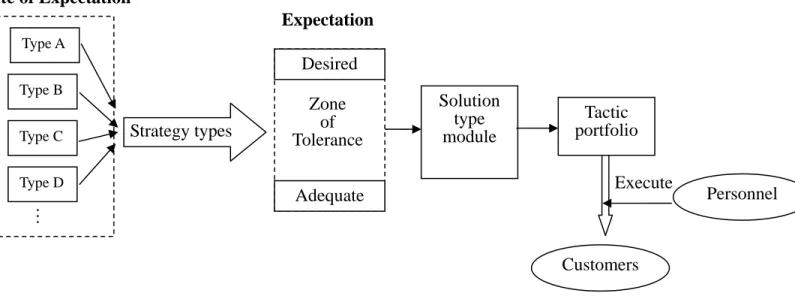
In this section we will illustrate our conceptual framework (as depicted in Figure 3) and show how the service providers can employ the framework to further the formulation of their service tactics.
As we mentioned earlier, the customers play an active participative role in the service production and delivery process. Based on the service encounter triad (James and Mona, 2006), there are interactions between the three parties - service organization (service provider), contact personnel and customer – in the service encounter. This framework is then described in terms of the three phases:
z Phase 1: Firstly, a service provider has to classify their objectives into a strategy type. According to different strategy types, such like selling new product or recovery services, each type is associated with a kind of state of expectation. This sate of expectation would capture a promise that while customers are under this kind of expectation (through the organization’s expectation-factor manipulation), the manipulator could not only achieve the objectives but have customer satisfied. For example, when a secondary service provider promotes a new product, their customers’ expectations may be too low, such as the lower adequate service level of customers, to expect a perfect and multi-functional product or service. However, if customers suffer a failure service in service encounters, their expectations should become high for the better recovery service from the service provider. In summary, service providers have to apply different strategy types to achieve customers’ expectations based on different service conditions.
z Phase 2: After completing the stage of state-of-expectation classification, the solution type module, which is a knowledge-based database with three influences (e.g. need, context and effort), is to compile factors that affect customers’ expectations in terms of Zeithaml et al. (1993). The service organization then indicates the factors required to be operated on expectations and how expectations would be effected to pick up directions for forming the service tactics. However, there is no need to employ every direction recommended. The service organization could just assemble some of them into a particular portfolio (i.e., a service tactic) in response to each individual customer. Briefly, a service tactic is an operational way to affect customers’ expectations of service providers. In order to manipulate customers’ expectations availably, combining helpful tactics to form a portfolio is essential and spontaneous.
State of Expectation Execute Solution type module Tactic portfolio Personnel Customers Strategy types Type A Type B Type C Type D … Desired Adequate Zone of Tolerance Expectation
Figure 3. The analysis framework
z Phase 3: The service tactics are accordingly executed by personnel or customers themselves.
In next section we will conduct two interesting scenarios to manifest the utility of our framework. The first scenario is stated based on services providers’ viewpoint. Another is performed by customers’ viewpoint.
Scenario A
This scenario assumes that a bicycle company wants to sell a new product within multi-function. The company’s employees on sales spot would tell a customer about the features of the bicycle, such as ridding on steep roads. However, the customer might feel doubtful about whether this product could match his/her needs and the truthfulness of the bicycle functions as the company has asserted. Because the customer is not familiar with
the product/service quality of the bicycle, the perceived risk of the bicycle might be in a high level. Nevertheless, the low perceived risk sometimes might also reduce the customer’s expectations. Hence, according to the above statement, the initial desired service level and adequate service level of customer expectation could be low. Our goal is manipulate customers’ expectations, such as raising the desired service level and adequate service level, in order to raise their expectations to purchase the bicycle.
Based on the framework we mentioned earlier, the company could have the following operational strategies in order to reach the goal:
z Explicit service promises
The company can post advertisement on the popular portal websites, such like yahoo or Google, which have good selling skills in interacting with customer to raise the desired service level and adequate service level.
z Word-of-mouth
The company can build their customer relationship management system to continue to interact with their customers and build the good reputation of the company for their original customers. The desired service level and adequate service level would then be raised accordingly.
z Past experience
The company can set up an experience room to provide their customers with pre-purchase service experience. Hence, company could implement the virtual reality on the experience room to simulate within the real situation and providers can customize what customers want in real situations. The desired service level and adequate service level can then be raised.
z Perceived service alternatives
New bicycles can be augmented with different functions suggested by customers in order for the company to provide customization solutions for customers. Naturally the adequate service level will be raised.
z Self-perceived service role
Customers could know how to ride the bicycle suitably and how to perform their roles in the experience. If they perform well in the experience room, the adequate service level will be raised.
In conclusion, the company can manipulate customers’ expectations through some strategies which utilize the influencing factors according to our framework. Zeithaml et al. (1993) noted that the desired service level is less subject to change than the adequate service level, and then the zone of tolerance will be narrower.
Scenario B
I took my wife, daughter and her friend to expend this past weekend in Taipei City. We stayed at the ABC Inn based on the recommendation of a fellow group member. It was a good choice. The hotel was comfortable, immaculate and I was impressed with service we received throughout the weekend. The entire staffs from housekeepers to front desk to shuttle drivers were warm and friendly. We were constantly greeted with a smile and a greeting. Every question was promptly answered and the service was perfectly efficient. On Sunday we took the hotel shuttle to the main train station to catch the train into the northern part of Taiwan. The sun was unbearable and in the heat of the afternoon we returned to the hotel. I called the hotel when we were almost reaching to the train station and was assured that the shuttle would be dispatched to pick us up. Then we waited and waited and waited under the heat for almost 30 minutes. At this recovery service moment, both my desired and adequate expectation levels were higher than the first-time service. Because of the situational factors of context, especially for my adequate expectation level, the position of the zone of tolerance was reduced.
I placed another call to the hotel and calmly stated that I had called earlier and was checking on the status of the shuttle. I was placed on hold for about a minute and the woman returned to the line. She handled it just as I coach people to do it. She quickly and sincerely apologized and stated that the driver was leaving immediately and would be at the station in less than five minutes. Sure enough, the shuttle was dispatched with the information system and arrived promptly. When the doors to the shuttle opened, the driver, contact personnel, greeted us with a smile and another prompt apology. "I know you've been standing out here in the heat, so I brought you some ice cold water." With that, he handed each of us a bottle of water. He then added, "I'll get you right back to the hotel!" Owing to the hotel policy, which is to fulfill every customer’s personal need and not offend his anticipation, the driver by doing that with gentle and soft voice in order to decrease desire expectation level.
This was a classic example of service recovery, which is a strategy type that providers may confront, when service provider dropped the ball: apologize ("I care") and resolve the issue ("the shuttle is leaving immediately"). Based on the framework of this study, the solution type module would indicate key factors (e.g. apology and problems resolving) to confirm what service providers should do. At last the tactic portfolio is conducted as following statement: the staff at the ABC Inn did it one better by anticipating that customers were hot (physically and emotionally) and thirsty and brought something to cool off both customers bodies and our tempers.
DISCUSSION AND CONCLUSION
In this paper, we first give an overview about the service encounter and customer expectations research. After a critical analysis of the nature and determinants of customer expectations model, we propos a conceptual framework to describe what and how providers could manipulate their customers’ expectations by two interesting and logical scenarios about the product-based services. Based on these antecedents, which Zeithaml et al. developed, we comprehend what factors would particularly affect the desired service level and the adequate service level of customer expectations.
However, there are several limitations associated with this paper. First, in order to achieve the satisfaction of customers, service providers should augment or narrow the zone of tolerance substantially depending on different service strategies. Although our research framework is extremely digestible and serviceable, how to categorize service providers’ strategy types based on the domination of customer expectations is an uncertain problem up to now. For example, what marketing or selling strategies service providers need to increase or decrease customers’ expectations is an important issue, nevertheless, literatures are insufficient for us to bind. Second, our research just pays attention to antecedent factors of the zone of tolerance rather than other influences. According to Zeithaml et al (1993), our research mainly tries to find out what and how service providers control their customers’ expectations.
In conclusion, this preliminary study provides some ponderable insights and recommendations of customer expectations. Researchers can adopt this framework briskly to build the decision support systems for making service strategies in the future. More research is needed at the zone of tolerance to determine what sizes of the zone should be in terms of different service stages. Furthermore, simulation studies which are adaptable for the complicated problem may be conducted on the basis of this framework.
REFERENCES
Bitner, M.J., Booms, B.H. & Tetreault, M.S. 1990. The service encounter: diagnosing favorable and unfavorable incidents. Journal of Marketing, 54(1), 71-84.
Czepiel, J.A., Solomon, M.R., Surprenant, C.F. & Gutman, E.G. 1985. Service encounters:an overview. Chapter1 in Czepiel, J.A., Solomon, M.R. and Surprenant, C.F. (Eds). The Service Encounter, Lexington Books, Lexington, MA, 3-15.
Hill, D.J. 1986. Satisfaction and consumer services. Advances in Consumer Research, 13, 311-5.
James L. Walker. 1995. Service encounter satisfaction: conceptualized. Journal of service