IEEE TRANSACTIONS ON MAGNETICS, VOL. 44, NO. 11, NOVEMBER 2008 2655
Transport of Carbon Nanotubes Coupled to Ferromagnetic Electrodes
Shih-Jye Sun
Department of Applied Physics, National University of Kaohsiung, Kaohsiung 811, Taiwan
We calculate the magnetoresistance of the single-walled carbon nanotube biasing by using ferromagnetic electrodes in different align-ments of magnetic polarization. In large polarization of the ferromagnetic electrodes, the magnetoresistance is significant and easily reaches saturation at small bias, which suggests spintronic devices are possible by using carbon nanotubes.
Index Terms—Ballistics, magnetoresistance, spintronics.
I. INTRODUCTION
S
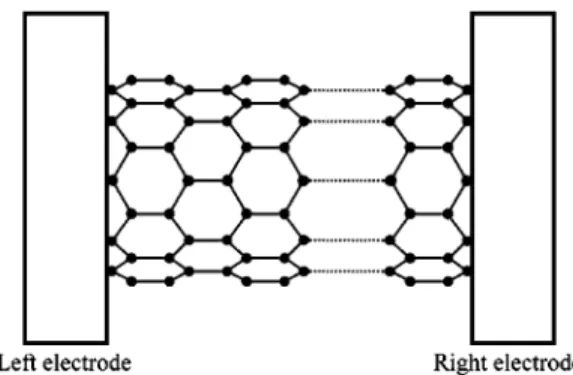
INCE their discovery in 1991 [1], carbon nanotubes (CNs) have attracted much attention in their intrinsic properties and potential applications in electronics. Some of the useful ap-plications of CNs are in electronic devices, owing to the fact that their scattering lengths are longer than conventional semi-conductors. CNs are appropriate for a broad range of potential applications [2]–[4]. Particularly, transport in individual single-walled carbon nanotubes (SWNTs) has attracted much interest in recent years [5], [6]; numerous simulation-based studies have examined the potential to exploit the unique nanometer-scale and electronic properties of SWNTs to develop nanoscale elec-tronic devices. In elecelec-tronic devices, SWNTs can be regarded as one-dimensional “quantum wires,” which may be either semi-conducting or metallic, depending on their chiral vector [7]. Many researchers have also investigated spintronics [8]–[11] for CNs, in which the degree of freedom of spin alters the elec-tronic properties [12], [13]. One feasible application of spin-tronic devices composed of CNs is based on the observations of magnetoresistance in ferromagnetically contacted multiwalled CNs (MWNTs) [14] and SWNTs [15], [16]. Compared with both CNTs, SWNTs have many advantages over MWNTs for spin transport studies owing to their well understood band struc-ture, long scattering and spin coherent lengths, and pronounced Coulomb interaction.In this study, ferromagnetic electrodes of the same material are connected to both sides of the SWNT, as displayed in Fig. 1, with the magnetoresistance caused by the difference between the currents in parallel and antiparallel configurations of both ferromagnetic electrodes. As has been verified experimentally [17], [18], SWNTs with nanoscale length will have ballistic transport and the spin coherent length should exceed the tube length. In addition, we ignore the spin flip and contact barrier existing on the contacted interface. In reality, the maintenance of spin polarization is difficult to hold as the polarized electrons pass through the interface.
II. THEORY
In the present work, a zigzag SWNT with chiral vector is considered, where is an integral. Based on the periodicity in its circular-direction, defined by direction, the
Digital Object Identifier 10.1109/TMAG.2008.2003035
Fig. 1. Schematic illustration of a zigzag CN connected by two magnetic elec-trodes.
SWNT can be considered to be a one-dimensional wire with N sites along the length. The N sites follow the relation,
, where is the number of honeycomb unit cells in the length. The Fourier transformation of the periodicity gives rise to discrete wave vectors,
, existing in the SWNT. The Hamiltonian description for the magnetically contacted SWNT is
(1) where and represent second quantization operators for elec-trons in magnetic electrodes and the SWNT, respectively; the in the first term represents the spin dependence of the kinetic energy of electrons in the left and right magnetic elec-trodes, which are indexed by and , respectively; the in the second term represents the atomic orbital energy level for each carbon atom in the SWNT; the third term represents the kinetic energy of the transport electrons in the SWNT with the site de-pendent hopping integral , and
, as and , as , where
0018-9464/$25.00 © 2008 IEEE
2656 IEEE TRANSACTIONS ON MAGNETICS, VOL. 44, NO. 11, NOVEMBER 2008
is the lattice constant; the last two terms represent the coupling interaction of the SWNT with the left and right electrode-con-tacted atoms by means of the coupling constants, and , respectively.
The current formula derived from the Green’s function method [19] with bias is
(2) where is the left (right) magnetic lead spectral function, is the Fermi–Dirac distribution function in the left (right) lead, and is the retarded Green’s function. The current formula of (2) requires that we calculate the retarded Green’s
function, , which
con-structs the relation with self-energy, , and bare Green’s
func-tion, , by , where is the step
function. Employing the equation of motion to Green’s function leads to an equation
(3)
where is (1) except the first and second terms, from which the self-energy has dimensions, represented by
. .. ... ...
(4) where the spin-dependent spectral functions, , is proportional to the density of states of the magnetic
electrodes, , in the relation of
. Introducing the polarization ratio, , to the spin-dependent spectral function in the wide band limit for metallic electrodes
gives rise to the relationships, , and
, where and is the bandwidth of the electrode [20].
III. RESULTS ANDDISCUSSION
In order to guarantee the transport is ballistic in our sample, the number of honeycomb unit cells in the length, , is limited to 5 and the energy variables of the Hamiltonian (1) used in our calculations in the unit of are
, and the electrode’s bandwidth is . In addition, all results are calculated for room temperature.
In the ballistic transport of SWNT, the MR depends entirely on the density of states of the magnetic electrodes. Both side
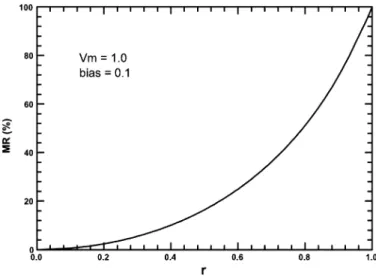
Fig. 2. The MR, defined byMR = (I 0 I )=I , where I and I are cur-rents with both ferromagnetic electrodes composed in parallel and antiparallel configurations, increases with the increase of polarization,r.
contacted magnetic electrodes should be of the same material. The magnetic polarization is dominated by majority electrons in the ferromagnetic electrode, but the minority electrons rep-resenting the opposite spin lead to different density of states in electronic bands for different spins. Therefore, the tunneling current in the ballistic transport includes two channels for spin up and spin down electrons. Because the spin coherent length is also very long in the SWNT the spin-flip process is inhibited. Fig. 2 shows the MR for various polarization ratios, , at small
bias. The MR is defined by [21], where
and are currents with both ferromagnetic electrodes com-posed in parallel and antiparallel configurations, respectively. The MR becomes significantly large when is large enough, which suggests that the half metal is the best choice for the ferromagnetic electrode. In parallel configuration, the up-spin electrons are injected from the majority band of the left elec-trode toward the same majority band of the right elecelec-trode, and similarly the down-spin electrons are injected in the minority channel. On the contrary, in the antiparallel configuration, the up-spin electrons are injected from the majority band of the left electrode toward the minority band of the right electrode, and in-versely so for the down-spin channel. Obviously, the is larger than .
Fig. 3 represents the MR increasing promptly with the in-crease of the bias at small bias region, and MR rapidly reaching its saturation as the bias increases. Furthermore, an obvious os-cillation in MR is observed only at large . This osos-cillation comes from the band structure in very short SWNTs, and will diminish as the length is extended. This behavior of fast satura-tion achievement in the SWNT makes it particularly applicable in spintronic devices.
In conclusion, the nanoscale ferromagnetically-contacted SWNTs transport ballistically and exhibit significant magne-toresistance at ferromagnetic electrodes with a large polariza-tion ratio. The magnetoresistance increases promptly with the increase of the bias at small bias region, and reaches saturation as the bias increases.
SUN: TRANSPORT OF CARBON NANOTUBES COUPLED TO FERROMAGNETIC ELECTRODES 2657
Fig. 3. The MR increases promptly with the increase of the bias at small bias region, and the MR rapidly reaches its saturation as the bias increases.
ACKNOWLEDGMENT
This work was supported by the National Science Council in Taiwan through Grants NSC-95-2112-M-390-002-MY3 and 96-2120-M-006-001. The hospitality of the National Center for Theoretical Sciences, Taiwan, where the work was initiated, is greatly acknowledged.
REFERENCES [1] S. Iijima, Nature, vol. 354, p. 56, 1991.
[2] A. Bachtold, P. Hadley, T. Nakanishi, and C. Dekker, Science, vol. 294, p. 1317, 2001.
[3] V. Derycke, R. Martel, J. Appenzeller, and P. Avouris, Nano Lett., vol. 1, p. 453, 2001.
[4] S. J. Wind, J. Appenzeller, R. Martel, V. Derycke, and P. Avouris, Appl.
Phys. Lett., vol. 80, p. 3817, 2002.
[5] Y. Xue and M. A. Ratner, Nanotechnol., vol. 16, p. 5, 2005. [6] S. Dag, O. Gulseren, S. Ciraci, and T. Yildirim, Appl. Phys. Lett., vol.
83, p. 3180, 2003.
[7] R. Saito, G. Dresselhaus, and M. S. Dresselhaus, Physical Properties
of Carbon Nanotubes. London, U.K.: Imperial College Press, 1998. [8] S. Datta and B. Das, Appl. Phys. Lett., vol. 57, p. 665, 1990. [9] B. W. Alphenaar, K. Tsukagoshi, and H. Ago, Physica E, vol. 6, p. 848,
2000.
[10] E. G. Emberly and G. Kirczenow, Chem. Phys., vol. 281, p. 311, 2002. [11] H. Mehrez, J. Taylor, H. Guo, J. Wang, and C. Roland, Phys. Rev. Lett.,
vol. 84, p. 2682, 2000.
[12] S. A. Wolf, D. D. Awschalom, R. A. Buhrman, J. M. Daughton, S. von Molnar, M. L. Roukes, A. Y. Chtchelkanova, and D. M. Treger,
Science, vol. 249, p. 1488, 2001.
[13] M. N. Baibich, J. M. Broto, A. Fert, F. Nguyen Van Dau, F. Petroff, P. Etienne, G. Creuzet, A. Friederich, and J. Chazelas, Phys. Rev. Lett., vol. 61, p. 2472, 1988.
[14] K. Tsukagoshi, B. W. Alphenaar, and H. Ago, Nature, vol. 401, p. 572, 1999.
[15] B. Nagabhirava, T. Bansai, G. U. Sumanasekera, B. W. Alphenaar, and L. Liu, Appl. Phys. Lett., vol. 88, p. 023503, 2006.
[16] A. Jensen, J. R. Hauptmann, J. Nygard, and P. E. Lindelof, Phys. Rev.
B, vol. 72, p. 035419, 2005.
[17] C. Schönenberger et al., Appl. Phys. A, vol. 69, p. 283, 1999. [18] S. Frank et al., Science, vol. 280, p. 1744, 1998.
[19] H. Haug and A.-P. Jauho, Quantum Kinetics in Transport and Optics
of Semiconductors. New York: Springer-Verlag, 1998.
[20] H. Bruus and K. Flensberg, Many-Body Quantum Theory in Condensed
Matter Physics. London, U.K.: Oxford Univ. Press, 2004, ch. 9. [21] S. Krompiewski, Acta Phys. Pol. A, vol. 113, p. 521, 2008.
Manuscript received February 25, 2008. Current version published December 17, 2008. Corresponding author: S.-J. Sun (e-mail: [email protected]).