CSI
ICT
NSC 99-2410-H-390 -028
99
8
1
100
7
31
Abstract
The research project compares the cognitive style of field independence/dependence (FI, FD) on the behavior of obtaining knowledge from online learning system. The process of obtaining knowledge is considered with respect to the involvement of knowledge provider’s and receiver’s cognition characteristics. The experiment is conducted where two groups with FI for one and FD for another are arranged. Knowledge objects developed for the experiment are WiMax. Data analysis results indicate that (1) It is found that FI group spends more time on the designed knowledge object (KO) than FD does. For non-designed KO, contrarily, the FD group has more time spent than FI group. (2) FI style is more likely to acquire knowledge from internal sources while FD prefers external where they can perform social interactions as the primary means to acquire knowledge. (3) FI group is likely monotonous to stick firmly with common or preferred passive knowledge resources; on the other hand, the transfer process of FD group seems to be more varied, and often passing through in-between several different knowledge sources. Discussion and implications are also addressed.
Keywords: Cognitive system, Cognitive style, Learning behavior, Field independence, Field dependence
Background
Obtaining knowledge is one of the most important issues of knowledge sharing that needs a multi-dimensional perception in its process. With the advance of information and communication technology (ICT), the obtaining channels become multiple and flexible. Generally, the process of the knowledge development occurs through such ways as personal interaction, publication, and the exchange of assets and services. However, conveniently receiving knowledge does not ensure a successful knowledge development. This is mainly because the ability to easily acquire knowledge is only one of the important obtaining knowledge tasks. This can be seen in the models by [1], including systemizing BA and exercising BA. In these BAs, the members can activate the sharing or exchange of knowledge to activate the process of tacit knowledge development. In addition, they also emphasize the IT’s importance to obtaining knowledge yet again.
Apparently, in support of the transfer process, studies have indicated that the obtaining knowledge process can be influenced by the knowledge contents and technology used, For example, O’Dell & Grayson [2] argue that intelligent agent software is an innovative technology used for obtaining knowledge. In this regard, Szulanski [3]
indicates that the analysis of obtaining knowledge should place an emphasis on the process, rather than on the act. Moreover, Garavelli et al. [4] indicate that obtaining knowledge is basically a cognitive process which creates a continuous system that derives the knowledge flow from its sender to the recipient. This process greatly depends on the provider’s cognitive system (or characteristics) and the method by which knowledge is transferred since these will have some influence on knowledge compilation and explanation. If look at the transfer process in more depth, it is found that knowledge can be divided into a set of episodes and therefore obtaining knowledge is a natural result of continuous flows that episodes move from the source to the recipient [5][6].
In fact, this process starts at the time that knowledge provider makes use of his/her expression media that is available to reveal the knowledge in succession. He or she conveys it to the recipient and thereby achieves the purpose of transfer. On the other hand, the recipient begins to structure and relate the received episodes and repeatedly reorganizes the knowledge structure until the end of transition to perform obtaining knowledge. However, this process does not necessarily indicate whether the knowledge provider’s episode accords with logic, but that it should be describable with any form of media (e.g. a word, a sentence, a gesture, a body language and can be structured by the recipient [7][8]. Obviously, the characteristics of cognitive style may have impact on the transfer performance.
Harem et al. [9] indicate that the knowledge receiver is also capable of obtaining knowledge similar to the kind of cognition that the knowledge provider possesses. This cognitive process can be further divided into two stages, which are called compilation and interpretation. Compilation is the upper layer in the obtaining knowledge process that refers to the externalization of tacit into an explicit knowledge [1]. This is also a method that expresses knowledge in the form of codes which could hold natural languages or a combination of media, and its end result is a knowledge object. Moreover, Albino [10] suggests that obtaining knowledge be defined into two parts or systems, which are the information and interpretation systems. Accordingly, obtaining knowledge is a communication process and activity where information is handled and its carriers can transfer knowledge to a person through suitable media.
In this concept, all the transferred information (regarded as knowledge object) is not considered knowledge yet unless it passes through the receiver’s explanation system that structures the knowledge objects into the whole knowledge body. Although knowledge that belongs to an individual is difficult to be transferred, compilation is usually compulsory and can pass through different motivators in order to realize its goals. Moreover, compilation inevitably reflects the compiler’s cognitive system. In reality, when someone explains how a certain thing is done, he/she accepts being influenced by his/her own cognitive system.
On the other hand, interpretation is to deal with the high level insight flow pertaining to knowledge [4]. The focal point of this flow is to characterize an individual’s thinking behavior and the development of its mental representation. Garavelli et al. [4] also emphasize that interpretation does not belong among the most important obtaining knowledge steps. Instead, it is the construction of a mental representation that explains true implications [8] and is determined by the knowledge receiver’s cognitive system. During the process of obtaining knowledge, cognitive psychology, cognitive behavior, and mental model will reveal in the process of continuous knowledge object transition [11][12]. These will happen at the time the provider expresses and sends the knowledge objects and the recipient interprets and structures the received objects. Therefore, the obtaining knowledge process should not depend only on a user’s characteristics as such characteristics prompt a user’s interpretation. But, it should rely on the knowledge sent to a user from a source point and on how to structure knowledge in a particular form. Furthermore, the research findings by Kossowska [13] indicate that cognition’s effectiveness is disrupted by the influence of every information/knowledge provided, implying that cognition system is important while transferring knowledge. Among the ways widely used to differentiate cognitive style is the Witkin [12]’s field independence-dependence (FI/FD) by conducting the group embedded figures test (GEFT). The research project conducts an experiment to reveal the difference of obtaining knowledge behavior between FI and FD styles. It should be noticed that the tool planned to differentiate subjects with respect to their cognitive style is CSI (analytical and intuitive) by Allinson & Hayes [14]. However, due to the use permission problem, we changed to be the GEFT. Basically, the FI is similar to the analytical style while FD to the intuitive one. Research findings may be also helpful to the development of online learning system.
Method
Table 1 is the characteristics of the research framework with respect to our experiment. First, we selected 10 subjects as the knowledge providers who created knowledge objects in multi-media bases. These subjects are all familiar with the use of ICT. Using GEFT for FI/FD, we selected 2 subjects; one is FI style ann another FD style according to their test scores. Both subjects develop knowledge objects of WiMax (KO-FI and KO-FD). The created knowledge objects were then put onto the transfer platform that was built by using Moodel, (Modular Object-Oriented Dynamic Learning Environment, MoodleDocs, 2008).
Second, we selected 75 subjects as the knowledge receivers who are also familiar with using computer and internet. Again, we selected 20 subjects for each group based on the FI/FD test score. Each group was again divided into two sub-groups (10 subjects each) and asked to obtain knowledge from KO-FI and KO-FD for each sub-group. It took from 50 to 60 minutes to obtain knowledge. It is noticed that the focus of the current study is to compare the cognitive styles on the process of obtaining knowledge, rather than how good the subjects are trained. The process of obtaining knowledge is recorded by using the Adobe Captivate that helps recording duration of each click that subjects performed.
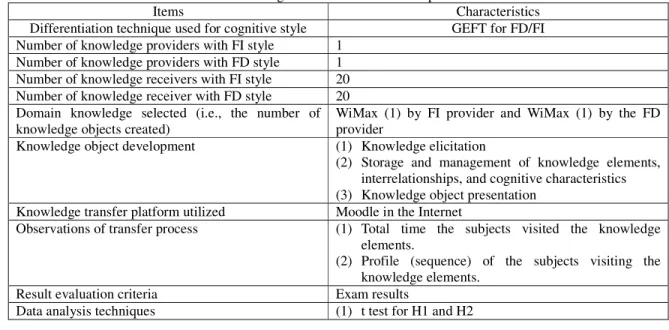
Table 1: Design characteristics of the experiment
Items Characteristics
Differentiation technique used for cognitive style GEFT for FD/FI Number of knowledge providers with FI style 1
Number of knowledge providers with FD style 1 Number of knowledge receivers with FI style 20 Number of knowledge receiver with FD style 20 Domain knowledge selected (i.e., the number of
knowledge objects created) WiMax (1) by FI provider and WiMax (1) by the FD provider Knowledge object development (1) Knowledge elicitation
(2) Storage and management of knowledge elements,
interrelationships, and cognitive characteristics
(3) Knowledge object presentation
Knowledge transfer platform utilized Moodle in the Internet
Observations of transfer process (1) Total time the subjects visited the knowledge
elements.
(2) Profile (sequence) of the subjects visiting the
knowledge elements.
Result evaluation criteria Exam results
3
(2) ANOVA for H3
(3) t test for H3 if (2) is significant
Experiment objective Examination and comparison of cognitive styles on knowledge transfer
Results and Discussions
GEFT and background knowledge test
The total number of subjects who participated as knowledge providers is 10. The examination result of GEFT for cognitive styles showed that the average score is 19.32. Of this, the top one was 23.76 while the bottom is 12.32, respectively. Therefore, they were selected as creating knowledge objects for KO-FI and KO-FD. A total of 75 knowledge receivers participated in this study. The test results were listed in the bottom of Table 2. No difference was found on the background knowledge of WiMax (t = 0.147, p = 0.884). The GEFT score for two groups showed significant difference (t = 20.32, p = 0.000).
Table 2: GEFT and background knowledge test result for receivers FI 20 (Male:9; Female: 11) Subjects
FD 20 (Male: 8; Female: 12) Average score for GEFT 15.87
Average score of background knowledge 37.63 Background knowledge of FI 37.85
Background knowledge of FD 37.40 t test: t = 0.147, p = 0.442
Average for the top 27% as FI group 25.20
Average for the bottom 27% as FD group 11.15 t test: t = 20.32, p = 0.000 Observations of process of obtaining knowledge
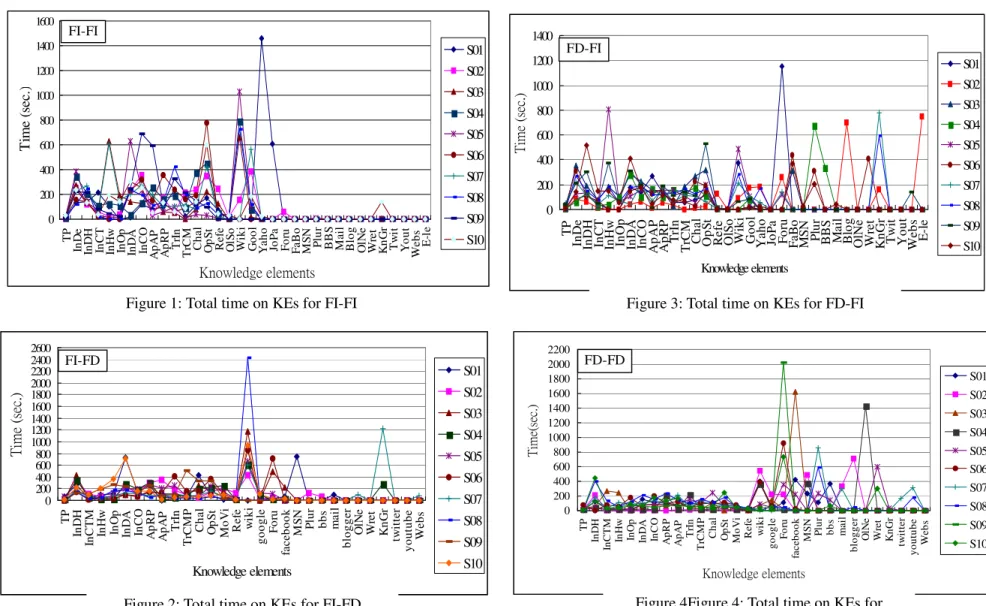
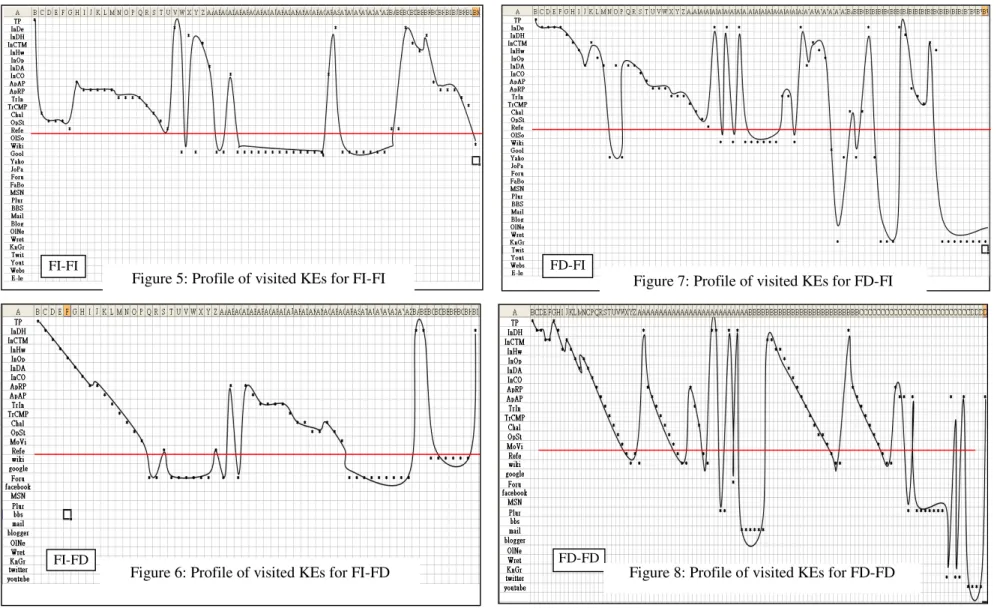
The knowledge obtaining process was recorded with respect to the time (in second unit) subjects spent on knowledge elements and the profile of the visited knowledge elements. Accumulated time for four groups (ten subjects each) is illustrated in Figure 1 (FI-FI), Figure 2 (FI-FD), Figure 3 (FD-FI), and Figure 4Figure 4 (FD-FD). In addition, we showed a profile of obtaining knowledge for each group in Figure 5 (FI-FI), Figure 6 (FI-FD), Figure 7 (FD-FI), and Figure 8 (FD-FD). There are implications.
(1) First, we summarize the time that subjects spent on both designed KO and non-designed KO knowledge resources (e.g., hyperlinked external knowledge resources). It is found that FI group spends more time on the designed KO than FD does (FI=43652.5 and FD=29638.1 sec.). For non-designed KO, contrarily, the FD group has more time spent than FI group (FI=19922.5 and FD=27836.4). The time that both groups spend although is not higher than internal knowledge resource, the external knowledge resource is also important to both groups (48.01%). This implies FI group is more likely to acquire knowledge from internal sources while FD one prefers external where they can perform social interactions as the primary means to acquire knowledge. This finding is consistent with the argument by Witkin et al. [12] that FD receivers are likely to obtain knowledge via social interaction. Our suggestion therefore is that the ICT-mediated obtaining knowledge system should consider the receiver’s cognitive characteristics by providing various knowledge resources and obtaining channels. Doing so may be helpful to avoid the intermediate termination of relation and reconstruction of knowledge episodic received. For FI style, sufficient contents in the system designed would be appreciated while environment for social interactions would be likely advantageous for FD one.
(2) In Figure 1, in addition to visiting the knowledge contents of the KO, the FI group likely stays longer in such passive knowledge resources as Wiki, Google, or Yahoo. This situation can be also seen in Figure 2. This is consistent with the argument by Witkin et al. [12] that FI people generally are internal-motivated. They are likely interested in non-social and abstract stimulus while obtaining knowledge. They are unlikely to interact with people and prefer static knowledge resources within which they can find their own way to relate, structure, and internalize the obtained knowledge.
(3) For the FD group, it is found in the Figure 3 and 5 that apart from browsing contents of the KO, the subjects spend much time on external knowledge resources, particularly on the interactive ones like forum, facebook, MSN, and knowledge group (in Figure 4Figure 4). In fact, the FD people are fairly active in any social environment [12], and therefore are influenced by social stimulus. In other words, they prefer the way of socialization to obtain knowledge that is integrated with their existing knowledge to structure a new knowledge body as a whole.
(4) For the profile of obtaining knowledge, in FI group (Figure 5 and 7) it is found that the subjects were mostly starting with the designed KO, then connected to hyperlinked external resources, and crossed between KO and hyperlinked external resources. Particularly, they immersed for much time in a single external passive knowledge
resources (e.g., Wiki, Google, and Forum). In FD group (Figure 7 and 9) the profile is similar to the FI group in the beginning of obtaining knowledge from the designed KO. However, the back and forth frequency in visiting the external knowledge resources is higher and some immersive phenomena happened in Wiki and knowledge group (in Figure 7) and Youtube (in Figure 8). Moreover, some of the FD subjects expressed that they had no “good” patience to go through in detail the contents of KO; and usually linked to Google talk to interact with their friends. This indicates that, on the one hand, FI group is likely monotonous to stick firmly with common or preferred passive knowledge resources; on the other hand, the transfer process of FD group seems to be more varied, and often passing through in-between several different knowledge sources. Generally, these two situations are likely consistent with their cognitive characteristics, as described above.
Conclusion
The importance of cognitive styles with respect to obtaining knowledge has been discussed. The social relevance of developing ICT-mediated knowledge sharing mechanism is increasingly important. As mentioned above, the obtaining knowledge is a multidimensional issue that needs to consider human behavior, technology, system science, and cognition science. The current research primarily focused on the capacity of the human cognitive process to experimentally observe the difference of FD/FI cognition styles in obtaining knowledge. Moreover, with the availability of techniques to differentiate cognitive style for both providers and receivers, the extension of the current study employing different techniques to group cognition styles may be helpful to generalize the research findings. Importantly, based on the steps of obtaining knowledge process, namely, externalization of knowledge provider and relation and reconstruction of knowledge receiver, one of the future research directions would be how to support externalizing knowledge for the cognition-styled providers and support relating and reconstructing knowledge for the cognition-styled receivers (e.g., knowledge representation techniques). This can be enhanced by developing an adaptable ICT-mediated obtaining knowledge platform for the behavior of obtaining knowledge. To provide an in-depth examination of its impact, an experiment with the synchronized interaction and collaboration may be necessary.
References
[1] I. Nonaka, N. Konno, The Concept of Ba: Building a Foundation for Knowledge Creation, California Management Review, 40(3), pp. 40-54, 1998
[2] C. O’Dell, C.J. Grayson Jr, If only we know what we know: The transfer of internal knowledge and best practice. New York: The Free Press, 1988.
[3] G. Szulanski, The process of obtaining knowledge: a diachronic analysis of stickiness. Organizational Behavior and Human Decision Processes 82(1), 9-27, 2000.
[4] C. Garavelli, M. Gorgoglione, B. Scozzi, Manage Obtaining knowledge by Knowledge technologies, Technovation, 22, pp. 269-279, 2002.
[5] L.S. Shih, Featuring information technology for obtaining knowledge, Unpublished Master Thesis, National University of Kaohsiung, 2008.
[6] C.H. Wu, S.C. Kao, L.H. Shih, Assessing the suitability of process and information technology in supporting tacit obtaining knowledge, Behavior and Information Technology, 29(5), 513-525, 2010.
[7] K.E. Weick, Sensemaking in organizations. Thousand Oaks, CA: Sage Publication, 1995.
[8] M.A, D’Eredita and C. Barreto, How does tacit knowledge proliferate? an episode-based perspective. Organization Studies 27, 1821-1841, 2006.
[9] T. Harem, G.V. Krogh, J. Roos, Knowledge-based strategic change, in Georg von Krogh & Johan Roos(ed.), Managing Knowledge-Perspectives on Cooperation and Competition, SAGE Publications, 1996.
[10] V. Albino, A. Garavelli, A. and G. Schiuma, Obtaining knowledge and Inter-firm Relationships in Industrial Districts : the Role of the Leader Firm, Technovation, 19, pp. 53-63, 1999.
[11] K.M. Goldstein, S. Blackman, Cognitive style: Field approaches and relevant research, New York: John Wiley & Sons, 1978.
[12]H.A. Witkin, D.R. Goodenough, Cognitive style: Essence and origins. New York: International University Press, Inc, 1981
[13] M. Kossowska, Motivation towards closure and cognitive processes: an individual difference approach. Personality & Individual Differences 43, 2149-2158, 2007.
[14] Allinson, C. W., & Hayes, J. (1996). The Cognitive Style Index: A measure of intuition-analysis for organizational research. Journal of management Studies, 33(1), 119-136.
Note: The research project has been published in the 2011 International Conference on Advances in Social Networks Analysis and Mining (Wu, CH, Kao, SC, Chang,JW, and Chen, KY (2011), “A comparison of cognitive styles on the behavior of obtaining knowledge: field independence vs. field dependence”, Proceedings on the 2011 International Conference on Advances in Social Networks Analysis and Mining, Kaohsiung, Taiwan, July, 25-27, pp. 403-404.)
0 200 400 600 800 1000 1200 1400 1600 1800 2000 2200 2400 2600 T P In D H In C T M In H w In O p In D A In C O A pR P A pA P T rI n T rC M P C ha l O pS t M oV i R ef e w ik i go og le Fo ru fa ce bo ok M SN Plur bbs mai l bl og ge r O lN e W re t K nG r tw it te r yo ut ub e W eb s Knowledge elements S01 S02 S03 S04 S05 S06 S07 S08 S09 S10 0 200 400 600 800 1000 1200 1400 1600 T P In D e In D H In C T In H w In O p In D A In C O A pA P A pR P T rI n T rC M C ha l O pS t R ef e O lS o W ik i G oo l Y ah o Jo Pa Fo ru Fa B o M SN Plur BB S M ai l B lo g O lN e W re t K nG r T w it Y ou t W eb s E -l e T im e (s ec .) S01 S02 S03 S04 S05 S06 S07 S08 S09 S10 0 200 400 600 800 1000 1200 1400 1600 1800 2000 2200 T P In D H In C T M In H w In O p In D A In C O A pR P A pA P T rI n T rC M P C ha l O pS t M oV i R ef e w ik i go og le Fo ru fa ce bo ok M SN Plur bbs mai l bl og ge r O lN e W re t K nG r tw it te r yo ut ub e W eb s S01 S02 S03 S04 S05 S06 S07 S08 S09 S10 FD-FD
Figure 4Figure 4: Total time on KEs for FD-FD
Figure 1: Total time on KEs for FI-FI
FI-FI
FI-FD
Figure 2: Total time on KEs for FI-FD
0 200 400 600 800 1000 1200 1400 TP In D e In D H In C T In H w In O p In D A In C O A pA P A pR P Tr In Tr C M C ha l O pS t R ef e O lS o W ik i G oo l Y ah o Jo Pa Fo ru Fa B o M SN Plur BBS Mail Blog O lN e W re t K nG r Tw it Y ou t W eb s E-le Knowledge elements S01 S02 S03 S04 S05 S06 S07 S08 S09 S10 FD-FI
6 FI-FI
FI-FD
FD-FI
Figure 5: Profile of visited KEs for FI-FI
Figure 6: Profile of visited KEs for FI-FD
Figure 7: Profile of visited KEs for FD-FI
FD-FD
2011 The International Conference on Organizational Innovation
Do 3G Mobile Phone Users Accept VIETMAP’s RTLBAS?
A Perspective of Ho Chi Minh City, Vietnam
Universiti Kebangsaan Malaysia (43600 UKM Bangi, Selangor Darul
Ehsan, Malaysia)
7/26~7/29
reception,
Dr. Anton de Waal
(Innovation in a small
island nation)
27
Does 3G Mobile Phone Users Accept
VIETMAP’s RTLBAS? A Perspective of Ho Chi Minh City, Vietnam
(
(ICT-based knowledge transfer)
29
8/1
1.
(
)
2.
9
2011 The International Conference on Organizational Innovation,
Bangi, Malaysia
Registration Form
Date : 2011, 5, 17
Job Title: Professor First name: Chien-Hsing Last name: Wu
Institution: National University of Kaohsiung
Department: Information Management Email: [email protected]
Mailing address: 700, Kaohsiung University Rd., Nanzih District, 811. Kaohsiung, Taiwan, R.O.C. City: Kaohsiung Postal/ Zip code: 811
Country: Taiwan Telephone: 886-7-5919509 Fax: 886-7-5919328
Paper Presentation (Alternative): Oral Posting Paper
No. Paper title Registration Fee (US$)
11R-070 Do 3G Mobile Phone Users Accept VIETMAP’s RTLBAS?
A Perspective of Ho Chi Minh City, Vietnam 300
---- --- ---
Payment Method
Telegraphic Transfer (T.T.)
• Account Name: Jasmine Publications • Account No : 0347-441-004199
• Bank Name: E.Sun Commercial Bank, Ltd., North Kaohsiung Branch • Bank Address: No.118 Ming-Cheng 2th Rd., San-Ming, Kaohsiung,
Taiwan. Postal /Zip Code 80794
• Swift Code: ESUNTWTP
Bank Money Transfer in Taiwan
Remark:
1. Once you complete the wiring instruction for the 2010ICOI registration fee, Please Email your wiring receipt to
[email protected] or [email protected] 2. For any problem, please contact on Dr. Charles Shieh 886-919136700
11
Do 3G Mobile Phone Users Accept VIETMAP’s RTLBAS?
A Perspective of Ho Chi Minh City, Vietnam
Chien-Hsing Wu
Department of Information Management, National University of Kaohsiung, Taiwan 700, Kaohsiung University Rd., Nanzih District, 811. Kaohsiung, Taiwan
Phone: 886-7-5919509; Fax: 886-7-5919328 Shu-Chen Kao
Department of Information Management
Kun Shan University of Technology, 949, Dawan Rd., Yung-Kung, Tainan, Taiwan Kuo-Din Yang
International Executive Master of Business Administration, National University of Kaohsiung, Taiwan
VIETMAP Vietmap Co., Ltd, a ch : 160 Tr n Bình Tr ng, Ph ng 3, Qu n 5, TP.H Chí Minh, Vi t Nam [email protected]
Ya-Fen Tseng
Department of Information Management,
Chung Hwa University of Medical Technology, 717, Tainan, Taiwan Tsung-Li Wang
Department of Digital Technology and Game Design, Shu-Te University, Kaohsiung, Taiwan
Abstract
With the development of advanced information and communication technology, the mobile value-added service of cell phone has attracted increasingly the users’ attention. The purpose of Real Time Location Based Advertising Service (RTLBAS) being developed by VIETMAP, a leading mapping company in Vietnam, is basically to use position technology to locate user’s spot and provide services. Upon the user’s position information, the advertising messages can be delivered by using the telecom system. The current research conducts an empirical study for the Ho Chi Minh City, Vietnam to examine the impacts of variables on the acceptance of RTLBAS. Based on the survey of 315 samples, the data analysis results indicate that (1) compatibility is the main concern that cell phone users are likely to use RTLBAS due to that customers are increasingly function-sensitive and function-compatible as the number of service types increases. (2) 3G cell phone users show that usefulness and ease of use are not the predicative factors to the behavior attitude. However, the perceived usefulness has significant impact on the behavior intention, implying that when users accept usefulness they will directly take action without a complex decision process (e.g., positive attitude). (3) The trialability has a significant impact on both behavior attitude and behavior intention. Because most subjects are not experienced in using RTLBAS related services, there seems an attempt to try it before they can actually use to reduce adoption risk, (3) the perceived playfulness is significantly and negatively related to the perceived ease of use, implying that special attention should be placed on the thought of users that more playfulness will lead to less ease of use, although not shows a significant impact on the behavioral attitude. Managerial implications are also addressed.
Keywords: Location based service, Technology acceptance model, Innovation diffusion theory Background
The "immediate action" is the common slogan for the marketing staff to improve service quality (e.g., quick response). The traditional way to advertise is to hang posters at the door or to publish in newspapers or magazines. The modern way is via Internet marketing that publishes the advertisement on website or sends e-mail directly to the potential customers. Both channels need a couple of days to process, without meeting the requirement of “advertising right now”. Consider a situation that “the boss of store picks up his cell phone, logons to a website, types the URL xxx.xxx.xxx.xxx, hyperlinks to the real time location-based advertising service (RTLBAS), types in text of ‘buy shirts get pants free, buy pants get clothes free, come in the cheapest clothing store XXX in the afternoon from 1:00 to 4:00; address xxxxxx”, and simply click OK.” The message is then sent directly to the cell phone users to complete the advertising need in time. From the perspective of delivering information instantly to customers, this seems quite a convenient way.
(www.vietmap.vn). It started on Oct-2005 with fields of business on digital maps making, GPS software and devices, location based solutions. In fact, the RTLBAS being introduced by VIETMAP is a mobile value-added service that combines location-based service (LBS) and Web geographic information system (Web GIS). It holds the functions of instance and location from LBS and message sending from Web GIS (Harder, 1998) and offers the capability of advertising anytime and anywhere. However, the VIETMAP conducted a preview of the acceptance of RTLBAS, such as Does this RTLBAS really work? what does customers think about it? Is there any thing that needs to be adjusted for this service? Based on the technology acceptance model (Davis, 1989), the current research conducts an empirical study for the 3G cell phone users in the Ho Chi Minh City, Vietnam to examine whether or not the customers accept this value-added service. The research findings would be a valuable reference for the helpful for the
VIETMAP to prepare for the RTLBAS before it can be introduced to the market. They are also helpful for advertisers,
store owners, and Telecom service providers to deliver this service to their customers. Literature Review
The General Statistic Office (GSO) (http://www.gso.gov.vn/), Vietnam, reported that the number of phone users has reached to 8.2 million in the year of 2009. This indicates that 97.5% has registered as phone users. Of which, 85.8% are cell phone users (TBIC, 2009). Kalaignanam et al. (2008) indicate that marketing efficiency gains can be enhanced via the context of the interactivity, personalization and addressability characteristics of the information and communication technology (ICT). In particular, the LBS has been in its developing stage due to the development of advanced, open of 3G telecommunication license, and the available of personal digital assistant, Smart phone, iPad, and iPhone. With the advanced ICT, The Telecom service providers argue that the LBS will be likely spreading to all kinds of mobile devices (Yadav and Varadarajan, 2005). The business will become even easier when marketers can catch their potential customers’ location. Among applications, for example, are GPS used in logistics and FCC (Federal commission of communications), USA, used to record locations when reporting emergence. Although the development of hardware and software do not totally meet the requirements of Law, it is believed that location system and location service will be playing an important role in the coming era of the digital value-added service.
The RTLBAS basically is designed and developed by using the ability of immediate information uploading. It combines the technology of location information service and immediate information sending that can provide a mobile value-added service for a specific time, location and area (Shih, 2004; Zhuo, 2006; Yang, 2010). To receive the message from RTLBAS, the cell phone first needs the capability of sending and receiving digital message which in fact is one of the embedded functions in the modern 3G mobile phone. Second, it has to be located by GPS and can send back its location information. Finally, the cell phone has to install the RTLBAS software. However, although it is simple to use this added-value service, compatibility of user behavior to accept (or even use) it may be critical. In other words, too much change with respect to habits of cell phone users may be a barrier to get acceptance of customers as well as business marketers.
There are a number of variables that affect the adoption willingness of innovative technology. Davis (1989) introduces the technology acceptance model (TAM), and to date the model has been widely used in examining use determinants of innovative technologies (e.g., Szajna, 1996; Chen et al., 2002; Yoon and Kim, 2007; Jan and Contreras, 2011). In addition, the experience of human-computer interaction generally remarks the playfulness (Moon and Kim, 2001). It has been regarded as a predictor of innovation technology use (Barnett, 1991). Moreover, Rogers (1983) introduces the innovation diffusion model to explain the behavior of technology use. There are five main factors including (1) comparative advantage, (2) compatibility, (3) complexity, (4) to try, and (5) observability. Particularly, the compatibility is the degree of match between innovation technology and the user’s cognition value, knowledge, past experiences, and current needs. Agarwal (2000) indicates that comparative advantage, compatibility, and complexity are most likely the determinants of innovative technology adoption. In fact, based on the design strategy of VIETMAP, the threshold to use the RTLBAS does not need too much time and effort. One thing that a cell phone user needs to do is to consider if it is compatible to his/her use behavior. In addition, according to Davis’s TAM (1989), usefulness and easy of use are two main factors. According to the VIETMAP experience, the research concern is that whether or not the compatibility is the major issue for the RTLBAS acceptance. It is quite understandable that people will take the thing if it is quite easy to have it and does not need too much effort to learn or even set up, before we think useful or ease of use. Therefore, the degree of compatibility of RTLBAS to the value-added innovation service will be more likely to increase the perceived usefulness and perceived ease of use, and the perceived playfulness as well (Lin & Lu, 2000; Moon & Kim, 2001)
Accordingly, in addition to the TAM, the current research adds the compatibility from the innovation diffusion theory as the independent variable that affects the use of RTLBAS (Chen et al., 2002; Lee, 2005; Zhuo, 2006).
Moreover, the purpose of RTLBAS is simple. It is just sending a message for a marketer and receiving the message for cell phone users. Its use is also easy (just turn on or off) (Yang, 2010). In some cases, it is also playful (e.g., unexpected surprise from the message senders) (Moon and Kim, 2001; Van der Heijden, 2003). Therefore, these features will be not only useful for users, but important to foster the perceived usefulness. The hypotheses are then proposed as follows. H1: Compatibility of RTLBAS is significantly related to perceived usefulness; H2: Compatibility of RTLBAS is significantly related to perceived ease of use; Compatibility of RTLBAS is significantly related to perceived playfulness; H4: Playfulness of RTLBAS is significantly related to the perceived
13
ease of use; H5: Perceived ease of use of RTLBAS is significantly related to perceived usefulness; H6: Perceived usefulness of RTLBAS is significantly related to behavioral attitude; H7: Perceived ease of use of RTLBAS is significantly related to behavioral attitude; H8: Perceived playfulness of RTLBAS is significantly related to behavioral attitude; H9: Triability of RTLBAS is significantly related to behavioral attitude; H10: Perceived usefulness of RTLBAS is significantly related to behavioral intention; H11: Behavioral attitude of RTLBAS is significantly related to behavioral intention; H12: Triability of RTLBAS is significantly related to behavioral intention.
Of which, the compatibility represents the degree of consistency between the innovative value-added service and the prior experience and needs. For example, the service and operation in RTLBAS likely matches the way I operate my cell phone. The usefulness is the degree that users think of the RTLBAS effective. For example, using RTLBAS makes my life easier. The ease of use represents the degree of simplicity that users operate the RTLBAS. For example, it is easy for me to operate the RTLBAS. The playfulness is the degree of happiness that users use the RTLBAS. For example, I am happy with the use of the RTLBAS. The triability is the degree of acceptance that the RTLBAS can be tried. For example, I think that the RTLBAS can be tried before adoption. For the dependent variables, the behavioral attitude is positive or negative concept that a user will be likely to adopt the RTLBAS. For example, it is a good idea to use the RTLBAS. Finally, the behavioral intention represents the strength of willingness that users adopt the RTLBAS. For example, I will be using the RTLBAS in the near future.
Method
Based on the hypotheses defined, the research model is formed as shown in Figure 1. The main independent variable is perceived compatibility. The dependent variables are perceived usefulness, perceived ease of use, and perceived playfulness. Another independent variable is triability. The dependents are behavioral attitude and behavioral intention.
A questionnaire was designed to collect data based on the variables defined. There were 26 items for independent and dependent variables to collect data. It was constructed by using a Likert 5-digit rating scale (from 1 to 5) using bi-polar descriptors for each question, where 1 represented “strongly disagree” while 5 “strongly agree”. The sample population was framed in the area of Ho Chi Minh City, Vietnam. Cell phone users whose phones had the function of GPS were the research targets. Due to a large number of subjects, we adopted convenient sampling plan. To effectively collect data, VIETMAP arranged 12 salespersons to perform interview for the need of both explaining the survey items and writing the questionnaire for subjects. They were familiar with the physical cell phone stores. Considering the return rate, the salespersons were assigned in various regions of Ho Chi Minh City. Finally, there were 420 subjects who were interviewed to provide answers of questionnaires, which were 10 times the measurement items. It should be noted that to increase the valid returned rate the salesperson would help explain the RTLBAS (e.g., the purpose of RTLBAS) and help fill up the questionnaire according to subjects’ opinions. Analysis Results
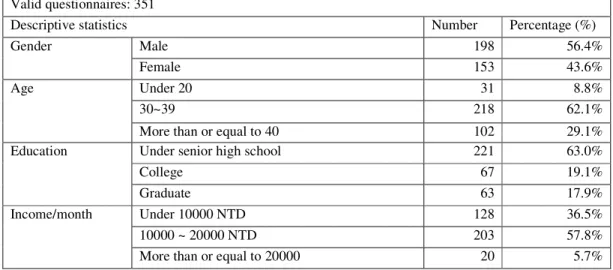
The number of valid returned questionnaires is 351 for a period of 3 weeks, indicating the 83.57% return rate. The descriptive statistics are summarized in Table 1. It is found that most subjects are above 30 years old and education level is under or equal to senior high school. The income per month is mostly under 20000 NTD.
Perceived compatibility Triability Perceived playfulness Perceived ease of use Perceived usefulness Behavioral attitude Behavioral intention H1 H2 H3 H4 H5 H7 H6 H8 H9 H10 H11 H12
Table 1: Descriptive statistics for samples Valid questionnaires: 351
Descriptive statistics Number Percentage (%)
Male 198 56.4% Gender Female 153 43.6% Under 20 31 8.8% 30~39 218 62.1% Age
More than or equal to 40 102 29.1%
Under senior high school 221 63.0%
College 67 19.1% Education Graduate 63 17.9% Under 10000 NTD 128 36.5% 10000 ~ 20000 NTD 203 57.8% Income/month
More than or equal to 20000 20 5.7%
With regard to the reliability, the study employed confirmatory factor analysis (CFA) to test the overall parameters of the conceptual model. The CFA result indicates that: 2 / df = 2.74, CFI = 0.96, NFI = 0.93, GFI = 0.87, RMSEA = 0.064, RMR = 0.079. Although the GFI and the RMSEA did not meet the best results, they are closed to an acceptable level. On this basis, we moved to the confirmation for validity. Details were listed in Table 2. The lowest value is 0.61 for BA. It indicates that Cronbach's for each variable is not unacceptable and the overall reliability is 0.91.
Table 2: Cronbach’s for the variables
Variables Cronbach’s Number of items
Perceived Compatibility (PC) 0.693 3
Perceived usefulness (PU) 0.828 5
Perceived ease of use (PEU) 0.832 4
Triability (TRY) 0.808 3
Perceived playfulness (PPY) 0.778 6
Behavioral attitude (BA) 0.610 2
Behabioral Intention (BI) 0.818 3
Overall 0.910 26
Moreover, to test the research model, we used the partial least-square, which contains two steps: model validity and predictability and significance of path coefficient. For the validity, we obtained results that satisfy four requirements: (1) item loading greater than 0.5; (2) composite reliability (CR) (Cronbach’s greater than 0.6; (3) average variance extracted (AVE) greater than 0.5; and (4) square root of AVE for a factor greater than the correlation coefficient of other factors. The correlation coefficient of factors with AVE validity is shown in Table 3. For example, the AVE of PC (0.707) in Table 3 is greater than 0.5, and its square root (0.841) is greater than correlation coefficient of other factors.
Table 3: Correlation coefficient of factors with AVE validity
Variables Mean Sd. PC PU PEU TRY PPY AT BI
PC 3.67 0.84 0.707 PU 4.00 0.77 0.536** 0.707 PEU 3.74 0.93 0.519** 0.491** 0.854 TRY 4.46 0.78 0.272** 0.293** 0.260** 0.707 PPY 3.83 0.72 0.535** 0.333** 0.295** 0.394** 0.714 BA 4.02 0.92 0.504** 0.366** 0.330** 0.401** 0.637** 0.721 BI 4.07 0.86 0.459** 0.278** 0.299** 0.360** 0.600** 0.601** 0.770 ** p<0.05; The number in the bold diagonal course is the square root of AVE.
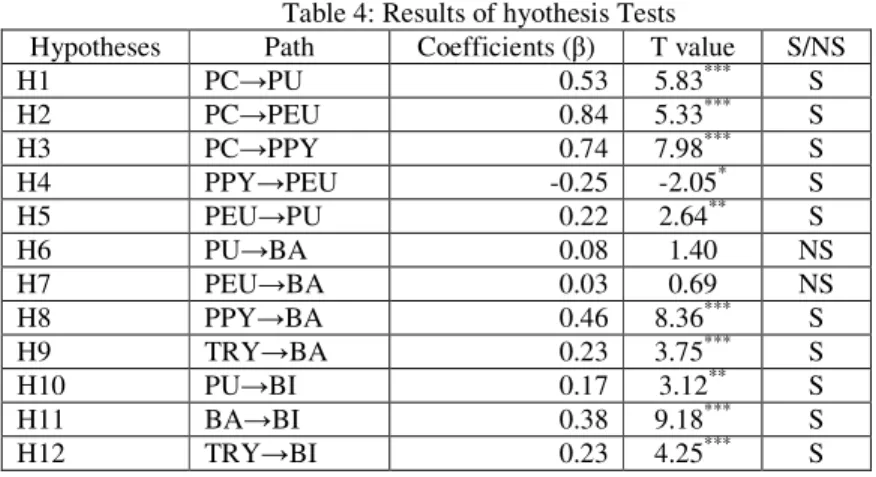
For the significance of path coefficient, we employed the structure equation model to derive the results, as shown in Table 4. We first used the re-sampled method of bootstrapping to test the significance of path by simulating 500 samples. The explained variance of the independent variables to the dependent variables was acceptable (between 0.481 and 0.563). Among the 12 hypotheses, 10 were supported. Particularly, the H4 that defines the
15
relationship between playfulness and ease of use is negative and significant. Discussion and implications are addressed below.
Table 4: Results of hyothesis Tests
Hypotheses Path Coefficients ( ) T value S/NS
H1 PC PU 0.53 5.83*** S H2 PC PEU 0.84 5.33*** S H3 PC PPY 0.74 7.98*** S H4 PPY PEU -0.25 -2.05* S H5 PEU PU 0.22 2.64** S H6 PU BA 0.08 1.40 NS H7 PEU BA 0.03 0.69 NS H8 PPY BA 0.46 8.36*** S H9 TRY BA 0.23 3.75*** S H10 PU BI 0.17 3.12** S H11 BA BI 0.38 9.18*** S H12 TRY BI 0.23 4.25*** S Discussion
The data analysis results illustrated in Table 4 disclose the acceptance of the 10 hypotheses and rejection of two. There are several implications. First, as we mentioned above, the purpose of the developed RTLBAS is simple. It is to send messages for a marketer and to receive the message for cell phone users. Perceived compatibility plays the key role that affects the usefulness, ease of use, and playfulness (H1, H2, H3). It implies that cell phone users are likely to accept the importance of compatibility prior to the usefulness and ease of use while adopting RTLBAS. This is according to the experience of VIETMAP that customers are increasingly function-sensitive and function-compatible as the number of service types in markets increases. Therefore, our suggestion from this finding is that the mobile value-added service provider of RTLBAS should first consider to design and develop this service function compatible to the operational ways the users behave.
Second, although the playfulness significantly influences the users’ behavioral attitude (H8) it at the same time negatively weakens the perception of ease of use (H4). This indicates that cell phone users are more likely to accept the playfulness toward the adoption attitude. On the one hand, however, this acceptance will be likely to decrease the ease of use (H4). On the other hand, since H7 does not show significant increasing playfulness will not be likely to influence the willingness of RTLBAS adoption. Therefore, we suggest that value-added service providers can increase the degree of playfulness of RTLBAS. Third, both H6 and H7 do not show a significant influence on the behavioral attitude while H10 shows supportive. This reveals that cell phone users are likely to accept directly the adoption intention of RTLBAS, without the need of the positive attitude. Most research in the literature suggests that innovative technology need to consider the usefulness and ease of use to ensure the positive acceptance attitude toward positive intention and actual use. However, our research finding does not follow this point; instead we argue that cell phone users will be likely to straightforwardly adopt the RTLBAS. The reasons could be that the purpose RTLBAS is fairly unique and simple. When more and more value-added services are brought onto the mobile cell phone, users are more likely to directly stimulate their intention to use without a significant transitive stage when the service is not too complex. Forth, the variable of triability shows a significant influence on both behavioral attitude and behavioral intention. This finding follows the usual situation that users are likely to try any innovative service to see how they feel.
Clearly, mobile value-added service adopters are becoming increasingly function-sensitive as the number of service types increases. These adopters are broadly making use of all services available for either their business or their daily life, particularly for information sharing. To enhance the willingness to adopt RTLBAS, we suggest that RTLBAS vendors or agents develop RTLBAS as compatible to the users’ behavior as well as the existing devices as possible, ensuring the RTLBAS meets the needs of users. The RTLBAS is in its developing stage and is not a complex technology. Adopters can easily adopt it once they decide to use it.
Conclusion
In this paper, we drew attention to the importance of real time location based system based on the perspective of information delivery. We also highlighted the potential determinants of the willingness to adopt RTLBAS, initiated the research hypotheses, and described the research model, sampling plan, and data analysis results and brief discussion as well. Factor analysis was used to reveal the factors, whereas structure path model was utilized to confirm the model fitness and test the defined hypotheses. Results show that compatibility is the main concern that cell phone users are likely to use RTLBAS. It has been seen that Internet and communication technology is
increasingly changing the way social networking, as an important marketing tool, is performed between marketers and consumers. From the real-world perspective, social networking is a requirement of social development because it makes connections through individuals; this involves such variables as social relationships and social trust (De Cindio et al., 2003; Spaulding, 2010). However, from the virtual world perspective, RTLBAS created for virtual social networking will be likely to become increasingly popular in cyberspace because they can overcome the obstacles of geography and time. Our research findings indicate that RTLBAS is likely being in the stage of a one-way information delivery mechanism by which value-added service providers can actively send instant messages to their customers to maintain their customer relationships. However, there are still many unknowns with regard to RTLBAS adoption willingness while virtually dealing with real-world activities in cyberspace, such as privacy. Practical investigation may be needed. Moreover, the current study focuses only on the cell phone users; opinions from marketers may need to be further explored.
References
Zhou, G.C. (2006), The development and trend of the mobile location service marketing, Market Intelligence & Consulting Institute, Institute for Information Industry (in Chinese).
Shih, S.Y. (2004), A study of mobile information service adoption for customers, Unpublished Master Thesis, Department of Business Administration, National University of Taipei (in Chinese).
Agarwal, R, & Karahnna, E. (2000), Time Files When You’re Having Fun: Cognitive Absorption and Beliefs About Information Technology Usage. MIS quarterly, 24(4), 665-694.
Barnett, L.A. (1991), The playful child: measurement of a disposition to play, Play and Culture, 4(1), 51-74.
Chen, L.D., Gillenson, M.L. and Sherell, D.L. (2002).Enticing online consumers: an extended technology acceptance perspective. Information & Management, 39(8) 705-719.
Davis, F. (1989), Perceived Usefulness, Perceived Ease of Use, and User Acceptance of Information Technology. MIS Quarterly, 13(3), 319-339.
De Cindio, F., Gentile, O., Grew, P. and Redolfi, D., (2003), Community networks: rules and behavior and social structure, The Information Society 19(5): 395-406.
FCC, (1996-2009), Enhanced 9-1-1 - Wireless Services,
http://www.fcc.gov/pshs/services/911-ervices/enhanced911/Welcome.html, Accessed date: March, 2010. Harder, C., (1998), Serving Maps on the Internet, Geographic Information on the World Wide Web, ESRI Press. Jan, U.A. and Contreras, V. (2011), Technology acceptance model for the use of information technology in
universities, Computers in Human Behavior 27, 845–851
Kalaignanam, K., Kushwaha T., and Varadarajan, P. (2008), Marketing operations efficiency and the Internet: An organizing framework, Journal of Business Research 61, 300–308.
Lin J.C.C. and Lu, H., (2000), Towards an understanding of the behavioral intention to use a web site , International Journal of Information Management, 20, 197-208.
Moon, J.W. and Kim, Y.G. (1999), Extending the TAM for a World-Wide-Web context, Information and Management, 38(4), 217-230.
Rogers E.M., (1995),Diffusion of Innovation (4th Ed.), New York: The Free Press of Glencoe .
Spaulding, T.J. (2010), “How can virtual communities create value for business?”, Electronic Commerce Research and Applications, 9(1), 38–49.
Szajna, B., (1996), Empirical evaluation of the revised technology acceptance model, Management Science, 42, 85-92.
TBIC, (2009), Millions of new phone users connect in January,
http://www.tbic.vn/english/19/tbic_details.aspx?DataID=13670, Accessed date: February, 2010. Van der Heijden, H. (2003), Factors influencing the usage of websites: The case of a generic portal in the
Netherlands, Information and Management, 40(6), 541-549.
Yadav, M.S. and Varadarajan R.P. (2005), Interactivity in the electronic marketplace: an exposition of the concept and implications for research. Journal of Academic Marketing Science, 33, 585–603.
Yang, K.D. (2010), A study of real time location based advertising service using technology acceptance model, unpublished Master Thesis, National University of Kaohsiung.
Yoon, C. and Kim, S. (2007), Convenience and TAM in a ubiquitous computing environment: The case of wireless LAN, Electronic Commerce Research and Applications 6, 102–112.