Network Improvement
Gwo-Hshiung
Tzeng
Sheng-Hshiung
Tsaur
In this paper we propose application of multiple criteria decision making to problems of a metropolitan network improvement plan. Initially, a bilevel multiple objective network design model is considered in two objectives which are minimal government budget and minimal total travel time of road users. We seek feasible improvement alternatives among those bottleneck links in an existing road network structure and travel demand. We present an effective heuristic algorithm to obtain noninferior solutions; then ELECTRE I11 multiple criteria decision making and group decision making are used to evaluate and to select a compromise solution among those noninferior solutions. From the design phase in multiple criteria decision making, multiple objective mathematical programming is used to formulate a continuous network design model. However, from the phase of evaluation, multiple criteria decision makiig to solve the discrete network design problem. The network of metropolitan Taipei is taken as an example to illustrate the operation of this model.
Keywords: Multiple criteria decision making, network design, group decision making.
Introduction
A network design problem
(NDP)
is a common decision making problem that arises in urban transportation planning to select improvements or additions to an existing network to decrease traffic congestion, pollution or other appropriate objectives. The network design problem, according to its characteristics, is classified into several types. If the link improvement variables are 0-1 integers or continuous variables, then either a discrete problem or a continuous problem can be Gwo-Hshiung Tzeng is at the Energy and Environmental Research Group and Institute of Traffic and Transportation, National Chiao Tung University in Taipei, Taiwan R.O.C. Sheng-Hshiung Tsaur is at the Department of Tourism, Chinese Culture University in Yang Ming Shan, Taipei, Taiwan, R.O.C.50 Gwo-Hshiung Reng and Sheng-Hshiung Tsaur
formulated. Chen and Alfa (1991) further divided the problems into three groups
-
(a) those with linear objective functions, (b) those with nonlinear objective functions and the solutions of which satisfy the system-optimal criterion, and (c) those with nonlinear objective functions of which the solutions satisfy the user-optimal equilibrium criterion.The network design problem is endowed with a linear objective function, and it is to minimize the sum of travel and investment costs, subject to all feasible link flow and all combinations of alternative improvement projects. A linear objective function indicates that the travel time on each link is a constant and does not vary with the link flow. With its objective function being linear, the system optimal problem and user-optimal equilibrium problem become identical. Although the assumption of linear cost can be a simplified solution, the outcome rendered is rather impractical as the purpose of network improvement is to decrease congestion.
The objective to solution for the network design problem of the second type is to minimize the sum of travel and investment costs, subject to the same constraints as those for problems in the first category. What differs is b a t the objective function is nonlinear, which shows that the travel time that the driver experiences on each link is a function of that link flow. The link flow rendered from the problem of the sort becomes the optimal flow of the whole system, rather than the flow of user-optimal equilibrium.
The network design problem of the third type encompasses a bilevel nonlinear objective function; its objective is to minimize the total cost and the link flow has to satisfy the condition of user-optimal equilibrium. As the flow of user-optimal equilibrium is a network structure, a problem of this kind is difficult to solve. Besides, the total user cost is not necessarily a decreasing function of decision variables (network improvements); thus, it explains the occurrence of Braess’s paradox (Murchland, 1970; LeBlanc, 1975). In theory, expanding the capacity of certain links might result in an increased total travel cost. Therefore, to work on the improvement of the network, a planner needs to predict the accumulated reaction of users in advance to avoid this situation.
Travel time cost was given and was considered as the sole objective in early transportation planning, and mathematical programming is made to find the optimal solution. To evaluate transportation planning, the multiobjective technique started to be used in the middle of 1960’s; then authors increasingly revealed their investigations of multiobjective design problems in a transportation
system is, therefore, confronted with varied needs from every aspect. As the investment in a transportation system is a sunk cost, it is natural that diversified evaluation should be taken on different points (needs) of view when network construction or improvement is to be achieved; ultimately the optimal project can then be selected.
The network design problem proposed in this paper has the following characteristics:
a.
b.
C. d.
Because most roads in the urban planning of Taiwan metropolis are already constructed, the intention to widen the entire car lanes to improve traffic conditions becomes rather impractical. Thus, what is discussed here is a continuous network design model.
In this paper we discuss issues of a nonlinear objective function; the improvements affect the equilibrium flow assignment (ie., the user-optimum rather than the system-optimum assignment).
The matrix of a trip demand is assumed to be fixed, not influenced by increased capacity.
A diversified evaluation considering different points (needs) of view is made to select projects.
Multiple Objective Equilibrium Network Design Problem
Most network design problems are conventionally formulated as a single objective problem for management. LeBlanc (1975) first used a branch-and-bound algorithm to solve the discrete network optimal design problem of a fixed investment budget. The single overall design objective is to minimize the total travel cost incurred by users, while the total budget serves
as
a constraint. Abdulaal and LeBlanc (1979) formulated a network design model with continuous decision variables. The budget constraint was put into the objective function after it had been converted into travel time unit. A fixed budget may exclude many potentially good designs that exceed the budget only slightly. If such a design is placed in budgetary constraints or is given with a parameter and then placed into the objective function after being converted into a time unit, it will be difficult for one to interpret the design as its parameter value is arbitrary. The number of objectives should be as large as needed to represent the total behavior value of the system. As each objective has played a particular role in the decision-making process, any attempt to transform these variously measured and scaled objectives into comparable units is inappropriate. The best way to treat this problem is to consider each52 Gwo-Hshiung Reng and Sheng-Hshiung Tsaur
objective independently, and to give each objective a relative importance (weight) throughout the process of management.
As for the solution to the network design problem, Steenbrink (1974)
initially proposed the concept of iterative optimization assignment (IOA) to solve the continuous network design problem. This algorithm consists of iterating between a user-optimized equilibrium with fixed improvements and a system-optimized design with fixed flows. The IOA algorithm is efficient in computation
as
it is used to solve a network problem of realistic size. The defect is that the iterative process may not converge toan
optimal solution. Abdulaal and LeBlanc (1979) used the Hooke-Jeeves method to solve the continuous network design problem. Because this algorithm does not employ derivatives, one is able to consider the user equilibrium constraints and to find true local minimum. Because of the existing nonconvexity of the network equilibrium design problem, no global optimal solution has yet been found. In regard to the Hooke-Jeeves algorithm for solution,as
substantial calculation resources are needed to handle the practical network problem, its application is thus largely handicapped. Suwansirikul (1987) proposed an equilibriumdecomposed optimization (EDO) that decomposes the original network design problem into interacting subproblems. Simultaneously each of them is solved by using a onedimensional search routine. Under the condition that the variables of all link improvementsare fixed, the equilibrium assignment will proceed. Its approximate solution is obtained with the iterative algorithm. Such a method proves more efficient than the Hooke-Jeeves algorithm.
Choi (1984, 1985, 1986) proposed the Land Use Transport Optimization (LUTO) model to solve the problem of joint optimization of a land use plan and a transportation plan. The LUTO model is a computerized system that enables simultaneously the planners to choose between the land development area and new transport links by optimizing an objective function consisting of both land development cost and transportation costs. The model is successfully used to derive the physical development strategy in Hong Kong, and is being applied to devise
an
implementation plan of the strategy.As the theory of multiple criteria decision making has developed during the past twenty years, its application has gradually appeared in various fields. Considering the utility of various community groups, Li
(1982) conceived the hierarchical multiobjective network design model, and the utility function per household for groups includes the objectives of disposable income and leisure time so that the optimal solution is obtained according to a heuristic algorithm under budgetary constraints.
and Harker (1983) established a multiobjective spatial-price equilibrium network design model for freight transportation. Two objectives are the maximization of total economic surplus and the minimization of transportation costs. The exact solution of the objective function cannot be found, because it involves linear integral calculus, and the flow pattern on the links is constrained to be a spatial price equilibrium. Current et al. (1987) considered minimization of total travel time and the minimization of total path length from demand point to network to establish two objectives of the shortest path problem. Based on these, he established the median-shortest path problem. Li (1988) designed the framework of an expert system and intended to use multicriteria decision making to evaluate and to select an improvement project for a transportation network. Tzeng and Chen (1993) took into account three objectives
-
the total travel time for road users, air pollution for non-users, and total travel distance for government, which were employed to formulate an effective multiobjective model for traffic assignment.The concept and method to solve bilevel programming were successively published in academic papers after 1980’s (Fortuny-Amat and McCarl, 1981; Candler and Townsley, 1982). As the concept of bilevel programming is adequate to explain the decision making operation of the network design problem, LeBlanc and Boyce (1986) took advantage of a piecewise linear bilevel programming model to devise the network design problem with user-optimal flows. In this paper we used the ideas of bilevel programming to explain and to discuss the network improvement problem with multiobjective decision making in the following section.
Modeling the Network Improvement Problem with Multiobjective Decision Making
The purpose of examining network design probIem in this paper is to seek feasible alternatives at a bottleneck link under
an
existing network structure and travel demands, including the enlargement of link capacity and each link flow under the designated alternative. Then the multicriteria decision making of ELECTRE 111 developed by Roy (1989, 1990) and the group decision making by Cook and Seiford (1978) are exploited to evaluate and to select a compromise alternative from feasible projects. In design phase, multiobjective mathematical programming is adopted to devise a continuous network design model. In the phase of54 Gwo-Hshiung Reng and Sheng-Hshiung Tsaur
-.
lternative performances''
evaluation, multicriteria evaluation decision making is used to solve the discrete network design problem. The stage of project-searching is solved through the concept of bilevel programming. After the viewpoints of government and users are taken into account, the preferences of users are
tentatively influenced when a link improvement is about to embark so
as
to minimize the total system costs. As for the travel time, the decision is determined by the route choice behavior of users (Tzeng, et al., 1989).
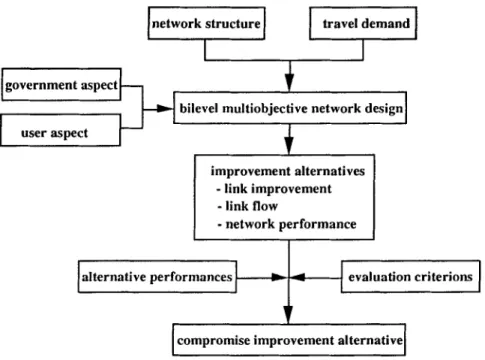
After criteria weights and project performance are set, project evaluation and selection are conducted with multiple criteria and group decision making to obtain a compromise alternative. The model of the framework
is shown in Figure 1.
evaluation criterions network structure travel demand
I
I
government aspect
--,
bilevel multiobjective network design
improvement alternatives
-
link improvement-
link flow-
network performance1
compromise improvement alternative1Figure 1. Framework of the network improvement model with
multiobjective decision making
The Model and the Solution of the Bilevel Multiobjective Network Design
In this paper we attempted to use the concept of the preceding bilevel programming, then to devise a continuous network design model under the given trip demand matrix. The model is shown as follows:
Tij =
C
h rr Vi,j r s R,,h r 2 0, Vr (7)
where,
a: link a in the network;
r: path r between origindestination pair in the network;
i,j: nodes in the network;
R:
the set of all paths of the network;Rij:
the set of all paths from origin i to destination j;C,: the average travel time on link a as a function of flow and capacity;
y,: the capacity improvement for link a;
y: (,.,, y,, ...) denotes the vector of improvement capacity of all links;
G,: the improvement cost for link a;
I: the set of links considered for improvement to the network; fa: the flow on link a;
f:
(..., fa, ...) denotes the vector of all link flows; h,: the flow on path r;d,: the link-path incidence matrix element, if link a is on path r, then dar= 1, otherwise d,=O;
56 Gwo-Hshiung lzeng and Sheng-Hshiung Tsaur
In the above mathematical equations, equations (1) to (3) constitute a high-level decision making problem; equation (1) represents the objective of minimization of user’s total travel time; equation (2)
represents the objective of minimization of the government’s total investment cost. Equations (4
-
7) constitute a low-level decision making problem, which is actually the network assignment problem of user equilibrium, and the equilibrium flow on the link can be obtained only through the link improvement variables. Equations (5) and (6) indicate respectively the definition and conservation of flow constraints. Equation(7) indicates that the flow on each link should be greater or equal to zero. The integrated mathematical model is constituted from the high- level problem
01)
and low-level problem(El).
The travel time function is assumed to be that of the BPR (the foundation used by the U. S. A.Bureau of Public Roads, BPR). The cost function is based on the recommendation of Abdulaal and LeBlanc (1979). Therefore, if equations
(1) and (4)
are
nonlinear objective functions, the integrated model becomes a bilevel nonlinear programming problem.This bilevel network design model
as
constructed is a typical price-control problem (Bialas and Karwan, 1984). The decision variables controlled by high-level are link improvement variables y, whereas the decision variables controlled by low level are the link equilibrium flows f on the whole, the low-level decision variables generally affect the performance of the high-level objective and vice versa. The bilevel decision-making operation forms the Stackelberg game, with its high-level decision makeras
leader and low-level decision makersas
followers.
Our heuristic algorithm combines the ideas of the constraint method (Marglin, 1967) with the IOA algorithm in order to discover alternatives in the noninferior solution set. According to the improvable performance values of each improvement link, the total budget is allocated. The procedure of the algorithm is
as
follows:a. Based on the objective of investment cost minimization and the objective of travel time minimization, set the greatest value M2 and the smallest value N2 of the allowable budget.
b. Transform the original multiobjective programming problem of the high level into:
where,
number of cutting points for section; Fd: feasible region.
= N2
+
(t/(s-1)) x (M2-
N2), t = 0, 1, 2,...,
s -1; s:c. Focus on various values, and acquire noninferior solution set under varied
Z,
objective constraint values.The following steps are repeated whenever noninferior solutions of link improvements are to be found:
Step 0
Select the initial vector
P
= (0, 0,...,
0, 0) to be the initial value of the link improvement variables, and solve the user equilibrium problem with y =Io
to obtain f w ) . Set j = 1 return to step J.Step J
(a) Under the assumption that is fixed, the multiplied value of each link and the value of the improvable capacity of unit cost are normalized; then the constant budget is allocated according to the normalized value of each improvement link. If the travel time function is the BPR type, then
where, Ca: the average travel time on link a;
4:
the travel time of freeflow; B,: the congestion parameter for link a;
4:
the original capacity of link a.(b) the allocated budget to each improvement link is transformed into
the capacity improvement value
,
and the user equilibrium problem is solved with y =fl
to obtain f(y').if 12
-
1i-l<
E for link a, set :y = (I:+
1:-')/2 and link a isnot improved thereafter; otherwise, set j = j + 1 and repeat Step J. ( E = 0.1)
58 Gwo-Hshiung lteng and Sheng-Hshiung Tsaur
(d) if all links need no further improvement, solve the user equilibrium problem with y = y* to obtain f(y*).
In the above algorithm, the idea to solve steps 0 and J is similar to marginal analysis. At first
,
the original problem is decomposed into many subproblems to consider each improvement link ( Suwansirikul, 1987), and the objective performance in each link is definedas
the decrease of congestion cost in the investment of per unit cost. The objective performance is also definedas
the product value of the improvement capacity for per unit investment cost and the travel cost decrease for per unit improvement capacity. The product value of each link shows the link performance improved in each link per unit improvement cost. According to the degree of that performance value, the budget allocation can be made. The budget to be obtained from an allocation in each link can be transferred into a capacity improvement value. This algorithm uses the idea of the IOA algorithm; hence, in all algorithms the equilibrium network flow is obtained from the previous stage, then put into for solution, when the variables of the link improvement are obtained each time. As the bilevel programming model is NP-hard (Nondeterministic Polynomial Hard), it is impossible to use a polynomial algorithm to solve the bilevel programming problem. For this reason, only an approximation approach is usable to solve a large-scale network problem. For a nonlinear bilevel problem, it suffices to indicate the complementarity condition to show non-convexity. Non-convexity implies that even if the solution to the problem is identified, the solution may be onlya
local solution rather than a global one. Therefore, the solution from this algorithm cannot be guaranteed to be the global optimum, but this result can be regarded as an approximately optimal solution.The techniques developed by LeBlanc et al (1975) can be, without constraint, applied to solve the equilibrium assignment problem with link improvement variable to be fixed and no discussion appears here. The program written in C language in this study can be experimented on a microcomputer; the results are favorable.
The Evaluation and Group Decision Making for Network Improvement Project
Various noninferior solution alternatives are obtained under various budget constraints perceived from the results of the preceding network design model; we used the multicriteria evaluation method of ELECTRE
compromise alternative from feasible alternatives with multiple evaluation criteria.
ELECTRE
I11 provides abundant information during the decision making process, The uncertainty is taken into account throughout the decision making process. The solution that a certain criteria performance is the best and other criteria performance are all worse can be avoided. Then the best compromise alternative is obtained. After a pseudo-criterion is introduced, distinguishing itself from other conventional models, the judgment of projects is diverted to become more coherent to the reality. In this paper we employed the group decision making ofCook
and Seiford (1978) to integrate preferences of all decision makers.Electre I l l
Electre I11 utilizes fuzzy ranking relations to establish the preference of decision makers; the definition of a credibility index s(a,b)
(0
<
s(a, b)<
1) for every alternative pair (a,b) demonstrates that alternative a is better than or at least as goodas,
alternative b. As the performance value of alternative criteria is commonly not fixed or known exactly, it explains why the idea of pseudo-criteria conceived from an indifference threshold and a preference threshold is brought in to explain such uncertainty. Furthermore, the weights of criteria are exercised in the definition of a concordance index whereas a veto threshold is applied to the definition of a discordance index; the definition of credibility index is eventually furnished by both. As for the ranking of alternatives, both downward distillation and upward distillation are exploited, integrating into a partial pre-order of alternatives. Major evaluation steps are as follows:Establishment of a threshold function
Assume that q(g(b)), p(g(b)) represent respectively the indifference threshold and preference threshold of a certain criterion; if such a criterion is a performance criterion (the greater its value is, the better), then
60 Gwo-Hshiung neng and Sheng-Hshiung Tsaur
In order to avoid incoherence, the establishment of a threshold function has to fulfil the following conditions:
If a criterion satisfies these definitions and requirements, it is considered as pseudo-criterion where, P: strong preference relation; Q:
weak preference relation; I: indifference relation; g(a) : the evaluation value of alternative a.
Establishment of a concordance index and a discordance index
Concordance index c(a,b)
-
the degree of endorsement that considers alternative a to be better than or at least as good as alternative b. Its calculation formula isas
follows:where,wj : the weight coefficient of criterion j; J : the set of all criteria; dj : the marginal credibility degree of alternative a considered better than
or at least
as
goodas
alternative b under criterion j, its calculation formula isas
follows:Gj(ab) = 0,
if
gj(b) > gj(a)+
Pj(gj(a>> Gj(a,b) = 1, if gj(b) I gj(a>+
qj(gj(a)>(20) (21)
qj(gj(a>> < gj(b) 5 gj(a) + Pj(Sj(a))
Discordance index dj(a,b)
-
the degree of endorsement that opposes alternative a is better than or at least as good as alternative b. Its calculation formula isas
follows:where,
Pj:
the preference threshold of criterion j;9:
the indifference threshold of criterion j; vj: the veto threshold of criterion j.Establishment of a credibilitv index Ma.bN
a. o(a,b)
=
c(a,b), if dj(a,b) c c(a,b), V jEJ
(26)1 - dj(a,b)
(27) b. o(a,b) = c(a,b)
n
, if dj(a,b) > c(a,b)jc J * 1
-
c(a,b)Method of alternative ranking
According to the calculation results of credibility, the ranking of
alternatives with regard to their superiority and inferiority (outranking) is arranged; its way of management has three steps
-
downward distillation, upward distillation and final ranking.a. Downward distillation
(a) Let A&) be the set of all alternatives; a(a,b) denotes the element of credibility matrix; s(1) is the discriminant function of the system (the suggestion of Roy (1986,1990)), k = 0, m = 1 .
(a,b)EA ,a#b
Find
h,_l=
Ma(g
o(a,b) (28)Gwo-Hshiung Reng and Sheng-Hshiung Tsaur
all alternatives in A@) proceed to pairwise comparison; if a(a,b)
>
&,
and a(a,b)>
@,a)+
s(a(a,b)), then alternative a is better than alternative b.Pb(a): the number of strategy a superior to strategy b (b e A@));
fb (a): the number of strategy a inferior to strategy b (b E A@));
Find the alternative with the greatest &(a) value, and let the alternative set be U@); if the alternative number of U@) is greater than or equivalent to 2, then let m = m + 1 and repeat steps b to e and turn to step f until A,,, = 0; if the alternative number of UQ
is smaller than 2, then turn to step f.
The ranking of alternative x in the U@) set is V,(x) = k + 1
A@+') = A@)
-
U@), if A@+') =9,
then it stops, or let k = k + 1,m=1, and go to step b. &(a) = pb(a)
-
fb(a).b. Upward distillation
The method of calculation is the same
as
the downward method, except that at step e it is the alternative with the smallest value qb(a) that is to be solved and a temporary order T(x) is obtained; T(x) is adjusted according to the following equation to obtain an upward distillation order; the result V2(x) is:V ~ ( X ) = 1
+
T,,- T(x), x E A (30)T,, = max T(x), x e A
c. Final ranking
A final ranking is obtained by taking average of the downward and upward orders
as
in the following equation:V(X) = (V~(X)
+
V2(~))/2, x E A (3 1)Consensus mnking of Cook and Seiford
Cook and Seiford (1978) proposed a consensus ranking that uses
the concept of minimal distance to integrate the preferences of decision makers. Armstrong et al. (1982) suggested its applicability to the
use in this method.
If the ranking is
R
= (A,, A*,...,
A,) of m noninferior solutions, then A,,, indicates the ranking of m noninferior solutions; the average value is used to manifest if equivalent ranking occurs. If there are n members, the ranking of member i towards an alternative is ri; the consensus ranking of all members towards alternative j is,
and the definition of consensus is the minimal distance of all members towards the preferences of all alternatives and theare shown
as
follows:n m
d =
C C
Irij- i = l j=1consensus preferences, which
C
rj I
In the above equation raC can only provide a ranking number k (k = I , 2,
...,
m; if we let { c J = k, then the definition djk is the totalcognition difference of n decision makers when the consensus ranking of
alternative j is k, djk =
C
Irij-kI (33) n i= 1 thus, m j=1 d k = d j k ,k
= 1,2,
...,
m
(34)Hence, the efforts to solve the consensus ranking problem with the minimal cognition difference are indicated by the 0-1 linear programming assignment problem
as
follows:m m j=1 k = l Min d =
C
C
djkxjk m j = l mC
xjk=l, k= 1 S.t. x j k = l ,k
= 1, 2,...,
mj
= 1, 2,..-,
mif the consensus ranking of alternative j is
k
64 Gwo-Hshiung neng and Sheng-Hshiung Tsaur
This method is used for managing problems of many decision makers. Although a decision maker expresses only his preference of the
rank of each alternative in a practical application, the problems need to let the decision marker clearly understand and cleverly use this operating procedure for consensus rankings.
Case Study of Metropolitan Taipai
Due to the rapid growth of traffic flow and the high concentration of transportation in the metropolitan Taipei, serious traffic congestion has occurred. In this paper the Taipei metropolitan area is our case study
area, the network and traffic data are extracted from materials established by the Bureau of Taipei Rapid Transit System. Altogether, there are 995 nodes and 2727 links. The total 330 traffic zones are used for modeling the travel demands. We have selected two major roadways of Taipei for its formulation of possible improvement (feasible alternatives). The selected east-west-bound one is Chung Hsiao East and West Roads (having 36 links), and the north-south-bound one is Fu Hsing North and South Roads (having 28 links). Furthermore, the travel time function is assumed to be a BPR cost function, and the investment function is assumed to be a linear function. To calculate the unit cost for the capacity at peak hours, the improvement unit capacity (PCU) per kilometer requires NT$10,000 (the width of the car lane is reckoned to be 3.5 meter), and if the furnished road capacity for a full day is taken into the calculation, each kilometer would require NT$l8OO/PCU. In this case study the major purposes are to test the proposed network improvement plan for operational procedures in usable ways and to demonstrate the applicability of the proposed method for practical planning.
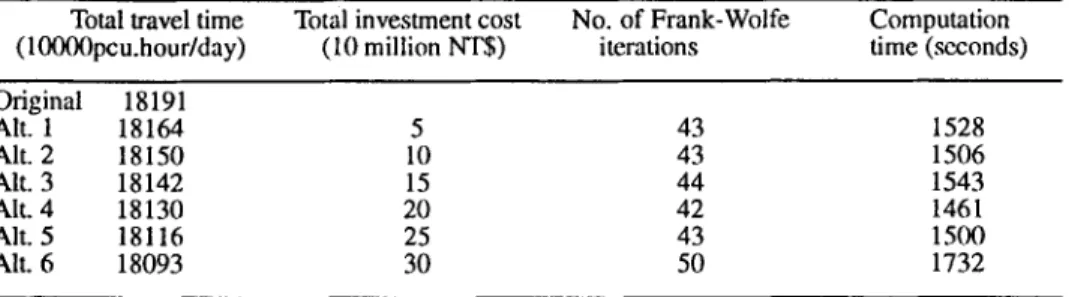
Noninferior solutions of network improvement alternatives If data on network and travel demands are inserted into the bilevel multiobjective network design model, the noninferior solutions can be obtained while minimizing the two objectives. The objectives of improvement performance of the noninferior solution of network design alternative and computation time
are
indicated in Table 1. Accordingly, the total travel time gradually decreases, after investment cost increases, because of the trade-off between these two objectives. The computation time required to locate the solution is approximately 30 minutes for a large-scale network. Based on the outcomes of the network assignment,pattern in which some links have comparatively higher traffic flow than before. Hence, the service level of improvement is evidently less than the improved degree of adjacent roads. The effects of the capacity expansion stay mainly within the bounds of old urban areas, rippling insignificant reaction beyond the bounds.
Table 1. The improved performance of noninferior solutions of
network improvement alternatives and computation time
Total travel time Total investment cost No. of Frank-Wolfe Computation (10000pcu.houdday) (10 million NT$) iterations time (seconds) Original 18191 Alt. 1 18164 5 43 1528 Alt.2 18150 10 43 1506 Alt.3 18142 15 44 1543 Alt.4 18130 20 42 1461 Alt.5 18116 25 43 1 500 Alt. 6 18093 30 50 1732
Remark: The computation results have been experimented on 80486 PC.
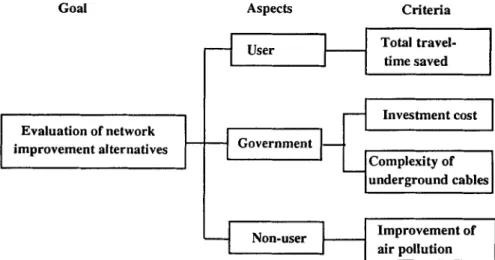
Evaluation criteria of the network improvement dernah'ves In view of the mutually conflicting criteria involved in the evaluation of transportation networks four evaluation criteria are selected: the total travel time saved, the investment cost, the improvement of air pollution and the complexity of underground cables. Among these criteria, the total travel time saved is accomplished upon consideration of the user (driver) aspect; the investment cost and the complexity of underground cables are conducted from the viewpoint of government, whereas the improvement of air pollution is conducted from the interest of a non-user (the general public). The hierarchical structure of evaluation criteria formulated is shown in Figure 2. The complexity of underground cables requires both the practical experiences and judgments of the construction division, and the other performance values of criteria are derived form calculated results of the network design model. They
are explained as follows:
Total travel time saved
The purpose of the network optimal assignment is to assign the travel demands for all
0-D
pairs onto each link of the network. When the equilibrium condition is attained, the travel time of any used routes66 GwO-Hshiung 7keng and Skng-Hshiung Tsaur
Goal
improvement alternatives
Aspects Criteria
User Total travel- time saved Investment cost Complexity of Improvement of air pollution Non-user
Figure 2. Hierarchical Structure of Evaluation Criteria on Network Improvement Alternatives
for each 0-D pair would be equal. The travel time function of the link is as follows:
where fa: the traffic flow of link a; A,: the travel time of free flow on link a; $: the original capacity of link a; y,: the improved capacity of link a.
For the whole network, the total travel time
0
is the aggregate of travel time of the vehicle flow on each link.'IT = faCa
a
The total time saving is referred to the differential value between the total travel time required in the original network and that of the improvement alternatives.
Total investment cost
Total investment cost can be obtained
as
C
daYarecommended links that require improvement in the network. Imorovement of air -pollution
Improvement of air pollution is conducted from the viewpoint of a non-user. According to investigation of the environmental quality cognition of Taipei metropolitan area at present, air quality is an environmental attribute that concerns the metropolitan residents most and it is evaluated to be the most unsatisfactory. Government experiments have already indicated that of air pollution compounds in Taipei about
99% of carbon monoxide (CO) is from emission of motor vehicles. If CO is used to represent air pollutant, the total amount of air pollution (TP) is the aggregate emission of all the traffic flow on each link for the whole network, whereas the improvement of air pollution is referred to the differential value between the total amount of pollution of the original network and that of improvement alternatives. Of these factors, the amount of pollution emission is associated with the driving distance, and the coefficient of pollution emission of the unit driving distance is related to driving speed. Hence, the coefficient of the pollution emission decreases
as
driving speed increases. Such evidence indicates the impacts of travel distance and traffic congestion on air pollution as follow:.where,P,: the coefficient of pollution emission of the unit driving distance (g/km); d,: the distance (km) of link a; V,: the driving speed of link a; a,
B
and y are the parameters of relation between P, and V,.Complexitv of underground cables
The instalment of the communal pipe culvert in Taipei metropolitan area is still on the construction calendar, and complication exists because the underground cables of many divisions are involved. We intend to consider the complexity of underground cables within the excavation bounds of the car lane width
as
its evaluation criteria for network improvement alternatives. With practical experiences of management from the construction divisions, the manner of a rating scale (0 -10) is68 Gwo-Hshiung Reng and Sheng-Hshiung Tsaur
thus established as a measure; the smaller the rating is, the smaller the commensurable complexity is, which facilitates the construction work.
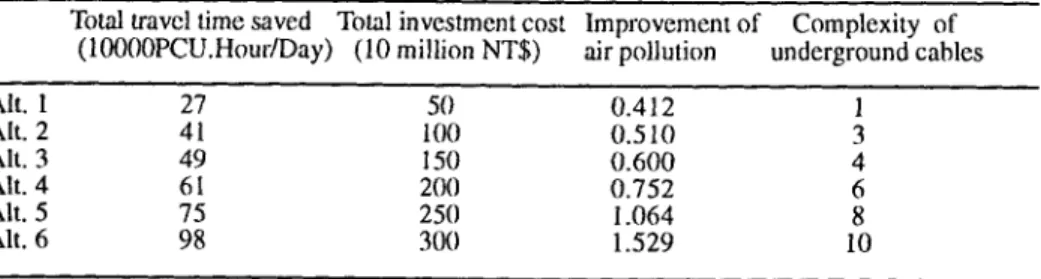
The evaluation matrix established according to the four evaluation criteria on six alternatives is shown in Table 2.
Table 2. Evaluation Matrix of Network Improvement Alternatives Total travel time saved Total investment cost Improvement of
(10000PCU.Hour/Day) (10 million NT$) air pollution underground cables Complexity of
Alt. 1 27 50 0.4 12 1 Alt. 2 41 100 0.510 3 Alt. 3 49 I50 0.600 4 Alt. 4 61 200 0.752 6 Alt. 5 75 250 1.064 8 Alt. 6 98 300 1.529 10
The
ELECTRE 111 method and application of the method of Cookand Seiford method
In this paper fourteen scholars were invited from the transportation bureau, environmental protection bureau and academic institutes to establish a decision making group to evaluate improvement alternatives of six networks; then those evaluation criteria with the assistance of the AHP method (see Appendix) are introduced into a pairwise comparative questionnaire, after which the weight of each criterion is given by the decision makers provided with consistent confirmation. The results of the preference investigation (weights of evaluation criteria) are shown in Table 3. The processes
are
concludedas
follows. The methods of ELECTRE I11 and that of Cook and Seiford are exploited to evaluate alternatives:a. As in our study the concept of threshold values is not clear to the decision makers, We, therefore decided to determine each threshold value according to the following equations: (i) calculate the differential values of each alternative under the same criterion, (ii) select those smaller differential values from the leading 1/5, 1/3,
1/2 differential values, and calculate their average values to form the indifference threshold value, preference threshold value, and veto threshold value.
Based on these threshold values, the concord index and the disconcord index derived from the evaluation value of the
Alternatives
Criteria Total travel Total investment Improvement of Complexity of Evaluators time saved cost air pollution underground cables
P I 0.286 0.130 0.156 0.428 P 2 0.333 0.128 0.205 0.334 P 3 0.278 0.107 0.171 0.444 P 4 0.385 0.154 0.154 0.307 P 5 0.364 0.124 0.149 0.363 P 6 0.250 0.250 0.167 0.333 P 7 0.286 0.208 0.149 0.357 P 8 0.436 0.114 0.136 0.3 14 P 9 0.400 0.080 0.117 0.403 P 10 0.385 0.154 0.066 0.395 P 11 0.400 0.167 0.167 0.266 P 12 0.267 0.107 0.160 0.466 P 13 0.333 0.125 0.125 0.417 P 14 0.318 0.156 0.117 0.409
Remark: P1-P5 represent the academic institute, P6-P8 represent the construction affairs bureau, P9-P11 represent the transportation bureau,P12-P14 represent the environmental
protection bureau.
C.
d.
alternatives, the concept of fuzzy theory is exercised to locate the credibility degree.
The ranking order of alternatives is conducted according to the credibility degree, and the process of management is a combination of both downward distillation and upward distillation toward the final one.
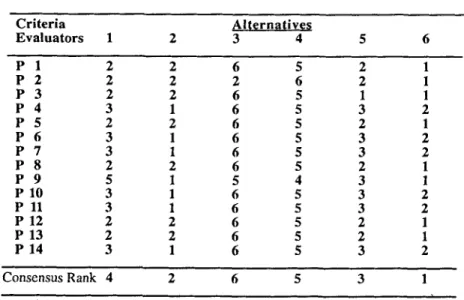
The preferences of decision makers towards network improvement alternatives are acquired after the preceding processes; then the method of Cook and Seiford is employed to integrate the preferences of all decision makers, resulting in a final consensus ranking shown in Table 4.
The rankings of the second and sixth alternatives are preferable to the others among the decision makers (see Table 4), whereas the sixth alternative manifests itself
as
the most preferable alternative on consensus ranking. Hence, the preferred alternative would be that of minimizing either total travel time or total investment cost subject to certain minimum performance standards relative to other performance criteria. Because of the effects that the decisions of a threshold value might incur on the evaluation results, we attempted to replace a threshold value by sensitivity analysis. As a result, a higher degree of comparison is70 Gwo-Hshiung Reng and Sheng-Hshiung Tsaur
Table 4. Evaluation Results of Network Improvement Alternatives
Criteria Alternatives Evaluators 1 2 3 4 5 6 P 1 2 2 6 5 2 1 P 2 2 2 2 6 2 1 P 3 2 2 6 5 1 1 P 4 3 1 6 5 3 2 P 5 2 2 6 5 2 1 P 6 3 1 6 5 3 2 P 7 3 1 6 5 3 2 P 8 2 2 6 5 2 1 P 9 5 1 5 4 3 1 P 10 3 1 6 5 3 2 P 11 3 1 6 5 3 2 P 12 2 2 6 5 2 1 P 13 2 2 6 5 2 1 P 14 3 1 6 5 3 2 Consensus Rank 4 2 6 5 3 1
Remark: Pl-P5 represent the academic institute. P6-P8 represent the construction affairs bureau. P9-P11 represent the transportation, P12-Pl4 represent the environmental protection bureau.
revealed among alternatives; changes are witnessed between them as the threshold value is decreased, and only the rankings of the foremost and trailing alternatives remain intact.
Conclusions and Recommendations
In this paper a multiobjective decision making process is proposed for the metropolitan network improvement problem. From the aspect of design, multiobjective mathematical programming is used to establish a continuous network design model. From the aspect of evaluation, multicriteria decision making is employed to solve a discrete network improvement problem. We also propose an effective heuristic algorithm
so that applications to the practical networks can be more efficient. In the
meantime, group decision making is also utilized to evaluate and to select the compromise consensus alternative from feasible alternatives. The application of multiobjective decision making provides more reasonable consideration for the network improvement problem; recommendations of improvement presented in this paper are
as
follows:1. Because of the nonconvexity property in the network design model, the solution is difficult to locate. The consideration of multiobjectives complicates the problem. We attempt to divide the
2.
3.
4.
evaluation. Although the problem is thus simplified, the complete decision-making process is long possessed of the idea of ranking order
as
the objective for each stage varies. It is, therefore, important that objective should be considered strictly to avoid the defect of the first-installed opinion.Many items of needs from different points of view are found in our
society, such
as
the safety of driving, public opinion and social benefit. If they are given more thought to, the decisions made would be better related to the practical issues.The communication and interaction between planners and decision makers are important and can affect the quality of decision making. Thus the combination of effective auxiliary aids of decision making has become necessary so that the decision maker can better control the alterations in regard to planning measures, and the techniques of interactive multiobjective decision making can be employed to solve problems.
It is assumed in this paper that an OD matrix is fixed and does not correspond to a practical situation. Further research on network design problems will be required for varied OD travel demand.
References
Abdulaal, M. and LeBlanc, L. J. (1979) "Continuous equilibrium network design models", Transportation Research, Vol. 13B, Armstrong, R. D., Cook, W. D. and Seiford, L. M. (1982), "Priority ranking and consensus formation: the case of ties," Management Science, Vol.28, pp.638-645.
Bialas W. and Karwan M. (1984) "Two-level linear programming". Management Science, Vol. 30, pp. 1004-1020.
Candler, W. and Townsley,
R.
(1982) "A linear two-level programming problem", Computer and Operations Research, Vol. 9, pp. 59-76. Chen, M. and Alfa, A. S. (1991), "A network design algorithm using a stochastic incremental traffic assignment approach, "Transportation Science, Vo1.25, pp.215-224.Choi,
Y.
L. (1984), "Land use transport optimization study," Hong Kong Engineer, Nov.
pp .47-57.Choi,
Y.
L. (1985), "The LUTO model and its applications in Hong Kong," Planning & Development, Vol.1, pp. 21-31.72 Gwo-Hshiung Tzeng and Sheng-Hshiung Tsaur
Choi,
Y.
L. (1986), "LUTO model for strategic urban development planning," Asian Geographer, Vo1.5, pp. 155-176.Cook, W. D. and Seiford, L. M. (1978), "Priority ranking and consensus formation, " Management Science, Vol.24, Current, J. and Min, H. (1986), "Multiobjective design of transportation
networks : taxonomy and annotation," European Journal of Operational Research, Vo1.26, pp. 187-201.
Current, J. R., Revelle, C. S. and Cohon, J. L. (1987), "The median shortest path problem : a multiobjective approach to analyze cost vs. accessibility in the design of transportation
networks,"Transportation Science, V01.21, pp. 188-197.
Fortuny-Amat, J. and McCarl, B. (198l), "A representation and economic interpretation of a two-level programming problem, I'
Journal of Operational Research and Society, Vo1.32, pp.783-792. Friesz, T .L. and Harker, P. T. (1983), "Multicriteria spatial price equilibrium network design:theory and computational results," Transportation Research, Vol. 17B, pp. 41 1-426.
LeBlanc, L. J. (1975), "An algorithm for the discrete network design problem,"Transportation Science, Vo1.9, pp. 183-199.
LeBlanc, L .J., Morlok E. and Pierskalla W.(1975), "An efficient approach to solving road network equilibrium traffic assignment problems," Transportation Research, Vol. 18@), pp.309-318. LeBlanc, L. J. and Boyce, D. E. (1986), "A bilevel programming
algorithm for exact solution of the network design problem with user-optimal flows," Transportation Research, Vol. 20B, Li, H. L. (1982), "The use of hierarchical multiobjective programming in urban transportation network design," Ph. D. Dissertation, University of Pennsylvania.
Li, H. L. (1988), "Expert system for evaluating multicriteria transportation networks, "Microcomputer in Civil Engineering, vol
.
3, no. 3, pp.259-265.(in Chinese).Marglin, S. (1967), Public Investment Criteria, PP. 103, MIT Press, Cambridge, Massachusetts.
Murchland, J. (1970), "Braess' paradox of traffic flow," Transportation Research, Vol. 16B, pp.45-55.
Roy, B., Present, M. and Silhol, D.(1986), "A programming method for determining which Paris metro stations should be renovated," European Journal of Operational Research, Vol. 24, pp.318-334.
pp. 1721-1732.
ELECTRE methods, University of Paris-Dauphine, Document Du Lamsade.
Roy, B. (1990), "The outranking approach and the foundation of the ELECTRE method," pp. 155-183, in Readings in Multiple Criteria Decision Aid, Carlos A. Bana e Costa (ed.), Spring-Verlag, Berlin. Saaty, T. L. (1980), The Analytic Hierarchy Process, McGraw-Hill,
New York.
Steenbrink, P. A. (1974), Optimization of Transportation Network. Wiley, New
York.
Suwansirikul, C., Friesz, T. L. and Tobin, R. L. (1987), "Equilibrium decomposed optimization: a heuristic for the continuous equilibrium network design problem, Science, V01.2 1, pp.254-263. Tzeng, G. H. and Chen, C. H. (1993), "Multiobjective decision making
for traffic assignment, "IEEE Transaction on Engineering Management, V01.40, pp. 180-187.
Tzeng, G. H., Shieh, H. M. and Shiau, T. A. (1989), "Route choice behavior in transportation: An application of the multiattribute utility theorem", Transportation Planning and Technology, Vol. 13, pp.289-301.
Appendix of
A M P
MethodsThe weights of wi are obtained with the Analytic Hierarchy Process (AHP). AHP, proposed by Saaty (1980), can simplify the complicated problem by constructing a hierarchy of objectives, criteria and alternatives, and can estimate the weights for each level of hierarchical structure. To obtain the weights, AHP suggests the provision of pairwise comparison matrix which has the following form:
aij anj
...
...
...
aim ai n-
1 n x n74 Gwo-Hshiung Zkeng and Sheng-Hshiung Tsaur
I
n x n
where the wi are weights and the ratio wi/wj are assigned by the decision maker. It can be seen that the pairwise comparison matrix A has the following properties: (1) aij = wi/wj, (2) aij = 1, for i = j and (3) 3 j
x aji = 1, Therefore, only the proportion of the matrix above the diagonal needs to be known in order to fill in the entire matrix. The 9-point scale used in typical AHP studies to express judgments in making paired comparisons is: 1, equal; 3, moderate; 5, strong; 7, very strong; 9, extreme; 2, 4, 6, 8 for compromise reciprocals for the inverse comparison. Let us denote the W
as
a vector of relative weights, i.e., W = [wl,...,
wj,...
,
wn]. Weights can then be estimated by solving the eigenvector equation :AW = Nw
where W is an eigenvectofof A and n is the associated eigenvalue. Since the observed matrix A may not be consistent, the estimation of W could thus be found out by satisfying
AW = A,-W
If 1- is exactly the same
as
n, the pairwise comparison matrix A is thus perfectly consistent. Because the chance of this perfect consistency is small, a consistency index (CI) is thus used to evaluate the consistency of the observed matrix A, which isCI =
b l a x-
nn - 1
If the CI value is less than 0.1, the consistency of the decision maker is considered satisfactory in general, and the vector W is thus presumed to provide the relative weights.