Internationalization, Local Adaptation,
and Subsidiary’s Entrepreneurship: An Exploratory
Study on Taiwanese Manufacturing Firms
in Indonesia and Malaysia
JI-REN LEE∗ [email protected]
Department of International Business, National Taiwan University, 50, Lane 144, Keelung Rd. Section 4, Taipei 106, Taiwan, ROC
JEN-SHYANG CHEN [email protected]
Department of Business Administration, Ming-Chuan University
Abstract. This inductive research attempts to explore the dynamics of firm internationalization process, with a focus on a manufacturing firm’s first-time foreign entry endeavor. By conducting comparative analyses based on six cases of Taiwanese manufacturing firms who have established production bases in Indonesia and Malaysia, we postulate a conceptual framework entailing relationships among entry decision, implementation strategy, and local adaptation. We highlight the role of subsidiary’s entrepreneurial initiatives play in achieving required extent of local adaptation and hence successful implementation for companies lacking sufficient experiential knowledge of internationalization. Propositions based on the conceptualization are detailed and the implications of these qualitative insights are discussed, with an expectation of contributing to the extant theories of internationalization.
Keywords: internationalization, subsidiary entrepreneurship, local adaptation
1. Introduction
Internationalization provides both opportunities and challenges to firms. On one hand, a firm can explore comparative advantages by relocating its business activities in foreign countries or exploit firm-specific advantages by replicating its competence abroad in order to achieve continuous business growth. On the other hand, environmental heterogeneity will require the company to accommodate local differentiation while maintaining the integration and global efficiency of resource utilization within its organizational context (Bartlett and Ghoshal, 1989; Gustavsson, Melin and Macdonald, 1994; Prahalad and Doz, 1987). This challenge entails both strategic and organizational capabilities (Bartlett, 1986), of which newly internationalized firms are by and large lacking and have to build up incrementally through the process of internationalization (Eriksson et al., 1997; Erramilli, 1991; Johanson and Vahlne, 1977; Welch and Luostarinen, 1988).
The purpose of this research is to explore the dynamics of a firm’s internationalization process, with an emphasis on the linkages between foreign expansion actions undertaken
by the corporation and cross-border operations of manufacturing activities following the foreign entry. To explore the essence and degrees of managerial challenges potentially faced by an entrant firm, our research especially focuses on the cases of first-time international expansion experience. Specifically, we organize our exploration around two issues that are critical to our understanding of firm internationalization: one concern with how a
man-ufacturing firm will make their first-time entry and post-entry implementation decisions,
while the other is to investigate how the newly established manufacturing subsidiary will
carry out the implementation through various managerial initiatives. More importantly,
our concern is not a static view on the entry strategy undertaken by an inexperienced firm. Instead, our interest is more on the evolutionary changes that occur through managerial initiatives and local adjustments at the subsidiary level, an inquiry which may drive value-added insights to the extant theory of internationalization. To carry out this research, we conducted a qualitative study by investigating six cases of Taiwanese manufacturing com-panies for their first-time foreign entry endeavors in Southeast Asia countries. Perceiving firm internationalization as a multilevel phenomenon (e.g., Boter and Holmquist, 1996), our research undertook a holistic view on the development of the case firm’s first-time foreign entry decisions. Based on in-depth field interviews with subsidiary managers of these case firms and supplementary archival data, we employed an analytic induction approach (Yin, 1994:110) to build explanations over the phenomena we observed, under which several propositions and a conceptual model of internationalization are postulated.
Our choice of Taiwanese manufacturing firms as cases for empirical exploration merits some discussion. As a major source of foreign direct investments in many Southeast Asia countries during the 1990s, most of Taiwanese firms attempt to explore cost advantages based on cheaper productive factors by investing in scaled production bases in foreign countries and hence expanding their existing production capacities. Such first-time foreign expansions of a high involvement approach could incur a higher level of investment risks and managerial challenges. Compared with the sequential development stages depicted by the process theory of internationalization, which starts from independent (export) agent, mar-keting subsidiary and finally manufacturing units (e.g., Johanson and Wiedersheim-Paul, 1975), our research cases may provide an alternative view on the nature and challenges of internationalization. In addition, as the majority of Taiwanese manufacturing firms base their advantages on providing competitive contractual manufacturing services for buyers from around the world, their foreign expansion decisions could be complicated by the in-fluences from various buyers, suppliers, or complementors, an issue which receives rather scant examination in the literature (e.g., Forsgren and Johanson, 1992). The present re-search, therefore, could complement those studies that observe internationalization from a multilevel approach (e.g., Boter and Holmquist, 1996; Johanson and Mattsson, 1988).
This paper will proceed as follows. We will provide a brief sketch of the literature associated with a firm’s internationalization. Although there exists different views regarding the role of prior theory in conducting inductive case research, we follow the suggestion of Yin (1994), who argues that case studies should start with a theoretical ground, regardless of the case study’s purposes1(p. 27), and propose a framework linking several constructs
of interest to begin our research exploration (cf. Yan and Gray, 1994). We will then depict several key methodological issues, including case and data collection. Results based on
our field interviews and comparative analyses will be elaborated, followed by a series of propositions regarding the conceptual linkages among internationalization, implementation strategy, local adaptation, and subsidiary entrepreneurship. The present paper concludes by providing a conceptual model of internationalization, implications and suggestions for future research.
2. Literature review
Being a critical element of a firm’s growth strategy, internationalization has been a central issue of research both in the field of strategy (Rumelt, Schendel and Teece, 1995:64) and international business (Wright and Ricks, 1994:681). Different from other strategic choices for growth (e.g., corporate diversification, technology development), the nature of inter-national expansion represents the managerial initiative of allocating value-added activities across national boundaries. The heterogeneities embedded in different national contexts re-quire the firm to exhibit a higher level of managerial capability to cope with the increasing organizational complexity under a wider geographic business scope, a nature which makes internationalization a challenging research issue.
As the nature of internationalization involves business operations within a heterogeneous environmental context, which may not be fully within the boundary of the firm’s existing knowledge set, it takes time for the firm to learn how to adjust to different local conditions and to rationalize its operation globally. Based on the behavioral theory of the firm (Cyert and March, 1963) and the growth theory of the firm (Penrose, 1959), the internationalization process theory (Johanson and Wiedersheim-Paul, 1975; Johanson and Vahlne, 1977) tends to remedy such a deficiency by characterizing internationalization as an incremental result of successive learning through investment actions and management adjustments. In their view, a firm’s internationalization actions do not necessarily result from deliberated planning steps and are regarded as a process of increasing experiential knowledge. Experiential knowledge is essential to the internationalization process as it not only reduces the level of risks involved in foreign operations but also guides a firm’s existing resource utilization and the pursuit of productive opportunities. Stated differently, internationalization is an evolutionary process driven by the interplays between (1) the level of general and market-specific knowledge a firm acquired, integrated, and used in previous business operations and (2) the level of incremental resource commitments made by a firm in the foreign market. The theory thus highlights the need for the development and the accumulation of experiential knowledge concerning the firm’s capabilities and resources utilization in driving the internationalization success (Eriksson et al., 1997).
Although it seems intuitively sound and useful for explaining a firm’s early foreign ex-pansion actions in some contexts, the internationalization process theory, nevertheless, has been criticized as having no explanation for how the internationalization process actually starts and for the mechanism by which experiential knowledge affects the resource commit-ments, which could make the theoretical explanation tautological (Andersen, 1993:217). Some were concerned that the development stages proposed by the process theory (agent, marketing subsidiary, and production unit; Johanson and Wiedersheim-Paul, 1975) could be too deterministic (Reid, 1983). Empirical tests of the internationalization process theory also
received mixed results (e.g., Eriksson et al., 1997; Millington and Bayliss, 1990; Sullivan and Bauerschmidt, 1990).
In addition to a firm’s experiential knowledge, the sources of influence on international-ization decisions may come from beyond the firm itself. Of importance to the evolution of a firm’s internationalization actions are the network relationships it possesses (e.g., Forsgren and Johanson, 1992; Johanson and Mattsson, 1988). The network relationships refer to the direct and indirect exchange relationship between the focal firm and its buyers or suppliers. In other words, a firm position in the industrial value chain and its relational assets with foreign counterparts developed in the domestic market may serve as both a source of knowl-edge acquisition and the inducement of a firm’s internationalization decisions. Meanwhile, whether a firm requires sequential learning through stages of incremental commitments to be successful depends upon the differences in industry context. For a firm operating in a highly internationalized industry, its internationalization decision will be closely related to the interdependence among the different production networks located in different countries as well as the industry dynamics, and hence may not follow what the staged international-ization model suggests (Johanson and Mattsson, 1988:210).
The above discussion basically suggests that firm internationalization contains not only an entry decision in a static sense, but also a rich set of organizational processes involving multiple units and events for evolutionary changes. Especially, previous literature indicates a critical notion that such an interactive process entails learning-by-doing types of actions and influential factors external to the focal firm’s existing business and knowledge boundaries. The present research starts from proposing a theoretical framework of internationalization, as shown in figure 1, to guide our subsequent research exploration and construct develop-ment. There are four elements in the framework: FDI decisions, implementation strategy, local adaptation, and post-entry outcomes. The framework in its present format suggests a linear linkage from decision to consequence. Of importance is our research intention in exploring the phenomenon in between by specifying two major constructs, one focuses on the headquarters’ implementation decisions and the other one refers to the subsidiary’s efforts in carrying out implementation decisions within the local context. As implementa-tion strategy reflects a rather broad scope for exploraimplementa-tion, for the purpose of this research, we employ two generic dimensions suggested by Porter (1986) concerning international strategy: configuration and coordination. The former indicates resource allocation decisions among organization units, while the later refers to mechanisms to link units with differ-ent degrees of interdependence. Although our research starts with a static and sequdiffer-ential framework, our eventual research attempts to explore a rich set of factors underlying these key constructs and the interplay between factors, under which the dynamic nature of a manufacturing firm’s first-time foreign entry could be unpacked.
Implementation Strategy • Configuration • Coordination Post-entry Outcomes FDI Decisions Local Adaptation n
3. Methodology
As stated earlier, our research attempts to explore the insights underlying the relationship between a firm’s first foreign entry decisions and its subsidiary’s initiatives in local adapta-tion. To implement such an exploratory study, we conducted case analyses of six Taiwanese manufacturing firms who invested in their first overseas manufacturing base in Southeast Asia countries. Although adopting a multiple-case design would require more research re-sources, as opposed to a single-case design, its major advantage is being able to generate more compelling evidence and more robust research outcomes (Yin, 1994:45). Meanwhile, since the issues we are going to explore involve multi-level phenomena, the unit of analysis shall cover both the parent firm and the subsidiary. However, as our research interests focuses on the implementation and local adaptation endeavors following foreign entry decisions, our field interviews target the subsidiary managers and take a holistic view (Yin, 1994:41) to examine the interactions between the subsidiary and its corporate headquarters from the subsidiary’s point of view. It is our intention to have the subsidiary manager’s view on the first-time entry experience as this view point has been largely underestimated in the pre-vious literature on internationalization. Following a replication logic in selecting cases for the study, we then employed an analytic induction approach to build explanations over the phenomena we observed by stipulating a set of causal linkages among research constructs we targeted (Yin, 1994:110). Based on a series of iterated comparisons between existing theoretical views and case evidences, we then drew several propositions and concluded in a refined framework of firm internationalization. Next, we will explain in more detail some of the critical elements of our research design in the following sections.
3.1. Case selection
The environmental setting of this study is in the Southeast Asia, where many Taiwanese firms chose to build their foreign manufacturing bases before the (indirect) investment pol-icy in Mainland China was formally deregulated in the mid-1990s. A significant wave of Taiwanese investment activities in this region commenced from 1987 and was led by small-to-medium-sized manufacturing companies. However, large scale and capital-intensive companies caught the investment wave roughly from 1990. Up to 1998, the cu-mulative amount of Taiwanese direct investments in the region has reached 6 billion US dollars, representing one of the major sources of foreign investments in the region (MOEA, 1999).
We purposefully chose Taiwanese manufacturing-based firms located in Bandung, Indonesia and Penang, Malaysia, representing two major clusters of Taiwanese firms in the region, as our research scope. Relying upon replication logic, rather than sampling logic, in selecting case companies (Eisenhardt, 1989:537; Yin, 1994:45) from each loca-tion, we identified six companies based on considerations explained below. In other words, the exact distribution of investment types and subsidiary adaptation behaviors within the case selection scope, and hence the statistical representation of cases chosen, is not our con-cern. Instead, our concern is whether case companies chosen could provide rich information in the aspects of research constructs under which a series of inductive analyses based on
comparisons of commonalities and contrasts could be made (cf. Human and Provan, 1997; Yan and Gray, 1994).
Major considerations of case selection in this study are: First, we chose those manufac-turing subsidiaries which represent their parent company’s first foreign direct investment endeavor. Second, to avoid extraneous variation (Eisenhardt, 1989; Yin, 1994) that might re-sult from the differences between single- and multiple-parent controls over the subsidiary’s operations, we limited our case selection to those subsidiaries whose operations are fully controlled by their Taiwanese parent firms. In a similar vein, to avoid variations due to industry heterogeneity, we chose three textile companies in Bandung and three computer related companies in Penang. Both industries represent the major sector of investments from Taiwanese firms in those two locations respectively. In fact, our choice of computer and textile firms also reflects an adequate representation of the industrial landscape in Taiwan since they are the two largest industrial sectors of Taiwan’s trade flow and cumulatively totally share over 65% of Taiwan’s export volumes. A final and practical consideration was the access of informants. Since the fieldwork was conducted in foreign sites and we required an in-depth interview with the subsidiary’s top management, the case companies finally included are those who were most cooperative and could timely fulfill our requests. The background and major characteristics of six case companies and a brief sketch of their foreign investment history can be found in the Appendix. The case company names have been disguised to ensure confidentiality and are labeled in an alphabetical order to make subsequent comparisons and referral rather easier.
3.2. Data collection
The fieldwork for this study was conducted in Bandung and Penang in February of 1998. A research protocol derived from our previously presented framework was established before commencing the field interview. After gaining acceptance from the target company, each in-depth interview with the general manager of the subsidiary was carried out by one co-author and a research assistant guided by the interview protocol. Each interview normally took three to four hours to complete. We did not tape record the interview in order to reduce conservative responses to the issues discussed. Nevertheless, all interview notes were well taken by the research assistant and were crossly checked after the interview by the interviewer (Eisenhardt, 1989). These interview reports were further triangulated by the other co-author shortly after the completion of the fieldwork in order to minimize potential interpretation biases. In addition to interview evidence, we collected each firm’s archival data from several public sources, including news clips, listed company’s files, and industry association’s publications, among others.
4. Results and propositions
Following an explanation-building type of analytic strategy (Yin, 1994:110), we analyzed case evidences with respect to each construct of the framework, and compared the case find-ings against previous theoretical arguments. All analyses and comparisons across six cases were conducted in a one-by-one manner. After a series of analytic iterations, we were able
to identify deviation between previous theoretical arguments and the case findings, under which propositions for conceptual revision could be postulated. Due to space limitation, we report only the final revision of the model with significant case evidences in the following sessions. Readers could refer to the final conceptual model, as shown in figure 1, for linking the following sessions of elaboration.
4.1. Foreign entry decision and influences
A firm’s internationalization action can be triggered by various underlying conditions per-taining to both the macro- and micro-environment under which the firm is operated. In order to lower their costs of production our six case firms, made direct foreign investments, this being the main factor in the firm’s decision process, there were however, other factors influencing decision making across the case firms.
For the three companies in the textile industries (AHAY, BLE, and CTT), each is located somewhat differently along the value chain of textile industry: AHAY is a contract manu-facturer of fabric and apparels serving foreign buyers, BLE is a children apparel producer mainly serving local market needs in Taiwan, and CTT is an upstream supplier of yarn and fabrics for both local and international buyers, including AHAY and BLE. Due to the maturity of the textile industry and little room for new innovation, these firms have to reduce production costs by every strategic means. A high percentage of operation costs based on labor input forced these firms to move their production bases to foreign countries in which labor inputs reveal significant comparative advantages. Among these three firms, AHAY was the first to invest in a manufacturing plant in Bandung. However, the key driving force behind AHAY’s strategic move was the threat of losing orders to Indonesian suppliers made by one of its major Dutch-based buyers. The chairman of AHAY therefore decided to set up a manufacturing plant in Bandung in 1990 in the hopes of maintaining a competitive supply position with respect to Indonesian suppliers for its major buyer.
AHAY’s foreign move eventually became a critical input to CTT and BLE’s strate-gic intent of foreign investments. More than just providing information, according to the subsidiary’s general manager of BLE, AHAY’s chairman strongly influenced the decision concerning site selection and plant acquisition during his second visit to Bandung. A simi-lar story can be found from CTT’s entry decision made at the end of 1992. However, CTT and BLE have somewhat different strategic orientations in investing manufacturing base in Bandung. BLE expected that in the short-term the subsidiary could take advantages of low-cost production and export back to Taiwan in order to enhance its competitiveness in Taiwan. Hopefully, the subsidiary can penetrate into the Indonesian market in the long run. CTT’s goal was to transfer and leverage the residual utility of existing machineries in Bandung in which production of low-end items were assigned.
For the other three case companies in the electronics and computer industries (i.e., DAPI, ELON, and FST), all served as contract manufacturers for international buyers competing in global markets. DAPI and FST were producing computer peripherals while ELON was supplying computer components. While competitiveness based on to-volume and time-to-cost becomes a key factor for contract manufacturing in general, these firms experienced both cost pressure and capacity constraints while facing rapid growth from the booming
global electronics and computer markets in the early 1990s. Since the scale of production is critical to the cost level, these firms chose to expand their production capacities in foreign countries with both low-cost inputs and appropriate supporting infrastructures. High-tech investments were constrained by government policy in Mainland China in the 1990s, the electronics and electrical equipment industry association in Taiwan strongly suggested their affiliated firms to select Penang, Malaysia for foreign investments, in which electronics supporting industries, for example, IC packaging, component supply, and print circuit board fabrication, were comparatively well established. We found that all these three companies were all affected by this wave of foreign investments.
Different from the business complementarities appeared in the textile cases, these three companies are somewhat competing in the global computer industry. Although their foreign investment decisions seem to be independent from each other, their decisions explicitly reflected considerations of other Taiwanese competitor’s strategic maneuvers, including foreign investment actions since as contract manufacturers they are competing for a similar set of global buyers. Meanwhile, their affiliations with respect to the major share-holding business groups seem to affect their decisions as well. For example, one of major institutional shareholder of DAPI was a large electronics conglomerate in Taiwan, which had invested in Southeast Asian countries several years before DAPI’s entry. Therefore, DAPI’s decision was able to somewhat leverage the operating experiences of its affiliated company. In a similar vein, while they were independent listed companies, FST and ELON maintained a cross-holding relationship. According to the subsidiary executive of FST, their decision of investing in Malaysia was in fact “a part of business group decisions.”
The above comparisons across case evidences lead us to put industrial network relation-ships as an indispensable element in influencing a firm’s first-time foreign entry decision. Similar to what Forsgren and Johanson (1992) suggested, we broadly define industrial network relationships as sets of interconnected relationships between players involving in business activities. Along the industry value chain, they could be suppliers, buyers, or com-petitors. More broadly, network relationships could include inter-organizational linkages due to participations in various business associations or affiliated relationship within a for-mal or inforfor-mal business group. Within the context of a firm’s initial foreign investment endeavor, network relationships seem to serve as a critical information input for bridg-ing the experience or knowledge gap, and as a reference point of business operations for overcoming potential foreignness. Our findings can be stated as the following proposition: Proposition 1. Industrial network with which a firm is associated is likely to affect its foreign direct investment and location selection decisions. The network relationships include those building upon buyer-supplier relations, competitive interactions, industry associations, and affiliation within a business group, among others.
4.2. Configuration and coordination
After making a foreign entry decision, a manufacturing firm has to face the challenges of on-site implementation, mainly concerning the establishment of the production facility that could fulfill its strategic purpose. Specifically, the implementation task includes two
major components: one is to decide the extent of value-added activities and accompanying resources to be implemented to the subsidiary; the other one is to define ways of linking the local operations with the corporate headquarter in a coherent manner. By employing Porter’s (1986) suggestion of the generic dimensions of internationalization strategy (p. 57), we regard the first component as the firm’s configuration decisions and the second component as coordination/control decisions. Within the context of our research exploration, configuration decisions refer to the transferring of tangible and intangible resources, including physical facilities, operation process routines, administration rules, and expatriate teams, etc., from the corporate headquarter to the subsidiary. Coordination decisions then indicate choices of various control mechanisms adopted along dimensions of business activities for ensuring efficient linkages of interdependent activities between the corporate headquarter and the subsidiary.
During our interviews, we asked informants to recall the historical progress of plant establishment. Although every company delegated an in-charge expatriate team, we found that the composition and organizing approaches were quite different among cases. For some firms (AHAY and BLE), they delegated an ad hoc team and relied upon a couple of veterans to carry out the implementation mission based on their personal working experience with the companies. Financial resources were the major source of transfer to the subsidiary’s operations. In other words, the in-charge expatriate(s) had to set up a plant almost starting from the scratch and to make it running within a pre-determined time frame. In contrast, for some other firms (CTT, DAPI, ELON, and FST), they adopted a rather systematic approach by more formally organizing a multi-function task team for the execution. While some of the team members may just have short-term assignments specifically aiming at plant implementation, core team members would become management expatriates responsible for the operations of the subsidiary. For this type of implementation, the case firms would undertake a global evaluation on resource content to be transferred and relatively thorough considerations on the processes of resource assimilation for the subsidiary. We therefore label the former one as an entrepreneurial approach of resource configuration, while the latter one as a systematic task-team approach. Table 1 presents comparisons of qualitative findings across cases along these categories.
In addition to team composition, one key element of implementation distinguishes these two types of resource transfer; that is, who is responsible for equipment purchasing. For the cases of entrepreneurial approach, subsidiaries were in charge of this task based on the finan-cial resources provided by the headquarters. As stated by the BLE’s subsidiary general man-ager at the time of interview, who was also the leader of the expatriate team in 1992, stated: Our headquarters provided the subsidiary around 1 million US dollars in cash for the operational needs when we came here in 1992. That was all we got from the headquarters at the initial stage. We had to handle all the remaining problems by ourselves. After paying for an acquisition of a used plant and purchasing production equipments, our Taipei headquarter helped us to make loan from the local bank through inter-bank endorsements. Beyond financial supports, there are almost no other significant inputs.
In contrast, for other cases pertaining to systematic task-team approach, headquarters either transferred the full set of existing production equipments from Taiwan (CTT) or
T able 1 . Comparisons of k ey research constructs. Case fi rms AHA Y BLE CTT D API ELON FST No. of expatriates (as if 1998) 16 2 4 4 4 2 No. of local emplo yees 1100 450 600 2500 1200 1800 Y ear of entry 1990 1992 1993 1990 1990 1989 Decision in fl uence F oreign major Domestic Domestic Global b uyers Competitors Competitors b uyer supplier b uyer Con fi guration approach Entrepreneurial Entrepreneurial Systematic Systematic Systematic Systematic task-team task-team task-team task-team • In-char ge Corporate o wner Ine xperienced T ask force, T ask force, T ask force, T ask force, expatriates w/short-term w/long-term w/short-term w/short-term assignment assignment assignment assignment • Equipments purchasing Subsidiary Subsidiary All transfer HQ purchases HQ purchase HQ purchase purchases purchases from HQ Control mechanisms Outcome-based Outcome-based Mix ed Process-based Process-based Process-based • Product spec. Sub . decision Sub . decision Standard product HQ appro v e HQ appro v e HQ appro v e • Production Sub . decision Sub . decision Sub . decision HQ appro v e HQ appro v e HQ appro v e Sources of product External to the External to the Corporate Corporate Corporate Corporate & process kno wledge compan y, sourcing compan y, sourcing headquarters headquarters headquarters headquarters from T aiw an from local Initial entry outcomes Positi v e Ne gati v e Ne gati v e Positi v e Ne gati v e Ne gati v e Subsidiary ’s subsequent Direct expansion Expansion to None Support HQ ’s N one Support HQ ’s le v eraging to Latin America Singapore expansion to expansion to Scotland & M ainland China Mainland China Current performance Positi v e Positi v e Ne gati v e a Positi v e Positi v e Positi v e aThe b usiness loss is lar gely due to changes in exchange rates.
dominated in the equipment purchasing decisions (DAPI, ELON, and FST). As the general manager of DAPI’s subsidiary, who was one of the implementation team members in 1990, stated:
Our company had clearly defined the plant to be established in Penang as a low-cost production site before entry. All the initial implementation activities followed this goal. Our headquarters spent several months before entry in defining the scope and the content of production processes to be established here, equipment specifications to be purchased, qualifications of expatriate and local personnel, as well as accompanying financial budget. Beyond industry differences, we found that the reason potentially leading to the adoption of these two different approaches is related to the level of existing manufacturing compe-tence these companies possessed. Our three electronics and computer companies provided contractual manufacturing services to global buyers for years. They faced rather tough com-petition in the global arena, which in turn required them to catch up with a higher level of manufacturing competence in order to survive. Similarly, CTT is an upstream producer providing commodity type of products to both global and local buyers. In contrast, AHAY and BLE were apparel providers who maintained a narrow range of in-house manufactur-ing processes while relied upon outsourcmanufactur-ing through local manufacturmanufactur-ing network to fulfill orders. With limited range of production knowledge, these two companies can offer little more than financial resources for their subsidiaries. Hence, we may establish the following proposition:
Proposition 2. Within the context of the first-time foreign entry of manufacturing firms,
corporate headquarters that have a greater strength in manufacturing competence are more likely to undertake a systematic, task-team approach to transfer both tangible and intangible resources, while those with weaker manufacturing competence are more likely to undertake an entrepreneurial approach in resource transfer.
Beyond configuration, we found that the linking mechanisms between corporate and subsidiary during the initial implementation adopted by case firms are different as well. While managerial coordination/control could occurs along the whole business process, for the purposes of this research, we will focus on two categories of activities that are critical to a manufacturing-based subsidiary’s initial implementation and operations; they are coordination of product specifications and production routines. To make the analyses conceptually comparable, we identify a continuum of coordination/control mechanisms that companies employed: namely from process-based to outcome-based control. Within this research context, process-based control refers to the tendency that the head office maintained final approval on decisions or changes made by the subsidiary along various dimensions of business activity. In contrast, outcome-based control indicates the tendency that the subsidiary makes the decision and manages the aftermath and head quarters monitors the outcomes only.
Based on these conceptual definitions, we found that three electronics and computer companies all adopted a process-based control approach in initial implementation. In other
words, their corporate headquarters required their subsidiaries to report any changes that occurred in the aspects of product specifications and production routines. The subsidiary had to get final approval from the headquarters’ product managers before actual changes were undertaken. Two case firms even reported that they had to dispatch daily operating reports to their headquarter in the initial implementation period. In contrast, three textile companies tended to adopt an outcome-based control approach. Except for the case that CTT produced commodity products (yarn and fabric) so there is very little product specification changes required, all three subsidiaries had enough discretionary power to define and make changes on product and process related issues.
There seems to be a slight deviation from a one-to-one relation between configuration and coordination approaches adopted by six firms. Although firms adopting systematic task-team (entrepreneurial) approach tend to introduce process-based (outcome-based) control mechanisms in their initial implementation, CTT seems to be a mixed case. Since CTT’s strategic purpose was to switch its existing production facilities to Bandung and the product items they were going to produce were rather standard, their production routines have been clearly defined and constrained by these facilities. However, after delegating a team of nine technicians led by a veteran expatriate to take full responsibilities for implementation, CTT’s headquarter did not set up process control routines to the resource conversion activities. Since we regard the choice between process- and outcome-based controls as a continuum, we may summarize these finding as the following proposition:
Proposition 3. For their first-time foreign entry, firms adopting a systematic task-team (entrepreneurial) approach in configuration are more likely to employ a process-based (outcome-based) control approach in coordinating product and process related activities
between the corporate and the subsidiary.
4.3. Local adaptation
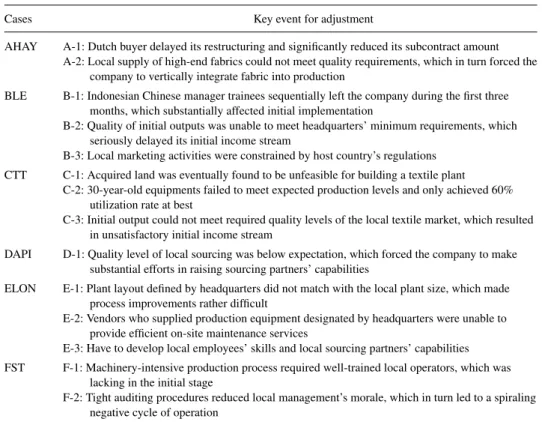
The findings reported above are mainly based on the intended implementation actions un-dertaken by our case firms. After interviewing with the subsidiary executives, however, we found that the extent and degree of local adaptation that these companies had experienced since entry were far more challenging than expected. Based on our interview data, we’ve identified a list of key issues, as shown in Table 2, faced by each case firm that requires different levels of managerial actions to adjust. Judging from the evidence, some cases only require adjustments at the operational level while others require redirection of the sub-sidiary’s operation. For instance, despite well-managed skill transfer by experienced teams, DAPI eventually found that the quality of parts supply available in Penang area could not meet the company’s minimum expectation, which significantly constrained the gearing up of production capacity. DAPI had to make substantial efforts in helping key suppliers’ man-ufacturing competence before they can fulfill international buyer’s requirement (D-1). In contrast, AHAY faced a similar situation in Bandung but ended up with different adaptation actions. After setting up an apparel assembly plant, AHAY found the quality level of avail-able local fabric supply was so low that they had to vertically integrate fabric into produc-tion in order to meet the buyer’s requirements (A-2). Despite different levels of managerial
Table 2. Summary of required extent of local adaptation.
Cases Key event for adjustment
AHAY A-1: Dutch buyer delayed its restructuring and significantly reduced its subcontract amount A-2: Local supply of high-end fabrics could not meet quality requirements, which in turn forced the
company to vertically integrate fabric into production
BLE B-1: Indonesian Chinese manager trainees sequentially left the company during the first three months, which substantially affected initial implementation
B-2: Quality of initial outputs was unable to meet headquarters’ minimum requirements, which seriously delayed its initial income stream
B-3: Local marketing activities were constrained by host country’s regulations CTT C-1: Acquired land was eventually found to be unfeasible for building a textile plant
C-2: 30-year-old equipments failed to meet expected production levels and only achieved 60% utilization rate at best
C-3: Initial output could not meet required quality levels of the local textile market, which resulted in unsatisfactory initial income stream
DAPI D-1: Quality level of local sourcing was below expectation, which forced the company to make substantial efforts in raising sourcing partners’ capabilities
ELON E-1: Plant layout defined by headquarters did not match with the local plant size, which made process improvements rather difficult
E-2: Vendors who supplied production equipment designated by headquarters were unable to provide efficient on-site maintenance services
E-3: Have to develop local employees’ skills and local sourcing partners’ capabilities FST F-1: Machinery-intensive production process required well-trained local operators, which was
lacking in the initial stage
F-2: Tight auditing procedures reduced local management’s morale, which in turn led to a spiraling negative cycle of operation
actions that were required for adjustment, this evidence seems to suggest that local adapta-tion be an indispensable element embedded in foreign entry processes across cases.
Further examining these case events, we found that the extent of required adaptation faced by the subsidiaries in general concentrated on the assimilation of transferred productive resources to the environmental heterogeneities. Managerial challenges mainly resulted from the identification, acquisition and adequate transformation of complementary resources to match with the production system to be installed, areas in which corporate planning could be less useful. For example, BLE’s failure in keeping manager trainees (B-1) and in recruiting qualified local managerial staff as substitutes seriously affected its initial implementation outcomes. Although CTT’s tactical goal was to transfer its existing production facilities overseas, the company in fact underestimated the required level of skillful operations and delicate maintenance in order to ensure that 30-year old machinery could be reassembled and maintained properly (C-2). Although it took a systematic task-team approach in transferring productive resources, ELON’s initial implementation in fact was seriously constrained by the headquarters’ bad plant layout and unilateral selection of a major equipment vendor, who were unable to support on-site services for the subsidiary (E-1 & E-2). In addition, FST had to fix the technical training problem of local operators before a sound production could be commenced (F-1).
Compared with the static view on what these companies were doing for entry imple-mentation, we would like to view local adaptation as evolutionary changes occurred at the subsidiary level along the time dimension. Such evolutionary processes would involve activities of different degrees of managerial difficulty, ranging from corrections of devia-tion from planning, capability building and upgrading in producdevia-tion through management changes, to reconfiguring the subsidiary in order to achieve organizational renewal, which will be discussed more fully in the next session. Hence, we may formally state the critical nature of the local adaptation as the following hypothesis:
Proposition 4. Within the context of foreign entry of manufacturing firms, local
adapta-tion at the subsidiary level, which refers to different degrees of managerial efforts made in assimilating resources transferred from the parent firm and in linking complementary resources locally sourced to jointly meet the needs for achieving successful implementation, is commonly required.
4.4. Subsidiary’s entrepreneuial initiatives
As every entry case reveals a different extent of local adaptation, the quality of subsidiary management in overcoming these obstacles becomes a critical element in determining the success or failure of initial implementation. In this regard, we sought evidence concerning how these subsidiaries have been doing in managing the required changes as well as re-vitalization if it exists. What we found is that after the initial resource transfer the role of corporate headquarters in guiding adequate local adaptation tends to be weaker since inex-perienced parent firms apparently lack of experiential knowledge so that instructions from a distant head office would prove to be less relevant. In contrast, the degree of reliance on subsidiary management to make quality decisions and timely changes would become great. Nevertheless, different control approaches undertaken by the head office leading toward the levels of discretionary power possessed by the subsidiary could potentially serve as a constraint factor to the effectiveness of local adjustment.
By comparing the nature and drivers of evolutionary changes occurring in each case, we would suggest a more focused construct, i.e., subsidiary entrepreneurial initiatives, to better reflect the quality of subsidiary management. Entrepreneurial initiatives are conceptually defined as managerial efforts that drive new ways of deploying the existing resources in order to achieve transformation or renewal of existing organization (e.g., Guth and Ginsberg, 1990; Stopford and Baden-Fuller, 1994). Within the present research context, entrepreneurial ini-tiatives especially refer to the subsidiary managers’ learning-by-doing efforts to manage the processes of resource utilization, integration and renewal, within the boundary of assigned discretion, in order to overcome various obstacles encountered in a foreign environment. Our comparative case studies found that the provision of entrepreneurial initiatives by key expatriates of the subsidiary represents a critical factor toward driving initial entry success. For the case of AHAY, after making a decision of vertical integration into fabric production to overcome poor local supplies, this company had to create a new venture in Bandung. However, since the fabric production is out of its existing competence area, AHAY had source related production technologies back from Taiwan by recruiting a new team of
technicians. With continuous entrepreneurial efforts led by the chairman of the board, AHAY successfully expanded the scope of its value-added activities and achieved a competitive position in the Bandung area at the time of our interview. A similar scenario occurred at BLE. After a daunting outcome happened during the first two years of entry, BLE’s headquarters decided to reduce further resource commitments and left any remaining problems to the subsidiary’s general manager to solve. While lacking a production background, this general manager decided to take a learning-by-doing approach by working on low-end contractual orders for other companies in the local area. Internally, BLE started to set up process routines and provided operational trainings for local employees. Only after a series of local initiatives of this sort did the manufacturing team emerge and quality output increased. The operation profitability was approaching positive values one year later. In 1996, the subsidiary started to take supply orders from its headquarters and commenced in the development of local chain stores. At the end of 1998, the subsidiary had invested in six wholly-owned stores and 35 points of sale in Indonesia and was expecting to further develop its apparel retailing businesses in the region based on the subsidiary’s experience.
For other cases with established manufacturing systems, the subsidiary’s efforts proved to be critical for eventual adaptation as well. What is different from the previous two cases discussed is that positive change outcomes occurred only after changing the subsidiary’s general manager. For instance, suffering from the poor transfer of an obsolete manufac-turing system, CTT’s recovery was led by a veteran expatriate, whose 20-year corporate experience was assigned as the second-term general manager in 1996. His initiatives in-cluded setting up process routines and quality standards, infusing regular technical training for local employees, exercising rigorous production and inventory controls, as well as ele-vating personnel moral. After raising the utilization rate up to 91%, CTT refocused its core production process by locally outsourcing some of its manufacturing activities. Up to the point of interview, the subsidiary had achieved the original business goal of both serving local market needs and extending the company’s production capacity meeting international market demands.
ELON and FST faced similar challenges: that is, to implement production processes locally under an organizational context of centralized coordination of resources. In addition, these companies struggled with a frequent succession of top-level expatriates responsible for technical functions, which led to an unstable transmission of knowledge and routines as well as low personnel moral. It was not until the appointment of the subsidiary’s third general manager that operational routines become effectively executed and some process renewal activities were initiated, including technical training, quality management activities, as well as people management.
The above discussion clearly portrays a critical lesson observed from these first-time foreign expansion cases; that is, as required extent of local adaptation commonly exists, the subsidiary manager’s provision of entrepreneurial initiatives may serve as a sufficient factor leading toward the achievement of entry goals. In other words, whether the subsidiary man-ager could vitalize the local organization by reconfiguring the subsidiary’s resource profile is key to subsequent, better performance. Our investigation also shows that the emergence of entrepreneurial spirits is more directly linked with the subsidiary manager’s characteristic rather than with the corporate headquarters’ guidance. Overall, while Birkinshaw, Hood,
and Jonsson (1998) suggest that subsidiary initiatives could be more critical in the early stage of building up the subsidiary’s contributory role within the organizational network of a large multinational corporation, our results submit that subsidiary entrepreneurial initia-tives could be more essential to the entry success for inexperienced firms in the early stage of internationalization. We therefore submit the following proposition:
Proposition 5. The provision of entrepreneurial initiatives by the subsidiary management is likely to affect the achievement of local adaptation and hence the attainment of entry goals.
The subsidiary’s entrepreneurial initiatives will become an indispensable part of the internationalization experience (e.g., Eriksson et al., 1997; Yu, 1990) of the corporation, which combined with the progress of the subsidiary’s performance will affect subsequent corporate subsequent entry decisions. Within the context of case firms, after a unsatisfactory starting period, some of the subsidiaries have not only successfully recovered the failure but also accumulated a significant amount of operational knowledge for further business leveraging. For example, among others, AHAY is going to expand into the Latin American market based on experience learned from Indonesia. BLE has become an important node for further expansion into the Southeast Asian markets. Moreover, DAPI’s subsidiary in Penang has become a manufacturing center of excellence for the corporation and successfully leverages its gained knowledge to other newly established subsidiaries. Thus, we may submit the following proposition:
Proposition 6. The accumulation of entrepreneurial initiatives made by, and managerial
experiences gained by the subsidiary are likely to become a central basis of the corporate experiential learning of internationalization, which in turn may affect the firm’s subsequent entry decisions.
5. Implications and conclusions
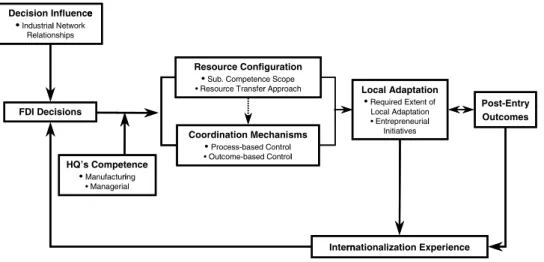
Our analyses and discussions based on field interviews with six case firms lead us to postu-late a revised conceptual framework, as shown in figure 2, regarding an internationalization process with special reference to the case firm’s first-time foreign entry experience. While this framework starts with similar assumptions with the extant internationalization process theory (e.g., Johanson and Vahlne, 1977), we end up with a revised conceptual framework suggesting the constructs of local adaptation and subsidiary entrepreneurial initiatives be included in the process of internationalization in order to accommodate the dynamic nature of such a business endeavor. This model does render both implications for the ongoing con-versations of the internationalization theory and suggestions for future research endeavors in at least three aspects.
First of all, while starting from a similar set of assumptions with the process theory of internationalization, our case studies on manufacturing firms in the textile and electronics sectors provide both supporting and value-adding evidences to the extant international-ization theory. On the one hand, our case study provides vivid evidence supporting the
Coordination Mechanisms
•Process-based Control
• Outcome-based Control Resource Configuration
•Sub. Competence Scope
• Resource Transfer Approach
Internationalization Experience Post-Entry Outcomes FDI Decisions Decision Influence •Industrial Network Relationships HQ’s Competence •Manufacturing • Managerial Local Adaptation •Required Extent of Local Adaptation • Entrepreneurial Initiatives l l r rn e • l ri l
Figure 2. A revised conceptual model of internationalization.
fact that firms new to the international markets do face substantial challenges in effec-tively transferring and managing their stocks of resources across national borders. On the other hand, we found that these firms do not necessarily adopt a learning-by-doing and incremental commitment approach for their entry decisions, as suggested by the process theory (e.g., Johanson and Wiedersheim-Paul, 1975; Johanson and Vahlne, 1977; Welch and Luostarinen, 1988), in order to overcome the uncertainty embedded in the international environment. All the case firms studied in this research in fact chose to invest a fully con-trolled manufacturing subsidiary in the foreign country as their first step. Concurring with the industrial network view of internationalization (e.g., Forsgren and Johanson, 1992), we found that the influence of a broadly defined network relationship did play a nontrivial role in affecting a firm’s entry decision and location selection. From the positive side, such an experiential influence from the network relations could reduce a certain degree of external uncertainty for the entrant firm. Nevertheless, the influence could also minimize the focal firm’s incentive to conduct adequate amount of pre-entry evaluation, which in turn may result in unsatisfactory post-entry outcomes.
Along the same line of conversation, the existing process theory of internationalization stresses the essential role of experiential learning in determining subsequent resource com-mitments. While we concur with this argument in general, our conceptual model further highlights the moderating role of existing competence in affecting a firm’s configuration and coordination decisions (Porter, 1986). Within our empirical context, both manufacturing and administrative competencies do matter in affecting the post-entry implementation strategy. In other words, a firm’s initial entry strategy would tend to replicate what it possesses. De-pending upon the applicability, careful building and effective leveraging embedded routines should be an equally important task for the firm to grow through internationalization (e.g., Kogut and Zander, 1993).
Our research results also show unequivocal evidence across the case firms regarding the required extent for local adaptation in the pursuit of entry success. Regardless of their
previous competence levels and implementation strategy adopted, the managerial challenge of meeting the required level of local adaptation seems to have been a relentless task for each case firm. Although different control mechanisms employed may affect the subsidiary’s discretionary power in conducting adjustments, the eventual outcomes of local adaptation are in fact contingent upon the quality of the subsidiary management (Ghoshal and Bartlett, 1994), under which entrepreneurial spirits exhibited by the subsidiary management seems to be more critical. In other words, granting a greater degree of autonomy to the subsidiary or enhancing the degree of localization may provide only a partial answer for reaching a satisfactory resolution. Our conceptualization in fact undermines a deterministic view on the choice between different degrees of autonomy or localization. Instead, our framework suggests an evolutionary view and portrays the need for a match between the required and feasible levels of local adaptation as well as the critical role subsidiary entrepreneurship plays in ensuring an entry success once the discrepancy occurs.
Hence, future research endeavors focusing on the exploration of the dynamics between local adaptation and subsidiary entrepreneurship within the organizational context for the initial foreign expansion will prove to be fruitful to our understanding of internationalization. More specifically, as previous research also suggested (e.g., Putti, Singh and Stoever, 1993), the constructs of autonomy and localization are in fact multifaceted in nature and not unequivocal in measurements. Given the fact that a firm’s first-time entry tends to replicate existing organizational routines, future research could explore how a firm could define feasible approaches along different dimensions of the control construct so that a balance between centralization and localization, or glocalization, could be achieved (Gustavsson, Melin and Macdonald, 1994:257). At a higher level of abstraction, as local adaptation refers to evolutionary changes occurred at the subsidiary level, it would be more rewarding if future research could explore the co-evolution processes between the subsidiary and the headquarters in reaching reconfiguring and mutual adjustments.
The third aspect of our research results that could serve as value-adding insight to the existing literature is concerned with the role of subsidiary entrepreneurship in a firm’s for-eign expansion actions. Birkinshaw and Hood (1997) refer to subsidiary development as an extension of the firm’s internationalization process and as dynamic in nature. Recent studies show that a subsidiary’s conscious managerial efforts in expanding competence scope lead to a contributory role and a higher degree of autonomy (Birkinshaw, Hood and Jonsson, 1998). Concurring with this emerging stream of literature, our research submits that the issue of subsidiary entrepreneurship cannot be ignored from the research domain of internationalization as well. Given the imperative of local adaptation for successful imple-mentation, the provision of a subsidiary’s entrepreneurial initiatives is even more essential for the internationalization of an inexperienced firm since the stock of knowledge in the headquarters is insufficient for supporting satisfactory local adaptation. More importantly, the accumulation of managerial experience gained from the entrepreneurial activities made by the subsidiary forms a central basis of the required experiential learning of the corporate parent. In this regard, our view of subsidiary entrepreneurship as an alternative source of experiential learning may provide a resolution to the tautological cycle between market commitments and experiential learning argued by the process theory of internationalization (cf. Andersen, 1993).
In this aspect, our findings complement those of Boter and Holmquist (1996) who stud-ied the cases of internationalization of six small Nordic companies. They clearly indicate that the role of entrepreneurs, either owners or professional managers, is vital for the in-ternationalization endeavors. While managerial decisions made at the headquarter may be critical to the subsequent implementation, our cases in fact suggest that, regardless of the quality of headquarters’ decisions, the role of subsidiary management is in fact the key to successful local adaptation. Collectively, we would suggest that future research focusing on the dynamics of internationalization take the role of management at different levels back to the whole picture. Practically, firms can take the lessons from our research into managerial considerations in order to increase the likelihood of its internationalization success. For example, the company could add weights to the criteria of entrepreneurial characteristics in recruiting key expatriates or members of a task force who are responsible for the ini-tial resource transfer and local adaptation. However, the accompanying challenge of such measures is whether the existing organizational context can accommodate subsidiary en-trepreneurial initiatives. Future research in this direction will be potential as many studies suggest that the creation of an organizational context that is able to facilitate subsidiary’s entrepreneurship could become an inseparable part of the construction of organizational capabilities for multinational corporations (Birkinshaw, 1997; Ghoshal and Bartlett, 1994). Appendix: Case Background and Key Comparisons
Case firms AHAY BLE CTT DAPI ELON FST
Location Bandung, Bandung, Bandung, Penang, Penang, Penang, Indonesia Indonesia Indonesia Malaysia Malaysia Malaysia Product Fabrics & Children apparels Yarn & Fabrics Computer Electronic Computer
apparels peripheral components peripheral
Corporate 4 42 63 70 91 56 sales of entry year (MUS$) Current 35 69 57 955 374 243 corporate sales (MUS$) Subsidiary’s 95% 95% 95% 100% 100% 100% ownership
Subsidiary Owner Professional Professional Professional Professional Professional
GM manager manager manager manager manager
Investment Switching Foreign production Expand Expand Expand Expand purposes production base & local production production production production
base market seeking capacity capacity capacity capacity
The first three case companies, AHAY, BLE, and CTT, are positioned in different stages of the industry value chain. Before investing in Bandung, AHAY was a fabric trading
company that owned a small-scale apparel factory in Taiwan. Due to the growing threat of losing the opportunity to supply one of its major buyers, AHAY started its evaluation of investing in Indonesia in 1989. After its completion in 1990, of AHAY’s apparel factory in Bandung, a major restructuring of the buyer’s company and their subsequent exit from the fabric business gave AHAY a slow start and forced it to redefine its business direction in Indonesia.
BLE owns a chain of specialty stores that markets children apparel in Taiwan. Although BLE has a small-scale apparel factory in northern Taiwan, its products are largely outsourced from local producers. Before establishing a manufacturing plant in Bandung in 1992, BLE concentrated the majority of its business development in Taiwan and had only a limited range of international business experience through a minority joint venture with a local Chinese partner in Thailand. In its joint venture, BLE furnished products and management know-how of chain store operations but did not participate in the daily control of operations in Thailand. By acquiring an existing factory in Bandung and engaging in a 95–5% joint venture, in response to local regulations, BLE’s first real foreign investment was to establish an overseas, low-cost production site supplying apparel to both its home market and potential local market opportunities. Established in 1958, CTT was a yarn (CVC, T/C) and fabric producer based in Taiwan that largely concentrated its business for the domestic market. CTT’s investment in Bandung was initiated in 1993 with the goal of establishing a low-cost production site that would employ its existing manufacturing facilities to support the needs of both its home market and local market.
The latter three companies, DAPI, ELON, and FST, also share some common characteris-tics. They are all OEM-based contract manufacturers providing electronic components and computer peripherals for various global branded buyers. In addition, each is an independent business entity that is held by larger conglomerates in Taiwan. The three companies entered Penang, Malaysia at almost the same time period (1989/1990) with a similar investment purpose of expanding their existing production capacities in a foreign country.
Acknowledgment
The authors would like to thank Shi-Tsung Cheng for his research assistance. Executives who have kindly provided their insights to enrich our research outcomes are also acknowl-edged. An early version of this paper has been presented at the 1st Southeast Asia Conference held in Taipei in January 2000 and the 2nd annual meeting of the Asia Academy of Manage-ment held in Singapore in December 2000, respectively. We appreciate all the comManage-ments provided by the conference participants. We also thank Professor Kulwant Singh and two anonymous reviewers for their constructive comments on an early version of this paper. Financial support from the National Science Council of Republic of China on this research project is gratefully acknowledged.
Note
1. Eisenhardt’s (1989) view that an ideal theory-building case research should begin with no theory in consideration is apparent different from what Yin (1994) has suggested. However, Eisenhardt (1989) also admitted that a clean
theoretical state is impossible to achieve but a research attempt to approach this ideal is important (p. 536). We basically regard previous literature review, under which our research framework is based, as a first step toward the development of a rich set of explanatory variables underlying the phenomenon to be observed.
References
Andersen, O. (1993). “On the Internationalization Process of Firms: A Critical Analysis.” Journal of International
Business Studies 24, 209–231.
Bartlett, C.A. (1986). “Building and Managing the Transnational: The New Organizational Challenge.” In M. Porter (ed.), Competition in Global Industries. Boston: Harvard Business School Press, pp. 367–401. Bartlett, C.A. and S. Ghoshal. (1989). Managing Across Borders: The Transnational Solution. Boston: Harvard
Business School Press.
Birkinshaw, J. (1997). “Entrepreneurship in Multinational Corporations: The Characteristics of Subsidiary Initia-tives.” Strategic Management Journal 18(3), 207–229.
Birkinshaw, J. and N. Hood. (1997). “An Empirical Study of Development Processes in Foreign-Owned Sub-sidiaries in Canada and Scotland.” Management International Review 37(4), 339–364.
Birkinshaw, J., N. Hood, and S. Jonsson. (1998). “Building Firm-Specific Advantages in Multinational Corpora-tions: The Role of Subsidiary Initiative.” Strategic Management Journal 19, 221–241.
Boter, H. and C. Holmquist. (1996). “Industry Characteristics and Internationalization Processes in Small Firms.”
Journal of Business Venturing 11, 471–487.
Cyert, R. and J. March. (1963). A Behavioral Theory of the Firm. Englewood Cliffs, NJ: Prentice-Hall. Eisenhardt, K.M. (1989). “Building Theories from Case Study Research.” Academy of Management Review 14(4),
532–550.
Eriksson, K., J. Johanson, A. Majkgard, and D. Sharma. (1997). “Experiential Knowledge and Cost in the Inter-nationalization Process.” Journal of International Business Studies 28(2), 337–360.
Erramilli, M.K. (1991). “The Experience Factor in Foreign Market Entry Behavior of Service Firms.” Journal of
International Business Studies 22(3), 479–501.
Forsgren, M. and J. Johanson. (1992). “Managing Internationalization in Business Networks.” In M. Forsgren and J. Johanson (eds.), Managing Networks in International Business. Gordon and Breach Science Publishers, S. A., pp. 1–16.
Ghoshal, S. and C.A. Bartlett. (1994). “Linking Organizational Context and Managerial Action: The Dimensions of Quality of Management.” Strategic Management Journal 15(special issue), 91–112.
Gustavsson, P., L. Melin, and S. Macdonald. (1994). “Learning to Glocalize.” In P. Shrivastava, A.S. Huff, and J.E. Dutton (eds.), Advances in Strategic Management. vol. 10B. Greenwich, CT: JAI Press, pp. 255–288. Guth, W.D. and A. Ginsberg. (1990). “Guest Editor’s Introduction: Corporate Entrepreneurship.” Strategic
Man-agement Journal 11, 5–15.
Human, S.E. and K.G. Provan. (1997). “An Emergent Theory of Structure and Outcomes in Small-Firm Strategic Manufacturing Networks.” Academy of Management Journal 42(2), 368–403.
Johanson, J. and L. Mattsson. (1988). “Internationalization in Industrial Systems: A Network Approach.” In N. Hood and J. Vahlne (eds.), Strategies in Global Competition. London, UK: Croom Helm, pp. 287–314, Johanson, J. and J. Vahlne. (1977). “The Internationalization Process of the Firm—A Model of Knowledge
Development and Increasing Foreign Market Commitment.” Journal of International Business Studies 8(1), 23–32.
Johanson, J. and F. Wiedersheim-Paul. (1975). “The Internationalization of the Firm—Four Swedish Cases.”
Journal of Management Studies 12(3), 305–322.
Kogut, B. and U. Zander. (1993). “Knowledge of the Firm and the Evolutionary Theory of the Multinational Corporation.” Journal of International Business Studies 24(4), 624–645.
Millington, A.I. and B.T. Bayliss. (1990). “The Process of Internationalization: UK Companies in the EC.”
Management International Review 30(2), 151–161.
Ministry of Economic Affairs (MOEA). (1999). Statistics on Overseas Chinese and Foreign Direct Investment. Taipei, Taiwan.
Porter, M.E. (1986). “Changing Patterns of International Competition.” California Management Review 28(2), 9–40.
Prahalad, C.K. and Y.L. Doz. (1987). The Multinational Mission. New York, NY: The Free Press.
Putti, J., K. Singh, and W.A. Stoever. (1993). “Autonomy and Localization of American, European, and Japanese MNC Subsidiaries in Singapore.” International Research in Business Disciplines 1, 107–23.
Reid, S. (1983). “Firm Internationalization, Transaction Costs and Strategic Choice.” International Marketing
Review 1(2), 44–56.
Rumelt, R.P., D.E. Schendel, and D.J. Teece. (1995). Fundamental Issues in Strategy. Boston, MA: Harvard Business School Press.
Stopford, J.N. and C.W.F. Baden-Fuller. (1994). “Creating Corporate Entrepreneurship.” Strategic Management
Journal 15(7), 521–536.
Sullivan, D. and A. Bauerschmidt. (1990). “Incremental Internationalization: A Test of Johanson and Vahlne’s Thesis.” Management International Review 30(1), 19–30.
Welch, L.S. and R. Luostarinen. (1988). “Internationalization: Evolution of a Concept.” Journal of General
Management 14(2), 34–55.
Wright, R.W. and D.A. Ricks. (1994). “Trends in International Business Research: Twenty-Five Years Later.”
Journal of International Business Studies 25, 687–701.
Yan, A. and B. Gray. (1994). “Bargaining Power, Management Control, and Performance in United States-China Joint Ventures: A Comparative Case Study.” Academy of Management Journal 37(6), 1478–1571.
Yin, R.K. (1994). Case Study Research: Design and Methods, 2nd edn. Thousand Oaks, CA: Sage Publications. Yu, C.M. (1990). “The Experience Effect and the Foreign Direct Investment.” Weltwirtschaftliches Archiv 126,
561–580.
Ji-Ren Lee is a professor of strategy and international business at the Department of International Business,
College of Management, National Taiwan University. He received his Ph.D. from University of Illinois at Urbana-Champaign. His research focuses on competence-based growth strategy, international joint ventures, and technol-ogy strategy.
Jen-Shyang Chen is an associate professor of strategy and management at the Department of Business
Admin-istration, Ming-Chuan University. He received his Ph.D. from National Taiwan University. His research interests include competence-based management, firm’s boundary and linkage, and strategy in emerging markets.