
中小企業技術商業化之探討 – 以SIBR 廠商為例
96
0
0
全文
(2) Acknowledgement. During the course of my thesis work, many individuals have unselfishly contributed their time and support to help make this project possible. I would like to extend my sincere gratitude to those who have provided guidance in every step along the way. First and foremost, I would like to thank my family for all the opportunities they have given me along with their loving support. Without them, I would not have achieved my success today. Special thanks to my advisor Professor Chang-Yung Liu who read my numerous revisions and helped make some sense of the confusion. Also thanks to my committee members, Chang-Yung Liu, I-Lin Cheng, and Ping-Yi Chao, who offered guidance and support. The thesis would not be possible without their relentless help and advice. The knowledge he has imparted reaches farther beyond this point today. In addition, special thanks to president Huang of NanoWin Technology for generously volunteering his time and assistance in allowing me to interview his company. Certainly, without his help, much of my research would not have been possible. I would also like to thank The Taiwan Assessment and Evaluation Association (TWAEA) for providing their SBIR trace report data for me to complete this research paper. My deep gratitude to Eric, Vincent Lee, Jei-Ru Chiou, Kai-Da Cheng and Ben Liu for always being there and understanding and believing in everything that I do. Their profound support and loving friendship is long lasting and treasured Lastly, it would not be complete without thanks to each and every classmate and faculty member in the Business and Management Department for their lasting friendships and memories. Thank you all for an exceptionally educational and exciting chapter in my life..
(3) Abstract Under the age of knowledge economy, innovation has become the key step to success in this competitive world. The importance of innovation, especially technology innovation cannot be overemphasized. Technology innovations are the power that initiate and drive the evolution of our society and economy. Despite the essential importance of technology innovation, any technology innovation will be worthless without a proper commercialization. However, technology commercialization seldom becomes fully realized. The Taiwan government as well realizes the value of technology innovation and technology commercialization. Therefore, different types of funding plans or policies have passed every year to support and incubate the innovation and technology innovation development of Taiwan firms. Without exception, Taiwan also has SBIR programs to encourage small businesses to explore their technological potential and provide the incentive to profit from its commercialization. Nevertheless, more than half of the SBIR innovation projects fail in the process of commercialization. This study aims to provide a better understanding of factors that influence the technology commercialization of SMEs which participated in the Small Business Innovation Research Project (SBIR). The sample of 970 firms comprised 1169 SBIR projects with ending years between 1 to 5 years respectively. In addition, a detailed interview and case study on NanoWin Technology Co. Ltd was preceded. This paper has studied and constructed a conceptual framework and its associated case examples in its relationship with technology commercialization. The findings suggest three board strategies and ten related concepts that contribute to the success of technology commercialization in SMEs: R&D strategy (market demand oriented, time to market, outer resource arrangement and core technology competence); Marketing strategy (focus on niche markets, create customer values and apply 4P strategy); Business strategy (clear strategy target, value chain positioning and profitable business models).. KEY WORDS: technology commercialization, strategy, SMEs, SBIR, new technology. 1.
(4) Content Chapter 1 Introduction .............................................................................. 4 1.1 Introduction............................................................................................................... 4 1.2 Research Background and Motive ............................................................................ 4 1.3 Research Goal ........................................................................................................... 6. Chapter 2 Literature Review....................................................................... 8 2.1 Innovation, Technology and Technology Innovation............................................... 8 2.2 Technology Commercialization.............................................................................. 17 2.3 SMEs and Small Business Innovation Research (SBIR)........................................ 29 2.4 SBIR participants and Technology Commercialization ......................................... 35. Chapter 3 Design/Methodology/Approach............................................... 41 3.1 Research Method .................................................................................................... 41 3.2 Research Data ......................................................................................................... 42 3.3 Research Process..................................................................................................... 44. Chapter 4 Trace Report of SBIR effect .................................................... 46 4.1 Background information of SBIR participants ....................................................... 46 4.2 Sample for the Trace Report of SBIR effect survey ............................................... 52 4.3 Firm Technology Commercialization Status Overview ......................................... 55 4.4 Reasons as to why commercialization failed .......................................................... 58 4.5 SBIR participants’ comments and suggestions toward technology commercialization......................................................................................................... 60. Chapter 5 Case study on NanoWin Technology Co. Ltd........................ 63 5.1 Background Information of NanoWin Technology Co. Ltd................................... 63 5.2 SBIR Projects Participated...................................................................................... 66 5.3 Company’s view towards Technology Commercialization.................................... 68. Chapter 6 Findings and Discussion........................................................... 74 6.1 Risks and Pitfalls related to Technology Commercialization................................. 74 6.2 Influential factors of technology commercialization .............................................. 77. Chapter 7 Conclusion and Suggestions .................................................... 86 7.1 Research Conclusion............................................................................................... 86 7.2 Research Limitations .............................................................................................. 88 7.3 Research Suggestions.............................................................................................. 88. Reference ..................................................................................................... 91. 2.
(5) Figures Figure 2.1 Diffusion of Innovation (Roger, 1962)............................................ 14 Figure 2.2 Technology Commercialization Process (Jolly, 1997).................... 19 Figure 2.3 Application Process of SBIR........................................................... 34 Figure 2.4 Conceptual Framework of Technology Commercialization ........... 40 Figure 3.1 Research Process ............................................................................. 45. Tables Table 2.1 Types of SBIR projects..................................................................... 32 Table 2.2 The Application Types and Subsidy Methods.................................. 33 Table 4.1 Analysis of repeatedly subsided firms .............................................. 46 Table 4.2 Integrated Analysis of closed-up projects......................................... 47 Table 4.3 Integrated Analysis of closed-up cases in terms of project types (1) 47 Table 4.4 Integrated Analysis of closed-up cases in terms of project types (P) 48 Table 4.5 Analysis of closed-up technology innovation projects in terms of different innovation fields (P)................................................................... 51 Table 4.6 Analysis of closed-up service innovation projects in terms of different innovation fields (P)................................................................... 52 Table 4.7 Sample organized in terms of technology fields............................... 53 Table 4.8 Sample organized in terms of firms’ concession year ...................... 54 Table 4.9 SBIR participated firms’ shareholding status ................................... 54 Table 4.10 The commercial rate for SBIR participants .................................... 55 Table 4.11 Commercialization effect towards firms’ profits (in thousands) .... 56 Table 4.12 Cross Analysis of SBIR projects’ commercial rate ........................ 57 Table 4.13 Reasons for commercialization failure ........................................... 58 Table 5.1 NanoWin Co. Ltd. Company History ............................................... 65 Table 6.1 Risks and pitfalls of technology commercialization......................... 74. 3.
(6) Chapter 1 Introduction 1.1 Introduction This study aims to provide a better understanding of factors that influence the technology commercialization of SMEs which participated in the Small Business Innovation Research Project (SBIR).. 1.2 Research Background and Motive Under the age of knowledge economy, innovation has become the key step to success in this competitive world. The importance of innovation, especially technology innovation cannot be overemphasized. Technology innovations are the power that initiate and drive the evolution of our society and economy. Hence, they have also become the supplier of a country’s military, political and economical power sources. In fact, a soviet economist Nikolai Dmitriyevich Kondratieff, who proposed “Kondratieff waves” - cycles of boom followed by depression, has proven that the main power source for the continual growth of western capitalism is its major technology innovations (i.e. destructive innovation). Despite the essential importance of technology innovation, any technology innovation will be worthless without a proper commercialization. The truth is that a new technology innovation can only be valuable to the firm if it will generate profits. As a matter of fact, no business activity is more heralded for its promise and approached with more justified optimism than the development and manufacture of new products. A successful technology commercialization is more than about money and profit income. Ideally, a profitable technology commercialization can set industry standards and open up. 4.
(7) crucial new markets. And most importantly, it can commence corporate renewal and redirection. Thus, technology commercialization has become a central and critical research issue for both the business and academic field. However, technology commercialization seldom becomes fully realized. This may be due to preemptive action taken by competitors.. Problems arise during the production. development process that cannot be overcome and even burn out financial resources. Often a company’s technology commercialization fails because it misunderstands the most promising markets and channels of distribution and because it misapprehends its own technology strengths or the new product’s technology challenges. In the path of technology commercialization, the firms are bound to risks and uncertainties; nevertheless, some of these risks can be eliminated if a careful and thorough examination is pre-taken. The Taiwan government as well realizes the value of technology innovation and technology commercialization. Therefore, different types of funding plans or policies have passed every year to support and incubate the innovation and technology innovation development of Taiwan firms. Without exception, Taiwan also has SBIR programs to encourage small businesses to explore their technological potential and provide the incentive to profit from its commercialization. Continuing up to October, 2006, SMEA of Taiwan has passed research funding to over 1896 innovation research projects and an accumulation of 4.04 billion Taiwan dollars. And the purpose of this funding is not only to promote the development of SMEs’ innovative research activity, but hopefully, for these firms to commercialize their innovative ideas and technologies into real products. On average, the commercial rate for SBIR participants is 49.14%; and about 18. 5.
(8) commercialized products can be developed for every innovation research project. On the contrary, this reflects that more than half of the SBIR innovation projects fail in the process of commercialization. These failures may be due to uncertainty of market demand, legislation limitations and drastic environmental changes. Then again, the fact that financial resources are strengthened by participation in the SBIR programs, these firms still having a high rate of commercialization failures is becoming the main liability and concern for the Taiwan government’s future technology innovation projects and development. Therefore, it is crucial for researchers and the government to find and exploit the factors that effect and influence the technology commercialization, especially for Taiwan SMEs. After all they account for a large amount of the country’s economic development and achievement. In this way, these SBIR participants or even SMEs will be better assisted in the future.. 1.3 Research Goal Based on the previous background information and motives, the primary focus of this research is to gather all related information and resources regarding technology commercialization and use SBIR participants as an object of study to discuss the key factors to technology commercialization. This study’s main purpose is to provide a better understanding of factors that effect and influence the technology commercialization of SMEs which participated in the Small Business Innovation Research Project (SBIR). The goals of this research project are as follows: 1. Discuss the concept of technology commercialization.. 6.
(9) 2. Discuss the relationship between technology commercialization and SBIR participants 3. Review the pitfalls and obstacles of technology commercialization faced by SBIR participants. 4. Find out the important factors of technology commercialization that effect and influence the technology commercialization of SBIR participants. 5. Give suggestions and recommendations for SBIR participants’ future development regarding technology commercialization based on the research result.. 7.
(10) Chapter 2 Literature Review 2.1 Innovation, Technology and Technology Innovation 1. Definition of Innovation The word “innovation” comes from Latin – “innovare”, meaning “to make something new”. According to the American Heritage Dictionary, innovation refers to the act of introducing something new or something that is newly introduced. In the business world, innovation is about turning opportunity into new ideas and then putting these ideas into widely used practice. The use of the term “innovation” has grown exponentially over the years in politics, businesses and international organizations. The original concept of innovation, however, is dedicated to the Austrian economist Joseph Schumpeter, a pioneer in innovation management. Schumpeter’s main contribution to the analysis of innovation is the entrepreneur- innovator. For Schumpeter, the entrepreneur is not the inventor of a discovery but the one who introduces this discovery into the firm, the industry, the economy, that is, strictly speaking, the person responsible for its diffusion (Tremblay, Fontan and Klein, 2005). Although the entrepreneur is not an inventor of new discoveries, a firm’s stability and productivity depend greatly on the ability of the entrepreneur and his/her innovation team to contribute their innovative ideas on a continuing basis. Although innovation is driven by the ability to see connections, to spot opportunities and to take advantage of them (Tidd, Bessant and Pavitt, 2005), the most important thing is not about who thought about the original ideas, or how these innovative ideas emerge, but how to turn these ideas into practice, or profits. Because any new concept of product creation or production process. 8.
(11) can only be called a “discovery”, only those discoveries that are brought to the market and have earned profits either through a new product, a new process or new services can be considered “innovation”.(Betz, 1993). Thus, the main challenge of innovation does not depend on its novelty or scientific significance but its successfulness when introduced to the market or its ability to create new values to the public (Drucker, 1985). To sum up, we can define “innovation” as a process of discovering new ideas and spotting opportunity, then introducing these new ideas through forms of new products, new processes or new services into widely used practice and making profit. And this process can be done by anyone who has innovative abilities. 2. Goal of Innovation Organizational innovations are typically tightly linked to organizational goals and objectives, to the business plan, and to market competitive positioning. Goals of innovation vary between improvements on products, processes and services and dispel a popular myth that innovation deals mainly with new product development. In fact, business organizations spend a significant amount of their turnover on innovation every year such as making changes to their established products, processes and services. After all, innovation is the key element in providing aggressive top-line growth and for increasing bottom-line results"(Davila et al, 2006). 3. Types of Innovation Innovation is not just about opening up new markets; it can also offer new ways of serving established and mature ones. As a matter of fact, there are different types of innovation which will be discussed as follows: (1) The 4Ps of innovation. 9.
(12) Generally, innovation can be divided into four broad categories: A. Product Innovation: changes in things (products/services) which an organization offers B. Process Innovation: changes in the ways in which they are created and delivered C. Position Innovation: changes in the context in which the products/services are introduced D. Paradigm innovation: changes in the underlying mental models which frame what the organization does (Tidd, Bessant and Pavitt, 2005) (2) Incremental vs. Radical Innovation Innovations can also be categorized by the degree of novelty involved (Schilling, 2005): A. Incremental Innovation: An innovation that makes a relatively minor change from (or adjustment to) an existing practice. A step forward along a technology trajectory with little uncertainty about outcomes and success. It generally involves minor improvements made by those working day to day with existing methods and technology (both processes and products), responding to short term goals B. Radical innovation: an innovation that is very new and different from prior solutions. It involves larger leaps of understanding, demanding a new way of seeing the whole problem, taking a much larger risk than many people involved. There is often substantial uncertainty about future outcomes. There may be considerable opposition to the proposal and questions about. 10.
(13) the ethics, practicality or cost of the proposal may be raised. Radical innovation involves considerable change in basic technologies and methods, created by those working outside mainstream industry and outside existing paradigms. (3) Disruptive Innovation vs. Sustaining Innovation More recently the concepts of disruptive vs.sustaining innovation have been popularized, where innovation is often characterized by its impact on existing markets or businesses. Sustaining innovations allows organizations to continue to approach markets the same way, such as the development of a faster or more fuel efficient car. Disruptive innovations on the other hand, significantly change a market or product category, such as the invention of a cheap, safe personal flying machine that could replace cars (Bower and Clayton, 1995) The “godfather” of innovation studies, J. Schumpeter, talks of a process of “creative destruction” where there is a constant search to create something new which simultaneously destroys the old rules and establishes new ones – all driven by the search for new sources of profits (Tidd, Bessant and Pavitt, 2005). (4) Open Innovation vs. Closed Innovation Open Innovation is a term promoted by Henry Chesbrough, a professor and executive director at the Center for Open Innovation at Berkeley. The central idea behind open innovation is that in a world of widely distributed knowledge, companies cannot afford to rely entirely on their own research, but should instead buy or license processes or inventions (i.e. patents) from other companies. In addition, internal inventions not being used in a firm's business should be taken outside the company (e.g., through licensing,. 11.
(14) joint ventures, spin-offs etc.). In contrast, closed innovation refers to processes that limit the use of internal knowledge within a company and make little or no use of external knowledge. Prior to World War II, closed innovation was the paradigm in which most firms operated. Most innovating companies kept their discoveries highly secret and made no attempt to assimilate information from outside their own R&D labs. However, in recent years the world has seen major advances in technology and society which have facilitated the diffusion of information. Not the least of these advances is electronic communication systems, including the internet. Today information can be transferred so easily that it seems impossible to prevent. Thus, the open innovation model states that since firms cannot stop this phenomenon, they must learn to take advantage of it (Frøslev, Olesen and Kjær, 2005). (5) System Innovation Regarding innovation in specific technologies, services or methods that are of interest at firm level, scholars have proposed two levels of innovation that are important at an industrial or economic level: A. New Technological systems (Systemic Innovations): innovations that may give rise to new industrial sectors, and induce major change across several branches of the economy. These systemic innovations are based on a range of radical and incremental socio-technical innovations. B. Technological Revolutions (or New Techno-Economic Paradigms): clusters of innovations that can change the whole economy, corresponding to Joseph Schumpeter's “creative destruction”. These revolutions can take decades to. 12.
(15) occur, as they involve massive innovations of economic, social and cultural practices (Freedman, 1984). 4. Innovation Diffusion Once innovation occurs, innovations may be spread from the innovator to other individuals and groups. The process or the life cycle of innovation can be described as the “s-curve” or diffusion curve (Rogers, 1962). The s-curve maps growth of revenue or productivity against time. In the early stage of a particular innovation, growth is relatively slow as the new product establishes itself. At some point customers begin to demand the product, and the product growth increases more rapidly. New incremental innovations or changes to the product allow growth to continue. Towards the end of its life cycle growth slows and may even begin to decline. In the later stages, no amount of new investment in that product will yield a normal rate of return. Innovative companies will typically be working on new innovations that will eventually replace older ones. Successive s-curves will come along to replace older ones and continue to drive growth upwards.. Diffusion of Innovation. First Technology. Growth. Second Technology. (ex. Market). TIME (ex. Year). 13.
(16) Figure 2.1 Diffusion of Innovation (Roger, 1962). In the figure above (Figure 2.1) the first curve shows a current technology. The second shows an emerging technology that current yields lower growth but will eventually overtake current technology and lead to even greater levels of growth. This “linear model” of innovation, however, has been substantially challenged by scholars in the last 20 years, and much research has shown that the simple invention-innovation-diffusion model does not do justice to the multilevel, non-linear processes that firms, entrepreneurs and users participate in to create successful and sustainable innovations. 5. Definition of Technology The term “Technology” is a broad concept that includes a wide range of meanings. The term “technical” comes from the Greek word “technikos” meaning “of art, skillful, practical.” The portion “ology” indicates “knowledge of” or “systematic treatment of.” Thus, the derivation of the term “technology” is literally “knowledge of the skillful and practical”. According to the Webster dictionary the term is "a scientific method of achieving a practical purpose" and "the totality of the means employed to provide objects necessary for human sustenance and comfort". Technology has affected society and its surroundings in a number of ways. In many societies, technology has helped develop more advanced economies (including today's global economy) and has allowed the rise of a leisure class. 6. Types of Technology. 14.
(17) (1) Conceptual Technology, Applicable Technology and Operational Technology A. Conceptual Technology: the ability to form a new concept, new behavior and new theory B. Applicable Technology: the ability to develop conceptual technology into practical tools or machines C. Operational Technology: the ability to improve pervious developed tools or machines based on real practical experience in order for the users to operate with repetition (2) Disruptive Technology The term disruptive technology was coined by Clayton M. Christensen and introduced in his 1995 article Disruptive Technologies: Catching the Wave, which he coauthored with Joseph Bower. A disruptive technology or disruptive innovation is a technological innovation, product, or service that eventually overturns the existing dominant technology or product in the market. Sometimes, a disruptive technology comes to dominate an existing market by either filling a role in a new market that the older technology could not fill (as more expensive, lower capacity but smaller-sized hard disks did for newly developed notebook computers in the 1980s) or by successively moving up-market through performance improvements until finally displacing the market incumbents; for instance, digital photography has begun to replace film photography. 7. Technology Innovation Technology innovation refers to the act of introducing a new device, method or material for application to commercial or practical objectives (Schilling, 2005).. 15.
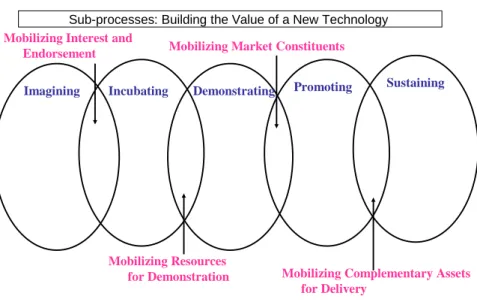
(18) In many industries, technological innovation is now the most important driver of competitive success. Firms in a wide range of industries rely on products developed within the past five years for more than one-third of their sales and profits. The increasing importance of innovation is due in part to the globalization of markets. Foreign competition has put pressure on firms to continuously innovate in order to produce differentiated products and services. 8. The Strategic Management of Technological Innovation Joseph Schumpeter, who wrote extensively on the subject of technology innovation, argues that entrepreneurs will seek to use technological innovation – a new product/ service or a new process of making it – to get strategic advantage. Thus, a firm’s strategy has a strong ties and an important influence on a firm’s innovation ability. Improving a firm’s innovation success rate requires a well-crafted strategy. A firm’s innovation projects should align with its resources and objectives, leveraging its core competencies and helping it achieve its strategic intent. A firm’s organizational structure and control system should encourage a generation of innovative ideas while also ensuring efficient implementation. A firm’s new product development process should maximize the likelihood of projects being both technically and commercially successful. To achieve these things, a firm needs the followings (Schilling, 2005): (1) An in-depth understanding of the dynamics of innovation (2) a well-crafted innovation strategy (3) well-designed processes for implementing the innovation strategy. 16.
(19) 2.2 Technology Commercialization 1. Definition of Technology Commercialization The process of introducing a new product into the market is called commercialization. Technology commercialization is the conversion of a body of work—that is, its intellectual property--into a stream of cash flow (Technology Commercialization & Partnership, 2006). It is also the process of helping universities, companies and inventors transform their innovative technologies into commercial products and services that are in market demand (Competitive Technology Inc., 2007). The actual launch of a new product is the final stage of new product development, and the one where the most money will have to be spent for advertising, sales promotion, and other marketing efforts. 2. Goal of Technology Commercialization No business activity is more heralded for its promise and approached with more justified optimism than the development and manufacture of new products or technology commercialization. Bringing new technologies to market has always been a central goal to business technology innovation. The purpose of technology commercialization of a firm may vary depending on each firms’ needs. Many studies have examined the purpose of technology commercialization, and generally found the following: (1) Set industry standards Setting standards that become another company’s barrier to entry or open up new markets; (2) Corporate renewal and redirection. 17.
(20) The excitement, imagination, and growth associated with the introduction of a new product invigorate the company’s best people and enhance the company’s ability to recruit new forces (Wheelwright and Sasser, 1989). (3) Maintaining growth and competitiveness Two forces, technology push and market pull, exist and interact with each other during the process of technology commercialization. Therefore, a successful technology commercialization not only will bring profit to a firm, but will also most importantly, strengthen a firm’s technology innovation abilities, and improve the quality of R&D employees. (4) Increase revenue and expand market share Through technology commercialization, a firm can earn additional financial income and transfer this income into R&D development costs or continue with product improvements. Therefore, through the cycle of continuing innovation, product improvement and profit generating, the firm is expected to succeed in its market position. In addition, through protection of intellectual property rights, sole ownership of the invented technology is owned by the firm and increase in product revenue and market share will be undefeatable. (5) Creating new commercial possibilities Many technologies are owned by multiple company departments or SBUs, and through effective integration, different types of technology portfolios can be formed. Not only can these technology portfolios be transferred for technology commercialization but many latent demands can be found, and new commercial possibilities can be explored from these technology portfolios (Adoutte, 1989).. 18.
(21) (6) Technology entrepreneurship In order for technology to be fully transformed in the value-added R&D process, many organizations transfer the new technology from its original firm to a newly formed organization, or a spin-off company. In addition, the behavior of technology commercialization is a direct path to intellectual power development, application of technology assets and business benefit creation (Chen,1999). 3. Process of Technology Commercialization (1) Sub-process: Building the Value of a New Technology Technology Commercialization is about performing a successful range of things, each adding value to the technology as it progresses. Being proficient at one or two things and clumsy at the rest brings down the average result; worse, it can halt a technology progression midstream. Technology Commercialization Process Sub-processes: Building the Value of a New Technology Mobilizing Interest and Mobilizing Market Constituents Endorsement Imagining. Incubating. Demonstrating. Mobilizing Resources for Demonstration. Promoting. Sustaining. Mobilizing Complementary Assets for Delivery. Bridges: Satisfying and Mobilizing Stakeholders at Each Stages. Figure 2.2 Technology Commercialization Process (Jolly, 1997). 19.
(22) Jolly (1997) proposed five key sub-processes (Diagram 2.2.3) involved in bringing new technologies to market, they are as follows: A. Imagining a techno-market insight: The notion of commercialization as a process of value recognition means that it starts at the idea stage itself. For technology-based innovations, this is when the prospects for a technical breakthrough get combined with a potentially attractive market opportunity. Competition in the commercialization process also actually starts right here. The competition for ideas, if anything, is as keen as the competition one sees between products and services in the marketplace – perhaps more so. It is here that most new technological discoveries get weaned out, despite the enormous work that may have gone into their elaboration. The judgment of whether ideas are worth pursuing is highly subjective. Some stakeholders place greater importance on the technical merit of ideas, while others are more attracted to their market potential. B. Incubating the technology to define its commercializability Getting a new idea recognized and endorsed to be worth pursuing is, of course, only the start. The commitment of resources and risk capital to develop it requires taking the idea a few steps further. The idea needs to be proved in some unequivocal manner, both technologically and in terms of the need(s) it is supposed to fulfill. The need to define commercializability well applies especially to lone inventors, university researchers, and small companies. They need to convince others about the. 20.
(23) potential a new technology offers in order to secure grants, obtain venture capital, or mobilize research support. C. Demonstrating it contextually in products and/or processes This is the stage associated with product development. Unlike other products, those that derive from a new technological capability require walking a tightrope between conceiving of something customers will buy and being able to implement it with the technology at hand. D. Promoting the latter’s adoption Very few inventions, no matter how well conceived and demonstrated, get an automatic reception by the market. As Myers and Sweezy found in studying 200 failed innovations, three-quarters of them were stopped only after they had made it to the pilot test stage; as many as one-fifth were actually stopped at the final, most expensive stage of production installation. In other words, 85 percent of all innovations that ultimately failed continued to be funded beyond the relatively economical phase of assessment and initiation. By far the greatest cause of their subsequent failure lay in the marketplace. As many as 27.5 percent of new product and process technologies were scuttled because of “uncontrollable” market factors. Another 26 percent failed because of limited sales potential and an inability to find buyers for something that was apparently developed “in the public interest.” Technology-based innovations encounter the problems any new product concept does – the need to create a market where usually none exists. For many new technologies the promotional challenge has two dimensions: The first is persuading people to adopt, this is especially true of technologies that require a new set of skills, work procedures,. 21.
(24) and standards before they become widely commercialized. These are what some refer to as “transilient innovations,” which set in motion a sequence of events that can disrupt, destroy, and make obsolete established competence, or create totally new organizations and industries. The second is the infrastructure that has to be created in order to deliver the technology’s full benefit.. Delivering a technology’s benefits does not necessarily. imply the creation of an altogether new infrastructure. Sometimes the challenge is getting parts of the infrastructure already in place to adopt it. E. Sustaining commercialization The key to realizing value from any new technology, of course, is to make sure the products and processes incorporating it enjoy a long presence on the market and that a fair share of the long-term value they generate are appropriated by the technology initiator. With rapid product (and technology) obsolescence and the constant entry of new competitors, this is often the hardest part. In fact, it is precisely here that many start-up companies fail. However, to extend the life of technology commercialization, three key factors should be kept in mind: a.. The integration of technology and product development process; setting up a consolidated market position; and enhancing the application of the technology. b.. Expanding the application range of the new technology by transferring the technology into new markets or new application departments. c.. Assuring the hold of the key technology to ensure the long term benefit for the inventor. 22.
(25) (2) Bridging: Satisfying and Mobilizing Stakeholders at Each Stage As important as these sub-processes are, there are also four bridges between these sub-processes. While the former involve problem solving of a technical or marketing nature (i.e. doing things to the technology), these bridges are associated with mobilizing resources around them (i.e. satisfying the various stakeholders of the technology at each stage). By bridging the subprocesses successfully, firms can create enough value in a predecessor stage to make a technology worth taking further, and mobilizing the stakeholders concerned with the next stage and convincing them of its future potentials. The bridges (Jolly, 1997) are as follows: A. Mobilizing Interest and Endorsement Mobilizing interest and endorsement is the first bridge between imagining an idea and assembling resources for the research and development phase associated with proving its worth. It involves mobilizing interest on the part of those whose support is needed at that point to take it further. B. Mobilizing Resources for Demonstration Mobilizing resources for demonstration is the link between the technology in its generic form and the development of marketable products incorporating it. This involves mobilizing a considerably greater amount of resources and seeking the cooperation of a larger number of actors both within and outside an organization. It involves the transition from interest and encouragement to a commitment on the part of backers. C. Mobilizing Market Constituents The bridge of mobilizing market constituents relates to the acceptance of the product incorporating a new technology by the first set of customers as well as a host of. 23.
(26) market constituents. The latter include suppliers of complementary products and the infrastructure needed for users to benefit fully from the technology, competitors helping to get the technology established as a standard solution for particular problems, as well as “lead users” and third parties that pay an important role in any new technology’s acceptance.. D. Mobilizing Complementary Assets for Delivery The final bridge, mobilizing complementary assets for delivery, relates to a broader diffusion of the technology, without which it will have only an ephemeral impact. (3) The changing cast of stakeholders to be Mobilized Jolly (1997) mentioned that the value of a technology at each stage is ultimately not measured by the investment made, nor by the standards of technical achievement, nor even by the knowledge accumulated over time. It is measured by what stakeholders relevant to that stage perceive in the technology. In the early stage, the relevant stakeholders might be scientific peers or venture capitalists; later, during the demonstration phase, the primary stakeholders might be various resource providers and potential customers; finally, when the finished product or process is ready for market launch, a host of market constituents, including suppliers, intermediate adopters, competitors and end-users can be involved. Performing the various technical and marketing activities proficiently at each stage, therefore, needs to be combined with actively interesting the relevant stakeholders and managing their expectations.. 24.
(27) This stakeholder management challenge is particularly great for technologies that change the basis of competition and that require a new pattern of delivery. Here, not only are the usually early-stage stakeholders to be satisfied by a number downstream market constituents mobilized as well. 4. Risks and Pitfalls related to Technology Commercialization (1) Risks Related to Technology Commercialization There are some risks related to technology Commercialization, which Professor Liu (2007) has mentioned as follows: A. The growth of the invested industry is not as high as expected B. The business and management experience of the high tech firm’s technical team is not sufficient C. Brain drain of professionals and technical personnel due to long term deficit and loss D. Profit gain deteriorating due to harsh rivalry from business competitors E. Problems occur in technology development, product exploitation and marketing that cannot be overcome F. Expected profit income has not occurred, yet the demand and financial gap for business capital is expanding. Thus, the company is facing financial difficulties G. Professionals’ over optimistic estimation in the business plan and over confidence with the new technology, resulting in the neglect of possible risks and dangers H. Differences of opinions and cognition dissonance regarding business and management strategies between primary shareholders and management teams;. 25.
(28) I. Controversy and disputation concerning the use of technology patents or intellectual properties; J. Serious income loss due to misjudgments of the firm’s business strategy. (2) Obvious Pitfalls related to new product development In addition, great promises of new product development are seldom fully realized due to the following pitfalls (Wheelwright and Sasser, 1989): A. The moving target: The basic product concept misses a shifting market or the company may make assumptions about channels of distribution that don’t hold up. Sometimes projects get into trouble due to inconsistencies in focus (i.e. start with a stripped-down version and wind up with a load of options). B. Lack of product distinctiveness: The designer fails to consider a full range of alternatives to meet customer needs. C. Unexpected technical problems: Delays and cost overruns because of overestimates of the company’s technical capabilities or simply its lack of depth and resources. D. Mismatches between functions: One part of the organization has unrealistic or even impossible expectations of another (i.e. Engineering may design a product that the company’s factories cannot produce). 5. Tactics related to Technology Commercialization (1) Timing of Entry The company has to decide on the introduction timing. Generally, firms try to decrease their development cycles in order to decrease their costs, and to increase their timing of entry options, but this does not imply that firms should always be racing to. 26.
(29) introduce their products as early as possible. When facing the danger of cannibalizing the sales of the company’s other products, if the product can be improved further, or if the economy is down, the launch should be delayed. A firm can strategically use entry timing to take advantage of business cycles or seasonal effects, to position products with respect to previous generations of related technologies, and to ensure that production capacity and complementary goods or services are in place (Schilling, 2005). (2) Compatibility of the new technology In deploying a technological innovation, often a firm must decide how compatible its technology is with that provided by others or with previous generations of its own technology. If there is an existing technology with a large installed base or availability of complementary goods, the firm can sometimes leverage the value of that installed base and complementary goods by making its technology compatible with current products. If the firm wishes to avoid giving away its own installed base or complementary goods advantages to others, it may protect them by ensuring its products are incompatible with those of future entrants. (3) Marketing The company has to decide who their primary target consumers are. In this way it can concentrate its distribution and promotion resources. The marketing strategy for a technological innovation must consider both the nature of the target market and the nature of the innovation. The three most commonly used marketing methods include advertising, promotions and publicity/public relations (Schilling, 2005). Many firms use advertising to build public awareness of their technological innovation. The media used is generally chosen based on its match to the target audience, the richness of information or. 27.
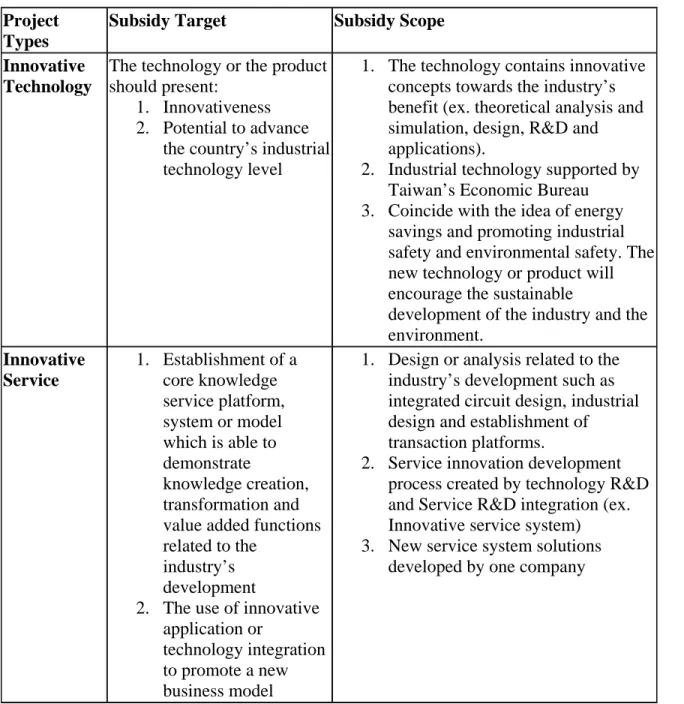
(30) sensory detail it can convey, the reach (the number of people exposed), and the cost per exposure. Firms can also use promotions at the distributor or customer level to stimulate purchase or trial. Promotions are usually temporary selling tactics that might include: offering samples or free trials, offering cash rebates after purchase, and offering incentives for repeat purchase. Finally, many firms use free publicity to effectively generate word of mouth. Free publicity such as articles that appear in a newspaper or magazine about the company or its product can generate awareness, and reach and influence target markets.. 28.
(31) 2.3 SMEs and Small Business Innovation Research (SBIR) 1. Small and Medium Enterprises (SMEs) (1) Definition of SMEs The term SME covers a wide range of definitions and measures, varying from country to country and between the sources reporting SME statistics. Some of the commonly used criteria are the number of employees, total net assets, and sales and investment level. However, the most common definitional basis used is employment, and here again, there is variation in defining the upper and lower size limits of an SME. Despite this variance, a large number of sources define an SME to have a cut-off range of 0-250 employees (Ayyagari, M, Beck T. and Demirgüç-Kunt A., 2003) (2) The Importance of SMEs Over the decades, governments around the world have started to focus their research funds on small and medium businesses, recognizing the importance of these businesses in modern economies. For one thing, SMEs are an important driving force for innovation and they can be as innovative as larger enterprises (Brown, 1998). In addition, for most countries, SMEs occupy the great majority of all economic business activities around the world. Taking Taiwan as an example, there was total of 1.23 millions SMEs or 97.8% SMEs by the end of 2006 (SMEA, 2006). Other advanced industrial societies offer similar profiles. 2. Small Business Innovation Research (SBIR) (1) How does the government support SMEs The government supports the innovation activities of SMEs in many different ways both directly and indirectly. When the source of the funding supporting SME innovation. 29.
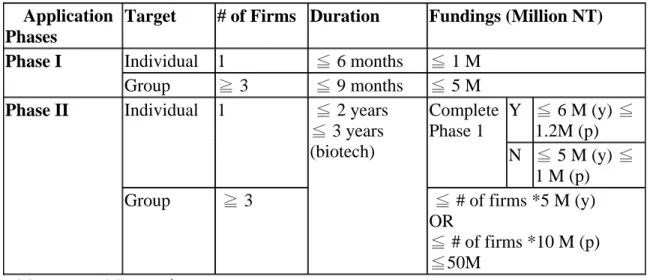
(32) comes directly from the governments’ finance capitals, it’s called “direct support of SMEs innovation policy.” The purpose of this kind of policy is to confirm that the funds go to these innovative SMEs directly, and programs such as the SBIR program of the USA, the SMART program of the UK, the ANVAR program of France and the IRAP program of Canada are identified in this category. There is also the “indirect support of SMEs innovation policy” which is referred to when the source of the funding supporting SME innovation is through intermediate organizations. The purpose of this kind of policy is to help SMEs solve developing problems, and programs such as the EIF of the EU investment bonds, the SBIC of the US small business investing firms and the EIS of the UK enterprise investing plan are included in this category (Technology Innovation Fund Center, 2005). (2) The role of SBIR Small Business Innovation Research (SBIR) is the name of a U.S. federal government grant program administered by the Small Business Administration (SBA) that provides funding solely to small, for-profit businesses to develop and commercialize certain technologies (GoBigMedia, 2007). The goal of the SBIR program is to encourage small businesses to explore their technological potential and provide the incentive to profit from its commercialization. By including qualified small businesses in the nation's R&D arena, high-tech innovation is stimulated and the government gains entrepreneurial spirit as it meets its specific research and development needs (SBA, 2007). 3. SBIR of Taiwan Small Business Innovation Research (SBIR) of Taiwan started in February, 1999 in Taiwan. The goal of this project is to drive and promote the innovation and research. 30.
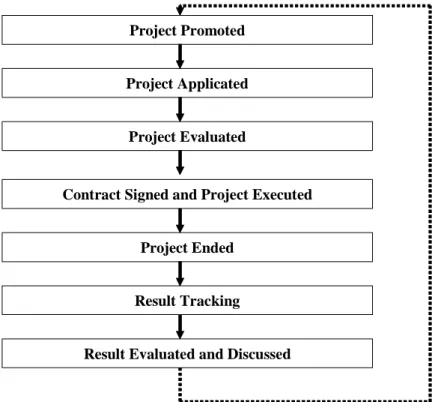
(33) activities of small and medium enterprises in Taiwan. In addition, the research outcomes are expected to nurture the growth of the industry, and accelerate Taiwan’s economic development. As of October, 2006, the SMEA of Taiwan has passed research funding to over 1896 innovation research projects and an accumulation of 4.04 billion Taiwan dollars. (1) Qualification Requirement of SBIR Firms established under “company law” and conform to the following are qualified to apply for the SBIR project: A. Paid-in capital ≦ 80 million NT dollars B. Number of employees ≦ 200 C. No record of overdue tax payments D. No record of cancellation in participated governmental technological projects in the past 5 years (2) Types of SBIR projects Types of Research encouraged by the program include: A. Developing a brand new idea, concept or new technology B. Applying an existing technology to a new application C. Applying a new technology or business model to an existing application D. Improving an existing technology or product upon various aspects The SBIR project is also divided into 2 categories: Innovation Technology and Innovation Service. The subsidy targets and scope of these 2 types of projects are explained as follows:. 31.
(34) Table 2.1 Types of SBIR projects Project Subsidy Target Subsidy Scope Types 1. The technology contains innovative Innovative The technology or the product concepts towards the industry’s Technology should present: 1. Innovativeness benefit (ex. theoretical analysis and 2. Potential to advance simulation, design, R&D and the country’s industrial applications). technology level 2. Industrial technology supported by Taiwan’s Economic Bureau 3. Coincide with the idea of energy savings and promoting industrial safety and environmental safety. The new technology or product will encourage the sustainable development of the industry and the environment. 1. Establishment of a 1. Design or analysis related to the Innovative core knowledge industry’s development such as Service service platform, integrated circuit design, industrial system or model design and establishment of which is able to transaction platforms. demonstrate 2. Service innovation development knowledge creation, process created by technology R&D transformation and and Service R&D integration (ex. value added functions Innovative service system) related to the 3. New service system solutions industry’s developed by one company development 2. The use of innovative application or technology integration to promote a new business model. 32.
(35) (3) The Application Types and Subsidy Methods The applications are categorized in two phases: A. Phase I : To evaluate scientific technical feasibility as well as industrial impact of an innovative idea or application B. Phase II : To implement R&D upon related technology and product based on an innovative and precise technical target which has completed a feasibility evaluation The application target, duration of each project and the funding are explained as follows:. Table 2.2 The Application Types and Subsidy Methods Application Target Phases Individual Phase I Group Individual Phase II. Group. # of Firms Duration 1 ≧3 1. ≦ 6 months ≦ 9 months ≦ 2 years ≦ 3 years (biotech). ≧3. (y) : a year; (p): a project. 33. Fundings (Million NT) ≦1M ≦5M Complete Y ≦ 6 M (y) ≦ Phase 1 1.2M (p) N ≦ 5 M (y) ≦ 1 M (p) ≦ # of firms *5 M (y) OR ≦ # of firms *10 M (p) ≦50M.
(36) (4) Application Process of SBIR The application Process of SBIR projects are as follows:. Project Promoted. Project Applicated. Project Evaluated. Contract Signed and Project Executed. Project Ended. Result Tracking. Result Evaluated and Discussed. Figure 2.3 Application Process of SBIR. 34.
(37) 2.4 SBIR participants and Technology Commercialization 1. The Importance of Innovation to SMEs A major issue for all SMEs is how to survive by maintaining or increasing market share through innovation (Brown, 1998). The drivers of SME innovativeness include market anticipation, customer focus, commitment of CEO/owners in NPD, processes and new ways of working. Furthermore, innovation in SME particularly was based more around developing new ways of working than new product innovations (Laforet and Tann, 2006). 2. Purpose of Technology Commercialization for SMEs Bringing new technologies to market has always been a central goal to business technology innovation. The purpose of technology commercialization of a firm may vary depending on each firms’ needs. Many studies have examined the purpose of technology commercialization in SMEs, and generally found the following: (1) Maintaining growth and competitiveness Two forces, technology push and market pull, exist and interact with each other during the process of technology commercialization. Therefore, a successful technology commercialization not only will bring profit to a firm, but will also most importantly, strengthen a firm’s technology innovation abilities, and improve the quality of R&D employees. (2) Increase revenue and expand market share Through technology commercialization, a firm can earn additional financial incomes and transfer these incomes into R&D development costs or continue with product improvements. Therefore, through the cycle of continuing innovation, product. 35.
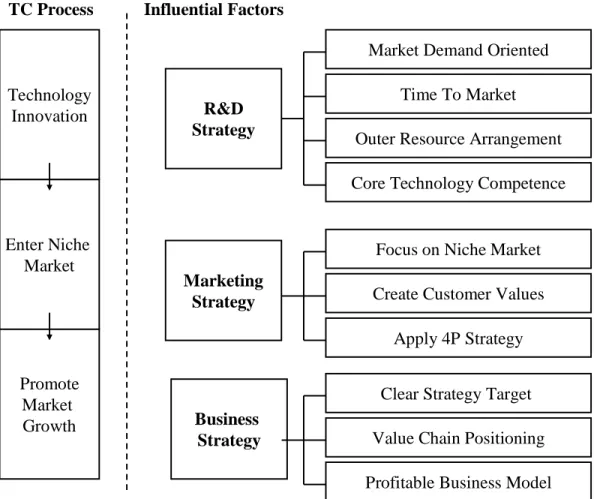
(38) improvement and profit generating, the firm is expected to succeed in its market position. In addition, through protection of intellectual property rights, sole ownership of the invented technology is owned by the firm and increase in product revenue and market share will be undefeatable. (3) Creating new commercial possibilities Many technologies are owned by multiple company departments or SBUs, and through effective integration, different types of technology portfolios can be formed. Not only can these technology portfolios be transferred for technology commercialization but many latent demands can be found, and new commercial possibilities can be explored from these technology portfolios (Adoutte, 1989). (4) Technology entrepreneurship In order for technology to be fully transformed in the value-added R&D process, many organizations transfer the new technology from its original firm to a newly formed organization, or a spin-off company. In addition, the behavior of technology commercialization is a direct path to intellectual power development, application of technology assets and business benefit creation. 3. Technology Commercialization Process for SBIR participants As mentioned before, the SBIR project is divided into 2 phases, phase 1 focuses on promoting innovative ideas and applications and phase 2 focuses on implementing R&D upon related technology and products based on an innovative and precise technical target. However, the toughest thing about technology commercialization is not the technology R&D itself but to turn that technology into a product and be able to profit from the product successfully. Almost 85 percent of all innovations that ultimately failed. 36.
(39) continued to be funded beyond the relatively economical phase of assessment and initiation. And, as many as 27.5 percent of new products and process technologies were scuttled because of “uncontrollable” market factors. Another 26 percent failed because of limited sales potential and an inability to find buyers for something that was apparently developed “in the public interest.”(Jolly, 1997) In other words, after the technology is developed or the SBIR project is ended, firms still have a long way to go before the technology is commercialized Compared with Taiwan’s SBIR project, the USA has an extra phase for their SBIR project – Phase 3. Phase III is the period during which Phase II innovation moves from the laboratory into the marketplace. Although no SBIR funds are available, the small firms can seek private capitals or non-SBIR federal agency funding such as CAP plan held by NIH to support this phase’s capital expenses. As for Taiwan’s SBIR participants, no such extra phase exists. Therefore, these firms must put extra effects into seeking potential investors, investing banks or venture capitalists in order to support their technology commercialization activities.. 4. Potential Concerns of Technology Commercialization for SBIR Participants Since the SBIR project, as mentioned above, is a very technology oriented government project, the qualification for the SBIR plan encourages and requires firms to submit innovative technologies in order to receive subsidies. The advantage of this is that innovative technology can be developed and technological potentials can be explored in a brief period. However, the downside of this policy is that these firms with an exceptionally strong technology background, have little or no knowledge regarding the marketing and commercialization of their technologies when they apply for the SBIR. 37.
(40) project. This will probably still be the case even after their project is completed. Therefore, it is possible that by focusing too much on the technology itself, both the government organization and the SBIR applicants fail to evaluate the technology’s commercialization potential and concerns. 5. Research Framework Based on the above literature review, this paper aims to provide a better understanding of factors that influence the technology commercialization of SMEs which participated in the SBIR projects through a conceptual framework. The questions that the framework is intended to explain are listed as follows: (1) The Problems and Concerns of technology commercialization Although technology commercialization may sound like a simple concept, it is a complex process which involves several different factors. Most technology-based inventions never go beyond the conception stage. This is also why the wise capitalist avoids exploiting new inventions and why the shares of companies bringing a new technology to market get referred to as “binary events” – worth a lot or worth nothing. How do firms, especially SMEs with scarce resources and limited capitals, survive from these failures and uncertainties? (2) R&D Strategies carried out by SMEs and SBIR participants Most of these SBIR participants have a superior technology background and plentiful R&D experiences; however, more factors are included in a good R&D strategy such as the usage of outer resources, the development of core technology competence and the time of entry. What is the best time for a technology to enter the market? Since technology development and demonstrations often involve greater investment than. 38.
(41) realizing technology, what is the best combination for the company’s resource and capital arrangement? And in order to stay competitive in the market, how does a company find its own core competence? (3) Marketing Strategies carried out by SMEs and SBIR participants Marketing is often the weak area for SBIR participants since most company CEOs only have technology backgrounds. Nevertheless, firms must keep in mind and recognize the importance of their marketing strategies in order to succeed in technology commercialization. These strategies include focusing on a niche market, creating customer values, and developing 4P strategies. But how can a company locate its niche market? And how can a firm create maximum values for its customers, through a tight cooperative relationship? (4) Business Strategies carried out by SMEs and SBIR participants Finally, business and management strategies carried out by SBIR participants are also very important. The firm must carefully and precisely define its strategy goals and supply chain position. Furthermore, a profitable business model is a definite key to the success and outstanding performances of a firm. However, how do firms set up their strategy objectives? And what is the relationship between a successful business model and a firm’s technology commercialization activities? In order to understand where in commercialization, problems occurred, and why, and in order to identify what firms should beware of when developing their R&D marketing and business strategies, the conceptual framework of the technology commercialization of SBIR participants is developed as follows:. 39.
(42) TC Process. Influential Factors Market Demand Oriented. Technology Innovation. Time To Market. R&D Strategy. Outer Resource Arrangement Core Technology Competence. Enter Niche Market. Focus on Niche Market Marketing Strategy. Create Customer Values Apply 4P Strategy. Promote Market Growth. Clear Strategy Target Business Strategy. Value Chain Positioning Profitable Business Model. Figure 2.4 Conceptual Framework of Technology Commercialization. 40.
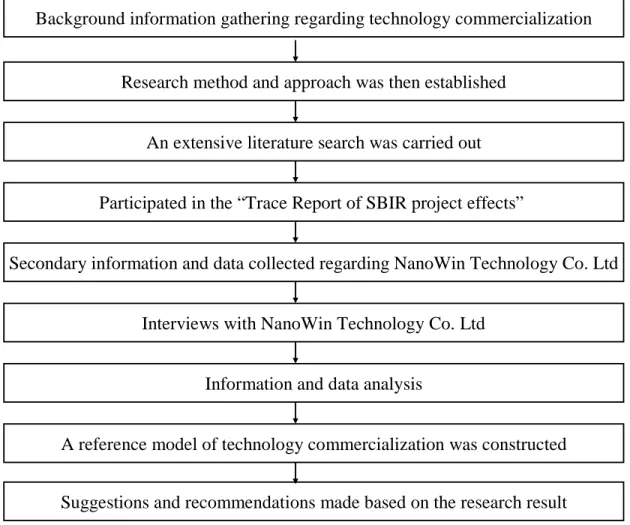
(43) Chapter 3 Design/Methodology/Approach 3.1 Research Method The paper’s research method is mainly based on the qualitative research method, or usually referred to as non-experimental research. In this category the researcher observes the phenomena as they occur naturally and does not intervene in any way. Types of designs in this category include descriptive research and correlational research (ex. post facto). Descriptive research design includes the following (Clark, 2000): A. Typical Descriptive Design: Examines characteristics of a single sample (explores aspects of phenomena of interest). B. Comparative Descriptive Design: Compares two or more groups that occur naturally in a setting (explores for differences). C. Case Study: Intensive exploration of a single unit of study (a person, family, group, community, or institution). D. Longitudinal descriptive: Studies a sample of individuals over time to examine patterns of change, growth, or trends across time. The research design or approach of this paper contains two main sources: a data analysis of “Trace Report of SBIR project effects” and a case study on one of the companies that participated in the SBIR project. In this way, a general picture of technology commercialization of SBIR participants can be formed from the data analysis and more details or concerns surrounding the issues related to technology commercialization can be carried out through extensive research and interviews with the interviewee company.. 41.
(44) 3.2 Research Data 1. Trace Report of SBIR project effects A typical descriptive design, as mentioned above, was used as the research method to collect and analyze the trace report of SBIR project effects. The data regarding technology commercialization was conducted as part of a wider study of the SBIR participants trace report in Taiwan. The data was collected via a questionnaire administered through the internet, fax or e-mails from The Taiwan Assessment and Evaluation Association (TWAEA). The principal questions of interest in this survey were the following: (1) An integrated investigation of each SBIR participant including A. The company’s general information B. The company’s operation and management C. The company’s R&D system and technology innovation characteristics D. SBIR projects’ major contributions to the company (i.e. Innovation strategy, R&D management and business strategy) E. SBIR project effects on the company’s innovation abilities F. The company’s satisfaction towards SBIR execution G. Expectations towards the government (2) Individual Traces report on SBIR projects A. General information of one individual SBIR project B. Evaluation of R&D results and technology commercialization of the individual SBIR project (i.e. statistics of R&D result and derive effects and benefits). 42.
(45) C. Relationships between the individual project and the company’s R&D strategy D. R&D alliance (i.e. satisfaction towards the alliance and outcomes of the alliance) E. Other suggestions The sample of 970 firms comprised 1169 SBIR projects with ending years between 1 to 5 years respectively. The majority of the projects were innovation technology projects (1161 projects or 99.32%) and then service innovation projects (8 projects or 0.68). 2. Case study on NanoWin Technology Co. Ltd The case study is one of several ways of doing social science research. Rather than using large samples and following a rigid protocol to examine a limited number of variables, case study methods involve an in-depth, longitudinal examination of a single instance or event. The researcher may gain a sharpened understanding of why the instance happened as it did, and what might become important to look at more extensively in future research ((Flyvbjerg, 2006). The case study target of this paper is NanoWin Technology Co. Ltd. Nanowin Technology Co., Ltd was established in Febuary 2003 at a research office in Tainan city by PhD students of National Cheng Kung University. The core technology of the company is to provide Nano-composition of surface treatment in the fields of precise molds, IC packaging and optical tools.. 43.
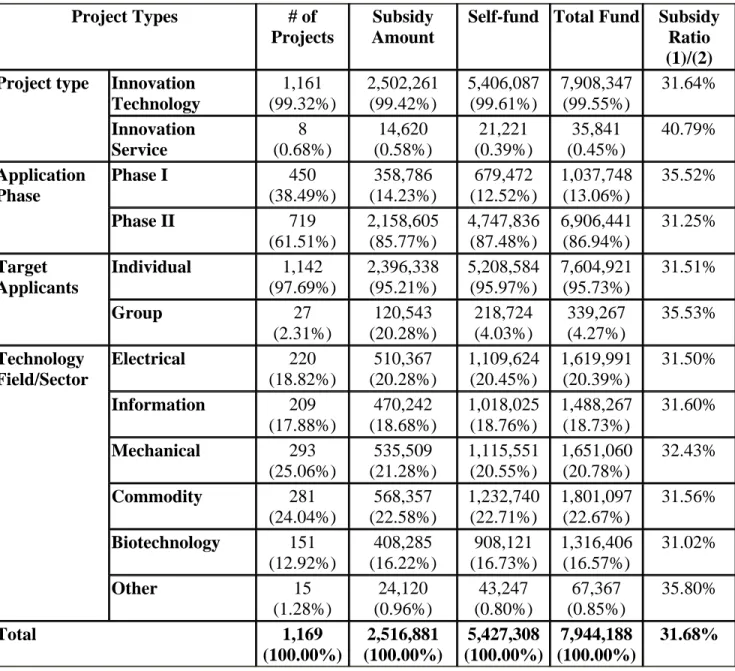
(46) An extensive literature search of the company and journals regarding technology commercialization was carried out first. Then a detailed interview and case study on NanoWin Technology Co. Ltd was preceded.. 3.3 Research Process The research process of this paper was performed as follows: 1. Background information gathering regarding technology commercialization 2. Research method and approach was then established 3. An extensive literature search of business magazines, journal databases, textbooks and relevant reports and citations was carried out 4. General information and relationships of SBIR participants and technology commercialization assembled by participating in the “Trace Report of SBIR project effects” 5. Secondary information and data collected regarding the targeted SBIR participant – NanoWin Technology Co. Ltd 6. Interviews with NanoWin Technology Co. Ltd 7. Information and data analysis 8. A reference model of technology commercialization of SBIR participants was constructed 9. Suggestions and recommendations made for SBIR participants’ future development regarding technology commercialization based on the research result. 44.
(47) Background information gathering regarding technology commercialization. Research method and approach was then established An extensive literature search was carried out Participated in the “Trace Report of SBIR project effects” Secondary information and data collected regarding NanoWin Technology Co. Ltd Interviews with NanoWin Technology Co. Ltd Information and data analysis A reference model of technology commercialization was constructed Suggestions and recommendations made based on the research result. Figure 3.1 Research Process. 45.
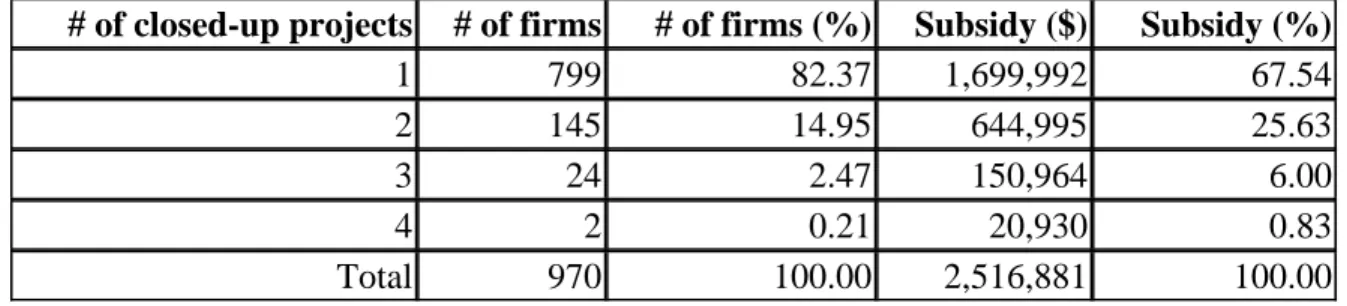
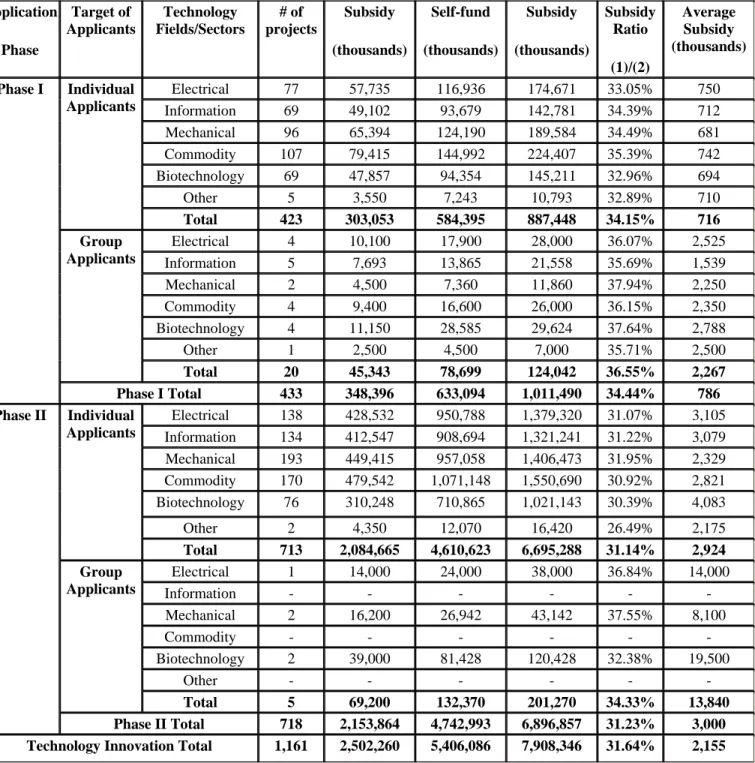
(48) Chapter 4 Trace Report of SBIR effect 4.1 Background information of SBIR participants The main purpose of the SBIR participants trace report was to evaluate each SBIR participant such as the company’s technology innovation characteristics and individual performance of the SBIR project participated. The data was collected via a questionnaire administered through the internet, fax or e-mails from The Taiwan Assessment and Evaluation Association (TWAEA). The sample of 970 firms comprised 1169 SBIR projects with ending years between 1 to 5 years respectively. The majority of the projects were innovation technology projects (1161 projects or 99.32%) and then service innovation projects (8 projects or 0.68). The analysis of the sample data collected for this report is as follows: 1. Analysis of repeatedly subsided firms The average applied SBIR projects for each firm is 1.2. The number of firms that applied for more than 3 projects is 26 firms (2.68%) and the total amount of their subsidies is around 171,894 NT dollars (6.83%). In addition, about 6.08% of firms got approved for more than 2 phase II projects. The analysis of repeatedly subsided firms is as follow: Table 4.1 Analysis of repeatedly subsided firms # of closed-up projects 1 2 3 4 Total. # of firms 799 145 24 2 970. # of firms (%) 82.37 14.95 2.47 0.21 100.00. 46. Subsidy ($) 1,699,992 644,995 150,964 20,930 2,516,881. Subsidy (%) 67.54 25.63 6.00 0.83 100.00.
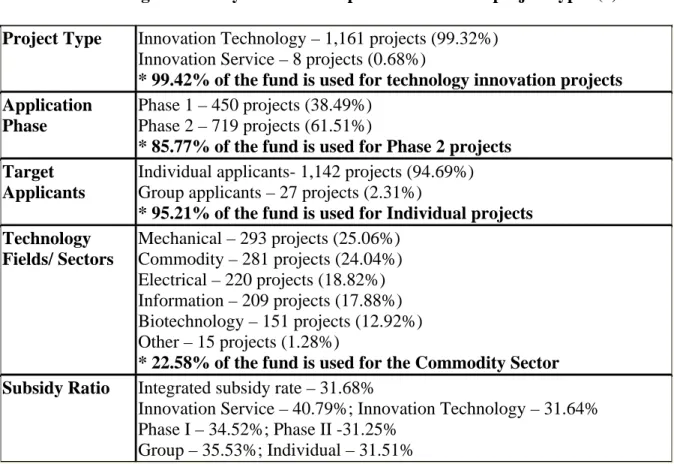
(49) 2. Integrated Analysis of closed-up projects. SBIR projects closed-up mostly in 2004, then 2003 and 2005; it terms of subsidy ratio, it is the highest for 2005 closed ups – 34.40%. The integrated analysis of closed-up projects is as follow: Table 4.2 Integrated Analysis of closed-up projects Closed-up year # of projects Subsidy amount Self-fund Total Fund Subsidy Ratio 2001 136 327,866 654,094 982,960 33.46% 2002 210 497,960 1,028,379 1,526,309 32.63% 2003 273 592,790 1,481,539 2,074,326 28.58% 2004 291 526,898 1,175,522 1,702,420 30.95% 2005 259 570,367 1,087,808 1,658,174 34.40% Total 1,169 2,516,881 5,427,308 7,944,188 31.68%. 3. Integrated Analysis of closed-up cases in terms project types Table 4.3 Integrated Analysis of closed-up cases in terms of project types (1) Project Type. Application Phase Target Applicants Technology Fields/ Sectors. Subsidy Ratio. Innovation Technology – 1,161 projects (99.32%) Innovation Service – 8 projects (0.68%) * 99.42% of the fund is used for technology innovation projects Phase 1 – 450 projects (38.49%) Phase 2 – 719 projects (61.51%) * 85.77% of the fund is used for Phase 2 projects Individual applicants- 1,142 projects (94.69%) Group applicants – 27 projects (2.31%) * 95.21% of the fund is used for Individual projects Mechanical – 293 projects (25.06%) Commodity – 281 projects (24.04%) Electrical – 220 projects (18.82%) Information – 209 projects (17.88%) Biotechnology – 151 projects (12.92%) Other – 15 projects (1.28%) * 22.58% of the fund is used for the Commodity Sector Integrated subsidy rate – 31.68% Innovation Service – 40.79%; Innovation Technology – 31.64% Phase I – 34.52%; Phase II -31.25% Group – 35.53%; Individual – 31.51%. 47.
(50) * In average, for every 1 NT dollar the government subsided, firms have to spend 2.16 NT dollars directly Table 4.4 Integrated Analysis of closed-up cases in terms of project types (P) Project Types. Project type. Application Phase. Innovation Technology Innovation Service Phase I Phase II. Target Applicants. Individual Group. Technology Field/Sector. Electrical Information Mechanical Commodity Biotechnology Other. Total. # of Projects. Subsidy Amount. 1,161 (99.32%) 8 (0.68%) 450 (38.49%) 719 (61.51%) 1,142 (97.69%) 27 (2.31%) 220 (18.82%) 209 (17.88%) 293 (25.06%) 281 (24.04%) 151 (12.92%) 15 (1.28%) 1,169 (100.00%). 2,502,261 (99.42%) 14,620 (0.58%) 358,786 (14.23%) 2,158,605 (85.77%) 2,396,338 (95.21%) 120,543 (20.28%) 510,367 (20.28%) 470,242 (18.68%) 535,509 (21.28%) 568,357 (22.58%) 408,285 (16.22%) 24,120 (0.96%) 2,516,881 (100.00%). 48. Self-fund Total Fund. 5,406,087 (99.61%) 21,221 (0.39%) 679,472 (12.52%) 4,747,836 (87.48%) 5,208,584 (95.97%) 218,724 (4.03%) 1,109,624 (20.45%) 1,018,025 (18.76%) 1,115,551 (20.55%) 1,232,740 (22.71%) 908,121 (16.73%) 43,247 (0.80%) 5,427,308 (100.00%). 7,908,347 (99.55%) 35,841 (0.45%) 1,037,748 (13.06%) 6,906,441 (86.94%) 7,604,921 (95.73%) 339,267 (4.27%) 1,619,991 (20.39%) 1,488,267 (18.73%) 1,651,060 (20.78%) 1,801,097 (22.67%) 1,316,406 (16.57%) 67,367 (0.85%) 7,944,188 (100.00%). Subsidy Ratio (1)/(2) 31.64% 40.79% 35.52% 31.25% 31.51% 35.53% 31.50% 31.60% 32.43% 31.56% 31.02% 35.80% 31.68%.
(51) 4. Analysis of closed-up projects in terms of different innovation fields The sample can be further divided by technology field/sector: (1) Innovation technology & Phase 1 projects: A. Group projects = 36.55% > Individual projects = 34.15% B. Average subsidy for every project: i.. Individual applicants Field/Sector Subsidy amount (in thousands) Electrical 750 Commodity 742 Information 712 Other 710 Biotechnology 694 Mechanical 681. ii.. Group applicants Field/Sector Subsidy amount (in thousands) Biotechnology 2,778 Electrical 2,525 Other 2,500 Commodity 2,350 Mechanical 2,250 Information 1,539. (2) Innovation technology & Phase II projects: A. Group projects = 34.33% > Individual projects = 31.14% B. Average subsidy for every project: i.. Individual applicants Field/Sector Subsidy amount (in thousands) Biotechnology 4,083 Electrical 3,105. 49.
(52) Information Commodity Mechanical Other ii.. 3,079 2,821 2,329 2,175. Group applicants Field/Sector Subsidy amount (in thousands) Biotechnology 19,500 Electrical 14,000 Mechanical 8,100. (3) Innovation Service & Phase I projects: A. Group projects = 43.94% > Individual projects = 30.79% B. Average subsidy for every project: i.. Individual applicants Field/Sector Information Other. ii.. Subsidy amount (in thousands) 900 745. Group applicants Field/Sector Other. Subsidy amount (in thousands) 3,000. (4) Innovation service & Phase II projects: A. Group projects = 49.46% B. Average subsidy for every project: i.. Individual applicants Field/Sector Other. Subsidy amount (in thousands) 4,740. 50.
數據
+7
Outline
Innovation, Technology and Technology Innovation
SMEs and Small Business Innovation Research (SBIR)
SBIR participants and Technology Commercialization
Company’s view towards Technology Commercialization
Risks and Pitfalls related to Technology Commercialization
Influential factors of technology commercialization
Research Suggestions
相關文件
Reading Task 6: Genre Structure and Language Features. • Now let’s look at how language features (e.g. sentence patterns) are connected to the structure
Promote project learning, mathematical modeling, and problem-based learning to strengthen the ability to integrate and apply knowledge and skills, and make. calculated
To take the development of ITEd forward, it was recommended in the Second Information Technology in Education Strategy “Empowering Learning and Teaching with Information
Like the governments of many advanced economies which have formulated strategies to promote the use of information technology (IT) in learning and teaching,
Now, nearly all of the current flows through wire S since it has a much lower resistance than the light bulb. The light bulb does not glow because the current flowing through it
Hence, we have shown the S-duality at the Poisson level for a D3-brane in R-R and NS-NS backgrounds.... Hence, we have shown the S-duality at the Poisson level for a D3-brane in R-R
This kind of algorithm has also been a powerful tool for solving many other optimization problems, including symmetric cone complementarity problems [15, 16, 20–22], symmetric
• Learn strategies to answer different types of questions.. • Manage the use of time
