
擁有同構鄰子圖的正則圖
37
0
0
全文
(2) 擁有同構鄰子圖的正則圖 Regular Graphs with Isomorphic Neighbor-Subgraphs 研 究 生:李昭芳. Student: Chao-Fang Li. 指 導 老 師:傅恆霖 教授. Advisor: Dr. Hung-Lin Fu. 國 立 交 通 大 學 應用數學系 碩. 士. 論. 文. A Thesis Submitted to Department of Applied Mathematics College of Science National Chiao Tung University In partial Fulfillment of Requirement For the Degree of Master In Applied Mathematics June 2004 Hsinchu, Taiwan, Republic of China. 中 華 民 國 九 十 三 年 六 月.
(3) 擁有同構鄰子圖的正則圖. 研 究 生:李昭芳. 指導老師:傅恆霖. 教授. 國 立 交 通 大 學 應 用 數 學 系. 摘. 要. 假如一個圖 G 中所有點都有相同的秩,那麼圖 G 是一個正則 圖。假如一個正則圖 G 中每一個點的鄰點所生成的子圖都跟圖 H 同構,則圖 G 稱做 H-正則。 在這篇論文中,首先我們將研究哪一種圖 H 使得沒有 H-正 則圖的存在(不被允許的圖 H ),接著對每一個”可能”的圖 H,我 們試著去建構出 H-正則圖。最後,我們提到關於擁有最少點數 的 H-正則圖的概念。那就是,對於一個給定的圖 H,討論點數 最少的 H-正則圖。. 中 華 民 國 九 十 三 年 六 月. i.
(4) Regular Graphs with Isomorphic Neighbor-Subgraphs Student: Chao-Fang Li. Advisor: Hung-Lin Fu. Department of Applied mathematics National Chiao Tung University Hsinchu 300, Taiwan, R.O.C.. Abstract. If all vertices of a graph G have the same degree, then G is a regular graph. A regular graph G is said to be H-regular if for each vertex v ∈ V (G), the graph induced by NG (v) is isomorphic to H. In this thesis, we shall first study for which H, an H-regular graph does not exist (forbidden H 0 s) and then, for each ”possible” H, we try to construct an H-regular graph. Finally, we mention the construction of H-regular graphs with smallest order, i.e., the extremal H-regular graph with a given H.. ii.
(5) 誌謝 首先感謝我的指導教授傅恆霖老師,在這些日子來不論是課業或是 論文的修正對我悉心的教導和關心,而在排球場上傅老師也是我們的教 練,在老師細心的教導及帶領下我們拿下不少的獎盃。最重要的是在待 人處事方面,傅老師常說: 「當學生不只是學習書上的知識,重點是要學 習待人處事的態度和方法。」這一點也一直深深的留在我腦海中。 同時也非常感謝系上所有的老師在課業上和生活上的幫助讓我在溫 馨的環境下完成學業,以及系上的助理小姐們對我的關心和照顧,讓不 常回家的我有一種像是在家一樣的感覺。 感謝嚴志弘學長、嘉芬學姐、許弘松學長、郭志銘學長、張飛黃學 長以及君逸、棨丰、抮君、啟賢還有所有組合和分析的同學,謝謝大家 在這段期間給我的照顧。另外,也感謝交大應數系排以及系女排的所有 人,讓我有很多美好的回憶。 最後感謝我的父母,是他們給我最大的支持,讓我在無憂慮的情況 下完成學業,是他們陪我走過這一個重要的階段。. iii.
(6) Contents Abstract (in Chinese). i. Abstract (in English). ii. Acknowledgment. iii. Contents. iv. List of Figures. v. 1. 1. Introduction and Preliminaries 1.1. Motivation . . . . . . . . . . . . . . . . . . . . . . . . . . . . . . . . . . . .. 1. 1.2. Graph terms . . . . . . . . . . . . . . . . . . . . . . . . . . . . . . . . . . .. 2. 1.3. Some special regular graphs . . . . . . . . . . . . . . . . . . . . . . . . . .. 5. 2 H-regular graphs. 10. 2.1. Forbidden H 0 s . . . . . . . . . . . . . . . . . . . . . . . . . . . . . . . . . . 10. 2.2. Constructions of H-regular graphs . . . . . . . . . . . . . . . . . . . . . . . 14. 2.3. H-regular graphs of small orders . . . . . . . . . . . . . . . . . . . . . . . . 17. 2.4. Extremal problem . . . . . . . . . . . . . . . . . . . . . . . . . . . . . . . . 28. 3 Concluding Remark. 29. References. 30. iv.
(7) List of Figures 1. The Petersen graph . . . . . . . . . . . . . . . . . . . . . . . . . . . . . . .. 5. 2. Examples of some (k, g)-cage . . . . . . . . . . . . . . . . . . . . . . . . . .. 6. 3. Examples of strongly regular graphs . . . . . . . . . . . . . . . . . . . . . .. 6. 4. Some of strongly regular graphs are H-regular graph . . . . . . . . . . . .. 7. 5. An O3 -regular graph which is not a vertex transitive graph . . . . . . . . .. 9. 6. C3 -regular graph . . . . . . . . . . . . . . . . . . . . . . . . . . . . . . . . 17. 7. C4 -regular graph . . . . . . . . . . . . . . . . . . . . . . . . . . . . . . . . 17. 8. C5 -regular graph . . . . . . . . . . . . . . . . . . . . . . . . . . . . . . . . 18. 9. C6 -regular graph . . . . . . . . . . . . . . . . . . . . . . . . . . . . . . . . 18. 10. C7 -regular graph . . . . . . . . . . . . . . . . . . . . . . . . . . . . . . . . 19. 11. P4 -regular graph . . . . . . . . . . . . . . . . . . . . . . . . . . . . . . . . 20. 12. P5 -regular graph . . . . . . . . . . . . . . . . . . . . . . . . . . . . . . . . 20. 13. P6 -regular graph . . . . . . . . . . . . . . . . . . . . . . . . . . . . . . . . 21. 14. P7 -regular graph . . . . . . . . . . . . . . . . . . . . . . . . . . . . . . . . 22. 15. All graphs of order 5 . . . . . . . . . . . . . . . . . . . . . . . . . . . . . . 25. 16. (P3 ∪ P2 )-regular graph . . . . . . . . . . . . . . . . . . . . . . . . . . . . . 26. v.
(8) 1 1.1. Introduction and Preliminaries. Motivation. In the study of graph theory, regular graphs play the most important role. Almost all graphs with good structures, say connectivity, are regular. Not only this reason, when we plan to study some properties, it is better off to start with considering regular graphs. For example, bridgeless cubic graphs have been mentioned here and there. Anyway, it is nice to be regular. In order to construct a graph with much better structure, we may also assign certain constraints to the graphs we construct. Say, if we assume that the smallest cycle length (girth) to be g, then we have an (r, g)-graph(r-regular graph with girth g). An (r, g)-graph with smallest order is the well-known (r, g)-cage. See [4] for a survey. On the other hand, if we let a k-regular graph whose adjacent pairs have λ common neighbors, and whose nonadjacent pair have µ common neighbors, then we have a strongly regular graph. The study of strongly regular graphs is also an important topic in Algebraic graph theory, see [1]. In this thesis, we shall study a new type of regular graphs. This notion was first mentioned to us by D. Hoffman a couple of years ago. The structure of such graphs is also very symmetrical. A regular graph G is said to be H-regular if for each vertex v belong to G, the graph induced by the neighbors of v is isomorphic to H. Since all graphs induced by the neighbors are isomorphic, in what follows, we call an H-regular graph a ”neighbor-regular” graph.. 1.
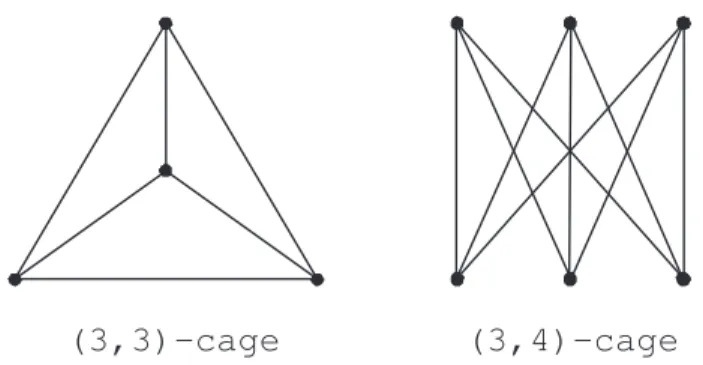
(9) 1.2. Graph terms. In this section we present those definitions and basic properties what will be assumed throughout the rest of this thesis. For those terms not included the readers can refer to [3] for reference. A graph G consists of a finite non-empty set V (G) of vertices and a finite set E(G) of distinct unordered pairs of distinct vertices called edges. The number of vertices of G is called the order of G and denoted by v(G). The number of edges of G is called the size of G and denoted by e(G). If e = uv is an edge of G, then u and v are called its endpoints. Two or more edges joining the same pair of vertices are called multiple edges. A loop is an edge whose endpoints are equal. A graph is simple if it has no loops and multiple edges. Throughout of this thesis we consider only simple graphs. If e = uv is an edge of G, then e is said to join the vertices u and v, and these vertices are then said to be adjacent. If u is adjacent to v, then it is denoted by u ∼ v. We also say that e is incident to u and v, and that v is a neighbor of u; the neighborhood NG (u) of u is the set of all vertices of G adjacent to u, the closed neighborhood NG [u] of u is the union of NG (u) and u. Two edges incident to the same vertex are adjacent edges. A matching in G is a set of edges no two of which are adjacent. Two graphs are isomorphic if there is a one-to-one correspondence between their vertex-sets which preserves the adjacency of vertices. An isomorphism from a graph G to itself is called an automorphism of G. An automorphism is therefore a permutation of the vertices of G that maps edges to edges and nonedges to nonedges. A subgraph of a graph G is a graph H such that V (H) ⊆ V (G) and E(H) ⊆ E(G), 2.
(10) denoted H ⊆ G. If V (H) = V (G), then H is called a spanning subgraph of G. If W is any set of vertices in G, then the subgraph induced by W is the subgraph of G obtained by joining those pairs of vertices in W what are joined in G. Any induced subgraph G[W ] of G is a subgraph induced by the subset W of V (G). If e is an edge of G, then the edge-deleted subgraph G − e is the graph obtained from G by removing the edge e. Similarly, if v is a vertex of G, then the vertex-deleted subgraph G − v is the graph obtained from G by removing the vertex v together with all its incident edges. For each vertex v in a graph G, the number of edges incident to v is the degree of v, denoted by deg(v) or d(v). The maximum and minimum degrees in G are denoted by 4(G) and δ(G) respectively. A vertex of degree 0 is called an isolated vertex, and a vertex of degree 1 is called an end-vertex. If all vertices of G have the same degree, then G is a regular graph; if each degree is k, then G is a k-regular graph. A 0-regular graph (that is, one with no edges) is a null graph, and a 3-regular graph is a cubic graph. A sequence of edges v0 v1 , v1 v2 , . . . , vr−1 vr (sometime abbreviated to v0 v1 . . . vr ) is a walk of length r from v0 to vr . If these edges are all distinct, then the walk is a trail, and if the vertices v1 , v2 , . . . , vr are also distinct, then it is a path and denoted by [v0 , v1 , . . . , vr ]. A walk in which v0 , v1 , . . . , vr , are all distinct except for v0 and vr is a cycle. The girth of a graph with a cycle is the length of its shortest cycle. A graph with no cycle has infinite girth. The union G ∪ H of two disjoint graphs G and H is the graph having vertex set 3.
(11) V (G) ∪ V (H) and edge set E(G) ∪ E(H). The graph obtained by taking the union of graphs G and H with disjoint vertex sets is the disjoint union, written G + H. The join of simple graphs G and H, written G ∨ H, is the graph obtained from the disjoint union G+H by adding the edges {xy : x ∈ V (G), y ∈ V (H)}. The Cartesian product G2H of two disjoint graphs G and H is the graph having the vertex set V (G) × V (H) and edge set {(u1 , v1 )(u2 , v2 ) : u1 = u2 and v1 v2 ∈ E(H) or v1 = v2 and u1 u2 ∈ E(G)}. The Cartesian product G2G2 · · · 2G(n-tuple) is denoted by Gn . A graph G is connected if there is a path joining each pair of vertices of G, or equivalently if G cannot be expressed as the union of two vertex disjoint graphs; a graph which is not connected is disconnected. A graph in which every two vertices are adjacent is complete graph; the complete graph with n vertices and n(n-1)/2 edges is denoted by Kn . The cycle graph Cn of order n consists of the vertices and edges of a n-gon, and the path graph Pn is obtained by removing an edge from Cn . The null graph On is the graph with n vertices and no edges. A matching with n edges is denoted by Mn . A bipartite graph is one whose vertex-set can be partitioned into two sets so that each edge joins a vertex of the first set to a vertex of the second set. A complete bipartite graph is a bipartite graph in which every vertex in first set is adjacent to every vertex in the second set. If the two sets contain r and s vertices respectively, then the complete bipartite graph is denoted by Kr,s ; a complete bipartite graph of the form K1,t is called a star graph and denoted by St . A connected graph which contains no cycle is a tree. A complete balanced m-partite graph with each partite set of size n is denoted by Km(n) = On ∨ On ∨ · · · ∨ On (m-tuple).. 4.
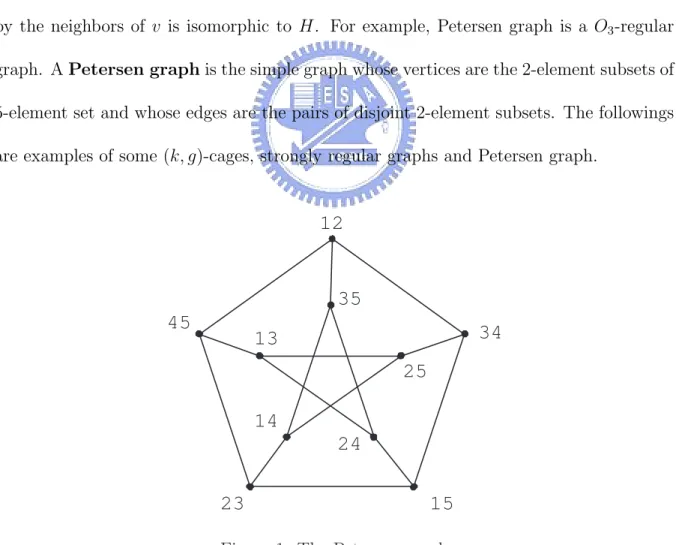
(12) 1.3. Some special regular graphs. In this section we present some regular graphs with special conditions. A simple n-vertex graph G is strongly regular if there are parameters k, λ, µ such that G is k-regular, every adjacent pair of vertices have λ common neighbors, and every nonadjacent pair of vertices have µ common neighbors, written (n, k, λ, µ)-graph. For example, Petersen graph is a strongly regular graph with n = 10, k = 3, λ = 0, µ = 1. A k-regular graph with girth g is a (k, g)-graph. A (k, g)-graph with the smallest order is called a (k, g)-cage. For example, Petersen graph is a (3, 5)-cage. For more information about cages, see [4] for reference. A regular graph G is said to be H-regular if for each vertex v ∈ G, the graph induced by the neighbors of v is isomorphic to H. For example, Petersen graph is a O3 -regular graph. A Petersen graph is the simple graph whose vertices are the 2-element subsets of 5-element set and whose edges are the pairs of disjoint 2-element subsets. The followings are examples of some (k, g)-cages, strongly regular graphs and Petersen graph.. 12. 35 45. 34. 13 25 14 24 23. 15. Figure 1: The Petersen graph. 5.
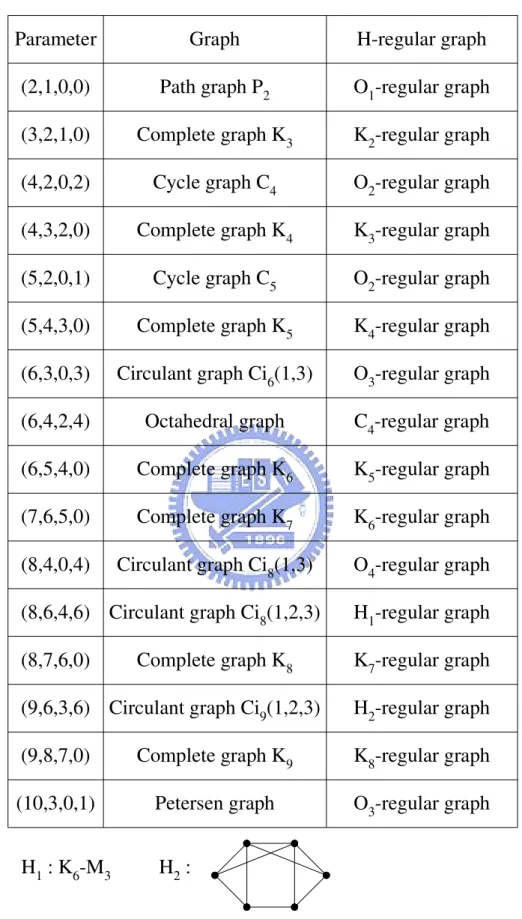
(13) (3,3)-cage. (3,4)-cage. Figure 2: Examples of some (k, g)-cage. Parameter. Graph. (5,2,0,1). (6,4,2,4). Figure 3: Examples of strongly regular graphs. Since Kk+1 is a (k, 3)-cage and a (k, g)-cage is a triangle-free graph for each g ≥ 4. Hence, we have. Proposition 1.3.1. A (k, g)-cage is a Kk -regular graph for g = 3 and it is an Ok -regular graph for g ≥ 4. As to strongly regular graphs, it seems that all graphs obtained in literatures are H-regular graphs for some H. We list some graphs in the following table. 6.
(14) Parameter. Graph. H-regular graph. (2,1,0,0). Path graph P2. O1-regular graph. (3,2,1,0). Complete graph K3. K2-regular graph. (4,2,0,2). Cycle graph C4. O2-regular graph. (4,3,2,0). Complete graph K4. K3-regular graph. (5,2,0,1). Cycle graph C5. O2-regular graph. (5,4,3,0). Complete graph K5. K4-regular graph. (6,3,0,3). Circulant graph Ci6(1,3). O3-regular graph. (6,4,2,4). Octahedral graph. C4-regular graph. (6,5,4,0). Complete graph K6. K5-regular graph. (7,6,5,0). Complete graph K7. K6-regular graph. (8,4,0,4). Circulant graph Ci8(1,3). O4-regular graph. (8,6,4,6) Circulant graph Ci8(1,2,3). H1-regular graph. (8,7,6,0). K7-regular graph. Complete graph K8. (9,6,3,6) Circulant graph Ci9(1,2,3). H2-regular graph. (9,8,7,0). Complete graph K9. K8-regular graph. (10,3,0,1). Petersen graph. O3-regular graph. H1 : K6-M3. H2 :. Figure 4: Some of strongly regular graphs are H-regular graph 7.
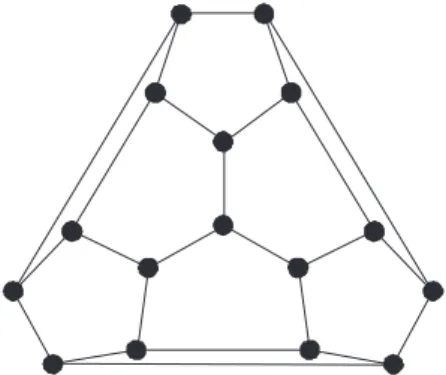
(15) Let D be a subset of {1, 2, . . . , bn/2c}. A circulant graph Cin (D) is a graph with vertex set V (G) = Zn , and edge set E(G) = {i ∼ j | d(i, j) ∈ D, ∀i, j ∈ Zn }, where d(i, j) =def min{| i − j |, n− | i − j |}. The elements of D will be referred as the differences. Clearly, the circulant graph Cin (1, 2, . . . , bn/2c) gives the complete graph Kn and the graph Cin (1) gives the cyclic graph Cn . By the definition of circulant graph, we have. Proposition 1.3.2. Cin (D) is an H-regular for some H. Proof. Let D = {a1 , a2 , · · ·, at } be a set of differences and p, q be two distinct vertices in Zn . Then NG (p) = {p ± a1 , p ± a2 , · · ·, p ± at } NG (q) = {q ± a1 , q ± a2 , · · ·, q ± at } and p ± ai ∼ p ± aj ⇐⇒ q ± ai ∼ q ± aj , ∀ i, j So, G[NG (p)] ∼ = G[NG (q)] =def H. That is, Cin (D) is an H-regular for some H.. A graph G is vertex transitive if its automorphism group acts transitively on V (G). Thus for any two distinct vertices of G there is an automorphism mapping one to the other. A vertex transitive graph is necessarily regular. By definition, it is not difficult to see that a vertex transitive graph is an H-regular graph for some H. But, the converse statement may not be true. Figure 5 is a example which is an O3 -regular graph but not a vertex transitive graph. This tells us that an H-regular graph is in fact not that symmetrical sometimes. 8.
(16) Figure 5: An O3 -regular graph which is not a vertex transitive graph. 9.
(17) 2. H-regular graphs. We start this chapter with the study of non-existence of H-regular graphs, i.e., to determine for which H, there dose not exist an H-regular graph.. 2.1. Forbidden H 0 s. Throughout of this section, an H which we can not find an H-regular graph is called a forbidden graph. The following lemma shows that there are quite a few connected graphs which are forbidden.. Lemma 2.1.1. Let H be a graph with two vertices x and y such that |V (H)| ≥ 3, dH (x) = |V (H)| − 1 and dH (y) = 1. Then H is a forbidden graph. Proof. Suppose not. Let G be an H-regular graph. Then, consider an arbitrary vertex v in G. By the definition of an H-regular graph NG (v) induces a graph G0 which is isomorphic to H. Let u ∈ NG (v) such that dG0 (u) = |V (H)| − 1 and w ∈ NG (v) such that dG0 (w) = 1. Now, since w ∈ V (G), NG (w) also induces a graph G00 which is isomorphic to H. But, by the fact that w ∈ NG (v) and dG0 (w) = 1, V (G00 ) contains exactly |V (H)|−2 vertices which are not in V (G0 )∪{v}, moreover {u, v} ⊆ V (G00 ). Now, since dG (u) = dG (v) = |V (H)|, uv is an independent edge in G00 . By assumption that H is connected, G00 is not isomorphic to H. Therefore, G can not be an H-regular graph, this leads to a contradiction. Hence, the proof is concluded.. Corollary 2.1.2. Let H be a graph with two vertices x and y such that V (H) ≥ 3, dH (x) = |V (H)| − 1 and dH (y) = 1. Then H ∪ Ot is a forbidden graph. 10.
(18) Proof. The proof follows by a similar argument.. Corollary 2.1.3. No (Sn ∪ Ot )-regular graphs exist for n ≥ 2 and t ≥ 0. Proof. Fix n ≥ 2. Because there exist both vertices u, v ∈ Sn such that d(u) = |V (Sn )| − 1 and d(v) = 1. By Corollary 2.1.2, there does not exist an (Sn ∪ Ot )-regular graph for some t ≥ 0. If the connected graph in Lemma 2.1.1 we considered is a tree, then we can lower down the maximum degree.. Lemma 2.1.4. Let H be a tree of order n and x ∈ V (H) such that dH (x) > (2n − 2)/3. Then H is a forbidden graph. Proof. Suppose not. Let G is a H-regular graph and v is an arbitrary vertex of G. By assumption G[NG (v)] = H. Therefore, we let u ∈ NG (v) be the vertex of degree larger than (2n − 2)/3 in G[NG (v)]. Let dH (u) = k, so k > (2n − 2)/3 ⇒ k > 2(n − k − 1). Then there exists a vertex w such that only x and v adjacent to w in NG [u]. Now, since dG (u) = dG (v) = |V (H)|, uv is an independent edge in G[NG (w)]. By assumption that H is connected, G[NG (w)] is not isomorphic to H. Therefore, G can not be an H-regular graph, this leads to a contradiction. Hence, the proof is concluded.. 11.
(19) Lemma 2.1.5. If H = Kn −Ps , then H is a forbidden graph for n ≥ 3 and 2 ≤ s ≤ n−1. Proof. Fix n ≥ 3, suppose G is a (Kn − Ps )-regular graph for some 2 ≤ s ≤ n − 1, and v is an arbitrary vertex of G. By assumption, G[NG (v)] = Kn − Ps . Let H = Kn − Ps . Then there exist x, y, z ∈ V (H) such that dH (x) = n − 1, dH (y) = n − 2, and dH (z) = n − 2. Let H1 = H ∪ {v}. Now, we consider two cases. Case 1. s = 2 Consider the vertex y. Because y ∼ v, so dH1 (y) = n − 2 + 1 = n − 1. Since n − 1 neighbors of y which are of full degrees, G[NG (y)] 6= Kn − P2 . Case 2. 3 ≤ s ≤ n − 1 Let G1 = G[NH1 (y)] and consider the vertex y. Because y ∼ v, so dH1 (y) = n − 2+1 = n−1, dG1 (v) = 2+n−4 = n−2, dG1 (x) = 2+n−4 = n−2, and the vertices of G1 −{v, x} are of degree at most n − 2 in G1 . Since y ∼ z and dH1 (y) = n − 2 + 1 = n − 1, there exists a vertex w which is not in H1 , and w ∼ z. As to the vertex u ∈ G[NG (y)], dG[NG (y)] (u) ≤ n − 2. Now, consider the vertex w. Since dG (y) = dG (z) = n, G[NG (w)] 6= Kn − Ps . Both cases lead to a contradiction. Hence, the proof is concluded.. Corollary 2.1.6. No ((Kn − Ps ) ∪ Ot )-regular graphs exist, where n ≥ 3, 2 ≤ s ≤ n − 1 and t ≥ 0. Proof. The proof follows by a similar argument.. Lemma 2.1.7. If H = Km,n and m 6= n, then H is a forbidden graph. Proof. 12.
(20) Suppose not. Let G be an H-regular graph and v be an arbitrary vertex of G. By assumption, G[NG (v)] = H. Suppose that H consists of X and Y , where |X| = m, |Y | = n and m > n. Let G1 = H ∪ {v}. Then dG1 (x) = n + 1 for all x ∈ X and G[NG1 (x)] = K1,n . Since G[NG (x)] is isomorphic to H, each vertex of A joins each vertex of Y , where A = NG (x) \ (Y ∪ {v}). But dG (y) = (m + 1) + (m − 1) = 2m > m + n for all y ∈ Y , this leads to a contradiction. Hence, the proof is concluded.. Corollary 2.1.8. If H = Kn1 ,n2 ,··· ,nr and ni 6= nj , for some i 6= j, then H is a forbidden graph. Proof. The proof follows by a similar argument.. Lemma 2.1.9. If H = Kn −Ks , then H is a forbidden graph for n ≥ 3 and 2 ≤ s ≤ n−1. Proof. Fix n ≥ 3. Suppose G is a (Kn − Ks )-regular graph for some 2 ≤ s ≤ n − 1 and v is an arbitrary vertex of G. By assumption, G[NG (v)] = Kn − Ks . Let Kn − Ks = H1 ∨ H2 , where H1 = Os and H2 = Kn−s . Consider an arbitrary vertex x of H1 . By assumption, G[NG (x)] is isomorphic to H. But the neighbors of x in H ∪ {v} are of degree n − 1(major vertices), so G[NG (x)] is disconnected. That is, G[NG (x)] 6= Kn − Ks . This leads to a contradiction. Hence, the proof is concluded.. 13.
(21) 2.2. Constructions of H-regular graphs. In this section, we will use ”join” and ”Cartesian product” of graphs to discuss the structure of H-regular graphs.. Lemma 2.2.1. If G is an H-regular graph, then G ∨ G is a (G ∨ H)-regular graph. Proof. Let v be an arbitrary vertex of G ∨G. Then G[NG∨G (v)] = G∨ G[NG (v)] = G∨ H.. Corollary 2.2.2. Cn ∨ Cn is a K5 -regular graph for n = 3 and it is a (Cn ∨ O2 )-regular graph for all n ≥ 4. Proof. By Lemma 2.2.1, since C3 is an P2 -regular graph, C3 ∨ C3 is a (C3 ∨ P2 )-regular graph, i.e., K5 -regular graph. On the other hand, Cn is an O2 -regular graph, for all n ≥ 4, Cn ∨ Cn is a (Cn ∨ O2 )-regular graph, for all n ≥ 4.. Lemma 2.2.3. Km(n) is a Km−1(n) -regular graph for all m ≥ 2 and n ≥ 1. Proof. Fix n ≥ 1 and m ≥ 2, choose x ∈ Km(n) . Then G[NKm(n) (x)] = On ∨ On ∨ · · · ∨ On (m-1 tuple)= Km−1(n) .. Corollary 2.2.4. Kt,t is an Ot -regular graph for t ≥ 1. Proof. By Lemma 2.2.3, let m = 2 and n = t.. 14.
(22) Lemma 2.2.5. If G1 is an H1 -regular graph and G2 is an H2 -regular graph, then G1 2G2 is an (H1 ∪ H2 )-regular graph. Proof. Choose a vertex x ∈ V (G1 2G2 ). By definition of Cartesian product, NG1 2G2 (x) = NG1 (x) ∪ NG2 (x). Hence G[NG1 2G2 (x)] = G[NG1 (x) ∪ NG2 (x)] = H1 ∪ H2 .. Corollary 2.2.6. If H-regular graphs exist, then (H ∪Ot )-regular graphs exist for t ≥ 1. Proof. Let G be an H-regular graph. Because Kt,t is an Ot -regular graph for each t ≥ 1, by Lemma 2.2.5, G2Kt,t is an (H ∪ Ot )-regular graph.. Lemma 2.2.7. If G is an H-regular graph, then Gt is a ( t ≥ 1, where. St. St. H)-regular graph for each. H is H ∪ H ∪ · · · ∪ H (t tuple).. Proof. By Lemma 2.2.5, Gt is an (. St. H)-regular graph for each t ≥ 1.. Corollary 2.2.8. (K3 )t is an Mt -regular graph for each t ≥ 1. Proof. Because K3 is an M1 -regular graph, by Lemma 2.2.7, we conclude that (K3 )t is an Mt -regular graph.. Corollary 2.2.9. If G is an H-regular graph, then G2(K3 )t is an (H ∪ Mt )-regular graph. Proof.. 15.
(23) Because (K3 )t is an Mt -regular graph, by Lemma 2.2.5, we get G2(K3 )t is an (H ∪Mt )regular graph.. 16.
(24) 2.3. H-regular graphs of small orders. In section 2.3, we shall consider the graphs H with order ≤ 5 and H ∼ = Cn or Pn for n ≤ 7.. Proposition 2.3.1. A Cn -regular graph exists for n = 3, 4, 5, 6, 7. Proof. The followings are easy to check. • n=3. Tetrahedron is a C3 -regular graph.. Figure 6: C3 -regular graph. • n=4. Octahedron is a C4 -regular graph.. Figure 7: C4 -regular graph. 17.
(25) • n=5. Icosahedron is a C5 -regular graph.. Figure 8: C5 -regular graph. • n=6. Ci12 (1, 2, 5) is an C6 -regular graph.. Figure 9: C6 -regular graph. 18.
(26) • n=7. G is a C7 -regular graph. a0 b0. c0 d0. a1 c1. b6 e0. e1. a6. d6 c6. d1. e6 b5. b1 e2. G:. d5. f c2 a2. c5 e5. d2 b2. a5. e3 c3. d4 e4. d3. c4. b3. a3. b4. a4. V (G) = {ai , bi , ci , di , ei , f | i ∈ Z7 }, Edges of G are : ai ∼ [ai+1 , ai+3 , ai+4 , ai+6 , bi , ci , bi+6 ]; bi ∼ [ai , ci , ci+1 , ai+1 , di , ei+1 , ei+4 ]; ci ∼ [ai , bi , bi+6 , di , di+3 , di+5 , ei ]; di ∼ [bi , ci , ci+2 , ci+4 , di+2 , di+5 , ei+4 ]; ei ∼ [bi+3 , bi+6 , ci , di+3 , ei+3 , ei+4 , f ]; f ∼ [ei , ei+3 , ei+6 , ei+2 , ei+5 , ei+1 , ei+4 ]. Note : x ∼ [α1 , α2 , . . . , αk ] =def {x ∼ αi | i = 1, 2, . . . , k}.. Figure 10: C7 -regular graph. 19.
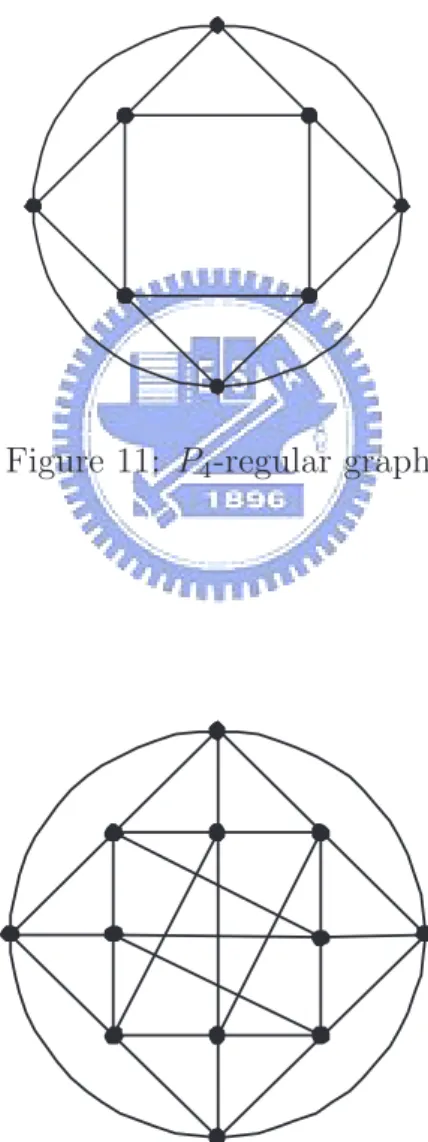
(27) Proposition 2.3.2. A Pn -regular graph exists for n = 2, 4, 5, 6, 7. Proof. The following is easy to check, • n=2. C3 is a P2 -regular graph.. • n=3. No P3 -regular graph, by Corollary 2.1.3.. • n=4. Figure 11: P4 -regular graph. • n=5. Figure 12: P5 -regular graph. 20.
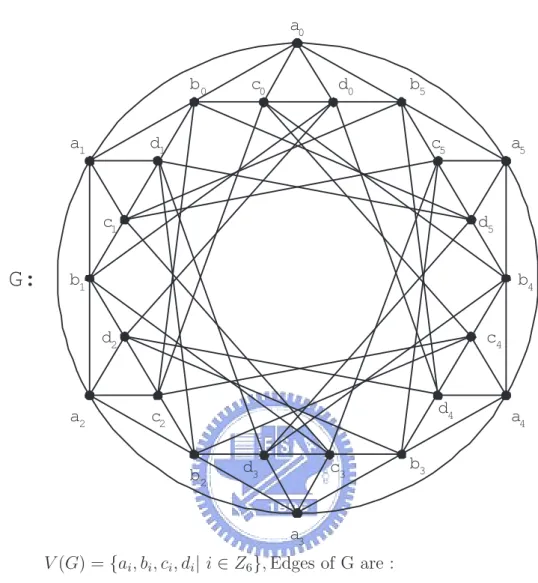
(28) • n=6. G is a P6 -regular graph. a0 b0. d0. c0. b5. d1. a1. d5. c1. G:. a5. c5. b4. b1 d2. a2. c4. d4. c2 b2. d3. c3. b3. a3. V (G) = {ai , bi , ci , di | i ∈ Z6 }, Edges of G are : ai ∼ [ai+1 , bi , ci , di , bi+5 , ai+5 ]; bi ∼ [ci+2 , ci , ai , ai+1 , di+1 , di+5 ]; ci ∼ [di , ai , bi , ci+2 , ci+4 , bi+4 ]; di ∼ [ci , ai , bi+5 , di+4 , di+2 , bi+1 ]. Note : x ∼ [α1 , α2 , . . . , αk ] =def {x ∼ αi | i = 1, 2, . . . , k}.. Figure 13: P6 -regular graph. 21. a4.
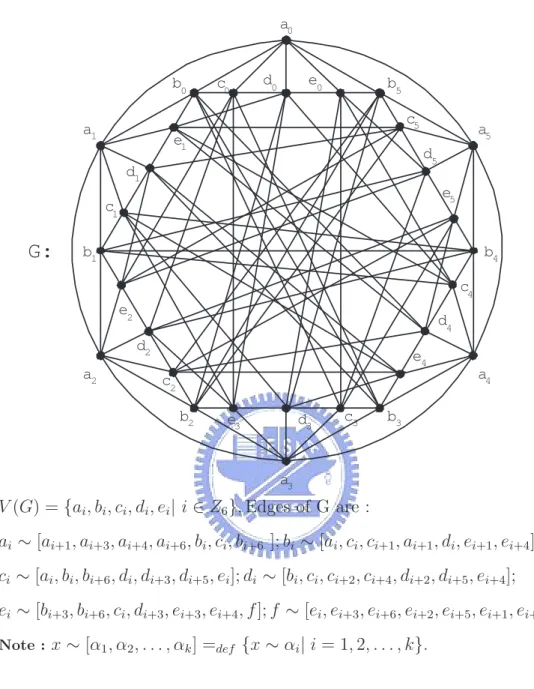
(29) • n=7. G is a P7 -regular graph. a0. b0. c0. d0. e0. b5 c5. a1. e1. a5 d5. d1 e5. c1. G:. b1. b4 c4 e2. d4 d2. a2. e4 a4. c2 b2. e3. d3. c3. b3. a3. V (G) = {ai , bi , ci , di , ei | i ∈ Z6 }, Edges of G are : ai ∼ [ai+1 , ai+3 , ai+4 , ai+6 , bi , ci , bi+6 ]; bi ∼ [ai , ci , ci+1 , ai+1 , di , ei+1 , ei+4 ]; ci ∼ [ai , bi , bi+6 , di , di+3 , di+5 , ei ]; di ∼ [bi , ci , ci+2 , ci+4 , di+2 , di+5 , ei+4 ]; ei ∼ [bi+3 , bi+6 , ci , di+3 , ei+3 , ei+4 , f ]; f ∼ [ei , ei+3 , ei+6 , ei+2 , ei+5 , ei+1 , ei+4 ]. Note : x ∼ [α1 , α2 , . . . , αk ] =def {x ∼ αi | i = 1, 2, . . . , k}.. Figure 14: P7 -regular graph. Proposition 2.3.3. For each graph of order 2, H, there exists an H-regular graph. Proof. Since H is of order 2, H = P2 or O2 . The proof follows by letting the H-regular graphs be K3 and C4 respectively. 22.
(30) Proposition 2.3.4. There exists an H-regular graph for each graph H of order 3 except H = P3 . Proof. We consider the following cases. • H = O3 K3,3 is an O3 -regular graph. • H = P2 ∪ O1 Since K3 is an P2 -regular graph, by Lemma 2.2.5, K3 2K2 is a P2 ∪O1 -regular graph. • H = P3 Because P3 = K3 − P2 , by Lemma 2.1.5, no P3 -regular graphs exist. • H = K3 K4 is a K3 -regular graph.. Proposition 2.3.5. There exists an H-regular graph for the graphs H of order 4 except H = K4 − P2 , K4 − P3 , S3 or P3 ∪ O1 . Proof. We consider the following cases. • H = O4 K4,4 is a a O4 -regular graph. • H = P2 ∪ O2. 23.
(31) Since K3 2K2 is a P2 ∪O1 -regular graph, by Lemma 2.2.5, (K3 2K2 )2K2 is a P2 ∪O2 regular graph. • H = M2 (K3 )2 is an M2 -regular graph. (Corollary 2.2.8) • H = C3 ∪ O1 Since K4 is a C3 -regular graph, by Lemma 2.2.5, K4 2K2 is a C3 ∪ O1 -regular graph. • H = P4 or C4 By Proposition 2.3.1 and Proposition 2.3.2. • H = K4 K5 is a K4 -regular graph. • H = K4 − P2 or K4 − P3 By Lemma 2.1.5, no (K4 − P2 )-regular graphs and (K4 − P3 )-regular graphs exist. • H = S3 or P3 ∪ O1 By Corollary 2.1.3, no S3 -regular graphs and (P3 ∪ O1 )-regular graphs exist.. Proposition 2.3.6 Let H be a graph of order 5. Then an H-regular graph exists if and only if H = G1 , G2 , G4 , G5 , G7 , G8 , G10 , G13 , G14 , G20 , G21 , G24 , G25 , G34 , see Figure 15. [2]. 24.
(32) G1. G2. G3. G4. G5. G6. G7. G8. G9. G 10. G 11. G 12. G 13. G 14. G 15. G 16. G 17. G 18. G 19. G 20. G 21. G 22. G 23. G 24. G 27. G 28. G 29. G 31. G 32. G 25. G 26. G 33. G 34. G 30. Figure 15: All graphs of order 5. Proof. We consider the following cases. • H = G1 and G34 K5,5 is a G1 -regular graph and K6 is a G34 -regular graph. • H = G2 , G4 , G5 , G7 , G10 , G14 and G21 By Corollary 2.2.6, G2 , G4 , G5 , G7 , G10 , G14 and G21 -regular graphs exist respectively. • H = G8 See Figure 16, (P3 ∪ P2 )-regular graphs exist. 25.
(33) Figure 16: (P3 ∪ P2 )-regular graph. • H = G13 and G20 By Proposition 2.3.1 and Proposition 2.3.2, G13 and G20 -regular graphs exist respectively. • H = G24 and G25 The graph Ci8 (1, 3, 4) is a G24 -regular graph and the graph Ci8 (1, 2, 4) is a G25 regular graph. • H = G3 , G6 and G11 By Corollary 2.1.3, G3 , G6 and G11 are forbidden graphs. • H = G9 , G15 , G29 , G31 and G33 By Lemma 2.1.6, G9 , G15 , G29 , G31 and G33 are forbidden graphs. • H = G16 , G22 and G27 By Lemma 2.1.1, G16 , G22 and G27 are forbidden graphs. • H = G26 Because G26 is K3,2 . By Lemma 2.1.7, no G26 -regular graphs exist. • H = G28 26.
(34) By Lemma 2.1.9, no G28 -regular graphs exist.. For the followings cases, we shall use similar technique to prove the nonexistence of an H-regular graph for H = G17 , G18 , G19 , G23 , G30 and G32 . Since their proofs are similar, we show the proofs of the first two cases. • H = G17 Let G be a G17 -regular graph and v ∈ V (G) such that G[NG (v)] = G17 . Let NG (v) = {x, y, z, w, u} such that x ∼ y, x ∼ z, x ∼ w, z ∼ w and w ∼ u. By assumption G[NG (z)] = G17 , there exist two vertices p and q which are not in NG (v) such that p ∼ x and q ∼ y. Now, consider G[NG (y)]. Since dG (v) and dG (x) are of degree 5, G[NG (y)] is disconnected. Hence, G[NG (y)] 6= G17 . This is a contradiction and thus G17 is forbidden. • H = G18 Let G be a G18 -regular graph and v ∈ V (G) such that G[NG (v)] = G18 . Let NG (v) = {x, y, z, w, u} such that x ∼ y, x ∼ w, x ∼ u, y ∼ z and w ∼ u. By assumption G[NG (x)] = G18 , there exists a vertex p which is not in NG (v) such that p ∼ x and p ∼ y. Consider G[NG (y)]. Since dG (v) and dG (x) are of degree 5, G[NG (y)] 6= G18 . This is a contradiction. Hence, G18 is forbidden. Since we have checked all cases of graphs of order 5, the proof is concluded.. 27.
(35) 2.4. Extremal problem. Let G be an H-regular graph. Then, we define f (H) as the smallest order for all possible H-regular graphs. The following result is a trivial lower bound.. Lemma 2.4.1. If a graph G is an H-regular graph, then f (H) ≥ 2|V (H)| − δ(H). Proof. f (H) ≥ |V (H)| + 1 + (|V (H)| − (δ(H) + 1)) = 2|V (H)| − δ(H).. Corollary 2.4.2. f (C3 ) = 4, f (C4 ) = 6, f (P2 ) = 3, f (P4 ) = 7. Proof. By Lemma 2.4.1, f (C3 ) ≥ 4, f (C4 ) ≥ 6, f (P2 ) ≥ 3, and f (P4 ) ≥ 7. Since K4 is a C3 -regular graph, Ci6 (1, 2) is a C4 -regular graph, K3 is a P2 -regular graph and Ci7 (1, 2) is a P4 -regular graph, f (C3 ) ≤ 4, f (C4 ) ≤ 6, f (P2 ) ≤ 3 and f (P4 ) ≤ 7 respectively. This concludes the proof.. Proposition 2.4.3. f (Ot ) = 2t, for each t ≥ 1. Proof. By Lemma 2.4.1, f (Ot ) ≥ 2t, and Kt,t is an Ot -regular graph, hence f (Ot ) = 2t.. Proposition 2.4.4. f (Kn ) = n + 1, for each n ≥ 1. Proof. By Lemma 2.4.1, f (Kn ) ≥ n + 1, and Kn+1 is Kn -regular graph, hence f (Kn ) = n + 1.. 28.
(36) 3. Concluding Remark. The study of neighbor-regular graphs has just begun. So far, not much is known. In this thesis, we manage to obtain several classes of graphs which are forbidden and for quite a few graphs H we construct an H-regular graph. But, we also realize the difficulty of obtaining general results. For example, we can construct H-regular graphs for H = Cn or Pn whenever n ≤ 7. How about n ≥ 8? On the other hand, we are able to say something about forbidden graphs, but there are quite a few forbidden graphs remained undiscovered. To conclude this thesis, we would like to pose a conjecture on finding forbidden graphs.. Conjecture. Let H be a tree which is not a path. Then H is a forbidden graph.. 29.
(37) References [1] C. Godsil, and G. Royle, Algebraic Graph Theory (2001). [2] R.C. Read, and R.J. Wilson, An Atlas of Graphs (1998). [3] D. B. West, Introduction to Graph Theory, Prentice Hall (1996). [4] P.K. Wong, Cages-A Survey, J. Graph Theory 6(1982), 1-22.. 30.
(38)
數據
+7



Outline
相關文件
The condition of the proposition holds if K is a number field (Corollary 2.4.2), or if at every ramified place, A has either good ordinary reduction or split-multiplicative
Given a shift κ, if we want to compute the eigenvalue λ of A which is closest to κ, then we need to compute the eigenvalue δ of (11) such that |δ| is the smallest value of all of
A subgroup N which is open in the norm topology by Theorem 3.1.3 is a group of norms N L/K L ∗ of a finite abelian extension L/K.. Then N is open in the norm topology if and only if
• Given a direction of propagation, there are two k values that are intersections of propagation direction and normal surface.. – k values ⇒ different phase velocities ( ω /k)
We will give a quasi-spectral characterization of a connected bipartite weighted 2-punctually distance-regular graph whose halved graphs are distance-regular.. In the case the
Given a connected graph G together with a coloring f from the edge set of G to a set of colors, where adjacent edges may be colored the same, a u-v path P in G is said to be a
We give a quasi- spectral characterization of a connected bipartite weighted 2-punctually distance- regular graph whose halved graphs are distance-regular.. In the case the
Theorem (M.Kalkowski, M.Karonski, and F.Pfender, 2010) ([8]) Every connected graph G 6= K 2 is 5-edge weight colorable1. Theorem (T.Bartnicki, J.Grytczuk,
