Nature of the 45° vortex lattice reorientation in tetragonal superconductors
A. Knigavko
Department of Electrophysics, National Chiao Tung University, Hsinchu, 30050 Taiwan, Republic of China
V. G. Kogan
Ames Laboratory and Department of Physics, Iowa State University, Ames, Iowa 50011
B. Rosenstein
Department of Electrophysics and National Center for Theoretical Sciences, National Chiao Tung University, Hsinchu, 30050 Taiwan, Republic of China
T.-J. Yang
Department of Electrophysics, National Chiao Tung University, Hsinchu, 30050 Taiwan, Republic of China 共Received 8 November 1999兲
The transformation of the vortex lattice in a tetragonal superconductor which consists of the 45° reorienta-tion relative to the crystal axes is studied using the nonlocal London model. It is shown that the reorientareorienta-tion occurs as two successive second order共continuous兲 phase transitions. The transition magnetic fields are cal-culated for a range of parameters relevant for borocarbide superconductors in which the reorientation has been observed.
Properties of the vortex matter have recently attracted great attention due to the diversity of phases and phenomena associated with them. One of the main research goals is the determination of the phase diagram. In high-temperature su-perconductors the vortex matter phases include the vortex liquid and various vortex solids which exist due to the com-petition of intervortex interactions with fluctuations both thermal and those due to the quenched disorder.1 On the other hand, in borocarbide superconductors a rich variety of quite perfect vortex crystals has been observed. The experi-mental information comes from such different measurements as neutron diffraction, decoration, and scanning tunneling microscopy.2–4For these near isotropic materials the entropy contribution to the free energy is small and phase transitions in the vortex lattice are governed by competition between intervortex interactions of different symmetry.
The borocarbides are materials of the tetragonal symme-try. Interactions of this symmetry should exist for any physi-cal subsystem of the crystal. In particular, in the mixed state with the field along the fourfold tetragonal axis they would favor a square vortex lattice. However, the standard magnetic repulsion of vortices is isotropic in this case. The isotropic interaction becomes dominant when the intervortex distance is large enough and a sparse lattice is close to hexagonal, the most closely packed two-dimensional lattice. One, therefore, expects that the interplay of the interactions of different sym-metries may result in structural transformations of the vortex lattices, observed in borocarbides.
For the applied magnetic field along the fourfold symme-try axis, these transformations are as follows. With decreas-ing magnetic field, the lattice undergoes a second order phase transition, at which the square structure loses stability and becomes a rhombic 共distorted hexagonal兲 vortex lattice.3,4 As the field further decreases, the rhombic lattice changes the orientation relative to underlying crystal by 45°,
which has been classified as the first order transition.5,2,6For the field along the twofold axis, the 90° reorientation has been reported.7
In this paper we study in detail the 45° reorientation and clarify its nature. We show that this reorientation proceeds as two successive second order共continuous兲 transitions and not as an abrupt first order transition, the scenario assumed be-fore. Instead of considering a limited class of rhombic lattices,6we study the general class of arbitrary lattices. We find that in the field region between the two second order phase transitions, the lattice with the lowest possible symme-try is realized 共with the inversion being the only symmetry element兲. This intermediate region is quite narrow and the structural evolution in this field domain might be difficult to discern experimentally. However, the thermodynamic char-acteristics of the superconductor are different for the two scenarios, and this can be tested. In particular, no latent heat is expected during the lattice reorientation. We also predict a peak in the critical current in the transition region if the pinning is of a weak collective type. Below we describe the London model with nonlocal corrections relevant for the mixed state of borocarbides. Then, the numerical procedure is outlined and the results are presented
A fruitful approach to the problem of the vortex lattice phases is the extended London model. We start here with London equations corrected for nonlocality8,6
4 c ji共k兲⫽⫺ 1 2qi j共k兲aj(k) ⫽⫺ 1 2共mi j ⫺1⫺2n i jlmklkm兲aj共k兲. 共1兲 Here aj⫽Aj⫹(⌽0/2)j, Aj is the vector potential, is the order parameter phase, and⌽0 is the flux quantum. The
PHYSICAL REVIEW B VOLUME 62, NUMBER 1 1 JULY 2000-I
PRB 62
nonlocal response kernel qi j(k) is expanded up to the second order terms in the wave vector k. The tensor ni jlm
⬀
具
vivjvlvm典
␥(T,l) where v is the Fermi velocity and the function ␥ decreases somewhat with temperature and drops fast for short mean-free paths l.9It is difficult to accurately estimate the components of nˆ because of uncertainties in determination of Fermi velocities and, in particular, of the mean-free path. At low temperatures, nˆ⬃␥/2, where is the Ginzburg-Landau parameter. Since good crystals of bo-rocarbides are clean materials with ⫽10–15, one expects the components of nˆ to be of the order 10⫺2. Note also that for the problem of vortex lattices in fields well under the upper critical field, the correction2nˆk2⬃02
k2Ⰶ1 (0is the zero-T coherence length兲. Therefore, for strong type-II su-perconductors, the corrections to the standard London equa-tions and the truncation in expansion共1兲 are well justified.
For the tetragonal symmetry, the tensor nˆ in the crystal frame has four independent components nxxxx, nxxy y, nzzzz, and nxxzz. The inverse mass tensor has two different compo-nents mxx⫺1⫽my y⫺1 and mzz⫺1. The London free energy func-tional corresponding to Eq.共1兲 reads
F⫽ 1 8
冕
dk 42共兩h兩 2⫺2⑀ i jk⑀lmnkjkmqlk⫺1hnhi兲, 共2兲where h(k) is the magnetic field and⑀i jkis the unit antisym-metric tensor. The nonlocal corrections preserve linearity of the London equations and do not change the standard Lon-don result that the interaction of two vortices is proportional to the field of one of them at the location of the other.9 As usual, the free energy density of a vortex lattice is given by
F⫽(B2/8⌽
0)兺ghz(g) where B is the magnetic induction, g is a vector of the reciprocal lattice, and hz is the component of the single vortex field along the vortex axes. We are in-terested in the field along the fourfold symmetry axis z. Solv-ing Eq.共1兲 for a single vortex one can bring the free energy density to the form6
F⫽
兺
g
B2/8
1⫹2g2⫹4共n g4⫹d gx2gy2兲, 共3兲
where n⫽nxxy y and d⫽2(nxxxx⫺3nxxy y). The free energy F(B,T) is the thermodynamic potential, which is minimum
in equilibrium of a superconducting slab in a perpendicular applied field. The temperature enters F(B,T) via T depen-dent parameters(T), n(T), and d(T) that can, in principle, be calculated using a microscopic model. Note that besides the factor B2, the induction enters via the area of the primi-tive lattice cell. We determine the stable lattice by numerical minimization of F(B,T;g) with respect to the lattice struc-ture specified by a given set of g’s.
The vortex lattice is completely defined by the basis vec-tors a1 and a2, i.e., by four parameters. Since a unit cell accommodates one flux quantum, a1a2sin⫽⌽0/B, three parameters suffice. Following Ref. 10 we choose ␣,
⬅(a2/a1)cos, and ⬅(a2/a1)sin as the needed three
共see Fig. 1 for definitions of␣and). The parameters and
are convenient because one can select a domain of their variation, each point of which corresponds to a lattice with
various equivalent choices of the basis vectors a1,2. Thus, the minimization of F is done at fixed B, n, and d with respect to , , and ␣ for 0⬍␣⬍, 0⭐⭐0.5, and 2
⫹2⭓1.10
The minima of F are often located on the bound-aries of this domain; we use the ‘‘Amoeba’’ numerical rou-tine convenient in such circumstances.11 The cutoff factor exp(⫺2g2) was introduced inside the sum 共3兲 to properly account for the failure of the London model in the vortex core. Changing parameters B and n,d we obtain the phase diagram.
The main finding of this work is that the reorientation of the lattice proceeds as two steps. Figure 2 shows the transi-tion lines on the B,d plane for a fixed n⫽0.015. The equi-librium lattices both before and after the reorientation have the rhombic symmetry D2h.12 Their symmetry axes, which coincide with the diagonals of a rhombic unit cell 共with the appropriate choice of such a cell, see Fig. 2兲, are aligned with
关110兴 and 关11¯0兴 at lower magnetic inductions, whereas the
symmetry axes are at关100兴 and 关01¯0兴 for higher B’s. This result is in accordance with data for YNi2B2C.5In a narrow region between the two rhombic phases, a less symmetric lattice is stable. Here, the unit cell is a general parallelogram. All in-plane symmetry elements disappear except the inver-sion, and the symmetry group reduces to C2h.
FIG. 1. General vortex lattice and its orientation relative to the crystal.
FIG. 2. Phase diagram of the vortex lattice in the region of the reorientation for n⫽0.015. Nonlocal parameters n and d are defined in the text. The magnetic induction b is in units of⌽0/22.
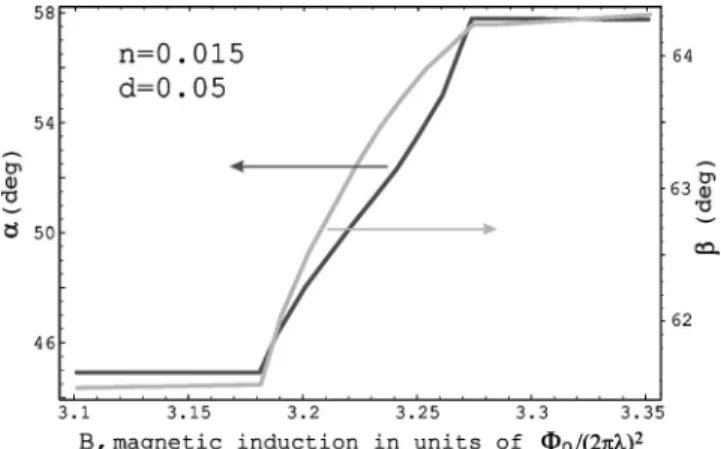
One could describe the reorientation process as a gradual rotation of the unit cell accompanied by a slight deformation. Figure 3 shows how the angles ␣ and  change when B increases in the vicinity of the reorientation共for d⫽0.05 and
n⫽0.015). The transitions at B⬇3.18 ⌽0/(2)2 and B
⬇3.27 ⌽0/(2)2 are seen clearly. The angles ␣, , and the other lattice parameters are continuous at the two transi-tion fields. We conclude that both phase transitransi-tions that oc-cur during the reorientation are of the second order. The sequence of symmetry changes with the field decreasing is
D2h→C2h→D2h. While at the first step of the reorientation, the symmetry becomes lower, at the second step the
symme-try increases. Correspondingly, the ground state is double degenerate in both D2h phases; the degenerate vacua 共two equilibrium structures of the same energy兲 are related by rotations over 90°. The structure becomes four times degen-erate in the intermediate C2hphase共rotations over ⫾45° and 90°). Practically, this may lead to apparently increased dis-order in the C2h phase.
It is worth noting that the relative energy differences be-tween the equilibrium C2h lattice and the rhombic ones is exceedingly small. As an example, we provide this figure for
d⫽0.05 and n⫽0.015: the relative difference between
ener-gies of the rhombic lattice at the transition point and the lattice in the middle of the field domain of C2hstructure is of the order 10⫺7. This is much smaller than 10⫺2for the rela-tive energy differences usually cited for triangular and square lattices within the standard London or Ginzburg-Landau models.
The location of the phase transition lines is sensitive to both n关the isotropic correction in Eq. 共3兲兴 and d 共the fourfold symmetric correction兲. Figure 4 shows the phase diagram of the vortex lattice on B,d and B,n planes in the region of the reorientation process. The region of stability of the mono-clinic lattice is broader for smaller n’s and larger d’s. Still, as is seen at Fig. 4, this field region is narrow for values of n and d adopted in our simulations. For example, for LuNi2B2C with ⬇710 Å , the field unit ⌽0/(2)2 is about 100 G.
The new scenario of the lattice reorientation in a tetrago-nal superconductor which is found this paper has implica-FIG. 3. Evolution of angles ␣ and  共defined in Fig. 1兲 with
field b⫽22B/⌽
0during reorientation.
FIG. 4. Phase diagram of the reorientation transformation共a兲 in the n,b plane for a set of d’s indicated and共b兲 in the d,b plane for a set of n’s indicated.
tions for thermodynamic characteristics of the vortex lattice and its dynamic behavior. We have found, and this is our main result, that the reorientation proceeds as two successive phase transitions of the second order when the applied field or temperature vary. Therefore, continuous variation of the entropy共i.e., no latent heat兲 and of the reversible magnetiza-tion are expected during reorientamagnetiza-tion. In contrast, the old scenario of the first order transition implied discontinuous jumps of the above quantities.
As is seen at Fig. 4, for small values of n and d, the domain of monoclinic phase shrinks. Then, it would be dif-ficult to distinguish experimentally this situation from first order transition, because the entropy would change fast with
B during the reorientation 共for the B sweep at a fixed T).
Still, one should not observe hysteresis, characteristic of the first order transitions. If the sequence of transitions we sug-gest here is found, it would be of interest to suppress n and d by making the mean-free path shorter and to see how the transition evolves 关as has been done with doping Lu-based borocarbide crystals with Co 共Refs. 13 and 14兲兴.
Both the upper and lower phase transitions (D2h↔C2h) of the reorientation process cause uniform spontaneous de-formations of the vortex lattice. As a result, a particular
com-bination of the elastic lattice moduli vanishes at the transi-tions. It has been recently shown that a change of elastic properties of this type leads generally to peculiarities in the critical current, provided a weak collective pinning operates in the material.15 Therefore, the reorientation of the vortex lattice in borocarbides may lead to a peak in the critical current.
Finally, we would like to point to other possible applica-tions of our results. The London model we employed reflects properly the symmetry of the system. It was originally de-rived for an anisotropic Fermi surface and isotropic super-conducting pairing.8 However, the d-wave type of pairing also leads to a similar effective London model16共for not very low temperature where the effects of the order parameter nodes become essential兲. The reorientation of the vortex lat-tice has indeed been found theoretically, and characterized as the first order transition.17 It would be of interest to check whether or not our scenario of the reorientation applies to this case as well.
This work was supported by NSC of Taiwan through Grants No. 0016 and No. 89-2112-M-009-039.
1G. Blatter et al., Rev. Mod. Phys. 66, 1125共1994兲. 2For TmNi
2B2C the decoration results on 45° reorientation were reported by A. B. Abrahamsen et al. 共unpublished兲. In LuNi2B2C this transition has been seen by L. Vinnikov in Cher-nogolovka, Russia共unpublished兲.
3M. R. Eskildsen et al., Phys. Rev. Lett. 79, 487共1997兲 共the sec-ond order transition between square and rhombic lattices in ErNi2B2C); M. Yethiraj et al., ibid. 78, 4849共1997兲 共the same transition in YNi2B2C).
4Y. De Wilde et al., Phys. Rev. Lett. 78, 4273共1997兲. 5D. McK. Paul et al., Phys. Rev. Lett. 80, 1517共1998兲. 6V. G. Kogan et al., Phys. Rev. B 55, 8693共1997兲. 7P. Gammel共private communication兲.
8V. G. Kogan and A. Gurevich et al., Phys. Rev. B 54, 12 386 共1996兲.
9V. G. Kogan, P. Miranovic, and D. McK. Paul, in The
Supercon-ducting State in Magnetic Fields, edited by C. A. R. Sa de Melo 共World Scientific, Singapore, 1998兲, p. 127.
10D. Saint-James, E. J. Thomas, and G. Sarma, Type II Supercon-ductivity共Pergamon Press, Oxford, 1969兲.
11W. H. Press, S. A. Teukolsky, W. T. Vetterling, and B. P. Flan-nery, Numerical Recipes in C 共Cambridge University Press, Cambridge, 1992兲.
12To avoid misunderstanding we point out that in all cases we speak about the symmetry of gauge invariant quantities. 13K. O. Cheon et al., Phys. Rev. B 58, 6463共1998兲. 14P. L. Gammel et al., Phys. Rev. Lett. 82, 4082共1999兲.
15B. Rosenstein and A. Knigavko, Phys. Rev. Lett. 83, 844共1999兲. 16I. Affleck, M. Franz, and M. H. S. Amin, Phys. Rev. B 55, 704
共1997兲.
17M. Franz, I. Affleck, and M. H. S. Amin, Phys. Rev. Lett. 79, 1555共1997兲.