科技部補助專題研究計畫成果報告
期末報告
國小學童數學成就之神經生物標記
計 畫 類 別 : 個別型計畫 計 畫 編 號 : MOST 103-2511-S-004-004-執 行 期 間 : 103年11月01日至105年01月31日 執 行 單 位 : 國立政治大學心理學系 計 畫 主 持 人 : 張葶葶 計畫參與人員: 博士班研究生-兼任助理人員:黎佩欣 報 告 附 件 : 出席國際會議研究心得報告及發表論文 處 理 方 式 : 1.公開資訊:本計畫涉及專利或其他智慧財產權,2年後可公開查詢 2.「本研究」是否已有嚴重損及公共利益之發現:否 3.「本報告」是否建議提供政府單位施政參考:否中 華 民 國 105 年 04 月 29 日
中 文 摘 要 : 這是一年期計畫的進度報告。此計畫原先預計以縱貫性研究探討個 體數學能力發展之行為與神經機制,並找出預測未來成就之腦造影 指標,然而本計畫僅核定通過一年,因此更改為以橫斷性研究探討 大腦進行四則運算的活化情形以及發展曲線,比較兒童及成人之行 為與大腦活化情形。這一年共完成刺激材料收集與測試、成人與兒 童之四則運算行為實驗 、以及成人與兒童腦造影實驗。行為實驗結 果四則運算中,減法和除法相較於加法與乘法更困難,其中加法和 乘法行為表現雖然相同,但使用的策略卻並不相同,兒童的減法錯 誤率、提取率均比起其他運算更高、反應時間更長。磁振造影實驗 則發現,四則運算中,成人比起兒童活化更多包含前額葉與後頂葉 區域,且減法特別明顯。這些研究顯示四則運算在大腦上發展的時 間點並不相同,顯示每種運算有其獨特的發展時間。目前計畫主持 人也仍在以縱貫性研究探討每一個體行為與神經機制發展的個別差 異。 中 文 關 鍵 詞 : 四則運算, 數學解題, 功能性磁振造影, 認知發展
英 文 摘 要 : This is the progress report of a one-year grant project. The aim of the project is to investigate how the brain solves addition, subtraction, multiplication, and division, the four basic arithmetic operation problems and how the brain functions develop with learning arithmetic skills by using a cross-sectional design to compare school-age
children with adults. In the past year, we have completed stimuli collection, extensively piloted the behavioral experimental paradigm, and completed one behavioral experiment to assess adults’ and children’s behavioral performance of the four basic arithmetic operations and strategy assessment. We have also conducted an fMRI study to investigate children and adults brain activation
profile. The behavioral results showed that children solved subtraction and division problems much less efficient than adults. Brain activation results suggested that adults engaged stronger activation than children during solving subtraction than the other three operations in the fronto-parietal circuits. Together these results have suggested that the four arithmetic operations develops distinctly across different developmental stage. Our results showed an operation-specific brain development from childhood into adulthood when solving simple arithmetic problems. Further research is needed to investigate the individual difference of each developing children using longitudinal design. 英 文 關 鍵 詞 : basic arithmetic operations, arithmetic problem solving,
1
Brain-based biomarker of mathematical skill underlying
school-age children
國小學童數學成就之神經生物標記
(MOST 103-2511-S-004 -004 )
Abstract:This is the progress report of a one-year grant project. The aim of the project is to investigate how the brain solves addition, subtraction, multiplication, and division, the four basic arithmetic operation problems and how the brain functions develop with learning arithmetic skills by using a cross-sectional design to compare school-age children with adults. In the past year, we have completed stimuli collection, extensively piloted the behavioral experimental paradigm, and completed one behavioral experiment to assess adults’ and children’s behavioral performance of the four basic arithmetic operations and strategy assessment. We have also conducted an fMRI study to investigate children and adults brain activation profile. The behavioral results showed that children solved subtraction and division problems much less efficient than adults. Brain activation results suggested that adults engaged stronger activation than children during solving subtraction than the other three operations in the fronto-parietal circuits. Together these results have suggested that the four arithmetic operations develops distinctly across different developmental stage. Our results showed an operation-specific brain development from childhood into adulthood when solving simple arithmetic problems. Further research is needed to investigate the individual difference of each developing children using longitudinal design.
2 中文摘要: 這是一年期計畫的進度報告。此計畫原先預計以縱貫性研究探討個體數學能力發 展之行為與神經機制,並找出預測未來成就之腦造影指標,然而本計畫僅核定通過一年,因 此更改為以橫斷性研究探討大腦進行四則運算的活化情形以及發展曲線,比較兒童及成人之 行為與大腦活化情形。這一年共完成刺激材料收集與測試、成人與兒童之四則運算行為實 驗 、以及成人與兒童腦造影實驗。行為實驗結果四則運算中,減法和除法相較於加法與乘 法更困難,其中加法和乘法行為表現雖然相同,但使用的策略卻並不相同,兒童的減法錯誤 率、提取率均比起其他運算更高、反應時間更長。磁振造影實驗則發現,四則運算中,成人 比起兒童活化更多包含前額葉與後頂葉區域,且減法特別明顯。這些研究顯示四則運算在大 腦上發展的時間點並不相同,顯示每種運算有其獨特的發展時間。目前計畫主持人也仍在以 縱貫性研究探討每一個體行為與神經機制發展的個別差異。 中文關鍵字:四則運算, 數學解題, 功能性磁振造影, 認知發展
3
1. Introduction
Mathematical cognition is a crucial skill contributes to proficiency in a wide range of contexts from advanced scientific and engineering reasoning to more simple quantitative operations important in everyday life (Butterworth, Varma, & Laurillard, 2011; Geary, 2013; Geary, Hoard, Nugent, & Bailey, 2013; Richland, Zur, & Holyoak, 2007). This ability provides a foundation for the development of skills that are becoming increasingly important in the 21st century (Richland, Zur, & Holyoak, 2007). In Taiwan, mathematics is one of the subjects that takes most compulsory curricular time according to government policy (教育部, 2008). Yet, more than 60% of school-age children attend afterschool math programs (林宜慧, 2007; 徐政業, 2008; 張雅俐, 2011; 許綺婷, 2001), suggesting that mathematics is a challenging skill for most of the school students. How, then, does the brain develop mathematical skill, specifically, the basic four operations? How does immature brain process these mathematical skills? How do learning and experience shape the brain function of these skills? These questions are the main focus of the current study. The original proposal intended to use a longitudinal design to investigate the developmental trajectory of each individual and find an early predictor of later school mathematical achievement, hence named “Brain-based biomarker of mathematical skill underlying school-age children”. However, due to the limitation that the grant was funded for only one year, we used a cross-sectional design to investigate age-related differences across a broader range samples. Along with fMRI imaging and analysis method, we seek to uncover these questions to inform how the brain develops arithmetic skill and eventually to develop a brain-based biomarker in identifying low achiever in the early stage.
Mathematical cognition is a discipline that studies the cognitive and neural bases of how human solves numerical problems and how they develop over time. Within this domain, addition, subtraction, multiplication, and division constitutes the most basic arithmetic problem solving. These four operations differ in problem solving strategies even in adults, suggesting that these operations are not entirely automatized even in adults with highly arithmetic proficiency (Campbell & Xue, 2001; Rosenberg-Lee, Chang, Young, Wu, & Menon, 2011). Specifically, the retrieval rate versus alternate calculation strategies differs widely across operations (Campbell, 1999, 2008). Retrieval is the dominant method for addition and multiplication, with procedural calculation are fairly efficient strategies for addition rather than multiplication, because multiplication was learned by memorizing table facts (Hecht, 1999). Subtraction and division rely more on alternate strategies such as counting and inversion. In line with these problem solution facts, Campbell and Xue (2001) reported retrieval rates of 76% for addition and 96% for multiplication, but only 58% for subtraction and 57% for division in college-age adults (Campbell & Xue, 2001). These differences may be the consequence of addition and multiplication being taught prior to subtraction and division, their respective inverse
4
operations, in most school curricula (Campbell, 2008). Problem solving using a related fact from previously learned inverse operations is clearly a more parsimonious strategy than memorizing facts for all four operations (Campbell & Alberts, 2009).
Neuroimaging studies examining neural correlates of basic arithmetic operations have not reached consensus about how the brain process four basic arithmetic operations. In particular, Lee
(2000) compared brain responses to single-digit multiplication and subtraction problems using fMRI and reported that multiplication elicited greater activation than subtraction in the left AG and supramarginal gyrus while subtraction elicited larger activation than multiplication, bilaterally, in the IPS. The author concluded that verbally based retrieval engaged the AG, whereas quantity based calculation differentially recruited the IPS. However the absence of a control condition precluded examination of brain activity produced by each operation separately. Moreover, these results were not able to be reproduced in other studies. For example, Chochon, Cohen, van de Moortele, and Dehaene (1999) found that multiplication was associated with left IPS activity while subtraction was associated with bilateral IPS activity. A direct comparison of subtraction to multiplication revealed greater activation only in the right IPS. No brain regions showed greater responses to multiplication over subtraction. More recent studies have revealed that the AG shows significant modulatory deactivation, or activation below the resting baseline, rather than activation, with greater task difficulty (Rosenberg-Lee, Chang, et al., 2011; Wu et al., 2009). The AG also shows prominent overlap with the PPC node of default mode network (Greicius, Krasnow, Reiss, & Menon, 2003; Raichle et al., 2001), a system important for internal mental processes including episodic (Cabeza, Ciaramelli, & Moscovitch, 2012; Cabeza, Ciaramelli, Olson, & Moscovitch, 2008) and semantic memory (Binder & Desai, 2011). Kawashima et al.(2004) presented single-digit addition, subtraction and multiplication problems with covert responses. Compared to a resting baseline all three operations showed left IPS activity, but subtraction and multiplication also demonstrated right inferior parietal cortex activity. In a direct comparison between operations, they found no significant activity differences anywhere in the brain. There was no separate control condition in their study. Moreover, small sample size and lacked the overt behavioral responses greatly limited the access to compliance and brain–behavior relationships.
Only three studies to date have examined brain responses to all the four basic arithmetic operations using within-subject design. Fehr et al. compared brain responses to complex (two-digit) and simple (one-digit) problems with each of the four operations using visually (Fehr, Code, & Herrmann, 2007) and aurally presented (Fehr, Code, & Herrmann, 2008) stimuli. Using a conjunction analysis, they found that complex, compared to simple, problems activated bilateral superior and middle frontal gyri and right precuneus across all operations. Brain activation between operations
5
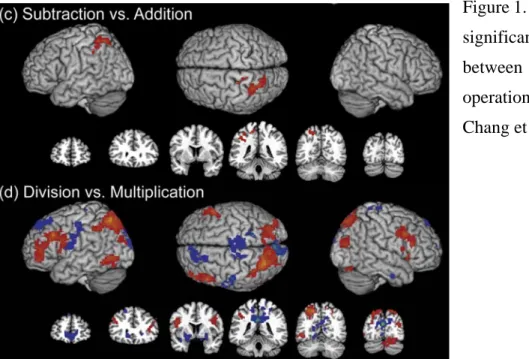
was not compared directly; therefore it is unclear whether there are any reliable differences between the operations. The other study was done by the PI of the current grant and colleagues (Rosenberg-Lee, Chang, et al., 2011). We directly compared brain responses across the four arithmetic operations to examine the functional overlap and dissociations between the four basic operations. The results showed that all operations showed a consistent profile of IPS activation and deactivation in the angular gyrus (AG). Subtraction and division evoked significantly greater activation in the left IPS, a region associated quantity representation and supports procedural calculation, than addition and multiplication, respectively (Figure 1). Although addition and multiplication both rely on retrieval, multiplication evoked significantly greater activation in right posterior IPS, as well as the prefrontal cortex, lingual, and fusiform gyri, demonstrating that addition and multiplication engage different retrieval processes. These results lead to the conclusions that the PPC shows considerable functional heterogeneity across basic arithmetic operations. Nevertheless, the implementation of block design and lack of properly matched problem difficulty across operations had greatly limited the interpretation of these results, leaving the exact neural correlates across the four arithmetic operations still yet unclear.
Figure 1. Brain regions that showed significant differences in activation between the four basic arithmetic operations (from Rosenberg-Lee, Chang et al., 2011).
An extended question emerged is how the brain responses of the four basic arithmetic operations develop when individuals become more proficient in arithmetic skill with learning and experience. Several imaging studies have investigated the functional engagement across distinct arithmetic operation from the developmental perspective (Chang, Rosenberg-Lee, Metcalfe, Chen, & Menon, 2015; De Smedt, Holloway, & Ansari, 2011; Kawashima et al., 2004; Prado, Mutreja, & Booth, 2014; Rivera, Reiss, Eckert, & Menon, 2005; Rosenberg-Lee et al., 2014). De Smedt and
6
colleagues examined brain activation of 10-12 year-old children while they perform addition and subtraction problem tasks. They found that subtraction problems elicited greater activations in IPS within the PPC as well as PFC, whereas addition elicit stronger activations in hippocampus and anterior temporal cortex (De Smedt et al., 2011). Similar results were also found in 7-9-year-old children (Rosenberg-Lee et al., 2014). Other studies have examined age-related difference in the brain responses using cross-sectional design to compare different age groups (Kawashima et al., 2004; Prado et al., 2014; Rivera et al., 2005). Kawashima and colleagues compared 9-14 year-old children and 40-49 year-old adults, with eight participants in each group. They found that adults engaged greater IPS activation than children for each operation. However, inconsistent with the Rosenberg-Lee and De Smedt studies (De Smedt et al., 2011; Rosenberg-Rosenberg-Lee, Chang, et al., 2011), which would suggest subtraction elicits greater frontal-parietal engagement than addition, they found no activation differences for the direct comparison between the two operations. Moreover, the small sample size and the advanced age of the adult participants had limited the interpretation of these findings. Similarly, Rivera and colleagues examined the neural correlates of addition and subtraction problem solving in children, adolescents, and adults ranging in age from 8 to 19. They found that the left SMG and IPS within the PPC as well as left lateral occipital temporal cortex showed linear increase with age, suggesting a greater involvement when individuals become more skillful in arithmetics. On the other hand, ventrolateral and dorsolateral PFC, as well as parahippocampal gyrus showed a linear decrease with age, suggesting that these regions may no longer be necessary in mature adults’ brain. However, using a mixture of addition and subtraction within one problem set, this study failed to provide the exact developmental tract for each of specific operation. Although the design of these above studies can be improved to some extent, findings to date have suggested distinct arithmetic operations activate different level of arithmetic brain network as early as the beginning of the first decade of life.
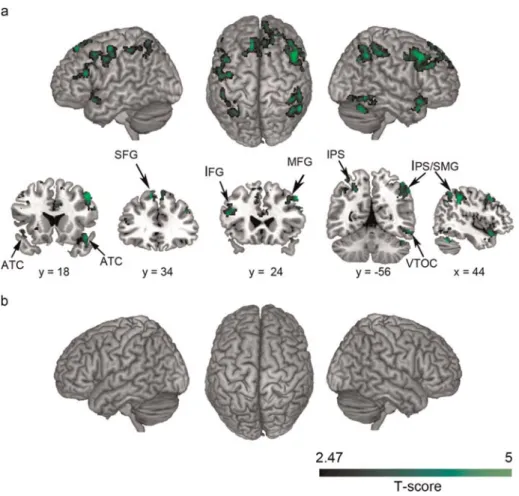
Only one study, to date, has used cross-sectional design to examine how multivariate brain responses across distinct arithmetic operations develops from childhood into adulthood. Using multivoxel representational similarity analysis (MRS), a method that computes spatial correlation between brain activations of two experimental conditions, the PI of the current grant and colleagues examined neural representation similarity between addition and subtraction problems and compare adults with 7-to-9-year-old children. They found that adults exhibited significant levels of MRS between addition and subtraction, not only in the IPS and SMG within PPC, but also in PFC, ventral temporal-occipital cortex, and anterior temporal cortex. In sharp contrast, no brain areas showed significantly greater MRS between problems types in children (Figure 2; Chang et al., 2015). These results have provided novel evidence that the emergence of arithmetic problem solving skills from
7
childhood to adulthood is characterized by maturation of common neural representations between distinct numerical operations, and involve distributed brain regions important for representing and manipulating numerical quantity. The questions remain unclear is whether the common neural representation can be generalize to other arithmetic operations, such as multiplication and division, and how does each individual develop the common neural representation.
Figure 2. Brain regions that showed significant MRS between addition and subtraction problems. (a)Adults showed significant MRS in multiple brain regions, including bilateral IPS, and supramarginalgyrus (SMG) in PPC, inferior and middle frontal gyri (IFG, MFG) in PPC, anterior temporal cortex (ATC), and right ventral temporal-occipital cortex (VTOC). (b) Children, in contrast, did not how significant MRS in any brain region. Color intensity indicates the MRS levels (T-score) in each group.
The current study aims to examine how the brain develops basic arithmetic operations using a cross-sectional design. We compare children and adults while they perform addition, subtraction, multiplication, and division. To our knowledge, this is the first study that assesses the development of all the four operations using within-subject design and compare different age groups. This is an project funded by MOST in 2014, with funding period from 2014.11.01 to 2015.10.31, and extended to 2016.1.31. Within the funding period we have conducted one behavioral experiment (48 children and 22 adults) and one fMRI experiment (23 children and 28 adults). By characterizing the behavioral, cognitive and neural profile of the four basic arithmetic operations, this study will provide essential knowledge that may not be provided by behavioral measurements alone.
2. Experiment 1: Four basic arithmetic operation and strategy assessment
2.1 Method 2.1.1 Participants
48 adults (aged range from 19 to 29 year-old, M = 22.5) and 22 children (aged range from 8 to 10 year-old, M = 8.85) participated in this experiment. All participants were given informed consent and paid for participation.
2.1.2 Procedure
In this experiment, each trial involves the presentation of an arithmetic problem (e.g. “5+3”). Participants are instructed to orally report the answer into the voice key as quickly as possible. The problem disappear immediately after a voice response is collected. After the participant has spoken the answer, they were queried on how he or she got the answer. Participants orally report the problem solving approach (procedural calculation, retrieval, transformation, or other) into the same voice key. The experimenter notes the answer and the strategy usage after each trial. During problem solving, the experimenter watches for physical indications of counting, such as regular movements (e.g., fingers, mouth) or calculation time. If the participant’s response differed from the experimenter’s observations (e.g., participant report retrieval but experimenter saw the participant mouthing counting), then a notation indicating disagreement between the participant and the experimenter is made. If counting is overt, then the experimenter classifies it as a counting strategy. If the trial is ambiguous, then the participant’s response is recorded as the strategy. Previous studies indicate that this method provides a useful measure of trial-by-trial strategy choices (Cho et al., 2012; Cho, Ryali, Geary, & Menon, 2011; Geary, Hamson, & Hoard, 2000; Qin et al., 2014) and agreement between
children’s description and experimenter’s observation was found higher than 95% of trials (Cho et al., 2011).
2.2 Results
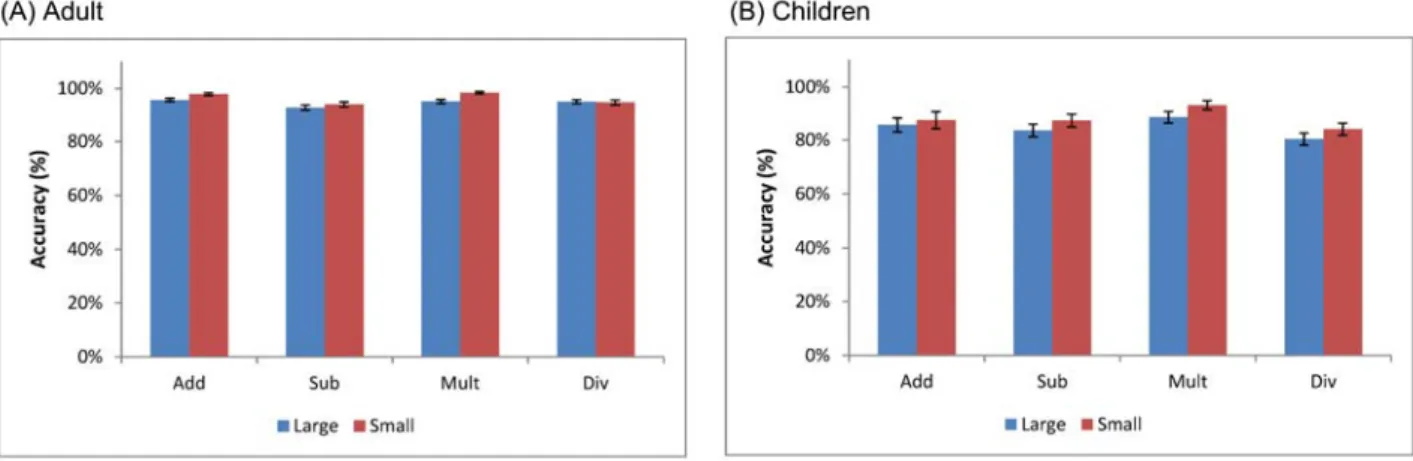
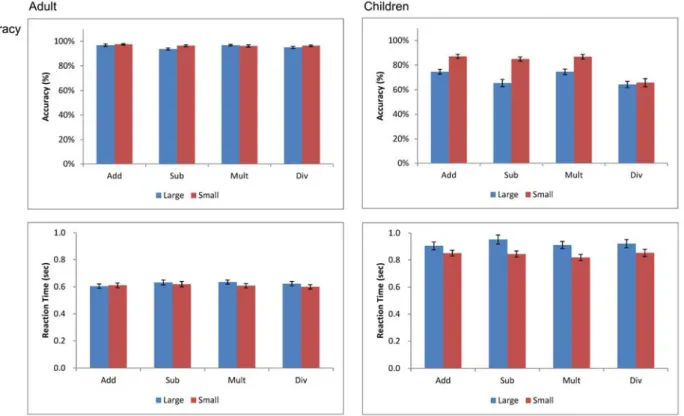
Accuracy of addition, subtraction, multiplication, and division for adults and children were illustrated in Figure 3. Mean accuracy of each participant was entered into a three-way ANOVA, with Operation (Addition, Subtraction, Multiplication, Division) and Problem Size (Large, Small) as within-subjects factors, and Group (Adult, Children) as between-subjects factor. There was a significant Problem Size effect, with Large size problems were less accurately than Small size problems (89.6% vs 92.1%, F = 29.226, p <.001), and Group effect, with children responded less accurately than adults (86% vs. 95 %, F = 42.890, p < .001). There was also an Operation effect (F=13.349, p < .001). Posthoc pair-wise comparison showed that the effect was driven by participants responded less accurately to Division than Addition (88.5% vs. 91.7%, p = .003) and Multiplication (88.5% vs. 93.8%, p < .001) as well as Subtraction than Multiplication (89.4% vs. 93.8%, p = .001). Posthoc comparison suggested that this interaction was driven by children responded much less accurately to Division than Multiplication (p < .000). No other interaction was observed (p > .05).
Figure 3. Accuracy during addition, subtraction, multiplication, and division of Adults (A) and Children (B).
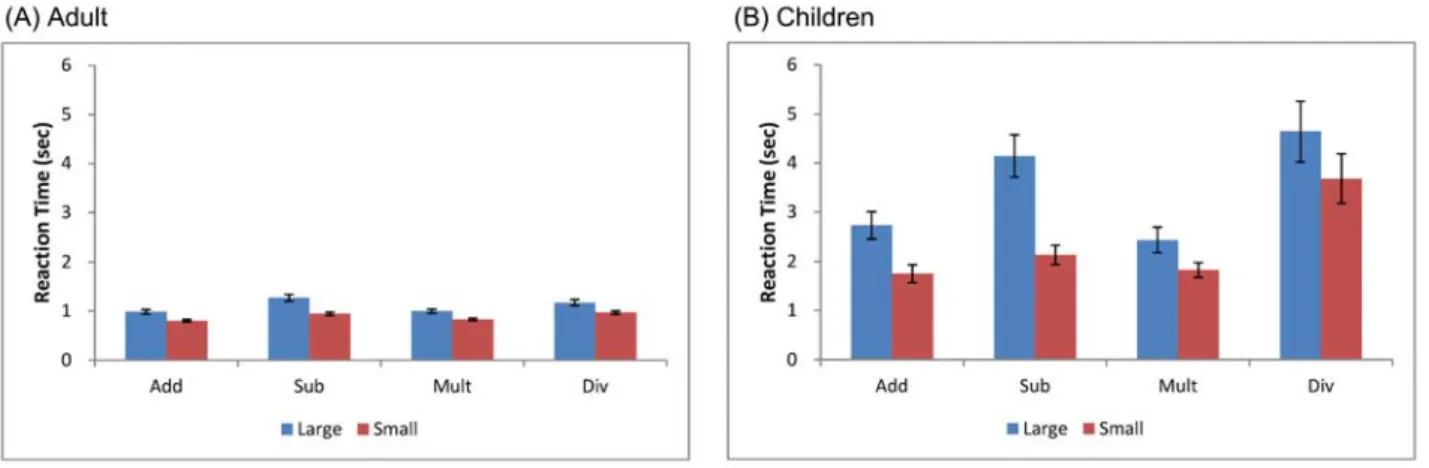
A parallel pattern was illustrated for median reaction time for each participant as shown in Figure 4, and parallel analysis using reaction time was conducted. Median reaction time of each participant was entered into a three-way ANOVA, with Operation (Addition, Subtraction, Multiplication, Division) and Problem Size (Large, Small) as within-subjects factors, and Group (Adult, Children) as between-subjects factor. There was a significant Problem Size, with Large
size problems were less efficient than Small size problems (2295 ms vs 1616, F = 31.515, p <.001), and Group effect, with children responded less efficient than adults (2917 ms vs. 995 ms, F = 118.795, p < .001). There was also an Operation effect (F=31.515, p < .001). Posthoc pair-wise comparison showed that the effect was driven by participants responded differently between each pair of the four operations (p <= .037), except for addition and multiplication (p = 1.000). There was Operation by Problem Size interaction, with the Problem Size cost (Large - Simple) was more significant in Subtraction than any other operations (p < .001). The Problem Size by Group interaction was also significant, such that the Problem Size cost was higher in Children (2295 ms) than Adults (1616 ms, p < .001).
Figure 4. Response time during addition, subtraction, multiplication, and division for adults (A) and Children (B).
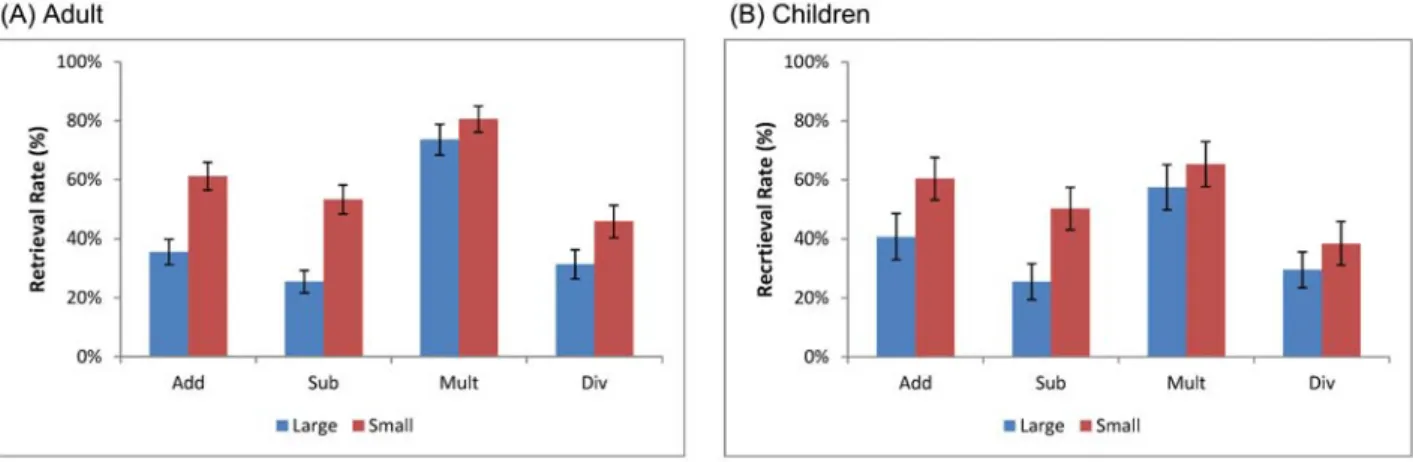
A parallel pattern was illustrated for retrieval rate, as shown in Figure 5, and parallel analysis was conducted on each adult. Retrieval rate of each condition for each adult participant was entered into a three-way ANOVA with Operation (Addition, Subtraction, Multiplication, Division) and Problem Size (Large, Small) as within-subjects factors, and Group (Adult, Children) as between-subjects factors. Participants retrieve less to Large than Small problems (40.9% vs. 56.8%, F = 94.467 ,
p < 001). There was a significant Operation effect, F = 28.105, p < .001), with Multiplication showed
highest retrieval rate than all the other thee operations. Interestingly, children retrieve the four arithmetic operations problems equivalently with adults (46.0% vs. 50.8%, p = .457). Operation by Problem Size interaction was significant (F = 17.779, p < .001), with Multiplication showed smallest retrieval rate difference than any other operations No other interaction was observed (p >= .139).
Figure 5. Retrieval strategy of addition, subtraction, multiplication, and division in Adults (A) and Children (B).
3. Experiment 2: fMRI experiment of four basic arithmetic operations
3.1 Method 3.1.1 Participants
31 adults (age ranged 19- to 29-year-old, M = 23.75) and 23 children (age ranged 8- to 10-year-old, age M = 8.85) have participated this experiment. Three adults were not included in imaging data analysis because of pilot testing. One children dropped out in the middle of the experiment. Five children was excluded from further analysis because of excessive movements. These exclusions resulted in 28 adults and 17 children for fMRI data analyses. All the participants are right handed and have no major contraindication for MRI (pacemaker, vascular stents, metallic ear tubes, and absence of metal implants or braces), serious neurological or medical illness, psychiatric illness, developmental disabilities, learning disabilities as well as sensory impairments such as vision or hearing loss.
3.1.2 Experiment Procedure
In this experiment, stimuli consisted of 128 problems of addition, subtraction, multiplication, and division, each for 32 problems. Each trial involved the presentation of a problem for 3000 ms after which an equal sign appeared for 500ms in the center. Next, the response alternatives were presented for 1000 ms and participants were asked to determine whether the response was the correct answer of the problem by pressing one of two keys based on their answer; 50% of the trials were correct (e.g. “6 + 3 = 9”) and the other 50% were incorrect (e.g. “6 + 3 = 8”). Incorrect answers differed by ± 1 or ± 2. Problems for the four operations were intermixed using event-related design. Each operation consisted of two conditions: complex and simple. In the complex condition, the
product of the two operands were larger than 25 (e.g., 8+7). In the simple condition, the product of the two operands were smaller than or equal to 25 (e.g., 5+2). In the complex condition, both operands were greater than 1 but less than 9, excluding tie problems (e.g., “2+2=4”). Inter-trial interval was jittered to optimize estimates of brain responses to each trial type. The entire experiment was broken up into 2 sessions, each session lasted about 9 minutes.
3.1.3 fMRI data acquisition
Functional and structural images were acquired on a Simens MAGNETOM Skyra 3T scanner at National Chengchi University. Cushions were placed around participants’ head to reduce head movement during scanning. Functional images were acquired using a T2* weighted echo-planar sequences. A total of 32 axial slices parallel to the anterior and posterior commissure (AC/PC) and covering the whole brain were acquired with a temporal resolution of 2 sec using the following parameters: TR = 2 s, TE = 35 ms, flip angle = 90°. The field of view were 256 x 256 mm, and the matrix size were 64 x 64 mm, providing an in-plane spatial resolution of 4 mm. For each participant, structural images were acquired using a high-resolution T1-weighted MRI sequence in the same session to aid localization of functional data. The following parameters were used: TI = 1100 ms; TR = 2530 ms; TE = 3.3 ms; flip angle = 7° , 192 slices in axial plane; The field of view were 256 x 256 mm, and the matrix size were 256 x 256, yielding acquired resolution of 1 mm.
3.1.4 fMRI Data Analysis
3.1.4.1 Image preprocessing. fMRI data were analyzed using SPM8
(http://www.fil.ion.ucl.ac.uk/spm). Prior to statistical analysis, images were corrected for errors in slice-timing, realigned to correct for any head motion, and coregistered to each of the individual participants’ structural scans. All participants’ images were spatially transformed to the same standard stereotaxic space (based on the Montreal Neurologic Institute coordinate system). Finally, images were spatially smoothed with 6mm full-width half-maximum Gaussian kernel to decrease spatial noise prior to statistical analysis.
3.1.4.2 Individual and group level analysis. In the first step, a within-subject procedure was used
to model (1) operation-specific effect, and (2) covariates of nuisance variables (6 motion parameters generated in SPM8’s realignment procedure) for each participant. The contrasts of regression parameter estimates for addition, subtraction, multiplication, and division were generated for each participant. These contrast images were then analyzed in a group-level one-sample t-test to identify brain areas with significant activation levels within each group (adults and
children). Because of the limited sample size, we determine significant clusters of activation using a loose threshold, with voxel-wise height threshold of p < .05 and a spatial extent threshold of 100 voxels. Activation foci were superimposed on high-resolution T1-weighted images and their locations were interpreted using known neuroanatomical landmarks (Tzourio-Mazoyer et al., 2002).
3.2 Results
3.2.1 Behavioral Results
Behavioral results of the fMRI experiment are illustrated in Figure 6. Note that in the Experiment 2 we used an equation verification task whereas in the Experiment 1 we used a production task, hence reaction time is much shorter in Experiment 2 than in Experiment 1. Mean accuracy of each participant was entered into a three-way ANOVA with Operation (Addition, Subtraction, Multiplication, Division) and Problem Size (Large, Small) as within-subjects factors and Group (Children, Adults) as a between-subjects factor. All the three main effects were significant, with participants responded less accurately to Large than Small problems (82.9% vs. 89.0%, F = 61.376,
p < .001), and Adults more accurately than Children (96.3% vs. 75.6%, F = 62.531, p < .001).
Operation effect was also significant (F (1, 15) = 25.850, p < .001). Posthoc pairwise comparison suggested that the Operation effect was elicited from each pair of the four operations (p < .05), except for between addition and multiplication (p = 1.000). There was a Problem Size by Group interaction (F = 4.346, p < .001), with Children showed greater Problem Size effect than Adults. Operation by Group was also significant (F = 19.363, p < .001), with Children showed more significant Operation effect than Adults. There was Operation by Problem Size interaction, with the Problem Size cost (Large - Simple) was less significant in Division than any other operations (p < .001).
A parallel analysis was conducted on median reaction time of each participant. Similar to accuracy, Children were more slowly than Adults (883 ms vs. 617 ms; F = 49.098, p < .001). Problem Size effect was also significant (F = 21.259, p < .001), with Large Problems was slower than Small problems (774 ms vs. 726 ms). Problem Size by Group was significant (F = 10.774, p < .001), with Children showed greater problem size cost than adults. No any other main effect or interactions was significant (p > .05).
Figure 6. Behavioral performance of addition, subtraction, multiplication, and division and Adults and Children in Experiment 2.
3.2.2 Brain Imaging Results
3.2.2.1. Whole-brain analysis of four operations for adults
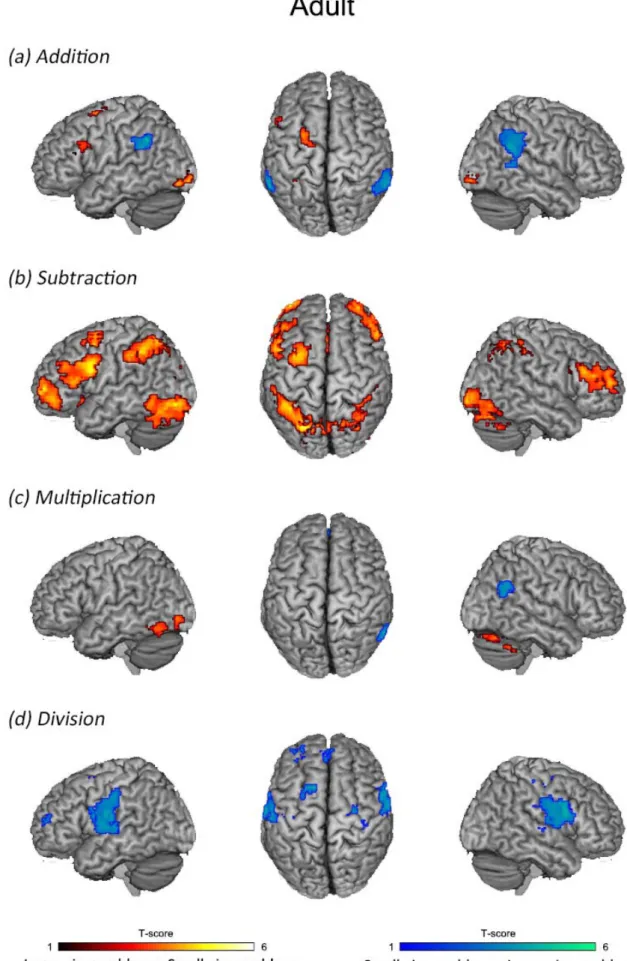
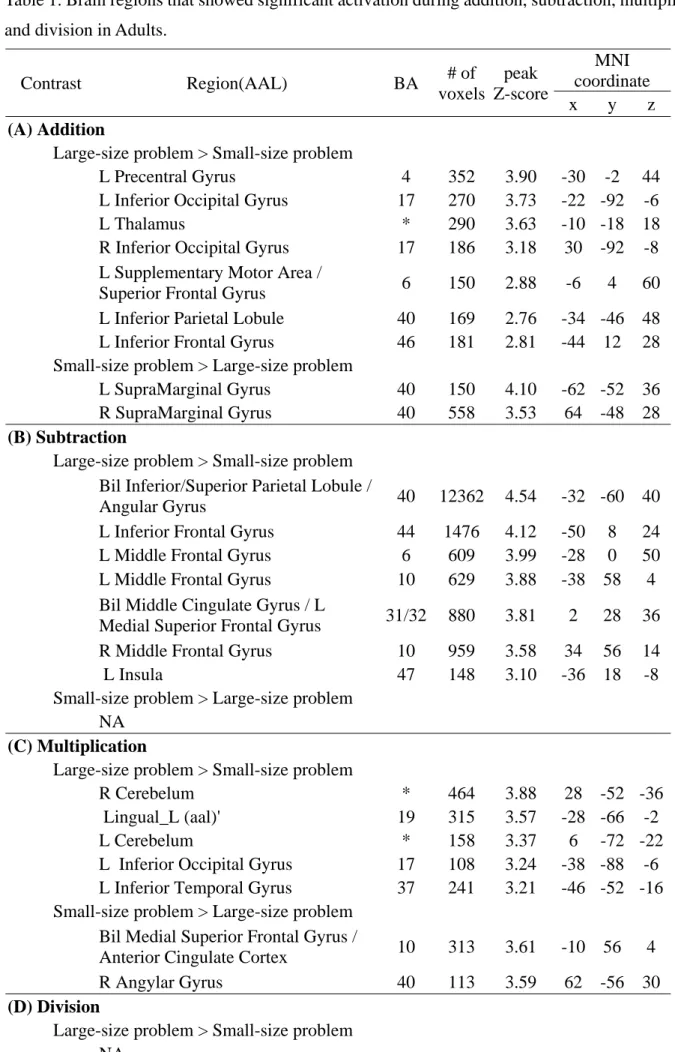
We first examined brain responses elicited during the solution of each of the four arithmetic operation problems in children and adults. Brain activations of adult during addition, subtraction, multiplication, and division problem solving are summarized in Figure 7 and Table 1. In order to preclude the responses included motor, decision making, or basic number processing, Simple size problem for each of the four operations was served as baseline. Therefore, the results depicted here were problem size effect of each of the four operations for adults and children. We found that Adults showed widespread activations for addition and subtraction problems, predominantly in frontoparietal circuits, including bilateral IPS in the PPC, middle frontal gyrus (MFG) in the dorsal lateral PFC and inferior frontal gyrus (IFG) in the ventral lateral PFC. These effects were more salient in Subtraction than in Addition. Multiplication and Division, in contrast, elicit less brain activations. For multiplication, this effect was consistent with behavioral effect, as c adults use retrieval stage to solve both large and small multiplication problems. For division problems, it is likely that both large and small size problem are equally difficult, hence no problem size effect was observed.
Figure 7. Brain regions that showed significant activation during addition, subtraction, multiplication, and division in Adults.
Table 1. Brain regions that showed significant activation during addition, subtraction, multiplication, and division in Adults.
Contrast Region(AAL) BA # of voxels peak Z-score MNI coordinate x y z (A) Addition
Large-size problem > Small-size problem
L Precentral Gyrus 4 352 3.90 -30 -2 44 L Inferior Occipital Gyrus 17 270 3.73 -22 -92 -6 L Thalamus * 290 3.63 -10 -18 18
R Inferior Occipital Gyrus 17 186 3.18 30 -92 -8 L Supplementary Motor Area /
Superior Frontal Gyrus 6 150 2.88 -6 4 60 L Inferior Parietal Lobule 40 169 2.76 -34 -46 48 L Inferior Frontal Gyrus 46 181 2.81 -44 12 28 Small-size problem > Large-size problem
L SupraMarginal Gyrus 40 150 4.10 -62 -52 36 R SupraMarginal Gyrus 40 558 3.53 64 -48 28
(B) Subtraction
Large-size problem > Small-size problem Bil Inferior/Superior Parietal Lobule /
Angular Gyrus 40 12362 4.54 -32 -60 40 L Inferior Frontal Gyrus 44 1476 4.12 -50 8 24 L Middle Frontal Gyrus 6 609 3.99 -28 0 50 L Middle Frontal Gyrus 10 629 3.88 -38 58 4 Bil Middle Cingulate Gyrus / L
Medial Superior Frontal Gyrus 31/32 880 3.81 2 28 36 R Middle Frontal Gyrus 10 959 3.58 34 56 14 L Insula 47 148 3.10 -36 18 -8 Small-size problem > Large-size problem
NA
(C) Multiplication
Large-size problem > Small-size problem
R Cerebelum * 464 3.88 28 -52 -36 Lingual_L (aal)' 19 315 3.57 -28 -66 -2 L Cerebelum * 158 3.37 6 -72 -22
L Inferior Occipital Gyrus 17 108 3.24 -38 -88 -6 L Inferior Temporal Gyrus 37 241 3.21 -46 -52 -16 Small-size problem > Large-size problem
Bil Medial Superior Frontal Gyrus /
Anterior Cingulate Cortex 10 313 3.61 -10 56 4 R Angylar Gyrus 40 113 3.59 62 -56 30
(D) Division
Large-size problem > Small-size problem
Small-size problem > Large-size problem R Supplementary Motor Area /
Middle Cingulate Gyrus 6 155 3.99 10 -20 48 L Superior Frontal Gyrus 6 102 3.81 -18 12 56 R Inferior Frontal Gyrus / Postcentral
Gyrus 6 1274 3.77 54 8 24 L Middle Frontal Gyrus 10 141 3.75 -26 54 16 L Postcentral Gyrus / Superior
Temporal Gyrus 6/ 41 1456 3.70 -50 -20 8 R Superior Frontal Gyrus 6 133 3.49 28 -12 58 L Anterior Cingulate Cortex 32 314 3.35 -4 16 26 L Medial Superior Frontal Gyrus 9 117 3.33 -2 48 32 R Superior Temporal Gyrus 41 149 3.10 38 -34 16 L Calcarine 31 105 3.14 -12 -76 26
3.2.2.2. Whole-brain analysis of four operations for Children
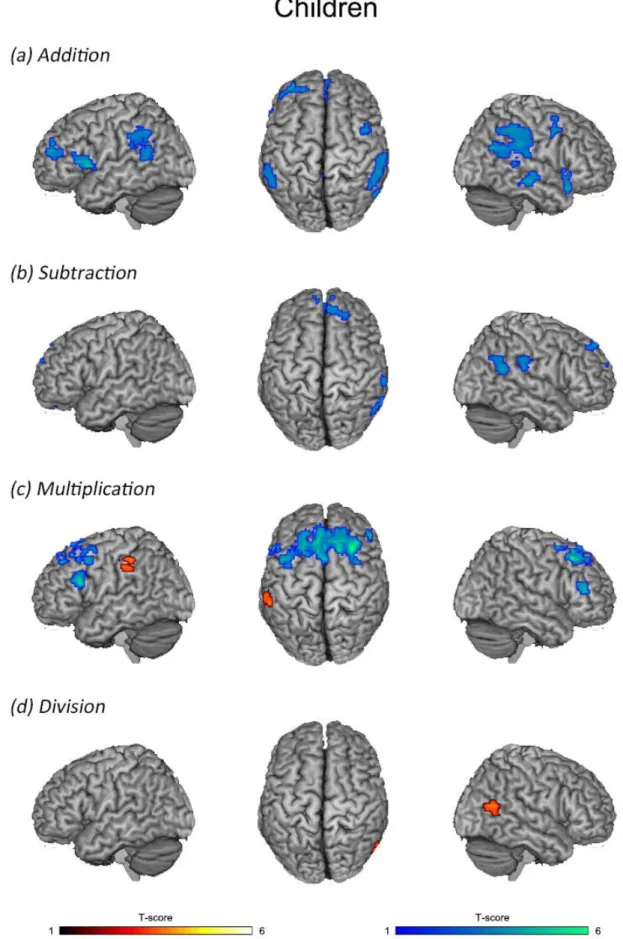
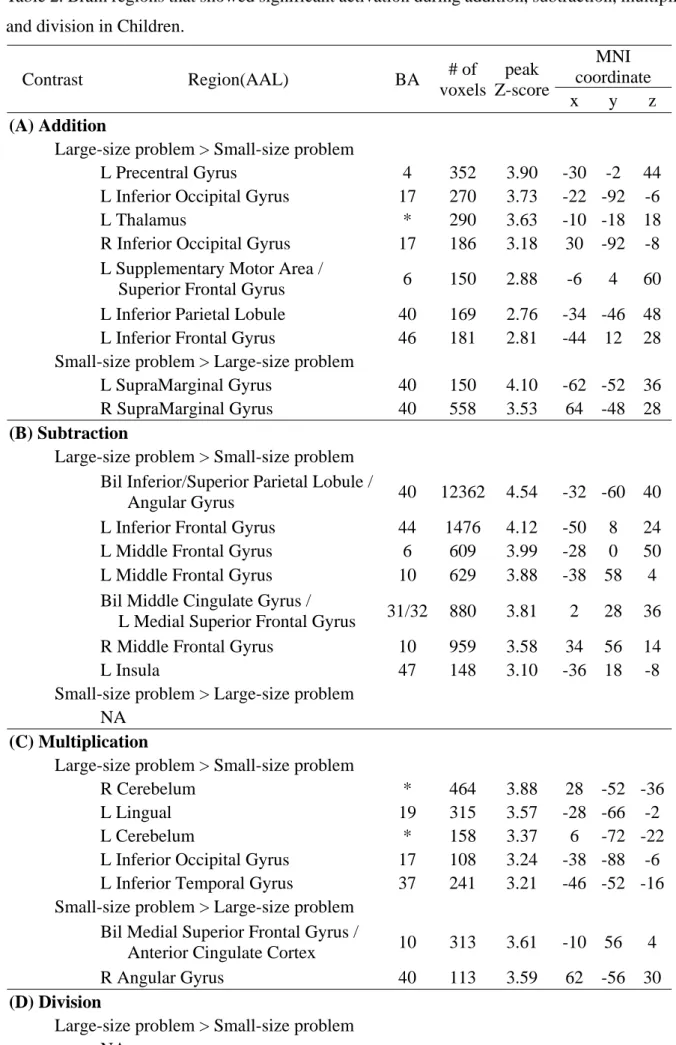
We then examined problem size effect for the four operations in children, as illustrated in Figure 8 and Table 2. In Sharp contrast, children show minimal activation in all the four operations, with more deactivations (large problem elicit less activation than Small problems) in widespread regions. These regions comprised of ventromedial prefrontal cortex, posterior parietal cortex, posterior temporal cortex, i.e., default mode network.
Figure 8. Brain regions that showed significant activation during addition, subtraction, multiplication, and division in Children.
Table 2. Brain regions that showed significant activation during addition, subtraction, multiplication, and division in Children.
Contrast Region(AAL) BA # of voxels peak Z-score MNI coordinate x y z (A) Addition
Large-size problem > Small-size problem
L Precentral Gyrus 4 352 3.90 -30 -2 44 L Inferior Occipital Gyrus 17 270 3.73 -22 -92 -6 L Thalamus * 290 3.63 -10 -18 18
R Inferior Occipital Gyrus 17 186 3.18 30 -92 -8 L Supplementary Motor Area /
Superior Frontal Gyrus 6 150 2.88 -6 4 60 L Inferior Parietal Lobule 40 169 2.76 -34 -46 48 L Inferior Frontal Gyrus 46 181 2.81 -44 12 28 Small-size problem > Large-size problem
L SupraMarginal Gyrus 40 150 4.10 -62 -52 36 R SupraMarginal Gyrus 40 558 3.53 64 -48 28
(B) Subtraction
Large-size problem > Small-size problem Bil Inferior/Superior Parietal Lobule /
Angular Gyrus 40 12362 4.54 -32 -60 40 L Inferior Frontal Gyrus 44 1476 4.12 -50 8 24 L Middle Frontal Gyrus 6 609 3.99 -28 0 50 L Middle Frontal Gyrus 10 629 3.88 -38 58 4 Bil Middle Cingulate Gyrus /
L Medial Superior Frontal Gyrus 31/32 880 3.81 2 28 36 R Middle Frontal Gyrus 10 959 3.58 34 56 14 L Insula 47 148 3.10 -36 18 -8
Small-size problem > Large-size problem
NA
(C) Multiplication
Large-size problem > Small-size problem
R Cerebelum * 464 3.88 28 -52 -36 L Lingual 19 315 3.57 -28 -66 -2 L Cerebelum * 158 3.37 6 -72 -22
L Inferior Occipital Gyrus 17 108 3.24 -38 -88 -6 L Inferior Temporal Gyrus 37 241 3.21 -46 -52 -16 Small-size problem > Large-size problem
Bil Medial Superior Frontal Gyrus /
Anterior Cingulate Cortex 10 313 3.61 -10 56 4 R Angular Gyrus 40 113 3.59 62 -56 30
(D) Division
Large-size problem > Small-size problem
Small-size problem > Large-size problem R Supplementary Motor Area /
Middle Cingulate Gyrus 6 155 3.99 10 -20 48 L Superior Frontal Gyrus 6 102 3.81 -18 12 56 R Inferior Frontal Gyrus / Postcentral
Gyrus 6 1274 3.77 54 8 24 L Middle Frontal Gyrus 10 141 3.75 -26 54 16 L Postcentral Gyrus /
Superior Temporal Gyrus 6/ 41 1456 3.70 -50 -20 8 R Superior Frontal Gyrus 6 133 3.49 28 -12 58 L Anterior Cingulate Cortex 32 314 3.35 -4 16 26 L Medial Superior Frontal Gyrus 9 117 3.33 -2 48 32 R Superior Temporal Gyrus 41 149 3.10 38 -34 16 L Calcarine 31 105 3.14 -12 -76 26
3.2.2.2. Voxel-wise full factorial ANOVA
Next, we investigated whether the two groups showed different responses between the four operations. We conducted a group-level voxel-wise whole-brain random-effects full factorial 4 (Operation) X 2 (Group) ANOVA, with Operation as within-subject factor and Group as between-subjects factor. We found significant Operation effect in the bilateral IPS in the PPC and MFG in the PFC, as illustrated in Figure 9. Activation level analysis within these regions suggested that Subtraction problems elicited stronger activations than the other three operations. Operation by Group was also significant in PPC and PFC, with children did not engage as stronger activations for Subtraction as adults, but higher activations for multiplication than adults (Figure 10).
ANOVA.
Figure 10. Brain regions that showed Operation by Group interaction as identified in the voxel-wise full-factorial ANOVA.
3.2.2.3 ROI analysis in PFC, PPC, and hippocampus
Because previous research of children solving arithmetic operation problems had also focused on hippocampus (Cho et al., 2012; Cho et al., 2011; De Smedt et al., 2011; Qin et al., 2014), we then examined activation profile within this region. Because our voxel-wise whole-brain analysis did not elicit any hippocampus region, we adopted the peak from the hippocampus reported by Cho et al. (2012) and draw a 6mm sphere centered on the peak to create hippocampus ROI. Signal strength within this ROI was summarized in Figure 11. We first entered signal strength values of the ROI into a separate two-way ANOVA, with Operation as within-subject factor and Group as between-subject factor. However, no any main effect or interaction was observed
Figure 11. Activation profile of right hippocampus.
4. Discussion and conclusion
In the present study, we investigated the cognitive and neural mechanisms of distinct arithmetic operation problems and how these cognitive skills develop after more than a decade of experience with problem solving. We first examined behavioral patterns of how accurate and efficient as well as the problem solving strategy whereby adults and children solve addition, subtraction, multiplication and division problems, the four most basic arithmetic operations that were solved using different strategies over development. We then examined how the brain responds to the four operations and how they change with development by comparing children and adults. To our knowledge, this is the first imaging study to examine all the four operations using a within-subject design and compare children and adults. Coupled with fMRI imaging analysis method, our study will provide useful knowledge to understand the developmental trajectory of how each arithmetic operation matures with learning and experience.
In the Experiment 1, we first investigated how accurately and how efficient that adults and children solve each of the arithmetic operation problem by measuring accuracy and reaction time of adults and children solving each of all the four operations. Accuracy and reaction time provides the measurements of how difficult each task is. We found that consistent with previous literature, subtraction were more difficult than addition as well division more difficult than multiplication (Campbell & Xue, 2001; De Smedt et al., 2011; Rosenberg-Lee, Barth, & Menon, 2011). Importantly, addition and multiplication do not differ in accuracy or reaction time, suggesting that our manipulation has successfully matched problem difficulty between the operations. Interestingly, the retrieval rate for multiplication is higher than addition, suggesting that different problem strategies can be used to accomplish problem solving with similar difficulties both in adults and children. Although subtraction and division were inverse form of other problem types, the two operations were solved using different strategies. For subtraction, large problems were solved by calculation whereas small problem were
solved by retrieval. Division, in contrast, was mostly solved by transformation from the inverse answer of multiplication. Our adults behavioral pattern has revealed robust and consistent results with literature. We also observed significant Operation by Group and Problem Size by Group interaction, suggesting that the four operations matures in distinct developmental stages.
To investigate the brain responses of all the four operations, we conducted one-sample t-test on activation level of each of the four arithmetic operations. We found that adults showed significant activations in arithmetic operations, particularly in addition and subtraction in the PPC and PFC, with subtraction stronger activation in the other three operations. Notably, none of these brain areas showed significant activations, particularly in PPC in any of the four operations in children. These results demonstrated that the maturation of arithmetic problem solving skills is characterized by significant developmental changes in a common neural network associated with arithmetic problem solving. Subtraction, undergo significant age-related differences along the protracted developmental stages. Crucially, the Subtraction problems require greater access to magnitude representations supported by the PPC (Ansari, 2008; Arsalidou & Taylor, 2011; Cohen Kadosh, Lammertyn, & Izard, 2008; Dehaene, Piazza, Pinel, & Cohen, 2003). This view has been supported by previous behavioral studies in which the percentage of direct retrieval used for solving subtraction problems is significantly lower for both adults and children (Barrouillet, Mignon, & Thevenot, 2008; Campbell & Xue, 2001). Numerous imaging results had demonstrated that the PPC develops across decades of the lifespan (Cantlon, Brannon, Carter, & Pelphrey, 2006; Cantlon et al., 2009; Chang, Metcalfe, Padmanabhan, Chen, & Menon, 2015; Chang, Rosenberg-Lee, et al., 2015; Holloway & Ansari, 2010; Kawashima et al., 2004). Consistent with this view, our results demonstrate that during subtraction, which involves deriving answers through quantity manipulation more than direct retrieval, PPC activation increases across the two age groups.
Consistent with previous literature (Ansari & Dhital, 2006; Cantlon et al., 2006; Kawashima et al., 2004; Rivera et al., 2005), adults engaged stronger PPC activation than children in most of the operations, at least addition and subtraction. Within the PPC, the IPS has been of particular interest in the context of the development of arithmetic problem solving skills. IPS is known to play a critical role in representing quantity information in both basic numerical processing and arithmetic problem solving (Ansari, 2008; Arsalidou & Taylor, 2011; Cohen Kadosh et al., 2008; Dehaene et al., 2003; Houde, Rossi, Lubin, & Joliot, 2010; Wu et al., 2009). Converging evidence from research using infants, children and young adults has suggested that representation of quantity is a foundational ability for numerical problem solving (Ansari, 2008; Cohen Kadosh et al., 2008; Dehaene et al., 2003; Feigenson, Dehaene, & Spelke, 2004; Halberda, Mazzocco, & Feigenson, 2008). Quantity representation ability is progressively refined with learning and maturation across the life span from early infancy into young adulthood (Halberda & Feigenson, 2008; Halberda, Ly, Wilmer, Naiman, &
Germine, 2012; Izard, Sann, Spelke, & Streri, 2009; Lipton & Spelke, 2003; Xu & Spelke, 2000). As these skills are built and enhanced, it is expected that the neural systems supporting these representations within the IPS should become more engaged as a result of solving arithmetic problems. Consistent with this view, our results demonstrate that for arithmetic operations, which involve deriving answers through quantity manipulation and direct retrieval (Barrouillet et al., 2008; Campbell & Xue, 2001; De Smedt et al., 2011; Rosenberg-Lee, Chang, et al., 2011), IPS activation would increases linearly into young adulthood.
We expected to see PFC engagement decrease with age, as previous literature (Cantlon et al., 2006; Cantlon et al., 2009; Rivera et al., 2005). However, PFC was found to show increased with age. One possibility is the heterogeneity of developmental trajectory in the PFC. Rosenberg-Lee and colleagues had compared 2nd and 3rd graders brain response while they solve simple addition
problems. They found that a heterogeneous developmental trend in the PFC, with VMPFC decrease whereas DLPFC increase with age between 2nd and 3rd grades. DLPFC has been considered as a core region associated with cognitive control (Bunge, Dudukovic, Thomason, Vaidya, & Gabrieli, 2002; Houde et al., 2010; Sridharan, Levitin, & Menon, 2008) whereas VMPFC is considered as a node of default mode network, set of brain regions consistently linked to decreases in activation during goal-oriented effortful cognitive tasks (Greicius et al., 2003; Raichle et al., 2001; Shulman et al., 1997). Our PFC ROI was drawn from the peak closer to DLPFC, a region likely to increase with learning and experience.
Over the last several decades, neuroimaging methods have been used intensively to examine brain development and maturation, leading to new insights into the biological underpinnings of human learning and skill acquisition. Question remained to be solved included how human learn arithmetic problem solving, how the problem solving skills develops, and whether different types of arithmetic operations showed different developmental trajectory. Very little work has been done to show how distinct arithmetic operations develop across childhood into adulthood (Chang, Rosenberg-Lee, et al., 2015; Kawashima et al., 2004; Prado et al., 2014). Our study provides an initial look of how children and adults’ brain respond to the four arithmetic operation problems that supports the maturation of problem-solving abilities. More work need to be done to explore the brain maturation underlying arithmetic problem solving, such as neural representation across operations and brain connectivity as well as neural circuits underlying arithmetic skill. Ongoing projects supported by MOST are investigating the longitudinal change and individual difference for school-age children (104-2511-S-004 -(104-2511-S-004).
Ansari, D. (2008). Effects of development and enculturation on number representation in the brain. Nat Rev Neurosci, 9(4), 278‐291. Ansari, D., & Dhital, B. (2006). Age‐related changes in the activation of the intraparietal sulcus during nonsymbolic magnitude processing: an event‐related functional magnetic resonance imaging study. J Cogn Neurosci, 18(11), 1820‐1828. doi: 10.1162/jocn.2006.18.11.1820 Arsalidou, M., & Taylor, M. J. (2011). Is 2+2=4? Meta‐analyses of brain areas needed for numbers and calculations. Neuroimage, 54(3), 2382‐2393. doi: 10.1016/j.neuroimage.2010.10.009 Barrouillet, P., Mignon, M., & Thevenot, C. (2008). Strategies in subtraction problem solving in children. J Exp Child Psychol, 99(4), 233‐251. doi: 10.1016/j.jecp.2007.12.001 Binder, J. R., & Desai, R. H. (2011). The neurobiology of semantic memory. Trends Cogn Sci, 15(11), 527‐536. doi: 10.1016/j.tics.2011.10.001 Bunge, S. A., Dudukovic, N. M., Thomason, M. E., Vaidya, C. J., & Gabrieli, J. D. (2002). Immature frontal lobe contributions to cognitive control in children: evidence from fMRI. Neuron, 33(2), 301‐311. Cabeza, R., Ciaramelli, E., & Moscovitch, M. (2012). Cognitive contributions of the ventral parietal cortex: an integrative theoretical account. Trends Cogn Sci, 16(6), 338‐352. doi: 10.1016/j.tics.2012.04.008 Cabeza, R., Ciaramelli, E., Olson, I. R., & Moscovitch, M. (2008). The parietal cortex and episodic memory: an attentional account. Nat Rev Neurosci, 9(8), 613‐625. doi: 10.1038/nrn2459 Campbell, J. I. D. (1999). Division by multiplication. Mem Cognit, 27(5), 791‐802. Campbell, J. I. D. (2008). Subtraction by addition. Mem Cognit, 36(6), 1094‐1102. doi: 10.3758/MC.36.6.1094 Campbell, J. I. D., & Alberts, N. M. (2009). Operation‐specific effects of numerical surface form on arithmetic strategy. J Exp Psychol Learn Mem Cogn, 35(4), 999‐1011. doi: 10.1037/a0015829 Campbell, J. I. D., & Xue, Q. (2001). Cognitive arithmetic across cultures. J Exp Psychol Gen, 130(2), 299‐315. Cantlon, J. F., Brannon, E. M., Carter, E. J., & Pelphrey, K. A. (2006). Functional imaging of numerical processing in adults and 4‐y‐old children. PLoS Biol, 4(5), e125. doi: 10.1371/journal.pbio.0040125 Cantlon, J. F., Libertus, M. E., Pinel, P., Dehaene, S., Brannon, E. M., & Pelphrey, K. A. (2009). The neural development of an abstract concept of number. J Cogn Neurosci, 21(11), 2217‐2229. doi: 10.1162/jocn.2008.21159 Chang, T. T., Metcalfe, A. W., Padmanabhan, A., Chen, T., & Menon, V. (2015). Heterogeneous and nonlinear development of human posterior parietal cortex function. Neuroimage, 126, 184‐ 195. doi: 10.1016/j.neuroimage.2015.11.053 Chang, T. T., Rosenberg‐Lee, M., Metcalfe, A. W., Chen, T., & Menon, V. (2015). Development of common neural representations for distinct numerical problems. Neuropsychologia. doi: 10.1016/j.neuropsychologia.2015.07.005 Cho, S., Metcalfe, A. W., Young, C. B., Ryali, S., Geary, D. C., & Menon, V. (2012). Hippocampal‐ prefrontal engagement and dynamic causal interactions in the maturation of children's fact retrieval. J Cogn Neurosci, 24(9), 1849‐1866. doi: 10.1162/jocn_a_00246 Cho, S., Ryali, S., Geary, D. C., & Menon, V. (2011). How does a child solve 7 + 8? Decoding brain activity patterns associated with counting and retrieval strategies. Dev Sci, 14(5), 989‐1001. doi: 10.1111/j.1467‐7687.2011.01055.x Chochon, F., Cohen, L., van de Moortele, P. F., & Dehaene, S. (1999). Differential contributions of the left and right inferior parietal lobules to number processing. J Cogn Neurosci, 11(6), 617‐ 630. Cohen Kadosh, R., Lammertyn, J., & Izard, V. (2008). Are numbers special? An overview of chronometric, neuroimaging, developmental and comparative studies of magnitude
representation. Prog Neurobiol, 84(2), 132‐147. doi: 10.1016/j.pneurobio.2007.11.001 De Smedt, B., Holloway, I. D., & Ansari, D. (2011). Effects of problem size and arithmetic operation on brain activation during calculation in children with varying levels of arithmetical fluency. Neuroimage, 57(3), 771‐781. doi: 10.1016/j.neuroimage.2010.12.037 Dehaene, S., Piazza, M., Pinel, P., & Cohen, L. (2003). Three parietal circuits for number processing. Cogn Neuropsychol, 20(3), 487‐506. doi: 10.1080/02643290244000239 Fehr, T., Code, C., & Herrmann, M. (2007). Common brain regions underlying different arithmetic operations as revealed by conjunct fMRI‐BOLD activation. Brain Research, 1172, 93‐102. doi: 10.1016/j.brainres.2007.07.043 Fehr, T., Code, C., & Herrmann, M. (2008). Auditory task presentation reveals predominantly right hemispheric fMRI activation patterns during mental calculation. Neuroscience Letters, 431(1), 39‐44. doi: 10.1016/j.neulet.2007.11.016 Feigenson, L., Dehaene, S., & Spelke, E. (2004). Core systems of number. Trends Cogn Sci, 8(7), 307‐ 314. doi: 10.1016/j.tics.2004.05.002 Geary, D. C., Hamson, C. O., & Hoard, M. K. (2000). Numerical and arithmetical cognition: a longitudinal study of process and concept deficits in children with learning disability. J Exp Child Psychol, 77(3), 236‐263. doi: 10.1006/jecp.2000.2561 Greicius, M. D., Krasnow, B., Reiss, A. L., & Menon, V. (2003). Functional connectivity in the resting brain: a network analysis of the default mode hypothesis. Proc Natl Acad Sci U S A, 100(1), 253‐258. doi: 10.1073/pnas.0135058100 Halberda, J., & Feigenson, L. (2008). Developmental change in the acuity of the "Number Sense": The Approximate Number System in 3‐, 4‐, 5‐, and 6‐year‐olds and adults. Dev Psychol, 44(5), 1457‐1465. doi: 10.1037/a0012682 Halberda, J., Ly, R., Wilmer, J. B., Naiman, D. Q., & Germine, L. (2012). Number sense across the lifespan as revealed by a massive Internet‐based sample. Proc Natl Acad Sci U S A, 109(28), 11116‐11120. doi: 10.1073/pnas.1200196109 Halberda, J., Mazzocco, M. M., & Feigenson, L. (2008). Individual differences in non‐verbal number acuity correlate with maths achievement. Nature, 455(7213), 665‐668. doi: 10.1038/nature07246 Hecht, S. A. (1999). Individual solution processes while solving addition and multiplication math facts in adults. Mem Cognit, 27(6), 1097‐1107. Holloway, I. D., & Ansari, D. (2010). Developmental specialization in the right intraparietal sulcus for the abstract representation of numerical magnitude. J Cogn Neurosci, 22(11), 2627‐2637. doi: 10.1162/jocn.2009.21399 Houde, O., Rossi, S., Lubin, A., & Joliot, M. (2010). Mapping numerical processing, reading, and executive functions in the developing brain: an fMRI meta‐analysis of 52 studies including 842 children. Dev Sci, 13(6), 876‐885. doi: 10.1111/j.1467‐7687.2009.00938.x Izard, V., Sann, C., Spelke, E. S., & Streri, A. (2009). Newborn infants perceive abstract numbers. Proc Natl Acad Sci U S A, 106(25), 10382‐10385. doi: 10.1073/pnas.0812142106 Kawashima, R., Taira, M., Okita, K., Inoue, K., Tajima, N., Yoshida, H., . . . Fukuda, H. (2004). A functional MRI study of simple arithmetic‐‐a comparison between children and adults. Brain Res Cogn Brain Res, 18(3), 227‐233. Lee, K. M. (2000). Cortical areas differentially involved in multiplication and subtraction: a functional magnetic resonance imaging study and correlation with a case of selective acalculia. Ann Neurol, 48(4), 657‐661. Lipton, J. S., & Spelke, E. S. (2003). Origins of number sense. Large‐number discrimination in human infants. Psychol Sci, 14(5), 396‐401. Prado, J., Mutreja, R., & Booth, J. R. (2014). Developmental dissociation in the neural responses to simple multiplication and subtraction problems. Dev Sci, 17(4), 537‐552.
Qin, S., Cho, S., Chen, T., Rosenberg‐Lee, M., Geary, D. C., & Menon, V. (2014). Hippocampal‐ neocortical functional reorganization underlies children's cognitive development. Nat Neurosci, 17(9), 1263‐1269. doi: 10.1038/nn.3788 Raichle, M. E., MacLeod, A. M., Snyder, A. Z., Powers, W. J., Gusnard, D. A., & Shulman, G. L. (2001). A default mode of brain function. Proc Natl Acad Sci U S A, 98(2), 676‐682. doi: 10.1073/pnas.98.2.676 Richland, L. E., Zur, O., & Holyoak, K. J. (2007). Mathematics. Cognitive supports for analogies in the mathematics classroom. Science, 316(5828), 1128‐1129. doi: 10.1126/science.1142103 Rivera, S. M., Reiss, A. L., Eckert, M. A., & Menon, V. (2005). Developmental changes in mental arithmetic: evidence for increased functional specialization in the left inferior parietal cortex. Cereb Cortex, 15(11), 1779‐1790. doi: 10.1093/cercor/bhi055 Rosenberg‐Lee, M., Ashkenazi, S., Chen, T., Young, C. B., Geary, D. C., & Menon, V. (2014). Brain hyper‐connectivity and operation‐specific deficits during arithmetic problem solving in children with developmental dyscalculia. Dev Sci. doi: 10.1111/desc.12216 Rosenberg‐Lee, M., Barth, M., & Menon, V. (2011). What difference does a year of schooling make? Maturation of brain response and connectivity between 2nd and 3rd grades during arithmetic problem solving. Neuroimage, 57(3), 796‐808. doi: 10.1016/j.neuroimage.2011.05.013 Rosenberg‐Lee, M., Chang, T. T., Young, C. B., Wu, S., & Menon, V. (2011). Functional dissociations between four basic arithmetic operations in the human posterior parietal cortex: a cytoarchitectonic mapping study. Neuropsychologia, 49(9), 2592‐2608. doi: 10.1016/j.neuropsychologia.2011.04.035 Shulman, G. L., Fiez, J. A., Corbetta, M., Buckner, R. L., Miezin, F. M., Raichle, M. E., & Petersen, S. E. (1997). Common Blood Flow Changes Across Visual Tasks: II. Decreases in Cerebral Cortex. J Cogn Neurosci, 9. Sridharan, D., Levitin, D. J., & Menon, V. (2008). A critical role for the right fronto‐insular cortex in switching between central‐executive and default‐mode networks. Proc Natl Acad Sci U S A, 105(34), 12569‐12574. doi: 10.1073/pnas.0800005105 Tzourio‐Mazoyer, N., Landeau, B., Papathanassiou, D., Crivello, F., Etard, O., Delcroix, N., . . . Joliot, M. (2002). Automated anatomical labeling of activations in SPM using a macroscopic anatomical parcellation of the MNI MRI single‐subject brain. Neuroimage, 15(1), 273‐289. doi: 10.1006/nimg.2001.0978 Wu, S., Chang, T. T., Majid, A., Caspers, S., Eickhoff, S. B., & Menon, V. (2009). Functional heterogeneity of inferior parietal cortex during mathematical cognition assessed with cytoarchitectonic probability maps. Cereb Cortex, 19(12), 2930‐2945. doi: 10.1093/cercor/bhp063 Xu, F., & Spelke, E. S. (2000). Large number discrimination in 6‐month‐old infants. Cognition, 74(1), B1‐B11. 林宜慧. (2007). 台南地區國一學生參加校外數學補習對其學習的影響. 國立高雄師範大學, 高 雄市. 徐政業. (2008). 學校與補習班數學教育情況及其對學生數學學習影響之比較. (碩士), 國立臺北 師範大學, 台北市. 張雅俐. (2011). 國小學童數學學業成就、數學補習經驗與數學學習策略關係之研究. (碩士), 國 立臺南大學, 台南市. 教育部. (2008). 97 年國民中小學九年一貫課程綱要. 臺北: 教育部. 許綺婷. (2001). 探討國三學生對補習班與學校教學的看法及其與基本學測數學科之表現的關 係. (碩士), 國立台灣師範大學, 台北市.
報告人: 張葶葶
職稱: 國立政治大學心理學系助理教授 出國日期: Jun 14-Jun 23, 2015
出國地點: 檀香山, 美國夏威夷州
會議名稱: 21st Annual Meeting of the Organization for Human Brain Mapping,
OHBM 行程: 6 月 14 日 台北出發直飛夏威夷檀香山國際機場,當日下午抵達,晚間參加大 會舉辦當日晚宴。 6 月 15 日 參與會議 6 月 16 日 參與會議
6 月 17 日 參與會議,發表論文 Neural correlates of complex multiplication problem solving(見附圖),並與學者交流 6 月 18 日 參與會議 6 月 21 日 晚間出發至機場,搭乘 22 日凌晨出發航班,23 日上午抵達台北。 心得: OHBM 是認知神經科學與腦造影技術領域每年的年度盛事,該組織每年六月於 世界各地舉辦會議,吸引上千學者前來交流,歷年來我多次參與該會議都獲益 良多,因此今年也再度投稿至該會議。 今年的會議如同往年般,吸引許多研究者,我見到相當多的熟面孔,許多在美 國進行博士後研究期間的同事也都出席,大家討論學術研究之餘,彼此也敘 舊、分享近況,彷彿同學會一般,會議期間我們重溫一起工作時的光景,會議 結束後,分開時也格外感傷,也約好未來將繼續在會議上相聚。 今年的每一場主題演講都相當吸引人,講者也都大有來頭,其中來自麻省綜合 醫院的 Bruce Fischl 提到以超高磁場強度進行 MRI 掃描後,配合 Free surfer 將 大腦皮質的溝與回分別對位的影像處理方式,可以大幅提升大腦影像解析度, 竟然可以顯影出大腦組織的層次,該演講中我坐在第一排,親眼見證其展示的 大腦解剖結構影像驚人的清晰;BJ Casey 素有發展領域之母之稱,現今有相當 多探討大腦認知功能發展領域的學者均出自其門下,其許多著作也被列為進入
發展領域必讀的文獻,今年的 OHBM 中我終於有幸朝聖,聽到 BJ Casey 講授 課程,Casey 博士相當具有大眾魅力,其演講非常能受到一般大眾接受與喜 愛,該演講中將青少年大腦與生理機制對其認知發展的影響與眾要性說明的相 當透徹;原先預定由來自澳洲的學者 Michael Breakspear 演講 Brain Waves 改為 以腦波進行睡眠研究,談到其中一個紡錘型的特定訊號稱為 sleep spindles 可以 做為相當良好的睡眠生理指標;其他諸如 Sabine Kastner 等也都是認知神經科學 領域中表現相當受人景仰的學者,能夠聽到他們演講真是非常開心。 這次的會議我也發表自己的研究,我們以磁振造影技術探討複雜乘法心算的解 題歷程與腦神經機制,也與來自世界各地的學者交流,共計有來自盧森堡、新 加坡、美國、加拿大、以及臺灣的學者前來詢問與交流,並給予建議。我也拜 訪了許多研究者的論文,對於這個領域的蓬勃發展相當讚嘆。 今年度的會議,我獲益非常良多,感謝科技部給予經費支持,使我能夠有機會 出國與來自世界各地的學者交流,希望科技部能持續給予經費支持,使臺灣的 學者能夠在國外報告自己的研究,增加國際間的可見度,也能對研究者達到刺 激與激發研究靈感之效。
科技部補助計畫衍生研發成果推廣資料表
日期:2016/03/25科技部補助計畫
計畫名稱: 國小學童數學成就之神經生物標記 計畫主持人: 張葶葶 計畫編號: 103-2511-S-004-004- 學門領域: 數學教育無研發成果推廣資料
103年度專題研究計畫研究成果彙整表
計畫主持人:張葶葶 計畫編號: 103-2511-S-004-004-計畫名稱:國小學童數學成就之神經生物標記 成果項目 量化 單位 備註(質化說明 :如數個計畫共 同成果、成果列 為該期刊之封面 故事...等) 實際已達成 數(被接受 或已發表) 預期總達成 數(含實際 已達成數) 本計畫實 際貢獻百 分比 國內 論文著作 期刊論文 0 2 100% 篇 研究報告/技術報告 0 0 100% 研討會論文 1 2 100% 兒童四則運算實 驗成果已發表於 2016年認知神經 科學學會年會 專書 0 0 100% 章/本 專利 申請中件數 0 0 100% 件 已獲得件數 0 0 100% 技術移轉 件數 0 0 100% 件 權利金 0 0 100% 千元 參與計畫人力 (本國籍) 碩士生 0 0 100% 人次 博士生 1 0 100% 博士後研究員 0 0 100% 專任助理 0 1 100% 國外 論文著作 期刊論文 0 2 100% 篇 研究報告/技術報告 0 0 100% 研討會論文 0 2 100% 專書 0 0 100% 章/本 專利 申請中件數 0 0 100% 件 已獲得件數 0 0 100% 技術移轉 件數 0 0 100% 件 權利金 0 0 100% 千元 參與計畫人力 (外國籍) 碩士生 0 0 100% 人次 博士生 0 0 100% 博士後研究員 0 0 100% 專任助理 0 0 100% 其他成果 (無法以量化表達之 成果如辦理學術活動 、獲得獎項、重要國 際合作、研究成果國 際影響力及其他協助 無產業技術發展之具體 效益事項等,請以文 字敘述填列。) 成果項目 量化 名稱或內容性質簡述 科 教 處 計 畫 加 填 項 目 測驗工具(含質性與量性) 0 課程/模組 0 電腦及網路系統或工具 0 教材 0 舉辦之活動/競賽 0 研討會/工作坊 0 電子報、網站 1 為推廣認知神經科學研究,並提高 家長與兒童受試者參與本研究,設 置政治大學大腦與學習實驗室粉絲 專頁 (https://www.facebook.com/brai nnlearninglab/),每週固定發表 新的腦科學研究,並招募受試者 ,目前計有257人加入,每次貼文 均有近千人觸及。 計畫成果推廣之參與(閱聽)人數 0