國
立
交
通
大
學
資訊科學與工程研究所
碩
士
論
文
藉由迴圈相依性與限制式牴觸分析進行大範圍安全
性質檢查
Scalable Security Property Checking by Loop Dependence and
Constraint Contradiction Analysis
研 究 生:翁文健
指導教授:黃世昆 教授
藉由迴圈相依性與限制式牴觸分析
進行大範圍安全性質檢查
Scalable Security Property Checking by Loop Dependence and
Constraint Contradiction Analysis
研 究 生:翁文健 Student:Wen-Chien Weng
指導教授:黃世昆 Advisor:Shih-Kun Huang
國 立 交 通 大 學
資 訊 科 學 與 工 程 研 究 所
碩 士 論 文
A ThesisSubmitted to Department of Computer and Engineering
College of Computer Science
National Chiao Tung University
in partial Fulfillment of the Requirements
for the Degree of
Master
in
Computer and Information Science
August 2008
Hsinchu, Taiwan, Republic of China
藉由迴圈相依性與限制式牴觸分析
進行大範圍安全性質檢查
學生:翁文健 指導教授:黃世昆 老師 國立交通大學資訊科學與工程學系 (研究所) 碩士班摘要
安全性質檢查用來確認程式中是否存在違反安全性質且可被利用進行惡意攻擊之程式 碼。對於邊界值測資以及動態程式分析很難進行此類檢查。故此 Execution Generate Executions 即 EXE 提出了 universal check 的概念,可以輕易地於動態程式分析中進行 安全性質檢查,涵蓋範圍遍及所有可執行路徑。然而進行大範圍 universal check 是有 困難的,因為執行路徑中 if-statement 的數量會呈指數成長。可是大部分的安全性質檢 查是多餘的,原因如下:(1) 在迴圈之中或之後的安全性質檢查可能與迴圈執行結果 無關。(2) 有其他的條件式保護造成多餘的安全性質檢查。本篇論文提出偵測此類多 餘以及不必要的安全性質檢查。我們使用(1)迴圈相依性測試檢測迴圈與安全性質檢查 的相關性。(2)條件式牴觸分析判斷安全性質檢查是否已被其他條件式限制保護。Scalable Security Property Checking by Loop
Dependence and Constraint Contradiction Analysis
Student:Wen-Chien Weng Advisor:Shih-Kun HuangDepartment of Computer Science and Engineering
National Chiao Tung University
Abstract
Security property check is to verify if a program violates security rules and can be
exploited to execute arbitrary code. This type of check is hard to be performed by testing
with corner cases and dynamic program analysis. Thus Execution Generate Executions, or
EXE for short, proposes the idea of universal check which is easy for dynamic program
analysis and could cover all execution paths. Unfortunately, universal check is not scalable.
The number of the if-statement of the execution path can be exponentially exploded, and
most of the property checks are redundant, due to two reasons: (1) Property checks within
or after a loop statement and the checks may not dependent on the loop. (2) The check is
already protected by other constraints. This paper proposes methods to detect those
redundant or unnecessary checks. We use (1) loop dependence analysis to check the
dependency relationship between loop and property check, and the necessity of this check,
and (2) constraint contradiction analysis to evaluate if the property check is already
致謝
感謝指導教授黃世昆老師的栽培,謝謝老師讓我們可以很自由的做研究並且 給予我們很好的建議。感謝博士班學長昌憲的指導,謝謝你不厭其煩的和我討論並且 教了我很多東西。感謝立文、友祥、彥廷、泳毅、琨翰、士瑜、慧蘭不論是在技術、 知識、生活上的幫助。最後更要感謝我的父母的栽培以及女友的支持。 要感謝的人太多了,那就謝天吧!Content
摘要 ... i Abstract ... ii 致謝 ... iii Content ... iv List of Figures ... viList of Tables ... vii
1 Introduction ... 1 1.1 Problem Descriptions ... 1 1.2 Motivation ... 2 1.3 Objective ... 2 2 Background ... 3 2.1 Program testing ... 3 2.2 Symbolic execution ... 3 2.3 Concolic execution ... 4
2.4 Static test generation ... 5
2.5 Dynamic test generation ... 5
2.6 Security property checking ... 6
2.7 ALERT ... 6
3 Related work: Constraint-based Execution Optimization ... 9
3.1 Constraint Solving Optimization ... 9
3.1.1 Minimizing Number of Calls to Constraint Solver ... 9
3.1.2 Minimizing Formulas ... 10
3.2 Path Optimization ... 12
3.2.1 Constraint Caching and reusing ... 12
3.2.2 Path Reduction ... 14
4 Method ... 17
4.1 Loop dependence analysis ... 17
4.2 Constraint contradiction detection ... 18
4.3 Reverse incremental check algorithm ... 19
5 Implementation ... 22 5.1 Data structure... 22 5.1.1 Structure... 22 5.1.2 Vector... 22 5.2 Naming ... 23 5.3 Taint analysis ... 24
5.3.1 Tainted by global variable ... 24
5.3.2 Tainted by function arguments... 24
5.3.3 Tainted by return value ... 25
5.3.4 Tainted by pass by address ... 26
5.4 Nested loop ... 27
5.5 Loop constraints elimination ... 27
6 Evaluations ... 32
6.1 Sort algorithms compared with CREST... 32
6.2 An n*n matrix allocation example ... 40
7 Conclusion ... 43
List of Figures
Figure 1: Example code of symbolic execution ... 3
Figure 2: Example of static and dynamic test generation ... 4
Figure 3: ALERT system architecture ... 8
Figure 4: Intersection result is null ... 18
Figure 5: Intersection result is non-null ... 18
Figure 6: Example of constraint contradiction detection ... 19
Figure 7: Reverse incremental check algorithm ... 21
Figure 8: Naming ... 23
Figure 9: Tainted by global value ... 24
Figure 10: Tainted by function arguments... 25
Figure 11: Tainted by return value ... 26
Figure 12: Tainted by pass by address ... 27
Figure 13: Loop constraints elimination example function test() ... 28
Figure 14: Execution tree of function test() ... 28
Figure 15: Special case of loop constraints elimination ... 30
Figure 16: Loop constraint elimination algorithm ... 30
Figure 17: Insertion sort for CREST ... 34
Figure 18: Insertion sort for ALERT + loop dependence analysis ... 35
Figure 19: Part of instrumented code for ALERT + loop dependence analysis ... 36
List of Tables
Table 1: Result of insertion sort ... 37
Table 2: Result of insertion sort ... 37
Table 3: Result of selection sort... 39
Table 4: Result of shell sort ... 39
Table 5: Result of bubble sort ... 40
Table 6: Result of matrix allocation using contradiction constraint detection ... 41
Table 7: Result compared between using constraint contradiction analysis and not using constraint contradiction analysis... 41
1 Introduction
1.1 Problem Descriptions
Test generation is a mainstream of program analysis. It can be partitioned into two groups:
static and dynamic test generation. Static test generation consists of analyzing the test
program without executing the program and generating test input with the information
acquired by static analysis. It is easier and faster, but imprecision. Dynamic test generation
executes the test program and gathers symbolic constraints then computes input by solving
these constraints with a constraint solver. It has better input coverage, more efficiency and
precision than static test generation, since dynamic test generation can acquire additional
runtime information. Runtime property checking is one of the applications of dynamic test
generation. It checks the test program against a set of specific properties defined by users. It
detects violations by generating an input to the test program that violates specific properties.
However, the scalability is the main concern of dynamic test generation. There are many
researches in order to address this problem. SMART[1], proposed by Godefroid, reuses
the preconditions and post-conditions of higher level functions when those functions are
used. EXE[2], proposed by Christian Cadar, uses cache mechanism to store constraint
results. These methods are useful, however they can not work efficiently when there is a
loop bounded by a symbolic variable in the test program. When a loop is bounded by a
symbolic variable, the number of times of the symbolic execution is dependent on this
symbolic variable. The symbolic execution has to try all possible value of this symbolic
bound. In this paper we proposed a method called loop dependence and constraint
contradiction analysis to address this problem and apply the method on security property
1.2 Motivation
Most dynamic test generation addresses scalability by reducing the number of times of
constraint query. EXE and CUTE[3] try to minimize the number of call to constraint solver,
and minimize the formulas. SMART uses function summaries to lower the number of times
of symbolic execution of a function. It is worth to note that most redundant symbolic
execution happen due to symbolic bounded loop and unnecessary. We propose two methods.
(1) To eliminate the redundant property checking (a kind of symbolic execution) caused by
symbolic bounded loops. (2) Ignoring unnecessary property check that results from
contradiction constraint.
1.3 Objective
In this paper, we observe that most security property checks (a kind of symbolic execution)
are redundant. (1) Security property checks that are within or after a loop statement which is
bounded by a symbolic variable. The times of performing the symbolic execution on the
loop are dependent on the range of the symbolic variable which bounded the loop, but the
security property checks are not necessary to be done at each time. If the security property
checking checks a property that is nothing to do with the loop statement, then it only needs
to be executed once. (2) Unnecessary security property checking. It is often to see that a
property is already protected by some constraints. Then it is unnecessary to perform security
property checking on it.
We propose two methods to address the above problem.
1. loop dependence analysis:
It can ignore the redundant property check by analyzing the relationship between loop
and property check.
2. contradiction constraint detection
2 Background
2.1 Program testing
Program testing has been studied since the 70’s(e.g., [4-7]). It assures that a program P
would execute correctly with test input cases. By program testing, programmers can make
sure their program functions well and find errors in programs. The main goal of program
testing is to generate input cases that could exercise all program behaviors, that is,
generating input cases that have the best test coverage. With better test coverage,
programmers can test programs more thoroughly. And the problem is called test generation
problem, it can be partitioned into two groups: static and dynamic test generation.
2.2 Symbolic execution
Symbolic execution[8] is a method which is widely used in constrain-based execution
nowadays. The main idea of symbolic execution is that symbols are used to represent
arbitrary values and the program is executed with these symbols. One symbolic execution
can be mapped into a large set of concrete execution, so it offers a way to abstract concrete
execution.
Figure 1: Example code of symbolic execution
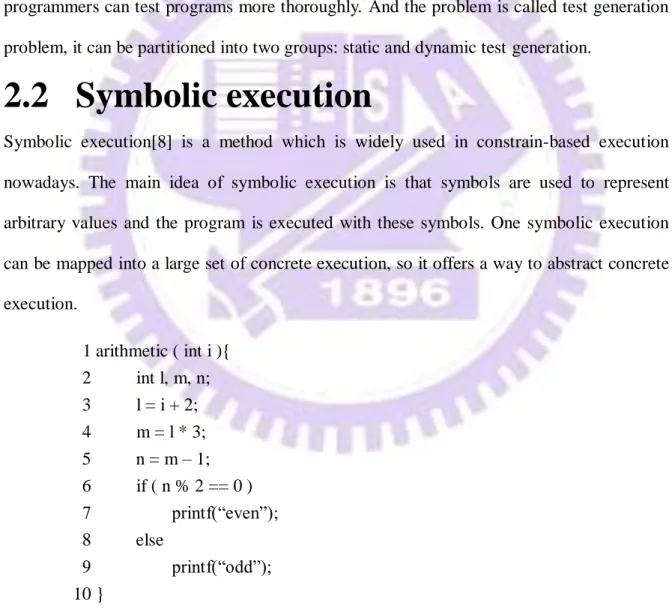
1 arithmetic ( int i ){ 2 int l, m, n; 3 l = i + 2; 4 m = l * 3; 5 n = m – 1; 6 if ( n % 2 == 0 ) 7 printf(“even”); 8 else 9 printf(“odd”); 10 }
In Figure.1, the program reads an input, does arithmetic, and determines the answer is either
even or odd. In the add operation at line 3, the symbolic l will be represented as “i + 2”, symbolic m will be represented as “3 * i + 6”, and symbolic n will be represented as “3 * i + 5.”
During the symbolic execution, we obtain an execution tree which represents the
control flow of this program. The symbolic execution tree is represented by the path
constraints along the execution path. In the above example, the execution tree has two
branches, one is to print “even”, and the other is to print “odd”. The path constraint can be used to characterize the input. The input in the “even” branch have result which is even, and their path constraint is n % 2 == 0. The cases in the “odd” branch have result which is odd,
and their path constraint is n % 2 != 0. Note that the path constraints can be accumulated. If
there is a nested IF statement, the constraints will be conjoined together.
In the following discussion, CUTE, DART[9], EXE, RWset, and SMART all use
symbolic execution.
Figure 2: Example of static and dynamic test generation
2.3 Concolic execution
The term concolic stands for cooperative concrete and symbolic execution. This term is first
proposed by K. Sen, D. Marinov and G. Agha, but the idea is first proposed by E. Larson
and T. Austin[10]. It is widely used in modern dynamic test generation. Dynamic test
generation tools like CUTE, DART, EXE and ALERT(our dynamic test generation system,
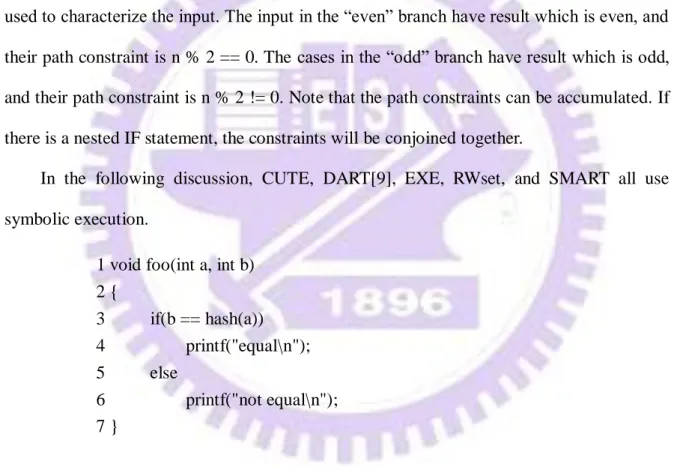
1 void foo(int a, int b) 2 { 3 if(b == hash(a)) 4 printf("equal\n"); 5 else 6 printf("not equal\n"); 7 }
this paper is based on this framework, it will be introduced in the following.) all uses this
technique. Concolic execution performs concrete execution and symbolic execution at the
same time and replaces with the concrete value expression that symbolic execution does not
know how to generate constraint or the constraint solver can not handle. Thus concolic
execution mitigates the imprecision in symbolic execution. It also maintains the advantages
of symbolic execution: (1) avoids generating redundant test cases, (2) better test coverage.
2.4 Static test generation
Static test generation (e.g., [11-13]) consists of analyzing the test program without actual
executing the test program and generating the test case to the test program. It is fast and
easy but less precision. If there is a function F in the test program and F can not be
analyzed, then the static test generation will lost its precision and code coverage. For
example, in Figure 2, function hash is a library function and can not be analyzed,
therefore the static test generation is impossible to generate a test case satisfying the
constraint b == hash(a). This situation is often occurred in application program, thus
static test generation is hard to become a practical tool.
2.5 Dynamic test generation
Dynamic test generation (e.g., [14-16]) consists of executing the test program P with a set
of random input, and gathering the symbolic constraints along the execution path, then
using constraint solver to reason another test case that will trigger another execution path.
Dynamic test generation will repeat the above steps until error occurs or traverses all
branches. Dynamic test generation is slower than static test generation, but has better
code coverage. For example, in Figure 2, with executing the function foo, dynamic test
generation can give a random concrete value to input a. If it triggers the else branch, then
next time dynamic test generation can fix the input a and make b == hash(a). Thus both
additional runtime information. Due to the reason dynamic test generation is more
powerful and practical.
2.6 Security property checking
In software testing, property means a specific behavior of a program execution, such as the
absence of buffer overflow or memory leaks. Runtime property checking dynamically
checks whether a program satisfies a set of specific property. Tools like Valgrind[17],
Purify[18] and SAGE [19]are widely used. With these tools software developers can
products more efficiently. Security property checking is a kind of runtime property checking
to check security properties such as integer overflow, and buffer overflow. It also is a kind
of dynamic test generation. Security property checking will try to generate a test case that
violates the specific properties by using a constraint solver. If it could generate a test case
that violates the specific security properties, then it infers there is a security flaw in the test
program.
2.7 ALERT
ALERT is abbreviated from “Automatic Logic Evaluation for Random Testing”. It is a
dynamic test generation using concolic execution technique and is a mix framework of
CUTE and EXE. It uses CIL (C Intermediate Language, an infrastructure for C program
analysis and transformation.) to simplify and instrument the test source code, and uses
CVC3 (an automatic theorem prover for Satisfiability Modulo Theories problem) as
constraint solver. It can generate test cases to cover the program execution paths. It also
supports security property checking; moreover, it can automatically generate corresponding
post constraints of C standard library functions without instruments C standard library
functions.
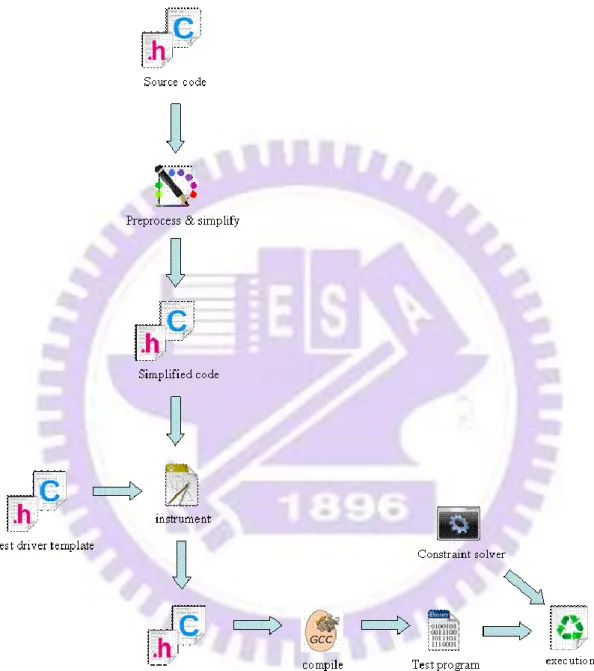
In Figure 3 is ALERT system architecture and following are ALERT execution steps: (1)
CIL supply 3 simplifications: simple three-address code, simple memory operation, and one
return. Besides, CIL transforms while, for and switch statement to if statement. (2) After
that ALERT again uses CIL to instrument the tested source code, add some additional
functions to gather the runtime information for dynamic analysis. (3) And then ALERT
compiles the instrumented source code to executable program and executes the program. (4)
Then ALERT executes concolic execution, the constraints along the execution path will be
collected. The last constraint along the path will be negated and all the constraint will be fed
into the constraint solver to generate a set of input to the next path. ALERT executes the
step 4 until all the execution paths of this test program are traversed or encounter an error.
During concolic execution ALERT also performs security property checks. It checks
whether the security property is violated. If it is true then ALERT will print warning
message. Besides, loop dependence analysis and constraint contradiction analysis are also
based on ALERT framework. While ALERT performs concolic execution, it also collects
variables that are assigned during loop executions and variables in security property check.
The symbolic constraints along the execution path are also used in constraint contradiction
3 Related
work:
Constraint-based
Execution Optimization
Constraint-based execution systematically explores all execution paths in the program by
collecting constraints along the path, then using a constraint solver to find next executable
path. However, dynamic testing suffered from the problem of scalability. To enhance the
performance we can either optimize constraint solving or eliminate redundant paths. We
classified these optimizations according to their purpose in the following.
3.1 Constraint Solving Optimization
3.1.1 Minimizing Number of Calls to Constraint Solver
Constraint solving is a very CPU-expensive operation; therefore we want to minimize
the number of calls to the constraint solver. We first present optimizations in EXE and
CUTE, discuss their advantages and drawbacks.
Constraint Caching
In EXE, a persistent cache is used to minimize the number of calls to the solver. EXE
prints the constraints as a string and computes the MD4 hash of the string. It then queries
the cache to see whether it is hit or not. If it gets a hit then the cache will return the answer;
if not, after invoking the solver EXE the (hash, result) pair is stored back to the cache.
If the cache size is not big enough, EXE has to replace a (hash, result) pair. Least
recent used strategy may be a good one. It is possible that an error answer occurs due to
hash collision. If so, it may get a false path, and cause the false positive or false negative.
Thus, universal hash might be a good choice.
Fast Unsatisfiability Check
the solver do not need to solve it, since the last one contradicts one of the preceding
constraints, and the whole path constraints is invalid.(In CUTE’s experimental results this
method can reduce the number of semantic checks by 60-95%.)Intuitively, linear search can
be used to check whether the last constraint is the negation of the preceding constraints.
However, it is not practical in real world, since the number of constraints is usually huge.
Hash function might be a good solution, it can reduce the search time from O(n) to
constant.(n is the number of constraints.)
3.1.2 Minimizing Formulas
The longer formula we feed to the solver the more time it needs to solve constraints. Thus if
we can minimize formula, we can speed up constraint solving. Following is three
optimizations in EXE and CUTE respectively.
Common Sub-constraints Elimination
Before passing path constrains to the lp_solve(CUTE builds their own solver on top of
lp_solve.), CUTE first identifies and eliminates common arithmetic sub-constraints. (In
CUTE’s experimental results this method can reduce the number of sub-constraints checks
by 64-90%.) It is possible to find common sub-constraints by linear search, but the number
of constraints is usually huge. Thus linear search may not be a good choice.
An MD4 hash for each sub-constraint is computed and stored in a cache. Before adding a
constraint into the path constraints, computing the hash of this constraint and then check
whether it is in the cache or not. If so, the constraint will not add into the path constraint
formula. Therefore the time complexity of searching reduces from O(n) to constant.(n is the
number of constraints in the path constraint formula.)
Constraint Independence Optimization
This is one of EXE’s important optimization, which exploits that path constraints can
have disjoint sets of operands. This optimization method has two benefits. (1) It can ignore
irrelevant constraints, thus decrease the cost of constraint solving. (2) It can increase the
cache hit rate in EXE, since the subset may be used by previous paths and smaller subset
reduce the number of checks. Thus it increases the cache hit rate.
EXE computes independent subset by constructing a graph G, whose nodes are
variables existing in all the constraints. Adding an edge between nodes ni and nj if and only
if there is a constraint that contains both of the nodes. Once graph G is constructed, EXE
apply component connected algorithm on G to compute its connected component. Then for
each connected component construct corresponding independent subset by adding all
constraints in the same component.
Incremental Solving:
Incremental solving identifies dependency between sub-constraints and exploits it to
achieve following goal: (1) solving constraints faster. (2) keeping the input similar.
CUTE defines two constraints p and p’ are dependent if variables in p and p’ have
conjunction or there is a constraint p’’ such that p and p’’ are dependent and p’ and p’’ are
dependent. It is worth to note that in CUTE, path constraints in two consecutive concolic
executions C and C’ only differ in the last constraint. Assume their corresponding solutions
are I and I’’, and the last constraint in C is K. CUTE first collects constraints in C that are
dependent with the negation of constraint K. Let the set of those constraints be M, and the
solution of M is C’’. Solution I’’ is the same as I except for those constraints in M every
solution of which is replaced by C’’(l).(l is the constraint in set M.), that is, the solution of
constraints that are not dependent with K still remains while the solution of constraints that
are dependent with K is changed.
The above optimizations have the same object: reducing the path constraints size by
constraints into multiple subsets, then checks the cache whether there is an answer, and just
solves constraints that are not in the cache. CUTE first finds out the constraints in C that is
dependent with the negation of the last constraint N, and then solves these constraints to
obtain solution C’’. The next solution C’ is the same as the previous one C but for those
constraints dependent with N replace their solution with C’’(l).(l is the constraint that is
dependent with N.).
Because EXE will fork process, it is better to use cache, and every child process can
query the cache. CUTE will negate the last predicate then compute the next input, thus the
replace strategy is better for it, since every execution path is relevant to the previous one. In
fact constraint independence optimization and incremental solving both use the “cache
concept”. They do not solve redundant constraints and only solve new constraints. Both of
them have significant improvement on execution optimization.
3.2 Path Optimization
3.2.1 Constraint Caching and reusing
Concolic execution will systematically execute every feasible path. In fact, the program
paths often increase exponentially in real program. Therefore executing all feasible paths is
not scalable. However, many paths are traversed repeatedly in test programs. One of
solutions to alleviate the problem is constraint caching and reusing, that is to reuse
constraints that already exist. SMART, which is an extension of DART, exercises functions
in the program and records the summaries (pre-conditions and post-conditions) of these
functions by their inputs and outputs. SMART re-use these summaries when program calls
these visited functions. According to SMART’s experiments, it can reduce the number of execution path from exponential to linear. ALERT with SP module (Resolving Constraints
for COTS/Binary Components for Concolic Random Testing proposed by Yang-Chieh Fan
implements on the C Standard Library currently. When the test program calls a function
from the C Standard Library, instead of traversing this function, ALERT will automatically
add the corresponding post-condition that is pre-constructed by ALERT developer. Not only
alleviate the path explosion problem, it also makes the concolic execution more precise and
explores more program paths.
SMART algorithm, compared with DART, is only different in function call statement.
When SMART executes a function call f, it first checks whether a summary of f is available
by checking whether current symbolic calling context implies the disjunction precondition
currently record in the summary of f. If so, SMART adds the summary of f into the path
constraints and turns the backtracking flag off, which is resumed when function f returned.
If no summary of f for current input is available, SMART will put the current input of f into
a stack and start backtracking f for current input. When it finishes backtracking, it will
execute add_to_summary function to compute the summary of f. After computing the
summary of f, SMART will determine where it should backtrack next by executing
solve_path_constr function. When backtracking is over, SMART will restore the input saved
in the stack.
Unlike SMART, ALERT with SP module provides an easy way to add post-conditions
of different functions and also support a post-condition library of the C Standard Library.
When the test program calls a function in the C Standard Library, ALERT instruments a stub
function after this function to add the corresponding pre-conditions into the current
constraint system. By this way it is not necessary to add source codes of functions in the C
Standard Library into the test program, and can add post-condition without traversing the C
Standard Library function.
The researchers of SMART run both SMART and DART on the subset of oSIP parser
code, which is an open-source C library implementing SIP protocol. According to the
however, SMART just increase linearly with the packet size. In addition, the running time is
linear to the number of the runs. The paper of Resolving Constraints for COTS/Binary
Components for Concolic Random Testing shows that the frequency of invocations of
external functions increases with the scale of the test program. With larger test programs the
missing constraints of external function increases. However, ALERT with SP module can
efficiently mitigate this problem by adding additional post-constraints. It also implies
ALERT with SP module can alleviate the path explosion problem, because it does not have
to traverse those external functions to obtain constraints.
DART has path explosion problem, but SMART solves it without loss path coverage
and makes it more scalable to large programs, because SMART can use the information
about functions it computed and re-use those summaries when it executes these functions
again. Thus, paths in these summarized functions do not need to be traversed repeatedly.
Moreover, this idea is not only just on functions, but also on loops, program blocks or object
methods.
The purpose of ALERT with SP module is to mitigate the gap between external
functions and test programs due to missing constraints resulted from concretization. With its
help, ALERT with SP module makes concolic execution more precise. In addition we also
can view this method as a kind of constraint caching and reusing since it can generate
required constraints without traversing external functions. Compare to SMART, ALERT
with SP module is a simple kind of SMART which can not generate required constraints
during execution and need to construct by users beforehand.
3.2.2 Path Reduction
To solve path explosion problem, SMART uses summary of functions to avoid
repeated traversal. On the other way, this problem can be alleviated by avoiding repeated
RWset[21], which derives from EXE, discards current path that have same side-effects as
previously exploded one. RWset proposes that it is unnecessary to traverse path that has
same side-effects with previously one. Once it recognizes this situation, it will stop the
traverse and generate an input for this path. And the experiments show that RWset got a
significant improvement on efficiency.
The main idea of RWset is many execution paths have the same effects, and it depends
on program point and program state. A program point is a MD4 hash of the program counter
and callstack, and a program state consists of the current path constraint and the values of
all concrete memory location. If there is an execution path that has the same program state
with previously executed one at some program point, then RWset considers this path will
produce the same effects and truncates this traverse. Besides, this idea can be enhanced by
exploiting that two program states are identical if they only differ in variables that are not
read after subsequent execution.
RWset records all program states along the execution path so far by writeset which is a
set of values of all concrete memory locations and path constraints at every program point;
moreover, it also stores readset at each program point. Given a program state, the readset
collects all locations read after a program point. When program reaches a program point,
RWset determines whether it has seen the program state before. RWset first intersects the
writeset and path constraints with the corresponding readset, and then compare the
intersection result with the current program state. If the result and the current program state
are equivalent, then RWset will prune this execution and generate a test case for this path;
otherwise RWset continues.
Researchers of RWset ran five medium-sized open-source benchmark compared with
EXE. The results show that RWset has a significant improvement. It substantially reduces
the number of test cases to achieve the same coverage as in EXE. In addition RWset does
benchmarks, the average runtime overhead of RWset is at most 4.38%. They measure it by
running an EXE version with all RWset require computations but without pruning any paths.
The most important problem that RWset solved is the scalability problem. As we already
know, constraint-based execution is not scalable when it checks large scale programs.
4 Method
4.1 Loop dependence analysis
The origin idea is proposed by RWSet. In this paper, we use this idea to analyze the
relationship between loop and security check. We use a loop set to represent the set of
variables that increase their value while executing loop iteration, and use a security property
set to represents the set of variables that security property checks. This analysis dynamically
executes along with symbolic execution. During the first loop iteration, variables which
have assignments in the loop statement will be collected into the loop set. If there is any
security property check, then the variables being checked is collected into the security
property set. After finishing the iteration, we intersect the two sets. If the intersection is null
then the property check is independent of the loop. The security check is unnecessary in the
successive iterations. Thus the successive iterations could be ignored. If the intersection is
nonempty, then the value that security property check checks is dependent on the loop. The
security checks need to be done in the successive iterations. By this analysis the redundant
security property check will be eliminated and the loop execution also be reduced.
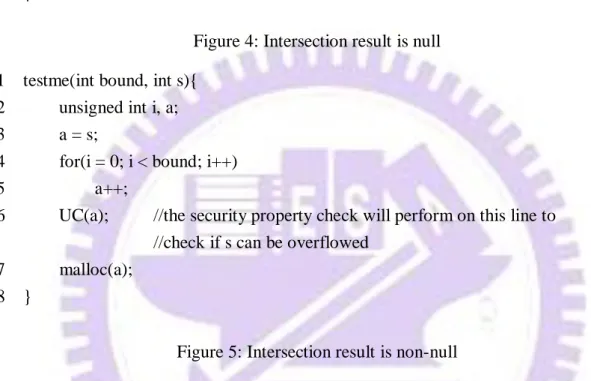
In Figure 4, the elements in loop set are i and k, the element in the security property set is s,
and the intersection of these two set is empty. We can infer that the property check is
independent of this loop. Thus this loop will not be executed in the successive symbolic
executions since it can be ignored. In Figure 5, the intersection of these two set is
non-empty, and the element in the intersection set is s. Thus, this loop will be executed
normally in the successive symbolic executions since the iterations of this loop may affect
Figure 4: Intersection result is null
Figure 5: Intersection result is non-null
Loop dependence analysis can be viewed as dynamic reaching definitions analysis. If some
variable in loops can reach security property checks, then the number of iteration of those
loops will affect security property checks. Otherwise, those loops can not affect security
property checks. Thus, the executions of those loops can be ignored. Loop dependence
analysis takes the advantages of dynamic analysis. It lowers the false positive and false
negatives while it does not cause much overhead.
4.2 Constraint contradiction detection
Programmers write codes more carefully than before since more and more attacks are
discovered, such as buffer overflow, integer overflow, format string attack. Thus
programmers usually add some secure checking code to prevent from being attack.
Therefore, the security property checks will be unnecessary. In this paper we proposed a 1 testme(int bound, int s, int k){
2 unsigned int i, a;
3 for(i = 0; i < bound; i++) 4 k++;
5 UC(s); //the security property check will perform on this line to //check if s can be overflowed
6 malloc(s); 7 }
1 testme(int bound, int s){ 2 unsigned int i, a; 3 a = s;
4 for(i = 0; i < bound; i++) 5 a++;
6 UC(a); //the security property check will perform on this line to //check if s can be overflowed
7 malloc(a); 8 }
method called constraint contradiction detection to find those unnecessary secure property
checks and eliminate them.
Instead of direct executing security property check, we check whether the security property
is protected (bounded) by other constraint by using reverse incremental check (details in
next section). If this property is already protected (bounded) then it means that the property
check is unnecessary and can be ignored. Otherwise it means this security should be
performed
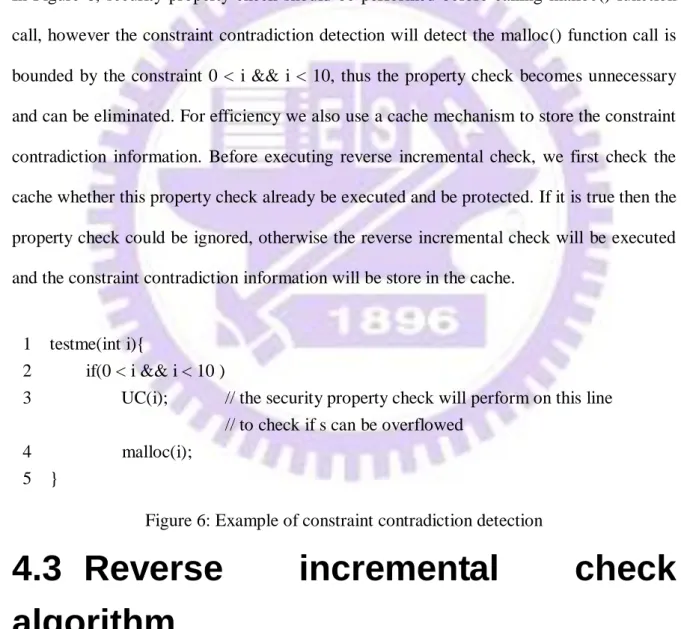
In Figure 6, security property check should be performed before calling malloc() function
call, however the constraint contradiction detection will detect the malloc() function call is
bounded by the constraint 0 < i && i < 10, thus the property check becomes unnecessary
and can be eliminated. For efficiency we also use a cache mechanism to store the constraint
contradiction information. Before executing reverse incremental check, we first check the
cache whether this property check already be executed and be protected. If it is true then the
property check could be ignored, otherwise the reverse incremental check will be executed
and the constraint contradiction information will be store in the cache.
Figure 6: Example of constraint contradiction detection
4.3 Reverse
incremental
check
algorithm
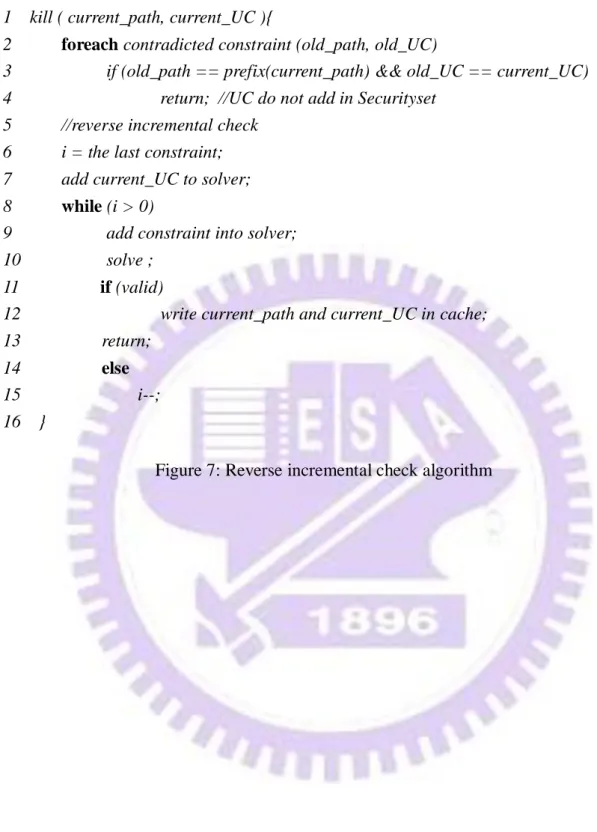
The kill subroutine takes current_path and cerrent_UC as arguments, in Figure 7 line 2, we
first check each cache data whether this constraint is already detected. If true then the 1 testme(int i){
2 if(0 < i && i < 10 )
3 UC(i); // the security property check will perform on this line // to check if s can be overflowed
4 malloc(i); 5 }
variables of the constraint will not be collected into the security property set, otherwise the
incremental reverse check will be executed in line 6.
The reverse incremental check starts from the latest predecessor constraint of the
current_UC, then using constraint solver to solve the predecessor constraint and current_UC,
if valid write the current_path and current_UC into cache, else collect the predecessor
constraint of current predecessor constraint into solver and solve again. Repeat line 9 to line
15 until there is no more constraints.
The main idea of reverse incremental check is based on a heuristic that programmer often
fix bugs by put some patch code just right before where bugs happened. For an example, in
Figure 5 the program might cause buffer overflow without the if statement checking the
value of variable i in line 2, thus programmers will put the if statement right before malloc()
function call in line 3. Therefore security property checks are often bounded by some
constraints that assure the verification of the program. With reverse constraint contradiction
detection, we can fast detect and ignore unnecessary security property check, moreover we
Figure 7: Reverse incremental check algorithm
1 kill ( current_path, current_UC ){
2 foreach contradicted constraint (old_path, old_UC)
3 if (old_path == prefix(current_path) && old_UC == current_UC) 4 return; //UC do not add in Securityset
5 //reverse incremental check 6 i = the last constraint; 7 add current_UC to solver; 8 while (i > 0)
9 add constraint into solver; 10 solve ;
11 if (valid)
12 write current_path and current_UC in cache; 13 return;
14 else 15 i--; 16 }
5 Implementation
5.1 Data structure
we define three kinds of structure and use four vector arrays in the loop dependence
analysis.
5.1.1 Structure
element: structure element consists of name and type. It is used to record the information of
elements in the wset. The naming mechanism satisfies static single assign form (SSA).The
details of the naming format will be described later.
loopbranch: structure loopbranch is used to record the information of branches which are
condition expression in loop statements. It has five fields. The branchID is the identifier of
branches. The Boolean variable begin distinguish the first iteration from loop branches. The
loopID records its corresponding loop statement. The secondIterBranchID records the
branchID of the second iteration.
loopInfo: structure loopInfo records information about the corresponding loop statement.
Vector west in the structure loopInfo is used to collect all left hand side variables in the loop
statement. Field intersect stores the intersect result with rset. We eliminate loop constraints
depend on the intersect result. If intersect equals 0, it implies the wset of this loop statement
does not intersect with rset. And this loop statement can be eliminated. Field seconIter is the
same as the field secondIterBranchID in the structure loopbranch. Field lineNum stores the
line number of the loop statement and field current stores the order of loop statements. We
can identify loop statements by using lineNum and current.
5.1.2 Vector
rset: it is a simple vector which stores all the variables referenced by universal check and
wsetStack: it records the state of nested loop, the loop id (the field lineNum in the structure
loopInfo) will be popped into this stack and be popped out while leaving this statement.
loopbranchStack: this vector stores structure loopbranch which are condition expression in
the loop statements in the execution order. It helps us distinguish loop branches form
branches.
loop: this vector stores structure loopInfo in the execution order.
5.2 Naming
Loop dependence analysis collects variable name into loop set and security property set. We
use the format “varName_cn_varRepos” to represent variables. “varName” is variable name.
Use “cn” as procedure stack counter, increasing “cn” while enter a new procedure stack,
decreasing it while leaving. “varPepos” increases when variable varName is assigned,
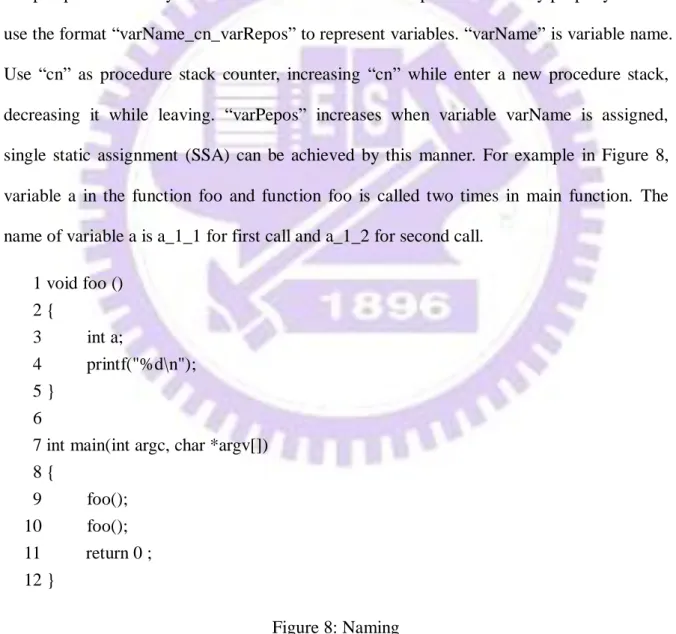
single static assignment (SSA) can be achieved by this manner. For example in Figure 8,
variable a in the function foo and function foo is called two times in main function. The
name of variable a is a_1_1 for first call and a_1_2 for second call.
Figure 8: Naming 1 void foo () 2 { 3 int a; 4 printf("%d\n"); 5 } 6
7 int main(int argc, char *argv[]) 8 {
9 foo(); 10 foo(); 11 return 0 ; 12 }
5.3 Taint analysis
Loop dependence analysis also can be viewed as taint analysis. It traces variables assigned
in loop statements and monitors whether variables in security property checks are tainted. It
is easy doing tainted analysis in a single function however it is complicated while doing
tainted analysis among multiple functions. We classify 4 taint approaches that variables in
one function could affect variables out of the function and discuss in following.
5.3.1 Tainted by global variable
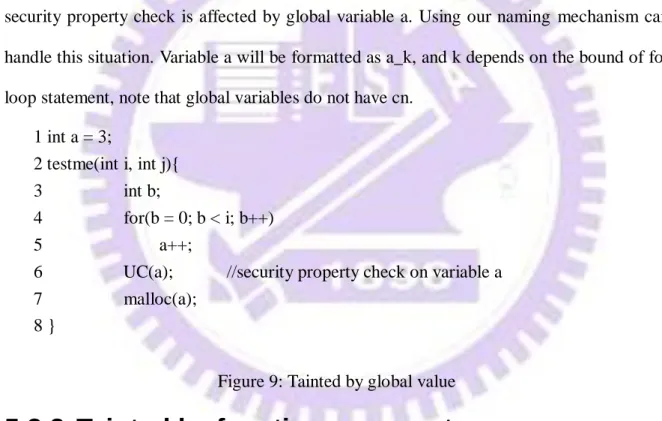
If a global variable is tainted, then it can affect any functions using it. In Figure 9, the
security property check is affected by global variable a. Using our naming mechanism can
handle this situation. Variable a will be formatted as a_k, and k depends on the bound of for
loop statement, note that global variables do not have cn.
Figure 9: Tainted by global value
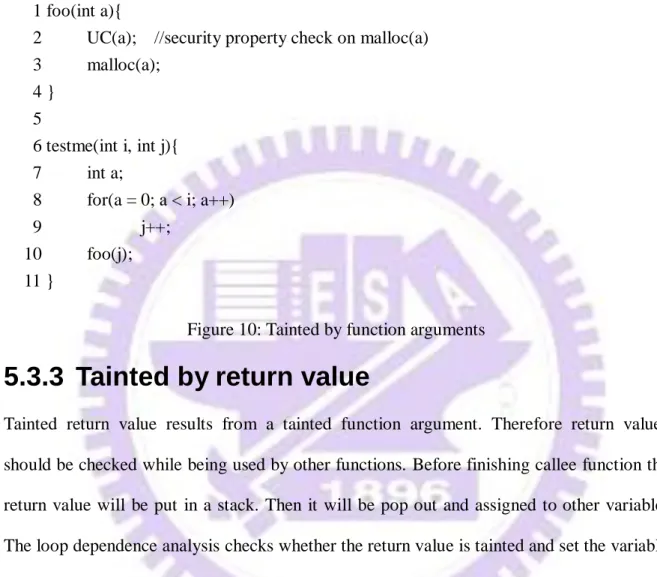
5.3.2 Tainted by function arguments
Tainted variable can affect other functions through function arguments, thus while function
arguments are passed, loop dependence analysis will check whether arguments are tainted.
In symbolic execution arguments will be put in a stack before calling the callee function.
While entering the callee the parameters will be pop out and be symbolized. In this step
dependence analysis will check arguments are tainted or not before symbolize the
arguments. If true the symbolic variable of the tainted parameter will be tainted either. In 1 int a = 3;
2 testme(int i, int j){ 3 int b;
4 for(b = 0; b < i; b++) 5 a++;
6 UC(a); //security property check on variable a 7 malloc(a);
Figure10, variable j in function testme will affect malloc() function in function foo. The
dependence analysis will detect it and make symbolic variable of variable a in function a
tainted.
Figure 10: Tainted by function arguments
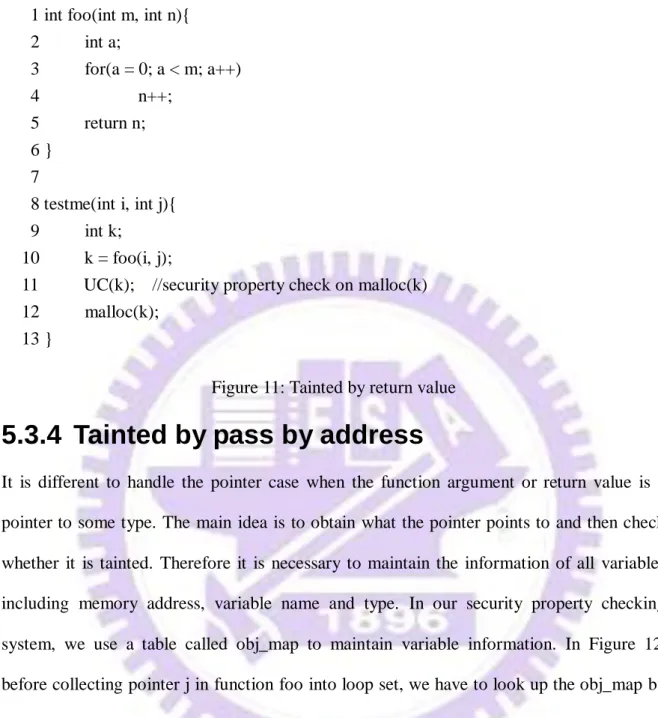
5.3.3 Tainted by return value
Tainted return value results from a tainted function argument. Therefore return values
should be checked while being used by other functions. Before finishing callee function the
return value will be put in a stack. Then it will be pop out and assigned to other variable.
The loop dependence analysis checks whether the return value is tainted and set the variable
assigned by this return value tainted if it is tainted. In Figure 11 the return value n of
function foo taint the variable k of function testme. This will be detected by loop
dependence analysis while pop the return value out and assign it to variable k. Loop
dependence analysis checks the loop set, if return value is in the set then set variable k
tainted by collecting into loop set. 1 foo(int a){
2 UC(a); //security property check on malloc(a) 3 malloc(a); 4 } 5 6 testme(int i, int j){ 7 int a; 8 for(a = 0; a < i; a++) 9 j++; 10 foo(j); 11 }
Figure 11: Tainted by return value
5.3.4 Tainted by pass by address
It is different to handle the pointer case when the function argument or return value is a
pointer to some type. The main idea is to obtain what the pointer points to and then check
whether it is tainted. Therefore it is necessary to maintain the information of all variables
including memory address, variable name and type. In our security property checking
system, we use a table called obj_map to maintain variable information. In Figure 12,
before collecting pointer j in function foo into loop set, we have to look up the obj_map by
variable address then check if the “real” variable is tainted. In this example obj_map will
return a is pointed by j, and then check whether variable a is tainted. 1 int foo(int m, int n){
2 int a; 3 for(a = 0; a < m; a++) 4 n++; 5 return n; 6 } 7 8 testme(int i, int j){ 9 int k; 10 k = foo(i, j);
11 UC(k); //security property check on malloc(k) 12 malloc(k);
Figure 12: Tainted by pass by address
5.4 Nested loop
When the test program enters a loop statement we will use line number as an identifier and
put this identifier into the vetor wsetStack. When the test program leaves a loop statement
we will pop its corresponding id out. Using this method we can trace the state of loops in
the test program, if the size of this stack is greater than one it will implies the test program
enters a nested loop statement. With the help of wsetStack we do not push redundant
element into the vector wset and avoid confused.
5.5 Loop constraints elimination
Loop constraints elimination performs when the following conditions hold:
1. the last constraint along the current path is a loop constraint, and
2. the wset of the corresponding loop statement does not intersect with the rset.
Loop constraints elimination will pop the constraints out until the branch of the second
iteration of this loop statement. 1 void foo(int i, int *j){ 2 int k;
3 if(i < 3)
4 for(k = 0; k < i; k++) 5 (*j)++ ;
6 }
1 void testme(int i, int j){ 2 int a;
3 if(i > 0){ 4 a = i; 5 foo(j, &a);
6 //security property check on malloc(a) 7 UC(a);
8 malloc(a); 9 }
Figure 13: Loop constraints elimination example function test()
Figure 14: Execution tree of function test()
Symbolic execution collects constraints along the execution path into a set S and
systematically traverses all the execution paths in the test program by negate the last
constraints in the set S, that is, symbolic execution traverses by depth first search. A loop
constraint is a constraint that decides whether the loop statement should be executed. For
example in Figure 13, the while loop statement is dependent on the constraint i < sym, and
the constraint i < sym is a loop constraint. That is, it is a condition expression in loop
statements. Figure 14 is an execution tree of the function test(). The nodes represent the
condition expressions of while loop statement and if statement. The left edge of nodes 1 // sym and j are symbolic variables
2 test(){ 3 while(i < sym){ 4 if(j == 1){ 5 //statements 6 }else{ 7 //statements 8 } 9 } 10 } i < sym j == 1 i < sym j == 1 i < sym 0 1
means the condition does not satisfy and represents by 0. The right edge of nodes means the
condition satisfies and represents by 1. For example, if the while loop statement executes
two iterations and the if statement j == 1 does not satisfy, then the execution path will be
1,0,1,0,0. and we say that there are three loop branch sets. The first set includes two nodes,
one for the condition expression of the while loop statement, and one for the if statement.
The second set is as same as the first set. And the third set only includes one node which is
the condition expression of the while loop statement. When the last constraint in the set S is
a loop constraint and the intersection result of this execution is null, then we will pop the
constraints out until the first loop branch set of this loop statement. For example in Figure14
the three nodes of the bottom will be popped out. And our system will try to negate the
branch of the if statement in order to traverse all branches within or after loop statements.
The loop branches control the number of times of the loop iterations. If the intersection
result of the corresponding loop statement in current execution is null, then we assume the
loop iterations are independent with universal checks and we pops all branches until the first
branch set of the loop iteration. By this method we reduce the number of times of iterations
and universal checks, and we still can traverse all branches of if statements within or after
the loop statement. Thus it can prevent from false negative due to lost collection of wset. If
the west of the current loop statement intersects with rset then it implies that the number of
times of this loop statement will affect the universal checks and the elimination will not
perform.
Notice that the loop statements described in this paper are symbolic bounded, that is, the
variable sym in the while statement in Figure13.is a symbolic value, and the number of
times that the while statement should be executed in the traditional symbolic execution is
Figure 15: Special case of loop constraints elimination
Figure 15 is a special case, the if statement in line 3 is not satisfy in every iteration and it
only satisfies in specific iteration. If we only pops out one loop branch set, there will be two
situations: (1) the true branch in Figure 15 will not be traversed until the specific iteration.
(2) the worst case, the false negative may occurs due to lost collection of west.
One of the advantages of our loop constraint elimination strategy is the special case can be
found and traversed quickly. By our strategy, if the loop can be reduced then the constraints
will be reduced until the first loop branch set. And ALERT will try to negate the constraint
of the if statement in line 3. Both branches of the if statement in line 3 will be traversed.
Figure 16: Loop constraint elimination algorithm 1 loop_constraint_elimination(current_branch)
2 {
3 loopInfo loop;
4 loop = loopbranchfind (loopbranchStack, current_branch); 5 while(loop != NULL){
6 if(loop.wset != empty && loop.intersect == 0 && loop.begin == false){
7 pop until the first loop branch set;
8 is_loop_branch = loopbranchfind (loopbranchStack, current_branch); 9 }else
10 break;
11 } 12 }
1 // j and sym are symbolic variable 2 while(i < sym){
3 if(j == 3){
4 //security property check on malloc(a) 5 UC(a); 6 malloc(a); 7 } 8 i++; 9 j++; 10 }
Figure 16 is the loop constraint elimination algorithm. In line 4 we first check if the
current_branch is a loop branch. If false the loop constraint elimination will finish. If true
we then check whether the elimination conditions are all satisfied in line 6. (1) the loop
statement should be traversed. (2) the wset of this loop statement does not intersect with rset
in the current execution. (3) it is not the first loop branch set because it is unnecessary to
eliminate the first loop branch set. If the above conditions are all satisfied then the loop
branch sets will be popped until one loop branch set left. And the steps will perform on all
6 Evaluations
6.1 Sort
algorithms
compared
with
CREST
CREST is an open-source dynamic test generation tool for C. It is maintained by Jacob
Burnim from University of California, Berkeley. CREST uses CIL to insert instrumentation
code into a test program, performs concolic execution and then uses Yices, a constraint
solver, to generate new input to another unexplored execution path.
In our paper we use insertion sort as a test case. We use four sort algorithms insertion sort,
selection sort, bubble sort and shell sort as test cases of CREST and ALERT with loop
dependence analysis and then compare the result. Due to different driver template, the test
codes for CREST and ALERT with loop dependence analysis are a little different but same
work. In Figure 17, the codes from line 23 to line 25 are set char array ary and integer
variable len symbolic, and line 26 limits the variable len under some value due to the
variable len can not greater than the length of array ary. For ALERT with loop dependence
analysis, char array ary and integer variable len are set symbolic in the instrumented code,
line 8 and line 9 in Figure 19 are set them symbolic. Line 22 in Figure 19 is the same
purpose as in line 26 in Figure 17.
We run CREST by the command “../bin/run_crest ./testInsertionSort 9000 –dfs”. The reason
of using depth-first-search is ALERT uses depth-first-search too. The result is in Table 1.
The number of iterations increases with the length of the array. As we know there are many
redundant iterations that traverse the same execution paths because the for loop statement in
line 7 Figure17 and the while statement in line 10 Figure17 are bounded by symbolic values.
However, we run the test case in ALERT with loop dependence analysis, because the
with rset, then it implies that the traverses of the for statement and the while statement in
Figure 18 can be reduced. In Table1 we can see ALERT with loop dependence analysis
really reduces much redundant execution paths. ALERT with loop dependence analysis has
the same result with different array length because the universal checks is irrelevant to the
array length which bounds the for loop statement. Figure 20 is the source code of selection
sort and Table 3 is the result of selection sort. Both of insertion sort and selection sort have a
nested for loop statement in the source codes. Thus the result of selection sort is similar to
insertion sort. As the array length increases, the total iterations for CREST grow
exponentially since there is a double nested loop statement bounded by a symbolic value.
However in ALERT with loop dependence analysis, we can detect that the universal checks
on malloc() function and memcpy() function are not dependent with the for loop statement.
Thus the total iterations do not increase with array length. Table 4 is the result of shell sort
and Table 5 is the result of bubble sort. Similar situations happen on Shell sort and Bubble
sort too. Note that the result of Shell sort using ALERT with loop dependence analysis can
Figure 17: Insertion sort for CREST 1 #include <crest.h>
2 #include <stdlib.h>
3 int insertion_sort(char *ary, int *len) 4 {
5 int i, j; 6 char value;
7 for(i = 1; i < *len; i++){ 8 value = ary[i]; 9 j = i - 1;
10 while(j >= 0 && ary[j] > value){ 11 ary[j + 1] = ary[j]; 12 j--; 13 } 14 ary[j + 1] = value; 15 } 16 return 0 ; 17 } 18 int main(void) 19 { 20 char ary[50]; 21 char *dest; 22 int len; 23 for(int i = 0; i < 50; i++) 24 CREST_char(ary[i]); 25 CREST_int(len);
26 if(len < 51 && len > 0){ 27 insertion_sort(ary, &len);
28 dest = malloc(len); 29 memcpy(dest, ary, len); 30 }
31 return 0; 32 }
Figure 18: Insertion sort for ALERT + loop dependence analysis 1 #include "test.h"
2 #include <stdlib.h>
3 int insertion_sort(char *ary, int *len) 4 {
5 int i, j; 6 char value;
7 for(i = 1; i < *len; i++){ 8 value = ary[i]; 9 j = i - 1;
10 while(j >= 0 && ary[j] > value){ 11 ary[j + 1] = ary[j]; 12 j--; 13 } 14 ary[j + 1] = value; 15 } 16 return 0 ; 17 }
18 void testme(char *ary, int len) 19 {
20 char *dest; 21 int k;
22 if(len < 51 && len > 0){ 23 k = len;
24 insertion_sort(ary, &k); 25 dest = malloc(k); 26 memcpy(dest, ary, k); 27 }
Figure 19: Part of instrumented code for ALERT + loop dependence analysis 1 void f(void)
2 { char ary[50] ; 3 int len ; 4 {
5 _sqAdd((unsigned int )ary, sizeof(ary), "ary"); 6 _sqInputBytes(ary, 50);
7 _sqInput(& len, T_INT);
8 _sqMakeSymbolicBytes(ary, 50); 9 _sqMakeSymbolic("len", T_INT);
10 _sqPush("ary", (unsigned int )ary, T_UINT); 11 _sqPush("len", len, T_INT);
12 testme(ary, len); 13 }
14 }
15 int main(int argc, char* argv[]) 16 {
17 _sqGetopt( argc, argv ); 18 _sqInit();
19 f();
20 int j = _sqSolve();
21 _sqHistRecord(j+1, branch_hist); 22 if (!isComplete) {
23 printf("****************Generating next test path****************\n"); 24 return 0; 25 } else { 26 printf("********************Mission Complete!********************\n"); 27 return 1; 28 } 29 }
Table 1: Result of insertion sort
Array length ALERT+UCOpt
(iterations) CREST (iterations) 5 5 155 10 5 >9000 20 5 >9000 30 5 >9000 40 5 >9000 50 5 >9000
Table 2: Result of insertion sort
result of insertion sort
0 1000 2000 3000 4000 5000 6000 7000 8000 9000 10000 5 10 20 30 40 50 array length ite ra tio ns ALERT+loop dependence analysis CREST
Figure 20: Source code of selection sort 1 #include "test.h"
2 void selectionSort(char *ary, int *len) 3 {
4 int i, j, indx; 5 char min, tmp;
6 for(int i = 0; i < *len - 1; i++){ 7 indx = i; 8 min = ary[i]; 9 for(j = i + 1; j < *len; j++){ 10 if(min > ary[j]){ 11 indx = j; 12 min = ary[j]; 13 } 14 } 15 tmp = ary[i] ; 16 ary[i] = ary[indx]; 17 ary[indx] = tmp; 18 } 19 }
20 void testme(char *ary, int len) 21 {
22 char *dest; 23 int k;
24 if(len < 41 && len > 0){ 25 k = len; 26 selectionSort(ary, &k); 27 dest = malloc(k); 28 memcpy(dest, ary,k); 29 } 30 }
Table 3: Result of selection sort
Array length ALERT+UCOpt
(iterations) CREST (iterations) 5 5 239 10 5 >9000 20 5 >9000 30 5 >9000 40 5 >9000 50 5 >9000
Table 4: Result of shell sort
Array length ALERT+UCOpt
(iterations) CREST (iterations) 5 5 239 10 5 >9000 20 5 >9000 30 5 >9000 40 5 >9000 50 5 >9000
Table 5: Result of bubble sort
Array length ALERT+UCOpt
(iterations) 5 5 10 5 20 5 30 5 40 5 50 5
6.2 An n*n matrix allocation example
Figure 21: Source code of matrix allocation 1 #include "test.h"
2 #include <limits.h> 3 void testme(int n) 4 {
5 int i, **matrix, tmp;
6 if(UINT_MAX / sizeof(int) > n && n > 0) 7 matrix=(int **)malloc(n * sizeof(int*)); 8 if (!matrix)
9 printf("allocation failure 1 in matrix()\n"); 10 for(i=0;i<n;i++) {
11 if(UINT_MAX / sizeof(int) > n && n > 0) 12 matrix[i]=(int *)malloc(n * sizeof(int)); 13 if (!matrix[i])
14 printf("allocation failure 2 in matrix()\n"); 15 }
Table 6: Result of matrix allocation using contradiction constraint detection
n
Eliminated universal checks
(by contradiction constraint detection)
10 9
20 19
30 29
40 39
50 49
Table 7: Result compared between using constraint contradiction analysis and not using
constraint contradiction analysis
n
Total iteration
(ALERT+
loop dependence analysis +
constraint contradiction
analysis)
Total iteration
(ALERT +
loop dependence analysis)
10 4 13
20 4 23
30 4 33
40 4 43
Figure 21 is a program which allocates an n*n matrix. In line 7 it first allocate an array of
integer pointer and line 10 to line 15 allocates n arrays of integer. There are vulnerabilities
in line 7 and line 12 since the type of argument to malloc() function is unsigned integer and
n*sizeof(int*) and n*sizeof(int) can be overflowed and allocates memory with wrong size to
the program. Thus the input validation is required in line 6 and line 11. It protects
n*sizeof(int*) and n*sizeof(int) against integer overflow. Table 6 is the result of ALERT
using contradiction constraint detection. Variable n is symbolic. When program executes the
for loop statement in line 10, universal check performs only at the first iteration since
contradiction constraint detection will detects the universal checks are redundant in the rest
iterations. Thus the number of eliminated universal checks increases with variable n.
Another advantage of constraint contradiction analysis is it can kill unnecessary rest
element. In Figure 21 line 7 and 12, the variable n will be collected into the rset, and loop
dependence analysis will detect the universal checks are dependent with the loop statement
in line 10 and the loop iterations can not be eliminated. However, if we use constraint
contradiction analysis, it will detect that the variable n is already protected by the if
statement in line 11 and the universal check on malloc() function is unnecessary. Thus
variable n will not be collected into the rset, and the rset will not intersect with the wset and
the loop iterations can be eliminated except the first iteration. Table 7 is the result of matrix
allocation. We bound the range of variable n due to testing convenience. The first column is
the range of variable n, the second column is ALERT with loop dependence analysis and
constraint contradiction analysis, and the third column is ALERT with loop dependence
analysis. As we can see we can eliminate the redundant universal check and loop iterations
by constraint contradiction analysis. If we do not use the constraint contradiction analysis,
the loop dependence analysis will not eliminate those redundant iterations since it determine