國
立
交
通
大
學
網路工程研究所
碩
士
論
文
適用於 IEEE 802.11 無線區域網路電話系統
中之省電傳送機制
Energy-Efficient Transmission Mechanism for VoIP over
IEEE 802.11 WLAN
研 究 生:黃中暉
指導教授:曹孝櫟 教授
適用於 IEEE 802.11 無線區域網路電話系統中之省電傳送機制
Energy-Efficient Transmission Mechanism for VoIP over IEEE 802.11
WLAN
研 究 生:黃中暉 Student:Chung-Huei Huang
指導教授:曹孝櫟 Advisor:Shiao-Li Tsao
國 立 交 通 大 學
網 路 工 程 研 究 所
碩 士 論 文
A ThesisSubmitted to Institute of Network Engineering College of Computer Science
National Chiao Tung University in partial Fulfillment of the Requirements
for the Degree of Master
in
Computer Science
June 2007
Hsinchu, Taiwan, Republic of China
適用於 IEEE 802.11 無線區域網路電話系統中之省電傳送機制
學生:黃中暉
指導教授:曹孝櫟博士
國立交通大學網路工程研究所碩士班
Abstract (in Chinese)
無線區域網路電話(Voice over IP over WLAN, VoWLAN)為公眾與私人無線區域網路系 統中一項重要的應用服務。然而,這樣的服務面臨了手持裝置耗電與系統能支援的最大 使用者數目(VoWLAN Capacity)有限等技術挑戰,因此使得大規模的商業化佈建緩慢。 在本研究中,我們針對 IEEE 802.11 無線區域網路電話系統提出了一個跨層的省電傳送 機制,此機制考量語音封包可以忍受某種程度封包遺失(packet loss)的特性,並且根據目 前語音封包遺失率,動態的停用媒體存取控制層(MAC)對於語音封包的回應封包 (Acknowledgement)。在此機制下,可以縮短手持裝置傳送與接收封包所需的時間與對應 消耗的能量。模擬結果說明瞭本機制可以在通話品質被保證的情況下,大幅的改善無線 區域網路手持裝置的耗電情形,以及無線區域網路電話系統所能支援的最大使用者數 目。
Energy-Efficient Transmission Mechanism for VoIP over IEEE 802.11
WLAN
Student: Chung-Huei Huang
Advisors: Dr. Shiao-Li Tsao
Institute of Network Engineering
National Chiao Tung University
Abstract (in English)
Voice over IP (VoIP) over WLAN (VoWLAN) is an important application for public and
private WLANs. However, VoWLAN systems suffer from various technical challenges such
as power consumption of WLAN stations (STAs) and VoWLAN capacity issues, making the
commercial deployment of large-scale VoWLAN services problematic. This study presents a
cross-layer and energy-efficient mechanism for transmitting VoIP packets over IEEE 802.11
WLANs. The proposed mechanism considers the characteristics of VoIP that can tolerate
some packet loss, and dynamically disables the medium access control (MAC) layer
acknowledgement for voice packets according to the packet loss rate. In doing so, the time
reduced. Simulation results demonstrate that the mechanism significantly improves the energy
efficiency of a VoWLAN STA and WLAN utilization while the voice quality can be also
Table of Contents
Abstract (in Chinese) ...i
Abstract (in English)...ii
Table of Contents...iv
List of Figures... v
List of Tables ...vi
Acknowledgements ...vii
Chapter 1. Introduction ... 1
Chapter 2. Network Architecture and Transmission Schemes for VoWLAN Services... 4
Chapter 3. Energy-Efficient Transmission Mechanism ... 10
3.1. Design of the Proposed Mechanism ... 10
3.2. The Maximum Numbers of Transmission Attempts for Voice Packets... 15
3.3. Implementation Issues ... 17
Chapter 4. Simulation Results... 19
Chapter 5. Conclusions ... 28
List of Figures
Figure 1. A generic network architecture for a VoWLAN system... 4
Figure 2. PS-Poll VoWLAN transmission scheme ... 5
Figure 3. U-APSD VoWLAN transmission scheme... 8
Figure 4. The proposed mechanism applied to the PS-Poll scheme... 12
Figure 5. Aveage duty cycle and enegy consumption for a VoWLAN STA ... 22
Figure 6. Average loss rates for uplink and downlink voice packets ... 24
Figure 7. Average delay for uplink and downlink packets ... 25
Figure 8. The length reduction of a duty cycle per STA under different codec and BERs ... 26
List of Tables
Acknowledgements
這篇論文可以順利完成,首先要感謝的人是我的指導教授,曹孝櫟老師。老師是我 在大學做專題期間一直到碩士班畢業的指導教授,也是影響我很深遠的人。在研究的指 導上,老師一直十分的栽培我,讓我有參與大型程式競賽、申請專利、出國參加研討會 這些其他碩士班學生可能沒有的經歷。而我在畢業後能到自己理想的公司工作,這一切 到要歸功於我的老師。而在待人處事上,老師也一直告訴我們要用積極進取的態度面對 生活,因為如此,讓我能有正確的價值觀來面對壓力與挑戰的到來。老師謝謝您,因為 您才有今天的我。 接著我要感謝實驗室夥伴們。謝謝建明學長、誌謙學長、一正學長、宥霖學長在我 研究過程中給予我的諸多建議,讓我在思考上可以趨於完備。謝謝彥筑、雅筑、政龍、 名杰在平日中對我的砥礪,這讓我有不斷努力下去的動力。謝謝建臻學弟、家祥學弟、 世永學弟常常陪我留在實驗室熬夜奮鬥。謝謝你們。 最後我要感謝一直支持我的家人。謝謝爸爸、媽媽、姊姊、哥哥願意當我的避風港, 讓我在遇到壓力時總是能得到紓解。謝謝女朋友乃瑛的默默陪伴,因為妳讓我不管作任 何事情都很有衝勁。Chapter 1. Introduction
Extensively used in public and private networks, WLAN offers convenient and broadband
accesses to mobile Internet services. Having recently attracted significant interest from both
academia and industry, Voice over IP (VoIP) over WLAN (VoWLAN) is considered as one of
the most important applications for WLANs [1]. However, various technical challenges
inhabit VoWLAN systems such as power consumption, mobility management, WLAN
utilization and quality of services (QoS), making large-scale VoWLAN services difficult to
deploy. Two critical challenges for a VoWLAN system are the VoWLAN capacity, i.e. the
number of VoIP sessions that an access point (AP) can support, and the power consumption of
a VoWLAN station (STA), i.e. the standby and talk hours of a VoWLAN terminal.
The IEEE 802.11 WLAN adopts Carrier Sense Multiple Access/Collision Avoidance
(CSMA/CA) for its medium access control (MAC) [2]. The method performs inefficiently
when transmitting large numbers of small MAC frames. Unfortunately, voice packets are
small, and are generated periodically every 10 ms to 30 ms. Several reports have already
indicated that small voice packets significantly reduce the overall WLAN performance, thus
limiting a WLAN AP to only support a small number of VoIP sessions [3][4]. To improve the
WLAN utilization for transmitting voice packets, previous studies optimized WLAN
voice packets [5][6]. Wang et al. presented a multicast downlink transmission mechanism that
aggregates multiple downlink voice packets into one multicast packet, and transmits the
packet to a group of VoWLAN STAs [3]. The overheads for inter-frame spacing and
contentions between small voice packets are eliminated, and the WLAN utilization is thus
improved. However, this mechanism requires VoWLAN STAs to always stay awake to
receive downlink multicast packets, and it does not solve the power consumption problem.
Regarding the power consumption issue for a VoWLAN system, Chen et al. evaluated three
VoWLAN packet transmission schemes based on the IEEE 802.11 power saving mode (PSM)
and IEEE 802.11e automatic power saving delivery (APSD) mode [7][8]. Wang et al.
considered the characteristic of voice packets arrivals and suggested to periodically wake up
VoWLAN STAs to receive and transmit voice packets [9]. Therefore, a Time Division
Multiple Access (TDMA)-like accesses can be achieved for transmitting and receiving voice
packets, reducing the energy consumption of VoWLAN STAs. Another important
characteristic of voice packets that is not fully elaborated in the design of a VoWLAN
transmission scheme is the need for a reliable delivery [10]. Reliable transmission is essential
for data packets, but is not always necessary for voice packets, which could tolerate some loss.
In this study, a cross-layer and energy-efficient transmission mechanism that differentiates
WLAN MAC-layer schemes for voice and non-voice packets is thus proposed. The
attempt of a voice packet according to the current packet loss rate and the target voice quality.
By eliminating MAC-layer acknowledgment frames for voice packets, the time and energy
consumed by sending and receiving acknowledgement frames are minimized. Therefore, the
energy efficiency of a VoWLAN STA and the WLAN utilization are both improved. To realize
the proposed idea without modifying the IEEE 802.11 standard, this work adopts WLAN
MAC multicasting that does not require the acknowledgement to transmit voice packets. Then,
the proposed mechanism can be implemented on the existing WLAN infrastructures merely
through software upgrades.
The rest of this thesis is organized as follows. Chapter 2 describes a network architecture for a
VoWLAN system and VoWLAN transmission schemes. Next, Chapter 3 presents the design
of the proposed mechanism. Chapter 4 discusses the simulation results. Conclusions are
Chapter 2. Network Architecture and Transmission Schemes for VoWLAN
Services
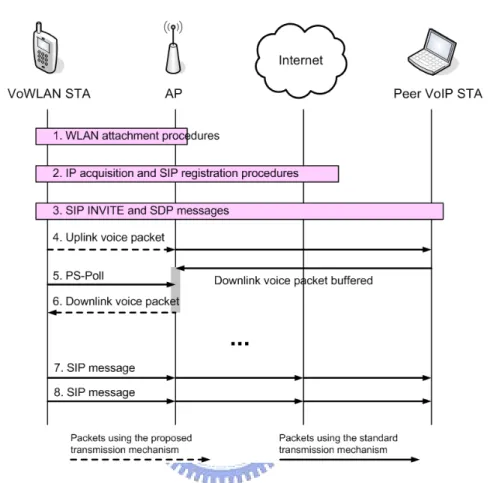
Figure 1. A generic network architecture for a VoWLAN system
Figure 1 illustrates a generic network architecture for a VoWLAN system. A VoWLAN STA is
attached to WLAN via an AP, which is further connected to the Internet. A VoWLAN STA can
then use call setup protocols such as session initiation protocol (SIP) to establish a VoIP
session with a peer STA, which can be a fixed or a mobile node. Two transmission schemes
are used to reduce the power consumption of a VoWLAN STA during a VoIP session. The first
method, called the PS-Poll transmission scheme, adopts the PSM defined in the IEEE 802.11
to enter the PSM, and stays in the doze state, which consumes much less energy than the
WLAN receiving state. If a VoWLAN STA has an uplink voice packet to transmit, it wakes up
and sends the packet. After receiving the acknowledgement frame from the AP for the uplink
voice packet, the VoWLAN STA sends a PS-Poll frame to retrieve the downlink voice packet
buffered on the AP. Normally, an AP first responds with an acknowledgement frame to the
PS-Poll frame and, then, transmits a downlink voice packet to the STA. According to IEEE
802.11 specifications, acknowledging a PS-Poll frame is not mandatory, but most existing
APs implement the PS-Poll acknowledgement. Finally, the STA receives and acknowledges
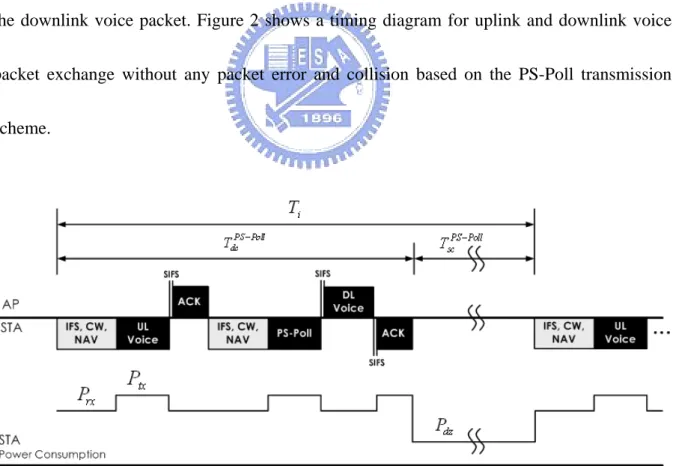
the downlink voice packet. Figure 2 shows a timing diagram for uplink and downlink voice
packet exchange without any packet error and collision based on the PS-Poll transmission
scheme.
A duty cycle, , refers to the time period for transmitting one uplink and receiving one
downlink voice packet for the PS-Poll transmission scheme. Since downlink and uplink voice
packets are generated periodically, say every , the sleep period of a VoWLAN STA for
every is given by .This model assumes that the voice codec is a
constant bit rate (CBR), and the codecs for uplink and downlink voice packets are symmetric.
Poll PS− Poll PS Poll PS− − Poll
PS− PS−Poll PS−Poll PS−Poll PS−Poll PS−Poll
Poll PS− PS−Poll Poll PS Poll PS Poll PS Poll PS− − − − Poll PS Poll PS Poll PS Poll PS− − − − Poll PS− Poll PS− PS−Poll dc T i T i T Tsc =Ti −Tdc
Figure 2 also illustrates the power consumption of a VoWLAN STA. , and
denote the power consumption of a VoWLAN STA during the receiving, transmitting and
doze states, respectively. Clearly, a shorter length of a duty cycle a VoWLAN transmission
scheme introduces, the less energy a VoWLAN STA spends for transmitting and receiving
voice packets and also the less network resources a VoWLAN session consumes.
rx
P Ptx Pdz
The energy consumed by applying the PS-Poll transmission scheme during a duty cycle,
, is defined as , where and denote the
energy consumed when transmitting one uplink and one downlink voice packet, respectively.
According to Wang’s study
dc
E Edc =Eul +Edl Eul Edl
[11], and can be further rewritten as:
, and
.
Above equations assume there is no packet loss due to packet collision or packet error during the transmission. denotes the energy consumption for a VoWLAN STA in the
WLAN MAC contention window. and denote the energy
ul E Edl ul ul ul E BK E FR E SU E = _ + _ + _ dl dl dl E BK E FR E SU E = _ + _ + _ BK E _ ul FR E _ E _FRdl
consumption for a VoWLAN STA that overhears other STAs’ transmissions.
and represent the energy consumption for a VoWLAN STA successfully
transmitting an uplink and receiving a downlink voice packet respectively.
Poll PS− Poll PS− Poll PS− ul SU E _ dl SU E _
Assuming that the average number of transmissions overheard by a VoWLAN STA during a
contention window period is given by , and that the VoWLAN STA consumes
during the overhearing period, the energy consumption due to the VoWLAN STA overhearing
the other VoWLAN STAs’ transmissions during a contention window period can be calculated
as t N Prx ⎟⎟ ⎠ ⎞ ⎜⎜ ⎝ ⎛ + × × = = − − −− −− − 2 _ _ Poll PS success dl Poll PS success ul rx Poll PS t Poll PS dl Poll PS ul T T P N FR E FR E .
The overhearing probabilities for downlink and uplink transmissions assume equal. The
parameters and denote the time periods for each successful transmission
of an uplink and downlink voice packet adopting the PS-Poll transmission scheme, given b , and
,
where , , , , , and represent the time periods for the
DCF Inter Frame Spacing (DIFS), Short Inter Frame Spacing (SIFS), the transmission of an
uplink voice packet, a downlink voice packet, an acknowledgement frame and a PS-Poll
frame, respectively. The energy consumption for a VoWLAN STA to transmit an uplink and to
Poll PS− PS−Poll y Poll PS− Poll PS− success ul T − Tdl−success ack sifs voice ul difs success ul T T T T T − = + − + + ack sifs voice dl sifs Poll PS difs success dl T T T T T T T − = + − + + − + + difs
receive a downlink voice packet for the PS-Poll transmission scheme, i.e. and , can be denoted as Poll PS− Poll PS− ul SU E _ dl SU E _
(
difs sifs ack)
tx ul voicerx
ul P T T T P T
SU
E_ PS−Poll = × + + + × − , and
(
difs sifs dl voice sifs)
tx(
PS Poll ack)
rx
dl P T T T T P T T
SU
E_ PS−Poll = × + + − + + × − + .
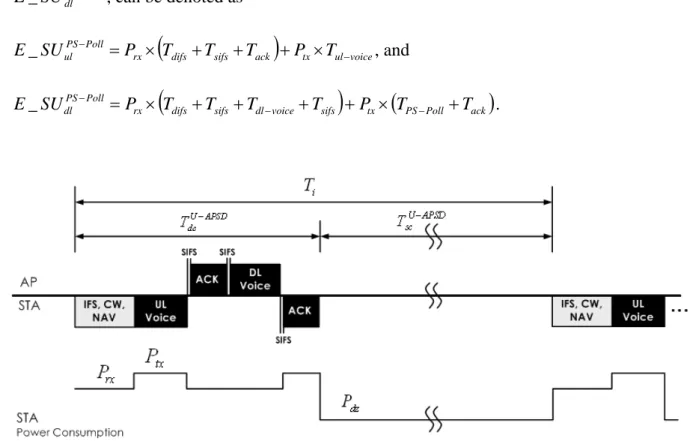
Figure 3. U-APSD VoWLAN transmission scheme
The second method adopts the APSD mechanism defined in the IEEE 802.11e [8]. The APSD
improves the IEEE 802.11 PSM by averting the PS-Poll procedure. An uplink voice packet
can be configured as a frame to trigger a service period, which is used to transmit downlink
packets. Figure 3 shows an example of an unscheduled-APSD (U-APSD) transmitting a
downlink and uplink voice packet. An STA is initially in the doze state. Once an STA has an
uplink voice packet to send, it wakes up and transmits the packet. The AP responds with an
then transmits a downlink voice packet to the STA. This approach avoids the PS-Poll
Chapter 3. Energy-Efficient Transmission Mechanism
3.1. Design of the Proposed Mechanism
The proposed transmission mechanism considers the characteristics of voice packets, and
differentiates voice and non-voice packets in the WLAN MAC transmission. The initial idea
behind the proposed mechanism is to disable the MAC layer acknowledgement for voice
packets, and to minimize the overheads for performing acknowledgements. However, to
disable the MAC acknowledgement for voice packets, lost packets cannot be detected and
retransmitted, and the voice quality may degrade. Therefore, the proposed mechanism is
improved herein by dynamically turning the MAC-layer acknowledgement on and off for
each transmission attempt of a voice packet, depending on the WLAN packet loss condition
and the target voice quality. If packet error and loss rarely occur, then the MAC-layer
acknowledgment for a voice packet is turned off, which improves the efficiency of network
and energy. Conversely, while the packet loss rate increases, the MAC-layer
acknowledgement for voice packets is turned on to ensure the voice quality.
By applying the PS-Poll transmission scheme shown in Figure 1, a VoWLAN STA transmits
an uplink voice packet, and then uses a PS-Poll frame to retrieve a downlink voice packet on
the AP. In addition to voice packets, an AP and STA may exchange non-voice packets such as
and session description protocol (SDP), so that an AP can distinguish voice packets and
non-voice packets. For an uplink voice packet transmission such as Step 4 in Figure 1, a
MAC-layer transmission counter, given by , is associated with each uplink voice packet,
where denotes the maximum number of MAC-layer transmission attempts for an uplink
voice packet. Similarly, is associated with downlink voice packets such as Step 6 in
ul r N ul r N dl r N
Figure 1. and are dynamically adjusted based on the current packet loss rate, and
the target voice quality that a VoIP session sets. and are negotiated by an AP and
STA, and are stored on both sides. For instance, if , then an uplink voice packet is
sent only once, and does not need to be acknowledged. Since is stored on both the STA
and AP, the STA knows that the packet will not be acknowledged, so the STA can return to
sleep or perform the next packet transmission without waiting for the acknowledgement frame.
Therefore, the STA can save the time and energy to receive acknowledgement frames from
the AP. Similarly, for a downlink packet transmission, the STA can conserve energy by not
sending an acknowledgement frame for a downlink voice packet. Hence, the overheads to
perform the MAC acknowledgement for voice packets are eliminated, and both the energy
efficiency and WLAN utilization can be improved. If , then the uplink voice packet
that is sent at the first time needs an acknowledgement from the AP. If the AP receives the
packet, it acknowledges the uplink voice packet, and the transmission is complete. Otherwise,
if the STA does not receive the acknowledgement from the AP, the STA detects the packet loss
ul r N Nrdl ul r N Nrdl 1 = ul r N ul r N 2 = ul r N
and resends the uplink voice packet again. Since , the resent voice packet does not
need the MAC acknowledgement. The STA proceeds for the next transmission or returns to
sleep after resending the voice packet. Restated, the STA sends the uplink voice packet at
most times that require the MAC-layer acknowledgement. The packet resent at the
time needs not be acknowledged. Clearly, increasing the values of and
generally improves the voice quality, but also increases the radio resource and energy
consumption for a VoWLAN session. The method to determine and is discussed
later in this section. Non-voice packets such as SIP messages and PS-Poll frames, which are
important packets and need to be reliably delivered, are transmitted by the standard WLAN
MAC mechanism. 2 = ul r N 1 − ul r N ul r N Nrul Nrdl ul r N Nrdl
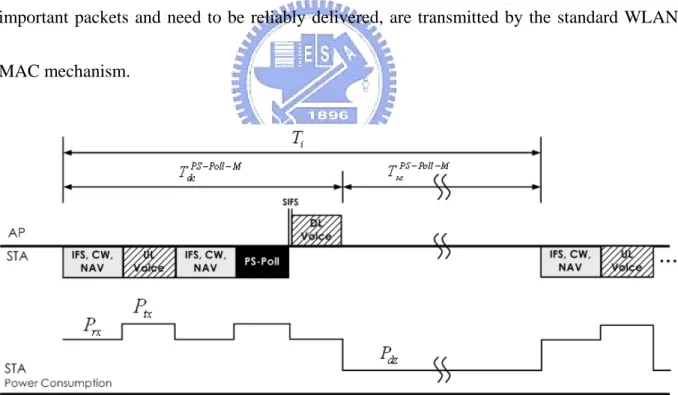
Figure 4. The proposed mechanism applied to the PS-Poll scheme
Figure 4 shows a timing diagram of the proposed method applied to the PS-Poll transmission
retransmitted. Comparing Figure 2 and Figure 4 reveals that sending packets without
acknowledgement frames significantly reduces the length of a duty cycle. This is because the
length of an acknowledgement frame is nearly equal to that of a small voice packet. Then, the
energy consumption of a VoWLAN STA for an uplink and downlink transmission by applying
the proposed mechanism to the PS-Poll scheme, denoted as and
respectively, become
, and
.
, , , and are further defined
as M Poll PS− − PS−Poll−M M Poll PS M Poll PS M Poll PS M Poll PS− − − − − − − − M Poll PS M Poll PS M Poll PS M Poll PS− − − − − − − − M Poll
PS− − PS−Poll−M PS−Poll−M PS−Poll−M
ul E Edl ul ul ul E BK E FR E SU E = _ + _ + _ dl dl dl E BK E FR E SU E = _ + _ + _ ul FR E _ E _FRdl E _SUul E _SUdl ⎟⎟ ⎠ ⎞ ⎜⎜ ⎝ ⎛ + × × = = − − − − −− − −− − − − 2 _ _ M Poll PS success dl M Poll PS success ul rx M Poll PS t M Poll PS dl M Poll PS ul T T P N FR E FR E . , and . , and voice ul difs success ul T T TPS−−Poll−M = + − M Poll PS− − M Poll PS− − voice dl sifs Poll PS difs success dl T T T T T − = + − + + − voice ul tx difs rx ul P T P T SU E_ = × + × −
(
difs sifs dl voice)
tx PS Pollrx dl P T T T P T SU E_ PS−Poll−M = × + + − + × − M Poll PS M Poll PS Poll PS Poll PS Poll PS− − − − − − − .
The decrease in energy consumption per duty cycle from adopting the proposed mechanism
for the PS-Poll scheme is thus obtained:
(A)
Assume that the PS-Poll scheme with and without the proposed mechanism suffers the same
dl ul dl ul dc E E E E E = + − − Δ
numbers of overhearing transmissions, i.e. . Additionally, the WLAN
MAC contention windows for the PS-Poll transmission scheme with and without the proposed
mechanism are assumed to be equal, i.e. . Then, Equation (A)
can be rewritten as M Poll PS Poll PS− − − M Poll PS Poll PS− − − t t N N = BK E BK E_ = _
(
− + −)
+ =ΔEdcPS−Poll E_SUulPS−Poll E_SUulPS−Poll−M E_SUdlPS−Poll E_SUdlPS−Poll−M
(
E_FRulPS−Poll−E_FRulPS−Poll−M +E_FRdlPS−Poll−E_FRdlPS−Poll−M)
=
[
Prx×(
Tsifs +Tack +Tsifs)
+Ptx×Tack]
+
[
NtPS−Poll×Prx×(
Tsifs +Tack)
]
(B) Equation (B) reveals that the performance improvement by applying the proposed mechanismcomes not only from the elimination of acknowledgement frames for downlink and uplink
voice packets, but also from reducing the length of the period that a VoWLAN STA overhears
the other VoWLAN STAs’ transmissions.
This proposed mechanism can also be applied to the U-APSD transmission scheme,
eliminating the acknowledgement frame for downlink voice packets. Notably, the uplink
voice packet in the U-APSD scheme is used to trigger download packet transmissions.
Therefore, the proposed design categorizes the important uplink voice packets as non-voice
packets in the U-APSD scheme, and processes them by using the standard MAC transmission
3.2. The Maximum Numbers of Transmission Attempts for Voice Packets
Disabling MAC-layer acknowledgement may introduce packet loss which degrades the voice
qualities. First, the contention window of each voice packet transmission does not increase
when sending packets over WLANs without the MAC-layer acknowledgement. The
probability of collisions rises when the number of VoWLAN sessions increases. Second, the
WLAN channel error also introduces packet loss. To reduce packet loss and maintain voice
quality, the proposed transmission mechanism defines the maximum numbers of transmission
attempts for each uplink and downlink voice packet, which are denoted as and
respectively. controls the uplink packet loss caused by uplink packet collision and
packet error, while controls the loss rate for downlink voice packets. Notably,
, since collision never occurs for transmitting downlink voice packets guarded by a
PS-Poll frame for the PS-Poll scheme, or by an uplink trigger frame for the U-APSD scheme.
Hence, is only used to reduce packet loss caused by WLAN channel error. A VoWLAN
system must set a target voice quality in terms of the packet loss rate. If the loss rates of the
downlink and uplink voice packets reach that predefined values, then and increase
to improve the downlink and uplink voice qualities. Conversely, and are
decreased to reduce the energy consumption when the packet loss rate is low. Typically, the
target packet loss rate is set to 1–2% for a VoWLAN application
ul r N Nrdl ul r N dl r N ul r dl r N N ≠ dl r N ul r N Nrdl ul r N Nrdl [12]. Another issue is
receiver-report mechanism like real-time control protocol (RTCP) between an AP and
VoWLAN STAs [13]. The sender and receiver reports containing the number of voice packet
sent and received by an AP and STA are periodically exchanged to obtain the current
3.3. Implementation Issues
To apply the proposed mechanism to the IEEE 802.11 standard, the WLAN MAC
multicasting that does not require acknowledgement from peers can be adopted to transmit
voice packets without acknowledgement frames. A VoWLAN STA, say STA i, is configured
with two MAC addresses, one unicast address, MAC STAi, and one multicast address, MAC
Mi. The WLAN MAC frame with a unicast address as the destination MAC address is used to
send non-voice packets, and the WLAN MAC frame with a multicast address as the
destination MAC address is used to send voice packets between an AP and STA. First, a
VoWLAN STA associates itself with an AP using its unicast MAC address. The AP and STA
then set up a shared multicast MAC address, by either implicitly producing MAC multicast
address from the STA’s unicast address, or explicitly exchanging a message between the STA
and AP to configure a new multicast MAC address. The multicast address is only shared by
the AP and STA, and not with other STAs. Restated, each STA has its own unicast MAC
address, and its own multicast address which is shared by the AP for uplink and downlink
voice packet transmission. A multicast address is used as the destination MAC address of
voice packets only because the MAC multicast frame does not need an acknowledgement
frame from the receiver, but the multicast frame has no intent to be sent to a group of STAs. If
or , then the first or transmission attempts for a voice
packet use the unicast MAC address, implying that the packet needs to be acknowledged. The 1
>
ul r
multicast MAC address is used at the and time transmission to avoid the MAC
acknowledgement. This design enables the proposed mechanism to be implemented in the
existing WLAN infrastructure through only software upgrades.
ul r
Chapter 4. Simulation Results
Simulations were conducted to evaluate the WLAN performance and the energy consumption
of a VoWLAN STA for different packet transmission schemes. The VoWLAN simulation
environment comprised an AP and several VoWLAN STAs, which established VoIP sessions
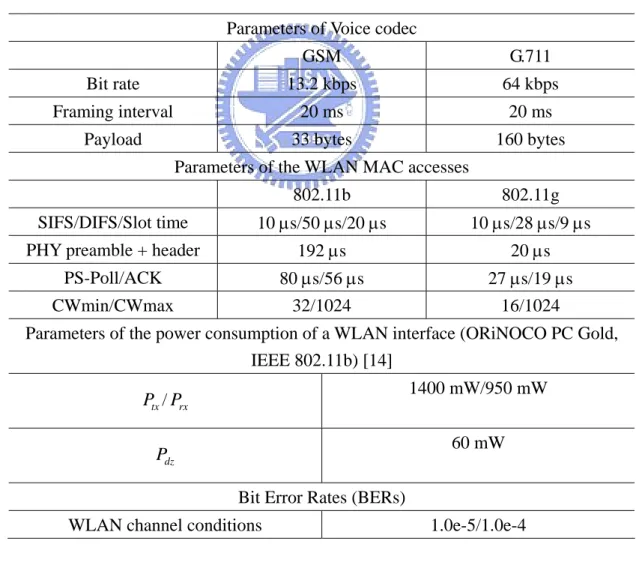
and exchanged voice packets with wired-line nodes in the same subnet. Table 1 summarizes
the simulation parameters.
Table 1. Simulation parameters Parameters of Voice codec
GSM G.711
Bit rate 13.2 kbps 64 kbps
Framing interval 20 ms 20 ms
Payload 33 bytes 160 bytes
Parameters of the WLAN MAC accesses
802.11b 802.11g
SIFS/DIFS/Slot time 10 μs/50 μs/20 μs 10 μs/28 μs/9 μs
PHY preamble + header 192 μs 20 μs
PS-Poll/ACK 80 μs/56 μs 27 μs/19 μs
CWmin/CWmax 32/1024 16/1024
Parameters of the power consumption of a WLAN interface (ORiNOCO PC Gold, IEEE 802.11b) [14]
tx
P /Prx 1400 mW/950 mW
dz
P 60 mW
Bit Error Rates (BERs)
WLAN channel conditions 1.0e-5/1.0e-4
VoWLAN STA by adopting the PS-Poll, U-APSD, PS-Poll with the proposed mechanism
(denoted as PS-Poll-M) and U-ASD with the proposed mechanism (denoted as U-APSD-M)
were first evaluated. The first simulation used the IEEE 802.11b and GSM voice codec, and
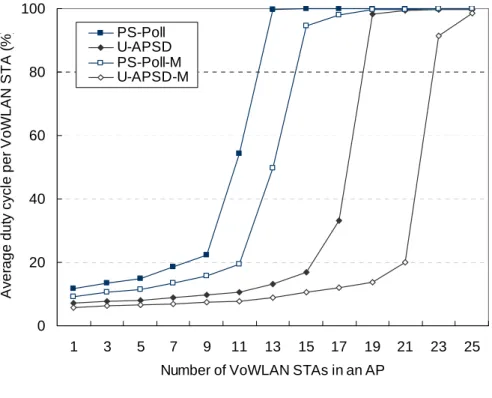
assumed a good WLAN channel condition, i.e. BER = 1.0e-5. Figure 5(a) shows the average
duty cycle per VoWLAN STA under different numbers of concurrent VoWLAN STAs in an
AP. The y-axis of Figure 5(a) shows the length of a duty cycle over a voice framing interval
which indicates the percentage of time that a VoWLAN STA must stay awake to transmit one
uplink and one downlink voice packet every voice framing interval. A larger percentage of a
duty cycle per voice framing interval implies that more energy is consumed for a VoWLAN
STA. Figure 5(a) indicates increasing the number of concurrent VoWLAN STAs in an AP also
increases the average duty cycle per VoWLAN STA, because a VoWLAN STA needs to spend
more time contending the WLAN channel when more concurrent VoWLAN STAs are served
by an AP. The figure illustrates that while the number of VoWLAN STAs in an AP is 1, the
PS-Poll and U-APSD transmission schemes with the proposed mechanism decrease by about
10% length of a duty cycle than the transmission schemes without the proposed mechanism.
This performance improvement is gained only by eliminating acknowledgement frames. The
performance improvement from applying the proposed mechanism grows as the number of
concurrent VoWLAN STAs in an AP increases. This is because that a VoWLAN STA usually
STAs. The proposed mechanism reduces the transmission time of voice packets, and hence,
significantly reduces the average length of an overhearing period while the WLAN load
becomes heavy. For instance, the average duty cycle per VoWLAN STA for the PS-Poll and
PS-Poll-M schemes when supporting 9 concurrent VoWLAN STAs are 4.48 ms and 3.16 ms
respectively. The proposed mechanism reduces the duty cycle by about 29%. The average
duty cycles for the U-APSD and U-APSD-M schemes are 1.96 ms and 1.48 ms respectively,
indicating a reduction of about 24% when adopting the proposed mechanism for the case that
9 VoWLAN STAs are served by an AP. The simulation results reveal that the proposed
method removes the acknowledgement frames for voice packets, thus shortening each duty
cycle, which also reduces the WLAN channel waiting time while a VoWLAN STA tries to
transmit a voice packet. To evaluate the improvement of energy consumption, the energy
consumption of a VoWLAN STA using various transmission schemes was investigated.
ORiNOCO PC Gold Card is used for this simulation [14]. Figure 5(b) shows the
corresponding energy consumption of Figure 5(a). The proposed mechanism reduced the
average energy consumption of PS-Poll and U-APSD by about 23% and 17%, respectively,
0 20 40 60 80 100 1 3 5 7 9 11 13 15 17 19 21 23 25 Number of VoWLAN STAs in an AP
A v er age d ut y c y c le pe r V o W LA N S T A ( % ) PS-Poll U-APSD PS-Poll-M U-APSD-M (a) 0 150 300 450 600 750 900 1 3 5 7 9 11 13 15 17 19 21 23 25 Number of VoWLAN STAs in an AP
A v e ra ge pow er c on s um pt ion pe r Vo W L AN ST A ( m W ) PS-Poll U-APSD PS-Poll-M U-APSD-M (b)
Voice packets for which acknowledgement frames are not sent might be lost due to packet
error or collision, degrading the voice quality. Therefore, the proposed mechanism
dynamically adjusts the maximum number of transmission attempts, i.e. and , for
each voice packet based on a target packet loss rate. In the simulations, the maximum
permissible packet loss rate was set to 2%.
ul dl
t
N Nt
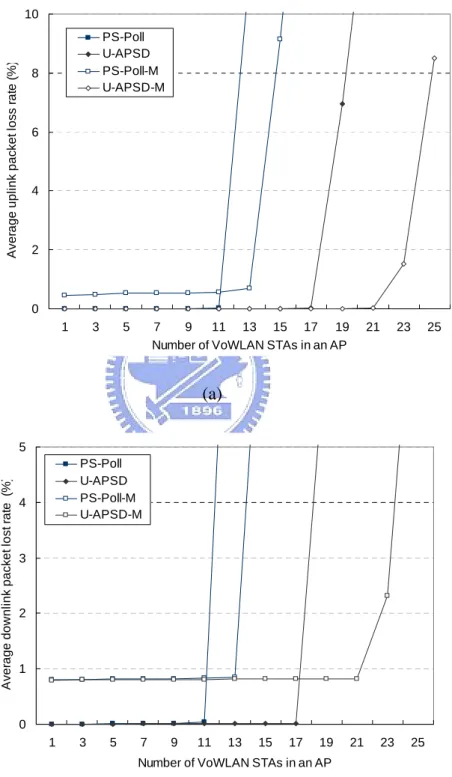
Figure 6 shows the average loss rates for uplink
and downlink voice packets by applying different transmission schemes. The simulation
results shows that although the packet loss rates of PS-Poll-M and U-APSD-M were slightly
higher than those of PS-Poll and U-APSD, the packet loss rates for the proposed transmission
mechanism are still less than 1%. The packet delays of different transmission schemes were
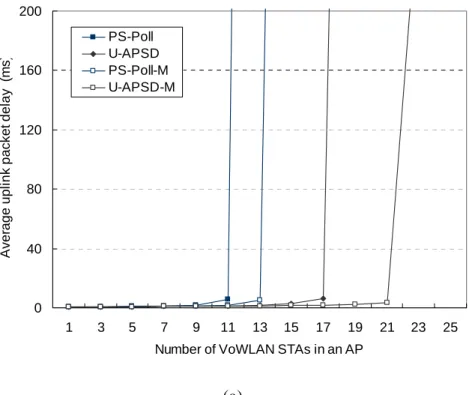
then investigated. Figure 7 shows the average delay for uplink and downlink voice packets.
The figure indicates that the voice packets encounter longer delays as the number of
VoWLAN STAs served by an AP increases. This is because that increasing the WLAN load
causes more packets to be queued on the AP, increasing the packet delay. Since the proposed
mechanism reduces the length of a duty cycle, it increases the maximal number of VoWLAN
STAs that can be supported by a WLAN. Simulation results indicate that PS-Poll-M can
support two more VoWLAN STAs than the PS-Poll scheme under a 50 ms delay and 2% loss
rate constraints for voice packets. U-APSD-M was found to support four more VoWLAN
STAs than the U-APSD scheme. Simulation results depicted in Figure 6 and Figure 7 reveal
transmission schemes by about 18% and 24%, respectively and also provides a similar voice quality. 0 2 4 6 8 10 1 3 5 7 9 11 13 15 17 19 21 23 25 Number of VoWLAN STAs in an AP
A v er age upl ink pac k et l os s r at e (% ) PS-Poll U-APSD PS-Poll-M U-APSD-M (a) 0 1 2 3 4 5 1 3 5 7 9 11 13 15 17 19 21 23 25 Number of VoWLAN STAs in an AP
A v er ag e d ow nl in k p ac k et l os t r at e ( % ) PS-Poll U-APSD PS-Poll-M U-APSD-M (b)
0 40 80 120 160 1 3 5 7 9 11 13 15 17 19 21 23 25
Number of VoWLAN STAs in an AP
A v er ag e upl in k p a cket d e la y (m s 200 ) PS-Poll U-APSD PS-Poll-M U-APSD-M (a) 0 40 80 120 160 200 1 3 5 7 9 11 13 15 17 19 21 23 25
Number of VoWLAN STAs in an AP
A v er age dow nl ink pac k et del ay ( m s ) PS-Poll U-APSD PS-Poll-M U-APSD-M (b)
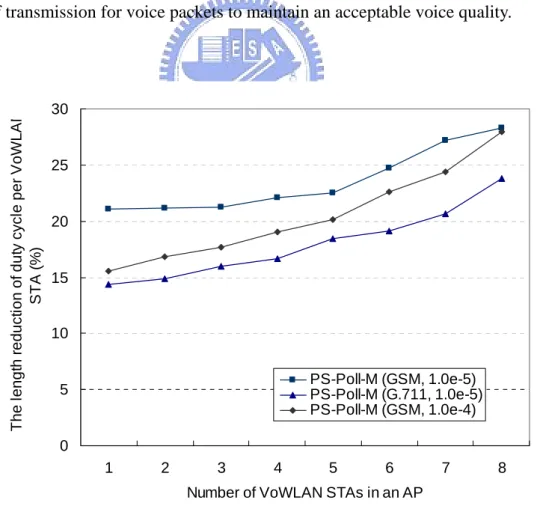
Figure 7. Average delay for uplink and downlink packets
different voice codecs and BERs was further evaluated. Figure 8 illustrates the length
reduction of a duty cycle per VoWLAN STA from applying the proposed mechanism to the
PS-Poll and U-APSD schemes. Simulation results indicate that the PS-Poll-M scheme using
GSM codec performed better than that using G.711 codec, because the acknowledgement
frame introduces relatively more overhead for low bitrate codecs such as GSM than high
bit-rate codecs such as G.711. Additionally, the simulation results show that PS-Poll-M
performs better at a BER of 1.0e-5 than 10e-4. This is because a poor WLAN channel quality
leads to a high packet loss, implying that the proposed methods must increase the maximum
number of transmission for voice packets to maintain an acceptable voice quality.
0 5 10 15 20 25 30 1 2 3 4 5 6 7 8
Number of VoWLAN STAs in an AP
T h e l e n g th r e du ct io n of d u ty cycl e p e r V o WLA N ST A ( % ) PS-Poll-M (GSM, 1.0e-5) PS-Poll-M (G.711, 1.0e-5) PS-Poll-M (GSM, 1.0e-4)
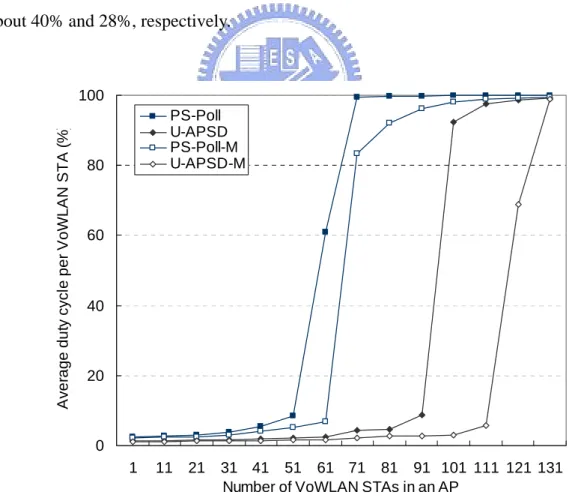
Finally, the performance improvement under different WLAN standards was investigated.
Figure 9 shows the average duty cycle per VoWLAN STA when using GSM codec in the
IEEE 802.11g with BER = 1.0e-5. While the number of concurrent VoWLAN STAs that can
be served by an AP increases, the probability to overhear other STAs’ transmission also
increases. Therefore, the proposed mechanism that reduces the length of overhearing period
efficiently reduces the length of a duty cycle for a VoWLAN STA for high speed WLAN
standards. For instance, while 51 concurrent VoWLAN STAs are supported by an IEEE
802.11g AP, the proposed mechanism reduces the average duty cycle of PS-Poll and U-APSD
by about 40% and 28%, respectively.
0 20 40 60 80 100 1 11 21 31 41 51 61 71 81 91 101 111 121 131 Number of VoWLAN STAs in an AP
A v e ra g e du ty cycl e p e r V o WLA N S T A ( % ) PS-PollU-APSD PS-Poll-M U-APSD-M
Chapter 5. Conclusions
This study presents a cross-layer and energy-efficient transmission mechanism for a
VoWLAN system. The mechanism dynamically disables the MAC acknowledgement for each
transmission of a voice packet according to the current packet loss rate and the target voice
quality, thus reducing the time and the energy consumed by a VoWLAN STA in transmitting
and receiving voice packets. Simulation results indicate that the proposed mechanism
significantly reduces the energy consumption of a VoWLAN STA, improves the WLAN
utilization for transmitting voice packets, and can also guarantee the voice quality.
Furthermore, WLAN multicasting is used to transmit voice packets without the MAC
acknowledgement, thus enabling the proposed mechanism to be implemented on the existing
References
[1] D. Lenton, “Speaking of Wi-Fi,” IEE Review, Vol. 49, No. 7, pp. 44 – 47, July 2003.
[2] ANSI/IEEE Std 802.11, “Wireless LAN Medium Access Control (MAC) and Physical
Layer (PHY) Specifications,” Aug. 1999.
[3] W. Wang, S. C. Liew, and V. O. K. Li, “Solutions to Performance Problems in VoIP over
802.11 Wireless LAN,” IEEE Transactions on Vehicular Technology, Vo. 54, No. 1, Jan.
2005.
[4] K. Medepalli, P. Gopalakrishnan, D. Famolari, and T. Kodama, “Voice Capacity of IEEE
802.11b, 802.11a and 802.11g Wireless LANs,” IEEE Global Telecommunications 2004
(IEEE Globecom ’04), Dec. 2004.
[5] S. Shankar N, J. Pavon, and P Wienert, “Optimal packing of VoIP Calls in an IEEE
802.11a/e WLAN in the Presence of QoS Constraints and Channel Errors,” IEEE Global
Telecommunications 2004 (IEEE Globecom ‘04), Dec. 2004.
[6] G. Hanley, S. Murphy, and L. Murphy, “Adapting WLAN MAC Parameters to Enhance
VoIP Call Capacity,” Proceedings of the 8th ACM International Symposium on Modeling,
Analysis and Simulation of Wireless and Mobile Systems (ACM MSWiM ‘05), Oct.
2005.
[7] Y. Chen, N. Smavatkul, and S. Emeott, “Power Management for VoIP over IEEE 802.11
March 2004.
[8] ANSI/IEEE Std 802.11e, “Media Access Control (MAC) Quality of Service
Enhancements,” Nov. 2005.
[9] X. Wang, T. D. Todd, D Zhao, and V. Kezys, “Power Saving Gateways for Real-Time
Voice Handset Support in IEEE 802.11 Wireless LAN,” IEEE International Conference
on Communications 2004 (IEEE ICC ‘04), Jun. 2004.
[10] A. Servetti and J. C. D. Martin, “Error Tolerant MAC Extension for Speech
Communications over 802.11 WLANs,” IEEE Vehicular Technology Conference (IEEE
VTC ‘05), Sep. 2005.
[11] X. Wang, J. Yin, and D. P. Agrawal, “Effects of Contention Window and Packet Size on
the Energy Efficiency of Wireless Local Area Network,” IEEE Wireless
Communications and Networking 2005 (IEEE WCNC ‘05), March. 2005.
[12] H. Zhai, X. Chen, and Y. Fang, “How Well Can the IEEE 802.11 Wireless LAN Support
Quality of Service,” IEEE Transactions on Wireless Communications, Vol. 4, No. 6, Nov.
2005.
[13] H. Schulzrinne, S. L. Casner, R. Frederick, and V. Jacobson, “RTP: A Transport Protocol
for Real-Time Applications,” RFC 1889.
[14] E. Shih, P. Bahl, and M. J. Sinclair, “Wake on Wireless: an Event Driven Energy Saving