國
立
交
通
大
學
資訊科學與工程研究所
碩
士
論
文
應用在 DNS 管理之做中學補救教學系統
Building a Learning-by-Doing Remedial Tutoring System
for DNS Management
研 究 生:張晉璿
指導教授:曾憲雄 教授
應用在 DNS 管理之做中學補救教學系統
Building A Learning-by-Doing Remedial Tutoring System
for DNS management
研 究 生:張晉璿 Student:Chin-Hsuan Chang
指導教授:曾憲雄 Advisor:Dr. Shian-Shyong Tseng
國 立 交 通 大 學
資 訊 科 學 與 工 程 研 究 所
碩 士 論 文
A Thesis
Submitted to Institute of Computer Science and Engineering College of Computer Science
National Chiao Tung University in partial Fulfillment of the Requirements
for the Degree of Master
in
Computer Science
June 2006
Hsinchu, Taiwan, Republic of China
中華民國九十五年六月
應用在 DNS 管理之做中學補救教學系統
研究生: 張晉璿 指導教授: 曾憲雄博士 國立交通大學資訊學院 資訊科學與工程研究所摘要
Learning-by-Doing,也就是「做中學」,此種教學方法強調讓學生親自動手去練習,以 學好技能。而在此教學方法下,學生在練習的時候所遇到的問題,可能來自於他所需的 專業知識不足或是在學習課程上沒有融會貫通,導致在實際練習時,產生學習上的障 礙。因此必須透過一個良好補救教學環境來幫助學生解決這些問題。近期由於電腦和網 路的普及化,許多的教學方法也都應用在網路學習(E-learning)上,但是 E-learning 應用 在「做中學」教學方法上仍缺乏適性化的補救系統。所以在這篇論文中,針對於這些問 題,我們提出一套方法及系統模型以建構一個適用於「做中學」的適性化補救教學系統。 在我們的方法中,我們使用以知識為基礎的方法去找出學生可能發生問題的地方,同時 也提出一套演算法(Ontology-based Adaptive Learning Sequences Construction, OALSC algorithm)來產生適性化的學習序列,以幫助學生能夠正確且有效的了解所需的知識,克 服在做中學所遇到的學習障礙。在實務上,我們把設計的系統模型應用在學習網域名稱 伺服系統(DNS)上。希望透過我們的系統能幫助學習該領域的學習者解決問題。另外只 要稍加修改,同樣一套系統開發模式與所發展的技術,應該可以應用到與做中學教學相 關的學習領域。 III關鍵辭: 做中學、知識本體、專家系統、補救教學、分享內容元件參考模型、適性化 學習序列、領域名稱伺服系統
Building A Learning-by-Doing Remedial Tutoring System
for DNS Management
Student: Chin-Hsuan Chang Advisor: Dr. Shian-Shyong Tseng
Institute of Computer Science and Engineering National Chiao Tung University
ABSTRACT
Learning-by-Doing, is a kind of popular teaching and learning methodology which
emphasizes that students would learn skills through practicing by themselves. In general, using Learning-by-Doing, students may encounter problems since they probably do not know required domain knowledge or they do not fully understand the contents of the courses. Thus, students often need good remedial tutoring system to help them improve their learning statuses. In recent years, due to the fast development of computer and network technologies, many kinds of teaching and learning methodologies are applied in E-learning. However, according to our observations, we found that most of these systems in Learning-by-Doing lack the adaptive remedial tutoring environments. Therefore, in the thesis, we propose a methodology and system model to build a Learning-by-Doing remedial tutoring system. In this proposed methodology, we use knowledge-based approach to identify students’ problems and propose the algorithm, (Ontology-based Adaptive Learning Sequences Construction,
OALSC algorithm), to generate adaptive learning sequences for helping students learn the
required knowledge correctly and efficiently to overcome the encountered problems. Besides,
the system model is applied in learning Domain Name System (DNS) management. We would like to notice that system model and developed algorithm could be easily adapted to other domains in Learning-by-Doing.
Keywords: Learning-by-Doing, ontology, expert system, remedial tutoring, SCORM, adaptive learning sequences, DNS
誌謝
首先感謝恩師曾憲雄教授在這兩年裡面的細心指導,由於老師的耐心教導以及勉 勵,使得我能夠順利的完成此篇論文 ; 在老師的諄諄教誨下,引導我逐步學習並培養許 多獨立研究的方法及技巧,並提升自我的能力。同時,也感謝論文的口試委員中山大學 資管系 陳年興教授、中華電信研究所 王景弘博士、及本校資訊科學與工程研究所 孫春在教授 的建議使得整篇論文的理論於實務上的內容更加完善。 其次,我要特別感謝曲衍旭學長及陳昌盛博士,這兩年期間裡,讓我了解許多的理 論與實務技巧,也給予我許多此篇論文的寶貴建議,並不厭其煩的接受我的詢問和討 論,並協助我修改此篇論文的工作,讓我受益良多,深表感激。 另外,要感謝的是實驗室的學長、同學、及學弟妹們。在完成這篇論文的過程中, 得到你們許多的協助及建議。同時也感謝實驗室同窗好友,嘉文、珍妮、喚宇、南極、 永彧、昇翰、仁杰、展彰,很高興能夠跟你們一同在交大 KDE Lab 成為同學,一起度 過忙碌且充實的生活。 最後,我要感謝我的家人,在我念碩士班的過程中,遇到挫折或困境時,能夠不斷 的給我支持跟鼓勵,讓我能順利完成學業。 要感謝的無法一一詳述,在此謹向所有幫助過我的人,致上深深的謝意。 VITable of Contents
Abstract (In Chinese) ...III Abstract ...IV Acknowledgement (In Chinese)...VI Table of Contents ... VII List of Figures ... VIII List of Tables ...IX List of Algorithms ...IX Chapter 1 Introduction ... 1 Chapter 2 Preliminaries ... 7
2.1 Learning-by-Doing ...7 2.2 Basics of the DNS System...9 2.3 Overview of DRAMA/NORM ...10 2.4 Ontology-based Learning Sequences Construction Scheme ...12 2.5 Two Phase Knowledge Acquisition Process...13 2.6 Historical Review of the iDNS-MS...15
Chapter 3 Learning-by-Doing Remedial Tutoring System ... 17
3.1 The need of Domain Ontology ...17 3.2 Overview of the System Architecture...21 3.3 Learning Module ...23 3.4 Diagnosis Module...27 3.5 Remedial Tutoring Module...30 3.6 Overall of the System Architecture ...32
Chapter 4 Ontology-based Adaptive Learning Sequences Construction Algorithm.. 33
4.1 OALSC Algorithm...33 4.2 A Simple DNS Example...36 Chapter 5 Implementation... 48 5.1 System Implementation ...48 5.2 Tutoring Examples...48 5.3 Diagnostic Examples ...49 5.4 Remedial Tutoring Examples ...52
Chapter 6 Concluding Remarks... 55 Reference ... 58
List of Figures
Figure 2.1: A simple process of Learning-by-Doing ... 8 Figure 2.2: DNS operation model... 10 Figure 2.3: NORM-based knowledge base... 12 Figure 2.4: The Ontology-based Learning Sequences Construction Scheme... 12 Figure 2.5: The Two Phase Knowledge Acquisition Process ... 14 Figure 3.1: Domain ontology bundled with courses & quizzes... 19 Figure 3.2: A simple example of DNS ontology... 19 Figure 3.3: The relations of the DNS ontology ... 20 Figure 3.4: Overview of the Learning-by-Doing Remedial Tutoring System architecture ... 22 Figure 3.5: Ontology-based Learning Sequences Construction Scheme transformation... 25 Figure 3.6: The normal distribution of student’s grades of courses... 26 Figure 3.7: Two Phase Knowledge Acquisition Process transformation ... 28 Figure 3.8: Both kinds of ontology transformations... 30 Figure 3.9: The inputs and outputs of the Remedial Tutoring Module... 31 Figure 3.10: Overall Learning-by-Doing Remedial Tutoring System architecture ... 32 Figure 4.1: The inputs and outputs of the OALSC algorithm... 34 Figure 4.2: A chart of the SPOF example... 37 Figure 4.3: The inference process of SPOF problem... 38 Figure 4.4: The inference chain of SPOF ... 39 Figure 4.5: The rule class chain of SPOF ... 39 Figure 4.6: The path of rule class chain mapped on the DNS ontology ... 40 Figure 4.7: The adaptive learning sequence about the SPOF problem... 41 Figure 4.8: The “normal” learning level course on learning sequence... 42 Figure 4.9: The “high” learning level course on learning sequence ... 43 Figure 4.10: The “low” learning level course on learning sequence ... 44 Figure 4.11: The enlarged part of DNS ontology ... 45 Figure 4.12: The newly added course which has Pre-requisition relation ... 46 Figure 4.13: The high learning level of DNS Equipment Deployment ... 47 Figure 4.14: The low learning level of DNS Equipment Deployment ... 47 Figure 5.1: Static learning sequences of DNS runs on the SCORM 2004 RTE ... 49 Figure 5.2: DNS on-line test facility on DNS diagnosis system... 50 Figure 5.3: DNS testing on DNS diagnostic subsystem ... 51 Figure 5.4: Inference results of DNS on-line test facility... 52 Figure 5.5: The adaptive remedial tutoring subsystem... 53 Figure 5.6: The adaptive learning sequences for solving the SPOF problem students encountered ... 54
List of Tables
Table 2.1: Historical review of the iDNS-MS ... 15 Table 4.1: The related learning sequence of SPOF by expert’s advices ... 38
List of Algorithms
Algorithm 4.1: The ontology-based adaptive learning sequences construction algorithm ... 35
Chapter 1 Introduction
In recent years, due to the fast developments of computer and network technologies, many kinds of teaching and learning methodologies are applied in E-learning.
Learning-by-doing is a kind of popular teaching and learning methodology, both in
traditional and E-learning environments. It emphasizes that students had better do their tasks if they want to learn skills about a certain discipline. Through practicing and doing tasks by themselves, they would learn the required skills more easily. However, in practice, most students might encounter problems in Learning-by-Doing. For example, there is a student who would like to learn about the skills of configuration and management of Domain Name System (DNS) servers. After reading some system administration books and learning by himself/herself to gain the basic DNS knowledge, he/she decides to set up and configure two (i.e., more than one) DNS servers in order to avoid the Single Point Of Failure (SPOF) problem. However, with the lack of correct understanding about SPOF, it is not uncommon that he/she puts both the two DNS servers in the same subnet (i.e., behind the same router), which means another kind of SPOF. That is, if the router is under attack (and crashed), both of the servers configured might stop providing DNS services (even though the systems are configured correctly and work healthily). Therefore, if there are no teachers to tell him/her about the wrong settings of the DNS servers, he/her might not be able to know the specified mistakes for a long time. Thus, it seems that adaptive remedial tutoring information is required to help the students solve the encountered problems.
Most researches about Learning-by-Doing in E-learning focus on building
simulated environments for students to practice their skills by them more conveniently. We found most of them lack the adaptive remedial tutoring for helping students solve the encountered problems (Caroll et al. 1988; Tam et al., 1999; Sala 2001; Roussou, 2004; Godoy, 2005). In general, after teachers identify the students’ problems and the related learning concepts which students should improve, they usually adjust the suitable orders of learning sequences as remedial tutoring information for students to learn more adaptively and efficiently in E-learning (Fischer 2001; Hwang 2002; Chen et al. 2005). Therefore how to generate the adaptive learning sequences as the way of remedial tutoring for students in Learning-by-Doing becomes an interesting issue.
According to our observations, about Learning-by-Doing in E-learning, there are two main difficulties to generate adaptive learning sequences. First, in traditional teaching and learning methodologies, quizzes are usually used to identify the students’ problems and the related learning concepts which they did not learn well (Hwang, 2002). However, in Learning-by-Doing, the quiz approach is not suitable for this purpose. It is hard to identify students’ problems and the related learning concepts by using quizzes alone since quizzes usually test only single learning concepts. Next, the second difficulty is how to generate adaptive learning sequences for students.
In the thesis, for helping students solve these problems, we propose a systematic methodology to build a Learning-by-Doing remedial tutoring system and design the
Ontology-based Adaptive Learning Sequences Construction (OALSC) algorithm to
generate adaptive learning sequences as remedial tutoring. In the proposed methodology, we adopt ontology and knowledge-based approach to help solve the mentioned problems. There are two main advantages, for using ontology in our methodology, described in the following paragraph:
(1) In general, an ontology consists of concept classes and relations. Our idea is that it is easy to use the ontology to represent the learning concepts and domain concepts of the teachers’ domain knowledge. Therefore, we can use the built ontology to help identify the students’ problems and generate the adaptive learning sequences through our proposed methodology.
(2) We want to identify not only the problems but also the related learning concepts about them for conducting remedial tutoring. In the proposed methodology, we will make use of the relations of ontology to generate the adaptive learning sequences. First of all, in order to get the best effects of students’ learning, we will ask experts to define specific relations between some learning concepts nodes of ontology. Next, we ask experts to enumerate a set of common error problem concepts and learning concepts on the specific ontology. Next, when we generate adaptive learning sequences by OALSC algorithm, the relations of the ontology will be utilized to adjust the orders of the courses in the learning sequences. Finally, through the proposed methodology, we would use the specific ontology to identify the problems and related learning concepts and to generate adaptive learning sequences.
Moreover, for the diagnosis of the students’ tasks in Learning-by-Doing, we adopt the knowledge-based diagnostic approach. In the thesis, we use the DRAMA/NORM (i.e. New Object-oriented Rule Model and Drama is an inference system based on NORM; they will be described in more detail in Section 2.3) to diagnose the students’ tasks by collecting the related facts and environmental conditions in real world for helping us generate the adaptive remedial tutoring information. The reasons for using
DRAMA/NORM are:
(1) As described above, it is hard to identify the students’ problems by using quizzes alone because these problems are probably caused by many different reasons and conditions in real world in Learning-by-Doing. Therefore, we adopt knowledge- based diagnostic approach to identify these problems. By using experts’ domain knowledge to identify these problems, it would be more correct and efficient than using quizzes.
(2) After diagnosis, the diagnostic information of the tasks can be utilized to help us generate adaptive learning sequences. Basically, the ontology is a kind of object-oriented knowledge representation. Therefore, we adopt the DRAMA/NORM since DRAMA is object-oriented. It is easy to integrate the diagnostic information with the learning concepts of ontology. We can map the concept classes of diagnostic information to the learning concepts of ontology. Finally, we propose the OALSC algorithm to generate adaptive learning sequences for students, by using the diagnostic results and records of DRAMA.
In addition, by considering the reusability and interoperability issues of the teaching material, we adopt the Sharable Content Object Reference Model (SCORM) model for building the web-based remedial tutoring system. The SCORM provides sequencing and navigation mechanism for learning objects. Therefore, the SCORM Run Time Environment (RTE) 2004 is used to implement the learning platform and generate the learning sequences.
In the thesis, a DNS management remedial tutoring system is built by applying this methodology. Basically, the designed Learning-by-Doing remedial tutoring system is
integrated into the iDNS-MS (Intelligent DNS Management System), proposed by Chen et al. (2003), and enhanced by Liu et al. (2004), Chen et al. (2005). In Section 2.6, the historical review of the iDNS-MS will be described. Like other network applications, the DNS management tasks also emphasize that users had better do their tasks in practice. In fact, it is one kind of application domain in Learning-by-Doing. Therefore we would like to build the remedial tutoring system to help DNS administrators and/or the DNS learners solve their encountered problems.
In summary, our main contributions of the thesis are:
1. We propose an ontology-based systematic methodology to build a Learning-by-Doing Remedial Tutoring System for helping students solve their encountered problems.
2. We design the Ontology-based Adaptive Learning Sequences Construction (OALSC) algorithm to generate adaptive learning sequences as remedial tutoring information in Learning-by-Doing.
3. A DNS management remedial tutoring system is built by applying this methodology. For enhancing the functionality of the iDNS-MS, the implementation of our designed remedial tutoring system will be integrated into the iDNS-MS.
The rest of this thesis is organized as follows. In Chapter 2, we introduce some preliminaries about Learning-by-Doing, Ontology, Drama/NORM, Ontology-based Learning Sequences Construction Algorithm (Chen et al. ,2005), Two Phase KA process (Chen, 2003) and the historical review of the iDNS-MS. Chapter 3 shows the
overall system architecture and describes our proposed methodology in detail. Chapter 4 mentions the proposed Ontology-based Adaptive Learning Sequences Construction algorithm. In addition, we use a simple DNS example to illustrate the process of the algorithm clearly. Chapter 5 gives descriptions about the implementation of the Learning-by-Doing remedial tutoring system for DNS management. Finally, concluding remarks are given in Chapter 6.
Chapter 2 Preliminaries
In this Chapter, we describe preliminaries information about the thesis. In Section 2.1, the Learning-by-Doing teaching and learning methodology are described briefly. In Section 2.2, we describe the basics of the Domain Name System (DNS). In section 2.3, we mention the DRAMA/NORM environment which is a object-oriented inference model. In Section 2.4, we give descriptions about the Ontology-based Learning Sequences Construction Algorithm proposed in Chen et al. (2005). Finally, in the last Section, we describe the Two Phase Knowledge Acquisition Process proposed in Chen (2003).
2.1 Learning-by-Doing
The Learning-by-Doing is a kind of popular teaching and learning methodology. Its main idea is to emphasize that students learn the skills by practices. For example, students want to learn about the skills of configuration and management of DNS. If they learn this skill only by theoretic tutoring courses, they may not learn the skill well easily. In general, it had better for them to do the tasks in practice after have learned the theoretic tutoring courses because they can increase their experiences and realize the real conditions about the tasks. In addition, most students usually encounter problems in Learning-by-Doing when they do their tasks in practice. There are two main reasons for above conditions. First, when students might not learn the required domain knowledge enough or well from theoretic tutoring courses, they lack the required domain knowledge to help them complete their tasks
while they doing their tasks. Next, when students do their tasks in practice, they might not retrieve the required knowledge suitably to help themselves complete their tasks. Therefore, these students need adaptive remedial tutoring information to help them solve these problems. As shown in Figure 2.1, we use a simple diagram to illustrate the process of Learn-by-Doing. On stage 1, students may learn the required domain knowledge from books or courses. Next, on stage2, they do their tasks by practicing. At this time, if they encounter problems, they may re-learning by themselves or ask teachers to help them when they do not know how to solve the encountered problems. On stage 3, in fact, most students need assistances from teachers for identifying their problems and generating suitable remedial tutoring information (on stage 4).
Figure 2.1: A simple process of Learning-by-Doing
In recent years, E-learning is one of popular research domains. However, in E-learning, most Learning-by-Doing systems focus on the simulated environment implementations but they often lack the mechanism of providing students adaptive
remedial tutoring information. Therefore, in the thesis, we propose a systematic methodology to build a Learning-by-Doing remedial tutoring system for helping students solve their encountered problems.
2.2 Basics of the DNS System
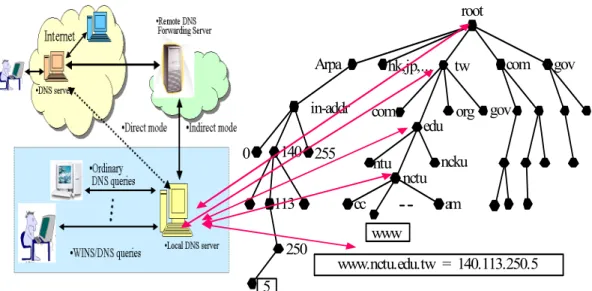
The Domain Name System (Mockapetris 1987-1; Mockapetris 1987-2) is responsible for translating between hostnames and the corresponding IP addresses needed by software. The mapping of data is stored in a tree-structured distributed database where each name server is authoritative (responsible) for a portion of the naming hierarchy tree. The client side query process typically starts with an application program on the end user's workstation, which contacts a local name server via a resolver library. That client side name server queries the root servers for the name in question and gets back a referral to a name server who should know the answer. The client's name server will recursively follow referrals re-asking the query until it gets an answer or is told there is none. Caching of that answer should happen at all name servers except those at the root or top-level domains (.com for example). The working paradigm could be illustrated in Figure 2.2.
Arpa in-addr 0 140 255 113 250 5 hk, jp,... tw com edu org ntu nctu ncku cc am www gov com gov root www.nctu.edu.tw = 140.113.250.5
Figure 2.2: DNS operation model
2.3 Overview of DRAMA/NORM
In traditional forward-chaining rule-base expert system, the rule base consists of all rules and facts. The system needs to go through every matching rule when conducting inference for the proper result. This might become inefficient when the number of rules and facts become large. Therefore, many researches aim to improve the maintenance of rule-based expert system by incorporating the objected-oriented approach.
We apply the DRAMA/NORM package for building up the expert system. DRAMA is a rule-based, client-server tool/environment for KBS development. It can assist knowledge engineers in building up an expert system. Briefly, DRAMA contains lots of innovative techniques including Object-Oriented technology,
knowledge inheritance, etc. It also contains useful tools, like rule verification tool, knowledge acquisition assistant tool and the inference server. Using the client-server architecture of DRAMA, the knowledge base is maintained on a server and clients could access this server for inference services.
The kernel knowledge model of DRAMA, named NORM (New Object-Oriented Rule-base Model), was developed by the KDE Lab at Dept. of Computer & Information Science of National Chiao-Tung University. The working model of NORM, containing knowledge classes (KCs) and the relations between KCs, as shown in Figure 2.3, is based on the principles about how people ponder and learn to acquire knowledge. According to domain expertise, when a person is trying to learn something, there are often some topics for him/her to study. A lot of new knowledge is built upon the original knowledge according to the discipline of Educational Psychology. Thus, new knowledge about the topics could easily be built one by one after the person successfully studies them. And, these topics could be transformed to KCs easily. In other words, learning is an activity to construct the relations between different KCs. Since this knowledge model fits in quite well with the thought of human and KCs are modularized, we can build and maintain the knowledge base more conveniently. It is very important to use such knowledge model for the knowledge engineers. Whenever there is a need to update some knowledge, it is unnecessary to change all the knowledge base. All we have to do is just to add or modify the modules involved. In addition, the client-server architecture of DRAMA makes the web services plausible and more easily. Thus, the benefits of the expert system approach can be utilized throughout the Internet.
Fact-Collection Fact Fact Fact Fact
Rule-base
Knowledge class Knowledge class Knowledge class Knowledge class Knowledge class Knowledge class Knowledge class Knowledge class Knowledge class Knowledge class Knowledge class Knowledge class Knowledge class Knowledge class dependenceFigure 2.3: NORM-based knowledge base
2.4 Ontology-based Learning Sequences Construction Scheme
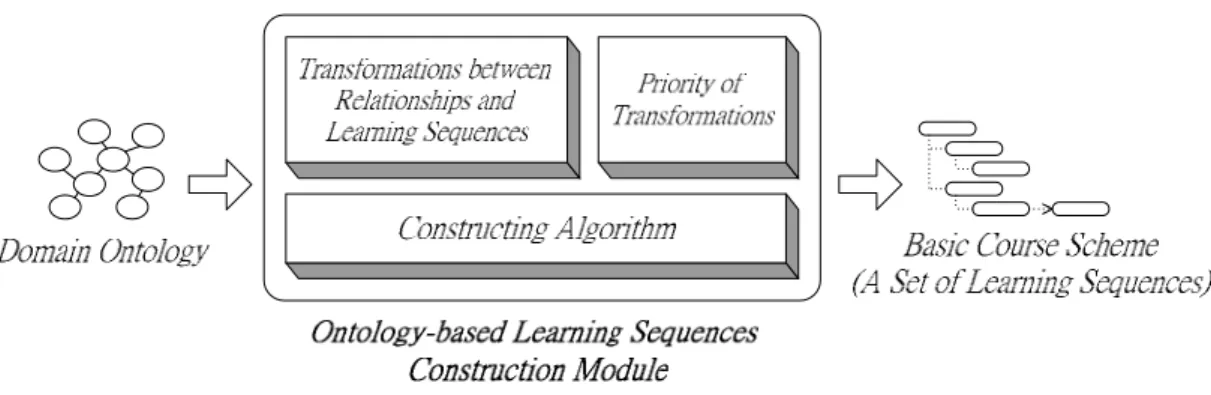
As shown in Figure 2.4, in Chen et al. (2005), the Ontology-based Learning Sequences Construction Scheme is proposed in order to transform a domain ontology to a basic course scheme. There are three primary parts in this construction module:
Figure 2.4: The Ontology-based Learning Sequences Construction Scheme
(1) Transformations between domain ontology relations and learning sequences. => With the help of the transformation process, we could transform the ontology relationship into some kind of learning sequence according to the properties of the relationship.
(2) Priority ordering definition among those transformations.
=> Usually, there are more than one kind of relations in an ontology and each relationship is supposed to correspond to a kind of transformation. Therefore, if we would like to transform a domain ontology into a basic course scheme, we have to decide the priority ordering definition among these transformations since there are so many co-existed relations. On the other hand, just like the definition of transformations, the priority ordering definition is also domain-dependent. Thus, it is supposed that the priority ordering is defined with the help of domain experts
(3) The ontology-based learning sequences constructing algorithm they posed.
=> Due to the complexity of this algorithm, please refer to Chen et al. (2005) for more detail.
2.5 Two Phase Knowledge Acquisition Process
Chen (2003) proposed effective algorithms for transforming the knowledge components represented in the ontology into specific rule classes of the knowledge base. As shown in Figure 2.5, the process for the construction of the knowledge base
consists of two primary phases. In Phase 1, the main task is to create the skeletal structure of the knowledge base (i.e., NORM in this case). In theory, this task can be done by either domain experts or knowledge engineers. However, in practice, the domain experts might not be familiar with the model of NORM. Thus, it is supposed to be primarily conducted by knowledge engineers. In Phase 2, CommonKADS-like analyzing models were adopted to help elicit rules by first using the ERCM (Eliciting
Rules from CommonKADS-like Models) algorithm and then applying the ORKC
(Organizing Rules into proper Knowledge Classes) algorithm. Therefore, through the algorithms and models they proposed, it is easy to carry out the knowledge acquisition from ontology to NORM-based knowledge base.
Figure 2.5: The Two Phase Knowledge Acquisition Process
2.6 Historical Review of the iDNS-MS
In this Section, we give the historical review of the iDNS-MS. In Chen et al. (2003), the authors proposed a unifying framework and implemented a prototype of system (i.e., iDNS-MS) for intelligent DNS management. The iDNS-MS consists of many subsystems which are DNS Configuration/Debugging subsystem, DNS Configuration/Tutoring subsystem, DNS Planning, and DNS Tutoring, respectively. Liu et al. (2004), further enhanced the diagnostic subsystem of iDNS-MS based on Chen et al. (2003). Chen et al. (2005) enhanced the DNS tutoring of the iDNS-MS with their proposed Ontology-based Learning Sequences Construction methodology. Table 2.1 shows the related historical review of the iDNS-MS.
Table 2.1: Historical review of the iDNS-MS
Year Author Related research
2003 C. S. Chen et al. The authors proposed a unifying framework and implemented a prototype of system (i.e., iDNS-MS) for intelligent DNS management
2004 C. L. Liu et al. The authors enhanced the diagnostic subsystem of the based on Chen et al. (2003).
2005 R. Y. Chen et al. The authors enhanced the tutoring subsystem of the iDNS-NS based on Chen
et al. (2003).
According to our observations and users’ feedbacks, we find that they are not enough for the iDNS-MS to just provide the general DNS tutoring. Since after users use the diagnostic subsystem, it only shows some diagnostic results and recommendations. Many users think themselves need advanced understandings of their encountered problems. For example, more DNS cases tutoring, interactive tutoring, adaptive tutoring, etc. Therefore, for enhancing functionality of the iDNS-MS, the implementation of our designed remedial tutoring system will be integrated into the iDNS-MS. After that the iDNS-MS can provide adaptive remedial tutoring for helping users improve their required DNS domain knowledge to solve their encountered problems.
Chapter 3 Learning-by-Doing Remedial Tutoring System
As mentioned in Chapter 1, we know that it is hard to identify students’ encountered problems and the related learning concepts in Learning-by-Doing. Since these problems might be caused by many different reasons and conditions in real world, it is not suitable to use a general way of test, like quizzes, to identify the root cause about the problems and the related learning concepts that students should improve. Due to the difficulties, it is not easy to generate adaptive remedial tutoring information about Learning-by-Doing in E-learning. Therefore, in this thesis, we propose an ontology-based approach to build a Learning-by-Doing Remedial Tutoring System for helping students solve the encountered problems.
3.1 The need of Domain Ontology
As we all know ontology is a popular knowledge representation and there are many researches on the methodology of ontology construction (Lpez 1999; Chen et al. 2002; Falkner et al. 2005). In the thesis, in order to use domain experts’ knowledge to identify the student’s encountered problems and to generate adaptive remedial tutoring information, a domain ontology is utilized to represent the domain experts’ knowledge in our methodology. In our methodology, there are two main advantages for using ontology:
(1) In general, an ontology consists of concept classes and relations. Our idea is that it is easy to use the ontology to represent the learning concepts and domain concepts of the teachers’ domain knowledge. Therefore, we can use the built ontology to help identify the students’ problems and generate the adaptive learning sequences through our proposed methodology.
(2) We want to identify not only the problems but also the related learning concepts about them for conducting remedial tutoring. In addition, we also ask domain experts to provide the related domain courses and quizzes which are bundled with the corresponding concepts on domain ontology. Hence, in this way, it is convenient to generate adaptive learning sequences for our methodology as shown in Figure 3.1. In the proposed methodology, we make use of the relations of ontology to generate the adaptive learning sequences.
On the other hand, for the specific purpose, the domain ontology used in our methodology is not the same as the general ontology. The first difference is that we ask domain experts to define not only the learning concepts on the domain ontology but also the common error problem concepts which are used to identify the related learning concepts when students encounter problems. The second difference is that we add two specific relations (i.e., Pre-Requisite and Mutually-Associative) to domain ontology. The two specific relations are related to the generating task of adaptive learning sequences. For example, the former relation is about that since some learning concepts are the preliminary knowledge of other ones. On the other hand, the latter relation is about that some relations between learning concepts will affect students’ learning. Therefore, we must take them into consideration for generating adaptive learning sequences.
Figure 3.1: Domain ontology bundled with courses & quizzes
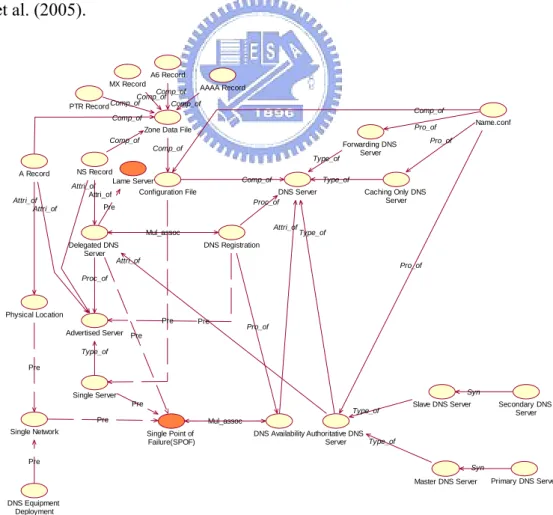
For example, Figure 3.2 shows a simple example of DNS ontology modified from Chen et al. (2005). Single Point of Failure(SPOF) Lame Server DNS Equipment Deployment Single Network Pre Pre Physical Location Pre Single Server Pre A6 Record AAAA Record MX Record PTR Record A Record Attri_of Secondary DNS Server Primary DNS Server NS Record Advertised Server Attri_of Attri_of Type_of
Zone Data File
Comp_of Comp_of Comp_of Comp_of Comp_of Comp_of Slave DNS Server Syn Master DNS Server Syn Delegated DNS Server Attri_of Proc_of Name.conf Configuration File Comp_of Comp_of Forwarding DNS Server Pro_of Caching Only DNS Server Pro_of Authoritative DNS Server Type_of Type_of Attri_of Pro_of DNS Server Comp_of Type_of Type_of Type_of DNS Availability Mul_assoc Attri_of DNS Registration Proc_of Pro_of Pre Pre Pre Mul_assoc Pre
Figure 3.2: A simple example of DNS ontology
Figure 3.3: The relations of the DNS ontology
As mentioned in Chen et al. (2005), the relations of the ontology are listed in Figure 3.3. The detailed meanings of the relations are explained as follows:
(1)Component of: If concept class A is a component of concept class B, it means that A is one component of B. For example, NS Record and A Record are components of Zone Data.
(2)Type of: If concept classes A and B are all the types of concept class C, it means that C has two kinds of types, namely A and B. For example, the Slave and Master DNS Server are two kinds of types of Authoritative DNS Server.
(3)Attribute of: Just as the literal meaning. If concept class A is an attribute of B, it means that B has the attribute A. For example, DNS Availability is an attribute of DNS Server.
(4)Process of: If a required process of concept class A indicates B, it means that B will process A
(5)Synonym: Suppose that there exists a synonym relationship between concept
class A and concept class B, it means that they are the same concepts and share the same tutoring contents.
(6)Pre-requisite constraint: If concept class A is a pre-requisite to concept class B, then A should be learned before B. For example, both the “Single Server” and “Single Network” concepts have Pre-requisite relation to SPOF, so someone has better to learn the “Single Server” and “Single Network” concepts before she/he wants to learn the SPOF concept.
(7)Mutually associative constraint: If concept class A and concept class B are mutually associative constraint. Thus, if A is considered, then B might be considered at the same time. And vice versa. For example, if we consider the DNS Availability concept, the SPOF concept will take into consideration, too.
3.2 Overview of the System Architecture
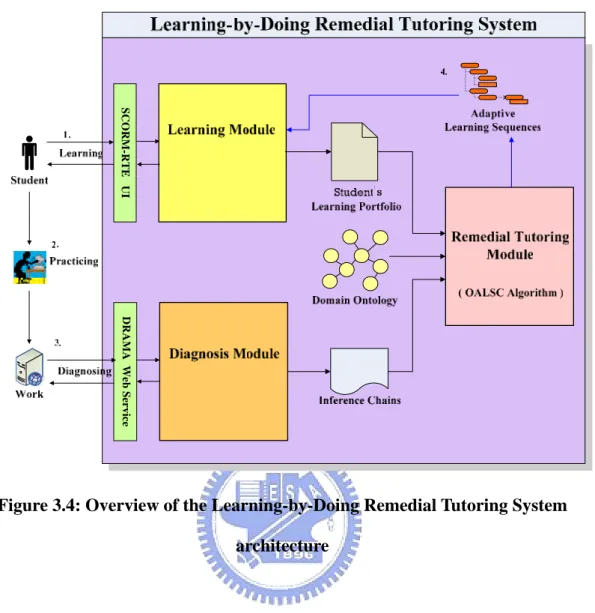
In E-learning, most of Learning-by-Doing systems lack the capability of providing adaptive remedial tutoring information. Therefore, as shown in Figure 3.4, we propose a systematic methodology to build the Learning-by-Doing Remedial Tutoring System for helping students solve their encountered problems. According to the general process of Learning-by-Doing, we design three modules in this system, namely, Learning Module, Diagnosis Module, and Remedial Tutoring Module.
SCO R M-R TE UI DRA MA Web Serv ice
Figure 3.4: Overview of the Learning-by-Doing Remedial Tutoring System architecture
The Learning Module of the system is a learning platform which is designed to provide students learning sequences with theoretic courses for learning the required domain knowledge. Besides, this module is constructed with the SCORM 2004
Sample Run-Time Environment (Version1.3.2) and used to show the learning
sequences. In SCORM RTE, the students’ learning statuses and learning activities will be recorded into the learning portfolios. The information is an important input source for Remedial Tutoring Module
Next, the Diagnosis Module is used to help students identify their encountered problems. The diagnostic information will be recorded on the inference chains which are also important input sources for Remedial Tutoring Module to generate adaptive
remedial tutoring information. The Diagnosis Module is constructed by using the
DRAMA/NORM. Since the DRAMA is object-oriented, it is utilized to represent the
concept classes of the domain ontology for identifying the students’ problems and the related learning concepts in Learning-by-Doing.
Finally, the Remedial Tutoring Module is used to generate the adaptive learning sequences as remedial tutoring information for students by our proposed OALSC
algorithm we proposed. If the diagnosis results show that the tasks have problems,
the OALSC algorithm will take the students’ learning portfolios, domain ontology and inference chains of diagnosis process as input sources and generate adaptive learning
sequences. These adaptive learning sequences will be stored in the repository of
Learning Module. Later, when students need remedial tutoring information, these adaptive learning sequences can be retrieved for helping them improve their learning. In brief, this design of Learning-Diagnosis-Remedial Tutoring System is suitable to generate adaptive remedial tutoring in the Leaning-by-Doing.
3.3 Learning Module
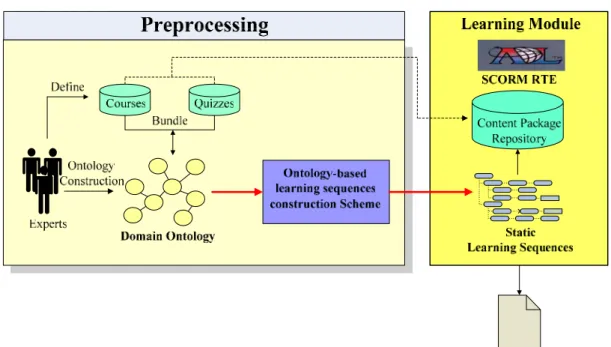
The Learning Module is a learning platform which is used to help students to learn or improve the required domain knowledge for completing their tasks. We use the SCORM 2004 Sample Run-Time Environment (SCORM RTE Version 1.3.2) to construct the learning platform for showing the learning sequences since SCORM is currently the most popular one of the existing standards for making learning contents. As shown in Figure 3.5, SCORM RTE contains a content package repository used to store and retrieve the learning sequences. When students would like to learn some
domain knowledge, the learning sequences will be provided for them from the content package repository. In principle, there are two kinds of learning sequences in this module, namely static and adaptive learning sequences. In the thesis, the learning sequences generated by the methodology proposed in Chen et al. (2005) will be called
static learning sequences in order to discriminate them from the adaptive learning sequences generated by our proposed methodology.
The static learning sequences generated by the Ontology-based Learning
Sequences Construction Scheme are used as basic tutoring courses to help students
to learn the required domain knowledge as shown in Figure 3.5. In Chen et al. (2005), in essence, this methodology transforms domain ontology to learning sequences scheme. Using this ontology-based transformation makes the Learning Module more flexible. If the domain ontology is modified or replaced, the new learning sequences scheme will follow the changes automatically. Thus, we use this methodology to construct the learning sequences in Learning Module.
On the other hand, the adaptive learning sequences generated by Remedial
Tutoring Module and stored in the content repository of the Learning Module are
used as remedial tutoring information to help students to improve their required domain knowledge and/or skills for solving the encountered problems. The detailed adaptive learning sequences construction will be described in Chapter 4.
Figure 3.5: Ontology-based Learning Sequences Construction Scheme transformation
Moreover, the Learning Module will record students’ learning statuses in Learning
Portfolios. In E-learning, learning portfolios are important records of students’
learning information. They record the information of students’ learning behaviors and help teachers realize which learning concepts the students learn well or badly. In general, the learning portfolios (including learning path, preferred learning course, grade of course, and learning time, etc.) can be utilized for teachers to revise their teaching (Wang et al. 2004). Therefore, in our proposed methodology, the students’ learning portfolios are used as important references to adjust the learning sequences for providing more adaptive remedial tutoring.
For differentiating students’ learning level easily, we map the grades of courses which students learned to the Learning Level field defined in the students’ learning portfolios. However, we decide the value of learning level in students’ learned courses
by several steps. First, quizzes about the courses would be given in order to test students’ understanding of the courses. After testing, the grades of courses are recorded in students’ learning portfolios. Second, without loss of generality, assume that the discrimination of quizzes in our system is very high. Thus, as shown in Figure 3.6, the students’ grades of courses are assumed to be Normal Distribution. The initialized learning portfolio of each student with respects to all the courses will be
Normal (Case 1).
z
Normal Distribution
Low level
High level
Normal
µ
µ σ
+
µ σ
−
(High Level Threshold)(Low Level Threshold)
Figure 3.6: The normal distribution of student’s grades of courses
Next, the mean and standard deviation of grades of the same courses in all the students’ learning portfolios can be calculated as followings:
Mean 1 N i i
x
N
µ
=
∑
= Standard Deviation 2 1 1 σ = ( N N i i x x = −∑
) 26Then we can define the thresholds of high level and low level according to the mean and standard deviation. The threshold of high/low learning level is defined as the mean plus/minus one standard deviation. The ranges of the normal learning level are between the thresholds of high and low learning level (Case2). Finally, the grades of the students’ learned courses in the portfolios will be mapped to the learning level by the thresholds.
z
Learning Level Definition
High¾ If the Grade of the course > High Level Threshold = µ σ+
Low
¾ If the Grade of the course < Low Level Threshold = µ σ− Normal
Case1: The initialized learning portfolio of each student with
respects to all the courses
Case2: > the Grade of the course > µ σ+ µ σ−
3.4 Diagnosis Module
The Diagnosis Module is designed to identify the students’ encountered problems in Learning-by-Doing. Generally speaking, as described in Chapter 1, we know that the master teacher plays an important role in Learning-by-Doing. Hence, we would like to use the Diagnosis Module to play the role of master teacher. In other words, it is as a virtual teacher in our system.
In order to take advantage of the teachers’ expert knowledge to identify students’ encountered problems, the domain ontology is used to represent the teachers’ expert domain knowledge. In fact, one of the important reasons for using ontology is that it is easy to represent the relations of the learning concepts in teacher’s expert domain knowledge.
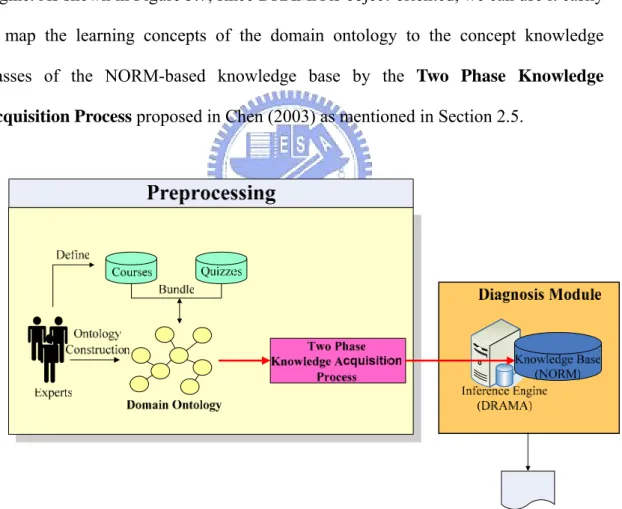
However, how do we achieve the goal? As described in Section 2.3, this module is built mainly with DRAMA consisting of NORM-based knowledge base and inference engine. As shown in Figure 3.7, since DRAMA is object-oriented, we can use it easily to map the learning concepts of the domain ontology to the concept knowledge classes of the NORM-based knowledge base by the Two Phase Knowledge
Acquisition Process proposed in Chen (2003) as mentioned in Section 2.5.
Figure 3.7: Two Phase Knowledge Acquisition Process transformation
When students complete their tasks, this Diagnosis Module could be used to
diagnose the tasks. It would collect the required facts by two major methods:
(1) Question-and-answer approach:
By this approach, the Diagnosis Module will ask users some questions about their tasks for getting facts. For example, in DNS domain, this module will give them some questions about the configurations of DNS servers (such as the software version). Next, they must answer the questions and the same Question-and-answer processes will be repeated several iteration to collect all the required information.
(2) User-given partial information and auto detection mechanism:
Sometimes, the module will ask users to give some information about their tasks. After it gets the user-given partial information, the mechanism will try getting the related facts from other places automatically and decide if the information is appropriate. For example, for DNS domain, if the users give the module their domain name information, the module will query the DNS servers in upper zone to find the related information through network.
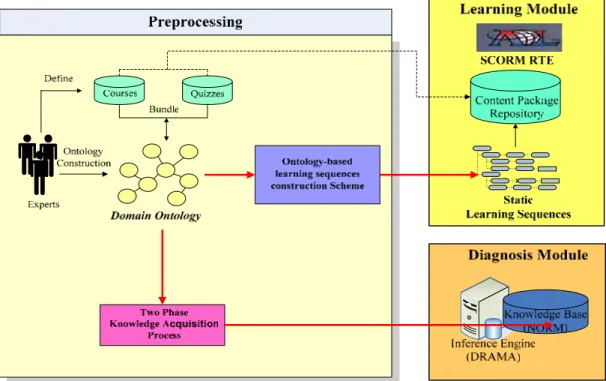
Therefore, this module would use forward chaining diagnosis to help students identify their problems in Learning-by-Doing. Figure 3.8 shows the integration of the Ontology-based Learning Sequences Construction Scheme (Figure 3.5) with Two Phase Knowledge Acquisition Process (Figure 3.7).
Figure 3.8: Both kinds of ontology transformations
3.5 Remedial Tutoring Module
After being diagnosed by Diagnosis Module, if any major configuration or administration problems have been identified, students require an adaptive remedial tutoring process to improve their domain knowledge (and skills) in order to solve these problems. Therefore, the functionality of the Remedial Tutoring Module is designed to generate adaptive learning sequences as remedial tutoring for students’ requirements.
As described above, we propose an algorithm, called Ontology-based Adaptive
Learning Sequences Construction (OALSC) algorithm, which will be described in
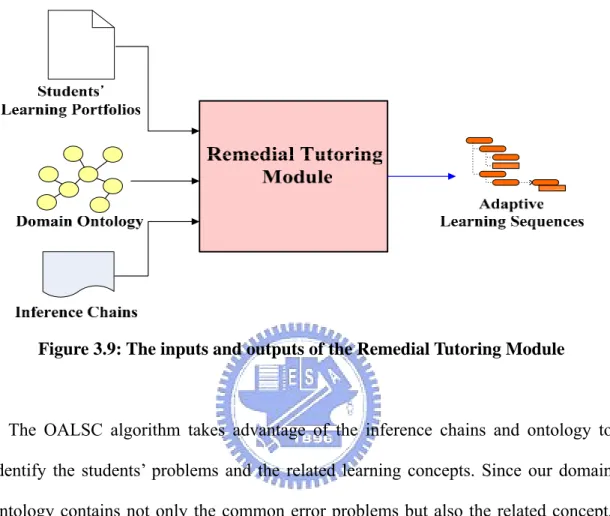
more detail in Chapter 4, to generate adaptive learning sequences. As shown in Figure 3.9, the inputs to the OALSC algorithm are a domain ontology, students’ learning
portfolios (from the Learning Module) and inference chains (from the Diagnosis Module) respectively.
Figure 3.9: The inputs and outputs of the Remedial Tutoring Module
The OALSC algorithm takes advantage of the inference chains and ontology to identify the students’ problems and the related learning concepts. Since our domain ontology contains not only the common error problems but also the related concept, through the NORM-based knowledge base, the inference chains are easily mapped to the paths on the domain ontology. Namely, the rules classes of the fired rule on inference chains map to the concept nodes of the domain ontology. Each inference chain can be mapped to one path on the domain ontology and if the path has error problem nodes on it, we know the users encounter the kinds of problems.
Moreover, the students’ learning portfolios are an important reference for teachers to realize the students’ learning statuses. Thus, according to the student’s learning portfolios, we would adjust the learning sequences to make them more adaptive. In brief, the Remedial Tutoring Module will utilize these related concepts, inference
chains and students’ learning portfolios to generate adaptive learning sequences by the OALSC algorithm. In next chapter, the OALSC algorithm will be described in more detail.
3.6 Overall of the System Architecture
In the thesis, we propose a systematic methodology to build the Learning-by-Doing Remedial Tutoring System for helping students solve their encountered problems. According to the general process of Learning-by-Doing, we design three modules in this system, namely, Learning Module, Diagnosis Module, and Remedial Tutoring
Module. Figure 3.10 shows the overall system architecture.
Figure 3.10: Overall Learning-by-Doing Remedial Tutoring System architecture
Chapter 4 Ontology-based Adaptive Learning Sequences
Construction Algorithm
In this Chapter, we will describe the Ontology-based Adaptive Learning
Sequence Construction (OALSC) algorithm in more detail. This algorithm is used
to generate adaptive learning sequences as the remedial tutoring for students to solve students’ encountered problems. Furthermore, in Section 4.2, we will use a simple DNS example to explain the whole process.
4.1 OALSC Algorithm
The Ontology-based adaptive learning sequences construction (OALSC)
algorithm is used to generate adaptive learning sequences in the Remedial Tutoring
Module. As shown in Figure 4.1, the inputs of the algorithm are domain ontology, students’ learning portfolios generated by The Learning Module, and inference chains generated from the Diagnosis Module. The outputs of the algorithm are adaptive learning sequences. The ontology is defined by domain experts for representing the common error problems and related learning concepts. The students’ learning portfolios in the Learning Module keep the students’ learning statuses. Inference chains contain the information of diagnosis process when students use the Diagnosis Module to diagnose their tasks.
Figure 4.1: The inputs and outputs of the OALSC algorithm
The main idea of OALSC algorithm is that we integrate inference chains containing the diagnostic information of tasks with specific ontology consisting of error problem nodes and the related learning concept nodes. Through the DRAMA, we can map the inference chains to rule class chains easily since the knowledge base of DRAMA is
NORM-based. In addition, since we use the Two Phase Knowledge Acquisition Process to transform ontology to the rules and rule classes of the knowledge base, we
can map the rule class chains to ontology easily.
On the other hand, since the specific ontology consists of leaning concepts nodes and error problem nodes, we can find out the related leaning concepts about the students’ encountered problems easily if we map the inference chains to the paths on ontology correctly. Thus, the Remedial Tutoring Module will take the related learning concepts found on ontology and generate the adaptive learning sequences as remedial tutoring to help students solve their encountered problems. Moreover, the students’ learning portfolios are used to make the learning sequences more adaptive through the
OALSC algorithm. This constructing algorithm is shown below:
Algorithm 4.1: The ontology-based adaptive learning sequences construction algorithm
Input: An inference chain, a student’s learning portfolio and a domain ontology Output: An adaptive learning sequence
Step1: Map the inference chain to the rule class chain
Step2: For each rule class of the rule class chain, named now-class, do Step3 to Step7 Step3: Map the specific rule class (now-class) to the concept node on the domain
ontology and name it now-concept
Step4: Check the learning level of the now-concept in the student’s learning portfolio Step 4.1: If at Normal level then go to Step7
Step 4.2: If at High level then add the <Skip> tag to the course of the
now-concept and go to Step7
Step 4.3: If at Low level then go to Step5
Step5: Find the associated courses of the now-concept which has Pre-Requisite or
Mutually-Associative relation
Step 5.1: If a Pre-Requisite relation is found then add the newly found courses
with <Pre > tag
Step 5.2: If a Mually-Associative relation is found then add the newly found
courses with <Mul-assoc> tag
Step 5.3: If nothing found then go to Step 7
Step6: Take all the newly found available courses and the associated concept nodes as
now-concept and go to Step4
Step7: Integrate the associated courses into learning sequence
Step 7.1: If the student’s learning level is Low then integrate the associated
courses which had tagged ( Pre or Mul-assoc ) in this turn into learning sequence
Step 7.2: Otherwise, integrate it into learning sequence Step8: Return the adaptive learning sequence
4.2 A Simple DNS Example
In this Section, we use a simple DNS example to explain the OALSC algorithm more clearly. The scenario is that a student in DNS management class wants to complete their DNS administration task and avoid the Single Point of Failure (SPOF) problem. However, since she/he may not fully understand the SPOF concept, she/he still makes the mistake of SPOF. Next, we describe what the single point of failure is and show how to help her/him solve the DNS problems by the Learning-by-Doing remedial tutoring system.
As shown in Figure 4.2, although the student sets three name servers in order to avoid the SPOF problem (i.e., to avoid the problem if there is only one name server and it crush, the all DNS services will stop), they still make the mistake of SPOF. Since the student has put all her/his DNS name servers on the same subnet and thus make a single point of failure problem with regard to DNS. This means that if subnet is under attack, all the DNS services might stop working.
Figure 4.2: A chart of the SPOF example
As shown in Table 4.1, after the student consults DNS domain experts, she/he understands that if she/he wants to solve the encountered SPOF problem, she/he had better learn the related learning sequence of experts’ advices in this order. However, if the student uses our remedial tutoring system, how does this system helps her/him generate the remedial tutoring like the learning sequence of the experts’ advices? The statements will be described in the following steps in more detail.
Table 4.1: The related learning sequence of SPOF by expert’s advices
Problem Related Learning Concepts
1. DNS server 2. Configuration File 3. A Record 4. Physical location 5. Single Network SPOF 6. SPOF
(1)First of all, the student’s DNS tasks will be diagnosed by the ontology-based Diagnosis Module. Therefore, we will get the inference chains which record the related information during the diagnosis process.
z Figure 4.3 shows the detailed inference process inferred by DRAMA engine of the student’s encountered SPOF problem.
Figure 4.3: The inference process of SPOF problem
z As shown in Figure 4.4, therefore, we would get the inference chain of SPOF (i.e., fired rules chain) from the diagnosis process.
Figure 4.4: The inference chain of SPOF
z As shown in Figure 4.5, the inference chain is mapped to the rule class chain easily because the knowledge base of the Diagnosis Module is NORM-based. Thus, it is easy to know the fired rules belong to which rule classes.
Figure 4.5: The rule class chain of SPOF
(2) Next, the OALSC algorithm will generate adaptive learning sequence. Figure 3.2 indicates the view before the OALSC algorithm maps the rule class chain to the ontology. On the other hand, Figure 4.6 indicates the view after the newly found rule class chain maps to the DNS ontology.
Moreover, in this mapping, if the path does not have any error concept node on DNS ontology, we can ensure that the student does not encounter any DNS error problem in the task.
Single Point of Failure(SPOF) Lame Server DNS Equipment Deployment Single Network Pre Pre Physical Location Pre Single Server Pre A6 Record AAAA Record MX Record PTR Record A Record Attri_of Secondary DNS Server Primary DNS Server NS Record Advertised Server Attri_of Attri_of Type_of
Zone Data File
Comp_of Comp_of Comp_of Comp_of Comp_of Comp_of Slave DNS Server Syn Master DNS Server Syn Delegated DNS Server Attri_of Proc_of Name.conf Configuration File Comp_of ... Comp_of Forwarding DNS Server Pro_of Caching Only DNS Server Pro_of Authoritative DNS Server Type_of Type_of Attri_of Pro_of DNS Server Comp_of Type_of Type_of Type_of DNS Availability Mul_assoc Attri_of DNS Registration Proc_of Pro_of Pre Mul_assoc Pre Pre
Figure 4.6: The path of rule class chain mapped on the DNS ontology
(3) As shown in Figure 4.7, after identifying that the mapped path has SPOF error problem node (i.e., the students encounter SPOF problems), the OALSC algorithm will take the related DNS concepts to construct the adaptive learning sequence by the order of the path. This adaptive learning sequence is used to help the student to solve the SPOF problem.
Figure 4.7: The adaptive learning sequence about the SPOF problem
(4) Next, the student’s learning portfolio is an input source of OALSC algorithm to make the learning sequence more adaptive. In fact, every time, before one course which is on the mapped path is integrated into the adaptive learning sequence, the student’s learning portfolio about the course must be checked. In next Section, three cases will be discussed in more detail.
(Case1) If the learning level of the course in the student’s learning portfolio is
Normal, the algorithm does nothing and keeps going on considering next course. For
example, as shown in Figure 4.8, the learning level of the DNS Server course is
Normal and it does nothing.
Course Name: DNS Server Grade: 70 Level: Normal ... Jordan,s Portfolio
Figure 4.8: The “normal” learning level course on learning sequence
(Case2) If the learning level is High, the <skip> tag is added on the course and takes next related course by the order. The <skip > tag means that teachers think that the student could skip this course because she/he learned the concepts of the course very well. For example, as shown in Figure 4.8, the learning level of the Configuration
File course is High and the <skip> tag is added on the course.
Course Name: Configuration File Grade: 90 Level: High ... Jordan,s Portfolio
Figure 4.9: The “high” learning level course on learning sequence
(Case3) If the learning level is Low, the OALSC algorithm tracks back to the ontology in order to realize if there is any related course that could help the student improve her/his understanding about the course of low learning level. For example, as shown in Figure 4.10, the learning level of the Single Network course is Low and then the OALSC algorithm tracks back to the ontology.
Course Name:
Single Network
Grade:
40
Low
Level:
...
Jordan
,s Portfolio
Figure 4.10: The “low” learning level course on learning sequence
z The part of DNS Ontology is enlarged to describe the next step more clearly, as shown in Figure 4.11.
P re S i n g l e Po in t o f F ai l u re( SP O F) L a m e S e rv e r D NS E q u i p m e n t D e p l o y m e n t S i n g l e N e tw o rk P re P r e A 6 Re c o rd AA A A Re co rd M X R e c o rd P T R R e c o rd P h y si c a l L o ca ti o n P r e A R e c o rd A ttri _ o f S i n g l e S e rv e r P re M u l ti p l e S e rv e r Z o n e Da ta F i l e C o mp _ o f C o mp _ o f C o mp _ o f Co mp _ o f Co mp _ o f S e c o n d a ry D NS S e r v e r P ri m a ry DN S S e rv e r N S R e c o r d C o mp _ o f A d v e rt i se d S e r v e r A tt ri_ of A tt ri_ of T y p e _ o f T y p e _ o f S l a ve D N S S e rv e r S y n M a ste r D NS S e rv e r S y n D e l e g a te d DN S S e rv e r At tri_ o f P ro c _ o f P re N a m e .c o n f Co n fi g u ra ti o n F i l e C o mp _ o f Co mp _ o f F o rw a r d i n g D N S S e rv e r P ro _ o f C a c h i n g O n l y D NS S e r v e r P ro _ o f A u th o ri t a ti v e D NS S e r v e r Ty pe _ o f Ty pe _o f A t tr i_ of P ro _o f DN S S e rv er C o mp _ o f T y p e _ o f T y p e _ o f T y p e _ o f D NS A v a i l a b i l i ty M u l -I n A ttri _ o f D N S R e g i stra ti o n P ro c _ o f P ro _ o f P re M u l -In P r e Pre-Requisite relation
Figure 4.11: The enlarged part of DNS ontology
After tracking back to the DNS ontology by the low learning level “Single Network” concept, the OALSC algorithm finds out the surrounding concept nodes are “Physical Location”, “Single “Point of Failure (SPOF)”, and “DNS Equipment Deployment”. In fact, in this example, the “Physical Location” and “Single Point of Failure” courses are on the original learning sequences. Therefore, only the “DNS Equipment Deployment” is considered and then the OALSC algorithm checks the relation between “Single Network" and “DNS Equipment Deployment”. Because the relation is “Pre-Requisite”, we know it means the experts suggest that if students learn the “DNS Equipment Deployment” course before learning the “Single Network” course, the students will learn the “Single Network” well more easily. Hence, the “DNS Equipment Deployment” course will be taken into consideration and added it
into the learning sequence.
z As shown in Figure 4.12, the newly found course (i.e., “DNS Equipment Deployment”) will be added into the learning sequence.
Figure 4.12: The newly added course which has Pre-requisition relation
Each time, when the newly found course is added into the learning sequence, the course learning level of student’s learning portfolio should also be checked. If the leaning level is high, the course will be added the <Skip> tag, as shown in Figure 4.13. On the other hand, if the learning level is low, we will track back to the ontology, as shown in Figure 4.14. In this example, if the learning level of “DNS Equipment Deployment” is low, the OALSC algorithm tracks back to the DNS ontology again and find that there is not any concept node surrounded with the “DNS Equipment Deployment”. Therefore the generating process of the adaptive learning sequence is completed. In addition, the same principles can be applied to other similar cases.
Figure 4.13: The high learning level of DNS Equipment Deployment
Figure 4.14: The low learning level of DNS Equipment Deployment
Chapter 5 Implementation
5.1
5.2
System Implementation
With our proposed methodology, we build a prototype of Learning-by-Doing remedial tutoring system for DNS management. For enhancing the functionality of the iDNS-MS, the implementation of our designed remedial tutoring system will be integrated into the iDNS-MS.
This system is built under Windows XP, Apache web server, and JAVA programming language. We use Rational Rose 2002 as the ontology editor. The Diagnosis Module is constructed by using the DRAMA/NORM (as the expert system shell) with client-server architecture and the object-oriented knowledge based structure. Finally, the learning platform which can show learning sequences is constructed by SCORM 2004 Sample Run-Time Environment (Version 1.3.2).
Tutoring Examples
As shown in Figure 3.2, in the thesis, we modify the ontology adopted from Chen et al. (2005). In addition, we also ask domain experts to provide the related courses and quizzes and use them to transform the modified DNS domain ontology to static learning sequences by the OALSC algorithm. As shown in Figure 5.1, these learning sequences are run on the SCORM 2004 RTE (Version 1.3.2),.
Figure 5.1: Static learning sequences of DNS runs on the SCORM 2004 RTE
On the other hand, there is an exam in the last node of static learning sequences in order to test students about how they learn these courses. The grades of these courses in the exam will be transformed to the values of learning level and be stored in students’ learning portfolios.
5.3 Diagnostic Examples
There is a diagnosis facility for helping users diagnose their DNS tasks:
z DNS on-line test:
In principle, the DNS on-line test facility is used to diagnose the DNS servers of students’ tasks with related DNS configuration information of network. In other words, if the DNS servers are available on the network, this facility would collect related environmental facts and then it will send the information to the server of DRAMA for inference. Finally, as shown in Figure 5.2, the server of DRAMA will return the inference results via the web server.
Figure 5.2: DNS on-line test facility on DNS diagnosis system
Next, as shown in Figure 5.3, the facility collects facts by asking the users to enter the domain zone name and the related configuration information about their DNS tasks.
Figure 5.3: DNS testing on DNS diagnostic subsystem
After the diagnosis process, this diagnostic subsystem will identify possible DNS problems about the tasks. For example, the diagnostic results are “The DNS servers are all under the same class C subnet, …” and “ The DNS servers share the same IP, …”, as shown in Figure 5.4. In fact, these identified problems are about the SPOF problems. Originally, the students can only get simple recommends in the iDNS-MS. However, after we integrate the adaptive remedial tutoring subsystem to the IDNS-MS, students can learn the adaptive remedial tutoring for getting advanced understandings about their encountered problems.
Figure 5.4: Inference results of DNS on-line test facility
5.4 Remedial Tutoring Examples
As shown in Figure 5.4, when students push the “Adaptive remedial tutoring” button, they will enter into the remedial tutoring subsystem, as shown in Figure 5.5.
Figure 5.5: The adaptive remedial tutoring subsystem
Next, when students login their accounts, the system will generate adaptive learning sequences as remedial tutoring for solving the encountered problems, as shown in Figure 5.6. In essence, the adaptive learning sequences are generated by the OALSC algorithm with students’ learning portfolios, domain ontology, diagnostic records and results.
Figure 5.6: The adaptive learning sequences for solving the SPOF problem students encountered