行政院國家科學委員會專題研究計畫 成果報告
以分析模式為導向之電子商務異質資訊整合之研究 - 應用
統一塑模語言、延伸式標籤語言、本體論(第 3 年)
研究成果報告(完整版)
計 畫 類 別 : 個別型 計 畫 編 號 : NSC 95-2416-H-004-055-MY3 執 行 期 間 : 97 年 08 月 01 日至 98 年 12 月 31 日 執 行 單 位 : 國立政治大學資訊管理研究所 計 畫 主 持 人 : 諶家蘭 報 告 附 件 : 出席國際會議研究心得報告及發表論文 處 理 方 式 : 本計畫可公開查詢中 華 民 國 99 年 03 月 25 日
行政院國家科學委員會補助專題研究計畫
■ 成 果 報 告
□期中進度報告
以分析模式為導向之電子商務異質資訊整合之研究
-應用統一塑模語言、延伸式標籤語言、本體論
計畫類別:■ 個別型計畫 □ 整合型計畫
計畫編號:NSC 95-2416-H-004-055-MY3
執行期間: 95 年 8 月 1 日至 98 年 12 月 31 日
計畫主持人:諶家蘭
共同主持人:
計畫參與人員:
成果報告類型(依經費核定清單規定繳交):□精簡報告 ■完整報告
本成果報告包括以下應繳交之附件:
□赴國外出差或研習心得報告一份
□赴大陸地區出差或研習心得報告一份
■出席國際學術會議心得報告及發表之論文各一份
□國際合作研究計畫國外研究報告書一份
處理方式:除產學合作研究計畫、提升產業技術及人才培育研究計畫、列管
計畫及下列情形者外,得立即公開查詢
□涉及專利或其他智慧財產權,□一年□二年後可公開查詢
執行單位:國立政治大學會計學系所
中 華 民 國 99 年 3 月 25 日
I
摘要
電子商務是跟領域和全球性之商業與科技集合體,大多數企業或多或少都面 臨企業流程之異質與商業模式的協同的問題。由於多元的商業網站、多媒體的頁 面、網路服務、資訊資源、和各國語言等日益分歧的異質網路資源,要建立一個 企業與企業間電子商務整合的解決方案實屬不易,而在國際、國家、與產業層次 上都是非常重要而有價值的探討。異質性與互動運算是企業與企業間電子商務整 合的主要問題,但是一般電子商務標準著重在 語法更甚於語意。而複雜的電子 商務環境中,商業模式與商業流程並非一致不變,尤其在面對跟國交易夥伴時, 商業訊息、詞彙、資料字典、通訊協定、目錄服務等異質和不一致性情形更形嚴 酸,是企業與企業間電子商務不可避免要正視的問題。本研究之目的為透過分析 導向模式、語意解析、以及 RosettanNet 與 ebXML 的個案研究來綜合考量跟國企 業的商業、技術、與策略等方面的因素,為企業與企業間整合性電子商務,建立 一套確實、有效率、理論、與實務並重的架構和方法。藉由闡明企業與企業間整 合性電子商務的塑模方法,對於學、研、產界而言,將在理論建立和實務運用方 面有突破性之探討。 關鍵字:企業與企業間整合性電子商務,異質資訊整合,統一塑模語言,建伸性 標籤語言、本體論II
Abstract
Electronic commerce within and across national boundaries is universal. Most firms if not all have problems in one way or another with business process integration and business model interoperability. On both theoretical and pragmatic levels, due to increasing diversity in web pages, services, data sources, and languages in all countries, developing a framework of cross national business to business integration resolution is important at international, national, and intra-national levels. This study will develop a framework and a method to explore the way in which technology and strategy factors influence integration and interoperability over schema and semantics in business-to-business integration electronic commerce.
Heterogeneity and interoperability are the key issues in business-to-business
integration. Electronic commerce standards are usually syntactic rather than semantic. In the complex electronic commerce environment, the business model and business process are not always the same, especially when facing cross national trading partners. This means reviewing the business messages, vocabularies, and data dictionaries is inevitable when establishing each business-to-business connection. Business-to-business integration hence seeks to reconcile the semantic conflicts between messages, protocols, and catalogues.
The purpose of the proposed study is to articulate a theory and practice oriented model and method for cross national business-to-business integration electronic commerce by exploring an analysis-driven schema and semantics resolutions among business process integration and business model interoperability with emphasis on RosettaNet and ebXML case studies to incorporate the multi-national corporate culture, technology, and strategy. A framework illustration the ways modeling and method that affects the cross national business-to-business integration electronic commerce would represent and advance in theoretical development and practical insights to scholars, professionals, and executives.
Keywords: Business to Business Integration Electronic Commerce, Heterogeneous
Information Integration, Unified Modeling Language, Extensible Markup Language, Ontology
III
Table of Contents
1. Introduction ... 1 1.1 Research Background ... 1 1.2 Research Issue ... 1 2. Reserach Method ... 22.1 Analysis-driven Ontology Modeling ... 2
2.2 Step A – Firm Public Process Ontology, “as-is” ... 4
2.4 Step C – Firm Ontology Representation ... 5
2.5 Step D – Standard Ontology Representation ... 6
2.6 Step E - Ontology Merge ... 6
2.7 Step F – Ontology Representation ... 8
2.8 Step G – Ontology Test ... 8
3. An Experimental Study ... 9 3.1 A Prototype System ... 9 3.1.1 DTD Importer ... 11 3.1.2 Ontology Editor ... 12 3.2 A RosettaNet Experiment ... 13 3.3 An ebXML Experiment ... 18 4. Discussion ... 20 4.1 Research Implication ... 20
4.2 Managerial and Technical Implications ... 22
5. Conclusion and Future Work ... 23
5.1 Conclusion ... 23
5.2 Future Research Work ... 24
1
AN ONTOLOGY-ASSISTED ANALYSIS IN ALIGNING
BUSINESS PROCESS WITH E-COMMERCE STANDARDS
1. Introduction
1.1 Research Background
Internet has changed the way business conducted between companies worldwide. Firms are now used to exchange business information electronically over Internet. Since the mid-1990s, wave after wave of web technology standards emerge to support the electronic business information exchange. Standards like Extensible Markup Language (XML), Internet Electronic Data Exchange (I-EDI), RosettaNet
1
, ebXML
2
, Web Ontology Language (OWL), and Semantic Web (SW) surge and sweep electronic commerce worldwide (W3C 2006) (RosettaNet 2006) (ebXML 2006) (OWL 2004). These standards impact on contemporary corporations in many aspects. These standards are proposed to provide a uniform way of business information exchange mechanisms. Semantic not syntactic integration emerges to be the issue that hinders the plan and progress of business-to-business integration electronic commerce (B2Bi EC), which in turn causes time, cost, and reinvention every time there is a change in the public process, there is a change in the standard, and there is a change in the partnership.
The traditional method to tackle the issue can be divided into the programming (ad hoc) approach and the mapping table (syntactic) method. The programming approach solves the problem in a one to one fashion but the result easily becomes the unmanageable “spaghetti” chaos. The mapping table seems to be an easy and convenient approach. However, it only deals with the specific data values not the data definition. An exponentially growing number of trading partners emerge in B2Bi EC. Programming is no longer an effective and flexible way. Mapping table is too primitive and inadequate. The new complexity of data semantic in the business information exchange makes both approaches even harder to tackle the problem (Stojanovic et al, 2002) (Trastour et al, 2003). We believe that Internet growth makes B2Bi climb to a higher level of exchange, that is, the exchange of business meanings and business constraints. A knowledge-intensive and system-to-system semantic integration model and method is in need.
1
RosettaNet is a consortium of major computer and consumer electronics, electronic components, semiconductor manufacturing, telecommunications and logistics companies working to create and implement industry-wide, electronic commerce and business process standards. RosettaNet is a subsidiary of GS1 US, formerly the Uniform Code Council, Inc. (UCC).
2
ebXML is a worldwide project initiated and driven by the Organization for the Advancement of Structured Information Standards (OASIS) and the United Nations Centre for Trade Facilitation and Electronic Business (UN/CEFACT). ebXML is to map out a common framework to enable interoperable electronic commerce and business expressed in XML.
1.2 Research Issue
Business-to-business integration is to exchange business information between different firms and interoperate the public processes over Internet. The traditional ways of trading include telephone, fax, and email. These approaches introduce faults, redundancies, and wastes. Electronic data interchange is a 1990s and transaction-based approach. However, the change of EDI specification is neither on
2
line or real time. EDI lacks the ability to quickly respond to business changes and suffers from the scalability in the presence of an exponentially growing number of users. Internet EDI is the next stage of B2Bi development. And new B2Bi standards have been proposed based on XML. They indeed provide a more on line and real time method than traditional EDI. However, companies still struggle with the difficulty of heterogeneity and interoperability in the exchange and execution of processes and protocols. In essence, an enhanced approach needs to provide the technology compatibility and the knowledge representation.
Electronic commerce within and across national boundaries is universal. Most firms if not all have problems in one way or another with business process integration and business model interoperability. On both methodological and pragmatic levels, due to increasing diversity in web pages, web services, data sources, and programming languages in all countries, developing an analysis framework of cross national B2Bi resolution is important at international, national, and intra-national levels. This study will develop an analysis framework and a method to explore the way integration and interoperability over schema and semantics can be achieved in B2Bi EC. The dynamics of Internet and intelligence of XML and ontology interplay with inter-organizational context, making it a base for exploring the model and method.
Various approaches have been proposed to study B2Bi issues. However, they lack the process perspective and the semantic representation. Their interoperability is based on adhocracy. Much is needed in the systematic and methodological enhancement. This research intends to tackle the inadequacy of B2Bi standard implementation in forms. An ontology-assisted analysis framework is created to reconcile and represent the conflicts and correspondences in the B2Bi EC issue. Based on the literature, in general, B2Bi framework has three fundamental layers to deal with (Cut et al, 2002) (Falkovych et al, 2003) (Gasevic et al, 2004). They are the communication layer, the content layer, and the process layer. These layers represent the important mechanism and management in B2Bi such as the coupling among partners, the autonomy, and the security. In essence, they mean the specifications of the message formats, the transport protocol, the procedure, and the security mechanism.
2. Reserach Method
2.1 Analysis-driven Ontology Modeling
The research structure depicted in Figure 1 is the analysis framework we present in the paper to illustrate the model and the method to be developed and deployed in the B2Bi EC standards implementation. The framework is made up of the Unified Modeling Language, the Extensible Markup Language, and the Ontology technologies. Business process interoperability and business data integration are considered the antecedents to B2Bi strategies. More in the framework, a set of analysis procedures are proposed. We analyze the cross national business partners’ data schema and process model. We examine the electronic commerce standard in the aspect of data semantics and process semantics. A set of heuristics and rules will be created to represent the above analyzed process models and data schema in form of syntax and semantics. The partners’ and the standards’ ontologies will be separately developed using the rules and the heuristics. We will merge these
3
ontologies in order to reconcile their conflicts and correspondences. The resulting merged ontologies are tested by the prototype system.
In the end, we hope there is an evolution step to be undertaken to reuse the resulting ontologies. The trading partners can share the domain knowledge in the future standard implementation. The following subsections describe the procedures of the analysis framework and are divided into Step A through Step D. Step A develops the domain ontology of the firm and of the trading partners. Step B creates the domain ontology of the standards. Step C focuses on the ontology knowledge representation for the firm and for the trading partners. Step D creates the ontology knowledge representation of the standards.
Figure 1:
An Ontology-assisted B2Bi EC Alignment and Management Framework (This Research)
Reuse, Manage, and Evolution
Cross Trading Partners’ Biz Model and Process Analyze EC Standards’ Data and Process using UML
Merge Ontologies, “to-be” Test XML and Ontologies
Model Standard Ontology using UML Model Public Ontology using UML
Analyze Partners’ Data and Process, “as-is” using UML Represent XML and Ontologies
4
2.2 Step A – Firm Public Process Ontology, “as-is”
A. to analyze the current business process, “as-is”
If we want to analyze the current process, in general, we initiate a meeting. The meeting participants include the process owners and the process users. Through interviewing users, we discover detailed information about the current processes. The detail information contains the process goal, the process flow, the process user role, the process input, the process output and others. This information should be minuted. According to the meeting minutes, we draw the UML diagrams. If we understand the current processes more, we can represent the process as in UML without losing its semantics.
A.1 to design the use case diagram
Before we draw a use case diagram, we have to gather data. We analyze the process actors, the process preconditions, and the process flow to fill out an analysis form. Take the purchase order (PO) as an example. There should be two actors in the purchase order process: buyer and seller. Before the buyer orders something, the seller makes a request for a quote document from the seller first. Then, if the buyer accepts the quote, he sends a purchase order to the seller. When the seller receives the purchase order, the seller confirms the order. This scenario is the common and simple one.
A.2 to design the sequence diagram
In a sequence diagram, we try to discover all messages that are exchanged in a business process and in the purchase order. It can be extracted from the use case diagram and the meeting minutes. In the purchase order example, the PO Request is the first message to be sent from the buyer to the seller. When the seller receives the order request, the seller should check the inventory to determine whether the firm can fulfill that purchase order or not. Then the PO Confirmation is the next message to be sent from the seller to the buyer.
A.3 to design the activity diagram
An activity diagram can show the flow from one activity to another activity. It can represent the detailed process flow. We should find the information from discussion at the meetings so as to develop the activity diagram. We need to discover the detailed actions in the flow, the initial state, and the final state. We then continue the PO example and finish the activity diagram. In this example, we have three
5
actions: request a purchase order, check inventory for this order, and confirm this purchase order.
A.4 to design the class diagram
We try to extract a generic class construct from the use case diagram, the sequence diagram, and the activity diagram. Again, we move on with the PO example. First, we work on the use case diagram. We discover four components: the two actors and the two use cases. We take the two major elements in the use case diagram, Actor and Use Case, to form the two classes: Actor and Activity. Next, we extract the class Message from the sequence diagram, because the sequence diagram describes the message flow and the order flow between the objects. Then, we work on the activity diagram which consists of several actions as described above. The class Action can be extracted.
2.3 Step B – Standard Public Process Ontology, “to-be”
B. to develop the EC-standard-compliant business process
We use four UML diagrams to perform the work such as the use case diagram, the sequence diagram, the activity diagram, and the class diagram. They are utilized to model an EC-standard-compliant business process. The mapping methods between the four diagrams are the same as in Step A. The difference between Step A and Step B is the source of analysis. Step A focuses on the firm existing and current public processes. We have to collect and examine them through interviews and observations. We model the standard processes from B2Bi EC standard specifications at Step B. Some B2B standards have the concept of process, but some do not. If they do not, we should discuss this issue with the trading partners in order to develop a new standard process specification based on the B2Bi EC recommendation. Of course, some B2B standards have adopted UML diagrams to present their standard processes in the specification. We can directly use them.
B.1 to design the use case diagram
We develop the use case diagram based on the B2B standard specification. A B2B standard specification often describes the process purpose and the process definition in the statements. We search and extract the basic components for a use case from the process statements.
B.2 to design the sequence diagram
The B2B standards should specify the sequence of the exchanged messages. The latest standards often adopt the sequence diagram to represent the sequence. Therefore, we use the diagram provided by the standards. If the standards do not use UML diagrams, we still can analyze the sequence of messages in the generic control constructs.
B.3 to design the activity diagram
A B2B standard should formalize the public process flow. Such formalization allows the partners to follow. We do not expect to manage many different process flows with our trading partners in the real world. A B2B standard provides the well-defined process flows. We can extract and formalize the defined process flow from B2B standard specification.
6
C.1 to capture the current B2B ontologies
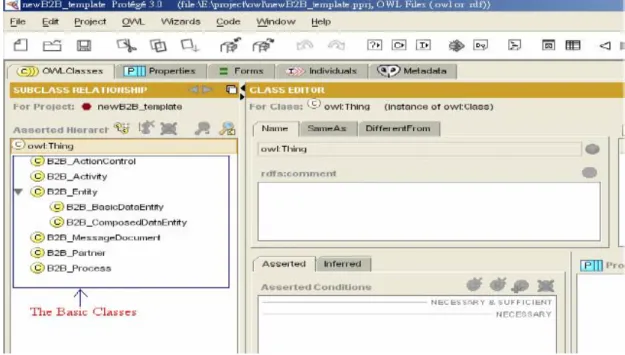
In this study, we propose a heuristics approach to model the ontologies for the firms and the B2Bi EC process and message. We build the ontology so as to describe the firms’ B2B domain knowledge. This domain ontology contains the basic classes and properties. Every business process should fit in an ontology definition. We define the basic B2B components and properties.
C.2 to model the current business document ontology
We analyze the core of the public processes performed between B2B partners. The core means the message analysis. We then need to develop a process ontology based on the semantics of the message analysis. The semantics refer to the context, the meaning, the terminology, and the relationship in the business document exchange process.
C.3 to reconcile the current business constraints
We may have constraints on each entity, each message, and each process. These constraints have to be converted into OWL. After business process and document ontology being created, we move on to build the EC standard ontology.
2.5 Step D – Standard Ontology Representation
D. to capture the EC standard’s ontologies
To build the EC standard ontology, we need to find out the B2B process specifications and their business documents. The definition of each business document is often encoded as DTD or XML Schema. We use the schema to create these EC standard ontology.
D.1 to design the EC standard’s process ontology
Notice that not all EC standards require implementing all elements in the specifications. Only the standards that are required in the partnership will be converted into OWL classes. In this section, we develop a set of heuristics to address the issue.
D.2 to model the EC standard’s document ontology per partner
The way to model the standard document ontology is the same as above. We extract the data definition in standard to do the conversion.
D.3 to reconcile the EC standard’s constraints
The standard may have constraints on each entity, each message, and each process. The trading partners in between may have their own practice constraints. We extract to collect them and use the above procedures to convert them into OWL object properties.
2.6 Step E - Ontology Merge
When initiating and implementing a new B2B initiative, we deal with new B2B EC standards. Different business partners and different settings occur. Though we have the existing ontology in the ontology repository, these new differences cause the ontology mismatch and inconsistency. We need to resolve and merge these ontologies including functions of (a) reading in ontologies, ontology updates, and adaptations, (b) viewing a specific version or a variant of an ontology, (c) differentiating ontologies, (c) checking the inconsistency in the ontology
7
combination.
In essence, the key to merge is to discover the differences and to generate the correspondence rules between ontologies. The differences are like the instances of the changes of class name, the addition or deletion of classes, the addition or deletion of properties, and the mergence or split of classes.Though it is common to find new conflicts and differences between new trading partners, there are common parts as well to take advantage of as we discuss on the repeat rate and reuse. The hard part is the more heterogeneous the ontologies are, the larger extent of change to be implemented between the old and the new processes. Analysis gives us the parts of the process to be changed and installed in the coming implementation. We adopt the ontology of the B2B standard and merge the B2B standard ontology based on the merge rules as listed in Table 1.
Table 1: Ontology Merge Rules (This Research) Level Type Current
(Old)
Standard (New)
Conflict
Description Merge Rules
Class Level Schematic conflicts None New Standard has a new class, which doest not exist in current process.
We keep the new class in the ontology. All the properties of the new class should be retained, too. Existed None The current process exist an old class, which does not appear in standard process.
If the old class will no longer exist in the future, we discard them; else we should add the old class to the new ontology.
Semantic conflicts Existed Class New Class They are with the different class names but the same meaning
We reserve the old class A and add it to new ontology. Then, we use the owl:sameAs to state the two classes are equivalent. However, we use the class B usually.
Existed Class New Class They are with the same class name but different meanings.
We keep the name of the new class. However we change the name of old class to another new name.
8 Property Level Schematic conflicts None New There are additional properties in a class.
We use and adopt these properties in the new ontology. Existed None There are deletion properties in a class. We have to determine whether the properties are no longer useful. If we do not use these properties any more, we discard them. We adjust the minimum cardinality of these old properties to 0 becausethey are not necessary properties in the new class.
Semantic conflicts Existed Property New Property They are with the different property names but the same meaning
We reserve the old property A and add it to new ontology. Then, we use the
owl:equivalentProperty
to state the two properties are equivalent. Existed Property New Property They are with the same property name but different meanings.
We keep the name of the new property. However we change the name of old property to another new name.
2.7 Step F – Ontology Representation
We have described the ontology representation in Step C and Step D. The technique is used in the merged ontology.
2.8 Step G – Ontology Test
To verify the ontologies merged, we consider two issues, the syntactic test and the semantic test. We test the syntactic of ontology through the ontology tool. It automatically validates the inconsistency of syntax. The semantic test is to discover the inconsistency between the database schema, the business processes, and the old
9
version of ontology. We extract the database schema and examine the consistency between the business ontology. We compare the consistency between the trading agreements in order to specify the business rules. We analyze the differences between the new ontology and the real environment. The analysis results will be used to adjust the business process to refine the merged ontology.
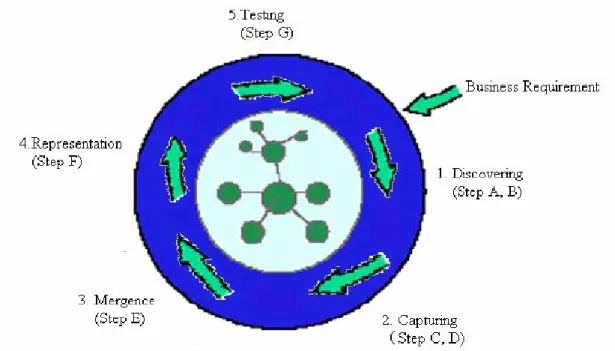
Figure 2 illustrate the Steps. As described above, we first discover the ontology requirements in Step A and Step B. We then create the ontology from Step C and Step C. We merge ontologies in Step E. Step F gives a merged representation. Step G tests the syntax and semantics.
Figure 2: An Ontology-assisted B2Bi eCommerce Alignment Framework (This Research)
3. An Experimental Study
3.1 A Prototype System
In this research, we have developed an experimental prototype that implements the presented B2Bi ontology development method. This prototype is built to facilitate the illustration of the feasibility and the validity of the method. In this section, we demonstrate an application of the prototype in two main electronic commerce standards, the RosettaNet, a worldwide and vertical B2B standard; and the ebXML, an OASIS and UN sponsored and horizontal B2B standard (RosettaNet 2006) (ebXML 2006) (OASIS 2005) (Hofreiter et al, 2002). Both standards are installed worldwide because they cover the diverse electronic commerce practices. We use these two major standards as the starter experiments in the illustration that our new method is feasible and valid. Preliminary experimental results show that this ontology-assisted method gives a viable resolution to the long-standing semantic and syntactic issue in the implementation of electronic commerce standards.
In both experiments, we choose the purchase order process as the baseline to illustrate a live case study of a large scale semiconductor component distributor. The
10
live case company is called company W. Company W is the number one distributor in the Asia Pacific region since 2004. The purchase order process is the main business process in their B2B EC. Company W since 2004 became quite concerned with the various EC standards to be installed and among its cross-national suppliers and customers. The time and efforts grow exponentially. At the same time, Company W is troubled by a needed lift to the next level of performance of global supply chain management. And B2Bi is the bottleneck of the performance and becomes the compelling reason to reengineer the electronic commerce architecture.
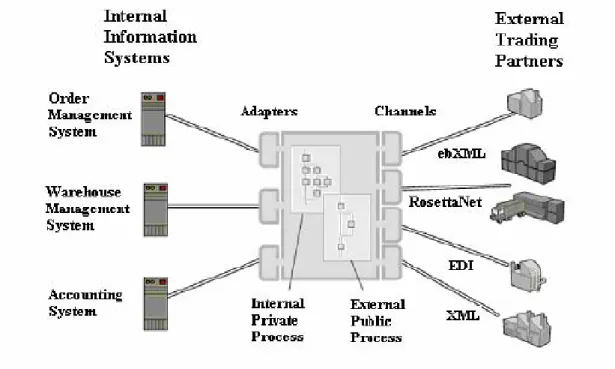
An ontology-assisted B2Bi eCommerce prototype architecture as shown in Figure 3 is developed in the experimental study. The B2Bi platform allows enterprises to exchange business documents over Internet. It provides various and common B2B protocols to connect the trading partners. It provides the ability to streamline the business process and the adapters when linking with the various enterprise information systems.
Figure 3: A Prototype Architecture of An Ontology-assisted B2Bi eCommerce Platform (This Research)
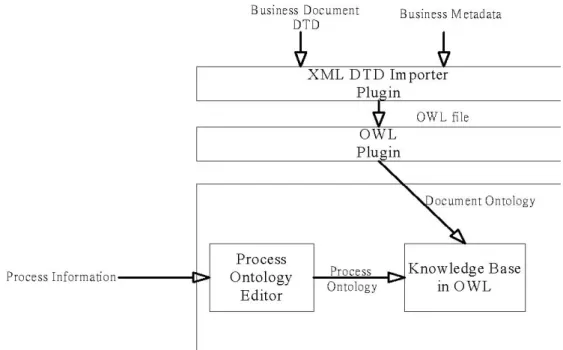
We build the research model of Step A through Step G into a prototype system. The layers in the system are illustrated in Figure 4. The system provides a number of main functions such as the DTD Importer, the Ontology Editor, and the Ontology Display. Figure 5 illustrates the structure of the functions.
11
Figure 5: Main Functions of the Prototype (This Research)
3.1.1 DTD Importer
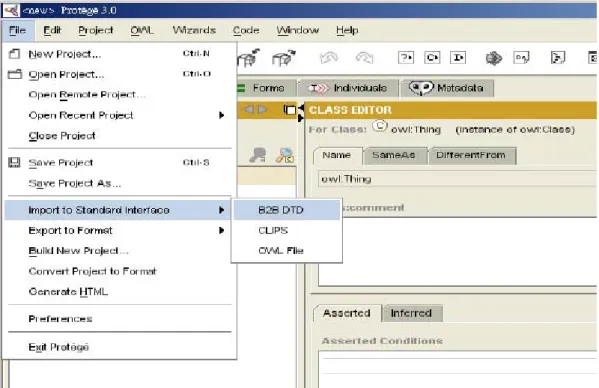
DTD importer parses the DTD that specifies the document format and transfers DTD to ontology. The user can enter the output OWL file as shown in Figure 6. This feature will transfer the file automatically. We will produce two groups of class and one group object property. The classes are B2B_DataEntity and B2B_ComposedDataEntity. The object property is B2B_BusinessProperty. The DTD Importer will differentiate all entities from DTD file base on the nature.
12
The DTD Importer also provides an ability to parse the entity’s metadata. Through parsing the metadata, we can enrich our document ontology. This program will read the entity information using a batch approach as shown in Figure 7.
Figure 7: The B2B DTD Importer (This Research)
3.1.2 Ontology Editor
We build a process ontology template. The basic classes and properties of the B2B process can use this template to develop the ontology as shown in Figure 8 and Figure 9. Business constraints also can be edited through the ontology.
13
Figure 9: The Basic Properties of a Process Ontology (This Research)
3.2 A RosettaNet Experiment
RosettaNet consortium (RosettaNet Consortium, 2004) is a non-profit consortium of more than 500 organizations working to create, implement and promote open eBusiness standards and services. RosettaNet tries to establish a common language and a standard processes for the electronic sharing of business information. In order to implement the experimental scenario, we install a set of RosettaNet core specifications. We will explain each in the following sections. These
14
core specifications include RNIF, PIP, and Dictionary.
We chose the RosettaNet Partner Interface Process™ (PIP) 3A4, the purchase order request process, to be the experimental public process, which is mostly implemented and installed. Purchase order process is corresponding to Company W’s sales order flow. The PIP3A4 specification provides the details of the purchase order process property and constraint. The structure and content of the business documents to be exchanged in RosettaNet is specified in DTD and XML Schema. We need to build the process ontology from the PIP specification and to create the document ontology from the DTD and message guidelines.
Step A - to analyze the existing business process
We analyze the current business process of purchase order between Company W and its buyers. In the use case diagram, we see two kinds of participants: Company W and buyers. Company W has the partner role of “Seller” and customers play the role of “Buyer”. In the sequence diagram, we see two business documents that are exchanged. They are the “Customer Order” and “Customer Order Ack”. There are three main activities in the sales order flow such as “Send A Customer Order”, “Check Inventory” and “Confirm Customer Order”.
Step B - to develop the B2B EC-standard-compliant business process The RosettaNet specifies PIP3A4 exchanging three messages such as “PurchaseOrderRequest”, “PurchaseOrderConfirmation” and
“ReceiptAcknowledgment”. PIP3A4 further specifies two more activites, that is, ”Request Purchase Order” and “Confirm Purchase Order”. They represent the standards to be complied with.
Step C - to represent the existing firm ontology
C.1 to design current business process ontology
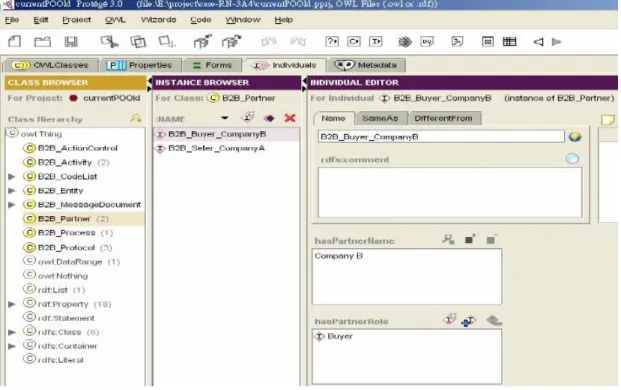
Company W and its buyers are B2B_Partner. We add them as the instances of B2B_Partner. The instance’s naming rule should be pre-established. We create the domain ontology of each business process for Company W and its buyers. In Figure 10, we show the B2B_Process “Customer Order”.
15
C.2 to model current business document ontology
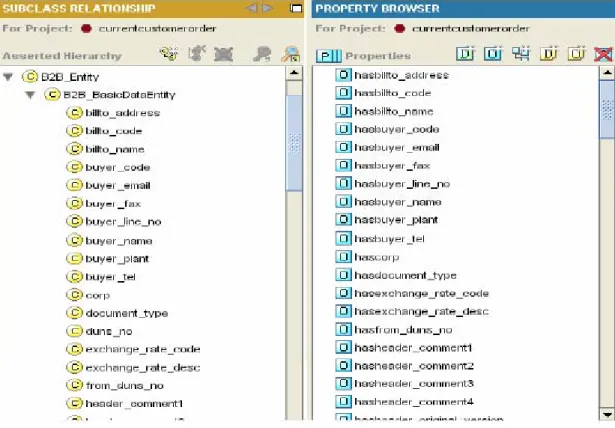
We use the DTD importer in the prototype to convert and store the DTD files into document ontology repository. The converted data result is shown in Figure 11.
16
Step D - to represent B2B EC standard ontology
D.1 to design RosettaNet process ontology
The PIP3A4’s ontology is built from the standard specification. The PIP restrictions must be considered. For example, the PIP3A4 specification defines when to enable a buyer to issue a purchase order and when to enable a seller to acknowledge the receipt of order, and even down to the line item level. No matter how and if the order is accepted, rejected, or pending. The provider's acknowledgment must include the information about delivery expectation. Further, when a provider acknowledges that a product line item on the purchase order document is “pending”, the provider must later use PIP3A7, "Notify of Purchase Order Acknowledgment" to notify the buyer when the product line item is either finally accepted or rejected. The PIP specification also describes the process start state to be one of the following: Purchase Order Request Exists, TPA Exists, Requesting Partner Approved, Responding Partner Approved, Buyer Authorized, Purchase Order Request Valid, or Purchase Order Request Non-Repudiated as shown in Figure 12. One of the above must be returned as the initial date started.
17
D.2 to model RosettaNet document ontology
The PIP3A4’s DTD files and message guideline give the details of each entity in the standard document. We again use the DTD importer to convert and load the specification. We edit the constraints for each entity. The DTD importer can intelligently determine and set up the business property domain and domain range properly. A RosettaNet PIP definition can be added as the instance’s comment as shown in Figure 13.
18
Step E - to merge ontology
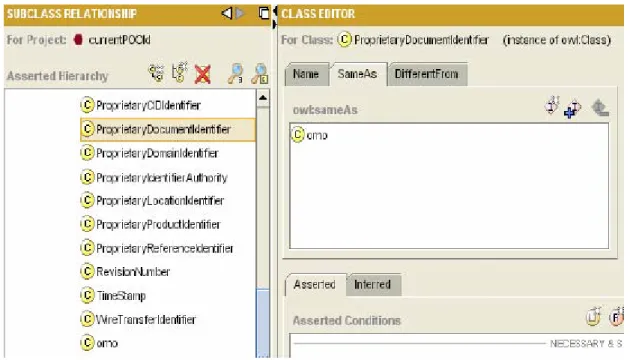
In the merge of ontologies, the purchase order has a unique number as the identity of the order. In this experiment, the current purchase order number is named “orno”. However PIP3A4 uses the field “ProprietaryDocumentIdentitfer” as the purchase order number. We resolve the inconsistency via link analysis.
When we generate the current business ontology and the B2B standard ontology, we can merge them in the system. Although Protégé provides the merge, we need to adjust the detail correspondence rules to link the relationship between two ontologies. The ontology editor provides the test function helps us check the ontology consistency. The purchase order usually has a unique number as the identity of the purchase order. The current order number is named “orno”. However, PIP3A4 names the field as “ProprietaryDocumentIdentitfer”. We use the owl:sameAs to link these two classes as equivalent.
Step F - to represent ontology
We generate a set of HTML files that contain the content of ontology. Users browse the ontology in a user-friendly interface. It minimizes the risk of ontology to be altered. With the hyperlink, we can trace any related classes and properties.
Step G - to test ontology
We validate the ontology with the Protégé test ontology function.
3.3 An ebXML Experiment
The second experiment we have conducted is a realization of ebXML in the case of purchase order. ebXML (ebXML, 2004) was started in 1999 and developed by the Organization for the Advancement of Structured Information Standards (OASIS). OASIS is a non-profit, international consortium that drives the development,
19
convergence, and adoption of eBusiness standards. The consortium produces more Web services standards than any other organization along with standards for security, eBusiness, and standardization efforts in the public sector and for application-specific markets. Founded in 1993, OASIS has more than 3,500 participants representing over 600 organizations and individual members in 100 countries (OASIS Consortium, 2004). ebXML is a modular suite of specifications that enables enterprises of any size and in any geographical location to conduct business over the Internet. By using ebXML, companies can exchange business messages, conduct trading relationships, communicate data in common terms and define and register business processes. In order to implement the experimental scenario, we install a set of ebXML core specifications. We will explain each in the following sections. These core specifications include the business process, the core component, and the collaboration protocol profile and agreement.
Steps A, B, C from the method are similarly applied in the ebXML experiment. The main difference is in Step D where we explain the procedure of transition. The difference is when we try to model the ebXML standard specification in ontology.
D.1 to design ebXML process ontology
ebXML uses Business Process Specification Schema (BPSS) to model business processes. In modeling the process ontology, we utilize the sequence diagram and the activity diagram. The BPSS specification specifies a Business Transaction, a Business Document flow for the Business Transaction, a Binary Collaboration, and then a Choreography for the Binary Collaboration. A Business Transaction in ebXML is the basic transaction unit between two partners. It consists of a Requesting Business Activity and a Responding Business Activity. A Binary Collaboration is always executed between two roles. They are called the Authorized Roles because they represent the actors that are authorized to participate in the collaboration. A Binary Collaboration consists of one or more Business Activities. These Business Activities must be conducted between the two Authorized Roles in the Binary Collaboration. A Choreography is an ordering and sequencing of Business Activities within a Binary Collaboration. The choreography is specified in terms of the Business States and the Transitions between these Business States. In the purchase order process example, we know it has two activities: Purchase Order Request Action and Purchase Order Confirmation Action. Both can be extracted from the BPSS sample file. We further know that if the activity is authorization required or non repudiation required. Below is the converted OWL scripts.
D.2 to design ebXML document ontology
The ebXML document ontology is created in use of the ebXML core component specification. The core component can be used to create the classes and the properties and be converted into ontology. The ebXML document ontology needs to incorporate existing DTD or existing XML Schema in order to support each component conversion. The ebXML core component in the standard ontology corresponds to the basic data entity in the domain ontology. The core component represents the same meaning as the data entity in the domain ontology. The ebXML aggregate information entity, on the other hand, stands for the composite data entity in the domain ontology. Because BPSS is also UML-based, the set of UML diagram such as the use case diagram, the class diagram, the sequence diagram, and the activity diagram our method recommends are adopted. Hence, the correspondence
20
and reconciliation will occur early at the analysis phase and will be carried out in the merge of standard ontology and domain ontology. For ebXML, the actual document definition is achieved using the ebXML core component specifications or by some methodology external to ebXML. They in turn are converted into a DTD or a XML Schema. BPSS specifies the specification name as “PurchaseOrderReques.dtd”.
We only need to get this DTD file and import it. A business document has three types of components. They are the basic data entity, the composite data entity, and the business property. The ebXML consists of: Core Component Type (CCT), Basic Information Entity, and Aggregate Information Entity. CCT are core components that carry the actual value and have no business meaning on their own. A Basic Information Entity is a singular concept that has a unique business semantic definition. A Basic Information Entity adds a semantic meaning to a single datatype or a CCT. When CCTs are reused in a business context, they become Basic Information Entities. An Aggregate Information Entity contains two or more Basic Information Entities or Aggregate Information Entities that together form a single business concept. Each Aggregate Information Entity has its own business semantic definition.
4. Discussion
4.1 Research Implication
The first set of literature investigating the issues of aligning the business processes with the business-to-business electronic commerce standards are described in (Omelayenko, 2001) (Stojanovic, Maedche, Motik, and Stojanovic2002) (Bussler, Fensel, and Maedche, 2002). They represent the earlier efforts working on the programming to approach the interface between the trading processes and new standards. This ad hoc programming approach was primitive and exploratory. Later in the literature survey, (Ding, Fensel, Klein, Omelayenko, and Schulten, 2004), the time when there were more business-to-business middleware systems in the marketplace, the researches gear toward to solve the issue of conversion and hub in the middleware system. Another important stream of literature presented in (Choy and Kim, 2004) (Cao, Zhang, and Seydel, 2005) addresses the integration aspect of the alignment. These studies relate to ours. They perceive the issue as a process and performance issue in the supply chain management. In (Hsieh, Lai, and Shi, 2006) (Iyer, Gupta, Johri, 2005) the process issue is further examined with mathematics to model the business operation.
In 2004 and 2005, we tested new PIPs including PIP3B18, PIP3B2, and PIP4C1 in the live case experiment. Each PIP took one month to three months instead of six months as in the prior years. The IT division assigned four full time system engineers instead of six to deliver the implementations. Figure 14 shows the equivalent classes generated from the PIP3A4 standard. Figure 15 gives the equivalent properties in the test.
21
Figure 15: Equivalent Properties
22
4.2 Managerial and Technical Implications
We summarize the managerial and technical implications into five points. Ontology is a more powerful technology on semantics and context. A mapping table is simple but lacks the ability to scale. It is a way of “mapping of terms” not an approach to “mapping of sense”. Ontology allows systems to discern the “one to one”, the “one too many”, and the “many to many” correspondences. It allows the systems to undertake the complex conversion such as the situation when there are same terms but with different meanings; different terms but with same meaning;
23
different terms but with different meanings yet close. Ontology can support an automation of the evolution of the terms, the concepts, and the relationships. The relationships between the new terms and the corresponding old terms can update automatically. Ontology is the base of reasoning.
The analysis framework and ontology enables the deployment of a new B2Bi EC standard initiative to be installed and operated in an effective and efficient fashion. Though RosettaNet PIP message defines many business entities, but there are many repeating entities in different PIPs. RosettaNet PIP3B2 is an example of the shipment notification process which specifies 120 business entities and properties. PIP3A4 is another example that has 143 business entities. However, there are 59 repeating business entities between these two PIPs. The repeat rate is above 49%. In fact, the more related the processes are, the higher the repeat rate will be. We must take advantage of the repeat rates. The repeat rate of entities between PIP3A4 and PIP3A8 is as high as 92%, almost identical. As new processes are continuously and constantly added to our ontology, the ontology must become more robust. The work of ontology creation becomes more automatic and less labor intensive. At the same time, the new knowledge extracted from the new ontology can be captured. Trading partners regularly collaborate and contribute to the reconciled and merged ontology which in turn forms a semantically rich repository in support of the reasoning, the inference, and the search of organizational learning. By enhancing and enriching the shared ontologies, we can deploy a new B2Bi EC initiative in a more effective and efficient manner.
A special function to transfer data model from DTD and XML Schema to OWL is
useful. A prototype of parser and converter to handle XML documents in the creation of
ontology is needed.
5. Conclusion and Future Work
5.1 Conclusion
In this paper, we have presented an ontology-assisted analysis method and alignment model in the implementation of the business-to-business electronic commerce standard specification over the existing trading partners’ public processes in the syntactic and semantic integration and interoperability. An application of the Unified Modeling Language is made to analyze the public process in the domain and in the standard. Terms, concepts, relations, and links are created from the analysis results and converted into an ontology representation. Web ontology language is introduced to formulate the analyzed knowledge and experience to align the domain and the standard. There are correspondences and conflicts in the process of alignment. They are resolved via the shared and reusable ontology which is a convergence of the domain ontology and the standard ontology. The converged and shared ontology is achieved via a set of rules and heuristics that are created in the research. The key of success in the business-to-business integration electronic commerce lies on the ability to accomplish the process interoperability and the schema comparability. Three main tasks have to be achieved to fulfill the requirements. In this research, we have constructed a prototype to implement the method. The prototype is used to illustrate the feasibility and validity of the method.
A set of starter experiments has been conducted in use of a straight through example of a purchase order process in the alignment with the RosettaNet standard
24
and the ebXML standard. The starter experiment serves as the baseline to demonstrate the method is feasible and valid. The three main things we have accomplished in the research are:
Identifying the main components of knowledge and experience to be reconciled and to be represented in the alignment of the standard ontology and the domain ontology.
Developing the set of rules and heuristics for the ontology correspondence and reconciliation.
Designing an experimental prototype to implement the method and to demonstrate the feasibility and the validity by selecting two main electronic commerce standards as the baseline test. The RosettaNet experiment represents the vertical electronic commerce standard. The ebXML experiment stands for the horizontal electronic commerce standard.
5.2 Future Research Work
The future research work will continue to explore the complex issues of the alignment and automation between domains and standards. Some of the immediate tasks to be undertaken in our study include:
Enhancing the ontology search and inference capability. As the rule base and heuristics base grow, search and inference engine become slow in the ontology management. Tuning and enhanced rules must be developed.
Upgrading the DTD importer to import XML Schema and to enable the conversion between XML Schema and OWL representation. This will solve the version control issue.
Conducting more diverse and complex experiments in terms of scale and scope. More experiments will be conducted in the public processes of receiving and payment that are closely related with the public process of purchase order. RosettaNet and ebXML will still be the main standards.
REFERENCES
1. Baclawski, K., Kokar, M.K., Kogut, P.A., Hart, L., Smith, J., Letkowski, J., & Emery, P. (2002) “Extending the Unified Modeling Language for Ontology Development”, Software and Systems Modeling, Vol 1 No 2, pp. 142-156.
25
American, Vol 284 No 5, pp. 34-43.
3. Bird, Linda, Andrew G., & Terry H. (2000) “Object Role Modelling and XML-Schema”, ER2000.
4. Bose, R. (2006) “ Understanding Management Data Systems For Enterprise Performance Management ”, Industrial Management and Data Systems, Vol 106 No 1, pp. 43-59.
5. Bussler, C. (2001) “Semantic B2B integration”, ACM SIGMOD Record, Vol 30 No 2, pp. 625.
6. Bussler, C., Fensel, D., & Maedche, A. (2002) “A Conceptual Architecture for Semantic Web Enabled Web Services”, ACM SIGMOD Record, Vol 31 No 4. 7. Cao, M., Zhang, Q.Y., Seydel, J. (2005) “B2C e-commerce web site quality: an
empirical examination”, Industrial Management & Data Systems, Vol 105 No 5, pp. 645-661.
8. Choy, L. Y., Kim, H. T. (2004) “A process and tool for supply network analysis”, Industrial Management & Data Systems, Vol 104 No 4, pp. 355-363.
9. Cranefield, S., & Purvis, M. (1999) “UML as an Ontology Modelling Language”, In Proceedings of 16th International Joint Conference on Artificial Intelligence on Workshop on Intelligent Information Integration.
10. Cranefield, S. (2001) “Networked Knowledge Representation and Exchange Using UML and RDF”, Journal of Digital Information, Vol 1 No 8.
11. Cut, Z., Jones, D., & O'Brien, P. (2002) “Semantic B2B Integration: Issues in Ontology-based Approaches”, ACM SIGMOD Record, Vol 31 No 1, pp. 43-48. 12. Decker, Stefan, Sergey M., Frank V. H., Dieter F., Michel K., et al. (2000) “The
Semantic Web: The Roles of XML and RDF”, IEEE Internet Computing, Vol 4 No 5, pp.63-64.
13. Ding, Y., Fensel, D., Klein, M., Omelayenko, B., & Schulten, E. (2004) “The Role of Ontologies in eCommerce”, Handbook on Ontologies, Staab S. and Studer R., Springer.
14. ebXML BPSS (2006) http://www.ebxml.org/
15. Gasevic, D., Djuric, D., Devedzic, V., & Damjanovic, V. (2004) “Converting UML to OWL Ontologies”, Proceedings of the 13th international World Wide Web Conference, pp. 488-489.
16. Gulledge, T. (2006) “What is integration?,” Industrial Management & Data Systems, Vol 106 No 1, pp. 5-20.
17. Helo, P., Szekely, B. (2005) “Logistics information systems: An analysis of software solutions for supply chain co-ordination”, Industrial Management & Data Systems, Vol 105 No 1, pp. 5-18.
18. Hunag, C.J., Amy J.C. Trappy, Yao, Y.H. (2006) “Developing an agent-based workflow management system for collaborative product design”, Industrial Management & Data Systems, Vol 106 No 5, pp. 680-699.
19. Hsieh, C.T., Lai, F.J., Shi, W.H. (2006) “Information orientation and its impacts on information asymmetry and e-business adoption: Evidence from China's international trading industry”, Industrial Management & Data Systems, Vol 106 No 6, pp. 825-840.
20. Iyer ,L. S., Gupta, B., Johri, N. (2005) ”Performance, scalability and reliability issues in web applications”, Industrial Management & Data Systems, Vol 105 No 5, pp. 561-576.
21. Kogut P., Cranefield S., Hart L, Dutra M., Baclawski K., Kokar M., & Smith J. (2002) “UML for Ontology Development”, The Knowledge Engineering Review, Vol 17 No 1, pp. 61-64.
26
22. Lesjak ,D., Vehovar, V. (2005) “Factors affecting evaluation of e-business projects”, Industrial Management & Data Systems, Vol 105 No 4, pp. 409-428. 23. Medjahed, B., Benatallah, B., Bouguettaya, A., Ngu, A.H.H, & Elmagarmid, A.K.
(2003) “Business-to-Business Interactions: Issues and Enabling Technologies”, The VLDB Journal, Vol 12 No 1, pp. 59-85.
24. OASIS Consortium (2005) http://www.oasis-open.org 25. Object Management Group (2005) http://www.omg.org
26. Omelayenko, B. (2001) “Preliminary Ontology Modeling for B2B Content Integration”, Proceedings of the 12th International Workshop on Database and Expert Systems Applications, pp. 7-13.
27. Rahm, Erhard & Philip A. B. (2001) “A survey of approaches to automatic schema matching”, The VLDB Journal, Vol 10, pp. 334-350.
28. RosettaNet Consortium (2006) http://www.rosettanet.org/
29. Stojanovic L., Maedche A., Motik B., & Stojanovic N. (2002) “User-Driven Ontology Evolution Management”, Proceedings of the 13th International Conference on Knowledge Engineering and Knowledge Management. Ontologies and the Semantic Web, pp. 285-300.
30. Web Ontology Language (2004) http://www.w3c.org/2004/OWL/
31. Zhao, F. (2004) “Management of information technology and business process re-engineering: a case study”, Industrial Management & Data Systems, Vol 104 No 8, pp.674-680.
1
Services economy dominates the research and development activities in the industrialized nations. More and more corporations in the manufacturing sectors identify a huge growing share of revenues and profits coming from the service units, not to mention the existing strong growth of service businesses in many sectors such as financial, banking, information, and retail sectors. Service innovation, growth, productivity, and valuation is critical and of great relevance to government, industry, business, and academia. The growing commoditization of service activities has gradually transformed the market competition from quality of services to the creation of experience economy. Software as service and business on demand represent the new waves of value generating in IT industry.
Services science begins to have contributions from different research fields (e.g. Information Management, Social Science), different institutions (universities, research laboratories, companies), different application fields (e.g. e-commerce, e-business, e-industry, e-government), different work cultures (e.g. academia, industry; software engineers, researchers), different parts of the world (Asia, Australia, North America, Europe), and different user groups (e.g. everyone, special jobs, special needs). As a consequence, the competitive edge of an enterprise now depends on the innovative collaboration and co-production of knowledge workers in industry and academia, and the application of science, engineering, business, and management.
The purpose of the study is to articulate a methodological and practice oriented framework and model through the study approach of survey, interviews, case studies, and experiments, to explore the ways in which research and development activities and factors influence the integration of innovation, technology, and strategy over the services science and economy. An analytic framework illustrating the ways how novel ideas and problem solving capabilities are formed and fostered in the context of research and development activities within and cross organizations will be created. An initial model representing the approaches how an advance in theoretical research and practical development in software service and business service is achieved will be developed.
This research project is financially sponsored by National Science Council. Based on my past interview and case study experience, I estimate the possible facility and resource I need at IBM Almaden Services Research is as follows.
2
2. Persons to interview: 8 to 10 researchers and scientists in services science research and development
3. Interview time: one hour to one and half hour each time
4. A work space, the computer/Internet access, and the library access would be greatly appreciated.
1. Anderson, James C., Nirmalya Kumar, James A. Narus (2007) Value Merchants: Demonstrating and Documenting Superior Value in Business Markets. Harvard Business Review. Boston, MA.
“Purchasing managers in business markets are becoming increasingly sophisticated in their strategies and tactics. Increasingly held accountable for reducing costs,
purchasing and other customer managers don’t have the luxury of simply believing suppliers’ claims of cost savings. A relatively easy and quick way to obtain savings is for purchasing managers to focus on price and obtain price concessions from suppliers. To enhance their negotiating power, purchasing managers attempt to convince suppliers that their offerings are the same as their competitors – that they could be easily replaced. In the face of such pressure… suppliers cave in and match competitor prices. It is rare commodity in business markets to find firms that do business based on demonstrably superior value.” (Pg. 3)
“Suppliers must adopt a philosophy of doing business based on demonstrated and documented superior value and implement that philosophy using an approach we call customer value management. Customer value management is a progressive,
practical approach to business markets that, in its essence, has two basic goals: 1. Deliver superior value to targeted market segments and customer firms, 2. Get an equitable return on the value delivered.” (Pp. 3-4).
“By ‘demonstrate,’ we mean showing prospective customers convincingly beforehand what cost savings or added value they can expect from using the supplier’s offering relative to the next-best alternative. Value case histories are one tool that best practice suppliers…use to accomplish this. Value case histories are written accounts that document the cost savings or added value that reference customers have received from using a supplier’s market offering. Another way best practice firms…
demonstrate the value of their offerings to prospective customers is through customer value assessment tools, which we term value calculators. These tools are
3
their laptops as part of a consultative selling approach to demonstrate the value that customers likely would receive from their offering… Thus suppliers work with their customers to define the measures on which they will track the cost savings or incremental profit produced and then, after a suitable period of time, work with customer managers to substantiate the results.” (Pp. 5-6).
“Our approach to customer value assessment focuses the supplier’s and customers’ limited resources on the value elements – that is, specific ways the offerings reduce customer costs or enable the customer to earn additional revenue and profit – that matter most and assessing them in the way that matters most… The guiding principle is to generate new knowledge, not recycle opinion.” (Pp. 8-9).
“In recent years, the terms value and value proposition have become two of the most widely used terms in business markets. While these terms are fundamental to our customer value management approach, our research reveals that despite their growing use, there is little specificity or agreement about (1) what is value, (2) what constitutes a customer value proposition, and (3) what makes a value proposition persuasive..” (Pg. 12).
“Value in business markets is the worth in monetary terms of the technical, economic, service, and social benefits a customer firm receives in exchange for the price it pays for a market offering… Thus, we conceptually view a market offering as having two elemental characteristics: its value and its price… Finally, we contend that customer value in business markets is a comparative concept in which customers assess the value of a given market offering relative to what they regard as the next-best
alternative to it. There always is an alternative. It might be: 1. A market offering from a competitor… 2. the customer’s decision to source an item from an outside supplier or make the item itself… 3. The status quo (i.e., not doing anything)… 4. The most recent offering from the same supplier…” (Pp. 24-25).
“The difference between value and price is the customers incentive to purchase. Remember, in this concept of value in business markets, raising or lowering the price does not change the value that offering provides to a customer firm. Rather, it changes the customer’s incentive to purchase the offering… And recognizing that the value of a given offering can vary by segment and by customer characteristics is vital.” (Pg. 27).
4
developing the suppliers firm’s value proposition.” (Pg. 30)
“The resonating-focus customer value proposition consists of the one or two points of difference, and perhaps a point of parity, that deliver the greatest value to the target customer. This proposition differs from the favorable-points-of-difference
proposition in… significant respects. First, more is not better.” (Pp. 34-35).
“To generate some creative ideas that might substantially improve an offering’s value to customers, consider the set of questions that Professors Chan Kim and Renee Mauborgne offer to promote out-of-the-box thinking. Specifically, supplier
managers, salespeople, and field technical representatives should be asked to answer the following four questions with respect to the present offering or the existing value proposition: 1. Reduce. Which value elements should be reduced well below industry standard? 2. Raise: Which value elements should be raised significantly above the industry standard? 3. Eliminate: Which value elements that the industry has taken for granted should be eliminated? 4. Create. Which new value elements should be created that the industry has never offered?” (Pp. 46-47).
2. Jagannathan, Sridhar, Jay Srinivasan, and Jerry L. Kalman (2002) Internet Commerce Metrics and Models in the New Era of Accountability. Prentice Hall. Upper Saddle River, NJ.
“Emergence of Services: Outsourcing as a Way of Life. One of the most interesting aspects of the Internet evolution is the proliferation of new and different services, so much so that the ‘service provider’ label is now a standard part of the Internet vernacular… Fundamentally, the Internet allows merchants to expand value in modular and spatially distributed ways. Each module of service, as we will see, gives rise to a set of vendors specializing around a service. Thus, it is no longer necessary or even prudent to consolidate one’s physical and human resources in company-owned and operated locations.” (Pg. 16).
“Organization of the Book. Overall, this book is designed to provide a framework for how to understand and cope with many issues that arise in building and sustaining an electronic commerce business by examining prevalent business models on the Internet. More specifically, the intent is to provide details about the ways to build business models that can then be pieced together in a building-block fashion to
5
electronic commerce. In the early chapters we set up a framework that establishes benchmarks you might use as a starting point for evaluation…Finally there is a trial analysis of a sample company we call Ebiztro.com to show how all can be brought together. Assembling these units into a cohesive view of an enterprise is achieved by defining the online business model in terms of four horizontal stacks and one vertical stack. The four horizontal stacks are platform, content, community, and commerce… The vertical stack is services, which provides value for each of the horizontal stacks. Metrics and examples to illustrate what we refer to as atomic business models are provided wherever possible. Services are vertical because they can be introduced into every horizontal stack, usually when a make versus buy
decision is at hand. Services are pervasive throughout the new economy, and they potentially touch every enterprise that uses online processes and technologies. Integrating services and service providers shortens time to market and often reduces capital costs.” (Pp. 22-23).
“The Service Providers. One of the most fascinating aspects of value creation on the Internet is the broad spectrum of Service Providers, many of whom owe their
existence to perceived online merchant needs. Service providers create a wide range of outsource capabilities that allow an online player to substitute owned assets or internally performed units of work with those that are externally contracted or carried out. The outsourced services in every aspect of business provide individuals, entrepreneurs, small businesses, and large businesses with new options on the way an atomic business functionality is achieved. All of which boils down to a simple consideration: Is there an external alternative in every specific, narrow aspect of business? The remarkable answer is an impressive YES!... As a consequence, the Internet now allows the creation of completely ‘virtual’ businesses that can own almost no infrastructure, no physical assets, no unique content, and no employees other than the owner, and yet are able to earn real revenue. Is this possible. Absolutely.” (Pg. 55).
“A full business is created to relate its mission to daily operations. We take it to the next level by relating the metrics of the business model to profitability of the
company… In essence, a for-profit business is a machine whose ultimate design and purpose is to serve customers. As a reward for doing so, it must then make money for its shareholders and satisfy the requirements of incorporation, promote employee well being, and meet the community responsibilities. Such an economic engine always has a final report card of how its capital is utilized. The resulting machine is designed to implement the intent of the business, or goals and objectives… The report
6
card is return on assets or capital employed.” (Pg. 313).
“Comprehension of all possible manual and automated business activities is achieved through business process mapping. Business process mapping can be carried out to considerable levels of granularity to include all software and human steps.” (Pg. 321).
“Appendix. Categorization of Selected Internet Companies.” (Pg. 353).
Selected list of figures and tables:
Figure 2.1 The Five-Stack E-Commerce Model Figure 2.8 Solution Space for E-Commerce
Figure 2.10 Service Providers Support and Supplement the Other Four Stacks.
Table 3.6 Illustrative Comparison Between In-House and ASP for an ERP Application Table 4.1 Metrics for Content Management.
Table 5.1 Community Entities and Associated Metrics Table 5.2 Cost Structure and Metrics
Table 6.2 Online Versus Offline: Benefits and Drawback [Baseline for Store Measurement]
Table 6.6 Buyer Perspective in an Online Marketplace
Table 6.7 Supplier Perspective in an Online Marketplace [Baseline Measurements for Exchanges]
Figure 6.12 Ecosystem Value Stack for Buyers, Sellers, and Partners Table 7.1 B2B, B2C, and C2C Pricing
Table 7.2 Pricing Mechanism by Market Environment
Table 7.3 Characteristics of Auctions in C2C, B2C, and B2B Contexts
Table 7.6 Advantages and Disadvantages of Direct Barter [Baseline Measurements for Barter Exchange]
Table 7.10 Metrics for Establishing Dynamic Pricing in an Exchange Table 8.2 Metrics for Permission Marketing
Table 8.2 Metrics for Merchant Affiliate Programs
3. Ricketts, John Arthur (2008) Reaching the Goal: How Managers Improve Services Business Using Goldratt’s Theory of Constraints. IBM Press. Pearson plc. Upper Saddle River, NJ.
“We are all avid consumers of services, yet we seldom think much about where those services come from. Services are often like background music: Most are barely