Macromolecules 1995,28, 1673-1680 1673
Synthesis
of
Side-Chain Liquid Crystalline Polyoxetanes
Containing 4-(Alkany1oxy)phenyl trans-4-Alkylcyclohexanoate
Side Groups
Yong-Hong Lu and Chain-Shu Hsu*
Department of Applied Chemistry, National Chiao Tung University, Hsinchu, Taiwan 30050, Republic of China
Received July 5, 1994; Revised Manuscript Received September 21, 1994@
ABSTRACT: The synthesis of side-chain liquid crystalline polyoxetanes containing 4-(alkanyloxy)phenyl truns-4-alkylcyclohexanoate side groups is presented. Differential scanning calorimetry, optical polarizing microscopy, and X-ray diffraction measurements reveal polymorphism of mesophases for all obtained polymers. Both spacer length and terminal alkyl length have a profound influence on the nature and thermal stability of the mesophases. Although the polyoxetane backbone is more flexible than the polymethacrylate backbone, side-chain crystallization did not occur for any of the synthesized polymers.
Introduction
Side-chain liquid crystalline polymers (LCPs) are of both theoretical and practical interest because they combine the anisotropic properties of liquid crystals with the polymeric properties and have the potential of being used for some new app1ications.l-l5 So far, most of the side-chain LCPs have been prepared mainly by radical polymerization of (meth)acrylates and by the hydro- silation of poly(methylhydrosi1oxane) backbones with mesogenic olefins. In recent years an increasing amount of research has been directed a t synthesizing new well- defined side-chain LCPs by living cationic polymeriza- tion,16 ring-opening p ~ l y m e r i z a t i o n l ~ - ~ ~ and living ring- opening methathesis p o l y m e r i ~ a t i o n . ~ ~ - ~ ~ Recently, Kawakami et al. reported the first example of side-chain LC polyoxetanes by cationic ring-opening polymeri- ~ a t i o n . ~ ~ - ~ ~
In our previous works we reported side-chain LC polysiloxanes containing cyclohexane-based mesogenic
side groups which exhibit conformational i s ~ m e r i s m . ~ ~ , ~ ~ These kinds of mesogens can be used to synthesize
noncrystallizable side-chain LCPs even when the poly- mers contain very long spacer ~ n i t s . ~ ~ - ~ ~ The goal of this paper is to present the synthesis of some new side- chain LC polyoxetanes containing 4-(alkanyloxy)phenyl
trans-4-alkylcyclohexanoate side groups. The effects of spacer length a s well as terminal alkyl length on the properties of mesophases exhibited by the synthesized polymers are discussed.
Experimental Section
Materials. trans-4-n-Propylcyclohexanoic acid, trans-4-n- butylcyclohexanoic acid, and trans-4-n-pentylcyclohexanoic acid were obtained from Tokyo Kaisei Inc. and were used as received. Boron trifluoride ether complex was also purchased from Tokyo Kaisei Inc. and was distilled before use. 3-(Hy- droxymethyl)-3-methyloxetane and all other reagents were obtained from Aldrich and were used as received. Dichlo- romethane used in the ring-opening polymerization was re- fluxed over calcium hydride and then distilled under nitrogen. Techniques. lH NMR spectra (300 MHz) were recorded on a Varian VXR-300 spectrometer. Thermal transitions and thermodynamic parameters were determined by using a Seiko SSCl5200 differential scanning calorimeter equipped with a
*
To whom all correspondence should be addressed.@ Abstract published in Advance ACS Abstracts, January 15, 1995.
0024-929719512228-1673$09.00/0
liquid nitrogen cooling accessory. Heating and cooling rates were 10 "Clmin. Thermal transitions reported were collected during the second heating and cooling scans. A Carl-Ziess Axiphot optical polarized microscope equipped with a Mettler
FP 82 hot stage and a FP 80 central processor was used to observe the thermal transitions and to analyze the anisotropic textures. Gel permeation chromatography (GPC) was run on an Applied Biosystems 400 LC instrument equipped with a differential refractometer, a UV detector, and a set of PL gel columns of
lo2,
5 x lo2, lo3, and lo4A.
The molecular weight calibration curve was obtained by using standard polystyrenes. X-ray diffraction measurements were performed with nickel- filtered Cu K a radiation with a Rigaku powder dfiactometer. Synthesis of Monomers IM-XIIIM. The synthesis of oxetane monomers IM-XIIIM is outlined in Schemes 1 and 2.3-[(Tosyloxy)methyll-3-methyloxetane (1).
To
the aqueous solution (80 mL of water) of 3-(hydroxymethyl)- 3-methyloxetane (9.10 g, 89.2 mmol) and sodium hy- droxide (20.0 g, 0.05 mol) was added dropwise the tosyl chloride (23.8 g, 0.125 mol) in tetrahydrofuran (THF, 80 mL), and the mixture reacted overnight a t room temperature. After THF was removed under reduced pressure, the product was extracted with diethyl ether three times (150 mL). The crude product was isolated by evaporating the solvent and further purification by recrystallization from n-hexane to form white crystals, mp 57.1 "C, yield 88.2%. lH NMR chemical shifts: 6 1.31 (8, 3H, -CH3), 2.47 (s, 3H, -Ph-CH3), 4.11 and 4.36 (m, 6H, -CH2-OTs and two -CH2- in the oxetane ring), 7.39 and 7.81 (two d, 4H, aromatic protons).3-[[(3-Bromopropyl)oxylmethyll-3-methyloxe- tane (4),3-[[(4-Bromobutyl)oxy1methyl1-3-methyl- oxetane (5),3- [ (5-Bromopentyl)oxylme thy11 -3-me- thyloxetane (61, and 3-~[(6-Bromohexyl)oxylmethyll- 3-methyloxetane
(7).
All four compounds were pre- pared by the same method. The synthesis of compound 6 is described below.A two-phase system composed of dibromopentane (70
g, 0.304 mol) in hexane (100 mL) and 34hydroxy- methyl)-3-methyloxetane (10 g, 0.098 mol), sodium hydroxide (65.0 g, 1.625 mol), and tetrabutylammonium bromide (0.5 g) in water (100 mL) was stirred for 24 h at room temperature and heated to reflux under stirring for 2 h. After the reaction system was cooled to room temperature, water (100 mL) was added, and the
1674 Lu and Hsu
Scheme 1. Synthesis of Monomer
IM
and Polymer IPCH, I CI-&-GCH,OH 0- I CH, I
1
TsCl CHs I CY-C-CKOT~ + H O ~ O G H , ~I
I
0- CH, KOH / EtOH 0- CH, 21
% J O H CH,&&-O- e O H CHs DCC / CH,Cl, 0 0- CH,Macromolecules, Vol. 28, No. 5, 1995
Scheme 2. Synthesis of Monomers IIM-2UIIM and
Polymers IIP-XIIIP CHs I I I CI-&-GCH,OH
I
IP$
organic layer was extracted three times with hexane. The product was isolated by evaporating the solvent after drying the solution with anhydrous magnesium sulfate. The crude product was purified by distillation, bp 80-85 "C (0.15 mmHg), to yield 18.4 g (75%) of a colorless liquid, bp 80-85 "C (0.15 mmHg). 'H NMR
chemical shifts: 1.30 (s, 3H, -CH3), 1.42-1.90 (m, 6H,
-O-CHZ-(CHZ)~-), 3.32-3.52 (m, 6H, -CH2-0-
CHz- and -CHz-Br), 4.33 and 4.50 (two d, 4H, two -CHz- in the oxetane ring).
3 [ [
14-
(Benzy1oxy)phenyll oxy1 methyl] -3-methyl- oxetane (21, 3- [[I34 [4-(Benzyloxy)phenylloxyl-propylloxylmethyll-3-methyloxetane (8),3-[[[4[[4- (Benzyloxy)phenylloxylbutylloxylmethyll-3- methyloxetane (91, 3-[[[5-[[4-(Benzyloxy)phenylI- oxylpentylloxylmethyll8-methyloxetane (101, and
3 - ~ ~ ~ 6 ~ ~ 4 ~ ~ l o n y ~ p h e n y l l o x y l h e n y l l o ~ l m e ~ ~ l - 3-methyloxetane (11). All five compounds were pre-
pared by the same method. The synthesis of compound
10 is described below.
p-(Benzyloxy)phenol(8.55 g, 0.043 mol) was added to a solution of 2.39 g (0.043 mol) of potassium hydroxide in 250 mL (90%) of ethanol. Potassium iodide (0.2 g) was added, and the solution was heated to reflux temperature for 1 h. 3-[[(5-Bromopentyl)oxylmethyll- 3-methyloxetane (6) (8.9 g, 0.036 mol) was added slowly,
0- CH,
I
BF,' OEt,I
IIP-
XIIP : n = 3-
6, m = 3-
5and the solution was heated to reflux temperature and stirred overnight. The solution was cooled, the solid salts were removed by filtration, and ethanol was removed in a rotovap. The remaining solid was ex- tracted with ethyl acetate and washed three times with 10% KOH. The collected ethyl acetate solution was dried over anhydrous magnesium sulfate and evapo- rated to dryness. The obtained crude product was purified by column chromatography (silica gel, ethyl
acetatex-hexane:chloroform = 1:6:1 as eluent) t o yield 10.7 g (81%) of a colorless liquid. lH NMR chemical shifts: 6 1.30 (s, 3H, -CH3), 1.42-1.90 (m, 6H, -0- CH2-(CH2)3-), 3.42-3.55 (m, 4H, -CHz-O-CHz-), 3.91 (t, 2H, -CHZ-O-Ph-), 4.33 and 4.50 (two d, 4H, two -CHz- in the oxetane ring), 5.01 (s, 2H, -0-CHz- Ph), 6.83-7.46 (m, 9 aromatic protons).
3[[(4-Hydroxyphenyl)oxylmethyll-3-methyl- oxetane (3), 3 4 [ [3-[ (4-Hydroxyphenyl)oxylpropyll-
oxy] methyl] -3-methyloxetane ( 12), 3- [ [4- L(4-Hy- droxypheny1)oxyl butylloxylmethyll-3-methylox- etane (131, 3-[[[5-[(4-Hydro9yphenyl)oxylpent- ylloxylmethyll-3-methyloxetane (141, and 3-[[[6- [(4-Hydroxyphenyl)oxyl hexylloxylmethyll-3- methyloxetane (15). All five compounds were pre-
Macromolecules, Vol. 28, No. 5, 1995
pared by the same method. The synthesis of compound
14 is described below.
Sodium (7.46 g, 0.324 mol) was added rapidly but in small pieces to a hot solution of compound 10 (12.0 g,
0.03 mol) in 300 mL of anhydrous t-BuOH. "he solution was heated to reflux for 24 h. After the sodium had completely reacted, a small amount of cold water was added, followed by the addition of a cold, dilute hydro- chloric acid solution. The t-BuOH was removed in a rotovap, and the residue was extracted with dichlo- romethane. The collected dichloromethane solution was washed with water, dried over anhydrous magnesium sulfate, and then evaporated to dryness. The obtained product was purified by column chromatography (silica gel, ethyl acetate: n-hexane = 1:2 as eluent) to yield
5.60 g (62%) of white crystals. lH NMR chemical shifts: 6 1.30 (s, 3H, -CH3), 1.42-1.90 (m, 6H -0- CH2-(CH2)3-), 3.42-3.55 (m, 4H, -CH2-0-CH2-),
3.90 (t, 2H, -CHz-O-Ph-), 4.33 and 4.50 (two d, 4H, two -CH2- in the oxetane ring), 6.78 (d, 4 aromatic protons).
Synthesis of Monomers IM-XIIIM. The mono- mers IM-XIIIM were synthesized by the same method. The preparation of monomer VIIIM is described below.
A solution of tram-n-propylcyclohexanecarboxylic acid
(0.64 g, 3.75 mmol), N,N-dicyclohexylcarbodiimide (0.81
g, 3.93 mmol), compound 14 (1.00 g, 3.57 mmol), and
4-(dimethy1amino)pyridine (0.044 g, 3.60 mmol) in dichloromethane (30 mL) was allowed to stir a t room temperature until esterification was complete. The N,N-dicyclohexylurea was filtered. The obtained filtrate was washed three times with water and dried over anhydrous magnesium sulfate and the solvent evapo- rated in vacuum to give the crude product. The ob- tained product was purified by column chromatography (silica gel, ethyl acetate:n-hexane = 1:6 as eluent) to yield 0.87 g of a liquid. lH NMR chemical shifis: 6
0.80-2.20 (m, 25H, -CH3, -0-CHz-(CH2)3-, and
(=O)-CH<), 3.47 (m, 4H, -CH2-O-CH2-CH2-), 3.93
(t, 2H, -CHz-O-Ph-), 4.33 and 4.50 (two d, 4H, two -CHz- in the oxetane ring), 6.87 and 6.94 (two d, 4
aromatic protons).
The cyclohexane ring's methine proton, which is next to the carbonyl group, shows a chemical shift a t about
2.43 ppm. This peak is split as a triplet of triplets and the coupling constant (Jda1-&d) is ca. 30 Hz. This
means that the methine proton is a t an axial position and the cyclohexane ring is in the trans form.31
Synthesis of Polyoxetanes IP-XIIIP. The syn- thesis of liquid crystalline polyoxetanes is also outlined in Schemes 1 and 2. All the polymers were synthesized by the same method. The preparation of polymer VIIIP is described below.
Dichloromethane was dried over calcium hydride and was distilled under nitrogen just prior to use. Freshly distilled boron trifluoride ether complex was used as an initiator. A solution of monomer VIIIM (0.432 g, 1
mmol) and dichloromethane (1 mL) was cooled to 0 "C under nitrogen and the initiator (2% mol with respect to monomer VIIIM) was then injected with a syringe. The reaction mixture was stirred at 0 "C for 24 h. After the reaction time, the polymers were separated and purified by several reprecipitations &om dichloromethane solution into n-hexane. The absence of monomer was checked by lH NMR and GPC.
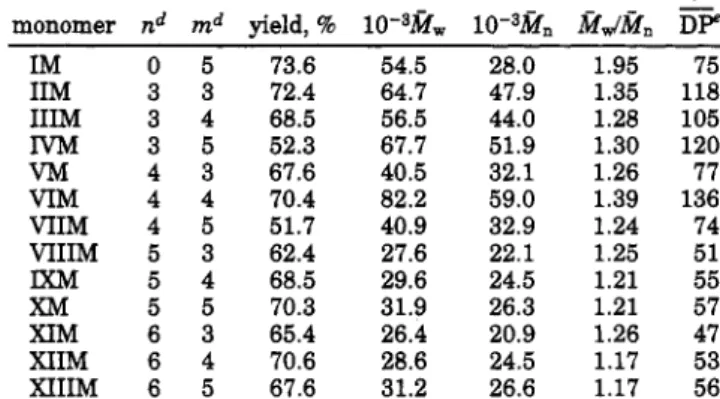
The results of ring-opening polymerization of oxetane monomers by BFyOEtz as a n initiator are summarized
(-CH2-CH2)2CH-C*7), 2.43 (tt, l H , -0-C-
Synthesis of LC Polyoxetanes 1675
Table 1. Polymerization of Monomers by Boron "riflwride Ether CompleP-c
monomer nd md yield, % 10-3Mw 10-3Mn MdMn IM 0 5 73.6 54.5 28.0 1.95 75 IIM 3 3 72.4 64.7 47.9 1.35 118 IIIM 3 4 68.5 56.5 44.0 1.28 105 IVM 3 5 52.3 67.7 51.9 1.30 120 VM 4 3 67.6 40.5 32.1 1.26 77 VIM 4 4 70.4 82.2 59.0 1.39 136 VIIM 4 5 51.7 40.9 32.9 1.24 74 VIIIM 5 3 62.4 27.6 22.1 1.25 51 IXM 5 4 68.5 29.6 24.5 1.21 55 XM 5 5 70.3 31.9 26.3 1.21 57 XIM 6 3 65.4 26.4 20.9 1.26 47 XIIM 6 4 70.6 28.6 24.5 1.17 53 XIIIM 6 5 67.6 31.2 26.6 1.17 56 * Solvent: CH2C12. Reaction temperature: 0 "C. Reaction time: 24 h. The concentration of monomer in CHZC12: 1.0 M. [Mono-
mer]:[BF30Et2] = 50:l. n and m according to Scheme 1. e D P
degree of polymerization. T H 2 t 10
p
I 4 I 3 I, 19 'cH,k - ' C H , - & H , % H , I H , - C - , ~ O~C&H,XH,-W ' C H IA
Y.6
A
C CH 9 CHCI, 100 180 160 140 1 1 0 IO0 80 6 0 40 1 0 0 ( P P m ) Figure 1. (A) lH NMR spectrum, (b) I3C NMR DEFT (135) spectrum, (C) 13C NMR DEFT (90) spectrum, (D)I3C NMRspectrum for polymer IIP.
in Table 1. All monomers gave reasonable yields in the polymerization. Figure 1 presents the representative
IH and I3C NMR spectra of polymer IIP. The assign-
ment of the carbon signals of polymers has been made on the basis of D E W (distortionless enhancement by polarization transfer) spectra (curve B and C). The chemical shifts of polymer IIP are reported as follows:
lH NMR (CDCl3, TMS, ppm) 6 0.80-2.20 (m, 21H, lCH3-, %H2- and (-CH2-CH2)2CH-C&7), 2.40 (tt,
l H , -O-C(=O)-CH<), 3.15-3.23 (m, 6H, CH3-C-
2H, -7CH2-O-Ph-), 6.80 and 6.90 (two d, 4 aromatic
1676 Lu and Hsu Macromolecules, Vol. 28, No. 5, 1995
Table 3. Phase Transitions and Phase Transition
phase transitions, "C (corresponding enthalpy changes, kcal/mrdb
heating polymer ma n a cooling
Enthalpies of Polymers IP-XVIP
Table 2. Thermal Transitions and Thermodynamic Parameters of Monomers IM-XIIIM
phase transitions, "C (corresponding enthalpy changes, kcal/mol)*
heating monomer na m a cooling IM IIM IIIM TVM VM VIM VIIM VIIIM IXM XM XIM XIIM XIIIM 0 3 3 3 4 4 4 5 5 5 6 6 6 5 3 4 5 3 4 5 3 4 5 3 4 5 K 93.7 (2.83) I 163.0 (2.62) K K 52.1 (8.30) I I - 39.3 (0.90) K K 46.8 (7.90) I I - 26.3 (0.65) K K 50.8 (7.W I I - 1 2 (5.76) K K 40.7 (6.64) I 13.8 (0.13) N-20.0 (0.10) K K 49.1 (10.0) I I 6.4 (0.06) N - 17.7 '3.22) K K 5L8 (9.51) I I 2 1 8 (0.17) N-9.3 (0.46) Kl-38.2 (140) K, K, 2.9 (2.54) K, 24.6 (4.87) I I - 19.6 (-Y K, 25.3 (154) K1 K 28.8 (5.72) I 1-3.7 (2.55) K K 35.6 (6.44) I I 15.4 (133) K,
-
14.7 (2.89) K, K 27.6 (6.09) I I 1 1 2 (0.15) N-27.2 (0.42) K K 19.6 (8.41) I I 12.7 (0.13) N-
10.1 (0.65) K K 27.3 (7.25) I 125.3 (0.15) N 6.2 (0.68) Ka n and m according t o Scheme 2. K = crystalline, N =
nematic, I = isotropic. Overlapped transition.
protons); 13C NMR (CDCl3, TMS, ppm) 8 14.33 (C19), 17.47 (Cl), 19.86 (C18), 28.95, 29.57, 32.19 (C14, C15, C17), 36.56 (C16), 39.41 (CS), 41.28 (C2), 43.49 (C13), 65.29,67.79 (C4, C5), 73.45 (C3),74.15 (C7), 114.88 (C9), 122.19 ((2101, 144.16 (Cll), 156.49 (C8), 174.96 ((212). The molecular weights of these polymers were deter- mined by GPC using a calibration based on polystyrene standards and therefore have only a relative meaning. The obtained polymers show very narrow molecular weight distributions. The calculated degrees of polym- erization based on GPC results are higher than 47 for all polymers. It is well-documented that the thermal transitions of a side-chain liquid crystalline polymer are usually molecular-weight independent if its degree of polymerization reaches such a high value.35
Results and Discussion
The thermal behavior of all monomers is reported in Table 2. Monomers IM-IVM, which contain respec- tively a spacer length less than four methylene units, show no mesomorphic behavior. This could be due to the bulky oxetane group. Monomers VM-VIIM that contain four methylene units in their spacers exhibit only a monotropic nematic phase. They display respec- tively a characteristic schlieren nematic texture. To our surprise, monomers VIIIM-XM that contain five me- thylene units in their spacers, show also no mesophase. Besides five methylene units, monomers VIIIM-XM contain respectively also a methylene oxide and an oxide unit in their spacers, i.e., there are eight atoms in a
IP IIP IIIP IVP VP VIP VIIP VIIIP IXP X P XIP XIIP XIIIP m xvpe XVIP 0 3 3 3 4 4 4 5 5 5 6 6 6 12 12 12 5 3 4 5 3 4 5 3 4 5 3 4 5 3 4 5 I 125.2 (0.02) SA 89.5 (0.96) S, G 12.0 S,33.1 (0.56) N 43.0 (0.03) I I 35.3 (0.03) N 19.8 (0.2U SA G 10.0 S,34.9 (-Y SA 52.0 (0.35) N 54.3 (0.01) I I 53.0 (0.01)" N 48.0 (-Y SA 27.3 (0.51) S, G 210 S,65.5 (-)" S,75.0 (L17) N 76.2 (-1' I I 75.6 (-Y N 72.7 (0.44) SA 44.7 (0.22) S, (2-0.6 SA 57.0 (0.OU N 74.5 (0.OU I 173.4 (0.01) N 40.0 (0.01) SA G2.1Sx65.5(O.05) S,83.0(0.01)N86.4(0.01)I I 84.2 (0.01) N 76.0 (0.01) SA 40.4 (0.02) S, G 24.1 S, 60.4 (0.18) 5,942 (-Y N 105.9 (0.66) I I 102.1 (-)" N 89.7 (0.62) SA 55.4 (0.20) S, G 1L7 S, 38.9 (0.02) SA 53.8 (0.03) N 7L9 (0.03) I I 68.2 (0.02) N 50.1 (0.04) SA 34.0 (0.01) S, G 8.3 S, 38.1 (0.12) S,56.2 (0.14) SA 89.7 (0.07) I I 85.6 (0.06) SA 517 (0.06) S,34.0 (0.06) S, G 28.1 S, 5L8 (0.04) S, 65.4 (0.29) SA 104.9 (0.78) I I 100.4 (0.78) SA 6L4 (0.33) S,47.7 (0.10) S, G 3.8 S, 36.9 (0.54) SA 84.0 (0.48) N 87.6 (-Y I 183.9 (-)" N 811 (0.51) SA 30.8 (0.43) S, G 1 9 S, 44.1 (Log)' So 56.2 (-) SA 98.5 (0.65) I 194.0 (0.66) SA 52.5 (-)' S, 40.0 (115) S, G 22.4 S, 57.4 (0.07) S, 68.7 (0.03) SA 115.0 (0.98) I I 110.5 (0.85) SA 65.4 (0.31) S, 54.5 (0.08) S, G 34.15, 67.9 (0.11) S, 73.9 (0.90) SA 112.2 (L32) I I 107.3 (142) SA 70.3 (-Y S, 64.2 (109) S, G 36.6 S, 75.6 (0.22) S, 83.2 (0.99) S, 118.2 (L39) I I 112.9 (147) SA 79.5 (0.92) s, 7L5 (0.02) s, G 43.0 S, 74.7 (0.2U S, 93.3 (104) SA 126.3 (150) I I 120.6 (L59) SA 89.6 (106) S, 70.7 (0.23) S,
a According to Scheme 2.
*
mru = mole repeating unit (forpolymers). Overlapped transition. g G = glassy, K = crystalline, I = isotropic phase, N = nematic phase, SA = smectic A phase, SB
= smectic B phase, SC = smectic C phase, SX = undefined smectic phase, prabable a smectic G phase. e Data obtained from ref 36.
spacer. However they do not reveal any mesophase. It seems that the odd-even effect plays also a very important role in the formation of a mesophase in addition to the effect of a bulky oxetane group. Mono- mers XIM-XIIIM that contain six methylene units in their spacers reveal again a monotropic nematic phase. Furthermore, let us consider the effect of the length of
the terminal alkyl group on the mesomorphic properties exhibited by the monomers. According to the data reported in Table 2, the length of the terminal alkyl group does not affect the nature of the mesophases formed by the monomers. However, it does affect the thermal stability of the mesophases. A monomer with a longer terminal alkyl group tends to form a wider mesomorphic temperature range.
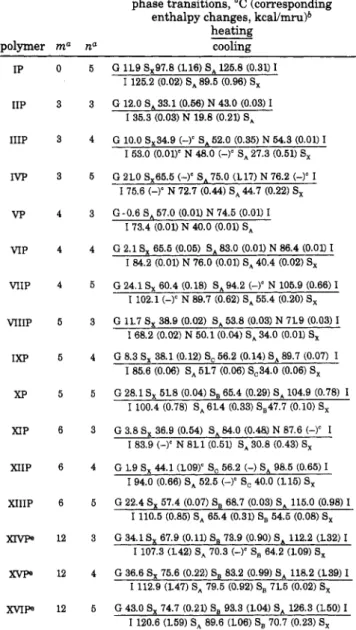
Table 3 reported the thermal transition and thermo- dynamic parameters of polymers IP-XIIIP. All poly- mers reveal liquid crystalline phases. The phase as- signment was conducted by both optical polarizing microscopy and X-ray diffraction measurements. Poly-
Macromolecules,
Vol.
28,No.
5, 1995 Synthesis of LC Polyoxetanes 1677 VI1 P 4 .Tt=89.7 z Y .d YIe
C I V I 1 P 5.02 i A 100 'C 29.78 i 4 . 9 3 i -60 -18 24 66 108 1so
Temp. ("C)Figure 2. DSC thermograms of
VIIP
(10 "C/min): (A) second heating scan;(B)
cooling scan.exhibits enantiotropic smectic A and an undefined smectic phase. Among polymers IIP-IVP that contain three methylene units in their spacers, polymer IIP presents enantiotropic nematic and smectic A phases, while both polymers IIIP and
IVP
exhibit enantiotropic nematic, smectic A, and an undefined smectic phase. Polymers VP-VIIP that contain four methylene units in their spacers, show mesomorphic behavior very similarto
that of their corresponding polymers IIP-IVP.
It
seems that the nature of the mesophase depends on the length of the terminal alkyl groups. Both polymers IIP and VP containing a propyl end group, revealing nematic and smectic A phases, while the other four polymers that contain either a butyl or a pentyl end group exhibit nematic, smectic A, and an undefined smectic phase. Figure 2 illustrates the representative DSC traces of polymer VIIP. On the heating scan (curveA), it shows a glass transition temperature
(Tg)
at 24.1"C followed by an undefined smectic to smectic A phase transition a t 60.4 "C, a smectic A
to
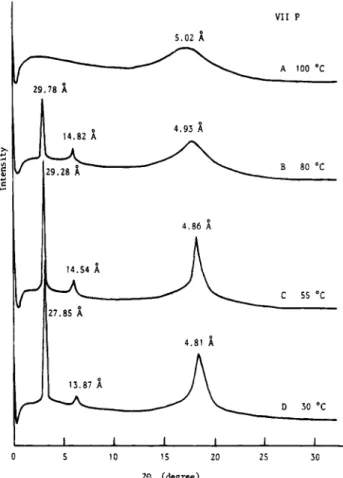
nematic phase transition at 94.2 "C, and a nematic to isotropic phase transition a t 105.9 "C. The cooling scan (curve B) looks almost identical to the heating scan, except that a very small supercooling (less than 5 "C) is observed for all three exothermic transitions. Figure 3 presents the temperature-dependent X-ray diffraction diagrams ob- tained from the powder sample of VIIP a t 100, 80, 55,and 30 "C. Curve A shows only a diffise reflection at about 5.02
A
that corresponds to the lateral spacing of mesogenic side groups. It indicates the formation of a nematic phase. The optical polarizing micrograph (Figure 4A) also reveals a characteristic nematic tex- ture. When the measuring temperature has been lowered to 80 "C, a sharp first-order reflection at 29.78A
and a second-order reflection a t 14.82A
(associated0 5 10 1 5 20 2s 30
20 (degree)
Figure 3. Temperature-dependent X-ray measurements for
polymer
VIIP
at (A) 100, (b) 80, (C) 55, and (D) 30 "C.with the smectic layers) are observed (curve B). The optical polarizing micrograph (Figure 4B) reveals a focal-conic fan texture for polymer VIIP in this temper- ature range. Both results are consistent with a smectic
A structure. When the measuring temperature has been further cooled to 30
"C,
the d spacing of the first- order reflection decreases from 29.78 to 27.85A
and a sharp wide angle reflection is observed (curve D). The optical polarizing micrograph (Figure 4C) shows a higher ordered smectic texture. These results indicate the formation of a tilted smectic phase, prabably a smectic G phase. The detailed structure of this smectic phase should be further studied by X-ray diffraction patterns of an aligned monodomain sample.Among polymers VIIIP-XP that contain five meth- ylene units in their spacers, polymer VIIIP exhibits enantiotropic nematic, smectic A, and an undefined smectic phase, polymer
IXP
reveals enantiotropic smec- tic A, smectic C, and an Undefined smectic phase, while polymer X P presents enantiotropic smectic A, B, and an undefined phase. Polymers XIP-XIIIP that contain six methylene units in their spacers show mesomorphic behavior very similar tothat
of their correspondingpolymers VIIIP-XP. Again it demonstrates that the
nature of the mesophase depends on the length of the terminal alkyl groups. Both polymers VIIIP and XIP with a propyl end group exhibit enantiotropic nematic, smectic A, and an undefined smectic phase. Their X-ray
diffraction patterns and optical polarizing micrographs are very similar to those of polymer VIIP. Both poly- mers
IXP
and XIIP with a butyl end group reveal enantiotropic smectic A, C, and an undefined phase. Figure 5 presents the DSC traces of polymer XIIP. It shows respectively a glass transition and three thermal transitions on both heating and cooling scans. The1678 Lu and Hsu Macmmoleeules, Vol. 28,
No.
5,1995Figure 4. Optical polarizing micrographs displayed by VIIP (A) N texture obtained after cooling from isotropic phase to
101 "C; (B) SA texture obtained after cooling to 85 "C; (C)
higher ordered smectic texture obtained after cooling to 31 "C.
temperature-dependent X-ray diffraction diagrams ob- tained from
a
powder sample of XIIP at 85,50, and 25"C are shown in Figure 6. Curve A shows a diffise wide-angle reflection a t 4.93
A
(associated with the lateral spacing of mesogenic side groups) and a sharp first-order reflection at 28.89A
and a second-order reflection at 14.49A
(both associated with the smectic layers) in the small-angle region. The optical polarizing micrograph reveals a focal-conic fan texture for polymerN I P at this temperature range. Both results are consistent with a smectic A structure. When the measuring temperature has been lowered from 85 to 50
"C, the d spacing of the first-order reflection decreases from 28.89 to 24.48
A
(curve B). This gives strung evidence for the formation of the tilted smectic C phase. This result is also in agreement with the optical polar- izing microscopic observation that reveals a broken fanX I 1 P 4
7
TI-44. I Ti-98. I Tg-1.9 T2-56.2 Ti-94.0 Ti =40 .O -50 -10 30 70 110 N hi L .- LE
c.-
Tnnp. ( " C )ura 6. DSC thermograms ofXIIF' (10 "C/min): (A) second ing scan;
(B)
cooling scan.X I 1 P
a
1.13 1 .C 4.66 1 4.60 1 12.40 1 1.11 t, 1.511 iFigure 6. Temperature-dependent X-ray measurementa for polymer
XIIP
at (A) 85, (B) 50, and (C) 25 'C.Macromolecules, Vol. 28, No. 5, 1995 >_ .- n
5
E-
Figure 7. Optical polarizing micrograph displayed by XIIP
SC texture obtained after cooling from isotropic phase to 50 "C. 4.70 i Ti.ll5.0 Ti-110.5 T2.65.4
1
I I I I -30 a 46 a4 122 I60 Temp. ("C)Figure 8. DSC thermograms of XIIIP (10 'C/min):(A) second heating man;
(B)
cooling scan.texture (Figure 7). When the measuring temperature
has been further cooled to 25 "C, the d spacing of the first-order reflection remains a t the same value and the wide-angle reflection becomes very sharp. The texture obtained at this temperature looks identical to that of Figure 4C. The results indicate the formation of a tilted smectic phase. Both polymers XP and XIIIP with a pentyl end group show enantiotropic smectic A, B, and an undefined phase. Figure 8 depicts the DSC traces of polymer XIIIP. It shows respectively a glass transi- tion and three thermal transitions on both heating and cooling scans. Figure 9 presents the temperature- dependent X-ray dimaction diagrams obtained from a powder sample of XIIIP a t 95,65,55 and 35 "C. Curve
A
shows a diffuse reflection a t 4.938;
a t the wide-angle region, a sharp first-order reflection a t 30.99A,
and a second-order reflection a t 15.58A a t small-angle region.30.99 i Synthesis of LC Polyoxetanes 1679 X l l l P
I
I I I I I I 0 5 IO I S 20 2 1 30 2@ l d e g m lFigure 9. Temperature-dependent X-ray measurements for
polymer XIIIP at (A) 95, (B) 65, (C) 55, and (D) 35 "C.
Figure 10. Optical polarizing micrograph displayed by XIIIP SB texture obtained after cooling from isotropic phase to 66.5
"C.
The optical polarizing micrograph reveals a focal-conic fan texture for polymer XIIIP a t this temperature range. Both results are consistent with a smectic A structure. When the measuring temperature has been lowered from 95 to 65 "C, the wide-angle reflection becomes very sharp (curve B). The optical polarizing micrograph (Figure 10) reveals some arc lines across the back of the fan a t the transition temperature region (near 66.5 "C). The arc lines will disappear when the temperature is further cooled. These results indicate the formation of a smectic B phase.37 When the measuring temperature has been further cooled to 35 "C, the d spacing of the first-order reflection decreases from 30.95 to 29.10
A.
The texture obtained a t this temperature looks identical to that of Figure 4C. The results indicate the formation of a tilted smectic phase. Polymers XIW-XVIP that
1680 LuandHsu Macromolecules, Vol. 28, No. 5, 1995
contain twelve methylene units in their spacers, show completely the same mesomorphic behavior with poly- mers X P and XIIIP.
The experimental data reported in Table 3 demon- strate that all polymers show polymorphism of meso- phases. In each series of polymers which contain the same terminal group, the isotropization temperature first decreases and then increases with increasing spacer length. Furthermore, the spacer length can affect also the nature of the mesophases formed. The polymers with shorter spacer lengths (n = 3, 4) form also a nematic phase besides the other two smectic phases, while those with longer spacer lengths (n 2 5 )
form only three smectic phases.
Conclusions
A new series of side-chain liquid crystalline poly- oxetanes containing 4-(alkanyloxy)phenyl trans-4alkyl- cyclohexanoate side groups are synthesized. The ob- tained polymers reveal polymorphism of mesophases. Both spacer length and terminal alkyl length have a profound effect on the nature and thermal stability of the mesophases. Although the polyoxetane backbone is expected to be more flexible than the polymethacry- late backbone, all the obtained polymers do not undergo side-chain crystallization even if twelve methylene units are used to connect the polymer backbone and the mesogenic units.
This
results could be due to the cyclohexane based mesogenic units that, as illustrated in our previous ~ t u d i e s , 3 ~ - ~ ~ exhibits conformational isomerism.Acknowledgment. The authors are grateful t o the National Science Council of the Republic of China for financial support of this work (Grants NSC-83-0405-
E009-010).
References
and Notes
(1) Ciferri, A., Krigbaum, W. R., Eds. Polymer Liquid Crystals; Academic Press: New York, 1982.
(2) Chapoy, L. L., Eds. Recent Advances in Liquid Cvstalline Polymers; Elsevier: London and New York, 1985. (3) Blumseein, A, Eds. Polymeric Liquid Crystals; Plenum: New
York, 1985.
(4) McArdle, C. B., Eds. Sicle Chain Liquid Crystal Polymers; Blackie: Glasgow and London, 1989.
(5) Jones, B. A.; Bradshaw, J. S.; Nishioka, M.; Lee, M. L. J.
Org. Chem. l W , 49,4947.
(6) Apfel, M. A; Finkelmann, H.; Janini G. M.; Lamb R. J.;
Luhmann,B.H.;Price,k;Roberte,W.U.;Shaw,T.J.;Smith,
C. A. Anal. Chem. 1985,57,651.
(7) Bradshaw, J. S.; Schregenbarg, C.; Karen H. C.; Markides, K. E.; Lee M. L. J. Chromatogr. 1986,358,95.
(8) Coles, H. J.; Simon, R. Polymer 1985,26, 1801.
(9) Goozner, R. F.; Finkelmann, H. Makromol. Chem. 1985,186, (10) Eich, M.; Wendor€€, J. H.; Reck B.; Ringsdorf, H. Makromol. (11) Eich, M.; Wendor€€, J. H. Makromol. Chem. Rapid. Commun. (12) Armitage, D.; Thackara, J. I.; Eades, W. D. Liq. Cryst. 1989, (13) Gray, G. W.; Hawthorne, W. D.; Hill, J. S.; Lacey, D.; Lee, (14) Ortler, R.; Brauchle, C.; Miller, A; Riepl, G. Makromol. Chem. (15) Natansohn, A.; Xie, S.; Rochon, P. Macromolecules 1992,25, (16) Perec, V.; Tomazos, D. A d u . Muter. 1992,4, 549.
(17) Tuan, P. A.; Kostromin, S. G.; Shibaev, V. P. Polym. Bull. (18) Fujishiro, K.; Pajerski, A. D.; Lenz, R. W. Liq. Cryst. 1992, (19) Fujishiro, K.; Lenz, R. W. Liq. Cryst. 1992, 12, 561. (20) Tuan, P. A.; Kostromin, S. G.; Shibaev, V. P. Polym. Bull.
2407.
Chem. Rapid. Commun. 1987,8,59. 1987,8,467.
5, 1389.
M. S. K.; Nestor, G.; White, M. S. Polymer 1989,30,964. Rapid. Commun. 1989,10,189.
5531.
1992,29, 49.
12, 417.
1993, 30, 249.
(21) Akiyama, E.; Nagase, Y. Makromol. C k m . , Rapid Commun. 1993, 14. 251.
(22) Kawakami, Y.; Takahashi, K.; Hibino, H. Macromolecules (23) Kawakami, Y.; Takahashi, K. Polym. Bull. 1991,25, 439. (24) Kawakami, Y.; Takahashi, K.; Nishiguchi, S.; Toida, K. (25) Komiya, Z.; Pugh, C.; Schrock, R. R. Macromolecules 1992, (26) Pugh, C.; Schrock, R. R. Macromolecules 1992,25, 6593. (27) Komiya, Z.; Schrock R. R. Macromolecules 1993,26, 1387. (28) Komiya, 2.; Schrock, R. R. Macromolecules 1993,26, 1393. (29) Kim, S. H.; Lee, H. J.; Jin, S. H.; Cho, H. N.; Choi, S. K. (30) Hsu, C. S.; Lu, Y. H. Polym. Bull. 1991,25, 169.
(31) Hsu, C. S.; Lu, Y. H. J . Polym. Sci., Polym. Chem. 1991,29, (32) Hsu, C. S.; Rodriguez-Parada, J. M.; Percec, V. Makromol. (33) Hsu, C. S.; Rodriguez-Parada, J. M.; Percec, V. J. Polym. Sci., (34) Hsu, C. S.; Percec, V. Makromol. C k m . 1988,189, 1141. (35) Percec, V.; Pugh, C. In Side Chain Liquid Crystal Polymers;
McArdle, C . B.; Ed.; Chapman and Hall: New York, 1989; p 53. 1991,24, 4531. Polym. Int. 1993, 31, 35. 25, 6586. Macromolecules 1993, 26, 846. 977. Chem. 1987,188,1017. Polym. Chem. 1987,25,2425.
(36) Hsu, C. S.; Lu, Y. H.; Chang, H. L. Polym. Bull., in press. (37) Gray, G. W.; Goodby J. W. Smectic Liquid Crystals, Texture
and Structures; Leonard Hill: Glasgow and London, 1984; p 39.