Derived from 2,2
ⴕ-Bis(3,4-dicarboxyphenoxy)-9,9ⴕ-spirobifluorene Dianhydride
D. SAHADEVA REDDY, CHING-FONG SHU, FANG-IY WU
Department of Applied Chemistry, National Chiao Tung University, Hsin-Chu, Taiwan, 30035, Republic of China
Received 25 July 2001; accepted 5 November 2001 Published online 00 Month 2001
ABSTRACT: The synthesis of aromatic poly(ether imide)s containing spirobifluorene units in the polymer backbone is described. 2,2 ⬘-Bis(3,4-dicarboxyphenoxy)-9,9⬘-spiro-bifluorene dianhydride, which was used as a new monomer, was synthesized with 2,2⬘-dihydroxy-9,9⬘-spirobifluorene as the starting material. In the spiro-segment, the rings of the connected bifluorene were orthogonally arranged. This bis(ether anhydride) monomer was employed in reactions with a variety of aromatic diamines to furnish poly(ether imide)s, involving an initial ring-opening polycondensation and subsequent chemically induced cyclodehydration. Excellent solubility in common organic solvents at room temperature, good optical transparency, and high thermal stability are the prominent characteristic features of these new polymers, which can be attributed to the presence of spiro-fused orthogonal bifluorene segments along the polymer chain. The glass-transition temperatures of the polyimides were 240 –293 °C, and the 5% weight-loss temperatures were greater than 500 °C.© 2001 John Wiley & Sons, Inc. J Polym Sci Part A: Polym Chem 40: 262–268, 2002
Keywords: organosoluble; polyimides; spirobifluorene; amorphous; thermal properties
INTRODUCTION
The excellent mechanical and electrical proper-ties, thermal stability, and chemical resistance of polyimides recommend them for use in high-per-formance polymer materials.1,2However, applica-tions of these polyimides have, in the past, been limited because of their poor solubility in typical organic solvents. This led to modifications in the mode of fabrication, in which the poly(amic acid) precursors are first subjected to fabrication, which is followed by a rigorous thermal treat-ment. However, this process has several draw-backs, which include the emission of volatile by-products (e.g., H2O) that create
strength-weaken-ing voids in thick parts and a storage instability of poly(amic acid) intermediates.3 To overcome these limitations, a considerable amount of re-search has been focused on the synthesis of solu-ble and processasolu-ble polyimides without deteriora-tion of their excellent innate properties.4Several approaches involving structural modifications of the polymer backbone, such as the introduction of bulky lateral groups,5–11 flexible linkages,12,13 and kinked monomers,14 –19have been reported.
In light of these observations, our goal was the synthesis of highly soluble polyimides and an ex-amination of their properties. Our strategy in-volved the incorporation of spirobifluorene units into the polymer backbone with ether linkages in the main chain. In the spiro-segment, the rings of the connected bifluorene were orthogonally ar-ranged and connected via a common tetracoordi-nated carbon,20 –22 and the polymer chains were
Correspondence to: C.-F. Shu (E-mail: [email protected])
Journal of Polymer Science: Part A: Polymer Chemistry, Vol. 40, 262–268 (2002) © 2001 John Wiley & Sons, Inc.
DOI 10.1002/pola.10103
twisted at an angle of 90° at each spiro-center. This structural feature was predicted to restrict the close packing of the polymer chains, thereby reducing the probability of interchain interac-tions, resulting in higher polymer solubility. Moreover, for the spiro-annulated segment, the rigidity of the polyimide backbone would be preserved. Therefore, a novel bis(ether anhy-dride) monomer, 2,2 ⬘-bis(3,4-dicarboxyphenoxy)-9,9⬘-spirobifluorene dianhydride (4), was synthe-sized, starting from 2,2 ⬘-dihydroxy-9,9⬘-spirobif-luorene (1),23and then polymerized with various aromatic diamines. The characteristics of these new poly(ether imide)s, such as the solubility, thermal behavior, and optical properties, are dis-cussed.
EXPERIMENTAL
Materials
1 (mp⫽ 285–287 °C) was prepared as described in
the literature.23 p-Phenylenediamine was
puri-fied by sublimation. m-Phenylenediamine was vacuum-distilled before use. 4,4 ⬘-Methylenediani-line and 4,4⬘-oxydianiline were recrystallized from ethanol. 3,3 ⬘-(Hexafluoroisopropylidene)di-aniline was used without further purification. The anhydrous solvents N-methyl-2-pyrrolidone (NMP; Aldrich) and pyridine (Aldrich) were stored over 4-Å molecular sieves before use.
Measurements
1H and13C NMR spectra were recorded on a Var-ian Unity 300-MHz or Bruker-DRX 300-MHz spectrometer with CDCl3or dimethyl sulfoxide-d6 (DMSO-d6) as a solvent. IR spectra were obtained on a Nicolet 360 Fourier transform infrared (FTIR) spectrometer. Differential scanning calo-rimetry (DSC) was performed on a Seiko SSC 5200 DSC with heating and cooling rates of 20 °C min⫺1. Samples were scanned from 30 to 400 °C, cooled to 30 °C, and scanned for a second time from 30 to 400 °C. The glass-transition tempera-ture (Tg) was determined from the second heating scan. Thermogravimetric analysis (TGA) was per-formed on a Seiko TG/DTA 200 instrument. The thermal stability of the samples was determined in nitrogen by measurement of the weight loss during heating at a rate of 10 °C min⫺1. Mass spectra were obtained on a JEOL JMS-SX/SX 102A mass spectrometer. Size exclusion
chroma-tography was carried out on a Waters chromatog-raphy unit interfaced with a Waters 410 differen-tial refractometer. Three Waters 5-m Styragel columns (300 ⫻ 7.8 mm) connected in series in decreasing order of pore size (104, 103, and 102Å) were used with tetrahydrofuran (THF) as the eluent, and polystyrene standard samples were used for calibration. Ultraviolet–visible (UV–vis) spectra were obtained with an Agilent 8453 spec-trophotometer. Wide-angle X-ray diffraction pat-terns were obtained at room temperature on an M18XHF material analysis and characterization instrument with Ni-filtered Cu K␣ 1 radiation (50 kV, 200 mA) with a sampling step of 0.02° and a scanning rate of 4° min⫺1.
2,2 ⴕ-Bis(3,4-dicyanophenoxy)-9,9ⴕ-spirobifluorene (2)
A mixture of 1 (3.48 g, 10.0 mmol) and 4-nitroph-thalonitrile (3.48 g, 20.1 mmol) was dissolved in anhydrous dimethylformamide (DMF; 20 mL), potassium carbonate (2.80 g, 20.3 mmol) was added, and the mixture was stirred at 60 °C for 14 h. The resulting solution was slowly poured into 120 mL of water to give a colorless, solid precipitate, which was collected by filtration and dried in vacuo. The crude product was recrystal-lized from ethyl acetate/acetonitrile (1:1 v/v) to afford the pure bis(ether dinitrile) 2 (5.67 g, 94.5%). mp: 286 –288 °C. IR (KBr, cm⫺1): 2234 (C'N), 1246 (COOOC).1H NMR (DMSO-d 6,␦): 6.54 (d, 2H, J⫽ 2.1 Hz), 6.66 (d, 2H, J ⫽ 7.5 Hz), 7.15 (dd, 2H, J⫽ 7.5, 7.5 Hz), 7.23 (dd, 2H, J ⫽ 8.7, 2.1 Hz), 7.26 (dd, 2H, J ⫽ 8.9, 2.4 Hz), 7.41 (dd, 2H, J ⫽ 7.5, 7.5 Hz), 7.62 (d, 2H, J ⫽ 2.4 Hz), 7.97–8.03 (m, 4H), 8.12 (d, 2H, J ⫽ 8.3 Hz). 13C NMR (DMSO-d6, ␦): 161.1, 153.6, 150.2, 147.9, 140.2, 139.0, 136.1, 128.2, 128.0, 123.4, 122.5, 122.3, 121.8, 120.7, 120.4, 116.5, 115.9, 115.3, 108.1, 65.4. HRMS: calcd for C41H20N4O2, 600.1586; found, 600.1572. 2,2 ⴕ-Bis(3,4-dicarboxyphenoxy)-9,9ⴕ-spirobifluorene (3)
Sodium hydroxide (13.5 g) was dissolved in a mix-ture of water and methanol (30 mL/30 mL) and added to compound 2 (5.4 g, 9.0 mmol). The mix-ture was refluxed for 36 h, at which time a clear solution was obtained. The resulting hot solution was filtered for the removal of insoluble impuri-ties. The filtrate was diluted with distilled water
and acidified with concentrated HCl (pH 2–3). The precipitated product was filtered and washed thoroughly with water until the washings were neutral and was dried to give the bis(ether diacid)
3 (5.3 g, 87.1%). mp: 155–158 °C (decomposition). IR (KBr, cm⫺1): 2500 –3400 (br, OH), 1712 (CAO), 1261 (COOOC).1H NMR (DMSO-d 6,␦): 6.37 (d, 2H, J ⫽ 2.3 Hz), 6.65 (d, 2H, J ⫽ 7.5 Hz), 6.98–7.02 (m, 4H), 7.11–7.16 (m, 4H), 7.39 (dd, 2H, J⫽ 7.6, 7.6 Hz), 7.67 (d, 2H, J⫽ 8.9 Hz), 7.97 (d, 2H, J ⫽ 7.6 Hz), 8.05 (d, 2H, J⫽ 8.3 Hz).13C NMR (DMSO-d6, ␦): 168.3, 167.4. 158.9, 155.1, 150.2, 147.8, 140.5, 137.9, 136.4, 131.4, 128.3, 127.9, 126.0, 123.4, 122.3, 120.6, 119.6, 118.8, 116.8, 114.9, 65.4. 2,2 ⴕ-Bis(3,4-dicarboxyphenoxy)-9,9ⴕ-spirobifluorene dianhydride (4)
Acetic anhydride (6 mL) was added to bis(ether diacid) 3 (3.2 g, 4.7 mmol), and the suspension was stirred under reflux for 45 min, during which time a white solid precipitated. After cooling, the solid was collected by filtration, washed with a small amount of glacial acetic acid, and dried in
vacuo at 140 °C for 12 h to yield the colorless, pure
dianhydride (2.6 g, 86%).
mp: 202–203 °C. IR (KBr, cm⫺1): 1849, 1777 (CAO), 1283 (COOOC).1H NMR (DMSO-d
6,␦): 6.52 (d, 2H, J⫽ 2.2 Hz), 6.68 (d, 2H, J ⫽ 7.5 Hz), 7.16 (dd, 2H, J ⫽ 7.5, 7.5 Hz), 7.24 (dd, 2H, J ⫽ 8.4, 2.4 Hz), 7.31 (d, 2H, J ⫽ 2.1 Hz), 7.38–7.44 (m, 4H), 7.97 (d, 2H, J⫽ 8.4 Hz), 8.01 (d, 2H, J ⫽ 7.5 Hz), 8.13 (d, 2H, J ⫽ 8.4 Hz). 13C NMR (CDCl3, ␦): 164.9, 162.4, 162.0, 153.7, 150.9, 147.9, 140.4, 139.6, 133.8, 128.3, 127.6, 124.8, 124.2, 124.0, 121.8, 120.4, 120.1, 116.5, 112.0, 65.8. HRMS: calcd for C41H20O8, 640.1158; found, 640.1150.
Poly(ether imide)s (6a– 6e)
A typical polymerization procedure was as fol-lows. The dianhydride 4 (320 mg, 500mol) was added in one portion to a stirred and clear solu-tion of 4,4⬘-methylenedianiline (99 mg, 500mol) in NMP (2.8 mL) under N2 at ambient tempera-ture. The stirring was continued for 12 h, result-ing in a viscous solution. Chemical cyclodehydra-tion of the resulting poly(amic acid) solucyclodehydra-tion was performed by the slow addition of a mixture of acetic anhydride (1.5 mL), pyridine (0.75 mL), and NMP (1.5 mL), which was followed by heating
at 80 °C for 2 h. The polymer solution was poured into methanol (80 mL), and the colorless, fibrous solid was collected by filtration, washed thor-oughly with methanol, and dried in vacuo at 100 °C to afford the corresponding polymer 6a. The polymers were purified by reprecipitation from THF into methanol.
RESULTS AND DISCUSSION
Synthesis of the Monomer
The new dianhydride (4) was synthesized in three steps, starting from 1, as shown in Scheme 1. Compound 1 was prepared according to the re-ported literature.23 Nucleophilic substitution of the nitro function of 4-nitropthalonitrile with diol
1 in an anhydrous DMF/K2CO3 medium fur-nished 2 in quantitative yields. Alkaline hydroly-sis of the bis(ether dinitrile) 2 with aqueous so-dium hydroxide in methanol resulted in 3, which was subsequently dehydrated with acetic anhy-dride to afford the desired monomer 4. The struc-tures of the synthesized compounds were verified by FTIR,1H NMR, and13C NMR spectroscopy, as well as mass spectroscopy. The presence of the C'N function in 2 is evident from the IR spec-trum (2234 cm⫺1). However, compound 3 was characterized by the presence of carboxyl groups (2500 –3400 broad and 1712 cm⫺1) in the IR spec-trum, and in the13C NMR spectrum, the carbonyl carbon signals were observed at ␦ ⫽ 168.3 and 167.4. When the tetracarboxylic acid 3 was dehy-drated to the bis(ether anhydride) 4, the absorp-tions due to the carboxyl groups disappeared, and characteristic CAO stretching absorptions of the cyclic anhydride unit appeared at 1849 and 1777 cm⫺1. In addition, the carbonyl carbon peak in the 13C NMR spectrum was shifted upfield (␦ ⫽ 164.9). Based on reported 1H NMR data of 2,2⬘-disubstituted-9,9⬘-spirobifluorene24and
iliary two-dimensional (H,H)-correlated spectros-copy, the positions of the chemical shifts for pro-tons of compounds 2–4 were readily assigned, as shown in Figure 1. The area of integration for the protons is consistent with the assignment. There-fore, the1H NMR spectra are consistent with the assigned structures of compounds 2–4.
Synthesis of the Poly(ether imide)s
Polyimides 6a–6e were synthesized in NMP solu-tions with the conventional two-stage procedure, involving ring-opening polycondensation and cy-clodehydration, in which the bis(ether anhydride)
4 was reacted with stoichiometric amounts of
dia-mine monomers 5a–5e to form poly(amic acid) intermediates (Scheme 2). The poly(amic acid)s were subsequently chemically imidized to poly-(ether imide)s by treatment with a mixture of acetic anhydride and pyridine.25 The polymers were isolated in quantitative yields by precipita-tion into methanol and dried in vacuo. The forma-tion of poly(ether imide)s 6a–6e was confirmed by IR spectroscopy. The absence of amic acid absorp-tions [⬃3350 (NH and OH) and 1650 cm⫺1 (amide, CAO)] and the presence of cyclic imide carbonyl absorptions (1778 and 1724 cm⫺1) in the IR spectra of poly(ether imide)s confirmed the complete cyclodehydration of the corresponding amide intermediate. In addition, DSC and TGA measurements, which did not show any transi-tions corresponding to imidization, indicated that the resultant polyimides were fully imidized. The structure of the poly(ether imide)s was character-ized by 1H NMR. Figure 2 shows the 1H NMR
spectra of polymers 6a–6e. In addition to the dis-tinct features associated with the spirobifluorene dianhydride component, resonances correspond-ing to the aromatic protons of the diamine com-ponent are clearly present. 13C NMR provided complementary information. The resonances
as-Figure 1. 1H NMR spectra of compounds (a) 2, (b) 3,
and (c) 4 in DMSO-d6. Scheme 2
Figure 2. 1H NMR spectra of poly(ether imide)s (a)
6a, (b) 6b, (c) 6c, (d) 6d, and (e) 6e in CDCl3. * indicates
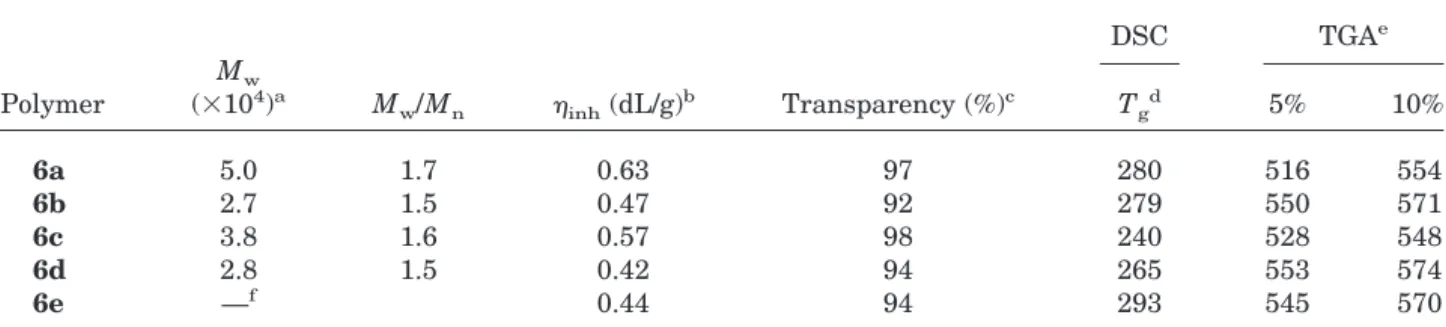
sociated with the carbonyl carbons of the ether-linked phthalic ring appeared in a relatively downfield region (␦ ⫽ 166).26 The molecular weights of the polymers, except for the poly(ether imide) 6e, which was only partially soluble in THF, were determined by gel permeation chroma-tography (GPC) with THF as the eluent and with calibration against polystyrene standards. The molecular weights and polydispersities [weight-average molecular weight/number-[weight-average mo-lecular weight (Mw/Mn)] are shown in Table I.
The crystallinity of the poly(ether imide)s was evaluated by wide-angle X-ray diffraction experi-ments. All the polymers displayed amorphous dif-fraction patterns due to the kinked 9,9 ⬘-spirobif-luorene structure. For spiro-fused bif⬘-spirobif-luorene, the two mutually perpendicular fluorine rings are connected via a common tetracoordinated carbon atom. This structural feature minimizes intermo-lecular interactions between the polymer chains and inhibits chain packing, leading to the ob-served reduction in crystallinity. The amorphous character of the polyimides is also reflected in their high solubility.
Solubility
The solubility of the poly(ether imide)s was deter-mined in a variety of organic solvents. All the polyimides exhibited good solubility in polar aprotic solvents such as NMP, DMF, dimethylac-etamide (DMAc), and pyridine and in m-cresol, a phenolic solvent, as well as chlorinated solvents such as chloroform and methylene chloride. The poly(ether imide)s, except for polyimide 6e, were
also soluble in the less polar THF. The poor solubil-ity of 6e in THF was possibly due to the rigid nature of its diamine moiety. The highly soluble nature of these poly(ether imide)s can be attributed to the presence of kinked spirobifluorene units (as dis-cussed previously), with flexible aryl ether linkages along the polymer backbone. It has been reported that poly(ether imide)s derived from 9,9 ⬘-bis[4-(3,4-dicarboxyphenoxy)phenyl]fluorine dianhydride (7) have poor solubility in organic solvents.27This ob-servation reveals the important role of the orthog-onal arrangement of each bifluorene moiety in the polymer chain, as this affects the enhanced solubil-ity of poly(ether imide)s 6a–6e:
Transmittance
UV–vis spectra of the poly(ether imide)s at a con-centration of 5⫻ 10⫺3mol/L in NMP solutions are shown in Figure 3. All the polymers except 6b showed transmittances above 90% in the wave-length range 450 – 600 nm. Polymer 6b exhibited a transmission in excess of 80% in the visible region. The transparency of the polymer solution in the visible region was evaluated by the aver-aging of the transmittances from 400 to 780 nm in the UV–vis spectra, and the results are presented in Table I. The colored nature of the polyimides
Table I. Molecular Weights, Inherent Viscosities, and Optical and Thermal Properties of Poly(ether imide)s 6a– 6e
Polymer Mw (⫻104)a M w/Mn inh(dL/g)b Transparency (%)c DSC TGAe Tgd 5% 10% 6a 5.0 1.7 0.63 97 280 516 554 6b 2.7 1.5 0.47 92 279 550 571 6c 3.8 1.6 0.57 98 240 528 548 6d 2.8 1.5 0.42 94 265 553 574 6e —f 0.44 94 293 545 570
aDetermined by GPC in THF based on polystyrene standards. bMeasured at 0.5 g/dL in DMAc at 30 °C.
cAverage transmittance in the visible region (400 –780 nm) for poly(ether imide) solutions in NMP at a concentration of 5
⫻ 10⫺3M with a 1.0-cm path length.
dDetermined by DSC at a heating rate of 20 °C min⫺1under nitrogen.
eTemperatures at which 5 and 10% weight losses were determined at a heating rate of 10 °C min⫺1under nitrogen. fPartially soluble in THF.
was due to the presence of intramolecular and intermolecular charge-transfer interactions and electron conjugation.28 –30 The favorable optical transparency of the polymers can be attributed to the suppression of intermolecular interactions by the spiro-structure, which possesses a mutually perpendicular arrangement of the bifluorene moi-ety. Moreover, the tetrahedral spiro-junction serves as a conjugation interrupter, thereby pre-venting extended conjugation along the polymer backbone.
Thermal Properties
The thermal properties of the poly(ether imide)s were investigated by DSC and TGA, and the re-sults are tabulated in Table I. The incorporation of rigid spirobifluorene units in the polymer back-bone resulted in poly(ether imide)s with higher
Tg’s. The Tg’s of polyimides 6a–6e were 240 –293 °C, depending on the structure of the diamine component. The poly(ether imide) with a hexaflu-oroisopropylidene linkage (6c) or the less sym-metric m-phenylene unit (6d) tended to have a lower Tg. Because of the symmetry and stiffness of the p-phenylene moiety in the polymer back-bone, the Tg of 6e was higher than that of the other polymers. The thermal stability of the poly-(ether imide)s was evaluated with TGA. All the polyimides were stable up to approximately 500 °C and showed a similar pattern of decomposi-tion. Their 5 and 10% weight-loss temperatures in nitrogen were 516 –553 and 548 –574 °C, respec-tively. These results are indicative of the high
thermal stability of the spirobifluorene unit in the polymer backbone.
SUMMARY
Spirobifluorene units with ether linkages were successfully introduced into the polymer back-bone for the first time via the polycondensation of
4 with a variety of diamines. The new
dianhy-dride monomer was prepared from 1 and 4-nitro-phthalonitrile. The obtained poly(ether imide)s possess excellent solubility in common organic solvents and good transparency to visible light, which can be attributed to the presence of spiro-fused orthogonal bifluorene segments along the polymer chain. DSC and TGA experiments also demonstrated the high thermal stability of the spiro-structure in the polymer backbone. Further studies on the incorporation of the spirobifluorene unit into a polymer backbone for the purpose of identifying new candidates for soluble and pro-cessable high-performance polymeric materials are currently in progress.
The authors thank the National Science Council of the Republic of China for its financial support.
REFERENCES AND NOTES
1. Polyimides; Wilson, D.; Stenzenberzer, H. D.; Her-genrother, P. M., Eds.; Blackie: New York, 1990. 2. Polyimides: Fundamentals and Applications; Ghosh,
M. K.; Mittal, K. L., Eds.; Marcel Dekker: New York, 1996.
3. Baise, A. I. J Appl Polym Sci 1986, 32, 4043. 4. de Abajo, J.; de la Campa, J. G. In Progress in
Polyimide Chemistry I; Kricheldorf, H. R., Ed.; Ad-vances in Polymer Science 140; Springer: Berlin, 1999; pp 23–59; see also references therein. 5. Lin, S. H.; Li, F.; Cheng, S. Z. D.; Harris, F. W.
Macromolecules 1998, 31, 2080.
6. Liaw, D. J.; Liaw, B. Y.; Li, L. J.; Sillion, B.; Mer-cier, R.; Thiria, R.; Sekiguchi, H. Chem Mater 1998, 10, 734.
7. Yi, M. H.; Huang, W.; Lee, B. J.; Choi, K. Y. J Polym Sci Part A: Polym Chem 1999, 37, 3449.
8. Yang, C. P.; Hsiao, S. H.; Yang, H. W. Macromol Chem Phys 2000, 201, 409.
9. Liaw, D. J.; Liaw, B. Y.; Chung, C. Y. Macromol Chem Phys 2000, 201, 1887.
10. Liou, G. S.; Wang, J. S. B.; Tseng, S. T.; Tsiang, R. C. C. J Polym Sci Part A: Polym Chem 1999, 37, 1673.
Figure 3. UV–vis spectra of polyimide solutions in NMP at a concentration of 5 ⫻ 10⫺3 mol/L with a 1.0-cm path length.
11. Yang, C. P.; Yu, C. W. J Polym Sci Part A: Polym Chem 2001, 39, 788.
12. Eastmond, G. C.; Paprotny, J.; Irwin, R. S. Macro-molecules 1996, 29, 1382.
13. Wang, C. S.; Leu, T. S. Polymer 2000, 41, 3581. 14. Mi, Q.; Gao, L.; Ding, M. Polymer 1997, 38, 3663. 15. Liou, G. S.; Maruyama, M.; Kakimoto, M. A.; Imai,
Y. J. J Polym Sci Part A: Polym Chem 1998, 36, 2021.
16. Matsumoto, T.; Kurosaki, T. Macromolecules 1997, 30, 993.
17. Liaw, D. J.; Hsu, P. N.; Liaw, B. Y. J Polym Sci Part A: Polym Chem 2001, 39, 63.
18. Zheng, H. B.; Wang, Z. H. Macromolecules 2000, 33, 4310.
19. Farr, I. V.; Kratzner, D.; Glass, T. E.; Dunson, D.; Ji, Q.; MeGrath, J. E. J Polym Sci Part A: Polym Chem 2000, 38, 2840.
20. Weisburger, J. H.; Weisburger, E. K.; Ray, F. E. J Am Chem Soc 1950, 72, 4250.
21. Wu, R.; Schumm, J. S.; Pearson, D. L.; Tour, J. M. J Org Chem 1996, 61, 6906.
22. Salbeck, J.; Yu, N.; Bauer, J.; Weissortel, F.; Best-gen, H. Synth Met 1997, 91, 209.
23. Prelog, V.; Bedekovic, D. Helv Chim Acta 1979, 62, 2285.
24. Haas, G.; Prelog, V. Helv Chim Acta 1969, 52, 1202.
25. Yang, C. P.; Lin, J. H. Polymer 1995, 36, 2607. 26. White, D. M.; Takekoshi, T.; Williams, F. J.;
Relles, H. M.; Donahue, P. E.; Klopfer, H. J.; Loucks, G. R.; Manello, J. S.; Matthews, R. O.; Schluenz, R. W. J Polym Sci Polym Chem Ed 1981, 19, 1635.
27. Hsiao, S. H.; Li, C. T. J Polym Sci Part A: Polym Chem 1999, 37, 1403.
28. Ishida, H.; Wellinghoff, S. T.; Baer, E.; Koenig, J. L. Macromolecules 1980, 13, 826.
29. Hasegawa, M.; Kochi, M.; Mita, I.; Yokota, R. Eur Polym J 1989, 25, 349.
30. Hasegawa, M.; Shindo, Y.; Sugimura, T.; Ohshima, S.; Horie, K.; Kochi, M.; Yokota, R.; Mita, I. J Polym Sci Part B: Polym Phys 1993, 31, 1617.