
Examinig china's soft power in Southeast Asia
99
0
0
全文
(2) ABSTRACT “soft power is the ability to get what a country wants through attraction rather than coercion or payment.” -. Joseph S. Nye Jr.. From Nye’s original soft power idea, the term now has been increasingly attached to China’s conduct of its diplomacy in various parts of the globe from Southeast Asia to Africa and South America. This research examines China’s soft power in Southeast Asia and its effectiveness relative to the pursuit and advancement of the country’s regional objectives and aspirations. The primary consideration here would be the US. 政 治 大. approach towards the region and how, if any, this has affected Southeast Asian governments’ reception and perception of China’s drive for increased influence and. 立. potential domination of regional affairs. Striking a comparison between Beijing’s. ‧ 國. 學. standing in Southeast Asia before and after its soft power application would likely provide a logical explanation on the effectiveness of its intensified diplomacy in. ‧. attracting regional countries.. Nat. sit. y. Also of particular importance to this research would be the US policy towards. io. attitude regarding Washington’s regional approach.. er. the region and the underlying rationale behind its stance, as well as Southeast Asia’s Undoubtedly, America’s image in. n. a l by the previous governments’ v missteps and unpopular i the region has been tainted n C i U governments still rely on the US eSoutheast actions, but there is no denying h that n g c hAsian military apparatus for regional stability and security. This has been made more complex. by China’s growing penetration in Southeast Asia, but might as well provide enough reason for the US to engage Southeast Asia a lot more. Knowing the political, economic and historical correlation of individual regional countries vis-à-vis the US and China might shed some light as to their mindset relative to the competition of these two external powers for increased influence in Southeast Asia.. Being the US’ most reliable ally in Southeast Asia, the Philippines offers the most compelling case for this study.. How the Philippines react, and what other. factors influence its behavior, as far its relations with both the US and China provides some relevant information in the overall calculation of Beijing’s attractiveness among ii.
(3) regional countries.. Particularly relevant to this estimation is determining China’s. rationale behind its goal of attaining unparalleled relations with the Philippines as well as Manila’s motivation in reciprocating Beijing’s offer of friendship. Equally important is the evolution of the Philippine-US relations and what drives these two countries to reinvigorate their security partnership, previously the cornerstone of American military supremacy in Southeast Asia, amid China’s charm offensive.. In the end, this study finds that it appears that the Philippines’ strategy vis-à-vis its relations with both the US and China has been to secure the best possible concessions from both countries while playing a delicate balancing game to accommodate their intensified competition for influence in the country. Although there. 治 政 大 security repercussions that Manila is still uneasy with the potential 立 rise might engender in the long run, especially with regards to their. have been remarkable improvement in relations between the Philippines and China, privately. conflicting claims over the SCS.. 學. ‧ 國. Beijing’s. As it seems, the Philippines’ increased confidence in. dealing with China can be rooted on its ability to keep the American military deeply. ‧. engaged in the country.. y. Nat. sit. As has been notable in the Philippine experience, Southeast Asia appeared. al. er. io. determined to sustain the power equilibrium with regards to external powers, and all indications point to China as the concentration of this strategy.. The ASEAN. n. v recognized that Beijing’s softCpower has already put n it iin a position to compete with hengchi U Washington for increased influence in the region.. Southeast Asia wants to. accommodate this, but judged that it would be safer to include other powers in the equation to ensure that the ASEAN still has control in managing these powers’ engagement. Having said this, while there is no doubt that China’s soft power has served its regional purpose well, Southeast Asia’s desire to sustain the regional balance of power, apparently with the US still at the top, would continue to put some limits to Beijing’s charm offensive in the region.. iii.
(4) TABLE OF CONTENTS Page No. TITLE PAGE……………………………………………………….. i. ENDORSEMENT SHEET…………………………………………. ii. ABSTRACT………………………………………………………... iii. TABLE OF CONTENTS…………………………………………... iv. LIST OF FIGURES………………………………………………... v. LIST OF TABLES…………………………………………………. vi. LIST OF ACRONYMS……………………………………………. vii. CHAPTERS I. 政 治 大 Background………………………………………..... 立. Introduction. 1. Literature Review. China’s Soft Power …………………………. ‧. Research Design…………………………………….. 13. y. Nat. 11. sit. n. er. io. al. v ni. Ch. engchi U. China’s Objectives in the Region…………………... IV. V. 14. China’s Southeast Asian Strategy: the Use of Soft Power China’s Soft Power Tools in Southeast Asia……….. III. 7. Engagement and Hedging…………………... Scope and Limitations………………………………. II. 6. 學. ‧ 國. Research Question…………………………………... 17 30. US Policy in Southeast Asia: Declining Influence? Clinton Administration……………………………... 37. Bush Administration………………………………... 43. Obama Administration……………………………... 51. The Philippine-US Security Alliance: the China Factor China’s Soft Power in the Philippines………………. 55. Philippines-US Security Relations………………...... 64. Conclusion………………………………………….. 74. Bibliography…………………………………………. 83. iv.
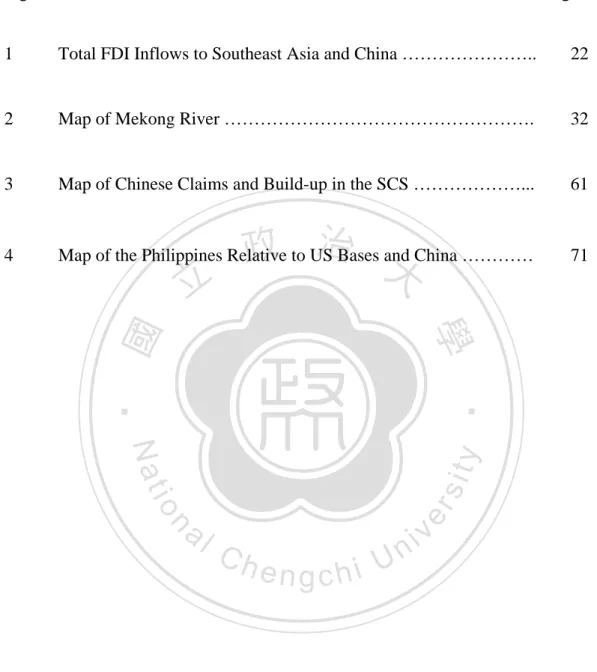
(5) LIST OF FIGURES. Figure. Page No.. 1. Total FDI Inflows to Southeast Asia and China …………………... 22. 2. Map of Mekong River …………………………………………….. 32. 3. Map of Chinese Claims and Build-up in the SCS ……………….... 61. 4. Map of the Philippines Relative to US Bases and China …………. 立. 政 治 大. 71. ‧. ‧ 國. 學. n. er. io. sit. y. Nat. al. Ch. engchi. i n U. v. v.
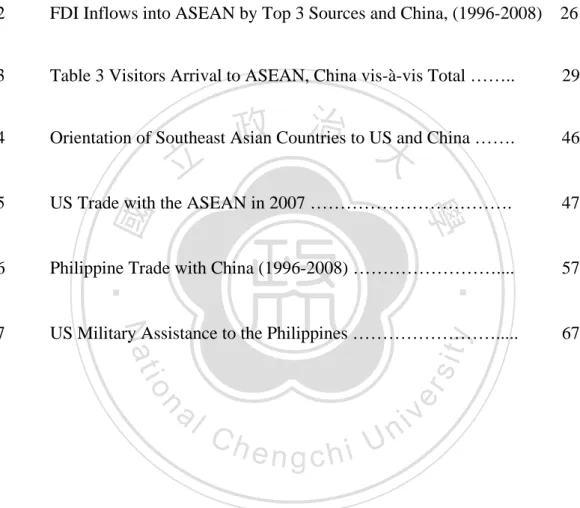
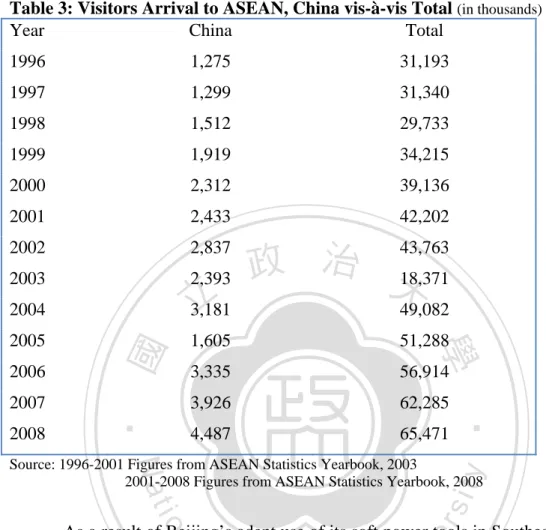
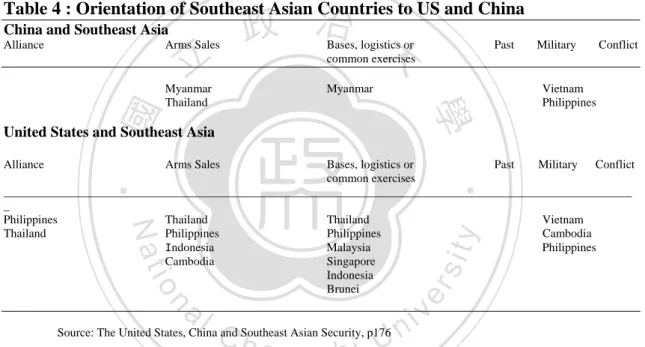
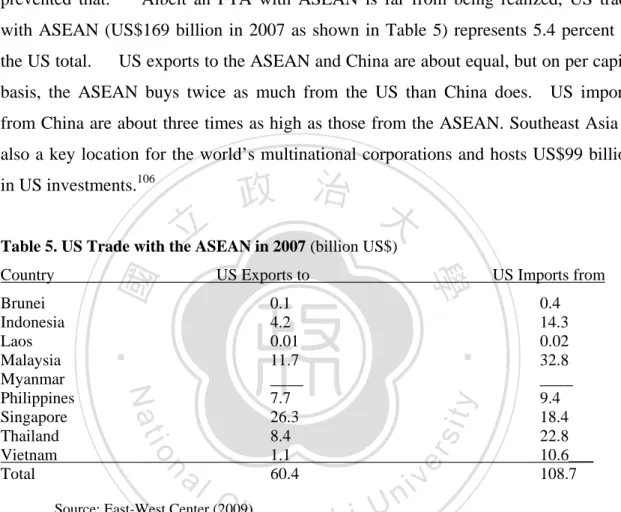
(6) LIST OF TABLES. Table. Page No.. 1. ASEAN Trade with China (1996-2008) …………………………. 2. FDI Inflows into ASEAN by Top 3 Sources and China, (1996-2008) 26. 3. Table 3 Visitors Arrival to ASEAN, China vis-à-vis Total ……... 4. Orientation of Southeast Asian Countries to US and China …….. 立. 政 治 大. 24. 29. 46. US Trade with the ASEAN in 2007 …………………………….. 47. 6. Philippine Trade with China (1996-2008) ……………………..... 57. 7. US Military Assistance to the Philippines ……………………...... ‧. ‧ 國. 學. 5. n. al. er. io. sit. y. Nat. 67. Ch. engchi. i n U. v. vi.
(7) LIST OF ACRONYMS. –. Approved Destination Status. ASEAN. –. Association of Southeast Asian Nation. ASEAN + 3. –. ASEAN plus China, Japan and South Korea. ARF. –. ASEAN Regional Forum. APEC. –. Asia-Pacific Economic Cooperation. CAFTA. –. China-ASEAN Free Trade Agreement. CPC. –. Communist Party of China. EAS. –. East Asia Summit. EU. –. European Union. FDI. –. Foreign Direct Investment. FTA. –. JMSU. --. Joint Marine Seismic Undertaking. JSOTF-P. --. Joint Special Operations Task Force-Philippines. MDT. –. Mutual Defense Treaty. MLSA. --. Mutual Logistics Support Agreement. QDR. --. Quadrennial Defense Review. –. Treaty of Amity and Cooperation. 立 Free Trade Agreement. --. y. sit. n. al. Trade and Investment Framework Agreement. er. io. TIFA. ‧. Nat. TAC. 政 治 大. 學. ‧ 國. ADS. South China Sea. i n U. v. SCS. –. SARS. --. C h eAcute Severe Syndrome hi n g cRespiratory. SEATO. --. Southeast Asian Treaty Organization. VFA. –. Visiting Forces Agreement. WTO. _. World Trade Organization. ZOPFAN. --. Zone of Peace, Freedom and Neutrality. vii.
(8) 立. 政 治 大. ‧. ‧ 國. 學. n. er. io. sit. y. Nat. al. Ch. engchi. i n U. v.
(9) CHAPTER I Introduction. Background. The Philippines has been an important ally of the US through World War II, the Cold War, and now the fight against terrorism and extremism--garnering the distinction as a US non-NATO ally in 2003.. The militaries of the two sides have ongoing and. expanding joint exercises in the southern Philippines, particularly aimed at uprooting the Abu Sayyaf terrorist group. Despite the general agreement on the importance of. 政 治 大 Philippine foreign policy became more independent and assertive regarding sovereignty 立 and self-interests or driven by domestic political pressures. For instance, due to the US-Philippine relations, however, bilateral frictions occasionally have risen as the 1. ‧ 國. 學. mounting pressures from increased nationalistic sentiments and apparent view of the absence of an external security threat, the Philippine Senate in 1991 rejected an. ‧. agreement extending American military bases’ stay in the country. Nonetheless, officials in both the US and the Philippines since 1992 repeatedly have reaffirmed the. y. Nat. sit. 1951 Mutual Defense Treaty (MDT), which dictated that both countries would support. al. But beyond the. er. io. each other if either one was to be attacked by an external party.. n. set-piece exercise called Balikatan (shoulder-to-shoulder), in which American and. Ch. i n U. v. Philippine Marines practice infantry operations and conduct civic action activities, there. engchi. has been little defense cooperation useful to both sides after the American bases pullout.2 In 1995, however, there was a change in attitude in Manila toward external security concerns because of the discovery of Chinese buildings on the Philippineclaimed atoll called Mischief in the disputed South China Sea (SCS) area. It was widely believed that China decided to build those structures in part to take advantage of the regional power vacuum caused by the collapse of the US-Philippine security alliance.. Facing a threat from an uncompromising Beijing, Manila in 1998 signed the. Visiting Forces Agreement (VFA) with Washington.. 1. Thomas Lum and Larry Niksch, “The Republic of the Philippines: Background and US Relations,” CRS Report for Congress (2009), www.fas.org/sgp/crs/row/ RL33233.pdf. 2 Richard D. Fisher, Jr, “Rebuilding the US-Philippines Alliance,” The Heritage Foundation (1999), http://www.heritage.org/Research/Reports/1999/02/Rebuilding-the-US-Philippine-Alliance. 1.
(10) As these developed, China’s economy has been surging to a record high as a result of the diplomatic and economic reforms adopted by Deng Xiaoping since 1978 that enabled the country to accomplish what no other country has done before. China’s economic rise is one of the most spectacular in history, with its per capita gross domestic product (GDP) increasing about 8 percent per year for the 25 years from 1979 to 2004. By comparison, the strongest average per-capita GDP growth for the last rising power--the US--for any 25-year period since 1830 was less than 4 percent per year.3 In 2007, China’s economy overtook Germany’s to become the world’s third largest, after the US and Japan, respectively.4 Despite its economic success, however, China is still plagued with an array of domestic woes from widespread poverty, social disparity to environmental degradation, among other concerns.. The Chinese. 治 政 大 Tying economic vibrancy with problems lies in sustaining the growth of the economy. 立 external security concerns, Chinese leaders often reminded themselves that the Soviet. leadership acknowledged that the foremost solution to their internal, as well as external,. ‧ 國. 學. Union lost the Cold War because the Soviets were not able to sustain the conflict largely due to its deteriorating economy.. ‧. No wonder that maintaining the strength of its economy has driven the. y. Nat. sit. transformation of China’s foreign policy discharge in recent years. More than ever,. al. er. io. Beijing now has been engaging the world by forging productive and increasingly. n. substantial relationships in every corner of the globe, to include new cooperative. Ch. i n U. v. partnerships and agreements in Southeast Asia, Central Asia, Europe, Africa, and South America.. engchi. China has likewise expanded its membership and participation in. international organizations, and has shown increased willingness to adhere to many norms and rules of the global economic and, to a lesser degree, even political system.. The SCS event of 1995 and the subsequent response by the Association of Southeast Asian Nation (ASEAN)--with the Philippines urging for American military intervention--had made the Chinese leadership realized that its aggressive behavior was counterproductive and merely undermined the economic and diplomatic advances 3. Jian Yang, “The Rise of China: Chinese Perspectives,” in The Rise of China and International Security America and Asia Respond, ed. Kevin J. Cooney and Yoichiro Sato (New York: Routledge, 2009), 18. 4 Nipa Piboontanaswat and Kevin Hamlin, “China Passes Germany to Become Third Largest Economy,” Bloomberg (January 14, 2009), http://www.bloomberg.com/apps/news?pid=newsarchive&sid=a9P1peF6QeOg&refer=home. 2.
(11) Beijing had made in Southeast Asia as regional countries became wary and concern of their big neighbor’s true intentions and the repercussions of such on the region’s peace and stability.. In particular, China did not want to see its political ties with the. Philippines deteriorate over the SCS and for Manila to strengthen its security relations with Washington.. Hence, from 1996 to 2000, Beijing consistently disavowed any. intention to dominate Southeast Asia and campaigned for members of the ASEAN to accept a substantial Chinese naval presence in regional waters as a matter of course.5. Amid this development, China is becoming more adept and confident with its foreign policy discharge, mostly through its soft power statecraft or charm offensive. It has increased its influence and importance in various parts of the globe, mostly in. 治 政 大 its image beginning 1997, areas. In Southeast Asia, China was able to further improve 立 when it helped regional economies wrestle the effects of a financial crunch by not countries where the US policy has faltered or deemed by the Americans as problematic. ‧ 國. 學. devaluating its currency. Since then, Beijing was able to wield increase power in Southeast Asia, mostly relying on its skillful use of its soft power tools. Along with. ‧. offering of economic inducements, China has allayed concerns that it poses a military or economic threat, assured its neighbors that it strives to be a responsible member of. y. Nat. sit. the international community, and produced real benefits through aid, trade and. al. er. io. investment. Specifically, China in November 2002 signed with the ASEAN a. n. Declaration on the Conduct of Parties in the SCS, which--albeit non-binding--seeks a. Ch. i n U. v. peaceful settlement of the disputes over the SCS through friendly coordination and. engchi. negotiation. In October 2003, China also became the first external power to accede to the ASEAN’s Treaty of Amity and Cooperation (TAC), which aimed at promoting amity and cooperation based on the principles of mutual respect of sovereignty and territorial integrity, non-interference in each other’s internal affairs and peaceful settlement of disputes.. Beijing’s image transformation in Southeast Asia can also be attributed to Washington’s missteps in the region. The US’ late response in helping regional economies during the 1997-98 Asian financial crisis and its focus on counterterrorism in Southeast Asia after the September 11, 2001 (9/11) attacks--which led to perception 5. Renato R. De Castro, “China, the Philippines and the US Influence in Asia,” American Enterprise Institute for Public Policy Research, Number 2 (2007), http://www.aei.org/outlook/26450. 3.
(12) that Washington’s policy has become one-dimensional--had helped China make significant inroads in the region. The apparent disregard of the then administration of US President George W. Bush for regional security institutions had also tarnished America’s image in Southeast Asia. Despite the fact that no US Secretary of State has missed an ASEAN Region Forum (ARF) meeting since 1982, then Secretary of State Condoleezza Rice skipped the July 2005 event in Laos, sending her deputy instead. Her absence was widely criticized in the region, noting that China’s foreign minister attended most of the ARF meetings and did not press them on a host of difficult issues, such as the war on terrorism, human rights, economic openness, and Myanmar’s accession to the ASEAN chairmanship.6. 治 政 大 radical Islamist groups in the millions of dollars of military aid from the US to combat 立 country as part of the US-led campaign against terrorism in Southeast Asia--the Meanwhile, while the Philippines since 2002 has been receiving hundreds of. ‧ 國. 學. Philippine government’s decision to pull out troops in Iraq to save a hostaged Filipino truck driver amid public clamor for such in July 2004 momentarily soured the. ‧. Philippines-US relations. In the aftermath of the incident, Manila continued its rhetoric of unwavering support for the US war on terror but the practical limitations of what it. Nat. sit. y. could do for Washington were revealed.7 Shortly after the Philippine troop withdrawal. er. io. in Iraq, China invited then Philippine President Gloria Macapagal-Arroyo for a state visit, aggressively wooing the latter by offering greater cooperation and trade.8 After. n. al. Ch. i n U. v. the visit, China and the Philippines in November 2004 signed a number of security. engchi. agreements from the conduct of military dialogues and trainings, as well as the provision of Chinese technical assistance and non-lethal military equipment.. China has likewise emphasized economics in pursuit of strategic leverage in Southeast Asia.. In the past few years, China has become one of the Philippines’. 6. Dana R. Dillon, and John J. Tkacik, Jr, “China and ASEAN: Endangered American Primacy in Southeast Asia,” The Heritage Foundation (2005), http://www.heritage.org/Research/Reports/2005/10/China-and-ASEAN-Endangered-American-Primacyin-Southeast-Asia. 7 Renato De Castro, “Overseas Woes and Domestic Tactics in the Philippines,” Global Asia (2009), http://www.globalasia.org/V4N3_Fall_2009/Renato_Cruz_De_Castro.html. 8 Joshua Kurlantzick, “China’s Growing Influence in Southeast Asia,” in China’s Expansion into the Western Hemisphere: Implications for Latin America and the US, ed. Riordan Roett and Guadalupe Paz, (Washington, D.C.: The Brookings Institution, 2008), 197. 4.
(13) biggest trading partners, a major investor in infrastructure, energy, agriculture, and mining, and a significant provider of foreign aid, mostly in the form of concessional loans which rival those of Japan, the Asian Development Bank, and the World Bank. As of 2008, the Philippines is the largest recipient of Chinese loans in Southeast Asia, which reportedly totaled $2 billion in pledged financing, of which about half has been disbursed.9. Significantly, China’s recent economic charm offensive in Southeast Asia, in general, and the Philippines, in particular, is clearly starting to take a hard strategic turn, aimed specifically at counterbalancing US military influence in the region.10 This is specifically true in the wake of the 9/11 attacks after which the US afforded. 治 政 terrorism. Washington appeared determined, 大 under the guise of combating 立 international terrorism, to establish a new military foothold in Southeast Asia, most. Southeast Asia with renewed strategic significance as another theater of its war on. ‧ 國. 學. notably in the Philippines, a strategically important location for power projection in East Asia. This development, however, is not well-received in the region because of. terrorism.. ‧. the view that the US’ Southeast Asian policy narrowly focused on fighting international. sit. y. Nat. al. er. io. Of late, however, there are some indications that the whole of Southeast Asia. n. has been given renewed importance in Washington’s foreign policy calculation.. Ch. i n U. v. In February 2009, US Secretary of State Hillary Clinton visited Indonesia--her first. engchi. official trip abroad in her capacity as Washington’s top envoy. Visiting Jakarta ahead of China may demonstrate the importance the new administration of US President Barack Obama has placed on its relations with Southeast Asia.. Providing some hint as to the. US’ approach toward the region in the context of the US-China-ASEAN triangular engagement, Clinton subtly said “When the US is absent, people believe we are not interested...that creates a vacuum that destructive forces can fill.”11. 9. Lum and Niksch, op. cit. Noel T. Tarrazona, “US, China Vie for Philippine Military Influence,” Asia Times, September 20, 2007, http://www.atimes.com/atimes/Southeast_Asia/II20Ae01.html. 11 “Clinton Cheered as She Wraps Up Indonesia Visit,” AFP, February 19, 2009, http://www.blnz.com/news/2009/02/19/Clinton_cheered_wraps_Indonesia_visit_0285.html. 10. 5.
(14) Then, as promised, Secretary Clinton attended the July ARF meeting, during which she signed the ASEAN TAC--a move the previous US administration had failed to accomplish. As Secretary Clinton said on a Bangkok TV talk show, “I strongly believe that the United States will get more involved in this region. The United States is back!”12 Also worth-noting is that when President Arroyo met with President Obama in Washington at the end of the same month, the latter designated the Philippines as coordinator of US affairs in the ASEAN. Although the function of the post is unclear, it nevertheless showed the importance the Obama government has placed on the US’ relations with the Philippines.. Research Question. 政 治 大 Motivated by the above-mentioned developments, this study finds it interesting 立 to examine how the politics in Southeast Asia has unfolded vis-à-vis China’s soft power. ‧ 國. 學. statecraft, especially the manner by which regional governments have responded in managing relations with the US and China without antagonizing either one. As such,. ‧. this study will try to probe the effectiveness of China’s soft power statecraft in Southeast Asia relative to the US policy in the region. Hence, this research will try to. y. Nat. al. er. io. Has China been able to wield influence over regional countries for them to. n. 1.). sit. answer these three questions:. Ch. i n U. v. undertake actions favorable to Beijing’s interests that they would not ideally do under different circumstances? 2.). engchi. Has the US policy in Southeast Asia affected regional governments’. reception of China’s soft power statecraft in the region? 3.). How does the improving Filipino-Sino détente, as a result of China’s. growing penetration in Southeast Asia, affect the Philippine security relations with its traditional ally, the US?. To answer these inquiries, the research will try to explore China’s application of its soft power in Southeast Asia, as well as the ASEAN’s response to Beijing’s socalled charm offensive in the region. Furthermore, this study will also scrutinize 12. “The United States is Back,” Comparative Connections, Volume 11, Number 3 (2009), http://www.csis.org/files/publication/0903qus_seasia.pdf. 6.
(15) Washington’s foreign policy discharge towards Southeast Asia, and the regional governments’ perception of such, especially amid China’s expanding involvement and increasing influence in regional affairs.. Overall, this study intends to complement, if. not provide an updated look at, the various literature written in the past by trying to come up with a more detailed and specific discussions on the topic at hand, especially in the wake of recent developments that suggest a change in attitude in Washington in its approach towards Southeast Asia, in general, and the Philippines, in particular.. Literature Review. China’s Soft Power. 治 政 What better way to have a better examination of the大 theoretical questions proposed in 立 this research work than to explore the soft power concept in the context of the definition ‧ 國. 學. by Harvard Academic Joseph S. Nye, Jr., who first coined the jargon in his 1990 book “Bound to Lead”--a manuscript intended to provide an explanation, if not justification,. ‧. for what seemed to be the US’ dwindling influence in global politics. According to Nye, soft power is “the ability to get what a country wants through attraction rather than. Nat. al. er. io. sit. y. coercion or payment.”13. n. But the term soft power now has become increasingly synonymous with China’s. Ch. i n U. v. interaction with the global community, most notably in Southeast Asia, Africa and. engchi. Latin America. There are even some suggestions that China’s soft power in Southeast Asia could supplant that of the US. Conventional wisdom, however, counters this presumption. For one, China does not have the cultural, institutional as well as nongovernment levers that Washington still enjoy to this day. Furthermore, Beijing is still plagued by an array of social and political problems like corruption, inequality, human rights and the rule of law that weakens its image in some parts of the globe. According to Nye, “while the Beijing consensus is attractive in authoritarian and semi-. 13. Joseph S. Nye, Jr., Bound to Lead: The Changing Nature of American Power (New York: Basic Books, 1991), 189. 7.
(16) authoritarian developing countries, they (political woes) undercut China’s soft power in the West.”14 On the other hand, the Congressional Research Service (CRS)--the public policy research arm of the US Congress--noted that while the challenge of China’s soft power does not alter vital US interests, it affects the ways and means by which Washington uses its own soft power to protect its interests and attain its strategic goals. In Southeast Asia, the CRS calculated that despite widespread improvements in public perceptions of China and parallel declines in perceptions of the US, Washington still draws upon considerable security and diplomatic assets in the region, and neither side can really claim to be the dominant power there.15 Council on Foreign Relations. 治 政 compete due to 大 its. Director for Asia Studies Elizabeth Economy pointed out that it is difficult for American. soft. power. 立. to. engagement. in. Iraq.. A Eurobarometer poll found that a majority of Europeans believes that the US. ‧ 國. 學. occupation of Iraq has hindered efforts to fight global poverty, protect the environment and maintain peace. Furthermore, Economy argued that differences in policies make. ‧. Beijing more appealing to others--noting that US soft-power efforts are focused on democracy promotion and encouraging good governance abroad, while China’s. io. al. er. newly-built roads, hospitals, and schools.16. sit. y. Nat. engagement involves lucrative trade and energy deals and produces tangible results like. n. v i n C h He argued that while power challenges US supremacy. e n g c h i U anxieties over China’s charm. Shogo Suzuki, however, offered a different view on whether or not China’s soft. offensive are at times justified, they tend to ignore the fact that the Chinese themselves are by no means united on whether China actually possesses adequate soft power or whether there is a ‘Beijing model’ of development which can serve as a source of such power for the Chinese. Suzuki took issue that most of the discourses on China’s soft power, at least those that tend to make an enemy out of it, were initiated by Western. 14. Joseph S. Nye Jr., “Squandering the US Soft Power Edge,” International Educator (2007), http://www.nafsa.org/_/File/_/frontlines_jan_feb.pdf. 15 Thomas Lum, et al, “Comparing Global Influence: China’s and US Diplomacy, Foreign Aid, Trade and Investment in the Developing World,” CRS Report for Congress (August 15, 2008), http://www.usembassy.it/pdf/other/RL34620.pdf. 16 Esther Pan, “China’s Soft Power Initiative,” Council on Foreign Relations (May 18, 2008) http://www.cfr.org/publication/10715/chinas_soft_power_initiative.html. 8.
(17) scholars while their Chinese counterparts tend to disagree in their determination to promote their soft power and what the content of this ought to be.17 In recent years, Nye’s soft power idea has evolved and expanded in scope. As Joshua Kurlantzick puts it in his book entitled “Charm Offensive,” the Chinese view soft power as anything outside of the military and security realm, including not only popular culture and public diplomacy but also more coercive economic and diplomatic levers like aid and investment and participation in multilateral organizations.18 Indeed, the Chinese are so caught up with the term that it has now entered China’s official language. In his keynote speech to the 17th National Congress of the Communist Party of China (CPC) on October 15, 2007, Chinese President Hu Jintao stated that the CPC. 政 治 大. must “enhance culture as part of the soft power of our country to better guarantee the people’s basic cultural rights and interests.”19. 立. ‧ 國. 學. As regards China’s soft power in Southeast Asia, Kurlantzick argued that because Southeast Asia is the first region where China unleashed its soft power, it. ‧. offers a vital window into how China will act as its influence grows.20. Certainly,. Southeast Asian states seemed to have been more than willing to embrace China’s use. y. Not only do the ASEAN and its individual members see. sit. Nat. of soft power in the region.. the political and strategic value of increased diplomatic as well as personal contacts. io. n. al. er. with a growing power like China, economic inducements like aid, investments and loan. i n U. v. grants, as well as peacekeeping and exchange programs, have certainly added to. Ch. engchi. Beijing’s appeal. China’s softened approach toward multilateral security arrangements and its assumption of a leading role in regional affairs have all the more enamored Southeast Asia to Beijing’s charm.. Cheunboran Chanborey provided some explanation as to why China had resorted to the use of soft power in order to advance its foreign policy agenda in Southeast Asia.. According to Chanborey, because China’s military assertiveness. 17. Shogo Suzuki, “Chinese Soft Power, Insecurity Studies, Myopia and Fantasy,” Third World Quarterly, Volume 30, Number 4 (2009). 18 Joshua Kurlantzick, Charm Offensive: How China’s Soft Power Is Transforming the World (New Haven: Yale University Press, 2007), 6. 19 Joseph S. Nye, Jr., “The Olympics and Chinese Soft Power,” The Huffington Post, June 10, 2009, http://www.huffingtonpost.com/joseph-nye/the-olympics-and-chinese_b_120909.html. 20 Kurlantzick, Charm Offensive, op.cit., p.11. 9.
(18) toward. the. region. had. proven. to. be. counterproductive,. and its hard power being relatively weak, soft power is the only means by which Beijing would be able to increase its influence in Southeast Asia, while creating a peaceful environment in the region which is precondition for its socio-economic development.21 Understandably, however, the CRS cautioned about the repercussions of China’s soft power application in Southeast Asia. In its January 2008 report, the CRS articulated that while there is a general agreement that China’s tactics have changed to a more accommodating posture with an emphasis on soft power, there is less certainty regarding its implications and whether Beijing’s goals have changed accordingly.22. On the other hand, some academics averred that there are limits to China’s. 治 政 大the authors noted that domestic reasons, namely; (1) imbalance in soft-power resources: 立 issue like lack of freedom of expression does not bode well with China’s cultural application of its soft power. Bates Gill and Yanzhong Huang cited three general. ‧ 國. 學. attractiveness as it curtails a free exchange of ideas among Chinese and the world at large, while problems like income inequality, unbalanced public goods and services as problems of legitimacy: Gill and. ‧. well as corruption blemished China’s image. (2). Huang noted that Beijing’s continuous resolve to deal with corrupt and even brutal. y. Nat. al. (3) foreign policy incoherence: the authors noted that. er. io. its international standing.. sit. dictators, as well as China’s lackluster commitment to human rights have undermined. n. humiliation by foreign powers has created a sense of victimization among the Chinese. Ch. i n U. v. people, and leaders often times harness popular nationalism for domestic and foreign. engchi. policy gains, even though a nationalist stance contrasts with its “good neighbor” policy.23. While the resolution of the above-mentioned limitations appeared to hinge more on China’s domestic policies and dispositions, there are some limits to China’s soft power that goes beyond its control. For instance, Renato De Castro suggested that China’s application of soft power in the Philippines, and the breakthroughs in 21. Cheunboran Chanborey, “China’s Soft Power in Southeast Asia,” The Cambodian Journal of International Affairs, Volume 2, Number 1 (2009), http://www.cicp.org.kh/download/CJIA/CICP_Cambodian%20Journal%20of%20International%20Affair s_Vol%202%20Number_Final%20. 22 Thomas Lum, Wayne M. Morrison and Bruce Vaughn, “China’s Soft Power in Southeast Asia,” CRS Report for Congress (2008), http://www.fas.org/sgp/crs/row/RL34310.pdf. 23 Bates Gill and Yanzhong Huang, “Sources and Limits of Chinese Soft Power,” Survival, Volume 48, Number 2 (2006), http://www.comw.org/cmp/fulltext/0606gill.pdf. 10.
(19) Philippine-China relations are upshots of Beijing’s realistic calculation of its changing strategic needs in the region.. However, De Castro pointed out that instead of being. pulled away from its allies and close economic partners, the Philippines now finds it more urgent to strengthen its security and economic relations with the US and Japan to balance China’s growing political and economic influence in Southeast Asia. He asserted that while the Philippine-China entente is a result of Beijing’s overall charm offensive in Southeast Asia, it nevertheless indicates the limits of China’s soft power statecraft in the region.”24. Engagement and Hedging. 治 政 大 have been handling their clear understanding on how Southeast Asian countries 立 relationships with a rising China and the preeminent power of the US. Generally, In consideration to De Castro’s arguments, it would be imperative to have a. ‧ 國. 學. experts have reached a consensus that Southeast Asian states employed varying level of engagement and hedging tactics against a possible Chinese domination, while closely. ‧. engaging the US to counterbalance China.. y. Nat. sit. Both the ASEAN as an organization, and its individual member-states practice. al. er. io. engagement with China. According to Denny Roy, ASEAN’s engagement with China. n. rests on the assumption that including China in regional activities will reduce tensions. Ch. i n U. v. and bring about political convergence.25 The idea is for China to cultivate a sense of. engchi. partnership with the ASEAN rather than to feel being left out, thereby developing a stake in the mechanisms that facilitate a sharing of mutual benefits. Furthermore, through increased participation with the Chinese, Southeast Asian states hope that China will be socialized into “the ASEAN way”26--which emphasizes informality, consensus, non-intervention in internal affairs, and is moving in a pace comfortable for all members.. The general thought is that consultation, consensus and cooperation are. 24. Renato De Castro, “The Limits to Twenty-First Century Chinese Soft-power Statecraft in Southeast Asia,” Issues and Studies 43, Number 4 (2007), http://iir.nccu.edu.tw/attachements/journal/add/4/43-477-116.pdf. 25 Denny Roy, “Southeast Asia and China: Balancing or Bandwagoning,” Contemporary Southeast Asia: A Journal of International Strategic Affairs, Volume 27, Number 2 (2005), http://www.ou.edu/uschina/texts/Roy2005SEAsiaChina.pdf. 26 For some more discussion about this principle see “Exploring the ASEAN Way,” @ http://www.ri.sch.edu.sg/d2d/aseanway/FD%20-%20TheWay2.html. 11.
(20) the more efficient means to pursue ASEAN’s agenda toward China than confrontation and intimidation.. Another strategy employed by ASEAN against a possible Chinese domination is thru hedging. ASEAN has sought ties with not only the US, but also Japan, Russia and India as counterweights against an increasing Chinese influence in the region. As an extension of this general approach of hedging by bringing in multiple great powers to check each other, several Southeast Asian governments practice low-intensity balancing with the US against China. Roy articulated that characteristic of this “soft balancing” is encouraging the US to maintain a military presence in the region, but declining to establish a formal military alliance.27 Another important aspect of this. 治 政 大 China’s most significant much its hegemonic intentions but rather its inconstancy. 立 contribution, therefore, has been to provide a strategic concern that can help anchor strategy is that while the US is dominant in the region, Southeast Asians fear not so. ‧ 國. 學. longer-term American attention in Southeast Asia. Along with its role as an engine of economic growth in the region, like the US and Japan, China has perhaps inadvertently. Nat. y. ‧. fulfilled ASEAN’s imperative of strategic diversification.28. al. er. She mentioned, though, that apart from keeping the US engage, the soft. io. component.. sit. Evelyn Goh concurred with Roy’s assessment on hedging and its soft balancing. n. balancing strategy also includes military acquisitions and modernization for regional governments.. Ch. i n U. v. It is worth noting that Vietnam recently announced plans to purchase. engchi. from Russia six advanced submarines and 12 fighter aircrafts, and the Philippines as well is pursuing the modernization of its armed forces. Goh also provided some explanation as to why regional governments resort to hedging. She explained that Southeast Asian states are hedging to prevent the occurrence of these three key undesirable outcomes: (1) Chinese domination or hegemony; (2) American withdrawal from the region; and (3) an unstable regional order. According to her, the existence of these three factors and their close interrelation further complicates the nature of hedging behavior in Southeast Asia.29 27. Ibid. Evelyn Goh, “China and Southeast Asia,” Foreign Policy in Focus (2006), http://www.fpif.org/articles/china_and_southeast_asia. 29 Evelyn Goh, “Meeting the China Challenge: The US in Southeast Asian Regional Strategies,” EastWest Center, Policy Studies 16 (2005), http://www.eastwestcenter.org/fileadmin/stored/pdfs/PS016.pdf. 28. 12.
(21) As has been implied, the ongoing interactions among the ASEAN, China and the US work for all sides of the triangular relations. As Evan S. Madeiros pointed out, China’s embrace of Asian multilateral organizations like the ASEAN plays a part in its hedging strategy against the US. Over time, Beijing hopes to utilize these venues to shape regional security perceptions, preferences, and agendas in ways that would not hinder, if not deter, its desired emergence as a great power.30 On the other hand, the general consensus is that the US has been forging deep relations, not necessarily military in nature, with Japan, India and key allies in Southeast Asia to be able to create structural constraints that may dissuade China from abusing its growing regional power.31. 政 治 大. Taking into consideration the above-mentioned literature on the topic at hand,. 立. this research will be conducted under the assumption that while China’s soft power in. ‧ 國. 學. Southeast Asia has considerably been effective in the pursuit of some of its regional objectives, their strategic and military dimension remain hindered by the balance of power politics in the region. In this connection, the presence of the US military. ‧. apparatus in the region will definitely put some limit to the effectiveness of China’s soft. sit. y. Nat. power statecraft in Southeast Asia as regional governments still see the US at the top of the region’s hierarchical order of power. The resurgence of the Philippines-US security. io. n. al. er. partnership post 9/11 attacks despite China’s intensified efforts to woo the Philippines clearly illustrates this argument.. Ch. Research Design. engchi. i n U. v. This research will be carried out through the conduct of a case study. The independent variable being China’s soft power, while the reception of Southeast Asia, the Philippines in particular, to Beijing’s strategy for increased regional influence serve as dependent variables.. Being the US’ number one ally in Southeast Asia, this. study will argue that the most difficult circumstance for China’s application of soft power statecraft in the region will be that of the Philippine response, and as such will provide the most compelling case to gauge its effectiveness.. With this in mind, the. 30. Evan S. Medeiros, “Strategic Hedging and the Future of Asia-Pacific Stability,” The Washington Quarterly (2006), http://www.twq.com/06winter/docs/06winter_medeiros.pdf. 31 Ibid. 13.
(22) US policy toward Southeast Asia functions as the intervening variable in this research since it will certainly influence, if not dictate, the ASEAN’s and the Philippines’ response to Beijing’s growing encroachment in the region.. This research will be conducted through careful appraisal and review of historical accounts on the topic at hand that are available in second-hand books, academic journals, newspaper reports and other on-line materials.. The purpose of this. is to have some information on the evolution of China’s soft power strategy in Southeast Asia, developments in the US’ approach towards the region, as well as the actions taken by ASEAN governments in order to maintain the power equilibrium in the region.. Special attention would be afforded to China’s charm offensive and the US. 政 治 大. re-emergence in the Philippines, as well as the country’s response to both.. 立. 學. ‧ 國. Meanwhile, statistics assessed by trusted financial and other related institutions, as well as public opinion polls conducted by reliable polling bodies will be used to support this study.. One objective for this is to prove how public opinion in Southeast. ‧. Asia towards China and the US has contrastingly changed over the targeted time frame. It will likely illustrate the effectiveness of Beijing’s soft power strategy in wooing. y. Nat. sit. Southeast Asians, on the one hand, and prove the unpopularity of Washington’s foreign. n. al. er. io. policy actions, on the other.. Scope and Limitations. Ch. engchi. i n U. v. This study will not consider other outside variables to China’s soft power in Southeast Asia other than that of the US’ approach towards the region. Certainly, regional government’s attitude and regard of the US policy in the region will be a key determinant in gauging the effectiveness of China’s soft power statecraft in the region. Knowing the motivations and objectives of the US in Southeast Asia and in the Philippines, as well as regional countries’ accommodation and reception of such will likely provide some indication as to whether or not China would be able to circumvent regional as well as individual country’s opinion to its favor.. However, while the. foreign policy choices of the US have seriously impaired its credibility in the region, it. 14.
(23) is beyond the scope of this research to make a comparative study on the US’ soft power with that of China’s.. In examining the Chinese soft power, I will not limit myself to Nye’s theoretical framework, but also include the other schools of thought that sprung out from the Harvard academic’s original idea. Therefore, this paper would likely cover China’s various soft power instruments, like increased diplomacy, values and culture promotion, as well as trade and other economic inducements. Since the apparent weakening of the US influence came after it refocused its Southeast Asian strategy toward fighting international terrorism, and that China’s own increased in the 1997-98 Asian financial crunch, the time period of this study will cover the most part of the 1990s to the present.. foreign policy agenda.. 學. ‧ 國. 政 治 大 The first part of this research would look into how China’s foreign policy 立 strategy in Southeast Asia had evolved, particularly its use of soft power to advance its In this connection, this paper will try to examine the evolution. of China’s soft power in Southeast Asia, including the foreign policy tools China has. ‧. been utilizing in order to improve its standing in the region. This section will also try to look at the response of ASEAN governments vis-à-vis China’s charm offensive, and. y. Nat. sit. their view on Beijing’s use of its growing influence in the pursuit of its regional goals.. al. er. io. To note, this paper will not examine each of the individual ASEAN countries. n. engagement with China, except that of the Philippines, but rather handle them as one entity.. Ch. engchi. i n U. v. Secondly, this study will explore already written literature on the US’ foreign policy towards Southeast Asia. Specifically, it will try to look at the changes that the US approach had gone through since the end of the Cold War up to the present, specifically the foreign policy priority of past and present administrations in Southeast Asia.. It will also try to deliberate on the responses of regional governments regarding. the US approach towards the region, and how do regional countries perceive the US in relation to other powers in the region, specifically China. This study will also scrutinize the policy differences between the US and China, and what element of Beijing’s soft power has made it more appealing to some regional governments than that of the US. 15.
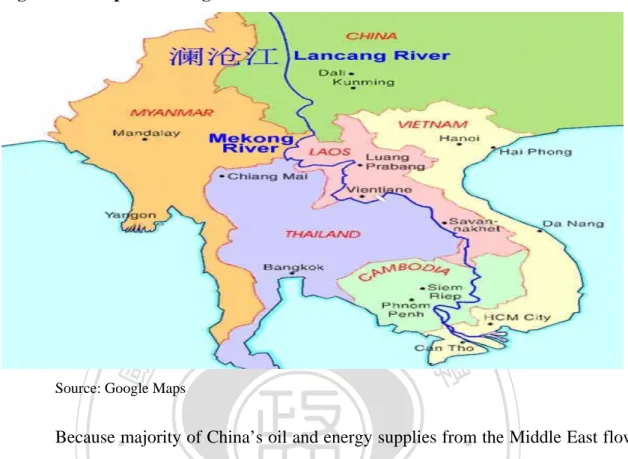
(24) approach. This paper will not explore the specific bilateral relationship of the US with other regional countries other than that with the Philippines.. Accordingly, the last part of this study would attempt to look at the Philippines’ position regarding, and actions it has taken vis-à-vis, the seemingly mounting competition for influence between the US and China in Southeast Asia, in the Philippines, in particular.. The focus is placed on the security aspect of the. Philippines-US relations because it is the most important element of their partnership relative to China’s growing regional power. To come up with a viable explanation, this study would examine the apparent transformation of the relationship between the Philippines and China, zeroing in on the soft-power tools that Beijing has employed. 治 政 大 that have transpired in the this study will also explore the significant developments 立 Philippines under the auspices of the Philippine-US security alliance, and see if China’s 學. ‧ 國. towards Manila, amid the resurgent Philippine-US security partnership. In this regard,. employment of soft power has altered the approach of either Manila or Washington towards their bilateral security accord.. To have a better assessment of the Philippine-. ‧. US security relations vis-à-vis China, this portion will cover the period before and after Beijing employed its soft power scheme in Manila.. n. er. io. sit. y. Nat. al. Ch. engchi. i n U. v. 16.
(25) CHAPTER II China’s Southeast Asian Strategy: the Use of Soft Power. This Chapter examines the independent variable in this study, which is China’s application of soft power statecraft in Southeast Asia, as well as one of its dependent variable that is Southeast Asia’s response to Beijing’s growing appeal relative to its regional objectives.. It is important to examine whether or not Beijing’s soft power. tools in the region has given it expanded influence and significance in the region for the purpose of luring Southeast Asian governments to become supportive, if not less critical, of whatever objectives and aspirations it is trying to accomplish in the region.. Striking. a comparison between China’s standing in Southeast Asia before and after its soft. 治 政 soft power in attracting regional countries towards大 its newfound appeal. Of 立 course, it would be difficult to have a clear calculation and perception of the value of. power application would likely provide a logical explanation on the effectiveness of its. ‧ 國. 學. Beijing’s soft power without clearly establishing the country’s motivations and rationale in aggressively wooing regional countries, and what had been the latter’s. ‧. response to them so far.. y. Nat. al. er. io. sit. China’s Soft Power Tools in Southeast Asia. n. China’s soft power turnaround in Southeast Asia began during the 1997-98. Ch. i n U. v. Asian Financial Crisis. Due to its response to the crisis coupled with the largely. engchi. indifference of the West and international institutions’ rigid requirements, Beijing was able to project an image as a responsible and reliable neighbor, one which is willing and ready to play a positive and leading role in regional affairs. After the crisis, ASEAN Secretary General Rodolfo Severino declared that “China is really emerging from this smelling good.”32 Because its neighbor-countries were impressed that it could succeed where they failed, China may have also inadvertently promoted the so-called “Beijing consensus,” a group of authoritarian states with market economies that can eventually. 32. Joshua Kurlantzick, “China’s Charm: Implications of Chinese Soft Power,” Carnegie Endowment for International Peace, Policy Paper Number 47, (June 2006), http://www.carnegieendowment.org/publications/index.cfm?fa=view&id=18401&prog=zch. 17.
(26) challenge the US-led “Washington consensus,” which is composed of liberal market economies governed by democratic regimes.33. Indeed, China’s relations with the ASEAN have come a long way. To think that several decades ago, most Southeast Asian countries viewed China with fear and utmost concern. From the 1950’s to the 1970s, China advanced the communist ideology and lent support to communist movements in the region. This had prompted some Southeast Asian countries to participate in and form alliances--like regional organizations such as the 1954 Southeast Asian Treaty Organization (SEATO) and the 1971 Five Power Defense Arrangements--with external powers, primarily the US, to protect their interests.34 Because of this, resentments and prejudices have festered against each of relatively 治 large Chinese minority. 政 大 against, and Thai Chinese In Malaysia, ethnic Chinese were officially discriminated 立 were forced to adopt Thai surnames. Large number of Chinese was killed in Indonesia Asian. country’s. 學. ‧ 國. Southeast. in 1965 of Sukarno’s pro-Beijing government because of lingering fears that Chinese living in Southeast Asia would have primary loyalty to China.35 In the 1990s, disputes. ‧. over the islands and reefs in the SCS were a major cause of tension between China and Southeast Asia. Apart from the aforementioned incident in 1995, conflicting claims. y. Nat. n. al. er. io. caused the death of some 70 Vietnamese naval personnel.. sit. over islands in the SCS led to naval clashes between Vietnam and China in 1988 that. Ch. i n U. v. Currently, though, the broader security concern for Southeast Asia involving. engchi. Beijing is the potential competition for regional space between China and the US, still viewed in the region as the preeminent global power. China’s drive to project Chinese influence in Southeast Asia could potentially, but not necessarily, bring American and Chinese interests into a direct collision.. Most unsettling for Southeast Asian countries. is the possibility of a Sino-American war over Taiwan--still regarded by the Chinese government as part of its territory, but was promised with continuous supply of advanced defensive weaponry by the Americans. Regional governments do not want to 33. Lai Hongyi, “China’s Evolving Relations with Southeast Asia: Domestic and Strategic Factors,” in Harmony and Development ASEAN-China Relations, ed. Lai Hongyi and Lim Tin Seng, (Singapore: World Scientific Publishing, 2007), 27. 34 Jing-dong Yuan, “China-ASEAN Relations: Perspectives, Prospects and Implications for US Interests,” Strategic Studies Institute (October 2006), 4. 35 Judith F. Kornberg and John R. Faust, China and World Politics: Policies, Processes, Prospect, Second Edition (London: Lyne Rinner Publishers, 2005), 168. 18.
(27) see a scenario wherein they would be forced to choose sides between these two powers in a contingency over Taiwan.. A further manifestation of this apparent desire by the Chinese to challenge the existing US-dominated international balance of power was its unveiling of a New Security Concept in July 2002. The concept serves the multiple goals of trying to: defuse international instabilities that could adversely affect China’s own development; expand China’s own wealth and influence in ways seen as non-threatening to its neighbors; and balance US global power in a manner that serves China’s interests.36 Although the concept offers nothing new, China appeared to be capitalizing on the strong international opposition to US unilateralism in dealing with terrorism, and to. 治 政 大 leaders also began to speak of Consistent with this new security concept, senior Chinese 立 China’s peaceful rise, which seeks to reassure countries of its benign intention by seeking a “win-win” solution to issues of mutual concern.. 學. ‧ 國. promote an alternative to American military framework anchored on alliances.. ‧. In accordance with this principle, Beijing signed numerous accords with the ASEAN that signals Beijing’s willingness to take some important and consistent steps. y. Nat. sit. toward conforming with the regional status quo in terms of participating in regional. al. er. io. institutions and adopting the norms of conduct. First, it signed the protocol to make. n. Southeast Asia a nuclear-free Zone of Peace, Freedom and Neutrality (ZOPFAN) in. Ch. i n U. v. 2001, and then signed with the ASEAN a Declaration on the Code of Parties in the SCS.. engchi. The following year, China also became the first external power to formally accede to the ASEAN’s TAC. The Joint Declaration on Strategic Partnership for Peace and Prosperity signed in October 2003 usefully indicated the range of political, economic, and cultural mechanisms that had been developed for close Sino-ASEAN cooperation, but it was also a significant indication of high-level Chinese commitment to positive engagement with Southeast Asia.37. In the second half of the 1990s, China began. cooperating with ASEAN in its Mekong Basin Development Cooperation, and developing transport links in the basin, which brings together China and mainland 36. Kerry Dumbaugh, “China’s Foreign Policy: What Does it Mean for US Global Interests?,” CRS Report for Congress (July 18, 2008), http://www.fas.org/sgp/crs/row/RL34588.pdf. 37 Evelyn Goh, “Southeast Asian Responses to China’s Rise,” in The Rise of China and International Security America and Asia Respond, ed. Kevin J. Cooney and Yoichiro Sato, (New York: Routledge, 2009), 162. 19.
(28) Southeast Asia.. In 1994, China joined in setting up the ASEAN Regional Forum. (ARF), an Asia-Pacific forum devoted to the discussion of security issues, and three years later, inaugurated--together with Japan and South Korea--a new framework for regional cooperation with the ASEAN + 3.38. Not only in the diplomatic and economic spheres that China wanted to interact more closely with the ASEAN and individual member-countries but through military cooperation and dialogue as well. For instance, China has attended the annual “Cobra Gold” joint exercises involving the US, Thailand and Singapore since 2002, and had ASEAN countries observed one of its major infantry exercises in 2004 and joined a military exercise in July 2007 that dealt with peacekeeping and disaster management as. 治 政 大 an alternative to the lowerannual Defense Minister’s meeting with ASEAN, offering 立 level Shangri-la Dialogue organized by the London-based International Institute for well as reconstruction. In the multilateral realm, Beijing has repeatedly suggested an. ‧ 國. 學. Strategic Studies. On the bilateral front, China has particularly targeted countries in the ASEAN that have been least comfortable with its growing strategic weight with. ‧. increased military contacts and aid. In 2005, Chinese leaders opened annual consultative talks with Vietnam and the Philippines and proposed a similar process with. al. er. io. sit. y. Nat. Indonesia.39. n. Another evidence of how the closeness between the two sides had become is the. Ch. i n U. v. frequency of high-level exchange visits between China and Southeast Asia.. engchi. Whereas. cabinet ministers dominate the high-level visits between 1988 and the mid-1990s, heads of states from both sides started regular visits with the outbreak of the 1997-98 Asian financial crunch. From then on, the state visits are usually capped by the signing of several joint developmental projects in various fields and/or loan agreements, usually favoring regional governments. Some analysts attributed this to China’s implementation of its “good neighbor” policy which became a priority to the Chinese government after the bloody Tiananmen Square incident in 1989 that caused the country’s international isolation.. 38 39. Ibid. Ibid., p.164. 20.
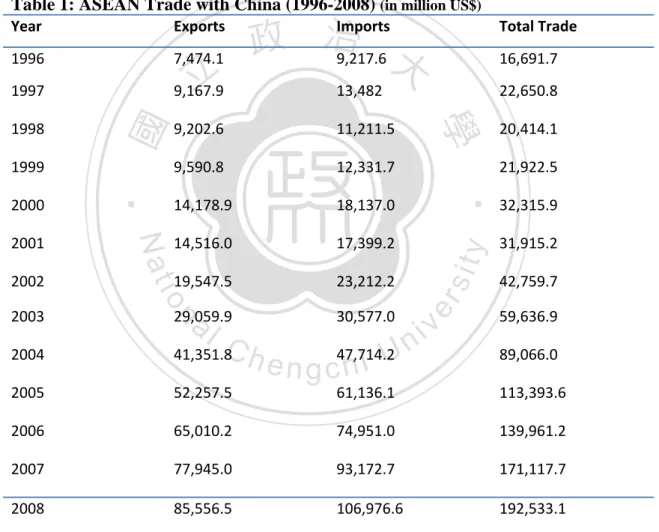
(29) Apart from security concerns, equally problematic for Southeast Asian governments is the potential impact of China’s economic growth to their struggling economies.. Although there is no agreement about the net outcome of China’s. economic growth on Southeast Asia, it is clear that this will bring both benefits and costs, and that a wide range of industries in the region will face stiff competition from their lower-cost Chinese counterparts.40 The competition for foreign direct investments (FDI), which has gradually tilted in Beijing’s way, is one of the risks that Southeast Asian governments have to face. The fact that China now is capturing a substantial majority of FDI flowing into East Asia, and that ASEAN’s share of such is dwindling led some to assert that Beijing’s FDI inflows come at the expense of Southeast Asia. Some argued, however, that the shares of FDI into China-ASEAN cannot be viewed in. 治 政 大 capital exists over which the last decade suggests that no fixed sum of investment 立 countries inevitably must compete. On the contrary, others expressed belief that China’s a zero-sum perspective. According to this argument, the variability of FDI flows over. ‧ 國. 學. FDI data is substantially overstated. Current research outside China has widely acknowledged that China’s FDI inflows must be discounted for “round-tripping”.. ‧. “Round-tripping” refers to the phenomenon where Chinese companies move funds out of China to other countries--mainly Hong Kong and the Caribbean tax havens--and. y. Nat. al. n. from 1980 to 2007.. er. Figure 1 shows the total FDI inflows to Southeast Asia and China. io. tax treatment.41. sit. bring them into China again in the form of FDI, mostly to take advantage of preferential. Ch. engchi. i n U. v. In an effort to assure Southeast Asian governments that China adheres to policies that would be beneficial for all countries concerned--the central idea of its often enunciated “win-win” philosophy--Beijing in 2000 floated with the ASEAN the idea of a free trade agreement. If fully implemented, the China-ASEAN free trade agreement (CAFTA) would create an economic area with a population of 1.7 billion, a combined GDP of over U$42 trillion, and a total trade volume of US$1.23 trillion. The deal, which took effect in January 2010 and affects over 7,000 different products, allows. for. certain. industries. to be exempt from lower tariffs and also permits. participating countries to identify other nationally important industries. Despite the 40. Ibid., p.160. Friedrich Wu, et. al., “Foreign Direct Investments to China and Southeast Asia: Has ASEAN been Losing Out,” Economic Survey of Singapore (2002), http://unpan1.un.org/intradoc/groups/public/documents/APCITY/UNPAN010347.pdf. 41. 21.
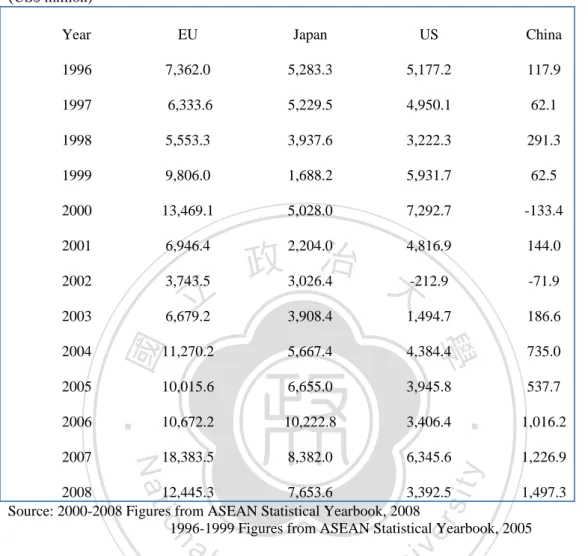
(30) likely loopholes and shortcomings of the agreement, the very prospect of such a large market is already beaming a positive signal to traders and investors as businessmen in the region step up their activities in anticipation of more commercial opportunities.. 42. In 2002, the year the CAFTA was signed, President Arroyo hailed the emergence of a “formidable regional grouping” that would rival the US and the European Union (EU).43. Figure 1. Total FDI Inflows to Southeast Asia and China (1980-2007) (billion US$). 立. 政 治 大. ‧. ‧ 國. 學. n. er. io. sit. y. Nat. al. Source: UNCTAD (2008). Ch. engchi. i n U. v. To facilitate the implementation of the CAFTA, the two sides in January 2004 put into action the Early Harvest program.. Under the program, China and ASEAN. countries have to cut tariffs on about 600 agricultural imports between 2 and 15 percent, and agreed to scrap these tariffs in 2006. In the first half of 2004, China has lauded the program a success, boasting that both sides have benefitted from the tariff-reduction program. Chinese figures showed that the country had imported a total of US$330 42. Ellen L. Frost, “China’s Commercial Diplomacy in Asia,” in China’s Rise and the Balance of Influence in Asia, ed. William W. Keller and Thomas G. Rawski, (Pennsylvania: University of Pittsburgh Press, 2007), 102. 43 Walden Bello, “The China-ASEAN Free Trade Area: Propaganda and Reality,” Focus of the Global South (January 2010), http://www.tni.org/article/china-asean-free-trade-area-propaganda-and-reality. 22.
(31) million-worth of fruits and vegetables from the ASEAN in the first half of that year alone, reflecting an increase of 38.7 percent year-on-year.44. While the Early Harvest. program’s start was very commendable, it did not take long before local sectors complain that they are at the losing end of the program. Take for example the case of Thailand. Reportedly, despite the limited scope of the Thailand-China Early Harvest agreement, it has wiped out northern Thai producers of garlic and red onions and crippled the sale of temperate fruit and vegetables. Thai newspapers pointed to officials in Southern China refusing to bring down tariffs as stipulated in the agreement, while the Thai government brought down the barriers to Chinese products.45. It comes not as a surprise, therefore, that the broader CAFTA itself has not been. 治 政 大 expressed concern that China already business groups in Indonesia and Thailand have 立 will reap most of the rewards from this deal, with little benefit flowing to ASEAN spared from criticisms and apprehensions. A few months after its implementation,. ‧ 國. 學. countries. Recently, Indonesian Industry Minister MS Hidayat warned parliament that CAFTA would have a serious impact on the steel, inorganic chemical, textile and layoffs and some industries would closed down.46. ‧. furniture industries. He said that if protective steps are not taken there would be mass. Nat. y. In Thailand, government officials. sit. are also worried about the impact the deal will have on its local industries.. al. er. io. The countries established beer brewing sector has placed new excise taxes on beer imports to ward off the flood of cheap Chinese alternatives.. In response to such. n. i v China argued that there are apprehensions, supporters of C the accord in the ASEANnand h thatn allow i Unationally important industries to g c hcertain built-in measures in the agreement e retain tariffs.47 Apparently, the consensus among ASEAN leaders is that they have no choice but to agree to a more integrated market with China in order to expand their own exports and especially make their economies more appealing to foreign investors. If investors can export freely to China, they will not be tempted to pull up stakes in other parts of Asia.48 44. China-ASEAN Trade on Fast track, People’s Daily Online, August 9, 2004, http://english.people.com.cn/200408/09/eng20040809_152306.html. 45 Walden Bello, “China Lassoes its Neighbors,” Institute for Policy Studies (March 8, 2010), http://www.ips-dc.org/articles/china_lassoes_its_neighbors. 46 Sarah Danckert, “Is China Exploiting ASEAN,” Business Spectator (February 5, 2010), http://www.businessspectator.com.au/bs.nsf/Article/Is-China-exploiting-ASEAN-pd201002052CRBK?OpenDocument&src=spb. 47 Ibid. 48 Frost, op. cit., p.105. 23.
(32) In addition to CAFTA, Beijing is negotiating closer economic partnerships with individual regional states as well. As a result, by the end of 2008, Southeast Asia’s total trade with China has jumped six-fold since 2000 to US$192.5 billion--surpassing that of the US. China’s share of Southeast Asia’s total commerce has increased to 11.3 percent from four percent in the same period, whereas the US’ portion of trade with the region fell to 10.6 percent from 15 percent 49. Significantly, Table 1 shows that. ASEAN trade with China has steadily increased after the 1997-98 Asian Financial crisis, especially so since 2001 when China joined the World Trade Organization (WTO) and the CAFTA talks were initiated. Table 1: ASEAN Trade with China (1996-2008) (in million US$) Imports 政 治 9,217.6 大. Exports . 1996 . 7,474.1 . 1997 . 9,167.9 . 13,482 . 9,202.6 . 11,211.5 . 9,590.8 . 12,331.7 . 14,178.9 . 18,137.0 17,399.2 . y. 31,915.2 . 19,547.5 . 23,212.2 . sit. 42,759.7 . al. 30,577.0 . 29,059.9 . n. 2003 . 21,922.5 . 14,516.0 . io. 2002 . 20,414.1 . 32,315.9 . Nat. 2001 . 22,650.8 . ‧. 2000 . 16,691.7 . Ch. 2004 . 41,351.8 . 2005 . 52,257.5 . 2006 . e n g c47,714.2 hi U. er. 1999 . ‧ 國. 1998 . 立. Total Trade . 學. Year . v ni. 59,636.9 89,066.0 . 61,136.1 . 113,393.6 . 65,010.2 . 74,951.0 . 139,961.2 . 2007 . 77,945.0 . 93,172.7 . 171,117.7 . 2008 . 85,556.5 . 106,976.6 . 192,533.1 . Source: ASEAN Statistical Yearbook, 2008. 49. “Free Trade Agreement Between China, ASEAN Grouping Comes into Force,” The China Post, January 1, 2010, http://www.chinapost.com.tw/business/asia/asian-market/2010/01/01/238917/Freetrade-agreement.htm. 24.
(33) While this fledgling trade relationship bodes well for the meager economies of some regional countries, it did not ensure that China would not use its increasing economic weight to pressure Southeast Asian governments to turn a blind eye on certain issues deemed detrimental to Beijing’s national interests and/or global credibility. In 2007, for example, as concerns rose throughout many parts of the world regarding the safety of Chinese products, officials in Indonesia, Malaysia, and the Philippines reportedly complained that China was pressuring them not to raise the issue, even when such imported goods were found to be dangerous. When they banned the sale of unsafe items from China, the Chinese government reportedly threatened and/or imposed retaliatory actions, causing consternation among many Southeast Asian leaders.50. In Cambodia, the government in December 2009 ordered the deportation. 政 治 大. of 20 asylum-seeking ethnic Uyghur Chinese--bowing to pressure from China which branded the group as criminals.. 立. ‧ 國. 學. Admittedly, there are some risks involved in dealing with China, but the Chinese government has effectively offset this by offering aid and investments for. ‧. Southeast Asian economies. This was clearly illustrated in December last year when Vice President Xi Jinping thanked the Cambodian government for deporting the. y. Nat. sit. Uyghur asylum-seekers while handing the country US$1.2 billion in aid.. al. er. io. On investments, China’s State Council and Ministry of Commerce estimated that, by. n. the end of 2004, China’s accumulated overseas investment (including investments by. Ch. i n U. v. both the government and companies) was US$44.8 billion, 75 percent of which (or. engchi. US$33.4 billion) went to Asia. Of the amount, about 70 percent went to Hong Kong and the remaining to other Asian economies, including the ASEAN.51 According to the statistics compiled by ASEAN Secretariat (as shown in Table 2), FDI from China to Southeast Asia was US$1.49 billion in 2008, which was just about 2.4 percent of its total FDI. The main sources of FDI in the region in 2008 are still the EU, which invested US$12.44 billion; Japan with US$7.65 billion, and the US with US$3.39 billion.52 Although China’s FDI to the region is still relatively small compared to. 50. Lum, et al., “Comparing Global Influence,” op. cit. Sheng Lijun, “China’s Peaceful Rise and its Political and Security Implications for Southeast Asia ,” in Harmony and Development ASEAN-China Relations, ed. Lai Hongyi and Lim Tin Seng, (Singapore: World Scientific Publishing, 2007), 38. 52 ASEAN Statistical Yearbook (2008), 129, http://archive.asean.org/Publication-ASEAN-SYB-2008.pdf. 51. 25.
(34) investments made by either the US or Japan, it is growing faster than many have predicted. Table 2: FDI Inflows into ASEAN by Top 3 Sources and China, 1996-2008 (US$ million) Year. EU. Japan. US. China. 1996. 7,362.0. 5,283.3. 5,177.2. 117.9. 1997. 6,333.6. 5,229.5. 4,950.1. 62.1. 1998. 5,553.3. 3,937.6. 3,222.3. 291.3. 1999. 9,806.0. 1,688.2. 5,931.7. 62.5. 2000. 13,469.1. 5,028.0. 7,292.7. -133.4. 2001. 6,946.4. 144.0. 2002. 3,743.5. 2,204.0 4,816.9 政 3,026.4治 大-212.9. 2003. 6,679.2. 3,908.4. 1,494.7. 11,270.2. 5,667.4. 4,384.4. 735.0. 10,015.6. 6,655.0. 3,945.8. 537.7. 10,672.2. 10,222.8. 3,406.4. 18,383.5. 8,382.0. 6,345.6. y. 1,016.2 1,226.9. sit. Nat. 2007. ‧. 2006. ‧ 國. 2005. 186.6. 學. 2004. 立. -71.9. al. er. io. 2008 12,445.3 7,653.6 3,392.5 1,497.3 Source: 2000-2008 Figures from ASEAN Statistical Yearbook, 2008 1996-1999 Figures from ASEAN Statistical Yearbook, 2005. n. v i n While most countries C in Southeast are receiving aid from China, the focus h e n gAsia chi U. of its developmental assistance program are reportedly Cambodia, Laos and Myanmar-the poorest countries in the region and ones that have unfriendly relations with the US. One reason for this is that China offers assistance without conditions that others like the US places on aid, such as democratic reform, market opening and environmental protection. China also financed infrastructure and energy-related projects in these countries, most of which enabled Beijing to access oil and raw materials.53. Evidenced. of this is when China unveiled in April 2009 a plan to offer US$39.7 million in special aid to Cambodia, Laos and Myanmar to meet these countries’ “urgent needs.”. The aid. excludes that of the total US$15 billion in credit that China plans to offer the ASEAN. 53. Lum, et al., “China’s Soft Power in Southeast Asia,” op.cit. 26.
數據

+7

相關文件
Robinson Crusoe is an Englishman from the 1) t_______ of York in the seventeenth century, the youngest son of a merchant of German origin. This trip is financially successful,
fostering independent application of reading strategies Strategy 7: Provide opportunities for students to track, reflect on, and share their learning progress (destination). •
Strategy 3: Offer descriptive feedback during the learning process (enabling strategy). Where the
Now, nearly all of the current flows through wire S since it has a much lower resistance than the light bulb. The light bulb does not glow because the current flowing through it
HPM practice in Taiwan: A case study of HPM Tongxun (HPM Newsletter). These articles have documented the process of development and evolution of HPM practice in Taiwan as well
HPM practice in Taiwan: A case study of HPM Tongxun (HPM Newsletter). These articles have documented the process of development and evolution of HPM practice in Taiwan as well
Southeast Asia: In Search of an ASEAN Community: Insight from the Former ASEAN Secretary-General. Singapore:
Southeast Asia: In Search of an ASEAN Community: Insight from the Former ASEAN Secretary-General. Singh, Daljit, Tin Maung Maung
