8ioFormosa (2010) 的(2):71-77
Anticancer Effect of a Novel
Hi
stone Deacetylase Inhibitor in Cell
Model
Sin-MiDg Huangl,2,Mei-Yu CheI戶, Chein-TieDCheD3,Kwok
.
Tung Lu旬,Vi-Ching Wang2• IOepartment ofLifeScien阻,National TaiwanNonn剖 UniversityTai闕,有 iw聞
'Oep訂\mentofPharmacology個dInstitute of 8asic Medical Science,National Cheng Kung University
Tain徊.Taiwan
'Oepartment ofChemist旬,National Tsing Hua University Hsinchu,Taiwan
(Received: 8 April 20 II,accepted: 9 May 20 II) ABSTRACT
Histonedeacetyl晶es(HDACs) are potential therapeuticta啥時 forthe treatment of hematologic and solid tumor malignancies due to their Qverexpression and/or increased activity in various cancers Although HDAC inhibitorse油 ibitsignificant inhibition ability in hematological cance間,也elf e叮eel In
solid tumors has not been satisfactory. Here,we propose a novel HDAC inhibitor,N-hydroxy-4-«(lR, 2R)-2-phenylcyclopropanecarboxamido)benzamide (HPCPC8),as a chemotherapeutic drug for solid tumors
Fi間, we examined the cytotoxicity of HPCPC8 in various lung and breast cancer cells and their corresponding nonnal cells using MIT assay. HPCPCB showed significant growth inhibition on various cancer cells,while there was no serious cytotoxicity against normal cells. Results of flow cytometry showed that HPCPC8 caused cell cycle arrest at G I phase. Western blotting indicated th剖 proteins required for cell cycle progression such as COC25A,COK4 個dcyclin E were reduced and the cell cycle inhibitor p21 was up-regulated by HPCPC8 treatment. Furthennore,HPCPCB inhibited HDAC activity and induced an increase in acetylated histone proteins H3 and H4 and non-histone proteins p53 個d tubulin. Our findings suggest that HPCPC8 is a potent HDAC inhibitor and has potential in cancer treatment
Key words: HDAC,acetylation,c個 cer,cell cycle arrest
EpigeDetic changes are clearly associated with tumorigen聞自 (Bha山, 2005). Re心eDt sωdies showed that 血e modification patterns of histones influen臼 overall survival and can be used as prognosis prediction biomarkers (B訂lesi el al.,
2007; Manuyakorn el al.). Histone d間cetylases (HDACs) are histone modification enzymes, which remove the acetyl-groups from histones and regulate chromatin structure and gene expression epigenetically. Inaddition to histones,HDACs have many other subs甘ates which are involved in the regulation of cellular function,such as p53,HSP90,
tubul 凹, and of various transcription facto閱 (xu el al., 2007). The acetylation status of non-histone proteins have influence on its stability (microtubulin, p刃, and SMAD7),甘anscriptional
activity (p刃, E2F family, NFKB, MEF2, and Introduction
Chemotherapy的。ne of the standard therapies for cancer 甘eatment and has an important role 晶 strategic and palliative treatment (Danesi el al.
,
2003; Mariette el aI., 2007). However, limited response, severe adverse side effect, and poor prognosis make the clinical use of chemotherapy unsatisfactory. Therefore, it is impo此ant to develop novel anticancer drugs with more curative effect and less side e仟ects for cancer treatment. A few target agents, such as bevacizumab and erlotinib,have been used with regular chemotherapy drugs in
combinative 甘'eatment to raIse 也e benefit and minimize the side effect (Sandler el al., 2006; Shepherd el al., 2005). Therefo間, it IS an
imperative task to develop nove) molecular targeted 虹堅
Sin-MingHua嗯, Mei-Yu Chen,Chein-Tien Chen,Kwok-Tung Lu,Vi-Ching Wang
TF2B), protein-protein interaction (STAn,
Retinoblastoma, and p-catenin), and prote凹-DNA
binding (p刃, E2F family
,
NFKB) (Minucci 祖dPelicci, 2006). Overexpression and/or increased activity of HDACs in various cancers and low basal
level in normal cells make HDACs potential
therapeutic targets for cancer treatment (Ellis et al.,
2009; Minucci and Pel 時間, 2006; Witt et al.,2009) The potent antitumor activities of HDAC inhibitors
have be demonstrated in cutaneous T-cell
lymphoma (Mann et af., 2007). HDAC inhibitors
show 祖tIC個閃閃伶ct through inducing cell cycle
叮rest, differentiation and apoptosis in various cancer cells (Bolden et af., 2006; Xu et al., 2007).
Therefo間, development of HDAC inhibitors is a feasible scheme for novel anticancer drugs used in solid tumors.
切 this study, we propose a novel HDAC inhibitor,
N-hydroxy-4-«IR,2R)-2-phenylcyclopro-panecarboxamido)benzamide (HPCPCB), a
derivative of USA Food and Drug Adminis甘atJOn
approved HDAC i他ibiωr vorinostat (SAHA,
suberoylanilide hydroxamic acid), as potential
anticancer drug for 訂閱ring solid tumors. The
antiωmor ability and mechanism of actions of HPCPCB were studied in lung and breast cancer
cell models. We found 也at HPCPCB induced cell
cycle arrest and potently inhibited 出e activity of HDAC resulting in 也e acetylation of histone and
non-histone proteins. Our data suggest that
HPCPCB is 阻 HDAC inhibitor and have potential
to be applied as targetedanticancer 當嗯, Materials and Methods
HPCPCB
The compound N-hydroxy-4-«IR,
2R)-2-phenylcyclopropanecarboxarnido)benzamide,
namely HPCPCB, was synthesized by one of the
co-authors, Dr. Chein-Tien Chen. HPCPCB was
obtained in powdery form and was dissolved in 100 % DMSO for further dilution in cell culture medi山n.
MDA-MB-231 were kindly provided by Dr
Ying-Jan Wang (Department of Environmental and
Occupational Health, National Cheng Kung
Unive悶 ity)
。totoxicity/MITassay
Cells were seeded at I x 10' cells/well in 6-well plates and maintained in culture medium containing 10% Fetal Bovine Serum (FBS, Gibco, lnvitrog凹,
Carlsbad, CAl for 16 hours. Different
concen甘ations of HPCPCB or solvent con甘'01
DMSO were added into each plate and incubated
for 48 hours. After 甘'eating wi曲。 5 mglml of
3-(4,5-d血抽ylthi缸。l-2-yl)-2, 5-diphenyl
te甘azolium bromide (MIT, Sigma-AI出ch, St Louis, MO) for 30 minutes at 37°C, cell viability was determined bymeasuring 也e absorbance at 570 om wavelength
Cell cycle analysis
The assay was performed according to Kuo et
al (Kuo et 訓, 2004). A549 was pretreated with
nocodazole (200 nglml) (Sigma-Aldrich) for 24 hours to arrest cells at the G2/M phase. Cells were released into G I phase by replacing medium with
fresh medi山n, then DMSO or7μM HPCPCB was
added. Cells were collected at various time poin臼 and the cell cycle distribution was analyzed by
FACScan flow cytometer (Bect凹J Die恆nson and
Company,Franklin Lakes,NJ,USA). 防'sternblotana妙的
After treating with solvent c油n甘01 DMSO or
HPCPCB, cell Iysates were collected and
immunoblotted for various proteins under the conditions described as below: p21 (I: I000),CDK4
(I.1000), GAPDH (1 :2000) (Santa Cruz, Santa
Cruz, CA, USA); Cdc25A (1:1000, Abca凹,
Cambrid阱, England); acetyl-histone H3 (I: 1000), acetyl-histone H4 (1 :1000) (Upstate, Millipore, Billerica, MA, USA); acetyl-p53 (Lys382) (1:500, Cell signaling, Danve時, MA, USA); acetyl-tubulin (I:10∞, Si伊a-Aldrich)
Celli帥的
The normal h山nan lung cell line 即眼鉤, the
hu血an lung adenocarcinoma cell lines A549 and H1299,and the large celllung cancer cellline H460
were purchased from American Tissue Culture
Company (Rockville
,
Maryland,
USA). Normalhuman breast cell MCF-IOA and breast cancer cell
Histonedeacetyl,個es(HDAC)activi,抄 ass旬,
The HDAC activity was measured with an HDAC fluorescent activity assay kit (BIOMOLInc,
Plymouth Meetin皂, PA, USA) according to the
manufacturer 's ins甘uctinns. Briefly, the cell lysate
were added to the diluted HPCPCB and SAHA,and
HDCAInhibition Effect of HPCPCB
pU 向一
…---一一----一
*
Inonnallung cells;#,Donnal breast cells =~---c。“‘ CCC25A Lun!! (μM) Breast (仙的 A549 6.94 MDA知ffi-231 6.23 H460 9.65 MCF-IOA' 15.52 HI299 6.91 IMR90' 20.00 Ar~
" 白﹒間冊CI'CO。 <" ,一1 戶'" .主,'
。 。 。•
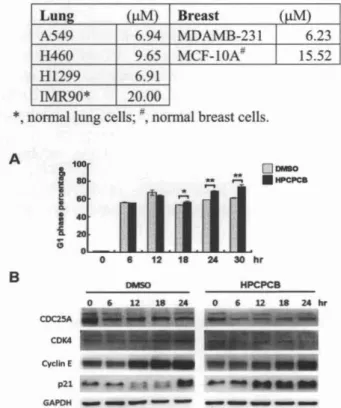
12 18 祖 團 h' 8 DO但缸, HPCPC8 。‘ u 11 24Table 1. Cytotoxicity of HPCPCB on nonnal human lung cells, normal breast cells, various lung carcinoma cells,and breast cancer cells
Figure1.HPCPCB induced cell cycleGIphase 缸Test
(A) Flow cytome 句 demons 個恤g 也e induction ofGI phase accumulation by HPCPCB, whereas DMSO solvent con賞。I did not affect cell cycle. (8) Western blortingdemonstrated 血at HPCPCB 甘'eatment abolisbed or delayed the change in expression level of cell cycle
con甘'Oiling proteins CDC25A, CDK4, and Cyclin E,
whereas increased the level of p21 cell cycleinhibitor. 弋
P<0.05;
",
P<O.OIHPCPCB inhibits HDAC activity
The HDAC activity assay was performed to measure the BOAC inhibition ability of HPCPCB in vitro. As shown in Figure 4,HPCPCB efficiently l凶tibitedBOAC activity at2μM and5μM
To determine whether HPCPCB could induce the acetylation of histone and non-histone proteins,
Western blot analysis was performed. The data indicated 血at HPCPCB induced acetylation of histones H3 and H4 at a dose of 1/6 IC50 in 30min (Figure 2A and 2B)
Furthermore, HPCPCB induced acetylation of non-histone proteins such as p53 and tubulin in 2 bours(Figure 3). HPCPCB 甘ea回ent increased p21 expression in both A549(p53 wild-type) and HI299
(p53 null) cells(Figure 3) HPCPCB inhibits cell growth of various lung and
breast cancercelllin自
HPCPCB is a synthetic derivative based on clinical anticancer drug SAHA. Cytotoxicity of HPCPCB was assayed in the normal human lung cell line 臥在R90, and various human lung cancer cell lines (A549,H1299,and H460); breast normal cell line MCF-lOA and breast cancer cell line MDA-MB-231. After 甘eating the cell lines with different concentrations of HPCPCB for 48 bou時,
cell viability w晶 measured by the MTI assay and the IC50 of each cell was calculated. As shown in Table I, HPCPCB showed significant growth inhibition on various cancer cells with IC50 doses ranging from 6.23-6.91μM, while there was no senouscytoto刮目tyagainst normal human lung cell 邱庄R90up to20μM
Results
HPCPCBcaus由 cellcycleGJphase arrest
In order to verify the cytotoxic effect of HPCPCB, we measured the cell cycle distribution after HPCPCB 甘eatment in a synchronized cell population. After pretreatment with nocodazole for 24 hours to arrest A549 cells at G21M phase, the culture medium were refreshed and 7μM HPCPCB was added. The HPCPCB-treated cells were collected at various time pointsand 祖alyzedfor the cell cycle distribution. The results indicated 也at HPCPCB-induced
G
I 缸rest(Figure IA).Furthermore, we performed Western blot to characterize the molecular mechanism of HPCPCB-induced G 1 arrest (Figure 1B). The expression level of cell cycle promoting proteins such as CDC25A, CDK4, and Cyclin E were increased at 12 hr after A549 releasing from nocodazole arrest in DMSO solvent con甘01 group In con甘甜, HPCPCB treatment significantly reduced or delayed the expression level of these cell cycle promoting proteins. Moreover, the cell cycle inhibiting protein p21 were up-regulated upon HPCPCB 甘'eatment
10 minutes at 25°C, developer was added to the samples to stop the reaction. After incubation for 10 min,luminescence was recorded on a SpectraMax® M5 microplate reader (Molecular Devices,
Sunnyvale,CA,USA)
Sin-Ming Huang,Mei- ¥u Chen,Chein-TienCh凹, Kwok-Tung Lu,Vi-Ching Wang A A~ HI299 咿C間.~岫 o 1.11 2.祖 4曲 ,。徊。'IC 曲,縛 113 句m 。1.t. 2.謂‘.. '飽,舟 ,n ...嚕.It憾。...H3 ...胡lotonoH地 aAPDH
一
--
一B
AIl49 ﹒扭曲 120 HI299 030101 畫。.,., 明4月間 mM…
U啊 UH Ac-HlatoneH4 GAPDH _~.圓__1.____Figure 2. HPCPCB induced acetylation of histone proteins atdi能rentdoses (A) and treatment times(8)
AS49 H1299' HPC阿巴"蠅 。 1.18 2.33 Fo個 OflC甜。,絡 113 。 1.18 2.濁 。 1/8 113 Ac司p53 Ac也b‘~in p21 GAPDH
Figure 3. HPCPCB induced acetylation of non-histone proteins including p53 and tubul 凹, and the expression of p21 protein at the indicated doses,as examined 2 hours after treatment. " H1299 is p53-null lung cancer cell line 50
,
43.43E
)( 40i
2010~I
E 1.1& 3.13 1.38。。計,計,
~",Q' 'I,~" _~... _+p c,0" ....~...ρ.' ,~~. v 祈祈Figure 4. HPCPCB efficiently inhibited HDAC activity comparable抽出eclinical use HDAC inhibitor SAHA as assessed by in vitro HDAC activity assay
Discussion
In 也isstudy we developed a novel compound,
which is derived from SAHA
,
named HPCPCB. We tested the cancer cell specific cytotoxicity of HPCPCB and demonstrated that HPCPCB exhibited cytotoxicity tow訂d cancer cells but not normal cells. More沿ver, HPCPCB induced cell cycle arrest through reducing the expression of CDC25A, CDK4 and CyclinE proteins andupregulating 出e expression of the cell cycle inhibitor p21 protein. CDC25A promotes cell cycle progression by activating G I CDK proteins such as CDK2 (Zou el al.
,
2001) and 伽 degradation of CDC25A leads cells G I arrest (Huang elaI., 20 II) p21 protein can bind to both the CDK4/cyclin D and CDK2/cyclin E complexes and inhibit both of their activity and lead ceUs to G I phase 叮rest (He el a人 2005). Our studies suggest that HPCPCB broadly inhibited cancer cell growth via arresting cancer cells at G I phase and deregulating the cell cycle control proteins.The HDAC inhibition ability of HPCPCB was conftrrned through the acetylation of histone and non-histone proteins in cell model and in in vi/ro
assays in time- and dose-dependant manners Non-histone proteins such as p53 個d tubulin were acetylated after HPCPCB treatment. Previous studies show that the acetylation of p53 increases its protein stability and transcriptional activity
(Bode and Dong,2004; Minucci and Pelicci,2006) The p53 activation is import缸It in cell cycle G I arrest. However, HPCPCB induced the expression of p21 protein in A549 and H 1299 cells despite the p53 status, suggesting that activation of p21 involved changes in promoter-associated proteins, including HDACs, and not via p53-dependent transcriptional activation. Note that HPCPCB induced the acetylation of tubulin protein. Acetylation of tubulin is important for microtubule
stabilizati凹, and decreases cell motility 伊'alazzoel
al.,2003; Xu el al.,2007). The tubulin acetylation implied that HPCPCB may inhibit cancer cell motility
Compare to other HDAC inhibitors such as SAHA and OSU-HDAC-44 (Tang el aI., 2010),
HPCPCB similarly induced the acetylation of histone proteins H3 and H4 and non-histone protein p53 in A549 and Hl299 cells. However,HPCPCB induced A549 G I phase arrest instead of G2/M arrest. The difference may because HPCPCB
HDCAInhibitionE釘ectof HPCPCB
preferentially deregulates 也e G I cell cycle control protems.
In conclusion,our studies show that HPCPCB broadly inhibited cancer cell growth and arrest cancer cells at G 1 phase. The inhibition of HDAC actIvIty in 叫tro and the induction of protein acetylation in vivo suggested that HPCPCB is a pan-HDAC inhibitor and induces acetylation of histone and non-histone proteins. We will further investigate whetber prolonged treatment will induce apoptosis by HPCPCB. Moreover, the motility inhibition of cancer cells by HPCPCB will be examined. Animal models will be used to validate the antitumor 祖danti-metastasis effect of HPCPCB
In VIVO
References
B缸Ie剖, F, Giaccone, G, Gallegos-Ru眩, M.l.,
Loundou, A., Span, S.W., Lefesvre, P., Kn阱,
FA. ,阻d Rodriguez, J.A. (2007). Global histone modifications predict prognosis of resected non small-cell lung cancer. J Clin Oncol 25,4358-4364
Bhalla, K.N. (2005). Epigenetic and chromatin modifiers as targeted therapy of hematologic malign個白的 JClinOncol 刃, 3971-3993 Bode,A.M.,and Dong,Z. (2004). Post-translational
modi日cationof p53 in tumorigenesis. Nat Rev Cancer 4,793-805.
Bolden, J.E., Pea此, M.J., and Johnstone, R.W. (2006). Anticancer activities of histone deacetylase inhibitors. Nat Rev Drug Discov 5,
769-784
Danesi,R.,de Braud,F.,Fogli,S.,de Pas, T.M., Oi Paolo, A., Curigliano, G, and Del Tacca, M (2003). Pharmacogenetics of anticancer drug sensitivity in non-small cell lung cancer Pharmacol Rev 55,57-103
Ellis, L., Hammers, H., and Pili, R. (2009) Targeting tumor angiogenesis with histone deacetylase inhibitors. Cancer Lett 280,
145-153.
He,G,Siddik,Z.此, Huang,Z.,Wang,R.,Koomen, J.,Kobayashi,R.,Khokh缸, A.R.,andKuan皂,J (2005). Induction of p21 by p53 following DNA damage inhibits both Cdk4 and Cdk2 activities. Oncogene 24,2929-2943
Hua嗯, S.M., Lu, K.T., and Wang, Y.c. (2011). ATM/ATR and SMAD3 pathways contribute to 3-indole-induced G arrest in cancer cells
and xenograft models. Anticancer Res 3 人 203-208
Kuo,C.c., Hsi帥, H.P.,P甜, W 玄, Chen,C.P.,Li仙,
J.P., Lee, S.J., Chang, Y.L., Chen, L.T., Che口,
C.T., and Chang, J.Y. (2004). BPROL075, a novel synthetic indole compound with antimitotic activity in human cancer cells, exerts e能 ctive antitumoral activity in vivo Cancer Res 64,4621-4628
Mann, B.S.,Johnson,J.R.,Cohen,M.H.,Justice,R.,
and Pazdur,R. (2007). FDA approval summary vorinostat for treatment of advanced primary cutaneous 下cell lymphoma. Oncologist 12,
1247-1252
Manuyakorn, A., Paulus, R., Farrell, J., Dawson,
N.A., Tze, S., Cheung-Lau, G, Hines, OJ.,
Reber,此, Seligson, 0.8., Horvath, S., et 01 Cellular histone modification patterns predict prognosis and 甘eatment response IIIres目table
pancreatic adenocarcinoma: results from RTOG 9704. J Clin Oncol 28, 1358-1365. Mariette,C.,Piessen, G,and Triboulet,J.P. (2007).
Therapeutic strategies in oesophageal carcinoma: role of surgery and other modalities. Lancet Oncol 8,545-553.
Minucci, S., and Pelicci, P.G. (2006). Histone deacetylase inhibitors and the promise of epigenetic (and more) treatments for cancer. Nat Rev Cancer 6,38-51
Palazzo, A., Ackerman, B., and Gundersen, GG (2003). Cell biology: Tubulin acetylation and cell motility. Nature42人 230
Sandler, A., Gray, R., Perry, M.C., Brahmer, J.,
Schiller, J.H., Dowlati, A., Lilenbaum, R.,and Johnson, D.H. (2006). Paclitaxel-carboplatin alone or with bevacizumab for non-small-cell lung cancer. N Engl J Med 355,2542-2550. Shepherd, FA., Rodrigues Perei悶, J.,Ciuleanu,T.,
Tan,E.H.,Hirsh, v.,Thongprase此, S.,Campos,
D., Maoleekoonpiroj, S., Smylie, M., Martins,
R., et al. (2005). Erlotinib inpreviously 甘eated
non-small-cell lung cancer. N Engl J Med 353, 123-l32
Tang,Y.A.,Wen,W.L., Chang,J.W.,Wei, T.T., T;凹,
Y.H., Salunke, S., Chen, c.T., Chen,C.S., and Wang, Y.c. (2010). A novel histone deacetylase inhibitor exhibits antitumor activity via apoptosis induction, F-actin disruption and gene acetylation in lung cancer. PLoS One 5,el2417
Sin-MingHuan且, Mei-Yu Chen,Chein-Tien Chen,Kwok-Tung Ln,Vi-Ching Wang
Oehme, I. (2009). Targeting histone deacetylases in neuroblastoma. Curr Pharm Des 15,436-447.
Xu,W.S.,Parmigiani,R.B.,and Marks,P.A. (2007) Histone deacetylase inhibitors: molecular mechanisms of action. Oncogene 26,
5541-5552
Zou,X.,Tsuts凶, T., Ray,D.,Blomqui剖,J.F.,lchijo, H.,Ucker,D.S.,個d K.iyokawa,H. (200l). The cell cycle-regulatory CDC25A phosphatase inhibits apoptosis signal-regulating kinase 1 Mol Cell BioI 2人 4818-4828.
生物學報 (2010) 的(2) : 71-77 新穎組蛋白去乙瞳醇抑制劑的抑癌能力探討 賀信銘 1 ,2陳美瑜 2 陳建添 3 呂國棟 I. 王億卿 2. l 圓立臺灣師範大學生命科學系 2 固立成功大學醫學院樂理所 3 國立清華大學化學系 (收稿日期。 201 1.4.8 '續受日期 2011.5.9) 帥,要
前人研究發現,但蛋白去乙越筒,(Histonedeacetylas間. HDACs) 在許多遍症腫 續中有過量表現成過度活化的現車,因此 HDACs 1l,具有潛力的措症治療橡靶﹒在 現行的血滾越續臨床治療上,但蛋白去乙鐘前抑制劑。王DACi) 已橙實具有多重抑 瘤能力;然而. HDACi 對於團體腫瘤的療致仍符進-步研究﹒本篇研究提出一個 新穎的 HDACi- N-hydroxy