國立交通大學
電子工程學系 電子研究所碩士班
碩 士 論 文
應用於查找表式場域可程式化閘陣列之壓縮樹
延遲最佳化合成演算法
Delay Optimal Compressor Tree Synthesis for
LUT-Based FPGAs
研 究 生:呂智宏
指導教授:周景揚 博士
黃俊達 博士
應用於查找表式場域可程式化閘陣列之壓縮樹延遲最
佳化合成演算法
Delay Optimal Compressor Tree Synthesis for
LUT-Based FPGAs
研 究 生:呂智宏
Student: Jhig-Hong Lu
指導教授:周景揚 博士
Advisor: Dr. Jing-Yang Jou
黃俊達 博士
Advisor: Dr. Juinn-Dar Huang
國 立 交 通 大 學
電子工程學系電子研究所碩士班
碩 士 論 文
A Thesis
Submitted to Department of Electronics Engineering & Institute of Electronics College of Electrical and Computer Engineering
National Chiao Tung University in Partial Fulfillment of the Requirements
for the Degree of Master
in
Electronics Engineering July 2009
應用於查找表式場域可程式化閘陣列之壓縮樹
延遲最佳化合成演算法
研究生:呂智宏 指導教授:周景揚博士,黃俊達博士 國立交通大學 電子工程學系 電子研究所碩士班摘要
在以查找表(Lookup table)為基礎的可程式邏輯陣列(FPGA)架構下,我們 提出一個壓縮樹合成演算法(DOCT)。此演算法的主要目的是為了達到延遲最佳 化。首先,在給定查找表的輸入限制之下,此演算法會先產生一組相對應的元 素樣本集合,再藉著這些元素樣本,用整數線性規劃法(ILP)去合成出延遲最 佳化的壓縮樹。並且在不失去延遲最佳化的特性下,更進一步用一套後製程序 去降低壓縮數所需要的面積。在實驗部分,我們把結果跟另一個演算法(GPC) 做比較。結果顯示,在現今的製程技術下,我們的延遲平均降低 32%,而面積 平均降低 21%。Delay Optimal Compressor Tree Synthesis
for LUT-Based FPGAs
Student: Jhih-Hong Lu
Advisor: Dr. Jing-Yang Jou, Dr. Juinn-Dar Huang
Department of Electronics Engineering Institute of Electronics
National Chiao Tung University
Abstract
In this thesis, we present a compressor tree synthesis algorithm, named DOCT,
which guarantees the delay optimal implementation in lookup-table (LUT) based
FPGAs. Given a targeted K-input LUT architecture, DOCT firstly derives a finite
set of prime patterns as essential building blocks. Then, it shows that a delay
optimal compressor tree can always be constructed by thosederived prime patterns
via integer linear programming (ILP). Without loss of delay optimality, a
post-processing procedure is invoked to reduce the number of demanded LUTs for
the generated compressor tree design. DOCT has been evaluated over a broad set of
benchmarkcircuits. Compared to the previous heuristic approach, the experimental
results show that DOCT reduces the depth of the compressor tree by 32%, and the
Acknowledgment
At first, I deeply appreciate my advisor Professor Jing-Yang Jou. Not only did
he made many beneficial suggestions for me, but also provide a resource-intensive
environment. I am also really thankful to my co-guidance advisor Professor
Juinn-Dar Huang for his guidance. He is a constant inspiration to me. I would like
to thank Bu-Ching Lin and Wan-Hsien Lin. Without their support, I could not finish
my research. Thanks to Yu-Shiang Wang, Ji-Huei Li, and Wan-Ling Shiu, for their
friendship and encouragement. And thanks to all members of EDA laboratory. During the past two years, each one of them was never afraid to offer their opinions. This kind of favor enlivened my train of thought in my academic field. Finally and especially, I would like to express my sincere acknowledgement to my family and all my friends for their aid.
Content
Abstract ... iv
Acknowledgment ... v
Content ... vi
List of Tables ... viii
List of Figures ... ix Chapter 1 Introduction ... 1 1.1 Technology Trend ... 1 1.2 Previous Works ... 1 1.3 Contribution ... 3 1.4 Thesis Organization ... 3 Chapter 2 Preliminaries... 4 2.1 Compressor Trees... 4 2.2 Definitions... 5 2.3 Problem Formulation ... 8
2.4 Properties of Prime Patterns... 11
Chapter 3 Proposed Algorithm... 17
3.1 Upper Bound Determination ... 18
3.2 Variables ... 20
3.3 Covering and Succeeding Constraints ... 21
3.4 Column and Stratum Constraints ... 22
3.5 Objective Function ... 24
Chapter 4 Experiments ... 29 4.1 Experimental Information ... 29 4.2 Parameters Setup ... 30 4.3 Experimental Results ... 31 Chapter 5 Conclusions ... 34 Reference ... 35
List of Tables
TABLE I CIRCUIT INFORMATION ... 30
TABLE II SYNTHESIS RESULTUNDER K = 5 ... 31
TABLE III SYNTHESIS RESULTUNDER K = 6 ... 32
List of Figures
Figure 2.1 An example of a compressor tree on ASICs. ... 4
Figure 2.2 The expression of a odt plane and a pattern. ... 5
Figure 2.3 (a) PPS(1) (b) PPS(2) (c) PPS(3) ... 6
Figure 2.4 Matches under the dot plane d0 3, 4, 2 ... 9
Figure 2.5 Illustrations for coversunderthe dot plane d0 3, 4, 2 ... 10
Figure 2.6 General compressor tree synthesis pseudo code. ... 11
Figure 2.7 All subpatterns of the pattern p41, 2p ... 11
Figure 2.8 Illustration for decompose( 3,1, 0,1 p). ... 12
Figure 3.1 DOCT flow. ... 17
Figure 3.2 Examples of a extension and cover ... 18
Figure 3.3 Examples of compressor tree synthesis ... 20
Figure 3.4 Phase I of the post-processing procedure ... 25
Figure 3.5 A two-output LUT with shared inputs. ... 26
Chapter 1
Introduction
1.1
Technology Trend
As the manufacturing cost and time-to-market pressure of developing
ASIC/SoC increase, the design and verification processes demand a better way to
reduce the development cost. The advantages of low risk, low NRE cost, and fast
time-to-market, have made FPGA a significant alternative for the electronic system
design, and then FPGA is usually used for flexible and low-volume applications
without regard to system performance. However, a high-performance system can be
possibly implemented with modern FPGAs, since an FPGA device can have a very
rich set of logic elements and very high-speed I/O interfaces under recent DSM
technologies [1-4]. The arithmetic circuit, rather than the control-dominated circuit,
is often the performance bottleneck for a high-performance system implemented
with FPGAs [5, 6] and thus this thesis presents an algorithm for the delay optimal
compressor tree synthesis.
1.2
Previous Works
A compressor tree is used to implement a multi-operand addition, which is one
of the essential operations in most DSP applications, e.g., FIR/IIR filters [7],
compressor tree has been introduced by Wallace and Dadda for more than 40 years
[10, 11]. An efficient method, called Three-Greedy Approach, is proposed in [12]
for the delay-optimized compressor tree synthesis. A delay optimal algorithm
without considering wire delay is further presented in [13]. All the building blocks
for the above two researches are restricted to full-adders and half-adders. However,
since the basic programmable logic block in a modern FPGA is a K-input LUT
(K 5 or 6), 3-input full-adders and 2-input half-adders are apparently not the appropriate building blocks for compressor tree synthesis from both area and delay
perspectives.
Algorithms proposed in [14] and [15] have made significant progresses in
reducing the delay of the compressor tree in FPGA designs. Although the GPC
heuristic has achieved reasonably good results [14], its inherently heuristic nature
cannot guarantee optimal solutions. Moreover, an algorithm which utilizes a set of
GPC patterns is presented in [15] for the delay-optimized compressor tree
construction via integer linear programming (ILP). However, this method does not
consider all valid GPC patterns under a given input constraint (i.e., K); therefore, it
cannot guarantee optimal solutions, either. According to [15], the compressor trees
synthesized by the above two algorithms even have the same depth in many cases.
A hybrid architecture is presented to obtain advantages of both ASIC and
FPGA technologies [16]. ASICs offer advantages of density and performance. On
the other hand, FPGAs offer advantages of flexibility and fast time-to-market. By
the same manner, hard configurable IP cores are developed to integrate into FPGAs
for accelerating the speed of compressor trees [17, 18]. But this kind of approaches
1.3
Contribution
In this thesis, we present a delay optimal compressor tree synthesis algorithm,
named DOCT, for LUT-based FPGAs. It firstly derives a set of prime patterns as
essential building blocks, and then utilizes them to construct the delay optimal
compressor tree via ILP. Besides, a post-processing procedure is invoked to
minimize the number of demanded LUTs without loss of delay optimality.
Compared to the GPC heuristic [14], the experimental results show that DOCT
reduces the depth of the compressor tree by 32% and the number of LUTs by 21%
on average based on the modern 6-input LUT-based FPGA architecture.
1.4
Thesis Organization
The rest of this thesis is organized as follows. Terminology, definitions,
fundamental theorems, and problem formulation are introduced in Chapter 2.
Chapter 3 details the proposed delay optimal compressor tree synthesis algorithm
with ILP formulation. The experimental results are then presented in Chapter 4.
Chapter 2
Preliminaries
2.1
Compressor Trees
A compressor tree is a circuit dealing with a multi-operand addition. Before
1960s, the multi-operand addition was often accumulated by the carry-propagate
adder (CPA). To minimize the delay of the carry chain produced by several CPAs,
Wallace and Dadda proposed an efficient implementation in 1960s to reduce all
partial products into two partial products by full-adders and half-adders, and to add
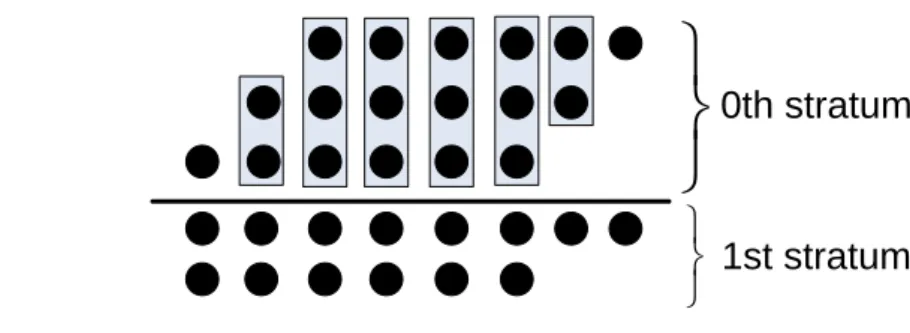
the final two partial products by a CPA. Three reduction rules are used for
constructing compressor trees: (i) any three dots with the same rank can be mapped
onto a full adder, (ii) the remaining two dots with the same rank can be mapped
onto a half adder or passed to the next stratum, and (iii) the last dots are directly
passed to the next stratum. The full adder acts as a 3:2 counter to add as many dots
as possible with the same rank. Figure 2.1 shows an example of a compressor tree
half adder full adder 0
0th stratum 1st stratum on ASICs, which reduces three partial products into two partial products.
2.2
Definitions
Firstly, this subsection describes a formal expression to characterize the
topology of the compressor tree. A compressor tree consists of a series of strata.
Each stratum is represented by a dot plane. A dot plane with respect to the s-th
stratum is denoted as an n-tuple 2 1, 2,..., 0
n s n n
d t t t ZN Z, where N is the set of non-negative integers, Z+ is the set of positive integers, and ti indicates the
number of dots which is in the i-th column of the dot plane on the s-th stratum of
the compressor tree. The set of dot planes is defined as D, and then the function
column: 2 1 0 column: 1 0
0-th stratum 6-LUT 6-LUT 6-LUT(a)
(b)
(c)
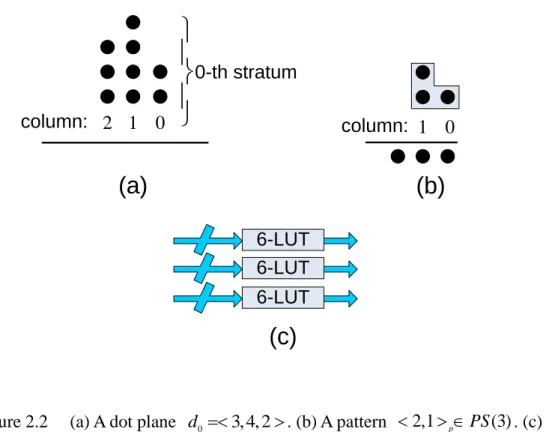
Figure 2.2 (a) A dot plane d0 3, 4, 2. (b) A pattern 2,1 p PS(3). (c) The pattern 2,1p is mapped onto 3 6-input LUTs.
:
r D N N can indicate the i-th element of the dot plane ds by r d i( , )s ti. The function w D: Z defines the width of each dot planesuch that w d( )s n
iff d is an n-tuple; meanwhile, the function s h D: Z defines the height of the dot plane d according tos h d( )s max{ ( , ) | 0r d is i w d( )}s . Figure 2.2(a) provides an illustrative example as follows. The dot plane d03, 4, 2 is the
input of a compressor tree consisting of three columns: two dots in the 0th column,
four dots in the 1st column, and three dots in the 2nd column. Therefore, the height
and the width of the dot plane d0 are h d( 0)max{3, 4, 2}4 and w d( 0)3,
respectively.
The following subsection describes a formal expression to characterize the
pattern. A pattern is denoted as an m-tuple 2 1, 2,..., 0
m m m p
p t t t ZN Z,
where tj indicates the number of dots which is in the j-th column of the pattern p.
The set of patterns is denoted as P, and then the function v P N: N can indicate the j-th element of the pattern p by v p j( , )tj . The function
:
iw PZ defines the number of input columns of each pattern, i.e., iw p( )m
iff ptm1,tm2,...,t0p. All patterns have the corresponding number of their
(a)
(b)
(c)
p
1p
2p
3p
4 Figure 2.3 (a) PPS(1). (b) PPS(2). (c) PPS(3).output bits. Thus the function ow P: Z calculates the minimal number of the required output bits by ( ) 1
0 2
( ) log ( iw p ( , ) 2 )i i
ow p v p i . A pattern is similar to a
counter in functionality, but it can sum inputs with value 1 in different ranks. For
example, a 3:2 counter like p3 as shown in Figure 2.3(c) sums three rank-0 inputs
while the pattern 2,1p as shown in Figure 2.2(b) sums two rank-1 inputs and one rank-0 input. Furthermore, the number of input columns of the pattern
2,1 p
is iw( 2,1 p) 2, and the number of its output bits is ow( 2,1 p) 3.
The function PS: Z P( )P points out the power set of patterns such that ( ) pPS k iff ( ) 1 0 ( , ) iw p i v p i k
, e.g., a pattern p belongs to PS(3), which implies i ( )-1
0 ( , ) 3
w p
i v p i
. Moreover, the function UPS: Z P( )P points out a union of pattern sets such that ( ) 1 ( )
k i
UPS k PS i .
Since a single LUT in the FPGA has the input constraint K (K6 for modern technologies), a pattern pUPS K( ) can be mapped onto ow p( ) copies of the
K-input LUT. For example, the pattern 2,1p can be mapped onto 3 copies of the 6-input LUT as shown in Figure 2.2(c). The delay is obviously equal to a LUT
delay as all patterns belong to UPS K . The delay optimal compress tree can be ( )
constructed with UPS K , but ( ) UPS K is an infinite set. In other words, we ( )
cannot determine the optimal solution with UPS K unless there is a finite set to ( )
construct the compressor tree without loss of delay optimality.
This thesis shows that a finite subset of the infinite set UPS K does exist to ( )
construct the compressor tree without loss of delay optimality. We denote the finite
set as PP and take patterns in it as prime patterns. Therefore, pPP iff
1 p (1)
p PS , or p has the property -1
0 ( , ) 2 2
i j j
i v p i
the carry propagation in each of its columns. For example, the prime pattern
4 1, 2 p
p as shown in Figure 2.3(c) possibly produces two valid carries in the 0th and 1st columns due to 0 1
4 ( , 0) 2 2 v p and 1 2 0 ( 4, ) 2 2 i i v p i ,
respectively. On the other hand, the pattern 2,1p is not a prime pattern because it will never produce a valid carry in the 0th column due to 0 1
( 2,1 p, 0) 2 2
v .
The function PPS: Z P(PP) points out a power set of prime patterns such that pPPS k( ) iff p{PPPS k( )}. For instance, a pattern p belongs to
(3)
PPS , which implies pPP and ( )-1
0 ( , ) 3
iw p
i v p i
, as shown in Figure 2.3(c). Moreover, Figure 2.3 illustrates three sets of prime patterns as follows:
1
(1) { }
PPS p , PPS(2){p2} , and PPS(3){p p3, 4} . The function
: ( )
UPPS Z P PP points out a union of prime pattern sets such that
1
( ) k ( )
i
UPPS k PPS i , and the function UNPPS: Z P(PP) points out a set
of non-prime patterns by UNPPS k( )UPS k( )UPPS k( ).
For the modern technology, there are only 37 distinct prime patterns in
(6)
UPPS ; therefore, we can find the delay optimal compressor tree based on
(6)
UPPS . For simplicity, all examples are demonstrated under K3 in the rest of this thesis.
2.3
Problem Formulation
Before formulating the compressor tree problem, this thesis introduces the
relationship between the dot plane and the pattern. In this thesis, a match is a
subgraph indicating the relationship between a pattern and a collection of dots, and
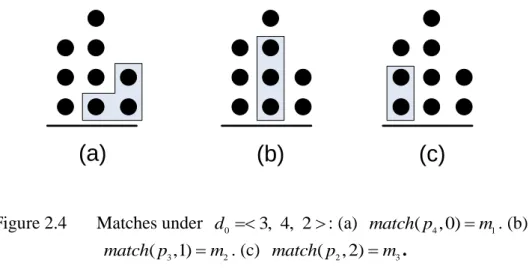
Figure 2.4 demonstrates three feasible matches under the dot plane d0 3, 4, 2:
4 1
( , 0)
match p m , match p( 3,1)m2, and match p( 2, 2)m3. In other words,
Figure 2.4(b) illustrates that three dots in the 1st column of d0 are matched to the
prime pattern p3 by m2. Furthermore, a cover is a set of matches such that each dot
in the same dot plane is matched exactly once by a certain pattern, and then the
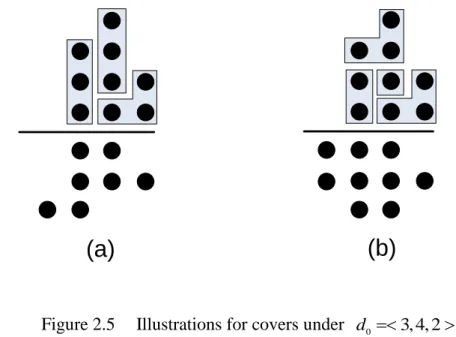
mapping is defined as cover: (P M)C, where C is the set of covers. Figure 2.5 demonstrates two feasible covers under the dot plane d0 3, 4, 2: the cover
1 2 4 1
({ , , })
cover m m m c with m4match p( 3, 2) ; the cover
1 3 5 6 2
({ , , , })
cover m m m m c with m5 match p( 1,1) and m6 match p( 4,1). Since the dot plane ds1 depends on the cover under the dot plane d , we can s
express ds1 by the output derived from the cover under d . Therefore, the s
function map: D C D determines the resultant dot plane ds1 after the dot
plane d is covered by the specific cover. For instance, Figure 2.5 shows two s
resultant dot planes, map d c( 0, )1 1,3, 2,1 and map d c( 0, 2)2,3,3,1 , derived from covers c1 and c2 under the dot plane d03, 4, 2, respectively.
(a)
(b)
(c)
Figure 2.4 Matches under d0 3, 4, 2: (a) match p( 4, 0)m1. (b)
3 2
( ,1)
On modern FPGAs, a ternary adder can sum three operands simultaneously. For
flexibility, we denote the maximum quantity of operands as H for a CPA on the
targeted FPGA. Therefore, H is equal to 3 in modern FPGAs. In the future, H may
be increased to 4, 5, 6, and so on; therefore, we can construct the compressor tree
by executing a sequence of covers until the height of the dot plane is less than or
equal to H. After the compressor tree is constructed completely by the sequence of
covers, at most H numbers are summed by a CPA. Since the delay of a pattern in
( )
UPS K is equal to a LUT delay, the depth of the compressor is equal to the times
of executing covers. Apparently, the fewer the times of executing covers is, the less
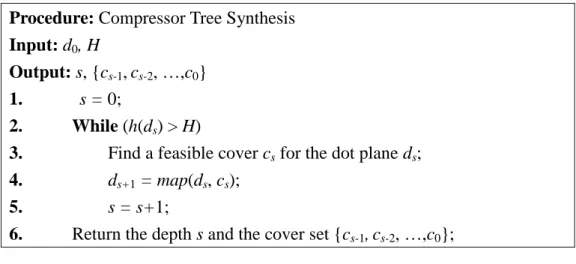
the depth of the compressor tree is. This thesis describes a general pseudo code to
construct compressor trees, as shown in Figure 2.6. Before we execute the loop
body, the height of the dot plane will be checked whether it is larger than H. If the condition is true, the dot plane needs a specific cover to reduce its height. After the
dot plane d is covered by the cover cs s, the resultant dot plane ds1, will be
produced by map d c( s, s). Therefore, the depth of the compressor tree is equal to
the times of executing loop. The unit delay model is used such that the delay is
(a)
(b)
determined by the depth of the compressor tree. Thus, we can declare that a
compressor tree is delay optimal if its depth is the minimum.
2.4
Properties of Prime Patterns
In order to synthesize the delay optimal compressor tree, the set of building
blocks should contain patterns where the number of inputs (i.e., i ( )-1 0 ( , )
w p
i v p i
) is equal to or less than K. In other words, the set of building blocks will be UPS K( )
exactly. Since UPS K( ) is an infinite pattern set, considering all combinations of
the compressor tree with UPS K( ) is impossible. This thesis describes the truth
(a)
(b)
(c)
Procedure: Compressor Tree Synthesis Input: d0, H
Output: s, {cs-1,cs-2, …,c0}
1. s = 0;
2. While (h(ds) > H)
3. Find a feasible cover cs for the dot plane ds;
4. ds+1 = map(ds, cs);
5. s = s+1;
6. Return the depth s and the cover set {cs-1,cs-2, …,c0};
that the delay optimal compressor tree can be constructed by the finite set
( )
UPPS K , rather than UPS K( ), without loss of delay optimality.
Before describing the fundamental theorem, we define the subpattern firstly.
The function sub N: N P P defines the subpattern ( , , ) ( , ), ( , 1),..., ( , ) p
sub j i p v p j v p j v p i P with the constraint
0 i j iw p( ). Figure 2.7 shows all subpatterns of the pattern p4 1, 2p:
4
(1,1, ) 1 p
sub p , sub(0, 0,p4) 2 p , and sub(1, 0,p4)1, 2p . In the following, this thesis defines pattern decomposition. The function
: ( )
decompose PP M defines a list of feasible matches {(sub j i p k( , , ), )} such
that the following conditions can be satisfied: (i) ( , )x i decompose p( ) :xPP,
and (ii) 2
(( , ), ( , ))x i y j decompose p( ) , i j ow y: ( ) j 1 i
. Figure 2.8
shows that the pattern 3,1, 0,1p can be partitioned into { ,p p p because of 1 1, 3}
the pattern decomposition decompose( 3,1, 0,1 p) {(p1, 0), (p1, 2), (p3, 3)} .
Then, this thesis shows that all patterns can be partitioned into a set of prime
patterns.
decompose
Lemma 1: For each pattern pUPS k( ), p can be partitioned into a set of prime patterns Ep { | ( , )pˆ p iˆ decompose p( )}.
Proof: In the beginning, we identify whether p belongs to UPPS(k). If
( )
pUPPS k , Ep p. Otherwise, we check the carry propagation possibility from the 0th column to (iw(p)−1)-th column in the pattern p. Because p belongs to
UNPPS(K), there exists a set of non-negative integers
1
0
| 0 ( ) and q ( , ) 2i 2q i
p
Q q q iw p v p i ; otherwise, p should belong to
( )
UPPS K , which contradicts pUNPPS k( ). Based on qmin{Qp}, let the pattern ˆp be the identified pattern with the property 0 iw p(ˆ0) q 1 such that
0
ˆ
( , ) ( , )
v p i v p i for 0 i iw p(ˆ0) and ( , )v p j 0 for iw p(ˆ0) j q. Due to
min{ p}
q Q , ˆp is a prime subpattern of p. Similarly, let '0 p be the subpattern
of p with the property iw p( ')iw p( )q such that ( ', ) ( , ( ) ( ') )
v p i v p iw p iw p i for 0 i iw p( ') , and v p j( , )0 for ( ) ( ')
q j iw p iw p . Obviously, p'sub iw p( ( ) 1, iw p( )iw p( '), )p UPS k( ) is true. If p is prime, ' p can be partitioned into Ep {p pˆ0, '}; therefore, this
lemma holds true. The above process, called cut, can extract another prime
subpattern on p . After we repeat cuts on ' p , p can be partitioned into '
0 1
ˆ ˆ ˆ { , ,..., }
p
E p p p such that ˆp is a prime pattern for 0 ii . Since p belongs
to UPS k , all patterns in ( ) E do belong to p UPPS k . Moreover, ( ) Ep is surely finite since each cut extracts a pattern ˆp under i iw p( ) 1ˆi . In other words, the
p can be partitioned into a set of prime patterns Ep { | ( , )pˆ p iˆ decompose p( )}.
According to Lemma 1, it is obvious that a non-prime pattern can be replaced
by a set of prime patterns. Therefore, Lemma 2 can be deduced by Lemma 1. Due
to pattern decomposition, the output of a non-prime pattern p may be different to
that of Ep. For example, the pattern 3,1, 0,1p has the output 1,1,1,1,1, but its decomposition decompose( 3,1, 0,1 p) {(p1, 0), (p1, 2), (p3, 3)} has the
output 1,1,1, 0,1, as shown in Figure 2.8(b). The new cover ˆc is derived after
every non-prime pattern p is partitioned into Ep, where match p i( , )c, c is a feasible cover under the dot plane d , and s 0 i w d( s). Thus, map d c never ( , )s ˆ produces more dots than map d c does. In the following, Lemma 2 shows that a ( , )s
compressor tree constructed with non-prime patterns can be replaced by a
compressor tree constructed with prime patterns, and then the latter has the same or
less depth.
Lemma 2: If there exists a compressor tree T constructed with UPS k( ), there exists
another compressor tree T' constructed with UPPS k such that the depth of ( ) T'
is equal to or less than that of T.
Proof: Let T be a compressor tree constructed with UPS k and the depth of T be ( )
z. The cover c is assumed to be under the dot plane s d on the s-th stratum of T s
for 0 s z . According to Lemma 1, a non-prime pattern
0
{ ' | : ( ', ) and ' ( )}
p p a match p a c p UNPPS k could be partitioned into a set of prime patterns Ep UPPS k( ). After pattern decomposition, the new cover is
denoted as ˆc and 0 map d c is denoted as ( 0, )ˆ0 ˆd . Since the decomposition may 1
delete some dots of d , i.e., 1 r d a( , )ˆ1 r d a( , )1 a for 0 a w d( )ˆ1 , where
0
a
. Thus, there is a new cover c under 1' ˆd such that a non-empty set of dots 1 '
Q in ˆd is matched by a certain match 1 m'c1' iff Q'Q, Q and Q are '
maximal, and Q is matched by a certain match mc1. In the same way, a
non-prime pattern p{ ' |p match p b( ', )c1 and 'p UNPPS k( )} can be partitioned into a set of prime patterns Ep UPPS k( ) . After pattern decomposition, the new cover is denoted as ˆc , and then the dot plane 1
2 1 1
ˆ ( , )ˆ ˆ
d map d c is derived such that w d( )ˆ2 w d( )2 and r d b( , )ˆ2 r d b( , )2 b
for 0 b w d(ˆ2), where b 0. This thesis calls the above process as transfer.
By executing transfers from d to 3 dz1, we can partition each non-prime pattern
in T into a set of prime patterns. In the end, there are two cases of ˆc for s
0 s z: (i) each dot in ˆd is match to s p1 1 p , and (ii) ˆc contains at least s
one match match p i( , ), where 0 i w d( )ˆs and p 1 p. If ˆc belongs to s
Case (i), ˆc makes no delay; otherwise, ˆs c has a LUT delay. Therefore, T could s
be transferred recursively into T' with the depth z' such that z'z.
By Lemma 2, we acknowledge that every compressor tree containing
non-prime patterns can be transformed into the compressor tree which only
contains prime patterns. In the following, this thesis deduces the key theorem by
Theorem 1: The minimum depth of compressor tree constructed with UPS k is ( )
the same as that of the compressor tree constructed with UPPS k . ( )
Proof: Let T be the compressor tree constructed with UPS k( ), and T' be the
compressor tree constructed with UPPS k( ); meanwhile, T and T' have the
minimum depth z and z’. Since UPS k contains ( ) UPPS k( ), i.e., the solution
space with UPPS k is the subset of that with ( ) UPS k , we can derive that ( )
'
z z. According to Lemma 2, a compressor tree constructed with UPPS k( ) has the depth z"z. Since T' is the compressor tree constructed with UPPS k( )to have the minimum depth, we can derive that z'z"z. Due to z'z and
'
z z, z is equal to z'.
According to the theorem, the delay optimal compressor can be constructed
with UPPS K , rather than ( ) UPS K . In other words, ( ) UPPS K is a compact ( )
set of basic building blocks for compressor trees. Throughout the rest of this thesis
Chapter 3
Proposed Algorithm
In this chapter, this thesis describes a delay optimal compressor tree synthesis
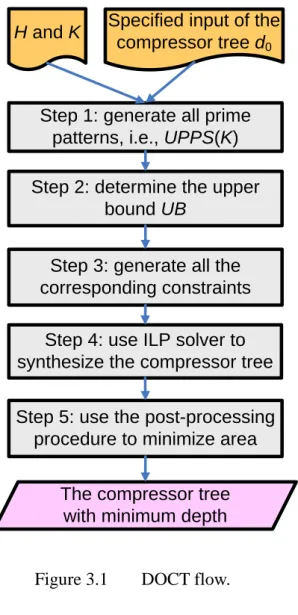
algorithm, DOCT, to synthesis compressor trees. The detail processes are shown in
Figure 3.1. Step 1 generates all prime patterns in UPPS K . Step 2 determines the ( )
upper bound of the minimum depth, denoted as UB, under the given input of the
compressor tree. Under UB, Step 3 unrolls the loop as shown in Figure 2.6 to
Specified input of the compressor tree d0
H and K
Step 1: generate all prime patterns, i.e., UPPS(K)
Step 2: determine the upper bound UB
Step 3: generate all the corresponding constraints
Step 4: use ILP solver to synthesize the compressor tree
Step 5: use the post-processing procedure to minimize area
The compressor tree with minimum depth
generate all the corresponding constraints and the objective function. Step 4 gains
the delay optimal compressor tree via the ILP solver. Furthermore, Step 5 uses a
post-processing procedure to minimize area overhead.
3.1
Upper Bound Determination
Since this thesis unrolls the loop as shown in Figure 2.6 to get the delay
optimal compressor tree, the upper bound of the minimum depth needs to be
determined in advance. Therefore, this subsection describes how to determine UB.
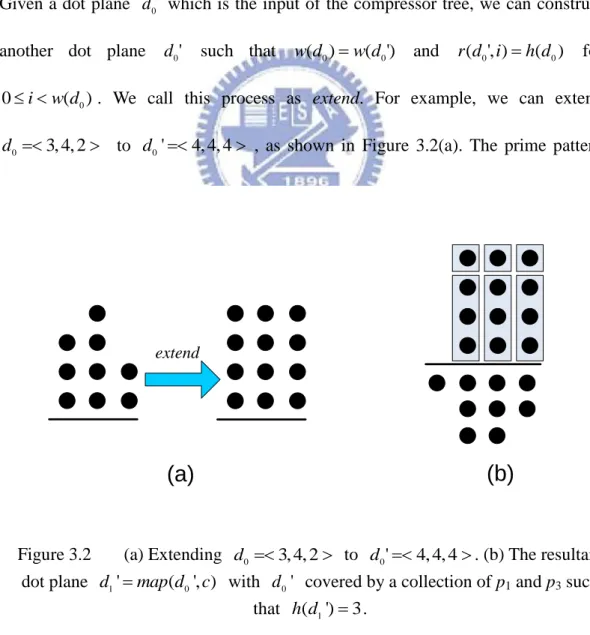
Given a dot plane d which is the input of the compressor tree, we can construct 0
another dot plane d0' such that w d( 0)w d( ')0 and r d i( ', )0 h d( 0) for
0
0 i w d( ). We call this process as extend. For example, we can extend
0 3, 4, 2
d to d0'4, 4, 4 , as shown in Figure 3.2(a). The prime pattern
extend
(a)
(b)
Figure 3.2 (a) Extending d0 3, 4, 2 to d0'4, 4, 4. (b) The resultant dot plane d1'map d( 0', )c with d covered by a collection of p0' 1 and p3 such
p
xK matches as many dots in the dot plane d as possible if K is equal to 0'
or less than h d( 0'). Then, the prime pattern yh d( 0') modK p matches the remaining dots, where K is the given input constraint of a LUT. Since d is 0'
regular, we can determine h d( 1') precisely by the equation (1), where
1' ( 0', )
d map d c is a dot plane derived from the cover
( 0') 1
(0') 1
0 ( , ) 0 ( , )
w d w d
i j
c match x i match y j . Therefore, the upper bound of the
estimation, min{ ( ) |h d1 c C d: 1map d( 0', )}c , can be determined by h d( 1').
1
( s ') ( s') / ( < > )p ( < ( s') mod > )p
h d h d Kow K ow h d K (1)
In all cases of this thesis we assume H 2. To determine UB, we execute the equation (1) recursively until h d( s1') is equal to or less than H. As the times of
executing the equation (1) is z', z' and UB should be equal. For example, based
on K3 and d0'4, 4, 4 , nine dots in d are matched to 0' p3 3 p
firstly, and then the others are matched to p14 mod 3p, as shown in Figure 3.2(b). Therefore, we can derive the upper bound of the minimum height of the dot
plane d as ( 4 / 31' ow( 3 p) ow( 4 mod 3 p))3 . Moreover, we can determine the upper bound of the minimum height of the dot plane d as 2 by the 2'
equation (1). Since h d( 2') is equal to H, the determination process for UB is
terminated. In this example, the times of executing the equation (1) is 2. Hence, UB
3.2
Variables
This subsection introduces the variables used in ILP formulation.
xs,i,j: the count of the match match p i( j, ) occurring on d s hs,i: the number of dots in the i-th column of ds, i.e., ( , )r d i s
, 1, ( , ) 0, ( , ) s s i s r d i H c r d i H 1, ( ) 0, ( ) s s s h d H q h d H
0th strutum
1st strutum
2nd strutum
(a)
(b)
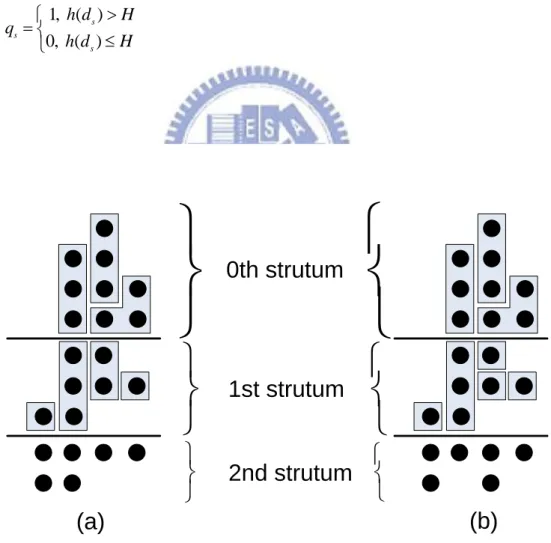
Figure 3.3 (a) The compressor tree before area minimization. (b) The compressor tree after Phase I of the post-processing procedure.
Figure 3.3(a) shows that the dot plane d0 3, 4, 2 has a cover
0 ({ 1, 2, 3})
c cover m m m which is constructed from m1match p( 4 1, 2p, 0) ,
2 ( 3 3 p,1)
m match p , and m3match p( 3, 2); therefore, x0,0,4 x0,1,3 x0,2,3 1
and other variables x0, ,i j on the 0th stratum are equal to zero. Furthermore, the dot plane d11,3, 2,1 has a cover c1cover m m m m({ 3, 4, 5, 6}) which is constructed from m4match p( 1 1 p, 0), m5match p( 2 2 p,1), and m6 match p( 1, 3);
therefore, x1,0,1x1,1,2 x1,2,3 x1,3,1 1, and other variables x1, ,i j on the 1st stratum are equal to zero.
3.3
Covering and Succeeding Constraints
The constraint (2) is called as covering constraint used to enforce a feasible
cover under the dot plane ds. We use the covering constraint to ensure that every dot
is matched exactly once. The inner summation of the constraint (2) sums the
amount of dots in the i-th column of ds, and they are matched to the prime pattern pj
by the match match p i( j, k) for 0 k min{ (iw pj),i1}. Further, the outer summation of the constraint (2) sums all the results of the inner summation for all
prime patterns. Figure 3.3(a) shows that the covering constraint enforces a feasible
cover cover m m m({ 1, 2, 3}) under the dot plane d0 3, 4, 2 such that
0,0,4 0,0
| ( )| ( ) 1 , , , 1 0 ( , ) , 0 ( ), 0 j UPPS K iw p j s i k j s i s j k v p k x h i w d s UB
(2)Since the dot plane ds+1 depends on how the preceding dot plane ds is covered,
we need the constraint (3) to construct the dot plane ds+1 such that hs1,i r d( s1, )i
for 0 i w d( s1). This thesis calls the constraint (3) as succeeding constraint. Firstly, the inner summation of the constraint (3) sums the number of matches
( j, )
match p ik for 0 k min{ow p( j),i1} to get the dots in the i-th column of the dot plane ds+1; meanwhile, the dots are contributed by the pattern pj. Further, the outer summation of the constraint (3) sums all the results of the inner
summation for all prime patterns to get hs+1,i. Figure 3.3(a) shows h1,0 x0,0,4 1,
1,1 0,1,3 0,0,4 2
h x x , h1,2 x0,1,3x0,2,3x0,0,4 3, and h1,3 x0,2,31, where the dot planed03, 4, 2 has the cover cover({(p4, 0), (p3,1), (p3, 2)}).
| ( )| ( ) 1 , , 1, 1 0 , 0 ( ), 0 j UPPS K ow p s i k j s i s j k x h i w d s UB
(3)3.4
Column and Stratum Constraints
The union of the constraints (4) and (5) is used to compute the correct cs,i. This
thesis calls the union of the two constraints as column constraint. If the i-th element
1. On the other hand, cs,i will be enforced to be 0 as hs,i is equal to or less than H. In
Figure 3.3(a), due to h1,12 and h1,2 3, c1,1 is set as 0 and c1, 2 is set as 1 via the
column constraint. Besides, the term Inf used in the constraints (5) and (7) can be
set as ( 0) 1 0 ( 0, ) w d i r d i . , , (H 2) cs i 1 hs i , 0 i w d( s), 0 s UB (4) , ,, 0 ( ), 0 s i s i s Inf c H h i w d s UB (5)
When the compressor tree is constructed completely, qs 0 and h d( )s H
should be satisfied iff the depth is equal to s. Therefore, a CPA can be used.
Otherwise, the dot plane ds still need be covered to reduce its height. This thesis
uses cs,i to obtain qs via the constraints (6) and (7). The union of these two
constraints is called as stratum constraint. Figure 3.3(a) shows an illustrative
example. The variable q1 is set as 1 via the stratum constraint due to h d( )1 3 H.
On the other hand, the variable q2 is set as 0 due to h d( 2) 2 H.
( ) 1 , 0 , 0 s w d s i s i q
c s UB (6) ( ) 1 , 0 , 0 s w d s i s i Inf q
c s UB (7)3.5
Objective Function
As stated above, the summation of qs will be the depth of the compressor tree
and it is equal to the equation (8). When we minimize the equation (8), the depth of
the compressor tree is minimized.
0
: UB s
s
Minimize
q(8)
For example, the depth of the compressor tree is 2 when the dot plane
0 3, 4, 2
d has the specific cover c0cover({(p4, 0), (p3,1), (p3, 2)}) , and
1 1,3, 2,1
d has the cover c1cover{(p1, 0), (p2,1), (p3, 2), (p1,3)} as shown in Figure 3.3(a).
3.6
Complexity Analysis
Here, this thesis analyzes the complexity of the number of variables and
constrains in our ILP formulation. Firstly, the number of variables is proportional to
the number of patterns (i.e., |UPPS K( ) |); the number of columns in every dot
plane; the upper bound of the minimum depth UB. This thesis denotes the number
of patterns as |P|. Besides, the minimum depth upper bound UB is proportional to
0
log( (h d ) ) . Therefore, the complexity of the number of variables is
0 0
(log( ( )) ( ) | |)
of the constraints in the following. Similar to the complexity of the number of
variables, the number of the constraints is proportional to the number of columns in
every dot plane and the minimum depth upper bound UB. Therefore, the
complexity of the number of the constraints is O(log( (h d0))w d( 0)).
3.7
Post-processing for Area Minimization
This thesis describes a post-processing procedure to reduce the area overhead
without losing delay optimality. This post-processing procedure is described as two
phases. Before detailing this two phases, we would define redundant matches firstly.
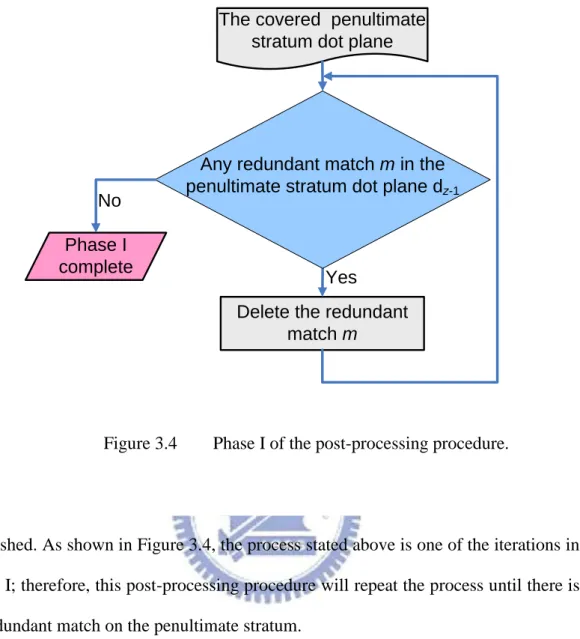
A match m on the dot plane ds is redundant iff h d( s1) does not increase while all
dots matched by m can be matched by p instead. In Phase I, we would delete all 1
redundant matches under the dot plane dz1 on the penultimate stratum when the
minimum depth of the delay optimal compress tree is z. Figure 3.3(a) shows that a
redundant match match p( 2,1) exists on the dot plane d11,3, 2,1, based on the specific cover cover({(p1, 0), (p2,1), (p3, 2), (p1,3)}). Figure 3.3(b) shows that the
depth of the compressor tree does not increase after deleting the redundant match
2
( ,1)
match p on d1. According to this phenomenon, this thesis presents Phase I of the
post-processing procedure for area minimization. Firstly, we check the existence of redundant matches under the dot plane dz1. If there is a redundant match m, it will be
deleted from the compressor tree, e.g., the two dots of the match match p( 2,1) on the
dot plane d1 can be matched by p1 instead such that they can be passed through from
is finished. As shown in Figure 3.4, the process stated above is one of the iterations in
Phase I; therefore, this post-processing procedure will repeat the process until there is
no redundant match on the penultimate stratum.
Practically, basic logic cells on modern FPGAs are flexible. In other words,
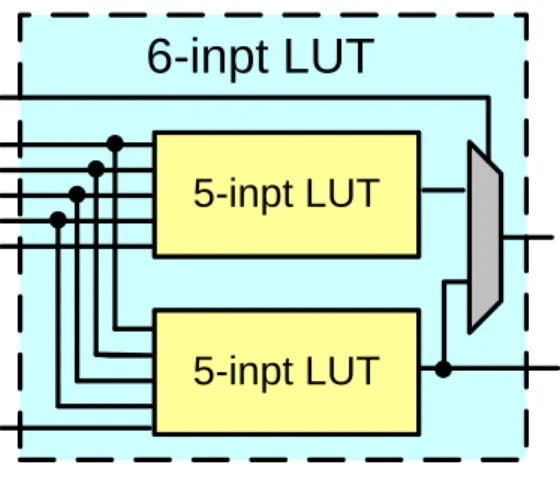
modern FPGAs employ two single-output LUTs with shared inputs as shown in
Figure 3.5. In general, this kind of circuits is called two-output LUTs. We observe that
two-output LUTs can map two single-output Boolean functions simultaneously if the
two functions satisfy two conditions: (i) the summation of the two function’s distinct
variables should be fewer than or equal to the physical-input constraint denoted as
PIC (PIC8 on Altera Stratix IV, and PIC5 in Xilinx Vertex V, e.g., PIC is equal to 6 in the example as shown in Figure 3.5), and (ii) the summation of the LUT
size of the two functions should be fewer than or equal to the The covered penultimate
stratum dot plane
Delete the redundant match m
Phase I complete
Any redundant match m in the penultimate stratum dot plane dz-1
Yes No
physical-capacity constraint denoted as PCC (PCC64 on Altera Stratix IV, and 64
PCC in Xilinx Vertex V [1, 2]) . Actually, PCC is equal to 2K, where K is the input constraint of a LUT. Besides, a two-output LUT can map a single output
function if the number of variables of the function is K (K = 6) as shown in Figure 3.5.
Moreover, we can merge the two distinct LUTs among all strata if the two functions
mapped by these two distinct cells satisfy PIC and PCC. Suppose we want to map the
two prime patterns p4 1, 2p as shown in Figure 3.6(a) (i.e., PIC6 , 64
PCC ), and then we can map the two patterns onto four two-output LUTs as shown in Figure 3.6(a). Obviously, the summation of the number of inputs of LUT 2
and 4 is equal to 6 which is fewer than PIC, and the summation of the LUT size is
equal to 3 3
2 2 which is fewer than PCC. Hence, we can merge LUT 2 and LUT 4 into a single LUT as shown in Figure 3.6(b). In Phase II, we merge the distinct LUTs
to map different patterns if these two functions mapped by them satisfy PIC and PCC.
5-inpt LUT
5-inpt LUT
5-inpt LUT
6-inpt LUT
LUT1
LUT 3
LUT 2
LUT 4
p
4p
4p
4p
4LUT 2
LUT 1
LUT 3
(a)
(b)
Chapter 4
Experimental Results
4.1 Experimental Information
We implement DOCT and the GPC heuristic [14] in C/C++ language on a
workstation with an Intel Xeon 2-GHz processor and 16 GB main memory under
the Centos 5.2 operating system. Besides, an open source package, lp_solve 5.5.13,
is used to solve the linear formulations. A set of benchmark circuits is evaluated
including three Radix-4 unsigned Booth-encoded multipliers (8 by 8 and 16 by16),
multiplier accumulators (MAC), discrete cosine transformation (DCT) [20], finite
impulse response filters (FIR), and motion estimations (ME). The input of each
compressor trees is extracted from the simulation result produced by MATLAB
Simulink toolbox. All compressor trees in our experiments are directly synthesized
without pipelined.
Table I illustrates the detail information of the benchmark circuits. In Table I,
Column 1 shows the variety of our benchmark circuits. Column 2 and Column 3
show the width and the height of the input dot plane, respectively. Column 4 shows
4.2 Parameters Setup
We implement two compressor tree synthesis algorithms DOCT and the GPC
heuristic. The following is the setting of parameters in our experiment.
DOCT: Compressor tree synthesis using DOCT described in preceding sections
under K6 and H3. This thesis supposes that DOCT is evaluated on Altera Stratix IV. Thus, the physical input constraint (PIC) is set to 8 and the physical
capacity constraint (PCC) is set to 64. The compressor tree produces three outputs
summed by ternary adder.
GPC: Compressor tree synthesis using the generalized parallel counter (GPC)
heuristic. In the GPC heuristic, there are three parameters: (i) M is the input
TABLEI CIRCUIT INFORMATION
Circuit Width Height Total
8 by 8 16 5 56 16 by 16 32 9 176 DCT_1 22 10 150 DCT_2 20 6 83 DCT_3 20 5 82 DCT_4 20 8 116 DCT_5 22 7 105 FIR_1 15 9 72 FIR_2 23 13 167 FIR_3 39 21 374 ME_1 10 10 100 ME_2 14 14 196 MAC_1 9 6 34 MAC_2 11 7 47
constraint of GPC patterns (the input constraint of LUTs in the targeted FPGA, e.g.,
6 for Altera Stratix IV, and Xilinx Vertex V), (ii) N is the output constraint of GPC
patterns, and (iii) k is the number of inputs of the final CPA (i.e., k is equal to H). In
our experiments, M is set as 6; N is set as 4; k is set as 3. The setting is the same as
[14].
4.3 Experimental Results
In our experiment, we compare both the depth and area produced by DOCT to
that by the GPC heuristic. Table II, III, and IV show the experimental results under
TABLE II
SYNTHESIS RESULT UNDER K = 5 K = 5 Circuit UB delay LUTs DOCT GPC DOCT GPC 8 by 8 1 1 2 29 45 16 by 16 3 2 4 149 222 DCT_1 3 3 3 160 171 DCT_2 2 2 2 103 109 DCT_3 1 1 1 42 47 DCT_4 2 2 2 101 107 DCT_5 2 2 3 86 132 FIR_1 3 2 4 61 97 FIR_2 3 3 4 177 222 FIR_3 4 4 4 536 580 ME_1 3 3 3 107 110 ME_2 4 3 4 222 240 MAC_1 2 1 3 17 40 MAC_2 2 2 3 34 50 Avg. 0.83 0.73 1 0.83 1
different input constraints of LUTs: K 5, K6, and K7, respectively. In Table II, III, and IV, Column 2 illustrates upper bounds of all benchmark circuits.
Column 3 and Column 4 illustrate the depth of compressor trees produced by
DOCT and the GPC heuristic. Meanwhile, Column 5 and Column 6 illustrate the
area in terms of LUTs on Altera Vertex Stratix IV produced by DOCT and the GPC
heuristic. Compared to the GPC heuristic, DOCT has 27% less depth with 17%
fewer LUTs under K5; 32% less depth with 21% fewer LUTs under K6; and 20% less depth with 2% fewer LUTs under K7. For all benchmark circuits, the GPC heuristic was finished in few seconds; meanwhile, DOCT was finished in
500 seconds.
TABLE III
SYNTHESIS RESULT UNDER K = 6 K = 6 Circuit UB delay LUTs DOCT GPC DOCT GPC 8 by 8 1 1 1 24 30 16 by 16 2 2 3 132 174 DCT_1 2 2 3 127 152 DCT_2 2 2 3 98 120 DCT_3 1 1 2 35 70 DCT_4 2 2 3 90 118 DCT_5 2 2 3 66 104 FIR_1 2 2 2 52 58 FIR_2 3 2 3 131 160 FIR_3 3 3 4 400 459 ME_1 2 2 3 78 105 ME_2 3 3 4 174 193 MAC_1 1 1 2 16 26 MAC_2 2 1 2 19 38 Avg. 0.73 0.68 1 0.79 1
It is evident that DOCT always have better or the same result in depth
compared to the GPC heuristic. The reason is that DOCT consider all combinations
of all prime patterns for constructing a compressor tree. Although DOCT does not
outperform the GPC heuristic in area for every case, it provides smaller area on
average.
TABLE IV
SYNTHESIS RESULT UNDER K = 7 K = 7 Circuit UB delay LUTs DOCT GPC DOCT GPC 8 by 8 1 1 2 26 40 16 by 16 2 2 2 125 119 DCT_1 2 2 3 109 127 DCT_2 2 2 2 83 78 DCT_3 1 1 2 40 62 DCT_4 2 2 2 82 78 DCT_5 1 1 1 44 44 FIR_1 2 2 2 51 48 FIR_2 2 2 3 125 135 FIR_3 3 3 3 397 334 ME_1 2 2 2 78 69 ME_2 2 2 3 123 153 MAC_1 1 1 1 12 16 MAC_2 1 1 2 22 33 Avg. 0.8 0.8 1 0.98 1
Chapter 5
Conclusions and Future Work
A delay optimal compressor tree synthesis algorithm, DOCT, has been
presented in this thesis. Since the infinite set of patterns can be superseded by the
finite set of prime patterns without loss of delay optimality, DOCT adopts an
ILP-based methodology to map prime patterns onto the compress tree with the
minimum depth and utilizes a post-processing procedure to minimize area overhead.
Therefore, DOCT can authenticallyarchive compressor trees with minimum depths
by all prime patterns under the input constraint of a LUT. On average, compressor
trees produced by DOCT have 32% less depth and 21% fewer LUTs than those
produced by the GPC heuristic on modern technologies.
Although DOCT has made a progress in reducing area overhead compared
to the GPC heuristic, we believe that there is still room for improvement. In the
beginning, we have put the area cost in the cost function of ILP formulation.
Unfortunately, the run time of DOCT is too long and unacceptable. But according
to the result of some smaller case, DOCT considering area cost in the cost function
could archive around 50% fewer LUTs than that does not consider. Yet, we believe
Reference
[1] Altera Corporation, Stratix IV device handbook. [Online]. Available: http://www.altera.com/
[2] Xilinx Corporation, Vertex-5 FPGA user guide. [Online]. Available: http://www.xilinx.com/
[3] Altera Corporation, Stratix III device handbook. [Online]. Available: http://www.altera.com/
.
[4] Xilinx Corporation, Vertex-4 FPGA user guide. [Online]. Available: http://www.xilinx.com/
[5] M. C. Herbordt, T. VanCourt, Y. Gu, B. Sukhwani, A. Conti, J. Model, and D. DiSabello, “Achieving high performance with FPGA-based computing,”
Computer, vol. 40, no. 3, pp. 50–57, March 2007.
[6] Altera Corporation, FPGAs provide reconfigurable DSP solutions. [Online]. Available: http://www.altera.com/literature/wp/wp_dsp_fpga.pdf
[7] S. Mirzaei, A. Hosangadi, and R. Kastner, “FPGA implementation of high speed FIR filters using add and shift method,” International Conference on Computer
Design, October 2006, pp. 308–313.
[8] O. Kwon, K. Nowka, and Jr. Swartzlander, “A 16-bit by 16-bit MAC design using fast 5:3 compressor cells,” Journal of VLSI Signal Processing Systems, Vol. 31, No. 2, pp. 77-89, June 2002.
[9] C.-Y. Chen, S.-Y. Chien, Y.-W. Huang, T.-C. Chen, T.-C. Wang, and L.-G. Chen, “Analysis and architecture design of variable block-size motion estimation for H.264/AVC,” IEEE Transaction on Circuits and Systems, vol. 53, no 2, pp. 578-583, February 2006.
[11] C. S. Wallace, “A suggestion for a fast multiplier,” IEEE Transaction on
Electronic computers, vol. 13, no. 1, pp. 14–17, February 1964.
[12] V. G. Oklobdzija, D. Villeger, and S. S. Liu, “A method for speed optimized partial product reduction and generation of fast parallel multipliers using an algorithmic approach,” IEEE Transaction on Computers, vol. 45, no. 3, pp. 294–306, March 1996.
[13] P. F. Stelling, C. U. Martel, V. G. Oklobdzija, and R. Ravi, “Optimal circuits for parallel multipliers,” IEEE Transaction on Computers, vol. 47, no. 3, pp. 273–285, March 1998.
[14] H. Parandeh-Afshar, P. Brisk, and P. Ienne, “Efficient synthesis of compressor trees on FPGAs,” Asia South Pacific Design Automation Conference, March 2008, pp. 138–143.
[15] H. Parandeh-Afshar, P. Brisk, and P. Ienne, “Improving synthesis of compressor trees on FPGAs via integer linear programming,” Design Automation and Test
in Europe, March 2008, pp. 1256–1261.
[16] P. S. Zuchowski, C. B. Reynolds, R. J. Grupp, S. G. Davis, B. Cremen, and B. Troxel, "A hybrid ASIC and FPGA architecture," International Conference of
Computer-Aided Design, November 2002 , pp. 187-194.
[17] A. Cevrero, P. Athanasopoulos, H. Parandeh-Afshar, A. K. Verma, P. Brisk, F. K. Gurkaynak, Y. Leblebici, and P. Ienne, “Architectural improvements for field programmable counter arrays: enabling efficient synthesis of fast compressor trees on FPGAs,” International Symposium on Field Programmable Gate
Arrays, February 2008, pp. 181–190.
[18] P. Brisk, A. K. Verma, P. Ienne, and H. Parandeh-Afshar, “Enhancing FPGA performance for arithmetic circuits,” Design Automation Conference, June 2007, pp. 334–337.
[19] J. Cong and Y. Ding, “FlowMap: an optimal technology mapping algorithm for delay optimization in Lookup-Table based FPGA designs,” IEEE Transaction
on Computer-Aided Design of Integrated Circuits and Systems, vol. 13, no. 1,
[20] W. Pan, A. Shams, and M. A. Bayoumi, “NEDA: a new distributed arithmetic architecture and its application to one dimensional discrete cosine transform,”
IEEE Signal Processing Systems, October 1999, pp. 159–168.