行政院國家科學委員會專題研究計畫 成果報告
自充填混凝土流動行為之三維離散元素模擬參數研究
研究成果報告(精簡版)
計 畫 類 別 : 個別型 計 畫 編 號 : NSC 95-2221-E-002-313- 執 行 期 間 : 95 年 08 月 01 日至 96 年 08 月 03 日 執 行 單 位 : 國立臺灣大學土木工程學系暨研究所 計 畫 主 持 人 : 謝尚賢 共 同 主 持 人 : 詹穎雯 計畫參與人員: 博士班研究生-兼任助理:張慰慈 報 告 附 件 : 出席國際會議研究心得報告及發表論文 處 理 方 式 : 本計畫可公開查詢中 華 民 國 96 年 11 月 01 日
目錄
目錄 ……… 1 (一)中文摘要 ……… 2 (二)英文摘要 ……… 2 (三)報告內容 ……… 2 3.1 研究目的 ……… 2 3.2 文獻探討 ……… 3 3.2.1 質流理論 ……… 3 3.2.2 離散元素法 ……… 3 3.2.3 計算效能 ……… 5 3.3 研究方法 ……… 5 3.3.1 SCC 砂漿元素 ……… 5 3.3.2 SCC 粗骨材元素 ……… 7 3.3.3 砂漿元素與粗骨材元素間之力學機制 ……… 8 3.3.4 試驗模具與鋼筋元素 ……… 8 3.3.5 工作性指標 ……… 8 3.4 結果與討論(含結論與建議) ……… 10 3.4.1 砂漿模擬 ……… 10 3.4.2 SCC 模擬 ……… 11 (四)參考文獻 ……… 18 (五)計畫成果自評 ……… 20 5.1 確定三維離散元素模擬之微觀參數範圍 ……… 20 5.2 驗證自充填混凝土砂漿流動性及粗骨材體積比之影響 ……… 20 5.3 學術論文之發表 ……… 20 (六)誌謝 ……… 21(一)中文摘要 自充填混凝土(Self-Compacting Concrete, 簡稱 SCC)為目前最重要的營建工程材料之 一,如何設計出具有良好工作性(workability)的自充填混凝土為近來研究之焦點。但由於混 凝土的非均質性,長時間且大量的試驗常耗費極高的人力、物力及時間成本,若能建立適 當的力學模型,佐以數值分析來預估試驗結果,則不僅能節省工程的成本與時間,也能增 進吾人對材料性質的瞭解。
欲以離散元素法(Discrete Element Method,簡稱 DEM)模擬自充填混凝土之流動行為 時,需找出離散元素法虛擬顆粒與自充填混凝土物理性質間的對應關係,才能正確描述其 性質。本研究透過物理性質之推演與力學模型之建立,佐以適當之實驗數據來回歸出自充 填混凝土流動試驗之三維離散元素法參數,藉此建立模擬自充填混凝土工作性之數值模 型,以利對自充填混凝土行為之瞭解與數值預測。 關鍵字:離散元素法、自充填混凝土、工作性、平行計算、物件導向技術。 (二)英文摘要
Self-Compacting Concrete (SCC) has become one of the most important materials in today’s construction industry. It is not an easy but important task to estimate the workability of a designed SCC. Several types of laboratory tests have been proposed to help understand the workability of it. However, these tests are often time consuming and costly. Therefore, computer simulations become a potential alternative to cope with this problem.
Due to the non-homogeneous and discontinuous properties of concrete materials plus large translation and rotation of aggregates in fresh concrete flow, the Discrete Element Method (DEM) becomes a better choice than the continuum mechanics based numerical approaches. By treating materials as a set of discontinuous particles with simple interaction mechanisms among them, we can then derive and simulate the macro behavior of the materials. For characterizing SCC, it is necessary to establish the relationships between the virtual discrete elements and the physics properties of SCC material.
In this research, through correlating the simulation results, in terms of workability, of SCC behavior with the experimental results, a numerical DEM model for predicting SCC workability is established. It is hoped that the outcomes of this research can enhance our understanding of SCC material as well as numerical prediction of SCC behaviors.
Keywords: Discrete Element Method, Self-Compacting Concrete, Workability, Parallel Computing, Object-Oriented Technology.
(三)報告內容 3.1 研究目的 自充填混凝土(Self-Compacting Concrete, 簡稱 SCC)問世以來,由於其「在澆置過程中 毋需施加振動及搗實,可藉由自身之充填能力而充填至鋼筋間隙及模版各處」之特性,非 但具有良好的工作性、且可避免蜂窩及骨料析離等問題,對於工程環境的提升、及品管控 制方面均有極大的助益,今日已經成為最重要的營建工程材料之一(Ozawa, et al., 1989; Masahiro, 1998)。SCC 與一般混凝土最大的差異在於其工作性(workability),係指 SCC 需具 備 良 好 的 充 填 能 力 (filling ability) 、 穿 透 能 力 (passing ability) 與 抗 析 離 性 (resistance to
segregation),設計時即以此為首要考量,與一般混凝土優先注重強度與耐久性不同。因此, 如何設計出具有良好工作性的 SCC 便成為相當受重視的議題。
然而,混凝土係由粗骨材、細骨材、水、粉體膠結料所組成之非均質材料,各種材料 在澆置過程中之存在複雜的交互作用,對於注重工作性的 SCC 而言,往往需要長時間且大 量的試驗來探求其特性,例如利用 V 型漏斗試驗(V-funnel test)、L 箱型試驗(L-shaped box test)、坍流度試驗(slump test)等來幫助瞭解 SCC 的性質(JSCE, 1999),所耗費的人力、物力 及時間成本均難以估計;若碰到一些較複雜的工程環境亦可能無法以試驗來模擬之。若能 建立適當的力學模型,佐以數值分析來預估試驗或工程現場之資訊,對於材料性質的認識 及營造成本之節省均會有良好之裨益。 3.2 文獻探討 3.2.1 質流理論 隨著自充填混凝土之澆置,粒料具有大幅度之移動、滑動、流動等不同的運動行為, 且材料可能出現不連續之現象,使得 SCC 較難以連體(continuum)理論描述之。過去之研究 多將 SCC 視為懸浮於砂漿溶液中之骨材,使用「粗骨材-砂漿質流」之二相模型(two-phase model),砂漿部份由於兼具固體之變形行為及液體之流動性,則多以質流(rheology)理論來 描述之(Jones and Taylor, 1977)。
質流是 1920 年由 Lehigh 大學的 Eugene Bingham 教授所提出,用以描述性質介於流體 與固體間之材料 (如圖 1)。混凝土砂漿在開始流動前,需先克服一臨界剪應力(critical shear stress),此時整體之變形幾可忽略,材料類似於固相行為;超越臨界應力後便開始流動,此 時之行為類似液體,其流動性由塑性黏滯係數(plastic viscosity coefficient)來決定(圖 2),這 樣的材料特性在學理上近似質流理論之中的賓漢流體(Bingham fluid),其行為可表示為:
0 pl
τ τ= +γ μ• (1)
τ :剪應力(shear stress)
0
τ :臨界剪應力(critical shear stress)
γ• :剪應變率(shear strain ratio)
pl
μ :塑性黏滯係數(plastic viscosity coefficient)
(對 SCC 砂漿而言,τ 、τ0、γ • 、μpl均為時間之函數,且具有τ0 0 • ≥ 與μpl 0 • ≤ 之特性。)
圖 1 質流理論介於固體力學(solid mechanics)及流體力學(fluid mechanics)理論之間 3.2.2 離散元素法
就離散力學的領域而言,離散元素法(Discrete Element Method,簡稱 DEM)是一常用且 較成熟的數值方法。DEM 最初是由 Cundall (1971)所提出,現今已被廣泛地應用在各種研 究領域中,其主要原理係基於將材料視為有限個不連續元素(粒子)之集合,進而從微觀的角 度來探討各元素間的力學交互作用,並據以推出材料的巨觀行為,其理論亦適用於模擬質 流材料。
(a) 牛頓流體(Newtonian fluid)與賓漢流體(Bingham fluid) (b) 以質流行為解釋時,SCC 與 傳統混凝土之差異 圖 2 質流行為之剪應力-剪應變率關係圖 由於 DEM 的基本假設係建構於離散體之上,過去的研究多偏重於材料工程或大地工 程等相關領域,如落石模擬(Giani, et al., 2001; 顧承宇等, 1996)、SCC 模擬(Noor, 2000; 劉 誼曦, 2002; Chan and Liu, 2003)、骨材級配的篩分析(Yang and Hsieh, 2001)、土壤與岩石行 為分析(Ting, et al., 1989; Ting and Corkum, 1992; Oda, et al., 1982; Iwashita and Oda, 1998) 等;此外,也有學者將之應用於火車之行車意外模擬(Kiyono and Nagai, 2003)、木屋結構破 壞模擬(Kiyono and Furukawa, 2006)之研究。
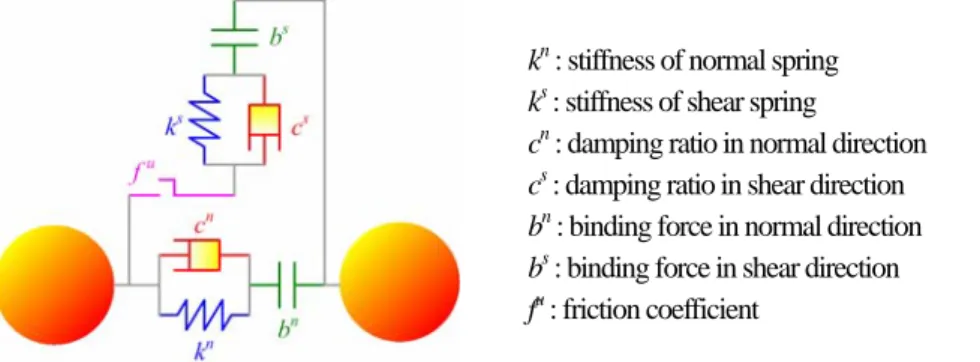
Noor 曾使用 DEM 來模擬 SCC 之流動行為(Noor, 2000),但受限於模擬工具在計算能力 方面之限制,因此無法使用較多的元素數來進行模擬,其結果也隨之受限,2002 年時,劉 誼曦(2002)使用商業軟體 PFC2D 針對 SCC 進行了系統性的研究,但由於其理論基礎為二維 DEM,在模擬真實世界之三維實驗時便不容易顯現出模擬參數間的差異性。作者所屬的研 究小組過去數年來積極投入 DEM 演算法之基本發展與改良。曾執行國科會「離散元素法 運動機制簡化與適用性之探討研究」計畫(編號 NSC91-2211-E-002-097) (謝尚賢等, 2003), 自行開發出一套可彈性擴充新式幾何形狀離散物件及運動機制的三維 DEM 模擬軟體架 構,名為 VEDO (VErsatile Discrete Object simulation system) (謝尚賢等, 2003; Yang and Hsieh, 2005; Yang, 2004)。VEDO 的設計與開發應用了最新的物件導向技術,主要目的在建立一高 度彈性之系統架構,以處理各類不同幾何形狀的元素及其間各類可能的複雜交互作用。此 外,也遵循 XML 標準,發展出一套可定義離散物件模擬問題與結果的描述語言,名為 dosXML (Yang, et al., 2004),以利模擬資料之交流與共享,並利相關軟體之開發。接著,亦 在 VEDO 的軟體架構上發展出一套名為 KNIGHT&ANNE/IRIS 的離散物件模擬系統 (Discrete Objects Simulation System,簡稱 DOSS) (Yang, 2004),該系統包含前後處理軟體 KNIGHT、計算引擎 ANNE/IRIS (林立欣,2005)、與視覺化程式 Venus Painter (陳詩華, 2003),可將 KNIGHT&ANNE/IRIS 的模擬結果以圖像或影片的方式呈現,大幅增加了 KNIGHT&ANNE/IRIS 在使用上的便利性。在實作上,目前已能處理的離散物件形狀有圓 球、圓柱、板及多面體等,而其中多面體的幾何形狀是以多個半空間(half-space)限制式來 描述,由多個限制式所組成的封閉空間即為多面體的模型(model);而兩個多面體間的碰撞 檢測,可利用現成的線性規劃(linear programming)及二次規劃(quadratic programming)程式來 計算達成(周靖江, 2004; Chen, et al., 2004)。而 KNIGHT&ANNE/IRIS 能處理的離散物件間 的力學機制,有彈簧、阻尼、摩擦與鍵結(bond)等之組合。自 2004 年起,KNIGHT&ANNE/IRIS 已被開始應用於對 SCC 之流動行為進行初步的模擬與探討(許鎧麟等, 2004; 林立欣, 2005),但礙於當時模擬系統在計算能力方面的限制而無法進行較詳盡的模擬研究;現時隨 著 KNIGHT&ANNE/IRIS 開發的日漸成熟與完備,目前已經可以使用該系統配合高效能計 算伺服主機(如現今常見的 PC 叢集系統)來模擬較大尺度的數值案例,以探究 SCC 的流動 行為。
3.2.3 計算效能
若欲實際對 SCC 之各項試驗進行模擬,可能遭遇的問題便是計算效能之考量,以一個 內含 11,000 顆直徑 5 mm 砂漿的 V 型漏斗模擬案例而言(圖 3a),使用內含 Intel Pentium IV 等級的處理器,每秒鐘的模擬計算亦須耗費 39.3 小時(Lin, et al., 2005)。對於實尺寸的模擬, 勢必耗費更多的計算時間。對此,國科會「平行離散元素模擬演算法之探討研究」計畫(編 號 NSC 94-2211-E-002-053) (謝尚賢等, 2005)亦嘗試以不同的平行策略來增進離散元素模擬 的效能,並已獲得良好的初步結果(Lin, et al., 2005; Lin, et al., 2006)。
基於目前累積之研究成果,本計畫進一步利用對 SCC 及 DEM 之瞭解與平行計算之技 術,進行有系統的數值模擬,透過比較與連結數值模擬的結果與實驗的結果,回歸及整理 出以三維 DEM 模擬 SCC 時,合理的力學機制及參數定義,期能增進吾人對於新拌 SCC 材 料性質之瞭解與行為預測之能力。 (a) SCC 試驗之 V 型漏斗 (b) SCC 砂漿試驗之 V 型漏斗 圖 3 SCC 相關試驗之 V 型漏斗模型 3.3 研究方法 欲以 DEM 模擬 SCC 之流動行為,則需找出 DEM 虛擬顆粒與 SCC 物理性質間的對應 關係,才能正確描述其性質。此一過程必須先對 SCC 材料特性與離散元素模擬(Discrete Element Simulation,簡稱 DES)兩者均有一定程度之瞭解,方可有效解決此問題。國科會「自 充 填 混 凝 土 (SCC) 澆 置 施 工 模 擬 與 分 析 數 值 方 法 之 研 發 ( 三 ) 」 計 畫 ( 編 號 NSC92-2211-E-399-004) (許鎧麟等, 2004)以現有軟體對於 SCC 之數值方法進行有系統的研 發,對於其基本性質已有初步的瞭解,確定 DEM 在 SCC 流動行為研究之可行性。劉誼曦 與(2002)林立欣(2005)之研究,建議 SCC 之 DES 可以採用以球形粗骨材元素與球形砂漿元 素所構成之二元模型,應足以描述 SCC 之流動行為。此二類元素所考量之物理性質及力學 機制又可歸納為:元素之直徑(diameter)、元素間正向彈簧之勁度(stiffness of normal spring)、 元素間剪切向彈簧之勁度(stiffness of shear spring)、元素間之正向阻尼(normal dashpot)、元 素間之剪切向阻尼(shear dashpot)、元素間之正向鍵結(normal bond)、元素間之剪切向鍵結 (shear bond)、元素間之摩擦(friction)等八類。 3.3.1 SCC 砂漿元素 SCC 砂漿係由細骨材、粉體膠結料、水、化學摻料等所混合之物質,其顆粒粒徑大小 約介於 0.1mm 至 1mm 之間。礙於各物質間的微觀互動機制複雜且難以分離評估之,勢必 需要對其進行簡化以利研究之進行。本研究假設單一粒徑、單一物理性質之球形「虛擬砂 漿元素」來描述 SCC 砂漿混合物,以下簡稱為砂漿元素。
元素直徑 砂漿元素之粒徑大小對於計算精度與計算量均具有重要的影響。若砂漿元素的直徑能 夠貼近 SCC 砂漿材料的尺寸(即前述的 1mm 以下),便可較輕易表現出真實砂漿的流動行 為;但砂漿元素的直徑過小時,亦會造成模擬所需的元素數過多,因而增加模擬所需的計 算量,因此砂漿元素直徑的決定便是一個重要的關鍵。本研究以直徑 10mm、5mm、4mm、 3mm 之砂漿元素分別進行砂漿試驗,依據試驗中各階段的物理現象來確認足以描述砂漿流 動行為的最小砂漿元素直徑,本研究用以確定砂漿元素直徑之方式為以下兩點: (1) 測定在靜止時,砂漿元素的總重需滿足靜力平衡條件。 (2) 測定在靜止時,砂漿元素對容器邊界的作用力必須等同靜止砂漿液體壓力之理論 值。 元素間正向彈簧勁度與等效密度因子 由於在本研究中使用單一直徑的球元素來模擬砂漿材料,基於球體堆疊時無法完全充 填空間之緣故,其密度將較已經近似流體之砂漿溶液為小。本研究使用劉誼曦(2002)與林立 欣(2005)所提出的等效密度因子(density factor)來調整之,以使其在材料總重上合理化。本 研究中使用之等效密度因子 f 定義為:D ' fD γ = × γ (2) ' γ :DES 所使用的元素密度 γ :真實材料的平均密度 但等效密度因子亦受到元素間正向彈簧勁度大小之影響。舉例而言,若元素的正向彈 簧勁度愈大,元素間的重疊(overlap)量便會愈低,若愈填滿同等大小的容器所需的元素數目 便愈少,此時容器中材料的總重便會愈顯不足,因此便需要較高的 等效密度因子來修正其 值。隨著元素正向彈簧勁度加大,等效密度因子亦會逼近於某一極限值,此值必須要經過 多次堆疊模擬後方能獲得。 元素間剪切向彈簧勁度 砂漿元素間剪切向彈簧之勁度受到以下兩項物理現象之影響: (1) 砂漿材料之流動性質係介於固體與流體之間,其剪切向勁度值應低於正向彈簧勁 度,因此可以定義出砂漿元素間剪切向彈簧勁度之上限範圍。
(2) 在數值模擬上,剪切向勁度控制了 DES 顆粒流(particle flow)達到靜止狀態所需之時 間。對於 SCC 砂漿而言,達到靜止狀態之時間並不會太長。因此可以定義出砂漿 元素剪切向彈簧勁度之下限範圍。
元素間正向阻尼
對於屬於黏滯性流體之砂漿而言,本研究採用黏滯性阻尼比(viscous damping ratio)來作 為控制阻尼機制之參數。阻尼比在先天上的限制便需介於 0 至 1 之間,此外,砂漿元素間 之正向黏滯性阻尼比亦受到以下物理現象之限制: (1) 過低的正向黏滯性阻尼比,會使得由球元素群在高速碰撞時的消能性不足,因之其 行為會接近彈性球而無法展現出其黏滯性,亦即偏離了砂漿材料的特性,因此可以 用來限定其下限範圍。 (2) 數值上若是阻尼比過高時,能量的變化便較為急劇,因此 DES 便需要使用較小的 時間步幅(time step),進而導致計算量的增加。因此,若砂漿元素流動行為的差異 不大時,應當選用較低的阻尼比來避免不必要的數值運算,此特性將成為 SCC(或 砂漿)DES 時的上限。 元素間剪切向阻尼 與 3.3.15 節所述的限制(2)相同,砂漿元素間之剪切向阻尼上限亦同樣需考量數值上的 限制;此外,剪切向阻尼對於砂漿流動行為有顯著的影響,其範圍需要與實驗對照時方能 顯現。
元素間正向鍵結 砂漿元素間之正向鍵結係用以描述元素間含有一層薄膜水覆蓋時,元素接觸後吸附力 之大小,此機制以鍵結強度(bond strength)控制。其範圍主要受到下列兩項物理現象之影響: (1) 砂漿元素間之正向鍵結強度過高時,會導致元素無法分離,其行為近似固體,因 此形成其上限。 (2) 鍵結強度過低時,會使得元素群的行為接近純水,因此可以限制其下限。 元素間剪切向鍵結 基於 DEM 之理論,剪切向鍵結主要在控制摩擦力之啟動與否,此機制亦由剪切向鍵 結強度來控制。其值過高時便無法顯現出摩擦力之影響,因此該值的選擇必須適中。 元素間摩擦機制
本研究使用庫倫摩擦(Coulomb friction)之乾摩擦理論,但基於 DES 係一動力行為,且 數 值 計 算 上 無 法 達 到 速 度 為 零 之 靜 止 狀 態 , 因 此 僅 使 用 動 摩 擦 係 數 (kinetic friction coefficient)來控制之。 3.3.2 SCC 粗骨材元素 與 SCC 之砂漿材料相較,粗骨材元素之材料特性較易決定。本研究對於粗骨材元素採 用單一物理性質但直徑不同之球元素來模擬之。 元素直徑 依據劉誼曦(2002)之假設,定義 SCC 骨材級配為常態分佈(normal distribution),其分佈 如圖 4 所示。依照混凝土對於粗骨材之定義,僅有滯留於四號篩(#4)上之材料才屬於粗骨 材,由此可定義出 SCC 粗骨材元素之直徑分佈範圍及數量。 圖 4 SCC 骨材級配累積百分比 元素間正向彈簧勁度與等效密度因子 由於進行 SCC 之 DES 時係將粗骨材與砂漿元素拌和,因此對於粗骨材之等效密度因 子原則上應與砂漿元素相同;而粗骨材元素間正向彈簧之勁度可由實驗室對粗骨材勁度之 瞭解、配合彈簧串聯理論來計算之: 1 1 1 2 n n n n K k K K = = + (3) 其中, n K 是實驗室所量得的材料正向勁度,而k 是材料間正向彈簧之勁度。 n 元素間剪切向彈簧勁度 由於粗骨材與粗骨材間、以及粗骨材與砂漿間在流動時並不屬於連體,因此依據 DES 勁度間採用串聯模型之假設,可忽略粗骨材元素之剪切向勁度而不計。
元素間正向阻尼與剪切向阻尼 SCC 在混合時,粗骨材元素間幾乎都由砂漿元素所包覆,因此其正向阻尼與剪切向阻 尼可以設定與砂漿元素相同。 元素間正向鍵結與剪切向鍵結 與前面討論彈簧勁度時相同之理由,粗骨材元素間之正向鍵結與剪切向鍵結亦可忽略 不計(劉誼曦, 2002)。 元素間摩擦機制 依據實驗室對於潮溼粗骨材之摩擦試驗,可以定義粗骨材間之動摩擦係數為 0.4 (劉誼 曦, 2002)。 3.3.3 砂漿元素與粗骨材元素間之力學機制 由前述之砂漿元素與粗骨材元素之設定,可以推導出此二元素間的力學互動機制。其 中正向與剪切向彈簧之勁度可由彈簧串聯理論計算之;正向阻尼與剪切向阻尼則設定與砂 漿元素相同,鍵結強度可以忽略不計,唯獨動摩擦係數建議應高於粗骨材間之動摩擦係數, 以表現出砂漿對粗骨材之束制能力。 3.3.4 試驗模具與鋼筋元素 在進行 DES 時,另需考量到構成試驗模具與鋼筋的的邊界元素。本研究使用圓柱元素 來模擬鋼筋、使用板元素來建構模具。考量鋼筋與模具之材料硬度均遠高於 SCC,可藉此 推導出其與砂漿或粗骨材元素間的正向彈簧與剪切向彈簧勁度。 3.3.5 工作性指標 為評估 SCC 或其砂漿之工作性,工程師定義所謂的「工作性指標」(workability index)。 該指標係由一系列的試驗所測定(JSCE, 1999),本研究使用其中的黏滯性指標(viscosity index)與流動性指標(flowability index)兩項,分別說明如後。 黏滯性指標與 V 形漏斗試驗 V 形漏斗試驗為常見的 SCC 標準試驗(JSCE, 1999),所謂的 V 形漏斗是如圖 3 所示的 V 形容器,下方有一可開啟的閘門,將 SCC 或砂漿材料由上方倒入 V 形漏斗,靜置後打開 閘門並計算所有材料漏光之時間,稱為流動時間(flow time) t 。此試驗的目的是為了評估m SCC 或砂漿材料通過狹窄通道的能力。因此定義了黏滯性指標(viscosity index) R :m 10 m m R t = (4) 當流動時間t 愈長時,黏滯性指標m R 便愈小,表示材料具有較高的黏滯性。 m 流動性指標與 L 箱形試驗 L 形漏斗試驗亦為常見的 SCC 標準試驗(JSCE, 1999),其模具如圖 5 所示,可以分為料 槽與流動槽兩部份(圖 6),SCC 的 L 箱形試驗另具有鋼筋(圖 5b),以一活動閘門分隔。先將 SCC 或砂漿材料倒入料槽中(圖 6a),靜置後再開啟閘門,材料會向右填滿流動槽,停止流 動時記錄最終狀態,其目的在測量 SCC 或砂漿材料之變形能力及流動性。依據不同類型的 靜止狀態可計算流動性指標(flowability index) B : m 1 m L L B L − = ,材料停止流動時無法抵達流動槽最右側 (5a) 2 1 m H B H = ,材料停止流動時可抵達流動槽最右側 (5b) 1 Bm 1 − ≤ ≤ (5c) 該指標愈大代表流動性愈高,Bm = 代表可完全流動均勻,1 Bm= − 則代表完全無法流動。 1
(a) 砂漿試驗 (b) SCC 試驗 圖 5 SCC L 箱形試驗 (a) L 箱可由閘門分為左側的料 槽與右側的流動槽 (b) Case I:材料無 法抵達流動槽 最右側 (c) Case II:材料可抵達流 動槽最右側 圖 6 SCC L 箱形試驗之流動性指標 工作性指標圖 對同一種配比的 SCC 或砂漿材料進行 V 形漏斗試驗與 L 箱形試驗,可以得到一組「黏 滯性指標-流動性指標」,將其繪製後可以得到工作性指標圖(如圖 7 所示)。藉由工作性指標 圖上的對應,可以瞭解 DES 微觀參數對於 SCC 黏滯性與流動性之影響,甚或可能找出其 與實驗室配比參數之對應關係。 SCC 充填均勻度 SCC 與傳統混凝土相較,其最大之優點即為其具有良好的充填能力,但實際上充填均 勻度會隨著 SCC 材料配比而異。觀念上,粗骨材比例及砂漿流動性對 SCC 充填能力應具 有一定程度之影響,但實驗室往往較難對已經充填完成之 SCC 試體進行判斷與評估;離散 元素模擬時則可藉由調整「粗骨材體積比」及「砂漿流動性」來觀察 SCC 之充填均勻度, 其中「粗骨材體積比」是由直接調整模擬時粗骨材算之數量來達成,「砂漿流動性」則可由 調整砂漿元素間正向鍵結強度來控制之(較高之鍵結強度代表著較低的流動性,其程度可由 砂漿 L 箱形試驗之流動性指標測得)。在判斷 SCC 充填均勻度方面,本研究則以 SCC 之 L 箱形試驗截面積變化及「粗骨材-砂漿截面積比」變化來評估。當截面積或「粗骨材-砂漿截 面積比」之變化愈緩時,代表 SCC 充填愈均勻。
3.4 結果與討論(含結論與建議) 3.4.1 砂漿模擬 元素尺度效應、等效密度因子與元素正向勁度 為使元素間正向彈簧勁度在材料上更具有物理意義,可以使用彈簧串聯公式將其轉換 為砂漿元素之正向勁度,由公式(3)可推得: 2 n n m m K = k (6) n m K :砂漿材料之正向勁度(具有物理意義) n m k :砂漿元素間正向彈簧之勁度 針對直徑 10mm、5mm、4mm、3mm 等四種不同尺度之砂漿元素進行模擬後,元素直 徑、等效密度因子與砂漿材料正向勁度之關係如表 1、表 2 及圖 8 所示。砂漿材料勁度在 1kN/m 時,等效密度因子之變化較大;若僅觀察 5kN/m 至 10kN/m 部份,等效密度因子隨 著元素尺度降低而逼近至 1.6 左右。由於文獻中對於單一球體隨機堆積密度上限之解析解 為 0.65 (Jaeger and Nagel, 1992) , 換 算 為 等 效 密 度 放 大 因 子 後 , 即 表 示 其 下 限 為
1 0.65 1.538≈ ,顯示本研究對於砂漿堆積已經相當密實(砂漿材料勁度在 1kN/m 的等效密度 因子會低於 1.538 是由於 DEM 理論在低正向勁度時容許較大的元素重疊量所致)。為降低 等效密度因子對後續研究之影響,本研究選擇砂漿材料正向勁度為 10kN/m,亦即砂漿元素 間正向彈簧勁度為 5kN/m;此外,由於 5mm 與 10mm 砂漿元素之等效密度因子與其他尺度 有較顯著之差異,並不適合作為數值模擬之選擇。 重量與邊界壓力之檢核 在砂漿溶液靜止時,可檢核數值解之重量與邊界壓力是否合乎物理意義。本研究針對 直徑 10mm、5mm、4mm、3mm 等四種不同尺度之砂漿元素計算其誤差(如圖 9 所示),顯 示 10mm 砂漿元素在邊界壓力上之誤差明顯高於其他尺度,同樣證實尺度效應之影響。與 等效密度因子在尺度效應上之結果合併比較,本研究建議砂漿元素直徑上限應限定在 4mm。 工作性指標 本研究調整前述各砂漿元素之微觀參數,對其進行 V 形漏斗與 L 箱形試驗之模擬,所 量測出之工作性指標數值解與實驗室量測值的比較如圖 7b 所示。研究顯示目前定義的微觀 參數範圍已經可以適當地表達出 SCC 砂漿試驗之工作性,建議砂漿元素之微觀參數應遵循 之範圍如表 3 所示,微觀參數變動時對所模擬之 SCC 砂漿溶液流動行為則如圖 10 及圖 11 所示。 (a) 實驗室資料(劉誼曦, 2002) (b) 實驗室資料與數值模擬資料之比對 圖 7 SCC 砂將試驗工作性指標圖
表 1 SCC 砂漿靜止狀態(V 形漏斗)所量測之物理量(等效密度因子、重量、邊界壓力) Model Analytical solution Simulation VFP01 VFP02 VFP03 VFP04 Stiffness kn (kN/m) 0.5 1.0 5.0 10.0 Density factor fd 1.505 1.560 1.610 1.620
Number of mortar elements 53,347 51,333 49,750 49,500
Average specific gravity 2.000 2.002 1.997 1.997 1.999
Error on average specific gravity (%) 0.091 0.168 0.145 0.030
Boundary contact force caused by liquid
pressure (N) 196.979 220.653 217.173 214.861 205.759
Error on boundary contact force (%) 12.019 10.252 9.078 4.457
表 2 SCC 砂漿靜止狀態(L 箱形模具)所量測之物理量(等效密度因子、重量、邊界壓力) Model Analytical solution Simulation LBP01 LBP02 LBP03 LBP04 Stiffness kn (kN/m) 0.5 1.0 5.0 10.0 Density factor fd 1.485 1.545 1.600 1.605
Number of mortar elements 38,180 36,618 35,397 35,217
Average specific gravity 2.000 2.004 2.000 2.002 1.998
Error on average specific gravity (%) 0.192 0.024 0.083 0.115
Boundary contact force caused by liquid
pressure (N) 125.440 122.115 124.843 120.969 125.943
Error on boundary contact force (%) 2.651 0.476 3.565 0.401
圖 8 砂漿元素直徑、等效密度因子與砂漿材料正向勁度之關係 3.4.2 SCC 模擬
在砂漿元素微觀參數的範圍限定之後,可進一步經由物理實驗及對粗骨材材料之瞭解 來定義 SCC 粗骨材元素之微觀參數。將此二種元素混合後即為模擬所需之 SCC 材料。以 下針對 SCC 粗骨材元素之微觀參數及 SCC 試驗模擬結果分別進行敘述:
SCC 粗骨材微觀參數範圍 依據粗骨材材料性質,本研究設定其材料正向勁度為 1,000kN/m;等效密度因子則設 定與砂漿相同(約接近 1.6,此值必須配合選用之砂漿元素尺寸不同而略做調整,以確保模 擬時之一致性);至於元素尺寸則可依據劉誼曦(2002)建議之常態分佈曲線(如圖 4),選用平 均值 1cm、標準差 0.3cm 之級配,換算為四類總數與直徑各異的球元素。此外,粗骨材之 體積比對於 SCC 之流動行為亦有明顯之影響,本研究分別選定粗骨材體積比 0.3 與 0.35 來 進行模擬。本研究使用之粗骨材相關微觀參數詳列如表 4。 (a) 重量誤差 (b) 邊界壓力誤差 圖 9 使用不同尺度之砂漿元素,溶液靜止時之重量與邊界壓力的檢核 b n m-m = 0.001 N b n m-m = 0.01N b n m-m = 0.1N
t=1.0 sec. t=2.0 sec. t=3.0 sec. t=5.0 sec.
b n m-m = 0.001 N b n m-m = 0.01N b n m-m = 0.1N
t=0.2 sec. t=0.4 sec. t=0.6 sec. t=1.0 sec.
圖 11 砂漿間正向鍵結強度改變時,對於 L 箱形試驗之影響 表 3 以 DEM 模擬 SCC 砂漿試驗時,建議微觀參數之範圍 參 數 建議值 說明 砂漿元素直徑 D 3 mm (1) D≤5mm時,可滿足邊界壓力合理性 之需求。 (2) D≤4mm時,可以看出 interaction 中 各參數之顯著影響。 (3) D 值過小時,將導致計算量較大(計算 時間較長)及記憶體可能不足之問題。 砂漿元素等效密度因子 f d 1.600 (3mm) 1.605 (4mm) (1) 虛擬砂漿元素之正向勁度愈高,使質 量守恆之 f 將愈高。 d (2) f 最終將收斂至 1.6 左右 d 砂漿元素比重 'γ = fd × γ 3.21 由等效密度因子 f 計算得來。 d 時間步幅Δt < 1x10⁻⁵ sec. (1) 應小於臨界時間步幅(與元素質量、元 素間正向及剪切向彈簧勁度有關),至 少應低於 3.38x10⁻⁵秒。 (2) 測試當阻尼比提升超過 25%時,能量 變化較急劇,應適度降低Δt值,最低 須降至 2.5x10⁻⁶秒。 砂漿-砂漿 正向彈簧勁度 n m m k − 5x10 3 N/m (1) km mn− 過高會降低臨界時間步幅,以致 於增加計算量。 (2) km mn− 過低會使 f 變化較大,因而無法d 控制其影響。
表 3 以 DEM 模擬 SCC 砂漿試驗時,建議微觀參數之範圍(續) 參 數 建議值 說明 砂漿-模具 正向彈簧勁度 n m c k − 1x10 4 N/m 由彈簧串聯模型可以訂出砂漿材料本身 的等值正向勁度為 1x10⁴ N。假設模具材 料正向勁度遠大於砂漿材料正向勁度,換 算 可 得 砂 漿 與 模 具 間 的 彈 簧 勁 度 2 n n m c m m k − = k − 砂漿-砂漿 剪切向彈簧勁度 s m m k − > 5x10 -2 N/m 其值過小,將使得結果近似水,大於 5x10 -2 N/m 時開始接近 SCC 砂漿。 砂漿-模具 剪切向彈簧勁度 s m c k − > 1x10 -1 N/m (1) 其影響可由其在工作性指標表的顯著 變化觀察得知。 (2) 若與正向勁度一樣考慮彈簧串聯模 型,可簡單定義km cs− =2km ms− ,但實際 上亦可保留其值之不同,以增加可調 整的參數數目。 砂漿-砂漿 正向阻尼係數 n m m c − 2.5 %~25 % (1) 當km cs− =1x10 N/m-1 時, n m m c − 和 n m c c − 在 25%以上對工作性指標的影響甚小, 但是對於流動行為(由動畫觀察)則非 常顯著。 (2) 2.5% 時,其行為仍接近一群彈性球 體,25% 時則較接近漿體,因此可以 由此控制其範圍。 (3) 可能在km ms− 提高時才有較顯著的影 響。 砂漿-模具 正向阻尼係數 n m c c − 25 %~100 % (1) 當km cs− =1x10 N/m-1 時, n m m c − 和 n m c c − 在 25%以下對工作性指標的影響甚小。 (2) 過 高 的 將cm cn− 使 得 臨 界 時 間 步 幅 縮 小。 (3) 可 能 在km cs− 提 高 時 才 有 較 顯 著 的 影 響。 砂漿-砂漿 剪切向阻尼係數 s m m c − 25 %~100 % (1) 其影響可在流動性指標上看出。 (2) 過高的將cm ms− 使得臨界時間步幅縮 小。 砂漿-模具 剪切向阻尼係數 s m c c − 25 %~100 % (1) 其影響甚微,或許在km cs− 提高時才有 較顯著的影響。 (2) 過 高 的 將cm cs− 使 得 臨 界 時 間 步 幅 縮 小。 砂漿-砂漿 正向鍵結力 n m m b − 1x10 -2 N~1 N (1) bm mn− = N 時,砂漿在試驗中無法流1 動,近似固體。 (2) bm mn− > ×1 10−2 N 時,對工作性指標影 響顯著。 砂漿-模具 正向鍵結力 n m c b − 0 砂漿試驗之模具上會殘留一層薄砂漿,隔 絕其餘砂漿與模具的鍵結,故可忽略之。
表 3 以 DEM 模擬 SCC 砂漿試驗時,建議微觀參數之範圍(續) 參 數 建議值 說明 砂漿-砂漿 剪切向鍵結力 s m m b − > 1x10 -6 N 主要在控制摩擦力之啟動與否,可能可以 對應質流理論中的降伏剪應力,但其值小 於 1x10⁻⁶ N 時便看不出其影響。 砂漿-模具 剪切向鍵結力 s m c b − 0 砂漿流過模具時,會殘留一層薄砂漿表 面,隔絕其他砂漿與模具的鍵結性質,故 可忽略之。 砂漿-砂漿 靜摩擦係數 s m m f − k m c f − 由於數值上很難達到相對速度為零之狀 態,故其影響可忽略。 砂漿-砂漿 動摩擦係數 k m m f − 0.2 (1) 對工作性指標圖之影響顯著。 (2) 屬於固體之係數,不應對於 SCC 砂漿 在此調節。 砂漿-模具 靜摩擦係數 s m c f − k m m f − 由於數值上很難達到相對速度為零之狀 態,故其影響可忽略。 砂漿-模具 動摩擦係數 k m c f − 0.1 (1) 對工作性指標圖之影響顯著。 (2) 屬於固體之係數,不應對於 SCC 砂漿 在此調節。 表 4 以 DEM 模擬 SCC 試驗時,建議粗骨材相關之微觀參數範圍 參 數 建議值 說明 粗骨材元素直徑 D 0.7~2.3 mm 依材料級配而定。 粗骨材元素等效密度因子 f d 1.600~1.605 (配合砂漿元 素之設定) 與砂漿元素之等效因子相同,以確 保模擬之一致性。 砂漿元素比重 'γ = fd × γ 3.840~3.852 由等效密度因子 f 計算得來。 d 時間步幅Δt < 1x10⁻⁵ sec. 應小於砂漿臨界時間步幅。 粗骨材-粗骨材 正向彈簧勁度 n a a k − 5x10 6 N/m 由材料性質估計。 砂漿-模具 正向彈簧勁度n a c k − 1x10 7 N/m 由彈簧串聯模型可以訂出粗骨材 材料本身的等值正向勁度為 1x10⁷ N。假設模具材料正向勁度遠大於 粗骨材材料正向勁度,換算可得粗 骨 材 與 模 具 間 的 彈 簧 勁 度 2 n n a c a a k − = k − 粗骨材-砂漿 正向彈簧勁度 n a m k − 5x10 6 N/m 由粗骨材與漿元素之彈簧串聯模 型得到。 粗骨材-粗骨材 正向阻尼係數 n a a c − 2.5 %~25 % 與砂漿元素間之正向阻尼係數相 同,以確保模擬之一致性。 粗骨材-模具 正向阻尼係數 n a c c − 25 %~100 % 與砂漿元素對模具之正向阻尼係 數相同,以確保模擬之一致性。
表 4 以 DEM 模擬 SCC 試驗時,建議粗骨材相關之微觀參數範圍(續) 參 數 建議值 說明 粗骨材-砂漿 正向阻尼係數 n a m c − 2.5 %~100 % 與砂漿元素間之正向阻尼係數相 同,以確保模擬之一致性。 粗骨材-粗骨材 剪切向阻尼係數 s a a c − 25 %~100 % 與砂漿元素間之剪切向阻尼係數 相同,以確保模擬之一致性。 粗骨材-模具 剪切向阻尼係數 s a c c − 25 %~100 % 與砂漿元素對模具之剪切向阻尼 係數相同,以確保模擬之一致性。 粗骨材-砂漿 剪切向阻尼係數 s a m c − 25 %~100 % 與砂漿元素間之剪切向阻尼係數 相同,以確保模擬之一致性。 粗骨材-粗骨材 靜摩擦係數 s a a f − 0.4 由於數值上很難達到相對速度為 零之狀態,故其影響可忽略。 粗骨材-粗骨材 動摩擦係數 k a a f − 0.4 由粗骨材材料試驗得來。 粗骨材-模具 靜摩擦係數 s a c f − 0.4 由於數值上很難達到相對速度為 零之狀態,故其影響可忽略。 粗骨材-模具 動摩擦係數 k a c f − 0.4 由粗骨材材料試驗得來。 粗骨材-砂漿 靜摩擦係數 s a m f − > 0.4 由於數值上很難達到相對速度為 零之狀態,故其影響可忽略。 粗骨材-砂漿 動摩擦係數 k a m f − > 0.4 由 於 粗 骨 材 與 砂 漿 屬 於 異 質 材 料,各其動摩擦係數應高於兩者各 自之動摩擦係數值。 重量與邊界壓力之檢核 在 SCC 靜止時,亦可檢核重量與邊界壓力來確認數值模擬是否合乎物理意義,其結果 如表 5 所示,靜止時 SCC 之重量誤差約在 7.3%以下,邊界壓力誤差約在 0.8%以下。由於 等效密度因子係人為強制給予之參數,或許因此造成重量誤差較大,但實際上應屬於可接 受的範圍。 表 5 SCC 靜止狀態(L 箱形模具)所量測之物理量(重量、邊界壓力) Model SCCVFP30 SCCVFP35 Volume Ratio 0.300 0.350 Stiffness kn (kN/m) 1,000 1,000 Density factor fd 1.605 1.605
Number of Coarse Aggregates elements 7,234 8,485
Number of mortar elements 178,866 175,763
Average specific gravity
Simulation 2.261 2.295
Analytical Solution 2.120 2.140
Error (%) 6.638 7.267
Boundary contact force caused by liquid pressure (N)
Simulation 6,968.469 7,088.689
Analytical Solution 6,927.912 7,033.399
SCC 充填均勻度
圖 13 表示當「粗骨材體積比」與「砂漿流動性」不同時,SCC 之 L 箱形試驗最終靜 止狀態的截面積變化;圖 14 則為「粗骨材-砂漿截面積比」變化,均顯示高流動性砂漿或 低粗骨材體積比可提高 SCC 的流動性與充填能力,以上結果亦可由模擬視算之結果看出(如 圖 15),此結果與實驗室預期之趨勢相同。
(a) 粗骨材體積比 Vaggr = 0.30 (a) 粗骨材體積比 Vaggr = 0.35
圖 13 不同粗骨材體積比、不同砂漿流動性之 L 箱形試驗截面積變化圖
(a) 粗骨材體積比 Vaggr = 0.30 (a) 粗骨材體積比 Vaggr = 0.35
圖 14 不同粗骨材體積比、不同砂漿流動性之 L 箱形試驗「粗骨材-砂漿截面積比」變化圖 結論與建議 SCC 砂漿之研究結果顯示:經由適當調整砂漿元素的微觀模擬參數,確可使其表現出 不同的工作性(流動性與黏滯性),且範圍大致可涵蓋 SCC 所關心的工作性指標範圍(黏滯性 指標小於 5,流動性指標小於 1)。此外,藉由檢核砂漿溶液靜置時的諸項物理性質(如重量 及邊界壓力檢測)、佐以合理的工作性指標及模擬視算,亦可協助訂定 SCC 砂漿微觀參數
的範圍。但究竟應如何調整諸項微觀參數以對應實驗室 SCC 漿試驗之配比參數,應是未來 進一步關心的研究課題。 SCC 之研究結果顯示:砂漿材料及粗骨材體積比對 SCC 流動行為均具有相當程度之影 響,並如實驗室所預測的趨勢相同(高流動性砂漿及低粗骨材體積比可提高 SCC 的充填能 力)。未來建議應對 SCC 粗骨材之參數再進行更細部的研究,以確定其他可能的影響因素。 最後,本研究所使用的 SCC 數值案例均耗費較大的計算量(以 16 顆目前主流之 Pentium IV 等級處理器,每秒鐘之模擬約需 5 至 6 小時方可完成),未來亦可以考量進一步與其他數 值方法結合(例如有限元素法或計算流體動力學等連體力學之理論)、或嘗試簡化模擬流程以 提高計算之效率,方能進行較多的數值模擬,以歸納出模擬之微觀參數與實驗室 SCC 配比 參數間的關係。 t=0.25 sec. t=0.50 sec. t=0.75 sec. t=1.00 sec. 0.001 n m m b − = N (Bm=0.653) bm mn− =0.1N (Bm =0.285) 圖 15 SCC 之 L 箱形試驗頂視圖,淺色部份為粗骨材元素,深色部份為砂漿元素。當砂漿 流動性較低時,明顯可看出 SCC 充填均勻度較差。 (四)參考文獻
Chan, Y.W., and Liu, Y.S. (2003). “Parameter Study of Discrete Element Method in Self-Compacting Concrete Simulation,” Proceedings of the 15th KKCNN Symposium on Civil Engineering, December 19-20, Singapore, S291-S296.
Chen, C.S., Hsieh, S.H., Yang, C.T., and Chou, C.C. (2004). “Contact Detection Analysis of Polyhedral Discrete Elements Using Linear and Quadratic Programming,” Proceedings of the 7th KKCNN Symposium on Civil Engineering, Thailand, December 13-15, 2004, pp. 231-236.
Cundall, P.A. (1971). “A Computer Model for Simulating Progressive, Large Scale Movement in Blocky Rock System,” Proceedings of the ISRM Symposium on Rock Fracture, Nancy, France,
Giani, G.P., Giacomini, A., Migliazza, M., and Segalini, A. (2001). “Design of Rockfall Restraining Nets From a Discrete Element Modelling,” Rock Mechanics and Rock Engineering,
Vol. 34, No. 2, pp. 99-118.
Iwashita, K., and Oda, M. (1998). “Rolling Resistance AT Contacts in Simulation of Shear Band Development By DEM”, Journal of Engineering Mechanics, Vol. 124, No. 3, pp. 285-292.
Jaeger, H.M., and Nagel, S.R. (1992), “Physics of Granular States,” Science, Vol. 255, pp. 1524.
Jones, T.E.R. and Taylor, S. (1977). “Mathematical Model Relating the Flow Curve of A Cement Paste to Its Water/Cement Ratio,” Magazine of Concrete Research, Vol. 29, No. 101, pp.
202-212.
JSCE (1999), “Standard Test Methods for Self-Compacting Concrete,” Recommendations for Self-Compacting Concrete, T. Uomoto and K. Ozawa (Editors), Concrete Engineering Series,
No. 31, Japan Society of Civil Engineers, pp. 50-77.
Kiyono, J. and Furukawa, A. (2006). “Bracing Effect Mechanism In the Collapse of Timber-frame Houses Due to Earthquake and Snow Weight,” Journal of Natural Disaster Science, Vol. 28, No. 1, pp.1-13.
Kiyono, Y. and Nagai, K. (2003). “Earthquake-induced Train Accident and Its Casualty Occurrence Mechanism,” Journal of Social Safety Science, Vol. 5, pp. 1-10 (in Japanese).
Lin, L.S., Hsieh, S.H., and Chang, W.T., (2005). “Parallel Discrete Element Simulation of SCC Behavior,” Proceedings of 18th KKNN Seminar on Civil Engineering, Kaochung, Taiwan,
December 19-21, 2005.
Lin, L.S., Hsieh, S.H., and Chang, W.T., (2006). “Development of a Parallel Discrete Particle Simulation System for Studying Self-Compacting Concrete Behavior,” the 11th International Conference on Computing in Civil and Building Engineering, Montreal, Canada, June 14-16,
2006.
Masahiro, O. (1998). “History of development and applications of self-compacting concrete in Japan,” Proceedings of the International Workshop on Self-Compacting Concrete, Kochi,
Japan, August 23-26, 1998.
Noor, M.A. (2000), “Three-Dimensional Discrete Element Simulation of Flowable Concrete,” Ph.D. Dissertation, Department of Civil Engineering, Graduate School of the University of Tokyo, Tokyo, Japan.
Oda, M., Nemat-Nasser, S., and Mehrabadi, M.M. (1982). “A Statistical Study of Fabric in a Random Assembly of Spherical Granules,” International Journal for Numerical and Analytical Methods in Geomechanics, Vol. 6, pp. 77-94.
Ozawa, K., Maekawa, K., Kunishima, M., Okamura, H. (1989). “Development of High Performance Concrete Based On the Durability Design of Concrete Structures,” Proceedings of the 2nd East-Asia and Pacific Conference on Structural Engineering and Construction (EASEC-2), Vol. 1, pp. 445~450, Chiang-Mai, Thailand, January 11-13, 1989.
Ting, J.M., Corkum, B.T. and Kauffman, C.R., Greco, C. (1989) “Discrete Element Model for Soil Mechanics”, Journal of Geotechnical Engineering, Vol. 115, No. 3, pp. 379-399
Ting, J.M., and Corkum, B.T. (1992). “Computational Laboratory for Discrete Element Geomechanics,” Journal of Computing in Civil Engineering, Vol. 6, No. 2, pp. 129-146
Yang, C.T. (2004). “A Versatile Discrete Objects Simulation System,” Ph.D. Dissertation, Department of Civil Engineering, National Taiwan University, Taipei, Taiwan.
Yang, C.T., and Hsieh, S.H. (2001). “A Probability-Based Discrete Element Method for Simulation of Sieve Analyses,” Proceedings of 14th KKNN Seminar on Civil Engineering,
November 5-7, Kyoto, Japan, pp. 141-146.
Yang, C.T., Hsieh, S.H., and Lin, L.S. (2004). “Design of an XML-based Markup Language for Discrete Object Simulations,” Bulletin of the College of Engineering, National Taiwan University, No. 92, pp. 121-135.
Yang, C.T., and Hsieh, S.H. (2005), “An Object-Oriented Framework for Versatile Discrete Objects Using Design Pattern,” Computational Mechanics, Vol. 36, No. 2, pp. 85-99.
林立欣(2005),「離散元素模擬的平行策略」,碩士論文,國立臺灣大學土木工程研究所,台
周靖江(2004),「以數學規劃研究多面體離散元素在三維空間之接觸分析與運動模擬」,碩士 論文,國立臺灣大學土木工程研究所,台北市。 陳詩華(2003),「離散元素分析之後處理圖形程式系統開發與應用」,碩士論文,國立臺灣大 學土木工程研究所,台北市。 許鎧麟、謝尚賢、詹穎雯(2003),「自充填混凝土(SCC)澆置施工模擬與分析數值方法之研 發(三)」,國科會研究成果報告,編號 NSC-93-2211-E-399-004. 劉誼曦(2002),「自充填混凝土質流行為之離散元素法參數分析」,碩士論文,國立臺灣大學 土木工程研究所,台北市。 謝尚賢(2005),「平行離散元素模擬演算法之探討研究」,國科會研究成果報告,編號 NSC 94-2211-E-002-053. 謝尚賢、楊承道、林立欣(2003),「離散元素法運動機制簡化與適用性之探討研究」,國科會 研究成果報告,編號 NSC-91-2211-E-002-097. 顧承宇、陳錦清、王銘德(1996),「落石問題之數值模擬」,1996年岩盤工程研討會論文集, 1996 年 12 月 12、13 日,臺北市。 (五)計畫成果自評 5.1 確定三維離散元素模擬之微觀參數範圍 本計畫對於自充填混凝土之三維離散元素所需考量的微觀參數進行了系統性的探討與 測試,並歸納出建議的的參數範圍,對於後續欲以離散力學理理論進行自充填混凝土砂漿 流動性模擬的學者提供了可參考的依據。 5.2 驗證自充填混凝土砂漿流動性及粗骨材體積比之影響 本研究探究了「砂漿流動性」及「粗骨材體積比」此兩項參數對於對於自充填混凝土 充填能力之影響,證實實驗室預測之假設,即「自充填混凝土會因為砂漿流動性不佳、或 粗骨材比例過高而降低其充填能力」。後續若有相關研究欲探究「自充填混凝土之充填能 力」,應可以此為基礎進行更深入的探討。 5.3 學術論文之發表 本計畫的研究成果已發表四篇國際會議論文,分別為:
z Hsieh, S.H., Chang, W.T., and Chan, Y.W. (2007). “Simulation of Self-Compacting Concrete Flow Behavior Using Three Dimensional Discrete Element Method,”
Proceedings of the 3rd Structural Engineers World Congress (SEWC-2007), Bangalore,
India, November 2-7, 2007. (已接受)
z Chang, W.T., Hsieh, S.H. and Chan, Y.W. (2007). “Three Dimensional Discrete Element Simulation of SCC Dynamic Behavior,” Proceedings of the 20th KKCNN Symposium on Civil Engineering (20th KKCNN), Jeju, Korea, October 3-6, 2007.
z Chan, Y.W., Hsieh, S.H., and Chang, W.T. (2007). “On The Rheological Behavior Of Self-Compacting Concrete Mortar Using Discrete Element Method,” 5th International RILEM Symposium on Self-Compacting Concrete (SCC2007), Ghent, Belgium, September 03-05, 2007.
z Chang, W.T., and Hsieh, S.H. (2006). “Parametric Study on Three Dimensional Discrete Element Simulation of Self-Compacting Concrete Mortar Flow Behavior,”
Proceedings of the 19th KKCNN Symposium on Civil Engineering (19th KKCNN),
Kyoto, Japan, December 10-12, 2006.
本研究之成果涵蓋了離散元素模擬與自充填混凝土兩方面,應對各領域均具有參考價 值及相當之貢獻。
(六)誌謝
本研究另特別感謝國家高速網路與計算中心(National Center for High-Performance Computing,NCHC)之臺灣格網知識計畫(Taiwan Knowledge Innovation National Grid,簡稱 KING)及國立臺灣大學計算機及網路資訊中心(Computer & Information Networking Center) 提供高效能計算伺服器供模擬計算之用。
1
出席「ASCE Workshop on Computing in Civil Engineering 2007
會議」心得報告
謝尚賢
國立台灣大學土木工程學系
(一) 參加會議經過
美 國 土 木 工 程 師 學 會 (American Society of Civil Engineers , 簡 稱
ASCE)每隔一年舉辦的 2007 International Workshop on Computing in Civil Engineering 國際會議,已有多年的歷史,每屆均有來自世界各地之知名學 者與會共襄盛舉。今年(2007 年)由位在匹茲堡(Pittsburgh, PA)的卡內基▪ 美隆大學(Carnegie Mellon University,簡稱 CMU)承辦。會議的主要目 的 主 要 是 在 把 全 世 界 從 事 土 木 工 程計 算 研 究 與 應 用 之 學 者 專 家(包括學術 界與工業界)聚集起來,一同交流分享最新的資訊與計算技術應用在土木工 程的成果與經驗,以利整個領域之成長進步。此次會議由全世界 200 多篇 投稿中經審查後,選出及邀請約 100 篇之文章來進行研討與交流,可說是 相當高品質的會議。 本次會議在三天的會期裡,將所有的論文(約有 100 篇),分成 12 個 時段(sessions)來發表,每個場次幾乎都有兩個平行進行的場次(tracks),
另安排有三個Keynote 演講,及一個特別的 Fenves Session,用以表彰 Steven
J. Fenves 在 Computing in Civil Engineering 領域的貢獻與終生成就。筆者 覺得此次議程之安排雖相當緊湊,但因只有兩個平行進行的場次,且論文 的 報 告 時 間 與 討 論 時 間 都 算 充 足 , 與 會 者 之 間 的 切 磋 交 流 與 互 動 相 當 不 錯,除了從論文發表中得到許多新知識外,亦從討論中得到很多的資訊與 啟發。
本 次 會 議 在 民 國 九 十 六 年 七 月 二 十 五 日 早 上 正 式 揭 開 序 幕 , 由 地 主 CMU 的代表 James Garrett 教授(亦是 CMU 土木與環境工程學系之系主任)
及 Lucio Soibelman 教授致歡迎辭,接著是第一天的 Keynote 演講:
z “The Role of Information Technology in the Management of an Aging Highway Infrastructure,"by Dr. Steven B. Chase, Turner-Fairbank Highway Research Center, McLean, Virginia.
z "Integration of Monitoring-Maintenance-Management of Civil Infrastructure Systems under Uncertainty in a Life-Cycle Perspective," by Dr. Dan M. Frangopol, Lehigh University.
z "Future Trends in Construction and What this means for Research and Education," by Dr. Edward J. Jaselskis, Program Director, National Science Foundation.
三 天 的 論 文 發 表 中 , 所 涵 蓋 的 討 論 主 題 十 分 廣 泛 , 有 sensing,
mobile/wearable computing, data modeling, data management and mining, information retrieval, life-cycle assessment of infrastructures, sustainable engineering, etc. 筆 者 最 感 興 趣 的 是 有 關 Computer-Aided Construction Management, Information and Knowledge Management, Mobile Computing
等方面的論文。此次筆者與同事及學生共投稿了 4 篇論文,皆被接受及邀
請發表,這四篇論文為:
z Lin, K. Y., S. H. Hsieh, H. P. Tserng, K. W. Chou, H. T. Lin, C. P. Huang, and K. F. Tzeng, "Establishing Domain Testing Resources to Support Advanced Text-based Information Retrieval Applications for Architecture, Engineering, Construction, and Facility Management (AEC/FM)".
z Shiu, R. S., C. C. Lu, S. C. Kang, and S. H. Hsieh, "Using a User-Centered Approach to Redesign the User Interface of a Computer-based Surveyor Training Tool".
z Choi, S. W., D. C. Hsu, H. L. Chi, S. C. Kang, and S. H. Hsieh, "Lessons Learned from User Interface Development and Evaluation on an Engineering Software".
z Chang, H. S., S. C. Kang, and S. H. Hsieh,“Color Schemes in 4D Construction Management Tools."
以上之第一篇由本人親自發表,其餘三篇則由同事或學生來發表,過程均 圓滿順利,亦獲得與會者對研究議題的熱烈討論,持續直到議程結束。 (二) 與會心得 首先要感謝國科會及國立台灣大學的補助,使筆者得以順利參加此項 國際會議並發表論文。此次會議所得到的收獲很多,現將主要的略述如下: 1. 此次會議期間與各國學者交流,不僅得到相當的肯定與鼓勵,更得 到許多寶貴的建議。筆者也向一些領域的專家學者們私下請益,得 到許多寶貴的研究經驗與未來研究方向的啟發。
3 2. 此次參與會議發現,歐美日先進國家在土木工程的計算與資訊應用 方面,一直持續推動研究將新的資訊技術應用於土木工程實務上, 來提昇工程之效率、品質與永續性,並相當注重跨領域及資訊技術 之整合應用,很值得我們參考與借鏡。 3. 此次參與會議能接觸各國相關領域的學者,除在學術上有相當程度 的交流之外,由本人親自發表之論文亦獲邀投稿本會議將在 ASCE
Computing in Civil Engineering 期刊(SCI 期刊)中出版的 Special Issue,深感光榮,相信應能對推廣臺灣之研究成果於國際上有一些 貢獻。 (三) 建議事項 本 次 參 與 會 議 , 一 切 皆 十 分 順 利 圓 滿 , 與 來 自 世 界 各 國 之 學 者 們 交 流,亦獲益良多。筆者們認為此一會議相當值得參與,建議國內從事土木 與建築工程計算研究的學者專家們,能及早準備,在兩年後的下一屆能共 襄盛舉。 (四) 攜回資料名稱及內容
此 次 會 議 攜 回 一 冊 論 文 集 :Proceedings of ASCE Workshop on
Establishing Domain Testing Resources to Support Advanced Text-based Information Retrieval Applications for Architecture, Engineering, Construction,
and Facility Management (AEC/FM)
By K.Y. Lin1, S.H. Hsieh2, H.P. Tserng3, K. W. Chou4,
H.T. Lin5, C. P. Huang6, and K. F. Tzeng7
1 Post-doctoral researcher, Dept. of Civil Engineering, National Taiwan Univ.,
2 Professor, Dept. of Civil Engineering, National Taiwan Univ., [email protected]
3 Professor, Dept. of Civil Engineering, National Taiwan Univ.,
4 Associate Technologist, National Center for Research on Earthquake
Engineering, [email protected]
5, 6, 7 Graduate student, Dept. of Civil Engineering, National Taiwan Univ.
Abstract
The paper addressed the lack of and the need to have domain-specific reference collections for supporting text-based information retrieval researches/applications in the domain. Different methods and examples that aided the development of reference collections were overviewed and a collection with 1182 documents and 11 information requests was generated. A task for testing the reference collection was implemented to illustrate the uses and potential applications of the collection. The precise testing task was to evaluate the segmentation-translation strategy for the Chinese contents within the collection for cross-language IR operations. The test results suggested positive answers to the test task. It is expected that the research outcome will provide standard, sharable, and reusable testing resources to support advanced text-retrieval researches and applications in AEC/FM.
Introduction
Information technology (IT) has been widely adopted for its potential applications within the construction and infrastructure industry. While a significant amount of project information resides in the form of semi-structured (e.g., texts loosely structured by markup languages) or un-structured data formats (e.g., raw texts, pictures, audios, and videos) (Caldas et. al., 2003), adopting IT to cope with these data becomes one of the most challenging and flouring research areas in the Architecture, Engineering, Construction and Facility Management (AEC/FM) sector. Caldas et. al. (2003) also observed that a great percentage of AEC/FM information is exchanged using text data files. It is therefore not surprising to see an increasing number of creative and rigorous applications of text-based Information Retrieval (IR) approaches being developed in the AEC/FM domain. The nature of IR-oriented researches requires the developed solutions to be validated statistically on a significant number of data sets. Researchers in the
information science domain can test their latest IR approaches on standard reference collections such as TREC’s (Text REtrieval Conference) data sets. For the construction and infrastructure industry, these resources have not been developed. While it is difficult to adopt the reference collections from TREC’s or other areas because of the applicability and scale issues, past text-based IR applications in AEC/FM had to spend a great amount of resources creating and preparing their own reference collections. It is not only a time-consuming task but also an elaborative process that demands manual inputs from data handlers and experienced industry practitioners. This issue is currently being investigated by the authors in an ongoing research project at National Taiwan University with the goal to develop domain-specific reference collections for text-based IR researches and applications in AEC/FM. This paper describes the overall collection preparation process and discusses the preliminary results that have been achieved so far. The paper first reviews past text-based IR researches in AEC/FM to highlight the lack of domain-specific testing resources. The paper then discusses lessons learned from the library and information science domain for preparing reference collections. The actual preparation process and issues encountered during the process are examined subsequently in the paper. In the end, an example test of the generated reference collection is illustrated.
Past Text-Based IR Researchers in AEC/FM
AEC/FM domain-specific researches that devoted to the retrieval of textual information include classification-oriented researches (McKechnie et. al., 2001; Chen and Amor, 2002; Turk and Cerovšek, 2003; Caldas et. al., 2003; Meziane and Rezgui, 2004; Amor and Xu, 2005; Caldas et. al., 2005; Rezgui, 2006),
non-classification-oriented researches (Demian and Frutcher, 2005; Lin and
Soibelman, 2006), and resource-generating researches (Yang et. al., 1998; Kosovac et. al., 2000; Dzeng and Chang, 2005).
Chen and Amor (2002) used 50 labeled websites and 101 mappings between New Zealand Yellow Pages and CBI classification system to test their automatic classification method. Turk and Cerovšek (2003) intended to use 870 research papers mostly from CIB W79 digital library to test their topic mapping strategy, although the actual topic assignment for each paper was not completed. Amor and Wu (2005) tested their term-class matching method with 14000 web pages drawn from an existing database of web sites known to be relevant to AEC. They however only examined the first 20 web pages retrieved to evaluate the performance. Demian and Frutcher (2005) converted 1018 product model objects annotated with text strings into short documents and measured the similarity between objects. Caldas and Soibelman (2003) divided 92 meeting minutes into 845 documents to train and test their classification algorithm. Later on, they used an average of 1200 documents per database for 20 project databases to validate their unstructured-data-integration system (Caldas and et. al., 2005). Lin and Soibelman (2006) tested their retrieval system using five
distinct construction products. Online product websites for each of the five construction products were pooled and the first 100 web pages retrieved by their system from the pool were examined. It can be observed from these past researches that (1) no common testing resources were used and each of the past reported researches had to prepare its own document collections, (2) important properties associated with these collections would impact the test results but were often deemphasized or ignored, and (3) the reported testing resources were limited in sizes and had no more than 1200 documents per collection in average. The lack of domain-specific reference collections for testing text-based IR researches in AEC/FM makes research validation difficult. It is therefore an area that requires more attention and devoted efforts.
Testing Resources in Library and Information Science
Before generating domain-specific reference collections for AEC/FM, lessons learned from library and information science are reviewed. A reference collection in library and information science usually contains a document database, a set of information requests, and relevance assessments indicating which documents are relevant in respect to the given information request.
Creating Text Reference Collections: Documents for the reference collections can come from various sources. Utilizing existing and available document databases can be a good solution for many of the collection and document properties might have been well defined. Web contents can be harvested to prepare text corpuses but irrelevant formatting, scripting, or other noisy texts are also introduced. Compared to the web contents, subscriptions from news feeds companies provide better quality of text documents but are often at a substantial cost. Scanned text images with OCR technologies provide another opportunity if post-processing and quality control for the OCR texts can be managed (Taghva et. al., 2004). After the source is selected, documents are collected and then formatted. In order to accommodate various testing environments, the document format needs to preserve both the natural language characteristics and machine-readable structures.
Defining the Information Requests: The well known Text REtrieval Conference (TREC) defines an information request as a ‘topic’ to represent the ‘user needs’ (as opposed to the actual ‘system queries’). Using natural language statements to describe topics allow different query formulation strategies to be tested. In a topic, criteria which define the relevance standard are also stated. In fact, the drafter of each topic is also the relevance assessor for that topic. Similar to the TREC document, each TREC topic is tagged by markup languages such as SGML or XML to give the topic a simple parsing structure.
Relevance Assessment: After an information request is defined, its corresponding relevant documents from the collection are identified. For this purpose, the pooling technique is frequently applied when it is impractical to manually assess the relevance of all documents in the collection. The pooling technique combines documents retrieved by participating runs (i.e., the result of an IR system executing a search task on a collection) and therefore can handle large-scale corpus. However, the most serious limitation about pooling is also related to its dependency upon contributions from a moderately large number of different systems (Oard et. al., 2004). Due to this reason, the manual method is preferred when only a number of IR systems can be employed. In that case, the Kappa measure which evaluates the inter-judge agreement can be calculated.
Preparing AEC/FM Domain-Specific Reference Collections
Select Document Sources for the Collection: Existing document databases were preferred over other alternative sources for creating the “start-up” reference collection so that document quality can be controlled for lab experiments. For this reason, three databases were selected as document sources. Considering the maximum reported scale of past testing resources in AEC/FM which was around 1200 documents per collection, a total of 1,182 documents have been collected in this project. These documents include 119 research reports from the National Center for Research on Earthquake Engineering (NCREE) at Taiwan, 849 conference papers and research reports from the Chinese Institute of Civil and Hydraulic Engineering (CICHE), and 214 research papers from the Construction Knowledge Management Community at Taiwan. Most of the collected documents have contents such as abstracts in both Chinese and English.
Preparing Collection Documents: Because some parsing structures were desirable for advanced IR applications, contents from the 1,182 documents were extracted and then organized using the simple Dublin Core expression in RDF/XML (version 1.1). Dublin Core elements such as “rights”, “contributor”, ”format”, ”relation”, “coverage” were excluded for contents matching these elements rarely appear in domain documents.
Define Information Requests: Unlike how TREC participants first defined ‘topics’ and then assessed document relevancies through pooling, an arbitrary AEC/FM information request might not have any relevant documents given the already collected documents. The difference is that TREC’s collections are usually very large with a significant number of IR systems contributing to the pooling task. To address the lack of these resources when defining information requests in this project, two strategies were used. The first strategy was implemented through posting analysis across the collection so that frequent terms and the concepts they represented could be gathered to assemble information requests. The second strategy was implemented by domain experts manually assigning each
document with a number of concepts. Afterwards, closely related concepts were aggregated to form an information request.
Assess Document Relevancies: Each information request was drafted by a domain expert who was also the main relevance assessor. One to three more domain experts other than the request drafter served as the secondary relevance assessors. Therefore, each information request was evaluated by at least two and at most four domain experts. The values of “overlap” (i.e., the number of intersected relevant documents divided by the number of union of the relevant documents) and “Cohen’s Kappa measure” were computed for each information request to see if the request’s corresponding relevance assessments done by human experts were consistent. For the information requests that did not pass the relevance consistency check, they were re-examined for modifications or abandonment.
Building Domain-Specific IR Instrument: As most document information was in both Chinese and English, a domain-specific IR instrument for converting the Chinese contents into matching English were developed to support the use of the generated reference collection. Through an automated process that utilized general segmentation/translation resources to handle Chinese textual information, segmented phrases that could not be translated were identified. The specific segmentation resource used was from the Academia SINICA at Taiwan and the translation dictionaries utilized were CEDICT and Newton’s Engineering Dictionary Series. In average, around 10% of the segmented Chinese phrases could not be automatically translated. Domain experts then manually translated these identified terms and compiled the translated results into a list. Unlike linguistic dictionary resources, this list is particularly intended for translating segmented Chinese terms for IR applications in AEC/FM.
Testing the Developed Reference Collection
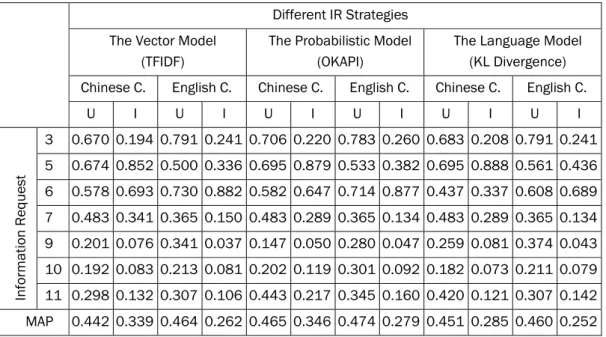
While an in-depth look of a reference collection should further describe the collection’s merits in terms of the collection’s capability to reflect the effectiveness of different retrieval strategies (Voorhees, 1998), a testing scenario was implemented in the project. The specific question to be answered in the test was about the semantic completeness of a Chinese document in the AEC/FM domain after the document was prepared into corresponding English terms. The results of the test would shed light on cross-language IR (CLIR) developments in the domain, and an example of such CLIR application is querying in Chinese but retrieving both Chinese and English domain documents (e.g., research papers).
Two hypotheses were defined for the testing. The null hypothesis H0 stated that a
Chinese document would carry the same semantics after being prepared into
matching English terms. The alternative hypothesis H1 stated that a Chinese