A Study on Teacher-Directed Instruction,
Formative Assessment, and Teacher
Support in Mathematics
Wen-Hua Chen*
Doctoral Student
Graduate Institute of Curriculum and Instruction, National Taiwan Normal University
Abstract
When evaluating students’ learning process, there are few studies on the roles of
inquiry-based learning and the formative assessment in mathematics curriculum in
Taiwan in the past. As an effort to understand the effects of these factors, the purpose
of this study is to evaluate how Taiwan's mathematics teachers perform specific tasks
associated with three domains of instructional practices, including teacher-directed
instruction, Formative Assessment, and Teacher Support, based on the date from the
Programme for International Student Assessment (PISA) in 2012. Firstly, this study
investigates the relationship between students' assessment scores in mathematics and
student-related factors that influence students' assessments of teachers in those skills.
Then, this study specifically compares and analyzes the students’ perceptions of their
mathematics teachers’ classroom supports in these three sections since Taiwanese pay
more attentions on the education in Shanghai and Finland,. The results of the study
indicate that: there is a significant and negative relationship between formative
assessment and student mathematics achievements when controlling the variation of
student characteristics; there is no meaningful relationship between teacher-directed
instruction and student mathematics scores; teacher support is significantly and
positively related to student mathematics achievements. Students in Taiwan and
Shanghai-China are more likely to agree with the availability of teacher support in
schools when compared with those in Finland.
keywords:
PISA, Formative Assessment, Mathematics Achievement
臺灣數學課堂的教師導向教學、
形成性評量及教師支持之研究
陳玟樺* 博士生 國立臺灣師範大學課程與教學研究所摘要
當評估學生學習歷程時,臺灣過去的數學課程較少關注於探究和形成性評量 所扮演的角色。為理解此影響,本研究運用國際學生能力評量計畫2012
(Programme
for International Student Assessment 2012
)資料來探究臺灣數學教師執行與教學實 踐相關之具體任務如教師導向教學(Teacher-Directed Instruction
)、形成性評量 (Formative Assessment
),以及教師支持(Teacher Support
)等面向與學生數學學 習成就之關係。此外,基於臺灣對上海和芬蘭教育多有關注,本研究亦針對此三 地學生對其數學教師課室中支持程度之感知做一比較與分析。研究結果顯示:在 控制學生特性下,形成性評量和學生數學成績之間呈現顯著負相關,教師導向教 學和學生數學成績之間則無顯著相關,至於教師支持和學生數學成績之間則呈現 顯著正相關。相較於芬蘭學生,臺灣和上海的學生似乎更傾向於認為學校數學教 師給予較多的支持。 關鍵詞:國際學生能力評量計畫、形成性評量、數學成就 *本篇論文通訊作者:陳玟樺,通訊方式:[email protected]。1. Introduction
The OECD (Organization for Economic Cooperation and Development) Programme for International Student Assessment (PISA) focuses on young people’s ability to use their knowledge and skills for overcoming real-life challenges. This orientation reflects a change in the goals and objectives of curriculum, meaning that there is an increasing concern about how students can take lessons beyond the classroom and into the real world instead of whether they have mastered in contents of a specific course. Since 2000, the Programme for International Student Assessment (PISA) has been conducted globally once every three years to measure fifteen-year-old students’ performances on reading, mathematics, and science, with focusing on one subject in each year of assessment. The set of results from the 2012 data collection (PISA 2012)1 focused on mathematics and compared the competencies of students
in 65 countries and economies. Around 510,000 students between the ages of 15 years three months and 16 years two months participated in PISA 2012 representing about 28 million 15-year-olds globally. In PISA 2012, Asian countries such as Shanghai-China, Singapore, Hong Kong-China, Chinese Taipei, Japan, and Korea got the highest scores in mathematics, reading, and science. The only country out of Asia in the top five list in science was Finland, with the 6th place in reading, and the 12th place in mathematics.
Taiwan ranked the 4th in mathematics among 65 countries and economies in PISA 2012,
moving up one spot from the previous assessment. Taiwan with the average of 560 points, only follows Shanghai, Singapore, and Hong Kong. According to the OECD, initiator, and administrator of the PISA tests, about 37 percent of Taiwan participants were considered top performers, who can “develop and work with models for complex situations, and work strategically using broad, well-developed thinking and reasoning skills.”
In the past years, Taiwan’s Ministry of Education made significant changes in the curriculum to underline the roles of inquiry-based learning and formative assessment. From
Curriculum Standards, Grade 1-9 Curriculum Guidelines to General Curriculum Guideline for Grades 1-12 Fundamental Education, a core principle of Taiwan’s Ministry of
Education’s approach is “the right to learn replacing the right to an education for all citizens”, and making education genuinely learner-centered.” (MOE, 2016). Students at the center of
1 The reason this study adopted the PISA 2012 database is that this study was conducted in October 2015 and completed in early 2016, when PISA 2012 was the latest version.
learning process is the main goal. Teachers must continuously provide supports actively and effectively to help students in learn process.
There are many factors that affect getting higher scores in international assessments. The changes in mathematics curriculum, students’ learning strategies and teachers’ supports are the potential factors. As the matter of fact, Taiwan continues to spend more and more efforts to support mathematics education. The main objective of the study to examine how Taiwan’s mathematics teachers’ performance affects students’ learning process by collecting their students’ perceptions.
2. Research Questions
2.1 How teacher-directed instruction, formative assessment, and teacher support are associated with student learning outcomes in mathematics among Taiwan students when controlling the variation of student characteristics?
2.2 How student characteristics in Taiwan explain the variation in teacher-directed instruction, formative assessment, and teacher support?
2.3 What are the differences of teacher behaviorsrelated to teacher-directed instruction, formative assessment, and teacher support among Taiwan, the 1st ranking Shanghai-
China and the 12th ranking Finland?
3. Literature Review
3.1 Mathematics Literacy
Mathematical literacy is “an individual’s capacity to formulate, employ, and interpret mathematics in a variety of contexts” (OECD, 2014). It includes reasoning mathematically and using mathematics concepts, procedures, facts, and tools to describe, explain, and predict phenomena. It assists individuals in recognizing the role that mathematics plays in the world and in making the well-founded judgments and decisions needed by constructive, engaged, and reflective citizens"(OECD, 2014). The assessment approach in the PISA, which emphasizes the application of knowledge and skills in real-life situations, is distinct from that of school mathematics. Under the PISA approach, students’ ability to reason quantitatively and represent relationships or dependencies is more crucial than the ability to answer familiar textbook questions in determining students’ practical mathematics ability. PISA questions are based on real situations, and they typically involve a variety of processes, content, and
contexts. According to the PISA, the four overarching concepts that relate to algebra, geometry, numbers, and statistics are “change and relationships,” “space and shape,” “quantity,” and “uncertainty and data.” The three process categories are “Formulating situations mathematically”; “Employing mathematical concepts, facts, procedures, and reasoning”; and “Interpreting, supplying, and evaluating mathematical outcomes.” PISA identifies four context categories in the broad areas of life in which mathematics problems may arise: personal, societal, occupational, and scientific.
3.2 Teacher-Directed Instruction, Formative Assessment, and Teacher
Support
In the context of globalization, most countries emphasize the “learner-centered” educational reforms. With the mathematics education reforms, in addition to lectures in the classroom, teachers are facilitators of learning, providing students with the information and tools they need to master a subject. At times, teachers act like guiders or tutors, working with small groups of students or individual students within the classroom or after class. Teachers also play the role of evaluators, constantly assessing students’ abilities through formal and informal assessments, providing suggestions for improvement and assigning grades. Assessments help teachers identify concepts that students are struggling to understand, skills they are having difficulty acquiring, or learning standards they have not yet achieved so that adjustments can be made to lessons, instructional techniques, and academic support. The PISA 2012 assessment included questions to students on the mathematics theories, concepts and content to which they had been exposed in school, and the amount of class time devoted to different types of problems and subjects. For example, students were asked to report how often a series of situations happen during their mathematics lessons. Students’ reports on whether different things happen in every lesson, in most lessons, in some lessons, or never or hardly ever were used to develop three indices reflecting teacher’s use of different teaching strategies to foster student learning: the index of teacher-directed instruction, the index of teachers’ use of formative assessment, and the index of teacher support.
According to PISA2012, the index of teacher-directed instruction was constructed using students’ reports on the frequency with which, in mathematics lessons, the teacher sets clear goals for student learning; the teacher asks students to present their thinking or reasoning at some length; the teacher asks questions to check whether students understand what was taught; and the teacher tells students what they have to learn. The index of teachers’ use of Formative
Assessment was constructed using students’ reports on the frequency with which, in mathematics lessons, the teacher tells students how well they are doing in math class; the teacher gives students feedback on their strengths and weaknesses in mathematics; the teacher tells students what they need to do to become better in mathematics. The index of teacher support emphasized on finding out how teachers provide additional helps and opportunities, help students in learning, and encourage students to work hard. This study examines the association between students’ reports of behavior and practices their mathematics teachers adopted in class. There are more and more schools encourage or require teachers to apply various approaches like teacher-directed instruction, formative assessment, and teacher support in the classroom, and there are a growing number of professional development opportunities available on this subject for educators.
4. Materials and Methods
4.1 Data Source
This study used the data from PISA, a program assessing 15 years old students’ skills in math, reading and science literacy internationally, organized by OECD. The data set includes a large amount of information from participant countries regarding students, schools, and parents. The first PISA was administered in 2003, and since then it has been conducted once every three years. The first time Taiwan joined PISA was 2003. This study applied the PISA data collected in 2012.
4.2 Variables
Teacher Behavior. Teacher-directed instruction and formative assessment scales are the
categories of teacher behavior in PISA. The teacher-directed instruction scale focuses on the following elements: “Setting clear goals, encouraging thinking and reasoning, checking student understanding, summarizing previous lessons, informing students about learning goals.” These assessments focus on understanding how teachers support students in classrooms, which aligns with supporting inquiry-based learning. Finally, the formative assessment identifies teachers' role in giving feedback, informing students about expectations and providing information to make them become successful. Students’ responses to each item in teacher-directed instruction and formative assessment are based on a four-point scale: 4 implies “every lesson,” 3 implies “most lessons,” 2 implies “some lessons,” and 1 implies “never or hardly ever.”
Teacher Support. Teacher support emphasized on finding out how teachers provide additional helps and opportunities, help students in learning, encourage students to work hard. Students' responses to each item in teacher support items are also based on a four-point scale, in which 4 implies “strongly agree,” 3 implies “agree,” 2 implies “disagree,” and 1 implies “strongly disagree.”
Gender. Gender is a categorical variable. The study includes gender in the analysis to examine whether male and female students significantly differ in terms of their mathematics achievement and responses to questions regarding teachers’ practices. Gender are regarded as a control variable in the analysis. Gender statistics of Taiwan PISA data set are shown in Table 1.
Table 1 Descriptive Statistics for Gender
Frequency Percent Cumulative percent Male 2935 48.54 48.54 Female 3111 51.46 100.00
Total 6046 100.00
Socio-economic Status. Another control variable in the analysis is the socio-economic status of students (SES). In PISA data SES is designated by “index of economic, social and cultural status (ESCS)”, which is based on student responses to parental occupations, the highest level of parental education, and an index of home possessions related to family wealth, home educational resources and possessions related to “classical” culture in the family home. SES descriptive statistics, including frequency, minimum, maximum, mean and standard deviation, are shown in Table 2 below.
Table 2 Descriptive Statistics for Socio-economic Status (SES)
N Minimum Maximum Mean SD Index of Socio-economic
Status (SES) 6023 -3.9 2.4 -0.39 0.85
4.3 Data Analysis
Inferential Statistics. The first question of the study is to examine the relationship between student mathematics achievements and several teacher practices, including teacher support, formative assessment, and teacher-directed instruction, while the variation of student
characteristics were controlled (gender and SES). Multiple regression analysis is used in this study. The second question is to examine the relationship of each scale of teacher practices and school and student characteristics. The study also conducted a multiple regression analysis on each scale by with variables of teacher support, formative assessment, and teacher-directed instruction respectively on school and student characteristics.
Descriptive Statistics. The third question of the study is to compare the differences of
teacher support and behaviors (formative assessment and teacher-directed Instruction) among Taiwan, Shanghai-China and Finland. The descriptive statistics (mean and standard deviations) of each country may provide the answer to the question.
5. Findings
5.1 How Teacher-Directed Instruction, Formative Assessment, and
Teacher Support are associated with student learning outcomes in
Mathematics among Taiwan students when controlling the variation
of student characteristics?
The purpose of this question is to understand whether formative assessment, teacher-directed instruction, and teacher support significantly explain student mathematics scores in PISA when the variations of Gender and SES were controlled. Multiple regression analysis is applied to estimate the significance. The results of the multiple regression analysis are shown in Table 3.
Table 3 Variables Prediction Students’ Mathematics Scores
Dependent Variable: the average of the Plausible Value 1-5 in Mathematics
B SE t P-value (Constant) 543.44 9.42 56.94 0.00 Formative Assessment -19.13 3.05 -6.27 0.00 Teacher-Directed Instruction -3.17 3.45 -0.92 0.35 Teacher Support 31.45 3.38 9.28 0.00 Gender -10.76 3.13 -3.43 0.00 Socio-economic Status(SES) 57.18 1.86 30.63 0.00 R=0.4625, R2=0.2139, Adjusted R2=0.2130, F (5, 3958) =215.45, P<0.05
The further analysis of the total samples, it indicated a negative relationship between Formative Assessment and student mathematics achievement. Specifically, the value of students mathematics score decreases 19.1336 as formative assessment increases one point. However, there is no statistically significant between Teacher-Directed Instruction and student mathematics scores. Teacher Support is also significantly and positively related to student mathematics achievements: the value of students mathematics scores will increase 31.4514 as the value of teacher support increases one point.
Table 3 also shows the inferential statistics of student characteristics. Gender and SES, are significantly associated with student test scores among all control variables in the regression analysis. Specifically, the average score of female students is 10.7686 points, which is less than that of male students in PISA mathematics assessments. SES is an important predictor of student learning: the value of in students' assessment scores increases 57.1807 as the value of SES increases one point. (R2=0.2139, F (5, 3958) =215.45, P<0.05)
5.2 How student characteristics in Taiwan explain the variation in
Teacher-Directed Instruction, Formative Assessment, and Teacher
Support?
The purpose of this question is to understand the underlying factors that influence students’ reports on their teachers' skills in teacher support, formative assessment, and teacher-directed instruction.
Table 4 Variables Prediction Students’ Perception of Teachers’ Formative Assessment
Dependent Variable: Formative Assessment
B SE t P-value (Constant) 2.32 0.01 139.24 0.00
Gender -0.13 0.02 -5.97 0.00 Socio-economic Status(SES) 0.05 0.01 3.94 0.00
R=0.1118, R2=0.0125, Adjusted R2=0.0120, F (2, 3985) =25.15, P<0.05
Table 4 shows the results of multiple regression on the relationship between student characteristics, and student reports on teachers’ formative assessment. The results show that students' Gender and SES are significant predictors of formative assessment. Specifically, the average score of female students is 1318 points, which is less than that of male students in PISA mathematics assessments. SES is a significant predictor of student learning: the value of students mathematics score decreases 19.1336 as SES increases one point. (R2=0.0125, F (2,
Table 5 Variables Prediction Students’ Perception of Teachers’ Teacher-Directed Instruction
Dependent Variable: Teacher-Directed Instruction
B SE t P-value (Constant) 2.78 0.015 175.94 0.00 Gender -0.02 0.020 -0.99 0.32 Socio-economic Status(SES) 0.04 0.012 3.37 0.00
R=0.0557, R2=0.0031, Adjusted R2=0.0026, F (2, 3987) =6.12, P<0.05
Table 5 shows the results of multiple regression on the relationship between student
characteristics, and student report on teacher-directed instruction. The results indicate that
Gender is not a significant predictor of teacher-directed instruction. Only SES is significantly
related to the teacher-directed instruction scale. The value of students’ scores increases 0.0422 as SES increases one point. (R2=0.0031, F (2, 3987) =6.12, P<0.05)
Table 6 Variables Prediction Students’ Perception of Teachers’ Teacher Support
Dependent Variable: Teacher Supportx
B SE t P-value (Constant) 3.25 0.01 240.22 0.00
Gender 0.01 0.01 1.00 0.31 Socio-economic Status(SES) 0.05 0.01 5.07 0.00
R=0.0819, R2=0.0067, Adjusted R2=0.0062, F (2, 3991) =13.43, P<0.05
Table 6 shows the results of multiple regression on the relationship between student
characteristics, and student perceptions of Teacher Support. The results show that Gender is
not a significant predictor of teacher support. Only SES is significantly related to the teacher
support scale. The value of students score increases 0.0542 as SES increases one point.
(R2=0.0067, F (2, 3991) =13.43, P<0.05)
5.3 What are the differences of teacher behaviors related to Teacher-
Directed Instruction, Formative Assessment, and Teacher Support
among Taiwan, the 1st ranking Shanghai-China and the 12th ranking
Finland?
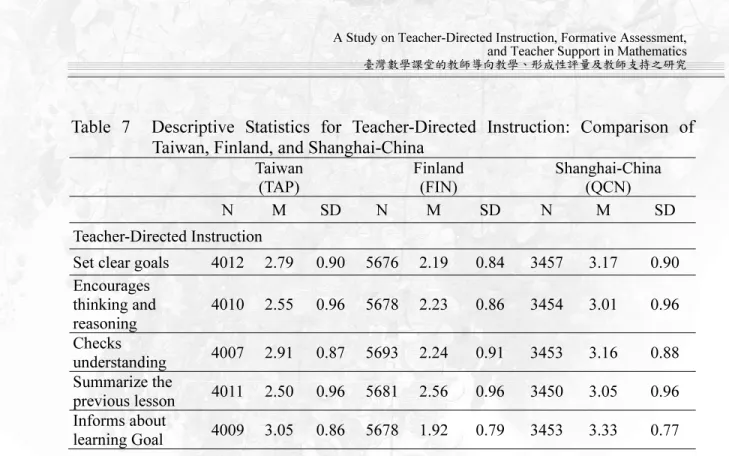
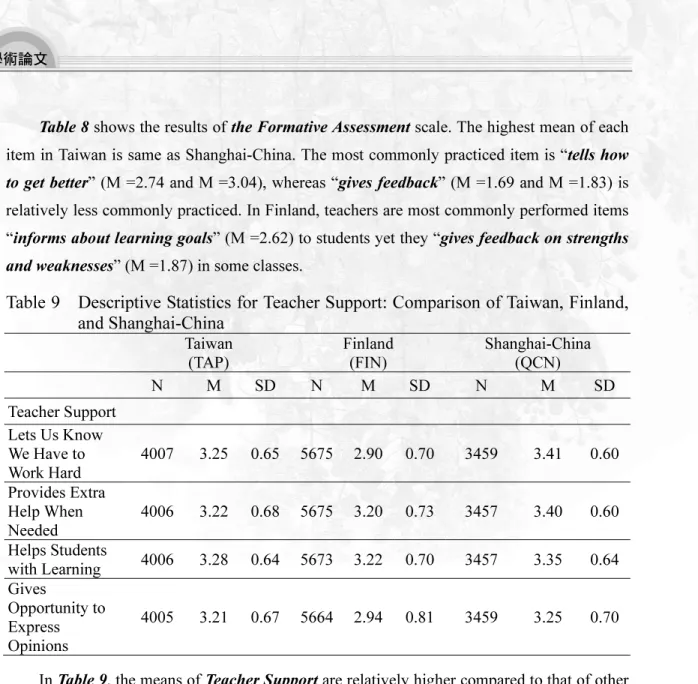
The purpose of this question is to compare the difference in teacher support, teacher-directed instruction, and formative assessment among Taiwan, Shanghai-China and Finland. Descriptive statistics of each item are shown in Table 7, Table 8 and Table 9.
Students’ responses are quantified in this study; the higher value means more frequent practices of the related items.
Table 7 Descriptive Statistics for Teacher-Directed Instruction: Comparison of
Taiwan, Finland, and Shanghai-China
Taiwan
(TAP) Finland (FIN) Shanghai-China (QCN)
N M SD N M SD N M SD Teacher-Directed Instruction
Set clear goals 4012 2.79 0.90 5676 2.19 0.84 3457 3.17 0.90 Encourages thinking and reasoning 4010 2.55 0.96 5678 2.23 0.86 3454 3.01 0.96 Checks understanding 4007 2.91 0.87 5693 2.24 0.91 3453 3.16 0.88 Summarize the previous lesson 4011 2.50 0.96 5681 2.56 0.96 3450 3.05 0.96 Informs about learning Goal 4009 3.05 0.86 5678 1.92 0.79 3453 3.33 0.77 In Table 7, the means of items regarding the Teacher-Directed Instruction scale in Taiwan and Shanghai-China is above 2.5, meaning that most classes adopt teacher-directed instruction. However, overall, this type of instruction is less common in schools in Finland. In Taiwan and Shanghai-China, the most commonly performed items is “informs about learning goals” (M=3.05 and M=3.33), whereas “summarizing previous lesson” (M=2.50 and M=3.05) and “encourages thinking and reasoning” (M=2.55 and M=3.01) are relatively less commonly practiced. The results in Finland are opposite. “summarizing previous lesson” (M=2.56) in most classes yet they “informs about learning goals” (M=1.92) in some classes.
Table 8 Descriptive Statistics for Formative Assessment: Comparison of Taiwan,
Finland, and Shanghai-China
Taiwan
(TAP) Finland (FIN) Shanghai-China (QCN)
N M SD N M SD N M SD Formative Assessment Gives Feedback 4003 1.69 0.83 5687 2.09 0.89 3447 1.83 0.93 Gives Feedback on Strengths and Weaknesses 4009 2.12 0.97 5681 1.87 0.84 3455 2.18 1.05 Informs about Expectations 4011 2.40 1.00 5675 2.62 0.88 3455 2.81 0.91 Tells How to Get
Table 8shows the results of the Formative Assessment scale. The highest mean of each item in Taiwan is same as Shanghai-China. The most commonly practiced item is “tells how to get better” (M =2.74 and M =3.04), whereas “gives feedback” (M =1.69 and M =1.83) is relatively less commonly practiced. In Finland, teachers are most commonly performed items “informs about learning goals” (M =2.62) to students yet they “gives feedback on strengths and weaknesses” (M =1.87) in some classes.
Table 9 Descriptive Statistics for Teacher Support: Comparison of Taiwan, Finland,
and Shanghai-China
Taiwan
(TAP) Finland (FIN) Shanghai-China (QCN)
N M SD N M SD N M SD Teacher Support Lets Us Know We Have to Work Hard 4007 3.25 0.65 5675 2.90 0.70 3459 3.41 0.60 Provides Extra Help When Needed 4006 3.22 0.68 5675 3.20 0.73 3457 3.40 0.60 Helps Students with Learning 4006 3.28 0.64 5673 3.22 0.70 3457 3.35 0.64 Gives Opportunity to Express Opinions 4005 3.21 0.67 5664 2.94 0.81 3459 3.25 0.70 In Table 9, the means of Teacher Support are relatively higher compared to that of other scales, meaning that Teacher Support is more widely adopted in all of three countries. Overall, the students in Taiwan, Finland, and Shanghai-China seem to agree with the statements which describe their teachers – “let us know we have to work hard,” “help us with learning,” “provide addition help when needed,” and “give opportunities to express opinions.” However, like other scales, the means of items in Teacher Support in Taiwan or Shanghai is higher than those in Finland, meaning that on average the students in Taiwan and students in Shanghai-China are more likely to agree with the availability of Teacher Support in their schools when compared with those in Finland.
6. Conclusion and Implications
The study compares students’ performances between Taiwan and another two countries -Finland and Shanghai-China, as their experience in education reforms highly attracts Taiwanese attentions in recent years. The purpose of this study was to examine how Taiwan’s mathematics teachers perform specific tasks associated with three domains of instructional practices, including teacher-directed instruction, formative assessment, and teacher support. Besides, the study examined whether those domains are able to predict student learning performance, as well as the factors that predict teachers’ practices of each domain when the variation of Gender and SES were controlled.
6.1 Students’ Mathematics Achievement
6.1.1. Role of SES and Gender
The study found that SES has statistically significant with student mathematics assessment scores. The effects of SES on student achievements in all subject matters are generally agreed in academic literature. Sun and Tsai (2007) conducted a meta-analysis by reviewing the literature on socioeconomic status (SES) and academic achievement published from 1996 to 2005. The sample included 127,447 students gathered from 26 independent samples. The results found that the relationship between the academic (mathematics) performance of students and their social status is higher than that of other subjects. However, it needs a further exploration to examine whether domestic mathematics education may be likely more unfavorable to socio-economically disadvantaged students.
It is worth further study whether this phenomenon highlights the domestic mathematics education is unfavorable to the disadvantaged students. In addition to the role of SES, student Gender is a significant predictor of ninth grade students’ mathematics scores. The results show that students' Gender is significant predictors of Formative Assessment, meaning that male students performed better than female students according to students’ mathematics achievements.
6.1.2. Role of teacher practices
The study found students’ assessment scores in mathematics increased with the increment in Teacher Support index when the variations of Gender and SES were controlled. This means that the more supports students in Taiwan received from their teachers, the better the mathematics scores they get. PISA’s definition of Teacher Support is linked with how
teachers help students in the learning process. On the other hand, the study also found that Teacher-Directed Instruction has no significant contribution to Taiwanese students’ mathematics achievements. Teacher-Directed Instruction, as defined by OECD, focuses on setting clear goals, and supporting student thinking and reasoning. Connected with these variables, supporting reasoning and thinking is one of the most fundamental aspects of inquiry learning in the US (NRC, 1996; NRC, 2000; NRC, 2012). Impressively, this study also indicated a strong negative relationship (B= -19.1336) between Formative Assessment and students’ mathematics scores. Formative assessment focuses on how teachers provide feedback of students’ weaknesses and strengths.
Assessments should support the learning of fundamental mathematics and provide useful information to both teachers and students. In 2000, The National Council of Teachers of Mathematics (NCTM) claimed Principles and Standards for School Mathematics and Assessment is one of the six Principles for School Mathematics. Unfortunately,
Grace and David (1994) found that Hong Kong’s education system has been characterized as exam-oriented education for a long time. They further pointed out that students in Hong Kong are generally competitive in the classroom, and teachers have a high degree of control over student learning, which make it difficult for students to experience the learning process. Besides, Chang et al. (2012) pointed out that Taiwan’s mathematics teachers often use examinations to evaluate students learning performances. However, there is a limited help in students' learning performance as an increase in the frequency of tests conducted, and even a harm to disadvantaged students. To overcome this challenge, Chang et al. (2012) also suggested improving mathematics teachers’ formative assessment practice through a teacher professional learning community. Guskey (2002) explained that professional development helps teachers change their practices, which leads to a change in student achievements. The lack of professional development could be one possible explanation for the missing statistics relationship with Formative Assessment. Thus, the lack of strong professional development would influence how teachers implement the changes envisioned by the curriculum reforms.
6.2 Transnational comparative analysis of Instructional Practices
In this study, the term “Teacher-Directed Instruction” refers to how the supports students in the inquiry process. In mathematics literacy assessment, Taiwan (the 4th place) and
other countries, and their teachers support students more frequently than their counterparts in Finland. When further studying on “Formative Assessment,” the score of give feedback toward students in Finland is higher than Taiwan and Shanghai-China, the only item which Finland surpass than the other countries. In addition, in terms of “Teacher Support," Taiwan, Finland, and Shanghai-China students agreed the statements that their teachers let them know they have to work hard, teachers will provide them extra help when needed, teachers will help them in learning, and teachers will give them the opportunities to express opinions.
Based on these positive findings, the formative assessment seems to be a challenge in all countries. OECD (2008) pointed out: “in classrooms, formative assessment refers to frequent, interactive assessments of student progress and understanding to identify learning needs and adjust teaching approaches appropriately. Teachers using formative assessment approaches and techniques are better prepared to meet students’ diverse needs – through differentiation and adaptation of teaching to raise levels of student achievement and to achieve greater equity of student outcomes”(p.1). In this study, it also found teachers in three countries providing lower quality supports with an emphasis on formative assessment than teacher-directed instruction and teacher support. Teachers in these countries primarily focused on thinking and discussing how students can get better scores but did not completely use formative assessment to support students’ learning process. Popham (2008) pointed out: “Formative assessment is a planned process in which assessment-elicited evidence of students’ status is used by teachers to adjust their ongoing instructional procedures or by students to adjust their current learning tactics.” In order to reduce the perceived gap between teachers and students, teachers should further explore why the use of formative assessment does not meet the expectations of students. One possible reason for the analysis is that if the contents of formative assessment is too monotonous and competitive that students may gradually develop negative emotions, and their mathematical achievements may also gradually drop. The potential effects of the curriculum may also be one of the critical factors, which is also worth a future follow-up study.
7. Limitations and Future Research
The major limitation of this study is that the results are based on the reports of students reflecting the practices of teachers, rather than classroom observations in real practices. It is suggested that the future studies could adopt systemic observations, tasks or tests, or clinical
interviews as methods (Piaget, 1976) to investigate teachers’ actual classroom practices on implementing the concept of learner-centered and formative assessment2. In this way, it is
able to get a better understanding of the changes in instructional practices of mathematics teachers. In addition, this study is a cross-sectional study, and further reasoning and longitudinal studies should provide more comprehensive results. The primary goal of this study is to understand the practices of Taiwan mathematics teachers by analyzing student reports. It also reminds teachers should rethink the purpose and significance of formative assessment to help students to learn effectively.
Reference
Chang, C., Chen, C., Fun, D., Lin, J. (2012). The Development of Formative Assessment Practice through Teachers’ Professional Learning Community and Its Impact on Student Learning Achievement. Bulletin of Educational Psychology, 43(3), 717-734.
Yuen-Yee, G. C. & Watkins, D. (1994). Classroom environment and approaches to learning: An investigation of the actual preferred perceptions of Hong Kong secondary school students. Instructional Science, 22(3), 233-246.
Guskey, T. R. (2002). Professional development and teacher change. Teachers and Teaching: Theory and Practice, 8(3), 381-391.
Minister of Education of Republic of China (Taiwan) (2016). Learner-Oriented Education: The Right to Learn is replacing the Right to an Education. Retrieved from http://english. moe.gov.tw/ct.asp?xItem=15739&CtNode=11402&mp=1
National Council of Teachers of Mathematics (NCTM). (2000). Executive Summary
Principles and Standards for School Mathematics. Retrieved from http://www.
nctm.org/uploadedFiles/Standards_and_Positions/PSSM_ExecutiveSummary.pdf
National Research Council (1996). National Science Education Standards. New York: National Academies Press.
National Research Council (2000). Inquiry and the National Science Education Standards: A guide for teaching and learning. Washington, D. C.: National Academy Press.
National Research Council. (2012). A framework for K-12 science education: Practices, crosscutting concepts, and core ideas. Washington, DC: The National Academies Press.
OECD. (2008). Assessment for Learning Formative Assessment. OECD Publishing. Retrieved from: http://www.oecd.org/site/educeri21st/40600533.pdf
OECD. (2014). PISA 2012 Results: Creative Problem Solving: Students’ Skills in Tackling Real-Life Problems (Volume V), PISA, OECD Publishing. Retrieved from: http://dx. doi.org/10.1787/9789264208070
Piaget, J. (1976). The child’s conception of the world (J. Tomlinson & A. Tomlinson, transl.). Totowa: Littlefield, Adams & Co.
Popham, W. J. (2008). Trans Formative Assessment. Alexandria, VA: Association for Supervision and Curriculum Development.
Sun, M. T., & Tsai, M. H. (2007). The relationship of socioeconomic status and academic achievement- a meta-analysis. Journal of Elementary Education19, 199-222.