Manufacturing Technique and Property Evaluations of PET/Gelatin
Composite Tubular Braids
Ching-Wen Lou
1, Po-Ching Lu
2, Jin-Jia Hu
3, band Jia-Horng Lin
2, 4, 5, a 1Institute of Biomedical Engineering and Materials Science, Central Taiwan University of Scienceand Technology, Taichung 40601, Taiwan, R.O.C.
2Laboratory of Fiber Application and Manufacturing, Department of Fiber and Composite Materials,
Feng Chia University, Taichung City 40724, Taiwan, R.O.C.
3Department of Biomedical Engineering, National Cheng Kung University, Taiwan, R.O.C. 4School of Chinese Medicine, China Medical University, Taichung 40402, Taiwan, R.O.C.
5Department of Fashion Design, Asia University, Taichung 41354, Taiwan, R.O.C. a [email protected], b[email protected]
Keywords: Gelatain, PET fibers, composite tubular braids.
Abstract. This study examine the influence of gelatain with different concentrations on the physical
property of the PET/Gelatin composite tubular braids. PET fibers are braided into tubular braids on a braider, and then immersed in gelatin solution with various concentrations to form PET/Gelatin composite tubular braids. The tensile strength and water contact angle of the braids are then tested to determine the their physical properties. The experiment results show that an increasing concentration of gelatin does not result in a significant varation in tensile strength, but a decreased displacement only.
Introduction
Major fabrics in textile industry include woven fabrics, knits, nonwovens, and braided fabrics; the former three of which are often in the forms of two-dimensional fabrics and the latter of which is three-dimensional (3-D) fabrics. Due to their 3-D formtion and ease of processing, braided fabrics often serve as reinforcement of 3-D composites; therefore, the resulting composites can be formed into different shapes. The influences of braid thickness, braid angle, pattern, and the selection of fibers on the properties of braided fabrics are commonly examined in studies [1-5]. In addition, the tubular knits are also used in vascular grafts by some scholars [6-8]. This study aims to test the tensile strength and water contact angle of PET tubular knits that have immersed in gelatin solutions with various concentrations, so as to determine the influence of the concentrations on braids’ physical properties.
Experimental Materials
PET fibers (Far Eastern New Century Co., Ltd., Taiwan, R.O.C.) has a fineness of 75 denier (D). Gelatin (Sigma Aldrich, US) is derived from swine’s skin.
a b
c d
Tubular braid
Longitudinal
Experimental Procedure
Preparation of PET Tubular Braids
Two plies of PET filaments are made into twisted yarns with a twist coefficient of 3 on a rotor twister, thermally treated at 140 °C for 30 minutes, and then braided surrounding a stainless steel mandrel with a diamter of 3 mm and length of 15 cm on a 16-spindle braider (Nan Hsing Machinery Co., Ltd, Taiwan, R.O.C.) to form PET tubular braids.
Preparation of PET/Gelatin Composite Tubula Braids
Gelatin powder is dissolved with deionized water by stirring at 50 °C for 4 hours to form 6, 8, and 10 wt% gelatin solutions. The PET tubular braids, which are on a stainless steel mandrel, are covered with another hollow stainless steel tube with a diameter of 5 mm, and then placed into a mold. Various gelatin solutions are separately added to the hollow stainless steel tube to soak the braids, and the mold is then kep at 50 °C for 4 hours. The PET tubular braids are obtained after stainless steel mandrel is removed. Figure 1 is the images of the PET tubular braids.
Figure 1. Images of a) PET tubular braids, and PET/Gelatin composite tubular braids that are made with a combination of b) 6, c) 8, and d) 10 wt% gelatin solutions.
Tests
Tensile Strength
Two forms of 5-cm long PET/Gelatin composite tubular braids are tested for tensile strength: one is in the tubular form, and the other is in the unfolded form, a result of the cut tubular braids longitudinally (Figure 2). The tensile strength of both sample types is tested with a universal strength tester (HT-91015, Hung Ta Instrument Co., Ltd., Taiwan, R.O.C.) with settings of 1-cm gauges’ distance and 10-mm/min tensile speed. The number of samples is 6.
Figure 2. Schematic diagram of the unfolded PET/Gelatin composite tubular braids.
Water Contact Angle
The unfolded PET/Gelatin composites, which are cut longitudinally, are trimmed into 1 cm × 1 cm pieces. The water contact angle of both the inner and outer layers of the samples is measured
with a contact angle meter, (Kyowa Interface Science Co., Ltd., Japan). The number of samples is 6.
Results and Discussion
Tensile Strength of the PET/Gelatin Tubular Braids
Figure 3. Tensile strength and displacment of PET/Gelatin composite tubular braids as related to various concentrations of gelatin solutions.
Tensile Strength of the Unfolded PET/Gelatin Tubular Braids
Figure 4. Tensile strength and displacment of the unfolded PET/gelatin composite tubular braids as related to various concentrations of gelatin solutions.
Figures 3 and 4 show that regardless of tubular or unfolded forms of the PET/Gelatin composite braids, increasing concentration of gelatin solution decreases the displacement but insignificantly changes the tensile strength. Such results are due to the fact that tensile strength of PET/Gelatin composite tubular braids depends on strength and fineness of the fibers as well as the density and thickness of the fabrics. Although variations in the concentrations of geltain solution influence the tensile strength, the major factor is the PET/Gelatin composite tubular braids themselves, and as a result, the concentration plays an insignificant role that influences the tensile strength. On the other hand, an increasing concentration of gelatin solution results in the bonding between fibers, and thereby preventing them from movement. Therefore, the displacement of PET/Gelatin composite tubular braids decreases with an increase in the concentration of gelatin solution.
Water Contact Angle
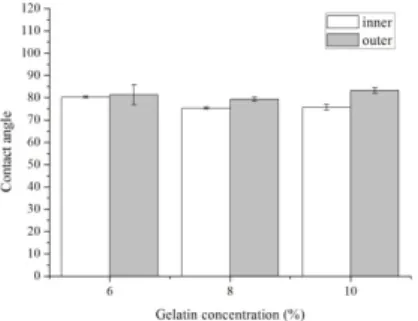
Figure 5 shows that the concentration of gelatin solution is not correlated with the water contact angle of the outer and inner layers of the unfolded PET/Gelatin composite tubular braids. The samples demonstrate their being hydrophobic regardless of the concentration. Although gelatin is a hydrophilic material, it chiefly fills the pores between the fibers of the braids, but does not
completely wrap the fibers. When water drips on the braids, it first contacts the hydrophobic PET fibers, not gelatin, which causes the water not to be absorbed and thus provides the braids with a hydrophobic feature.
Figure 5. Water contact angle of the unfolded PET/Gelatin composite tubular braids as related to various concentrations of gelatin solutions.
Conclusion
This study successfully examines the influence of the concentration of the gelatin solution on the tensile strength, displacement, and water contact angle of PET/Gelatin composite tubular braids. An increasing concentration decreases the displacement of the PET/Gelatin composite braids in a tubular form by 69 % with 8 % gelatin solution and 70 % with 10 % gelatin solution. Similarly, the increasing concentration decreases the displacement of the PET/Gelatin braids in an unfolded form by 69 with 8 % gelatin solution and by 87 % with 10 % gelatin solution. However, regardless of the concentration, the water contact angle of the unfolded PET/Gelatin braids is between 75 and 85 degrees.
Acknowledgement
The authors would especially like to thank National Science Council of the Taiwan, for financially supporting this research under Contract NSC 100-2221-E-006-097.
References
[1] H. Ghiasi, L. Lessard, D. Pasini and M. Thouin: Appl. Compos. Mater. Vol. 17 (2009), p.159. [2] P. Potluri, A. Manan, M. Francke and R. Day: Compos. Struct. Vol. 75(2006), p. 377.
[3] C.K. Leung, G.W. Melenka, D.S. Nobes and J.P. Carey: Compos. Struct. Vol. 100 (2013), p. 135.
[4] J.S. Tate, A.D. Kelkar and J.D. Whitcom: Int. J. Fatigue. Vol. 28 (2006), p. 1239.
[5] W.J. Na, H.C. Ahn, S.Y. Jeon, J.S. Lee, H.M. Kang and W.R. Yu: Compos. Sci. Technol. Vol. 91 (2014), p. 30.
[6] J.N. Wang, Y.L. Wei, H.G. Yi, Z.W. Liu, D. Sun and H.R. Zhao, Mat. Sci. Eng. C-Mater. : Vol. 34 (2014), p. 429.
[7] A.F.D.P. Freitas, M.D. de Araujo, W.W. Zu and R.M.E. Fangueiro: J. Text. I. Vol. 101 (2010), p.1027.
[8] Y. Nakazawa, M. Sato, R. Takahashi, D. Aytemiz, C. Takabayashi, T. Tamura, S. Enomoto, M. Sata and T. Asakura, J. Biomater. Sci. Polym. Ed. Vol. 22 (2011), p. 195.