行政院國家科學委員會專題研究計畫 成果報告
含鈦鋁之鈷基超合金在不同溫度及應變速率下的動態塑變
行為與顯微結構分析
研究成果報告(精簡版)
計 畫 類 別 : 個別型 計 畫 編 號 : NSC 100-2218-E-151-001- 執 行 期 間 : 100 年 08 月 01 日至 101 年 07 月 31 日 執 行 單 位 : 國立高雄應用科技大學機械工程系 計 畫 主 持 人 : 陳道星 計畫參與人員: 碩士班研究生-兼任助理人員:蔡智凱 碩士班研究生-兼任助理人員:賴祉妤 公 開 資 訊 : 本計畫涉及專利或其他智慧財產權,1 年後可公開查詢中 華 民 國 101 年 09 月 01 日
中 文 摘 要 : 本計畫主要是探討鈷基超合金在不同鈦與鋁的含量下之塑性 變形特性與微觀結構,並探討合金元素鈦與鋁之添加與應 力、應變、應變速率與測試溫度之變化對鈷基超合之機械性 質的影響。計畫期間為一年主要在開發之鈦與鋁元素的添加 製備出兩種不同含鈦與鋁含量之鈷基超合金與一種完全不含 鈦與鋁之鈷基超合金,經萬能材料試驗機(MTS)進行靜態壓 縮測試( =10-3, 10-2, 10-1s-1, T= 700℃, 500℃,及 25℃)及微觀組織觀測,來描述不同鈦與鋁含量之鈷基超合金 在不同溫度及應變速率下之塑變行為。所有之研究成果將可 作為具耐高溫性質之不同鈦及鋁含量之鈷基超合金之研製及 其在高速成型加工與結構元件設計應用之參考。 中文關鍵詞: 鈷基超合金、應變速率效應、溫度效應、差排,鈦與鋁。 英 文 摘 要 : The effect of titanium and aluminum contents, strain,
strain rate and tested temperatures on the mechanical properties and microstructural properties will be investigated in this study. These cobalt base super alloys are to be tested using material testing system (MTS) at strain rates of 10-3, 10-2 and 10-1s-1 and at temperatures of 700℃, 500℃ and 25℃
respectively. It is found that the flow stress increases with increasing strain rate and Ti and Al contents, but decreases with increasing temperature. Furthermore, the strain rate sensitivity increases with increasing strain rate, but decreases with increasing temperature. The microstructural
observations confirm that the mechanical response of the cobalt superalloy specimens is directly related to the effects of the titanium and aluminum contents, strain rate and temperature on the evolution of the microstructure. It can be observed that the
strengthening effect in cobalt suprealloy is a result primarily of dislocation multiplication. The
dislocation density increases with increasing strain rate, but decreases with increasing temperature. 英文關鍵詞: co-base superalloy, strain rate, precipitate, thermal
行政院國家科學委員會補助專題研究計畫成果報告
含鈦鋁之鈷基超合金在不同溫度及應變速率下的動態塑變行為
與顯微結構分析
計畫類別:
個別型計畫 □ 整合型計畫
計畫編號:NSC -100-2218-E-151-001
執行期間:100 年 08 月 01 日至 101 年 07 月 31 日
計畫主持人:陳道星
共同主持人:
計畫參與人員:蔡智凱(碩士生)
、賴祉妤(碩士生)
成果報告類型(依經費核定清單規定繳交):
精簡報告 □完整報告
本成果報告包括以下應繳交之附件:
□赴國外出差或研習心得報告一份
□赴大陸地區出差或研習心得報告一份
□出席國際學術會議心得報告及發表之論文各一份
□國際合作研究計畫國外研究報告書一份
處理方式:除產學合作研究計畫、提升產業技術及人才培育研究計畫、列管計
畫及下列情形者外,得立即公開查詢
□涉及專利或其他智慧財產權,
一年□二年後可公開查詢
執行單位:
國立高雄應用科技大學機械工程系
中 華 民 國 101 年 8 月 31 日
含鈦鋁之鈷基超合金在不同溫度及應變速率下的動態
塑變行為與顯微結構分析
The dynamic plastic deformation behaviour and microstructure evolution
of cobalt base superalloy with different Ti and Al under various
temperatures and strain rates
計畫編號: NSC 100-2218-E-151-001
執行期限: 100年8月1日至101年7月31日
主 持 人: 陳道星 國立高雄應用科技大學機械工程系 助理教授
1. 中文摘要 本計畫主要是探討鈷基超合金在不同 鈦與鋁的含量下之塑性變形特性與微觀結 構,並探討合金元素鈦與鋁之添加與應 力、應變、應變速率與測試溫度之變化對 鈷基超合之機械性質的影響。計畫期間為 一年主要在開發之鈦與鋁元素的添加製備 出兩種不同含鈦與鋁含量之鈷基超合金與 一種完全不含鈦與鋁之鈷基超合金,經萬 能材料試驗機(MTS)進行靜態壓縮測試 ( =10-3, 10-2, 10-1s-1, T= 700o , 500o ,及 25o )及微觀組織觀測,來描述不同鈦與 鋁含量之鈷基超合金在不同溫度及應變速 率下之塑變行為。所有之研究成果將可作 為具耐高溫性質之不同鈦及鋁含量之鈷基 超合金之研製及其在高速成型加工與結構 元件設計應用之參考。 C C C 關鍵詞:鈷基超合金、應變速率效應、溫 度效應、差排,鈦與鋁。 AbstractThe effect of titanium and aluminum contents, strain, strain rate and tested
temperatures on the mechanical properties and microstructural properties will be investigated in this study. These cobalt base super alloys are to be tested using material testing system (MTS) at strain rates of 10-3, 10-2 and 10-1s-1 and at temperatures of 700 ℃, 500℃ and 25℃ respectively. It is found that the flow stress increases with increasing strain rate and Ti and Al contents, but decreases with increasing temperature. Furthermore, the strain rate sensitivity increases with increasing strain rate, but decreases with increasing temperature. The microstructural observations confirm that the mechanical response of the cobalt superalloy specimens is directly related to the effects of the titanium and aluminum contents, strain rate and temperature on the evolution of the microstructure. It can be observed that the strengthening effect in cobalt suprealloy is a result primarily of dislocation multiplication. The dislocation density increases with increasing strain rate, but decreases with increasing temperature. Keywords: co-base superalloy, strain rate, precipitate, thermal energy, dislocation, Ti and Al addition
2. Introduction
Cobalt base superalloy is well suitable materials for use in dramatic temperature change and corrosion environments, and is therefore widely used in such applications as the International Space Station, turbine blades, combustor lines in gas turbine engines, and nuclear reactors equipment[1, 2]. The strengthening mechanism of Cobalt base superalloys are mainly by utilizing the carbide precipitates, such as M6C and M23C6,
and solid solution strengthening elements, such as W, Mo, and Ta [3]. However, the high temperature strength and ductility of these Cobalt base superalloys are inferior to those of nickel base superalloys. Recently, the literatures [4] reported that a ternary compound Co3Al,Co3Ta and Co3Tiwith L12
structure was developed. The novel cobalt base superalloys strengthened by high volume fractions of the L12 compound leads
high mechanical properties, superior hot-corrosion and wear resistance compared with nickel base superalloys for the applications in severe environments. In general, the flow stress in engineering materials increases with increasing strain rate, but decreases with increasing temperature. The effects of strain rate or temperature the particular material are important. Previous literatures have shown that the rate of dislocation multiplication and the dislocation structures themselves are highly sensitive not only to the deformation temperature and strain rate, but also to the original crystal structure of the material [5, 6]. In general, the rate of dislocation multiplication increases with increasing
strain rate or reducing temperature and leads to an improved material strength [7]. This study investigates the effects of the addition of titanium and aluminum on the mechanical properties and microstructural evolution of cobalt base superalloy and the flow stress behaviors of the superalloy at different temperatures. The microstructures of the tested specimens are examined using transmission electron microscopy (TEM). The stress-strain relation and the evolution of the microstructure are discussed for each of the considered test conditions
3. Experimental Procedure and
Material Preparation
The cobalt base superalloys were prepared in a vacuum arc melted furnace. The mass chemical composition of the cobalt base superalloy (as measured by a glow discharge spectrometer (GDS)) are 17 Cr, 9 Ni, 13 W, 1.2 Mn, 0.04 C, and the balance Co, with different contents of Ti and Al, and it was shown in Table 1. The solution heat treatment of the ingots was carried out at 1300℃ for 2 h in a vacuum furnace. Then they were then aged at 680℃ for 4 h and at 850℃ for 20 h and poured into a heated permanent metal mold. Then an indirect extrusion machine forms bars with dimensions of 13 mm x 700 mm (diameter x length). Finally, these bars were machined into cylindrical specimens with a length and diameter of 9.7 mm and the ends
of each specimen were then carefully finished using a grinder. Quasi-static tests were carried out using a Material Testing System (MTS) at strain rates of 10-3 s-1, 10-2 s-1 and 10-1 s-1, respectively and temperatures of 25℃, 500 ℃ and 700℃.
After quasi-static testing, the microstructural observations of deformed specimens were examined using a JEOL TEM-3010 transmission electron microscope (TEM) operating at 300kV. The specimens for TEM observation were prepared by cutting foils of 350μm thickness from the deformed specimens. The disks were then punched from each foil, finally ground to a thickness of 200μm, and then twin-jet polished with a solution of Spar etchant (100 ml of distilled water, 100 ml of 32% HCl, 10 ml of 65% HNO3 and 0.3 ml 1-methoxy-2-propanol).
4. Results and Discussions
4-1Mechanical behaviour response
Figure 1(a) shows the true stress-strain curves for cobalt base superalloy which contains 0.9% Ti and 0.9%Al contents deformed at temperature of 25 ℃, 500℃ and 700℃, and strain rates of 10-3 s-1, 10-2 s-1 and 10-1 s-1, respectively. It can be observed that the flow stress of Co-0.9Ti-0.9Al superalloy increase with strain rate and strain, but decrease with
increasing temperature. Furthermore, it is apparent that no fracture occurs in any loading condition. These results indicate that the Co-0.9Ti-0.9Al superalloy has excellent deformability properties under the strain rate range and the temperature conditions. This thermal softening effect is manifested in the stress-strain curves shown in Fig. 1(a) by the differences observed in the flow stress and work-hardening rate under different loading conditions. It also can be seen the similar results at the Co-0.9Ti-0.3Al and Co-0Ti-0Al superalloy, as shown in Fig.1 (b) and 1(c). Figs. 1(a)-1(b) present the higher Al contents of cobalt base superalloy have high flow stress. Furthermore, Figs. 1(a)-1(c) present the cobalt base superalloys contain Ti and Al contents have high flow stress than the cobalt base superalloy without Ti and Al additions. From Figs. 1(a)-1(c), there can be suggested that a lower deformation temperature increases the density and multiplication rate of the dislocations within the cobalt base superalloy microstructure, and prompts a corresponding increase in the plastic flow resistance.
4-2Strain rate effect
The relationship between the strain rate sensitivity of the three cobalt base superalloy and the strain rate can be visualised by plotting the flow stress against
Since the flow stress of cobalt base superalloy is dependent on the strain rate, the variation of the flow stress with strain rate is dominated by the specific rate-controlling deformation mechanism. If the strain rate is controlled by a thermally activated process with a free energy of activation G , the relationship between
the flow stress and the strain rate can be described by the Arrhenius type equation, i.e.
the semi-logarithmic strain rate at a constant true strain. Figures 2(a) show that the Co-0.9Ti-0.9Al superalloy for true strains of 0.1 and 0.2, the flow stress increases with increasing strain rates and strain, but decreases with increasing temperature. It also can be seen the similar results at the Co-0.9Ti-0.3Al and Co-0Ti-0Al superalloy as shown in Fig.2 (b) and 2(c), respectively. However, it also reveals that the cobalt base superalloy contains Ti and Al contents has a higher value of flow stress for a similarly strain rate. It is seen that the flow stress of the three cobalt superalloys increase with increasing strain rate. The effect of the strain rate on the stress can be quantified via the strain rate sensitivity parameter β. The strain rate sensitivity, β, of the cobalt superalloy can be calculated from the experimental data presented in Figs. 2(a)-2(c), and the equation as showing in following [8]: 1 2 1 2 ln kT kT
where is the deformation strain rate, G
is the activation free energy, k is the Boltzmann constant, T is the absolute temperature, and the activation volume . *
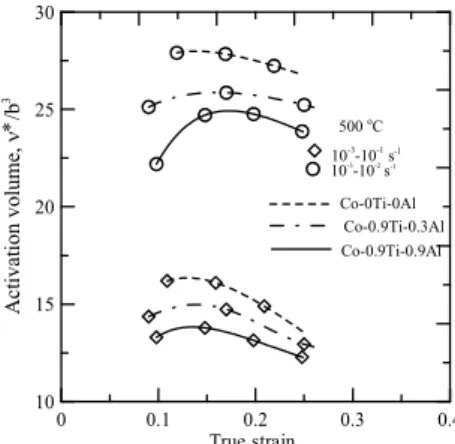
The activation volume index provides an indication of the evolution of dislocations during a plastic deformation process. Using the relationship presented in Eq. 2, the activation volume, normalized with respect to b3 (where b is the Burger vector of cobalt superalloy, i.e. 2.5×10⁻¹⁰ m), can be presented as a function of the strain, as shown in Figs. 4(a)-4(c), respectively. The results show that the activation volume decreases with increasing strain but increases with increasing temperature at the similar strain. ) / ln( 2 1 1 2
where the flow stresses2 and are 1 obtained from tests conducted at strain rates of and ,respectively, and are calculated at the same value of plastic strain. Figs. 3(a)-3(c) present the strain rate sensitivity of the cobalt base superalloy as a function of strain. It can be seen that the strain rate sensitivity of the three cobalt base superalloys increases with strain rate, but decreases with increasing temperature. Furthermore, it is also evident that the cobalt base superalloy contains Ti and Al contents have a higher value of β for a similarly deformed temperature and strain rate.
2
1
The results suggest that the thermal activation effect, which assists dislocations
to overcome obstacles during plastic deformation, reduces as the strain and strain rate are increased. The reduction in the activation volume with increasing strain rate also indicates that the amount of thermal vibration occurring at higher strain rates is less than which occurs in low strain rate testing.
4-4 Microstructural observations and analysis
Figure 5 (a), 5(b) and 5(c) present the optical micrograph of the three as-received cobalt base superalloys. The microstructure graphes comprises equi-axed grains and annealing twins. From the mechanical behaviour analysis, the stress-strain behaviour of the three cobalt base superalloy specimens under different strain rate and temperatures is clarified in terms of the corresponding microstructural evolution. The microstructural evolution due to the influences of strain rate and temperature can be investigated by using TEM technology. There are many literatures reported in different strain rate loading, the dislocation structures are dependent upon the stacking-fault energy and the high stacking-fault materials are deeply influenced by dislocation cells [9-11]. However, the cobalt base superalloys are
high stacking-fault energy material, they are reasonable to expect the microstructures of the deformed specimens to contain cell structures.。
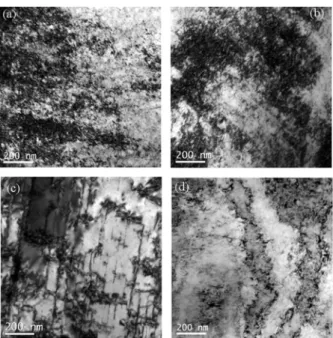
Figure 6(a) presents the TEM micrograph of Co-0.9Ti-0.9Al alloy deformed at a strain rate of 10-3s-1 and at temperature of 25℃. Comparison of the Fig. 6(a) with 6(b) at a constant temperature of 25℃, bur at an increasing strain rate, it presents that with increasing strain rate, the average size of the dislocation cells decreases. However, comparing the micrographs deformed at a constant strain rate (e.g. 10-1 s-1) but at an increasing temperature (Figs. 6(a), 6(c) and 6(d)), it is observed that the dislocations are annihilated as the deformation temperature is increased. It is the similar tendency at Co-0.9Ti-0.3Al and Co-0Ti-0Al alloy which shows in Fig. 7 and Fig. 8. But comparing Fig. 6 and Fig. 7, it presents that the dislocation density of Co-0.9Ti-0.9Al alloy is higher than Co-0.9Ti-0.3Al alloy. A higher dislocation density, which increases the degree of dislocation tangling, reduces the mobility of the dislocation and therefore enhances the resistance of the material to plastic deformation. Furthermore, comparing Fig. 6 and Fig. 7 with Fig. 8, it presents that the dislocation density of cobalt base alloys with Ti and Al additions
are higher than cobalt base alloys without Ti and Al additions. These observations are also consistent with the strain rate and temperature effect on the Figs. 1(a)-1(c). Furthermore, it is known that cobalt base superalloy contains Ti and Al contents, which can formation the coherent precipitate of Co3(Ti,Al) compound also can enhance
the strength of the cobalt base superalloy
5. CONCLUSIONS
6. References
1. D.L. Klarstrom, J. Mater.Eng. Perform., 2, 523 (1993).
2. V. Kuzucu, M. Ceylan, H. Celik and I. Aksoy, J.Mater. Process. Technol.,74, 137
(1998).
3. C.Tang, F. Pan, X. Qu, B. Duan, T. Wang and X. He, Rare Metals, 27, 292 (2008). 4. A. Suzuki, G.C. DeNolf and T. M. Pollock,
Scr. Mater., 56, 385 (2007)
5. S. Yadav and K. T. Ramesh, Mater. Sci.
Eng. A, 203 140 (1995)
This study has investigated the quasi-static mechanical behaviour and microstructural evolution of three cobalt base superalloys at strain rates ranging from 10-3 s-1 to 10-1 s-1 and temperatures of 25~700 ℃ with and without Ti and Al contents. The results have shown that the flow stress increase with increasing strain rate, but decrease with increasing temperature. Moreover, it has been revealed that under the same deformation condition, the cobalt base superalloy contains Ti and Al contents has high strength than without Ti and Al content. As the deformation temperature increases, the strain rate sensitivity decreases, but the activation volume increases. TEM observations have shown that the dislocation density increases with increasing strain rate, but decreases with increasing temperature. The high dislocation density and small dislocation cell size result in an increased flow stress. Furthermore, the cobalt base superalloy has the Ti and Al contents, which can formation the coherent compound of Co3(Ti,Al) also can enhance the strength of
the cobalt base superalloy.
6. D. E. Albert and G. T. Gray III, Acta
Mater., 45, 343 (1997).
7. H. Jarmakani, J. M. McNaney, B. Kad, D. Orlikowski, J. H. Nguyen and M. A. Meyers,
Mater. Sci. Eng. A, 463, 249 (2007).
8. S. S. Egg, Y. Q. Sue, P. B. Hirsch, Mater.
Sci. Eng. A, 192-193, 45 (1995)
9. M.A. Meyers and L.E. Murr, Editor, Shock Wave and High-Strain Rate Phenomena in Metals: Concept and applications, Chapter 37, Plenum Press, New York, 607 (1981).
10. C.L. Fu, J. Mater. Res., 5, 971 (1990) 11. W. S. Lee, T. H. Chen, Mater. Trans., 47, 355 (2006).
7. Figures and Table
Table 1 Chemical composition of cobalt base
superalloy. Element (wt.%) Cr Ni W Ti Al Co superalloy—2 17 9 13 0.9 0.9 Balance superalloy—2 17 9 13 0.9 0.3 Balance superalloy—3 17 9 13 0 0 Balance 0 0.1 0.2 0. True Strain 3 0 200 400 600 800 1000 T rue St re ss( MPa) Co-0.9Ti-0.9Al 0.1 s-1 0.01 s-1 0.001 s-1 25 oC 500 oC 700 oC
Fig. 1(a). True stress-strain curves of
Co-0.9Ti-0.9Al alloy deformed at strain rates of 10-1 s-1, 10-2 s-1 and 10-3 s-1 and temperatures of 25℃, 500℃ and 700℃ , respectively. 0 0.1 0.2 0.3 True strain 0 200 400 600 800 1000 T ru e s tre ss (M P a) Co-0.9Ti-0.3Al 0.1 s-1 0.01 s-1 0.001 s-1 25 oC 500 oC 700 oC
Fig. 1(b). True stress-strain curves of
Co-0.9Ti-0.3Al alloy deformed at strain rates of 10-1 s-1, 10-2 s-1 and 10-3 s-1 and temperatures of 25℃, 500℃ and 700℃ , respectively. 0 0.1 0.2 0.3 True Strain 0 200 400 600 800 1000 T rue St re ss( MPa) Co-0Ti-0Al alloy 0.1 s-1 0.01 s-1 0.001 s-1 700 oC 500 oC 25 oC
Fig. 1(c). True stress-strain curves of
Co-0Ti-0Al alloy deformed at strain rates of 10-1 s-1, 10-2 s-1 and 10-3 s-1 and temperatures of 25℃, 500℃ and 700℃ , respectively. strain rate, s-1 400 600 800 1000 Fl ow St re ss, (M Pa ) 0.1 0.2 10-4 10-3 10-2 10-1 100 500 o C 25 oC 700 oC
Fig. 2(a). Variation of flow stress with log
strain rate at true strains of 0.1 and 0.2 and temperatures of 25℃, 500℃ and 700℃ for Co-0.9Ti-0.9Al alloy.
strain rate, s-1 400 500 600 700 800 900 Fl ow St re ss , (MP a) 0.1 0.2 10-4 10-3 10-2 10-1 100 500 oC 25 oC 700 oC 0 5 10 15 20 25 Str ain r ate s en si tiv ity , MP a
Fig. 2(b). Variation of flow stress with log
strain rate at true strains of 0.1 and 0.2 and temperatures of 25℃, 500℃ and 700℃ for Co-0.9Ti-0.3Al alloy.
strain rate, s-1 400 500 600 700 800 900 Fl ow St re ss, (M Pa ) 0.1 0.2 10-4 10-3 10-2 10-1 100 500 oC 25 oC 700 oC
Fig. 2(c). Variation of flow stress with log
strain rate at true strains of 0.1 and 0.2 and temperatures of 25℃, 500℃ and 700℃ for Co-0Ti-0Al alloy.
0 0.1 0.2 0.3 0. True strain 4 0 5 10 15 20 25 St ra in rate s en si tiv it y, MP a 10-3-10-1 s-1 10-3-10-2s-1 25 oC Co-0.9Ti-0.9Al Co-0Ti-0Al Co-0.9Ti-0.3Al
Fig. 3(a). Variation of strain rate
sensitivity as function of strain for three cobalt superalloy at temperature of 25℃
0 0.1 0.2 0.3 0. T 4 500 oC Co-0.9Ti-0.9Al Co-0Ti-0Al Co-0.9Ti-0.3Al 10-3-10-1 s-1 10-3-10-2s-1 rue strain
Fig. 3(b). Variation of strain rate
sensitivity as function of strain for three cobalt superalloys at temperature of 500℃
0 0.1 0.2 0.3 0.4 True strain 0 5 10 15 20 25 St ra in r ate s ens iti vity , MP a 10-3-10-1 s-1 10-3-10-2s-1 700 oC Co-0.9Ti-0.9Al Co-0Ti-0Al Co-0.9Ti-0.3Al
Fig. 3(c). Variation of strain rate
sensitivity as function of strain for three cobalt superalloys at temperature of 700℃
0 5 10 15 20 25 Ac tiv ati on v ol um e, b 0 0.1 0.2 0.3 0. T 4 25 oC Co-0.9Ti-0.9Al Co-0.9Ti-0.3Al Co-0Ti-0Al 10-3-10-1 s-1 10-3-10-2s-1 rue strain
Fig. 4(a). Variation of activation volume
as function of strain for three cobalt superalloy at temperature of 25℃
0 0.1 0.2 0.3 True strain 0.4 10 15 20 25 30 Ac tiv ati on v ol um e, b 10-3-10-1 s-1 10-3-10-2s-1 500 oC Co-0.9Ti-0.9Al Co-0.9Ti-0.3Al Co-0Ti-0Al
Fig. 4(b). Variation of activation volume
as function of strain for three cobalt superalloys at temperature of 500℃ 0 0.1 0.2 0.3 True strain 0.4 0 5 10 15 20 25 30 Ac tiv ati on v ol um e, b 10-3-10-1 s-1 10-3-10-2s-1 700 oC Co-0.9Ti-0.9Al Co-0.9Ti-0.3Al Co-0Ti-0Al
Fig. 4(c). Variation of activation volume
as function of strain for three cobalt superalloy at temperature of 700℃
Fig. 5 (a). Micrograph of as-received
Co-0.9Ti-0.9Al alloy; (b) Co-0.9Ti-0.3Al; (c) Co-0Ti-0Al alloy
Fig. 6. TEM micrographs of dislocation
arrangement for Co-0.9Ti-0.9Al alloy deformed at strain rates of: (a) =10-3 s-1 and temperature at 25℃ and (b)
=10-1 s-1 , temperature at 25℃; and =10-1 s-1 at temperature of (c) 500℃; (d) 700℃.
Fig. 7. TEM micrographs of dislocation
arrangement for Co-0.9Ti-0.3Al alloy deformed at strain rates of: (a) =10-3 s-1 and temperature at 25℃ and (b) =10-1 s-1 , temperature at -25℃; and =10-1 s-1 at temperature of (c) 500℃; (d) 700℃.
Fig. 8. TEM micrographs of dislocation
arrangement for Co-0Ti-0Al alloy deformed at strain rates of: (a) =10-3 s-1 and
temperature at 25℃ and (b) =10-1 s-1 , temperature at -25℃; and =10-1 s-1 at temperature of (c) 500℃; (d) 700℃
國科會補助計畫衍生研發成果推廣資料表
日期:2012/08/27國科會補助計畫
計畫名稱: 含鈦鋁之鈷基超合金在不同溫度及應變速率下的動態塑變行為與顯微結構分析 計畫主持人: 陳道星 計畫編號: 100-2218-E-151-001- 學門領域: 應力應變與成型無研發成果推廣資料
100 年度專題研究計畫研究成果彙整表
計畫主持人:陳道星 計畫編號: 100-2218-E-151-001-計畫名稱:含鈦鋁之鈷基超合金在不同溫度及應變速率下的動態塑變行為與顯微結構分析 量化 成果項目 實際已達成 數(被接受 或已發表) 預期總達成 數(含實際已 達成數) 本計畫實 際貢獻百 分比 單位 備 註 ( 質 化 說 明:如 數 個 計 畫 共 同 成 果、成 果 列 為 該 期 刊 之 封 面 故 事 ... 等) 期刊論文 2 0 100% 研究報告/技術報告 1 0 100% 研討會論文 2 0 100% 篇 論文著作 專書 0 0 100% 申請中件數 0 0 100% 專利 已獲得件數 0 0 100% 件 件數 0 0 100% 件 技術移轉 權利金 0 0 100% 千元 碩士生 2 0 100% 博士生 0 0 100% 博士後研究員 0 0 100% 國內 參與計畫人力 (本國籍) 專任助理 0 0 100% 人次 期刊論文 2 0 100% 研究報告/技術報告 0 0 100% 研討會論文 0 0 100% 篇 論文著作 專書 0 0 100% 章/本 申請中件數 0 0 100% 專利 已獲得件數 0 0 100% 件 件數 0 0 100% 件 技術移轉 權利金 0 0 100% 千元 碩士生 0 0 100% 博士生 0 0 100% 博士後研究員 0 0 100% 國外 參與計畫人力 (外國籍) 專任助理 0 0 100% 人次其他成果