Insertion of a Si layer to reduce operation current for resistive random access memory
applications
Yu-Ting Chen, Ting-Chang Chang, Han-Kuang Peng, Hsueh-Chih Tseng, Jheng-Jie Huang, Jyun-Bao Yang, Ann-Kuo Chu, Tai-Fa Young, and Simon M. Sze
Citation: Applied Physics Letters 102, 252902 (2013); doi: 10.1063/1.4812304 View online: http://dx.doi.org/10.1063/1.4812304
View Table of Contents: http://scitation.aip.org/content/aip/journal/apl/102/25?ver=pdfcov Published by the AIP Publishing
Articles you may be interested in
Stabilizing resistive switching performances of TiN/MgZnO/ZnO/Pt heterostructure memory devices by programming the proper compliance current
Appl. Phys. Lett. 104, 043508 (2014); 10.1063/1.4863744
Performance and characteristics of double layer porous silicon oxide resistance random access memory Appl. Phys. Lett. 102, 253509 (2013); 10.1063/1.4812474
Switching dynamics and charge transport studies of resistive random access memory devices Appl. Phys. Lett. 101, 113503 (2012); 10.1063/1.4749809
Schottky diode with excellent performance for large integration density of crossbar resistive memory Appl. Phys. Lett. 100, 213508 (2012); 10.1063/1.4722784
Microcrystalline oxide-incorporated new diffusion barrier for dynamic random access memory and ferroelectric random access memory capacitor electrode
J. Vac. Sci. Technol. A 15, 2781 (1997); 10.1116/1.580823
This article is copyrighted as indicated in the article. Reuse of AIP content is subject to the terms at: http://scitation.aip.org/termsconditions. Downloaded to IP: 140.113.38.11 On: Wed, 30 Apr 2014 15:13:20
Insertion of a Si layer to reduce operation current for resistive random
access memory applications
Yu-Ting Chen,1Ting-Chang Chang,1,2,3,a)Han-Kuang Peng,4Hsueh-Chih Tseng,2 Jheng-Jie Huang,2Jyun-Bao Yang,1Ann-Kuo Chu,1Tai-Fa Young,4and Simon M. Sze2,5
1
Department of Photonics, National Sun Yat-Sen University, Kaohsiung 804, Taiwan
2
Department of Physics, National Sun Yat-Sen University, Kaohsiung 804, Taiwan
3
Advanced Optoelectronics Technology Center, National Cheng Kung University, Tainan, 701, Taiwan
4
Department of Mechanical and Electro-Mechanical Engineering, National Sun Yat-Sen University, Kaohsiung 804, Taiwan
5
Department of Electronics Engineering, National Chiao Tung University, Hsinchu 300, Taiwan
(Received 10 April 2013; accepted 12 June 2013; published online 24 June 2013)
In this study, a reduction of low resistive state (LRS) current is discovered in a V:SiO2/Si bi-layer
structure with the addition of a Si layer. A Pt/V:SiO2/TiN structure is fabricated as the standard
sample. The results of conduction mechanism analyses for LRS indicate that a SiO2 interfacial
layer forms through oxidation of the inserted Si layer after the set process. The LRS current reduction can be attributed to the formation of this SiO2 layer. In addition, self-compliance
behavior for the bi-layer structure during the set process further proves the existence of this SiO2
buffer layer in LRS.VC 2013 AIP Publishing LLC. [http://dx.doi.org/10.1063/1.4812304]
Because of the scaling down devices used for conven-tional charge storage based memories, performance reliabil-ity is a significant challenge due to physical limitations.1–3 Recently, resistive random access memory (ReRAM) has developed and attracted extensive attention as a substitute for next-generation memory because of its superior proper-ties. Such resistive switch (RS) behavior has been found in various materials.4–9In this letter, RS studies are performed in an SiO2-based ReRAM structure due to its high
compati-bility with current semiconductor manufacturing industry processes.10,11 In order to promote the application of ReRAM devices, studies have concentrated on issues such as the stability of the switching behavior, a reduction of the operation current (power), and an improvement of the cross-talk issue.12–15 According to these previous studies, switch-ing stability can be improved by a metal dopswitch-ing system.16,17 Therefore, a vanadium (V)-doped SiO2 layer is chosen in
this study. In addition, we attempt to reduce the operation current by using a bi-layer stack structure.
In this work, a TiN bottom electrode was deposited on a SiO2/Si substrate. Contact-holes were defined by patterning
the spacer constructed from the SiO2formed low
tempera-ture oxide (LTO) film by using standard lithography and reactive ion etching on the TiN bottom electrode. The 17-nm-thick vanadium (V)-doped silicon dioxide layer was stacked, followed by the 3-nm-thick Si layer in order to form the bi-layer structure (sample B) by co-sputtering the vana-dium and SiO2 targets. The 3-nm-thick Si layer is
pre-deposited on the TiN by sputtering intrinsic Si target in pure Ar ambient. Devices were completed after the lift-off process by the subsequent deposition of a 200-nm-thick Pt top elec-trode. The devices without an inserted Si layer were simulta-neously fabricated with the standard sample, termed sample A. Schematic diagrams of these two structures are shown in Fig.1(a).
The RS characteristics were measured by using an Agilent B1500 semiconductor characterization analyzer with biasing at the TiN terminal and grounding at the Pt terminal. Devices in this letter were activated by a positive forming process with a compliance current of 1 lA. The reversible RS behavior can be switched from high resistive state (HRS) to low resistive state (LRS) through the set process by posi-tive voltage with compliance current of 3 mA and switched back to HRS through the reset process by negative voltage.
The active layer of vanadium (V)-doped silicon dioxide layer (V:SiO2) is confirmed by Fourier transform infrared
(FTIR) analyses. From the FTIR spectrum shown in Fig.1(b), the absorption signals of V can be obtained in addi-tion to the Si signals.18,19 Both V and Si are discovered in the oxidative phase. As a result, V is confirmed to be doped in the SiO2 film. Subsequently, the RS behaviors of these
two devices are performed and compared in Fig.1(c). A re-markable decrease of the LRS current is presented in the switching characteristic of the V:SiO2/Si bi-layer structure
(sample B). In addition, the reset voltage (Vreset), which is
defined as the voltage where the current begins to decrease, also increases.
In order to investigate the difference between samples A and B, conduction mechanisms are analyzed. Figure 2(a)
shows the analyses of both LRS and HRS for sample A. As the biasing voltage is small, the conducting electrons are driven by the electric field. Ohmic conduction dominates the conduction mechanism. In contrast, Poole-Frenkel emission dominates the conduction mechanism at a higher bias due to the more apparent lowering of the trap barrier, as shown in Fig. 2(b). After a reset process, LRS transforms to HRS by the formation of an interfacial insulator, called as switching layer (SL).20 As a result, Schottky emission dominates the initial small voltage zone. Afterward, Poole-Frenkel emis-sion becomes the major mechanism due to the charge de-trapping behavior from the CF composed of oxygen vacancies, as shown in Fig.2(c).
a)
0003-6951/2013/102(25)/252902/3/$30.00 102, 252902-1 VC2013 AIP Publishing LLC
APPLIED PHYSICS LETTERS 102, 252902 (2013)
This article is copyrighted as indicated in the article. Reuse of AIP content is subject to the terms at: http://scitation.aip.org/termsconditions. Downloaded to IP: 140.113.38.11 On: Wed, 30 Apr 2014 15:13:20
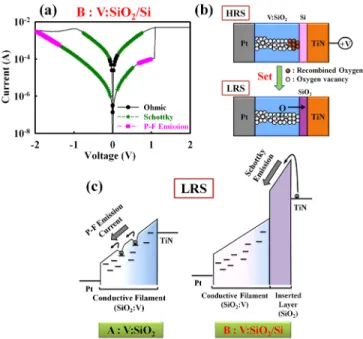
The conduction mechanisms of sample B are also ana-lyzed and shown in Fig.3(a). The conduction mechanism fol-lows Ohmic conduction in LRS, then changing to Schottky emission, unlike in sample A when it changes to Poole-Frenkel emission. Hence, a model is proposed to explain this difference in conduction mechanisms and is shown in Fig.3(b). The interfacial insulator is formed by the recombi-nation of oxygen ions and oxygen vacancies while the device is at HRS. After a set process by biasing a positive voltage on TiN, the oxygen ions can be driven toward TiN therefore oxi-dizing the inserted Si layer, causing the formation of a SiO2
barrier layer between the CF of the V:SiO2film and the TiN
bottom electrode. Owing to the formation of the high band gap SiO2barrier layer (9 eV) in LRS, the charge-transporting
behavior becomes more difficult. Therefore, this SiO2barrier
layer formation induced by the inserted Si layer increases the
barrier for the transport of charges and thereby reduces LRS current, as shown in Fig.3(c).
The increase in Vreset for sample B compared to that of
A, shown in Fig.1(c), also can be attributed to the formation of this SiO2barrier layer in LRS. Since the series resistance
is increased by the additional SiO2layer, the reset condition
that drives the oxygen ions away from TiN and thereby resets the resistance state from LRS to HRS shown in Fig.4(a)
requires a higher reset voltage. In addition, the self-compliance behavior in LRS is obtained for sample B. During the set process, the LRS can be reached without the protection of compliance current while appropriate voltage is swept, as shown in Fig. 4(b). The self-compliance behavior can also significantly act as evidence of the formation of the SiO2barrier layer in LRS.21 The series resistance attributed
to the formation of the SiO2 barrier layer limits the current
FIG. 1. (a) Schematic diagram of the two deposited structures. (b) FTIR anal-yses. (c) Resistive switching behavior comparison between the two devices.
FIG. 2. (a) Conduction mechanism analyses of sample A. (b) The conduc-tion mechanisms in LRS are Ohmic conduction followed by Poole-Frenkel emission. (c) The conduction mecha-nisms in HRS are a short period of Schottky emission followed by Poole-Frenkel emission.
252902-2 Chen et al. Appl. Phys. Lett. 102, 252902 (2013)
This article is copyrighted as indicated in the article. Reuse of AIP content is subject to the terms at: http://scitation.aip.org/termsconditions. Downloaded to IP: 140.113.38.11 On: Wed, 30 Apr 2014 15:13:20
characteristic. As a result, self-compliance behavior can be obtained in LRS. Due to the requirement of a compliance cur-rent during ReRAM operation, a combination of transistor and ReRAM (1T1R) has been considered as a suitable struc-ture for an array strucstruc-ture nowadays.22 However, since the large transistor size is a drawback for the development of the device scaling down, various alternative structures have been proposed.15,23,24 Our noteworthy findings of this situation where compliance current is not required is, therefore, an advantage for the use of ReRAM devices in array structures.
In conclusion, a reduction of the LRS current is discov-ered in a V:SiO2/Si bi-layer structure after the addition of an
inserted Si layer. The Pt/V:SiO2/TiN stack structure is
fabricated as standard device. Due to the operation polarity, the oxygen ions generated among the set process are driven toward the Si/TiN terminal. Subsequently, the inserted Si layer is oxidized and forms a SiO2barrier layer. As a result,
the LRS current can be suppressed since the dominated con-duction mechanism transfers from Poole-Frenkel emission to Schottky emission. In addition, the current is limited and shows self-compliance behavior owing to the formation of this SiO2barrier layer. Due to this self-compliance behavior
which was obtained by the insertion of a Si layer, any addi-tional devices that are usually required to attain current com-pliance to protect the device from hard breakdown for an array application would therefore not be necessary.
This work was performed at National Science Council Core Facilities Laboratory for Science and Nano-Technology in Kaohsiung-Pingtung area and was supported by the National Science Council of the Republic of China under Contract NSC 101-2120-M-110-002.
1S. C. Chen, T. C. Chang, P. T. Liu, Y. C. Wu, P. S. Lin, B. H. Tseng, J. H.
Shy, S. M. Sze, C. Y. Chang, and C. H. Lien,IEEE Electron Device Lett.
28, 809 (2007).
2
J. Lu, T. C. Chang, Y. T. Chen, J. J. Huang, P. C. Yang, S. C. Chen, H. C. Huang, D. S. Gan, N. J. Ho, Y. Shi, and A. K. Chu,Appl. Phys. Lett.96, 262107 (2010).
3
T. C. Chang, F. Y. Jian, S. C. Chen, and Y. T. Tsai,Mater. Today14, 608 (2011).
4
Q. Liu, W. Guan, S. Long, M. Liu, S. Zhang, Q. Wang, and J. Chen,
J. Appl. Phys.104, 114514 (2008).
5
H. Y. Lee, P. S. Chen, T. Y. Wu, C. C. Wang, P. J. Tzeng, C. H. Lin, F. Chen, M. J. Tsai, and C. Lien,Appl. Phys. Lett.92, 142911 (2008).
6
M. C. Chen, T. C. Chang, C. T. Tsai, S. Y. Huang, S. C. Chen, C. W. Hu, S. M. Sze, and M. J. Tsai,Appl. Phys. Lett.96, 262110 (2010).
7
Y. T. Tsai, T. C. Chang, C. C. Lin, S. C. Chen, C. W. Chen, S. M. Sze, F. S. Yeh(Huang), and T. Y. Tseng,Electrochem. Solid-State Lett.14, H135 (2011).
8S. C. Chen, T. C. Chang, S. Y. Chen, C. W. Chen, S. C. Chen, S. M. Sze, M. J.
Tsai, M. J. Kao, and F. S. Yeh(Huang),Solid-State Electron.62, 40 (2011).
9
J. J. Huang, T. C. Chang, J. B. Yang, S. C. Chen, P. C. Yang, Y. T. Chen, H. C. Tseng, S. M. Sze, A. K. Chu, and M. J. Tsai,IEEE Electron Device Lett.33, 1387 (2012).
10
Y. T. Chen, T. C. Chang, J. J. Huang, H. C. Tseng, P. C. Yang, A. K. Chu, J. B. Yang, M. J. Tsai, Y. L. Wang, and S. M. Sze,ECS Solid-State Lett.
1, 57 (2012).
11L. Zhang, R. Huang, D. Gao, D. Wu, Y. Kuang, P. Tang, W. Ding,
A. Z. H. Wang, and Y. Wang,IEEE Electron Device Lett.30, 870 (2009).
12
H. C. Tseng, T. C. Chang, J. J. Huang, P. C. Yang, Y. T. Chen, F. Y. Jian, S. M. Sze, and M. J. Tsai,Appl. Phys. Lett.99, 132104 (2011).
13K. C. Chang, T. M. Tsai, T. C. Chang, Y. E. Syu, C. C. Wang, S. L. Chuang,
C. H. Li, D. S. Gan, and S. M. Sze,Appl. Phys. Lett.99, 263501 (2011).
14
Y. E. Syu, T. C. Chang, T. M. Tsai, Y. C. Hung, K. C. Chang, M. J. Tsai, M. J. Kao, and S. M. Sze,IEEE Electron Device Lett.32, 545 (2011).
15Z. J. Liu, J. Y. Gan, and T. R. Yew,Appl. Phys. Lett.100, 153503 (2012). 16
S. Y. Wang, D. Y. Lee, T. Y. Huang, J. W. Wu, and T. Y. Tseng,
Nanotechnology21, 4952014 (2010).
17
H. Zhang, L. Liu, B. Gao, Y. Qiu, X. Liu, J. Lu, R. Han, J. Kang, and B. Yu,Appl. Phys. Lett.98, 042105 (2011).
18
J. S. Bae and S. I. Pyun,Solid State Ionics90, 251 (1996).
19
D. Choi, G. E. Blomgren, and P. N. Kumta,Adv. Mater.18, 1178 (2006).
20
Y. S. Chen, H. Y. Lee, P. S. Chen, W. H. Liu, S. M. Wang, P. Y. Gu, Y. Y. Hsu, C. H. Tsai, W. S. Chen, F. Chen, M. J. Tsai, and C. Lien,IEEE Electron Device Lett.32, 1585 (2011).
21
C. Y. Lin, C. Y. Wu, C. Y. Wu, T. Y. Tseng, and C. Hu,J. Appl. Phys.
102, 094101 (2007).
22Y. Sato, K. Tsunoda, K. Kinoshita, H. Noshiro, M. Aoki, and Y.
Sugiyama,IEEE Trans. Electron Devices55, 1185 (2008).
23
J. Shin, I. Kim, K. P. Biju, M. Jo, J. Park, J. Lee, S. Jung, W. Lee, S. Kim, S. Park, and H. Hwang,J. Appl. Phys.109, 033712 (2011).
24D. Lee, J. Park, S. Jung, G. Choi, J. Lee, S. Kim, J. Woo, M. Siddik, E.
Cha, and H. Hwang,IEEE Electron Device Lett.33, 600 (2012). FIG. 3. (a) Conduction mechanism analyses of sample B. (b) The proposed
model of the conduction mechanism in LRS during the set process. (c) Comparison of the energy band diagrams in LRS between these two structures.
FIG. 4. (a) The schematic diagram in LRS, equivalent to two resistances in series. (b) The self-compliance behavior during set process further confirms the existence of the SiO2barrier layer.
252902-3 Chen et al. Appl. Phys. Lett. 102, 252902 (2013)
This article is copyrighted as indicated in the article. Reuse of AIP content is subject to the terms at: http://scitation.aip.org/termsconditions. Downloaded to IP: 140.113.38.11 On: Wed, 30 Apr 2014 15:13:20