Magnetic skyrmions and their lattices in triplet superconductors
A. Knigavko
Department of Electrophysics, National Chiao Tung University, Hsinchu, Taiwan 30050, Republic of China B. Rosenstein
Department of Electrophysics, National Chiao Tung University, Hsinchu, Taiwan 30050, Republic of China and National Center for Theoretical Sciences, National Chiao Tung University, Hsinchu, Taiwan 30043, Republic of China
Y. F. Chen
Department of Electrophysics, National Chiao Tung University, Hsinchu, Taiwan 30050, Republic of China ~Received 25 January 1999!
A complete topological classification of solutions in SO~3! symmetric Ginzburg-Landau free energy has been performed and a new class of solutions in weak external magnetic field carrying two units of magnetic flux has been identified. These solutions, magnetic skyrmions, do not have a singular core as Abrikosov vortices do and at low magnetic field they become lighter for strongly type II superconductors. As a conse-quence, the lower critical magnetic field Hc1is reduced by a factor of lnk. Magnetic skyrmions repel each other as 1/r at distances much larger than magnetic penetration depthl forming a relatively robust triangular lattice. Magnetization near Hc1increases gradually as (H2Hc1)2. This behavior agrees very well with experi-ments on heavy fermion superconductor UPt3. Newly discovered Ru based compounds Sr2RuO4 and Sr2YRu12xCuxO6 are other possible candidates to possess skyrmion lattices. Deviations from exact SO~3! symmetry are also studied.@S0163-1829~99!06425-5#
I. INTRODUCTION
A rich variety of novel magnetic properties can be found in superconductors with an unconventional type of pairing symmetry. At present several examples of unconventional superconductors are known. The first of them is, of course, a family of Tccuprates. In connection with them a lot of recent
effort has been devoted to the study of d-wave pairing of various types with a possible admixture of s wave. On the other hand, a triplet type of pairing is believed to exist in UPt3 ~Refs. 1,2! and in some other heavy fermion
compounds.3It is also suspected to occur in recently discov-ered new classes of Ru based superconductors, laydiscov-ered per-ovskite Sr2RuO4,4,5 and bulk compound Sr2YRu12xCuxO6 ~Ref. 6! which has a double perovskite structure. Since all
mentioned superconductors are strongly type II, vortices play the major role in their thermodynamical properties. In
high-Tc superconductors, despite fundamental differences in
mechanism and microscopic properties compared to tional superconductors, vortices are quite similar to conven-tional Abrikosov vortices. The reason for this is the existence of a dominant single order parameter field: d-wave conden-sate. Small ~sometimes quite important! deviations can be accounted for due to the admixture of the s-wave component. Then, the order parameter is effectively multicomponent. This property leads generally to various new effects such as nonaxisymmetric vortices7,8and phase transitions within flux line lattices near Hc2.9 Similar phenomena exist and should be even more pronounced in systems with an intrinsically multicomponent superconducting order parameter10,11 such as heavy fermion compounds.
The situation in triplet superconductors might be more exotic. The order parameter is necessarily multicomponent.
In addition, under certain conditions the rotational symmetry
~at least an approximate one! between different components
might exist. In that case vortices are not the only type of topological solitons which can carry magnetic flux through the sample. The corresponding phenomenological Ginzburg-Landau theory has the order parameter of a vector type with a continuous symmetry. It is known in the theory of super-fluid 3He ~Ref. 12! that in such a system there exist topo-logical defects which have no singularities even within the London approximation. On the other hand, vortices have a singularity at their core, at least for one of the components of the order parameter. This makes their energy roughly propor-tional to lnk, similar to the case of a standard Abrikosov vortex. Therefore, for sufficiently large k vortices are ex-pected to be heavier than nonsingular topological defects and the latter become the most likely candidates for thermody-namically stable configurations of the order parameter field into which a homogeneous superconducting~Meissner! state transforms under the action of an external magnetic field.
It is the purpose of the present paper to investigate this possibility in detail. We find such a nonsingular in the Lon-don approximation solution, the magnetic skyrmion, describe its structure, and show that it is energetically favorable over the Abrikosov vortex in a wide range of Ginzburg-Landau parameterk values. Lattices of magnetic skyrmions are par-ticularly important at fields near the lower critical field. The most striking effects are the reduction of Hc1 by a factor of
lnk and a dramatic change in the behavior of magnetization near Hc1. We also investigate what happens to magnetic skyrmions when the continuous symmetry breaking terms are introduced into the free energy. It is shown that they survive under small perturbations and gradually evolve to PRB 60
other still nonsingular configurations under large perturba-tions of a certain type.
Magnetic skyrmion lattices may have already been ex-perimentally observed in UPt3. Magnetization curves near Hc1~Refs. 13,14! are rather unusual ~see Fig. 1 of Ref. 15 in
which a short account of this work was presented!. Theoreti-cally, if the magnetization is due to penetration of vortices into a superconducting sample then one expects 24pM to
drop with an infinite derivative at Hc1. On the other hand
experimentally24pM continues to increase smoothly. Such
a behavior was attributed to strong flux pinning or surface effects.13 However, both experimental curves in Fig. 1 of Ref. 15, as well as the other ones found in literature, are close to each other if plotted in units of Hc1. We propose a
more fundamental explanation of the universal smooth mag-netization curve near Hc1. If one assumes that fluxons are of
unconventional type for which interaction is long range then precisely this type of magnetization curve is obtained. Indeed magnetization near Hc1 due to fluxons carrying N units of
flux F0[hc/2e, with line energy « and mutual interaction V(r), is found by minimizing the Gibbs energy of a very
sparse triangular lattice
G~B!5 B
NF0@«13V~an!#2 BH
4p, ~1!
where an5(F0/B
A
3)1/2 is lattice spacing. When V(r) ;exp@2lr#, the magnetic induction has the conventionalbe-havior B;@ln(H2Hc1)#22,16 while if it is long range,
V(r);1/rn, then one finds B;(H2Hc1)n11. The physical
reason for this different behavior is very clear. For a short range repulsion, if one fluxon penetrated the sample, many more can penetrate almost with no additional cost of energy. This leads to the infinite derivative of magnetization. On the other hand for a long range interaction making a place for each additional fluxon becomes energy consuming. Deriva-tive of magnetization thus becomes finite.
The remainder of the paper is organized as follows. In Sec. II we present the SO~3! symmetric model and note that it is an excellent approximation to certain successful models of UPt3~Ref. 17! as well as to others.18The London approxi-mation is developed. In Sec. III we perform complete topo-logical classification of solutions and find that the magnetic skyrmion carries two units of magnetic flux. General form of cylindrically symmetrical solutions is given. In Sec. IV we determine the magnetic skyrmion lattice structure Hc1 and
the magnetization curve. An example of deviations from ex-act SO~3! symmetry is considered in Sec. V. More specifi-cally, we address the case of a Zeeman-like interaction rel-evant to the Sr2YRu12xCuxO6 ~Ref. 19! system which
initially motivated us to search for exotic vortices. Section VI contains discussion of the results and possibilities to ex-perimentally observe various effects of magnetic skyrmions.
II. THE MODEL
A. Ginzburg-Landau free energy functional and its symmetries
Let us consider a model Ginzburg-Landau theory with the order parameter ci(rW) being a three-dimensional (i51,2,3)
complex vector. It is convenient to consider index i as a spin
in the case of weak spin-orbit coupling in the pairing chan-nel, but this is not a necessary interpretation. The case of the strong-spin–orbit interaction can also be addressed provided some modifications of the free energy functional are made. Average spin of the Cooper pair at a specific point in the space is given by
Si~rW![c*j~rW!~2i«i j k!ck~rW!. ~2!
The material under study is assumed to be isotropic. Exten-sions of our results to anisotropic situations are discussed in Sec. V.
The Ginzburg-Landau free energy functional of the sys-tem has the form
F5Fpot1Fgrad1 1 8pBj 2 , ~3! Fpot52acici*1 b1 2 ~cici*! 21b2 2 uciciu 2, ~4! Fgrad5 \2 2m*~Djci!~Djci!*, ~5!
where Dj[]j2i(e*/\c)Aj are covariant derivatives, Bj
[(¹3AW)j, m*.0 is the effective mass of the pair, and e*
is the effective charge of the pair. For a superconducting phase to exist the coefficienta should be positive below the phase transition point and we set a5a
8
(Tc2T) with a8
.0, while for positive definiteness of the potential the other
coefficients of Eq.~4! should satisfy b1.0 andb2.2b1.
The free energy density Eq. ~3! has the following inde-pendent symmetries. The spin rotations, forming a group SOspin(3), act on the index i of the order parameter field, so
that it transforms as a vector. Two-dimensional ~orbital! space rotations, forming a different SOorbit(2) group, act on
spatial coordinates xjand the electric charge transformations, forming a U~1! group, rotate the complex phase of the order parameter. Note that in Eq. ~3! we assumed that external magnetic field HW is oriented along the z direction. We will consider only configurations invariant under translations in that direction or the thin film geometry.
First we consider the case of zero external magnetic field. Pure superconducting ~Meissner! phases that appear below
Tc are found by minimization of Fpot with respect to ci*.
This is conveniently done making use of the following pa-rametrization of the order parameter vector:
cW5cieWi5 f~nWcosf1i mW sinf!, ~6!
where f.0, 0<f<p/2, nW and mW are unit vectors that are arbitrarily oriented with respect to some fixed coordinate system in the spin space with orthonormal basis eW1,eW2,eW3.
There exist two phases, depending on the sign of the coeffi-cient b2: I: b2.0, cW5 f nW1imW
A
2 , nW'mW,f5p/4, f 25a b1 . ~7!II: b2,0, cW5 f eifnW, nW56mW; f25
a b11b2
.
~8!
Combining Eqs. ~2! and ~6! one obtains SW5 f2sin 2f Wl, where lW[nW3mW. In phase I the projection of the spin of a Cooper pair SW on the vector lW is equal to either 11 or 21, reflecting spontaneous time reversal symmetry breaking. In phase II this projection is always zero.
B. Theories of triplet superconductors and terms breaking SOspin„3… symmetry
Obviously, the model of the previous subsection is an idealization of the actual situation in triplet superconductors. In this subsection we note that some successful models of UPt3, notably that of Machida et al.,17differ from this model only by small less symmetric terms. These terms could be considered as small perturbations, at least in some regions of the H-T diagram. The asymmetries are of several types. First, the space symmetry SOorbit(2) is normally broken
down to some crystallographic point group of a given mate-rial (D6h for UPt3, D4h for Sr2RuO4, D2h for Sr2YRu12xCuxO6). The effective mass m* then becomes a
symmetric tensor m*jk. Second, the spin SW can be coupled to the magnetic field. This explicitly breaks SOspin(3) down to
SOspin(2). Separate spin and orbital symmetries SOspin(2)
^SOorbit(2) are broken down to diagonal SOtot(2) as well.
The various types of perturbations are
DFpot25a
8
@~Tc2Tc (1) !uc1u21~Tc2Tc (2) !uc2u2#, ~9a! DFpot45b3~uc3u22uc1u22uc2u2!2 1b4uc3u2~uc3u22uc1u22uc2u2!, ~9b! DFgrad5K@~Djci!~Dicj!*1~Dici!~Djcj!*#, ~9c! DFZeeman5mSW•BW, ~9d! DFnonlin5DxucW•BWu 2. ~9e!We estimate their coefficients for the case of UPt3. Some models of UPt3 do not have three-dimensional complex
or-der parameter and therefore will not be addressed here. Ex-amples include E1g singlet pairing,20 E2g triplet pairing,21 and the accidental degenerate AB model.22 On the other hand, the model of weak spin-orbit coupling developed by Machida et al.17 is of the type we are interested in. In this model asymmetric terms are very important in explaining the double superconducting phase transition at zero external magnetic field. However, they are small in the low-temperature superconducting phase~phase B! well below its critical temperature T!Tc2.0.45 K and at low magnetic fields H.Hc1. Indeed, for the quadratic terms one gets from experiment (Tc2Tc1)/Tc;0.2, (Tc12Tc2)/Tc,0.05. The
quartic terms Eq.~9b! are an order of magnitude smaller. The corrections to the gradient terms are very small
K/(\2/2m*);0.01 and m/(\2/2m*);0.01. The coefficient of the nonlinear coupling term Eq. ~9c! is negligible:
@(Dx/2)Hc1
2 #/(a2/2b
1).1026. Another model of UPt3,
which has similar structure to Eq. ~3!, is the accidental de-generate AE.18 Estimates are similar with exception of
K/(\2/2m*) which is now of order 1 ~found from fitting
transition lines near Hc2).
In general, topological solitons exist even in those cases when the symmetry is weakly broken. In Sec. V we consider in detail the influence of one symmetry breaking term, Zee-man coupling, Eq. ~9b!, in connection to the material Sr2YRu12xCuxO6. We show that it does not affect the
sta-bility of solitons that we investigate in this paper. C. London approximation
The London approximation assumes that the order param-eter has the form dparam-etermined by the potential part of the free energy Eq. ~4!. In particular, the modulus of the order pa-rameter is fixed. Any variations of the order papa-rameter field over the space are only due to changes of the degeneracy parameters which parametrize the vacuum manifold. From this standpoint in usual s-wave superconductors there are no topological solitons within the London approximation. The famous Abrikosov vortex has a core—a region in which the modulus of the order parameter varies significantly and van-ishes at some point. A vortex can be incorporated into the London approximation at the cost of singularities: the vortex core is assumed to shrink to a point in which energy diverges logarithmically. Accordingly, a cutoff, the correlation length, should be introduced and one obtains lnk dependence for a vortex line tension. As discussed above, this means that if there exists a nonsingular solution it is bound to become energetically favorable for k large enough.
Below we concentrate on the properties of nonunitary phase I, Eq. ~7!, of a triplet superconductor near the lower critical field Hc1. This phase is always assumed when we
refer to the superconducting state. We define magnetic pen-etration depth l[c/ue*u
A
b1m*/4pa, coherence length j[\/
A
2am*, flux quantum F0[hc/e*, andGinzburg-Landau parameter k[l/j. For convenience we express all physical quantities in dimensionless units as follows:
x[lx˜, F[ a 2 b1k2 F ˜ , f2[ a b1 f˜2, A[ F0 2pla, B[ F0 2pl2 b. ~10! The tildes will be omitted hereafter.
In order to determine the degeneracy parameters we con-sider the symmetry breaking pattern of the superconducting state. Both the spin rotation SOspin(3) symmetry and the
su-perconducting phase U~1! symmetry are spontaneously bro-ken, but a diagonal subgroup U~1! survives. It consists of combined transformations: rotations by angle q around the axis lWwhich are accompanied by gauge transformations eiq. These combined transformations together with rotations of vector lW itself, form the vacuum manifold. The vacuum manifold is isomorphic to the SO~3! group. Our aim is to find nonsingular topological line defects in this case. We
choose a triad of orthonormal vectors nW, mW, lW to be the degeneracy parameters. From the definition of these vectors the following important relations can be derived:
nW ]imW52mW ]inW, ~11!
~]inW!21~]imW!252~nW ]imW!21~]iWl!2, ~12!
«pqslp~]ilq!~]jls!5~]inp!~]jmp!2~]imp!~]jnp!.
~13!
To obtain the free energy density of the London approxi-mation we substitutecW in the form Eq.~7! into the gradient part, Eq.~5!, of the total free energy functional and make use of Eqs.~11! and ~12!. After some algebra we get
FL5 1 2~]iWl! 21~nW ] imW2ai!21bi 2 . ~14!
Varying energy functional with respect to vector potential aW one obtains the supercurrent equation
np¹Wmp2aW5¹W3~¹W3aW!5 jW, ~15! where the Maxwell equation was used. Equation~15! shows that the superconducting velocity~in units of \/m*) is given by
np¹Wmp52¹W q. ~16!
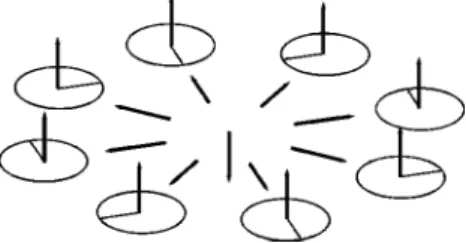
Thus, the angle q, which specifies the position the pair of perpendicular unit vectors nW and mW in the plane normal to vector lW, takes the role of superconducting phase in the present case~see Fig. 1!. Other field equations are most eas-ily obtained by considering FL( lW,nW,mW) as a functional of lW
and nW only and performing conditional variation with con-straints lW•nW50, lW25nW251. This procedure yields the inde-pendent equation for lW
D lW2 lW~ lW•D lW!12 jk~ lW3]klW!50. ~17!
III. TOPOLOGICAL CLASSIFICATION OF SOLUTIONS IN LONDON APPROXIMATION
In this subsection we develop a classification scheme for the finite energy solutions to our model in the London ap-proximation derived above. The main result is that the Lon-don equations~15! and ~17! in the presence of the magnetic flux admit nonsingular topologically stable solutions. This class of solutions contains cylindrically symmetric ones.
A. General topological analysis
Let us consider boundary conditions for a superconductor which extends over the whole space. The free energy density Eq. ~14! is positive definite and contains BW2 term. It follows that magnetic field vanishes at spatial infinity. Then one has to specify the triad nW, mW, lW at different distant points. The corresponding~first! homotopy group of vacuum manifold is p1@SO(3)#5Z2.
12 It yields a classification of finite energy
solutions into two topologically distinct classes. This classi-fication is too weak, however, because it does not guarantee nontrivial flux penetrating the plane. We will see that con-figurations having both ‘‘parities’’ are of interest.
In the presence of the magnetic flux, the configurations are further constrained due to the flux quantization condition. The vacuum manifold is naturally divided into SO(3)
→SO(2)^S2, where the S2 is the direction of lW and the
SO~2! is the superconducting phase q defined in Eq. ~16!. For given number of flux quanta N[F/F0, the phase q
makes N winds at infinity, see Fig. 2. The first homotopy group of this part is therefore fixed: p1@SO(2)#5Z. If, in
addition, vector lWis fixed throughout the volume of a super-conductor there is no way to avoid singularity in the phase q. It becomes ill defined at some point and, accordingly, the modulus of the order parameter have to vanish there. De-struction of the superconducting state takes place in rather small area, especially for large k. Thus, we arrive at the usual picture of the Abrikosov vortex.
However, the general requirement that a solution has fi-nite energy is much weaker. It tells us that the direction of lW should be fixed only at infinity. This follows from the pres-ence of the (]iWl)2term in FL@see Eq. ~14!# which cannot be
‘‘gauged away’’ as the corresponding term for the SO~2! part. A relevant homotopy group isp2(S2)5Z. The second
homotopy group appears because the constancy of lWat infin-ity~say, up! effectively ‘‘compactifies’’ the two-dimensional physical space into S2. One can have topologically nontrivial
FIG. 1. Definition of angles q and Q. Unit vectors lW, nW, mW constitute a triad of perpendicular vectors in the spin space.q is the superconducting phase defined in Eq.~16!.
FIG. 2. Configuration of a magnetic skyrmion with Q521. Solid arrows represent lW field while ‘‘clocks’’ show that phase q rotates twice clockwise as a round on the remote contour is com-pleted.
configuration, skyrmions, which are markedly different from vortices. Unit vector lWcan nontrivially wind towards the cen-ter of the texture. The topological number Q should be introduced,23
Q5 1
8p
E
«i jWl~]iWl3]jWl!dS. ~18! Configurations of the order parameter field with topological number Q521(Q511) have vector lWflipping its direction from up to down ~or from down to up! until it reaches the center of the texture from an infinitely remote point ~see Fig. 2!.To summarize, configurations fall into classes character-ized by two integers N and Q. The ‘‘parity’’ of the more general topological analysis is just Q5N(mod 2). Due to the presence of two topological numbers an interesting possibil-ity arises. There exists topologically nontrivial configuration that preserves the modulus of the order parameter @see Eq.
~7!# at every point. We call these regular solutions magnetic
skyrmions. For them these two topological numbers are re-lated to each other. We find this relation integrating the su-percurrent equation~15! along a remote contour and using of the identity~13!:
Q5N/2. ~19!
The lowest energy solution within the London approximation corresponds to N/25Q561.
B. Cylindrically symmetric magnetic skyrmions In the class of solution N/25Q521 there are ones pos-sessing cylindrical symmetry. We will describe them in polar coordinatesr andw. The triad nW, mW, lW has the form
l
W5eWzcosQ~r!1eWrsinQ~r!,
nW5@eWzsinQ~r!2eWrcosQ~r!#sinw1eWwcosw, ~20!
mW5@eWzsinQ~r!2eWrcosQ~r!# cosw2eWwsinw,
whereQ is the azimuthal angle of lW~see Fig. 1!. This choice corresponds to the situation when the pair of perpendicular vectors nW and mW winds twice as a distant circle on Fig. 2 is completed. Due to cylindrical symmetry of the solution in question function Q(r) satisfies boundary conditions Q
5p atr50 and Q50 atr→`.
The free energy of the magnetic skyrmion per unit length takes the form
ems5«s1«cur1«mag, ~21! «s[
E
rdrF
1 2S
dQ drD
2 1sin 2Q 2r2G
, ~22! «cur[E
rdrS
11cos Q r 1aD
2 , ~23! «mag[E
rdrB25E
rdrS
a r1 da drD
2 , ~24!where energy is measured in units of e05(F0/4pl)2. The
first part ems is the same as in standard nonlinear s model
without magnetic field.23. The second term«curis analogous
to the supercurrent contribution in the London approximation of the usual superconductor.16The third term is the magnetic energy. Equation ~23! shows that a singularity at r50 is absent ~integrand converges! since 11cos Q(0)50.
The actual distribution of magnetic field and order param-eter in this case can be found from the following system of equations:
Q
9
11rQ8
52sinrQS
21cos Qr 12aD
, ~25!a
9
1a8
r 2 a r22a5 1 r~11cos Q!. ~26! In the next section we solve this equation.IV. MAGNETIC SKYRMION SOLUTION
A. Blow up of single skyrmion by magnetic field The general form of the solution of Eqs.~25! and ~26! is given in Fig. 2. The orientation of the unit vector lW ~solid arrows! forms a skyrmion of SO~3! invariants model.23The phase q makes two rounds at infinity ~clock inside small circles on the ‘‘infinitely remote’’ circle!. If magnetic field were absent there are infinitely many degenerate solutions
Qs~r!52 arctan~d/r! ~27!
which have the same energy «52 for any size of the skyr-miond. The skyrmion of the nonlinears model possesses a scale invariance. This degeneracy in various physical prob-lem is lifted by perturbations. In some physical situations the skyrmion is stabilized by four derivative terms,23 sometimes it shrinks and sometimes blows up. In the present context the magnetic field lifts the degeneracy and we prove below that the skyrmion blows up. Of course if there are many skyrmi-ons present, their repulsion will stabilize the system. This is discussed in the next subsection.
To prove that the skyrmion blows up, we explicitly con-struct variational configurations and show that as the size of these configurations increases, the energy is reduced to a value arbitrarily close to the absolute minimum of «ms52.
The first term in the energy Eq. ~21! «s is the usual
expres-sion for the energy of the skyrmion. It is bound from below by the energy of usual skyrmion «52. To construct a varia-tional configuration forQ, we pick up one of these solutions Eq.~27! of certain sized. The second term«cur, the
‘‘super-current’’ contribution is positive definite. Therefore its mini-mum cannot be lower than zero. One still can maintain the zero value of this term when the field Q is a skyrmion. Assuming this one gets the relation between a and Q:a(r)
52(11cos Q)/r522r/(r21d2). The magnetic field contri-bution ~which is also positive definite! for such a vector po-tential is«mag58/3d2. To sum up, the energy of the configu-ration is«5218/3d2. It is clear that whend→`, we obtain energy arbitrarily close to the lower bound of «52. The skyrmion therefore blows up.
We also solved Eqs.~25!,~26! numerically on the segment of r from 0 to a cutoff rmax with boundary conditions bur5r
max50 and (Q
8
1Q/r)ur5rmax50. The secondbound-ary condition allows us to approach the correct asymptotic behavior of Q at infinity ;1/r which follows from Eqs.
~25!,~26!. The results for the distribution of magnetic field
forrmaxranging from 50 to 600 are presented in Fig. 3. One
clearly sees that as the cutoff increases the magnetic field at the center r50 decreases and the flux spreads out over larger area. This is in accord with the variational proof above.
B. Skyrmion lattice and Hc1
Skyrmions repel each other, as we will see shortly, and therefore form a lattice. Since they are axially symmetric objects, the interaction is axially symmetric and hexagonal lattice is expected~see Fig. 4!. Assume that lattice spacing is
an. At the boundaries of the hexagonal unit cells the angle
Q is zero, while at the centers it is p. Magnetic field b is continuous on the boundaries. Therefore, to analyze mag-netic skyrmion lattice we should solve Eqs.~25!,~26! on the unit cell with such boundary conditions demanding that two units of flux pass through the cell~by adjusting the value of
magnetic field on the boundary!. We approximate the hex-agonal unit cell by a circle of radius R5(31/4/
A
2p)an hav-ing the same area, Fig. 4.We performed such calculations for R from R55 until
R5600 using the finite elements method. The result is
pre-sented in Fig. 5. The energy per unit cell is described well in a wide range of R~deviation at R510 is 1%! by an approxi-mate expression
«cell521
5.62
R . ~28!
The dominant constant contribution to the energy at large R comes, as in the analytical variational state, above from the first term«sin the integrand of Eq.~21!. The contribution to
the energy Eq. ~21! from the supercurrent term «curis small
for large R but becomes significant at denser lattices. The third term, magnetic energy«magyields a small deviation of
magnetic skyrmion energy from 2 at large R.
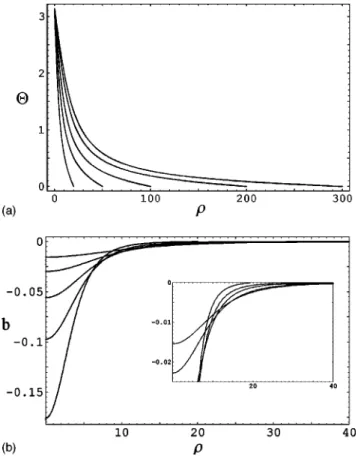
Profile of the angleQ(r) and of the magnetic field b are depicted in Figs. 6~a! and 6~b!, respectively. Radius of the circular cell R varies from 20l to 300l. In Fig. 6~a! a smaller value of R corresponds to a lower curve. Small r asymptotics of the solution up tor3 terms read
Q~r!→p1cr
F
11r 2 8S
b~0!1 c2 3DG
, a~r!→b~0! 2 r1 r3 16@b~0!1c 2#,where c and b(0) are constants to be determined by numeri-cal integration. Most of the flux goes through the region where the vector lW is oriented upwards. In other words, the magnetic field is concentrated close to the center of a mag-netic skyrmion.
The value of hc1(R→`)5«ms(R→`)/4 for a triplet
su-perconductor filling the whole space is equal to 1/2. In physi-cal units this result reads
Hc15 F0
4pl2. ~29!
FIG. 3. Magnetic field of the isolated magnetic skyrmion. The distance from the center r varies from 0 to a cutoff rmax with boundary conditions (Q81Q/r)ur5r
max50,bur5rmax50 imitating
the infinite domain.rmax540l for the lowest curve and 600 for the uppermost one.
FIG. 4. A fragment of the magnetic skyrmion lattice. For nu-merical calculations we approximate the symmetric unit cell by a disk of the same area: R5(31/4/
A
2p)an.FIG. 5. Energy of the unit cell of the magnetic skyrmion lattice. Dots are numerical values for different R. The line is the fit of Eq. ~28!.
It is quite different from Hc1 of conventional (s-wave! su-perconductors where an additional factor lnkis present. Line energy of Abrikosov vortices «v for the present model was calculated numerically ~beyond London approximation! in Ref. 19. Fork520 and 50 we obtain 2«v/«ms'3.5 and 4.4,
respectively. Therefore we expect that the lower critical field of UPt3 is determined by magnetic skyrmions.
C. Magnetization of the skyrmion lattice
If h.hc1 the external magnetic field enforces a definite
value of magnetic flux through a sample. Magnetic skyrmi-ons, being topological objects, carry quantized magnetic flux and their number in the sample is determined by the average magnetic induction b, similarly to the case of vortices. En-ergy of magnetic skyrmions as function of R Eq.~28! actu-ally determines the interaction between them. However, magnetic skyrmions, contrary to vortices, are extended ob-jects and their linear size R is also determined by the number of them in the sample.
To qualitatively estimate the magnetization curve pro-duced by ‘‘skyrmion mixed state’’ we make use of the unit cell energy obtained in the previous section. The Gibbs en-ergy density of the sample of volume V5S3L, where S is the transverse area and L is longitudinal extension, is given in dimensionless units Eq.~10! by
G~b!5N«cellL V 2 2bh5 b 2
S
215.62A
b 2D
22bh. ~30! The second equality follows the facts that magnetic induc-tion b is related both to the number of magnetic skyrmionsN5Sb/2 and to the size of the magnetic skyrmion defined
above R254/b. Minimization of Eq. ~30! with respect to b yields b.0.225
S
h hc1 21D
2 , h>hc15 1 2. ~31!Equation ~31! shows that a skyrmion lattice is character-ized by zero slope of magnetization curve at hc1, in contrast
to the infinite slope for the magnetization curve associated with a vortex lattice. This circumstance provides a tool in the experimental search for the triplet superconductivity with ap-proximate SO~3! symmetry. Our results agree well with the earlier work of Burlachkov et al.25 who also obtained zero slop of the magnetization at hc1 for a stripe lW texture which
might arise in the case of very high anisotropy of effective mass tensor m* @see Eq. ~3!#.
V. INFLUENCE OF SO„3… BREAKING TERMS In this section we consider influence of an SO~3! symme-try breaking terms on skyrmion lattice. List of these terms was given in Sec. IIB Eqs.~9a!–~9e!. The perturbations are not expected to affect the existence of topological solitons— just modify their energy. When the coefficient of a breaking term becomes of order 1, the soliton might disappear, al-though it is not necessary. We study in detail the influence of Zeeman term Eq. ~9d!. The choice is motivated by our pre-vious study of possible spontaneous vortex state in a new bulk perovskite superconductor Sr2YRu12xCuxO6.19
This compound has very unusual magnetic properties and is suspected to be a p-wave superconductor for the following reasons.6At the temperature of about 60 K, at which super-conductivity sets in, these materials begin to exhibit basic ferromagnetic properties such as a hysteresis loop. Experi-mental observation of a positive remanence suggests exis-tence of spontaneous magnetization in the absence of an ex-ternal magnetic field. Exact overlap of superconductivity and ferromagnetism lead us to consider an isotropic triplet model Eqs. ~3!–~5! in nonunitary phase with spontaneous time re-versal symmetry breaking. In this case, a direct spin coupling of the condensate to a magnetic field
mSW•BW5 e*\
2m*cgS
W•BW ~32!
becomes relevant. In what follows this coupling will be re-ferred to as Zeeman-like coupling and characterized by di-mensionless parameter g. For sufficiently large values of g energetics of the triplet superconductor changes consider-ably. There exists a critical value gc151 above which the
mixed state might respond on an external magnetic field fer-romagnetically and, on the other hand, in the presence of an external magnetic the field mixed state might occur even for temperatures above Tc.19 For larger Zeeman-like coupling,
g.gc2'lnk, vortex energy becomes negative. Spontaneous
FIG. 6. Numerical solution of GL equations in London approxi-mation for a unit cell of the magnetic skyrmion lattice. Radius of the circular cell R varies from 20l to 300l. ~a! Angle Q as a function of the distancer from the center of the cell. ~b! Magnetic field b as a function of the distancer from the center of the cell. A smaller R corresponds to a lower curve.
vortex phase appears at H50 and exists for arbitrarily large magnetic field. The Meissner phase, therefore, completely disappears. Vortices become thinner when H grows. The structure of the vortex core is markedly different from the usual one.
Our analysis in Ref. 19 was entirely based on the simplest possible topological objects: vortices of the usual type. Value ofk for the materials of Wu et al.6are estimated to be quite large and, consequently, vortices should be heavy compared to magnetic skyrmions. Spontaneously magnetized skyrmion lattice can also occur, as in the previous case of vortices of usual type. Values of g required to obtain spontaneous vortex state g5lnkwere very high and made the scenario question-able. This value is lowered to g;1 for magnetic skyrmion lattice.
The free energy per unit length for a single magnetic skyr-mion now has form
FL5
E
rdrF
1 2S
dQ drD
2 1sin 2Q 2r2 1S
11cos Q r 1aD
2 1S
ar1da drD
2 2gS
ar1da drD
cosQG
. ~33!The equations read
Q
9
11rQ8
52sinrQS
21cos Qr 12aD
1gsin QS
a8
1ar
D
, ~34! a9
1a8
r 2 a r22a5 1 r~11cos Q!2 g 2Q8
sinQ. ~35! We use the same boundary conditions as that for the case of isolated magnetic skyrmion at g50 ~see Sec. IV A!. Cal-culations were performed both for positive and negative val-ues of g. Plot of the energy of the magnetic skyrmion as a function of g is presented in Fig. 7. The characteristic feature of this dependence is a maximum near g50. Profiles of the magnetic field b(r) for different g of both signs are pre-sented in Fig. 8. Zeeman interaction strongly influences the behavior of b(r) near the center of the magnetic skyrmion and in quite different manner for positive and negative g.Note, however, that as ugu increases, the behavior of the function changes significantly in the interval of r from the origin up to only some limiting value, after which it remains approximately the same for different g. Thus we observe that nonzero g actually introduces new length scale in the prob-lem. Changes in the profile of Q(r) with g are less pro-nounced and are not displayed.
VI. DISCUSSION
In this paper we performed topological classification of solutions in SO~3! symmetric Ginzburg-Landau free energy. This model with addition of very small symmetry breaking terms describes heavy fermion superconductor UPt3and
pos-sibly other triplet superconductors. A class of topological solutions in weak magnetic field carrying two units of mag-netic flux was identified. These solutions, magmag-netic skyrmi-ons, are nonsingular~do not have singular core as Abrikosov vortices do!. They repel each other as 1/r at distances much larger then magnetic penetration depth l forming relatively robust triangular lattice. At lattice spacings much larger than
l their energy is reduced by a factor of the order of lnkas compared to the usual Abrikosov vortex solutions and there-fore dominate the magnetic properties for strongly type II superconductors. The lower critical magnetic field Hc1
5F0/4pl2 is reduced correspondingly by a factor 2lnk.
Magnetization near Hc1 instead of sharply rising with
in-finite derivative increases gradually as (H2Hc1)2. This
agrees very well with the experimental results for UPt3, see
Fig. 1 of Ref. 15. For fields higher then several Hc1London FIG. 7. Energy of the isolated magnetic skyrmion as a function
of dimensionless Zeeman coupling g for R/l5300.
FIG. 8. Magnetic field of the isolated magnetic skyrmion as a function of distance from the center r for different Zeeman cou-pling and for the case of rmax5300l ~see Fig. 3 caption!. ~a! g 50,0.5,0.7,0.9,1.0,1.1. ~b! g50,20.5,20.7,20.9,21.0,21.1. In both cases a smallerugu corresponds to a lower atr50 curve.
approximation is not valid anymore since magnetic skyrmi-ons will start to overlap. At distances between fluxskyrmi-ons of order l ~or at the field Hc1
8
;Hc12 lnk) one expects thatordinary Abrikosov vortices, which carry one unit of mag-netic flux, become energetically favorable. The usual vortex picture has indeed been observed at high fields by Yaron
et al.24 Curiously, our result on magnetization is similar to the conclusions of Burlachkov et al.25 who investigated stripelike~quasi-one-dimensional! spin textures in triplet su-perconductors. Magnetic skyrmions are quite stable objects and they are not destroyed by small perturbations of exact SO~3! symmetry of the original model Eqs. ~3!–~5!. More-over, deformed magnetic skyrmions might exist even at large deviations from exact SO~3! symmetry. We demonstrated this including Zeeman-like interaction Eq.~32!.
Let us list below the experimental features which can al-low the identification of the magnetic skyrmions lattice.
~1! The lower critical field is significantly smaller than
usually expected. For such strongly type II superconductors as UPt3, Sr2RuO4, or Sr2YRu12xCuxO6 withk;50–70 the
reduction amounts 8 times. Although Hc1 is expected to be
very small~less than 1 G! it is still measurable.
~2! Magnetization above Hc1, but below crossover to
Abrikosov vortex lattice Hc1
8
;(F0/2pl2)lnk is markedlydistinct from the usual one due to long range nature of the magnetic skyrmions.
~3! The unit of flux quantization is different: 2F0.
~4! The magnetic field profile is different: no exponential
drop even at very sparse lattices.
~5! Superfluid density ucWu2 is almost constant throughout
the mixed state. There are no normal cores of the fluxons. This can be tested using the scanning tunneling microscopy technique.
~6! Due to the fact that there is no small normal core
where dissipation and pinning usually take place, one ex-pects that pinning effects are greatly reduced. Correspond-ingly, the critical current should be very small.
~7! The vortex lattice in the region around Hc1 can melt
into the so-called lower field vortex liquid due to thermal fluctuations.26 The melting of the usual Abrikosov vortex lattice is easy even in not very strongly fluctuating supercon-ductors because the interaction between Abrikosov vortices is exponentially small. This is not so for magnetic skyrmi-ons. Due to their long range 1/r interaction the lattice is more robust and therefore no melting is expected.
ACKNOWLEDGMENTS
The authors are grateful to B. Maple for a discussion of the results of Ref. 13, to L. Bulaevskii, T.K. Lee, H.C. Ren, J. Sauls, and M.K. Wu for discussions, and to A. Balatsky for hospitality while at Los Alamos. This work was sup-ported by NSC, Republic of China, through Contract No. NSC86-2112-M009-034T.
1K. Machida and T. Ohmi, J. Phys. Soc. Jpn. 67, 1122~1998!. 2J. A. Sauls, Adv. Phys. 43, 113~1994!.
3M. Sigrist and K. Ueda, Rev. Mod. Phys. 63, 239~1991!. 4Y. Maeno, H. Hashimoto, K. Yoshida, S. Nishizaki, T. Fujita, J.
G. Bednorz, and F. Lichtenberg, Nature ~London!, 372, 532 ~1994!.
5T. M. Rice and M. Sigrist, J. Phys.: Condens. Matter 7, L643 ~1995!.
6M. K. Wu, D. Y. Chen, F. Z. Chien, S. R. Sheen, D. C. Ling, C. Y. Tai, G. Y. Tseng, D. H. Chen, F. C. Zhang, Z. Phys. B 102, 37~1997!.
7
Y. Ren, J. H. Xu, and C. S. Ting, Phys. Rev. Lett. 74, 3680 ~1995!.
8P. I. Soininen, C. Kallin, and A. J. Berlinsky, Phys. Rev. B 50, 13 883~1994!; A. J. Berlinsky, A. L. Fetter, M. Franz, C. Kallin, and P. I. Soininen, Phys. Rev. Lett. 75, 2200~1995!.
9D. Chang, C. Y. Mou, B. Rosenstein, and C. Wu, Phys. Rev. Lett. 80, 145~1998!; Phys. Rev. B 57, 7955 ~1998!.
10T. A. Tokuyasu, D. W. Hess, and J. A. Sauls, Phys. Rev. B 41, 8891~1990!.
11I. A. Luk’yanchuk and M. E. Zhitomirsky, Supercond. Rev. 1, 207~1995!.
12M. M. Salomaa and G. E. Volovik, Rev. Mod. Phys. 59, 533 ~1987!.
13A. Amann, A. C. Mota, M. B. Maple, H. von Lohneysen, Phys. Rev. B 57, 3640~1998!.
14Z. Zhao, F. Behroozi, S. Adenwalla, Y. Guan, J. B. Ketterson, B. K. Sarma, and D. G. Hinks, Phys. Rev. B 43, 13 720~1991!. 15A. Knigavko and B. Rosenstein, Phys. Rev. Lett. 82, 1261~1999!. 16M. Tinkham, Introduction to Superconductivity ~McGraw-Hill,
Singapore, 1996!.
17K. Machida and M. A. Ozaki, Phys. Rev. Lett. 66, 3293~1991!; T. Ohmi and K. Machida, ibid. 71, 625 ~1993!; J. Phys. Soc. Jpn. 65, 4018~1996!.
18M. E. Zhitomirsky and K. Ueda, Phys. Rev. B 53, 6591~1996!. 19
A. Knigavko and B. Rosenstein, Phys. Rev. B 58, 9354~1998!. 20K. A. Park and R. Joynt, Phys. Rev. Lett. 74, 4734~1995!. 21J. A. Sauls, J. Low Temp. Phys. 95, 153~1994!.
22A. Garg and D. C. Chen, Phys. Rev. B 49, 479~1994!.
23R. Rajaraman, Solitons and Instantons~North-Holland, Amster-dam, 1982!.
24U. Yaron, P. L. Gammel, G. S. Boebinger, G. Aeppli, P. Schiffer, E. Bucher, D. J. Bishop, C. Broholm, and K. Mortensen, Phys. Rev. Lett. 78, 3185~1997!.
25L. I. Burlachkov and N. B. Kopnin, Zh. E´ ksp. Teor. Fiz. 92, 1110 ~1987! @Sov. Phys. JETP 65, 630 ~1987!#.
26D. R. Nelson, Phys. Rev. Lett. 60, 1973~1988!; D. S. Fisher, M. P. A. Fisher, and P. A. Huse, Phys. Rev. B 43, 130~1991!.