
Prepaid Service for Voice over GPRS
8
0
0
全文
(2) can communicate without involving the gateway. Gatekeeper is optional in an H.323 network, which may be physically co-located with a terminal, gateway, or multipoint control unit. A gatekeeper provides call control services to the H.323 endpoints. The functions of gatekeeper include address translation, admissions control, bandwidth control, and zone management. The gatekeeper may also perform optional functions such as call control signaling, call authorization, call management, and so on. Multipoint control unit (MCU) utilizes multipoint controllers (and optionally multipoint processors) to support multipoint conferences. Multipoint controller (MC) provides control functions to support conferences between three or more endpoints in a multipoint conference. Every MCU contains an MC. Terminals, gateways and gatekeepers may or may not contain MCs. Multipoint processor (MP) receives audio, video and/or data streams from the end-points involved in a multipoint conference. An MP is optionally included in a gateway, gatekeeper or MCU.. 2.3. Integrating H.323 and GPRS. In 3G TR 21.978 [1], VoIP services for General Packet Radio Service (GPRS) is defined based on the H.323 protocol, which nicely integrates GPRS with H.323-based VoIP network. In this approach, the mobile phone or mobile station (MS) is equipped with vocoder and H.323 terminal capability. Figure 3 illustrates the network architecture of 3G TR 21.978. In this architecture, an H.323 MS connects to a GPRS base station system (BSS) using radio link. Through BSS, a serving GPRS support node (SGSN) receives and transmits packets between the MSs and their counterparts in the public switched data network (PSDN). The gateway GPRS support node (GGSN) interworks with the H.323 VoIP network using Internet protocol. Both SGSN and GGSN interact with the GSM location databases, including the home location register (HLR) and the visitor location registers (VLRs), to track the location of the MSs. An H.323 gatekeeper GK communicates with the HLR and the GGSN to perform address translation and routing path establishment. The details will be elaborate in Section 4.. 3. The Mobile Prepaid Mechanism. In mobile prepaid service, a customer subscribes to the mobile service with a prepaid credit. This credit is either coded into the MS or kept in the network. In this article, we assume that the credit is kept in the network (most mobile operators follow this approach [5]). Initialization of a prepaid customer is completed within a certain number of days after subscription. The following functions are implemented to support mobile prepaid service: Call origination and termination: Whenever the prepaid customer makes a call (call origination), the. corresponding payment is decremented from the prepaid credit. If the credit is used up during a phone call, then the call is forced to terminate. Status report of the credit balance can be obtained from the MS or the network. For countries exercising calling party pay policy (e.g., Taiwan), an incoming call to the prepaid customer is charged to the calling party. Hence the call termination charging needs not be implemented for prepaid service. On the other hand, for countries exercising called party pay policy (e.g., the US), the prepaid customers are also charged for call termination. Thus the prepaid mechanism for incoming calls is required. If the balance of prepaid customer is depleted, the customer cannot originate calls, but may be allowed to receive phone calls for a period (e.g., 6 months). Credit recharging: To recover the prepaid service, the balance needs to be recharged by purchasing a top-up card. The top-up card is like a lottery scratch card, which can be purchased in stores such as 7-Elelven. When the seal of the top-up card is scratched off, a secret code appears. The customer dials a toll-free number, and follows the instructions of an interactive voice response (IVR) to input the mobile phone number and the secret code. The system will verify and refresh the account if it is a valid code. On the other hand, if the prepaid balance is not depleted at the end of a valid period, the balance is automatically reset to zero. After a certain period of time, the unused prepaid credit may be considered abandoned and becomes the operator or the government’s property.. 4. Prepaid Mechanism for Wireless VoIP. This section proposes a prepaid mechanism for wireless VoIP. Figure 4 illustrates the 3G TR 21.978 wireless VoIP network with prepaid capability. An prepaid service center (PSC) is connected to the H.323 gatekeeper to carry out prepaid functions described as follows.. 4.1. Registration. In the 3G TR 21.978 network, the H.323 MS must register to the network when it is turned on. In this procedure, the H.323 gatekeeper will maintain a address mapping for the MS. Specifically, the mobile station ISDN number (MSISDN; the telephone number of the MS) is mapped to an IP address. Also, registration allows the GPRS network to track the location of the MS. To support prepaid service, the gatekeeper communicates with the PSC to validate the MS. The message flow is illustrated in Figure 5 and is described in the following steps: Step 1.1: The MS, SGSN, GGSN and HLR communicate to each other to perform GPRS attach and location update as in Step 1 of Figure 7 in [1]. In GPRS attach, the MS indicates its presence to the network. This procedure is either executed.
(3) immediately after the MS has been switched on or when the user decides to access the GPRS service. In location update, the HLR is informed the location of the MS (i.e., the addressed of the cell (BTS) and SGSN where the MS resides). The signaling path is (1)<->(2)<->(3) in Figure 4. Step 1.2: The MS, SGSN, and GGSN communicate to each other to activate the Packet Data Protocol (PDP) context as in Step 2 of Figure 7 in [1]. In this step, an IP session is established between the MS and the GGSN so that the MS can communicate with the gatekeeper GK in the next step. The signaling path is (1)<->(2) in Figure 4. Step 1.3: The MS initiates the endpoint registration to inform the GK of its transport address and alias address (i.e., MSISDN) through the Registration, Admission and Status (RAS) Registration Request (RRQ) message. The signaling path is (1)->(2)->(4) in Figure 4. Step 1.4: Through location update, the GK communicates with the HLR to obtain the subscriber data of the MS. The signaling path is (8) in Figure 4. If the subscriber data indicates that the MS is a prepaid customer, then Step 1.5 is executed. Otherwise (the MS is a postpaid customer), Step 1.5 is skipped. Step 1.5: The GK exchanges the Credit Status message pair with the PSC to obtain the prepaid credit of the MS. These messages can be implemented following the standard TCP/IP protocol. The signaling path is (5) in Figure 4. Step 1.6: For a postpaid customer, the gatekeeper confirms the registration as described in Figure 7 in [1]. The signaling path is (4)->(2)->(1) in Figure 4. For a prepaid customer, the gatekeeper checks if the customer still has enough credit (based on the status obtained from the PSC). If so, the RAS Registration Confirm (RCF) message is sent to the MS. The nonStandardData field of RCF indicates the amount of the prepaid credit to be shown on the screen of the MS. If the prepaid credit is depleted, there are two possibilities. ˙The customer is not allowed to originate outgoing calls, but may be allowed to receive incoming calls. In this case, the RCF message is sent to the MS where the nonStandardData field includes a reminding message to ask the customer to recharge the credit. ˙The customer is not allowed for any call activities. The RAS Registration Reject (RRJ) is sent to the MS, and the registration attempt fails.. 4.2. Call Setup. Without loss of generality, we assume that a prepaid MS originates a call to an H.323 terminal residing in the H323 VoIP network (see Figure 4). The message flow is given in Figure 6:. Step 2.1: As in Step 1.1, the MS, SGSN, and GGSN communicate to each other to establish an IP session so that the MS can be connected to the H.323 network. The details are given in Step 1, Figure 8 in [1]. Step 2.2: The MS sends the RAS Admission Request (ARQ) message to the GK. From the MS's subscriber data, the GK identifies that this is a prepaid call. Step 2.3: The GK sends the TCP/IP Credit Status Request message to the PSC. The PSC returns the prepaid credit of the MS to the GK. Step 2.4: If the prepaid credit is depleted, the GK sends the RAS Admission Reject message to the MS to reject the call. Suppose that the prepaid customer has enough credit. The GK authorizes this call by sending the RAS Admission Confirm (ACF) message to the MS, which indicates the called party's call signaling channel transport address. Step 2.5: The MS sets up the call following the standard H.323 procedure as described in Steps 3-7 of Figure 8 in [1]. In this procedure, the other call party (the H.323 terminal) communicates with the GK through path (6) in Figure 4. After call setup, the voice path is (1)<->(2)<->(7) in Figure 4. After the call setup, the prepaid credit of the MS is decremented in seconds. Credit decrement can be performed at the PSC or at the GK. In this article, we assume that the GK starts decrementing the credit at the end of Step 2.5. The call setup for incoming calls to an H.323 prepaid MS is similar, and the details are omitted.. 4.3. Call Release. A prepaid call is terminated normally if the prepaid credit is positive when the call is complete. If the prepaid credit is depleted during the call, then the call is forced to terminate. Normal call release follows the standard H.323 procedure except that the gatekeeper should report the remaining credit to the PSC by exchanging the TCP/IP Report Credit message pair as described in Step 3.5, Figure 7. The details are omitted. The call release for forced termination is described as follows (see Figure 7). Without loss of generality, we assume that the other call party is an H.323 terminal. Step 3.1: The GK notices that the prepaid credit is depleted. It forces to clear the call by sending the RAS Disengage Request (DRQ) message to this MS. Steps 3.2 and 3.3: The MS sends Q.931 Release Complete message [2] to clear the call path to the other call party, and replies the Disengage Confirm (DCF) message to the GK. Step 3.4: The other call party also exchanges the DRQ and DCF message pair with the GK to clear the call. Step 3.5: The GK reports the amount of current credit to the PSC. The PSC updates the credit of the prepaid customer.. 4.4. Credit Recharging.
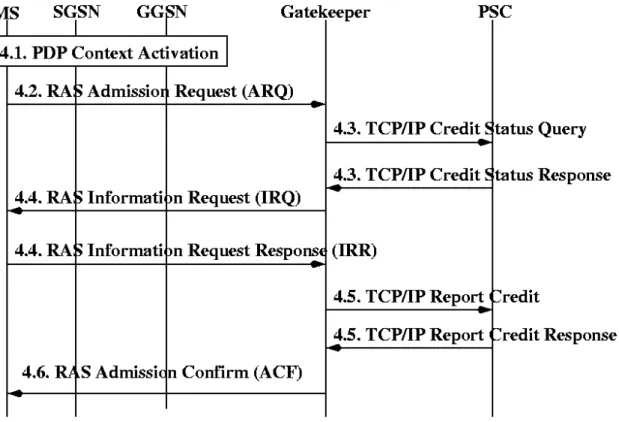
(4) To recharge the credit, the prepaid customer purchases a top-up card with the secret code as described in Section 3. Then the following steps are executed (see Figure 8). Step 4.1: Like Step 2.1, the MS, SGSN, and GGSN communicate to each other to establish an IP session. Step 4.2: The MS sends the RAS ARQ to the GK. The nonStandardData field of the ARQ indicates that the MS would like to recharge the prepaid credit. Step 4.3: The GK queries the PSC to obtain the amount of the current prepaid credit. Step 4.4: The GK sends the RAS Information Request (IRQ) message to the MS. The nonStandardData filed of IRQ indicates the amount of the current credit for the prepaid customer. When the MS receives this message, it shows the current prepaid credit on the screen, and asks the prepaid customer to input the secret recharging code. The code typed by the customer is stored in the nonStandardData of the RAS Information Request Response (IRR) message. The IRR is delivered to the GK. Step 4.5: The GK verifies the secret code and reports the amount of the new credit to the PSC. Alternatively, the secret code can be verified at the PSC. The PSC updates the credit of the prepaid customer. Step 4.6: The GK confirms the recharging procedure by sending the RAS ACF message to the MS. The new credit is displayed on the screen of the MS. A prepaid customer can query the credit status through a procedure similar to the one illustrated in Figure 8 by eliminating Steps 4.4 and 4.5.. 5. Discussion and Conclusions. Voice over IP (VoIP) is considered as a promising trend in telecommunication business. Particularly, integrating mobile phone services with VoIP becomes an important issue. From business consideration, it is highly desirable to support prepaid service for wireless VoIP. However, prepaid solutions for wireless VoIP have not been addressed in the literature. This paper proposed a prepaid mechanism for wireless voice over IP (VoIP) service. Based on General Radio Packet Data (GPRS), we consider the wireless VoIP environment proposed in 3GPP TR21.978. A prepaid service center (PSC) is introduced to maintain the credits of the prepaid customers. The PSC can be a commercial product used in hot billing platform [5]. The H.323 protocol is utilized to implement prepaid mechanism including prepaid customer registration, credit decrement (and forced termination due to credit depletion), and credit recharge. We showed that prepaid service for wireless VoIP can be implemented by using standard architectures and protocols, which proves the commercial feasibility of wireless prepaid VoIP service. Our approach has the following advantages: Deployment: From the descriptions in Section 4, the prepaid mechanism can be easily implemented by. using standard H.323 protocol. In existing mobile prepaid approaches [5], the implementation of prepaid mechanism may not be as trivial as our approach. International Roaming: With proper roaming agreement between the H.323 service provider and the GPRS service providers, international roaming can be supported. For example, in Section 4, PSC and HLR may be in Taiwan, and SGSN, GGSN and H.323 gatekeeper are in the UK. When the MS (who subscribes to the services in Taiwan) roams to the UK, the customer may still enjoy the prepaid service (while authentication may be required between the PSC and the gatekeeper). In existing mobile prepaid service, international roaming is not supported (partly due to the fact that the visited networks cannot distinguish prepaid customers from the postpaid customers [5]). Billing: Our approach supports real-time rating. In the conversation, the prepaid is decremented in, say, seconds, and when the credit is depleted, the call path is disconnected.. Acknowledgment The work was sponsored in part by National Science Council under contract NSC 89-2213-E-009-203, the Lee and MTI Center for Networking Research, NCTU.. References [1] 3GPP. 3rd Generation Partnership Project; Technical Specification Group Core Network; Feasibility Technical Report – CAMEL Control of VoIP Services. Technical Report 3G TR 21.978 version 3.0.0, 3GPP, 1999. [2] ITU. Call Signalling Protocols and Media Stream Packetization for Packet Based Multimedia Communication Systems. Technical Report ITU-T H.225 (Version 3), International Telecommunication Union, 1998. [3] ITU. Packaet-based Multimedia Communications Systems. Technical Report ITU-T H.323, Version 3, International Telecommunication Union, 1999. [4] Lin, Y.-B., and Chlamatac, I. Mobile and Wireless Networks Protocols and Services. John Wiley & Sons, 2000. [5] Lin, Y.-B., Rao, H., and Chang, M.-F. Mobile Prepaid Phone Services. IEEE Personal Communications, 7(3):6-14, 2000. [6] Rao, H. C.-H., Lin, Y.-B., and Chou, S.-L. iGSM: VoIP Service for Mobile Networks. IEEE Communications Magazine, 4(38):62-69,2000. Phone Lin received the B.S.C.S.I.E. and Ph.D. degrees from National Chiao Tung University, Taiwan, R.O.C., in 1996 and 2001, respectively. He is currently an Assistant Professor with the Department of Computer Science and Information Engineering, National Taiwan University, Taiwan, R.O.C. His current research interests include design and analysis of personal communications services networks, mobile computing, and performance modeling..
(5) Figure 1: The GPRS Network. Figure 2: The H.323 Architecture. Figure 3: The 3G TR 21.978 Wireless VoIP Network.
(6) Figure 4: The Prepaid Mechanism for 3G TR 21.978 Wireless VoIP Network. Figure 5: The Message Flow for Prepaid MS Registration.
(7) Figure 6: The Message Flow for Prepaid MS Call Origination. Figure 7: The Message Flow for Prepaid MS Call Release (Forced Termination).
(8) Figure 8: The Message Flow for Credit Recharging.
(9)
數據


相關文件
CBETA uses its service to provide the uses to donate by using the credit cards or PayPal account to support the CBETA
request even if the header is absent), O (optional), T (the header should be included in the request if a stream-based transport is used), C (the presence of the header depends on
Indicate the type and format of information included in the message body. Content-Length: the length of the message
Lecture & modified by baluteshih Credit by yp155136. Credit
Sequence-to-sequence learning: both input and output are both sequences with different lengths..
Goal: select actions to maximize future reward Big three: action, state, reward.. Scenario of Reinforcement Learning.. Agent learns to take actions to maximize expected
Goal: select actions to maximize future reward Big three: action, state,
Pascanu et al., “On the difficulty of training recurrent neural networks,” in ICML, 2013..
