
具有以物理模式為基礎色彩渲染效果的電腦合成中國水墨畫之研究
62
0
0
全文
(2) 具有以物理模式為基礎色彩渲染效果的 電腦合成中國水墨畫之研究 Computer-Generated Chinese Painting with Physically-Based Ink and Color Diffusion 研 究 生:林韋錦. Student:Wei-Jin Lin. 指導教授:施仁忠. Advisor:Zeng-Chun Shih 國 立 交 通 大 學 資 訊 科 學 系 碩 士 論 文. A Thesis Submitted to Institute of Computer and Information Science College of Electrical Engineering and Computer Science National Chiao Tung University in partial Fulfillment of the Requirements for the Degree of Master in. Computer and Information Science. June 2004. Hsinchu, Taiwan, Republic of China. 中華民國九十三年六月.
(3) 具有以物理模式為基礎色彩渲染效果的 電腦合成中國水墨畫之研究. 指導教授: 施仁忠 教授. 研究生: 林韋錦. 國立交通大學資訊科學系. 摘. 要. 在中國水墨畫中,除了使用墨與水調和出各種不同濃淡的墨色之外,色彩也扮演了 一個很重要的角色。要描繪一幅景物時,除了用墨色表現出明暗對比之外,若加入了物 體本身的色彩,更可以顯現出物體的本質,進而提升整幅畫的生命力。在本篇論文中, 利用真實的物理理論來模擬水與墨/顏料在畫紙上的流動,接著在色彩的表現上,利用 Kubelka-Munk 的理論,考慮顏料與畫紙之間光線的折射與反射來表現出擬真的顏色, 同時使用 tablet pen 作為輸入裝置,建立了一個可供使用者以各種顏色描繪一幅中國水 墨畫的互動式系統。. I.
(4) ). Computer-Generated Chinese Painting with Physically-Based Ink and Color Diffusion. Student: Wei-Jin Lin. Advisor: Dr. Zen-Chung Shih. Institute of Computer and Information Science National Chiao-Tung University. ABSTRACT. Water and ink are two important elements in Chinese Ink Painting. By mixing water and ink, we can get different concentrations to show the contrast of an object. To make a painting more vivid, we can also apply the third element, color, to display the nature of an object. In this thesis, we simulate the ink diffusion effects based on observations and analysis of the physical phenomenon, such as the flows of water and ink/pigment on paper. Then we display realistic colors by taking the light reflection and transmission between pigments and paper, namely the Kubelka-Munk theory [15], into consideration. We also use tablet pen as an input device to create an interactive painting system for users to draw a Chinese Ink Painting with color pigments.. II.
(5) Acknowledgements First of all, I would like to show my gratitude to my advisor, Prof. Zen-Chung Shih for his patience and guidance. Also, I am grateful to all the members in Computer Graphics and Virtual Reality Laboratory for their useful suggestion and encouragement in these days. I want to dedicate the achievement of this work to my family. Without their support, I couldn’t fully focus on my study.. Special thanks to my girl friend who helps to correct and typeset this thesis.. III.
(6) Contents ABSTRACT(in Chinese)…………………………………………………………………….. I ABSTRACT(in English)…………………………………………………………………….. II Acknowledgements ………………………………………………………………………......III Contents……………………………………………………………………………………….IV List of Figures………………………………………………………………………………...VI CHAPTER 1 INTRODUCTION .............................................................................................1 1.1 Shapes and Colors in Chinese Ink Paintings ................................................................2 1.2 Overview.......................................................................................................................3 1.3 Thesis Organization ......................................................................................................4 CHAPTER 2 RELATED WORKS..........................................................................................5 2.1 Brush Model .................................................................................................................5 2.2 Ink Diffusion.................................................................................................................6 2.3 Color Representation ....................................................................................................7 2.4 Survey of Commercialized Painting Packages .............................................................8 CHAPTER 3 SYSTEM OVERVIEW .....................................................................................9 3.1 System Architecture......................................................................................................9 3.2 User Interface..............................................................................................................10 CHAPTER 4 MODELS AND ALGORITHMS FOR COLOR INK PAINTING .............12 4.1 Brush Model ...............................................................................................................12 4.2 Physically-Based Model of Ink Diffusion ..................................................................14 4.2.1 Diffusion Phenomena ......................................................................................14 IV.
(7) 4.2.2 Discrete Paper Model ......................................................................................15 4.2.3 Discrete Ink Model and Ink Flow ....................................................................18 4.2.4 The Moving Direction of Water Flow .............................................................22 4.2.5 Ink Diffusion Process.......................................................................................32 4.3 Color Representation ..................................................................................................34 4.3.1 The Colors of Ink and Color Pigment..............................................................35 4.3.2 The Water Effect on Paper ...............................................................................37 CHAPTER 5 IMPLEMENTATION RESULTS...................................................................39 CHAPTER 6 CONCLUSIONS AND FUTURE WORKS...................................................48 REFERENCE. V.
(8) List of Figures. Figure 1.1 Ling-chih Plants, Symbols Of Longevity by Chang Dai-chien……...…………..…2 Figure 3.1 System Architecture…………..……………………………………………………9 Figure 3.2 User Interface…………..…………………………………………………………10 Figure 3.3 Strokes with different concentrations.…………..………………………………..10 Figure 3.4 Comparison between real and simulated various ink concentration……………...11 Figure 3.5 Dry and Wet Brush………………………….…………………………………….11 Figure 4.1 Normal Brush………….………………………………………………………….13 Figure 4.2 Normal Brush and Contour Brush………………………………………………..13 Figure 4.3 Anti-aliasing Mask…………………………………………………………….….14 Figure 4.4 The Capillary Phenomenon……………………………………………………….15 Figure 4.5 The Real Ink Diffusion Effect……………...……………………………………..15 Figure 4.6 Discrete Paper Model………………………..…………..………………………..16 Figure 4.7 Three simulated ink diffusion image represent different kinds of paper…..……..17 Figure 4.8 An illustration to explain the phenomenon called “filter effect”……………..…..21 Figure 4.9 Determine directions of water flowing into neighboring papels…………...…….23 Figure 4.10 The relationship among static friction, maximum static friction, and dynamic friction…………………………………………………………………………………….…..24 Figure 4.11 Paper Texture Mask………………….…………………………………………..30 Figure 4.12 Inertia Factor………………….……………………………..…………………..31 Figure 4.13 Ink Diffusion Order………………….…………………………………………..33. VI.
(9) Figure 4.14 Humidity………………………………...…………………..…………………..34 Figure 4.15 Color mixing……………….….…….…………………………………………..37 Figure 5.1 Basic effects in Chinese Ink Painting………………………………………….…40 Figure 5.2 The blending effect of several strokes…………………………………...……….40 Figure 5.3 Simulation Result (“Bamboo And Chrysanthemum” by Chang Dai-chien.)……..41 Figure 5.4 Simulation Result (“Fisherman Return” by Chang Dai-chien.)………………….42 Figure 5.5 Original Painting……………………………………...…………………………..43 Figure 5.6 Original Painting………………………………………………...……………..…43 Figure 5.7 Using Dry Brush to Draw the Plants and Grass…………………………………..44 Figure 5.8 Using Contour Brush to Draw the Plants on the Left…………………………….45 Figure 5.9 Add color on the rock……………………………………………………..………46 Figure 5.10 Add color on the leaves of the plant…………………………………………….46 Figure 5.11 Simulated Result (“Ling-chih Plants, Symbols Of Longevity” by Chang Dai-chien.)…………………………………………………………………………………….47. VII.
(10) Chapter 1 Introduction Ink and color are equally important in Chinese Ink Painting. Unlike western paintings which explore the changes of light and color, Chinese Ink Painting focuses mainly on the combination of shape and color. Ink depicts the frame and the substantial spirit of a painting. Color on the other side acts as a supporting role to flesh as well as glorify the frame. The perfect chemistry of their combination is shown in Figure 1.1. With shape and color, we can catch the whole spirit of Chinese Ink Painting.. 1.
(11) Figure 1.1 Ling-chih Plants, Symbols Of Longevity by Chang Dai-chien [7]. The painting shows shape with ink and the nature of the object with colors.. 1.1 Shapes and Colors in Chinese Ink Paintings In Chinese Ink Painting, shape is constructed by drawing dots and lines with brushes, while colors are diffused layer by layer with different thickness of ink or different colors of pigments. These techniques together create the unique quality and effects in Chinese Ink Painting. With the observations of the shapes and colors in Chinese Ink Painting, we simulate different kinds of effects according to real physical characteristics.. 2.
(12) To deal with shapes, we propose two types of brushes and various quantities of water to simulate not only dry and wet strokes, but contour effects.. In western paintings, take watercolor for example, the absorbency of paper is not so high that water and color pigment both flow on paper. Therefore, a shallow water simulation is needed to simulate the color pigments flowing on paper [9]. However, the paper used in Chinese Ink Painting is different from that used in western paintings. The absorbency of Hsuan paper is very high, so the water in the brush will immediately sink into the paper and bring the ink and color with it to flow among the paper fibers once the brush touches the paper. To express the unigue characteristics of Chinese Ink Painting, a diffusion model should be proposed to simulate the flow of particles in paper instead of the shallow water flow on paper.. As to color, we consider ink and color pigments separately. First, in ink diffusion simulation, water and carbon particles are moved in paper according to real physical properties. By adjusting parameters in our proposed system, we can also simulate many different ink diffusion effects. Second, in simulating pigments behaviors, pigment particles are moved the same as carbon particles in ink diffusion process. We display the colors of the pigments by applying Kubelka-Munk (KM) theory, which models the light reflection and transmission between pigments and paper. According to KM theory, we can simulate how pigments show their colors on different background colors.. 1.2 Overview We proposed an interactive painting system with tablet pen as its input device. Users can create a Chinese Ink Painting simply by adjusting the parameters of brushes. 3.
(13) Giving thoughts to system processing speed, we use multiple threads to handle the diffusion process. In this way, we can decrease the idle time for screen display, which has been a major problem in traditional computer painting system.. To create a simulative painting environment as close to the real world as possible, we also simulate the actual painting sequence of Chinese Ink Painting, such as applying colors after dampening the paper to achieve the diffusion effects and stacking ink from thin to thick concentration.. 1.3 Thesis Organization This thesis is organized as follows. In chapter 2, we review the previous related researches about brush models, ink diffusion and color display. Then we compare the proposed system with current commercialized painting packages. We describe the system overview, including system framework and user interface in chapter 3. Chapter 4 describes models and algorithms for color ink painting, dividing into three sections: brush models, ink diffusion and color display. We show some implementation results in chapter 5, including some imitated paintings and original paintings using the proposed system. Then we have some discussions on these results. Finally, chapter 6 concludes this work and addresses some future works to improve our work.. 4.
(14) Chapter 2 Related Works We will discuss some previous works related to Chinese Ink Painting on three main topics, which are brush model, ink diffusion and color representation. Then we will compare our system with current commercial painting packages.. 2.1 Brush Model To simulate brush motions and to get realistic results on the paper, an appropriate brush model should be defined. Strassmann [20] proposed a brush model to simulate the traditional Japanese art of sumi-e, where brush strokes are created by sweeping a one-dimensional brush bristle over a skeleton. Suguru Saito and Masayuki Nakajima [18] provided a three-dimensional physically-based brush model that allows users to draw strokes on a computer with a pen-type input device. A two-dimensional brush model was proposed by Shan-Zan Weng at el. [25].The region where the brush contacts the canvas is circle-shaped (which can be considered as a footprint) and the bristles are distributed uniformly in it. To 5.
(15) create a stroke, they proposed an algorithm to extract the skeleton of a stroke and let the center of the brush model move along with it. The orientation of the brush during movement was taken into consideration to make the generated strokes look natural and smooth. Finally, the footprints of the bristles would be taken as the path of ink contribution on the canvas. With different types of brush selected, different styles of strokes can be generated. Wong and Ip [27] used an inverse cone to represent the virtual brush. In the DAB [8] project, they used a particle system to represent their brush geometry. Xu et al. [28] proposed a two-level hierarchical geometry model. They used three B-spline curves to control the three-dimensional brush geometry. Some of the brush models mentioned above are defined in 2D while the others are defined in 3D. As to the brush models defined in 2D, another curve need to be defined to represent the path of the brush: a spline curve evaluated by control points. Since the proposed system in this thesis is an interactive system, the brush path is determined by users. We don’t need to define another skeleton to represent the path. Besides, brush models defined in 3D often have to simulate the brush motion, which will require a lot of system resources. After considering system speed and the presented effects, we define our brush model in 2D. The detailed brush model will be discussed in section 4.1.. 2.2 Ink Diffusion 6.
(16) The special effect of ink diffusion is produced by the incredible absorbency of Hsuan paper. Ink diffusion is widely used in Chinese ink painting and it is also what differentiates Chinese ink painting from western painting. A technique proposed by Lee [17] efficiently rendered oriental black ink paintings with realistic diffusion effects. The system proposed by Lee can simulate ink diffusion based on a variety of paper types and ink properties. However, there has been no mechanism presented about the simulation of blending effects of two or more strokes. Small [19] proposed a parallel approach to predict the motion of pigment and water on the paper, which computes the status in each paper cell repeatedly to achieve realistic diffusion effects. A more sophisticated paper model was proposed by Curtis and Anderson [9]. With a more complex shallow water simulation, they can simulate realistic diffusion effects of watercolor. Sheng-Wen Huang et al. [13] proposed a physically-based ink diffusion model by simulating the interaction among water particles, carbon particles and paper. This model is the main reference for the ink diffusion simulation in this thesis. By making some modifications and extensions to Huang’s model, we can achieve the requirement for an interactive system. Detailed ink diffusion model will be discussed in section 4.2.. 2.3 Color Representation The importance of colors in Chinese Ink Painting is no less than ink diffusion effects. Previous researches on Chinese Ink Painting all focus on black ink painting, and they rarely discuss the simulation of color pigments. In DAB project [8], they simulated color mixture on the canvas and used a simple alpha blending to get the colors from two different pigments in two layers. The system proposed by Xu [28] also used a simple alpha blending to show the color mixture. Curtis and Anderson [9] used Kubelka-Munk theory, which researches on the light reflection and transmission between pigments and paper, to compute the color of a stroke 7.
(17) painted on another stroke. Another work that used KM theory is proposed by Chet S. Haase et al. [12]. They used this theory to compute a variety of color mixtures of pigments. Since KM theory can display the color of the mixed pigments realistically, our system also use it to compute the display of colors. Details will be discussed in section 4.3.. 2.4 Survey of Commercialized Painting Packages Among current commercial painting packages, a system similar to ours is COREL’s Painter, which doesn’t need stroke skeleton information such as spline curve. This is why we compare our system with Painter on the simulation of Chinese Ink Painting. In Painter, the simulation results of watercolor and oil painting effects are realistic, but there is only a calligraphic brush Sumi-e that simulates the effects of Chinese writing brushes. The Sumi-e brush in Painter can create calligraphic strokes but it is unable to achieve the ink diffusion effects in Chinese Ink Painting. Our system, however, complements this defect.. 8.
(18) Chapter 3 System Overview. 3.1 System Architecture OpenGL is the graphic API used in our proposed system. We use glDrawPixels to render the final color of each pixel. The flow of the whole process is shown in Figure 3.1 below. When strokes are drawn on the screen using tablet, the system will put all the pixels drawn into a queue. Then the system serves the queue as an input for the ink diffusion thread. At this time, the system processes the ink diffusion thread and render the color of each pixel computed by KM model in a parallel process way. By processing the ink diffusion thread and refreshing screen at the same time, the current progress of the system is noticeable and the idle time is greatly reduced.. Figure 3.1 System Architecture, the system processes the ink diffusion thread and computes the color by KM model in a parallel process way. 9.
(19) 3.2 User Interface The system provides a user interface using the GLUI user interface library. Users can choose brush type, pigment type and different ink concentrations. The basic functions such as load canvas, save canvas and save canvas as a bitmap file (*.bmp), and undo the last stroke are provided. Besides, by adjusting the stroke parameters such as colors, size, water volume, and carbon volume, users can achieve various painting effects.. Figure 3.2 User Interface. Figure 3.3 Strokes with different concentrations. Left to right: from thin to thick.. 10.
(20) (a) Simulated image.. (b) Real image. Figure 3.4 Comparison between real and simulated various ink concentration. We also simulate the painting sequence from observations of real painting behaviors, such as drawing after dampening the paper to achieve the diffusion effects. In real world, if we apply water on paper, the wet area would appear darker because of the light reflection and transmission in paper. The water effect is provided for users to show whether an area on the paper is wet or not. Also, the wet area would dry out gradually as time elapses, as shown in Figure 3.5.. Figure 3.5 (a) The effect of wet area on paper. (b) Dry brush drawn on a wet area. (c) Left: the stroke of (b) after the canvas dries. Right: Dry brush drawn on dry area. .. 11.
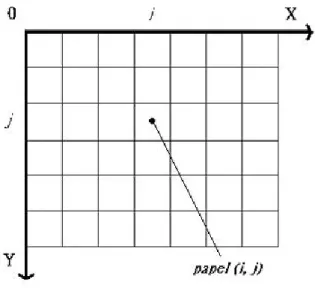
(21) Chapter 4 Models and Algorithms for Color Ink Painting The painting media (Chinese writing brush and Hsuan paper) used in Chinese Ink Painting are very different from those in western painting. In order to create the combining effects of these two media, we have to simulate their properties. We propose a simple brush model with two different types to simulate the strokes of Chinese writing brush. In ink diffusion, we reference Huang’s [13] ink diffusion model but makes some modifications. As to the color display of the pigments, we adopt the KM theory.. 4.1 Brush Model There are two types of brush model in our system, both of them are simple models defined in 2D. The first type is normal brush, which includes median thick brush and thick brush in Chinese writing brushes. The brush bristle are randomly distributed in a circle of radius size (an integer value; the radius of the largest pressure of input) and the number of points representing the bristle is the area of the circle (πr2=π∙size2). Users can change the. 12.
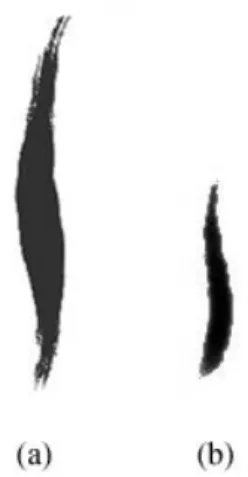
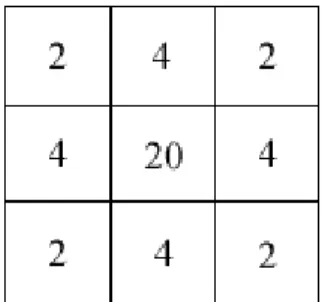
(22) size of the circle by applying different input pressures while dragging the circle to form the bristle effects at the same time, as shown in Figure 4.1.. Figure 4.1 Normal brush. The brush bristle are randomly distributed in a circle of radius size (the radius of the largest pressure of input) and the number of points representing the bristle is the area of the circle (πr2 =π∙size2) The second type is contour brush, which is the thin brush of Chinese writing brush and is used to depict the contours or details of an object. Contour brush is constructed by filling every pixel in a circle of radius size to represent the brush bristle. Also, users can input different pressures to change the size of the circle and drag the circle to form the effect of contour strokes. Since there are some coarse results from extremely small stroke size, e.g. smaller than 3, we apply a simple anti-aliasing process to smooth the strokes with a mask to filter all the pixels in the strokes. Figure 4.2 shows the strokes of the two brush types and Figure 4.3 shows the corresponding mask.. Figure 4.2 (a) Normal Brush and (b) Contour Brush.. 13.
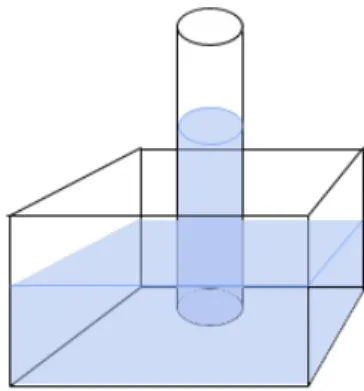
(23) Figure 4.3 Anti-aliasing mask. The coefficients are the most appropriate results for contour brush strokes.. 4.2 Physically-based Model of Ink Diffusion When the brush bristles touch the surface of the paper, the ink in the bristles begins to flow inside the paper. The high absorbency of the paper and different quantity of water cause different diffusion effects, such as strokes with their edges flurry and blurred. These diffusion features represent complex physical phenomena which cannot be completely simulated by conventional graphical techniques such as texture mapping or the creation of degradation functions, since purely mathematical method generally results in flatly blurred images which are different from realistic diffusion images.. 4.2.1 Ink Diffusion Phenomena Capillary phenomenon, a physical mechanism, is an important factor that causes the ink diffusion in the paper structure. In Figure 4.4, a thin tube is placed in a container filled with water with one end in the water and the other end in the air. The liquid will rise inside the tube and the liquid surface inside the tube is higher than the surface of the outside water. This phenomenon can also be observed in the ink diffusion in paper. The typical paper is composed of fibers which are positioned in random position and random direction in which small holes and spaces between fibers act as thin capillary tubes for carrying water away from the initial 14.
(24) area, and create diffusion, as shown in Figure 4.5.. Figure 4.4 The capillary phenomenon.. Figure 4.5 The real ink diffusion effect.. 4.2.2 Discrete Paper Model Although the diffusion phenomenon is a continuous physical phenomenon, the simulation of the diffusion phenomenon in computer is discrete. Therefore, the paper model is defined in a discrete 2D array of [X × Y] paper cells. Each paper cell is called a papel [16], as shown in Figure 4.6. The papel is a basic unit of the paper structure and corresponding to a pixel on the screen. 15.
(25) Figure 4.6 Discrete paper model. The paper cells are named papels (Courtesy of Huang).. According to Huang’s [13] definition, each papel has some properties. Absorbency (p), the ability of absorbency of the papel p is defined as following. When the moving ink pass through p with N fibers lay in, the quantity of water left and deposited in p is Q. The relationship between Q and N can be represented as. Q∝N.. (1). According to the previous research proposed by Lee [16], the number of the cross points of fibers in the paper is the most important factor to the ability of absorbency. If the number of cross points of fibers is Cn, then the relationship between Cn and Absorbency (p) is. Cn ∝ Abosorbency ( p) .. We can approximate the relationship between N and Cn from (1) and (2) as 16. (2).
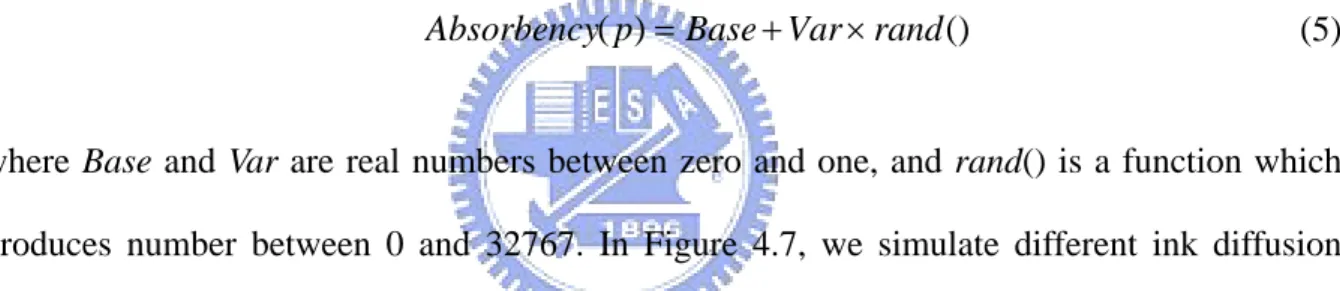
(26) N ∝ Cn ,. (3). Then we obtain the following relationship:. Absorbency( p) ∝ N ∝ Q .. (4). Based on the relationship of (4), we can define many kinds of paper model with different ability of water absorbency with different densities of paper fibers. The initial ability of absorbency of each papel can be described as. Absorbency( p) = Base + Var × rand (). (5). where Base and Var are real numbers between zero and one, and rand() is a function which produces number between 0 and 32767. In Figure 4.7, we simulate different ink diffusion effects with different kinds of absorbency of paper. The coefficient of the ability of water absorbency is represented as a real number between zero and one.. Figure 4.7 Three simulated ink diffusion image represent different kinds of paper.. 17.
(27) 4.2.3 Discrete Ink Model and Ink Flow The black ink in Chinese ink painting is a dilute mixture of water and colloidal carbon particles. The carbon particles are much smaller than those of watercolor paints such that they can diffuse into paper along with the absorbed water. Besides the capillarity, the forces acting on the motion of ink involve the interaction between waters and waters, waters and carbons and the gravity, etc. To simulate chaotic and complex motion of ink in fibers, we separate the ink into two kinds of particles: water particles and carbon particles. [26]. Water Particle. In Huang’s [13] definition of water, the water volume is divided into particles for the characteristic of discrete-computing ability of computers. All of the water particles are defined as objects that have uniform volume and uniform mass. The only different property of the water particles is their positions, which recorded the index of the papel they are at.. With the definition of water particles, we can decide the movement of these particles on paper. When the water in a certain papel is decided to flow out, the quantity and direction of the water to flow out are the two characters must be figured out. Based on some physical knowledge and hypothesis, the approximate equation of K(p), the ratio of the quantity of water to flow out to the quantity of water contained in the papel p is represented as. (. ). K ( p ) = Base + Var × 1 − (1 − Absorbency ( p ) ) , 2. (6). where Base is a real number between zero and one to represent the basic flow rate of p, and. 18.
(28) Var is a real number between zero and one to represent the difference between the highest flow rate and the lowest flow rate.. The reason for the ability of ink diffused in paper is the capillarity only on water particles, not on carbon particles. Based on this phenomenon, we have to decide the direction of the diffused water flowing out, which is decided by predicting the probabilities of the water particles. This method will be discussed in section 4.2.4.. Carbon Particle. Carbon particles don’t move like water particles. Instead, if the force produced by the energy of the movements of the water particles is larger than the force produced by the friction of the carbon particles, the carbon particles move with the water particles. According to Huang’s [13] definition, carbon particles have some attributes such as mass, position, diameter and color. But all of these attributes are not uniform, which is different from water particles. The diameter and mass of a carbon particle is decided according to the fineness when grinding the ink initially. If the initial ink grinding is coarse, the ink contains small and large particles which produce an observable change of color intensity along the border line of the initial brush area. On the other hand, if the carbon particles are homogeneous, small, and uniform, most carbon particles move with water unhindered by the fibers, such that a continuous and smooth intensity change appears across the diffusion area. This occurs because only sufficiently small carbon particles can seep into the fiber mesh and flow along with water particles, large carbon particles are left without flowing away.. Under the influence of the motion of water particles, suspended carbon particles move in a manner called Brownian motion [21]. According to this physical mechanism, the quantity of carbon flow is proportional to the quantity of water flow. A phenomenon occurs because only 19.
(29) those carbon particles whose granule size is smaller than the space between fibers can seep into the mesh along with water. Particles whose granule size is bigger than the space remain at the initial position, as shown in Figure 4.8. This phenomenon is referred as a “filtering effect” [11, 16] of the fiber mesh, and can be represented as the following, where p is the papel the carbon particle lays in and Hole_Diameter is defined as the average length of diameter of the holes between fibers in the papel.. if ( Carbon_Diameter > Hole_Diameter(p)) then Carbon_Position Å p else Carbon_Position Å Water_OutFlow_Direction(p),. 20.
(30) (a). (b) Two adjacent cubes represent two neighbor papels. Black grains in papels are carbon particles in different sizes. The chaos strings on the face between two papels represent fibers. The arrow represents the direction of water flow which carbon particles are moving along with.. (c) Larger diameter of carbon particles can not pass the holes between fibers results in a filtering effect and be left in the original papel.. Figure 4.8 An illustration to explain the phenomenon called “filter effect” (Courtesy of Huang). 21.
(31) Besides the diameter-filtering mechanism, the mass-filtering mechanism is proposed. Suppose Vc is the velocity of the carbon c suspended in the water in papel p, and W p is the quantity of out-flowing water in p. The relationship between Vc , W p and the diameter of holes in p, Hole_Diameter(p), is described as. V c ∝ W p , Vc ∝. 1 . ( Hole _ Diameter ( p)) 2. (7). If the carbon c is too heavy to moved out from papel p and then deposited in p, then. Vc ← 0 . On account of this physical phenomenon [21], we define an upper-bounded threshold T p for papel p, to decide whether the carbon particle can move out or not. If the mass of carbon c is larger than T p , then Vc ← 0 . The value of T p is decided depending on. Vc . The relationship between T p and Vc is represented as. T p = T (Vc ) = T (W p ×. 1 ), ( Hole _ Diameter ( p )) 2. (8). where T is a transform function from Vc to T p .. 4.2.4 The Moving Direction of Water Flow. The water in a papel may flow to some of its eight neighboring papels. The directions of this movement are determined by taking the following dominant factors that affect the flow of water into account. 1. The gradient of water between neighboring papels based on Brownian motion. 22.
(32) 2. Degree of Absorbency for water of the neighboring papels. 3. Factor of paper texture of the neighboring papels. 4. Factor of inertia acting on water flow. All of these factors are about the relationship between some papels and their neighboring papels. Therefore, we classify neighboring papels into eight directions, d k (k = 1, 2, …, 8), that point to the center of the neighboring eight papels p k (k = 1, 2, …, 8) from c0 , respectively, as shown in Figure 4.9. By considering all the factors described above, we can obtain the probability of each direction and decide the quantity of the water flowing out according to these calculated probabilities, which will be shown in Equation 17.. Figure 4.9 Determine directions of water flowing into neighboring papels, p k (k =. 1, 2, …, 8), according to the probabilities in eight directions calculated based on four factors (Courtesy of Huang). Besides, the static friction can affect the flow of water also. Static friction is a resistance that prevents water from moving and originates from the interfacial tension between water particles and fibers in the given area, even the tension among water particles. It increases linearly when the water particles intend to flow until it reaches the maximum static friction. Then water starts to flow and the static friction transfers to the dynamic friction, as shown in. 23.
(33) Figure 4.10.. Figure 4.10 The relationship among static friction f s , maximum static friction f ms , and dynamic friction f d . P is the external force, such as. interfacial tensions. f is the friction changed corresponding to P (Courtesy of Huang). In Huang’s [13] method, the critical threshold CT p , which is defined as the minimum quantity of water in a papel p corresponding to the maximum static friction, is calculated using the degree of absorbency, a p , as CT p = γ s a p ,. (9). where γ s is a coefficient for converting the degree of absorbency into the quantity of water corresponding to maximum static friction and is set experimentally. When the quantity of water in p is larger than CT p , water is free to flow out from p . Otherwise, water is left in. p. If water particles are decided to flow out, we calculate the probability of the flowing direction. The following paragraph describes how to transfer the four factors that affect the direction of water flow into probabilities. 24.
(34) The Factor of Gradient. It is assumed that the movement of water particles in a paper obeys Brownian motion. A mixture of two sets of water particles, each has different number of water particles, will produce an irreversible diffusion process in which water particles transfering from the set with larger number to the other one with smaller one. This movement continues until the difference of particle’s numbers of two sets reach a value expressing the balance of forces acting on these two sets in tolerance. Gradient here is used to represent the difference of number of water particles between two sets.. Let us assume that the number of water particles in c0 and p k are Wc and Wk , respectively. The probability based on Brownian motion is determined by the equation. Gk =. u (Wc − Wk ) G sum. (10) 8. G sum = ∑ u (Wc − Wi ) i =1. where G k (k = 1, 2, …, 8) is a probability based on gradient. u (x) is the unit function, i.e. if x ≥ 0 , then u ( x) = x , otherwise u ( x) = 0 .. The Factor of Absorbency. When the water particles intend to flow out into the neighboring papels, attractions from each neighboring papels result in different kinds of quantity of water flow. When the water. 25.
(35) particles intend to flow, the static friction f s continuously acts on them and grows linearly until the maximum static friction f ms is reached, as shown in Figure 4.10. Based on Newton’s Second Law Of Motions, we figure out the equation as. fd = M × a ,. (11). where f d is the dynamic friction, which cannot be changed by any forces or interfacial tensions, is usually a constant force in ideal between the flowing water and fibers. a is the acceleration of those flowing water particles in water flow. Based on the theorem discussed by Theo [21], we figure out that a is usually much smaller than g , the acceleration of gravity. Therefore, we can regard it as a constant value of acceleration acting on those water particles.. M is the mass of the flowing water. Because of the pre-defined uniformity of mass of water particle, the quantity of water flow is proportional to M . Assume N w is the number of water particles in the water flow, the relationship between M and N w can be described as. Nw ∝ M .. (12). From Equation 11 and 12, we can conclude that. fd ∝ Nw × a .. (13). According to the equations deduced above and the constant a , the relationship between f d and N w is represented as. 26.
(36) fd ∝ Nw .. (14). This important deduction indicates that larger f d makes larger N w . Based on the relationship in Equation 8, we conclude that. fd ∝ ap Î Nw ∝ ap ,. (15). where a p is the degree of absorbency of papel p .. We assume that the eight neighbors of center papel c0 are p k (k = 1, 2,…, 8), and the degree of absorbency of c0 and. pk. are. Absorbency(c0 ) and. Absorbency( p k ) ,. respectively. Probabilities based on absorbency are distributed to the eight directions and calculated by the equations. Ak =. Absorbency ( p k ) Asum. (16) 8. Asum = ∑ Absorbency( pi ) i =1. where Ak (k = 1, 2,…, 8) is a probability based on absorbency.. The Factor of Paper Texture. While water pulled by capillarity and flowing in the holes of fibers, fibers in the trajectory of water flow are saturated with water. For this phenomena of capillarity, different. 27.
(37) kinds of alignment of fibers result in different trajectories of water flow. The texture of Hsuan paper was, as a rule, solid, firm, unblemished, white and most hospitable to ink. After material choosing, steaming, bleaching, stamping, and baking, the paper was made with dense, fixed, irregularly distributed, and interlocked fibers of the material we use. According to those processes of manufacturing, the alignments of fibers in the paper structure are chaotic. In other words, the distribution of fibers in paper structure is uniform. When water in a certain papel determines the next papels to flow in, the probabilities of its eight candidate neighbors are almost the same for uniform distribution of fibers in paper mesh based on the factor of paper texture.. The second kind of representative paper usually used in ink painting is silk paper. Because of the drawback of difficult preservation, the ancients discovered that silk paper is a good substitute for Hsuan paper. Besides the convenience of preservation, it has good ability of absorbency the same as Hsuan paper. Silk paper is handmade and woven in perpendicular directions. The special process of manufacture differing from the Hsuan paper results in different kinds of distribution of fibers. For the reason, the directions of water flow are mainly vertical or horizontal when the water flowing in the holes of fibers in a piece of silk paper.. Huang [13] took the texture of paper into account as a factor determining the directions of water flow. Since the distributions of fibers in paper structure are not the same, the textures. 28.
(38) of paper are different. When the water particles in a papel c0 decided to flow out, we cover. c0 with a 3× 3 texture mask, denoted as M direct , with the center element m0 positioned at c0 . The eight elements in periphery of M direct , denoted as mk (k = 1, 2, …, 8), are weights used to represent the alignment of fibers of different kinds of papers. For a simple instance, we use two kinds of M direct to represent the texture of Hsuan paper and silk paper, as shown in Figure 4.11.. In Figure 4.11(b), all of the elements in periphery set to 1 express that all the eight probabilities of flowing direction of neighboring papels are equal because of random, uniform distribution of fibers. Elements in horizontal and vertical directions given larger value than those in diagonal direction, as shown in Figure 4.11(c), expresses the regular distribution of fibers in silk paper.. 29.
(39) Figure 4.11 (a) Texture mask; (b) One example of texture mask for Hsuan paper; (c) One example of texture mask for silk paper. m0 is the center element in the mask positioned at c 0 (Courtesy of Huang).. The Factor of Inertia. Besides those three factors we have mentioned above, there is still an important physical mechanism we need to take into consider. Every moving object without actively motive power could not be moved to the next area without inertia. With inertia, object will move to next place by the remaining power acted on it and will not stop moving immediately. According to the conception of Newton’s First Law Of Motions, we discover that inertia increases when the weight of object increases. In the other hand, decreasing inertia decreases. 30.
(40) the weight of object. In our case, water is treated as moving object. Assume that water in papel p 0t in (t)-th time interval is originated from papels p kt −1 (k = 1, 2, …, 8) in (t-1)-th time interval, and the quantity of water particles flowing along with direction d it −1 (i = 1, 2, …, 8), from p kt −1 to p 0 is wkt −1 . Based on the conception about the relationship between inertia and weight of object, we conclude that water in p 0t will intend to flow out in the same direction with which wkt −1 flowing along. The probabilities of the eight neighboring flowing directions from p 0t , denoted as I kt (k = 1, 2, …, 8), is proportional to the quantity of wkt −1 in direction d it −1 , as shown in Figure 4.12.. Figure 4.12 The direction of flow due to inertia and the probability of flow direction is proportional to the quantity of incoming water flow (Courtesy of Huang).. 31.
(41) The probabilities used for determining the directions of water flow movement, i.e. the next area to flow into, are determined by using the four factors described above. The higher the probability of the neighbor cell has, the more the water flow toward it. The probabilities can be described as. α 1Gk + α 2 Ak + α 3 mk + α 4 I kt. Rk =. Rsum (17) 8. Rsum = ∑ (α 1Gi + α 2 Ai + α 3 mi + α 4 I it ) i =1. where Rk (k = 1, 2, …, 8) is the probability involving four dominant factors of each neighboring papels and α 1 , α 2 , α 3 , and α 4 are weights for controlling behavior and movement of water flow resulting in different kinds of effects.. The directions of water particles, i.e. the meshes water flow will move to next, are determined by using these probabilities. The quantity of water flowing to neighbor papel p k (k = 1, 2, …, 8) is proportional to the probability Rk been counted.. 4.2.5 Ink Diffusion Process. In Huang’s [13] ink diffusion process, the whole process includes skeleton finding, initial area pipelining and propagation process. Since the input of our proposed system is constructed by the user, there is no need to find the input skeleton. If we draw a stroke on 32.
(42) paper in real world, we can observe that the ink diffusion process starts at the beginning of the stroke and then continues to the path the stroke is drawn. We therefore apply this phenomenon into our proposed system. That is, when the user input a stroke, we put all the pixels in the stroke into a queue in proper order. Then we do the diffusion process in proper order to every pixel (papel) in the queue, as shown in Figure 4.13, which is, move the water particles in the papels and then move the carbon particles according to the methods described in the last four sections.. Figure 4.13 Ink diffusion order.. In real world, after drawing a stroke on paper, the wet stroke will dry out gradually. This phenomenon is called evaporation. The evaporation of water is a complicated process in which many factors play a role. One important factor is the contact area with atmosphere [20].. 33.
(43) When other factors are almost fixed, larger contact area results in higher rate of water evaporation. In Huang’s [13] thesis, the contact area of each papel with atmosphere is equal. Based on the equality of the contact area of all papels, the rate of water evaporation in each papel of the paper is approximately equal. There is another important factor which is in opposite to the evaporation of water, called humidity [20]. For the simplicity and the demand of our theorem, we assume that the number of water particles evaporated in papel p at step t-th, E tp , depends on the humidity H ( 0 ≤ H ≤ 1 ) and is expressed by the equation. E tp = h(1 − H ) × Water p ,. (18). where Water p is the number of water particles in papel p , and function h(x) yields a coefficient for the evaporation of water, where 0 ≤ x ≤ 1 . Figure 4.14 shows an example of the function h . The less the humidity, the greater is the amount of water evaporated.. Figure 4.14 Function h(x) for determining the quantity of water evaporated. (Courtesy of Huang).. 4.3 Color Representation. 34.
(44) In the proposed system, we classify the pigments into three types: ink, color and water pigment. Although there are three different types of pigments, they share the same diffusion. process. The colors of the first two types, ink and color pigment, are represented according to Kubelka-Munk theory [9, 15]. As for the third type of pigment, water, its color is represented by another model, which will be discussed in section 4.3.2.. 4.3.1 The Colors of Ink and Color Pigment. Kubelka-Munk (KM) model is to perform the optical composition of pigment layers. In KM model, there are two coefficients to be defined for each pigment, namely absorption coefficient K and scattering coefficient S. A certain fraction, K, of the light traveling in each direction will be absorbed by the pigment material, and another portion, S, will be scattered. In fact, the K and S coefficients for a given pigment are determined experimentally using spectral measurements in typical applications of KM theory. But we can observe that all that matters in KM model is the ratio of these two coefficients, not the values. Therefore, we set the scattering coefficient S to 1 and only compute the absorption coefficient K by the following equation, which is referred in KM theory. K (1 − R ) = S 2R. 2. (19). where R is the reflectance of the pigment in each RGB color channel and its value is between. 35.
(45) zero and one. For a pigmented layer of given thickness x (where x is the ratio of the number of the remaining carbon particles to the maximum carbon capacity in each papel) with absorption and scattering coefficients K and S, the KM model can compute reflectance R and transmittance T through the layer [15]:. R = sinh bSx c T =b c. (20). where c = a sinh bSx + b cosh bSx , a = (S + K ) S and b = a 2 − 1 . Then we use the optical compositing equations in KM model [20] to determine the overall reflectance R and transmittance T of two layers with reflectances R1, R2 and T1, T2, respectively:. R = R1 +. T=. T12 R2 1 − R1 R2. T1T2 1 − R1 R2. (21). When a new stroke is drawn on the canvas, the computation of Equation 21 is repeated to get the overall reflectance R of each pixel to render. Note that for more than one pigment of thickness x1 ,…, x k , the K and S coefficients of each pigment are weighted in proportion to that pigment’s relative thickness x k and the overall thickness of each papel is accumulated with the pigment’s thickness painted on it. Figure 4.15 shows the mixture result of three 36.
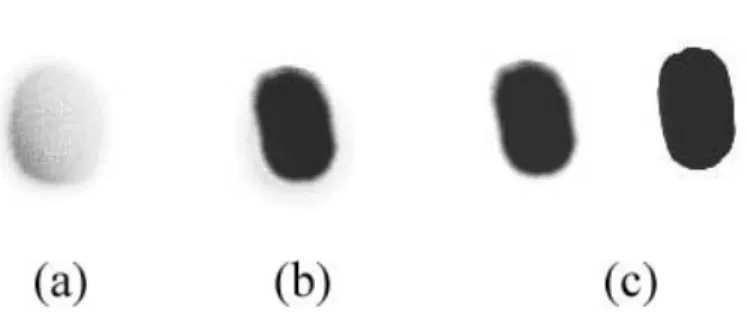
(46) colors. Note that the colors in the accumulated pigment area in the simulated result (b) resemble to the correspondent area in the real image (a).. Figure 4.15 Color mixing. (a) The real image. (b) The simulated result.. For the color representation of pigment type ink, the reflectance R in each RGB channel are set to the same value. Since we divide the concentration of ink into five levels in our proposed system, the reflectance of each level are 0.01, 0.1, 0.2, 0.3 and 0.4, respectively.. 4.3.2 The Water Effect on Paper. When we apply water on paper, the wet area looks darker than the dry area. This phenomenon is caused by the reflection and scattering of light on the paper surface. In our proposed system, we simulate the water effect in a simple way and define the wet area as a. 37.
(47) mask. When users choose pigment type water to draw an area, the diffusion process works the same as that for ink and color pigment. Once the diffusion process is over, the number of carbon particles in each papel is use to construct an alpha mask; that is, the alpha value of each papel is in proportion to the number of the remaining carbon particles. We use this mask to filter the canvas and create an effect of water flowing into paper, as shown in Figure 3.4 in Chapter 3.. 38.
(48) Chapter 5 Implementation Results The implementation results of our proposed system are presented in this chapter. The system is written in C++ language and runs OpenGL on the PC platform with an AMD 1.4GHz CPU and 256 MB RAM.. Figure 5.1 shows the results of using our proposed system as Huang [13] did. Figure 5.1 (a) is the simulating result of dripping a drop of ink on Hsuan paper, which is done in interactive rate (within one second). And the effect of blending two brush, “dense brush following dilute brush” (濃墨破淡墨) process, is presented in Figure 5.1 (b). It is done by applying a dense brush stroke on the area where you have previously drawn a dilute brush stroke. And the dense stroke must be drawn before the dilute stroke is dried. Figure 5.1 (c) displays the stroke of dry brush by decreasing the water quantity of the brush (set the water number to be under 50).. 39.
(49) Figure 5.1 Basic effects in Chinese Ink Painting. (a) A drop of ink. (b) Dense brush following dilute brush. (c) Strokes of dry brush.. Figure 5.2 (a) shows the blending result of several strokes with different concentrations. By accumulating several strokes from thin to thick, users can get their desired ink blending effects in Chinese Ink Painting. Figure 5.3 (b) shows the blending effect of color pigments and ink.. Figure 5.2 (a) The sequence of several strokes. (b) The blending effect of several strokes. (c) The blending effect of color pigments and ink. 40.
(50) In Figure 5.3 and Figure 5.4, we mimic two Chinese ink paintings drawn by Chang Dai-chien with the tablet pen device in our proposed system and the original paintings are attached for comparison. The painting time for the simulated images in Figure 5.3 and Figure 5.4 varies with the complexity of the original paintings: Figure 5.3 is within three hours while Figure 5.4 is about five hours. During the painting time, the ink diffusion process of each stroke is done in interactive rate (in seconds; the actual time depends on the size of the stroke: the larger the size of the stroke, the longer the processing time).. Figure 5.3 (a) The original painting “Bamboo and Chrysanthemum” by Chang Dai-chien. (b) The simulated result.. 41.
(51) Figure 5.4 (a) The original painting “Fisherman Return” by Chang Dai-chien. (b) The simulated result.. Figure 5.5 references a bird photo to draw an original Chinese Ink Painting with our proposed system. More original paintings drawn with the proposed system can be seen in Figure 5.6 to include more kinds of materials in Chinese Ink Painting.. 42.
(52) Figure 5.5 Top: The painting using the proposed system. The photo in the right is used as a reference.. Figure 5.6 Several paintings using the proposed system.. 43.
(53) How the Proposed System Works. Here we present a demonstration of mimicking a Chinese Ink Painting “Ling-chih Plants, Symbols Of Longevity” by Chang Dai-chien [7] to show how the proposed system works and how to use the proposed system. We first depict the shape of the plants by selecting the brush type “normal brush” and pigment type “ink.” Note that we would like to use dry brush effect to draw the plants, so we don’t need high water quantity in the brush. The quantity of water is decreased to 52, as shown in Figure 5.7.. Figure 5.7 Using Dry Brush to Draw the Plants and Grass.. Next, we draw the leaves of the plants on the left by selecting the brush type “contour brush” and setting the stroke size to 2, as shown in Figure 5.8. 44.
(54) Figure 5.8 Using Contour Brush to Draw the Plants on the Left.. Then we go on drawing the rock using normal brush. By changing the ink concentration, we can depict the texture of the rock. After the shapes of all objects in the painting are drawn, we then apply color on each object. First, apply color on the rock by selecting pigment type “color pigment." After it is set, input the value of each RGB color channel and increase the quantity of water on brush to create more diffusion effects. Finally, we can draw the region of the rock by setting the stroke size to 6, as shown in Figure 5.9.. In Figure 5.10, we continue to apply color on the plant on the left. Since the leaves of the plant are thin, we don’t want the stroke to be diffused widely. The quantity of the water is decreased and another color is set to paint the leaves.. 45.
(55) Figure 5.9 Apply color on the rock.. Figure 5.10 Apply color on the leaves of the plant. 46.
(56) Figure 5.11 shows the comparison of the final painted result (right) with the original painting (left).. Figure 5.11 Left: The original painting “Ling-chih Plants, Symbols Of Longevity” by Chang Dai-chien. Right: The simulated result.. 47.
(57) Chapter 6 Conclusions and Future Works In this thesis, we propose an interactive system for Chinese color ink painting. The proposed system is composed of three main parts: a simple brush model to simulate Chinese writing brush, a method to generate ink diffusion effects in Chinese Ink Painting and a model to represent colors of pigments.. The brush model we proposed can produce good Chinese Painting strokes with tablet pen as the input device. By detecting the input pressure of the tablet pen, we can get various strokes with different shapes.. The diffusion model is based on real physical phenomenon. The paper mesh is separated into multi-layer X-Y planes, each of them divided into paper cells. Water particles flow in the holes or spaces of fibers of the paper mesh by capillarity. The carbon particles float and move in this liquid due to the collision with water particles. The directions and quantity of water flow are determined as a result of different degree of water absorbency, the alignment of fibers, and the factor of inertia of each paper cell. This ink diffusion algorithm can be used to draw lots of subjects with ink diffusion effect in Chinese Ink Painting style by controlling the user-defined stroke parameters. The most important is the effect of expressing the mixture of different kinds of brush strokes. For example, the effect of two wet brushes blend with each 48.
(58) other. “Dense brush following dilute brush”, is a typical example in Chinese Ink Painting. Besides, since the proposed algorithms are based on physical theory and observational-based analyses, resulting images using this physical-based method are very realistic.. By adapting KM theory, the color of each pigment is correctly computed. First, we transform the user input RGB reflectance into reflection and transmission coefficients. Then we apply KM equations with the transformed coefficients to get the reflectance R in each RGB color channel on paper. The color of several overlaying pigments can also be represented accurately by computing the reflectance R in each RGB color channel with the reflection and the transmission coefficients.. Further works have to be done:. 1. Although the brush model we proposed can generate fair stroke results, there are still some effects cannot be generated: the brush splitting effect and the various brush effects created by deforming the brush hair and changing the hand gesture while painting. In the future, we hope to improve our brush model by proposing a more complex one to simulate all the effects of Chinese Ink Painting.. 2. The processing time of the ink diffusion process depends on the area of the input stroke. The larger the input stroke area is, the longer time the diffusion process takes. Although we can achieve interactive rate during painting, the input strokes with large area still take lots of time to finish the diffusion process. Therefore, we will implement the ink diffusion process on hardware to decrease the processing time of the proposed system.. 3. The resolution of our proposed system is restricted (the current resolution is 600*600 pixels). We refresh the whole screen pixels in each time step even when the stroke only 49.
(59) occupies few parts of the whole screen. For the efficiency of the refreshing time, the screen resolution should not be too large. As to this problem, we will try to do some improvements in the future, such as subdivide the whole screen into several parts and only refresh the parts where the stroke occupies.. 4. Currently, the color representation of our proposed system simulates the composition of color pigments. Besides the effects of overlaying color pigment, there are still some other common mixing effects created by mixing colors on canvas in real paintings. We will attach the mixing color on canvas feature to our proposed system in the future to create various mixing color effects on canvas.. 50.
(60) Reference [1] 于非闇著,怎樣畫國畫;中國畫顏色的研究,莊嚴出版。 [2] 王定理著,中國畫顏色的運用與製作,藝術家出版。 [3] 田學文著,海上畫派,藝術圖書公司印行。 [4] 朱子弘著,國畫色彩研究,藝術家出版。 [5] 江文雙編,彩色中國名畫,藝術圖書公司印行。 [6] 孫揚、胡振郎著,怎樣畫山水,藝術圖書公司印行。 [7] 張大千畫,張大千作品選集,國立歷史博物館出版。 [8] Bill Baxter, Vincent Scheib, Ming C. Lin, Dinesh Manocha, “DAB: Interactive Haptic Painting with 3D Virtual Brushes”, Proceedings of ACM SIGGRAPH 01, 2001, pp. 461-468. [9] Cassidy J. Curtis, Sean E. Anderson, Jonathon. E. Seims, and Kurt W. Fleischer, and David H. Salesin, “Computer-generated watercolor”, Proceedings of SIGGRAPH 97, in Computer Graphics Proceedings, Annual Conference Series, pp. 421-430, August 1997. [10] Colin Doncaster, “Toon - A shader for cartoon rendering” (for RenderMan) http://www.webnation.com/vidirep/panels/renderman/shaders/toon/toon.phtml [11] Qinglian Guo, Tosiyasu L. Kunii, “Modeling the Diffuse Paintings of ‘Sumie’”. In: Kunii T (Ed.), Modeling in Computer Graphics (Proceedings of the IFIP WG5.10). Berlin: Springer, 1991. Page 329~338. [12] Chet S. Haase, Gary W. Meyer, “Modeling Pigmented Materials for Realistic Image Synthesis”, ACM Transactions on Graphics (TOG), Volume 11, Issue 4 (October 1992),. 51.
(61) 1992, Pages: 305 - 335. [13] Sheng-Wen Huang, Der-Lor Way, Zen-Chung Shih, “Physical-Based Model of Ink Diffusion in Chinese Ink Paintings”, Journal of WSCG 2003. [14] Henrik Wann Jensen, Justin Legakis, Julie Dorsey, “Rendering of Wet Materials”, Rendering Techniques '99. Eds. D. Lischinski and G. W. Larson. Springer-Verlag, pages 273-282, 1999. [15] G Kortum, “Reflectance Spectroscopy”, Springer-Verlag, 1969. [16] Jintae Lee, “Diffusion rendering of black ink paintings using new paper and ink models”, Computer & Graphics 25 (2001), Page 295~308. [17] Jintae Lee, “Simulating oriental black-ink painting”, IEEE Computer Graphics & Applications 1999; 19(3): 74-81. [18] Suguru Saito and Masayuki Nakajima, “3D physics-based brush model for painting", Proceedings of ACM SIGGRAPH 99:conference abstracts and applications, Page 226 August 8 - 13, 1999, Los Angeles, CA USA. [19] David L Small, “Simulating Watercolor by Modeling Diffusion , Pigment and Paper Fibers”, SPIE Proceedings, Vol. 1460, No. 15. San Jose, CA, 1990. [20] Steve Strassmann, ”Hairy Brushes”, Proceedings of ACM SIGGRAPH 86, page 225-232. [21] Theo G. M., Van De Ven, “Colloidal Hydrodynamics”, Colloid Science – A Series of Monographs, Page 51~77. [22] Der-Lor Way, Chih-Wei Hsu, Hsin-Yi Chiu, Zen-Chung Shih, “Computer-Generated Chinese Painting for Landscapes and Portraits”, Journal of WSCG 2001. [23] Der-Lor Way, Yu-Ru Lin, Zen-Chung Shih, “The Synthesis of Trees in Chinese Landscape Painting Using Silhouette and Texture Strokes”, Journal of WSCG Volume 10, Number 3, 2002, pp. 449-507. [24] Der-Lor Way, Zen-Chung Shih, “The Synthesis of Rock Textures in Chinese Landscape Painting”, Computer Graphics Forum Volume 20, Number 3, pp. C123-C131, 2001. 52.
(62) [25] Shan-Zan Wen, Zen-Chung Shih, Hsin-Yi Chiu, “The Synthesis of Chinese Ink Painting”, National Computing Symposium’99, page 461-468, 1999. [26] Andrew Witkin, “Particle system Dynamics”, Physically Based Modeling (SIGGRAPH 2001 COURSE NOTES), Page C1~C12. [27] H.T.F. Wong, H.H.S. Ip, “Virtual brush: a model-based synthesis of Chinese calligraphy”, Computers and Graphics, Volume 24, Number, 2000, pp. 99-113. [28] Songhua Xu, Francis C.M. Lau, Feng Tang, Yunhe Pan, “Advanced Design for a Realistic Virtual Brush”, Computer Graphics Forum Volume22, Issue 3, 2003, pp. 533-542(10). [29] Young Jung Yu, Do Hoon Lee, “Interactive Rendering Technique for Realistic Oriental Painting”, Journal of WSCG, Volume11, Number1, 2003.. 53.
(63)
數據
![Figure 1.1 Ling-chih Plants, Symbols Of Longevity by Chang Dai-chien [7]. The painting shows shape with ink and the nature of the object with colors](https://thumb-ap.123doks.com/thumbv2/9libinfo/8225331.170713/11.892.306.635.112.644/figure-plants-symbols-longevity-chang-painting-nature-object.webp)


+7

相關文件
In summary, the main contribution of this paper is to propose a new family of smoothing functions and correct a flaw in an algorithm studied in [13], which is used to guarantee
21 參看Masaharu, Anesaki, “Buddhist Āgamas in Chinese: a concordance of their parts and of the corresponding counterparts in the Pāli Nikāyas”.. Transactions of the
Through a critical examination of some Chinese Christian intellectuals’ discussion on the indigenization of Christianity in China, this paper attempts to show that Chinese
Yuen Shi-chun ( 阮 仕 春 ) , Research and Development Officer (Musical Instrument) of the Hong Kong Chinese Orchestra, is the foremost innovator in the construction
This thesis applied Q-learning algorithm of reinforcement learning to improve a simple intra-day trading system of Taiwan stock index future. We simulate the performance
/** Class invariant: A Person always has a date of birth, and if the Person has a date of death, then the date of death is equal to or later than the date of birth. To be
A digital color image which contains guide-tile and non-guide-tile areas is used as the input of the proposed system.. In RGB model, color images are very sensitive
The main objective of this system is to design a virtual reality learning system for operation practice of total station instrument, and to make learning this skill easier.. Students
