Compact efficient Q-switched eye-safe laser at
1525 nm with a double-end diffusion-bonded
Nd:YVO
4
crystal as a self-Raman medium
Y. T. Chang, K. W. Su*, H. L. Chang, and Y. F. Chen* Department of Electrophysics, National Chiao Tung University, Hsinchu, Taiwan
*Corresponding author: [email protected], [email protected]
Abstract: We report on an efficient Q-switched eye-safe laser at 1525 nm with a double-end diffusion-bonded Nd:YVO4 crystal as a self-Raman gain
medium. A diffusion-bonded crystal not only reduces the thermal effects but also increase the interaction length for the stimulated Raman scattering. With an input pump power of 17.2 W, average power of 2.23 W at the first-Stokes wavelength of 1525 nm is generated at a pulse repetition rate of 40 kHz, corresponding to a conversion efficiency of 13%.
2009 Optical Society of America
OCIS codes: (140.3550) Lasers, Raman; (140.3380) Laser Materials; (140.3480) Lasers,
diode-pumped. References and links
1. L. R. Marshall and A. Kaz, “Eye-safe output from noncritically phase-matched parametric oscillators,” J. Opt. Soc. Am. B, 10, 1730-1736 (1993).
2. G. H. Xiao, M. Bass, and M. Acharekar, “Passively Q-switched solid-state lasers with intracavity optical parametric oscillators,” IEEE J. Quantum Electron. 34, 2241-2245 (1998).
3. Y. F. Chen, S. W. Chen, S. W. Tsai, and Y. P. Lan, “High-repetition-rate eye-safe optical parametric oscillator intracavity pumped by a diode-pumped Q-switched Nd:YVO4 laser, Appl. Phys. B 76, 263-266 (2003).
4. Y. F. Chen, Y. C. Chen, S. W. Chen and Y. P. Lan, “High-power efficient diode-pumped passively Q-switched Nd:YVO4/KTP/Cr4+:YAG eye-safe laser,” Opt. Commun. 234, 337-342 (2004).
5. R. Fluck, R. Häring, R. Paschotta, E. Gini, H. Melchior, and U. Keller, “Eyesafe pulsed microchip laser using semiconductor saturable absorber mirrors,” Appl. Phys. Lett. 72, 3273-3275 (1998).
6. I. Sokólska, E. Heumann, S. Kück, and T. Łukasiewicz, “Laser oscillation of Er3+:YVO
4 and Er3+, Yb3+:YVO
4 crystals in the spectral range around 1.6 µm,” Appl. Phys. B 71, 893-896 (2000). 7. A. Sennaroglu, “Broadly tunable Cr4+-doped solid-state lasers,” Prog. Quantum Electron. 26, 287-352
(2002).
8. N. Takei, S. Suzuki, and F. Kannari, “20-Hz operation of an eye-safe cascade Raman laser with a Ba(NO3)2 crystal,” Appl. Phys. B 74, 521-527 (2002).
9. Y. F. Chen, “Compact efficient all-solid-state eye-safe laser with self-frequency Raman conversion in a Nd:YVO4 crystal,” Opt. Lett. 29, 2172-2174 (2004).
10. Y. F. Chen, “Efficient 1521-nm Nd:GdVO4 Raman laser,” Opt. Lett. 29, 2632-2634 (2004). 11. A. Brenier, G. Jia, and C. Tu, “Raman lasers at 1.171 and 1.517 µm with self-frequency conversion in
SrWO4:Nd+ crystal,” J. Phys.: Condens. Matter 16, 9103-9108 (2004).
12. J. H. Huang, J. P. Lin, R. B. Su, J. H. Li, H. Zheng, C. H. Xu, F. Shi, Z. Z. Lin, J. Zhuang, W. R. Zeng, and W. X. Lin, “Short pulse eye-safe laser with a stimulated Raman scattering self-conversion based on a Nd:KGW crystal,” Opt. Lett. 32, 1096-1098 (2007).
13. Y. X. Fan, Y. Liu, Y. H. Duan, Q. Wang, L. Fan, H. T. Wang, G. H. Jia, and C. Y. Tu, “High-efficiency eye-safe intracavity Raman laser at 1531 nm with SrWO4 crystal,” Appl. Phys. B 93, 327-330 (2008). 14. Z. P. Wang, D. W. Hu, X. Fang, H. J. Zhang, X. G. Xu, J. Y. Wang, and Z. H. Shao, “Eye-safe Raman laser
at 1.5 µm based on BaWO4 crystal,” Chin. Phys. Lett. 25, 122-124 (2008).
15. G. M. A. Gad, H. J. Eichler, and A. A. Kaminskii, “Highly efficient 1.3-µm second-Stokes PbWO4 Raman laser,” Opt. Lett. 28, 426-428 (2003).
16. H. M. Pask, “The design and operation of solid-state Raman lasers,” Prog. Quantum Electron. 27, 3-56 (2003).
17. P. Černý, H. Jelínková, P. G. Zverev, and T. T. Basiev “Solid state laser with raman frequency conversion,” Prog. Quantum Electron. 28, 113-143 (2004).
18. J. A. Piper and H. M. Pask, “Crysatalline Raman Lasers,” IEEE J. Sel. Top. Quantum Electron. 13, 692-704 (2007).
19. A. A. Kaminskii, K. Ueda, H. J. Eichler, Y. Kuwano, H. Kouta, S. N. Bagaev, T. H. Chyba, J. C. Barnes, G. M. A. Gad, T. Murai, and J. Lu, “Tetragonal vanadates YVO4 and GdVO4 – new efficient χ(3)-materials for Raman lasers,” Opt. Commun. 194, 201-206 (2001).
20. S. H. Ding, X. Y. Zhang, Q. P. Wang, F. F. Su, P. Jia, S. T. Li, S. Z. Fan, J. Chang, S. S. Zhang, and Z. J. Liu, “Theoretical and experimental study on the self-Raman laser with Nd:YVO4 crystal,” IEEE J. Quantum Electron. 42, 927-933 (2006).
21. Y. F. Chen, “High-power diode-pumped actively Q-switched Nd:YVO4 self-Raman laser: influence of dopant concentration,” Opt. Lett. 29, 1915-1917 (2004).
22. F. F. Su, X. Y. Zhang, Q. P. Wang, S. H. Ding, P. Jia, S. T. Li, S. Z. Fan, C. Zhang, and B. Liu “Diode pumped actively Q-switched Nd:YVO4 self-Raman laser,” J. Phys. D: Appl. Phys. 39, 2090-2093 (2006). 23. F. Hanson, “Improved laser performance at 946 and 473 nm from a composite Nd:Y3Al5O12 rod,” Appl.
Phys. Lett. 66, 3549-3551 (1995).
24. R. Weber, B. Neuenschwander, M. M. Donald, M. B. Roos, and H. P. Weber, “Cooling schemes for longitudinally diode laser-pumped Nd:YAG rods,” IEEE J. Quantum Electron. 34, 1046-1053 (1998). 25. M. Tsunekane, N. Taguchi, T. Kasamatsu, and H. Inaba, “Analytical and experimental studies on the
characteristics of composite solid-state laser rods in diode-end-pumped geometry,” IEEE J. Sel. Top. Quantum Electron. 3, 9-18 (1997).
26. M. Tsunekane, N. Taguchi, and H. Inaba, “Improvement of thermal effects in a diode-end-pumped, composite Tm:YAG rod with undoped ends,” Appl. Opt. 38, 1788-1791 (1999).
27. M. P. MacDonald, Th. Graf, J. E. Balmer, and H. P. Weber, “Reducing thermal lensing in diode-pumped laser rods,” Opt. Commun. 178, 383-393 (2000).
28. J. Šulc, H. Jelínková, V. Kubeček, K. Nejezchleb, and K. Blažek, “Comparison of different composite Nd:YAG rods thermal properties under diode pumping,” Proc. SPIE 4630, 128-134 (2002).
29. Z. Zhuo, T. Li, X Li, and H. Yang, “Investigation of Nd:YVO4/YVO4 composite crystal and its laser performance pumped by a fiber coupled diode laser,” Opt. Commun. 274, 176-181 (2007).
30. Y. T. Chang, Y. P. Huang, K. W. Su, and Y. F. Chen, “Comparison of thermal lensing effects between single-end and double-end diffusion-bonded NdYVO4 crystals for 4F
3/2→4I11/2 and 4F3/2→4I13/2 transitions,” Opt. Express, 16, 21155-21160 (2008),
http://www.opticsinfobase.org/oe/abstract.cfm?URI=oe-16-25-21155.
1. Introduction
Since water absorption in eye tissue and the intraocular fluid prevents light in the spectral range of 1.4-1.8 µm from reaching the retina, there is a considerable interest in compact laser sources with wavelengths in this eye-safe regime. The methods of generating eye-safe laser include optical parametric oscillators [1-4], Er3+, Cr4+, and Yb3+ doped solid-state laser [5-7],
and stimulated Raman scattering (SRS) [8-15]. SRS has been convinced to be a promising method for wavelength conversion in solid-state lasers [16-18]. The discovery of new Raman materials gives birth to the laser sources at new wavelengths. In the recent years, eye-safe lasers from SRS frequency conversion have been successfully demonstrated in several Raman materials such as Ba(NO3)2, Nd:YVO4, Nd:GdVO4, Nd:SrWO4, Nd:KGWO4, BaWO4, and
PbWO4 [8-15]. The laser crystal simultaneously serving as a Raman crystal can provide the
advantage of compactness and simplicity for an intracavity SRS laser [19,20]. The laser emission at wavelengths of 1176 and 1525 nm based on self-SRS action in 1064- and 1342-nm actively Q-switched Nd:YVO4 laser have been reported, respectively [9, 21-22].However,
the overall performance is hindered by the thermal effects because the Raman gain coefficient decreases substantially with increasing temperature above room temperature [21]. Therefore, to improve the thermal effects in the gain medium is critically important for developing self-Raman solid-state lasers.
In the past few years, the thermal effects have been verified to be efficiently improved by using the so-called composite crystal as a gain medium. The composite crystal is fabricated by the diffusion bonding of a doped crystal to an undoped crystal with the same cross section [23-29]. To the best of our knowledge, the composite crystal has not been applied to the self-Raman laser systems. In this work, we employ a double-end diffusion-bonded Nd:YVO4
crystal to investigate the output performance of the self-Raman laser at 1525 nm. With an input pump power of 17.2 W, the maximum average power at 1525 nm is 2.23 W at a pulse repetition rate of 40 kHz, corresponding to conversion efficiency of 13%. The maximum
average output power with the composite crystal is found to be nearly 40% higher than that with a conventional Nd:YVO4 crystal at the same pulse repetition rate.
2. Experimental setup
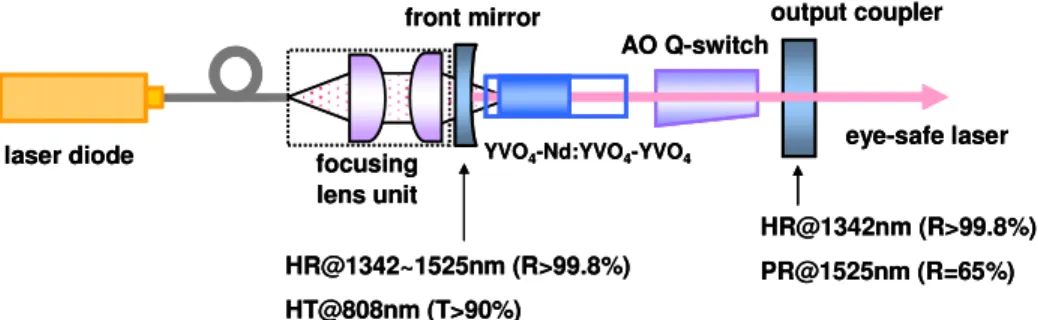
The experimental setup of a diode-pumped actively Q-switched eye-safe Raman laser employing a composite Nd:YVO4 crystal is shown in Fig. 1. The laser crystal is an a-cut 4
mm × 4 mm × 20 mm double-end diffusion-bonded Nd:YVO4 crystal bounded with one
2-mm-long undoped YVO4 end at the pumped facet of 0.3-at.% Nd3+-doped Nd:YVO4 crystal
and one 8-mm-long undoped YVO4 end at the other facet. The laser crystal is supplied by
Witcore Co., Ltd. With the 1342-nm fundamental pump wavelength, the wavelength of the first-Stokes component for the YVO4 Stokes shift at 890-cm-1 can be calculated to be around
1525 nm. The front and output coupler are designed for the first-Stokes generation. Both sides of the laser crystal are coated for antireflection at 1330-1530 nm (R<0.2%). In addition, the laser crystal is wrapped with indium foil and mounted in a water-cooled copper block. The water temperature was maintained at 22oC. The front mirror is a 500-mm radius-of-curvature concave mirror with antireflection coating at 808 nm on the entrance face (R<0.2%), high-transmission (HT) coating at 808 nm (T>90%), and high-reflection (HR) coating at 1342 and 1525 nm on the other face (R>99.8%). The output coupler is a flat mirror with high-reflection coating at 1342 nm and partial-reflection (PR) coating at 1525 nm (R=65%). The pump source is an 808-nm fiber-coupled laser diode with a core diameter of 600 µm, a numerical aperture of 0.16, and a maximum power of 17.2 W. The pump beam is reimaged at the laser active medium and the waist radius is nearly 250 µm. The 30-mm-long acousto-optic Q-switcher (NEOS Technologies) had antireflectance coatings at 1342 nm on both faces and was driven at a 27.12-MHz center frequency with 15.0 W of rf power. The overall laser cavity length is 75 mm.
laser diode focusing
lens unit
front mirror output coupler
HR@1342~1525nm (R>99.8%) HT@808nm (T>90%)
HR@1342nm (R>99.8%) PR@1525nm (R=65%) AO Q-switch
YVO4-Nd:YVO4-YVO4
eye-safe laser
laser diode focusing
lens unit
front mirror output coupler
HR@1342~1525nm (R>99.8%) HT@808nm (T>90%)
HR@1342nm (R>99.8%) PR@1525nm (R=65%) AO Q-switch
YVO4-Nd:YVO4-YVO4
eye-safe laser
Fig. 1. Experimental setup of a diode-end-pumped actively Q-switched Nd:YVO4 Raman laser. 3. Experimental results and discussions
We firstly used a simple laser setup for CW operation at 1342 nm to investigate the improvement of the thermal lensing effect in a double-end diffusion-bonded Nd:YVO4 crystal
[30]. For this investigation an output coupler with partial reflection at 1342 nm was used instead of the above-mentioned Raman cavity output coupler. The optimum reflectivity of the output coupler was found to be approximately 92–94%. The effective focal lengths of the thermal lens were estimated based on the fact that the laser system would start unstable for a cavity length longer than the critical length related to the thermal lensing. Even though the absolute accuracy is not easily achieved, this method is confirmed to provide the high relative accuracy for the effective focal lengths of the thermal lens [30]. Figure 2 shows the experimental data and fitted lines of thermal lensing power in a conventional crystal and a double-end diffusion-bonded crystal with the same dopant concentration. It can be seen that the effective focal length in a double-end diffusion-bonded crystal is nearly 1.6 times that in a conventional Nd:YVO4 crystal. As a result, the thermal effects can be substantiated to be
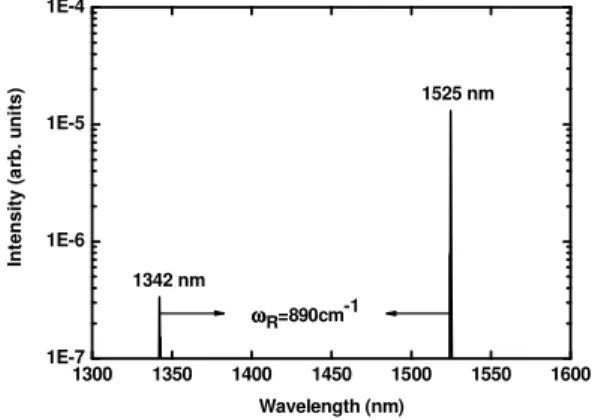
When the Raman cavity output coupler was used in the laser cavity, the pumping threshold for the Raman laser output was found to be 2–3 W for the pulse repetition rates within 20-40 kHz. The beam quality factor was found to be better than 1.5 over the entire operating region. The spectrum of laser output is measured by an optical spectrum analyzer (Advantest Q8381A) employing a diffraction lattice monochromatorwith a resolution of 0.1 nm. As shown in Fig. 3, the optical spectrum for the actively Q-switched self-Raman output displayed that the fundamental laser emission was at 1342 nm and the Stokes component was at 1525 nm. The frequency shift between Stokes and laser lines is in good agreement with the optical vibration modes of tetrahedral VO4-3 ionic groups (890 cm-1) [19].
6 9 12 15 18 0 2 4 6 8 1 / f (((( m -1 ))))
Input pump power (W) double-end
conventional
Fig. 2. Dependences of thermal lensing power on input pump power for conventional and double-end diffusion-bonded Nd:YVO4 CW laser at 1342 nm.
1300 1350 1400 1450 1500 1550 1600 1E-7 1E-6 1E-5 1E-4 In te n s it y ( a rb . u n it s ) Wavelength (nm) 1342 nm 1525 nm ω ω ω ωR=890cm-1
Fig. 3. Optical spectrum of the diode-pumped actively Q-switch Nd:YVO4 self-Raman laser.
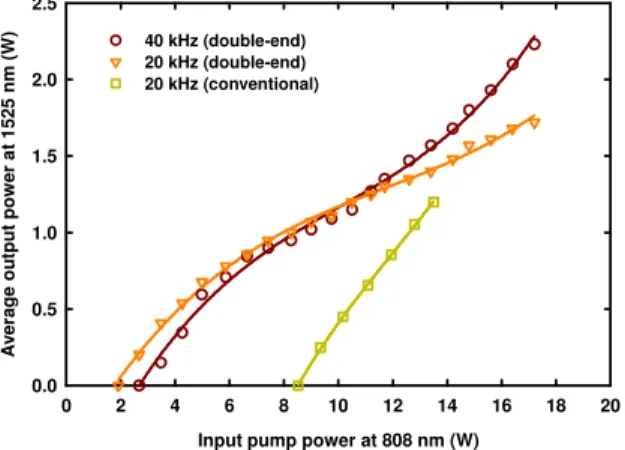
Figure 4 shows the experimental results of the average output power at 1525 nm with respect to the input pump power for the present self-Raman laser at pulse repetition rates of 20 and 40 kHz. For comparison, the previous results obtained by Chen [9] with a conventional 0.2%-doped Nd:YVO4 crystal at a repetition rate of 20 kHz is also depicted in the same figure.
Note that there were no experimental data for a conventional 0.2%-doped Nd:YVO4 crystal at
a pulse repetition rate of 40 kHz because of the high lasing threshold. It can be seen that the Raman lasing threshold for a double-end diffusion-bonded Nd:YVO4 crystal is approximately
2.0 W that is substantially lower than the lasing threshold of 8.5 W for a conventional Nd:YVO4 crystal at the repetition rate of 20 kHz. Moreover, the lasing threshold at a pulse
repetition rate of 40 kHz for present self-Raman laser is below 3.0 W. A rather low lasing threshold for high pulse repetition rates comes from the fact that the undoped part of the composite crystal increases the interaction length and then enhances the Raman gain.
It has been experimentally evidenced that the maximum output power for a conventional self-Raman laser is limited by the critical pump power that induces a large temperature gradient in the gain medium to lead to the Raman gain lower than the cavity losses [21]. Consequently, the output power begins to saturate when the pump power exceeds the critical pump power. As shown in Fig. 4, the critical pump power for the self-Raman laser with a double-end diffusion-bonded Nd:YVO4 crystal can exceed 17.2 W that is limited by the
available pump power and is considerably greater than the critical pump power of 13.5 W with a conventional Nd:YVO4 crystal. As a result, the self-Raman laser with a double-end
diffusion-bonded Nd:YVO4 crystal can generate the maximum average output power up to
1.72 W that is approximately 43% higher than the result with a conventional 0.2 %-doped Nd:YVO4 crystal [9]. At a repetition rate of 40 kHz, the maximum power at 1525 nm is even
up to 2.23 W with an input pump power of 17.2 W, corresponding to a conversion efficiency of 13%. To the best of our knowledge, this is the highest average power for diode-pumped eye-safe self-Raman laser.
Input pump power at 808 nm (W)
0 2 4 6 8 10 12 14 16 18 20 A v e ra g e o u tp u t p o w e r a t 1 5 2 5 n m ( W ) 0.0 0.5 1.0 1.5 2.0 2.5 40 kHz (double-end) 20 kHz (double-end) 20 kHz (conventional)
Fig. 4. The average output power at 1525 nm with respect to the input pump power at pulse repetition rates of 20 and 40 kHz shown as the down-triangle and circle symbols respectively for the double-end diffusion-bonded Nd:YVO4 crystal and that at 20 kHz shown as the square symbol for a conventional Nd:YVO4 crystal reported by Chen [9].
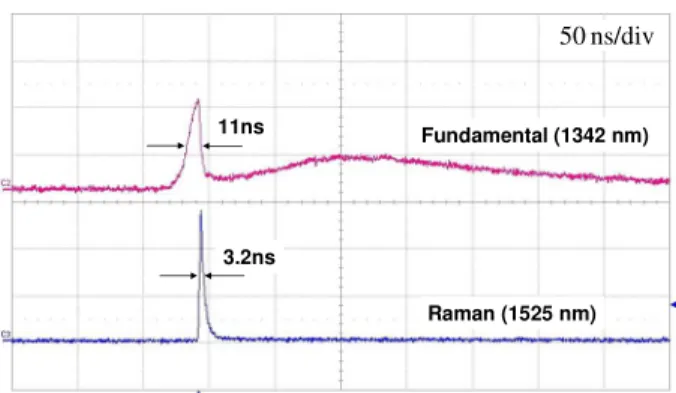
The temporal traces for the fundamental and Raman pulses are recorded by a LeCroy digital oscilloscope (Wavepro 7100, 10 Gsamples/s, 1-GHz bandwidth) with two fast p-i-n photodiodes. At a repetition rate of 40 kHz the pulse energy is up to 56 µJ with an input pump power of 17.2 W and the pulse width is measured to be approximately 3.2 ns, as shown in Fig. 5. The corresponding peak power is higher than 17 kW. At the pulse repetition rate of 20 kHz, the maximum pulse energy is up to 86 µJ. Figure 6 shows the pulse width at a pulse repetition rate of 20 kHz with a pump power of 17.2 W. It can be seen that although a second tiny Raman pulse usually follows the main first peak, its contribution is rather limited. Consequently the peak power can be generally higher than 22 kW. Since the fundamental energy is remained after first Raman pulse, the sub-pulse of fundamental wave is formed shown as Fig. 5 and Fig. 6. At a pulse repetition rate of 20 kHz, the remaining energy is sufficient to reach Raman gain and a second tiny Raman pulse is produced shown as Fig. 6. The sub-pulse would not be generated if the reflectivity of output coupler was lowered.
3.2ns 11ns Fundamental (1342 nm) Raman (1525 nm) ns/div 50 3.2ns 11ns Fundamental (1342 nm) Raman (1525 nm) ns/div 50
Fig. 5. Temporal characteristics of the fundamental and Raman pulses at a pulse repetition rate of 40 kHz with a pump power of 17.2 W.
3.8ns 7.6ns Fundamental (1342 nm) Raman (1525 nm) ns/div 50
Fig. 6. Temporal characteristics of the fundamental and Raman pulses at a pulse repetition rate of 20 kHz with a pump power of 17.2 W.
4. Conclusion
A compact efficient high-power diode-pumped actively Q-switched self-Raman laser at 1525 nm is demonstrated by employing a double-end diffusion-bonded Nd:YVO4 crystal.
Experimental results reveal that the composite crystal can reduce the thermal effects to reach a higher critical pump power. More importantly, the undoped part plays a critical role in lowering the lasing threshold at high pulse repletion rates because of the increase of the Raman interaction length. The maximum average output power of 2.23 W at first-Stokes wavelength of 1525 nm is generated at a pulse repetition rate of 40 kHz, and the pulse width of Raman pulse is about 3.2 ns with an input pump power of 17.2 W. The corresponding conversion efficiency and peak power are approximately 13% and 17.4 kW, respectively.
Acknowledgments
The authors thank the National Science Council for their financial support of this research under Contract No. NSC-95-2112-M-009-041-MY2.