虛擬攝影棚在台灣電視節目製作之替代效果研究
黃靜蓉、張宏宇
摘要
自從1994年虛擬攝影棚技術問世以來,多數廠商認為這項發明將為電視節目帶來 科技和製作的契機,因此陸續投入研發的行列。20年過去了,虛擬攝影棚的效益和限 制為何?是否足以替代傳統實景棚?本研究以台灣為研究範圍,分析5家電視台,分 別是台視、中視、華視、東森、和壹電視,蒐集205個節目和68份專家問卷資料,結 果顯示虛擬攝影棚的採用率約只有三成,而新聞是唯一一種節目類型具備超過五成採 用率。此外,本研究也發現9個可以代表目前台灣電視產業採用虛擬棚所獲致效益和 限制的共變數。 ☉ 關鍵字:虛擬攝影棚、替代效果、採用率、電視節目製作、台灣 ☉ 本文作者黃靜蓉為國立交通大學傳播與科技學系副教授;張宏宇為國立交通大學傳播與科 技學系助理教授。 ☉ 通訊作者為黃靜蓉,聯絡方式:E-mail:[email protected]; 電話: 03-5712121~58712;通訊處:30010新竹市大學路1001號 ☉ 收稿日期:2015/08/13 接受日期:2016/01/29Substitution Effects of Virtual Studios on Taiwanese
TV Broadcasting
J. Sonia Huang, Hong-Yu Chang
Abstract
Virtual studios (VSs) have had an immense impact on TV broadcasters who are excited by both the technology and the potential for enhancing their own productions. However, it remains to be determined whether VSs have substituted real background sets since their introduction in 1994 and what the benefits and the limitations are. This study analyzed 205 programs and collected 68 expert questionnaires from Taiwan’s TV broadcasting companies to examine the substitution effects of VSs. Results show that VSs were used for only one third of program productions and that news was the only program type with an adoption rate of more than 50%. Moreover, this study identified 9 common factors that represent an empirical summary of VSs’ benefits and limitations 20 years after their introduction.
☉Keywords: virtual studios, substitution effect, rate of adoption, TV broadcasting, Taiwan ☉J. Sonia Huang is Corresponding author and Associate Professor in the Department of Communication and Technology, National Chiao Tung University; Danny Chang is Assistant Professor in the Department of Communication and Technology, National Chiao Tung University.
☉E-mail: [email protected]; Phone: 03-5712721~58712; Address: No.1001,Ta Hsueh Road, Hsinchu City 30010, Taiwan
☉Acknowledgements: This study was made possible through a research grant from the Development Plan for World Class Universities and Research Centers of Excellence in Taiwan (2011/04/01~2012/12/31). The authors would also like to thank Prof. Liangwen Kuo's administrative support and acknowledge Ting-Ya Yin, Ivy Chang, and Chu-Hung Lin for their data entry contributions.
Substitution Effects of Virtual Studios
on Taiwanese TV Broadcasting
Traditionally, after a video production is planned and designed, the required scenery must be purchased and full schematic drawings must be prepared for each set. These sets are then constructed, delivered to the studios, and erected; after the broadcast, they must be dismantled, transported, and either stored for further use or discarded. This cycle is quite often the most expensive aspect of a video production, and the time required dictates both the production timetable and the studio’s overall output.
Developments in computer graphics and synthesis technologies have resulted in virtual reality and virtual studios (VSs), which are new types of methods and systems for creating video scenes. VSs, a combination of traditional studio, chroma-key technology, and virtual technology, are an extended application of virtual reality (Yang & Zhang, 2011). The technology frees video production from the restrictions of time, space, and cost and is suited for news, sports, weather, and current affairs shows where the presentation format is known in advance and consistency and repeatability of production are essential (Drew, 1997).
VSs have been demonstrated at broadcast exhibitions since their introduction in 1994 (Gibbs et al., 1998). They have had an immense impact because TV broadcasters are excited by both the technology and the potential for enhancing productions and reducing costs. For example, a virtual set enables a broadcaster to quickly change the outlook of a studio environment without moving the actual set. Especially for stations with little studio space, a VS enables using multiple sets and enhanced graphical elements in a broadcast (Whitney, 2002).
A substitute good is defined as an alternative good that the consumer can purchase to fulfill the same need (Hoskins, McFadyen, & Finn, 2004). This paper discusses whether VSs constitute a substitute for real background sets in particular broadcasting companies, channel types, program types, and during prime time, as well as what the benefits and the limitations are. Using empirical data collected through program analysis and a survey of experts, this
Literature Review
The VS was created in an attempt to overcome luminance and chroma-key constraints (i.e., no correlation between movement in the foreground and background) and was made possible by advancements in computer technology, advanced 3D modeling and texture mapping, increased data processing speeds, and newly developed pattern recognition techniques and algorithms (Moshkovitz, 2000). It is a form of TV studio functioning that merges real and virtual sets for live TV productions (Hough, Athwal, & Williams, 2012) (Figure 1). Sometimes VS techniques are called “virtual reality,” a term which is essentially accurate but also includes applications from other, nonbroadcast fields such as computer games and simulators. Nonetheless, the VS is used almost exclusively for TV broadcast applications.
The first VS was invented in approximately 1990. Japan was probably the first country to develop real-time virtual sets for various TV program productions (Gibbs et al., 1998; Hayashi et al., 1996). For example, in 1991, NHK designed a prototype VS system to
Figure 1.
Virtual studio removes a range of green or blue color from the image
captured by a studio camera and replaces it with a 3D virtual environment
1produce a science documentary, Nanospace, which contained the main elements of a VS system: real-time background rendering and real-time foreground tracking. However, NHK’s efforts were hindered by poor graphic hardware performance.
VS systems were not commercially available until SGI’s 1993 introduction of a hardware engine called RealityEngine2 (Gibbs et al., 1998). Two early VS systems were developed using RealityEngine2 by IMP (a company with expertise in real-time graphics) and VAP (the company that led the Mona Lisa Project (Blonde et al., 1996). In September of 1994, IMP and VAP first demonstrated their VS systems at the International Broadcasting Convention in Amsterdam. Thereafter, VS systems have proliferated because broadcasters are highly interested and realize that VSs are part of a much larger trend of digitalization, in which aspects range from digital technology, high-definition (HD) television, and compression and digital transmission systems to interactivity and the Internet.
The VSs currently on the market have fairly similar functionality and performance but differ in accuracy of tracking and registration, ease of use, and general robustness (Gibbs & Baudisch, 1996). The tracking systems used in VSs were classified into two main categories: electromechanical and optical. They further divided electromechanical tracking systems into two subcategories: active and passive. Consequently, current mature tracking technologies are electromechanical tracking systems (electromechanical-active), sensor-based camera tracking systems (electromechanical-passive), and pattern recognition systems (optical). The first requires determining the lens objective’s zoom and focus ring position as well as the camera mount’s various degrees of freedom; the second requires using complicated sensors and encoders, and the positioning and calibration of cameras are complex; the third requires using a hardware digital video processor for pattern recognition (Yang & Zhang, 2011). Because electromechanical tracking was the first developed, most commercial companies use it to render 3D backgrounds. Broadcast companies such as RT-Set, Radamec, NHK, and Accom use electromechanical tracking, whereas companies such as Orad and Evans and Sutherland specialize in optical tracking. In addition, 3D systems can perform 2D rendering if required.
Blonde et al. (1996) documented the strength of VSs. First, VSs align the scenery production process with the rest of the production process. Second, the flexibility offered by easily switching from one set to another eliminates the substantial cost and time constraints of building, storing, transporting, and resetting current sets. Third, several programs can share studio space and equipment, and rapid turnaround times can increase studio output. Drew (1997) summarized the benefits of virtual sets and virtual productions according to three aspects: programs, costs, and production. Specifically, VSs are suited for news, sports, weather, and current affairs programs where the presentation format is known in advance and consistency and repeatability of production are essential. Virtual productions save substantial amounts of money when a series of programs that use the same background sets are commissioned and the program production team has a far greater range of options available to them regarding the format design, studio size, and space-time constraints. A similar advantage identified by Mitsumine, Yamanouchi, and Inoue (2001) is that VSs enable pseudo-shooting in places where shooting cannot be performed in reality (e.g., outer space and ancient sites) and enable camera work that would normally be physically impossible.
Although current virtual set technology can be successfully used, even in live productions, several problems associated with this technology still require solutions. VSs have many limitations, including unrealistic images, poor compatibility with actual images, and the considerable amount of labor required to produce computer-generated sets (Mitsumine et al., 2001). Specifically, high-quality (or photorealistic) 3D graphics include a large number of polygons, textures, and various special effects, but rendering all of them live is not currently possible even with the most powerful graphic workstations. Furthermore, VS technology requires the work of personnel from different departments, such as specially trained operators, computer and software maintenance engineers, and skilled people for set design and graphics work during production. Still further limitations lie in the designated camera tracking system. For instance, the pattern recognition system limits the shooting sector that a camera can cover because it requires at least a small part of the grid that is on the studio wall to be visible at all times, whereas the camera movement of an electromechanical
camera tracking system is severely limited when studios are too large or have very low ceilings (Moshkovitz, 2000).
Virtual studios in Taiwan
Taiwan was an early adopter of VS systems, but the progress was not as expected. Global TV adopted the first VS system for news broadcasting as early as 1997 (Lee, 2002). Global TV surveyed and tested different VS systems and decided to purchase RT-Set’s Larus system. Global TV’s work with a VS included daily news, political talk shows, and a special report, 1997 The Return of Hong Kong. However, Global TV discontinued production in 2004 because of a shortage of funds. TVBS, a leading TV broadcaster was probably the second company in Taiwan to apply the virtual production technology, borrowed from Orad in 1998, but TVBS returned the equipment and made no procurement. It was not until 1999 that VS production began proliferating in Taiwan under ImageTech’s full commitment (Chang, 2008). ImageTech, led by software engineers from Silicon Valley, computer animators who had participated in several international projects, and local artists, successfully produced a large amount of virtual videos ranging from news, children’s entertainment, education, and drama programs and trained numerous VS professionals. Although ImageTech ceased its virtual production in 2005, several national and cable TV networks (e.g., TTV, CTV, and ETTV), inspired by ImageTech, built their own VSs in the early 2000s. Even so, Chang (Chang, 2008) conducted a study on VS application in Taiwanese TV program production and concluded that the development of virtual studios has fallen short of expectations; the broadcast industry and academic circles in Taiwan should make concerted efforts to identify solutions for limitations and promote the development of and training for virtual studio production. A recent development was NextTV, established in 2009, who heavily invested in three HD VS systems from Vizrt (formerly known as RT-Set) for news and finance channels (personal communication, 2012).
Although many companies are producing VS systems internationally, two competing companies (i.e., Vizrt and Orad) export such systems to Taiwan. Vizrt specializes in
electromechanical tracking and open hardware, whereas Orad specializes in optical tracking (i.e., pattern recognition) and in-house platforms. Orad is more expensive because its VS must run on its own computers instead of on Windows NT, but nonprofit organizations can often receive a discount on an Orad studio (personal communication, 2012). Consequently, Vizrt dominates the commercial market in Taiwan, whereas Orad is mainly used by educational institutions.
Substitution effect
Demand-related products can be divided into two groups: substitutes and complements (Albarran, 2002; Hoskins et al., 2004). Substitute goods are an alternative that the consumer can purchase to fulfill the same need; complementary goods are those that are used in conjunction with one another. For example, an iPhone is a substitute for an ETC model because it performs the same function. Computer and Internet access are complementary goods because with more people owning a computer, the demand for Internet access and bandwidth will increase.
A substitution effect mainly results from a change in relative prices: An increase in the price of Good A makes it a less attractive purchase than substitute goods whose prices are unchanged; therefore, some people switch to purchasing one of the substitutes (Hoskins et al., 2004). For example, if the price of TV sets increases 10%, a person planning to buy a new TV might opt to pay for repairs for his or her old set instead, while another person might decide to buy a computer with TV access. In addition to a price change, changes in tastes, preferences, demographic characteristics, individual household income, and technology encourage the substitution of different products or services (Albarran, 2002). A technology change can assume the form of a new production technique or a new product, such as the Sony Handicam, which has transformed in-field news reporting, as well as some types of documentary shooting, by enabling one individual to perform the duties of a whole TV crew by reporting, shooting, and producing.
products on existing products, using terms such as displacement effect or cannibalization effect to represent such phenomena. Displacement theories, originated by Lazarsfeld, assume that once a new medium enters the market, users of existing media reallocate their limited amount of time because new outlets usually provide the same gratification more easily and attractively (DeFleur & Ball-Rokeach, 1982; Himmelweit, Oppenheim, & Vince, 1958; Lazarsfeld, 1940). Some recent studies have focused on the time displacement effect of online media on traditional media at the individual level (e.g., De Waal & Schoenbach, 2010; Lee & Leung, 2008), although so far Internet use seems to have complemented rather than replaced traditional media use (Chyi, 2006; Chyi & Huang, 2011; Chyi & Lasorsa, 2002; Tarkiainen, Ellonene, & Kuivalainene, 2009).
Analysis of substitution effects
The marginal rate of substitution (MRS) is used by economists to define the ratio at which a consumer is willing to substitute X for Y (Formula 1; Case & Fair, 2004) . For example, when the MRS is equal to 4, a consumer is willing to trade 4 units of Y for 1 additional unit of X. However, the formula requires hypothetical or longitudinal data for mapping each consumer’s preferences among the combinations of goods and services available (e.g., Chen & Wang, 2009).
For empirical and cross-sectional data, substitution effects are examined according to the rate of adoption (ROA), which explains how the use of new technologies, processes, and innovations (i.e., X) spreads through a society (Formula 2; Rogers, 1962, 2003) . The ROA is a relative measure, meaning that the rate of one group is compared with that of another. The ROA measure is commonly used by communication scholars when calculating new media effects. For example, Chyi et al. (2006; 2011; 1999, 2002) compared the percentages of print edition readers, online edition readers, and hybrid readers to elucidate the demand relationship between online and print products. Similarly, De Waal and Schoenback (2010)
measured the exposure to online news and to various traditional media to demonstrate displacement effects. Therefore, the study used the alternative to examine the substitution effects.
VSs have existed for more than 20 years; however, it is still unclear if they have fully substituted real background sets. This paper examines the substitution effect of VSs for TV broadcasting in Taiwan. The following research questions are asked:
RQ1: Do VSs provide a substitute for traditional production?
RQ2: Do VSs fully substitute real background sets in particular broadcasting companies, channel types, program types, and on-air time?
RQ3: What are the benefits and the limitations of virtual production?
Methods
For answering the research questions, our analyses were based on data from a program analysis and an expert survey of TV broadcasting companies in Taiwan. As mentioned previously, although VSs have been produced commercially since 1994, TV broadcasters do not apply them as widely as expected. As of 2012, five TV broadcasting companies (including network and cable) had adopted VSs in routine production in Taiwan. Accordingly, the five broadcasters, TTV, CTV, CTS, ETTV, and NextTV, were the subjects of the present study.
Program analysis
The program analysis involved studying the programming strategies regarding production adopted by the five TV broadcasting companies from a randomly selected week during the summer of 2012. Each company’s program schedule was collected and analyzed according to its TV company, channel type, program type, production type, and on-air time. In total, 205 programs from the five TV broadcasting companies were collected. The TV company was coded by company name; channel type was categorized as news,
variety, finance, and other; program type categories were news, children, education, talk or discussion, series or drama, entertainment, music, sports, and other; production type was dichotomized as virtual and traditional (including real background, outdoor, and others); and on-air time was categorized into prime time (7:00 p.m. to 10:00 p.m.) and daytime (12:00 a.m. to 7:00 p.m. and 10:00 p.m. to 12:00 a.m.). Except for the production type, all variables were coded by one coder (a student majoring in communication and technology) and 10% of the programs were randomly selected and independently reviewed by another coder (one of the authors) to establish intercoder reliability. Because our variables were indices at the ratio level, Pearson’s r was used to test reliability. The coefficients ranged from .97 to 1.00 among TV company, channel type, program type, and on-air time. To ensure the validity of the production type (i.e., virtual and traditional) for each program, the coding was performed by the TV experts in the survey.
Expert survey
The expert survey is a type of purposive survey designed to study a small subset of a larger population in which the subset is easily identified but the enumeration of all is nearly impossible (Babbie, 1990). Studying a sample of the subset was sufficient for our purposes. Furthermore, respondents of an expert survey should not be randomly selected because they are people whose knowledge of a particular cultural context is required for achieving research objectives (Lindlof & Taylor, 2002). Knowing that not all employees of the five companies were familiar with VSs, we selected experts from seven essential positions, that is, anchor or host, producer, director, lighting technician, hardware engineer, software engineer, and virtual set designer. In total, 70 experts who had virtual production experience were surveyed using a self-administered questionnaire. During June to October of 2012, we visited each TV
company and delivered our questionnaire to the managers of the production and engineering teams for distribution to increase the completion rate (Dillman, 2007). Among the 70 invited experts, 68 completed the survey, yielding a completion rate of 97%.
In the absence of previous empirical research on the benefits and limitations of VSs, 85 questions were developed according to the literature reviewed in the previous section (Blonde et al., 1996; Chang, 2008; Drew, 1997; Gibbs et al., 1998; Gibbs & Baudisch, 1996; Hayashi et al., 1996; Lee, 2002; Mitsumine et al., 2001; Moshkovitz, 2000; Whitney, 2002; Yang & Zhang, 2011), interviews with industry experts (i.e., production and engineering managers from the five TV broadcasters), and academic colleagues (i.e., professors and assistant instructors of VS-related classes). Specifically, 14 questions concerned the benefits of virtual sets, 18 questions concerned the benefits of virtual production, 20 questions concerned the limitations of virtual sets, 19 questions concerned the limitations of virtual production, and 14 questions concerned Taiwan’s TV production environment. The 85-question survey was then provided for the invited experts to rate on a 7-point Likert scale.
Results
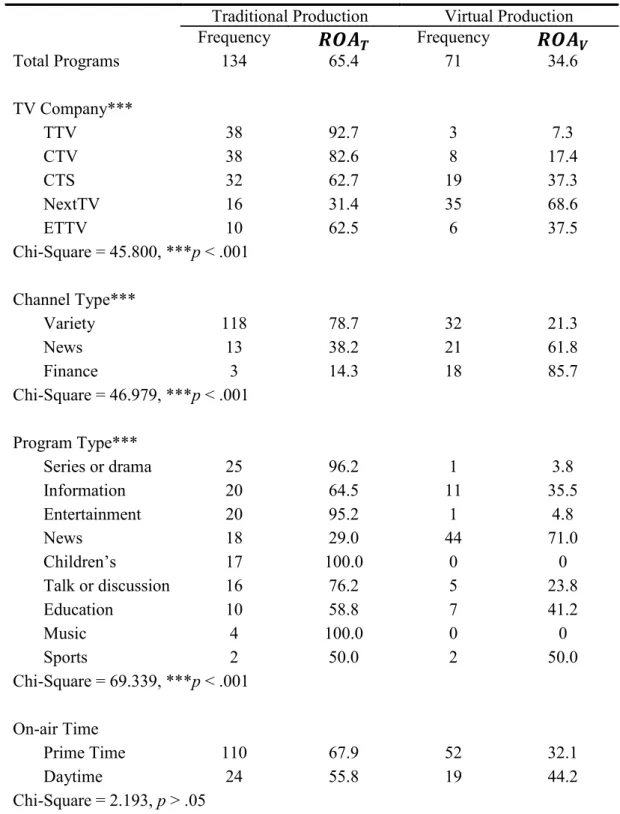
To examine whether the VS is a substitute for traditional production, the ROA was calculated for traditional production and virtual production separately according to broadcasting company, channel type, program type, and on-air time. Table 1 contains the ROAs as well as the frequency of programs broadcasted in one random week. Regarding the TV company, NextTV was the largest user of VSs, with approximately 70% of its programs produced in a VS. Furthermore, TV companies varied significantly in production methods despite all owning VS systems (chi-square = 45.800,
p
< .001). Regarding channel type, news (61.8%) and finance (85.7%) benefited the most from virtual production, with the differences between traditional and virtual production being statistically significant (chi-square = 46.979,p
< .001). Regarding program type, only news programs depended heavily on virtual productions; sports programs adopted both traditional and virtual productions evenly; and other types of programs still preferred traditional production methods (chi-squarepreferences between programs aired in primetime and programs aired in daytime existed (chi-square = 2.193, p > .05).
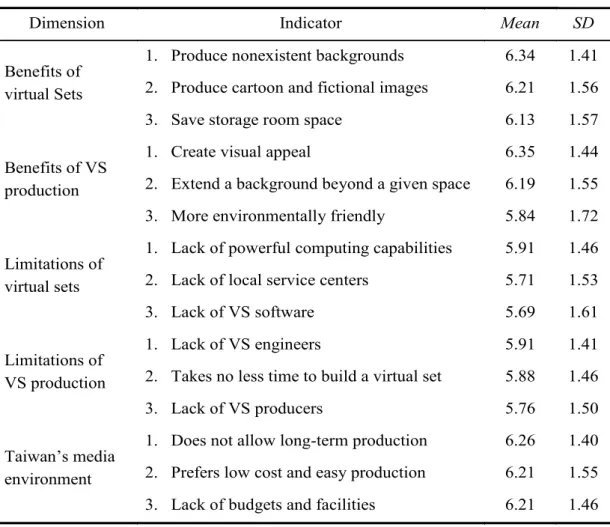
Regarding the benefits and limitations of virtual production, the expert survey showed that the top three benefits of virtual sets were their abilities to “produce nonexistent backgrounds,” to “produce cartoon and fictional images,” and to “save storage space”; the top three benefits of VS production were their ability to “create visual appeal,” “extend a background beyond a given space,” and to be “more environmentally friendly” (Table 2). On a 7-point Likert scale, the six benefit indicators scored from 5.84 to 6.35. Conversely, the top three limitations of virtual sets were a “lack of powerful computing capabilities,” a “lack of local service centers,” and a “lack of VS software”; the top three limitations of VS production were a “lack of VS engineers,” the fact that it “takes no less time to build a virtual set,” and a “lack of VS producers” (Table 2). On a 7-point Likert scale, the six limitation indicators scored from 5.69 to 5.91. In addition, the 68 experts evaluated Taiwan’s media environment, and the results revealed that the top three trends specific to Taiwan were “does not allow long-term production,” “prefers low cost and easy production,” and “lack of budgets and facilities” (Table 3). On a 7-point Likert scale, the three Taiwan-specific indicators scored from 6.21 to 6.26.
Table 1.
Program analysis of virtual studio adoption (
N
= 205)
Traditional Production Virtual Production Frequency𝑹𝑹𝑶𝑶𝑨𝑨
𝑻𝑻 Frequency𝑹𝑹𝑶𝑶𝑨𝑨
𝑽𝑽 Total Programs 134 65.4 71 34.6 TV Company*** TTV 38 92.7 3 7.3 CTV 38 82.6 8 17.4 CTS 32 62.7 19 37.3 NextTV 16 31.4 35 68.6 ETTV 10 62.5 6 37.5 Chi-Square = 45.800, ***p < .001 Channel Type*** Variety 118 78.7 32 21.3 News 13 38.2 21 61.8 Finance 3 14.3 18 85.7 Chi-Square = 46.979, ***p < .001 Program Type*** Series or drama 25 96.2 1 3.8 Information 20 64.5 11 35.5 Entertainment 20 95.2 1 4.8 News 18 29.0 44 71.0 Children’s 17 100.0 0 0 Talk or discussion 16 76.2 5 23.8 Education 10 58.8 7 41.2 Music 4 100.0 0 0 Sports 2 50.0 2 50.0 Chi-Square = 69.339, ***p < .001 On-air Time Prime Time 110 67.9 52 32.1 Daytime 24 55.8 19 44.2 Chi-Square = 2.193, p > .05Table 2.
Experts' evaluation of virtual studios (
N
= 68)
Dimension Indicator Mean SD
Benefits of virtual Sets
1. Produce nonexistent backgrounds 6.34 1.41 2. Produce cartoon and fictional images 6.21 1.56 3. Save storage room space 6.13 1.57 Benefits of VS
production
1. Create visual appeal 6.35 1.44 2. Extend a background beyond a given space 6.19 1.55 3. More environmentally friendly 5.84 1.72 Limitations of
virtual sets
1. Lack of powerful computing capabilities 5.91 1.46 2. Lack of local service centers 5.71 1.53 3. Lack of VS software 5.69 1.61 Limitations of
VS production
1. Lack of VS engineers 5.91 1.41 2. Takes no less time to build a virtual set 5.88 1.46 3. Lack of VS producers 5.76 1.50 Taiwan’s media
environment
1. Does not allow long-term production 6.26 1.40 2. Prefers low cost and easy production 6.21 1.55 3. Lack of budgets and facilities 6.21 1.46
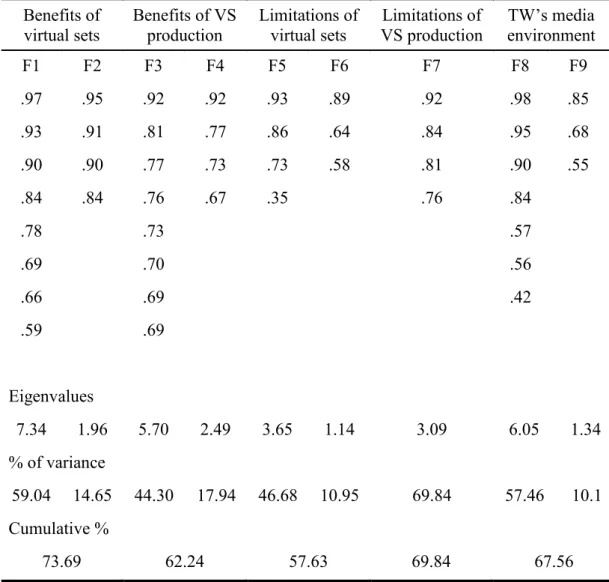
Although we developed 85 questions about virtual production, we did not measure that many constructs; hence, we used a variable reduction scheme to indicate how variables clustered together. The 85 indicators based on the five dimensions were subjected to five runs of principle axis factoring (PAF). In the social sciences some correlation among factors are expected and the multivariate normality is often violated, so the PAF is preferable to other factor analysis methods such as principal components and maximum likelihood (Costello & Osborne, 2005; Warner, 2012). Prior to performing the PAF, we assessed the suitability of the data according to the following criteria: subject to item ratio is 5 to 1 or larger; Kaiser-Meyer-Olkin values exceed .50; and Bartlett’s test of sphericity reaches statistical significance. We removed 20 items on the five dimensions to satisfy these criteria. When performing PAF, the only indicators whose commonality exceeded .50 were retained and factor loadings greater than .40 for no more than one component were rotated via direct oblimin. Among the 65 items, we retained 45 indicators and found 9 components with eigenvalues that exceeded 1, explaining variances ranging from 57.63% for limitations of virtual sets to 73.69% for benefits of virtual sets (Table 3). The 9 components were denoted as follows: F1, real background substitution; F2, outdoor scene substitution; F3, being cost effective and time saving; F4, reliance on VS professionals; F5, unreal composition; F6, poor compatibility; F7, lack of VS professionals; F8, fast and inexpensive production; and F9, no incentives.
Table 3.
Factor analysis of experts' evaluation of virtual studios
Note: N = 68. Extraction method: Principal Axis Factoring. Rotation method: Oblimin with Kaiser normalization. F1 = real background substitution; F2 = outdoor scene substitution; F3 = being cost effective and time saving; F4 = reliance on VS professionals; F5 = unreal composition; F6 = poor compatibility; F7 = lack of VS professionals; F8 = fast and inexpensive production; F9 = no incentives.
Benefits of
virtual sets Benefits of VS production Limitations of virtual sets VS production Limitations of environment TW’s media
F1 F2 F3 F4 F5 F6 F7 F8 F9 .97 .95 .92 .92 .93 .89 .92 .98 .85 .93 .91 .81 .77 .86 .64 .84 .95 .68 .90 .90 .77 .73 .73 .58 .81 .90 .55 .84 .84 .76 .67 .35 .76 .84 .78 .73 .57 .69 .70 .56 .66 .69 .42 .59 .69 Eigenvalues 7.34 1.96 5.70 2.49 3.65 1.14 3.09 6.05 1.34 % of variance 59.04 14.65 44.30 17.94 46.68 10.95 69.84 57.46 10.1 Cumulative % 73.69 62.24 57.63 69.84 67.56
Discussion and Conclusion
Regarding RQ1 and RQ2, we found that virtual production is not yet a substitute for traditional production, because its overall ROA is 35%; however, VSs substitute real background sets in particular broadcasting companies, channel types, and program types (i.e., NextTV, news, and finance). Previous research also found VSs suitable for news and current affairs (Drew, 1997). These results can also be attributed to several characteristics of broadcasting in Taiwan. First, the largest adopter, NextTV, was established in 2009 and started to broadcast in 2010; therefore, it built the most advanced, full HD VS and hired broadcasting talents with specific skills. By comparison, other TV companies purchased a VS for various reasons, such as program experiments, cost reduction, and competition prevention, but their talent pool mainly focused on standard definition production and traditional studio settings. Second, because of the predictability and immobility of news production, a VS, which is capable of changing news scenes in seconds, is a more suitable choice for news programs than for other programs such as entertainment and drama programs. For example, a news program adopting virtual production can change background and foreground images as much as desired in one show (e.g., Virtual Sets 1 and 2 in Figure 2), whereas a traditional production is limited by its real settings. Third, finance programs demand numerous numbers, tables, and figures, which are difficult to present in traditional studios. A combination of a virtual set, a virtual touch panel, and computer graphics (i.e., Virtual Scenes 3 and 4 in Figure 2) facilitates clear presentation of finance information. Without this system, traditional productions mostly rely on handheld boards to show numbers.
Figure 2.
Virtual sets and scenes for news and finance
Regarding RQ3, the results show that the benefits of virtual sets and virtual production were real background substitution, outdoor scene substitution, being cost effective and time saving, and reliance on VS professionals. Results confirm some previous studies that VS provides a good alternative to traditional production (Blonde et al., 1996; Drew, 1997; Mitsumine et al., 2001). Without VS, an ancient temple set is not affordable and a massive web set about wildlife is impossible to construct. The reported limitations of virtual sets and virtual production were a lack of VS professionals, unreal composition, and poor compatibility, which echoed past studies (Mitsumine et al., 2001; Moshkovitz, 2000). The greatest problem for virtual production may be that the fewer the companies that adopt VSs are, the fewer the people that are familiar with virtual production, and consequently, the greater the number of obstacles that emerge in the production process. Concerning the
Virtual Set 1
Virtual scene 3
Virtual scene 4
Taiwan media environment, fast and inexpensive production and no incentives from TV broadcasters play a large part in VS adoption. The results may reflect Taiwan’s small market size (a national population of 23 million) and the ineluctable trend of media globalization, causing local production to decrease in number and length and imported programs to dominate the market. Overall, these 9 common factors provide an empirical summary of VSs’ benefits and limitations 20 years after its introduction.
As mentioned, substitution effects result from changes of price, taste, demographics, income, and technology, some or all of which must favor substitute goods (Albarran, 2002; Hoskins et al., 2004). Our results show that VSs in Taiwan have not reached a tipping point. Concerning the ROA, only one third of TV broadcasters adopted VSs in routine production even though the technology has existed for more than 20 years. In addition, VSs were only partially substituted real background sets for newer companies, news and finance channels, and news programs. Although this study found four common benefits of using VSs for broadcasters, more limitations and Taiwan-specific problems were presented. For example, the cost beyond that of entry-level VS systems continues to be a factor; TV broadcasters must hire an additional set design team; and many programs are fraught with integration and scheduling difficulties. In other words, the price, income, and technology do not encourage VS substitution. Coincidently, NewscastStudio in the United States reported, “Over the past few years, we’ve seen full virtual and hybrid environments become a pivotal part of broadcast and cable election coverage – but that trend appears to have taken a bit of a step back this year along with a more restrained approach to hard sets.” (Hill, 2014). Thus, questions of how to use virtual technology the most effectively, and the future of this technology, continue to trouble TV broadcasters not only in Taiwan but also in other countries. We suggest that VSs function the most effectively when paired with a physical space; combining the virtual and the real provides the advantages of both modes and provides grounding for program production.
It is important to address the limitations of this study and directions for future research. In the literature review, critical articles about VSs were almost entirely from engineering sciences and published before the year 2000 (e.g., Blonde et al., 1996; Drew, 1997; Gibbs et al., 1998; Hayashi et al., 1996); therefore, future studies can provide updated information from an applied perspective. Articles on VS development in Taiwan, such as Lee (2002) and Chang (2008), were master theses and outdated; again, the present study might represent an empirical summary of VSs in Taiwan for future researchers. Furthermore, the study’s survey size of 68 participants limited us to overall factor analyses of the benefits and limitations of VSs; future research may include more participants in a survey. More participants can easily be found considering the fact that the number of TV broadcasters building VSs during the past few years has almost doubled (e.g., TVBS, CtiTV, TITV, FOX International), probably resulting from Next TV’s full adoption. Finally, the present study focused on the production side. Future studies might consider collecting data from TV audiences concerning their viewing experiences and preferences toward VSs.
With the introduction of HD production and HD TV sets, we anticipate an increase of VS adoption in the broadcasting industry as virtual production becomes more capable of creating flawless backgrounds and foregrounds. In research, when more VSs are adopted, more empirical data can be collected, and more common patterns can be found. In practice, more exploitation of VSs will nurture more experienced professionals and ultimately lead to more cost-effective production.
References
Albarran, A. B. (2002). Media economics: Understanding markets, industries, and concepts
(2 ed.). Ames: Iowa State University Press.
Babbie, E. (1990). Survey research methods. Belmont, CA: Wadsworth.
Blonde, L., Buck, M., Galli, R., Niem, W., Paker, Y., Schmidt, W., & Thomas, G. (1996). A virtual studio for live broadcasting: The Mona Lisa project. IEEE Multimedia, 3(2), 18-29.
Case, K. E., & Fair, R. C. (2004). Principles of microeconomics (7th ed.). Upper Saddle River, NJ: Prentice Hall.
Chang, C. W. (2008). An applied study of virtual studio in TV program production. (M. A.), National Taiwan University of Arts.
Chen, Y. M., & Wang, W. S. (2009). Economic dispatch with environmental considerations using marginal rate of substitution decision approach. Journal of Quality, 16(2), 109-118.
Chyi, H. I. (Ed.). (2006). Re-examining the market relation between online and print newspapers: The case of Hong Kong Mahwah, NJ: Lawrence Erlbaum.
Chyi, H. I., & Huang, J. S. (2011). Demystifying the demand relationship between online and print products under one newspaper brand: The case of Taiwan and the emergence of a universal pattern. Asian Journal of Communication, 21(3), 243-261.
Chyi, H. I., & Lasorsa, D. L. (1999). Access, use and preference for online newspapers.
Newspaper Research Journal, 20, 2-13.
Chyi, H. I., & Lasorsa, D. L. (2002). An explorative study on the market relation between online and print newspapers. Journal of Media Economics, 15(2), 91-106.
Costello, A. B., & Osborne, J. W. (2005). Best practices in exploratory factor analysis: Four recommendations for getting the most from your analysis. Practical Assessment, Research & Evaluation, 10(7), 1-9.
evaluations and media displacement effects over time. New Media & Society, 12, 477-496.
DeFleur, M. L., & Ball-Rokeach, S. J. (1982). Theories of mass communication (4 ed.). New York: McKay.
Dillman, D. A. (2007). Mail and Internet surveys: The tailored design method (2nd ed.). New York: Wiley.
Drew, D. N. A. (1997). Practical studio productions using high-quality, low cost virtual sets.
SMPET Journal, 106, 618-623.
Gibbs, S., Arapis, C., Breiteneder, C., Lalioti, V., Mostafawy, S., & Speier, J. (1998). Virtual studios: An overview. IEEE Xplore, January-March.
Gibbs, S., & Baudisch, P. (1996). Interaction in the virtual studio. Computer Graphics, November, 29-32.
Hayashi, M., Enami, K., Noguchi, H., Fukui, K., Yagi, N., Inoue, S., . . . Itoh, Y. (1996). Desktop virtual studio system. IEEE Transactions on Broadcasting, 42(3), 278-284. Hill, M. P. (2014). Virtual tech takes step back during 2014 election coverage.
NewscastStudio. Retrieved April 30, 2015, from: http://www.newscaststudio. com/2014/11/05/virtual-tech-takes-step-back-during-2014-election-coverage/
Himmelweit, H., Oppenheim, A., & Vince, P. (1958). Television and the child. London: Oxford University Press.
Hoskins, C., McFadyen, S., & Finn, A. (2004). Media economics: Applying economics to new and traditional media. Thousand Oaks, CA: Sage Publications.
Hough, G., Athwal, C., & Williams, I. (2012). Advanced Occlusion Handling for Virtual Studios. In G. Lee, D. Howard, J. Kang & D. Ślęzak (Eds.), Convergence and Hybrid Information Technology (Vol. 7425, pp. 287-294): Springer Berlin Heidelberg.
Lazarsfeld, P. F. (1940). Radio and the printd page. New York: Dell, Sloan and Pearce. Lee, F. C. (2002). The development of virtual studio for TV program production in Taiwan.
(M. A.), National Taiwan Normal University.
Telematics and Informatics, 25(3), 145-155.
Lindlof, T. R., & Taylor, B. C. (2002). Qualitative communication research methods. Thousand Oaks, CA: Sage Publications.
Mitsumine, H., Yamanouchi, Y., & Inoue, S. (2001). An acquisition method of 3-dimensional video components for image-based virtual studio. Paper presented at the IEEE, Maui,
HI.
Moshkovitz, M. (2000). The virtual studio: Technology and techniques. Woburn, MA: Focal Press.
Rogers, E. (1962). Diffusion of innovations. New York: The Free Press. Rogers, E. (2003). Diffusion of Innovations (5 ed.). New York: The Free Press.
Tarkiainen, A., Ellonen, H. K., & Kuivalainene, O. (2009). Complementing consumer magazine brands with Internet extensions? Internet Research, 19(4), 408-424.
Warner, R. M. (2012). Applied statistics: From bivariate through multivariate techniques
(2nd ed). Thousand Oaks, CA: Sage.
Whitney, D. (2002). Virtual news sets get more affordable. Electronic Media, 21(13), 14-15. Yang, Y., & Zhang, X. (2011). Research and analysis of the virtual reality with