Research Express@NCKU - Articles Digest
Research Express@NCKU Volume 7 Issue 7 - February 20, 2009 [ http://research.ncku.edu.tw/re/articles/e/20090220/5.html ]
Epigenetic Inactivation of the Chromosomal
Stability Control Genes, BRCA1, BRCA2, and
XRCC5 in Non-Small Cell Lung Cancer
Ming-Ni Lee
1, Ruo-Chia Tseng
1, Han-Shui Hsu
2, Jia-Yang Chen
1,
Ching Tzao
3, William L. Ho
4, and Yi-Ching Wang
5,*1Department of Life Sciences, National Taiwan Normal University
2Division of Thoracic Surgery, Department of Surgery, Taipei Veterans General Hospital
3Division of Thoracic Surgery, Tri-Service General Hospital
4Department of Pathology, Veterans General Hospital
5Department of Pharmacology, College of Medicine, National Cheng Kung University [email protected]
Clinical Cancer Research 2007;13:832-838.
SCI 6.250、Ranking 15/132 (11%) in “Oncology”
W
e previously performed a genome-wide loss of heterozygosity (LOH) study in 71 primary surgically-resected non-small cell lung cancer (NSCLC) tumors in which a high mean LOH frequency was reported, indicating the presence of chromosome instability in NSCLC. Chromosome instability may be caused by failure in the repair of DNA double strand breaks (DSBs). We therefore postulated that alterations of genes in chromosomal stability control pathways, such as DSB repair genes, BRCA1, BRCA2, and XRCC5, may be involved in NSCLC tumorigenesis.Immunohistochemical staining of BRCA1, BRCA2, and XRCC5 proteins was performed on 98 tumor samples. The data indicated that 37%, 34%, and 21% of tumors showed an absence or low
expression of BRCA1, BRCA2, and XRCC5 proteins, respectively (Table 1). Chi-square analysis showed that low BRCA1 or BRCA2 protein expression occurred primarily in patients suffering from
adenocarcinoma (AD)-types of lung cancer (P = 0.014). By contrast, low protein expression of the XRCC5 was nearly significantly restricted to patients suffering from squamous cell carcinoma (SCC) of lung cancer (P = 0.058) (Table 1).
Table 1. Correlation analyses of BRCA1/BRCA2/XRCC5 protein alteration in relation to clinicopathologic variables of 98 NSCLC patients
1 of 4
Research Express@NCKU - Articles Digest
In this cohort of patients, 81 patients had been analyzed for the protein expression of p53 and RB in our lab previously. Therefore, the alterations of BRCA1, BRCA2, and XRCC5 proteins were tested for their association with the alterations in 53 and RB to reveal the existence of a correlation of DSB repair with p53/RB pathway (Table 2). The data indicated that a loss of both BRCA1 and RB protein expression was more in AD patients than that in SCC patients (P=0.020). In addition, there was a borderline significant trend for low XRCC5 protein and p53 overexpression in smoking patients compared to that in non- smoking patients (P = 0.084) (Table 2).
Table 2. Correlation analyses of low protein expression of BRCA1/BRCA2/XRCC5 and RB/p53 protein alteration in relation to bumor type and smoking habit
5’CpG hypermethylation has been shown to be the mechanism underlying the frequent aberrant expression of many tumor suppressor genes. Therefore, we studied promoter hypermethylation of the BRCA1, BRCA2, and XRCC5 genes and found that there were 30%, 42%, and 20% of NSCLC tumors showing promoter hypermethylation in the BRCA1, BRCA2, and XRCC5 genes, respectively. To
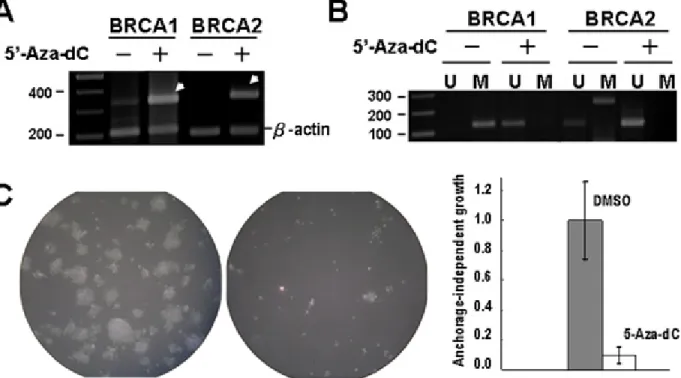
determine whether BRCA1 and BRCA2 promoter methylation could be further linked to the loss of gene expression, CL1-5F4 NSCLC cell, which showed negative expression and promoter hypermethylation of the BRCA1 and BRCA2 genes, were treated with the demethylating agent 5’-aza-2’-deoxycytidine (5’-Aza- dC). As shown in the Fig. 1A and 1B, 5-Aza-dC successfully restored mRNA and protein expression and de-methylated the promoter region in the cells that lacked BRCA1 and BRCA2 expression and that harbored a methylated respective promoter. In addition, a significant decrease of anchorage-
independent growth was observed in CL1-5F4 cancer cells re-expressing the BRCA1 and BRCA2 (Fig. 1C).
2 of 4
Research Express@NCKU - Articles Digest
Fig. 1 (A) Effects of 5’-Aza-dC treatment on mRNA expression and (B) demethylation of BRCA1 and BRCA2 in CL1-5-F4 NSCLC cells. The absence of the M product after 5’-Aza-dC indicates the
demethylation of the promoter in these cell lines. (C) The anchorage-independent tumorigenic assay of CL1-5F4 cells treated with 5’-Aza-dC. The left panel shows the photographic views for colony formation;
the right panel is the counted ratio of colony number between DMSO control and 5’-Aza-dC treated cells.
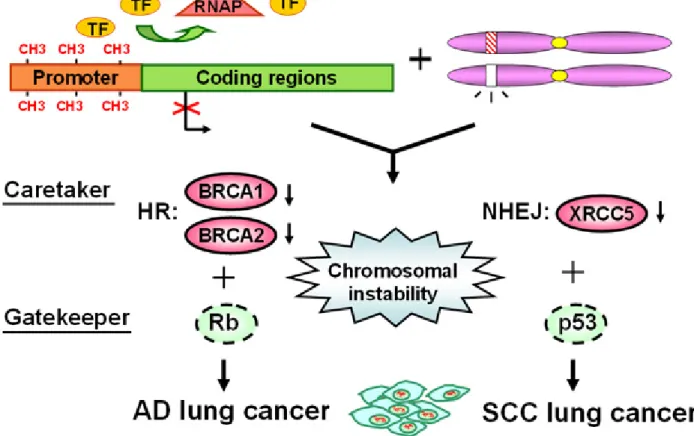
Low levels of BRCA1/BRCA2 and XRCC5 protein expression occurred specifically in primary AD and SCC lung tumors, respectively (Table 1). In addition, low BRCA1 expression was significantly associated with low RB expression, especially in AD-type lung cancer. Concurrent alterations in XRCC5 and p53 were the most frequent profile in smoking NSCLC patients (Table 2). We therefore hypothesized a model in which alteration of the DSB repair pathway, perhaps by interacting with p53 and RB deregulation, is important in the pathogenesis of a subset of NSCLC. The function of these “gatekeepers” (p53 and Rb) and “caretakers” (XRCC5 and BRCA1/BRCA2) in regulating the cellular response to DSB in NSCLC warrants further investigation (Fig. 2).
3 of 4
Research Express@NCKU - Articles Digest
Fig. 2. Possible defects of the DSB repair pathway involved in lung tumorigenesis. Low mRNA/protein expressions of the BRCA1, BRCA2, and XRCC5 may result from mainly promoter hypermethylation and partly from LOH. The alteration of HR repair pathway (BRCA1 and BRCA2), perhaps by interacting with RB deregulation, is important in the pathogenesis of AD lung cancer, whereas the alteration of the NHEJ (XRCC5), by interacting with p53 deregulation, is important in SCC lung cancer.
4 of 4