國立臺灣大學電機資訊學院資訊網路與多媒體研究所 碩士論文
Graduate Institute of Networking and Multimedia College of Electrical Engineering & Computer Science
National Taiwan University Master Thesis
利用不對稱溝通概念的實驗性遊戲
Human and Dog : An Experiment on Unequal
Communication Mechanic
周冠廷
Kuan-Ting Chou
指導教授:陳彥仰博士
Advisor: Mike Y. Chen, Ph.D.
中華民國
105
年6
月June 2016
誌謝
首先誠摯的感謝指導教授陳彥仰博士,在研究所期間的悉心指導使 我得以一窺人機互動領域的門徑。討論時循循善誘的引導方式,讓我 在研究上獲益匪淺。在實驗室的這段時間老師以身作則的示範了許多 世界級的做事方式是我將來學習的典範。
本論文的完成另外亦得感謝侯信丞、王權、陳德元、劉軒齊、吳沛 容及沈昊平等人的大力協助,因為有你們的體諒與幫忙,才使得本論 文能夠完整而嚴謹。
在台大人機互動實驗室的兩年,我有幸跟世界上最頂尖的一群天才 創造了許多回憶,認真的學術討論、趕死線時的革命情感.... 這些是我 們之間不可取代的羈絆。感謝眾位學長姐、同學、學弟妹的共同砥礪,
你/妳們的陪伴讓我兩年的研究生活變得多采多姿。
感謝王瀚宇學長的過去遊戲製作技巧的指導以及跟我討論過的所有 想法,對我這兩年的研究生活影響深遠。也感謝李柏緯、梁翔勝等學 長姐的教導,讓我學會了許多不一樣的技能,也感謝王權、修敏傑、
林哲瑋、邵元輔的互相勉勵與一起合作過的 projects,這些經驗成就 了現在的我,以及恭喜我們順利度過這兩年。而其他實驗室的學弟妹,
我也從你們身上學到很多,不管是精神面還是技能面,期許你們未來 也能順利畢業。
最後再次感謝我在研究所的這段時間所遇到的所有人,是你們成就 了這篇論文的每字每句。
摘要
不對等溝通像是某種語言的流利度不夠可能會是種尷尬的經驗在現 實生活中。然而,就遊戲而言,不對等溝通的機制能夠使遊戲變得更 具挑戰性與趣味性。比手畫腳是一個典型的例子,遊戲方式是其中一 個玩家嘗試透過肢體語言表達其意思,而其他玩家嘗試去猜謎底。不 同於現今大多數的電子合作遊戲,它們採納的大都為對等溝通的機制,
而我們想嘗試加入不對等溝通機制於電子合作遊戲中。因此,我們設 計了一款遊戲,角色為一個人與一隻狗,在不對等溝通的狀況下去解 決一連串的謎題。最終,我們執行了一個實驗來評估我們的遊戲。從 觀察中,我們發現了許多有趣的溝通模式以及提出了一些潛在的設計 議題供未來作參考。
Abstract
Inequality of communication capabilities may cause an awkward ex- perience in real life. However, in terms of gaming, this can be a chal- lenging and interesting mechanic.Charades[1], where one player tries to express a word via body language while others try to guess it, is a good example of such cases. Different from most digital co-op games, which equal communication mechanics have been widely used, we experiment with this unequal communication mechanic. Thus, we have designed a digital co-op game called Human and Dog, in which 2 avatars, a hu- man and a dog, communicate to solve a series of puzzles with unequal communication capabilities. Ultimately, we conducted an experiment to evaluate our game. Several interesting patterns were discovered from our observation. We then concluded some design suggestions from our collected data for future reference.
Contents
誌謝 i
摘要 ii
Abstract iii
1 Introduction 1
2 Related Work 2
3 Game Design 4
4 Level Design 6
5 Study Design 9
6 Result 10
7 Communication Patterns 13
8 Discussion 16
9 Conclusion 18
Bibliography 19
List of Figures
4.1 (a): The keypad from dog’s view. (b): The clue on the nearby desk.
(c): The name that can only be seen by dog. . . 7
4.2 (a) & (b): The modified 8-puzzle seen on the side of human and dog, respectively. (c): The passage that only the dog can pass through. . . 8
4.3 (a) The auxiliary items: poker cards and periodic table. (b) & (c): The mushroom in the dog’s and the human’s view respectively. . . 8
6.1 The level of enjoyment in each puzzle. . . 11
6.2 The level of difficulty on communication in each puzzle. . . 11
6.3 The level of overall difficulty in each puzzle. . . 12
Chapter 1 Introduction
Cooperative design has been an integral part of many digital games, and one of the core mechanics is communication. Digital games with equal communication patterns can be widely seen, most of which adopt voice or text chat. Others employ body language like Mute Robot[8] and Way[4] or pre-defined symbols like Portal 2[3].
On the contrary, cases with unequal communications happen seldom appear in the scenes of digital game design, while such situation does occur in reality when people try to communicate with deaf or mute people but know little about sign language, or even try to communicate with pets. Inspired by these real-world situations, we designed Human and Dog, featuring two protagonists: a human, and a dog.
Each of them has asymmetric advantages that can be utilized to solve certain tasks and communicates with each other through unequal communication capabilities. In order to explore the game design, each puzzle contains different types of information and mechanic for players to communicate. This paper is structured as follows: we first summarize the related works on communication patterns, mechanics, and how challenge affects players. Next, we introduce the game design, including the game mechanics, the game design patterns and the brief sketch of each level. Finally, we describe the experiment used to evaluate our game, present the results, and discuss the findings.
Chapter 2
Related Work
Challenge is considered to be one of the key components of game-play and has been an important research topic. Cox et al. studied how the level of physical and cognitive challenge can affect a player’s experience of immersion and concluded that cognitive challenge may have greater effect on immersion [5]. Iacovides et al.
investigated how players solve challenges and identified some player strategies [9].
Although Knowledge Exchange was considered a co-op strategy in this work, it has become a challenge in our game. Some communication problems like misunder- standing occurred during the experiments and we will discuss how players deal with it in the later section. Both Cox and Iacovides quoted the Flow theory [6], which suggests that flow is achieved because of a balance between the perceived level of challenges and the person’s skills.
Prior works have explored and analyzed co-op game design patterns. Cases of board games have been studied by Hsi et al., where they yielded some interesting findings that may be useful for game designers [11]. This also presented an ontology with a view to analyzing game play [14]. Bjork and Holopainen presented a large quantity of game design patterns [12], including cooperative and social interaction patterns. Rocha et al. presented a framework of several co-op game design pat- terns and analyzed the actual impact of using these game mechanics to design a cooperative video game [10], which is later extended by El-Nasr et al. who pro- posed Cooperative Performance Metrics (CPMs) to evaluate game experiences [7].
Also, Toups et al. analyzed the communication mechanics of 40 co-op games using grounded theory [13], Some of which also emerged in our game: environment mod- ifying mechanic appeared in the form of players using auxiliary items to represent their message in the last puzzle. Emergent mechanic means players extend certain mechanic for communication usage. Jumping is an example and we will discuss how it was used in the later section. Express/emotional means that some mechanics con- tain the emotional meaning such as gesture and body language. This phenomenon was also identified in our game.
Chapter 3 Game Design
Our game is a two-player co-op puzzle-solving game built with Unity3D [2]. The game involves two players with two consoles connected via Internet. To enhance the interaction, we adopted two cooperative game design patterns, Complementarity and Information Asymmetry. Complementarity, defined by Rocha et al. [10], implies that players play different roles to complement each others’ activities in the game.
Information Asymmetry indicates that different players would acquire and perceive different information during gameplay. Furthermore, the most important mechanic of our game is unequal communication. We experiment this mechanic with two characters, a human and a dog character described below:
• Human Character
Human is pretty good at doing intricate moves like typing, using tools or oper- ating mechanism with their own hand. So this character is mainly responsible for the interactive part of solving puzzles. Also, this character can directly communicate with the other player using verbal language.
• Dog Character
Dog is usually considered having a different range of sensing capabilities such as olfaction and vision. So it is mainly responsible for collecting clues critical to the puzzles. Also, its smaller figure allows it to pass through narrow areas.
In the story of our game, the dog was transformed from a human. Although
it can understand what the human is saying, its expressing capabilities are limited to 4 different kinds of vocal patterns (whine, howl, bark, and anger.)
Chapter 4 Level Design
Our goal for the levels is to explore the game design with different information and mechanics and examine how players communicat. Below are the sketches of the levels:
1. Symbolic information problem:
Players have to get the password of a door and type in on the numpad on the wall. The dog can get the digits of the code by sniffing around, and the human needs to figure out the permutation with a clue on a desk. (Figure 4.1 (a) and (b))
2. Discrete spatial information problem
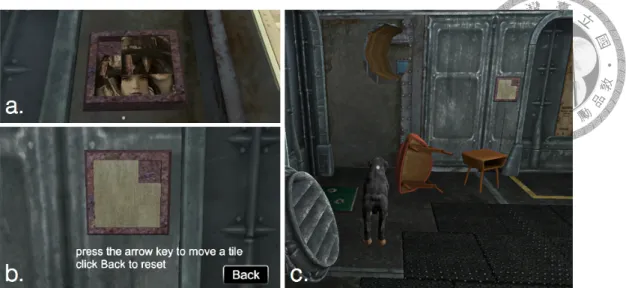
This problem consists of two parts. The first is to look for a narrow secret passage way that only the dog can get through. After the dog passes through the passage, both players have to communicate in different rooms to solve the second part of the puzzle. (Figure 4.2 (c)) The second part is a modified 8- puzzle where the back side faces the human and the normal side faces the dog.
Therefore, the dog should instruct the human to move the tiles. (Figure 4.2 (a) and (b))
3. Continuous spatial information problem
This part is a first person shooting game for the human to destroy 3 invisible mushrooms. The human would understand the goal by reading a piece of note
on a nearby table. These mushrooms are invisible to the human, yet visible to the dog. (Figure 4.3 (b) and (c)) The dog should show the locations of the mushrooms for the human to shoot at to complete the level.
4. Auxiliary items represented information problem
In the last level, players are provided with a set of poker cards and a periodic table.(Figure 4.3 (a)) A name written on the floor can only be discovered by the dog, (Figure 4.1 (c)) and it is the password for a computer which can only be operated by the human.
Figure 4.1: (a): The keypad from dog’s view. (b): The clue on the nearby desk.
(c): The name that can only be seen by dog.
Figure 4.2: (a) & (b): The modified 8-puzzle seen on the side of human and dog, respectively. (c): The passage that only the dog can pass through.
Figure 4.3: (a) The auxiliary items: poker cards and periodic table. (b) & (c): The mushroom in the dog’s and the human’s view respectively.
Chapter 5 Study Design
In order to understand user behaviors and the gaming experience, 16 participants were recruited (F=5;M=11;Age=20 to 27). Before the game, game rules and oper- ations for both players were introduced. The avatars were randomly assigned and the duration of game-play was around 40 to 50 minutes. After the game, partici- pants filled up a questionnaire about their gaming habits and a 5-point Likert-scale questionnaire for their gameplay experience of Human and Dog such as difficulty and enjoyment. A short semi-structured interview is also conducted to understand their strategies, communication protocols, and behaviors in certain situations.
Chapter 6 Result
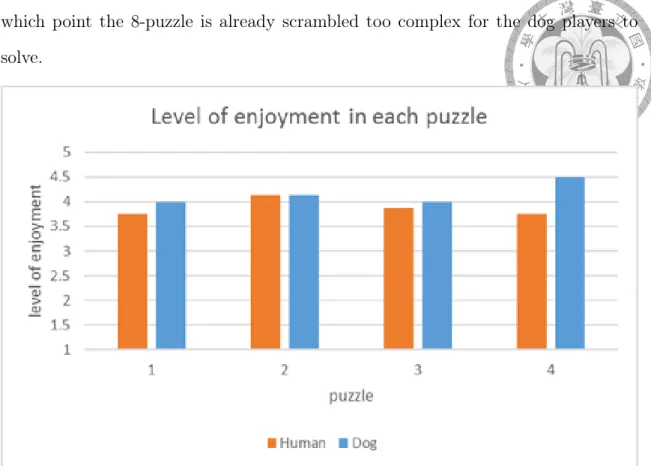
We received overall positive feedbacks from the participants. Average enjoyment of each puzzles is all rated high (above 3.75 out of 5.0). (Figure 6.1) Although there is no significant difference between puzzles within subject comparison among all metrics, some explanation can still be made based on the consistent proportion of the collected data. As for overall difficulty, six out of eight human players rate puzzle 2 as the most difficult. They thought the puzzle design is a little too hard for them to figure out even they with the hint saying "Maybe there is a similar sliding mechanism behind this wall." They thought the most confusing part is the mirroring design, as the space is at the upper-left position in figure 2(a) while at the upper-right position in figure 2(b) (Figure 4.2 (a) and (b)). Four out of eight human players considered puzzle 3 as the most easiest one because it contains the lowest level of cognitive challenge. In terms of enjoyment, six out of eight dog players rated puzzle 4 the most interesting one. This is because they had the most expressing capabilities and interactive mechanics among all puzzles, which made them feel more active. In terms of difficulty on communication, five out of eight dog players thought puzzle 2 was the most difficult one. One of the reasons was that the human players could only imagine what the puzzle may look like behind the wall and the mirroring design would make the human players think there is a complex mapping of it. The other reason was that some human players would play around the puzzle before they realize they need to communicate with the dog players, at
which point the 8-puzzle is already scrambled too complex for the dog players to solve.
Figure 6.1: The level of enjoyment in each puzzle.
Figure 6.2: The level of difficulty on communication in each puzzle.
Figure 6.3: The level of overall difficulty in each puzzle.
Chapter 7
Communication Patterns
After the experiments, various communication patterns are identified as listed below:
1. Mapping dog vocal patterns to certain meanings
At the beginning of the game, most players would settle down the mapping of positive and negative. Some distinguish positive and negative by the number of voice or by the 4 vocal patterns of the dog. For example, “If the answer is yes, bark once; otherwise, bark twice.” For another example, “If it’s yes, bark; otherwise, whine or use the angry voice.” In the first puzzle, some of the human players would map the digits by the times of barking to represent a digit or ask a yes-no question about whether the next digit is a certain number. In the second puzzle, most of the human players would map the next direction to the number of dog voice or a kind of voice. A few would map the position of a tile to the number of barks. In the third puzzle, the human players may iteratively correct their aiming direction by asking “Should I aim upward,downward,leftward or rightward” and shoot until they have shot a target. We also discovered that some dog players would use the vocal patterns usually considered with negative emotional meaning to express the human player has misunderstood what the dog players intended to express.
down possibilities. For example, in puzzle 3, the human players would ask “Is the mushroom on the ground?”. In the last puzzle, the human players would ask how long the name is first and when they were communicating via the periodic table, some of the human players would ask “Is the element in the first group?”.
3. Taking turns in the lead
Most of the time, the human players would take the lead. However, the dog may discover key information of the puzzle first, and it would try to draw attention from the human with its sound. For instance, in the third puzzle, the human did not know the locations of the mushrooms so they would let the dog lead the way. In the last puzzle, some of the dog players would actively pick the cards and the human players would guess what the dog managed to convey.
4. Body Language Expression
Except the dog would express the information with its sound, it may also use certain kinds of body language. For example, in the third puzzle, the human players would guess the location of a mushroom based on the direction the dog faced. Some of the dog players would use jumping to indicate there is something around its current location or something on the wall with higher position. For example, in the last puzzle, the dog player would use jumping to express that the element with smaller atomic number is in the group aligned with the dog’s location.
5. Communicating with auxiliary items
In the last puzzle, poker cards and a periodic table were provided to help communicate. Players would use poker cards to represent a number. Two kinds of behavior were found. One is the representation of separate digit, while the other is that id the total value. In addition, the number would be the order of an alphabet in the name or the atomic value of an element, which
further represent some alphabets in the name. Other interesting mappings were also discovered like using a suits of cards to represent the group number of elements and another one to represent the period of elements.
Chapter 8 Discussion
After observing the game-play and the interviews, we have found some game issues under the unequal communication mechanic.
1. Narrowing the information gap
Although Information Asymmetry is pretty common in many cooperative games, there is a challenge in our communication mechanism which requires the human player iteratively ask questions to shape his own understanding of the information the dog player has. If the human players is not good at this kind of communication or the information is way beyond his understanding, they would feel frustrated. To address this issue, there are two approaches.
The first is to place a hint to help human players shape their understanding.
The other one is enhancing the communication capability of dog players under the no-direct-voice constraint, such as visualizing where the dog is looking at while it is barking.
2. Avoiding making a over-complex puzzle
In the second puzzle, some human players have pretty diverse imagination of what the dog saw at the other side of the room. The information gap seemed to be too large. Hence, even a hint provided to the human players won’t do too much favor. We recommend don’t make a puzzle so complex that it is way beyond one of player’s understanding and the other player’s expressing
capabilities.
3. Avoiding repetitive tasks for players
After the quantitative analysis, we found that there is a positive correlation between the enjoyment of the dog and the overall difficulty of that in each puz- zle, but a drop between the enjoyment of the human and the overall difficulty of the human in the last one. A possible reason may be that repetitive tasks are needed to solve this puzzle (i.e. asking for the alphabet), which lowers the enjoyment. This can also explain why the second puzzle has the highest enjoyment within the four, where the answer is the shortest (4 steps to solve the puzzle), and requires the least queries.
Chapter 9 Conclusion
In this paper, we present a game experiment about unequal communication me- chanics, which few games have explored before. We explored the game design with the information type and conducted an study to evaluate our game and understand players’ behavior and experience. Finally, we identified various communication pat- terns and addressed some game issues for future reference. We hope to see more future work experimenting with this mechanic.
Bibliography
[1] Charades. Wikipedia. Retrieved January 2, 2016 from https://en.
wikipedia.org/wiki/Charades.
[2] Unity. unity3d. http://unity3d.com/, 2005.
[3] Portal 2. http://www.thinkwithportals.com/, 2011.
[4] Way. http://www.makeourway.com/, 2011.
[5] A. Cox, P. Cairns, P. Shah, and M. Carroll. Not doing but thinking: The role of challenge in the gaming experience. In Proceedings of the SIGCHI Conference on Human Factors in Computing Systems, CHI ’12, pages 79–88, New York, NY, USA, 2012. ACM.
[6] M. Csikszentmihalyi. Flow: the psychology of optimal experience. Harper- Perennial, New York, 1991.
[7] A. El-Nasr, E. Milam, M. Lameman, and S. Mah. Understanding and evaluating cooperative games. In Proc. CHI 2010. ACM SIGCHI, 2010.
[8] C.-Y. Hsu, Y.-C. Tung, W.-H. Wang, and H.-Y. Wang. Mute robot: Cooper- ative gameplay through body language communication. In CHI ’14 Extended Abstracts on Human Factors in Computing Systems, CHI EA ’14, pages 281–
284, New York, NY, USA, 2014. ACM.
[9] I. Iacovides, A. L. Cox, A. Avakian, and T. Knoll. Player strategies: Achieving
Interaction in Play, CHI PLAY ’14, pages 131–140, New York, NY, USA, 2014.
ACM.
[10] R. P. J. B. Rocha, S. Mascarenhas. Game mechanics for cooperative games. In ZDN Digital Game, 2008.
[11] I. H. J. P. Zagal, J. Rick. Collaborative games: Lessons learned from board games. In Simulation and Gaming, vol.37, pages 24–40, 2006.
[12] J. H. S. Björk. Patterns in game design. California, USA: Charles River Media, 2004.
[13] Z. O. Toups, J. Hammer, W. A. Hamilton, A. Jarrah, W. Graves, and O. Gar- retson. A framework for cooperative communication game mechanics from grounded theory. In Proceedings of the First ACM SIGCHI Annual Sympo- sium on Computer-human Interaction in Play, CHI PLAY ’14, pages 257–266, New York, NY, USA, 2014. ACM.
[14] F.-V. Zagal, Mateas and L. Hochhalter. Towards an ontological language for game analysis. In Digital Interactive Games Research Association Conference (DiGRA 2005), 2005.