補助優秀新進教師學術研究計畫成果報告
「量子點量子位元在非馬可夫過程下的動態研究」
年度編號:970114
會計編號:D97-3200
執行期間: 97 年 3 月 1 日至 98 年 2 月 28 日
計畫主持人:陳岳男 (物理系)
中 華 民 國 98 年 2 月 28 日
中文摘要
在執行完研究計畫後,已獲致不錯的成果:首先,我們已先算出在p-i-n junction 中
的量子點偶合到非馬可夫的環境時,其量子散粒雜訊可能會從sub-Poissonian 的行為轉變
成super-Poissonian 的行為。另外呢,我們也考慮了雙量子點 p-i-n junction 在一維光子晶 體波導管中之光子延遲效應,這類型的非馬可夫效應也可以由分析量子散粒雜訊的訊號 去區分出來。在此計畫的資助下,已發表四篇論文在國際期刊。
關鍵詞:量子點、量子傳輸、非馬可夫過程。
Abstract
Nonequilibrium current noise is calculated for a quantum dot embedded inside a p-i-n junction. An additional term from non-Markovian effect is obtained in the derivation of noise spectrum. In addition, we also propose to observe the retardation effect between two quantum dots in a one-dimensional waveguide. The effect of retardation is more pronounced comparing to that in free space. If the photons are to be reflected by a mirror at one of the ends, the interference role played by the reflecting photon is found to be destructive. With the combination of p-i-n junction, the retardation effect can be read out via current-noise spectrums.
Keywords: Quantum Dots, Quantum Transport, non-Markovian process.
目錄
1. 前言……… ………4.
2. 研究目的……… ………6
3. 研究方法……… ………7
4. 結果與討論……… …....11
5. 成果……… ……..14
6. 附件……… …..15
1. 前言
In the last decade, great attentions have been focused on the development and advancement of the field of quantum information science. Even though, a few large obstacles still remain in building a real quantum computer. The most formidable difficulties are, for instance, the generation of high degree of the quantum entangled states and the precise readout of qubits. In recent years, significant progress has been made towards the few-qubits quantum operations in quantum-optics and atomic systems [1]. Nevertheless, solid-state quantum computation is still the favorite choice for the reason of the scalability of quantum processor [2]. Among the various candidates for quantum information processing, semiconductor quantum dot (QD) is an attractive candidate due to its direct analogous to a real atom with discrete energy levels.
In fact, QDs are semiconductor structures containing a small number of electrons (1 ~ 1000) within a region of space with typical sizes in the sub-micrometer range. Many properties of such systems can be investigated by transport, e.g. current-voltage measurements, if the dots are fabricated between contacts acting as source and drain for electrons which can enter or leave the dot. In contrast to real atoms, QDs are open systems with respect to the number of electrons N which can easily be tuned with external parameters such as gate voltages or magnetic fields. For example, by changing the size and the shape of the dot with external gate voltages, one can realize dots as artificial atoms, with the possibility to ‘scan through the periodic table’ by adding one electron after the other within one and the same system. In fact, quantum effects such as discrete energy levels (atomic shell structure) and quantum chaos (as in nuclei) are observable in a controlled manner in QDs [3]. Moreover, the experiments can be conducted in a regime, which usually is not accessible to experiments with real atoms. For example, a singlet–triplet transition should occur in real helium atoms for magnetic fields such large as of the order of 105T, as they occur only in the vicinity of white dwarfs and pulsars [4]. Inartificial atoms, which have a much larger size than real atoms, much smaller magnetic fields are sufficient to observe such effects.
Coupling of two QDs leads to double QDs which in analogy with atomic and molecular physics sometimes are called ‘artificial molecules’, although this terminology can be somewhat
misleading: in the strong Coulomb blockade limit, double QDs are better described as two-level systems with controllable level-spacing and one additional transport electron, which rather suggests the analogy with a simple model for an atom, in particular if it comes to interaction with external fields such as photons or phonons. Several groups have performed transport experiments with double QDs, with lateral structures offering experimental advantages over vertical dots with respect to their tunability of parameters [5].
Recently, Fujisawa and co-workers [6] performed a series of experiments on spontaneous emission of phonons in a lateral double QD. Their device was realized in a GaAs/AlGaAs semiconductor heterostructure within the two-dimensional electron gas. Focused ion-beams were used to form in-plane gates, which defined a narrow channel of tunable width. The channel itself was connected to source and drain electron reservoirs and on top of it, three Schottky gates defined tunable tunnel barriers for electrons moving through the channel. The application of negative voltages to the left, central, and right Schottky gate defined two QDs (left L and right R), which were coupled to each other, to the source, and to the drain. The tunneling of electrons through the structure was sufficiently large in order to detect an electron current yet small enough to provide a well-defined number of electrons (~ 15 and ~ 25) on the left and the right dot, respectively. The Coulomb charging energy (~ 4 meV and ~ 1 meV) for placing an additional electron onto the dots was the largest energy scale, see Fig. 1.
Fig. 1
From the experimental findings, Fujisawa et al. concluded that the coupling to a bosonic
environment was of key importance in their experiment. They further confirmed it is acoustic phonon, instead of photon, responsible for the spontaneous emission as the electron transport from the left to the right QD. Right after the publication of this experiment, T. Brandes and B.
Kramer reported the theoretical calculations, which fit the experimental data very well, on this double dot device [7]. In their model, although the electron-phonon interaction was treated with a non-Markovian way, only the stationary state current was present. Discussions on the qubit dynamics are still lacking. Besides, the couplings between the QDs and the electronic reservoirs on both sides are treated in an ideal Markovian limit, in which some important physics might be lost. Actually, in a previous work by Gurvitz [8], a Lorentzian form of coupling was considered, and it was found Zeno and Anti-Zeno like effects may be observed.
2. 研究目的
T the aim of present project is to develop a theory for the dynamics of qubits. Primary examples are coupled semiconductor QD qubits. The theory will be developed with the goal to be applicable to the non-Markovian couplings from both the reservoirs and measurements. The following summarizes the primary objectives of the research.
to develop a non-Markovian theory for the dynamics of a QD qubit coupled to the bosonic (phonon) environment and external measurements.
to extend the single qubit case to the two-qubit one, in which the entanglement dynamics will be investigated thoroughly from the analyzing of concurrence.
to work out the optima conditions for useful quantum operations under the influences of the non-Markovian couplings.
Reference
[1] T. Pellizzari, S. A. Gardiner, J. I. Cirac, and P. Zoller, Phys. Rev. Lett. 75, 3788 (1995); J. I.
Cirac and P. Zoller, Phys. Rev. Lett. 74, 4091 (1995).
[2] A.T. Costa, Jr. and S. Bose, Phys. Rev. Lett. 87, 277901 (2001); W.D. Oliver, F. Yamaguchi, and Y. Yamamoto, Phys. Rev. Lett. 88, 037901 (2002).
[3] L. Kouwenhoven, C. Marcus, Phys.World (1998) 35.
[4] W. Becken, P. Schmelcher, F. Diakonos, J. Phys. B 32 (1999) 1557; S. Jordan, P.
Schmelcher, W. Becken,W. Schweizer, Astron. Astrophys. 336 (1998) L33 8; see also
Physikalische Blatter 55(11) (1999) 59 (inGerman).
[5] W.G. van der Wiel, S. De Franceschi, J. M. Elzerman, T. Fujisawa, S. Tarucha, L. P.
Kouwenhoven, Rev. Mod. Phys. 75, 1 (2003).
[6] T. Fujisawa, T. H. Oosterkamp, W. G. van der Wiel, B. W. Broer, R. Aguado, S. Tarucha, L. P. Kouwenhoven, Science 282 (1998) 932.
[7] T. Brandes and B. Kramer, Phys. Rev. Lett. 83, 1999 (2000).
[8] B. Elattari and S. A. Gurvitz, Phys. Rev. Lett. 84, 2047 (2000).
[9] T. Hayashi, T. Fujisawa, H. D. Cheong, Y. H. Jeong, and Y. Hirayama, Phys. Rev. Lett. 91, 226804 (2003).
3. 研究方法
Master Equation without Markovian approximaton:
In the cases we are interested, the quantum systems are coupled to environments, such as bosonic fields or electron reservoirs. Although the environment is affected by the coupling, in general we can assume the coupling is weak, and the environment remains unchanged. This assumption will allow us to derive the master equation in a simple fashion.
Following the derivation of Y. Yamanoto and A. Imamoglu [10], we consider a system S interacting with a reservoir R via interaction V. If we assume initially (t=0) the system and reservoir is uncoupled, the initial density operator ρ(0) is then given by
) 0 ( ) 0 ( ) 0
( S R
.
Time evolution of ρ(t) in the interaction picture obeys the Liouville-von Neumann equation )]
( ), ( 1[ )
( Vint t t
t i dt
d
.
If we further assume the number of degrees of freedom of the reservoir is very large, then the reduced density operator satisfies
)]
( ), ( 1 [
)
( Tr Vint t t t i
dt d
R
S
.
After integration and successive substitution one gets
)]]) ' ( ), ' ( [ ), ( ([
1 ' )
( int int
0 2
t t V t V Tr i dt
dt t d
R t
S
.Usually, it is impossible to solve the above equation exactly, and the Markov approximation is usually employed to solve it. In this project, however, we wish to go beyond this simple
approximation. Therefore, we just expand the commutators directly. In this case, one immediately finds that there are terms contain two-time correlation function, such as Vint(t)Vint(t')(t'). For the double QDs we are interested, the electron-phonon interaction is the main source of decoherence. The interaction term can actually be written as [11]
, ) )(
int
q( q qR q L
q L L R R a a
V
where aq is the creation operator of an acoustic phonon in mode q and q is the electron-phonon coupling matrix element. To this point, one can apply the polaron transformation [12] to above equation, and it turns out that the appearance of the phase operators X, which are products of unitary displacement operator Dq Exp(zaq z*aq).
Therefore, the master equation will contain the terms like, . If the phonon environment is assumed in thermal equilibrium, the boson correlation is described by
, which depends on the time difference only. In this case, one may Laplace-transformed the whole equations into the Z-plane and probably solve them algebraically. To obtain the time-dependent dynamics of the qubit, it is usually a formidable task to perform the inverse Laplace transformation directly. Therefore, we suspect a numerical technique is required to resolve the dynamics at the last stage.
) '
' (t X Xt t
) '
' C(t t
X
Xt t
Non-Markovian coupling from the measurements:
As can be seen from Fig. 1, the left and right dots are coupled to the electron reservoirs.
To deal with the interactions, people usually assume that the chemical potential of the left (right) reservoir is shifted to positive (negative) infinity. In this case, the tunneling of the electron from the dot to the reservoir (or vice versa) can be approximated as an energy-independent tunneling rate, i.e. the Markovian limit. Unfortunately, it is usually not the case for real experiments.
Therefore, in this project, we will consider a more realistic situation: the tunneling density of state (DOS) from the dot to reservoir is energy-dependent. This means the tunneling of the electron is no more Markovian, and the corresponding equations of motions
have to be rewritten. In a previous work by Gurvitz and his co-worker [13], they considered the DOS with a Lorentzian form
4 / )
) (
( 2 2
d D k
d
k
,
where is the reservoir bandwidth. They introduced an auxiliary D-state that corresponds to a resonance state embedded in the reservoir to deal with such a non-Markovian problem.
Borrowing their idea, we will first consider the Lorentzian DOS to solve the dynamics of the qubit. The difference from Ref. [13] is that this Lorentzian DOS may also in return mix with the electron-phonon effect mentioned above. This will certainly increase the complexity of the problem and, of course, the difficulties of the numerical computations.
d
Counting Statistics for Quantum Shot Noise
Up to the present, we mentioned very few about the current-correlations measurements in this proposal. Actually, because electrons share the particle-wave duality with photons, one might expect fluctuations in the electrical current to play an important role. Current fluctuations due to the discreteness of the electrical charge are known as shot noise. Although the first observations of shot noise date from work on vacuum tubes in the 1920s, our quantum mechanical understanding of electronic shot noise has progressed more slowly than our understanding of photon noise. Much of the physical information shot noise contains has been appreciated only recently, from experiments on nanoscale conductors [14], where classical mechanics breaks down. At that scale, shot noise can reveal a rich variety of details about charge transport.
In a quantum conductor in nonequilibrium, electronic current noise originates from the dynamical fluctuations of the current being away from its average. To study correlations between carriers, we will relate the electron dynamics with the reservoir operators by introducing the degree of freedom n as the number of electrons that have tunneled through the barrier [15] and define the expectation values, O(n)
i0,L,RTrbath n,iOˆ(t)n,i with
n
O n
O ( ) . This leads to a system of equations of motion,
) 1 ( ) ( 0 )
( 0
L n R Rn
n n n
n ,
L/R eans the occupation probability of the 0
R or by time t,
n 0 L R )
(t), the shot noise spectrum can be determined from the Mac-Donald formula [16]
) ] [ ( ( ) ( )
) ( 0 / )
( /
L R n C n n
n R
L n iT P P
n ,
where n m L/R dot, n represents the empty state, and
P=∣L>< ∣. Together with the total probability of finding n electrons in the collect P (t)=n (n)(t)+ n (n)(t)+ n (n
] ) ( ) ( [ ) sin(
2 )
SI( 2 2
0
2 n t t I
dt t d dt
e
,efore, a careful and self-consistent treatment of this part will probably be the main difficulty.
oto and A. Imamoglu, Mesoscopic quantum optics (Wiley-Interscience, New
72, 233301 (2005).
where I represents the current.
Notes that in the above calculations, the assumption for the electron tunneling is Markovian.
Since we are interested in the non-Markovian regime, the derivations might be invalid.
Fortunately, in a previous work by Gurvitz and his co-worker [13], they introduced an additional
“auxiliary state” to represents the non-Markovian effect, and the whole formulation for the counting statistics still holds. We will thus adopt their idea and apply it to our two-dot or four-dot device. However, one should also keep in mind that in our case there is another non-Markovian source form the dissipative (phonon) environment. Ther
Reference
[10] Y. Yamam York, 1999).
[11] T. Brandes, Phys. Rep. 408, 315 (2005).
[12] G. D. Mahan, Many-Particle Physics, (Plenum, New York, 1990).
[13] B. Elattari and S. A. Gurvitz, Phys. Rev. Lett. 84, 2047 (2000).
[14] Y. M. Blanter and M. Buttiker, Phys. Rep. 336, 1 (2000).
[15] Y. N. Chen, D. S. Chuu, and S. J. Cheng, Phys. Rev. B
onald, Rep. Prog. Phys. 12, 56 (1948).
[16] D. K. C. MacD
4. 結果與討論
I. Proposal for detection of non-Markovian decay via current noise
We propose to detect non-Markovian decay of an exciton qubit coupled to multimode bosonic reservoir via shot-noise measurements. Nonequilibrium current noise is calculated for a quantum dot embedded inside a p-i-n junction. An additional term from non-Markovian effect is obtained in the derivation of noise spectrum. As examples, two practical photonic reservoirs, photon
acuum with the inclusion of cut-off frequency and surface plasmons, are given to show that the noise may become super-Poissonian due to this non-Markovian effect. Utilizing the property of super-radiance is further suggested to enhance the noise value.
v
Fig.1 Schematic view of a QD p-i-n junction with its exciton coupled to a bosonic environment.
II. Proposal for observation of retardation effect between two quantum dots via current noise
We propose to observe the retardation effect between two quantum dots in a one-dimensional waveguide. The effect of retardation is more pronounced comparing to that in free space. If the photons are to be reflected by a mirror at one of the ends, the interference role played by the reflecting photon is found to be destructive. With the combination of p-i-n junction, the retardation effect can be read out via current-noise spectrums.
.2 (a) Schematic view of the two dots embedded in a p-i-n junction such that the electron an o QD 2. (b) Current-noise spectrums of the system with
Fig d
hole can tunnel int (black line) and
without (green line) the consideration of retardation.
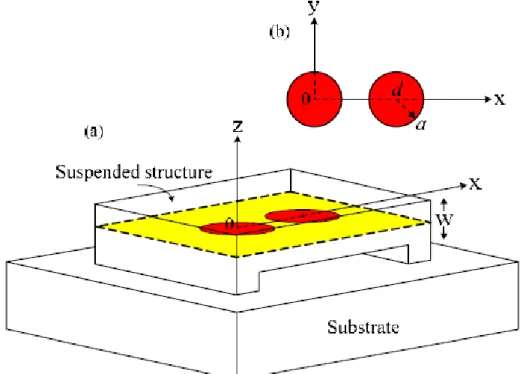
III. Decoherence of a charge qubit embedded inside a suspended phonon cavity
honon coupling. Such a system with low decoherence may be useful for manipulating the qubits.
This study elucidates the theory of phonon-induced decoherence of a double dot charge qubit that is embedded inside a suspended semiconductor slab. The influences of the lattice temperature, width of the slab, and positions of the dots on the decoherence are analyzed. Numerical results indicate that the decoherence in the slab system is weaker than that in a bulk environment. In particular, the decoherence is markedly suppressed by the inhibition of the electron-p
Fig.3(a) Schematic view of a DQD embedded in a suspended semiconductor slab with a width of w. (b) The top view shows that two identical dots are performed with the dot radii of a and
interdot distance of d.
Fig. 4 Quality factor Q as a function of tunneling coupling for slab and bulk systems (upper inset). The temperatures are T=20 mK (black solid line), 200 mK (red dashed line), and 400 mK
(blue dotted line), respectively. A drastic enhancement of quality factor is found to be independent of temperature (arrow).
5. 成果
I. Invited Talks
1. 2nd International Workshop on Solid State Quantum Computing (June 25 ~ June 28, 2008, Taipei)
2. University of Freiberg (July 2009, Germany) II. Publications
Journals
1. Spontaneous emission of quantum dot excitons into surface plasmons in a nanowire, Opt. Lett. 33, 2212 (2008); G. Y. Chen, Y. N. Chen*, and D. S. Chuu.
2. Proposal for observation of retardation effect between two quantum dots via current noise, Appl. Phys. Lett. 93, 132101 (2008); Yueh-Nan Chen* and Lukas Gilz.
(Selected as the Cover Image for APL Sep. 29, 2008)
3. Proposal for detection of non-Markovian decay via current noise, Phys. Rev. B 77, 035312 (2008); Yueh-Nan Chen* and Guang-Yin Chen.
4. Decoherence of a charge qubit embedded inside a suspended phonon cavity, Phys. Rev. B 77, 033303 (2008); Y. Y. Liao, Y. N. Chen, W. C. Chou, D. S. Chuu.
In summary, we have successfully worked out the shot-noise spectrums of a QD coupled to the non-Markovian environment. As expected, the current noise indeed reflects the characteristic of the non-Markovian feature. Moreover, I have also extended its applications in detecting the retardation effect of the photons in a photonic crystal.
These findings are very interesting, and have attracted attention. For example, our work was selected as the cover image for Appl. Phys. Lett., Sep. 29, (2008). I believe it certainly has important impact in the field of quantum information science.
附件一