Chapter Four Results and Discussion
The first research question aimed to explore the effect of keeping oral-written dialogue journals on overall English speaking proficiency. To answer this question, the GEPT high intermediate speaking test was conducted as the pre- and post-test, followed by the statistical analysis of t-test. The second research question further investigated the improvement in speaking fluency, grammatical accuracy, and vocabulary richness. It would be answered on the basis of the findings of quantitative analysis and qualitative inquiry including the results of the first and second speaking learning logs as well as the interview. The third research question attempted to examine the subjects’ perceptions of this activity. We could get the picture based on the analysis of the first and second speaking learning logs and the interview.
4.1 Results
In order to answer the research questions in this study, three sources of data were presented to help understand the effect of this activity on speaking English and the subjects’ perceptions of this activity. The followings included statistical analysis of performance data, the results of speaking learning logs, and the interview results.
4.1.1 Statistical analysis of performance data
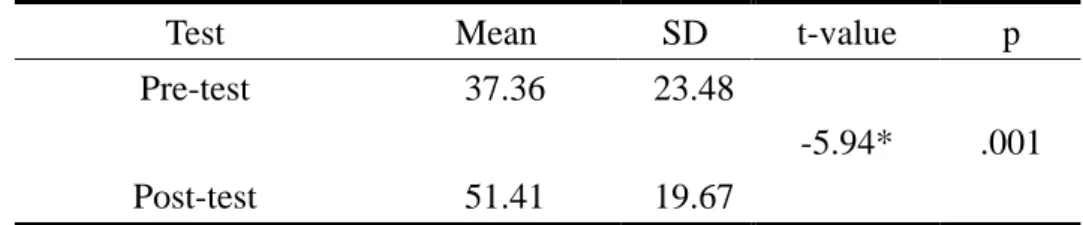
The GEPT high intermediate speaking test was conducted to evaluate the subjects’ entry levels as well as their speaking proficiency after the three-month experiment. The results of pre- and post-test were analyzed with t-test (repeated measure). It was shown that the overall English speaking proficiency was significantly different between pre-test and post-test (Table 4.1); that is, the subjects’
speaking performance had improved.
Table 4.1 T-test of pre- and post-test (N=11)
Test Mean SD t-value p
Pre-test 37.36 23.48
-5.94* .001
Post-test 51.41 19.67
*p< .05
For each subject the transcriptions of six oral journals extracted from three different stages (entry, mid, and end) were compared. The one-way ANOVAs (repeated measure) were conducted to examine if there were significant differences in the oral journals in three different periods (entry, mid, end) in terms of fluency judged from speaking rate, number of pauses, ratio of pause time to total speaking time, average speaking runs and number of repetitions.
First, concerning the speaking rate (words per minute), the results, as shown in Table 4.2 and 4.3, revealed that, the subjects’ oral performance was found to be significantly different through keeping oral-written dialogue journals. Since the results reached significance, Tukey method was used for further comparison, as shown in Table 4.4. The speaking rate was found higher at the end of this project than that in the beginning and mid stages of this activity, while there was no difference between the oral journals in the beginning and mid stages.
Table 4.2 Speaking rate (N=11)
Stage Mean SD
Entry 51.842 16.383
Mid 53.218 11.305
End 62.788 13.851
Table 4.3 Summary table of analysis of variance on speaking rate
Source SS df MS F p
Between Groups 4681.07 10 Within Groups 1981.58 22
Period 782.09 2 391.05 6.52* .007
Residual 1199.49 20 59.97
Total 6662.65 32
*p< .05
Table 4.4 Posterior comparison of speaking rate Period Entry
(M=51.84)
Mid (M=53.22)
End (M=62.79)
Entry 1.38 10.95*
Mid 9.57*
End
*p < .05
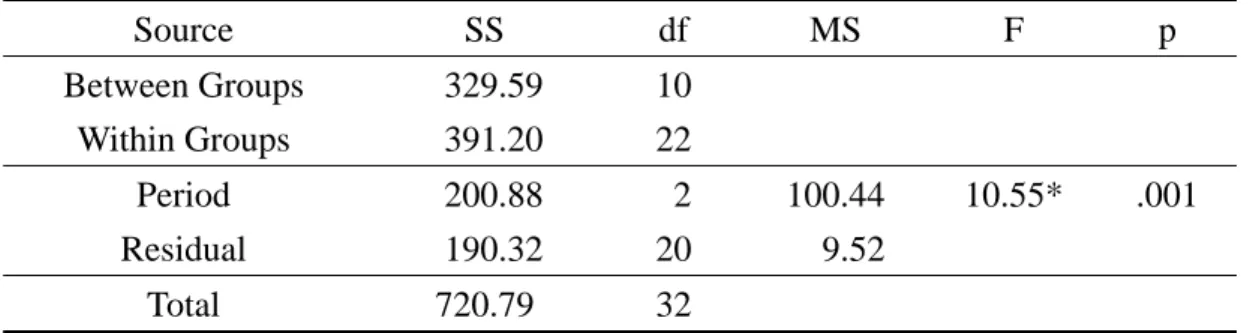
Second, a significant difference was found between the oral journals in the three periods with regard to the number of pauses per one hundred words, as displayed in Table 4.5 and 4.6. Because the result reached significance, a posterior comparison is necessary. As shown in Table 4.7, the number of pauses in the entry journals was higher than that in the mid and end journals while no significant difference was found in the number of pauses per one hundred words between mid and end stages.
Table 4.5 Number of pauses per 100 words (N=11) Stage Mean SD
Entry 17.520 5.203
Mid 13.725 3.305
End 11.549 3.741
Table 4.6 Summary table of analysis of variance on number of pauses per 100 words
Source SS df MS F p
Between Groups 329.59 10 Within Groups 391.20 22
Period 200.88 2 100.44 10.55* .001
Residual 190.32 20 9.52
Total 720.79 32
*p < .05
Table 4.7 Posterior comparison of number of pauses per 100 words Period End
(M=11.55)
Mid (M=13.73)
Entry (M=17.52)
End 2.18 5.97*
Mid 3.79*
Entry
*p < .05
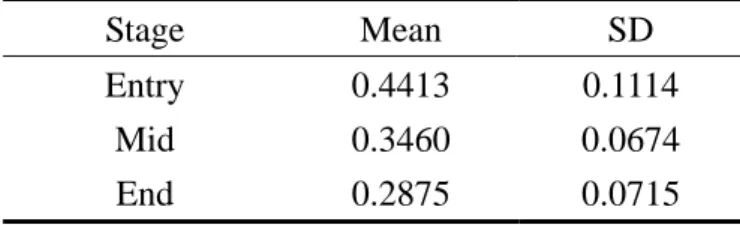
Third, as identified by the statistical analysis in Table 4.8 and 4.9, the oral journals at entry, mid and end stages exhibited significant difference in ratio of pause time to total speaking time. Since the result reached significance, Tukey method was used for further comparison, as shown in Table 4.10. The percentage of pause time in entry oral journals was higher than that in mid and end oral journals, while there was no significant difference between mid and end oral journals.
Table 4.8 Ratio of pause time to total speaking time (N=11) Stage Mean SD
Entry 0.4413 0.1114
Mid 0.3460 0.0674
End 0.2875 0.0715
Table 4.9 Summary table of analysis of variance on ratio of pause time to total speaking time
Source SS df MS F p
Between Groups 0.1309 10 Within Groups 0.2222 22
Period 0.1325 2 0.0663 14.73* .001
Residual 0.0897 20 0.0045
Total 0.3531 32
*p < .05
Table 4.10 Posterior comparison of ratio of pause time to total speaking time Period End
(M=0.2875)
Mid (M=0.3460)
Entry (M=0.4413)
End 0.0585 0.1538*
Mid 0.0953*
Entry
*p < .05
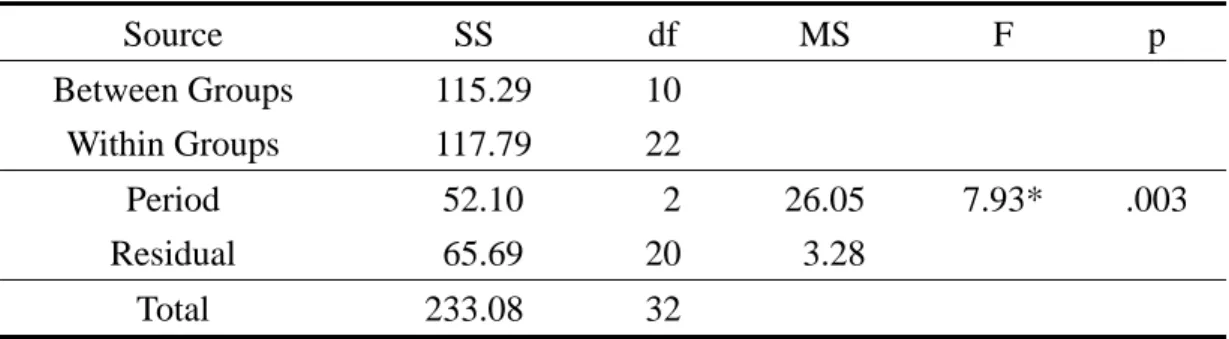
Fourth, the statistical analysis revealed a significant difference across the oral journals in the three periods on average speaking runs. The results are presented in Table 4.11 and 4.12 below. Then, further comparison using Tukey method was displayed in Table 4.13, showing that the average speaking runs in the end oral journals was higher than that in the entry ones, while no significant difference was found between the entry and mid, and between mid and end speaking runs.
Table 4.11 Average speaking runs (N=11)
Stage Mean SD
Entry 6.31 2.38
Mid 7.75 2.39
End 9.39 2.59
Table 4.12 Summary table of analysis of variance on average speaking runs
Source SS df MS F p
Between Groups 115.29 10 Within Groups 117.79 22
Period 52.10 2 26.05 7.93* .003
Residual 65.69 20 3.28
Total 233.08 32
*p < .05
Table 4.13 Posterior comparison of average speaking runs Period Entry
(M=6.31)
Mid (M=7.75)
End (M=9.39)
Entry 1.44 3.08*
Mid 1.64
End
*p < .05
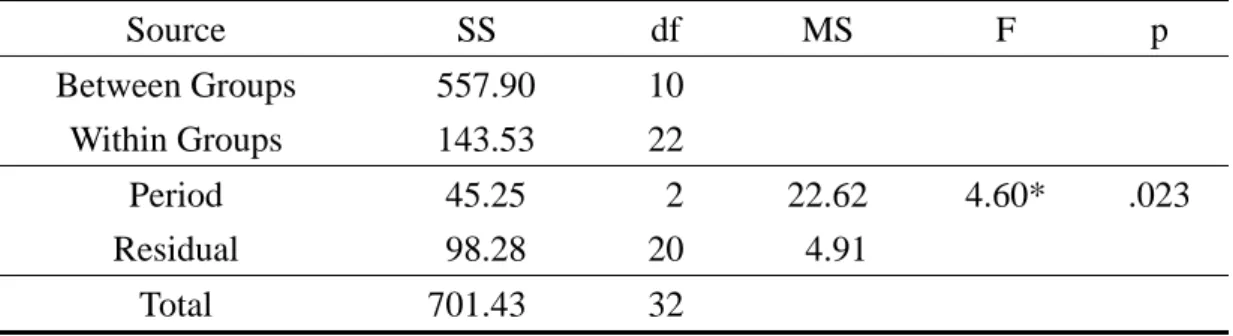
Fifth, in terms of the number of repetitions per 100 words, there was significant difference found across the oral journals in the three different periods during this activity, as shown in Table 4.14 and 4.15. So, Tukey method was adopted for further comparison. As displayed in Table 4.16, the number of repetitions in the mid oral journals was higher than that in the end oral journals. In other words, from the mid to end stage, the subjects showed obvious progress in reducing the number of repetitions.
Table 4.14 Number of repetitions per 100 words (N=11) Stage Mean SD
Entry 5.074 5.382
Mid 5.269 5.037
End 2.693 3.359
Table 4.15 Summary table of analysis of variance on number of repetitions per 100 words
Source SS df MS F p
Between Groups 557.90 10 Within Groups 143.53 22
Period 45.25 2 22.62 4.60* .023
Residual 98.28 20 4.91
Total 701.43 32
*p < .05
Table 4.16 Posterior comparison of number of repetitions per 100 words Period End
(M=2.69)
Entry (M=5.07)
Mid (M=5.27)
End 2.38 2.58*
Entry 0.20
Mid
*p < .05
In short, during the three-month training with oral-written dialogue journals, all subjects improved their speaking in many aspects including increase of speaking rate and the average speaking runs and reduction of pauses, pause time and repetitions.
While most of the subjects improved fluency, there were still individual differences among them. For example, in terms of speaking rate, the subjects who were at the higher-intermediate and lower-intermediate level did not have obvious improvement.
For the higher-intermediate level students, one possible explanation is that their speaking at the beginning of this experiment seemed to have reached a level that could not be elevated in such a short period of time. As for the lower-level student, it seemed that such practice was still not enough for him to improve his fluency; so more practice might be needed.
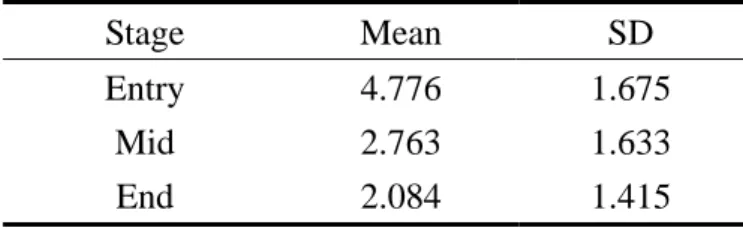
In this study, grammatical accuracy is defined as being accurate in tense, prepositions, plurals, and subject-verb agreement. With the calculation of errors of verb tense, preposition, plural forms and subject-verb agreement per 100 words in six different oral journals in three periods (entry, mid, and end), the quantitative analyses were indicated as follows. In terms of verb tense accuracy, a significant difference was found across the oral journals during this activity as shown in Table 4.17 and 4.18.
Thus, Tukey method was used for further comparison, as shown in Table 4.19. The percentage of tense errors per 100 words in entry oral journals was higher than that in mid and end oral journals, while there was no significant difference in that between mid and end stages.
Table 4.17 Tense errors per 100 words (N=11) Stage Mean SD
Entry 4.776 1.675
Mid 2.763 1.633
End 2.084 1.415
Table 4.18 Summary table of analysis of variance on verb tense accuracy
Source SS df MS F p
Between Groups 28.63 10 Within Groups 89.25 22
Period 43.12 2 21.56 9.35* .001
Residual 46.13 20 2.31
Total 117.88 32
*p < .05
Table 4.19 Posterior comparison of verb tense accuracy Period End
(M=2.08)
Mid (M=2.76)
Entry (M=4.78)
End 0.68 2.70*
Mid 2.02*
Entry
*p < .05
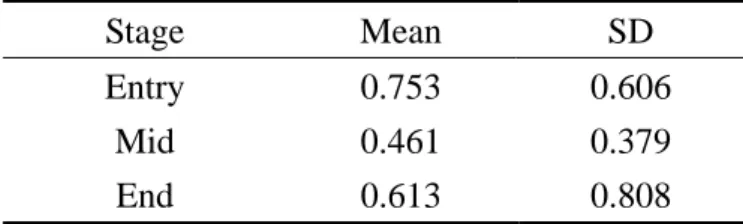
Prepositional errors refer to wrong prepositions used, missing preposition, two-word verbs incorrectly used and preposition intruder, categorized in Lay’s (1991) study. In this case, “My mother want to check if I get better or not, but I would have a meeting at Saturday night” is an example of wrong prepositions used. “I arrive Taipei Taipei Station at six o’clock and got a train…” is an example of missing prepositions. As for two-word verbs incorrectly used, “…if the plant is transformed with…” is an example of this kind. “In the several days ago, …” is an example of preposition intruder. As for prepositional accuracy, no significant difference was found across these oral journals over time. That is, students did not display obvious progress in this aspect. The findings were shown in Table 4.20 and 4.21.
Table 4.20 Errors of prepositions per 100 words (N=11) Stage Mean SD
Entry 0.753 0.606
Mid 0.461 0.379
End 0.613 0.808
Table 4.21 Summary table of analysis of variance on prepositional accuracy
Source SS df MS F p
Between Groups 5.22 10 Within Groups 6.89 22
Period 0.47 2 0.23 0.73 .495
Residual 6.42 20 0.32
Total 12.11 32
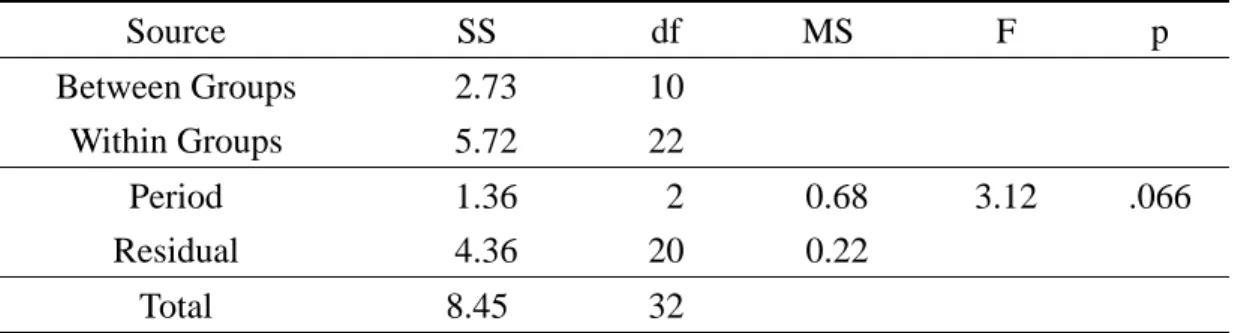
Errors of plural forms refer to “missing S in plural nouns,” and “adding S in words where they should be singular.” For example, the error in the sentence “we partitioned the freshmen into six part” belongs to the former case, and “the second activities is wonderful memory in my life” the latter one. Regarding the accuracy of plural forms, it was found that the change, as shown in Table 4.22 and 4.23, was not statistically significant. In other words, it seemed that the improvement in this aspect was very limited.
Table 4.22 Errors of plural forms per 100 words (N=11) Stage Mean SD
Entry 0.731 0.419
Mid 1.166 0.587
End 0.740 0.435
Table 4.23 Summary table of analysis of variance on accuracy of plural forms
Source SS df MS F p
Between Groups 2.73 10 Within Groups 5.72 22
Period 1.36 2 0.68 3.12 .066
Residual 4.36 20 0.22
Total 8.45 32
Errors of subject-verb agreement refer to the case in which verbs do not change in form from singular to plural or vice versa. Examples like “…they always has
different opinions” and “He still have a distance with us” are of this kind of errors.
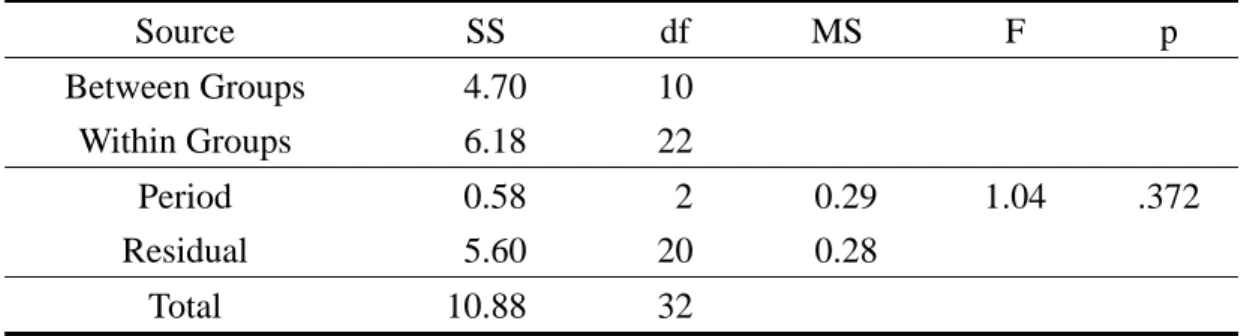
With regard to the accuracy of subject-verb agreement, there was no significant difference found across the oral journals in three different periods; that is, improvement in this aspect was too trivial. Findings were shown in Table 4.24 and 4.25.
Table 4.24 Errors of subject-verb agreement per 100 words (N=11) Stage Mean SD
Entry 0.777 0.843
Mid 0.525 0.505
End 0.473 0.253
Table 4.25 Summary table of analysis of variance on accuracy of subject-verb agreement
Source SS df MS F p
Between Groups 4.70 10 Within Groups 6.18 22
Period 0.58 2 0.29 1.04 .372
Residual 5.60 20 0.28
Total 10.88 32
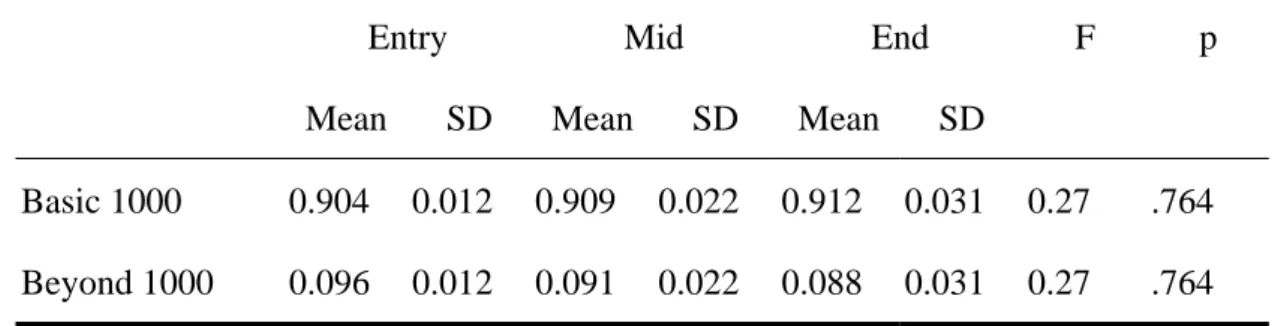
As stated earlier, lexical acquisition is one of the components worthy of investigation because the problem of facing lexical deficiency when speaking English was identified in most subjects’ questionnaire reports before this activity. In this paper, lexical richness was measured by two methods including type-token ratio (TTR) and Vocabprofile (VP) analysis. Table 4.26 and 4.27 presented the results of analyses, i.e. changes in lexical variation and changes in lexical profile. In terms of changes in lexical variation, table 4.26 showed that no significant difference was found across the oral journals in the three different periods during this activity.
Although the figures showed a trend of progress, the change was not statistically
significant. In terms of changes in lexical profile, table 4.27 displayed the distribution of basic and non-basic vocabulary. In this case, basic vocabulary refers to all vocabulary that is within the first 1000 most frequent word families, and non-basic vocabulary, all vocabulary that is beyond the first 1000 most frequent word families, including the most frequent 1000-2000 words, academic words, and off-list words. A view of the lexical profile indicated no significant difference; that is, the non-basic words in the oral journals did not show significant increase throughout this activity and the basic words did not show significant decrease. It seemed that they did not improve in vocabulary because they used more and more basic words in speaking English. However, the results of TTR within the first level (basic 1000) showed that the subjects indeed increased their lexical variation, as shown in Table 4.28. In other words, they became more capable of varying the basic words they knew, rather than repeated the same words.
Table 4.26 Changes in lexical variation throughout this activity
Entry Mid End F p
Mean SD Mean SD Mean SD
Lexical Variation 0.422 0.085 0.428 0.105 0.434 0.091 0.20 .820
Table 4.27 Changes in VP throughout this activity
Entry Mid End F p
Mean SD Mean SD Mean SD
Basic 1000 0.904 0.012 0.909 0.022 0.912 0.031 0.27 .764 Beyond 1000 0.096 0.012 0.091 0.022 0.088 0.031 0.27 .764
Table 4.28 Changes in lexical variation within the basic 1000 words
Entry Mid End F p
Mean SD Mean SD Mean SD
Lexical Variation 0.396 0.088 0.399 0.104 0.403 0.084 0.09 .915
To sum up, the statistical analyses revealed that the subjects had improved their speaking in six aspects, namely, the speaking rate, the number of pauses, the ratio of pause time to total speaking time, average speaking runs, number of repetitions per 100 words and verb tense accuracy, as shown in Table 4.29.
Table 4.29 Summary of statistical results
Variable Period Entry-mid Mid-end Entry-end
1. Speaking rate √ √
2. Number of pauses √ √
3. Ratio of pause time to total
speaking time √ √
4. Average speaking runs √
5. Number of repetitions per
100 words √
6. Verb tense accuracy √ √
However, one thing worth noticing was that the number of repetitions did not show significant difference at the beginning and end points. One possible explanation was that at the beginning of this activity, the subjects had less confidence in speaking English and were more afraid of making errors when speaking. In this sense, instead of having more repetitions, they chose to pause more frequently and have longer pauses. Therefore, the improvement was not significantly different in the number of repetitions per 100 words between initial and final entries.
4.1.2 Results from the speaking learning logs
The first speaking learning log, filled out and collected in the middle of the activity, reflected the subjects’ own perceptions of performance after keeping the oral journals for one and a half months. Most of the subjects perceived that they made improvements in self-confidence in speaking English, speaking rate, number of pauses and repetitions and became more accurate in the use of tense, plural forms, and subject-verb agreement as well as enhanced vocabulary acquisition, both in finding appropriate words to express themselves and in expressing ideas more correctly (Table 4.30). However, most of them saw no change in prepositions.
Table 4.30 Results of the first speaking learning log Increase Decrease No change Extent
Category (f, %) (f, %) (f, %)
1.Confidence (7, 63.64) (1, 9.09) (3, 27.27) 2a Speaking rate (6, 54.55) (0, 0) (5, 45.45) 2b Number of pauses (1, 9.09) (7, 63.64) (3, 27.27) 2c Number of repetitions (1, 9.09) (7, 63.64) (3, 27.27) 4a Errors of tense (0, 0) (8, 72.73) (3, 27.27) 4b Errors of prepositions (0, 0) (3, 27.27) (8, 72.73) 4c Errors of plural forms (0, 0) (7, 63.64) (4, 36.36) 4d Errors of subject-verb
agreement (0, 0) (7, 63.64) (4, 36.36) Extent
Category
Better (f, %)
Worse (f, %)
No change (f, %) 6a. Can find appropriate
words for expression (8, 72.73) (0, 0) (3, 27.27) 6b Can express ideas in
English correctly (7, 63.64) (0, 0) (4, 36.36) Note. N (total number of subjects) =11; f= the number of subjects
According to self reports of the subjects, the reasons of improvement in fluency are as follows. Being more capable of organizing the ideas enabled them to speak more fluently than they did at the beginning. One subject (Kimily) pointed out that
the ability to organize ideas helped reduce the repetition. Gaining more opportunities to practice speaking English was another reason that resulted in fluency.
Due to speaking English more often, the subjects could gradually express what they wanted to say in English more easily and spontaneously. They became less dependent on thinking and organizing the content in their first language – Chinese.
Practicing speaking English more often also reduced pauses or repetitions due to errors. Additionally, employing communication strategies helped increase fluency, such as raising a new topic and using other words to explain the ideas. The reminder of the researcher’s feedback was also another reason leading to the reduction of repetitions.
For grammar accuracy, except the use of prepositions, most of the subjects perceived that they had made progress (Table 4.30). They reported that the researcher’s feedback served as an effective prompt that enabled them to be more conscious of their grammatical errors. However, in terms of prepositions, eight subjects saw no improvement after keeping oral journals for one and a half months.
They offered several reasons for their performance in the first speaking learning log.
Jessie admitted that she did not use prepositions very frequently and even if she used the prepositions, she chose the easier ones for expression. Under such circumstance, she did not perceive any change in the use of prepositions. Likewise, Johnny stated that since he usually made few errors in prepositions, he did not recognize much change in this aspect. Ellen said that actually she did not know whether her use of preposition was correct or not. At the same time, Kimily stated that the use of prepositions would be definitely incorrect if she did not have the knowledge of its usage. Only after recording could she correct the errors, so there were still problems every time. Clare commented that it took too much effort to find the right words to express herself, not to mention pay attention to the details, such as prepositions.
Grace thought that some expressions had become a kind of habit and it was hard to correct them in a short time.
In terms of vocabulary, it was revealed that most of the subjects deemed that they had made improvement in vocabulary acquisition (Table 4.30). Eight subjects perceived they improved in finding appropriate words to express themselves and seven subjects thought that the words they used in speaking could express their ideas more effectively. Concerning the reasons of their improvement, a wealth of information might provide us with clear explanations. First of all, when unable to use specific words to express themselves, they substituted with other words. The approximate words may not completely convey their original ideas, but at least the meanings were similar. In addition, frequent practice in speaking helped accumulate the words commonly used in speaking. English vocabulary could also be expanded when they consulted the dictionary or other resources after recording to check whether they had used the words or phrases correctly. Imperceptibly and gradually, the vocabulary capacity could be increased. Also, being more comfortable in speaking English allowed them to use the words familiar to them, rather than rack their brains for certain specific words when speaking. Furthermore, in daily life, they tended to pay more attention to English, such as noticing English word usage or refreshing their memory to recall English words or phrases learned before.
After the activity of oral-written dialogue journals was over, the subjects were required to fill out another speaking learning log in order to help the researcher understand their thoughts about their progress in the second half of this experiment.
The results of the second speaking learning log indicated that most of the subjects perceived that they had increased their confidence and the rate of speaking, decreased frequency of repetitions, reduced errors of tense and subject-verb agreement, and enhanced vocabulary acquisition, both in finding appropriate words to express
themselves and in expressing ideas more correctly (Table 4.31). However, the improvement in the reduction of pauses and errors of plural forms was not very obvious. Only five subjects saw progress in reducing pauses and errors of plural forms, respectively. Furthermore, there was only little improvement in prepositions.
Seven subjects saw no change in this aspect.
Table 4.31 Results of the second speaking learning log Extent
Category
Increase (f, %)
Decrease (f, %)
No change (f, %) 1.Confidence (7, 63.64) (0, 0) (4, 36.36) 2a Speaking rate (8, 72.73) (0, 0) (3, 27.27) 2b Number of pauses (0, 0) (5, 45.45) (6, 54.55) 2c Number of repetitions (0, 0) (6, 54.55) (5, 45.45) 4a Errors of tense (0, 0) (8, 72.73) (3, 27.27) 4b Errors of preposition (0, 0) (4, 36.36) (7, 63.64) 4c Errors of plural forms (0, 0) (5, 45.45) (6, 54.55) 4d Errors of subject-verb
agreement (0, 0) (7, 63.64) (4, 36.36) Extent
Category
Better (f, %)
Worse (f, %)
No Change (f, %) 6a. Can find appropriate
words for expression (8, 72.73) (0, 0) (3, 27.27) 6b Can express ideas in
English correctly (11, 100.00) (0, 0) (0, 0) Note. N (total number of subjects) =11; f= the number of subjects
In terms of fluency, most of the subjects perceived that they increased their speaking rate and reduced the number of repetitions. One of the reasons of improvement in fluency was that gaining more opportunities to speak English helped the subjects reduce the time to think and organize their ideas. They became more spontaneous in speaking English. The progress in grammar and vocabulary was also another factor that made the speaking more fluent. The ability to think more broadly, to focus on a topic, and to elaborate more easily further explained the progress in
fluency. Being able to relax so as to express ideas in a simple way is one more reason for the improvement. Being used to speaking English also made the speaker bold enough to make mistakes when speaking, which indirectly enhanced fluency.
Furthermore, in daily life, becoming more aware of English words that they might use in oral journals also contributed to fluency. However, six subjects saw no change in the reduction of pauses. Five out of the six subjects thought that the reason of no change had more to do with running out of ideas when speaking English; that is, they did not know what to say next.
For grammar, most of subjects perceived improvement in the use of tense and subject-verb agreement, while most of them saw no progress in the use of prepositions and plural forms in the second half of this activity. Two reasons were offered for the progress in grammar accuracy. The feedback from the researcher was identified as contributing to the progress. As time went on, the subjects became more conscious of grammar as a result of the researcher’s constant reminding. Furthermore, listening to the tape again to check grammatical errors was another factor for progress in grammar. On the other hand, seven subjects who perceived no progress in prepositions explained why. Kimily stated that as a result of being unable to use prepositions very well, she tried to avoid using prepositions and only used those familiar to her. Sherry stated that she still made many prepositional errors because of being unfamiliar with the use. David remarked that one reason for lack of improvement is his tendency to neglect prepositional errors, and the other is his inability to judge its correctness. Besides, the reasons that Clare, Johnny and Jessie mentioned are similar to those in the first learning log. With respect to the use of plural forms, based on their own reports, they tended to forget to pay attention to the details such as plural forms, so this kind of errors still could not be avoided.
As for vocabulary, it was shown that the aspects of expressing ideas and finding
appropriate words to express themselves had obtained obvious improvement. In particular, regarding the aspect of expressing ideas, all of the subjects felt they could now express their ideas more easily. Several reasons were offered by the subjects to explain their feelings in making progress in vocabulary. First of all, the researcher’s feedback played an important role. By reading the feedback, they not only learned useful expression that could be practiced next time but also understood which words were used inappropriately. Besides, because of this activity, they became more attentive and sensitive to English. For example, they began to pay attention to how others speak English, and try to memorize those words and use them in oral journals.
This activity also helped them learn how to paraphrase, how to use simple, familiar words to explain their ideas, instead of being stuck whenever they did not know how to express certain ideas. When they recognized that they failed to express something or they had used the words inappropriately, they would consult the dictionary for help.
Finally, recalling the words they had learned in senior high school is also another reason for progress.
A comparison of the results of the first and second speaking learning logs was shown in Table 4.32.
Table 4.32 Summary of results of the first and second speaking learning logs Extent
Category
Increase (fI, fII)
Decrease (fI, fII)
No change (fI, fII) 1.Confidence Same (7, 7) (1, 0) (3, 4) 2a Speaking rate II (6, 8) (0, 0) (5, 3) 2b Number of pauses (1, 0) I (7, 5) (3, 6) 2c Number of repetitions (1, 0) I (7, 6) (3, 5) 4a Errors of tense (0, 0) Same (8, 8) (3, 3) 4b Errors of preposition (0, 0) — (8, 7) 4c Errors of plural forms (0, 0) I (7, 5) (4, 6) 4d Errors of subject-verb
agreement (0, 0) Same (7, 7) (4, 4)
Extent Category
Better (fI, fII)
Worse (fI, fII)
No Change (fI, fII) 6a. Can find appropriate
words for expression Same (8, 8) (0, 0) (3, 3) 6b Can express ideas in
English correctly II (7, 11) (0, 0) (4, 0)
Note. I: The first speaking learning log; II: The second speaking learning log f: Number of the subjects; —: Improvement not significant
As shown in the table, more subjects perceived progress in the reduction of pauses, repetitions and errors of plural forms in the first half of the experiment. In terms of the number of pauses, seven subjects reported progress in the first speaking learning log, while only five in the second one. The reason, according to their reports in the second speaking learning log, is related to running out of ideas when speaking English.
As for repetitions, seven subjects reported progress in the first speaking learning log, while six in the second one. Among the five subjects who saw no change, two of them are the same students as those who saw no change in the first period. The rest of three offered their reasons of no change in the second half of this activity such as repetitions becoming a habit, not knowing what to say next, and not sure of which grammatical structures to use. Regarding errors of plurals, seven subjects reported progress in the first speaking learning log, while only five in the second one. Among the six subjects who perceived no change in the second period, three of them are the same students as those who saw no progress in the first period. The rest of three offered their reasons of no improvement including failing to pay attention to this kind of errors and not attempting to eradicate them. In contrast, more subjects reflected they made progress in the rate of speaking and in expressing ideas correctly in the second learning log. In terms of the rate of speaking, compared with six subjects, eight subjects reported improvement in this aspect. Because having practiced speaking English for a longer period of time and having improved grammar and
vocabulary use, three subjects who saw no change in the first period perceived progress in the second period. One of them specifically remarked that his rate of speaking was easily influenced by the nature of topics. Regarding expressing ideas more correctly, compared with seven subjects, eleven reported progress in this aspect.
Those who saw no change in the first period perceived improvement in the second period. They offered their reasons, such as being able to offer more description or explanation and learning commonly used words from the researcher’s feedback, and paying more attention to the more appropriate ways of expression. For confidence, errors of tense and S-V agreement, and the ability to find appropriate words for expression, the percentage of improvement is the same in the two logs. The findings proved that throughout this activity, most of the subjects paid constant attention to tense and S-V agreement and tried to avoid making theses kinds of errors when speaking English; thus, they saw progress in two periods. As for finding appropriate words for expression, the reasons of improvement were very similar in the two periods. Last, it was noteworthy that most subjects reported that they did not improve the usage of prepositions in both learning logs.
4.1.3 Comparison of quantitative and qualitative results
With a comparison of the quantitative and qualitative results, both showed that the subjects had more obvious improvement in the second half of this activity in terms of the rate of speaking and more obvious progress in the first half of this activity in terms of the reduction of pauses. Concerning the number of repetitions, the statistical results revealed that the significant improvement occurred in the second half of this activity, while the speaking learning log results indicated that more subjects perceived the progress in the first half of this activity. In fact, among the five subjects who saw no change in the second period, only two of them did not make substantial improvement, while the rest of three did improve to some extent.
Therefore, the explanation of the contradiction between the learning log results and the statistical analysis was that since the subjects still repeated themselves while speaking English, they were likely to overlook their progress. For grammatical accuracy, verb tense accuracy was found to be the only aspect that reached the statistical significance in two periods (entry-mid & entry-end), supported by the results of speaking learning logs. Because of this activity, the subjects started to become aware of tense problems and gradually self-monitoring of tense became a habit and then their improvement became stable in the second period; therefore, the statistical significance was found in the first half of this activity. With respect to prepositions, both statistical analysis and the speaking learning log results showed that the improvement was not significantly different. The reasons would be discussed later. As for plural forms and subject-verb agreement, while the speaking learning log results revealed the improvement, no significant improvement was found in the statistical results, which would be left for later discussion. With regard to vocabulary, the speaking learning log results showed improvement while the statistical results did not reveal significant difference; thus, further explanation would be proposed.
4.1.4 Interview results
The interview, including seven parts, is focused on exploring the activity’s effect on speaking and the subjects’ perceptions of this activity. It was conducted shortly after the three-month activity was over. All of the subjects were individually interviewed face to face by the researcher during their free time and the time of each interview lasted from forty minutes to one hour. All of the interviews were recorded and transcribed subsequently (see Appendix H, for example). According to the interview results, all of the subjects had a positive attitude toward keeping oral-written dialogue journals. Concerning the confidence in speaking English, nine subjects
stated that their confidence had increased, while another two subjects indicated that although their confidence was not really elevated, they became more comfortable in speaking English. Seven out of these nine subjects pointed out that this was because of frequent practice. Being accustomed to speaking English made them more comfortable in speaking English. For example, Ellen emphasized that frequent practice in speaking English made her more fluent in speaking and more tolerant of errors. Gradually she found out that errors were in fact not so many as she had imagined, so she became more comfortable in speaking English. Besides, two subjects emphasized the importance of the researcher’s feedback. Sherry and Sheree specifically stated that the feedback’s corrections contributed to the increase of confidence. Sherry mentioned that the one-on-one, private, and less stressful feedback resulted in her better performance in speaking, which further elevated her confidence. She underscored the importance of frequent practice and one-on-one feedback in building her confidence in speaking English. Furthermore, perceiving progress helped enhance her confidence. David, Jessie, Cathy, and Ellen also agreed that their confidence increased because they felt they could speak more fluently than before. Among the two subjects (Amal and Clare) who thought they did not gain much confidence in speaking English, Amal stated that she thought she did not gain much confidence partly because she did not know whether her speaking was good enough to successfully communicate with English native speakers, and partly because she saw little improvement in her oral performance.
With regard to the motivation, ten subjects reported that their motivation to speak or learn English became stronger. This activity triggered them to become aware of their deficiency in speaking English and to take action to improve their English.
They were motivated to make English a part of their lives. For example, Amal, Sherry, and Johnny stated that before joining this activity, they usually felt very
nervous when encountering native English speakers, but after participating in this activity, they became more natural and willing to talk to foreigners. Sheree and Johnny said that thinking in English and talking to themselves in English are their ways to strengthen English speaking. Johnny also said that this activity motivated him to pay attention to English vocabulary when reading, from which he not only learned words that might have the chance to be used in speaking but also deepened the impression of words he could speak out. Cathy mentioned that motivation to practice English prompted her to practice speaking English in the dormitory once a week. Ellen said that this activity stimulated her classmates and her to purposefully talk with each other in English in daily lives. David emphasized it was not until this activity that he realized that his English was intermitten, which motivated him to improve his speaking ability. Jessie reported that since she was practicing speaking English, if she had the chance to talk to foreigners, she would be eager to let them understand what she was trying to say and to see if she could make herself understood.
As for the participant who recognized no substantial change in stimulating motivation, Clare underscored the dullness of this activity, from which she could not obtain a sense of achievement; therefore, no particular motivation in speaking or learning English was generated. She also added that because every time she only had a few minutes to prepare what to say, she came to realize she could not express herself in English in such a short time. Gradually, she started to put in less effort in this activity.
When it comes to their perceptions of this activity, all of them had positive opinions, while some, though not many, also had negative opinions about the use of oral-written dialogue journals. They considered this activity worthwhile, great, meaningful, and they liked this activity. Cathy, Sheree, Jessie and Johnny remarked that recording the oral journals was a stimulator, pushing them to speak English.
Cathy said that this activity offered her an opportunity to practice speaking English, forcing her to learn English. She considered this activity worthwhile and she learned something from it. Jessie remarked that because of the pressure of recording, she could not but think of something to say in English. Sheree also agreed that the pressure of recording propelled her to speak English. Johnny emphasized that he liked this activity because it was a spur to force him to learn English and move ahead;
otherwise, in such environment, he was very passive. Kimily stated that although she spent little time on this activity every week, she noticed obvious progress in her speaking. So, this activity to her was worthwhile and great. Likewise, Ellen acknowledged that this activity was not difficult to her because all she had to do was recording but she could still gain a lot of things, so she liked this activity. Kimily further asserted that taking part in this activity with her friends was also another reason for her increased motivation. They shared and discussed what and how they recorded in their oral journals, from which they felt they were not lonely in learning English; instead, they viewed this activity as fun and interesting. David stated that this activity was very meaningful to him. It was very beneficial for English learning, prompting him to become more comfortable in speaking English and less worried about errors. Sherry said that this activity was fun. She only had to speak English once in a while and there was also someone giving her feedback. Sometimes when listening to her recordings, she felt very funny because she wondered why she recorded the oral journals like that. Amal also reported that there were few opportunities to speak English in daily life and her English was poor, so it was really valuable to have someone seriously listen to her speaking and give appropriate feedback such as encouragement and suggestion; the feeling was great. Grace stated that when finding she could speak more fluently, she gradually became more confident and fond of this activity. She felt that joining this activity was not bad.
She could have the opportunity to practice speaking English.
Although they held positive attitude toward this activity, they still had some negative reactions such as tiredness, pressure, rejection, frustration and fear. Except Jessie, who expressed only positive experience, all of rest somewhat had negative opinions. Among them, eight subjects complained that after school started, they became very busy, so sometimes they felt tired and annoyed in recording oral journals.
Besides, Sheree and Grace both mentioned that at the beginning of this activity, they kind of had a feeling of rejection because they felt their speaking was really terrible.
Grace commented that in the beginning, she felt very frustrated, stressed, upset and fearful, but gradually as she perceived her progress in speaking, she became more confident. Sheree said that initially she didn’t speak well, so she felt that recording the five-to-ten-minute oral journals was stressful, but gradually she was accustomed to this, and realized that she needed to work hard and thus became more positive.
Likewise, Johnny and Amal stated that in the initial stage, they felt quite frustrated due to their poor performance, but constant support and encouragement from the researcher turned their attitudes into more positive and they gradually became used to speaking English. Especially in Amal’s case, during this activity, she happened to encounter a foreigner who asked her to do him a favor to translate the content of his mobile phone voice mail into English. This was a frustrating experience to her because failing to think of the word “bill,” she tried very hard to explain it. Finally, that foreigner got the message and asked her if the word she was trying to say is
“bill.” Then, he shook his head and told her that her English was really not good and needed to be improved. After the event, she became passive, losing the initial passion and motivation toward this activity.
In terms of the benefits of keeping oral-written dialogue journals for speaking, the followings are the thoughts of these subjects. All subjects considered this
activity helpful in speaking English. They maintained that this activity provided them with an opportunity to practice speaking English. Sheree emphasized in daily life seldom having the chance to speak English, she just read something in English.
She felt that it was not enough to learn English simply by reading. Only by speaking English out could she ensure that she had learned it. So, keeping oral journals offered her an opportunity to speak English. Besides, due to the training of thinking and organizing ideas in a short time, Johnny could gradually organize his ideas more quickly as well as speak English easily and spontaneously.
All of the subjects found a gap between what they wanted to say and what they could say. They acknowledged that oftentimes when recording the oral journals, they encountered a situation in which they didn’t know how to express themselves in appropriate English words. Ellen, Cathy, David, and Johnny stated that they would look up in the dictionary for the words they did not know how to say or were unsure of the meaning after they finished recording. Jessie and David reported that they usually used simple words with similar meanings to express themselves. David and Amal said that they would try to recall what they had learned. Sherry stated that the desire to express something pushed her to look for the words and search in her memory what she had learned. Kimily stated that she could not think of certain words she had learned in high school when she was expressing similar ideas, but she could recognize those words when reading. After constant practice in this activity, she had more concrete feeling toward those words and could use them in her speaking.
She admitted that usually she did not look up the words in the dictionary after she finished recording, but when she happened to see the words that she failed to say before, she tried to memorize them and use them in the oral journals as much as possible. Grace acknowledged that when she could not come up with the right words to express herself, she usually abandoned the message and switched to another
topic. Most of them did experience the gap between recognition and production level.
Another benefit that all the subjects pointed out is that they recognized their weaknesses in speaking English such as vocabulary, grammar and pronunciation.
Ellen, Grace, David and Sherry stated that reading the feedback was a way to know whether their ideas were clearly conveyed and understood. Grace stated that she became aware of her problems such as pronunciation and tense and then would correct those errors because of the one-on-one individualized feedback. Amal also held that she could realize her grammatical errors and pronunciation problems.
Johnny admitted that he used to be unaware of his emphasis on [s] and [∫] when speaking, but now he realized he had this problem from the feedback. Besides, he didn’t know that there were so many pauses in his speaking, but the feedback served as a reminder. Cathy said that from the feedback, she could know what errors she made and made corrections accordingly. Kimily and David stated that whenever they went back to listen to the tape, they would identify their problems in speaking.
Furthermore, seven of the subjects stated that they tried out the words they were not sure when speaking. Kimily, Clare and Cathy agreed that they would use those words because they could not think of other words they were sure of. Sherry said that although sometimes she knew the words she used were incorrect or dubious, she still spoke them out; otherwise, she might think of nothing to say. Sheree also admitted that she would go ahead even if she knew what she said was wrong, because she thought the researcher would provide her with corrections.
In terms of practicing different language functions such as description, narration, and expression of opinions and feelings, eight subjects remarked that they could practice using various language functions. Cathy reported that she understood how to talk about things from certain angles or learned to express ideas in a more
organized way. Sheree commented that at the beginning of this activity, she only described things that happened in daily life, but from the researcher’s feedback, she tried to think about the questions provided and then responded in English accordingly.
Grace acknowledged that she usually talked about things happening in daily life full of sweets and sorrows, so she felt she could practice different language functions.
Amal stated that talking about different topics every time pushed her to not only employ various vocabulary but also figure out ways to express new ideas more completely. Johnny agreed that this activity increased his ability in describing things.
Last, ten subjects mentioned that this activity allowed them to discuss many different topics, which is beneficial to speaking. Five subjects (Sherry, Cathy, Amal, Grace, Sheree) said that they could practice speaking by using different approaches to address different topics. Another two subjects (Johnny and David) stated that in order to talk about different topics, they had to practice using different English words.
Jessie also mentioned that she could practice using different ways to talk about similar or different topics.
More specifically, based on the interview results, practice is one of the most important reasons that led to the improvement in fluency. All of the subjects thought that frequent practice made them spend less time organizing and thinking what to say and how to say it. They became used to thinking in English, which made them more relaxed and less cared about their errors. Second, three subjects (Jessie, Johnny and Clare) mentioned that the desire to express the ideas quickly and clearly in a short time pushed them to speak fluently and not to pause too much. Third, two subjects also (Sherry and Johnny) considered the researcher’s written feedback another factor that contributed to their progress in fluency. It played a crucial role in reminding the subjects. Because of the reminder, they would remember not to repeat too often or
pause too much when speaking. Johnny said that the feedback reminded him not to repeat too often. Fourth, Sherry stated that the variety and diversity of topics stimulated her to think from different perspectives, which further strengthened thinking ability, so the fluency was improved. In terms of extent of improvement in fluency, five subjects reported that they had improved to a great extent. Finally, all of the subjects emphasized that among fluency, grammar and vocabulary, fluency is the aspect in which they had improved most.
For grammar, nine subjects except Johnny and Grace thought that their grammatical accuracy had made some improvement. In their opinion, the researcher’s feedback is the most important factor. They asserted that the feedback played a crucial role in reminding them not to make the same mistakes repeatedly.
Seven subjects considered the range of progress in this aspect moderate.
As for vocabulary, first of all, four subjects including Amal, Grace, David, and Sherry considered the researcher’s feedback a factor that contributed to the expansion of vocabulary. They acknowledged that they could learn some new words from reading. Second, Ellen, Cathy, and Grace emphasized that stimulated by this activity, they tended to become more conscious of English. Ellen said that when reading in daily life, she would consider how these words could be used in speaking, but she had never thought of doing so before. For Cathy, after participating in this activity, she tried to think in English as much as possible. Besides, when seeing common words, she would even think of memorizing those words. Grace said that in daily life, she became keen on observing how others speak in English. Third, Amal and David mentioned that at the beginning, they were always stuck when failing to find the appropriate words to express their ideas, but gradually, they realized that they could use the words simpler and more familiar to substitute for those exact words. Fourth, Kimily and Sheree said that this activity triggered the awareness that they seemed to
have forgotten many things they had learned in school. So, they went back to refresh their memory of English. Fifth, Johnny and David stated that they usually consulted the dictionary for the appropriate words or those they were unsure of whenever they finished recording. Last, Johnny said that through speaking things out, he could reinforce the impression of the usage of the words he had learned. As for the extent of improvement, nine subjects regarded their improvement as moderate, but they still perceived they were making progress.
As far as the influence of feedback is concerned, the subjects’ opinions will be presented in the following five aspects. In “adding information” category, opinions were divided. Nine subjects (Johnny, Sheree, Cathy, Amal, Grace, Sherry, David, Jessie, Clare) noted that they learned the expressions and words used in the feedback.
Three subjects (Johnny, Sheree, Cathy) mentioned that their thinking had become diversified and quick as a result of reading the feedback. Johnny thought he could see how the researcher approached issues, which accelerated his thinking. Trying to think from other perspectives was what Sheree considered effective, while Cathy agreed that she could understand the researcher’s point of view and then viewed from different angles when describing things. Three subjects (Ellen, Kimily, & Cathy) became more motivated and willing to keep oral journals, as well as more interested in the activity after reading the “adding information” part.
As for “suggestion” part, all of the subjects considered it a reminder. Kimily, Cathy, Clare, Jessie, Sherry, Ellen and Johnny all agreed that this part played the role of reminder, from which they knew where they should improve, for example, grammar and fluency. To Sherry, the biggest change was that she tried to pause between sentences, rather than within sentences, a strategy suggested by the researcher. Johnny admitted that from the “suggestion,” he became aware of not repeating too much. Grace also considered it very helpful for speaking. Amal