A R T I C L E Journal of
Materials
Chemistry
www .rsc .or g/mat e rialsSynthesis of a high-efficiency red phosphorescent emitter for
organic light-emitting diodes
Cheng-Hsien Yang, Chia-Cheng Tai and I-Wen Sun
Department of Chemistry, National Cheng Kung University, Tainan, Taiwan, 701, Republic of China
Received 31st October 2003, Accepted 24th December 2003
First published as an Advance Article on the web 11th February 2004
Four novel red phosphorescent emitter compounds bis(1-phenylisoquinolinato-N,C2’)iridium(acetylacetonate),
(piq)2Ir(acac), bis(1-(1’-naphthyl)isoquinolinato-N,C2’)iridium(acetylacetonate), (1-niq)2Ir(acac),
bis(1-(2’-naphthyl)isoquinolinato-N,C2’)iridium(acetylacetonate), (2-niq)2Ir(acac) and
bis(1-phenyl-5-methylisoquinolinato-N,C2’)iridium(acetylacetonate), (m-piq)2Ir(acac), have been synthesized and fully
characterized. Electroluminescent devices with a configuration of ITO/NPB/CBP:dopant/BCP/AlQ3/Al were
fabricated. All devices emitted in the red region with an emission ranging from 624 to 680 nm. (m-piq)2Ir(acac)
shows a maximum brightness of 17 164 cd m22at a current density of J ~ 300 mA cm22and the best
luminance efficiency of 8.91 cd A21at a current density of J ~ 20 mA cm22. (1-niq)
2Ir(acac) exhibits
pure-red emission with 1931 CIE (Commission International de L’Eclairage) chromaticity coordinates x ~ 0.701, y ~ 0.273.
Introduction
In the past decade, great progress has been made in organic
light-emitting diodes (OLEDs).1–3Both red-emitting fluorescent and
phosphorescent dopants have been investigated. Fluorescent dyes, including
[2-methyl-6-[2,3,6,7-tetrahydro-1H,5H-benzo[ij]-quinolizin-9-yl]-4H-pyran-4-ylidene]propanedinitrile (DCM2)
and 4-(dicyanomethylene)-2-tert-butyl-6-(1,1,7,7-tetramethyl-julolidyl-9-enyl)-4H-pyran (DCJTB) series, usually exhibit a
maximum external quantum efficiencies limited to 1–2%.4,5
However, by employing triplet-based phosphorescent dyes in OLEDs where both singlet and triplet excited states participate,
the external quantum efficiency can reach as high as 5–6%.6,7
Recently, the photophysics of cyclometalated metal complexes has been the subject of extensive studies. OLEDs based on the
triplet emitters such as Ir(III),8,9Pt(II),10 Ru(II),11and Os(II)12
have been demonstrated with high efficiency. The best performing phosphorescent dopants have been shown to be
those based on iridium complexes.10,13 These iridium
com-plexes are highly suitable for OLED applications due to their relatively short excited state lifetime, high photoluminescence
efficiencies and excellent color tunability.13
Lately, Okada and coworkers demonstrated a high efficiency
red OLED,14Ir(piq)
3[tris(1-phenylisoquinolinato-N,C2
)iridium-(III)], which exhibits a maximum emission peak at 623 nm, and
efficiency of the electroluminescence device is 8.0 lm W21,
9.3 cd A21at 100 cd m22, 6.3 lm W21, 8.4 cd A21at 300 cd m22;
its CIE-coordinates are (0.68, 0.33). In this paper, we report a series of high efficiency red phosphorescent iridium complexes based on the isoquinoline derivatives.
Results and discussion
Isoquinoline ligands were synthesized from
3,4-dihydroisoquino-line as shown in Scheme 1.15We prepared 1-phenylisoquinoline
(piq), 1-(1’-naphthyl)isoquinoline (1-niq), 1-(2’-naphthyl)iso-quinoline (2-niq) and 1-phenyl-5-methyliso1-(2’-naphthyl)iso-quinoline (m-piq) for metal complexes. Only the synthesis of 1-phenyl-5-methylisoquinoline (m-piq) is described in the Experimental section.
Scheme 2 outlines the synthetic process for red phosphorescent
iridium complexes: (piq)2Ir(acac), (1-niq)2Ir(acac), (2-niq)2
Ir-(acac) and (m-piq)2Ir(acac). The iridium complexes were
prepared from the isoquinoline ligands and iridium trichloride
DOI
:
1
0.1039/b313843g
Scheme 1 Synthesis of 1-phenyl-5-methylisoquinoline (m-piq).
Scheme 2 Synthesis of the iridium complexes.
J . M a t e r . C h e m . , 2 0 0 4 , 1 4 , 9 4 7 – 9 5 0 9 4 7 T h i s j o u r n a l i s ß T h e R o y a l S o c i e t y o f C h e m i s t r y 2 0 0 4
to form a dimer, [(C‘N)2Ir(m-Cl)2Ir(C ‘
N)2], followed by the
reaction with acetylacetone in the presence of sodium carbonate.8
All procedures involving Ir(III) species were carried out under
nitrogen gas atmosphere. All these materials were characterized
by1H and13C NMR as well as mass spectrometry.
The signals in the1H NMR spectrum could be exactly assigned
to the various hydrogen atoms when the iridium was chelated with ligands (see Experimental section). In the mass spectrum, all these compounds show the corresponding ion peaks of acetylacetonate and ligand. After using vacuum sublimation to
purify these complexes, we found that (1-niq)2Ir(acac) has poor
thermal stability. Therefore, we only report the mass spectral data of this complex.
The photoluminescence (PL) and electroluminescence (EL) spectra are shown in Fig. 1 and Fig. 2, respectively. The PL and EL spectra show the same trends. The PL spectrum of
(piq)2Ir(acac) in CH2Cl2shows an emission band at 618 nm.
The other complexes exhibit bathochromic shifts at 664.8, 633 and 623.4 nm. The EL spectra of these devices based on these four iridium complexes were recorded at a current density of
J ~ 50 mA cm22. The EL spectrum of (piq)
2Ir(acac) and
(m-piq)2Ir(acac) show the same emission band at 624 nm,
(2-niq)2Ir(acac) shows the band at 633 nm, and (1-niq)2Ir(acac)
shows the maximum bathochromic shift at 680 nm. AC-2 mea-surements showed that these compounds have high HOMO values in the range 25.11 to 25.35 eV.
Devices were fabricated by high vacuum (1026Torr) thermal
evaporation on pre-cleaned indium–tin oxide (ITO) glass
substrates as shown in Fig. 3. With a base pressure ofy1 6
1026Torr, the organic and metal cathode layers were grown
successively. In this device, 4,4’-bis[N-(1-naphthyl)-N-phenyl-amino]biphenyl (NPB) acted as a hole transport layer, 2,9-Dimethyl-4,7-diphenyl-1,10-phenanthroline (BCP) as a hole
blocking layer, tris-(8-hydroxyquinoline)aluminium(III) (AlQ3)
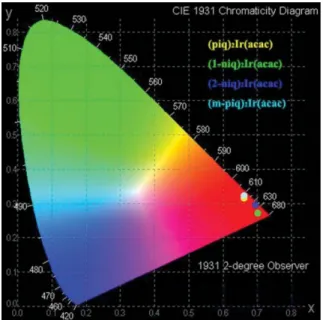
as an electron transport layer, 4,4’-bis(N-carbazolyl)biphenyl (CBP) as the host material, and iridium complexes as the dopant. The corresponding CIE coordinates are x ~ 0.679,
y ~ 0.318 for (piq)2Ir(acac), x ~ 0.701, y ~ 0.273 for
(1-niq)2Ir(acac), x ~ 0.697, y ~ 0.299 for (2-niq)2Ir(acac) and
x ~ 0.677, y ~ 0.321 for (m-piq)2Ir(acac) (as shown in Fig. 4)
All four devices show red to deep-red emissions, these were close to the National Television Standards Committee recommended red for a video display.
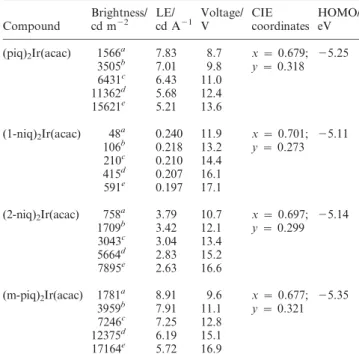
Electrophosphorescence data for the iridium complexes are summarized in Table 1. In these complexes, we change the substituent at C-1 of isoquinoline from phenyl to 1-naphthyl
and 2-naphthyl. The data show that (1-niq)2Ir(acac) and
(2-niq)2Ir(acac) as the dopant give better bathochromic shifts
(680 and 634 nm, respectively), but have poor brightness and luminance efficiency. In contrast, when we retain the isoquino-line C-1 substituent group as phenyl and change the C-5 sub-stituent group from hydrogen to methyl, a better performance
in brightness and luminance can be achieved. (m-piq)2Ir(acac)
showed a better performance than (piq)2Ir(acac) in both
bright-ness and luminance efficiency. When (m-piq)2Ir(acac) was used
as the dopant, a maximum brightness of 17 164 cd m22 was
achieved at a current density of J ~ 300 mA cm22.
In summary, we have designed and synthesized cyclometa-lated iridium complexes suitable for use as red dopant materials in OLEDs. In comparison to the known derivatives of this
Fig. 1 PL Spectra of the Ir complexes in CH2Cl2.
Fig. 2 EL Spectra of iridium complexes at J ~ 50 mA cm22.
Fig. 4 CIE coordinates of (piq)2Ir(acac) (0.679, 0.318), (1-niq)2
Ir-(acac) (0.701, 0.273), (2-niq)2Ir(acac) (0.697, 0.299) and (m-piq)2
Ir-(acac) (0.677, 0.321).
Fig. 3 Configuration of the device.
class,16(m-piq)2Ir(acac) shows better efficiency and equivalent
CIE coordinates data. Although (2-niq)2Ir(acac) can not give
brightness and luminance efficiency as high as (piq)2Ir(acac), it
produces a more pure red color than (m-piq)2Ir(acac) and can
be used in special applications as indicated by its CIE data. We believe the efficiency can be further improved by using a more suitable host material for the emitting layer, or a more suitable
device structure.7
Experimental
Instrumentation1
H NMR and13C NMR spectra were measured using a Bruker
AMX-400 (400 MHz), FAB mass spectra were collected with a Bruker APEX II, and Photoluminesence spectra were recorded with a HITACHI F-4500. The melting point data were measured with a PYRIS Diamond TG/DTA-10 at a heating
rate of 20uC min21
. N-(2-o-Tolylethyl)benzamide
Benzoic acid (12.2 g, 100 mmol) was dissolved in 100 ml of dry dimethylformamide. While the solution was cooled with ice with stirring, triethylamine (11.5 g) and ethyl chloroformate (11 g) were added. After a lapse of 30 min, 2-methylphenethyl-amine (14 g, 104 mmol) was added dropwise. The mixture was
stirred at room temperature for 1 h and then at 50–60uC for 1 h,
and poured into ice-water. The crystallized precipitates were washed in water, dried, and recrystallized from cyclohexane to afford N-(2-o-tolylethyl)benzamide (14.66 g, 61.3 mmol). 5-Methyl-1-phenyl-3,4-dihydroisoquinoline
N-(2-o-Tolylethyl)benzamide (14.66 g, 61.3 mmol) was heated
with stirring at 130uC for 4 h together with 150 ml of xylene,
50 ml of phosphorus oxychloride and 50 g of phosphorus pentoxide. The reaction mixture was decanted to remove the solvent. The residue was carefully decomposed with ice-water, and made weakly alkaline with 45% sodium hydroxide. The crystals which precipitated were extracted with benzene
(2 6 100 ml). The organic layer was washed with water (3 6
100 ml) and dried over MgSO4.
1-Phenyl-5-methylisoquinoline
All of the organic layer above was reacted for 16 h together with active manganese dioxide (100 g). After the reaction, the manganese dioxide was removed by filtration, and the benzene was distilled off. Recrystallization of the resulting crystals from cyclohexane afforded 1-phenyl-5-methylisoquinoline as yellow crystals (11.94 g, 54.5 mmol).
1-Phenylisoquinoline (piq) (yield 33%)
Tm ~ 95 uC, EIMS: m/z 205, [M]1;1H NMR (acetone-d6,
400 MHz): d 8.57 (d, J ~ 5.6 Hz, 1H), 8.09 (d, J ~ 8.5 Hz, 1H), 8.01 (d, J ~ 8.2 Hz, 1H), 7.79–7.69 (m, 4H), 7.62 (t, J ~ 8 Hz, 1H), 7.58–7.50 (m, 4H).
1-(1’-Naphthyl)isoquinoline (1-niq) (yield 30%)
Tm~ 106.4uC, EIMS: m/z 255, [M]1;1H NMR (acetone-d6,
400 MHz): d 8.66 (d, J ~ 5.6 Hz, 1H), 8.08–8.02 (m, 3H), 7.89 (d, J ~ 5.9 Hz, 1H), 7.75 (td, J ~ 8, 1.3 Hz, 1H), 7.69 (td, J ~ 7.3, 1.38 Hz, 1H), 7.58–7.45 (m, 4H), 7.35–7.32 (m, 2H). 1-(2’-Naphthyl)isoquinoline (2-niq) (yield 41%)
Tm~ 163.3uC, EIMS: m/z 255, [M]1; 1 H NMR (acetone-d6, 400 MHz): d 8.62 (d, J ~ 5.6 Hz, 1H), 8.23–8.18 (m, 2H), 8.09– 8.01 (m, 4H), 7.87 (dd, J ~ 8.4, 1.6 Hz, 1H), 7.82–7.76 (m, 2H), 7.65–7.58 (m, 3H).
1-Phenyl-5-methylisoquinoline (m-piq) (yield 54.5%)
Tm ~ 61.2uC, EIMS: m/z 219, [M]1;1H NMR (acetone-d6,
400 MHz): d 8.60 (d, J ~ 5.6 Hz, 1H), 7.91 (d, J ~ 8.5 Hz, 1H), 7.87 (dd, J ~ 5.95, 0.69 Hz, 1H), 7.68–7.66 (m, 2H), 7.60 (d, J ~ 7.0 Hz, 1H), 7.57–7.47 (m, 4H).
Preparation of red phosphorescence iridium complexes, (piq)2
-Ir(acac), (1-niq)2Ir(acac), (2-niq)2Ir(acac) and (m-piq)2Ir(acac)
All procedures involving IrCl3?H2O were carried out in
nitro-gen gas atmosphere. Cyclometalated Ir(III) m-chloro-bridged
dimers were synthesized by the method reported by
Nono-yama.17 IrCl
3?H2O (Next Chimica) and 2.5 equiv. of ligand
were heated in a 3:1 mixture of 2-ethoxyethanol and water.
This slurry was heated at 100uC for 24 h. After cooling to room
temperature, the precipitate was filtered off and washed with water. The obtained solid was placed in a flask and dispersed in 2-ethoxyethanol. Acetylacetone and sodium carbonate were
added to the solution and the mixture were heated at 120uC for
12–16 h. After cooling to room temperature, the crude product was filtered off and washed with water, followed by two portions of n-hexane and ether. The solid was dried in vacuum and zone sublimed to give pure product which was used for advanced analysis and device fabrication.
Bis(1-phenylisoquinolinato-N,C2’)iridium(acetylacetonate) (piq)2
-Ir(acac) (yield 53.8%) Tm ~ 372.9 uC, FAB MS: m/z 700, [M 1 1]1; 1H NMR (CD2Cl2, 400 MHz): d 9.01 (d, J ~ 6.4 Hz, 2H), 8.51 (dd, J ~ 6.4,1.2 Hz, 2H), 8.25 (d, J ~ 8 Hz, 2H), 7.99 (m, 2H), 7.76 (m, 4H), 7.57 (d, J ~ 6.4 Hz, 2H), 6.97 (t, J ~ 7.6 Hz, 2H), 6.69 (t, J ~ 7.6 Hz, 2H), 6.37 (d, J ~ 7.6 Hz, 2H), 5.35 (s, 1H), 1.81 (s, 6H). 13C NMR (CD 2Cl2, 400 MHz) d: 175.1, 158.9, 141.8, 137.0, 130.6, 127.4, 123.8, 120.9, 119.9, 118.9, 118.0, 117.5, 116.8, 116.5, 110.6, 110.4, 90.7, 18.5.
Table 1 Electrophosphorescence data for iridium complexes
Compound
Brightness/
cd m22 LE/cd A21 Voltage/V CIEcoordinates HOMO/eV
(piq)2Ir(acac) 1566a 7.83 8.7 x ~ 0.679; y ~ 0.318 25.25 3505b 7.01 9.8 6431c 6.43 11.0 11362d 5.68 12.4 15621e 5.21 13.6 (1-niq)2Ir(acac) 48 a 0.240 11.9 x ~ 0.701; y ~ 0.273 25.11 106b 0.218 13.2 210c 0.210 14.4 415d 0.207 16.1 591e 0.197 17.1 (2-niq)2Ir(acac) 758a 3.79 10.7 x ~ 0.697; y ~ 0.299 25.14 1709b 3.42 12.1 3043c 3.04 13.4 5664d 2.83 15.2 7895e 2.63 16.6 (m-piq)2Ir(acac) 1781a 8.91 9.6 x ~ 0.677; y ~ 0.321 25.35 3959b 7.91 11.1 7246c 7.25 12.8 12375d 6.19 15.1 17164e 5.72 16.9
For each parameter, the data in different rows correspond to those measured at different current density:a20 mA cm22,b50 mA cm22, c
100 mA cm22.d200 mA cm22,e300 mA cm22.
Bis(1-(1’-naphthyl)isoquinolinato-N,C2’)iridium(acetylacetonate)
-(1-niq)2Ir(acac) (yield 34.5%)
Tm~ 369.8uC, FAB MS: m/z 800, [M 1 1]1.
Bis(1-(2’-naphthyl)isoquinolinato-N,C2’)iridium(acetylacetonate)
(2-niq)2Ir(acac) (yield 64.4%)
Tm~ 370uC, FAB MS: m/z 800, [M 1 1]1;1H NMR (CD2Cl2, 400 MHz): d 9.21 (m, 2H), 8.75 (s, 2H), 8.60 (d, J ~ 6.4 Hz, 2H), 8.08 (m, 2H), 7.86 (m, 4H), 7.77 (m, 2H), 7.67 (d, J ~ 6.4 Hz, 2H), 7.17 (m, 6H), 6.69 (s, 2H), 5.32 (s, 1H), 1.79 (s, 6H). 13C NMR (CD2Cl2, 400 MHz) d: 175.2, 158.0, 137.1, 133.3, 131.0, 127.4, 124.4, 121.9, 121.0, 120.1, 119.9, 119.7, 119.4, 118.6, 117.8, 117.2, 116.9, 115.0, 111.1, 108.6, 90.7, 18.6. Bis(1-phenyl-5-methylisoquinolinato-N,C2’
)iridium(acetylaceto-nate) (m-piq)2Ir(acac) (yield 41.8%)
Tm ~ 383.7 uC, FAB MS: m/z 728, [M 1 1]1; 1H NMR (CD2Cl2, 400 MHz): d 8.85 (d, J ~ 8 Hz, 2H), 8.49 (d, J ~ 6.4 Hz, 2H), 8.22 (d, J ~ 8 Hz, 2H), 7.71 (d, J ~ 6.4 Hz, 2H), 7.61 (m, 4H), 6.93 (td, J ~ 6.4, 1.2 Hz, 2H), 6.65 (td, J ~ 6.4, 1.2 Hz, 2H), 6.34 (dd, J ~ 7.6, 1.2 Hz, 2H), 5.32 (s, 1H), 2.77 (s, 6H), 1.80 (s, 6H). 13C NMR (CD 2Cl2, 400 MHz) d: 175.1, 159.2, 141.7, 137.2, 130.5, 126.8, 124.4, 123.8, 121.4, 120.2, 118.8, 117.6, 116.6, 115.0, 110.6, 106.7, 90.6, 18.5, 9.4. OLED Fabrication and measurement
Pre-patterned ITO glass with an effective device of area
0.16 cm2was cleaned in detergent for 10 min, and then washed
with a large amount of doubly distilled water. After sonication
in pure water for 5 min, the glass was dried in an oven at 180uC
for 90 min. The organic layers were deposited thermally at a
rate of 0.1 nm s21 and pressure of y1 6 1026
Torr in a deposition system. Aluminium was deposited as the cathode. The HOMO value of iridium complexes were measured with a RIKEN Photoelectron Spectrometer AC-2. The electrophos-phorescence data were measured with a SpectraScan PR650. These devices were fixed in the device holder and collected the light from the front face.
Acknowledgements
This work was supported by the National Science Council of the Republic of China, Taiwan.
References
1 M. Thelakkat and H.-W. Schmidt, Adv. Mater., 1998, 10, 219. 2 L. S. Hung and C. H. Chen, Mater. Sci. Eng. R., 2002, 39, 143. 3 S. Tokito, T. Lijima, T. Tsuzuki and F. Sato, Appl. Phys. Lett.,
2003, 83, 2459.
4 Z. Y. Xie, L. S. Hung and S. T. Lee, Appl. Phys. Lett., 2001, 79, 1048.
5 C. H. Chen, C. W. Tang, J. Shi and K. P. Klubek, Thin Solid Films, 2000, 363, 327.
6 M. A. Baldo, M. E. Thompson and S. R. Forrest, Nature (London), 2000, 403, 750.
7 C. Adachi, M. A. Baldo, M. E. Thompson and S. R. Forrest, J. Appl. Phys., 2001, 90, 5048.
8 S. Lamansky, P. Djurovich, D. Murphy, F. Abdel-Razzaq, H. Lee, C. Adachi, P. E. Burrows, S. R. Forrest and M. E. Thompson, J. Am. Chem. Soc., 2001, 123, 4304.
9 F. Chen, Y. Yang, M. E. Thompson and J. Kido, Appl. Phys. Lett., 2002, 80, 2308.
10 M. A. Baldo, D. F. O’Brien, Y. You, A. Shoustikov, S. Sibley, M. E. Thompson and S. R. Forrest, Nature (London), 1998, 151, 395.
11 H. Rudmann, S. Shimada and M. F. Rubner, J. Am. Chem. Soc., 2002, 121, 4918.
12 J. H. Kim, M. S. Liu, A. K.-Y. Jen, B. Carlson, L. R. Dalton, C. F. Shu and R. Dodda, Appl. Phys. Lett., 2003, 83, 776. 13 M. A. Baldo, M. E. Thompson and S. R. Forrest, Nature
(London), 2001, 403, 750.
14 S. Okada, H. Iwawaki, M. Furugori, J. Kamatani, S. Igawa, T. Moriyama, S. Miura, A. Tsuboyama, T. Takiguchi and H. Mizutani, 2002 SID 02 DIGEST 1360.
15 D. A. Walsh, J. Med. Chem., 1978, 21, 582.
16 The (piq)2Ir(acac) complex has been described in a recent paper
by Su et al. The device based on this complex gave gext~ 8.46% at
J ~ 20 mA cm22. In this paper, we treat (piq)2Ir(acac) as the
standard while (m-piq)2Ir(acac) shows better luminance efficiency
and brightness. We predict that (m-piq)2Ir(acac) should exhibit a
better gextthan (piq)2Ir(acac). See: Y. J. Su, H. L. Huang, C. L. Li,
C. H. Chien, Y. T. Tao, P. T. Chou, S. Datta and R. S. Liu, Adv. Mater., 2003, 15, 884.
17 M. Nonoyama, Bull. Chem. Soc. Jpn., 1974, 47, 767.