ANNEX 1
RESOLUTION MEPC.328(76)
AMENDMENTS TO THE ANNEX OF THE PROTOCOL OF 1997 TO AMEND THE INTERNATIONAL CONVENTION FOR THE PREVENTION OF POLLUTION FROM SHIPS, 1973, AS MODIFIED BY THE PROTOCOL OF 1978 RELATING THERETO
2021 Revised MARPOL Annex VI
THE MARINE ENVIRONMENT PROTECTION COMMITTEE,
RECALLING Article 38(a) of the Convention on the International Maritime Organization concerning the functions of the Marine Environment Protection Committee (the Committee) conferred upon it by international conventions for the prevention and control of marine pollution from ships,
RECALLING ALSO article 16 of the International Convention for the Prevention of Pollution from Ships, 1973, as modified by the Protocols of 1978 and 1997 relating thereto (MARPOL), which specifies the amendment procedure and confers upon the appropriate body of the Organization the function of considering amendments thereto for adoption by the Parties, RECALLING FURTHER that the Committee, at its seventy-second session, adopted resolution MEPC.304(72) on the Initial IMO Strategy on reduction of GHG emissions from ships,
HAVING CONSIDERED, at its seventy-sixth session, proposed amendments to MARPOL Annex VI concerning mandatory goal-based technical and operational measures to reduce carbon intensity of international shipping and exemption of unmanned non-self-propelled (UNSP) barges from certain survey and certification requirements, which were circulated in accordance with article 16(2)(a) of MARPOL,
HAVING ALSO CONSIDERED, at its seventy-sixth session, the comprehensive assessment of the impacts of the proposed amendments to MARPOL Annex VI on States, including on developing countries, especially on least developed countries (LDCs) and small island developing States (SIDS),
1 ADOPTS, in accordance with article 16(2)(d) of MARPOL, the amendments to MARPOL Annex VI, the text of which is set out in the annex to the present resolution;
2 DETERMINES, in accordance with article 16(2)(f)(iii) of MARPOL, that the amendments to MARPOL Annex VI shall be deemed to have been accepted on 1 May 2022 unless prior to that date not less than one third of the Parties or Parties the combined merchant fleets of which constitute not less than 50% of the gross tonnage of the world's merchant fleet have communicated to the Organization their objection to the amendments;
3 INVITES the Parties to note that, in accordance with article 16(2)(g)(ii) of MARPOL, the amendments to MARPOL Annex VI shall enter into force on 1 November 2022 upon its acceptance in accordance with paragraph 2 above;
4 INVITES ALSO the Parties to consider and initiate as soon as possible the development of a Carbon Intensity Code;
As set out in documents MEPC 76/7/13, MEPC 76/INF.68, and MEPC 76/INF.68/Add.1, Add.2 and Add.3.
5 INVITES the Organization, mindful of the review clauses provided for in regulations 25.3 and 28.11 of the amendments to MARPOL Annex VI, to initiate the respective reviews as early as possible;
6 INVITES ALSO the Organization to keep under review the impacts on States of the aforesaid amendments to MARPOL Annex VI, paying particular attention to the needs of developing countries, especially LDCs and SIDS, so that any necessary adjustments can be made;
7 AGREES to undertake a lessons-learned exercise from the comprehensive impact assessment of the amendments to MARPOL Annex VI, with a view to improving the procedure for conducting future impact assessments taking into account the Procedure for assessing impacts on States of candidate measures (MEPC.1/Circ.885) and the terms of reference for the impact assessment of the short-term measure;†
8 ENCOURAGES the Parties to consider early application of the aforesaid amendments;
9 REQUESTS the Secretary-General, for the purposes of article 16(2)(e) of MARPOL, to transmit certified copies of the present resolution and the text of the amendments to MARPOL Annex VI contained in the annex to all Parties to MARPOL;
10 REQUESTS ALSO the Secretary-General to transmit copies of the present resolution and its annex to Members of the Organization which are not Parties to MARPOL.
† As set out in the Terms of reference and arrangements for the conduct of a comprehensive impact assessment of the short-term measure before MEPC 76 (MEPC 75/18, annex 6).
ANNEX MARPOL ANNEX VI
REGULATIONS FOR THE PREVENTION OF AIR POLLUTION FROM SHIPS
Chapter 1 – General
Regulation 1 Application
The provisions of this Annex shall apply to all ships, except where expressly provided otherwise.
Regulation 2 Definitions
1 For the purpose of this Annex:
.1 Annex means Annex VI to the International Convention for the Prevention of Pollution from Ships, 1973 (MARPOL), as modified by the Protocol of 1978 relating thereto, and as modified by the Protocol of 1997, as amended by the Organization, provided that such amendments are adopted and brought into force in accordance with the provisions of article 16 of the present Convention.
.2 A similar stage of construction means the stage at which:
.1 construction identifiable with a specific ship begins; and
.2 assembly of that ship has commenced comprising at least 50 tonnes or one per cent of the estimated mass of all structural material, whichever is less.
.3 Anniversary date means the day and the month of each year that will correspond to the date of expiry of the International Air Pollution Prevention Certificate.
.4 Audit means a systematic, independent and documented process for obtaining audit evidence and evaluating it objectively to determine the extent to which audit criteria are fulfilled.
.5 Audit Scheme means the IMO Member State Audit Scheme established by the Organization and taking into account the guidelines developed by the Organization.1
.6 Audit Standard means the Code for Implementation.
.7 Auxiliary control device means a system, function or control strategy installed on a marine diesel engine that is used to protect the engine and/or its ancillary equipment against operating conditions that could result in damage or failure, or that is used to facilitate the starting of the engine. An auxiliary control device
1 Refer to the Framework and Procedures for the IMO Member State Audit Scheme (resolution A.1067(28)).
may also be a strategy or measure that has been satisfactorily demonstrated not to be a defeat device.
.8 Code for Implementation means the IMO Instruments Implementation Code (III Code) adopted by the Organization by resolution A.1070(28).
.9 Continuous feeding is defined as the process whereby waste is fed into a combustion chamber without human assistance while the incinerator is in normal operating conditions with the combustion chamber operative temperature between 850°C and 1,200°C.
.10 Defeat device means a device that measures, senses or responds to operating variables (e.g. engine speed, temperature, intake pressure or any other parameter) for the purpose of activating, modulating, delaying or deactivating the operation of any component or the function of the emission control system such that the effectiveness of the emission control system is reduced under conditions encountered during normal operation, unless the use of such a device is substantially included in the applied emission certification test procedures.
.11 Electronic Record Book means a device or system, approved by the Administration, used to electronically record the required entries for discharges, transfers and other operations as required under this Annex in lieu of a hard copy record book.2
.12 Emission means any release of substances, subject to control by this Annex, from ships into the atmosphere or sea.
.13 Emission control area means an area where the adoption of special mandatory measures for emissions from ships is required to prevent, reduce and control air pollution from NOx or SOx and particulate matter or all three types of emissions and their attendant adverse impacts on human health and the environment. Emission control areas shall include those listed in, or designated under, regulations 13 and 14 of this Annex.
.14 Fuel oil means any fuel delivered to and intended for combustion purposes for propulsion or operation on board a ship, including gas, distillate and residual fuels.
.15 Gross tonnage means the gross tonnage calculated in accordance with the tonnage measurement regulations contained in Annex I to the International Convention on Tonnage Measurements of Ships, 1969, or any successor Convention.
.16 In-use sample means a sample of fuel oil in use on a ship.
.17 Installations in relation to regulation 12 of this Annex means the installation of systems, equipment, including portable fire-extinguishing units, insulation, or other material on a ship, but excludes the repair or recharge of previously installed systems, equipment, insulation or other material, or the recharge of portable fire-extinguishing units.
2 Refer to the Guidelines for the use of electronic record books under MARPOL (resolution MEPC.312(74)).
.18 Installed means a marine diesel engine that is or is intended to be fitted on a ship, including a portable auxiliary marine diesel engine, only if its fuelling, cooling or exhaust system is an integral part of the ship. A fuelling system is considered integral to the ship only if it is permanently affixed to the ship. This definition includes a marine diesel engine that is used to supplement or augment the installed power capacity of the ship and is intended to be an integral part of the ship.
.19 Irrational emission control strategy means any strategy or measure that, when the ship is operated under normal conditions of use, reduces the effectiveness of an emission control system to a level below that expected on the applicable emission test procedures.
.20 Low-flashpoint fuel means gaseous or liquid fuel oil having a flashpoint lower than otherwise permitted under paragraph 2.1.1 of regulation 4 of chapter II- 2 of the International Convention for the Safety of Life at Sea (SOLAS), 1974, as amended.
.21 Marine diesel engine means any reciprocating internal combustion engine operating on liquid or dual fuel, to which regulation 13 of this Annex applies, including booster/compound systems if applied. In addition, a gas-fuelled engine installed on a ship constructed on or after 1 March 2016 or a gas-fuelled additional or non-identical replacement engine installed on or after that date is also considered as a marine diesel engine.
.22 MARPOL delivered sample means the sample of fuel oil delivered in accordance with regulation 18.8.1 of this Annex.
.23 NOx Technical Code means the Technical Code on Control of Emission of Nitrogen Oxides from Marine Diesel Engines adopted by resolution 2 of the 1997 MARPOL Conference, as amended by the Organization, provided that such amendments are adopted and brought into force in accordance with the provisions of article 16 of the present Convention.
.24 Onboard sample means a sample of fuel oil intended to be used or carried for use on board that ship.
.25 Ozone-depleting substances means controlled substances defined in paragraph (4) of article 1 of the Montreal Protocol on Substances that Deplete the Ozone Layer, 1987, listed in Annexes A, B, C or E to the said Protocol in force at the time of application or interpretation of this Annex.
Ozone-depleting substances that may be found on board ship include, but are not limited to:
Halon 1211 Bromochlorodifluoromethane Halon 1301 Bromotrifluoromethane
Halon 2402 1,2-Dibromo-1,1,2,2-tetraflouroethane (also known as Halon 114B2)
CFC-11 Trichlorofluoromethane CFC-12 Dichlorodifluoromethane
CFC-113 1,1,2-Trichloro-1,2,2-trifluoroethane
CFC-114 1,2-Dichloro-1,1,2,2-tetrafluoroethane CFC-115 Chloropentafluoroethane
.26 Shipboard incineration means the incineration of wastes or other matter on board a ship, if such wastes or other matter were generated during the normal operation of that ship.
.27 Shipboard incinerator means a shipboard facility designed for the primary purpose of incineration.
.28 Ships constructed means ships the keels of which are laid or that are at a similar stage of construction.
.29 Sludge oil means sludge from the fuel oil or lubricating oil separators, waste lubricating oil from main or auxiliary machinery, or waste oil from bilge water separators, oil filtering equipment or drip trays.
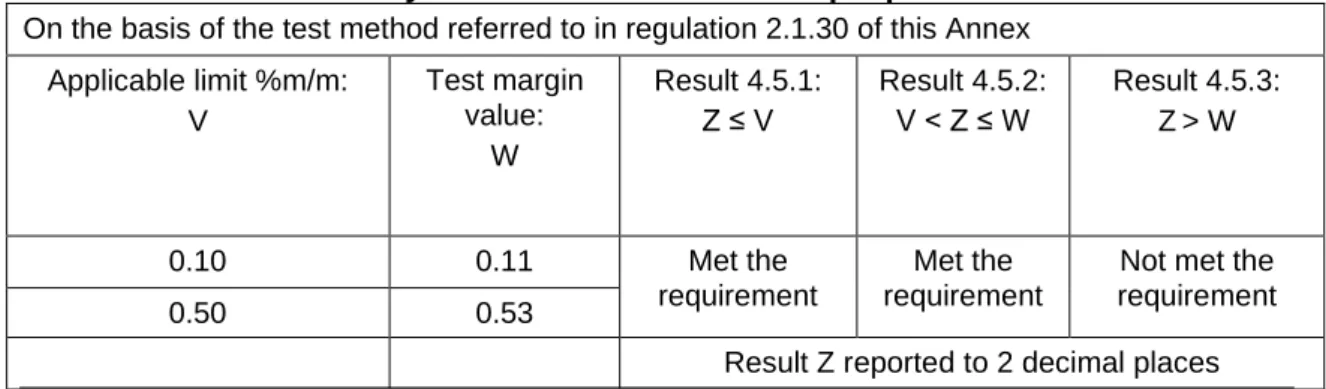
.30 Sulphur content of fuel oil means the concentration of sulphur in a fuel oil, measured in % m/m as tested in accordance with a standard acceptable to the Organization.3
.31 Tanker in relation to regulation 15 of this Annex means an oil tanker as defined in regulation 1 of Annex I of the present Convention or a chemical tanker as defined in regulation 1 of Annex II of the present Convention.
.32 Unmanned non-self-propelled (UNSP) barge means a barge that:
.1 is not propelled by mechanical means;
.2 has no system, equipment and/or machinery fitted that may generate emissions regulated by this Annex; and
.3 has neither persons nor living animals on board.
2 For the purpose of chapter 4:
.1 A ship delivered on or after 1 September 2019 means a ship:
.1 for which the building contract is placed on or after 1 September 2015; or
.2 in the absence of a building contract, the keel of which is laid, or which is at a similar stage of construction, on or after 1 March 2016;
or
.3 the delivery of which is on or after 1 September 2019.
.2 Attained annual operational CII is the operational carbon intensity indicator value achieved by an individual ship in accordance with regulations 26 and 28 of this Annex.
3 Refer to ISO 8754:2003 Petroleum products – Determination of sulphur content – Energy-dispersive X-ray fluorescence spectrometry.
.3 Attained EEDI is the EEDI value achieved by an individual ship in accordance with regulation 22 of this Annex.
.4 Attained EEXI is the EEXI value achieved by an individual ship in accordance with regulation 23 of this Annex.
.5 Bulk carrier means a ship which is intended primarily to carry dry cargo in bulk, including such types as ore carriers as defined in regulation 1 of chapter XII of the International Convention for the Safety of Life at Sea (SOLAS), 1974, (as amended) but excluding combination carriers.
.6 Calendar year means the period from 1 January until 31 December inclusive.
.7 Combination carrier means a ship designed to load 100% deadweight with both liquid and dry cargo in bulk.
.8 Company means the owner of the ship or any other organization or person such as the manager, or the bareboat charterer, who has assumed the responsibility for operation of the ship from the owner of the ship and who on assuming such responsibility has agreed to take over all the duties and responsibilities imposed by the International Management Code for the Safe Operation of Ships and for Pollution Prevention, as amended.
.9 Containership means a ship designed exclusively for the carriage of containers in holds and on deck.
.10 Conventional propulsion in relation to chapter 4 means a method of propulsion where a main reciprocating internal combustion engine(s) is the prime mover and coupled to a propulsion shaft either directly or through a gear box.
.11 Cruise passenger ship in relation to chapter 4 means a passenger ship not having a cargo deck, designed exclusively for commercial transportation of passengers in overnight accommodations on a sea voyage.
.12 Distance travelled means distance travelled over ground.
.13 Existing ship means a ship which is not a new ship.
.14 Gas carrier in relation to chapter 4 means a cargo ship, other than an LNG carrier as defined in paragraph 2.16 of this regulation, constructed or adapted and used for the carriage in bulk of any liquefied gas.
.15 General cargo ship means a ship with a multi-deck or single deck hull designed primarily for the carriage of general cargo. This definition excludes specialized dry cargo ships, which are not included in the calculation of reference lines for general cargo ships, namely livestock carrier, barge carrier, heavy load carrier, yacht carrier, nuclear fuel carrier.
.16 LNG carrier in relation to chapter 4 of this Annex means a cargo ship constructed or adapted and used for the carriage in bulk of liquefied natural gas (LNG).
.17 Major conversion means in relation to chapter 4 of this Annex a conversion of a ship:
.1 which substantially alters the dimensions, carrying capacity or engine power of the ship; or
.2 which changes the type of the ship; or
.3 the intent of which in the opinion of the Administration is substantially to prolong the life of the ship; or
.4 which otherwise so alters the ship that, if it were a new ship, it would become subject to relevant provisions of the present Convention not applicable to it as an existing ship; or
.5 which substantially alters the energy efficiency of the ship and includes any modifications that could cause the ship to exceed the applicable required EEDI as set out in regulation 24 of this Annex or the applicable required EEXI as set out in regulation 25 of this Annex.
.18 New ship means a ship:
.1 for which the building contract is placed on or after 1 January 2013;
or
.2 in the absence of a building contract, the keel of which is laid or which is at a similar stage of construction on or after 1 July 2013; or .3 the delivery of which is on or after 1 July 2015.
.19 Non-conventional propulsion in relation to chapter 4 of this Annex means a method of propulsion, other than conventional propulsion, including diesel-electric propulsion, turbine propulsion, and hybrid propulsion systems.
.20 Passenger ship means a ship which carries more than 12 passengers.
.21 Polar Code means the International Code for Ships Operating in Polar Waters, consisting of an introduction, parts I-A and II-A and parts I-B and II-B, adopted by resolutions MSC.385(94) and MEPC.264(68), as may be amended, provided that:
.1 amendments to the environment-related provisions of the introduction and chapter 1 of part II-A of the Polar Code are adopted, brought into force and take effect in accordance with the provisions of article 16 of the present Convention concerning the amendment procedures applicable to an appendix to an annex; and .2 amendments to part II-B of the Polar Code are adopted by the
Marine Environment Protection Committee in accordance with its Rules of Procedure.
.22 Refrigerated cargo carrier means a ship designed exclusively for the carriage of refrigerated cargoes in holds.
.23 Required annual operational CII is the target value of attained annual operational CII in accordance with regulations 26 and 28 of this Annex for the specific ship type and size.
.24 Required EEDI is the maximum value of attained EEDI that is allowed by regulation 24 of this Annex for the specific ship type and size.
.25 Required EEXI is the maximum value of attained EEXI that is allowed by regulation 25 of this Annex for the specific ship type and size.
.26 Ro-ro cargo ship means a ship designed for the carriage of roll-on-roll-off cargo transportation units.
.27 Ro-ro cargo ship (vehicle carrier) means a multi-deck roll-on-roll-off cargo ship designed for the carriage of empty cars and trucks.
.28 Ro-ro passenger ship means a passenger ship with roll-on-roll-off cargo spaces.
.29 Tanker means an oil tanker as defined in regulation 1 of Annex I of the present Convention or a chemical tanker or an NLS tanker as defined in regulation 1 of Annex II of the present Convention.
Regulation 3
Exceptions and exemptions General
1 Regulations of this Annex shall not apply to:
.1 any emission necessary for the purpose of securing the safety of a ship or saving life at sea; or
.2 any emission resulting from damage to a ship or its equipment:
.2.1 provided that all reasonable precautions have been taken after the occurrence of the damage or discovery of the emission for the purpose of preventing or minimizing the emission; and
.2.2 except if the owner or the master acted either with intent to cause damage, or recklessly and with knowledge that damage would probably result.
Trials for ship emission reduction and control technology research
2 The Administration of a Party may, in cooperation with other Administrations as appropriate, issue an exemption from specific provisions of this Annex for a ship to conduct trials for the development of ship emission reduction and control technologies and engine design programmes. Such an exemption shall only be provided if the applications of specific provisions of the Annex or the revised NOx Technical Code 2008 could impede research into the development of such technologies or programmes. A permit issued under this regulation shall not exempt a ship from the reporting requirement under regulation 27 and shall not alter the type and scope of data required to be reported under regulation 27. A permit for such an exemption
shall only be provided to the minimum number of ships necessary and be subject to the following provisions:
.1 for marine diesel engines with a per cylinder displacement up to 30 L, the duration of the sea trial shall not exceed 18 months. If additional time is required, a permitting Administration or Administrations may permit a renewal for one additional 18-month period; or
.2 for marine diesel engines with a per cylinder displacement at or above 30 L, the duration of the ship trial shall not exceed five years and shall require a progress review by the permitting Administration or Administrations at each intermediate survey. A permit may be withdrawn based on this review if the testing has not adhered to the conditions of the permit or if it is determined that the technology or programme is not likely to produce effective results in the reduction and control of ship emissions. If the reviewing Administration or Administrations determine that additional time is required to conduct a test of a particular technology or programme, a permit may be renewed for an additional time period not to exceed five years.
Emissions from seabed mineral activities
3.1 Emissions directly arising from the exploration, exploitation and associated offshore processing of seabed mineral resources are, consistent with article 2(3)(b)(ii) of the present Convention, exempt from the provisions of this Annex. Such emissions include the following:
.1 emissions resulting from the incineration of substances that are solely and directly the result of exploration, exploitation and associated offshore processing of seabed mineral resources, including but not limited to the flaring of hydrocarbons and the burning of cuttings, muds, and/or stimulation fluids during well completion and testing operations, and flaring arising from upset conditions;
.2 the release of gases and volatile compounds entrained in drilling fluids and cuttings;
.3 emissions associated solely and directly with the treatment, handling or storage of seabed minerals; and
.4 emissions from marine diesel engines that are solely dedicated to the exploration, exploitation and associated offshore processing of seabed mineral resources.
3.2 The requirements of regulation 18 of this Annex shall not apply to the use of hydrocarbons that are produced and subsequently used on site as fuel, when approved by the Administration.
Unmanned non-self-propelled barges
4 The Administration may exempt an unmanned non-self-propelled (UNSP) barge4 from the requirements of regulations 5.1 and 6.1 of this Annex by means of an International Air Pollution Prevention Exemption Certificate for Unmanned Non-self-propelled (UNSP) Barges,
4 Refer to the Guidelines for exemption of unmanned non-self-propelled (UNSP) barges from the survey and certification requirements under the MARPOL Convention (MEPC.1/Circ.892).
for a period not exceeding five years provided that the barge has undergone a survey to confirm that conditions referred to in regulations 2.1.32.1 to 2.1.32.3 of this Annex are met.
Regulation 4 Equivalents
1 The Administration of a Party may allow any fitting, material, appliance or apparatus to be fitted in a ship or other procedures, alternative fuel oils, or compliance methods used as an alternative to those required by this Annex if such fitting, material, appliance or apparatus or other procedures, alternative fuel oils, or compliance methods are at least as effective in terms of emissions reductions as those required by this Annex, including any of the standards set forth in regulations 13 and 14.
2 The Administration of a Party that allows a fitting, material, appliance or apparatus or other procedures, alternative fuel oils, or compliance methods used as an alternative to those required by this Annex shall communicate to the Organization for circulation to the Parties particulars thereof, for their information and appropriate action, if any.
3 The Administration of a Party should take into account any relevant guidelines developed by the Organization5 pertaining to the equivalents provided for in this regulation.
4 The Administration of a Party that allows the use of an equivalent as set forth in paragraph 1 of this regulation shall endeavour not to impair or damage its environment, human health, property or resources or those of other States.
Chapter 2 – Survey, certification and means of control
Regulation 5 Surveys
1 Every ship of 400 gross tonnage and above and every fixed and floating drilling rig or other platform shall, to ensure compliance with the requirements of chapter 3 of this Annex, be subject to the surveys specified below:
.1 An initial survey before the ship is put into service or before the certificate required under regulation 6 of this Annex is issued for the first time. This survey shall be such as to ensure that the equipment, systems, fittings, arrangements and material fully comply with the applicable requirements of chapter 3 of this Annex;
.2 A renewal survey at intervals specified by the Administration, but not exceeding five years, except where regulation 9.2, 9.5, 9.6 or 9.7 of this Annex is applicable. The renewal survey shall be such as to ensure that the equipment, systems, fittings, arrangements and material fully comply with applicable requirements of chapter 3 of this Annex;
.3 An intermediate survey within three months before or after the second anniversary date or within three months before or after the third anniversary date of the certificate which shall take the place of one of the annual surveys specified in paragraph 1.4 of this regulation. The intermediate survey shall be such as to ensure that the equipment and arrangements fully comply with the applicable requirements of chapter 3 of this Annex and are in good working
5 Refer to 2015 Guidelines for exhaust gas cleaning systems (resolution MEPC.259(68)).
order. Such intermediate surveys shall be endorsed on the IAPP Certificate issued under regulation 6 or 7 of this Annex;
.4 An annual survey within three months before or after each anniversary date of the certificate, including a general inspection of the equipment, systems, fittings, arrangements and material referred to in paragraph 1.1 of this regulation to ensure that they have been maintained in accordance with paragraph 5 of this regulation and that they remain satisfactory for the service for which the ship is intended. Such annual surveys shall be endorsed on the IAPP Certificate issued under regulation 6 or 7 of this Annex; and
.5 An additional survey either general or partial, according to the circumstances, shall be made whenever any important repairs or renewals are made as prescribed in paragraph 5 of this regulation or after a repair resulting from investigations prescribed in paragraph 6 of this regulation. The survey shall be such as to ensure that the necessary repairs or renewals have been effectively made, that the material and workmanship of such repairs or renewals are in all respects satisfactory and that the ship complies in all respects with the requirements of chapter 3 of this Annex.
2 In the case of ships of less than 400 gross tonnage, the Administration may establish appropriate measures in order to ensure that the applicable provisions of chapter 3 of this Annex are complied with.
3 Surveys of ships as regards the enforcement of the provisions of this Annex shall be carried out by officers of the Administration.
.1 The Administration may, however, entrust the surveys either to surveyors nominated for the purpose or to organizations recognized by it. Such organizations shall comply with the guidelines adopted by the Organization;6 .2 The survey of marine diesel engines and equipment for compliance with
regulation 13 of this Annex shall be conducted in accordance with the revised NOx Technical Code 2008;
.3 When a nominated surveyor or recognized organization determines that the condition of the equipment does not correspond substantially with the particulars of the certificate, it shall ensure that corrective action is taken and shall in due course notify the Administration. If such corrective action is not taken, the certificate shall be withdrawn by the Administration. If the ship is in a port of another Party, the appropriate authorities of the port State shall also be notified immediately. When an officer of the Administration, a nominated surveyor or recognized organization has notified the appropriate authorities of the port State, the Government of the port State concerned shall give such officer, surveyor or organization any necessary assistance to carry out their obligations under this regulation; and
.4 In every case, the Administration concerned shall fully guarantee the completeness and efficiency of the survey and shall undertake to ensure the necessary arrangements to satisfy this obligation.
6 Refer to the Code for Recognized Organizations (RO Code), as adopted by the Organization by resolution MEPC.237(65), as may be amended by the Organization. Refer also to the Survey Guidelines under the Harmonized System of Survey and Certification (HSSC), 2019 (resolution A.1140(31)).
4 Ships to which chapter 4 of this Annex applies shall also be subject to the surveys specified below, taking into account the guidelines adopted by the Organization:7
.1 An initial survey carried out before a new ship is put in service and before the International Energy Efficiency Certificate is issued. The survey shall verify that the ship’s attained EEDI is in accordance with the requirements in chapter 4 of this Annex, and that the SEEMP required by regulation 26 of this Annex is on board;
.2 A general or partial survey, according to the circumstances, carried out after a major conversion of a new ship to which this regulation applies. The survey shall ensure that the attained EEDI is recalculated as necessary and meets the requirement of regulation 24 of this Annex, with the reduction factor applicable to the ship type and size of the converted ship in the phase corresponding to the date of contract or keel laying or delivery determined for the original ship in accordance with regulation 2.2.18 of this Annex;
.3 In cases where the major conversion of a new or existing ship is so extensive that the ship is regarded by the Administration as a newly constructed ship, the Administration shall determine the necessity of an initial survey on attained EEDI. Such a survey, if determined necessary, shall ensure that the attained EEDI is calculated and meets the requirement of regulation 24 of this Annex, with the reduction factor applicable corresponding to the ship type and size of the converted ship at the date of the contract of the conversion, or in the absence of a contract, the commencement date of the conversion. The survey shall also verify that the SEEMP required by regulation 26 of this Annex is on board and, for a ship to which regulation 27 applies, has been revised appropriately to reflect a major conversion in those cases where the major conversion affects data collection methodology and/or reporting processes;
.4 For existing ships, the verification of the requirement to have a SEEMP on board according to regulation 26 of this Annex shall take place at the first intermediate or renewal survey identified in paragraph 1 of this regulation, whichever is the first, on or after 1 January 2013;
.5 The Administration shall ensure that for each ship to which regulation 27 applies, the SEEMP complies with regulation 26.2 of this Annex. This shall be done prior to collecting data under regulation 27 of this Annex in order to ensure the methodology and processes are in place prior to the beginning of the ship’s first reporting period. Confirmation of compliance shall be provided to and retained on board the ship;
.6 The Administration shall ensure that, for each ship to which regulation 28 applies, the SEEMP complies with regulation 26.3.1 of this Annex. This shall be done prior to 1 January 2023. Confirmation of compliance shall be provided to, and retained on board, the ship;
.7 The verification that the ship's attained EEXI is in accordance with the requirements in regulations 23 and 25 of this Annex shall take place at the first annual, intermediate or renewal survey identified in paragraph 1 of this
7 Refer to the 2014 Guidelines on survey and certification of the Energy Efficiency Design Index (resolution MEPC.254(67), as amended by resolutions MEPC.261(68) and MEPC.309(73)); consolidated text: MEPC.1/Circ.855/Rev.2, as may be further amended.
regulation or the initial survey identified in paragraphs 4.1 and 4.3 of this regulation, whichever is the first, on or after 1 January 2023; and
.8 Notwithstanding paragraph 4.7 of this regulation, a general or partial survey, according to the circumstances, carried out after a major conversion of a ship to which regulation 23 of this Annex applies. The survey shall ensure that the attained EEXI is recalculated as necessary and meets the requirement of regulation 25 of this Annex.
5 The equipment shall be maintained to conform with the provisions of this Annex and no changes shall be made in the equipment, systems, fittings, arrangements or material covered by the survey, without the express approval of the Administration. The direct replacement of such equipment and fittings with equipment and fittings that conform with the provisions of this Annex is permitted.
6 Whenever an accident occurs to a ship or a defect is discovered that substantially affects the efficiency or completeness of its equipment covered by this Annex, the master or owner of the ship shall report at the earliest opportunity to the Administration, a nominated surveyor or recognized organization responsible for issuing the relevant certificate.
Regulation 6
Issue or endorsement of Certificates and Statements of Compliance related to fuel oil consumption reporting and operational carbon intensity rating
International Air Pollution Prevention Certificate
1 An International Air Pollution Prevention (IAPP) Certificate shall be issued, after an initial or renewal survey in accordance with the provisions of regulation 5 of this Annex, to:
.1 any ship of 400 gross tonnage and above engaged in voyages to ports or offshore terminals under the jurisdiction of other Parties; and
.2 platforms and drilling rigs engaged in voyages to waters under the sovereignty or jurisdiction of other Parties.
2 A ship constructed before the date this Annex enters into force for that particular ship’s Administration, shall be issued with an IAPP Certificate in accordance with paragraph 1 of this regulation no later than the first scheduled dry-docking after the date of such entry into force, but in no case later than three years after this date.
3 Such certificate shall be issued or endorsed either by the Administration or by any person or organization duly authorized by it.8 In every case, the Administration assumes full responsibility for the certificate.
International Energy Efficiency Certificate
4 An International Energy Efficiency Certificate for the ship shall be issued after a survey in accordance with the provisions of regulation 5.4 of this Annex to any ship of 400 gross tonnage and above before that ship may engage in voyages to ports or offshore terminals under the jurisdiction of other Parties.
8 Refer to the Code for Recognized Organizations (RO Code), as adopted by the Organization by resolution MEPC.237(65), as may be amended by the Organization.
5 The certificate shall be issued or endorsed either by the Administration or any organization duly authorized by it.8 In every case, the Administration assumes full responsibility for the certificate.
Statement of Compliance related to fuel oil consumption reporting and operational carbon intensity rating
6 Upon receipt of reported data pursuant to regulation 27.3 of this Annex and attained annual operational CII pursuant to regulation 28.2 of this Annex, the Administration or any organization duly authorized by it shall:
.1 determine whether the data has been reported in accordance with regulation 27 of this Annex;
.2 verify that the attained annual operational CII reported is based on the data submitted in accordance with regulation 27 of this Annex;
.3 based on the verified attained annual operational CII, determine the operational carbon intensity rating of the ship in accordance with regulation 28.6 of this Annex; and
.4 issue a Statement of Compliance related to fuel oil consumption reporting and operational carbon intensity rating to the ship no later than five months from the beginning of the calendar year, upon determination and verification pursuant to regulations 6.6.1 to 6.6.3 of this Annex. In every case, the Administration assumes full responsibility for this Statement of Compliance.
7 Upon receipt of reported data pursuant to regulations 27.4, 27.5 or 27.6 of this Annex, the Administration or any organization duly authorized by it9 shall promptly determine whether the data has been reported in accordance with regulation 27 and, if so, issue a Statement of Compliance to the ship. In every case, the Administration assumes full responsibility for this Statement of Compliance.
8 Notwithstanding paragraph 6 of this regulation, a ship rated as D for three consecutive years or rated as E in accordance with regulation 28 of this Annex shall not be issued a Statement of Compliance unless a plan of corrective actions is duly developed and reflected in the SEEMP and verified by the Administration or any organization duly authorized by it in accordance with regulations 28.7 and 28.8 of this Annex.
Regulation 7
Issue of a Certificate by another Party
1 A Party may, at the request of the Administration, cause a ship to be surveyed and, if satisfied that the provisions of this Annex are complied with, shall issue or authorize the issue of an IAPP Certificate or an International Energy Efficiency Certificate to the ship, and where appropriate, endorse or authorize the endorsement of such certificates on the ship, in accordance with this Annex.
2 A copy of the certificate and a copy of the survey report shall be transmitted as soon as possible to the requesting Administration.
9 Refer to the Code for Recognized Organizations (RO Code), as adopted by the Organization by resolution MEPC.237(65), as may be amended by the Organization.
3 A certificate so issued shall contain a statement to the effect that it has been issued at the request of the Administration and it shall have the same force and receive the same recognition as a certificate issued under regulation 6 of this Annex.
4 No IAPP Certificate, International Energy Efficiency Certificate or UNSP Exemption Certificate shall be issued to a ship which is entitled to fly the flag of a State which is not a Party.
Regulation 8
Form of Certificates and Statements of Compliance related to fuel oil consumption reporting and operational carbon intensity rating
International Air Pollution Prevention Certificate
1 The IAPP Certificate shall be drawn up in a form corresponding to the model given in appendix I to this Annex and shall be at least in English, French or Spanish. If an official language of the issuing country is also used, this shall prevail in case of a dispute or discrepancy.
International Energy Efficiency Certificate
2 The International Energy Efficiency Certificate shall be drawn up in a form corresponding to the model given in appendix VIII to this Annex and shall be at least in English, French or Spanish. If an official language of the issuing Party is also used, this shall prevail in case of a dispute or discrepancy.
Statement of Compliance related to fuel oil consumption reporting and operational carbon intensity rating
3 The Statement of Compliance pursuant to regulations 6.6 and 6.7 of this Annex shall be drawn up in a form corresponding to the model given in appendix X to this Annex and shall be at least in English, French or Spanish. If an official language of the issuing Party is also used, this shall prevail in case of a dispute or discrepancy.
International Air Pollution Prevention Exemption Certificate for Unmanned Non-self- propelled Barges
4 In accordance with regulation 3.4 of this Annex, the International Air Pollution Prevention Exemption Certificate for Unmanned Non-self-propelled Barges shall be drawn up in the form corresponding to the model given in appendix XI to this Annex and shall be at least in English, French or Spanish. If an official language of the issuing country is also used, this shall prevail in the event of a dispute or discrepancy.
Regulation 9
Duration and validity of Certificates and Statements of Compliance related to fuel oil consumption reporting and operational carbon intensity rating
International Air Pollution Prevention Certificate
1 An IAPP Certificate shall be issued for a period specified by the Administration, which shall not exceed five years.
2 Notwithstanding the requirements of paragraph 1 of this regulation:
.1 when the renewal survey is completed within three months before the expiry date of the existing certificate, the new certificate shall be valid from the date
of completion of the renewal survey to a date not exceeding five years from the date of expiry of the existing certificate;
.2 when the renewal survey is completed after the expiry date of the existing certificate, the new certificate shall be valid from the date of completion of the renewal survey to a date not exceeding five years from the date of expiry of the existing certificate; and
.3 when the renewal survey is completed more than three months before the expiry date of the existing certificate, the new certificate shall be valid from the date of completion of the renewal survey to a date not exceeding five years from the date of completion of the renewal survey.
3 If a certificate is issued for a period of less than five years, the Administration may extend the validity of the certificate beyond the expiry date to the maximum period specified in paragraph 1 of this regulation, provided that the surveys referred to in regulations 5.1.3 and 5.1.4 of this Annex applicable when a certificate is issued for a period of five years are carried out as appropriate.
4 If a renewal survey has been completed and a new certificate cannot be issued or placed on board the ship before the expiry date of the existing certificate, the person or organization authorized by the Administration may endorse the existing certificate and such a certificate shall be accepted as valid for a further period that shall not exceed five months from the expiry date.
5 If a ship, at the time when a certificate expires, is not in a port in which it is to be surveyed, the Administration may extend the period of validity of the certificate, but this extension shall be granted only for the purpose of allowing the ship to complete its voyage to the port in which it is to be surveyed, and then only in cases where it appears proper and reasonable to do so. No certificate shall be extended for a period longer than three months, and a ship to which an extension is granted shall not, on its arrival in the port in which it is to be surveyed, be entitled by virtue of such extension to leave that port without having a new certificate. When the renewal survey is completed, the new certificate shall be valid to a date not exceeding five years from the date of expiry of the existing certificate before the extension was granted.
6 A certificate issued to a ship engaged on short voyages that has not been extended under the foregoing provisions of this regulation may be extended by the Administration for a period of grace of up to one month from the date of expiry stated on it. When the renewal survey is completed, the new certificate shall be valid to a date not exceeding five years from the date of expiry of the existing certificate before the extension was granted.
7 In special circumstances, as determined by the Administration, a new certificate need not be dated from the date of expiry of the existing certificate as required by paragraph 2.1, 5 or 6 of this regulation. In these special circumstances, the new certificate shall be valid to a date not exceeding five years from the date of completion of the renewal survey.
8 If an annual or intermediate survey is completed before the period specified in regulation 5 of this Annex, then:
.1 the anniversary date shown on the certificate shall be amended by endorsement to a date that shall not be more than three months later than the date on which the survey was completed;
.2 the subsequent annual or intermediate survey required by regulation 5 of this Annex shall be completed at the intervals prescribed by that regulation using the new anniversary date; and
.3 the expiry date may remain unchanged, provided one or more annual or intermediate surveys, as appropriate, are carried out so that the maximum intervals between the surveys prescribed by regulation 5 of this Annex are not exceeded.
9 A certificate issued under regulation 6 or 7 of this Annex shall cease to be valid in any of the following cases:
.1 if the relevant surveys are not completed within the periods specified under regulation 5.1 of this Annex;
.2 if the certificate is not endorsed in accordance with regulation 5.1.3 or 5.1.4 of this Annex; and
.3 upon transfer of the ship to the flag of another State. A new certificate shall only be issued when the Government issuing the new certificate is fully satisfied that the ship is in compliance with the requirements of regulation 5.4 of this Annex. In the case of a transfer between Parties, if requested within three months after the transfer has taken place, the Government of the Party whose flag the ship was formerly entitled to fly shall, as soon as possible, transmit to the Administration copies of the certificate carried by the ship before the transfer and, if available, copies of the relevant survey reports.
International Energy Efficiency Certificate
10 The International Energy Efficiency Certificate shall be valid throughout the life of the ship subject to the provisions of paragraph 11 below.
11 An International Energy Efficiency Certificate issued under this Annex shall cease to be valid in any of the following cases:
.1 if the ship is withdrawn from service or if a new certificate is issued following major conversion of the ship; or
.2 upon transfer of the ship to the flag of another State. A new certificate shall only be issued when the Government issuing the new certificate is fully satisfied that the ship is in compliance with the requirements of chapter 4 of this Annex. In the case of a transfer between Parties, if requested within three months after the transfer has taken place, the Government of the Party whose flag the ship was formerly entitled to fly shall, as soon as possible, transmit to the Administration copies of the certificate carried by the ship before the transfer and, if available, copies of the relevant survey reports; or
.3 if the ship's equipment, systems, fittings, arrangements, or material covered by the survey were changed without the express approval of the Administration, as provided for in regulation 5.5 of this Annex, unless regulation 3 of this Annex applies.
Statement of Compliance related to fuel oil consumption reporting and operational carbon intensity rating
12 The Statement of Compliance issued pursuant to regulation 6.6 of this Annex shall be valid for the calendar year in which it is issued and for the first five months of the following
calendar year. The Statement of Compliance issued pursuant to regulation 6.7 of this Annex shall be valid for the calendar year in which it is issued, for the following calendar year, and for the first five months of the subsequent calendar year. All Statements of Compliance shall be kept on board for at least five years.
Regulation 10
Port State control on operational requirements
1 A ship, when in a port or an offshore terminal under the jurisdiction of another Party, is subject to inspection by officers duly authorized by such Party concerning operational requirements under this Annex,10 where there are clear grounds for believing that the master or crew are not familiar with essential shipboard procedures relating to the prevention of air pollution from ships.
2 In the circumstances given in paragraph 1 of this regulation, the Party shall take steps to ensure that the ship shall not sail until the situation has been brought to order in accordance with the requirements of this Annex.
3 Procedures relating to the port State control prescribed in article 5 of the present Convention shall apply to this regulation.
4 Nothing in this regulation shall be construed to limit the rights and obligations of a Party carrying out control over operational requirements specifically provided for in the present Convention.
5 In relation to chapter 4 of this Annex, any port State inspection may verify, when appropriate, that there is a valid Statement of Compliance related to fuel oil consumption reporting and operational carbon intensity rating, an International Energy Efficiency Certificate and a Ship Energy Efficiency Management Plan on board, in accordance with article 5 of the present Convention.
6 Notwithstanding the requirements in paragraph 5 of this regulation, any port State inspection may inspect whether the Ship Energy Efficiency Management Plan is duly implemented by the ship in accordance with regulation 28 of this Annex.
Regulation 11
Detection of violations and enforcement
1 Parties shall cooperate in the detection of violations and the enforcement of the provisions of this Annex, using all appropriate and practicable measures of detection and environmental monitoring, and adequate procedures for reporting and accumulation of evidence.
2 A ship to which this Annex applies may, in any port or offshore terminal of a Party, be subject to inspection by officers appointed or authorized by that Party for the purpose of verifying whether the ship has emitted any of the substances covered by this Annex in violation of the provision of this Annex. If an inspection indicates a violation of this Annex, a report shall be forwarded to the Administration for any appropriate action.
3 Any Party shall furnish to the Administration evidence, if any, that the ship has emitted any of the substances covered by this Annex in violation of the provisions of this Annex. If it is
10 Refer to the Procedures for port State control, 2019 (resolution A.1138(31)). Refer also to the 2019 Guidelines for port State control under MARPOL Annex VI Chapter 3 (resolution MEPC.321(74)).
practicable to do so, the competent authority of the former Party shall notify the master of the ship of the alleged violation.
4 Upon receiving such evidence, the Administration shall investigate the matter and may request the other Party to furnish further or better evidence of the alleged contravention.
If the Administration is satisfied that sufficient evidence is available to enable proceedings to be brought in respect of the alleged violation, it shall cause such proceedings to be taken in accordance with its law as soon as possible. The Administration shall promptly inform the Party that has reported the alleged violation, as well as the Organization, of the action taken.
5 A Party may also inspect a ship to which this Annex applies when it enters the ports or offshore terminals under its jurisdiction, if a request for an investigation is received from any Party together with sufficient evidence that the ship has emitted any of the substances covered by the Annex in any place in violation of this Annex. The report of such investigation shall be sent to the Party requesting it and to the Administration so that the appropriate action may be taken under the present Convention.
6 The international law concerning the prevention, reduction and control of pollution of the marine environment from ships, including that law relating to enforcement and safeguards, in force at the time of application or interpretation of this Annex, applies, mutatis mutandis, to the rules and standards set forth in this Annex.
Chapter 3 – Requirements for control of emissions from ships
Regulation 12
Ozone-depleting substances
1 This regulation does not apply to permanently sealed equipment where there are no refrigerant charging connections or potentially removable components containing ozone- depleting substances.
2 Subject to the provisions of regulation 3.1, any deliberate emissions of ozone-depleting substances shall be prohibited. Deliberate emissions include emissions occurring in the course of maintaining, servicing, repairing or disposing of systems or equipment, except that deliberate emissions do not include minimal releases associated with the recapture or recycling of an ozone-depleting substance. Emissions arising from leaks of an ozone-depleting substance, whether or not the leaks are deliberate, may be regulated by Parties.
3.1 Installations that contain ozone-depleting substances, other than hydrochlorofluorocarbons, shall be prohibited:
.1 on ships constructed on or after 19 May 2005; or
.2 in the case of ships constructed before 19 May 2005 which have a contractual delivery date of the equipment to the ship on or after 19 May 2005 or, in the absence of a contractual delivery date, the actual delivery of the equipment to the ship on or after 19 May 2005.
3.2 Installations that contain hydrochlorofluorocarbons shall be prohibited:
.1 on ships constructed on or after 1 January 2020; or
.2 in the case of ships constructed before 1 January 2020 which have a contractual delivery date of the equipment to the ship on or
after 1 January 2020 or, in the absence of a contractual delivery date, the actual delivery of the equipment to the ship on or after 1 January 2020.
4 The substances referred to in this regulation, and equipment containing such substances, shall be delivered to appropriate reception facilities when removed from ships.
5 Each ship subject to regulation 6.1 shall maintain a list of equipment containing ozone-depleting substances.11
6 Each ship subject to regulation 6.1 that has rechargeable systems that contain ozone-depleting substances shall maintain an ozone-depleting substances record book. This record book may form part of an existing logbook or electronic record book12 as approved by the Administration. An electronic recording system referred to in regulation 12.6, as adopted by resolution MEPC.176(58), shall be considered an electronic record book, provided the electronic recording system is approved by the Administration on or before the first IAPP Certificate renewal survey carried out on or after 1 October 2020, but not later than 1 October 2025, taking into account the guidelines developed by the Organization.12 7 Entries in the ozone-depleting substances record book shall be recorded in terms of mass (kg) of substance and shall be completed without delay on each occasion, in respect of the following:
.1 recharge, full or partial, of equipment containing ozone-depleting substances;
.2 repair or maintenance of equipment containing ozone-depleting substances;
.3 discharge of ozone-depleting substances to the atmosphere:
.3.1 deliberate; and .3.2 non-deliberate;
.4 discharge of ozone-depleting substances to land-based reception facilities;
and
.5 supply of ozone-depleting substances to the ship.
Regulation 13 Nitrogen oxides (NOx) Application
1.1 This regulation shall apply to:
.1 each marine diesel engine with a power output of more than 130 kW installed on a ship; and
.2 each marine diesel engine with a power output of more than 130 kW that undergoes a major conversion on or after 1 January 2000 except when demonstrated to the satisfaction of the Administration that such engine is an
11 See appendix I, Supplement to International Air Pollution Prevention Certificate (IAPP Certificate), section 2.1.
12 Refer to the Guidelines for the use of electronic record books under MARPOL (resolution MEPC.312(74)).
identical replacement to the engine that it is replacing and is otherwise not covered under paragraph 1.1.1 of this regulation.
1.2 This regulation does not apply to:
.1 a marine diesel engine intended to be used solely for emergencies or solely to power any device or equipment intended to be used solely for emergencies on the ship on which it is installed, or a marine diesel engine installed in lifeboats intended to be used solely for emergencies; and
.2 a marine diesel engine installed on a ship solely engaged in voyages within waters subject to the sovereignty or jurisdiction of the State the flag of which the ship is entitled to fly, provided that such engine is subject to an alternative NOx control measure established by the Administration.
1.3 Notwithstanding the provisions of paragraph 1.1 of this regulation, the Administration may provide an exclusion from the application of this regulation for any marine diesel engine that is installed on a ship constructed, or for any marine diesel engine that undergoes a major conversion, before 19 May 2005, provided that the ship on which the engine is installed is solely engaged in voyages to ports or offshore terminals within the State the flag of which the ship is entitled to fly.
Major conversion
2.1 For the purpose of this regulation, major conversion means a modification on or after 1 January 2000 of a marine diesel engine that has not already been certified to the standards set forth in paragraph 3, 4, or 5.1.1 of this regulation where:
.1 the engine is replaced by a marine diesel engine or an additional marine diesel engine is installed, or
.2 any substantial modification, as defined in the revised NOx Technical Code 2008, is made to the engine, or
.3 the maximum continuous rating of the engine is increased by more than 10% compared to the maximum continuous rating of the original certification of the engine.
2.2 For a major conversion involving the replacement of a marine diesel engine with a non- identical marine diesel engine, or the installation of an additional marine diesel engine, the standards in this regulation at the time of the replacement or addition of the engine shall apply.
In the case of replacement engines only, if it is not possible for such a replacement engine to meet the standards set forth in paragraph 5.1.1 of this regulation (Tier III, as applicable), then that replacement engine shall meet the standards set forth in paragraph 4 of this regulation (Tier II), taking into account the guidelines developed by the Organization.13
2.3 A marine diesel engine referred to in paragraph 2.1.2 or 2.1.3 of this regulation shall meet the following standards:
.1 for ships constructed prior to 1 January 2000, the standards set forth in paragraph 3 of this regulation shall apply; and
13 Refer to the 2013 Guidelines as required by regulation 13.2.2 of MARPOL Annex VI in respect of non-identical replacement engines not required to meet the Tier III limit (resolution MEPC.230(65))
.2 for ships constructed on or after 1 January 2000, the standards in force at the time the ship was constructed shall apply.
Tier I14
3 Subject to regulation 3 of this Annex, the operation of a marine diesel engine that is installed on a ship constructed on or after 1 January 2000 and prior to 1 January 2011 is prohibited, except when the emission of nitrogen oxides (calculated as the total weighted emission of NO2) from the engine is within the following limits, where n = rated engine speed (crankshaft revolutions per minute):
.1 17.0 g/kWh when n is less than 130 rpm;
.2 45 · n(–0.2) g/kWh when n is 130 or more but less than 2,000 rpm;
.3 9.8 g/kWh when n is 2,000 rpm or more.
Tier II
4 Subject to regulation 3 of this Annex, the operation of a marine diesel engine that is installed on a ship constructed on or after 1 January 2011 is prohibited, except when the emission of nitrogen oxides (calculated as the total weighted emission of NO2) from the engine is within the following limits, where n = rated engine speed (crankshaft revolutions per minute):
.1 14.4 g/kWh when n is less than 130 rpm;
.2 44 · n(–0.2) g/kWh when n is 130 or more but less than 2,000 rpm;
.3 7.7 g/kWh when n is 2,000 rpm or more.
Tier III
5.1 Subject to regulation 3 of this Annex, in an emission control area designated for Tier III NOx control under paragraph 6 of this regulation (NOx Tier III emission control area), the operation of a marine diesel engine that is installed on a ship is prohibited:
.1 except when the emission of nitrogen oxides (calculated as the total weighted emission of NO2) from the engine is within the following limits, where n = rated engine speed (crankshaft revolutions per minute):
.1 3.4 g/kWh when n is less than 130 rpm;
.2 9 · n(–0.2) g/kWh when n is 130 or more but less than 2,000 rpm;
.3 2.0 g/kWh when n is 2,000 rpm or more;
when
.2 that ship is constructed on or after:
14 Refer to the Guidelines for the application of the NOx Technical Code relative to certification and amendments of Tier I engines (MEPC.1/Circ.679).
.1 1 January 2016 and is operating in the North American Emission Control Area or the United States Caribbean Sea Emission Control Area;
.2 1 January 2021 and is operating in the Baltic Sea Emission Control Area or the North Sea Emission Control Area;
.3 that ship is operating in a NOx Tier III emission control area other than an emission control area described in paragraph 5.1.2 of this regulation, and is constructed on or after the date of adoption of such an emission control area, or a later date as may be specified in the amendment designating the NOx Tier III emission control area, whichever is later.
5.2 The standards set forth in paragraph 5.1.1 of this regulation shall not apply to:
.1 a marine diesel engine installed on a ship with a length (L), as defined in regulation 1.19 of Annex I to the present Convention, of less than 24 metres when it has been specifically designed, and is used solely, for recreational purposes; or
.2 a marine diesel engine installed on a ship with a combined nameplate diesel engine propulsion power of less than 750 kW if it is demonstrated, to the satisfaction of the Administration, that the ship cannot comply with the standards set forth in paragraph 5.1.1 of this regulation because of design or construction limitations of the ship; or
.3 a marine diesel engine installed on a ship constructed prior to 1 January 2021 of less than 500 gross tonnage, with a length (L), as defined in regulation 1.19 of Annex I to the present Convention, of 24 metres or over when it has been specifically designed, and is used solely, for recreational purposes.
5.3 The tier and on/off status of marine diesel engines installed on board a ship to which paragraph 5.1 of this regulation applies which are certified to both Tier II and Tier III or which are certified to Tier II only shall be recorded in such logbook or electronic record book15 as prescribed by the Administration at entry into and exit from a NOx Tier III emission control area, or when the on/off status changes within such an area, together with the date, time and position of the ship.
5.4 Emissions of nitrogen oxides from a marine diesel engine subject to paragraph 5.1 of this regulation that occur immediately following building and sea trials of a newly constructed ship, or before and following converting, repairing, and/or maintaining the ship, or maintenance or repair of a Tier II engine or a dual fuel engine when the ship is required to not have gas fuel or gas cargo on board due to safety requirements, for which activities take place in a shipyard or other repair facility located in a NOx Tier III emission control area are temporarily exempted provided the following conditions are met:
.1 the engine meets the Tier II NOx limits; and
.2 the ship sails directly to or from the shipyard or other repair facility, does not load or unload cargo during the duration of the exemption, and follows any
15 Refer to the Guidelines for the use of electronic record books under MARPOL (resolution MEPC.312(74))