Current status and future trends for
promoting an international sustainable resource management
Dr. Stefan Bringezu
Member of the International Panel for Sustainable Resource Management
Director
Material Flows and Resource Management
Wuppertal Institute Presentation
5th, 6th October 2009 Taipeh, Taiwan
Goals and policy approaches towards SRM
The analytical perspective: Material Flow Analysis (MFA)
Major problems of global resource use: The Big Three
Megatrends: de-coupling and geographic shifts
Visions and tasks for global SRM
The Resource Panel
Conclusions and OutlookThe presentation
Stefan Bringezu
Goals and policy approaches towards SRM
The analytical perspective: Material Flow Analysis (MFA)
Major problems of global resource use: The Big Three
Megatrends: de-coupling and geographic shifts
Visions and tasks for global SRM
The Resource Panel
Conclusions and OutlookThe presentation
What is the goal of sustainable resource consumption?
The 7 principles of sustainable resource management
1. Secure adequate supply and efficient use of materials, energy and land resources as reliable biophysical basis for creation of wealth and well-being in societies and for future generations
2. Maintain life-supporting functions and services of ecosystems
3. Provide for the basic institutions of societies and their co- existence with nature
4. Minimize risks for security and economic turmoil due to dependence on resources
5. Contribute to a globally fair distribution of resource use and an adequate burden sharing
6. Minimize problem shifting between environmental media, types of resources, economic sectors, regions, and generations
7. Drive resource productivity (total material productivity) at a rate higher than GDP growth
Source: Bringezu and Bleischwitz (2009)
Stefan Bringezu
Three pillars of a sustainable resource use policy
Source : Stefan Bringezu
Goals (e.g. Dematerialisiation),
objectives (e.g. decoupling),
targets (e.g. Factor 4/10) - broad discussion
- indicators for orientation and monitoring
Incentive framework
- market based instruments (adjust subsidies, taxes etc.)
- planning (e.g. extraction licenses, construction standards)
- standards for sustainable cultivation (e.g. organic farming, FSC)
- no go zones for mining (e.g. national parks)
- no use materials (e.g. Hg, U)
Improved information - EU, national, regional, communities, firms, households
- institutional +
technological potentials for improvement
- good-practice examples - education and training
Objectives of the EU resource strategy
25 years GDP
resource use
env. impacts
reduction of resource specific impacts
increase of
resource productivity
eco-efficiency
⇒ How to effectively decouple resource use from economic growth?
⇒ Is it possible to decouple environmental impacts from resource use (at macro level)?
Stefan Bringezu
Goals and policy approaches towards SRM
The analytical perspective: Material Flow Analysis (MFA)
Major problems of global resource use: The Big Three
Megatrends: de-coupling and geographic shifts
Visions and tasks for global SRM
The Resource Panel
Conclusions and OutlookThe presentation
A basic perspective
Stefan Bringezu
Processes Products Companies
Sectors Cities Regions Economies
Air
Soil Water
Spatial boundary
Functional boundary
Upstream flows
Downstrea m flows Imports
Systems perspective(s) on the metabolism
Exports
Specific environmental problems related to certain
impacts per unit of flow of
Substances e.g.
Cd, Cl, Pb, Zn, Hg, N, P, C, CO2,
CFC
Materials e.g.
wooden products, energy carriers, excavation, biomass, plastics
Products e.g.
diapers, batteries, cars
within certain
firms, sectors, regions
Problems of
environmental concern related to the throughput
of
Firms e.g.
single plants, medium and big companies
Sectors e.g.
production sectors, chemical industry, construc- tion
Regions e.g.
total or main
throughput, mass flow balance, total material requirement associated with
substances, materials, products
Types of material flow related analysis
Stefan Bringezu
Multi-level accounting and indicator system
Source: after Moll and Femia 2005
Economy-wide MF Analysis (EW-MFA)
Specification of the flows (materials, substances)
Partition of the economic system (branches, products)
Level of detail
-
+
Level of aggregation
- +
Substance flow accounts Substance flow
indicators
Substance Flow Analysis (SFA) - MF Accounts for
particular materials - Natural Resource
Accounts Resource
specific flow indicators
Material System Analysis (MSA)
Life Cycle Inventories Product specific
MF indicators
Life Cycle Analysis/
assessments (LCA)
MF Accounts by branch (PIOT, NAMEA-
type accounts) Sectoral and
structural MF and RP indicators
Input-Output Analysis (IOA) Decomposition Analysis Environmental Input-Output
Analysis (eIOA)
Economy-wide MF Accounts Economy-wide MF Indicators
(total material resources, groups of materials)
Material Flow Analysis - recent history
• Ayres and Kneese, late 1960s
• The ConAccount network, since 1997 (www.conaccount.net)
• International projects such as Resource Flows (1997) and Weight of Nations Report (2000)
• MFA “re-invented” since 1992, Austria, Germany, Japan
• International Society for Industrial Ecology, since 2000
(www.is4ie.org)
Stefan Bringezu
Relevance to statistics in the European Union
• EUROSTAT (2001): „Material Flow Accounts
and derived indicators - A methodological guide“
• EUROSTAT (2001) (Ed.): Material use indicators for the European Union 1980-1997;
and subsequent up-dates
• Official MFA in EU Member States, e.g.
Austria,
Belgium (parts), Denmark, Germany, Italy, Portugal, Finland, Spain, United Kingdom
• EEA - reports considering resource flows (e.g. Environmental Signals 2000, 2002;
„Kiev Report“ 2003; Outlook report 2005;
"Belgrade Report" 2007)
The OECD process:
Measuring material flows and resource productivity
Start 2003 (Tokyo)
Council Recommendations 2004, 2008
Series of workshops (Helsinki, Berlin, Rome, Tokyo)
Products (4/2008):
- Sythesis report
- Vol. I: The OECD guide
- Vol. II: The accounting framework - Vol. III: Inventory of country activities (coop. with EEA)
- Vol. IV: Implementing national MF Accounts ("guide light", jointly with Eurostat)
Stefan Bringezu
Scheme of the socio-industrial metabolism at the level of
Economy-wide MFA
Driving forces of the socio- industrial
metabolism in
terms of activities
and underlying
factors
Stefan Bringezu
Basic types of environmental pressure indicators
Goals and policy approaches towards SRM
The analytical perspective: Material Flow Analysis (MFA)
Major problems of global resource use: The Big Three
Megatrends: de-coupling and geographic shifts
Visions and tasks for global SRM
The Resource Panel
Conclusions and OutlookThe presentation
Stefan Bringezu
Humans exert major pressures on the environment
GHG emissions
Mineral Resource
Flows
Land Use Change AIR
CLIMATE
SOIL
WATER
BIODIVERSITY Societies
Economies
0 10 20 30 40 50 60 70 80 90
1980 1985 1990 1995 2000 2005 2010 2015 2020
Billion Tons
Biomass Coal Crude Oil Natural Gas Metal Ores Ind. & Constr. Minerals
"New Scarcity": growing implications of resource use
MOSUS Baseline scenario DEU
Source: SERI; Giljum et al. 2007
*not shown
Projected increase of used extraction from 2000 to 2020:1,5 times
Unused extraction adds at least the same amount*Stefan Bringezu
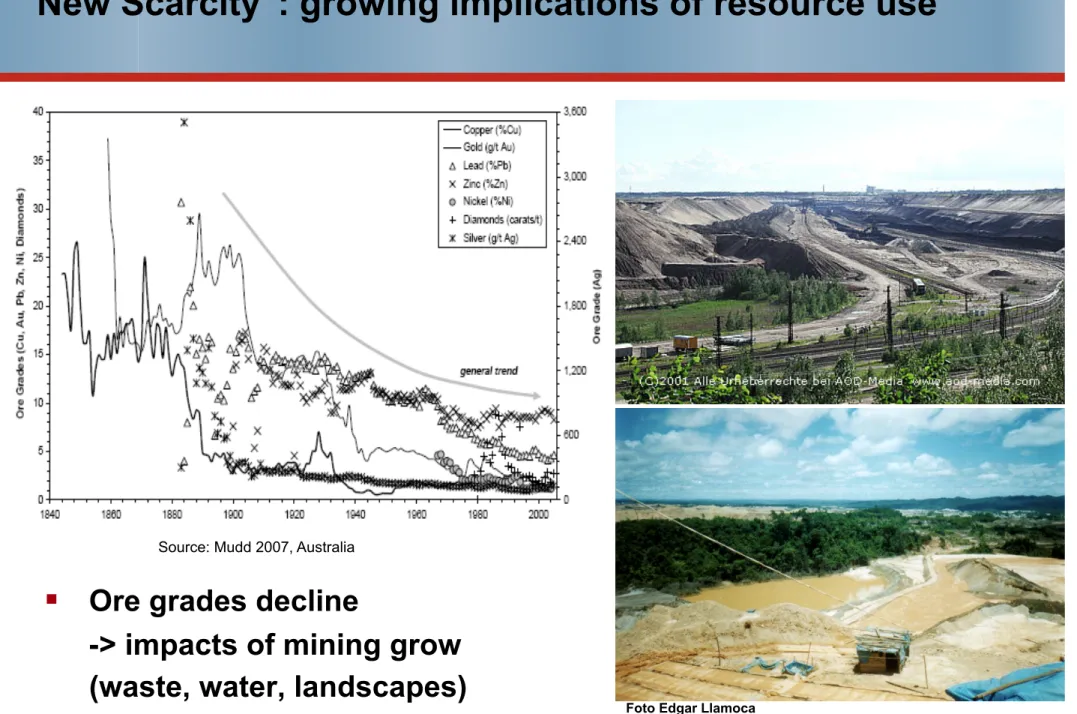
Ore grades decline-> impacts of mining grow (waste, water, landscapes)
"New Scarcity": growing implications of resource use
Source: Mudd 2007, Australia
Foto Edgar Llamoca
Global resource extraction in 2000: 145 – 180 bill. tonnes- fossil fuels, metals, other minerals, biomass (used + unused): 80 bill. t - earth excavation: 40 – 50 bill. t
- erosion in agriculture: 25 – 50 bill. t
Total Material Consumption (TMC) of the EU in 2000: 44 t/cap global adoption in 2050 (9 bill people) -> 400 bill. t (factor 2-3)
TMC of USA in 1991: 74 t/capglobal adoption in 2050 -> 666 bill. t (factor 4-5)
-> Global adoption of current EU and/or US technologies and consumption patterns could lead to increase by factor 2 to 5
Global resource extraction expected to increase Some estimates
Source: Bringezu et al. 2009
Stefan Bringezu
Interim conclusion
Global extraction of mineral resources will grow
Environmental impacts may increase overproportionally
Global land use
(109 hectare)
“agriculture“
deserts, glaciers, others settlements, infrastructures
2050
3.9 4.1
grass- lands
5.0 0.36 2000
crops1.5 1.5
arable land perma- 3.5
nent pastures
4.4 1.4 1961
3.1
agric. land:
+ 7% to 31%
cropland + 7% to 27%
+ 72% to 118%
+?
- 3% to -23%
-?
Sources: Benedikt-Kemp et al. 2002, MEA 2005, GEO 4, OECD (2008)
forests
Stefan Bringezu
Global trends of population, yields and diet: cropland will expand for feeding the world with protein rich meals
Source: UN population statistics ; FAO (2003, 2006); estimates based on Gallagher report 2008
60 80 100 120 140 160
2004 2030
Index 2004 = 100
Population Cropland
Cropland per capita Cereals yields in DC
Meat consumption in DC
Cereal yields Cereal yields Cereal yields
Meat consumption
Interim conclusion
Only to feed the world population will require the expansion of global cropland
Any additional demand for non-food biomass will add on top of this
Stefan Bringezu
Global production of liquid biofuels
Source: SCOPE 2009
2007: 1.8% of global fuel
2008 (estim.): ethanol 5.46%, biodiesel 1.5%
2007
Source: OECD/FAO 2008.
Source: SCOPE (2009).
Land use for fuel crops
2007: 27 Mha; 2008: 36 Mha for liquid biofuels (2% gobal cropland)
Trends for expansion particular in tropical countries (high yields) Brasil:
- Sugare cane 9 mill ha in 2008 (up 27% since 2007)
- Potential area for soybeans: 100 mill ha (23 Mha in 2005) - expansion at the expense of grasslands, savannahs
(Cerrado) and tropical forests
Indonesia:
- oil palm plantations often on cleared forest land (2/3) - applications for expansion: 6 mio ha -> 25 mio ha - forest clearing 1/4 on peat soils
Stefan Bringezu
GHG balance estimate*, in 2030
10% biofuels could substitute fossil fuels emitting 0.84 Gt CO2
substitution potential 20-90%:0.17-0.76 Gt CO2
LUC induced additional emissions:0.75 to 1.83 Gt CO2
Implications of land use change
GHG emissions - mitigation by 1st generation biofuels questionable
*Ravindranath, N.H. et al. (2009) GHG Implications of Land Use and Land Conversion to Biofuel Crops. In: R. W. Howarth and S.
Bringezu (editors), Biofuels: Environmental Consequences and Interactions with Changing Land Use. Report of the Internatinal SCOPE Biofuels Project. (http://cip.cornell.edu/biofuels/)
Policy targeted BAU: biofuel demand will contribute to expansion of global crop land
0 500 1000 1500 2000 2500 3000 3500
2004 2030
square meter per capita
Global agricultural land for material biomass use in Germany
Global agricultural land for energetic biomass use in Germany
Global agricultural land for plant-based nutrition in Germany
Global agricultural land for animal-based nutrition in Germany
Domestic agricultural land in Germany
Cropland: World
Example of a net consuming country:
Global land use of Germany for biomass consumption
Source: Bringezu et al. 2008
Stefan Bringezu
Interim conclusion
Expansion of global cropland for fuel crops may lead to inreased net GHG emissions over the next 30 years as well as losses of biodiversity
This cannot be avoided by production standards and product certification as long as the demand for
biomass is growing globally (indirect land use changes)
Goals and policy approaches towards SRM
The analytical perspective: Material Flow Analysis (MFA)
Major problems of global resource use: The Big Three
Megatrends: de-coupling and geographic shifts
Visions and tasks for global SRM
The Resource Panel
Conclusions and OutlookThe presentation
Wuppertal Institute
Stefan Bringezu 33
Material consumption decouples from GDP
October 2009
Total Material Requirement and economic growth
Stefan Bringezu
Total material consumption of abiotic resources
TMCabiot** (without excavation and erosion) – prelim. values
Source: Dittrich 2009, based on UN
Comtrade and Schütz and Bringezu 2008;
materialflowsnet
TMCabiot** between 9 and 16
tons per capita
TMCabiot** between 17 and 32
tons per capita TMCabiot** between 33 and
65
tons per capita
TMCabiot** > 65 tons per capita
TMCabiot** between 2 and 4
tons per capita
TMCabiot** < 2 tons per capita
(only Benin) TMCabiot** without biomass, 2005
TMCabiot** between 5 and 8
tons per capita
No data available or data with high uncertainties
Which way is China going to take?
China
?
EU-15 1980 USA 1975
Following the US will require afactor 6
Following the EU a factor 12 ofincrease in resource productivity
Stefan Bringezu
Physical trade balance of EC/EU considering hidden flows
Source: Schütz et al (2003)
PTB absolute PTB of HF
PTB TMR trade
Million tonnes
The EU
increasingly
uses foreign
resources
(import
surplus)
The importance of indirect flows is growing
Stefan Bringezu
Regional disparity of environmental pressure: Platinum-
Group-Metal production for Europe´s supply
Resource extraction prefers sparsely populated areas Conflicts and social control grow with population density
Population density (persons/km2)
Domestic TMR (t/cap)
Scource: Bringezu et al. 2009
Stefan Bringezu
Interim conclusion
Global resource extraction will grow further unless resource productivity will not increase drastically
Material productivity of industrial economies increases while resource and pollution intensive industries
(mining/refining) are dislocated (towards DCs and sparseley populated areas)
Goals and policy approaches towards SRM
The analytical perspective: Material Flow Analysis (MFA)
Major problems of global resource use: The Big Three
Megatrends: de-coupling and geographic shifts
Visions and tasks for global SRM
The Resource Panel
Conclusions and OutlookThe presentation
Stefan Bringezu
Monitoring and control of the "Big Three" essential
Indicators should measure national consumption of global resources
Targets should reduce absolute levels
Cross-sectoral challenge:Resource productivity increase (GDP/TMR)
Priority tasks for resource policies
Cross-sectoral challenges
GHG emissions (GWP)
Mineral extraction
(TMCabiot) Global cropland
(GLUAcropland)
Halt expansion of global cropland (REDD etc.)
Sust. production standards
Limit consumption ofagricultural goods to levels which can be supplied sust.
(e.g. adjust biofuel quota)
Priority tasks for resource policies Sector specific challenges
Biomass
Foster international recyclingMetals
Construction minerals
Urban mining
Aggregate tax + programme for dematerialisedconstruction
Revisit public investmentsStefan Bringezu
Current features of metabolic development
Resource efficiency and carbon recycling
Future features of metabolic development
Resource efficiency and carbon recycling
Stefan Bringezu
Exemplary routes of carbon recycling
tonnes
Targets for long-term sustainable development of the
socio-industrial metabolism of the EU
Stefan Bringezu
Resource efficient and recycling based industries
Steady stocks societies
Solarized technosphere
Balanced bio-economy
Four visions for a sustainable resource management
Resource efficient and recycling based industries
Steady stocks societies
Solarized technosphere
Balanced bio-economy
Four visions for a sustainable resource management
Stefan Bringezu
Balance between de-materialization and re-materialization
Resource light product design
Shift to more services, product-service-systems
Recycling systems
- mining the technosphere ("urban mining")
- diversity of chemical elements -> challenge for separation technologies after collection
Functional diversity of complex materials and micro/nano structures based on a common element matrix
- organic materials
- molecular design, nanotech, bionic
Resource efficient and recycling based industry
Characteristics
Environmental performance of different car types
‘
Stefan Bringezu
Balance between de-materialization and re-materialization
Resource light product design
Shift to more services, product-service-systems
Recycling systems
- mining the technosphere ("urban mining")
- diversity of chemical elements -> challenge for separation technologies after collection
Functional diversity of complex materials and micro/nano structures based on a common element matrix
- organic materials
- molecular design, nanotech, bionic
Resource efficient and recycling based industry
Characteristics
foster material and energy efficiency (dematerialisation)
resource efficient recycling at various levels (re-materialisation)
limit absolute consumption of resources
investments into R&D on SRM innovations
improve info systems at various levels (EW-MFA to resource protocoll of buildings/components)
education and trainingResource efficient and recycling based industry
Major challenges
Stefan Bringezu
Resource efficient and recycling based industries
Steady stocks societies
Solarized technosphere
Balanced bio-economy
Four visions for a sustainable resource management
The steady stocks society Characteristics
Dynamic flow equilibrium
- of total technosphere stock (consisting of many durable product/
material stocks)
- concerning artefacts at different locations
Approaching a saturation level of buildings and infrastructures
- living space per capita - roads etc.
Shift from adding new constructions to renovation
No net expansion of built-up land (114 ha/d, 2002-05)
Improving quality of life in heterogenous regions
Growing and shrinking infrastructures
Resource light buildings "Featherweights" (also Vision One)
Recycling and urban mining (- " -)
Stefan Bringezu
Downsizing of multi-storey buildings in Stollberg, Germany
Before the partial
deconstruction (above) and afterwards (below)
The steady stocks society Major challenges
Stabilizing stock of fixed capital -> Re-directing investments into
a. renovation, quality improvement of existing buildings and infrastructures,
b. non-fixed capital formation ("brain-ware" instead of "hard- ware")
-> new assessment criteria for fixed capital changes in national accounts ?
Stabilizing stocks of materials may not be sufficient to halt spread of built-up land ("flattening" and dispersion of buildings)
-> certificates for "built-up" land?
Stefan Bringezu
The steady stocks society Policy tasks
fostering more efficient use of existing buildings
expansion of highway system -> optimising existing network
qualify paradigm of equal regional development
minimise state owned fixed capital while considering social aspects and quality of public utilities
market based instruments (esp. phasing out subsidies for additional constructions, land use certificates)
resource light construction and renovation of buildings
Resource efficient and recycling based industries
Steady stocks societies
Solarized technosphere
Balanced bio-economy
Four visions for a sustainable resource management
Stefan Bringezu
Solarized technosphere
Solar energy systems – potentials & trade-offs
PV could supply 118 - 206 EJ/y electricity on 393,000 km2 (1 % of
"unused" land, mainly deserts)
This would require 9 - 16 bill t/year mineral resource requirements (= double to triple TMR of Germany in 2000)
-> Renewable energy requires significant amount of non-renewables in the form of minerals
Biomass: captures 1-6% of solar radiation
Solar systems: 10-20% (currently, >40% reached, 60% under development)
Integration of solar energy functions into buildings and infrastructures
Photo credits see
Bringezu and Bleischwitz 2009
Stefan Bringezu
Solar Islands
© CSEM (Centre Cuisse d´Èlectronique e de Microtechnique), Hinderling et al. 2007
Solarized technosphere
Tasks for research, policy and technology development
analyse non-renewable mineral flows associated with
renewable energy use and the related environmental impacts,
assess the trade-offs and potential synergies between climate, energy and resource policies
foster the development of integrated energy technologies (e.g.
multi-functional wall and roofs for the solarisation of buildings), and explore the potential of "solar islands"
Stefan Bringezu
Resource efficient and recycling based industries
Steady stocks societies
Solarized technosphere
Balanced bio-economy
Four visions for a sustainable resource management
Balanced Bio-Economy and Bioniconomy
Characteristics
Bio-economy largely based on biomass use,
interwoven with and nested in natural eco-systems
Balanced with regard to
- food vs. non-food (food first)
- production consistent with local environmental conditions (e.g.
risk of erosion, eutrophication): "Sustainable Production"
- domestic and foreign supply and consumption level not exceeding local, regional and global capacities:
"Sustainable Consumption"
Long-term vision: Bioniconomy
- making use of biological principles ("bionic") - carbon recycling and industrial photosynthesis
Stefan Bringezu
Balanced Bio-Economy and Bioniconomy
Key challenges for technology development
Extension of the bio-refinery principle to the whole economy:
cascading use of materials and energy from biomass (first as material, second for energy)
Recycling and re-use of carbon from end-of-life products (in particular organic waste)
Carbon capture from exhaust gases and ambient air -> carbon capture and re-use (CCU) instead of CCS
Visions of a sustainable resource use
A future vision in 2050: Brazil and Indonesia flourish with their natural resources
Stefan Bringezu
Balanced Bio-Economy and Bioniconomy
Policy tasks
halt global expansion of cropland (e.g. by economic instruments to value natural ecosystems, REDD etc.)
direct expansion of cropland to degraded land: research on potentials and trade-offs ongoing
develop integrated land use planning for agriculture, forestry, settlements/infrastructure/mining, and conservation areas (also in DCs)
monitor global land use for domestic consumption
develop incentive framework to adjust consumption of biomass to levels which can sustainably be supplied:
- revisit targets and subsidies for biomass consumption (e.g.
biofuel quota and tax exemptions)
- foster material and energy efficiency (e.g. fuel efficiency of car fleets, minimisation of food waste, healthier diets)
Goals and policy approaches towards SRM
The analytical perspective: Material Flow Analysis (MFA)
Major problems of global resource use: The Big Three
Megatrends: de-coupling and geographic shifts
Visions and tasks for global SRM
The Resource Panel
Conclusions and OutlookThe presentation
Stefan Bringezu
The Resource Panel was established to :
o provide independent, coherent and authorita5ve scien5fic assessments of policy relevance on the sustainable use of natural resources and in par5cular their environmental impacts over the full life cycle
o contribute to a be:er understanding of how to decouple economic growth from environmental degrada5on.
It currently has four working groups:
o Decoupling
o Biofuels
o Priori5za5on of products and materials
o Global metal flows
Interna1onal Panel
for Sustainable Resource Management
Outlook: Institutions of a global sustainable resource
governance
Stefan Bringezu
Growth Competitiveness Index increases with Material Productivity
Note: GDP in PPP U.S. $; t-statistics and F-statistics significant with p<0.05; Source: Bringezu and Bleischwitz (2009)
Chances of employment grow with resource productivity of industrial branches
Note: Spearman rank correlation highly significant: rs = 0.6756, p<0.001. Source: Bringezu et al. 2009
The example of Germany
Stefan Bringezu
Interim conclusion
Industries with enhanced resource productivity provide benefits
- for both climate protection and resource conservation - employment and international competitiveness
Goals and policy approaches towards SRM
The analytical perspective: Material Flow Analysis (MFA)
Major problems of global resource use: The Big Three
Megatrends: de-coupling and geographic shifts
Visions and tasks for global SRM
The Resource Panel
Conclusions and OutlookThe presentation
Stefan Bringezu
Conclusions and outlook (1/2)
MFA allows to monitoring the physical economy and assess its performance with regard to sustainability
Decoupling of economic development and resource use is ongoing
However, resource and pollution intensive industries tend to be dislocated to sparsely populated regions
The Big Three need to be controlled: GHG, TMCabiot, GLUAcroplandConclusions and outlook (2/2)
Four visions outline essential characteristics of the future sustainable metabolism:- resource efficient and recycling based industry - the steady stocks society
- solarised technosphere
- balanced bio-economy and bioniconomy
Progress towards global SRM will depend on countryexperiences with resource policies considering both domestic and foreign resource use
Many thanks for your attention !
CONTRIBUTING EDITORS:
STEFAN BRINGEZU
AND
RAIMUND BLEISCHWITZ
ISBN: 978-1-906093-26-6 RETAIL PRICE: €50
http://www.greenleaf- publishing.com/
productdetail.kmod?productid=2920 For further information and
discount, please click