
任務導向教學對高職生字彙學習之效益研究
142
0
0
全文
(2) The Effects of Task-Based Instruction on Vocabulary Learning: A Study of EFL Vocational High School Students. Advisor: Dr. Shwu-Mei Hwang By: Chiu-Lan Yeh. A Thesis Submitted to the Graduate Program of Applied Foreign Languages In Partial Fulfillment of the Requirements For the Degree of Master of Arts National Pingtung Institute of Commerce. Pingtung, Taiwan, R.O.C. January, 2009.
(3) 摘要 英文字彙知識在閱讀上扮演著極重要的角色,但在英語為外語的台灣而言,學 生對字彙的學習常有困難;特別是對高職生來說,更是如此。有鑑於此,本研究 旨在探討任務導向教學對高職生字彙學習成效的影響。共 67 位來自屏東市高職 三年級的兩班學生參與本研究。其中一班為控制組(37 人),以傳統課程講授方式 進行字彙閱讀教學;另一班為實驗組(30 人),則以任務導向教學方式作為上課的 主軸。兩組學生分別給予前測、後測、角色分配工作單、任務工作單及補充講義 來進行本實驗。本研究為期一年,主要採用獨立樣本 t 檢定進行資料比對分析, 研究結果分別敘述如下: 整體而言,採用任務導向教學對高職生字彙學習具有顯著效果。在字彙表現 上,學生在選擇題字彙的表現,具有顯著差異。而在詞類變化克漏字閱讀測驗的 表現上,並沒有顯著差異。不過,採用任務導向教學的實驗組平均成績仍然比控 制組成績要來得高些。兩組學生在接受性字彙知識學習的後測成績上具有顯著差 異,但產出性字彙知識則無。本研究結果顯示,接受任務導向教學的學生字彙表 現比接受傳統課程教學學生的表現要來得佳。 本文最後亦提出一些教學及研究建議,供國內英語教學老師、研究人員或 其他相關領域之專家參考。 關鍵字:英語為外語,任務導向教學,克漏字閱讀,接受性字彙知識,產出性字 彙知識. i.
(4) Abstract Vocabulary knowledge plays a critical role in reading comprehension; however, learners in the EFL setting have difficulties in learning words. Hence, this study is to explore the effects of task-based instruction on vocabulary learning. Sixty-seven participants studying in the third-year of vocational high school in Pingtung city participated in this study. The participants were assigned into two groups that in the control group (n = 37) implemented a traditional lecture instruction while the other (n = 30) implemented task-based instruction. The participants have been given a pretest, posttest; role-allocation sheets, task worksheets, and supplement handouts as the study instrument. The study was conducted for one year. Independent Samples t-tests were performed to analyze the collected data. The results were stated as follows: First, there was significant difference between the two groups, and learners under the task-based instruction (TBI) had significantly better performance. Second, there was significant difference in multiple-choice item (MC) in learning vocabulary but no significant difference in part of speech (PS) and cloze procedure (CP) items. Third, there was significant difference in the aspect of receptive vocabulary knowledge but not in productive aspect. Fourth, the findings of this study indicated that the experimental group, no matter in which aspect of vocabulary learning, had better performance than the control group after the treatment of task-based instruction.. ii.
(5) Finally, several pedagogical implications and suggestions for researchers or English instructors were offered.. Keywords: EFL, task-based instruction, cloze procedure, receptive vocabulary knowledge, productive vocabulary knowledge. iii.
(6) ACKNOWLEDEMENTS. Firstly, I would like to express my gratitude to my advisor, Dr. Shwu-Mei Hwang, for her help and patience for my thesis. Due to her guidance, I have learned how to enhance my research skills; her comments and feedback have also helped me on the experimental process. Therefore, from the bottom of my heart, I profoundly appreciated her since she has encouraged me on how to do study properly and encouraged me on how to overcome all of the difficulties during processing the research which I encountered. Without her, I wouldn’t conquer many hurdles to become a brave and thoughtful person. Thus, I am full of the gratitude for her helpful suggestions and comments. Moreover, I would like to express my deep gratitude to the director, Mr. Fu-Xiang Xu, who is the head of teaching affairs in Ping-Rong Comprehensive High School in Pingtung city, Taiwan. Due to his assistance, I got the great opportunity to conduct the experiment in his school. In particular, he introduced two homeroom teachers to me. One was Miss Gong-Mei Chen; the other was Zhen-Xin Chen. Both of them were very nice homeroom teachers. During the experimental teaching, they guided me painstakingly including meeting my needs for proceeding the experiment or giving me teaching suggestions. Besides, I am also grateful for the two classes of students who were willing to participate in the experimental teaching. Sincerely, I was moved by the two classes of students because some of them would come and ask me questions after class. Needless to say, I’m appreciative of the two classes’ participation for my study. In addition, during the experiment in Ping-Rong Comprehensive High School, many teachers were very concerned about my English teaching and they gave me a lot of encouragement, so they were very kind to me and I was also grateful for their kindness in giving me inspirations and spiritual supports. iv.
(7) Furthermore, I would like to thank the committee members, Dr. Chin-Cheng Huang and Dr. Miao-Chi Wu, for their comments and suggestions for my thesis. Due to their suggestions and nonstop feedbacks, they’ve made my thesis become more thorough. Frankly speaking, I’m really moved by their hard working for my thesis when I received their corrections of my thesis copies. Additionally, I completed the master’s thesis at NPIC; during NPIC, I took several professors’ courses which were all helpful for my thesis, so I am grateful to those professors’ teaching, including Dr. Shwu-Mei Hwang, Dr. Lian-Chu Hsieh, Dr. Mei-Chen Chen, Dr. Shih-Chung Lin, and Dr. Su-Fen Liao. Also, I have to express my thanks to my dear classmate, Mr. Bruce Kao, for his help; he double checked the data analysis of my thesis and taught me how to complete statistical analysis. He is really a nice man in my class because he always helped our classmates to solve their problems. In conclusion, I am so glad that I could complete this gruelling work for my thesis. I still need to thank a lot of people who have ever helped me resolve my problems in my daily life including my students’ parent, Zhao-Qian Chen, my best friends, Tony Chen and Hui-Yi Peng, and my family; especially during doing my research, both of the school military officer, Ren-Gwo Hwang, and the head of students affairs, professor Chiu-Fang Chiu, assisted me in solving my personal problems while I was suffering from a thorny problem off campus. Concerning their assistance, I will keep their kindness in my mind till eternity. Anyway, I would like to thank you all again, to the aforementioned persons who have ever helped me. As for the thesis, all faults or errors are my personal responsibility.. v.
(8) Table of Contents. Abstract (Chinese)……………………………………………………………………...i Abstract………………………………………………………………………………..ii Acknowledgements…………………………………………………………………...iv Table of Contents……………………………………………………………………..vi Tables………………………………………………………………………………..…x Figures…………………………………………………………………………….......xi CHAPTER ONE….…………………………………………………………………...1 Introduction………………………………………………………………………1 Problem Statement…………………………………………………………...8 Research Questions…………………………………………………………..9 Purpose of the Study………………………………………………………....9 Definition of Terms…………………………………………………………10 CHAPTER TWO…………………………………………………………………….12 Literature Review……………………………………………………………...12 Vocabulary Learning………………………………………………………12 The Nature of Vocabulary……………………………………………..12 Receptive and Productive Knowledge in Vocabulary Learning………19 The Significance of Vocabulary in Language Learning……………….21. vi.
(9) Strategy use in Relation to Vocabulary Learning……………………...23 Vocabulary Instruction…………………………………………………...25 Task-based Instruction and Language Learning………………………….28 Definitions of “task” …………………………………………………28 The Characteristics of Task…………………………………………..29 Task-based Instruction………………………………………………..31 Tasks and Vocabulary Learning………………………………………32 Summary.………………………………………………..………………..39 CHAPTER THREE……………………………………………………..……………41 Methodology……………………………………………………………………41 Research Design…………………………………………………………….41 Participants………………………………………………………………….42 Instrument…………………………………………………………………..44 English Vocabulary Tests……………………………………………….44 Validity……………………………………………………………...44 Reliability…………………………………………………………..45 Results of the Pretest……………………………………………….45 Role-Allocation Sheets…………………………………………………46 Task Worksheets………………………………………………………..48. vii.
(10) Supplement Handouts…………………………………………………..49 Data Analysis……………………………………………………………….50 Procedures…………………………………………………………………..50 CHAPTER FOUR……………………………………………………………………55 Results and Discussion………………………………………………………….55 Results…………………………………………………………………………..55 Discussion……………………………………………………………………....71 CHAPTER FIVE……………..………………………………………………………77 Conclusion………………………………………………………………………77 Summary of the Major Findings……………………………………………77 Pedagogical Implications…………………………………………………...80 Suggestions for the Future Study…………………………………………...82 References……………………………………………………………………………85 Appendix A The Pretest Questions (English Version) …………………………....104 Appendix A The Pretest Questions (Chinese Version) …………………………...107 Appendix B. The Posttest Questions (English Version) ………………………….110. Appendix B. The Posttest Questions (Chinese Version) ………………………....113. Appendix C. Role-Allocation Sheet (English Version) …………………………..116. Appendix C. Role-Allocation Sheet (Chinese Version) ………………………….117. viii.
(11) Appendix D. Sample Task Worksheet…………………………………………….118. Appendix E. Syntax and Structure Handouts (5 Phrases) (English Version) …….121. Appendix E. Syntax and Structure Handouts (5 Phrases) (Chinese Version) …....124. Appendix F. Part of Speech of Words and Suffix words………………………....127. Appendix G. The Pretest Scores of Control and Experimental Groups………..…128. Appendix H. The Scores of the Posttest of Control and Experimental Groups…..129. ix.
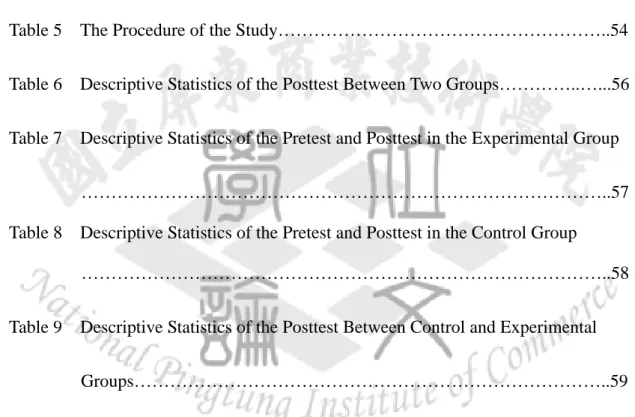
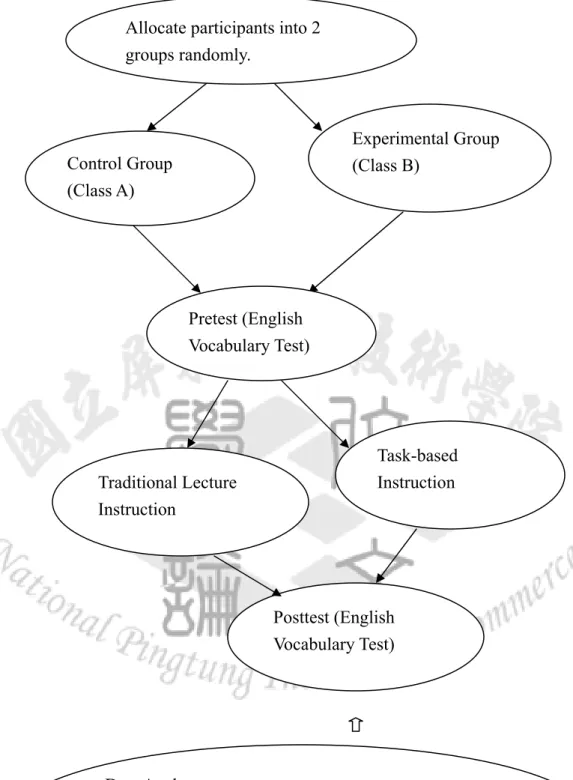
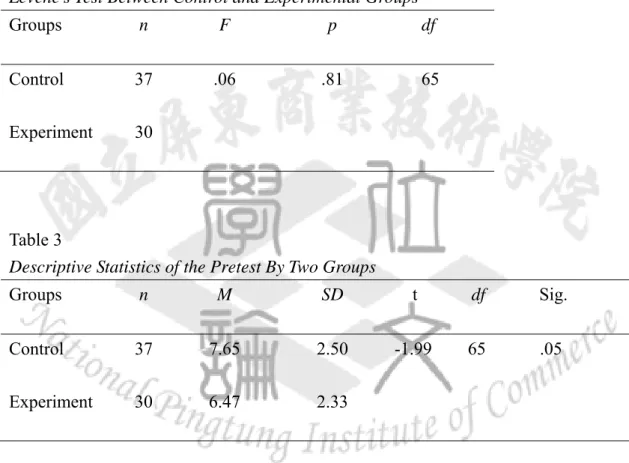
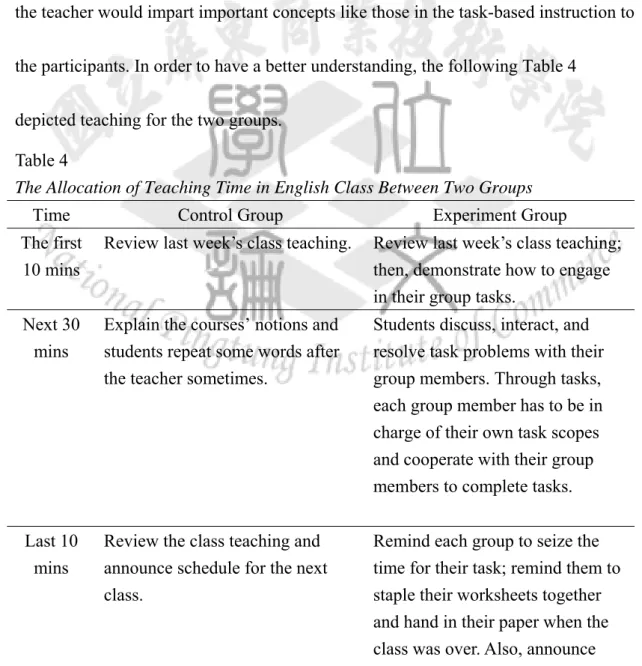
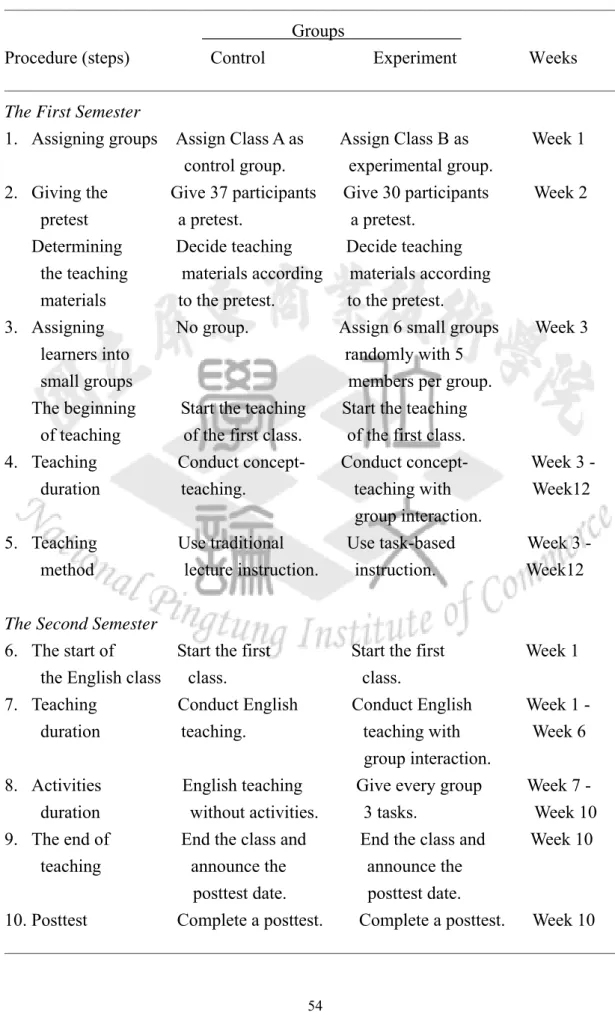
(12) Tables Table 1. The Definitions of Tasks…………………………………………….……..29. Table 2. Levene’s Test Between Control and Experimental Groups…………….….46. Table 3. Descriptive Statistics of the Pretest by Two Groups………………………46. Table 4. The Allocation of Teaching Time in English Class Between Two Groups……………………………………………………………………..52. Table 5. The Procedure of the Study………………………………………………..54. Table 6. Descriptive Statistics of the Posttest Between Two Groups…………..…...56. Table 7. Descriptive Statistics of the Pretest and Posttest in the Experimental Group ……………………………………………………………………………..57. Table 8. Descriptive Statistics of the Pretest and Posttest in the Control Group ……………………………………………………………………………..58. Table 9. Descriptive Statistics of the Posttest Between Control and Experimental Groups……………………………………………………………………..59. Table 10 Descriptive Statistics of the Pretest and Posttest in the Experimental Group .…………………………………………………………………………..61 Table 11 Descriptive Statistics of the Pretest and Posttest in the Control Group ..…………………………………………………………………………..62 Table 12 Descriptive Statistics of the Posttest Between Two Groups……………...66. x.
(13) Figures. Figure 1. The Flowchart of the Experimental Study Design…………………..……43. xi.
(14) CHAPTER ONE Introduction As so many people around the world learning English as a second language, English has become an international language. According to Kao (2006), English has been used as the first or second language more than any other language. Based on Johnson’s (2003) statement, there was an estimated one billion people in the world that they have been learning English as a foreign language. Especially, Kao referred to most countries with the most influence in international affairs that they used English as their first or official language. Besides, in most countries in the world, people have regarded English as their top priority when they decided to learn one of the foreign languages (Chang, Yeh, Joe, You, Chern, & Liao, 2007). Viewing from the aforementioned points, English fever is now throughout the world including Taiwan (Chen, 2005; Huang, Liu, Huang, Chang, and Wu, 2005; Tsai, 2005; Wu, 2005). Before 2001, learners from the 7th to 9th graders had to learn English; however, English is so important that the Ministry of Education (MOE) has implemented English Teaching under the policy of the Nine-Year Integrated Education since 2001. That is, all of the students around the island from the fifth grade should learn English (Chen & Chien, 2006; Hsu & Chan, 2005; Huang et al., 2005; Liu, 2007; Wu, 2005). Moreover, after implementing English in the fifth and sixth graders in 2001, the MOE found that it was necessary for students to start learning earlier to make them equip 1.
(15) with good English proficiency. Thus, in 2005 the MOE has carried out the English teaching which was advanced from the third grade of students in the elementary schools over the country (Chen & Chien, 2006; Huang et al., 2005; MOE, 2006; Wu, 2005). However, regarding the students of vocational high schools in Taiwan, school teaching hours and large class sizes seemly slow down the progress of most students. Both lower English proficiency and less teaching hours have limited their progress in English learning. Moreover, most students studying in vocational senior high schools that their English proficiency still remains at the level of junior high school. Particularly, according to Huang (2004), students in vocational senior high schools were allocated only two hours for learning English per week; in contrast, senior high school students have to learn English at least four hours every week. That is, in general senior high schools, teaching hours were two times more than those of vocational senior high school ones. Therefore, the gap of English proficiency between the students of general senior high and vocational senior high would be by far more serious if students didn’t use a better approach to learn English. Chen (2005) indicated that vocational senior high school students spent less time and effort on learning English, so most of the students of the vocational senior high schools got very low scores when they took their entrance examination of Basic Competence. 2.
(16) Test. In fact, students in Taiwan, if their scores of English and other subject matters are respectively acceptable, one of their priorities will be to choose one of the general senior high schools to study. On the contrary, if students get very low grades or even they are unable to achieve the level of the entrance examination criteria of general senior high schools, their last resort will be to choose vocational senior high schools. Obviously, their English proficiency is not better than those students who are studying in general senior high schools. In other words, due to lower scores in English aspects, students in vocational senior high schools were generally neglected and left far behind the regular high schools’ ones. In order to improve the English proficiency of learners, several researchers (Brown, 2002; Chen, 2005; Richards, 2002) proposed using appropriate teaching approach in the classroom to improve learners’ English proficiency was necessary. What can an English teacher do to bridge the gap for the learners’ present proficiency level between vocational and regular senior high schools? According to Nation (2002a), learners spending time to learn vocabulary, especially learning high-frequency words, were worth doing it. He believed that “direct vocabulary learning is a way of trying to bridge the gap between second language learners’ present proficiency level and the proficiency level needed to learn from unsimplified input” (p. 97). Also, vocabulary was the foundation for learners to learn English.. 3.
(17) Richards and Renandya (2002) declared that vocabulary was the major element for learners to possess good language proficiency. And vocabulary was regarded as the base for learners to know how to speak, how to listen, how to read, and how to write. Richards and Renandya (2002) also discussed the significance of vocabulary as follows: Without an extensive vocabulary and strategies for acquiring new vocabulary, learners often achieve less than their potential and may be discouraged from making use of language learning opportunities around them such as listening to the radio, listening to native speakers, using the language in different contexts, reading, or watching television (p. 255). In fact, a lot of beginners in Taiwan have no clues on how to memorize vocabulary. Oxford (1990) reported that learners learning language had the difficulty recalling a variety of vocabulary words which were indispensable to help learners reach fluency. Hague’s (1987) research has stated that vocabulary, no matter foreign languages or mother tongues, had a large number of different meanings. That is, when learners absorb all sorts of languages, especially their mother tongues, they had to consider that vocabulary was the element which was fairly tumultuous and which was not easily controlled by learners. In addition, Hsieh (1995) mentioned that learning vocabulary through a variety of practice activities was necessary. These activities included listening, speaking, reading, and writing. For example, in speaking aspect, there were many oral skill activities and these activities should be connected to real life. Vocabulary learning with sentences has played a vital role in EFL setting for 4.
(18) learners to learn English. Madsen (1983) maintained that vocabulary test should include content words such as nouns, verbs, adjectives, and adverbs. He also asserted that vocabulary learning through sentences could facilitate learners to see the whole meaning of words in which the context was provided. In order to recognize whether learners did learn their English diligently, many tests like the English Basic Competence Test (BCT) of junior high, the Entrance Examination of Four Year Technological Colleges (EEFTC), the Joint Entrance Examination of Colleges, and Test of English as a Foreign Language (TOEFL) have put the vocabulary items into the exam papers. The major purpose was to test examinees’ overall language ability such as the understandings of definitions, synonyms, sentences, grammar, or the understanding of the context from the sentences. Therefore, vocabulary learning teaching in EFL classroom was essential. In addition to learning content, an appropriate teaching method could speed up students’ English learning; In Taiwan, a number of English teachers teach English but they bypass teaching or upgrading students’ vocabulary. That is, teachers call upon their students to recite vocabulary. Nonetheless, they don’t teach students how to put vocabulary into use. As a result, students are not able to grasp vocabulary as they should. Moreover, when they are learning vocabulary, they not only feel frustrated but they also are xenophobic sentiments from learning English. Obviously, it is necessary. 5.
(19) for learners to learn vocabulary through vocabulary instruction. In addition, Nation (2002a) stated that using word parts could help learners learn vocabulary. Chen (2001) contained that successful vocabulary instruction could let learners acquire foreign language easily and efficiently. Also, it could arouse learners’ high interests to learn foreign language. English teachers’ teaching approach like task-based instruction played an extremely significant role in the EFL environment. A study by Oxford (2001) utilizing integrated skills in the ESL/EFL classroom has specified that task-based instruction underscored to do tasks and the tasks were changed from one level to another. That is, task-based instruction was related to every level of language proficiency. And task-based instruction should be relevant to the use of language communication. Also, in order to complete the real world tasks, Byrd (1998) considered that students had to be taught a detailed needs analysis in their task-based courses. Besides, foreign language curriculum with different proficiency levels should contain different kinds of tasks; then, through different kinds of pedagogical tasks, students beyond the classroom could obtain the essential knowledge and skills for their successful communication. According to Larsen-Freeman (2000), task-based approach was a good way for learners to learn a language. Under this approach, learners had a lot of chances to. 6.
(20) interact with other people by employing task-based approach-the context for language use was naturally for them to finish their tasks. Brown (2001) maintained that task-based instruction should put an emphasis on meaning, purpose, and communication. Task-based curricula should underline not only in grammar or phonology parts but also in pragmatic functions. Sachs, Kong, Lo, and Lee (1994) reported that there were 81.4% of English instructors who have recognized that tasks or activities were the most significant for learners’ L2 learning. Additionally, even in non-language learning course like Botany class, Keats and Boughey (1994) have lent support that using task-based cooperative group work to help learners to learn a lecture was a good teaching method. From task-based teaching approach, Keats and Boughey have found that most learners learning by doing under the task-based small groups were better than the traditional lecture teaching was. Under this approach of task-based teaching, the research results have indicated that learners were more motivated and they could get better realizations from their course. In Taiwan, a lot of studies mentioned learning strategies like cooperative learning, cognitive strategy, mnemonic strategy, and so forth, but there were very few studies concerning task-based teaching approach which has been documented in the literature. Since less emphasis was placed on the task-based aspects of teaching. 7.
(21) approach and task-based instruction has been proven successfully as well as effectively in teaching, there is a need to explore whether vocabulary learning by using task-based instruction has the effects for vocational senior high school students. All in all, task-based approach seems an effective and motivating teaching approach. How it can help learners in vocabulary learning is worth exploring. Problem Statement The limitations of school teaching hours and large class sizes confined students’ learning progress. Two hours per week for learning English was not enough for vocational senior high schools’ students. Moreover, the learning motivation of the students in vocational senior high schools was lower than the students in general senior high (Chen, 2005). Because of lower English proficiency, they even could not spell out 26 letters of English alphabet as mentioned previously (Chen, 2005; Huang, 2004). Furthermore, Bensoussan’s (1983) study has stated that EFL learners have only equipped with words’ knowledge which was not enough for comprehension. That is to say, EFL learners could realize every word’s meaning apart within a sentence but they couldn’t understand the sentence meaning since they didn’t know how those words within a sentence which were syntactically mutual related. Specifically, in order to improve the limitations of the above mentioned and, in particular, for the sake of those learners who were less successful learners in vocational senior high schools, it is. 8.
(22) necessary for teachers to find out a good way to help students to learn English rather than students depending on themselves to learn English autonomously. Research Questions There were three questions regarding the effects of task-based instruction on EFL learners’ vocabulary learning in this study. 1. To what extent does task-based instruction make a difference in vocabulary learning? 2. In which aspects of task-based instruction help students in vocabulary learning? 3. To what extent does task-based instruction make a difference in receptive and productive vocabulary learning? Purpose of the Study Students learning English in vocational senior high school were generally neglected. Based on these facts, those students were the group of people who need help the most. Since task-based instruction was a useful method for learning second language, Ellis (2003b) thought that tasks were helpful to promote language acquisition because tasks could cause communicative contexts to exist. Hence, the present study attempted to explore the effects of learners’ vocabulary learning by utilizing task-based instruction as compared to a traditional instruction technique. Speaking of. 9.
(23) the traditional instruction technique, it means that instructors teach their students English by stating or explaining the meanings of vocabulary, sentences, or articles but they don’t engage in activities with groups to help their students to learn English during their English classes. Therefore, the present study has emphasized on the three points. First of all, explore the current vocabulary learning in vocational high school students. Next, explore whether there were differences in vocabulary learning after the intervention of task-based instruction. Moreover, after the treatment of task-based instruction, examine in which aspect that task-based instruction help students more in vocabulary learning. Definition of Terms The following definitions of terms which were defined in this study were listed below: BCT: BCT stands for Basic Competence Test. It’s a kind of test system and the BCT is a standardized test. When students are graduated from junior high, they could take the test of BCT. Based on the scores which they received, students get higher score that they are usually permitted to enter general senior high schools to study. However, if students get lower score from BCT, they will be usually allocated to vocational senior high schools to study. EEFTC: The term, EEFTC, is an abbreviation from the Entrance Examination of. 10.
(24) Four-Year Technological Colleges. It’s about graduates of vocational senior high schools graduating from their schools and participating in the test of the EEFTC. If those graduates could pass the EEFTC, they will be allowed to enter colleges to study. Task-based Instruction (TBI): Task-based instruction makes for learners to experience the context by communicating or exchanging messages with their group members or peers naturally by using mother tongue or target language to discuss and resolve their task problems. Brown (2001) has maintained that TBI should be the authentic sources from the real world such as menus, letters, textbooks, narratives, conversation and so forth. Vocational Senior High School: In compared to the students of general senior high schools, the students of vocational senior high schools (or vocational high schools) are disqualified to get into general senior high schools to study because they received lower grades from BCT. Consequently, they can not but choose vocational senior high schools to study. Receptive Vocabulary: It refers to learners who recognize words without producing (writing down) words. Productive Vocabulary: It refers to learners who have to comprehend and produce words from reading contexts. For example, in part of speech or cloze reading texts, learners have to comprehend the reading context and then write down the correct. 11.
(25) spellings and appropriate words in different blanks according to the needs of sentence structures in reading context.. 12.
(26) CHAPTER TWO Literature Review The purpose of the study intended to examine the effects of vocabulary learning through task-based instruction on EFL vocational high school students. Literature review in this chapter contained three parts: The first part included vocabulary learning; the second part was vocabulary instruction, the third part covered task-based instruction in vocabulary learning. Vocabulary Learning The Nature of Vocabulary Vocabulary was the center for learners to learn language; however, it was ignored by language teachers and researchers in the second language classrooms and in the second language pedagogy as well as research (Coady, 1997; Graves & Fink, 2007; Jiang, 2004; Nation, 1990; Paribakht & Wesche, 1997; Richards, 1976; Summers, 1987; Zimmerman, 1997a). Vocabulary was also an important predictor for language proficiency. Since vocabulary was so critical that Gass (as cited in Altman, 1997) said that we couldn’t but value the research on the nature of vocabulary itself. She mentioned that the nature of vocabulary itself has contained three parts- morphemes, organization, and use. For example, Larsen-Freeman (as cited in Brown, 2001) and Nation (2002a) advocated that learners knowing a word should include its. 13.
(27) form (grammar), meaning (semantics), and use (pragmatics). At the same time, Nation (2002b) underscored that learners knowing the form of a word should include spelling, pronunciation, and word parts, especially knowing word parts like prefixes and suffixes which helped learners know more unfamiliar words. Next, Read (2004) stated that the acquisition of L2 vocabulary knowledge should include a word’s semantic features and its characteristics of syntax, collocation, morphology, phonology, pragmatics, and orthography. Researchers also highlighted how significant word families were (Laufer, 1997; Nation, 2002a, 2004; Schmitt & Meara, 1997; Schmitt & Zimmerman, 2002), so they advocated that knowing a word should include knowing its word family. That is, vocabulary knowledge included knowing word families which could increase learners’ vocabulary size. Researchers (Carlisle, 1995; Hunt and Beglar, 2002, 2005; Schmitt, 1998) pointed out vocabulary knowledge had at least six types including (1) othography, (2) word formation via affixes, (3) collocation and word phrases, (4) minor and non-concrete meaning, (5) associations, and (6) grammatical patterns. In particular, Hunt and Beglar (2002; 2005) believed that the above mentioned first four types of vocabulary knowledge were necessary for EFL learners to understand foreign language and become professional readers. Hunt and Beglar have claimed “if these four types of knowledge are developed for the high frequency and general academic words of English, learners will be in a better position. 14.
(28) to deal successfully with texts from a wide variety of disciples” (p. 33). According to Fromkin, Rodman, and Hyams (2003), knowing a word could utilize stress to tell different words and a word was usually made up of one or more syllables. In addition, EFL learners’ English proficiency is generally limited and the beginners even couldn’t pronounce a word properly. Therefore, Zhou (2006) has claimed that pronunciation was primitive for learners to learn languages and it had to do with listening, speaking, and reading skills. In order to possess communicative competence, many experts argued that pronunciation was indispensable for learners to communicate with others. And the communicative competence lied in learners who had good pronunciation in order to make speakers (learners) understood by others easily (Brown, 2001; Celce-Murcia, Brinton, and Goodwin, 2003; Derwing, 2006; Jones, 2002; Zhou, 2006). Additionally, in regard to vocabulary, Schmitt (2000) emphasized that it was necessary for language learners to have both abilities in using lexical chunks and producing language by syntactic production. That is, pragmatic fluency was built up on realizing the correct lexical phrase in the correct syntactic condition. Moreover, Nilsen and Nilsen (2003) underlined that it was meaningless if words existed separately. Also, Bensoussan (1983) pointed out that a number of teachers had the same conclusion about learners’ vocabulary learning which learners could understand. 15.
(29) the meaning of every word in sentences but they couldn’t understand the sentences’ meaning. The major reason was because learners lacked of the concepts of syntax and sentence structure. In other words, only vocabulary knowledge was not enough for learners to understand the meaning of sentences. Learners also should know the relationship between words and syntax which were closely related. In addition, Thornbury (2002) regarded grammar as an instrument for conveying meaning. Not only vocabulary but also grammar could communicate meanings. Thus, he has emphasized that communicative competence was built up on the combination between grammar and vocabulary to let learners reach the communicative purpose. His claim was similar to what Larsen-Freeman (2002) has contended “…grammar affords speakers of a particular language a great deal of flexibility in the ways they can express propositional, or notional, meaning and how they present themselves in the world” (p. 104). Also, Pennington (2002) pointed out teachers should spend more time on grammar teaching in which teachers should be “… [d]evoted to semantic structure of the lexicon and of connected discourse, and to the way words are selected to fulfill contextual requirement” (p. 92). Besides, Ellis (2003a) has claimed that promoting learners’ language proficiency and accuracy depended on the learning and acquisition of target grammar which could make it become easier to internalize grammatical system of target. 16.
(30) language. The book, Language Files (2001), mentioned that by combining the grammar concept of constituent (groups of words), learners could distinguish groups of words in a sentence or even a reading passage. Nation (2002a) has contended that knowing a word should involve knowing its part of speech and knowing its grammatical patterns how to use. He also referred to a lot of linguists who confirmed vocabulary has been playing a vital role in grammar. Concerning the constituents, it was very similar to what Brown (2001) said “grammar”. That is, grammar was about how a sentence was formed. For instance, modifiers, phrases, clauses, verbs and noun systems, word order and so on were all correlated to grammar. Due to the importance of both vocabulary and grammar, they should be combined together in teaching. Sinclair and Renouf (1991) said that “vocabulary fleshes out the structures, introduces variety and promotes practice of the structure in question” (p. 143). In particular, Ho (2005) found that learners learning English grammar helped them understand English structure and grammar improved their reading, writing, and communication abilities. Hinkel and Fotos (2002) pointed that learners in many EFL classrooms regarded grammar learning as the major method. They also claimed that learners had to focus on what grammarians underlined “parts of speech.” Thus, they have considered that learners learned target language, no matter in written passages or rules’ development for the purpose of the use of translation, must learn parts of speech.. 17.
(31) No matter in ESL or EFL classrooms, learners spent a great deal of time to learn vocabulary that was essential. For L2 or EFL learners, what should they know and learn to improve their language proficiency? Nation (2002a) proposed four principles for learners as the norm of vocabulary learning. Firstly, learners have to pay attention to the typical qualities of vocabulary learning such as how to learn vocabulary and what vocabulary learners should learn. Secondly, learners have to know what should learn and its learning order. Thirdly, learners should know the vocabulary learning procedures like meaning-based input, language-based learning, meaning-based output, and fluency development. Finally, learners had to examine their own vocabulary learning progress. As stated in the aforementioned first principle, Xiao (1998) in his book, How to Learn English, pointed out readers’ reading comprehension depended on how much understanding to the vocabulary size, syntax, and background knowledge. Based on Nation’s principles, a lot of researchers have considered that learners in vocabulary learning were worth spending time on learning affixes, stems, and high-frequency words (Coady, 1997; Graves & Fink, 2007; Kieffer & Lesaux, 2007; Wysocki & Jenkins, 1987). Besides, knowing the meaning of affixes like suffixes and knowing the base forms of words, learners would feel more at ease to know their meanings when they encountered new words (Laufer, as cited in Schmitt, 2000).. 18.
(32) Morphology helped learners memorize vocabulary words because learners were introduced the lists of affixes and stems with their meanings (Nattinger, 1991). In fact, morphology knowledge has explained learners’ vocabulary knowledge in detail; if learners could understand English morphology, they could identify a great number of vocabulary words in reading paragraphs (Mochizuki & Aizawa, 2000; Schmitt & Meara, 1997). As to morphology, the knowledge of affixes, roots, and stems could aid learners to learn unfamiliar words or help learners guess unfamiliar words from context (Nattinger, 1989; Richards, 2000; Schmitt & Meara, 1997). Also, affixes could be divided into inflectional suffix, derivational prefix, and derivational suffix (Fromkin & Rodman, 1998; Fromkin, Rodman, & Hyams, 2003), and learners could learn words much easier if they master words’ affixes. Receptive and Productive Knowledge in Vocabulary Learning Nation (1990) considered that productive knowledge of vocabulary contained understanding a word and producing a word. Both receptive and productive knowledge of vocabulary were important, but receptive knowledge of vocabulary was easier to learn than productive knowledge. In other words, learners needed to spend more time on productive knowledge of vocabulary (Hsu, 2005; Mondria & Wiersma, 2004; Nation, 2002a; Waring, 1997). Schmitt (2000) explained that receptive knowledge was correlated to learners who could recognize a word while they were. 19.
(33) encountering it; also, receptive knowledge was related to reading and listening. Learners could generate a word by themselves while they were writing or speaking that was called productive knowledge. In particular, Nation (1990) showed that productive knowledge of vocabulary was connected with learners who were able to pronounce, write, spell, and use a word. Additionally, he reported that it would be helpful for learners to have sufficient receptive vocabulary which could help them employ some of knowledge in use. However, even though learners could understand a great deal of receptive vocabulary, it was not enough if they didn’t know how to extend the receptive vocabulary to use. Therefore, instructors had to notice the situation and design activities regarding productive vocabulary learning for learners to practice which would encourage learners to learn those words and use words (Horowitz & Gordon, as cited in Nation, 1990). An experimental study by Mondria and Wiersma (2004) has examined the views of vocabulary learning from a lot of foreign language instructors, that is, “… words that are learned both receptively and productively are better retained receptively than words that are learned just receptively” (p. 79). Learning vocabulary productively could result in a great deal of receptive retention and learning vocabulary receptively could result in a certain amount of productive retention. Hsu’s (2005) study found that the difference between receptive and productive vocabulary tests from learners had significant difference and. 20.
(34) learners’ performance on receptive vocabulary knowledge was better than that of their productive knowledge. Obviously learners learning vocabulary in productive aspects were more difficult than learners learning vocabulary in receptive ones. The Significance of Vocabulary in Language Learning Richards (2000) stressed that vocabulary and lexical items were the most important part for learners to learn a second language and to know how to communicate with others. Actually, people couldn’t engage in communication or discourse if they didn’t use vocabulary as a basis. Therefore, vocabulary knowledge was a major concern for L2 or EFL learners, so teachers should consider the limitation of teaching time and decide what kind of vocabulary knowledge would be more justified to be taught. Vocabulary knowledge was vital that it was one of the major factors for readers to obtain information from contexts or articles (Bensoussan, 1983; Hsieh, 2000; Hunt & Beglar, 2005; Nation & Coady, 1991; Zimmerman, 1997a). Bensoussan (1983) also maintained that vocabulary knowledge was one of the major considerations influencing learners’ reading. Besides, Laufer (1997) and Qian (1999) have emphasized that vocabulary knowledge was positively essential for learners’ L2 reading. However, Huang’s (2004) study found that learners’ vocabulary knowledge was not enough because learners, no matter they were studying in senior high or. 21.
(35) vocational high in Taiwan, didn’t achieve the vocabulary threshold of 3000 words. In particular, vocational high school students were able to accumulate only 426 word families which meant their vocabulary storage was quite limited and the study about vocabulary storage in reading comprehension aspect also found they were the least efficient readers among senior high, vocational high, and comprehensive university students. Moreover, concerning vocabulary development in relation to reading, Schmitt (2000) has asserted that teachers in vocabulary learning classes could help their students to preview vocabulary before a reading class because previewing vocabulary could raise learners’ reading comprehension ability when reading a text; or teachers could allow their students to look up dictionaries for the unknown words in the context to aid them to have a good reading comprehension while they were reading, regardless of the interruption of the reading processing. Laufer (1997) emphasized that insufficient vocabulary capacity or storage would block learners’ reading comprehension. Qian (2002) underscored that “the more words a learner knows, the more likely it is that he or she will have a greater depth of knowledge for theses words” (p. 517). Also, Nation (2002a) and Lin (2005) pointed out that learners increasing vocabulary size was mostly from reading, so teachers cannot but pay more attention to reading passages to help learners learn more vocabulary from reading texts.. 22.
(36) Strategy Use in Relation to Vocabulary Learning Another significant aspect correlated with learners’ vocabulary learning was learning strategy use for both native speakers and EFL students alike. In particular, vocabulary learning in learning strategies was the most popular for learners’ language learning (Hsu, 2005; Nattinger, 1989; O’Malley & Chamot, 1990). Concerning vocabulary learning strategy, guessing vocabulary from context was a good way for learners to find out unknown words and their meanings (Carter & McCarthy, 1991; Nation, 2002a; Nation & Coady, 1991; Nattinger, 1989; Oxford, 1990; Schmitt, 2000). For instance, Nation (2002b) advocated that guessing from context could bring learners confidence and make them become a sensitive guesser when they were looking for possible clues from the context. Besides, Oxford (1990) contended that guessing was indispensable for reading. When learners applied guessing strategy in their reading, it was unnecessary for them to comprehend all of the details from the context. They could employ linguistic clues such as prefix, suffix, and word order to guess meanings as those linguistic clues were useful to help them to comprehend the meanings of unknown words in context. Besides, using dictionary was also another vocabulary learning strategy that could bring learners many benefits. First, dictionary could aid learners for vocabulary learning and context understanding (Grabe & Stoller, 1997; Hsieh, 2000). Second, dictionary could help learners to find out different parts. 23.
(37) of speech, spelling, meanings, collocations, pronunciation, frequency of words, and word parts of the target words (Hu, 2006; Nation, 2002b;Yang, 2005). Third, in an activity, using dictionary could help EFL learners to comprehend and produce words easily (Summer, 1989). Fourth, it could help learners to understand parts of speech, collocations, and sentence patterns of target words (Nation, 1990). In short, it was primordial for learners to use dictionary to improve vocabulary learning (Hunt & Beglar, 2002; Nuttall, 1982; Schmitt, 1997; Summers, 1989; Yang, 2005). In addition to dictionary use, vocabulary learning by using translation strategy was also necessary and helpful (Hunt & Beglar, 2002; Liao & Chiang, 2003; Prince, 1996), because translation could bring L2 learners the advantages like saving time, understanding text easily, and communicating efficiently (Liao, 2005; 2006; Stibbard, 1998). In L2 classroom, O’Malley and Chamot (1990) stressed on vocabulary acquisition or reading for details. Namely, learners used translation strategy to acquire L2 language that was a useful way. Hinkel and Fotos (2002) have reported that EFL learners who had to rely on translation to learn English and memorize English vocabulary as well as grammar rules. Similarly, O’Mally and Chamot (1990) highlighted that translation which was the most efficient and economical way for learners to convey meanings. Learners adopted translation strategy for acquiring L2 vocabulary or reading for detail that really could achieve the learning effects. Carter. 24.
(38) and McCarthy (1991) reported that a better method for learners to gain vocabulary efficiently was language teachers who taught their students vocabulary by way of meaning and meaning’s links. Stibbard (1998) in his research has found that written translation could be as a studying supplement and it was suitable for learners to develop their prudence, accuracy, and critical reading because translation was the best way for learners to understand what authors have written down in a text. In addition, he stressed that translation could be employed “as a time-saving and efficient classroom management tool, as a valuable study-aid and as a way to promote thoughtful communication and can at the same time be developed into a useful skills, relevant to learners’ everyday lives” (p. 75). Similarly, Thornbury (2002) thought that translation maybe was most efficient way for teachers to let their students know the meanings of words or sentences. Vocabulary Instruction Since vocabulary was an imperative part of language learning (Chiang, 2006; Zimmerman, 1997b), a great deal of instruction time should be devoted to teaching vocabulary words. However, Carter and McCarthy (1991) found that language teachers, linguists, and applied linguists didn’t value vocabulary study at all. Until recent years, more and more scholars (Brown, 2001; Hu, 2006; Nilsen & Nilsen, 2003, Schmitt, 2000; Richards & Renandya, 2002) have started to pay more attention to. 25.
(39) vocabulary study and instruction. Chen (2001) contended that successful vocabulary instruction could make learners learn foreign language easier and arise learners’ interests to maximize their learning. Besides, Lin (2005) considered that before teachers taught learners vocabulary, they should take account of learners’ level and choose proper teaching method as well as skills. Additionally, teachers had to notice some principles and strategies for vocabulary instruction. First of all, teachers could design many meaningful activities which were related to authentic language situations to allow students for repeated practice. Next, teachers should choose high-frequency words to teach but vocabulary instruction should include “word for production” and “word for recognition” items. Moreover, teachers should cultivate students’ English vocabulary learning strategies and let learners have a lot of opportunities to meet English vocabulary. Many researchers pointed out that during the classes of vocabulary instruction, teachers could (1) teach students high-frequency words (Nation, 2004), (2) explain words’ meanings and teach learners strategies like guessing unknown words from context clues (Hsu, 2005; Hunt & Beglar, 2002), (3) teach word parts such as prefixes, suffixes, and stems to facilitate learners to remember words (Kucan, Trathen, Straits, Hash, Link, Miller, & Pasley, 2007; White, Power, & White, 1989), (4) teach learners. 26.
(40) to use dictionaries (Grabe & Stoller, 1997; Graves & Fink, 2007; Schmitt, 1997), and (5) teach learners spelling and pronunciation (Celce-Murcia, Brinton, & Goodwin, 2003; Hebert, 2002; Huang, Yu & Yang, 2006; Jones, 2002). Besides, it was not grammar rules but vocabulary items were the best indicator for successful reading (Laufer, 1997). Thus, Nation (1990) has underlined that teachers could focus on specific vocabulary and vocabulary learning strategies on condition that the teachers’ purpose in the classes were to strengthen learners’ reading vocabulary. Even though learners would encounter unknown vocabulary in the reading articles and maybe often bring the interruption during the reading process, the interruption process was actually unavoidable and it could promote the future texts reading without interruption when reading texts were going to a further stage. Moreover, in vocabulary instruction, teachers were necessary to teach students collocations. When learners have learnt collocational groups, they would be alert to some limitations of the vocabulary of a language (Lewis, 1997; Nation & Newton, 1997; Nattinger, 1989, 1991). Gong and Luo (2003) emphasized that when teachers were designing teaching tasks, teachers should not only consider what students should do but also consider what students were able to do and how to do. Above all, teachers still needed to consider their students who should be required proper language proficiency and then they were able to achieve their task goal about what the teachers have set up.. 27.
(41) Task-based Instruction and Language Learning Definitions of “task” What is a “task”? According to The American Heritage Dictionary of the English Language (1992), the definition of the “task” was referring to “a piece of work assigned or done as part of one’s duties; a difficult or tedious undertaking” (p.1838). Next, in the dictionary of Collins Cobuild English Dictionary for Advanced Learners (2001), the meanings of the “task” denoted that “A task is an activity or piece of work which you have to do, usually as part of a larger project” (p.1597). In language learning, Skehan (1998) referred to a task was an activity that learners completing a task should consider its priority and consider meaning was the most important part, tasks were similar to the real life and communication problems should be resolved, and task evaluation was based on task outcome which was completed by learners. Brown (2001) explained a task was a particular technique form. That is, task and technique might be the synonymous with “a problem-solving task/technique or a role-play task/technique” (p. 50). As to Richards (1990), he defined “task” which was “Tasks, or activity structures, refer to activities that teachers assign to attain particular learning objectives” (p. 11). Obviously, tasks were related to activities that instructors had to allocate certain activities for learners to complete; then, learners through activities could learn something to achieve their learning. 28.
(42) objectives. Moreover, in order to have a better understanding concerning what is “task”, there were still some other researchers who have clearly defined “task" as follows: Table 1 The definitions of Tasks ____________________________________________________________________________________________. Authors. Definitions. ____________________________________________________________________________________________. Ellis (2003b). Nunan (2004). “ ‘Tasks’ are activities that call for primarily meaning-focused language use” (p. 3). “a pedagogical task is a piece of classroom work that involves learners in comprehending, manipulating, producing or interacting in the target language while their attention is focused on mobilizing their grammatical knowledge in order to express meaning, and in which the intention is to convey meaning rather than to manipulate form” (p. 4).. ____________________________________________________________________________________________. The Characteristics of Task When learners were cramming a foreign language, they would gradually realize the features of a task. In fact, before learners were engaging in tasks, the instructor could tell their students the characteristics of a task to make sure learners understand while they were proceeding the whole task process what would happen during the task. According to Ellis (2003b), a task had the several characteristics: Firstly, the characteristics of a task were connected to a workplan, cognitive processes, and four language skills. Secondly, a task mainly looked at meaning; communicative outcome. 29.
(43) was also precisely defined within a task. Thirdly, a task should be correlated with language use of the real life. In fact, regarding tasks features, Ellis looked at a task’s meaning: Communication and language use practically were the major part in a task. And in the workplan of a task, in order to finish a task’s outcome, learners could decide what language they would use. From Gong and Luo’s (2003) views, they have discovered two critical traits which were related to task-based language instruction. One of the two features was pertaining to a great number of pair works or group works occurring in a task-based classroom. In particular, learners had more opportunities to interact with their group members while they were participating in a group work. The second feature was about “involving” learning style. For instance, involving learning style was a general learning style including the adaptations of environment and role play; basic skills and real life were combined together. Based on researchers’ views, meaning was important in task-based language instruction. Besides, every learner had the chances to play different roles in different tasks in every group. In addition, learners had to be cooperatively and interactively to accomplish their tasks. And each task in vocabulary learning was connected to learners’ real life that learners could get answers by discussion and communicating with their group members to resolve their problems. Finally, when every task was. 30.
(44) finished, the researcher as an English teacher would give a positive feedback on their worksheets of every group to let every group know how each group fared. Task-based Instruction In task-based instruction, Oxford (2001) referred to teachers who usually allocated students into pair work and group work to allow students’ interaction and collaboration with their partners or group members. She also advocated that task-based instruction could be applied to different levels’ learners. However, the task nature would change from a level to another one. Ellis (2003b) claimed that “The overall purpose of task-based methodology is to create opportunities for language learning and skill development through collaborative knowledge building” (p. 276). In particular, in order to have a common guidance for teachers to teach task-based lessons, he has brought up the following principles: First, task difficulty should be proper; task was concentrated on meaning and forms, and task goals should be clearly. Second, risk-taking was encouraged and every learner had to play an active role to complete their task. Third, learners should be familiar with task features and when they accomplished their tasks, they had to assess their performance and progress. By using task-based language teaching on EFL learning in Taiwan, Guo (2006) has found that learners in experimental group got a lot of chances than control group to learn English by communicating with their group members. Learners had carte. 31.
(45) blanche when they tried to complete their tasks with their group members. Although their group members could not speak the target language very well, they had more opportunities than traditional English teaching in the control group to learn useful words and phrases through their communication activities under task-based language teaching. Moreover, Willis (1996) found that learners’ mind processes in communication tasks were completely different while they were forming their words in their minds to express what they thought or remembered. Willis also has concluded four conditions about learners’ language learning. Firstly, it was essential to have a language to engage in authentic and considerable language exposures. Secondly, it was necessary to have the opportunities to use language to exchange information with others or to use language to do many things. Thirdly, the motivation of language use should be included. Fourthly, instruction condition was indispensable. Therefore, there were many chances to focus on language forms while learners were learning language. Tasks and Vocabulary Learning Learners could learn vocabulary through tasks. Ellis (2003b) has showed that the actual intention of implementing tasks was to create the environment for learners to use language with many skills to help the progress of language learning. Nonetheless, achieving a successful result was not the real intention for the major goal. 32.
(46) of tasks when learners engaged in their tasks. Regarding learners taking part in task-based learning, Harmer (1998) has stated that usually successful English teachers knew how to keep a balance about serious English classes by adding activities to make learners at ease in learning English. Next, Min’s (2008) experimental study showed that reading with vocabulary activities such as multiple-choice questions and vocabulary fill-in tasks was a more effective way for EFL high school learners’ vocabulary acquisition than the narrow reading approach only for learners to acquire vocabulary. In order to let learners know how to use language, Ur (1996) asserted that the purpose of task-based activities was to direct at chunks which were connected with target language in context and it was possible concerning task-based activities which were combined with the precise units’ practice and demonstration that actually had a connection with the target gist. Also, for the purpose of communication, it was possible to get the maximum effect if activities were combined with vocabulary, grammar, and pronunciation’s learning. Learners participated in activities that they could increase the acquiring of abstract English notions. For example, Hunt and Beglar (2005) suggested that learners could do the tasks like arranging target words and phrases in groups; learners also could make grammar trees to understand the relations between target words and phrases, and make grammar trees to know the. 33.
(47) coordinates, superordinates as well as the connected wordings of target words and phrases. On the other hand, Furuta (2002) has proposed that learners learning language should be purposely and communicatively. Lee (as cited in Myers, 2000) considered that language learning through task-based activities in the classroom could make the learners’ target language learning become more interactively, productively, and communicatively. Actually, Lee has found that “Task-based activities focused on problem solving, consensus building and interdependent group functioning not only promote the active participation of each individual class member but can be constructed in such a way as to provide learners varying degrees of linguistic support” (p. 33). In foreign language learning tasks, Littlewood (1992) has quoted Breen’s (1987) view about language learning task which referred to “any structural language learning endeavour which has a particular objective, appropriate content, a specified working procedure, and a range of outcomes for those who undertake the task” (p. 23). In other words, any kind of language learning activities were all related to what Breen said language learning task; hence, those activities from unsophisticated exercise items to sophisticated activities like making decisions, resolving problems, or mimicking games were possible tasks. Besides, tasks in classroom surroundings were effective to help learners in their. 34.
(48) academic achievement performance and language communication. According to a survey study from Bailey and Boykin (2001), when learners were engaging in academic problem resolving tasks, learners in a high variability context performed better than they were in a low variability context. Actually, in their study, each academic task type was separated while investigating learners’ performance. As to the academic tasks types, there were two task types in the investigation such as spelling and multiple-choice vocabulary tasks which were helpful for learners’ vocabulary learning. Spelling was also underlined by Morris, Blanton, Blanton, and Perney (1995) whose research found that low-level group learners weren’t good at spelling their own grade-level words. Although students were higher-grade students in elementary school, teachers in word-spelling task had the necessity to lower the words’ difficulty level to the lower-grade level for them to learn words. As to the other multiple-choice vocabulary tasks, Madsen (1983) advocated that multiple-choice completion was a good vocabulary learning and test type, and learners could rely on contextual clues and sentence meanings to find the correct answer. Therefore, he looked at multiple-choice completion for learners to learn vocabulary in which learners would read every sentence with a missing word and they had to finish multiple-choice questions by choosing one of the four vocabulary items. 35.
(49) to be the answer in every sentence. Besides, multiple-choice completion could examine the passive vocabulary of learners. In Chang’s (2008) research, she found that learners in multiple-choice task needed the abilities of comprehension and selection, unlike translation task which needed the abilities of comprehension and production. Therefore, the learners in multiple-choice tasks got higher score than the other tasks like translation task and immediate recall task. The major reason was because learners had more opportunities to choose the possible correct answer from the multiple-choice options when they were encountering unknown vocabulary words. Due to offering the options for learners to choose, they felt that multiple-choice task was easier than the other tasks which they should write down their answers. Additionally, Grace (1998) in her research found that translation for participants learning vocabulary brought the salient contribution both in short-term and long-term vocabulary retention aspects. And her research in sentence-level translation also discovered that sentence-level translation could really bring learners the benefits for memorizing vocabulary. Grace’s (2000) research has also found that L1 translation had good performance and significantly better than no-translation group ones even though those groups were learning vocabulary by using CALL. In other words, L1 translation strategy was workable for EFL learners to learn L2 (Anderman, 1998; Liao, 2006; Nation, 1990). Also, Prince (1996) in his experimental study has proved that. 36.
(50) there was a significant difference for learners to exploit translation learning condition to memorize new words that would be more effective than learners only employed context learning condition to recall words. Concerning two strategies like translation recall translating L2 into L1 and translation recall translating L1 into L2, the learners’ performance in the former strategy was better than the latter one. And the weaker group by using translation to remember L2 words had better learning effects actually. With respect to L2 vocabulary learning strategies, Fan’s (2003) survey study found that learners using guessing strategy had significant difference than using dictionary strategy. However, dictionary strategy was more useful than guessing strategy. And the finding has suggested that L2 learners had better consider the usage both guessing and dictionary usage strategies when they were learning L2 vocabulary, especially in learning new words. Chatel (2001) claimed that cloze procedure could help learners have a better understanding in words, sentence meanings in context as well as word order relations, help learners employ a subject’s background knowledge, and help learners use decoding strategies to read for comprehension. Thornbury (2002) advocated that cloze procedure test was an overall assessment because it was an efficient test and it could test learners’ overall language competences such as vocabulary, grammar, and discourse. That is, learners could learn vocabulary or other units through cloze. 37.
數據

+3
Outline
相關文件
• Information on learners’ performance in the learning task is collected throughout the learning and teaching process so as to help teachers design post-task activities
• following up the recommendation of offering vocational English as a new Applied Learning (ApL) course, as proposed by the Task Force on Review of School Curriculum with a view
• Oral interactions are often indivisible from the learning and teaching activities of an English task, and as such, speaking activities can be well integrated into any
Then they work in groups of four to design a questionnaire on diets and eating habits based on the information they have collected from the internet and in Part A, and with
to introduce how teachers may enhance learning and teaching effectiveness by adopting virtual reality (VR) technology and relevant strategies in the classroom as well as
The Centre for Learning Sciences and Technologies (CLST), The Chinese University of Hong Kong (CUHK) launched the!. EduVenture ® learning system, which has been well received by
• To consider the purpose of the task-based approach and the inductive approach in the learning and teaching of grammar at the secondary level.. • To take part in demonstrations
computational & mathematical thinking by task-based teaching as a means to provide an interactive environment for learners to achieve the learning outcomes; and (ii) how
