CHAPTER TWO LITERATURE REVIEW
Chapter two is comprised of three parts. The first part is a discussion on language curriculum development. The second part puts emphasis on the issue of differentiated curriculum for gifted students and program development for language gifted students. The third part of this chapter explores the issue of program evaluation.
Curriculum Development
Language curriculum development is an aspect of a broader field of educational activity curriculum development or curriculum studies (Richards, 2001). According to Richards (2001), curriculum development “focuses on determining what knowledge, skills, and values students learn in schools, what experiences should be provided to bring about intended learning outcomes, and how teaching and learning in schools or educational systems can be planned, measured, and evaluated” (p. 2). Given this definition of curriculum development, we may further narrow down the scope of the knowledge, skills and values to be learned to those related to language to define
“language curriculum development” as “the determination of what knowledge, skills and values about language students should learn in schools, what language experiences should be provided to bring about intended learning outcomes, and how language teaching and learning in schools can be planned, measured, and evaluated.”
Aspects of Curriculum Development
The discussion in this subsection includes clarification of some terms, a description of the evolution of curriculum development and important components of a curriculum.
Syllabus, Program and Curriculum
The history of curriculum development in language teaching starts with the
notion of syllabus design (Richards, 2001: 2), but they have different contents covering different scopes of teaching activities. Meanwhile, many people consider a curriculum as a synonymy of a program. In fact, the two refer to different educational activities. The terms, syllabus, program and curriculum are all related to activities of teaching, yet each of which has different scopes of coverage and focus.
Breen (1984) considers a syllabus as “a specification of the content of a course of instruction and lists what will be taught and tested” (p. 49). Nunan (1988b) defines syllabus as “a statement of content which is used as the basis for planning courses of various kinds, and the task of the syllabus designer is to select and grade this content”
(p. 6). In Widdowson’s term, a syllabus is “a framework within which activities can be carried out,” and “a teaching device to facilitate learning” (Widdowson, 1984: 26, cited in Nunan, 1988b). Therefore, a syllabus is a framework for course arrangement or a teaching device. Through the design of syllabi, the teachers express their assumptions about the characteristics of language, the psychological process of learning, and the pedagogic and social processes within a classroom (Breen, 1984;
Nunan, 1988b). So, it would be safe to say that the scope of a syllabus is meant to cover that of a course. As Rogers (1989) puts it, “syllabi, which prescribe the content to be covered by a given course, form only a small part of the total school program”
(p. 26). In other words, syllabi are more localized, and they take care of what actually happens at the classroom level. Traditionally, syllabus design has been seen as a subsidiary component of curriculum design (Nunan, 1988b; Richards, 2001).
The term program applies to “any organized educational activity offered on a continuing basis” (Weir and Roberts, 1994:1). Lynch (1996), adding a concern of goals and end product to the essence of a program, contends that the term “program”
tends to “evoke the image of a series of courses linked with some common goal or
end product” (p. 2). Lynch’s revision of the definition gives a better description of
what “program” is for. A program must be meant for some goals to justify its own existence and implementation. Therefore, we may further combine the two to provide a comprehensive definition of a program as “any organized educational activity which is implemented on a continuing basis with a view to reaching some common goal or end product.” A language program then is a program that is aimed for the instruction of language. A language program, as Richards (2001) defines it, is “any organized course of language instruction” (p. 1). This may sound quite broad and loose a definition without making any mention of life span or goals of the program. In Lynch’s (1996) terms, a language program “consists of a slate of courses designed to prepare students for some language-related endeavor” (p. 2). Putting into consideration the above definitions of a program and the specific aim of language teaching of a language program, we therefore come to define a language program as
“a set of organized activities of language teaching and learning which is implemented on a continuing basis with a view to reaching some common goal or end product in language learning.”
As stated earlier, a curriculum is in essence a broader and more comprehensive notion. Candlin (1984) suggests that “curriculums are concerned with making general statements about language learning, learning purpose and experience, evaluation, and the role relationships of teachers and learners.” When Candlin (1984) defines
“curriculum”, he in fact, is referring to “language curriculum”. Based on Candlin’s
definition of language curriculum, Nunan (1988b) expands the scope into one that
applies to more than the field of language teaching and learning. In Nunan’s definition,
curriculum is “all those activities in which children engage under the auspices of the
school” (p. 5). He also contends that in planning, implementing, evaluating a
curriculum, it is of vital importance that “all elements be integrated, so that decisions
made at one level are not in conflict with those made at another”(Nunan, 1988b:5).
Nunan places more emphasis on the integration of all elements of a curriculum, which is not mentioned by Candlin (1984). This feature of integration of all elements thus adds to one dimension that distinguishes a curriculum from a syllabus. Richards (2001) also tries to differentiate between a curriculum and a syllabus by inspecting the process of curriculum development and that of syllabus design. He concludes that
“syllabus design is one aspect of curriculum development” and that “curriculum development is a more comprehensive process than syllabus design” (p. 2).
Then, what distinguish a curriculum from a program? Note that a definition of a program is rendered as “any organized educational activity which is implemented on a continuing basis with a view to reaching some common goal or end product.” If we adopt Richard’s definition of curriculum development
1and make comparison between these two, it is not difficult to detect that the element of evaluation distinguishes a curriculum from a program. Without the activity of evaluation of the whole set of teaching activities, a curriculum does not make a curriculum, but becomes a program.
To conclude, a syllabus is “a specification of the content of a course of instruction and lists what will be taught and tested” in class (Richards, 2001). It is a subpart of a curriculum, and syllabus design has been seen as a subsidiary component of curriculum development. A program is an organized educational activity which is implemented on a continuing basis with a view to reaching some common goal or end product. Such an organized educational activity encompasses a set of courses which work together for the realization of the common goal. A curriculum, on the other hand, is concerned with the planning, implementation, management, administration and
1
Curriculum development “focuses on determining what knowledge, skills, and values students learn
in schools, what experiences should be provided to bring about intended learning outcomes, and how
teaching and learning in schools or educational systems can be planned, measured, and evaluated
(Richards, 2001: 2).
evaluation of education programs.
Evolution of Curriculum Development
As early as in 1949, before curriculum development was given due attention from educators and teachers, Tyler had made a very important statement on the nature and process of curriculum development. He argued that educational objectives should describe learner behavior (not teacher behavior) and should identify what changes have come about in learners as a result of teaching (Richards, 2001:40). He proposed four fundamental questions which he considered must be answered in developing any curriculum and plan of instruction, including specification of educational purposes, educational experiences provided to students to attain the specified purposes, the way to organize these experiences and the determination of whether these purposes are achieved (Tyler, 1949). Based on Tyler’s questions for curriculum development, Richards (2001) outlined a model for curriculum development as Figure 2.1 shows.
(Richards, 2001:39) Figure2.1 Model of Curriculum Development Based on Tyler (1949)
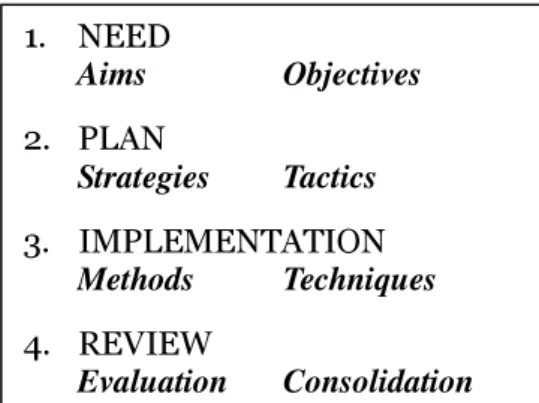
This linear approach to curriculum development may be referred to as “Tyler’s model.” Following Tyler’s model, educators have developed variations of the model, such as the one proposed by Inglis (1975). The phases of “content” and “organization”
in Tyler’s model were modified into “plan” and “implementation” respectively in Inglis’ model, as shown in Figure 2.2. Inglis further divided each of the phases into two subcomponents. “Consolidation” here functions as a final activity of the whole
Aims and objectives
Content
Organization
Evaluation
Figure2.2 Model of Curriculum Development Based on Inglis (1975)
curriculum to respond to the result of evaluation and thus consolidate the whole curriculum. Both Tyler’s and Inglis’ models and many other variations of the two are all one kind of linear approach to curriculum development in nature. What is implied by the model is that once evaluation of the language program is done, the curriculum is also accomplished, no matter what the evaluation result might be.
Models of this linear-approach kind accordingly incurred criticism. Among other things, the treatment of leaving evaluation at the final stage rather than giving it a role at every stage was criticized (Richards, 2001). Following up were models of a cyclical kind, like the one proposed by Nicholls and Nicholls (1972) shown in Figure 2.3. The greatest difference between Nicholls and Nicholls’ model and the previous ones is that the new model is a non-linear approach to curriculum development. It has
Figure 2.3 Cyclical Approach to Curriculum Development Based on Nicholls and Nicholls (1972)
Aims & Objectives
Development &
Implementation
Assessment &
Evaluation
Feedback Further Study
1. N E E D
Aims Objectives 2 . P L A N
Strategies Tactics 3 . I M P L E M E N T A T I O N
Methods Techniques 4 . R E V I E W
Evaluation Consolidation
also been referred to as an ends-means model as it starts with a specification of aims and objectives of language teaching and then provides teaching means to teach the language needed as specified in the objectives. This cyclical approach does not end the process at the stage of evaluation. Instead, it links the stage of evaluation with the starting stage of specifying aims and objectives. By doing so, the results of the evaluation can thus be used to modify the aims and objectives established before the implementation of the program, and then a set of more appropriately and reasonably designed objectives will be subsequently developed. Then, the whole process will start over from the very beginning stage, only this time with a new set of aims and objectives, which are supposed to yield more satisfying results, in terms of both language teaching and language learning.
This cyclical model better brings out the essence of curriculum development than its linear-approach counterparts. However, it is not without defects. For one thing, the unidirectional relationships between stages suggest that once one stage is finalized, the subsequent stage shall follow regardless of whether the previous stage is soundly developed or not. Even if it leaves much to be desired, the procedure shall proceed any way. However, it is very often the case that one needs to move on to the next stage and conduct the activities pertaining to this particular stage to know what the problem is concerning the previous stage. Take the first two stages for example. It is very likely that curriculum developers fail to see the unrealistic part and the impracticability of the aims and objectives set in the very beginning until they really implement the curriculum. Some goals may be over-ambitious, while others may not be challenging enough. Still some goals may be overlooked. One way to make this up is to assign a bidirectional relationship between every two adjacent stages, and this is shown in Brown’s (1989) model.
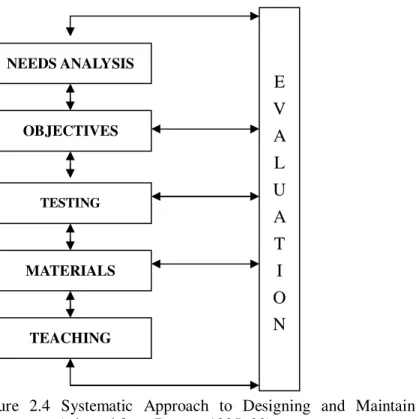
Brown (1989) develops a “systematic approach” to designing and maintaining
Figure 2.4 Systematic Approach to Designing and Maintaining Language Curriculum (adapted from Brown, 1995: 20)
language curriculum as shown in Figure 2.4. As Brown (1995:19) puts it, “this model is meant to be applicable to language programs,” but it is complete and consistent with the systems approach used in educational technology and curriculum design circles. This model provides not only “a set of stages for logical program development and a set of components for the improvement and maintenance of an already existing language program,” but also “a continuing process of curriculum development and maintenance while accounting for possible interactions among the various components of the design” (Brown, 1995). This is a multi-cyclical approach to curriculum development. In this model, the process of developing a curriculum involves not only stages of activities but also several cycles of implementation and evaluation.
Revision of Brown’s Curriculum Development Model
In Brown’s (1989, 1995) systematic approach to curriculum development, there are six components including needs analysis, objectives and goals, testing, materials,
NEEDS ANALYSIS
OBJECTIVES
TEACHING
TESTINGE V A L U A T I O N
MATERIALS
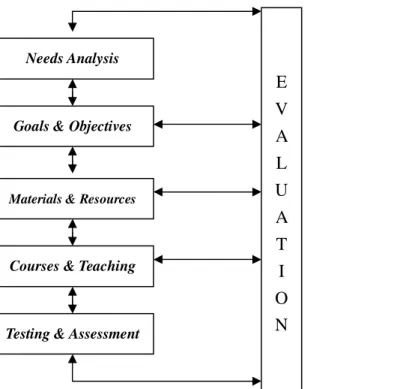
teaching and evaluation. Pratt (1994), in his elaboration of curriculum planning, also includes six components, but the contents of some of the components are not the same, which being testing vs. assessment, materials vs. resources, teaching vs. curriculum and instruction. To render a more comprehensive inclusion of curriculum components, the researcher combined Borwn’s and Pratt’s categorizations and produced a new set of components of curriculum, including needs analysis, goals & objectives, materials
& resources, courses & teaching, testing & assessment as Figure 2.4 shows.
Figure 2.5 Revised Model for Curriculum Development Based on Brown (1995) and Pratt (1994)
The bi-directional arrows interconnect the components of a curriculum, each of which is further connected with the activity of evaluation. As Brown (1995) puts it, the arrows and the links to evaluation are meant to imply three things. First, curriculum development in the real world may not start from the stage of needs analysis but any other stages in the figure. It is often the case, in fact, that “needs analysis, formulation of goals and objectives, articulation of tests, and delivery of instruction are all going on at the same time” (p. 217). Second, the whole process of curriculum development is an ongoing process with no end point until the curriculum
Needs Analysis
Goals & Objectives
Testing & Assessment
Materials & ResourcesE V A L U A T I O N
Courses & Teaching
is terminated. Thus, an element of improvement is instilled in this model. The bi-directional arrows that connect components imply revision and improvement of a certain component from its neighboring one. Third, the activity of evaluation functions as a checkpoint which examines and inspects the appropriateness of each stage to insure the worth of the curriculum. It is also like “the glue that connects and holds all the elements together.” In Brown’s terms, evaluation in the model is “the heart of the systematic approach to language curriculum design,” which “includes, connects, and gives meaning to all the other elements” (p. 217).
Another difference between Brown’s model and this blended model is the order of occurrence of the components. In Brown’s model, the component to consider right after “goals & objectives” is “testing”. Unlike Brown’s arrangement, Nicholls and Nicholls (1972) have “assessment & evaluation” conducted after the program is implemented (See Figure 2.3). If we take into consideration purposes and timing for testing and assessment, we may see it advisable to place the component of testing and assessment after “courses and teaching” has been implemented as Figure 2.5 suggests.
The purpose for testing and assessment is to better understand how much and how well students learn and know (Pratt, 1994). If the effect and influence from a program on students is what educators want to know, it is natural that the implementation of testing and assessment be conducted after courses start and instruction is given.
Brown (1989, 1995), in depicting the six components of curriculum development, did not explicate the role of testing in the implementation of a curriculum. Instead, he focused more on different types of tests and the purposes served by each type of test.
Pratt (1994), on the other hand, applies assessment to replace testing, the former being
more comprehensive and better serve the multiple purposes in a composite of a
curriculum
2. Taking all these into consideration, the researcher decides the model for curriculum development be revised as Figure 2.5 shows, which better describes the role plays by each component.
Components of Curriculum
The following provides detailed explication of each of the components except the component of evaluation. The exclusion of evaluation in this subsection is due to the fact that evaluation itself involves complicated knowledge, methods, skills and sensitivities (Posavac & Carey, 2007), which demands a whole section to elaborate on.
Thus, the other five curriculum components are defined and explicated below.
Needs analysis, or needs assessment (Stufflebeam et al., 1985) is defined by Brown (1995) as “the systematic collection and analysis of all relevant information necessary to satisfy the language learning requirements of the students within the context of the particular institutions involved in the learning situation” (p. 21). The purpose is to collect information that can be used to develop a profile of needs of a group of learners in order to be able to make decision about the goals and content of a course (Richards, 2001; Stufflebeam et al., 1985). It is generally assumed that to make an educational program sound, an analysis of learners’ needs is indispensable (Richards, 2001; Brown, 1995). In an EFL context, besides language learners, the target population may also include policy makers, teachers, parents, academic specialists or even communities agencies (Richards, 2001; Pratt, 1994; Suarez, 1990).
Needs analysis involves more than students’ and teachers’ ideas and viewpoints of needs. Administrators, employers, instructions, societies and even the whole country
2
Assessment functions as an integral part of instruction, to provide feedback about the success of the
program, to report individual student achievement, to diagnose the students’ learning, to consolidate
students’ knowledge prior to moving to the next unit of instruction, to direct students to instructional
priorities and to influence their approach to learning, to enhance students’ self-concept and sense of
efficacy, to guide decisions about the learner, to provide organizing targets for learners, and to provide
symbolic significance (Pratt, 1994: 105-106).
would exert a certain amount of influence on the development of a curriculum. Their needs “may also have a bearing on the language teaching and learning situation”
(Brown, 1995: 20). Once we take these factors into consideration in developing a curriculum, we are engaging ourselves in conducting what Richards (2001) terms as
“situation analysis.” Richards (2001) defines situation analysis as “an analysis of factors in the context of a planned or present curriculum project that is made in order to assess their potential impact on the project” (p. 91). The information gathered from situation analysis may serve to complement what is derived from analyses of learners’
and teachers’ needs. Clark’s (1987) also argues for the need to conduct situation analysis if a sound curriculum is to be developed (p. xii). The goal of situation analysis is to “identify key factors that might positively or negatively affect the implementation of a curriculum plan” (Richards, 2001: 105). Together with the information gathered from needs analysis, information derived from situation analysis may well serve as a basis for setting goals and objectives of the curriculum in question and as a basis for evaluating the curriculum as well.
The information gathered from such analysis further helps program developers
to formulate goals and objectives of the program (Richards, 2001). Goals and
objectives are different concepts of different scopes and with different degrees of
specificity. Goals, synonymous with Pratt’s (1994) aims, refer to descriptions of the
general purposes or intents of a curriculum. As Brown (1995) defines “goals,” they
are “general statements concerning desirable and attainable program purposes and
aims based on perceived language and situation needs” (p. 71). In deriving goals for a
program to satisfy learners’ needs, Brown indicates that serving as a basis for
developing more precise and observable objectives, goals should be general
statements of the program’s purposes focusing on what the students should be able to
do when leaving the program, and that goals should not be viewed as permanent.
Instead, goals can be changed and modified with times (Brown, 1995: 71-72). In other words, “goal statements are attempts in general terms what the program hopes to accomplish within the time allotted” (p. 72). A curriculum is mostly to be organized around the goals.
Compared with goals, objectives are precise and observable, and are developed on the basis of goals (Pratt, 1994). Objectives “serve as building blocks that would lead to accomplish the broader curriculum goal” (Brown, 1995: 73). Therefore, we may conclude that the distinguishing difference between goals and objectives is the level of specificity. As Mager (1975) indicated, objectives involve performance, conditions and criterion, which are usually not specified in goals. Performance specifies what learners will be able to do; conditions refer to the important conditions under which the performance is expected to occur, and criterion refer to the quality or level of performance that is considered acceptable. Once program developers have goals established, the next step to take is based on the goals to specify the objectives in terms of performance, conditions and criterion.
“Materials and resources” is the next important component of curriculum
development. Materials are defined by Brown (1995) as “any systematic description
of the techniques and exercises to be used in the classroom teaching” (p. 139). Pratt
(1994) considers useful and high-quality instructional materials are one of the major
factors in successful implementation of curriculum innovations. Materials can come in
many different forms, be based on different approaches, and can be organized around
different syllabi. Brown also suggests three ways to derive materials—adopting,
developing and adapting. Some combination of the three also serves the purpose of
deriving materials. Whichever approach to take, teachers are to ensure the materials fit
the approaches taken and syllabi arranged, satisfy learners’ learning needs and the
situational needs of the program, and match as much as possible the goals and
objectives of the program. Meanwhile, the content of the materials must be rigorous to cover a wide variety of topics and cater to cultural diversity and appropriateness.
Materials that do not match these requirements can be eliminated. Resources include equipment, facilities, human resources, time and cost. All these factors need to be considered carefully in developing a curriculum.
Following is courses and teaching. To develop a special curriculum for the gifted, a set of differentiated courses and implementation of different instructional skills are indispensable (Maker, 1982). The importance is such that it requires a whole section to explore. Therefore, the discussion in this part will focus on the enhancement of teaching in conducting a special program. As Brown (1995) points out that all curriculum design is to support teachers to teach. Teachers can not teach well out of nothing. There are certain things program developers or school authorities can do to optimize teaching effectiveness, such as orienting and involving teachers in the curriculum, supporting teachers, monitoring teachers and revitalizing teachers.
Brown (1995) states that “a curriculum in which the administrators view their job as
supporting the teachers will be a curriculum in which the teachers are in a better
position to do a good job of teaching” (p. 188). Administrators can support teachers
by “providing buffers between the teachers and negative aspects of the world outside
the program, by eliminating all unnecessary paperwork, and by ensuring that all
required resources are available for the teachers to deliver instruction and to continue
developing themselves professionally” (p. 188). One more thing to help optimize
teaching effectiveness is to revitalize teachers. Some provision should be made for
helping teachers to feel upbeat and positive about what they are doing to sustain
stamina and to fight against burnout. The element of teaching is by no means less
important than any other elements of a curriculum, for only when there are happy
teachers full of vitality and passion toward their profession will there be happy
students and effective programs.
The next component to plan is testing and assessment. There are four kinds of tests that may be applied during the implementation of a curriculum. They are proficiency tests, placement tests, diagnosis tests and achievement tests, all of which will be needed in implementing a language gifted program (Brown, 1995; Bachman and Palmer, 1996). Proficiency tests are to test the general overall language ability of the students and to gauge the proper level for program goals and objectives.
Placement tests will serve the purpose of grouping students of similar levels together in the same class within a program. Achievement tests, given at the end of a course or a program, can be applied to better understand the amount of language each student has learned in a certain period of time
3. Diagnosis tests are mainly concerned with diagnosing problems students may have in learning a subject. To some extent, they are related to achievement decisions but they aimed at fostering achievement by promoting strengths and eliminating weaknesses of students. To implement a special language curriculum, it will be of vital importance to develop a comprehensive testing system to provide valuable information for better program development.
As mentioned earlier, Pratt (1994) extends the element of testing into a broader one, assessment, which includes activities more than test-taking. Madaus and Kellaghan (1992) define assessment as “an activity designed to show what a person know or can do” (p. 120). In planning assessment, teachers are concerned not only with tests and examinations, but also with all the means through which they can collect information about students’ learning (Pratt, 1994: 104). It is believed that assessment by teachers generally has more positive effects on student learning than standardized tests (Madaus and Kellaghan, 1992; Pratt, 1994). Assessment serves
3
The information gained from achievement tests can also be used in reexamining the needs analysis,
selecting teaching materials and teaching strategies, and evaluating program effectiveness as well
(Brown, 1995).
more functions than tests and can come in various different forms
4. Therefore, for teachers to know better their students’ learning in a specific course, the application of carefully designed assessment will be a must.
Differentiated Curriculum for the Gifted
In this section, delineations of the definition of giftedness, traits of language gifted students, and identification of the gifted are presented, followed by discussion of principles of developing gifted curriculum, modifications of curriculum for the gifted. Finally, key considerations for developing language gifted programs are discussed.
Definitions of Giftedness
It is very important to render an explicit definition of giftedness, for such an explicit definition is a key stone for the development of programs for the gifted (Feldhusen and Jarwan, 2000). The importance is threefold. First, there is a close link between the definition and the identification system (Ward, 1983; Hoge, 1988, Davis and Rimm, 2004). It is also important because of its relationship with program goals and curriculum offerings. Finally, the definition adopted or developed by a school will determine who will be selected and who will be excluded. However, it is never easy to render a specific definition of giftedness. As Davis and Rimm (2004) put it, “there is no one definition of ‘gifted,’ ‘talented,’ or ‘giftedness’ that is universally accepted” (p.
28), for “whether a person is judged ‘gifted’ depends upon the values of the culture”
(p. 3). Therefore, what the researcher aimed to do was to make a comparison between definitions of giftedness and to further propose one definition that best fits the context of English talented curriculum in high school in Taiwan.
4
Forms of assessment may include observation, portfolios and records of work, oral questions and
interviews, questionnaires, checklists, essay-type questions, etc. (Pratt, 1994).
In the history of gifted education, there have been many educators and researchers who tried to delineate giftedness in various ways. Sir Francis Galton, referred to as “the grandfather of the gifted-child movement,” by Stanley (1976), is credited with the earliest significant research and writing devoted to intelligence testing (Davis and Rimm, 2004). Lewis Terman, “father of the gifted education movement” (Stanely, 1976), not only modified and Americanized the Binet-Simon tests for identifying slow learners in France (Binet and Simon, 1905), but also conducted a longitudinal study of 1528 gifted children (Terman, 1925). Almost at the same time, Leta Hollingworth, “the nurturant mother of gifted education” (Stanely, 1976), made great contributions to supporting gifted children and gifted education (Hollingworth, 1926; 1942). Then, following these giants, more researchers and educators proposed models of intelligence and different definitions of giftedness, trying to interpret giftedness and intelligence in the best light.
Generally speaking, there are two very different concepts of giftedness in the educational field (Gallagher and Gallagher, 1994; Gagné, 2003). One concept views giftedness as potential. The other concept regards giftedness as the actual production of outstanding work. The decision of choosing the first or the second concept as the emphasis of giftedness has much to do with the eligibility of an individual for special classes or services. As the children get older, it is more likely that both original potential and past experience of the children are taken into consideration in identifying program eligibility (Gallagher and Gallagher, 1994).
The Potential Camp
Marland (1972) defines gifted and talented children as those who are identified
by professionally qualified persons as having outstanding abilities and being capable
of high performance. Children capable of high performance include those with
demonstrated achievement and/or potential abilities in any of the following areas:
general intellectual aptitude, specific academic aptitude, creative or productive thinking, leadership ability, and visual and performing arts. Gallagher and Gallagher (1994) contend that the so-called “outstanding abilities” in Marland’s definition refers in particular to the ability to master and use those symbol systems that lie at the heart of the operation of the modern society (p. 6). Javits (1988) simplifies Marland’s definition of gifted and talented students into “children and youths who give evidence of higher performance capability in such areas as intellectual, creative, artistic, or leadership capacity or in specific academic fields, and who require services or activities not ordinarily provided by the schools in order to develop such capabilities fully” (Cited in Gallagher and Gallagher, 1994: 5). Both Marland (1972) and Javits (1988) emphasize more on capabilities rather than achievement, which put their definitions under the concept of potential.
Sternberg (1985) proposes and elaborates a triarchic theory of intelligence. The model is fundamentally an information-processing approach to human intellectual functioning. The three major parts of the model include metacomponents, knowledge acquisition components, and performance components
5. Sternberg’s theory of intelligence puts more focus on potential. Even in the part of performance components, final achievements or end products of the students are not emphasized but the skills needed by students in order to perform well in specific domains are.
The Production Camp
Renzulli (1977, 1978) reviews research on characteristics of successful and
5
Metacomponents deal with recognizing and clarifying problems, planning strategies to solve problems, mental presentation of problems, integrating the cognitive resources needed to solve
problems, surveillance of problem solving, and judging the quality of solutions; Knowledge acquisition
components refer to forms of intelligence in which new information is dealt with and committed to
long-termed memory; Performance components are processes used in leaning new things, often being
specific pieces of knowledge or skills that are related to a problem in question (Sternberg, 1985).
eminent individuals and concludes that gifted individuals possess three clusters of traits, which he calls the “three-ring conception” of giftedness. The three interlocking clusters are above-average general and/or specific ability, high levels of task commitment, and high levels of creativity. It is the interaction among the clusters that is necessary for creative and productive achievement. Renzulli (1977) also contends that “gifted and talented children are those possessing, or capable of developing this composite set of traits and applying them to any potentially valuable area of human performance,” and that “children who manifest, or are capable of developing an interaction among the three clusters require a wide variety of educational opportunities and services that are not ordinarily provided through regular instructional programs” (p. 261). Renzulli and Reis (1985) also stress that gifted behavior is contextual, by which it means gifted behavior “occurs in certain people at certain times and under certain circumstances” and that the clusters may not be equally important in all situations. One’s great task commitment may compensate for his average cognitive ability, and someone who has superior creativity may come to produce something great without great task commitment. Apparently, Renzulli’s definition of giftedness is more product-oriented.
Gardner’s (1985) model of multiple intelligences is now recognized as the most
popular and widely applied model of human abilities. The seven distinctive types of
intellectual behavior include Linguistic Intelligence, Logical-Mathematical
Intelligence, Bodily-Kinesthetic Intelligence, Musical Intelligence, Interpersonal
Intelligence, Intrapersonal Intelligence. Later on, he added one more intelligence to
the list, Naturalist Intelligence (Gardner, 1999). Following Gardner’s theory of
multiple intelligences, educators would have to assess children on several dimensions
of intelligences and declare them as gifted in one or more of the domains. Gardner
also believes that the distinctions between these intellectual domains become even
greater as the students mature and their individual interests crystallize around some of these domains. Though widely embraced by schools and teachers as a guide to curriculum and instruction, there are few tests or measurements available to identify giftedness in the seven domains (Gallagher and Gallagher, 1994; Feldhusen and Jarwan, 2000). As a consequence, educators would have to resort to actual performances or achievements of the students to identify which specific domain or domains they are particular good at. Accordingly, the theory of multiple intelligences should go to the product camp.
There have been distinctions made between giftedness and talent (Feldhusen and Jarwan, 2000; Gagné, 2003; Morelock, 1996). As Gagné (2003) has put it, gifts and talents “roughly correspond to the ideas of potential/aptitude and achievement or, in other words, to the distinction between natural abilities and systematically developed skills” (p. 60). In other words, gifts (i.e., general aptitudes) are untrained natural abilities, while talents (i.e., specific skills) are learned capabilities (Davis and Rimm, 2004). The relationship between one’s gifts and talents is that “the presence of talent necessarily implies the possession of well-above-average natural abilities; one cannot become talented without first being gifted, or almost so,” but “the reverse is not true” (Gagné 2005: 110). Such distinctions therefore put giftedness in the potential camp and talent in the production camp.
The above theories belong to explicit theories of giftedness. Sternberg (1995) proposed an implicit theory that summarizes laymen’s conception of giftedness. The theory specifies five necessary sufficient conditions that gifted persons have in common, including excellence, rarity, productivity, demonstrability and value
6, which put the implicit theory in the production camp.
6
Excellence—being extremely good at something; Rarity—possessing a high level of an attribute that
is uncommon relative to peers; Productivity—leading to productivity; Demonstrability—being
demonstrable through one or more valid tests; Value—being valued by society (Sternberg, 1995).
A Final Definition
Taking all these definitions of giftedness into consideration, we may come to a summary of definitions of giftedness as Table 2.1 shows. It appears that the so-called
“giftedness” has much to do with an inborn capacity which enables a gifted individual to perform much better than an average person in a certain field. As Feldhusen and Jarwan (2000) put it, giftedness is a genetic endowment that “paves the way to the development of specific abilities, aptitudes, and talents”. Even in Renzulli’s and Gardner’s definitions, there is a role for such “genetic endowment” to play. Both Renzulli’s three-ring concepts of giftedness and Gardner’s multiple intelligences Table 2.1 Definitions of Giftedness
definition Definition
researcher Potential-oriented Product-oriented
Marland (1972) having outstanding abilities and being capable of high performance in the areas of general intellectual aptitude, specific academic aptitude, creative or productive thinking, leadership ability, and visual and performing arts
Javits (1988) higher performance capability in such areas as intellectual, creative, artistic, or leadership capacity or in specific academic fields
Renzulli (1978) Above-average ability
High levels of task commitment High levels of creativity
Sternberg (1985) Knowledge acquisition components Metacomponents
Performance components
Sternberg (1999) Excellence; Rarity; Productivity;
Demonstrability; Value
Gardner (1985, 1999) Linguistic, Logical-mathematical, Spatial, Musical, Bodily-Kinesthetic, Interpersonal, Intrapersonal & Natural Intelligences
Feldhusen and Jarwan (2000); Gagné (2003)
genetic endowment that paves the way to the development of specific abilities, aptitudes, and talents; A gifted children usually scores high on an intelligence test or an academic achievement test;
natural abilities
Talent is a specific ability within a domain of human activity, such as art, music, mathematics, political science, drama or literature; systematically developed skills
require some inborn capacity to sustain the performances observable to the observer,
be it an interaction of above-average ability, high levels of task commitment and
creativity or one or more of the eight intelligences. We may therefore be able to come
up with a comprehensive definition of giftedness based mainly on Gagné’s, Sternberg’s and Feldhusen and Jarwan’s (2000) definitions as genetic endowments encompassing three components (including knowledge acquisition component, metacomponent, and performance component) that pave ways to the development of specific abilities, aptitudes and talents.
In learning a second or a foreign language, it involves a considerable commitment of time and effort (Lock, 1996; Richards, 2001). Even in the learning (or acquisition) of one’s first language, it also takes a lot of time and efforts to demonstrate exceptionally good command of it (Foley and Thompson, 2003).
Accordingly, it is appropriate to say that exceptionally outstanding linguistic performance involves gifts (i.e., natural abilities) and talents (i.e., systematically developed skills). Besides, one’s outstanding linguistic performance (or talent in language), as Gagné (1985, 2003. 2005) has put it, implies the possession of natural abilities in learning languages, that is, language gift. In light of this, the term “English talented” will be adopted to encompass the two elements of “nature” and “nurture”
coming into play in outstanding performance in learning English as a foreign language and to manifest the fact that outstanding performance (i.e., talent) implies natural abilities (i.e., gift), but not vice versa.
Traits of Language Gifted/Talented Students
Given the definition of giftedness we derive previously, language giftedness
may well refer to “a genetic endowment that paves way to the development of
language learning ability, and literary appreciation and creation.” Fox and Durden
(1982) consider it difficult to define “language giftedness”, yet they still propose five
categories of language giftedness. They include one’s outstanding abilities in verbal
expression, reading, foreign languages, creative writing and general verbal reasoning.
A person does not need to possess exceeding capacity in all these five categories to be language gifted. Although it is rare, if not impossible, for a person to excel at all the five categories, it is advisable for program developers to incorporate all the five categories into a language program so as to cater to language talented students’
individual learning needs.
Piirto (1992) points out that language talented students start writing and reading at a very young age, and that they are very much focused and engage themselves in the literal world. Besides, they are passionate and imaginative, and enjoy intellectual stimuli and challenges from language (Piirto, 1992 cited in Passow, 1992). Tsai (1989) also points out four features shown in the language development of gifted learners.
The features manifest themselves in four aspects: (1) Vocabulary—a larger vocabulary, more sophisticated diction, interest in words and phrases and a more precise way of choosing words or phrases; (2) Linguistic fluency—being good at expressing themselves, using longer sentences and more beautiful diction, showing better abilities in learning foreign languages, and speaking more than two languages fluently;
(3) Reading ability—starting to read at a very young age and enjoying reading, both efficiently and extensively, especially books that are more challenging and that are educational and impart knowledge, such as encyclopedias, dictionaries, biographies, etc; and (4) Writing ability—better penmanship, and better ability to write sentences, letters, stories, prose, and poems.
Chen (1988) proposed three criteria, based on which gifted learners can be identified. The criteria include (1) high sensitivity to language—they show a very good command of language through their using difficult words and delicately manipulating them; (2) rich imagination—the imagination is produced through experience and integration; and (3) sensitivity to life—their writing is not only
“composition”, but it embraces life and reveals enthusiasm and tremor toward life.
Lewis (1995) also makes a list of learning traits of language talented students. They include (1) the ability to read at a very young age; (2) a love of extensive reading and showing understanding of the content; (3) better reading and writing ability than peers;
(4) the ability to make up imaginative and logical stories; (5) the ability to make up surprising and unexpected endings to stories; (6) the ability to give appropriate and effective description of details; (7) the ability to grasp the theme and the plot of stories or articles; (8) a large and advanced vocabulary which can be used in writing and speaking; (9) a preference of writing down ideas and conceptions; (10) the ability to render characters in stories that sound real; (11) being keenly observant about human behaviors; (12) being sensitive to others’ feelings and emotions, and interpersonal relations. Ho (1998) suggests these traits be taken into consideration by teachers in identifying language talented students (p. 25).
In her study of two verbally talented children, Bailey (1996) summarizes qualities demonstrated by the two children include fluid, descriptive oral language, early mastery of the phonetic code, an advanced ability to use a linguistic symbol system, active engagement in reading or writing tasks for extended periods of time, playful doing a skill coupled with seriousness of purpose, ability to express complex thoughts, and craving for challenge. As Bailey herself points out, this may not be a magical list to precisely define verbal talent, but it is indicative of special verbal talent.
Teachers or parents may employ a list such as this as a checklist, based on which they may further identify verbally talented students.
According to VanTassel-Baska (1996a), verbally gifted learners are students
who read well and fluently, and read often and outside of class. They are interested in
words and word relationships, able to use an advanced vocabulary and enjoy verbal
puzzles and games. Besides, they enjoy talking about literature. When reading, they
are able to process key ideas about what is read and write descriptively and
communicate a story. To be brief, they enjoy playing with language in its oral and written forms, and exhibit understanding of the structure of language in speaking and writing.
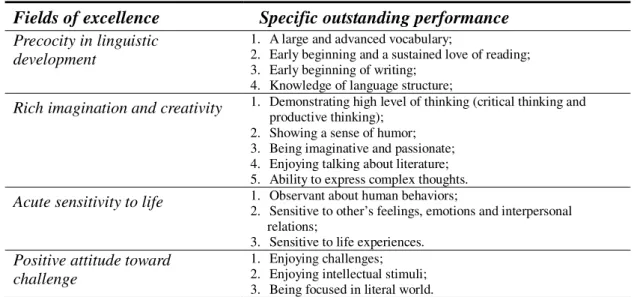
Weaving all the above definitions of language giftedness together, we may render a table like Table 2.2, which provides a more concise and ready-to-use guideline for identifying language talented learners. A language talented student may not excel in all the fields, but he may demonstrate many of the outstanding abilities.
Table 2.2 Language Giftedness Traits
Fields of excellence Specific outstanding performance Precocity in linguistic
development
1. A large and advanced vocabulary;
2. Early beginning and a sustained love of reading;
3. Early beginning of writing;
4. Knowledge of language structure;
Rich imagination and creativity 1. Demonstrating high level of thinking (critical thinking and productive thinking);
2. Showing a sense of humor;
3. Being imaginative and passionate;
4. Enjoying talking about literature;
5. Ability to express complex thoughts.
Acute sensitivity to life 1. Observant about human behaviors;
2. Sensitive to other’s feelings, emotions and interpersonal relations;
3. Sensitive to life experiences.
Positive attitude toward challenge
1. Enjoying challenges;
2. Enjoying intellectual stimuli;
3. Being focused in literal world.
Among the four fields of excellence, precocity in linguistic development and rich imagination and creativity are mentioned in most research, which suggests that outstanding performances in these two fields are more often observed. Thus, students’
precocity in linguistic development and their rich imagination and creativity would be important indicators of language giftedness.
Identification of the Gifted/Talented
Hoge (1989) points out three steps to take in terms of defining giftedness. First
of all, there is a need to be explicit in defining what makes up giftedness. Besides,
definitions should be derived from “theories concerning human abilities in general
and superior abilities in particular.” Then based on such definitions and supporting
theories, specific identification or selection procedures can thus be derived. Finally,
“there should be substantial efforts to verify or validate the identification system empirically (cited in Feldhusen and Jarwan, 2000: 279).
The ultimate purpose of such identifying procedures is to identify who will be better qualified to be included in the program. It would be neither valid nor reliable enough if only one standardized test is given in the identification process. In fact, as Feldhusen and Jarwan (2000) put it, “the use of multiple procedures for identification has been emphasized as a response to theories of human abilities which stress multiple factors” (p. 274). A variety of data sources are suggested in the literature for the identification of academically gifted and talented children for special programs or services. The list of the sources includes standardized tests, school grades, rating scales, references, essay writing, past accomplishments, interviews, creativity tests, and creativity inventories. Nominations from teachers, counselors, peers, parents, and the students themselves can be used as well (Davis and Rimm, 2004).
However, it is not necessary for educators to carry out all the above ways to identify gifted learners, but it is for sure that a sound identification system typically is carried out through a series of steps, each of which compliments another to render higher validity and reliability of the identification system. The order and sequence of steps, clarity of objectives, purposefulness of each component must be made explicit so that the whole identification system will be defensible (Feldhusen and Jarwan, 2000: 274). Besides, the number of steps and the purpose of each step are dependent on the nature of the program for the gifted and the talent areas it is meant to serve (p.
276). For example, the procedures for identifying mathematically gifted students and
those for language gifted students will not be the same. Besides standardized tests and
aptitude tests, identification of language talented students may rely more on essay
writing, past accomplishments and portfolio assessment than that of mathematically
gifted students. One more thing to pay attention to is that even with the application of multiple procedures for identification, it does not necessarily guarantee making absolute valid decisions. The quality and relevance of identification measures, and the manner in which the data are synthesized and interpreted place limits on the reliability and validity of such decisions (p. 274). In other words, the more reliable and valid each step of identification is, the higher reliability and validity the whole identification system will be.
For identifying gifted and talented students, Feldhusen and Jarwan (2000) propose the following recommendations:
1. Identification processes in gifted education should be based on the best current conceptions and theories of human aptitudes, talents, and abilities.
2. Test instruments and rating scales with established reliability and validity should be selected for use in the identification process.
3. Identification should be viewed as an ongoing process.
4. Labeling children as “gifted” should be avoided; it is preferable to regard the process as selecting children for programs or services.
5. Identification should always be diagnostic in nature, identifying strengths, aptitudes, and talents as well as problems, weaknesses, and needs (p. 279).
Richert et al. (1982) in the National Report on Identification also propose six identification principles, which turn out to be of great help in guiding school staff in identifying the gifted. They are as follows.
1. Defensibility: Procedures should be based on the best available research and recommendations.
2. Advocacy: Identification should be designed in the best interests of all students. Students should not be harmed by the procedures.
3. Equity: Procedures should guarantee that no one is overlooked. The civil rights of students to equal access to programs should be protected. Strategies should be specified for identifying the disadvantaged gifted. Cutoff scores should be avoided.
4. Pluralism: The broadest defensible definition of giftedness should be used.
5. Comprehensiveness: As many learners with gifted potential as possible
should be identified and served.
6. Pragmatism: Procedures should allow for cost-effective modification of available instruments and personnel. (Cited in Richert, 2003)
To conclude, when conducting the task of identification, multiple procedures are highly recommended. The clarity of objectives, purposefulness of each component also must be made explicit. Each step of the process should be as reliable and valid as possible to make the identification process both reliable and valid. Finally, program staff are advised to follow the identification principles suggested as mentioned above so as to reach the best result of identification.
Principles of Developing Curriculum for the Gifted
Once students are identified as “gifted” or “talented”, special programs specifically tailored to address students’ specific gift or talent should be offered (Marland, 1972; Renzulli, 1978; Maker, 1982; Javits, 1988; Ho, 1998; Feldhusen and Jarwan, 2000). As Feldhusen and Jarwan (2000) put it, “a special program for gifted and talented students should provide more advanced, rigorous curriculum experiences to satisfy intellectual needs, which are not addressed in regular classes” (p. 278).
Marland (1972) also believes that gifted students require differentiated educational programs and services beyond those normally provided by the regular school program in order to realize their contribution to self and society. Thus, gifted education should be aimed at enhancing the learning and development of gifted students so as to help students exert their giftedness, and to excel themselves in the field where students’
giftedness and talents will shine (Ho, 1998). Maker (1982) once pointed out that qualitative modification of curriculum should be made for the gifted learners. Maker and Nielson (1995) also mention the importance of qualitative modification in developing gifted curriculum by stating that
Modifications must be quality changes rather than quantity and they must
build upon and extend the characteristics (both present and future) that
make the children different from other students (p. 3).
Again, such qualitative difference implies that the program should be designed to enhance or take into account what is special about the gifted students.
The U.S. Office of Education’s Office of the Gifted and Talented (1976) defined
“differentiated education or services” as
process of instruction which is capable of being integrated into the school program and is adaptable to varying levels of individual learning response in the education of the gifted and talented.
(USOE, 1976: 18665, cited in Maker, 1982: 4) Eisner and Vallance (1974) presented five conceptions of curriculum that have shaped the thinking of many educators of the gifted. VanTassel-Baska (1992, 1994a) adds a sixth orientation which is related to career preparation to the list. The total set of six orientations serves as a curriculum philosophy for the gifted (VanTassel-Baska, 1994a). They are as follows:
1. Curriculum as the development of cognitive process. This orientation focuses on process skill development, where higher-level thinking skills are emphasized, such as critical thinking, creative thinking and problem solving ability.
2. Curriculum as technology. This is also a process-oriented view point on curriculum, but it focuses more on the organization of curriculum into student inputs and outputs (VanTassel-Baska, 1994: 5). Thereby, it relies to a great extent on stated behavioral or performance objectives with measurable outcomes.
3. Curriculum as personal relevance. This orientation emphasizes student- centeredness, self-directed learning and caters to individual student needs.
4. Curriculum as social reconstruction. This orientation considers the purpose of educational institutions to be an agent for social change. Thus, social and cultural factors should be taken into consideration in arranging the content of curriculum. The curriculum for global futures, the theme of global interdependence and multicultural issues are examples of this orientation (VanTassel-Baska, 1994a; 2000).
5. Curriculum as academic rationalism. This orientation regards education as
“a way of providing students with an understanding of great ideas and the ability to analyze and synthesize past achievements” (VanTassel-Baska, 1994a; 2000).
6. Curriculum as a precursor to career/professional life. This orientation focuses on the practical side and the utilitarian of education. It views curriculum as a preparation for the future of the students.
To be brief, the general principle of developing curriculum for the gifted can be concluded as to provide qualitative changes which help better enhance development and extension of the characteristics that make the gifted standout. Following this principle, educators may go on to make specific adjustments in curriculum so as to establish a most appropriate curriculum to satisfy the needs of the gifted students and further produce a most desirable result.
Modifications of Curriculum for the Gifted
Modifications of curriculum depend much on combination of many factors, such as philosophy, personality, skills and prior experiences of the teachers or program developers, the administrative structures of the gifted program, the school system, and the common and unique characteristics of the students (Maker, 1982;
Maker and Nielson, 1995). Kaplan (1974) once pointed out that differentiation of curricular activities for the gifted students is manifested in the elaboration of procedures for presenting learning opportunities, nature of the input and expectations for learning outcomes. (Kaplan, 1974; Maker, 1982). Gallagher (1975) proposed three aspects to change to modify the regular curriculum to render a more appropriate one to meet the needs of gifted learners, including the content of the material to be taught, the method of presenting material, and the nature of the learning environment.
Gallagher and Gallagher (1994) direct more attention to the role of the content
in developing a differentiated curriculum for the gifted. The adjustments they make
include acceleration, enrichment, sophistication and novelty in the content of teaching.
Content acceleration means that the program provided to the gifted will be two or more grades beyond their expected grade level (p. 99). Content enrichment refers to the modification in which “the teacher provides gifted students with a variety of materials or references that will elaborate on the basic concepts to be taught in the standard program” (p. 100). Content sophistication involves providing material that will allow students to see larger systems of ideas and concepts related to the basic content of the course provide for general students. It is further pointed out that such an approach to curriculum adjustment is more possible and more appropriate when gifted students are clustered together in special classes or resources rooms (p. 101). Novelty in the teaching content involves introduction of totally different material from what is offered in the regular program provided for the average student. The rationale underlying the choice of topics is that “some subjects will be useful to the gifted students and their advanced career and academic goals” (p. 101). It is also believed that some elements in the gifted students may be enhanced by such experiences.
USOE contends that a differentiated curriculum should embody a high level of cognitive and affective concepts and processes beyond those normally provided in the regular curriculum. Besides, educators should apply instructional strategies which cater to the unique learning styles of the gifted and talented. What’s more, flexible administrative arrangements for instruction, both in and out of school, should be made, such as special classes, seminars, resource rooms, independent study, students internships, mentorships, research filed trips, library media research centers and other appropriate arrangements (USOE, 1976, cited in Maker 1982: 4).
Maker’s (1982) Modifications of Gifted Curriculum
Maker (1982) pinpoints four common elements shared by various differentiated
programs for the gifted. First, these programs all build upon the characteristics unique
to gifted students, which serve as a base or point of reference for modifications to be made. Second, they all include concepts at higher levels of abstraction or greater complexity in terms of teaching content, which entails modification of content. Third, they all emphasize the development of thinking skills at a higher level than acquisition and memory, which emphasis suggests the importance of modification of process.
Fourth, they all suggest provision of administrative or other arrangements necessary to enable all learners to utilize their potential to the fullness, which involves broader modification of the learning environment. Accordingly, she proposes modifications in four areas to construct a more appropriate curriculum for gifted students. They include content modifications, process modifications, product modifications and learning environment modifications. Based on the four dimensions of modification, Maker and Nielson (1995) review thirteen teaching-learning models in education of the gifted
7. Each model, with different assumptions and philosophical bases, has its own strengths and weaknesses. They can be either applied separately or combined as a curriculum development framework for gifted programs. Appendix A shows a summary of the total number of the modifications made in each model. The following discussion will focus on the modifications applied by most models.
Content Modifications. The content of a curriculum refers to what is taught, including ideas, concepts or facts that are presented to students (Maker, 1982; Maker and Nielson, 1995). To make the subject matter more appropriate for gifted students and better satisfy their intellectual curiosity, it is advisable to modify the content in terms of abstractness, complexity, variety, and study of methods.
7