Soochow University
Global Business Program, School of Business Thesis
The Impact of Electronic Word of Mouth in Hospitality and Tourism Industry: Evidence
from Booking.com and Hotels in Taiwan
Student:Pin-Yu Lin (林品瑜) Advisor:Dr. Chun-Yun Cheng (鄭鈞云)
July, 2016
The Impact of Electronic Word of Mouth in Hospitality and Tourism Industry: Evidence
from Booking.com and Hotels in Taiwan
A Thesis Submitted to Soochow University
in partial Fulfillment of the Requirements for the Degree of
Master of Business Administration In
Global Business Program
By
Pin-Yu Lin (林品瑜)
Global Business Program, School of Business, Soochow University July, 2016
i
Abstract
Electronic word of mouth (eWOM) has revolutionized the hospitality and tourism industry. Nowadays, online reviews are potentially affecting travelers’ decision making process in the level of creating ideas and narrowing choices. This thesis has analyzed the rich content of online user-generated reviews of hotels in Taiwan by using the data retrieved from Booking.com, the largest online accommodation booking platform in the world.
The research has found out that eWOM has significant impact on hotel room sales, and has also identified the most frequently mentioned aspects of online hotel reviews. It is obligatory for hoteliers to monitor and analyze the online reviews of what consumers are discussing about their properties, and to identify aspects that require immediate attention in order to increase service quality and customer satisfaction, also reinforces brand positioning.
Key words: Electronic Word of Mouth (eWOM), Hotel, Booking.com, Online Reviews, User-Generated Content (UGC), Word Frequency
ii
Acknowledgement
First and foremost I would like to express my profoundest gratitude to my thesis advisor Dr. Chun-Yun Cheng, thank you for your professional guidance, patience, and unreserved support. Professor Cheng has inspired me and brings me to a higher level of thinking. Every time I encounter any difficulties when writing thesis, profession Cheng will give me constructive advice and help me solve the problems. I also want to give my heartfelt thanks to the thesis committee Dr. Yi-Fen Chen and Dr. Jin-Shyang Roan, for giving me valuable suggestions and insightful comments on my thesis defense, making my thesis even better and more complete.
In addition, I wish to extend my wholehearted appreciation to Serena, the secretary of Global Business Program, for her continuous encouragement and assistance during the past two years of my MBA study. My special thanks also goes to my classmates in GBP - Lina, Emily, Wilbur, and Rachel, I wouldn’t forget those tough days reading numerous papers and writing thesis together, helping each other to deal with thesis problems. Thank you all for accompanying seeing me through these two years.
Last but not least, I would like to offer my deepest and sincerest gratitude to my dearest family and my boyfriend, thank you for always being there for me, giving me endless love and care in every possible way. I couldn’t have made this far without my parents. Finally, this long journey of writing thesis has come to an end; I’ve really improved a lot on both academic writing and solving problems from different perspectives. I have accomplished so many dreams during these two years of MBA study, and it has become a milestone of my life.
iii
Table of Contents
Abstract ... i
Acknowledgement ... ii
Table of Contents ... iii
List of Tables ... v
List of Figures ... vi
Chapter 1 Introduction ... 1
1.1 Research Background ... 1
1.2 Booking.com Introduction ... 6
1.3 Research Purpose ... 10
Chapter 2 Literature Review and Hypotheses ... 13
2.1 Definition of Word of Mouth ... 13
2.1.1 Traditional Word of Mouth ... 14
2.1.2 Electronic Word of Mouth (eWOM) ... 14
2.1.3 Differences between traditional WOM and eWOM ... 15
2.2 eWOM in Travel and Tourism Industry ... 15
2.3 eWOM in Hospitality Industry ... 19
2.3.1 Review-generating Factors ... 21
2.3.2 Impacts of eWOM ... 22
2.4 Theoretical Background and Hypotheses ... 29
Chapter 3 Methodology ... 32
3.1 Research Method ... 32
3.2 Data Collection and Data Analysis ... 33
Chapter 4 Results and Discussion ... 36
4.1 Results of Hypotheses ... 36
4.2 Word Frequency Analysis... 39
iv
Chapter 5 Conclusion ... 56
5.1 Conclusion and Discussion ... 56
5.2 Implications ... 58
5.3 Limitations and Future Research ... 59
Reference ... 62
Appendix ... 68
v
List of Tables
Table 2. 1 Hypotheses ... 31
Table 3. 1 Number of Hotels in Taiwan ... 33
Table 3. 2 Descriptions of Variables ... 35
Table 4. 1 Descriptive Statistics ... 36
Table 4. 2 Model Summary ... 36
Table 4. 3 Coefficients ... 37
Table 4. 4 Results of Hypotheses ... 38
Table 4. 5 Top 20 Most Frequently Mentioned Words in Taipei and Taichung ... 41
Table 4. 6 Top 20 Most Frequently Mentioned Words in Kaohsiung and Hualien ... 42
Table 4. 7 Bedroom & Bathroom Theme of Taipei and Taichung ... 43
Table 4. 8 Bedroom & Bathroom Theme of Kaohsiung and Hualien ... 43
Table 4. 9 Location Theme of Taipei and Taichung ... 45
Table 4. 10 Location Theme of Kaohsiung and Hualien ... 45
Table 4. 11 Service Theme of Taipei and Taichung ... 47
Table 4. 12 Service Theme of Kaohsiung and Hualien ... 47
Table 4. 13 Cleanliness Theme of Taipei and Taichung ... 49
Table 4. 14 Cleanliness Theme of Kaohsiung and Hualien ... 49
Table 4. 15 Quality and Value Theme of Taipei and Taichung ... 51
Table 4. 16 Quality and Value Theme of Kaohsiung and Hualien ... 51
Table 4. 17 Amenities Theme of Taipei and Taichung... 53
Table 4. 18 Amenities Theme of Kaohsiung and Hualien ... 54
vi
List of Figures
Figure 1. 1 ("BrightLocal “Local Consumer Review Survey 2014”," 2014) ... 2
Figure 1. 2 ("BrightLocal “Local Consumer Review Survey 2015”," 2015) ... 3
Figure 1. 3 Consumers Pay Most Attention to Overall Star Rating ... 4
Figure 1. 4 Word of Mouth is Still Important ... 5
Figure 1. 5 ("Booking.com,")New Search Method “Passion Search” ... 8
Figure 1. 6 Booking.com for Business ... 9
Figure 1. 7 Booking.com Review System ... 10
Figure 2. 1 ("CMA Customer Survey," 2015) ... 17
Figure 2. 2 Lines of Research on eWOM in Hotel Industry ... 20
Figure 2. 3 Main Review-generating Factors ... 22
Figure 2. 4 Impacts of eWOM from Consumer Perspective ... 24
Figure 2. 5 Impacts of eWOM from Company Perspective... 27
1
Chapter 1 Introduction
1.1 Research Background
It is undoubtedly that more and more people prefer to spend their free time traveling nowadays. There are various kinds of reasons why people traveling a lot recently; first of all, it is the rapid development of transportation system. People no need to spend such a long time heading to the places they want to go, the time cost has been significantly reduced, thanks to the greatly effective public transportation. Since the short time trip becomes more feasible, traveling seems more attractive and practical to the travelers, who can visit many amazing places without the concern of time consuming.
Secondly, the existence of low cost airlines attracts many more travelers as well. Those budget airline companies take Tiger Air, Ryanair, and EasyJet, for example, often offer low-fare and economic plane tickets, so travelers from different income levels can purchase.
Thirdly, since business competition is getting more intense each day, the pressure level of the labors has also ascended. As a result, people who seek for leisure travels have increased rapidly in the past few years.
Try to imagine for a moment that you are planning to travel abroad and need to book a hotel. However, without being familiar with the city or the country, you may wonder how to make a decision about where and which hotel to stay. You do have some options such as asking friends, check out a travel agency, or maybe search others’ opinions on the Internet.
What all these methods have in common is that people often look for the advice from others as part of their decision making. It is widely known that word of mouth, both positive and negative, has the potential to influence consumer purchase decisions.
2
When it comes to traveling, making a room reservation is an indispensable thing. In the past, people need to contact the hotel to book a room, or choose to go on a tour group, which everything has been settled down by the travel agency. However, with the emergence of the Internet technology, travelers are able to book the accommodation via the Internet, whether through the hotel websites or the online platform such as Booking.com, TripAdvisor, and Agoda etc. Consumers can compare prices and features of the accommodations, as well as reading other travelers’ reviews online. In the case of booking rooms, consumers are using online hotel reviews more than any other information source (Kim, Mattila, & Baloglu, 2011).
Online booking certainly makes the arrangement of traveling plan become far simpler and tourism industry has developed worldwide. There are even more affordable hotels, hostels, and B&Bs available for travelers.
Figure 1. 1 ("BrightLocal “Local Consumer Review Survey 2014”," 2014)
With regard to online user-generated reviews, BrightLocal has conducted “Local Consumer Review Survey 2014” about how consumers read and use online reviews (see Figure 1. 1). The result has revealed that 88% of consumers say they trust online reviews as much as personal recommendations (vs. 79% in 2013), and there are only 13% of consumers
3
do not trust online reviews as much as personal recommendations (vs. 21% in 2013). They suggest that “For one half, this trust will only be granted if there are multiple reviews to read.
For the other half, this trust is dependent on the reviews being authentic.” Therefore in this case, the quality is as important as the quantity.
Figure 1. 2 ("BrightLocal “Local Consumer Review Survey 2015”," 2015)
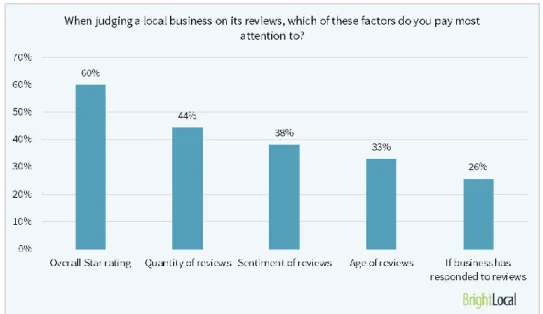
BrightLocal has also conducted “Local Consumer Review Survey 2015” in the next year (see Figure 1. 2). The results have revealed that 92% of consumers read online reviews, compared to 88% in 2014. Hence, the trend it that the numbers of consumers take online reviews into account is growing rapidly. Moreover, 40% of consumers may form their own opinions by reading 1-3 reviews, in contrast to 29% in 2014. The research also points out that star rating is ranked the number one factor used by consumers to judge a business; only 13%
of consumers consider using a business that has a one or two star rating. This phenomenon is especially typical in hotel industry, where consumers often compare star ratings of the hotels and prefer to select hotels with higher star ratings (see Figure 1.3).
4
Figure 1. 3 Consumers Pay Most Attention to Overall Star Rating
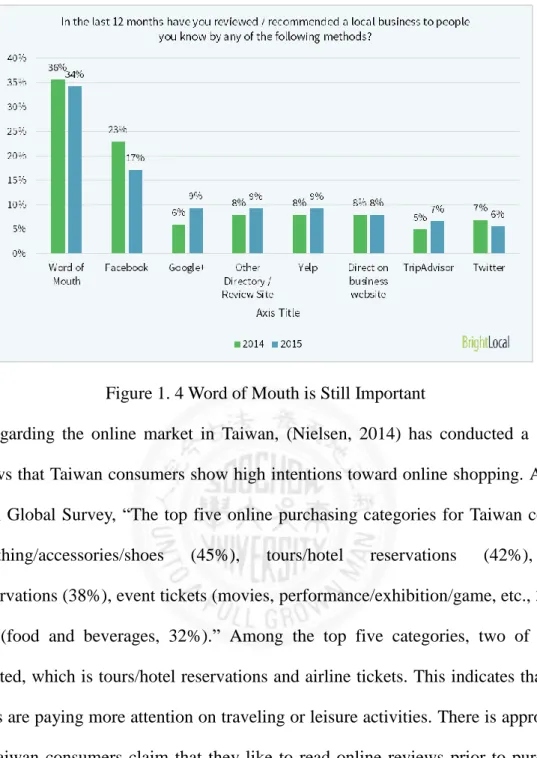
The survey has also shown that 68% of consumers claim that positive reviews make them trust a business more; on the other hand, they are becoming more concerned about fake reviews. As there are too many exaggerated advertisements everywhere and on the Internet, people may find it difficult to trust the company and the organizations running these campaigns. It is therefore important that eWOM exists, which is an online platform for everyone to express their genuine feelings, whether positive or negative comments, they are all valuable. Different from promotional content, online reviews come from an unbiased source. The figure below shows that word of mouth is still the most popular method of recommendation for consumers in spite of a 2% drop compared to last year (see Figure 1. 4).
5
Figure 1. 4 Word of Mouth is Still Important
Regarding the online market in Taiwan, (Nielsen, 2014) has conducted a survey in 2014 shows that Taiwan consumers show high intentions toward online shopping. According to Nielsen Global Survey, “The top five online purchasing categories for Taiwan consumers are clothing/accessories/shoes (45%), tours/hotel reservations (42%), airline ticket/reservations (38%), event tickets (movies, performance/exhibition/game, etc., 36%) and groceries (food and beverages, 32%).” Among the top five categories, two of them are travel-related, which is tours/hotel reservations and airline tickets. This indicates that Taiwan consumers are paying more attention on traveling or leisure activities. There is approximately 69% of Taiwan consumers claim that they like to read online reviews prior to purchasing a product and they would spend considerable time researching products online before buying.
As the numbers of consumers reading online reviews is increasing, electronic word of mouth (eWOM) is gaining much more importance. Electronic word of mouth is essential especially in tourism and hotel industry, since people go traveling more frequently than before.
In the hotel industry, people tend to read prior guests’ reviews before booking a room.
Previous studies are mostly about why and what factors make consumers generate online
6
reviews and the impacts of eWOM in hotel industry. Those previous research provide a fundamental understanding of eWOM and hotels, however, the influence of online user-generated reviews in the travel and hotel industry is still largely unknown to researchers.
In order to bridge this knowledge gap in tourism industry, this thesis seeks to explore the relationship between eWOM and hotels more detailed by analyzing online user-generated reviews using data extracted from Booking.com. Booking.com has chosen to be the research website in this thesis is because it is the largest accommodation booking platform in the world.
In chapter 1.2 we will introduce more about Booking.com as well as its offerings and features.
1.2 Booking.com Introduction
Founded in 1996, Booking.com B.V. is owned by the Priceline Group, the leading online accommodations booking website in the world. According to the Booking.com website, they have more than 1,000,000 rooms reserved online every day. Furthermore, Booking.com guarantees the best prices for everyone and every kind of property, from hostels, bed and breakfasts to apartments and five-star luxurious hotels.
Headquarters in Amsterdam in the Netherlands, Booking.com has international offices operated in over 70 countries and the website is available in 42 languages. With this customized design, consumers can not only choose their own languages, but also select the currency they prefer. Booking.com wants to help the consumers, no matter leisure or business travelers, to book the accommodations with the best prices.
Booking.com is a user-friendly website, travelers only need to type the places they want to visit and the website will show suitable accommodations with best prices and benefits.
Travelers can choose whether they want to stay in the hotels, hostels or B&Bs and compare their prices easily, you can also save your favorite places on Booking.com which is very
7
convenient. In addition, Booking.com presents photos and complete descriptions of every accommodation, featuring advantages and facilities, travelers can even have discounts sometimes.
According to the information on the website, travelers using Booking.com to reserve their stays can gain the following benefits:
Lowest Rates
Booking.com guarantees the best price for every traveler, whether you want to stay in a pretty luxury five-star hotel or a low-cost hostel.
No reservation fees
Booking.com doesn’t charge any booking fees or administration fees; sometimes you can even cancel your reservation within a specific time free of charge.
Secure Booking
The Booking.com reservation system is solid and secure. Booking.com puts many efforts to protect every traveler’s privacy by encrypting credit card and personal information.
Recently Booking.com has launched a brand new search method called “passion search,”
which is a brilliant online platform enables travelers to explore and search for remarkable destinations based on their passions (see Figure 1. 5). Simply type the attractions you want to see and the “passion search” will show destinations featuring these attractions, for example, if you type “northern lights” you can see places such as Iceland, Sweden, Norway, and Finland…etc. Passion search is benefit for travelers who are eager to do something, but have no idea where to go.
8
Figure 1. 5 ("Booking.com,")New Search Method “Passion Search”
People travel for several kinds of purposes; most of them travel for leisure activities, but the numbers of business travelers are growing rapidly. The main reason is that employees of multinational companies have to deal with oversea clients, and also go on business trips to other regional offices or even in other countries for meetings, office works and trainings.
Another important reason is that the mobile phone, Internet and the facility to work virtually from any place make business travelers keep in touch with office, family, and their friends while travelling.
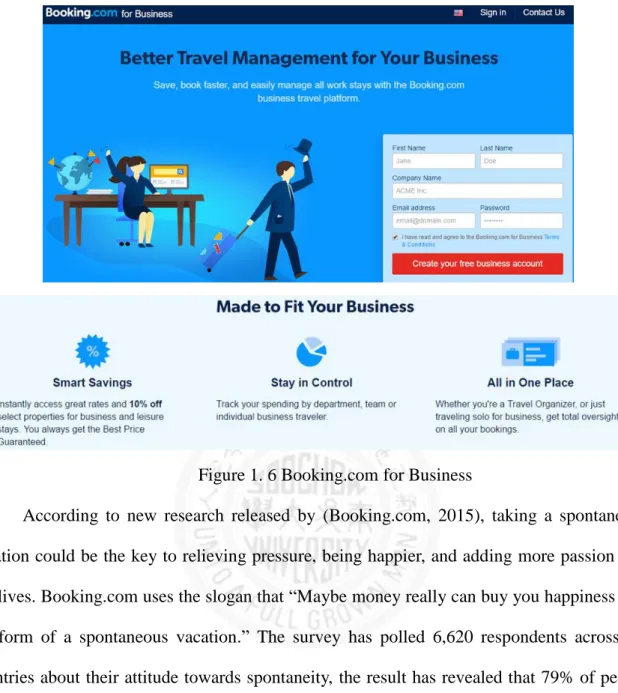
Facing the changes of business travel, Booking.com has responded with highly tailored services designed to give business travelers an easier and worthy experiences, as well as better value for employers (see Figure 1. 6). Realizing these trends and listening to consumers’ specific requests, Booking.com has made their products best empower business travelers around the world to effortlessly search, book, and enjoy the best accommodations to stay when traveling for work.
9
Figure 1. 6 Booking.com for Business
According to new research released by (Booking.com, 2015), taking a spontaneous vacation could be the key to relieving pressure, being happier, and adding more passion into our lives. Booking.com uses the slogan that “Maybe money really can buy you happiness – in the form of a spontaneous vacation.” The survey has polled 6,620 respondents across six countries about their attitude towards spontaneity, the result has revealed that 79% of people agree that taking a spontaneous trip boosts their happiness, and 65% of people claim that it makes them more productive at work. This research has indicated that people are paying more attention on traveling since they believe taking a vacation can reduce stress from the exhausting work life and enhance their living standards. In other words, the travel and tourism industry is becoming much more important than before, and the travel-related company should take it seriously.
In conclusion, Booking.com did put much effort on making their website more user-friendly to consumers. In addition, Booking.com will keep up on the trend and launch
10
creative searching method, which make consumers easier to search what they are looking for.
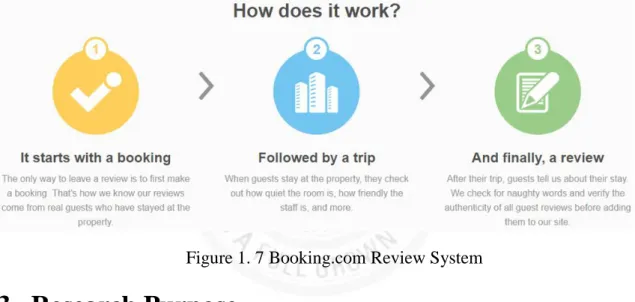
Last but not least, travelers can write reviews on Booking.com, whether they’re positive or negative opinions, as long as it’s authentic (see Figure 1. 7). Authentic review means that if you have actually stayed in the property, you can post the reviews. To prevent travelers from writing unreal reviews, Booking.com has drawn up the policy that only those who actually make a booking from Booking.com have rights to write reviews. The figure below shows how the Booking.com review system works. Those user-generated online reviews on Booking.com are the data that we are going to analyze in this paper.
Figure 1. 7 Booking.com Review System
1.3 Research Purpose
The concept of word of mouth (WOM) can be defined as the process of conveying information from person to person (Richins & Root-Shaffer, 1988). As a new type of word of mouth communication, online user-generated review is an emerging market phenomenon that is playing an increasingly important role in consumers’ purchase decisions (Chen & Xie, 2008). These online user-generated reviews are called electronic word of mouth (eWOM), which are highly helpful for consumers when making an online purchasing decision. Chen and Xie (2008) also argue that electronic word of mouth (eWOM), a type of product information created by users based on individual usage experience, can serve as free “sales
11
assistants” to help consumers identify the products that best match their personal needs.
Hotels, tourist attractions, or other travel-related products are intangible products, which are concurrently produced and consumed and therefore cannot be evaluated beforehand.
Unlike other tangible products, making a travel-related purchase decision involves a more intensive online reviews searching and filtering (Papathanassis & Knolle, 2011). Online user-generated reviews or eWOM constitute a significant and valuable input to tourism industry.
When a consumer is making a purchase decision, interpersonal influence and electronic word of mouth (eWOM) are said to be the most important information source (Litvin, Goldsmith, & Pan, 2008). These influences are particularly significant in the hospitality and tourism industry, where guests often cannot inspect the quality of the service at the time of purchase. Previous studies are mostly focus on numerical online ratings of the travel related products, ignoring the role of user-generated contents (UGC) or online travel reviews (Pavlou & Dimoka, 2006). These online reviews or electronic word of mouth (eWOM) are proposed to convey useful reputation information about a hotel’s prior transactions that cannot be fully captured with crude numerical ratings.
This paper seeks to examine the rich content of online user-generated reviews in the hotel industry by using the data retrieved from Booking.com, the largest online accommodation booking platform in the world. In our study, the hotels in Taiwan are the research subjects in this paper. We have selected four cities in Taiwan – Taipei, Taichung, Kaohsiung, and Hualien; respectively stand for the north, the south, the east, and the central of Taiwan. Since these four cities have diverse characteristics, we believe selecting hotels from those different districts can make the result fairer and more impartial. In addition, we decide to analyze English online hotel reviews since we aim to do the research from foreigners’
12
perspective, understanding what kinds of opinions they have regarding hotels in Taiwan.
The main questions of the research are as follows:
(1) How electronic word of mouth (eWOM) plays an important role in hospitality and tourism industry.
(2) Identify the impacts of eWOM on hotel room sales.
(3) Understand the relationship of eWOM on hotels in Taiwan, and what are the most frequently mentioned aspects in the online hotel reviews?
(4) Identify the possible aspects that hoteliers need to pay close attention to improve their services.
13
Chapter 2 Literature Review and Hypotheses
The increasing use of Internet technology has generated numerous online user reviews.
Prior literature has discovered the influence of user-generated contents (UGC) or eWOM on the sales of products such as movies, CDs, and books (Ye, Law, Gu, & Chen, 2011). However, the influence of online user-generated reviews in the hotel and tourism industry still needs to be further investigated. In chapter two, we will review previous related studies on the definition of traditional word of mouth (WOM) and electronic word of mouth (eWOM), as well as eWOM in hospitality and tourism industry.
Online user-generated reviews or eWOM about travel destinations, hotels, and tourism services have become significant sources of information for travelers (Pan, MacLaurin, &
Crotts, 2007). In chapter 2.1 we will define word of mouth (WOM), traditional WOM, and electronic WOM (eWOM), as well as comparing the differences between WOM and eWOM.
However, we will focus on eWOM since this is the topic in our paper. Secondly, in chapter 2.2 we will illustrate how eWOM plays an important role in travel and tourism industry with previous studies. Lastly, in chapter 2.3 we will discuss the main purpose of this paper, which is the relationship between eWOM and hotel industry.
2.1 Definition of Word of Mouth
The concept of WOM (Word of Mouth) could be traced back to 1967, which was defined as the communication about products, brands, or services between people who were not commercial entities (Arndt, 1967). Richins and Root-Shaffer (1988) also define WOM as the process of conveying information from person to person. WOM plays a primary role in
14
consumer buying decisions and it includes sharing opinions and reactions of consumers.
However, there are still two forms of WOM that should be illustrated – traditional word of mouth and electronic word of mouth (eWOM).
2.1.1 Traditional Word of Mouth
In the past when browsing the Internet is not that common, people tend to share their opinions about products with families and friends which is called oral communication. And this kind of face-to-face communication is so-called traditional word of mouth. Furthermore, the spread of traditional word of mouth is limited, and it mostly exists in a small group of individuals (Cheung & Thadani, 2012).
2.1.2 Electronic Word of Mouth (eWOM)
Electronic word of mouth (eWOM), often be referred to as online reviews, online recommendations, online user-generated contents (UGC), or online opinions, has drawn more attention with the advent of new technology tools (Serra Cantallops & Salvi, 2014). In the recent decades, thanks to the rapid development of Internet technology, people can use computers and their mobile phones to surf the Internet whenever, and wherever they want. As a result, consumers are able to post their comments online about service, product, or brand, and others can take their opinions as references. (Chevalier & Mayzlin, 2006) have stated that
“Online user reviews have become an important source of information to consumers, substituting and complementing other forms of business-to-consumer and offline word of mouth communication about product quality.” In today’s online world, websites undeniably play an important role in WOM.
15
2.1.3 Differences between traditional WOM and eWOM
Although eWOM does have some characteristics in common with traditional WOM, it is still different from traditional WOM in several dimensions; and it all contributes to the uniqueness of eWOM. First of all, as in traditional WOM, sharing of information is between small groups of people in synchronous mode; hence it is difficult to convey the information to any individual who is not present when the information is exchanged (Cheung & Thadani, 2012). Moreover, information in traditional WOM is usually been shared in private conversations or discussions. On the other hand, eWOM possesses unparalleled scalability and speed of diffusion; it consists of multi-way exchanges of messages in asynchronous mode.
Secondly, Cheung and Thadani (2012) also mentioned that unlike traditional WOM, eWOM is more persistent and accessible. The reason is that most of the text information is being saved on the Internet and therefore it would be available for an indeterminate period of time. Thirdly, eWOM is more measurable compared to traditional WOM. To clarify this concept more in-depth, researchers can effortlessly retrieve a great number of eWOM information online and analyze their features such as the word frequency of messages, location of the messages, and messages style. In conclusion, Sun, Youn, Wu, and Kuntaraporn (2006) illustrate the difference between traditional WOM and eWOM as “compared to traditional WOM, online WOM is more influential due to its speed, convenience, one-to-many reach, and its absence of face-to-face human pressure.”
2.2 eWOM in Travel and Tourism Industry
In travel and tourism industry, travelers use the Internet to obtain travel information, share their travel experiences, build a relationship with people from all over the world or
16
purchase travel-related products. The Internet already supports the pre-travel phase where all the research and bookings can be done online; the during-travel phase by means of interactive platforms such as on the Booking.com, TripAdvisor, or through online blogs while on the road; and the post-travel phase where people can share experiences, review hotels, restaurants, or historic spots, and post photographs and videos from their journeys (Chung & Buhalis, 2008).
When a consumer is making a purchase decision, interpersonal influence and electronic word of mouth (eWOM) are said to be the most essential information source (Litvin et al., 2008). These influences are particularly critical in the hospitality and tourism industry, whose intangible products are difficult to evaluate before their consumption. Some research has already identified that the number of consumers depending on eWOM when making purchase decision are growing, such as reading book reviews, cosmetics reviews, or film reviews.
Nevertheless, the online tourism platform is broad and contains information from different categories, ranging from carriers, hotels, to consumers themselves, such as customer-to customer exchanges, publishing blogs, and online forums (Mack, Blose, & Bing, 2008). Although the quality of the eWOM information and the reliability of the sources may vary, the internet has dramatically changed the word of mouth communication since consumers are able to exchange their opinions online asynchronously.
Why eWOM plays such an important role in travel and tourism industry is because travel-related products can’t be assessed before purchasing. When purchasing shoes, clothes, and even cosmetics, which consumers can test or try on the product; and if they don’t like it, the products can be returned. Unlike those tangible goods that can be sent back, travelers often book trips blind and there’s no return option. Furthermore, quite a lot of money and valuable time are being spent on traveling. Many travelers have been misled by companies’
17
information before; they therefore turn to the source they trust most for travel information and advice: other travelers’ opinions.
Figure 2. 1 ("CMA Customer Survey," 2015)
Competition and Markets Authority (CMA) has conducted a customer survey in 2015 (see Figure 2. 1) about “How important were the online reviews to your decision to buy it, compared to other sources of information or recommendations; such as friends and family; the opinions of experts etc.?” And the questionnaire is based on people who had purchased an item from that category after reading online reviews about the category. Figure 2.1 has shown that consumers consider reading online reviews in travel and hotels category is much more important and it is ranked number one category in this questionnaire. The result is not surprising since the travel-related products are intangible and always need to be evaluated after purchasing. In addition, the numbers of travel-related websites and online forums are growing; it is rather more convenient for people to find information and other travelers’
opinions on the Internet. Take the hotel industry for example; consumers can browse all the features and facilities of the hotels online, compare prices, know other travelers’ thoughts about the hotels, and when the consumers have made their decisions on which hotel to stay,
18
they can simply book a room online. As a result, eWOM is gaining more importance in travel and tourism industry obviously.
19
2.3 eWOM in Hospitality Industry
The rapid growth of Internet information technology, which empowers Internet users and allow multi-way information communications in travel and tourism industry, has generated an enormous number of online user-generated contents (UGC) or eWOM on hotels, travel destinations, and travel-related services (Sigala, 2008).
Advances in information technology and the introduction of new methods of communication have led to increasingly significant changes in consumer behavior. These changes have produced a shift in focus on companies’ marketing strategies and business administration, especially in the hotel industry (Serra Cantallops & Salvi, 2014). Numerous new accommodations possess some great advantages in the marketplace from the beginning.
Those advantages may consist of providing plentiful facilities (such as gym, swimming pool, lounge bar etc.), a great price–quality value, a beautiful building, or located in a great location.
However, the most important task is to make the consumers routinely share guest experiences online that keeps them expecting to come back again and telling others what a fabulous hotel/resort it is. In the hospitality industry, eWOM has undeniably been a powerful marketing strength.
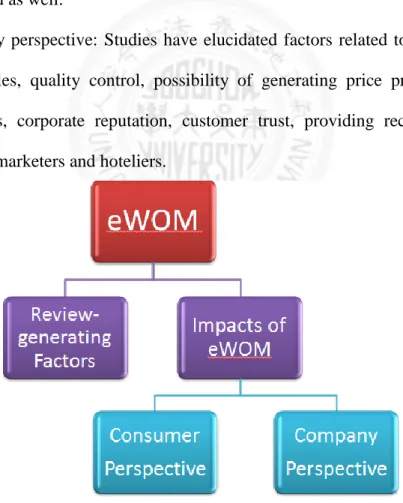
Therefore, analyzing eWOM in hotel industry is of critical importance. According to (Serra Cantallops & Salvi, 2014), previous research on eWOM and hotels can be categorized into two major lines, review-generating factors and impacts of eWOM (see Figure 2.2).
Review-generating factors mean the factors in relation to the generation of reviews. They have also found out that “studies related to the review-generating process analyze factors such as motivation, gender influence, cognitive and psychological aspects, satisfaction/dissatisfaction, group influence, sense of community belonging, and elements
20
related to service quality and helping other vacationers and/or companies, among others.”
As for impacts of eWOM, these impacts can be direct or indirect and are analyzed from the consumer perspective and the company perspective both.
I. Consumer perspective: Studies have demonstrated factors in relation to positive or negative reviews, including reliability, gender differences, content and ease of accessing the online reviews, product acceptance, and media (blogs and virtual online platforms, travel websites, product review sites etc.). Factors regarding the influence of purchase, decision models, purchase intention and loyalty have been discussed as well.
II. Company perspective: Studies have elucidated factors related to eWOM and hotel room sales, quality control, possibility of generating price premium, marketing strategies, corporate reputation, customer trust, providing recommendations for tourism marketers and hoteliers.
Figure 2. 2 Lines of Research on eWOM in Hotel Industry
21
2.3.1 Review-generating Factors
What kinds of factors make consumers write a travel review on the Internet? Yoo and Gretzel (2008) claim that online travel review writers are generally driven by helping a travel service provider, concerning for other consumers, and needs for enjoyment and positive self-enhancement. Most of the research point out that “Service Quality” and “Satisfaction and Dissatisfaction” are consumers’ major motivations for generating reviews (see Figure 2. 3).
Yoo and Gretzel (2008) also mention that guest satisfaction has a direct and positive influence on the hospitality organizations. Consequently, all of the accommodations should make every effort to meet and exceed consumers’ expectations in every aspect. Speaking of consumer dissatisfaction, Sánchez-García and Currás-Pérez (2011) state that dissatisfaction can directly cause negative eWOM impact and regretful consumers are more inclined to spread negative eWOM, which is consistent with prior marketing theory that their goal is probably warning others instead of looking for revenge. This statement matches the study (Yoo & Gretzel, 2008) have found that venting negative feelings is obviously not a strong motivation for writing online travel reviews.
22
Figure 2. 3 Main Review-generating Factors
In this line, Swanson and Hsu (2009) also state that consumers who have satisfying experiences are less likely to recommend the firm or to convince others to use the firm’s services compared to their dissatisfied experiences. In addition, many dissatisfied consumers may not complain to the companies, but they will share their discontented experiences with other present and potential consumers in the form of negative word of mouth. They will discuss their service encounters with friends, colleagues, family members, acquaintances, and the service company. On the whole, dissatisfied consumers tend to be more likely to tell others about their complaints and attempt to persuade others not to consume the firm’s services.
When a consumer is discussing about a service failure and successful recovery, other potential consumers might merely focus on the service failure and worry they will encounter the same problem as well. As a result, managers of the companies in the hotel and tourism industry clearly need to put much more efforts on managing consumer expectations and on preventing service failures from happening.
Most of the commonly mentioned motivations of generating eWOM in tourism industry are helping other travelers to make a proper decision. The motivations for contributing can be classified into five main categories: (1) self-directed, (2) helping other vacationers, (3) social benefits, (4) consumer empowerment, and (5) helping companies (Bronner & de Hoog, 2011).
Except for self-directed consumers, consumers with other four kinds of motivations would like to share their experiences with others, and they believe their self-experience may help other travelers or the company.
2.3.2 Impacts of eWOM
23
The second line is the impacts of eWOM in hotel industry, and it can be illustrated from company and consumer perspective. From the consumer perspective, it has been observed that all of the previous studies consider the impacts of online user-generated reviews (or eWOM) in the decision making process.
Consumer Perspective
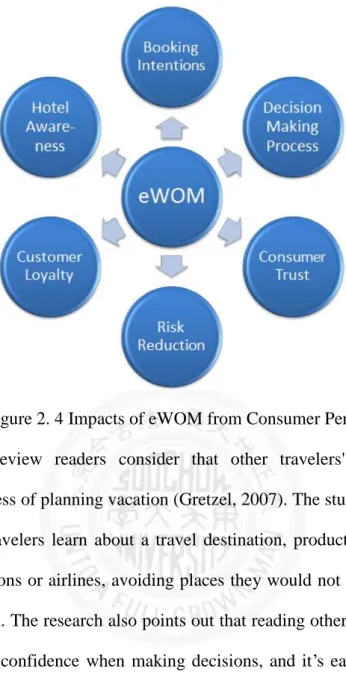
Many previous studies have revealed that eWOM has strong influence toward product evaluation and purchase decisions. Figure 2.4 shows main impacts of eWOM from consumer perspective. Vermeulen and Seegers (2009) argue that exposure to online hotel reviews increase the average possibility for consumers to consider booking a room in the reviewed hotel. This positive impact can be clarified by the fact that all online reviews, whether positive or negative, make consumers more aware of the reviewed hotel’s presence. In addition, the research also shows that online reviews (or eWOM) improve hotel awareness more for lesser-known hotels than for well-known hotels. Similarly, the persuasive effect of online reviews tends to be stronger in lesser-known hotels. Hence, the overall influence of online reviews (or eWOM) on hotel consideration is more significant for lesser-known hotels than for well-known hotels.
On the other hand, Sparks and Browning (2011) clarify that consumers appear to be more affected by early negative information, particularly when all of the reviews are negative.
Nevertheless, positive information and numerical rating details, increases both booking intentions and consumer trust. The research also highlights that “the occurrence of recent positive reviews can override or moderate the effect of a set of negative reviews with respect to booking intentions.”
24
Figure 2. 4 Impacts of eWOM from Consumer Perspective
Online travel review readers consider that other travelers' opinions have great influences on the process of planning vacation (Gretzel, 2007). The study indicates that online travel reviews help travelers learn about a travel destination, product or service, help them evaluate accommodations or airlines, avoiding places they would not enjoy and also provide creative ideas for them. The research also points out that reading other travelers' online travel reviews can increases confidence when making decisions, and it’s easier to imagine what a place would be like, reduce risk or uncertainty, and helps with planning journeys more efficiently.
Kim et al. (2011) suggest that gender is another impact on consumer’s motivation to read online hotel reviews (eWOM). The study result shows that women tend to be more likely to read online reviews for the purpose of convenience and risk reduction. The reason is that women focus on all available information and try to find out the similarities and differences between numerous pieces of information, and they are more sensitive to the details and more likely to process information in a comprehensive and effortful way (Meyers-Levy &
25
Maheswaran, 1991). Men, on the other hand, tend to put emphasis on the information that they consider useful. Studies also indicate that women might be more profoundly influenced by eWOM than men when booking a hotel or buying things online (Garbarino & Strahilevitz, 2004).
In addition, variables such as credibility of eWOM, perceived trustworthiness, useful online reviews and level of expertise are frequently mentioned when discussing the impact and influence of online hotel reviews on consumer perspective. These aspects are contribute to risk reduction during the decision making process. Papathanassis and Knolle (2011) suggest that “users engage in information-seeking activities to minimize the risk associated with the purchase of an intangible and inseparable service bundle.”
Another important factor is in relation to easy access and processing of the online reviews, which is significant due to its quantity of available information. Because of this reason, consumers have a complicated task of filtering and analyzing the online reviews.
However, Sparks and Browning (2011) argue that depending on easy to evaluate information, such as general category ratings (e.g. star ratings for hotels or consumer ratings of products) may have a greater impact on product purchase intentions compared to more detailed information. In conclusion, positive reviews mostly have positive influence on consumers, mainly on the selected aspects, hence increasing the possibility of purchasing. Otherwise, negative reviews can contribute negatively in all of the aspects.
Company Perspective
Electronic word of mouth (eWOM) communication, take the online hotel reviews for instance, which is getting increasing attention from marketing managers in the hotel industry, mainly due to the fact that consumers are making considerable use of online platforms and
26
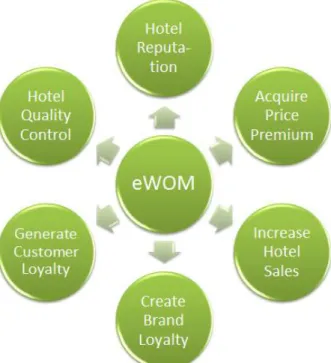
often do not make a booking without searching for other consumers’ online opinions on hotels, tourist attractions, or restaurants. Hoteliers understand that the information provided in a form of reviews and ratings enable them to make management decisions to improve the service operations, maximized profits, optimized revenues and the increase of brand loyalty and brand image (Ford & Bach, 1997). Impacts of eWOM from company perspective are presented in figure 2.5.
Previous research has shown that positive online reviews can significantly increase the number of bookings in a hotel, and the variance or polarity of eWOM for the online reviews of a hotel has a negative influence on the amount of online sales (Ye, Law, & Gu, 2009). The results further proposed that “a 10% improvement in reviewers’ rating can increase sales by 4.4% and a 10% increase in review variance can decrease sales by 2.8%.”
Another important impact from company perspective is customer loyalty, which is a strategic topic for a company’s success (Reichheld, 1993). For many years hospitality firms have believed that the goal of successful marketing is to create as many new consumers as possible, while hoteliers believe it is very important to satisfy the guests while they are staying in the property. (Petrick & Sirakaya, 2004) also suggest that customer loyalty is an essential aspect since retaining customers is more desirable and less expensive than attracting new ones. Loyal customers are more likely to discuss prior experiences positively than their counterparts, creating a potential opportunity for free electronic word of mouth (eWOM) advertising (Shoemaker & Lewis, 1999). As Rauyruen and Miller (2007) point out, “Creating a loyal customer base is not only about maintaining the numbers of customers overtime, but it is also about nurturing the relationship with customers to encourage their future purchase and level of advocacy.”
Loureiro and Kastenholz (2011) argue that corporate reputation plays a vital role in the customer’s perception of service performance quality, therefore leading to a reliable image of
27
the service in the customer’s mind. Keh and Xie (2009) has stated in their research that corporate reputation has positive impact on both customer identification and customer trust. In addition, customer commitment is able to mediate the relationships between the two relational constructs (customer identification and customer trust) and behavioral intentions. In other words, if the hotel has good reputation, it may increase customer trust and they may be more willing to book a room of the hotel. As a result, it is of great importance that the hotel manages their corporate reputation well.
Figure 2. 5 Impacts of eWOM from Company Perspective
Consumer behavior and new technologies has led to an increased market transparency that could create opportunities and risks for the companies. Verma (2010) suggests that potential market offerings in the hospitality industry have become increasingly complexed because of large measure to advances in information technology. This kind of condition allows consumers to compare and evaluate the relative costs and advantages of different alternatives. Jun, Vogt, and MacKay (2010) argue that the heterogeneity of accommodation services increases uncertainty in decision making; consequently, individuals need to assess various attributes of information and use different information sources (e.g., direct
28
accommodation websites, online travel agencies, destination official websites, consumer review online forums).In this aspect, Wen (2009) cites (O’Connor & Frew, 2004), indicating that “close relationships between customers and suppliers’ websites can reduce the danger of substitution and help to insure long-term profitability.” The authors further put emphasis on the essence of creating a strong relationship bond with the consumers is to study how they make online purchases and what factors affect their online purchase intentions.
From the company perspective, the impacts of eWOM could be considered as opportunities, since if the companies analyze and manage these impacts properly, they can obtain competitive advantages in their business (Dickinger, 2010) ; (Hills & Cairncross, 2011).
Otherwise, the companies would be affected by the negative impact on consumers. In other words, positive online hotel reviews (eWOM) can definitely enhance the reputation of the company as well as the possibility of obtaining price premiums (Yacouel & Fleischer, 2011).
On the other hand, negative eWOM could reduce consumer interest in the products or services provided by the company, which will have negative influence on its price competitiveness and profits.
A key finding deduced from previous studies is that the influence of online user reviews is particularly significant for experience goods, since their quality is often unknown before consumption and consumers have to rely on eWOM and online reviews for opinions about the goods (Klein, 1998). Most of the services and products offered by the hotel industry are experience goods, therefore the quality of the hotel facilities can only be known after the services has been consumed (Litvin et al., 2008). However, there are very few previous research in the existing tourism literature on the impact of eWOM on the performance of firms, in spite of the fact that studies on this topic would help tourism practitioners and hoteliers to better understand the importance of online user reviews (eWOM) for their
29
businesses.
In conclusion, electronic word of mouth (eWOM) is an essential source of information for companies and increasingly influences their marketing strategies (Jun et al., 2010);
(Yacouel & Fleischer, 2011). Moreover, eWOM is especially important in the hospitality industry, for the travel-related products can’t be evaluated beforehand. There are more and more hotels put emphasis on managing eWOM on the Internet. Companies who manage eWOM adequately can have a competitive advantage, directing their actions to specific targets according to the type of the product, as well as influencing consumers who could be potentially loyal to their brand, while at the same time maintaining current consumers (Loureiro & Kastenholz, 2011).
2.4 Theoretical Background and Hypotheses
As a new type of word-of-mouth information, online consumer reviews (or eWOM) is an emerging market phenomenon that is playing an increasingly important role in consumers’
purchase decisions (Chen & Xie, 2008). At the same time, an increasing number of travelers will search online travel reviews for travel planning or hotel booking. Also in the tourism research, Ye et al. (2009) has found out that the content of online consumer reviews or eWOM can influence the number of bookings in a hotel.
Customer surveys may be a good method to know the consumers’ opinions, but the best way to gain a full understanding of consumers’ feelings about a hotel is to analyze the contents of the their online reviews. Nowadays, qualitative data analysis is rapidly becoming feasible for hoteliers, using software applications that support content analysis and those that offer advanced linguistic analysis (Pullman, McGuire, & Cleveland, 2005). In the hospitality, travel and tourism industry, several researchers have done the online reviews analysis. For
30
instance, Sparks and Browning (2011) examine the role of four key elements that can affect perceptions of trust and consumer choice. Stringam, Gerdes, and Vanleeuwen (2010) examine consumer reviews from an online distribution website to study the main factors that drive consumer ratings of hotels.
In order to understand the hotel industry in Taiwan, this thesis seeks to explore the relationship between eWOM and hotels in Taiwan by analyzing online user-generated reviews using data extracted from Booking.com. Furthermore, we decide to analyze English online hotel reviews since we want to do the research form foreigner travelers’ perspective, understanding what kinds of opinions they have regarding hotels in Taiwan. We use Booking.com as the selected research website in this thesis since it is the largest accommodation booking platform in the world. In addition, we use the software NVivo 10 to collect the online travel reviews from Booking.com and analyze those reviews using statistic software SPSS.
We run the multiple regression analysis by using statistic software SPSS for the purpose of validating if eWOM has impacts on hotel room sales or not. In addition, we adopted the methodology suggested by (Ye et al., 2011) that the number of published reviews on Booking.com can be taken as a proxy for the hotel room sales during the study period.
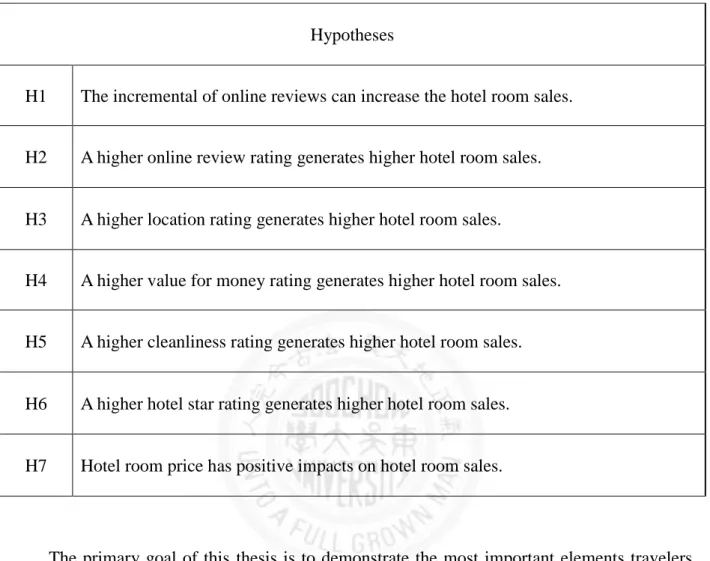
Previous studies have indicated that the online user-generated reviews (eWOM) may influence sales of books (Chevalier & Mayzlin, 2006) and movies (Liu, 2006). We therefore propose the following hypotheses on the basis of their findings (see Table 2.1).
31
Table 2. 1 Hypotheses
The primary goal of this thesis is to demonstrate the most important elements travelers take into consideration in online reviews and ratings and to identify how hotel businesses are portrayed on Booking.com (Bilgihan, 2013). In addition, it aims to provide hoteliers a profounder understanding of ways to create, control and monitor aspects that may affect brand image by proposing information to the areas that require improvements.
Hypotheses
H1 The incremental of online reviews can increase the hotel room sales.
H2 A higher online review rating generates higher hotel room sales.
H3 A higher location rating generates higher hotel room sales.
H4 A higher value for money rating generates higher hotel room sales.
H5 A higher cleanliness rating generates higher hotel room sales.
H6 A higher hotel star rating generates higher hotel room sales.
H7 Hotel room price has positive impacts on hotel room sales.
32
Chapter 3 Methodology
3.1 Research Method
When booking the accommodations, travelers might choose a hotel based on its location (for example, close to the MRT station, tourist location, or city center), brand reputation, additional facilities (including free Wi-Fi, self-service laundry, or gym), service quality, price, and quality ratings by previous guests (Verma, 2010). In our study, we aim to analyze the online reviews on Booking.com written by the guests who have actually stayed in the hotels.
Booking.com provides travelers’ evaluation in the form of reviews and ratings of the hotels. It is a platform which allows travelers to write a review describing their experiences at the hotel, in part justifying the ratings designated. Travelers are able to rate their overall satisfaction during their stays, with a 1 – poor to 10 – Exceptional hotel rating system.
Travelers can also rate the services respectively, such as cleanliness, location, facilities, staff, value for money, and free Wi-Fi.
Online reviews (or eWOM) analysis techniques were applied by using the software tool NVivo 10 with the aim of analyzing online user-generated contents retrieved from Booking.com. NVivo 10 is stated to be an instrument for discourse analysis, grounded theory method, conversation analysis, phenomenology, mixed methods research and more (Bilgihan, 2013). The software extracted qualitative data in the form of reviews and comments and quantitative data in the form of demographic information and hotel ratings. The online travel reviews are considered as the primary data for analysis, these reviews portray both positive and negative experiences from consumers (Bilgihan, 2013).
33
3.2 Data Collection and Data Analysis
During the process of data collection, the software NVivo 10 has collected data on 80 hotels in Taiwan, with 20 hotels in Taipei, 20 hotels in Taichung, 20 hotels in Kaohsiung, and 20 hotels in Hualien (see Table 3.1). In each city, we select hotels that are ranked top 20 having more online reviews than other non-chosen hotels. Furthermore, we analyze 20-30 online reviews in each hotel since most of the travelers only read the up-to-date reviews on the first and second page of the website, and 1733 traveler reviews has been retrieved from 80 hotels in Taiwan.
Table 3. 1 Number of Hotels in Taiwan Selected Cities in Taiwan Number of Hotels
Taipei 20
Taichung 20
Kaohsiung 20
Hualien 20
Total 80
In our thesis, we have selected hotels from four cities in Taiwan – Taipei, Taichung, Kaohsiung, and Hualien; respectively stand for the north, the south, the east, and the central of Taiwan. Taipei city is the capital of Taiwan, which is a bustling and modern city, attracting many foreign tourists come to visit every year. Taichung and Kaohsiung are prosperous cities as well; on the other hand, Hualien is more like the countryside. However, there are more and more foreign travelers visiting Hualien due to its nature beauty and magnificent landscapes.
34
Since these four cities have diverse characteristics, we believe selecting hotels from those different districts can make the result fairer and more impartial.
The first research question is to identify the impacts of online hotel reviews (or eWOM) on hotel room sales. The policy of Booking.com is that only customers who have successfully made online bookings are allowed to post a review after their stays. Therefore, the online reviews on the Booking.com website are verified and genuine. In addition, the number of published reviews on Booking.com might be taken as a proxy for the hotel room sales during the study period (Ye et al., 2011).
In order to realize the effects of eWOM and hotel room sales, we run the regression analysis by using the statistic software SPSS. We applied multiple regression analysis with the independent variables as follows (see Table 3.2): review rating, location rating, cleanliness rating, value for money rating, hotel star rating, price, and online reviews in April (referred as incremental of reviews); and the dependent variable is the increasing numbers of online reviews from April to June (referred as hotel room sales). All of the hotel reviews and ratings (review rating, location rating, cleanliness rating, and value for money rating) are evaluated by travelers who have made bookings from booking.com and actually stayed in the hotels.
This data analysis is aimed to see whether eWOM (including online reviews and ratings of the hotels) has impacts on hotel room sales or not.
35
Table 3. 2 Descriptions of Variables
The second research question sought to illustrate the most frequently mentioned aspects of hotels in Taiwan. In order to address this question, we conduct frequency analysis of the words by using the software Nvivo 10. This method is based on the premise that words which are used more frequently are of higher importance (Stringam & Gerdes, 2010). Word frequency was calculated in the set of non-differentiated comments, generating those words used most frequently in the travelers’ reviews. In addition, we will analyze the online reviews from six aspects of the hotels, which are “Bedroom & Bathroom,” “Service,” “Cleanliness,”
“Location,” “Quality and Value,” and “Amenities.” By applying word frequency method, the hoteliers may understand which aspects they need to pay more attention to improve their services.
Variables Descriptions
Incremental of Reviews Incremental of reviews of selected hotels in the chosen cities
Review Rating
The overall review rating of a hotel evaluating by travelers who have actually stayed in the hotel
Location Rating
Rating regarding the location of a hotel, assessing by travelers who have actually stayed in the hotel
Value for Money Rating
Travelers evaluate the value between quality and price of a hotel
Cleanliness Rating
Rating regarding the cleanliness of a hotel, evaluating by travelers who have actually stayed in the hotel
Hotel Star Rating
The star-rating category of a hotel given by an official organization according to the quality of the hotel
Price The lowest price of the hotel room listed on Booking.com
36
Chapter 4 Results and Discussion
4.1 Results of Hypotheses
This thesis aims to identify two main questions; the first question is to identify the impacts of eWOM on hotel room sales, and the second one is to illustrate what are the most frequently mentioned aspects of hotels in Taiwan. In chapter 4.1 we will first present the findings on whether eWOM has impacts on hotel room sales or not. Table 4.1 shows the mean and standard deviation of the dependent variable and independent variables in the analysis, and N represents the number of hotels being analyzed in the thesis.
Table 4. 1 Descriptive Statistics
Mean Std. Deviation N
Hotel Room Sales 4.7861 .87094 80
Ln (Number of Reviews) 6.8507 .61369 80
Location Rating 8.5788 .59229 80
Cleanliness Rating 8.5975 .71847 80
Value for Money Rating 8.1425 .60520 80
Review Rating 8.4650 .58680 80
Ln (Price) 7.5655 .63363 80
Hotel Star Rating 3.3000 .83287 80
Table 4. 2 Model Summary Model Summary
R R Square Adjusted R Square Std. Error of the
Estimate R Square Change
.791 .625 .589 .55859 .625
37
Table 4. 3 Coefficients Coefficients
Model
Unstandardized Coefficients
Standardized Coefficients
t Sig.
(p value)
B Std.
Error Beta
(Constant) -1.832 1.830 -1.001 .320
Ln (Number of Reviews) .923 .113 .650 8.183*** .000
Review Rating -1.366 .918 -.920 -1.489 .141
Ln (Price) -.164 .155 -.120 -1.060 .293
Hotel Star Rating .292 .100 .279 2.913*** .005
Location Rating .408 .207 .278 1.969* .053
Cleanliness Rating .261 .527 .216 .495 .622
Value for Money Rating .785 .383 .546 2.048** .044
a. Dependent Variable: Hotel Room Sales
Independent Variable: Ln (Number of Reviews), Location Rating, Cleanliness Rating, Value for Money Rating, Review Rating, Ln (Price), Hotel Star Rating
*p < .10
**p < .05
***p < .01
As indicated in the model summary (see Table 4.2), there is a significant relationship between the independent variables and dependent variable with an adjusted R-square of 58.9%, which shows that eWOM has significant impact on the room sales of a hotel.
Furthermore, the number of online reviews has significant influence on hotel room sales with p value = .000 < .01. This indicates that Hypothesis 1 is supported at the 0.01 level. And beta
= .650 implies that the number of online reviews of a hotel on Booking.com have significantly positive influence on the number of online bookings made through the website, which means the increasing number of online reviews can increase hotel room sales as well.
38
In addition, location rating, hotel rating, and value for money rating also have significant impacts on hotel room sales with p value < .05 and p value < .10, which shows that hypothesis 3, hypothesis 4, and hypothesis 6 are being supported at the 0.05 level and the 0.1 level. However, the impact of online review rating, hotel room price, and cleanliness rating with hotel room sales is not significant since the p value > .10. Therefore, hypothesis 2, hypothesis 5, and hypothesis 7 are not being supported at the 0.1 level. The following table is the summary of the hypotheses and the results.
Table 4. 4 Results of Hypotheses
S = Significant, NS = Non-significant
In terms of Hypothesis 2, the result of p = 0.141 > .10 shows that online review rating has non-significant relationship among online bookings for that hotel, which means that
Hypotheses Results
H1 The incremental of online reviews can increase the hotel room sales. S
H2 A higher online review rating generates higher hotel room sales. NS
H3 A higher location rating generates higher hotel room sales. S
H4 A higher value for money rating generates higher hotel room sales. S
H5 A higher cleanliness rating generates higher hotel room sales. NS
H6 A higher hotel star rating generates higher hotel room sales. S
H7 Hotel room price has positive impacts on hotel room sales. NS
39
higher review rating doesn’t result in more hotel room sales. This result can be explained that foreign travelers may emphasize more on the context of online reviews rather than just focus on review ratings. Hypothesis 3 is supported at the .10 level with p value = .053 < 0.10 which shows that higher location rating can increase hotel room sales. Hypothesis 4 has also been supported at the 0.05 level since p value = .044 < 0.05, so that there is a significant relationship between value for money rating and hotel room sales. This means that foreign travelers concern about the quality of the hotel instead of just saving money, and if the hotel has good quality and affordable price, they consider the hotel value for money.
H5 is not being supported with p value = 0.622, which means cleanliness rating has a non-significant impacts on the number of online bookings. In fact, foreign travelers do care about cleanliness of the room, and they mention it in many online reviews. However, all of the chosen hotels possess high cleanliness rating, so the result indicates that higher cleanliness rating doesn’t increase hotel room sales directly. Hypothesis 6 is being supported at the 0.05 level with p value = 0.005, which indicates that the hotel star rating has significant relationship with hotel room sales. This result shows that higher hotel star rating generates higher hotel room sales, and foreign travelers tend to choose the hotels with higher star rating.
Regarding hypothesis 7 with p value = 0.293 > .10 indicates that Ln (Price) has a non-significant impact on hotel room sales, moreover, beta = -.120 implies that hotel room price has a negative impact on online room sales and that less expensive hotels tend to have more online bookings. This result can be explained that many foreign travelers are backpackers, and they tend to stay in cheaper hostels instead of living in luxury hotels.
4.2 Word Frequency Analysis
The second research question sought to identify the most frequently mentioned aspects
40
of hotels in Taiwan. After the collection of the online hotel reviews, the extraction process identified all unique words contained in the text comments. This process has analyzed 1733 online hotel reviews on Booking.com.
Top 20 most frequently mentioned words of online reviews in four cities separately (see Table 4.5 and Table 4.6) highlights some of the issues that were mentioned frequently by those posting online reviews. From the analysis, it is clear that the room itself is very important; as it is ranked the most frequently cited word throughout all the reviews and in all four chosen cities. In addition, a variety of other issues also appear frequently, including location, breakfast, staff, clean, good, helpful, as can be seen from the Tables.