行政院國家科學委員會專題研究計畫 成果報告
關節軟骨修補材料之動態機械性質研究(II)
研究成果報告(精簡版)
計 畫 類 別 : 個別型
計 畫 編 號 : NSC 97-2221-E-151-019-
執 行 期 間 : 97 年 08 月 01 日至 98 年 08 月 31 日
執 行 單 位 : 國立高雄應用科技大學機械工程系
計 畫 主 持 人 : 蔡立仁
共 同 主 持 人 : 魏鴻文、周伯禧
計畫參與人員: 碩士班研究生-兼任助理人員:李宏爵
報 告 附 件 : 出席國際會議研究心得報告及發表論文
處 理 方 式 : 本計畫涉及專利或其他智慧財產權,2 年後可公開查詢
中 華 民 國 98 年 10 月 30 日
1
Dynamic Response of Low Friction, High Strength Hydrogels under
Compression and Tension
Final Report (NSC-97-2221-E-151-019)
Principal investigator: Liren Tsai
1(蔡立仁)
Cooperate investigator: Pei-Hsi Chou
2(周伯禧), Hong-Wen Wei (魏鴻文)
3 1Department of Mechanical Engineering, National Kaohsiung University of Applied Sciences
2Department of Sports Medicine, Kaohsiung Medical University
3Orthopaedic Device Research Center, National Yang-Ming University
Abstract
Osteoarthritis has a strong effect on the mobility of human normal activities, and could
potentially hamper people’
s daily life. With increasing percentage of elders in our society, it
became more and more important to prevent and resolve Osteoarthritis when it’
s been diagnosed.
Most common treatment for Osteoarthritis right now is using glucosamine to repair the damaged
cartilages. However, when cartilage has completely worn off from joints, surgery to replace old
joints or repair worn cartilage is unavoidable. Hydrogel is a kind of polymer material which has
been used to repair the broken cartilage. In this research, we utilized modified Split Hopkinson
Pressure Bar (SHPB) and Split Hopkinson Tension Bar (SHTB) to measure the mechanical
properties of the Hydrogels under high strain rates. Volume pressure vs. strain and true stress vs.
true strain data for different concentration of hydrogels under dynamic loading was presented to
demonstrate the effect of sudden impact to the polymer material.
Keywords:Hydrogel, SHPB, SHTB, volume ratio vs. pressure curve, true stress vs. true strain.
1. Introduction
Hydrogel has been intensively studied in the past two decades. Many hydrogel products have
already been used in our daily life, for example, contact lenses. Not only because hydrogels are
superabsorbent (they can contain over 99% water), it is also a bio-compatible material which has
been considered as one of the most probable replacements for human soft tissues. Hydrogel is a
network of polymer chains that are water-insoluble. By adjusting the composition of polymer
chains and chain binding mechanism, the hydrogels can increase their mechanical strength while
withstand their extra low fiction hence they are good candidates for joint or spine soft tissues (like
cartilage) replacement.
Osteoarthritis is a common issue people have to face when they grow old. It is a sign the
cartilages have stiffen and worn out after decades of usage. It only gets worst until cartilages are
completely removed from the joints and unbearable pain would result. The most common treatment
right now is using glucosamine to repair the damaged cartilages. However, when sever injury to the
cartilage occurred, surgery are usually necessary either to repair the cartilage or replace the injured
joint. To repair the worn out cartilage, reinforcement natural or synthetic liquid was injected to the
broken spot to reconstruct the broken cartilage. Due to the mechanical natural of hydrogels, they
have been widely considered as one of the most potent candidates for cartilage repair.
In this research, Split Hopkinson Pressure Bar (SHPB) as well as Split Hopkinson Tension Bar
(SHTB) were utilized to study the dynamic behavior of prepared hydrogel specimens. By changing
2
the applied strain rate, the volume ratio vs. pressure curves and true stress vs. true strain curves
were observed to describe the compressibility of hydrogels under dynamic deformations.
2. Experiment Procedures
2.1 Experimental Configuration and Setup
2.1.1 Split Hopkinson Pressure Bar (SHPB)
The Split Hopkinson Pressure Bar (Fig. 1) is an adaptation of the device developed by Kolsky
[2]. It consists of a gas gun system, an incident bar, a transmitted bar and a specimen assembly. A
projectile fired from a gas gun impacts one end of the incident bar and generates a compressive
stress pulse propagating down the bar into the specimen. This pulse reverberates within the
specimen, sending a transmitted pulse into the transmitted bar and a reflected pulse back into the
incident bar. The bars are designed to remain elastic throughout the test so that the complete
displacement time and stress-time histories at the interfaces between the specimen and the bars can
be determined from measurements of the incident, reflected and transmitted pulses [3]. Figure 2
shows the SHPB facility built in KUAS. The length of the SHPB table is about 8 meters and the
incident and transmitted bars are made by 22mm diameter AL7075.
Fig.1 Illustration of SHPB experimental setup.
Fig.2 The SHPB facility built in KUAS.
2.1.2 Split Hopkinson Tensile Bar (SHTB)
The Split Hopkinson Tensile Bar was first introduced by Harding [4]. Since then, SHTB have
emerged into five different categories separated from their different pulse generation and sample
clamping structures. In National Kaohsiung University of Applied Sciences, we use striker bar
along with dog-bone shaped specimen to study the high strain rate properties of novel materials,
Figure 3. It consists of a gas gun system, an incident bar, a transmitted bar and a specimen assembly.
A projectile fired from a gas gun impacts one end of the incident bar and generates a tensile stress
pulse propagating down the bar into the dog-bone shaped specimen. This pulse reverberates within
the specimen, sending a transmitted pulse into the transmitted bar and a reflected pulse back into the
incident bar. The bars are designed to remain elastic throughout the test so that the complete
displacement time and stress-time histories at the interfaces between the specimen and the bars can
be determined from measurements of the incident, reflected and transmitted pulses. Figure 4 shows
the SHTB facility built in KUAS. The length of the SHTB table is about 8 meters and the incident
and transmitted bars are both made by 20mm diameter steel.
3
Fig.3 Illustration of SHTB experimental setup.
Fig.4 The SHTB facility built in KUAS.
2.1.3 Specimen Assembly in Compression Tests
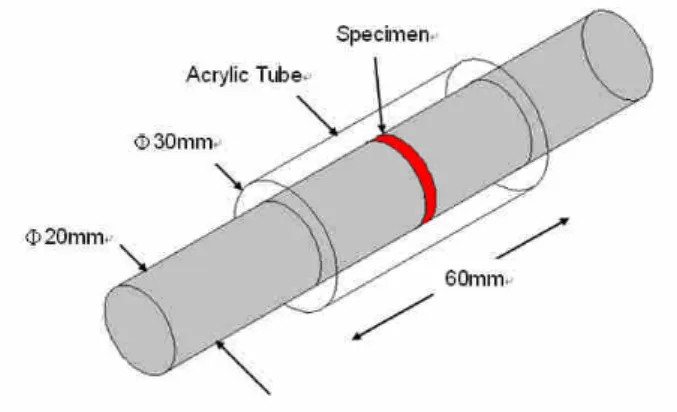
In this research, a special specimen assembly was implanted to modify the dynamic strain
condition in the specimen during the experiments, as shown in Fig. 5. An acrylic tube was used as a
confinement for the soft hydrogel specimens. The confinement cell prevents radial expansion,
resulting in the development of a uniaxial strain state rather than a uniaxial stress state. Thus, the
only deformations are along the axis of the specimen, and measurement of these deformations
provides a measure of the volume change in the sample [5]. The stress state in the specimen builds
up to a hydrostatic stress state which approximating the measured axial stress. Each test therefore
provides one data point: a measured volumetric strain corresponding to a measured pressure.
Fig.5 Specimen assembly for hydrostatic experiments.
2.1.4 Specimen Assembly for Tensile Tests
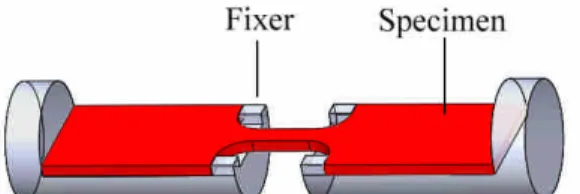
For SHTB experiments, dog-bone shaped specimen assembly was implanted to study the
dynamic tensile strain condition, as shown in Fig. 6. A steel fixer was used as a confinement for the
dog-bone shaped specimens. The fixer holds the specimen at proper location to ensure dynamic
tensile loading could be performed on the specimens without undesired slippery or torsion
conditions. Thus, the only deformations are along the axis of the specimen, and measurement of
these deformations provides a measure of the dynamic tensile strength of specimens. Each test
therefore could provide a complete true stress vs. true strain curve for specimens under desired
strain rate conditions.
4
Fig.6 Specimen assembly for SHTB experiments.
2.2 Uniform Stress State
For large impedance between compression bars and specimen and for small specimen
thickness, a uniform stress state is developed. The volume ratio of the specimen can be determined
as following:
T rdt
L
C
V
V
0 0 0 02
1
(1)
In which
C
0stands for the longitudinal wave speed in the compression bars,
L
0represents the
initial thickness of the specimen, and
rrepresents the strain of the reflected wave. The
hydrostatic pressure for the specimen during the uniform stress state situation can then be
determined using the transmitted wave data:
t hydro
E
P
(2)
Where
E
represents the elastic modulus of the compression bars and
trepresents the strain
of the transmitted wave.
3. Material
Acrylic acid, Ammonium peroxodisulfate, methylenebisacrylamide, and Pluronic were utilized
to produce the low friction, high strength hydrogel specimens [6], Fig. 7. This Pluronic and PAA
bonded hydrogel material possess some special gelation conditions. The gelation took place only
when the pH value of the solution is greater than 4.75, and when its temperature is greater than 7
oC.
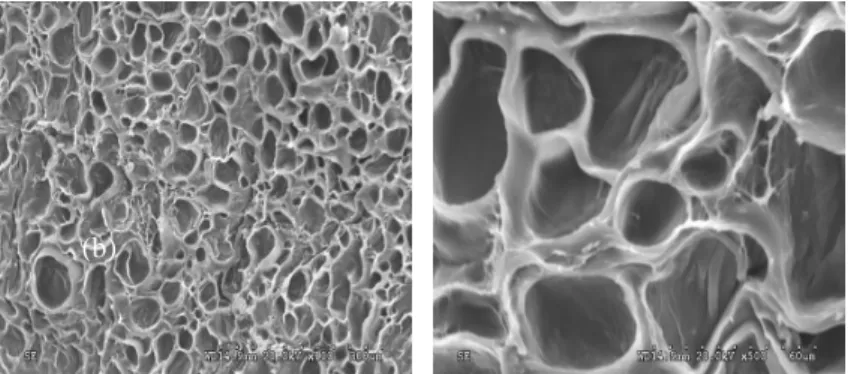
Figure 8 shows the detailed hydrogel structure after it has been fully swollen in synthetic human
body fluid. It is shown that the hydrogel structure became quite porous after it has fully absorbed
liquid.
5
Fig.8 SEM pictures of the hydrogels specimens used in the proposed research. (a) x100; (b) x500
4. Results and Discussion
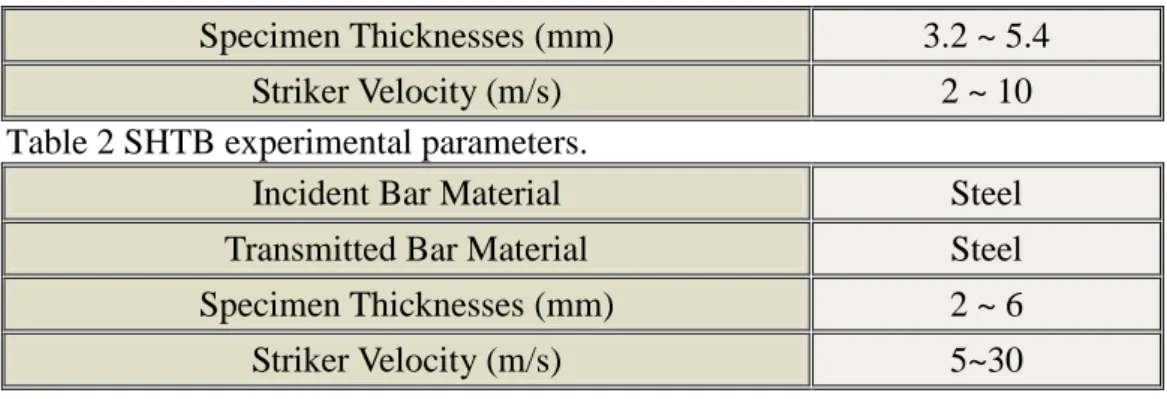
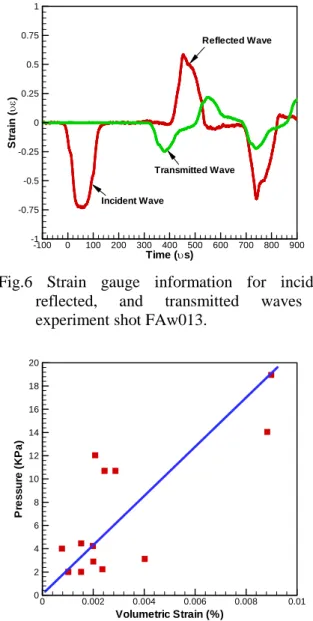
The experiment parameters were shown in Table 1&2. The duration of the compression pulses
was about 118μs~200μs for each experiment. Light pulse shaping was applied to ensure the
proper ramping during the rise-time of the incident pulse to produce a state of equilibrium in the
hydrogel specimens and also to prevent the specimens from damaging before the compression stress
reached equilibrium. The strain rate of the experiments were between 100~2400 s
-1. Figure 9 shows
the experiment result of hydrogels with cross-linking concentration 6.75%, in which the test result
shows that when the strain rate increased the elastic modulus of hydrogels increased accordingly.
From the constrained condition experiments, the dynamic bulk strength of the tested hydrogel
specimens can be observed, as shown in Figure 10. It does not exhibit perfect linear behavior when
the hydrostatic compression increased. However, from this series of experiments we could estimate
the bulk modulus of 6.75% hydrogel was about 0.2 when the applied strain rates were between
100~300s
-1. Higher compression pulse experiments concluded that the dynamic strength of the
proposed hydrogel material could be as high as 14MPa.
Fig.9 Strain gauge information for incident,
reflected,
and
transmitted
waves
of
experiment shot FAw013.
Fig.10 Volumetric strain vs. pressure data for
this batch of hydrogel materials.
Table 1 SHPB experimental parameters.
Incident Bar Material
Al 7075
Transmitted Bar Material
Al 7075
6
Specimen Thicknesses (mm)
3.2 ~ 5.4
Striker Velocity (m/s)
2 ~ 10
Table 2 SHTB experimental parameters.
Incident Bar Material
Steel
Transmitted Bar Material
Steel
Specimen Thicknesses (mm)
2 ~ 6
Striker Velocity (m/s)
5~30
5. Summary
The dynamic bulk response of prepared Polyacrylic acid-Alginate-Silica hydrogels were tested
using SHPB and SHTB techniques. The hydrogel was found to be able to withstand hydrostatic
pressure up to 14MPa without drastic damage.
6. Acknowledgements
The author would like to thank NSC for funding this project (grant number NSC-97-2221-E
-151-019).
7. References
[1]www.jointreconstruction.com/ kneeinjury/arthro.htm
[2]H. Kolsky, “
An Investigation of the Mechanical Properties of Materials at Very High Rates of
Loading,”Proc. Phys. Soc., London, Vol. 62B, pp. 676-700, 1949.
[3]R. Feng and K. T. Remash, “
On The Compressibility of Elasto-Hydrodynamic Lubrican,”
Journal of Tribology, Vol. 115, pp. 557-559, 1993.
[4]J. Harding, E.O. Wood, and J.D. Campbell, “
Te
ns
i
l
e
t
e
s
t
i
ng
of
ma
t
e
r
i
a
l
s
a
t
i
mpa
c
t
r
a
t
e
s
of
s
t
r
a
i
n”
,
Journal of Mechanical Engineering Science, 1960, 2, 88-96
[5]H. Saraf, K. T. Ramesh, A. M. Lennon, A. C. Merkle, and J. C. Roberts, “
Mechanical Properties
of Soft Human Tissues under Dynamic Loading,”Journal of Biomechanics, Vol. 40, pp.
1960-1967, 2007.
[6]凌銘鴻、林鴻儒
*,低摩擦及高強度水膠應用於修復關節軟骨之研發。結案報告,計劃編號
NSC 94-2216-E-218-004
8. Self Evaluation
In the proposed project, the main objective was to facilitate a versatile SHTB system which is
suited for both hard and soft material dynamic tests. We have achieved our goal by design and
manufacture the SHTB in KUAS (Fig. 4).
The second objective of the project is to perform a series of experiments on Hydrogel to
determine its dynamic response. The dynamic tests have been performed on Hydrogel specimens,
and one oral presentation has been performed:
Tsai, L.; Chiang, C.C.; Wang, S. H. and Lin, H. R. (2009), Dynamic Response of Low Friction,
High Strength Hydrogels, International Conference on Applied Mechanics, Oslo, Norway.
7
By assembling SHTB, students are able to learn proper design and communication skills with
the machine shops. Also, the research results should give us a clear idea of the shock absorbing and
dynamic property of porous polymer materials. The objectives of the project have been successfully
achieved.
出國報告(出國類別:投稿參加會議)
報告名稱 :參加國際會議報告書-2009
WCSET International Conference on Applied
Mechanics 2009
(ICAM2009)
服務機關:國立高雄應用科技大學
姓名職稱:蔡立仁 助理教授
派赴國家:挪威 奧斯陸
報告日期:8/25/2009
出國期間:7/28-8/6 2009
一、目的:
WCSET為一國際性學術機構,目的在增進先進的科學、工程以及學理的研究,促
進各國的科學研發的交流。近幾年來的會議重點偏向生醫材料、奈米材料、光學
實驗方法、智慧材料等相關課題,為國際之實驗力學相關論文發表及觀摩最新研
究進展之會議。這次ICAM2009論壇偏重在應用力學(Applied Mechanics)方面的
研討,共有來自全球十幾個國家上百篇的投稿。
二、經費來源:
感謝國科會計畫的支持讓我們能夠順利參加此國際會議;經費來源為國科會
計畫編號 NSC-97-2221-E-151-019。
三、過程:
此次會議包含三天的行程,其中內容包括Acoustics and Noise Control、
Applied
Mechanics 、 Automotive
Engineering 、 Biomedical
Engineering 、
Computational Mechanics、Engineering Materials、Fluid Dynamics等,本次會議有
數十個演講場次與5位的邀請演講,投稿的論文也有上百篇。圖一為本人與會留
影,我們發表一篇最近的研究成果探討生醫水膠材料在動態衝擊下的材料性質”
Dynamic Response of Low Friction, High Strength Hydrogels”,其中許多
的討論建議對我們相當具有幫助。其中和本實驗室研究相關的部份,以蘇聯的Dr.
Zakharov所發表的”Surface and Guided Waves in Composites with Nematic
Coatings”以及韓國的Dr. Lee發表的相關研究,最具有啟發性。本次會議議程
如附件所示。
圖一、會議報告現場。
四、心得(或成效)
:
感謝國科會計畫補助出席國際會議經費,讓我能參與2009年International
Conference on Applied Mechanics,我們研究團隊開始準備投稿(包括實驗計
劃、實驗分析及結果討論)需花費近一年時間,會議期間我國與各國學者專家共
聚一堂,將研究成果在此次會議中提出並與各國學者討論及交換意見,會後更詳
談研究方向及目前發展的趨勢。
攜回資料名稱及內容
1. 會議議程一冊
2. 會議論文集光碟一份
3. 聯絡資料(包含相近研究領域之名片交換)
五、建議事項:
感謝國科會補助使我得以赴美國參與此一盛會,讓研究成果得以發表及交
流。國科會鼓勵老師參加國際研討會,並於經費上予以支持,可讓我們了解到各
國在相關研究領域的進展,亦可增加研究人員的國際觀及語文能力,值得大力推
廣。另外本次參加此研討會帶回的相關資訊,將可作為我們未來研究發展方向的
參考,對本計畫有相當的助益。
1
Dynamic Response of Low Friction, High Strength Hydrogels
Liren Tsai
1, Chia-Chin Chiang
1, Hong-Ru Lin
21
Department of Mechanical Engineering, National Kaohsiung University of Applied Sciences
2Department of Chemical and Material Engineering, Southern Taiwan University
Abstract
Osteoarthritis has a strong effect on the mobility
of human normal activities, and could potentially
hamper
people’
s
daily
life.
With
increasing
percentage of elders in our society, it became more
and
more
important to prevent
and resolve
Osteoarthritis whenever it’
s been diagnosed. The
most common treatment for Osteoarthritis is using
glucosamine to repair the damaged cartilages.
However, when cartilage has completely worn off
from joints, surgery to replace old joints or repair
worn cartilage is unavoidable. Hydrogel is a kind of
polymer material which has been used to repair the
broken cartilage. In this research, we utilized
modified Split Hopkinson Pressure Bar (SHPB) to
measure the mechanical properties of the Hydrogels
under high strain rates. Volume pressure vs. strain
data of Hydrogel under dynamic loading was
presented to demonstrate the effect of sudden
impact to the polymer material.
Keywords : Hydrogel, SHPB, volume ratio vs.
pressure curve.
1. Introduction
Hydrogel has been intensively studied in the
past two decades. Many hydrogel products have
already been used in our daily life, for example,
contact lenses. Not only because hydrogels are
superabsorbent (they can contain over 99% water),
it is also a bio-compatible material which has been
considered
as
one
of
the
most
probable
replacements for human soft tissues. Hydrogel is a
network of polymer chains that are water-insoluble.
By adjusting the composition of polymer chains and
chain binding mechanism, the hydrogels can
increase their mechanical strength while withstand
their extra low fiction hence they are good
candidates for joint or spine soft tissues (like
cartilage) replacement.
Osteoarthritis is a common issue people have
to face when they grow old. It is a sign the
cartilages have stiffen and worn out after decades of
usage. It only gets worst until cartilages are
completely removed from the joints and unbearable
pain would result. The most common treatment
right now is using glucosamine to repair the
damaged cartilages. However, when sever injury to
the cartilage occurred, surgery are usually necessary
either to repair the cartilage or replace the injured
joint. Figure 1 [1] shows the procedure for articular
cartilage repair surgery. To repair the worn out
cartilage, reinforcement natural or synthetic liquid
was injected to the broken spot to reconstruct the
broken cartilage. Due to the mechanical natural of
hydrogels, they have been widely considered one of
the most potent candidates for cartilage repair.
In this research, a set of Split Hopkinson
Pressure Bar (SHPB) was used to study the
dynamic behavior of prepared hydrogel specimens.
By changing the applied strain rate, the volume
ratio vs. pressure curve was observed to describe
the compressibility of hydrogels under dynamic
deformations.
Fig.1 Arthroscopic cartilage repair [1].
2. Experiment Procedures
2.1 Experimental Configuration and Setup
2.1.1 Split Hopkinson Pressure Bar (SHPB)
2
an adaptation of the device developed by Kolsky
[2]. It consists of a gas gun system, an incident bar,
a transmitted bar and a specimen assembly. A
projectile fired from a gas gun impacts one end of
the incident bar and generates a compressive stress
pulse propagating down the bar into the specimen.
This pulse reverberates within the specimen,
sending a transmitted pulse into the transmitted bar
and a reflected pulse back into the incident bar. The
bars are designed to remain elastic throughout the
test so that the complete displacement time and
stress-time histories at the interfaces between the
specimen and the bars can be determined from
measurements
of
the
incident,
reflected
and
transmitted pulses [3]. Figure 3 shows the SHPB
facility built in KUAS. The length of the SHPB
table is about 8 meters and the incident and
transmitted bars are made by 22mm diameter
AL7075.
Fig.2 Illustration of SHPB experimental setup.
Fig 3. The SHPB facility built in KUAS.
2.1.2 Specimen Assembly
In this research, a special specimen assembly
was implanted to modify the dynamic strain
condition in the specimen during the experiments,
as shown in Fig. 4. An acrylic tube was used as a
confinement for the soft hydrogel specimens. The
confinement
cell
prevents
radial
expansion,
resulting in the development of a uniaxial strain
state rather than a uniaxial stress state. Thus, the
only deformations are along the axis of the
specimen, and measurement of these deformations
provides a measure of the volume change in the
sample [4]. The stress state in the specimen builds
up to a hydrostatic stress state which approximating
the measured axial stress. Each test therefore
provides one data point: a measured volumetric
strain corresponding to a measured pressure.
Fig.4 Specimen assembly for hydrostatic
experiments.
2.2 Uniform Stress State
For large impedance between compression
bars and specimen and for small specimen thickness,
a uniform stress state is developed. The volume
ratio of the specimen can be determined as
following:
T rdt
L
C
V
V
0 0 0 02
1
(1)
In which
C
0stands for the longitudinal wave
speed in the compression bars,
L
0represents the
initial
thickness
of
the
specimen,
and
rrepresents the strain of the reflected wave. The
hydrostatic pressure for the specimen during the
uniform
stress
state
situation
can
then
be
determined using the transmitted wave data:
t hydro
E
P
(2)
Where
E
represents the elastic modulus of the
compression bars and
trepresents the strain of
the transmitted wave.
3. Material
Acrylic acid, Ammonium peroxodisulfate,
methylenebisacrylamide, and Pluronic were utilized
3
to produce the low friction, high strength hydrogel
specimens [5]. Figure 5 shows the detailed hydrogel
structure after it has been fully swollen in synthetic
human body fluid. It is shown that the hydrogel
structure became quite porous after it has fully
absorbed
liquid.
The
structures
of
the
post
compressed hydrogel specimens remain to be
determined.
Fig.5 SEM pictures of the hydrogels specimens
used in the proposed research. (a) x100; (b) x500
4. Results and Discussion
The experiment parameters were shown in
Table 1. The duration of the compression pulses
was about 118μs for each experiment. Light pulse
shaping was applied to ensure the proper ramping
during the rise-time of the incident pulse to produce
a state of equilibrium in the hydrogel specimens
and also to prevent the specimens from damaging
before the compression stress reached equilibrium.
The strain rate of the experiments were between
100~800 s
-1. Figure 6 shows the experiment result
of Shot FAw013, in which the red line indicates the
strain wave in incident bar and the green line
indicates the strain wave in transmitted bar. From
these test results, the dynamic bulk strength of the
tested hydrogel specimens can be observed, as
shown in Figure 7. It does not exhibit obvious
linear behavior when the hydrostatic compression
increased. Higher compression pulse experiments
are necessary to further exam the dynamic response
of the proposed hydrogel material under extreme
dynamic loading conditions.
Time (s) S tr a in ( ) -100 0 100 200 300 400 500 600 700 800 900 -1 -0.75 -0.5 -0.25 0 0.25 0.5 0.75 1 Incident Wave Reflected Wave Transmitted Wave
Fig.6 Strain gauge information for incident,
reflected,
and
transmitted
waves
of
experiment shot FAw013.
Volumetric Strain (%) P re s s u re (K P a ) 0 0.002 0.004 0.006 0.008 0.01 0 2 4 6 8 10 12 14 16 18 20
Fig.7 Volumetric strain vs. pressure data for this
batch of hydrogel materials.
Table 1 SHPB experimental parameters.
5. Summary
The dynamic bulk response of prepared
Polyacrylic acid-Alginate-Silica hydrogels were
tested using SHPB techniques. The hydrogel was
found to be able to withstand hydrostatic pressure
up to 18kPa without drastic damage. The dynamic
response of the hydrogel under higher pressure
Incident Bar Material
Al 7075
Transmitted Bar Material
Al 7075
Specimen Thicknesses
(mm)
3.2 ~ 5.4
Striker Velocity (m/s)
2 ~ 10
4
remains to be determined.
6. Acknowledgements
The author would like to thank NSC for
funding this project (grant number NSC-97-2218-E
-151-001).
7. References
[1] www.jointreconstruction.com/kneeinjury/
arthro.htm
[2] H. Kolsky, “
An Investigation of the Mechanical
Properties of Materials at Very High Rates of
Loading,”Proc. Phys. Soc., London, Vol. 62B,
pp. 676-700, 1949.
[3] R.
Feng
and
K.
T.
Remash,
“On The
Compressibility
of
Elasto-Hydrodynamic
Lubrican,”Journal of Tribology, Vol. 115, pp.
557-559, 1993.
[4] H. Saraf, K. T. Ramesh, A. M. Lennon, A. C.
Merkle,
and
J.
C.
Roberts,
“Mechanical
Properties
of
Soft
Human
Tissues
under
Dynamic Loading,”Journal of Biomechanics,
Vol. 40, pp. 1960-1967, 2007.
WCSET 2009 : World Congress on Science, Engineering and Technology, July 29-31, 2009, Oslo, Norway 1 WASET 2009 OSLO, NORWAY
WCSET 2009 July 29-31, 2009 Oslo, Norway WCSET 2009 PROGRAM
C
ONFERENCEP
ROCEEDINGS ISSN: 2070-3724 www.waset.org/journals/wasetC
ONFERENCEV
ENUER
ICAH
OLBERGH
OTEL Holbergs plass 1 0166 Oslo, Norway phone: +47 23 15 72 00 fax: +47 23 15 72 01 e-mail: [email protected] www.rica.no/holbergTime Paper Title Authors
Wednesday: July 29, 2009 07:45
08:45 Welcome & Registration
08:45
09:00 Opening Remarks
09:00
09:30 Invited Talk: Future imaging systems
Jens Hjelmstad
NTNU Norwegian University of Science and Technology. Institute of Electronics and Telecommunication, Trondheim, Norway
09:30
10:00 Invited Talk: Video Streaming: History, Current Trends and Future Visions Pål Halvorsen Department of Informatics, University of Oslo, Oslo, Norway 10:00
10:30 Invited Talk: Diagrams of states and error models in Quantum Information Processing
Sara Felloni
Department of Electronics and Telecommunications, Norwegian University of Science and Technology Trondheim, Norway 10:30
10:45 Coffee Break
10:45 11:15
Invited Talk: BaPrO3: an electronic semiconductor. Synthesis, phase transitions, stability and conduction properties
Anna Magraso
Department of Chemistry, University of Oslo, Norway 11:15
11:45
Invited Talk: Past, Present and Future Scopes in Biodiesel Industry
Jorge Mario Marchetti
Chemical Engineering Department, Norwegian University of Science and Technology, Trondheim, Norway
11:45
12:15 Invited Talk: The History of Thermodynamics: Past and Future
Tore Haug-Warberg
Chemical Engineering Department, Norwegian University of Science and Technology, Trondheim, Norway
12:15
13:30 Chair: Arabadzhi Vladimir Session – I (Oral Presentation) Depth Controls of an Autonomous Underwater Vehicle by
Neurocontrollers for Enhanced Situational Awareness Igor Astrov, Andrus Pedai Tallinn University of Technology, Estonia Investigation of Aerodynamic Performance Due to
Automotive Engine-cooling Exit Flow Chen-Guang Lai, Yasuaki Kohama, Shigeru Obayashi, Shinkyu JeongTohoku University, Japan On the exact solution of non uniform torsion for beams
with axial symmetric cross-section A. Campanile, M. Mandarino, V. Piscopo, A. Pranzitelli The University of Naples "Federico II", Italy Improved IDR(s) Method for Gaining very Accurate
Solutions
Yusuke Onoue, Seiji Fujino, Norimasa Nakashima
Research Institute for Information Technology, Kyushu University, Japan
Underwater interaction of 1064 nm laser radiation with
metal target G. Toker, V. Bulatov, T. Kovalchuk, I. Schechter The Israel Institute of Technology (the Technion), Israel Analysis of Positive-displacement Hydraulic System in
Power Plane Kalvis Kravalis Riga Technical University, Latvia The Self-Propelled Model of a Boat, Based on the Wave
Thrust Arabadzhi V.V. Institute of Applied Physics (of Russian Academy of Sciences), Russia 13:30
14:00 Lunch Break
14:00
WCSET 2009 : World Congress on Science, Engineering and Technology, July 29-31, 2009, Oslo, Norway 2 Surface and Guided Waves in Composites with Nematic
Coatings Dmitry Zakharov Moscow State University of Railway Engineering, Russia Estimation Of Natural Frequency of The Bearing System
Under Periodic Force Based on Principal Of Hydrodynamic Mass of Fluid
M. H. Pol, A. Bidi, A.V. Hoseini Islamic Azad University of Iran Beams from the glued laminated timber experiment versus
FEM model
Lenka Melzerová, Petr Kuklík
Czech Technical University in Prague, Faculty of Civil Engineering, Czech Republic
On the Integrated Control of Vehicle Acticve Suspension
and Steering Systems Mohamed M. ElMadany and Khalid A. Alsaif King Saud University, Saudi Arabia Dynamic Response of Low Friction, High Strength
Hydrogels Liren Tsai, Chia-Chin Chiang, Shih-Han Wang, Hong-Ru Lin National Kaohsiung University of Applied Sciences, Taiwan Investigation of Buoyant Parameters of k-ε Turbulence
Model in Gravity Stratified Flows A.Majid Bahari, Kourosh Hejazi K.N.Toosi University of Technology, Iran Wind-tunnel measurement of the drag-reducing effect of
compliant coating Inwon Lee, Victor M. Kulik, Andrey V. Boiko and Ho Hwan Chun Pusan National University, Korea Analysis of Positive-displacement Hydraulic System in
Power Plane P. Lielpēters, K. Kravalis, T. Torims Riga Technical University, Latvia Molar Excess Volumes and Excess Isentropic
Compressibilities of Ternary Mixtures Containing 2-Pyrrolidinone
Jaibir S Yadav, Dimple, Vinod K Sharma Maharshi Dayanand University, Rohtak, India 16:00
16:15 Coffee Break
16:15
18:00 Chair:R.K.Nagaria Session – III (Oral Presentation) Detecting and Locating Wormhole Attacks in Wireless
Sensor Networks Using Beacon Nodes He Ronghui, Ma Guoqing, Wang Chunlei, Fang Lan Beijing Institute of System Engineering, China Identifying blind spots in a stereo view for early decisions
in SI for fusion based DMVC Nadeem Ahmad Khan, H. Ali, K. Hameed Lahore University of Management Sciences , Lahore, Pakistan Optimal convolutive filters for real-time detection and
arrival time estimation of transient signals Michal Natora, Felix Franke, Klaus Obermayer Berlin Institute of Technology, Germany A Comparison of Wavelets_Based to Guaranteeing ECG
Compression quality Dallali Adel Faculté des Sciences de Gafsa, Tunisia Determination of the Characteristics for Ferroresonance
Phenomenon in Electric Power Systems Sezen Yildirim, Taha Çetin Akinci, Serhat Seker, Nazmi Ekren Istanbul Technical University, Turkey Effect of Visual Speech in Sign Speech Synthesis Zdeněk Krňoul University of West Bohemia, Czech republic
New Design Methodologies for High Speed Low Power
XOR-XNOR Circuits Shiv Shankar Mishra, S.Wairya, R.K.Nagaria, S.Tiwari Motilal Nehru National Institute of Technology, India Simulation of Snow Covers Area by a Physical
Based Model Hossein Zeinivand, Florimond De Smedt Vrije Universiteit Brussel, Brussels, Belgium Thursday: July 30, 2009
09:00
11:00 Chair: Iftikhar (Lance) Nizami, Marios Poulos Session – IV (Oral Presentation) A New Analytical Approach to Reconstruct Residual
Stresses Due to Turning Process G.H. Farrahi, S.A. Faghidian and D.J. Smith Sharif University of Technology, Iran Behavior of solutions of the system of recurrence equations
on the base of Verhulst-Pearl model Dumachev V.N., Rodin V.A. Voronezh State University, Russia Detection of Alternaria alternata isolates in tomato fields of
Isfahan provice (Iran) Faeze sadat Abtahi, Mahdi Khodai Motlagh and Marayam Khalilzade University of Tehran, Iran Differentiation of gene expression profiles data for liver
and kidney of pigs Nataliya Khlopova Russian State Agrarian University, Russian Federation Detection of Alternaria alternata isolates in tomato fields of
Isfahan provice (Iran) Faeze sadat Abtahi, M. Khodai Motlaghand M. Khalilzade University of Tehran, Iran Structural Characterization And Physical Properties of
WCSET 2009 : World Congress on Science, Engineering and Technology, July 29-31, 2009, Oslo, Norway 3 Differentiation of Gene Expression Profiles Data for Liver
and Kidney of Pigs
Khlopova N.S., Glazko V.I., Glazko T.T.
Russian State Agrarian University-MTAA named after K.A. Timiryazev, Moscow, Russia
Biogas Production and Biodegradability of Cotton Stalks in the Presence of Pesticides
Mohammad Nabil Mahmoud, Ibrahim El Aassar
Microbial Biotechnology Department, National Research. Center, Cairo, Egypt
Synthesis and Evaluation of Some Glycinate Salts M. Z. Mohamed, E. A. Ghazy Microbial Biotechnology Department, National Research Center (NRC), Dokki, Egypt
Endometrial Cancer Recognition via EEG Dependent Upon
14-3-3 Protein Marios Poulos, Eirini Maliagani, Minas Paschopoulos and George Bokos, Ionian University, Greece Extraction of Semantic Digital Signatures From Mri Photos
For Image-Identification Purposes Marios Poulos, George Bokos Ionian University, Greece Norwich’s Entropy Theory of Perception Does Not Derive
Equal-loudness Contours: a Heuristic on Inappropriate Limits and Unexamined Assumptions in Mathematical Biology
Iftikhar (Lance) Nizami
Boys Town National Research Hospital, USA
An Important Flaw in American National Standards
Institute ANSI S3.4-2007 and Why it Happened Iftikhar (Lance) Nizami Boys Town National Research Hospital, USA 11:00
11:15 Coffee Break
11:15
13:00 Chair:Orly Sarid Session – V (Oral Presentation)
Comparison of different advanced oxidation processes for
degrading 4-chlorophenol M.D. Murcia, M. Gomez, E. Gomez, J.L. Gomez and N. Christofi Edimburgh Napier University, Scotland (UK) Mechanisms of Organic Contaminants Uptake and
Degradation in Plants
E.Kvesitadze, T.Sadunishvili, G.Kvesitadze
Durmishidze Institute of Biochemistry and Biotechnology, Tbilisi, Georgia
Development of a Kinetic Model for the Photodegradation
of 4-Chlorophenol using a XeBr Excilamp M. Gomez, M.D. Murcia, E. Gomez, J.L. Gomez and N. Christofi Edinburgh Napier University, Scotland (UK) Conservation and Management of Sand Dune for Ecological
Sustainability in Guilan Coastline- South of Caspian Sea
Ali reza ghodrati
Agricultural and natural resources research center of Guilan. Rahst, Iran .and head of watershed management Department, Iran Pentachlorophenol Removal via Adsorption and
Biodegradation Rakmi Abd.-Rahman, Nurina Anuar National University of Malaysia, Bangi Selangor, Malaysia Identification of Active Properties of Knee Joint using GA
Optimization
B.S. K. K. Ibrahim, M.S.Huq, M.O. Tokhi, S.C. Gharooni, R. Jailani and Z.Hussain
University of Sheffield, United Kingdom Outlier Pulse Detection and Feature Extraction For Wrist
Pulse Analysis Bhaskar Thakker Indian Institute of Technology Delhi, India In vitro Studies of Mucoadhesiveness and Release of
Nicotinamide Oral Gels Prepared from Bioadhesive Polymers
Sarunyoo Songkro, Naranut Rajatasereekul, Nipapat Cheewasrirungrueng
Prince of Songkla University, Thailand Metabolic Investigation in Patients with Hepatatis B with or
without Diabetes to Define Role of Enzymes and Metals
G. Ali Qureshi, Qasim Rahopoto, B. R. Devrajani, Aziz A. Mustoi, S. A. Memon, Waqas Sami, S. H. Parvez
Medical Research Centre, LUMHS, Jamshoro, Pakistan Anxiolytic-like effects of dichloromethane extracts of
valerian in adult male wistar rats Ramin Hajikhani Islamic Azad University, Karaj Branch, Iran Perceptions and Attitudes towards Infant’s Physical Health
and Caring: Immigrants and Native Born Mothers Orly Sarid, Yana Shraga Ben-Gurion Univ. of the Negev, Social Work Department, Israel 13:00
14:00 Lunch Break
14:00
16:00 Chair: Iman Ahmed Elkiweri Session – VI (Oral Presentation) Formulation and Evaluation of Vaginal Suppositories
Containing Lactobacillus Sanae Kaewnopparat, Nattha Kaewnopparat Prince of Songkla University, Thailand Increased Solubility, Dissolution and Physicochemical
Studies of Curcumin-Polyvinylpyrrolidone K-30 Solid Dispersions
Nattha Kaewnopparat, Sanae Kaewnopparat, Amaravadee Jangwang, Daungkhae Maneenaun, Thitima Chuchome, Prince of Somgkla University, Thailand
Derivative spectrophotometry applied to the determination of triprolidine hydrochloride and pseudoephedrine hydrochloride in tablets and dissolution testing
Lawan Sriphong
WCSET 2009 : World Congress on Science, Engineering and Technology, July 29-31, 2009, Oslo, Norway 4 New simultaneous high performance liquid chromatographi
c method for determination of NSAIDs and opioid analgesic s in advanced drug delivery systems and human plasma
Asad Ullah Madni, Mahmood Ahmad, Naveed Akhtar, Muhammad Usman
The Islamia University of Bahawalpur, Pakistan . In vitro Anti-tubercular screening of newly synthesized benzimidazole derivatives M. Shahar Yar, M. Mustaqeem Abdullah, Jaseela Majeed Jamia Hamdard University, India
Modeling of hydrogen peroxide and Acetone production
Reactor Gholam Reza Soltanian Islamic Azad University-Farahan Branch, Iran Removal of Methylene Blue from aqueous solution by using
gypsum as a low cost adsorbent Muhammad Abdul Rauf United Arab Emirates University, United Arab Emirates Snthesis and Characterization of Newo-Mercapto Azo
Complex Dyes Salem Edrah, Numan Almonasy, Radim Hrdina, Ladislav Burgert Al-Mergab University, Alkomes, Libya, Libya The effect of loperamide and fentanyl on the distribution
kinetics of verapamil to lung and brain in Sprague Dawley rats.t
Iman Ahmed Elkiweri
College of Nursing-Jeddah King Saud bin Abdulaziz University for Health Sciences, United States
16:00
16:15 Coffee Break
16:15
17:00 Chair: Zainuriah Hassan Session – VII (Oral Presentation) InAlGaN Quaternary Multi-Quantum Wells UV Laser Diode
Performance and Characterization S.M. Sabah, H. Abu Hassan, Z. Hassan Universiti Sains Malaysia, Malaysia Structural and Optical Properties of InxAlyGa1-x-yN
Quaternary Alloys N.H. Abd Raof, H. Abu Hassan, S.K. Bakhori, S.S. Ng, Z. Hassan Universiti Sains Malaysia, Malaysia Surface Phonon Polariton in InAlGaN Quaternary Alloys S.S. Ng, Z. Hassan, H. Abu Hassan Universiti Sains Malaysia, Malaysia
A Comparison Study of a Symmetry Solution of Magneto-Elastico-Viscous Fluid along a Semi-Infinite Plate with Homotopy Perturbation Method and 4th Order Runge– Kutta Method
Mohamed M. Mousa, and Aidarkhan Kaltayev Al-Farabi Kazakh National University, Kazakhstan
The Investigations of Water-ethanol Mixture by Monte
Carlo Method N.A.Atamas, A.A.Atamas Kiev Taras Shevchenko University, Ukraine On the Mechanism Broadening of Optical Spectrum of a
Solvated Electron in Ammonia V. K. Mukhomorov Agrophysical Institute, St.-Petersburg, Russia Surface morphology and formation of nanostructured
porous GaN by UV-assisted electrochemical etching Zainuriah Hassan Universiti Sains Malaysia, Malaysia Performance of InGaN/GaN Laser Diode Based on
Quaternary Alloys Stopper and Superlattice Layers Zainuriah Hassan Universiti Sains Malaysia, Malaysia Friday: July 31, 2009
09:00
11:00 Chair: Somlak Wannarumon, Stefan Menzel Session – VIII (Oral Presentation) Using GRN-FDTD For Simulation Of Electromagnetic
Environment
Vipul Sharma, Shyam S Pattnaik, S. Devi, Shyam Kamal, Ambarish Pathak, Manu Smriti
Gurukul Kangri University, Haridwar, India Organic thin film transistors based oligothiophine
derivatives using a,w-dihexyl(quarter- & sexi-)thiophene
Jae-Hong Kwon, Myung-Ho Chung, Tae-Yeon Oh, Hyeon-Seok Bae, and Byeong-Kwon Ju
Korea University, Repulic of Korea Evaluation of Neuro-Fuzzy Approach for Software
Estimation S.H.Deshmukh, M.V.Deshpande, S.G.Bhirud Svkm's D.J.Sanghvi College Of Engineering, Mumbai, India A new correlation for overall Sherwood number in packed
liquid-liquid extraction column S. GhaffariTooran- H. Abolghasemi-H.Bahmanyar-M.Emaeili-A. safariUniversity of Tehran, Iran A Perspective Study of Asthma And Its Control in Assam
(India) Vijaya Kumar Subash Sikkim University, India ISC – Intelligent Subspace Clustering, a Density based
Clustering approach for High Dimensional Database Sunita Jahirabadkar Pune University, India A Distributed e-Learning System corresponding to
Environment of Computer
Kazunari Meguro, Shinichi Motomura, Takao Kawamura, Kazunori Sugahara
Tottori University, Japan Continuous Service Offer for a Distributed e-Learning
System
Kazunari Meguro, Shinichi Motomura, Takao Kawamura, Kazunori Sugahara
WCSET 2009 : World Congress on Science, Engineering and Technology, July 29-31, 2009, Oslo, Norway 5 Topographic Arrangement of 3D Design Components on 2D
Maps by Unsupervised Feature Extraction Stefan Menzel Honda Research Institute Europe GmbH, Germany Numerical Simulation of Investment Casting of Gold
Jewelry: Experiments and Validations Marco Actis Grande, Somlak Wannarumon Politecnico di Torino Sede di Alessandria, Italy Comparisons of Computer Fluid Dynamic Software
Programs applied to Jewelry Investment Casting Process Somlak Wannarumon, Marco Actis Grande Politecnico di Torino Sede di Alessandria, Italy 11:00
11:15 Coffee Break
11:15
13:00 Chair: Norihiko Yoshida Session – IX (Oral Presentation) Unscented Grid Filtering and Smoothing for Nonlinear Time
Series Analysis N.Nikolaev and E.Smirnov Goldsmiths College, University of London, United Kingdom Classification System Design by Combining Rough Sets and
Wavelet Neural Networks Yasser Fouad Mahmoud Hassan Alexandria University, Egypt Categorical Missing Data Imputation Using Fuzzy Min-Max
Neural Networks With Numerical & Categorical Inputs Pilar Rey & Jesus Cardenosa Universidad Politécnica de Madrid, Spain Balancing Neural Trees for Improving Classification
Performance Asha Rani, Christian Micheloni, Gian Luca Foresti University of Udine, Italy SWARM: A meta-scheduler to minimize job queuing times
on computational grids Jean-Alain Grunchec, Jules Hernández-Sánchez, and Sara Knott University of Edinburgh, UK A Parallel Implementation of the Reverse Converter for the
Moduli Set {2n, 2n–1, 2n–1–1} Mehdi Hosseinzadeh, Amir Sabbagh Molahosseini, and Keivan Navi Science and Research Branch, Islamic Azad University, Tehran, Iran Effect of Clustering on Energy Efficiency and Network
Lifetime in Wireless Sensor Networks Prakash G.L, Chaitra K Meti , Poojitha K , Divya R.K Visvesvaraya Technological University, India Applying Fuzzy Decision Making Approach to IT
Outsourcing Supplier Selection Gulcin Buyukozkan, Mehmet Şekir Ersoy Galatasaray University, Istanbul, Turkey Analyzing CPFR Supporting Factors with Fuzzy Cognitive
Map Approach Gulcin Buyukozkan, Orhan Feyzioglu, Zeynep Vardaloglu Galatasaray University, Istanbul, Turkey Efficient Decentralized Evaluation of Node Trustworthiness
in Peer-to-Peer Networks" and "Stepwise Refinement in Executable-UML for Embedded System Design: A Preliminary Study
Norihiko Yoshida Saitama University, Japan
13:00
14:00 Lunch Break
14:00
17:00 Chair:Alberto Izquierdo Session – X (Oral Presentation) Applying Autonomic Computing Concepts to Parallel
Computing using Intelligent Agents Blesson Varghese, Gerard McKee University of Reading, United Kingdom Evolutionary Computing Approach for the solution of initial
value problems in Ordinary differential equations Junaid Ali International Islamic University, Pakistan Instance-Based Ontology Matching Using Different Kinds of
Formalisms Katrin Zaiss, Tim Schlueter, Stefan Conrad Heinrich-Heine-University, Germany ICT for designers to improve their decision making Nicholas C. Humes Queen's University of Belfast, Northern Ireland
Optimum Radio Capacity Estimation of a Single-Cell Spread Spectrum MIMO System under Rayleigh Fading Conditions
P.Varzakas
Technological Educational Institute of Lamia, Department of Electronics, Greece
Personalization and the Universal Communications
Identifier concept Francoise Petersen European Telecommunications Standards Institute, Apica, France Increasing the Efficiency of Rake Receivers for
Ultra-Wideband Applications
Aimilia P. Doukeli, Athanasios S. Lioumpas, George K. Karagiannidis, Panayiotis V. Frangos and P. Takis Mathiopoulos
Natiotan Technical University of Athens, Greece Exploring Performance-Based Music Attributes for
Stylometric Analysis Abdellghani Bellaachia, Edward Jimenez George Washington University, USA 16:00
16:15 Coffee Break
A Comparative Study of Fine Grained Security Techniques
WCSET 2009 : World Congress on Science, Engineering and Technology, July 29-31, 2009, Oslo, Norway 6 Regional Knowledge Management Platform for the
Sustainable Development in the Bucharest-Ilfov Romanian Region
Mihaela Muresan
Professor Dr. Dimitrie Cantemir Christian University, Bucharest, Romania
Developing a sustainable educational portal for the D-Grid community
Viktor Achter, Sebastian Breuers, Marc Seifert, Ulrich Lang, Joachim Götze, Bernd Reuther, Paul Müller
Universität zu Köln, Germany Grey System&Data Mining&Social Variables Behrooz Ahmadlou Shiraz University, Iran Action Research to Introduce a Process-based Knowledge
Map in a Small-sized Manufacturing Runchana Sinthavalai Prince of Songkla University, Thailand
Radar task schedulers based on multiple queue María I. Jiménez, Alberto Izquierdo, Juan J. Villacorta, Lara del Val, and Mariano Raboso University of Valladolid, Spain
14:00
17:00 Chair: Samee U. Khan (Digital Presentation)
Finite element simulation of copper T-branch bulge forming
using a solid bulging medium H. Bisadi, M. Kalantari Dehaghi Iran University of Science and Technology (IUST), Iran Velocity and Acceleration Simulation of a Vehicle with a
Continuously Variable Arash Babaei, Naghdali Choupani Sahand University of Technology, Iran Comparison between Skyhook and Minimax Control
Strategies for Semi-active Suspension System Hongkun Zhang, Hermann Winner, Wenjun Li Jilin University, China Suitability of the Gamma Frequency for Seizure Files
Classification
Maria Tito, Mercedes Cabrerizo, Melvin Ayala, Prasanna Jayakar, and Malek Adjouadi
Florida International University, USA
Car Horn’s Sound Recognition Using Phased Modeling Mostafa Jahangir, Mohammad Ebrahim Shirii, Ali Movaghar Rahimabadi, Mohammad Hossein Peyravi Islamic Azad University Sepidan Branch, Iran
Energy and Distance Based Clustering: An Energy Efficient
Clustering Method for Wireless Sensor Networks Mehdi Saeidmanesh, Mojtaba Hajimohammadi, Ali Movaghar Islamic Azad University Aligudarz branch, Iran Improvement in DGPS Accuracy Using Recurrent
S_CMAC_GBF Ching-Tsan Chiang, Jih-Sheng Hsu, and Chia-Yen Hsieh Ching Yun University, Taiwan A Competitive Replica Placement Methodology for Ad hoc
Networks Samee U. Khan and Cemal Ardil North Dakota State University, USA A Fast Replica Placement Methodology for Large-scale
Distributed Computing Systems Samee U. Khan and Cemal Ardil North Dakota State University, USA Knowledge representation and retrieval in design project
memory
Smain Bekhti, Nada Matta
College of Computer Science and Information Systems - Imam University, Kingdom of Saudi Arabia
Simulation and Optimization of Mechanisms made of
Micro-molded Components Albers, A.; Leslabay, P. Institute of Product Development, Universität Karlsruhe, Germany Knowledge representation and retrieval in design project
memory
Smain Bekhti, Nada Matta
College of Computer Science and Information Systems - Imam University, Kingdom of Saudi Arabia
QoS Routing in Wired Sensor Networks with Partial
Updates Arijit Ghosh and Tony Givargis University of California, Irvine, USA Investigation the Mathematical Equation of Cersis
Siliquastrum Leaf curve by Image Processing Technique Mohammed Dehghandar Payame Noor University, Iran Compost quality Management by Adding Sulfuric Acid and
Alkaline Wastewater of Paper Mill as two Amendments Alipour Hamid Reza, Mohammadi Torkashvand Ali Islamic Azad University-Rasht Branch, Iran Investigation of the Possibility to Prepare Supervised
Classification Map of Gully Erosion by RS and GIS Mohammadi Torkashvand Ali, Alipour Hamid Reza Islamic Azad University-Rasht Branch, Iran Verification of On-Line Vehicle Collision Avoidance Warning
System using DSRC Chan Wei Hsu Chan Wei Hsu, Taiwan Integration of Acceleration Feedback Control with
Automatic Generation Control in Intelligent Load Frequency Control
Hidayat Zainuddin, Farhan Hanafi, Mohd. Hendra Hairi, Aminudin Aman, and Md.Hairul Nizam Talib
Universiti Teknikal Malaysia Melaka (UTeM), Malaysia Design for the nanowire resonant mass sensor Zeng Dujuan Tsinghua University, China
Equation Based Rate Control for Adaptive Video Streaming
WCSET 2009 : World Congress on Science, Engineering and Technology, July 29-31, 2009, Oslo, Norway 7 QSI Dynamical Fetch Policy for SMT Shu-Chiao Yang, Jong-Jiann Shieh Tatung University, Taiwan
Target Tracking in Sensor Networks: A Distributed
Constraint Satisfaction Approach Rouhollah Mostafaei, Ali Habiboghli, Mohammad.R Meybodi Islamic Azad University of KHOY Branch, Iran
Learning a Song : an ACT-R Model Belkacem Chikhaoui, Hélène Pigot, Mathieu Beaudoin, Guillaume Pratte, Philippe Bellefeuille, Fernando Laudares University of Sherbrooke, Canada
Classification of the users and their needs in giving services
to the clients on the web Shahram Amin Islamic Azad Univercity Mahallat Branch, Iran Development of Genetic-based Machine Learning for
Network Intrusion Detection (GBML-NID) Wafa' Slaibi Al-Sharafat, Reyadh Sh.Naoum Al Al-Bayt University, Jordan The Experimental Study of the Effect of Flow Pattern
Geometry on Performance of Micro Proton Exchange
Membrane Fuel Cell Tang Yuan Chen
National Chiao Tung University, Taiwan(ROC) Applying a spectrum estimation algorithm for time
estimating to determine user location in UMTS network
Mohammad Reza Amini Islamic Azad University Iran
Pulsation Suppression Device Design for Reciprocating
Compressor Amin Almasi Tecnicas Reunidas S.A., Spain Reciprocating Equipment Piston Rod Dynamic
Elastic-Plastic Deformation Analysis Amin Almasi Tecnicas Reunidas S.A., Spain Nonlinear Large Deformation Analysis of Rotor Amin Almasi Tecnicas Reunidas S.A., Spain Three Dimensional Analysis of Sequential Quasi Isotropic
Composite Disc for Rotating Machine Application Amin Almasi Tecnicas Reunidas S.A., Spain Solving Inhomogeneous Wave Equation Cauchy Problems
using Homotopy Perturbation Method Mohamed M. Mousa, Aidarkhan Kaltayev Al-Farabi Kazakh National University, Almaty, Kazakhstan A Survey on three Methods of Watermarking for Digital
Images Pegah Fakhari, Arash Khodadadi, S.K. Setarehdan University Of Tehran, Iran A Capacitive Sensor Interface Circuit Based on Phase
Differential Method
Hasmayadi Abdul Majid, Nabihah Razali, Mohd. Shahiman Sulaiman, Abu Khari A'ain
Malaysia Institute of Microelectronic Systems (MIMOS), Malaysia Simulation of Microwave Devices Using RBF Neural
Network
Vipul Sharma, Shyam S Pattnaik, S. Devi, Shyam Kamal, Ambarish Pathak, Manu Smriti
Gurukul Kangri University, Haridwar, India Technical Equipment
1- Laptop Computer 2- LCD Data Projector 3- USB Flash Drive - Memory 4- CD/DVD-ROM Drive
5- PowerPoint Presentation Remote with Laser Pointer 6- PowerPoint Presentation/ Acrobat Reader Software