Application
of Wireless
Network
in
a
Medical
Emergency
Service
Network
Mei-Ju Su', Heng-Shuen
C h e r ~ ~ ~ ,Geng-Shiau Lin'
,Fong-Ming
S h y ',Syi
Su',
Po-Hsun Cheng'
,Chung-LiangShih', Jia-Wei Lin' ,Sao-Jie Chen'
I Institute o f Electronic Engineering, College of Electrical Engineering and Computer Science 2Department of Medical Informatics, College of Medicine,
'Institute of Health Care Organization Administration, College of Public Health 4Department of Family Medicine, National Taiwan University Hospital.
*Address: m-4 17, Department o f Electrical Engineering, National Taiwan University, Taipei 106, Taiwan,
Email: csiCu;cc.cc.nui.cdu.tw,
Abstruct- Life i s priceless, so pre-hospital evaluation and management is important in emergency medical service. To enhance the quality of emergency medical service, the mobile hospital emergency medical system (MHMES) is designed to
provide for *prepared services. This system could improve the communication among the ambulance, the dispatch and mission control center and the emergency department of the hospital via a wiretess network, and provide comprehensive service during pre-hospital resuscitation and transportation
of the patients. The MHMES consists of three sub-systems located in three sites respectively, Dispatch and Mission Control Center, Emergency Department of Hospital, Ambulance. It includes electrical map to track the ambulances and transfer patients situation and histories with the hospital to follow the symptom. Therefore, this system would be able to reduce the mortality during transportation and enhance the safety and quality of emergency medical service. I t structures an emergency informatics system of National Taiwan University Hospital to provide a application of Wireless Network in a Medical Emergency Service Network.
Index Terms--- Emergency medical service, ambulance, dispatch and mission control center, emergency department.
Life is priceless, so emergency medical service requires more comprehensive resources to rescue lives. However, the emergency physicians seldom get necessary information of the patients before the arrival of ambulances and could not help the Emergency Medical
Technicians (EMT) in the ambulances during
transportation. It will hamper the pre-hospital resuscitation and miss the tiny opportunity to cure patients. In other word, the mortality of the patients is increasing.
0-7803-8940-9/05/$20.00 0 2 0 0 5 IEEE.
-
45
-
Principal Investigator David Gagliano showed, inore than $30 bifIion per year is spent i n treating stroke patients. However, the morbidity and disability would be significantly reduced if appropriate thrombolytic therapy is
given within the 'golden' 3-hour period
of
symptom onset.Currently, only 3% of these patients could receive thrombolytic therapy without delay [ I][2]. The golden
period for the Stoke patients is 3 hours, and would be shorter for the severe wounded and ill patients.
In an emergency, EMTs and paramedics typically are dispatched to the scene by a 9 I I operator, and often work with police and fire department personnel. Once they arrive, they determine the nature and extent of the patient, condition while trying to ascertain whether the patient has preexisting medical problems. Following strict '
rules and guidelines, they give appropriate emergency care and, when necessary, transport the patient. Emergency treatment for more complicated problems is carried out under the direction of medical doctors by radio preceding or during transport.[h] If a medical emergency service network can provide more accuracy treatment from the medical doctors at emergency room. The EMTs and paramedics will not just follow a frigidity strict rules and guidelines
In previous studies, all the emergency medical services information exchange relies on radio network. [3]. Europe
Union project, I-DISCARE, has been designed to deliver supports to mobile medical actors working in remote area
[4]. This experimental system combining medical, information and satellite technologies appears as a valuable tool to support medical services i n . remote and mobility situations including disaster context. I-DJSCARE project aims to deploy the system among the users' com1nunity.[5] In Asia, Korea has Korean Emergency Medical Dispatch Priority Reference System (K-EMDPRS)
also using communication system to execute the emergency medical dispatch. [6]
In these years, the epidemic diseases or accidents are growing in proportional to the growing complexity of our society, like Enterovirus or Severe Acute Respiratory Syndrome (SARS). Therefore, it is required to develop a local emergency care system.
Motivated to improve the quality of prehospital emergency medical service and to enhance the information exchange between the emergency medical services system and the hospital. National Taiwan University Hospital designs the mobile hospital emergency medical system (MHMES). The goal of this system is to integrate the mobile services-GPRS(Genera1 Packet Radio Service), 3G
and satellites technologies-GPS(Globa1 Positioning System) with the Hospital Information System (HIS) and
develop orientation and message transmission model between the prehospital emergency medical services and the hospitals. With the support of this system, the on-duty physicians could receive real-time multimedia information from the emergency medical services on the screen of the computer early before the arrival of the patients. This information includes the identification of the patients, continuous monitor of vital signs in real time, general condition of the patient, drug allergy, specific disease and other necessary information. Besides early preparation for the arrival o f the patients, the on-duty physicians would be able to cooperate with the emergency medical technicians (EMT) and provide necessary instructions fo the staffs in the field to enhance damage and disaster control ability.
1
---
r I I I Mission control Center 7 . . .....
.
*..,.
...
...
*...
....
.r j . ? > < ~ , C ,. - " , 1 ¶ -*
.
.
.
. . .
, r - I I I!
Fig. I . Sysrcm Architccturc
11.
METHODS
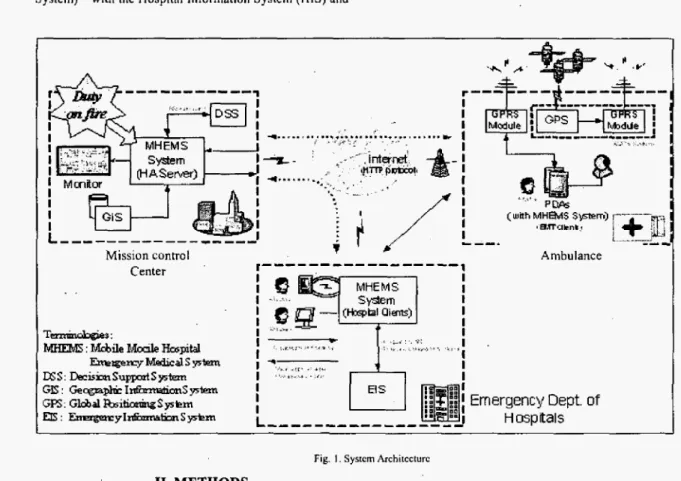
The mobile hospital emergency medical system (MHMES) consists of three sub-systems located in three sites respectively including the dispatch and mission control center, and the on-duty ambulances and the Emergency Department of hospital.(Fig. I ). The communication protocol is designed to integrate the data exchange between the HIS, the ambulances, the
CPRS
(General Packer Radio Service) and theGPS
(global Positioning System) module, and the workstation of MHEMS. The whole emergency hospital medical service network is establishedby
MHEMS master, MHEMS hospital ctient and MHEMS EMT Client.(Fig.l) TheGPS module and the software system includes:
GIs,
dispatch and mission control system, PDA system of EMT.A . . I sub-system at the Dispatch and Mission Control Center: This sub-system, including three main parts - the MHEMS system (Mobile Hospital Emergency Medical System), the DSS (Decision Support System) and the GIS(Geographic Information System), is designed to cooperate with the fire-fighting departments. As the center receives an emergency call, the MHEMS,
DSS
and CIS sub-system would record the time of call and automaticallyimmediately. While the sub-system provides the EMTs the position of the ambulance, the hospital, and the accident, it will estimate the Estimated Time Arrival (ETA). Fig2.
The main function o f this sub-system would be as the following:
Define the district of each fire brigade and hospital. Accept report case and input the accident address, contact phone number and other informed data. Record the duty data of the ambulance, as arriving and leaving time to the accident site and the Hospital.
1 Pre-calculate the ETA(Estimated Time Arrival), of the route before ambulance arriving hospital.
-
Monitor the ambulance. '9 Print duty report.
.
1
Fig 2. GIS & DSS of Dispatch and Mission Control Cenrcr
B.
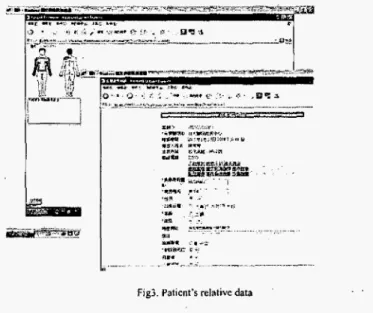
I1 sub-system at Emergency Department uj'Hospitak The sub-system could collect and deliver the information with the ambulance via internet. While the ambulance access the sub-system through the subsystem of the dispatch center, the subsystem in the hospital will inform the on-duty physician automatically and query the related information from the database of the HIS (hospital information system). When the EMTs transfer data to the sub-system, it will alarm to notify the hospital to deal with it. Moreover, it can query HIS (Hospital Information System) about the patient's data.The
main
functionof
this sub-system would beas
the following:1 Get the whole duty record of the hospital from Mission control center. Set a flashing signal at emergency room before new patient arrives.
= Get ETA(Estimated Time Arrival) from
ambulances in period time.
3 Query the patient's whole data from the
Ambulance.
Store the emergency treatment to HIS.
Y '*.-SI ..'.. ' ' , 7 - r i . . I" u w * C. <.; " B I B c 1: 0.I
.-
. ... . .. . .I*_..-:.
.-" . ~.~ ... " ... " . .FIg3. Patient's relative data
C. 111 sub-system at Ambuloncr:
This subsystem would transfer real-time bio-parameters of the patients and other information in multimedia form to the hospital and the dispatch center via
GPRS
of ambulance module (Fig 4,5). The location of the ambulance will be located by GPS modute The EMTs could provide basic information to the MHEMS with FDA viaGPRS.
With the information, the hospital could arrange necessary preparation, the dispatch center could rearrange the resource to enhance emergence medical service to the accident, and the physicians and the EMTs could cooperate more closely to provide high-quality pre-hospital resuscitation both on the scene and during the transportation. Its main functions would be as the following:Get the report case information and the duty records of the ambulance from the workstation of Mission control center.
Provide five bio-parameters measurement and fill some forms including wounded pictures, digital images, rescue reason and basic information of patient,
Transmit the patient's data to the workstation of Missinn cnntrol center.
-2d
Fig 4 ambulance modcl
because the ambulance rides in very high speed.
III. ENVIROMENTS
* . , ~ ~b ~~~" I. ~ ~ ~ ~ , , ~
, - . - _ ~ ^ !
Fig 5.Scrccn of atnbulancc modulc
The ambulance module include
GPRS
and GSM(Globa1 System for Mobile Communication) communication[9]. The GPS module is set at the ambulance. It processes latitude and longitude of ambulance through Satellite 5 execution timeserial number of ambulance velocity of ambulance on its screen. And the module will sent these data
in
period time to Dispatch and Mission Control Center in GPRS and transmit by GSM antenna. It provides the all relative execution data of the ambulance in the short time. Dispatch and Mission Control Center updates the execution data on webpage so the emergency department of hospital can get the real time information of the ambulance and patient. Furthermore, the module has to apply the function of avoiding collisionThe MHEMS environments as follow develop an wireless medical emergency service network. The communication protocol uses Accer system. [ 101
The environments includes: [SI
A/ Sofiwure includes:
GIS(Geographic Information System) Dispatch and mission system PDA system of EMT
HIS(Hospita1 Information System)
B}
Hardware inclridex:Cluster server x 2
m DiskArray
m AD Server
GPSmodule
C} System mvkonments includes: MS-Windows 2003 Server MS-SQL 2000 Server MS-AD Domain Server .NET Framework Apache Framework Java Runtime Engine Anti-Virus System
Inform Hospital 8 read ETA
treatment
records
w
(
J
IV Message Transfer
The main function of MHEMS system includes:A) MHEMS system administers and maintain B) Emergency notification process
C) Ambulance monitor D) Emergency records handling
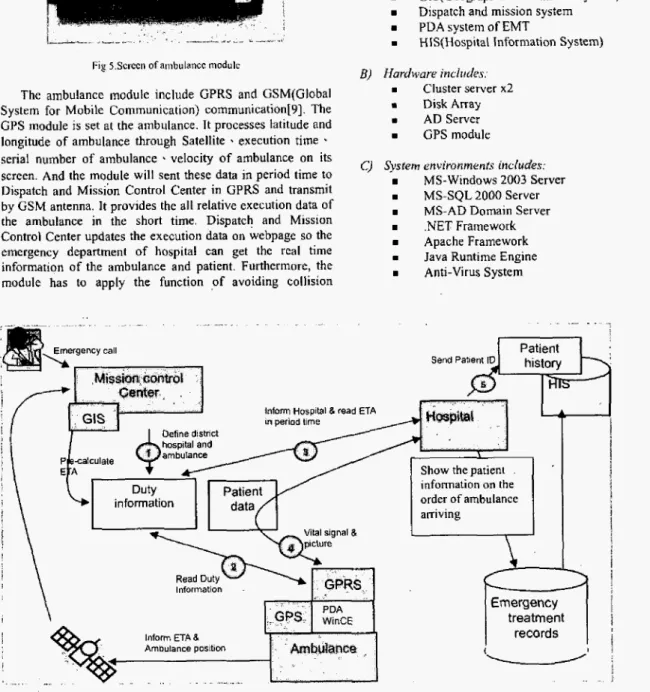
The message flow of the MHEMS system fabricates the whole functions of the emergency service. Each part has to work the accuracy operation to hold the exactitude because each one plays the key role of saving patient's life. They are the following: (Fig 6 . )
Emergency call connects to Dispatch and Mission Control Center. The GIS of the center defines district hospital and ambulance and pre- calculate the ETA Estimated Time Arrival. The emergency department of hospital can follows the patients situation through the center.
4
EMTs of ainbulance read the Duty Information and transfer vital signal and patient's relative data to Emergency department of hospital by GPS or GPRS communication of PDA. EMT also can do more professional treatment through the direction of physician of hospital. The ambulance position
i s indexed by GPS(globa1 Positioning System) of SateIlite in GPS module.
J,
At the same time, the emergency department of hospital has to Dispatch and Mission Control Center has to update the ETA in period time..
.L
Before the arriving of the ambulance, the emergency department of hospital can prepare the instrument or adjust beds depending on the patient information from Dispatch and Mission Control Center. The hospital can provide the fitted medication.
+
ARer the treatment of the emergency department, the treatment records saved to the HIS and transfer to the proper
clinic.
V. CONCLUSION
MHEMS has improved the traditional emergency service Message real time exchanges (voice, medical data,
logistics instructions) between EMT and physicians and operators of Dispatch and Mission Control Center
The system has the following advantages: [Z] [4]
patient pre-identification,
patient's pre- medical available data
early start of patient's medical file and therefore a better medical and operational treatnxnt,
early preparation for the patient emergency department of hospital
pre-medical process,
a real time monitor of events concerning the patient is available, the history of the operations is permanently available
This MHEMS system, includes three subsystems: the dispatch and mission control center, the hospital, and the ambulance The system has further progress plan. The communication speed upgrades between the ambulance and Dispatch and Mission Control Center by 3G then the EMTs can work with the physicians of the emergency department of hospital. They can transfer better resolution of real situation of patients and do more professional treatment to raise the rescue probability The EMTs take the portable measurement combined with wireless communication to transmit real time situation of patients far from the ambulance, with the information technology, a new cooperation model could be created between these subsystems, and improve the interaction between the hospital and emergency medical service system. Although it takes time to create the appropriate model of information exchange ' to provide
high quality pre-hospital medical service and to enhance the preparation o f the hospital for the patients, the contribution in saving priceless lives will justify our effort
V1. ACKNOWLEDGEMENT
The authors wish to express their appreciation for the
research grants from the National Health Research Institute, the National Science Council ("SC-91-22 13-E-002-082,
NSC-90-22 !3-E-002-063), and the Ministry of Education, Taiwan. REFERENCE I . 2 . 3 . 4. 5 . 6. 7.
Davld Cagliana. Principal lnvcstigator3 B D M Fcdcral. Inc.. Tclciiicdicinc Today
Baltiirlorc. MD. -'Wireless Ambulance Te1emedicii;e May Lessen Stroke Morbidit?.
.
Tclciiicdicinc Today. 2005P r i J d J . V ; Vuckovic. A.. 'TAeinrdicine opponunity for improving survival lihetiliirod durins einergency inedical sewices" ;
Conipuicr-Baacd Mcdlcd Systcnis. 1998. Proccedings. I I th IEEE
Sympusiuni on. Pagcs: 1x7- lY1.12-14 Junc 1998
I-DISCARE projcct. http://www.mcdes.fr/IDISCARE/flome.html
Bcltramc. F.: Maiyni. I?: Om. G:Information Technology in
Bioincdicinc. "On the integration of healthcare emergency systems in Europe. the WETS project case study'' IEEE Transactions on Volumc 2, Issuc 2, Iunc 1998 Pagc(s):89
-
97Hyun Cho: "Study on thc coniniunication systeni far Korean enicrgcncy
medical dispatch". Entcrprisc " w o r k i n g and Computing in Hcalthcare Industry. 2004. HEALTHCOM 2004. Procccdinps. 6th Intcmational Workshop on, Pagcs: I72 - 176.28-29 Junc 2000
Burcau of Labor Statistics. U S Dcparmmcnt of Labor, Occupurionul O ? r / / i d Huiidbuok. 21104-05 Editrufi. Enicrgcncy Medical Tcchnicians
and Paramcdics. on thc Intcmcl at hnp~//www~ls.gav/oco/o~o~IOI .htm (visitcd May 04.2005).
H. Ward Silvcr, Data Communications Staff Engineer Phyio-Control
Corporation. Wtrclcss transmission of emergency medical cart data. 1998. IEEE
Lepschy, C.; Minerva. G; Minervini. D.: Pascali, F,"GSM-GPRS radio acccss dimensioning", Vehicular Technology Confcrcncc. 2001. VTC 2001 Fall. IEEE VTS 54" Volunic 2. 7-1 I Oct. 2001 Pagc(s):558
-
561w01.2
Kuladinithi, K.: Konspcn. A.: Aust. S.; Fikouras, N : Gorg. C.."
Mobility nianagcmcnt for an intcgratcd network platform". Mobile and
Wirclcss Communications Nctwork. 2002.4th lntcmational Workshop on 9-1 I Scpt. 2002 Pagc(s):62 I - 42
8.
9.