Chemorheology on Simultaneous
IPN
Formation
of
Epoxy Resin and Unsaturated Polyester
MU-SHIH LIN* and REUI-jE CHANCt
Department of Applied Chemistry, National Chiao-Tung University, Hsinchu, Taiwan 30050, Republic of China
SYNOPSIS
Study of the simultaneous interpenetrating polymer network ( I P N ) between diglycidyl ether of bisphenol-A (DGEBA) and unsaturated polyester ( U P ) was carried out at ambient temperature. Fourier transform infrared ( FTIR) spectroscopy was employed to investigate the intermolecular H-bonding and functional group changes. Viscosity changes due t o H- bonding and crosslinking were examined with a Brookfield viscometer. Gelation time was measured by a Techne gelation timer. Complexation between Co( 11) ( t h e promoter for U P cure) and diamine (the curing agent for DGEBA) was detected with UV-visible spectrometer. Experimental evidence revealed that intermolecular interactions were observed in systems such as DGEBA/l.JP, DGEBA/diamine, UP/diamine, Co(II)/diamine, DGEBA/uncured UP, and UP/uncured DGEBA. All such interactions had measurable effects on the curing behaviors for both networks, as were indicated by the viscosity changes and gelation time. The IPNs thus obtained were further characterized with rheometric dynamic spectroscopy ( R D S ) and differential scaning calorimetry (DSC)
.
Partial compatibility between U P and DGEBA networks was evidenced from a main damping peak with a shoulder near glass transition temperature ( T , ) for lower U P content; while at higher U P content, only a main damping peak near T, was observed. DSC revealed a broad glass transition for all IPNs. The resultant I P N materials were all transparent. 0 1992 John Wiley & Sons, Inc.I NTRO DU CTI 0 N
Although significant progress has been made in the development of interpenetrating polymer network ( I P N ) materials in recent years,'-6 there still is a lack of information concerning the viscosity change during simultaneous IPN formation. Such a viscos- ity change is important when IPN materials are ap- plied in coatings and/or prepregs. Both epoxy resin and unsaturated polyester are thermosetting poly- mers. The former exhibits excellent mechanical properties and good adhesion to metals and carbon fiber; while the cost of the latter is lower. Their IPN materials provide balanced performance and cost. Since epoxy undergoes condensation cure and U P undergoes free radical cure, each network formation
* T o whom correspondence should be addressed.
t Present address: Central Standard Bureau, F 10, 185, Sec. 2, Hsin-Hai Road, Taipei, Taiwan 10637, Republic of China.
Journal of Applied Polymer Science, Vol. 46, 815-827 (1992)
0 1992 John Wiley & Sons, Inc. ccc 0021-8995/92/050815-13
seems to proceed independently. However, in view of the complicated molecular interactions in the system, apparently this is not the case for each net- work. Interlocking between the two networks ap- parently affects curing behavior relative to each other. An IPN composition of equal parts of each component, for example, shows an unusual increase in viscosity and a much shorter gelation time than other compositions. Therefore, we believe an un- derstanding of IPN chemorheology of this system is necessary. Kwok-Wallem and Han reported the chemorheology of unsaturated p ~ l y e s t e r . ~ In this ar- ticle we report the effects of molecular interactions and network interlocking on viscosity change and gelation time during IPN formation.
EXPERIMENTAL
Diglycidyl ether bis (phenol-A) (DGEBA) (Epikote
815) liquid epoxy resin with an EEW of 190 and a viscosity of 10 P at 25°C was obtained from Shell
816 LIN AND CHANG
Chemical Co. Isophronediamine (IPDA) and m-xy- lenediamine (MXDA) purchased from ICI were used directly as curing agents for DGEBA. Stoichiometric equivalent ratio of epoxy to diamine was maintained among all the IPN compositions investigated.
H2N3cH3
CHZNH2 H,NCH,--O--CH,NH,C H3
General-purpose unsaturated polyester ( 157 BQ T C ) with a number-average molecular weight of 2000 was obtained from Yong-shun Industrial Co. (Taiwan), which contains phthalic anhydride, pro- pylene glycol, maleic anhydride, and styrene. Cobalt octoate was used as promoter and methyl (ethyl ke- tone) peroxide ( M E K P ) was used as peroxide for
U P cure.
Fourier transform infrared spectrometry ( FTIR) (Bomen model number DA 3-002) with a resolution of 0.5 cm-' was employed to monitor the shifts and changes of IR absorptions. Samples were cast and sandwiched between KBr plates which were then mounted on a cell holder. Samples with various DGEBA/UP ratios were used in this study. Simul- taneous IPN formation was induced at ambient temperature.
Viscosity measurements were done with a Brook- field viscometer. Gelation time was measured with a Techne gelation timer. Here, gelation time is de- fined as the time period from the beginning of cure to the point where the sample's viscosity increases high enough to stop the flow. Essentially a glass rod was immersed in a sample of gel at a specific tem- perature; the other end of the glass rod was con- nected to the gelation timer. The curing agent then was added and curing commenced. Simultaneously,
the gelation timer was set to start vibrating up and down. Eventually, the viscosity of the gel increased so high that vibration ceased. This time period was automatically recorded by the gelation timer and is taken as gelation time.
UV-visible spectra were recorded with a Hitachi
330 instrument by using methanol as solvent. DSC thermograms were obtained with a Mettler Model 20 instrument at a heating rate of lO"C/min, under N2 atmosphere. RDS were recorded with a Rheo- metric 11, at 1 Hz of frequency. The temperature range was -100-200°C.
RESULTS AND DISCUSSIONS
The final transparent IPN materials contained DGEBA, UP, diamine, cobalt octoate, MEKP, cured DGEBA and cured UP networks. Molecular inter- actions among these species and viscosity changes are discussed below:
Interaction between DCEBA and UP
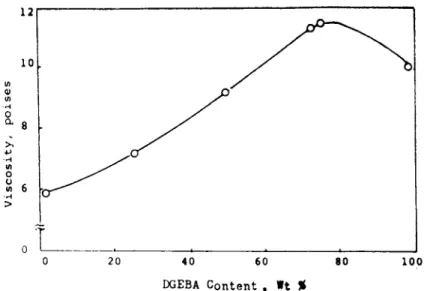
When pure DGEBA and UP were blended in various ratios, an increase in viscosity was generally ob- served. Figure 1 shows the nonlinear relationship of viscosity increase versus DGEBA content in the blends before curing. This viscosity increase can be attributed to the intermolecular H-bonding between DGEBA and UP, as evidenced from the shift of car- bony1 absorption in the IR spectra in Figure 2. The original carbonyl peak of the UP occurs at 1725.4 cm-'
.
Upon the addition of an equal part of DGEBA, the carbonyl peak shifts to higher wave number at 1728 cm-'.
Since the OH end group of the low-mo- lecular weight UP is believed to originally H-bonded with its own carbonyl group, addition of EGDBA to UP, is believed to replace part of the original tight hydrogen bonds with the weaker intermolecular hy- drogen bonds between the OH end group of UP andthe epoxide group of DGEBA, as shown in the fol- lowing expression: HO-C-Rl-C-O-~-O-C
-
II
0 zII
II
r O 0 0 0 0-II
II II 1 -C-O-&-O-C-R,-C-OH DGEBA+
-CHEMORHEOLOGY ON SIMULTANEOUS IPN FORMATION 817
-
0
'L---,
0 20 4 0 6 0 8 0 100
E E B A C o n t e n t , It
I
Figure 1 Viscosity of UP/DGEBA blends (uncured) versus DGEBA content.
The higher DGDBA content in the blend, the more extensive is the intermolecular H-bond for- mation between U P and DGEBA. This leads sub- sequently to higher viscosity of the system, as shown in Figure 1. Because of the extensive intermolecular H-bonding between DGEBA and UP, no apparent phase separation was observed. The resultant IPN materials were all transparent. This improved com- patibility was evidenced from the broad single glass
transition in DSC for all IPNs (Fig. 3 ) . Figure 4 shows the rheometric dynamic spectroscopy of the IPNs. UP has a damping peak a t 165"C, and DGEBA shows two damping peaks at 106 and -10°C. The peak a t 106°C is believed due to glass transition; while the peak a t -10°C is probably due to p-transition. Keenan and Seferis reported a p- transition at -40°C for an epoxy cured by sulfone- based aromatic diamine.' An IPN of UP/DGEBA
50150 I I I I , , , I I , , , , I I , , r , 1 1 1 1 1850. 1725. 1600. 1475. -1 W a v e n u m b e r , cm
LIN AND CHANG 818 E x o .
t
J.
bH Endo.= 89/11 composition indicates an inner shift of a single damping peak a t 144°C. The IPN of equal parts of each component (UP/DGEBA = 50/50) shows two peaks at 62 and 94°C; while the IPN of
UP/DGEBA = 22/78 has a damping peak a t 80°C with a small shoulder a t 101°C. It appears that UP and DGEBA are, at least partially compatible and that increasing UP content would enhance compat- ibility by introducing more OH groups, and hence more H-bondings, into the IPNs.
89/11
50/50
Interaction between DGEBA and Diarnines
I
The original epoxide group of DGEBA absorbs a t 915.1 cm-'. Addition of the curing agent MXDA to DGEBA, before curing, shifts epoxide absorption to 914.5 cm-'. This shift is believed to be due to the intermolecular H-bonding between the epoxide group of EGDBA and the amino group of MXDA. In their study of epoxy/amine curing behavior, Bel-
50 100 150 200
0
Temp., C
Figure 3
DGEBA compositions.
DSC thermograms of IPNs at various U P /
0 0 o o Tan
6
0 0 0 . E O 0 - 9 0 0"0 9% 08 0 00 o o o o o o D 0 0 s, 2 5 ) 0 v -o -o -o -o -o w -o -o ~ -oqo
0 L 0 0 0 O Qt-
i
l . 3 J 1 -1 J 1 1 1 1 1 1 1 1 1 I J I I 1 1 1 L 1 I 1 1 1 I 1c
-100 0 100 2 0 0 T e m p . , OC Figure 4 100/0, ( B ) 89/11, ( C ) 50/50, ( D ) 22/78, ( E ) 0/100.CHEMORHEOLOGY ON SIMULTANEOUS IPN FORMATION 8 19 3 4 0
.
3 3 0 ffl5
3 2 0 E-
3 1 0 $ 3 0 0 2 9 0z
T i -! a, % 2 8 0 a 2 7 0 2 6 0 2 5 0 I-
.-
.-
.-
.
- 0 8 0 1 6 0 2 4 0 3 2 0 4 0 0 T i m e , m i n s . Figure 5 DGEBA/IPDA 1/2.Viscosity change versus cure time for DGEBA. ( A ) DGEBA/IPDA 1/1, ( 0 )
lenger and co-workers reported an intramolecular H-bonding in epoxy-amine networks and an inter- molecular H-bonding in e p ~ x y - a m i n e , ~ as indicated below:
the addition of excess diamine reflects a lower vis- cosity increase (Fig. 5 ) and a longer gelation time (Fig. 6 ) for epoxy cure.
Interaction between UP and Diamines
I
-N-
-
-
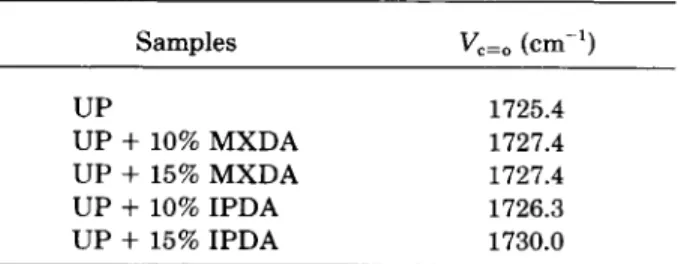
Addition of diamine to U P results in new H-bonding between carbonyl group of U P and diamine as evi- denced from the shifts of the carbonyl peak to a higher wave number in IR spectra as shown in Table
I. The greater amount diamine in U P results in higher wave numbers indicating the presence of more extensive hydrogen bonds. Similar interactions
H 0
l
-CH-\
I'
,CH2-CH2-
CH,Intramolecular H-bonding Intermolecular H-bonding in epoxy-amine network
Both types of hydrogen bonds retard the reactivity of diamine and slow down the cure rate; therefore,
2 5 0
'
0 0 . 5 1.0 1 . 5 2 . 0 2 . 5 3 . 0
IPDA Content, IPDA/DGEBA Equiv. R a t i o Figure 6 Gelation time of DGEBA vs. IPDA content.
820 LIN AND CHANG
Table I in UP
Shift of Carbonyl Absorption Peak
UP 1725.4
U P
+
10% MXDA 1727.4UP
+
15% MXDA 1727.4UP
+
10% IPDA 1726.3U P
+
15% IPDA 1730.0between poly (ethylene glycol) diacrylate and di- amine were observed in our laboratory: lo
HO- -R1- -0-&-0-
-
- 0 - 0 0 0 0 :II
II
II
-II
0, HzN--R~-NHz-
-F
- F F
0 -C-O-&-O-C-R1-C-OH HO-C-Rl-C-O-&-O-C-II
0II
0 - -/%//
H\ /HE
-\II
- N-R,-N - - 0 0 0 -C-O-&-O-C-R1-C-OHII
II
II
This effect also reflects in the viscosity change as a function of diamine level as shown in Figure 7. For UP/MXDA mixture, the viscosity increases with the increase of MXDA. The maximum viscosity of UP/DGEBA occurs at 4 phr of MXDA, after which, excess free MXDA acts as a plasticizer for UP, and the viscosity decreases. For UP/IPDA mixture, less H-bonding was observed in the early stage, presumably due to the steric methyl group in IPDA. The maximum viscosity occurs a t an IPDA level of 6 phr. Similar decrease in viscosity was also noted when excess IPDA was added.
Interaction between Cobalt Salt and Diamine
Mixing cobalt octoate with diamine results in com- plexation as is evidenced from its UV-visible spectra. Figure 8 shows the absorption spectra of Co ( 11)
/
MXDA and Figure 9 shows those of Co (11) /IPDA, where curves a, b, and c are spectra of diamine, co- balt octoate, and Co ( 11) -diamine complex, respec- tively. A series of similar Co ( I1 ) -amine complexes have been known to inorganic chemists."." A rea- sonable inference is that in DGEBA/UP IPN sys- tems, the formation of Co (11) -diamine complex is inhibitory to bonded Co (I1 ) and diamine; hence408
6 D i a n i n t = I P D A
Diamine Content, phr
Figure 7
IPDA.
CHEMORHEOLOGY ON SIMULTANEOUS IPN FORMATION 82 1 . 4 4 - .31- . 2 6 . .21. .16. Co C o n c .= 3 u n i t HXDR C o n a . = 2 u n i t .ll. . 0 6 _. W a v e l e n g t h ,
nm
Figure 8 6/1.UV-visible spectra of (1) MXDA, ( 2 ) cobalt octoate, (3) cobalt octoate/MXDA
their reactivities decrease and both network growth are slowed during IPN formation.
Comparison of DCEBA Cure Behavior by MXDA and IPDA
Dynamic DSC thermograms of DGEBA cured by MXDA and by IPDA are given in Figures 10 ( a ) and
10 ( b )
.
It was found that in the DGEBA/MXDA curing system, the maximum exothermic peak oc- curs at 108.5"C; while for the DGEBA/IPDA sys- tem, two maximum exothermic peaks (104 and 132°C) were found. In DGEBA/IPDA systems, the 104°C peak probably is due to the reaction of the less steric NH2 and the second peak at 132°C due. 2 3
. 2 2
I
cone. c o : 3 u n i t IPD1:2 unrtI ( 3 ) . 0 7 4 8 Id8 5 4 8 6 & 6 8 7 4 0 7 Q Q 0 ' Wavelength, nm Figure 9 3/2.
822 LIN AND CHANG
Figure 10
DSC thermogram of DGEBA cured by IPDA.
( a ) Dynamic DSC thermogram of DGEBA cured by MXDA. ( b ) Dynamic
to the reaction of the NH2 near the methyl group. A single exothermic peak was observed in the case of DGEBA/MXDA, because the two NH2 groups
are equivalent. The gelation time in MXDA/ The presence of uncured UP has measurable effects DGEBA was 190 minutes, compared with 373 min- on the gelation time for DGEBA cure behavior. Fig- Utes in IPDA/DGEBA system, which confirms the ure 11 shows the gelation time of DGEBA cured by retarded curing rate by the steric methyl group in IPDA in the presence of different amounts of un-
Effects of the Presence of Uncured U P on DGEBA Cure Behavior
-
IPDA.
3 0 0
cured UP. Below 30 phr of uncured UP, the OH end
3 0 0
-10 0 10 2 0 3 0 4 0 5 0
Polyester Content, phr Figure 11
uncured UP.
CHEMORHEOLOGY ON SIMULTANEOUS IPN FORMATION 823 2 5 0 200 ln al ,10150 0 a h 4J 0 $ 0 0 ln .rl 5 0 0 0 30 60 90 1 2 0 1 5 0 180 2 1 0 2 4 0 T i m e , m i n s . Figure 12
UP. (A) DGEBA, (0) DGEBA
+
25 phr UP, ( 0 ) DGEBA+
28.6 phr UP.Viscosity change of DGEBA cure, containing different amounts of uncured
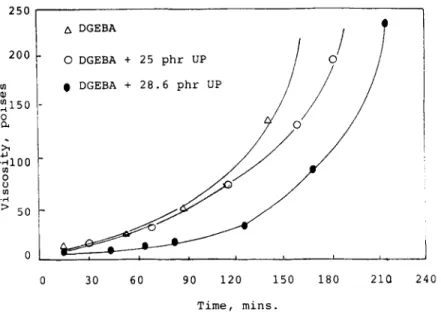
group in UP acts as a catalyst for the DGEBA-di- amine cure system, accelerating the cure reaction. This catalytic effect is known in the 1 i t e r a t ~ r e . l ~ On the other hand, above 30 phr of uncured UP, first, the excess UP probably acts, at least in part, as a diluent for DGEBA, hence effectively lowering the concentrations of both DGEBA and diamine. Sec- ond, the excess uncured UP H-bonds with diamine as previously indicated in Table I. Third, excess un- cured UP also H-bonds with DGEBA, as was pre- viously shown from the shift of carbonyl peak in IR
absorption (Fig. 2 ) , thus increasing the viscosity of the UP/DGEBA blend (Fig. 1 )
.
This H-bonding is reflected in the decreased mobility of both diamine and DGEBA chains. Therefore, excess uncured UP slows the curing rate of DGEBA, as indicated by longer gelation time (Fig. 11 ) and the slower increase in viscosity (Fig. 12).Effects of the Presence of Uncured DGEBA on UP
Cure Behavior
Figure 13 shows the increase of viscosity of UP cured by 0.5 phr MEKP in conjunction with 0.1 phr cobalt octoate. Curve a is the viscosity change of UP, while curves b, c, and d are those of UP containing 12.5, 25, and 37.5 phr of uncured DGEBA, respectively.
It was found that the more uncured DGEBA in the UP/MEKP/cobalt system, the slower the rise in viscosity. The presence of uncured DGEBA dilutes both the free radical and U P concentrations. Fur- thermore, the H-bonding between DGEBA and UP
restricts the chain mobility of UP. Therefore, the presence of uncured DGEBA retards the curing rate of UP, leading to slowed increase of viscosity (Fig. 13) and a longer gelation time (Fig. 14).
Effect of Diamine on the Cure Behavior of UP
Figure 15 shows the gelation time of UP cured by 0.5 phr MEKP and 0.1 phr cobalt octoate in the presence of various IPDA levels. Below 1 phr of IPDA, the gelation time decreases presumably be- cause the H-bonding between UP and diamine in- creases the viscosity of the system and leads to a decreased termination rate, which subsequently leads to a n earlier autoacceleration stage (i.e., Tromsdorff effect). At IPDA content above 1 phr, the formation of Co (11) -amine complex is enough to reduce the active cobalt ions and slow the curing rate. Therefore, an increase of gelation time is ob- served with higher diamine contents.
Amounts of Cobalt Salt on UP Cure Behavior
Figure 16 shows the viscosity increase of UP cured at room temperature by 0.5 phr MEKP with two different cobalt octoate levels. It was found that 0.2
phr cobalt octoate (curve a ) was much more effective in enhancing the viscosity increase than 0.1 phr (curve b )
.
It is known that cobalt salt acts as a pro- moter in UP/peroxide cure systems, inducing in-824 LIN AND CHANG
7
50 100 120 0L ,
20 40 G O 80 0 'T i i i i e ' , NI ns.
Figure 13 Viscosity change of UP cure, containing different amounts of uncured DGEBA. ( A ) UP, ( 0 ) UP
+
12.5 phr DGEBA, ( A ) UP+
25 phr DGEBA, (0) UP+
37.5 phr DGEBA.creased viscosity. This increase causes difficulty in chain diffusion for free radical polymerization, es- pecially near the gel point. The increase of cobalt salt shifts the gel effect to an earlier stage. Figure 17 shows the gelation time of UP versus MEKP content for 0.35 phr and 0.2 phr cobalt octoate. When MEKP concentration is higher than 0.3 phr, the effect of cobalt salt becomes insignificant.
Viscosity Changes during Simultaneous IPN Formation
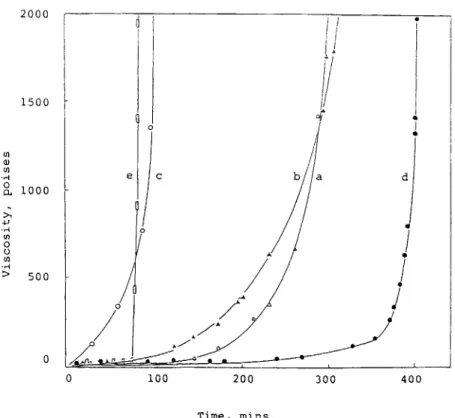
Figure 18 shows typical viscosity changes of this IPN system cured at 3 O O C . The DGEBA was cured by a stoichiometric equivalent of IPDA, and UP was cured by 0.5 phr MEKP with 0.1 phr cobalt octoate. Since DGEBA undergoes condensation cure and UP
120
*
(0 c 4 E 1 0 0 a, E .rl u 6 0 1 0 10 2 0 3 0 40 DGEBA Content, phrCHEMORHEOLOGY ON SIMULTANEOUS IPN FORMATION 825
IPDA
Content, p h rFigure 15 Gelation time of UP containing different amounts of IPDA.
undergoes free radical cure, both networks grow by different mechanisms. The two networks appear to be fully simultaneous IPNs. Curve a (Fig. 18) shows the viscosity change of the pure DGEBA; while curve e shows that for the pure UP. UP shows a much higher curing rate especially near the gel point, and
its viscosity increases faster than the pure DGEBA. When U P is the minor component in the DGEBA/ UP system (curve b, DGEBA/UP = 78 / 2 2) , the initial viscosity increase is believed to be due partly to the H-bonding between DGEBA and UP as men- tioned previously (Figs. 1 and 2 ) , and partly to the
5 0 m 4 0 m -d 0 a >.
*
.r( 10 3 08
2 0 Lo .rl > 10 0 I 0 a b 0 2 0 4 0 6 0 8 0 9 0 Time. mins. Figure 16amounts of cobalt octoate. (0) 0.2 phr cobalt octoate, ( A ) 0.1 phr cobalt octoate. Viscosity change of U P cured by 0.5 phr MEKP in conjunction with different
826 LIN AND CHANG
MEKP Content, phr
Figure 17
( A ) 0.35 phr cobalt octoate, ( W ) 0.2 phr cobalt octoate.
Gelation time of U P cured by various amounts of MEKP in conjunction with
2 0 0 0 1 5 0 0 ln Q) rJl TI
g
1 0 0 0 >1 u .rl ln 0 (0 .r( 5 0 0 0 0 100 2 0 0 300 4 0 0 Time, mins.Figure 18 Viscosity changes during DGEBA/UP IPN formation a t 30°C. The IPN compositions in ratio of DGEBA/UP: ( a ) 100/0, ( b ) 78/22, ( c ) 5 0 / 5 0 , ( d ) 11/89, ( e ) 0/100.
CHEMORHEOLOGY ON SIMULTANEOUS IPN FORMATION 827
Table I1 Cured at 30°C Ratio of DGEBA/UP
Gelation Time of DGEBA/UP IPNs
Gelation Time (min) 100/0 78/22 50/50 11/89 0/100 337 405 149 453 91
interlock of DGEBA and UP networks. Such net- work interlocking in later stages of IPN formation results in a decreased curing rate because of high viscosity and, subsequently leads to a longer gelation time than the pure DGEBA as shown in Table 11. The blend of equal parts of DGEBA and UP (curve c, DGEBA/UP 50/50) shows an unusual increase in viscosity in the early stages, which can be inter- preted as resulting from the extensive H-bonding in systems such as DGEBA/UP and UP/IPDA (Table I ) and network interlocking. When the UP is the major component, as in curve d (DGEBA/UP 11/
8 9 ) , a significantly slow curing behavior was ob- served. This phenomenon can be attributed to the extensive H-bonding between U P and diamine (Ta- ble I; Fig. 7 ) . Since the ratio of DGEBA to diamine is maintained by stoichiometric balance, the H- bonded diamine is not totally free to react with DGEBA. On the other hand, the complexation be- tween IPDA and cobalt ions (Fig. 9 ) retards cure reactions of both DGEBA by IPDA and U P by Co (II)/MEKP. In addition, the extensive H-bonds in UP/DGEBA, UP/IPDA probably presents an extra barrier to free radical attack of UP. Furthermore, network interlocking between cured DGEBA and cured UP should provide additional steric hindrance and restriction of chain mobilities, which further retards curing reactions. Consequently, a much re- tarded curing behavior and a long gelation time of
453 minutes were found in this IPN composition (Table 11).
CONCLUSIONS
During the simultaneous IPN formation of DGEBA and UP, extensive intermolecular interactions in
such pairs as DGEBA
/
UP, DGEBA/
diamine, UP/
diamine, cobalt ion/diamine, DGEBA/uncured UP,and UP/uncured DGEBA were observed. Essen- tially all such interactions and network interlocking showed measurable effects on IPN cure behavior, which was reflected in an increased viscosity and decreased gelation time.
The extensive molecular interactions, H-bonding, and network interlocking led these IPNs to be, a t least, partially compatible a t lower UP contents; while at higher UP content the IPNs became totally compatible.
The authors express their sincere appreciation to National Science Council of ROC for financial support to this work under contract number NSC 80-0405-E6.
REFERENCES
1. L. H. Sperling, Interpenetrating Polymer Networks and
Related Materials, Plenum Press, New York and Lon-
don, 1981.
2. K. C. Frisch, D. Klempner, and H. L. Frisch, Muter. Des., 4,855 (1983).
3. S. Nishi and T. Kotoka, Macromolecules, 18(8), 1516 ( 1985).
4. D. L. Siegfried, D. A. Thomas, and L. H. Sperling,
Polym. Eng. Sci., 21, 39 (1981).
5. D. J. Hourston and R. Satguunathan, J . Appl. Polym.
Sci., 29, 2969 (1984).
6. D. J. Hourston, R. Satgurunathan, and H. Verma, J .
Appl. Polym. Sci., 39, 215 (1987).
7. K. Wallem and C. D. Han, J . Appl. Polym. Sci., 28,
3185 (1983).
8. J. D. Keenan and J. C. Seferis, J . Appl. Polym. Sci.,
24, 2375 (1979).
9. V. Bellenger, J. Vender, J. Francillette, P. Hoarau, and E. Morel, Polymer, 28,1079 (1987).
10. M. S. Lin and K. T. Jeng, J. Polym. Sci., Polym. Chem.
Ed. (in press).
11. J. A. Broomhead, F. P. Dwyer, and J. W. Hogarth,
Inorg. Syn., 6,183 (1960).
12. K. F. Purcell and J. C. Kotz, Inorganic Chemistry,
W. B. Saunders Co., Philadelphia, 1977, pp. 711-749. 13. M. A. Golub and N. R. Lerner, J . Appl. Polym. Sci.,
32, 5215 (1986).
Received August 29, 1991 Accepted December 27, 1991