C O M M U N I C A T I O N S
Stabilized single-frequency fiber
ring laser based on hybrid
amplifier and fiber Fabry-Perot
devices for C- plus L-band
operation
Chien-Hung Yeh
National Chiao Tung University
Department of Photonics and Institute of Electro-Optical Engineering
Hsinchu 300, Taiwan and
Industrial Technology Research Institute Computer & Communications Research
Laboratories
Transmission System Department Chutung, Hsinchu 310, Taiwan E-mail: [email protected]
Bing-Chung Cheng National Chiao Tung University
Department of Photonics and Institute of Electro-Optical Engineering
Hsinchu 300, Taiwan and
Fu-Jen Catholic University Department of Physics Taipei 242, Taiwan
Chih-Yang Chen
National Chiao Tung University
Department of Photonics and Institute of Electro-Optical Engineering
Hsinchu 300, Taiwan
Sien Chi
National Chiao Tung University
Department of Photonics and Institute of Electro-Optical Engineering
Hsinchu 300, Taiwan and
Yuan Ze University
Institute of Electro-Optical Engineering Chung-Li 320, Taiwan
关DOI: 10.1117/1.2080727兴
Subject terms: EDFA; fiber ring laser; Fabry-Perot laser diode; L band; FFP filter; SOA.
Paper C040809RR received Oct. 31, 2004; revised manuscript received Feb. 22, 2005; accepted for publication Mar. 14, 2005; published online Oct. 14, 2005.
1 Introduction
Stabilized and tunable optical output are very necessary for fiber ring lasers applied to wavelength-division multiplex-ing 共WDM兲 for communications and optical sensor sys-tems. In general, a fiber Fabry-Perot 共FFP兲 filter can pro-vide wavelength tuning inside the ring cavity of the fiber ring laser. Because of the bandwidth limitation of erbium-doped fiber amplifiers 共EDFAs兲, the operation region of erbium-doped fiber共EDF兲 ring lasers extends only from C to L band共1530 to 1610 nm兲1,2and thus must be supple-mented with the proposed S-band fiber ring laser.3Actually, the wideband ring laser must use a long length of EDF even to approach C- plus L-band operation.1 However, that is insufficient to stabilize the lasing wavelength and power of a fiber ring laser. Recently, several remedial techniques, such as integrating two cascaded FFP filters of widely dif-ferent free spectral ranges共FSRs兲 into a cavity,4,5 using a compound ring resonator composed of a dual-coupler fiber ring and a tunable band pass filter,2 adding an extra ITU-grid periodic filter in the optical loop,6 and employing an integral saturable-absorber-based tracking narrowband filter,7have been reported experimentally.
In this study, to provide a stable single-frequency fiber ring laser covering both C and L bands, we propose and experimentally demonstrate a stable and tunable single-frequency fiber laser using a hybrid two-stage amplifier module, which consists of a semiconductor optical ampli-fier共SOA兲 and an EDFA, together with a Fabry-Perot laser diode 共FPLD兲 and an FFP filter. The effective operation range of the proposed laser is 1541.52 to 1593.04 nm with a tuning step of 1.12 nm. We also report good output power and wavelength stability, tuning range, and side-mode sup-pression ratio共SMSR兲.
2 Experiments
The experimental setup of the proposed C- plus L-band fiber ring laser for single-frequency and wavelength-tuning operation is illustrated in Fig. 1. This apparatus comprises a hybrid two-stage amplifier module, a 1⫻2 and 90:10 op-tical coupler共C兲, an FFP filter, an optical circulator 共OC兲, and an FPLD. In the hybrid amplifier, the first共SOA兲 stage has 250-mW bias current and the second共EDFA兲 stage was composed of a high-concentration 18-m-long EDF 共High Wave 742兲, a 1550- to 980-nm WDM coupler 共W兲, an op-tical isolator, and a 980-nm pump laser, as shown in Fig. 1. In the proposed structure, we only employ an SOA and a short length of EDF to achieve an operation range of 1540 to 1620 nm. For this reason, the effective gain region will be shifted from shorter to longer wavelengths by this pro-posed configuration.8 Actually, the optical output of the SOA can be used to pump the second stage共EDFA module兲 for extending the bandwidth from C to L band. The central wavelength of the FPLD is 1560.56 nm with 1.12-nm mode 0091-3286/2005/$22.00 © 2005 SPIE
Optical Engineering 109701-1 October 2005/Vol. 44共10兲
spacing, when the bias current is set at 15 mA. The FFP filter is an all-fiber device having a wide tuning range, a low insertion loss共⬍0.5 dB兲, and a polarization-dependent loss共PDL兲 of ⬃0.1 dB. The FFP filter, having a free spec-tral range共FSR兲 of 80 nm and a finesse of 200, can be used to provide wavelength selection in the ring laser cavity by applying an external voltage共0 to 12 V兲 on the piezoelec-tric transducer共PZT兲 of the filter. Moreover, the FPLD is also used inside the ring cavity in the proposed fiber ring laser for wavelength filtering and lasing, as shown in Fig. 1. In addition, an optical spectrum analyzer 共OSA兲 with 0.05-nm resolution and a power meter 共PM兲 are used to measure the output spectra and powers for this proposed laser at the output port, as shown in Fig. 1.
To provide stable single-frequency operation, the central wavelength of the FFP filter passband is tuned to align the longitudinal-mode FPLD for wavelength lasing and tuning. Therefore, the 1.12-nm tuning step is determined by the longitudinal-mode spacing of the FPLD. In this way, the side modes of the FPLD are suppressed and the optical output amplified. In contrast with conventional fiber ring laser operation,1–3,9the FPLD and the optical circulator are removed, but a polarization controller共PC兲 is placed in the ring cavity in order to control the polarization state and maintain the output wavelength and power stabilization. 3 Results and Discussions
This proposed ring laser could provide a stabilized single-frequency output. Figure 2 shows the amplified spontane-ous emission共ASE兲 spectra of the first 共SOA兲 stage, second 共EDFA兲 stage, and hybrid amplifier when the EDFA and SOA were operated at 100-mW pump power and 250-mA bias current, respectively. In addition, when a hybrid am-plifier is used, the medium gain could be enhanced to ex-tend to longer wavelengths. In Fig. 2, an 70-nm ASE bandwidth of 1545 to 1615 nm can be observed, and −23.1-dBm maximum peak power occurs at 1556 nm. Ac-tually, the multiwavelength output of FPLD was distributed at C band, and the central wavelength was 1560.56 nm. Due to the limitation of the output spectrum of the FPLD and the ASE spectrum of the S-band EDFA used, the effec-tive operation range will be limited approximately to 1540 to 1590 nm.
Figure 3 shows the output power and the SMSR versus the lasing wavelength in the tunable range with 1.12-nm tuning step, while different external voltages 共0 to 12 V兲 were applied to the PZT of the FFP filter, over the wave-length range 1541.52 to 1593.04 nm. Figure 3 shows the maximum output power of 4.9 dBm at around 1569.52 nm. The power will drop to 2.6 and 0.4 dBm at 1557.36 and 1587.44 nm, respectively. Moreover, the SMSR of ⬎29.8 dB at 0.05 nm and the output power of ⬎1.4 dBm can be achieved while the proposed laser is tuned from 1551.60 to 1582.96 nm. At a lasing wavelength of 1527.68 nm, the SMSR is up to 44.9 dB at 0.05 nm. As a result, the SMSR of⬎29.8 dB at 0.05 nm and the output power of ⬎1.4 dBm can be achieved while this ring laser is tuned from 1551.60 to 1582.96 nm in steps of 1.12 nm.
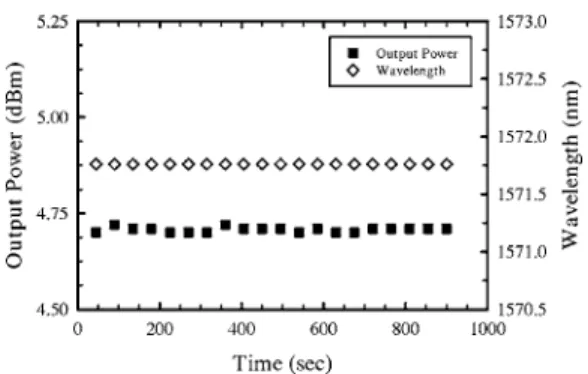
To investigate the power and wavelength stability, the short-term stability of the proposed structure was measured. The lasing wavelength is 1571.76 nm initially, and the ob-servation time is more than 900 s. In Fig. 4, the power fluctuation for the proposed configuration is less than 0.02 dB. Simultaneously, the proposed ring laser can dramati-cally reduce the wavelength variation to zero. Due to the limitation of the resolution of the OSA, the linewidth of the output signal cannot be measured by an OSA. However, we can determine the output type共multimode or single mode兲 by the self-homodyne method. During a 2-h observation,
Fig. 1 Proposed and experimental setup for the stabilized fiber ring
laser with two optical Fabry-Perot devices inside the ring cavity.
Fig. 2 Optical spectra of the ASE for the hybrid amplifier, first共SOA兲
stage, and second共EDFA兲 stage.
Fig. 3 The output power and the SMSR versus the lasing
wave-length in the tunable range with 1.12-nm tuning step, for different external voltages共0 to 12 V兲 applied to the PZT of the FFP filter, over the wavelength range 1541.52 to 1593.04 nm.
Optical Engineering 109701-2 October 2005/Vol. 44共10兲
the stabilized output of the proposed ring laser was still maintained. The threshold current of the FPLD was 11 mA, and its bias current can be adjusted between 11 and 20 mA for wavelength tuning. When the bias current is greater than 20 mA, the side mode of the ring laser cannot be suppressed, due to the gain saturation of the FPLD. Exter-nal injection into the FPLD can lock the mode for stabilized single-frequency output. Compared with a conventional fi-ber ring laser,1–3,9this laser has more stable output. How-ever, the performance of this ring laser is limited by the gain of the EDF and bandwidth of the FPLD.
4 Conclusion
A stabilized and tunable single-frequency fiber ring laser using a Fabry-Perot laser diode共FPLD兲 and a fiber Fabry-Perot共FFP兲 filter inside the ring cavity has been proposed and experimentally demonstrated. Due to the bandwidth limitation of the FPLD, the effective operation range of the proposed laser is from 1541.52 to 1593.04 nm in steps of 1.12 nm. The maximum output power of 4.9 dBm and side-mode suppression ratio共SMSR兲 of 44.9 dB at 0.05 nm for the laser are reached at 1569.52 and 1567.28 nm,
respec-tively. In addition, an SMSR of⬎29.8 dB at 0.05 nm and an output power of ⬎1.4 dBm can be achieved while this ring laser is tuned from 1551.60 to 1582.96 nm. Output wavelength variation of zero and output power fluctuation of艋0.02 dB have also been obtained. Therefore, this pro-posed stabilization technique is expected to qualify the sta-bilized fiber ring laser for applications to WDM network and fiber sensor systems.
Acknowledgments
This work was supported in part by the National Science Council 共NSC兲 of Taiwan under grants NSC 94-2215-E-155-001 and NSC 94-2215-E-155-003.
References
1. S. Yamashita and M. Nishihara, “Widely tunable erbium-doped fiber ring laser covering both C-band and L-band,” IEEE J. Sel. Top.
Quantum Electron. 7共1兲, 41–43 共2001兲.
2. R. M. Sova, K. Chang-Seok, J. U. Kang, and J. B. Khurgin, “Tunable dual- fiber ring laser based on 2nd order Sagnac-Lyot fiber filter,” in
IEEE CLEO 2002 Tech. Dig., Vol. 1, pp. 444–445共2002兲.
3. C. H. Yeh, C. C. Lee, and S. Chi, “A tunable S-band erbium-doped fiber ring laser,” IEEE Photonics Technol. Lett. 15共8兲, 1053–1054 共2003兲.
4. K. J. Vahala, P. Namkyoo, J. Dawson, and S. Sanders, “Tunable, single-frequency, erbium fiber ring lasers,” in IEEE LEOS ’93 Conf.
Proc., pp. 708–709共1993兲.
5. K. K. Chow, C. Shu, M. W. K. Mak, and H. K. Tsang, “Widely tunable wavelength converter using a double-ring fiber laser with a semiconductor optical amplifier,” IEEE Photonics Technol. Lett.
14共10兲, 1445–1447 共2002兲.
6. A. Bellemare, J.-F. Lemieux, M. Têtu, and S. LaRochelle, “Erbium-doped fiber ring lasers step-tunable to exact multiples of 100 GHz 共ITU-grid兲 using periodic filters,” in Proc. ECOC’98, Vol. 1, pp. 153– 154共1998兲.
7. Y. Cheng, J. T. Kringlebotn, and D. N. Payne, “Stable single-frequency traveling-wave fiber loop laser with integral saturable-absorber-based tracking narrow-band filter,” Opt. Lett. 20, 875–877 共1995兲.
8. C. H. Yeh, K. H. Lai, Y. J. Huang, C. C. Lee, and S. Chi, “Hybrid L-band optical fiber amplifier module with erbium-doped fiber am-plifiers and semiconductor optical amplifier,” Jpn. J. Appl. Phys.,
Part 1, 43共8A兲, 5357–5358 共2004兲.
9. C. H. Yeh, C. C. Lee, C. Y. Chen, and S. Chi, “A tunable C-plus-L band fiber ring laser based on hybrid amplifier,” Jpn. J. Appl. Phys.,
Part 1, 43共2兲, 650–651 共2004兲.
Fig. 4 The output power fluctuation for the proposed ring laser. The
lasing wavelength is 1571.76 nm initially, and the observation time is more than 900 s.
Optical Engineering 109701-3 October 2005/Vol. 44共10兲