行政院國家科學委員會補助專題研究計畫
▇成果 報告(計畫名稱)
群體智慧網絡與服務價值創造之技術方法與策略模式研究 (2)
計畫類別:
▇
個別型計畫 □整合型計畫
計畫編號:NSC 98- 2410-H- 004 - 050 -MY2
執行期間: 98 年 8 月 1 日至 100 年 7 月 31 日
計畫主持人:苑守慈
共同主持人:
計畫參與人員:
成果報告類型(依經費核定清單規定繳交):
▇
精簡報告□完整報告
本成果報告包括以下應繳交之附件:
□赴國外出差或研習心得報告一份
□赴大陸地區出差或研習心得報告一份
▇
出席國際學術會議心得報告及發表之論文各一份
□國際合作研究計畫國外研究報告書一份
處理方式:除產學合作研究計畫、提升產業技術及人才培育研究計畫、列
管計畫及下列情形者外,得立即公開查詢
□涉及專利或其他智慧財產權,□一年□二年後可公開查詢
執行單位:政大資管系
A Study of the Impacts of Positive/Negative Feedback on Collective Wisdom
- Case Study on Social Bookmarking Sites
Abstract
The core spirit for web 2.0 is collective wisdom (i.e., the contribution of users, and the creation of value through the interaction between users). Social bookmarking sites integrate all kind of contents on the Internet (especially those generated by users), and play the role of pivot between content production and consumption. This paper mainly investigates how the positive/negative feedbacks would impact the quality of the collective wisdom within the autonomous service environments (i.e., the social bookmarking sites). Our research findings show that the performance of social bookmarking sites has a tradeoff between collective filtering (i.e., results of positive feedbacks) and front page update frequency that should be carefully managed for ensuring the good quality in collective wisdom and service performance. Moreover, the negative feedback could also shape the collective wisdom and stabilize the system performance. The research findings are believed to provide some managerial guidelines for web 2.0 sites design and operations.
Keywords: collective wisdom, positive/negative impact, social bookmarking site, agent-based
modeling and simulation
1. Introduction
In the web 2.0 era, since the amount of user generated contents in social media has been rapidly increasing, people now become both producer and consumer of the digital content. Massive user’s own contents and opinions are publishing on different social media. The role of websites is transformed from the operator of contents to the operator of the platforms and channels. Today, user’s contributions are treated as valuable ingredient for performing collective wisdom. Users are encouraged to contribute their own contents, interact with other participants, and exchange information so as to originate the collective intelligence.
The collective wisdom is formed by the bottom-up approach which relies on the interactive contributions between participants. Thus, the collective wisdom cannot be centralized controlled, but it requires some mechanisms of protocols to facilitate the development of the collective wisdom under different autonomous service environments.
In order to provide some guidelines for driving the effective bottom-up formation of collective wisdom, in this paper we investigate how the positive/negative feedbacks would impact the quality of the collective wisdom within an autonomous service improvement. A case study of social bookmarking site (i.e., an autonomous service environment) is used to undergo the required investigations and analysis. Social bookmarking sites, in general, aim to integrate all kind of contents on the Internet (especially those generated by users), and play the role of pivot
between content production and consumption. From the media aspect, a social bookmarking site can be considered as a news gatekeeper (or gateway) in the web 2.0 era.
This paper will first highlight the impact of positive/negative feedback on collective wisdom. The origin of collective animal behavior and the existing operations of some social bookmarking sites are also surveyed. Then, an operational model of social bookmarking site and its mechanism of collective wisdom development is built and used for subsequent simulations. Lastly, the simulations outcomes provide several managerial implications about how to utilize the positive/negative feedback on collective wisdom development for attaining a high quality bottom-up autonomous service environment.
The structure of this paper is organized as follows. In Section 2, we survey the relevant research about the positive/negative feedback for collective wisdom. The social bookmarking sites as well as their operation mechanisms are also described in order to provide the background required for unfolding our case study of the feedback impact analysis. In Section 3, a general framework of the positive and negative feedback mechanism for shaping the collective wisdom on the social bookmarking sites is provided. Agent-based modeling and simulations are subsequently utilized for analyzing how the positive/negative feedbacks could influence the quality of the social bookmark site, and Section 4 demonstrates the impact analysis results. Discussions and managerial implications based on our analysis results are then presented in Section 5. Finally, a conclusion and future research directions are provided in Section 6.
2. Related Research
2.1. Collective Wisdom
The concept of collective wisdom is derived from the patterns observed in collective animal behaviors. The phenomenon of self-organized behaviors can be generally observed among animal behaviors. There are some famous collective animal behaviors (Sumpter 2006), for example, the entrance crater to a nest of the ant Messor barbarous, a flock of birds twisting in the evening light, a fish school wincing at the thought of a predator, the cram to leave an underground station, ants marching in an endless line, the quiet hum of a honey bee hive, the pulsating roar of a football crowd, and a swarm of locusts flying across the desert. According to Sumpter, the collective self-organized animal behavior can be explained in terms of repeated interactions between the animals and their environments. But what are the principles driving those animals to achieve the autonomous collective behaviors? To explain and understand these self-organized behaviors, there were certain patterns found in which the feedbacks of individuals play the most fundamental drivers to form the collective behaviors. According to (Sumpter 2006), collective animal behavior and biological structures such as termite mounds, ant trail networks are created based on 9 principles.
Integrity and variability. Integrity means that each of the animals in a group is different, in
terms of their genes and/or their previous experience. In an animal group, high inter-individual variation can provide a continual supply of new solutions to the problems the group aims to solve. Variability implies the essential opportunity to form collective wisdoms.
Positive feedback. Positive feedback is the amplification of events through recruitment or
reinforcement (Bonabeau et al. 1997; Camazine et al. 2001). An isolated behavior is quickly subsumed by a mass of similar behaviors. Positive feedback is the best studied component of collective animal behavior. However, work with only positive feedback may cause tragedy such as the famous “circular mill” of ants. Without variability and integrity judgment, ants just follow the previous feedback and form a circular path and repeat the endless circular path. (Surowiecki 2004)
Negative feedback. If positive feedback builds up a collective pattern then it is negative
feedback that stabilizes it.
Response thresholds. Animals often change their behavior in response to a stimulus reaching
some threshold. Response thresholds can interact with positive feedback to generate local aggregations.
Leadership. The notion of self-organization seems somehow incompatible with the notion of
leadership. In insect societies, however, there are some key individuals that catalyze and organize the group (Robson and Traniello 1999).
Inhibition. Members of a group exhibiting one type of behavior can inhibit the behavior of
others. When this inhibition is passive it is indistinguishable from negative feedback. Inhibition can also be active, whereby members of one group actively try to reduce another type of behavior.
Redundancy. The value of redundancy in animal groups is often implicated in the observation
that insect societies never crash. The apparent redundancy in the system allows it to continue to function even when faced with a major reduction in its workforce.
Synchronization. Audience applause and other synchronization phenomena are achieved
through small adjustments by individuals of their own frequency towards that of some local average. Essentially, synchronization is an example of positive feedback in time rather than space.
Selfishness. For group cooperation, natural selection produces Hamilton’s rule: The
relatedness of the individual that profits from the altruistic act of the focal individual must be higher than the cost/benefit ratio this act imposes (Hamilton 1964). All collective animal
behavior involves some form of cooperation, in the sense that individuals interact to form a pattern that is larger in scale than one individual.
On the other hand, on the basis of Surowiecki’s study (Surowiecki 2004), the fundamental elements of collective intelligence include: cognitive diversity, independence, decentralization. Cognitive diversity means the heterogeneity of the individuals, which diversify the viewpoint of groups, reduce the chance of blind spots, and initiate valuable outcomes for groups. Independence indicates individuals should provide their unique opinions instead of just follows other’s behaviors. Lack of independence and just simply receiving the external information would then lead to deviant outcomes of collective wisdom. Decentralization implies the optimization of individual’s ability in terms of the individuals using their professional skills and experiences to handle the most suitable problems, but an integrated mechanism should be present to provide an easy aggregation of the decentralized individuals according to culture, rules or implicit agreement.
Furthermore, according to Heylingen (Heylingen 1999), mechanisms of collective intelligence can be unfolded into three types: averaging preference, feedback, and diversion of labor. The simplest way to achieve averaging preference is through vote. By expressing individual’s preference, the group could determine the directions and solve conflicts. But when the number of members achieves certain threshold, it is helpless for improving the decision making. Feedback mechanism improves the defect of voting, which requires every participants have to fully understand the problem to select their preferred choice. Behaviors of ants are the classical example of utilizing the feedback mechanism. An ant does not have to complete all paths for its decision making of food searching. The pheromone mechanism provides an aggregate of feedbacks. A better path means more positive feedbacks embodied, and unfavorable path then unfolds because of the negative feedbacks. The risk of utilizing the feedback mechanism is the temporal optimal solution will be over weighted and reduce the possibility for other solutions. This could interferer the global optimization outcomes, but can be solved by controlling the sensitivity of group preference with the approach like the Delphi method. Division of Labor means individuals should work on their expertise and contribute themselves for the group. However, a wide variety in the professional fields could cause difficulty for integration. Appropriate overlap could facilitate the information exchange between the fields.
From the aforementioned related research, the positive/negative feedbacks from decentralized independent individuals are highly correlated to the quality and performance of collective wisdom. In the web 2.0 era, this correlation should also be further investigated within the autonomous social media in order to attain some guidelines for high performance web 2.0 service operations. Accordingly, this paper uses the case of social bookmarking sites to demonstrate our exploration and the analysis.
2.2. Social Bookmarking
Many websites that emphasis on the participation, sharing, and interaction of users has emerged in light of the web2.0 trend. Social media and soft computing are famous representative works follow the trend. The social bookmarking is one of the creations based on this trend. According to Lerman (Lerman 2007a), the core elements of those social websites including: (1) users create or contribute content, (2) users annotate content with tags, (3) users evaluate content and (4) users create social networks by designating other users with similar interests as friends or contacts. Users could utilize these sites for collaborative interactions such as detecting public opinion trends in the blogosphere (Adar et. al, 2004), constructing taxonomies from the distributed tagging activities of many individuals (Mika 2007), and using social networks as recommendation (Lerman 2007b). Besides the basic operations of storing, organizing, searching, and managing bookmarks on the Internet with the help of metadata, users may utilize social bookmarking for personal opinion sharing and cooperate with other users or groups for collaborative content categorization, evaluation, and filtering so as to provide quality contents for the whole community.
Major function components of social bookmarking can be unfolded into the following categories (Hammond et al. 2005; Lerman 2007a, 2007c; Lund et al. 2005).
Mechanism of document selection for emergent front page. In the network era today, the
common problems exist in our world is how to handle the massive information around us. The quality evaluation of digital content is one of the major issues awaiting feasible solutions. Social bookmarking site utilize the “voting” mechanism for users to provide their recommendations. Social bookmarking method enables new ways of organizing information and categorizing resources. The creators of a bookmark assign informal tags to each resource and apply a user-directed collaborative method of classifying information. Other users could also contribute their opinions in tags of the bookmark. Through the pattern, the community of users will develop a unique structure of tag expressions to define resources over time.
Beyond the collaborative document selection method, when combining the document selection mechanism with the emergent front page, a bottom up collaborative recommendation system of the community can easily make social connections with other individuals interested in just about any topic.
Mechanism of meta-data processing. One of the important issues about information
processing is the arrangement from various digital contents to meta-data utilized by searching and browsing. In social bookmarking sites, two methods for the meta-data processing are applied simultaneously. For the traditional taxonomy method, metadata is generated only by experts with predefined subject indexes. The emerging method named “Folksonomy”, which is a bottom-up and user-generated taxonomy. Folksonomy allows everyone to generate the metadata, including experts, content creators and consumers. Users can freely choose any
keywords instead of predefined and controlled vocabularies. According to Smith Gene, traditional classification systems have several problems: they can be slow to change, they reflect (and reinforce) a particular worldview, they are rooted in the culture and era that created them, and they can be absurd at times (Smith 2008). On contrast to traditional taxonomy, Folksonomy are highly flexible that allows multiple indexes according to various viewpoints from users.
Social Network Relationships. Social bookmarking preserves useful information that other
registered users have created and saved within the community. Usually the social bookmarking sites are accessible to everyone, and visitors can participate in social bookmarking directly. In a social bookmarking site, it indicates who created each bookmark and provides access to the other bookmarked resources made by the same user, and the relationships between users could be captured.
The group design in some social bookmarking sites enables the aggregation of users with similarity. The group designs enables web2.0 to reach the whole society based on the long tail effect. From the social interaction perceptional viewpoint, users can understand the popular issues their friends care about. Users can easily make social connections with other individuals interested in just about any topic, thus may extends the possibility to make new friends. From the collaborative filtering perceptual viewpoint, since friends may have some similarity of interests, users can observe more contents through the recommendation from their friends. Users can also see how people have utilized certain tags for searching specific contents. The folksonomy researching make it possible for users take advantage of the insights of other users to find information related to the topic they are also interested. The collaboration encourages users to repeat visiting the social bookmarking site since the collective wisdom enables constantly changing resources.
The social bookmarking website could be considered as a form of collective behavior. By gathering participant’s personal experience, social bookmarking site could preserve and extract knowledge on the basis on collective behaviors. Mechanisms utilized in social bookmarking aim to strengthen the possibility of collective wisdom from social network relationships as well as the altruism behaviors. In order to carry out high quality content from the social bookmarking sites, previous mentioned mechanisms could be concluded as feedback mechanisms that help user to explore the collective wisdom within the social bookmarking community.
The major focus of this paper highlights the feedback mechanism for content evaluation and improves recommendation service from autonomous collective behaviors within the social media community. Other functions (such as taxonomy and social networks) are beyond the scope of this paper due to the complex correlations with other professional domains like semantics, archival science, and social network analysis.
3. Positive/Negative Feedback Mechanism on Collective Wisdom
In this section, a general mechanism of positive and negative feedback design for shaping collective wisdom on social bookmarking sites is provided. Agent-Based Modeling Simulation (ABMS) is used to simulate the operations of social bookmarking sites and evaluate how the principles driven by the feedback impact analysis that would shape the collective wisdom. The ABMS and its applicability are unfolded in section 3.1. The simulation structure, the recommendation mechanism, and the simulation performance indicators of social bookmarking site are then elaborated in section 3.2.
3.1. Agent-Based Modeling Simulation (ABMS)
Agent-based modeling and simulation (ABMS) is a new approach to modeling systems comprised of autonomous, interacting agents. ABMS has strong roots in the fields of multi-agent systems (MAS) and robotics from the field of artificial intelligence. But ABMS is not only tied to designing and understanding “artificial” agents. Its main roots are in modeling human social behavior and individual decision-making (Bonabeau 2002)
Simulation has been widely applied on physics, biology, social science and other professional domains. A distinguishing feature of simulation is it exerts simple activity from individuals to emerge complex behavior. The complex system has the following characteristics: (1) Co-evolution. The individual interact with others and the environment continuously, and make influence and change to each other. (2) Emerging. When massive individuals interact with each other and achieve certain complexity, it will produce unpredictable but the advanced form, structure and features. (3) Self-organizing. Autonomous mechanisms of individuals exist within the system, instead of top-down control mechanism. (4) Non-linear dynamics. The causal relationships between individuals or parameters are not a linear format but in an unpredicted and constantly changes type. Due to the complex features, it would be difficult to establish mathematical models. Instead, simulations could present the system more precisely and allow the heterogeneity of agents within the system.
The operation logic of simulation system is: the researcher establishes the simulation model for target, and put information which is gathered from real world, and observes the behaviors in the simulation model. The ABMS could easily represent the complex system among various simulation methods. An agent is identifiable, a discrete individual with a set of characteristics and rules governing its behaviors and decision-making capability. An agent is situated, living in an environment with which it interacts with other agents. The attributes, behavioral rules, resources, decision making sophistication, and the rules to modify behavioral rules of agent are dynamic and heterogeneous. According to (Macal and North 2005), an agent is autonomous and self-directed. An agent is goal-directed, having goals to achieve with respect to its behaviors. An agent is flexible, and has the ability to learn and adapt its behaviors over time based on experience.
In this study, a social bookmarking site is considered as a complex system. Participants join the website, behave and operate according the guideline of collective recommendation which is based on the interactions with other users. Through the practice of saving and sharing bookmarks to a public Web site and “tagging” them with keywords, collective wisdom will emerge according to the autonomous collective recommendations and unfold as the headlines of the Web site. The behavior of users in social bookmarking sites is following simple operation rules, but with different incentives, recognition, and participation types. For designers of the Website, simple modifications on its design such as interface, the presentation styles of content, the recommendation methods, and its reward mechanisms could be widely different in such a complex system. In order to predict and evaluate the influences of mechanism designs in complex system, ABMS is an appreciated way as an assisting tool.
3.1.1. The Recommendation Mechanism of Social Bookmarking Site
In this study, positive/negative feedback mechanisms on collective wisdom for social bookmarking sites are simulated for evaluation. Social bookmarking sites gather user’s contribution and recommendation to enrich digital contents. Users classify and evaluate these contents through the provided functions on social bookmarking sites. Based on the algorithms of recommendation system, collective wisdoms are presented to users according to their desired interface. If we simplify the collective wisdom as the working tasks, every article or content could be regarded as a basic task unit waiting to be handled. A user’s job is to read the content and determine whether to recommend the article.
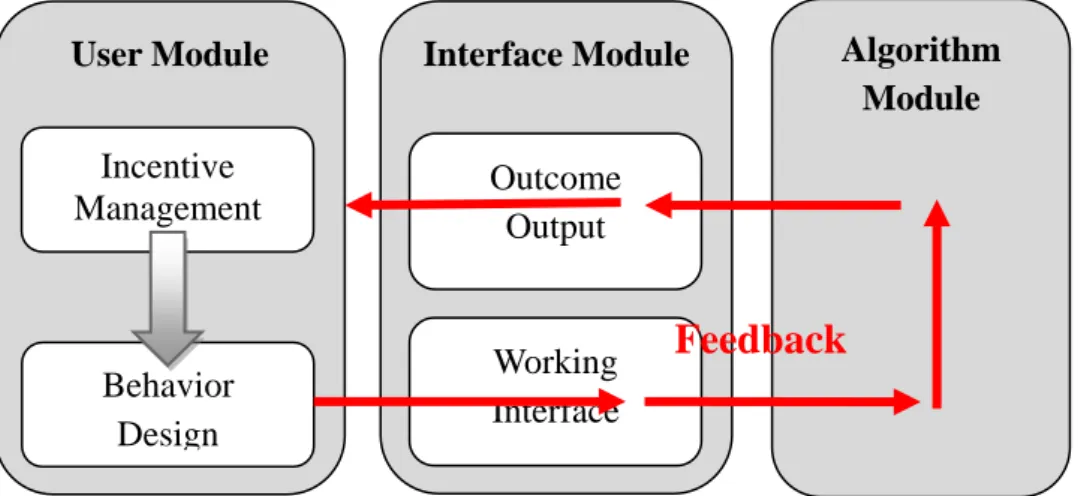
The recommendation mechanism in social bookmarking sites can then be unfolded into three module designs of the website. That is, the user module, the interface module, and the algorithm module. The sketch of the operation structure for each component is shown as Figure 1. We will elaborate each module as follows.
Figure 1. The Operation Structure of Social Bookmarking Sites
The User Module. The roles of user could be unfolded into different types including content
creator, content archivist, content referee, and reader. User could play multiple roles at the
User Module Algorithm
Module Interface Module Outcome Output Working Interface Incentive Management Behavior Design
Feedback
same time. Content creator is the blogger that writes articles for the blogs. Content creator does not directly publish their article on the social bookmarking site, but social bookmarking site will increase the visibility of the content. The provided JavaScript based “Blog Sticker” from social bookmarking site enables user make recommendations while reading articles in blog interface. Archivist is the first user who recommends an article to the social bookmarking site, which means the archivist is also a referee. The difference between archivist and referee is the archivist brings new outside content into the social bookmarking sites, but the referee contributes recommendations on the given contents. The reader is the most passive role in a social bookmarking site. Although a reader neither contributes content nor makes recommendations, but it is the most common role in the social bookmarking sites. However, if the members of contribution and collective information processing reach the threshold for generating valuable collective wisdom, readers could still brings the flows as well as the value for the websites.
Both the personal motivation and website provided incentives encourage users to contribute their contents and recommendations so as to make interactions within the website. The incentive design should consider whether the triggered behaviors could benefits the whole system. In social bookmarking sites, most referee make recommendations based on their preference. If the mechanism is designed to achieve maximum agreements among user groups, the provided incentives should consider to reward referees to make recommendations based on group preferences. (For example, referee will get rewards if their provided content earns certain positive feedbacks) The variety of operational rules on collective wisdom should be taking into consideration, including the diversity of content and role of participants.
The Interface Module. The interface module plays a double-faced role in social bookmarking
sites. On one hand the interface provides the input channel for user to share their knowledge and on the other hand the interface represents the channel to transmit the recommendation results to users. The positive feedback is also established on this double-faced role structure. Consider that pheromone for the ants, the pheromone represents the previous march path of the community, it also guide the marching directions for ants.
From the perspective of referees, the interface is the workplace where collective wisdom could propose their evaluations. According to Heylighen, effective problem solving is determined by how the problem is revealed and presented. The present includes problem description, possible reaction behaviors, and evaluation rules for optimal solution (Heylighen 1999). For social bookmarking sites, the problem description is presented through the interface design. A good interface design should average the tasks (i.e. providing articles for evaluation), and make most of the tasks have the chance to be handled. In social bookmarking sites, a good interface design is to present the content items at the most capturing place that let users to process it independently. Also, the additional incentive design (such as rewards and scores) could also encourage users to process the content according to the given behavior rules.
Since both the input channel of evaluation and the presence of the recommendation results share the same web page at the interface. It is important to adjust the balance between the two sides. Reason by analogy, the balance between variability and positive feedback for collective wisdom is important as well. It is importance to provide a design that various types of contents could have the opportunity to be noticed and evaluated. In the same time, it requires the presented recommendations could catch the mainstream issues of the public, and satisfy users with valuable contents for repeat visiting. For example, if we display the most popular articles prior than other contents, it will reduce the chance for user to read and handle the latest articles and cause the unbalanced problem. Therefore, if the collocation of latest articles and popular articles could be proper organized, it will make user satisfied with the recommendation results and also contribute their efforts to collective wisdom appropriately.
Articles with few recommendations have lower chance to be noticed in social bookmarking sites. But it may not represent that the articles with few recommendations are low quality or unfavorable to others. It is possible that article is just created and prompted to the social bookmarking site, and the number of referees is still few. Naturally, the article is with fewer recommendations since the information processing task is not fully executed. By a careful arrangement of the interface design, these kinds of articles could be revealed and refereed by collective wisdom.
The design that enables referee to make independent decisions without interferes with previous recommendations is also important. The interface design is correlated to the recommended contents, and will influence user’s satisfaction. Once the recommendation outcomes cannot achieve user’ expectation, it will reduce the will for users to utilize social bookmarking sites.
The Algorithm Module. The evaluations from referees of social bookmarking sites will be
integrated and calculated according to the given algorithm. The algorithm of social bookmarking sites has two features. The first feature is to calculate each weighted value of specific target, and present the true value of the article effectively. For example, if the referee gives positive recommendations for almost every article, then the referee may be identified and grant lower weight when calculating the recommendation results. The second feature is eliminating the possible attacks from malicious manipulations. For example, if malicious user could register massive pseudonym identities to recommend specific target, the algorithm could detect possible events from some parameters such as the IP address and exclude those untruthful feedbacks that make recommendation accurately. For most of the social bookmarking sites, the algorithm of recommendation process will not fully reveal so as to prevent users from manipulating the operation of the Website.
For the sake of managing, controlling, and influencing user’s behaviors on social bookmarking sites, the feasible solutions could consider the interface design, the incentives design and its operation algorithms. The first step is deliberating the desired user behaviors, and then designs certain methods such as providing incentives, revealing partial algorithm, redesigning the
interface so as to achieve the goal.
3.2. Structure and Parameters of Collective wisdom Simulation Design
In this paper, the positive/negative feedbacks on collective wisdom will be utilized for shaping the social bookmarking sites for high quality content and services. Within the simulation environment, autonomous agents will consistently visit blogs, participate the bookmarking activity such as archive articles, make recommendations. In the meantime, a part of agents will perform the content creator that regularly contributes articles to others. The place an article was displayed on web page is according to its visibility, and this also implies the possibility that the content can be noticed by participants. The variables and behavior rules in ABMS are defined as follows.
3.2.1. Agents
Agents in the ABMS are defined as the users of social bookmarking sites.
Content Quality (Qu): If the role of agents is the content creator, the content quality is
normally distributed according to the parameter Qu. Each content creator owns a Qu value and every article also has a Qn value. The spectrum of Qu and Qn value is from 1 to 9, which represents the possibility that an article could be recommended by referees. For example, if the Qn value of an article is 6, it implies 60% of referees will recommend this article. The Qu value of the content creator will be influenced by the feedback conditions of created articles. If the articles proposed by content creator acquire much positive feedbacks then the Qu value will be increased.
Reading Satisfaction (S): The reading satisfaction (S) of user was calculated automatically
according to the quality of read article every time user visits the website. The S is an integrated function of content quality and update status of articles. If the user read high quality content articles, then the reading satisfaction S is high. If the user read the article that is already accessed before, it cannot bring much reading satisfaction for user. On the contrast, if the update frequency of articles remains low, even the provided article is with high content quality, it cannot satisfied the users.
3.2.2. Article
Articles are the environment parameters of the ABMS. The interaction behaviors (including creating, recommending, and reading) take place between users and articles. The layout organization (i.e. the combination of articles and the sorting rules) could be considered as the outcomes of interactions between user and the environments. The following are some related parameters.
Content Quality (Qu): As mentioned in Section 3.2.1, Qu represent the content quality of an
article. Value of the Qu parameter is between 1 and 9.
Degree of Work Accomplishment (w): The visibility of an article means the content
evaluation task can be handled by user. An article could be valued correctly after sufficient evaluations. The degree of work accomplishment represents the overall percentage that an article is read and evaluated by all users. For example, if the degree of work accomplishment is 80%, which implies that 80% of registered user had already read this article.
Recommendation numbers (g): The algorithm design is out of the scope of this study. The
algorithm we applied here is the simplest voting recommendation method that every vote counts equally. The total number of recommendations (g) from users is utilizing to measure the content quality.
3.2.3. Design of Interaction Behavior Rules
In each time period, the system and every agent follow the rules and complete the sequence of tasks below, repeat interactions take place continuously until the setting time frame expires. 1. In the initial stage, setting a certain number of articles with its own quality parameter Qu on
the simulation platform.
2. Agent will create article, read article, and make feedback recommendation in every time unit.
3. The reading sequence is from the most popular articles with highest visibility to lower one. Agent decides whether to make feedback recommendations according to the reading sequence. The probability of making feedback recommendation is determined by content quality (Qu).
4. After the agent read all the articles within the system, the reading satisfaction (S) of every agent will be calculated by simulation platform.
5. The simulation platform then updates the presentation priority of each article according to the relevant parameters (the status of article created, and the status of article recommended) of the last simulation. The presentation priority determines the layout organization of next round.
6. The ABMS computes all parameters during this simulation time period.
3.2.4. Measurement of Simulation Experiment
In order to understand how the collective wisdom on social bookmarking sites is carried out, this paper utilizes the following measurement indexes for observation. Several simulation scenarios are designed and parameters are manipulated for advanced observation of simulations.
1. The Average Degree of Work Accomplishment. It describes whether the work is average distributed to users for information process in simulation experiments and whether high quality articles are concealed due to the unfairness work distributions. Since social bookmarking sites act as the key role that triggered networked collective wisdom and form a value chain of contents, whether the work accomplishment of feedback recommendation will highly influence the circulation of positive feedback of the value chain.
Work accomplishment is the leading measurement index about how the simulation works. The task dispatching will influence the degree of work accomplishment. Once high quality articles are concealed due to the defective mechanism, reading satisfaction will decrease and depress the will for content creators to contribute articles. The efficiency of works is computed based on the work distribution and the participation rate of user, which also represents a major index for observing the operation of feedback recommendation mechanism.
2. The Average Reading Satisfaction. This is the lagging indicator for measuring social bookmarking sites operations. A healthy operation mechanism with positive feedback circulations will increase the content quality for all members of the social bookmarking site.
3. The Creation of Diversified Popular Issues. The group designs enables web2.0 reaching the whole society based on the long tail effect and highlights the value of communication for target population. The social bookmarking site enables both mass communication and minority communication to create diversified popular issues and attract users for retention. These popular issues are co-created by collective wisdom with high quality content and should be able to raise sympathetic responses.
The emphasis of user generated content and collaborative interactions enables the collective wisdom in the web 2.0 era. A social bookmarking site integrates diversified network resources (especially those blog articles form user generated content) and becomes the key element of the content value chain. The feedback recommendation mechanisms are also extensively applied to other web 2.0 websites such as photos recommendation, video recommendation, etc. The social bookmarking is one of the significant instances of collective wisdom in web 2.0 applications. From the media viewpoint, social bookmarking sites are belonging to social media that provides a quite different operation method to create user generated content and enables collective behavior (public gatekeeper) to improve the social media operate smoothly.
The social bookmarking sites belong to complex systems that individuals works independently and make interactions dynamically, which is difficult to make proper estimation and observations. The operation designs of social bookmarking collective wisdom which is inspired from animal collective behaviors. In order to understand the complex operation principles and feedback recommendation impact on collective wisdom, we use the agent-based modeling simulation for advanced observation. Through the simulation experiments, we expect the operation principles and accommodative feedback mechanism shaping the collective wisdom on social media could be thoroughly explored. Precisely, the impacts of positive/negative feedback on collective wisdom would be investigated.
4. Feedback Simulations on Collective Wisdom
The simulation environment of collective wisdom was developed based on the modeling tool “Repast” (The Recursive Porous Agent Simulation Toolkit). There are some popular multi-agent simulation development toolkits, such as the StarLogo from MIT, the Swarm from Santa Fe Institute, and NetLogo from Northwestern University, etc. Repast is also the popular one, while it enables complex function and easy developments (Railsback et al. 2006). We will introduce the operation designs of feedback recommendation in section 4.1 and elaborate the simulation experiments and their outcomes in section 4.2.
4.1. The Operation Designs of Feedback Recommendation
The positive/negative feedback recommendation mechanism utilizes the integration of user’s evaluations when they read the contents to organize and sort the contents on the platform. The collective intelligences regarding the articles will bring readers better experience since the mechanism provides high quality content to users. As mentioned in section 3, reading and evaluating articles could provide double-faced implications. Users could not only help the community to evaluate the quality of each article but also recommend high quality content for others through the feedbacks. The experiment is designed by manipulate the reading behaviors of users to improve the reading strategy and benefit collective wisdom from feedback mechanism.
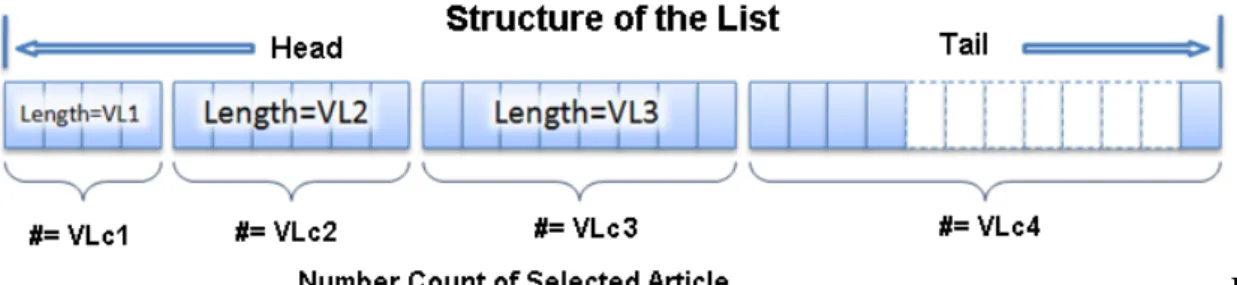
According to Lerman’s report (Lerman 2007a), the visibility of an article is influenced based on the visibility on the front page, the visibility in the upcoming stories queue, and the visibility through the friends interface. Articles on front page have the highest visibility, which implies the articles have the highest probability to be noticed by users. As the sequence of pages increases, the visibility decreases. We do not consider the friends interface (user’s social relationship tie strength) in this study. The article selection rule design is to select different volume of articles in each sections of the priority sequence list. The design is sketched as Figure 2.
Figure 2. The reading strategy designs
Every list is divided into four parts with different length. The lengths of four parts are adjustable variables. The length of the popular issue list is denoted as follows: the first part is VL1, the second part is VL2, the third part is VL3, and the rest is for last part. The sequence list is also divided into 4 parts in the same manner and denoted as TL1~TL3. Every agent will select several articles in every part of the two lists. The selection numbers are also adjustable variables. In popular issue list, the number of selection articles are denoted as VLc1~VLc4, while the numbers selected from sequence list are denoted as TLc1~TLc4. The variables could determine the possibility of an article being read. But the possibility of article selection in the same part of the list is totally equal. The reasonable setting of parameters should let the first part have the highest probability, which means articles in front page have highest visibility. As the sequence decrease, the visibility decreases, too. The parameters are introduced in Table 1.
Table 1. Parameters definitions
The assu mpti on of simu latio n expe rime nt desig n inclu des: 1. R e a s Variable Name Definition Variable Name Definition
NumUsers Numbers of agents Runs The time unit for
experiment OriginalArticl
e
Numbers of original
articles aging
Parameters for cleaning expired articles
VL1 Length of part 1 in Popular
issue list TL1
Length of part 1 in sequence list
VL2 Length of part 2 in Popular
issue list TL2
Length of part 2 in sequence list
VL3 Length of part 3 in Popular
issue list TL3 Length of part 3 in sequence list VLc1 Number of articles selected from VL1 TLc1 Number of articles selected from TL1 VLc2 Number of articles selected from VL2 TLc2 Number of articles selected from TL2 VLc3 Number of articles selected from VL3 TLc3 Number of articles selected from TL3 VLc4 Number of articles selected from VL4 TLc4 Number of articles selected from TL4
onable feedback recommendation. In our experiments, whether an agent recommend an
article is determined by the content quality of the article. If the content quality (Qu) of given article is 5, which represents there is 50% chance that agent will recommend this article. For real operations, unreasonable behaviors and recommendations from user will exist and require particular algorithms and incentive designs to eliminate them. This paper assumes the user’s behaviors are reasonable and takes simple reading strategy design that counts every vote with same weight.
2. Social relationships do not exist between users. In our experiment, agents select articles only from the two given lists (popular issue list, and sequence list). No relationships exist between agents and agents do not read articles through their social relationships.
3. Equal involvement of users. In our experiment, the involvement of every agent is equal. That is, agents read the same number of articles within a time unit, and also would make feedback recommendations after reading articles. In the real world, the involvements of users are diversified; some users contribute a lot while some users only read articles without any contributions (i.e. the free-rider)
For fully understand the performance of simulation experiments, observation indexes are designed as follows.
1. Reading Satisfaction. The average content quality of the articles an agent read in every time unit represents the reading satisfaction of that time. In particular, if the article does not update frequently, then an agent will access the already read articles. Even though these articles are with good quality, the reading satisfaction remains low due to the repeat articles. Therefore, in our experiment design, the content quality (Qu) of a repeat article for agents is set to 1 so as to present the dissatisfaction of user.
2. Repeat Rate of Reading. As mentioned previously, reading satisfaction of repeat article is set to 1. The higher repeat rate indicates the lower reading satisfaction. The repeat rate of reading equals to the total number of repeat article divided by the total number of article read in the time period, and translates to percentage format.
3. Content Quality of Front Page. Our simulations make the top 20 articles of the popular issue list present in the front page. The front page represents the outcomes of collective wisdom. This index is defined as the average content quality of the top 20 articles in the popular issue list.
4. Front Page Turnover time. This index is defined as the average time period that articles stay in the front page. If only few articles with high quality remain stay in the front page and assume the pool of articles is finite then there will be articles repeatedly brink back and forth between the front page and the pool.
5. Degree of Work Accomplishment. Each article in the simulation platform represents an
is counted as the total agent numbers that read this article divide by all agent numbers, and translated into percentage format.
6. Headline Popularity. As mentioned previously, the social bookmark site also acts as a
social media. The headline news arrangement could initiate issues and make people concentrate in the issue. When front page turnover time is short, it speeds up the metabolism of articles. However, it may not make the public concentrate on this issue due to the short turnover time. From the viewpoint of media, the popularity of popular issues is a major index. In this study, we assume that the more reader of an article, the easier to form a common issue. Therefore, the average degree of work accomplishment of the top 20 articles in front page is used for measuring the popularity of headline.
4.2. Experiments and Outcome Analysis
4.2.1. Experiment 1- Selection Effect comparison (Popular Issue List vs. Sequence List)
Experiment 1 is designed to compare the selection effect of reading strategy from popular issue list and sequence list. This experiment manipulates the combination of three variables and utilizes different reading strategies for simulations. In experiment 1-1, the reading strategy is from both the lists and select 10 articles from each list. Reading strategy in experiment 1-2 is to purely select the articles from the sequence list, which means agents only read those latest articles. On the contrast, the reading strategy in experiment 1-3 is purely from the popular issue list, and agents only read popular articles on the front page. The parameter settings of reading strategy are listed in Table 2.
In every experiment, there are 50 agents and 300 initial articles created in the time frame 0, each round execute 150 units of time. For the list partitions, the first part contains 20 articles, the second part contains 70 articles, and the third part contains 100 articles. Every experiment has its own reading strategy design, but each agent will read 20 articles and dispatch the 20 articles in each part of the popular issue list and the sequence list. The dispatching is to make the first part of the list owns the highest visibility, and decrease progressively for rest parts. This is to simulate that user rarely select those articles in the back of the list.
Table 2. Parameter settings of reading strategy in Experiment 1
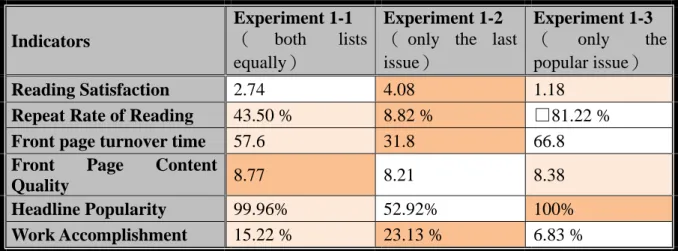
For each parameter settings, experiments take place 10 times and record the six indicators at the end of experiment (t=150). The indicators are averaged based on the 10 experiments and listed in Table 3. The best and subordinate performance of each indicator is marked in the table.
Table 3. Simulation outcome of Simulation 1
Indicators
Experiment 1-1
( both lists
equally)
Experiment 1-2
( only the last issue)
Experiment 1-3
( only the
popular issue)
Reading Satisfaction 2.74 4.08 1.18
Repeat Rate of Reading 43.50 % 8.82 % �81.22 %
Front page turnover time 57.6 31.8 66.8
Front Page Content
Quality 8.77 8.21 8.38
Headline Popularity 99.96% 52.92% 100%
Work Accomplishment 15.22 % 23.13 % 6.83 %
As shown in Table 3, the performance of indicators regarding reading satisfaction, repeat rate of reading, front page turnover time, and work accomplishment in experiment 1-2 is better than others. However, the Headline Popularity indicator is the worst one. The best performance of Headline Popularity is in experiment 1-3, however, other indicators are inferior. In experiment
Experiment 1-1
(both lists equally)
Experiment 1-2
(only the last issue)
Experiment 1-3
( only the popular issue)
Var. Val. Var. Val. Var. Val. Var. Val. Var. Val. Var. Val.
VL1 20 TL1 20 VL1 20 TL1 20 VL1 20 TL1 20 VL2 70 TL2 70 VL2 70 TL2 70 VL2 70 TL2 70 VL3 100 TL3 100 VL3 100 TL3 100 VL3 100 TL3 100 VLc 1 3 TLc 1 3 VLc 1 0 TLc 1 6 VLc 1 6 TLc 1 0 VLc 2 3 TLc 2 3 VLc 2 0 TLc 2 6 VLc 2 6 TLc 2 0 VLc 3 2 TLc 3 2 VLc 3 0 TLc 3 4 VLc 3 4 TLc 3 0 VLc 4 2 TLc 4 2 VLc 4 0 TLc 4 4 VLc 4 4 TLc 4 0
General setups:NumUsers=50 OriginalArticle=300 Runs=150
1-1 which combines both reading strategies, its Headline Popularity has the similar performance to experiment 1-3, while the other indicators are much higher than experiment 1-3.
A particular phenomenon happens in the simulation: a few articles achieve the extremely high work accomplishment while others are low. Those highly refereed articles aggregate in the beginning stage of the simulation experiment. In experiment 1-3, some articles created in the initial stage occupy the front page that makes other articles lower visibility. This also explains the reason that the Headline Popularity in experiment 1-3 is the highest but the FrontPage Turnover Time is long, and highly repeat reading makes the reading satisfaction lower.
General speaking, the reading satisfaction is the highest in experiment 1-2, but it only considers the time sequence for selecting article, this make the feedback recommendation mechanism useless for improvement. The strategy results in lower Headline Popularity and lower Front Page Content Quality. This does not match the concept that utilizes the collective wisdom in social bookmarking sites to screen most popular issues. Experiment 1-3, on the contrast, the strategy that has higher Headline Popularity and Front Page Content Quality, but last created articles lost the visibility. Relatively, experiment 1-1 combines both reading strategies, will be the appropriate solution.
Simulation experiment 1 presents the different effects about how collaborative filter design that selects reading articles according to the popularity or time sequence. Articles refereed by readers and recommended to front page will form positive feedback that improves the visibility of high quality contents. When readers could access the latest articles, they will help the collective wisdom to contribute the new articles that average the overall work accomplishment. An ideal strategy is to guide readers regarding both the popularity and time sequence. This also explains the positive feedback and independence are necessary conditions for providing collective wisdom. Selecting from the popular headline represents the positive feedback mechanism. And selecting according to time sequence implies the independence decision of users. In experiment 1-1, however, unbalanced work distribution leads to highly repeat reading rate and long turnover time.
4.2.2. Experiment 2. Drop Out Operations of Out-of-Date Articles
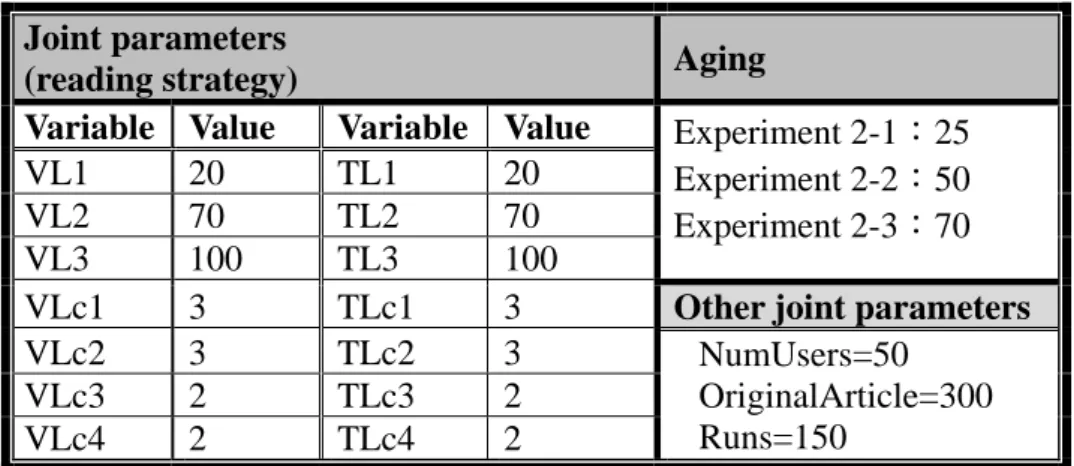
In order to solve the problems of high Repeat Reading Rate and long Turnover Time, drop out operations are introduced by aging the articles and handle the out-of-date articles. That is, if articles stay in the platform for a certain period of time, they will be removed from the popular list and make new articles have higher visibility. In experiment 2, different aging parameters (25, 50, 75 units of time) are applied while the reading strategy is in compliance with experiment 1-1. This means when the article is created, they will be removed from the popular list after 25, 50, and 75 units of time. A comparison about experiment 1-1 (same strategy but no drop out) will also take place. Parameter settings in experiment 2 are shown in Table 4. Each
sub-experiment will take place 10 times and calculate the averaged outcome indicators.
Table 4. Parameters settings in Experiment 2
Joint parameters
(reading strategy) Aging
Variable Value Variable Value Experiment 2-1:25
Experiment 2-2:50 Experiment 2-3:70 VL1 20 TL1 20
VL2 70 TL2 70 VL3 100 TL3 100
VLc1 3 TLc1 3 Other joint parameters
VLc2 3 TLc2 3 NumUsers=50
OriginalArticle=300 Runs=150
VLc3 2 TLc3 2
VLc4 2 TLc4 2
The experiment outcomes, the best and subordinate performance of each indicator are marked in the Table 5. Due to the drop out operation design, significant improvement of high Repeat Reading Rate and long Turnover Time can be noticed in comparing with experiment 1-1. The best improvement setting is the shortest aging time in experiment 2-1. However, the Headline Popularity, Front Page Content Quality, and Work Accomplishment are lower by applying the drop out operation of out-of-date articles. The headline popularity declined about 20% in experiment 2-1.
Table 5. Experiment outcomes for drop out operations
Indicators Experiment 2-1 (Aging=25) Experiment 2-2 (Aging=50) Experiment 2-3 (Aging=75) Experiment 1-1 (Aging=0) Reading Satisfaction 3.80 3.48 3.24 2.74
Repeat Rate of Reading 26.70 % 31.66 % 35.84 % 43.51 %
Front Page Turnover Time 7.1 14.0 21.2 57.6
Front Page Content
Quality 7.92 8.2 8.3 8.77
Headline Popularity 80.17 % 92.78 % 97.02 % 99.96 %
Work Accomplishment 12.66 % 12.90 % 15.56 % 15.22 %
In general, due to the short aging time setting in experiment 2-1, the performance in Repeat Reading Rate and Turnover Time is good, but articles have lower visibility and lower Front Page Content Quality. The Headline Popularity is much lower than other experiment settings. Relatively, even the Headline Popularity in experiment 2-2 and 2-3 are lower than experiment 1-1, but is still over 90%. Their Front Page Content Quality is higher than 8 and perform much better in Reading Satisfaction comparing to experiment 1-1. The suitable drop out operation design will improve the overall performance.
Satisfaction, Repeat Rate of Reading, Front Page Turnover Time) could be categorized in the same group while it is related to the update of the articles. The indicators including Front Page Content Quality, Headline Popularity can be also categorized in the same group that reflects the effect of collective filtering. The performance between the two groups is tradeoff relationships and should be considered when applied to real world operations.
4.2.3. Experiment 3-Simulations on Inhibition and robust
Discussions of collective wisdom in section 2 show clearly that positive feedback could improve the visibility of good quality plans from various plans. The negative feedback or inhibition mechanism could diminish the effect of wrong decision, and stabilize the whole system. In previous experiments, the positive feedback design allow users to make recommendation when reading an article so as to increase the visibility of popular and high quality articles. However, neither negative feedback nor inhibition mechanism is considered in previous experiments. In experiment 3, we apply the inhibition concept and observe the overall system performance.
In previous experiment, if the reader recommends an article then the total vote count will increase. But if reader does not recommends that article, the total vote count remains as original number. In experiment 3, we utilize the negative recommendation for inhibition. That is, when reader does not recommend an article, it means the total vote count of that article will decrease a vote count. In our experiment, the negative feedback recommendation is only for the popular issue list. The operation principle is: there might be some articles are highlighted due to recommendations from unreasonable or unfair readers and positive feedback mechanism. The content quality of these articles is not qualified to occupy the popular issue list, and require negative feedback mechanism to balance the inappropriate outcomes from positive feedback mechanism.
Experiment 3-1 adopts the better designs from experiment 1 and 2. That is, take 10 articles from popular issue list, take another 10 articles from time sequence list, and set the aging time of article to 50 time units. The only difference is the use of negative feedback mechanism on popular issue list. Comparisons target is experiment 2-2 that has the same parameter settings but without inhibition mechanism. The parameter settings of the two experiments are listed in Table 6.
Table 6. Parameter settings of negative feedback mechanism simulations
Reading strategy parameters Other variables Variable Value Variable Value
NumUsers=50 OriginalArticle=300 Runs=150 Aging=50 VL1 20 TL1 20 VL2 70 TL2 70 VL3 100 TL3 100 VLc1 3 TLc1 3 VLc2 3 TLc2 3
VLc3 2 TLc3 2
VLc4 2 TLc4 2
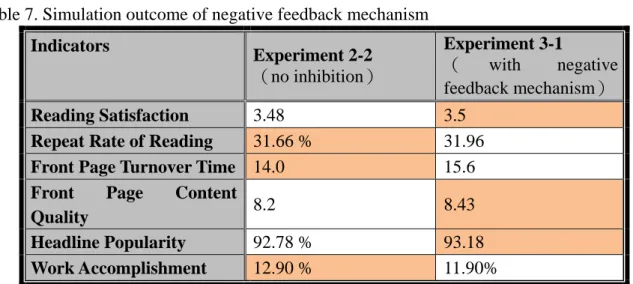
Table 7. Simulation outcome of negative feedback mechanism
Indicators Experiment 2-2 (no inhibition) Experiment 3-1 ( with negative feedback mechanism) Reading Satisfaction 3.48 3.5
Repeat Rate of Reading 31.66 % 31.96
Front Page Turnover Time 14.0 15.6 Front Page Content
Quality 8.2 8.43
Headline Popularity 92.78 % 93.18
Work Accomplishment 12.90 % 11.90%
The performance indicators of the simulation experiment outcomes are recorded in Table 7. With the inhibition (negative feedback mechanism) will improve the Front Page Content Quality as well as the Headline Popularity, while other indicators are minor influenced. In particular, the Reading Satisfaction is increased while the Repeat Rate also increases. The effects of collective filtering are truly improved by reading high quality content and receive higher reading satisfaction. Besides the improvement on Reading Satisfaction, the negative feedback mechanism also stabilizes other indicators in experiment 3-1, which means collective wisdom could be stabilized by applying the negative feedback mechanism.
For advanced exploration of the effect of negative feedback mechanism, we apply some unreasonable users in the following experiments. Those unreasonable users are expected to create irrational recommendations in these experiments, and then we will monitor the effect of inhibition from negative feedback mechanism. The irrational behavior is designed to have N % chance that user make negative feedback recommendations when the content quality is N, which is the opposite behavior rule of general recommendation. The following six experiments examine the performance indicators on the 10%, 30%, and 50% of irrational users with both feedback design settings. Detailed experiment parameters are shown in Table 8.
Table 8. Parameter settings in experiment 3-2~3-7
Experiment # 3-2 3-3 3-4 3-5 3-6 3-7
% of irrational users 10% 30% 50%
Apply Negative
feedback mechanism No Yes No Yes No Yes
Other parameters:
VL1=20 VL2=70 VL3=100 VLc1=3 VLc2=3 VLc3=2 VLc4=2 TL1=20 TL2=70 TL3=100 TLc1=3 TLc2=3 TLc3=2 TLc4=2
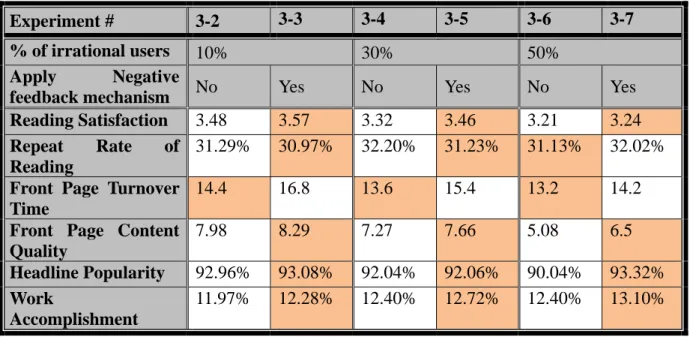
Table 9. Outcomes of negative feedback mechanism with irrational behavior
Experiment # 3-2 3-3 3-4 3-5 3-6 3-7 % of irrational users 10% 30% 50%
Apply Negative
feedback mechanism No Yes No Yes No Yes Reading Satisfaction 3.48 3.57 3.32 3.46 3.21 3.24
Repeat Rate of Reading
31.29% 30.97% 32.20% 31.23% 31.13% 32.02%
Front Page Turnover Time
14.4 16.8 13.6 15.4 13.2 14.2
Front Page Content Quality 7.98 8.29 7.27 7.66 5.08 6.5 Headline Popularity 92.96% 93.08% 92.04% 92.06% 90.04% 93.32% Work Accomplishment 11.97% 12.28% 12.40% 12.72% 12.40% 13.10%
The better performance indicators are marked in Table 9. Two trends can be observed from the experiments. (1) With the increase of irrational users, the overall performance will decline. (2) Experiment with negative feedback mechanism performs better than others. This result confirms to the experiment 3-1 that inhibition could improve the ability of error adjustment on collective wisdom and stabilize the whole recommendation system.
5. Discussion
Based on the simulation results of Section 4, certain analysis points about the impacts of the positive/negative feedbacks for social bookmarking sites (or even web 2.0 applications in general) could be manifested.
As mentioned in section 3, social bookmarking sites could be unfolded into three parts, the user, the interface, and the algorithm. Experiment 1 is related to the reading strategy of the users. Experiment 2 is related to the algorithm that considers the drop out operation from negative feedback mechanism. Experiment 3 is also related to user behaviors; by providing the negative recommendation function for user to perform the inhibition and negative feedback mechanism so as to stabilize the whole system performance. Through the experiments, we found the tradeoffs existed between article update frequency and the effects resulting from collaborative filtering. These tradeoff analyses are believed to be useful to design and operate social bookmarking sites effectively in order to derive the good quality in collective wisdom.
The analysis points attained are then enlisted below:
1. User behaviors could be manipulated by the design of incentives and interfaces; it could also be controlled by revealing partial algorithms behind the web 2.0 system. The principle, directions, and strategy could be inspired from these experiments. The tradeoff between collective filtering and update frequency should be precisely managed for better performance improvement. The website owner could manipulate the designs for their diversified goals. The balance between popular issue and time sequence could cope with the interface design so as to encourage users to read and contribute themselves for various contents in the website.
2. The Repeat Reading Rate is an important indicator for user satisfaction. Since repeat articles could not satisfy users, but the popularity of headline requires the visibility of these articles, and may increase the repeat reading. Therefore, if the additional discussion is added to these articles, it will extend the time to stay in the front page but also diminish the repeat reading since the new ideas are contributed continuingly in the same article. New opinions could improve the User Satisfaction while reading the repeat articles.
3. The negative feedback could shape the collective wisdom and stabilized the system performance. But in real operations, irrational behaviors from malicious users should be also considered seriously. The simulation experiment assumes most of the users behave reasonably. But for real world website operations, the previous mentioned directions (incentives design, interface design and revealing partial algorithm) could reduce the irrational user behaviors.
4. We assume the one with different opinions are irrational users. But it happens in real world due to their varied preference and interests, instead of the irrational behaviors, and this could not be treated as the malicious users. Their opinions should be noticed by certain mechanism designs that consider both majority groups and minority groups.
6. Conclusion and Future Directions
For guiding the development of bottom-up collective wisdom, this paper presents a meta-perspective positive/negative feedbacks viewpoint to understand the shaping of the collective wisdom towards high quality performance and service improvement. We also found the feedbacks also influence the stabilization of the overall performance.
This paper uses the case of social bookmarking sites (one of the representative web 2.0 applications) to unfold our investigations. The social bookmarking sites benefit from UGC (users generated contents) and the interactions from massive users from the community for information process, evaluation, and recommendation.
Inspired from the collective animal behaviors, this paper analyzes the impacts of the positive/negative feedback mechanisms on the collective wisdom through the agent-based modeling and simulations. Certain useful design and operation principles to drive the high
quality of collective wisdom in social bookmarking sites are derived based on the in-depth analysis of the simulation results. These principles are also believed to be useful to other web 2.0 applications.
References
Adar, E., Zhang, L., Adamic, L. A., & Lukose, R. M. (2004). Implicit structure and the dynamics of blogspace. Workshop on the Weblogging Ecosystem, 13th International World Wide Web Conference.
Bonabeau, E., Theraulaz, G., Deneubourg, J. L., Aron, S., & Camazine, S. (1997). Self-organization in social insects. Trends in Ecology & Evolution, 12(5), 188-193.
Bonabeau, E. (2002). Agent-based modeling: Methods and techniques for simulating human systems. Proceedings of the National Academy of Sciences, 99(90003), 7280-7287.
Camazine, S., Deneubourg, J. L., Franks, N. R., Sneyd, J., Theraulaz, G. & Bonabeau, E. (2001) “Self-organization in biological systems. Self-organization in biological systems. Princeton University Press.
Hamilton, W. D. (1964) The genetical evolution of social behaviour, I and II. Journal of Theoretical Biology, 7, 1–52
Hammond, T., Hannay, T., Lund, B., & Scott, J. (2005). Social bookmarking tools (I). D-Lib Magazine, 11(4), 1082-9873.
Heylighen, F. (1999). Collective intelligence and its implementation on the web: Algorithms to develop a collective mental map. Computational & Mathematical Organization Theory, 5(3), 253-280.
Lerman, K. (2007). Dynamics of collaborative document rating systems. Proceedings of the 9th WebKDD and 1st SNA-KDD 2007 Workshop on Web Mining and Social Network Analysis, 46-55.
Lerman, K. (2007). Social networks and social information filtering on digg. Proceedings of the International Conference on Weblogs and Social Media (ICWSM-07)
Lerman, K. (2007). Social information processing in social news aggregation. IEEE Internet Computing, 16-28.
Lund, B., Hammond, T., Flack, M., Hannay, T., & NeoReality, I. (2005). Social bookmarking tools (II). D-Lib Magazine, 11(4), 1082-9873.
Macal, C. M., & North, M. J. (2005). Tutorial on agent-based modeling and simulation. Proceedings of the 37th Conference on Winter Simulation, 2-15.
Mika, P. (2007). Ontologies are us: A unified model of social networks and semantics. Web Semantics: Science, Services and Agents on the World Wide Web, 5(1), 5-15.
Railsback, S. F., Lytinen, S. L., & Jackson, S. K. (2006). Agent-based simulation platforms: Review and development recommendations. Simulation, 82(9), 609-623.
Robson, S. K., & Traniello, J. F. A. (1999). Key individuals and the organization of labor in ants. Information Processing in Social Insects, 239–259.
Smith, G. (2008). Tagging: People-powered metadata for the social web. Berkeley.
Surowiecki, J. (2004). The wisdom of crowds: Why the many are smarter than the few and how collective wisdom shapes business, economies, societies and nations. Doubleday.
Sumpter, D. J. T. (2006). The principles of collective animal behaviour. Philosophical Transactions of the Royal Society B: Biological Sciences, 361(1465), 5-22.