行政院國家科學委員會專題研究計畫 成果報告
團聯式共聚高分子微胞在受限環境中的自組裝行為
研究成果報告(精簡版)
計 畫 類 別 : 個別型 計 畫 編 號 : NSC 100-2221-E-009-045- 執 行 期 間 : 100 年 08 月 01 日至 101 年 07 月 31 日 執 行 單 位 : 國立交通大學應用化學系(所) 計 畫 主 持 人 : 陳俊太 計畫參與人員: 碩士班研究生-兼任助理人員:李庭嫻 碩士班研究生-兼任助理人員:蔡佳展 博士班研究生-兼任助理人員:姚奕群 報 告 附 件 : 出席國際會議研究心得報告及發表論文 公 開 資 訊 : 本計畫可公開查詢中 華 民 國 101 年 10 月 30 日
中 文 摘 要 : 利用高分子來潤濕孔洞形模板是一個很有效用來製備高分子 奈米材料的方法。然而,對這些高分子奈米材料大小及形態 的控制通常是很困難的。在本報告中,我們研究了在高分子 奈米材料的形成過程中非溶劑的效應。我們利用水來當作非 溶劑,加入受限於陽極氧化鋁奈米孔洞的 PMMA 溶液中。非溶 劑(水)會潤濕孔洞的強壁,因而迫使得 PMMA 的溶液被孤立在 奈米孔洞的中央部份。在溶劑揮發之後,可以因此形成 PMMA 的奈米球或是奈米柱的結構。這些奈米球與奈米柱的長寬比 可以利用高分子溶液的濃度來加以改變。這些受非溶劑影響 而形成的奈米結構是用所謂的雷利不穩定性所驅使。若沒有 使用非溶劑,則 PMMA 的分子只是沉積在奈米孔洞的牆壁上而 形成高分子奈米管。除了 PMMA 以外,另一個常用的高分子 PS 也被用來驗證實驗的機制。本研究不但提供了一個簡單用 來製備高分子奈米材料的方法以外,也對高分子材料在受限 環境的行為了解很有幫助。 中文關鍵詞: 陽極氧化鋁,受限效應,奈米柱,奈米管,模板 英 文 摘 要 : Wetting a porous template with polymer melts or
solutions has been proved to be a promising method to fabricate different kinds of polymer nanomaterials. However, the control over the morphology and sizes of these polymer nanomaterials is still difficult. In this report, we study the effect of using nonsolvent on the formation of polymer nanomaterials in the nanochannels of porous alumina templates. Water is used as nonsolvent and is added into a poly (methyl methacrylate) (PMMA) solution in dimethylformamide (DMF) which is confined in the nanochannels of an anodic aluminum oxide (AAO) membrane. The nonsolvent wets the pore wall and forces the PMMA solution to be isolated in the center of the nanochannels. After the evaporation of the solvent, PMMA nanospheres or
nanorods are formed. The ratios between the lengths and the diameters of the PMMA nanospheres or nanorods are varied by changing the concentration of the
polymer solution. The formation of the polymer nanomaterials caused by water is considered to be driven by the Rayleigh-instability-driven
transformation. If the nonsolvent is not added, PMMA molecules deposit on the pore walls after the solvent is evaporated, and PMMA nanotubes are generated. In
addition, the nonsolvent effect is investigated for another polymer, polystyrene (PS). Similar results are obtained using PS. This study not only provides a simple way to prepare polymer nanomaterials with controlled sizes and morphology, but also leads to a deeper understanding of the formation of polymer nanomaterials in confined nanopores.
英文關鍵詞: anodic aluminum oxide, confinement, nanorods, nanotubes, templates
Introduction
Recently, the preparation of polymer nanomaterials has aroused great interest due to their special properties and applications in field such as sensors, actuators, drug delivery, or solar cells.[1-4] Compared with other preparation methods, the template method has been shown to be a useful method to fabricate different kinds of polymer nanomaterials.[5, 6] Polymer solution or melt are introduced into the nanochannels of porous templates by wetting, and polymer nanomaterials are produced after the selective removal of the templates.[7] The polymer nanomaterials have unique properties and special morphologies, which are not observed in the bulk.[8-11] One of the most frequently used templates is the anodic aluminum oxide (AAO) membrane, which is fabricated by the electrochemical oxidation of aluminum foil.[12] By applying a two-step anodization process, which was developed by Masuda et al., AAO membranes with hexagonally packed nanochannels and high pore densities can be fabricated.[13] Even though many polymer nanomaterials have been prepared using templates such as the AAO templates, there are only few studies which focus on the formation mechanism of polymer nanomaterials using the template method.[14] For instance, Russell et al. studied the transition from partial to complete wetting of PS melts using AAO membranes.[15] The wetting transition was proved to be related to the spreading coefficient, which is also dependent on the annealing temperature and the molecular weight of polymers. In addition, Wendorff et al. studied the effect of polymer molecular weight on the formation of PS nanomaterials by wetting AAO templates with different polystyrene solution.[16] They found that the formation of PS nanotubes, nanorods, or unique void structures can be varied by changing the molecular weight of polymers. Later, Jin et al. studied the effect of interfacial interactions on adjusting the polymer structures by template wetting with PS solution.[17] They showed that the nanorod morphology is related to the solvents which have preferential interaction to the pore wall of the template. Despite these studies, it is still difficult to fully understand the formation mechanism of polymer nanomaterials prepared by templates. The formation process of these nanomaterials involves many related factors, such as the type of polymers, the molecular weight of polymers, the solution concentration, the solvent type, the drying condition, the size of the nanopore, and the surface chemistry of the pore wall.[18-25] These factors are critical in controlling the properties, morphologies, and sizes of polymer nanomaterials made by templates, but they still require further studies.
In this report, we show the effect of nonsolvent on the formation of polymer nanomaterials prepared by templates. Poly(methyl methacrylate) (PMMA) solution in DMF is first introduced to the nanochannels of AAO templates by a capillary force. Without adding the nonsolvent, PMMA chains deposit on the pore wall, and nanotubes are prepared after the solvent is dried by using a vacuum pump. By adding the nonsolvent, the PMMA solution is forced to be isolated in the center of the nanochannels of the templates, and PMMA nanospheres or nanorods are formed after the solvent is dried. The aspect ratios of the polymer nanostructures are found to be related to the polymer concentration. The formation of these nanomaterials is caused not only by the non-favorable interaction between the polymer and nonsolvent, but also by the confinement effect of the nanoporous template. To demonstrate the versatility of this study, another commonly used polymer, PS, is also investigated, and similar data are obtained.
By investigating different drying periods of the polymer solution in the nanochannels before water is added, the formation mechanism of the polymer nanomaterials is shown to be related to the Rayleigh-instability-type transformation. The Rayleigh instability was first demonstrated by Plateau, who studied the instability in
then breaks into a chain of drops in order to reduce the total surface energy. Later, Rayleigh demonstrated that the wavelength of the distortion and the diameter of the drops are determined by the fastest distortion mode.[27] Similar studies were further conducted by Nichols and Mullins, who extended Rayleigh’s approach to solid cylinders.[28] The Rayleigh-instability-type transformation has been shown for different materials such as metals or polymers.[29-31] Here, the polymer solution confined in a nanochannel is isolated by water and forms a cylindrical domain, which later changes and breaks into spherical domains, resulting in the formation of polymer nanospheres with similar sizes. When little amount of solvent has been evaporated before adding water, the transformation process is completed, and intermediate structures can also be observed.
Experimental
Polystyrene (PS) was obtained from Sigma Aldrich with the weight average molecular weight (Mw) of 35
kg/mol. Poly (methyl methacrylate) (PMMA) with weight average molecular weights (Mw) of 97 and 557
kg/mol) were obtained from Sigma Aldrich and Polymer Source, respectively. Dimethylformamide (DMF) and sodium hydroxide (NaOH) were purchased from TEDIA. The AAO membranes (pore diameter ~ 150-400 nm, thickness ~ 60 μm) were bought from Whatman. Polycarbonate filters (VCTP, pore size: 0.1 μm) were purchased from Millipore. The wipers (Kimwipes) were obtained from Kimberly-Clark.
PMMA and PS nanomaterials were made under different but similar conditions. For making PMMA nanomaterials, for instance, polymer solutions (PMMA in DMF) with different concentrations (5, 8, 10, 16, and 32 wt%) were first made. To parepare PMMA nanotubes, the AAO templates were immersed into the PMMA solution for 3 s. After the templates were removed from the solution, the residual solution outside the nanopores of the AAO templates was cleaned by wiping with wipers (Kimwipes). Later, the samples were dried by a vacuum pump, followed by immersing into NaOH(aq) to selectively remove the AAO template.
Finally, the samples were filtered and washed with deionized water using polycarbonate filters. To prepare PMMA nanospheres or nanorods, similar process were performed, but the AAO templates were dipped into a glass bottle of water before the templates were selectively removed by using NaOH(aq).[32]
A scanning electron microscope (SEM) with an accelerating voltage of 10 kV was used to investigate the polymer nanomaterials. Before the SEM studies, the samples were dried in a vacuum oven at 30 oC and were coated with 4 nm platinum. Bright-field transmission electron microscopy (TEM) experiments were conducted with a JEOL TEM operating at an accelerating voltage of 200 kV. For TEM measurement, the samples were placed onto copper grids covered with Formvar and carbon.
Results and Discussion
In order to investigate the nonsolvent effect on the formation of polymer nanomaterials prepared by porous templates, we use water as the nonsolvent. We consider the Hildebrand solubility parameters (δ) of the polymers and solvents. The Hildebrand solubility parameter is the square root of the cohesive energy density, and is frequently used as an indicator for solvation and swelling.[33] Polymers are soluble in solvents with solubility parameters of similar values. The solubility parameters of PMMA, PS, DMF, and water are 19.4, 18.6, 24.8, and 47.9 MPa1/2, respectively. Therefore, PMMA and PS are soluble in DMF and are insoluble in water. It is also critical that DMF and water are miscible, so that water can diffuse into the polymer solution confined in the nanochannels.
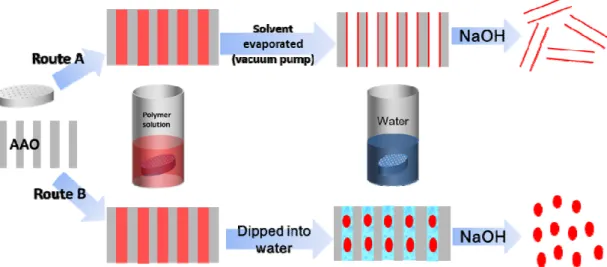
Figure 1. The illustration of the experimental processes. For route A, the sample is dried directly using a
vacuum pump without adding water, and polymer nanotubes are obtained. For route B, the sample is dipped into water before the AAO template is selectively removed by NaOH(aq).
The scheme for fabricating the polymer nanomaterials is shown in Figure 1, which is separated into route A and route B. The difference between route A and route B is that water (nonsolvent) is not added in route A to show the effect of the nonsolvent. For both routes, the polymer solution is introduced into the nanopores of the AAO templates by a capillary force. The height at which the polymer solution can reach by the capillary force is inversely proportional to the radius of the nanochannels, given by the Jurin’s law:[34]
h = 2 γ cosθ/ρg r (1)
where h is the maximum height, γ is the surface tension of the solution, θ is the contact angle of the solution at the pore wall, ρ is the density, g is gravity, and r is the radius of the nanopore. The height at which the polymer solution can reach is higher than the length of the nanopores (~ 60 μm), mainly because of the small pore diameters (~150-400 nm). The lower viscosity of the polymer solution causes the solution to be drawn into the nanopores within a very short time.
After the AAO templates are removed from the polymer solution, a wiping step using a Kimwipes wiper is performed to selectively remove the polymer solution outside the nanopores of the AAO templates. This step is to make sure that the polymer nanomaterials obtained after removing the templates are from the materials confined in the nanochannels. Without the wiping process, the results are disturbed by the materials outside the nanochannels. For route A, the solution-containing templates are dried using a vacuum pump, resulting in the deposition of polymers on the pore walls. After the templates are selectively removed by aqueous NaOH solution, polymer nanotubes can be obtained. The vacuum pump is applied to make sure that the solvent is dried. If not, the residual solvent in the nanochannels may cause the morphology change of the polymers when the samples are dipped into the aqueous NaOH solution. For route B, the solution-containing templates are dipped into a bottle of water immediately after the wiping step. The preferential interaction between water and the pore wall induces the formation of a wetting layer of water on the surface of the pore wall.[35] Therefore, the polymer solution is isolated in the center of the nanopores. After the templates are selectively removed by using aqueous NaOH solution, nanospheres or nanorods are observed, depending on the concentration of the polymer solution.
When water is introduced into the PMMA solution-containing nanopores, it is critical to make sure that the solvent is not dried. If the solvent has evaporated completely before introducing water, then polymer nanotubes can be obtained, due to the precipitation of the polymers on the pore wall. In this study, the solvent for the polymer is DMF, which has a high boiling point (153 oC) and a low vapor pressure (2.6 mmHg at 20
oC). Consequently, the polymer solution can stay longer in the nanopores of the AAO template before the
water is added. For solvents such as THF (boiling point: 66 oC, vapor pressure: 129 mmHg at 20 oC) or chloroform (boiling point: 61 oC, vapor pressure: 159 mmHg at 20 oC), good solvents for PMMA at room temperature, they have higher vapor pressures than that of DMF and evaporate quickly.
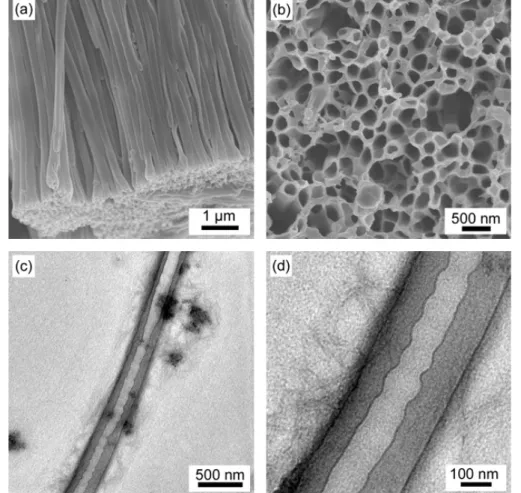
Figure 2. Electron microscopy (SEM and TEM) images of PMMA (Mw: 97 kg/mol) nanotubes. (a-b) SEM
pictures of PMMA nanotubes from 5 wt% (a) and 10 wt% (b) PMMA solution. (c-d) TEM pictures of PMMA nanotubes from 10 wt% PMMA solution with low (c) and high (d) magnifications.
Figure 2 is the SEM and TEM pictures of PMMA nanotubes. Without water, PMMA precipitate on the pore wall of the AAO template after the solvent evaporates.[36] The diameters (150-400 nm) and length (~ 60 μm) of the PMMA nanotubes correspond to the sizes of the nanopores. Branched structures, which indicate the branched pores in the AAO templates, can be observed from the side view of the nanotubes (Figure 2a). The tubular shape of the structures is observed from the top view shown in Figure 2b. The top parts of the nanotubes are observed to be inter-connected, showing that the polymer solution wets the top surface of the template and forms a thin polymer film. Figure 2c and d show two typical images of a single PMMA nanotube with low and high magnifications, respectively. The tubular structure is clear, and the wall thickness of this nanotube is ~ 100 nm with an diameter of ~ 300 nm. The wavy structures with nonuniform thickness on the tube wall are caused by the fast evaporation of the solvent by using the vacuum pump. The sample has
been dried by the vacuum pump, so the tubular polymer structures are retained even after they are exposed to the aqueous NaOH solution.
Figure 3. SEM and TEM images of PMMA (Mw: 97 kg/mol) nanospheres and nanorods. (a-b) SEM
images of PMMA nanospheres from 5 wt% (a) and 10 wt% (b) PMMA solution. (c-d) TEM images of PMMA nanorods from 5 wt% (c) and 10 wt% (d) PMMA solution.
After adding water into the PMMA solution confined in the nanochannels of AAO templates, PMMA nanospheres or nanorods are obtained. Figure 3a is the SEM image of PMMA nanostructures by adding water into 5 wt% PMMA solution. Water wets the pore wall and causes the PMMA solution to precipitate in the center of the nanopores, resulting in the formation of PMMA nanospheres and short nanorods. As the PMMA concentration increases to 10 wt%, longer PMMA nanorods are obtained (see Figure 3b). The inner structures of the PMMA nanomaterials from 5 and 10 wt% PMMA solution are further investigated by TEM (Figures 3c and 3d), and the solid structure of the materials is shown. The results from 5 and 10 wt% PMMA solution shows the dependence of the polymer morphology on the polymer concentration. The PMMA concentrations are further increased to 16 and 32 wt% (Figure 4a and 4b), and PMMA nanorods with even longer lengths are obtained. The highest concentration we used in this work is 32 wt%, because of the solubility problem and the high viscosity of the polymer solution. When the polymer concentration is very high, the viscous solution is difficult to be used. The relationship between the aspect ratio (the length divided by the diameter) of the
PMMA nanostructures and the concentration of the polymer solution is plotted in Figure 4c. The aspect ratio of the nanomaterials increases with the polymer concentration.
Figure 4. SEM pictures of PMMA (Mw: 97 kg/mol) nanomaterials prepared from (a) 16 and (b) 32 wt%
PMMA solution. (c) Plot of the aspect ratio of the nanorods versus the polymer concentration. The closed boxes represent the average values of the aspect ratios, and the error bars indicate the standard deviation.
In order to understand the formation mechanism of the polymer nanomaterials induced by nonsolvent and the concentration-dependent morphology, we also study the intermediate states of the formation process by controlling the amount of solvent in the nanochannels. The above results are obtained by immersing the solution-containing templates into water without any drying process. The solution-containing (5 wt% PMMA in DMF) templates are dried at room temperatures for different periods of time before immersing into water. Figures 5b, 5c, 5d, and 5e are the SEM images of the water-induced PMMA nanomaterials by drying for 30, 20, 10, and 0 minutes, respectively. Wavy PMMA structures are obtained at longer drying time, while PMMA nanospheres are observed without the drying process. From these results, we propose a simple model to explain the possible formation mechanism of the water-induced polymer nanomaterials, as demonstrated in Figure 5a. When water enters the solution-containing nanopore and wets the pore wall, the polymer solution is isolated and forms a cylindrical domain. The cylindrical solution then undulates and breaks into spherical domains, caused by the Rayleigh instability.[26, 27]
Figure 5. The model and SEM images of the formation mechanism of polymer nanomaterials induced by
nonsolvent. (b-e) SEM images of PMMA (Mw: 97 kg/mol) nanostructures from 5 wt% PMMA solution under
When the Rayleigh instability is used for viscoelastic materials, the viscosity resists the breakup of the materials.[37] The time for the material breakup is
τm = η R0 /σ (2)
where τm is the characteristic time for the fastest growing mode, η is the viscosity, R0 is the radius of the
cylinder, and σ is the surface tension.[37, 38] When the sample is not dried before putting into water, more solvent is present in the nanochannels. Therefore, the characteristic time for the transformation process is short because of the solution viscosity is low. Consequently, the cylindrical solution domain undulates and forms spherical domains before the solvent is dried, resulting in the formation of polymer nanospheres (Figure 5e). When some solvent are dried before immersing the sample into water, the time for the transformation process is long because of the solution viscosity is high. Consequently, the transformation process may not be completed before the solvent is dried, resulting in the formation of undulated structures (Figure 5b, 5c, and 5d). The undulated structures can be observed by using polymers with higher molecular weights without any drying process, due to the higher solution viscosity. For example, PMMA with high molecular weight (Mw:
557 kg/mol) is used, and undulated PMMA structures are obtained, as shown in the Supporting Information. Even though most results can be explained by the simple model, the mechanism of the formation of the polymer nanomaterials induced by nonsolvent is considered to be more complicated. This complexity is because water is soluble in DMF, so the interface between water and the polymer domain is not well-defined. If water wets the pore wall and diffuses into polymer solution by Fickian diffusion, a broad interface is expected.[39] If some amount of solvent is dried, water may diffuse into the concentrated polymer solution by non-Fickian diffusion (Case II), in which the diffusion constant is a function of the concentration, and a sharp interface may be formed.[40] In addition, the rate of precipitation of the polymers is controlled by the diffusion rate of water molecules. To solve these issues, a different model may be required to better reflect the formation process.
The sizes of the polymer nanomaterials preapred by templates are also compared to the original pore sizes of the AAO templates. The nanochannels can be observed by the top view of the AAO templates, as shown in the Supporting Information. The distribution of the nanopores in the AAO templates is plotted in Figure S3a. The diameters of the nanopores are from 150 to 400 nm, and the average pore size is 237 nm. Becasue the pore diameter near the surface is larger than the pore diameters away from the surface, the measured values are also larger than the actual values. The size distribution of the diameters of the PMMA nanotubes is shown in Figure S3b. The diameter of the PMMA nanotubes is ~219 nm, which is close to the average pore size of the AAO templates. This result demonstrates that nanotubes are formed by the precipitation of polymers on the pore walls. But the size distribution of the nanotubes is broad compared to that of the nanopores of the AAO templates. The broadness is caused by the nanotubes are not rigid and may be distorted after they are removed from the template. Such distortion causes the discrepancy of the measured diameters from the real diameters. The size distribution of the diameters of the nanospheres made from 5% PMMA solution is shown in Figure S3c. The average size of the nanospheres is 159 nm, which is considerably smaller than the average pore size. The decrease in diameters can be explained by the fact that the polymer chains aggregate in the center of the nanopores instead of precipitating on the pore wall.
to those from PMMA polymers. Without adding nonsolvent (water), PS nanotubes are observed. By adding water, PS nanospheres or nanorods are fabricated. The lengths of the PS nanorods, however, are shorter than the lengths of the PMMA nanorods, when the same polymer concentration is used. For instance, the length of the PS nanorods from 30 wt% PS (Mw: 35 kg/mol) solution is ~ 1.5 μm, while the length of the PMMA
nanorods from 30 wt% PMMA (Mw: 97 kg/mol) solution is ~ 3.5 μm. Several factors may cause the length
difference of the polymer nanorods, including the molecular weight, the solubility of the polymer in DMF, or the interaction between the polymer and the pore wall.
In order to understand the confinement effect of the AAO template on the formation of water-induced polymer nanomaterials, we investigate the precipitation of polymers when they are dropped into a beaker of water without the presence of the AAO template. PMMA or PS solution is dropped into water under sonication using a micropipette. The sonication step is to keep the polymers from forming large aggregates. Figure S5 demonstrates the SEM images of PMMA and PS aggregates that are formed by dropping 1 wt% polymer solution into water without the presence of the AAO templates. Without the confinement from the template, polymer aggregates with irregular shapes are preapred from both PMMA and PS solution in DMF. Conclusions and Suggestions
In this report, we have shown the effect of nonsolvent (water) on the formation of polymer nanomaterials made by templates using two different polymers, PMMA and PS. Without using the nonsolvent (water), polymer precipitate on the pore walls after the evaporation of the solvent, resulting in the formation of polymer nanotubes. When water (nonsolvent) is added to the polymer solution confined in the nanopores of AAO templates, water forms a wetting layer on the pore walls and causes the polymer solutions to be isolated in the central part of the nanopores, resulting in the formation of polymer nanospheres or nanorods. The aspect ratios of the nanomaterials induced by nonsolvent can be controlled by the polymer concentration. This study shows that the morphology and sizes of polymer nanomaterials can be easily controlled by using nonsolvent. In the future, we will apply this simple method to other polymer/solvent systems. This concept can also be applied to fabricate nanomaterials from conjugated polymers or inorganic materials.[41]
References
[1] J. Jang, V. Springer, "Conducting polymer nanomaterials and their applications", in Emissive Materials:
Nanomaterials, Springer-Verlag Berlin, Berlin, 2006, p. 189.
[2] C. Li, H. Bai, G. Q. Shi, Chem. Soc. Rev. 2009, 38, 2397. [3] C. S. Brazel, Pharm. Res. 2009, 26, 644.
[4] J. T. Chen, C. S. Hsu, Polym. Chem. 2011, 2, 2707. [5] C. R. Martin, Accounts Chem. Res. 1995, 28, 61.
[6] M. Steinhart, J. H. Wendorff, A. Greiner, R. B. Wehrspohn, K. Nielsch, J. Schilling, J. Choi, U. Gosele,
Science 2002, 296, 1997.
[7] M. Steinhart, R. B. Wehrspohn, U. Gosele, J. H. Wendorff, Angew. Chem.-Int. Edit. 2004, 43, 1334. [8] K. Shin, S. Obukhov, J. T. Chen, J. Huh, Y. Hwang, S. Mok, P. Dobriyal, P. Thiyagarajan, T. P. Russell,
Nat. Mater. 2007, 6, 961.
[9] P. Dobriyal, H. Q. Xiang, M. Kazuyuki, J. T. Chen, H. Jinnai, T. P. Russell, Macromolecules 2009, 42, 9082.
[10] M. Steinhart, S. Senz, R. B. Wehrspohn, U. Gosele, J. H. Wendorff, Macromolecules 2003, 36, 3646. [11] W. Zhao, D. A. Chen, Y. X. Hu, G. M. Grason, T. P. Russell, ACS Nano 2011, 5, 486.
[12] J. Sarkar, G. G. Khan, A. Basumallick, Bull. Mat. Sci. 2007, 30, 271. [13] H. Masuda, K. Fukuda, Science 1995, 268, 1466.
[14] M. Steinhart, "Supramolecular Organization of Polymeric Materials in Nanoporous Hard Templates", in
Self-Assembled Nanomaterials Ii: Nanotubes, T. Shimizu, Ed., Springer-Verlag Berlin, Berlin, 2008, p.
123.
[15] M. F. Zhang, P. Dobriyal, J. T. Chen, T. P. Russell, J. Olmo, A. Merry, Nano Lett. 2006, 6, 1075. [16] S. Schlitt, A. Greiner, J. H. Wendorff, Macromolecules 2008, 41, 3228.
[17] X. D. Feng, Z. X. Jin, Macromolecules 2009, 42, 569. [18] Y. Wang, L. Tong, M. Steinhart, ACS Nano 2011, 5, 1928.
[19] D. Chen, S. Park, J. T. Chen, E. Redston, T. P. Russell, ACS Nano 2009, 3, 2827. [20] X. D. Feng, S. L. Mei, Z. X. Jin, Langmuir 2011, 27, 14240.
[21] J. T. Chen, D. Chen, T. P. Russell, Langmuir 2009, 25, 4331.
[22] J. T. Chen, M. F. Zhang, L. Yang, M. Collins, J. Parks, A. Avallone, T. P. Russell, J. Polym. Sci. Pt.
B-Polym. Phys. 2007, 45, 2912.
[23] D. Chen, W. Zhao, D. G. Wei, T. P. Russell, Macromolecules 2011, 44, 8020.
[24] G. Q. Han, Y. H. Liu, J. B. Luo, X. C. Lu, J. Nanosci. Nanotechnol. 2011, 11, 10240. [25] H. Wu, Z. H. Su, A. Takahara, Polym. J. 2011, 43, 600.
[26] J. Plateau, Transl. Annu. Rep. Simthsonian Inst. 1873, 1863. [27] L. Rayleigh, Proc. London Math. Soc. 1878, 10, 4.
[28] F. A. Nichols, W. W. Mullins, Trans. Met. Soc. AIME 1965, 233, 1840.
[29] M. E. Toimil-Molares, A. G. Balogh, T. W. Cornelius, R. Neumann, C. Trautmann, Appl. Phys. Lett.
2004, 85, 5337.
[30] P. W. Fan, W. L. Chen, T. H. Lee, J. T. Chen, Macromol. Rapid Commun. 2012, 33, 343.
[31] D. Chen, J. T. Chen, E. Glogowski, T. Emrick, T. P. Russell, Macromol. Rapid Commun. 2009, 30, 377. [32] J. T. Chen, W. L. Chen, P. W. Fan, ACS Macro Lett. 2012, 1, 41.
[33] B. A. Miller-Chou, J. L. Koenig, Prog. Polym. Sci. 2003, 28, 1223.
[34] P. G. de Gennes, F. Brochard-Wyart, D. Quere, "Capillarity and Wetting Phenomena", Springer, New York, 2004.
[35] G. V. Franks, Y. Gan, J. Am. Ceram. Soc. 2007, 90, 3373.
[36] J. T. Chen, K. Shin, J. M. Leiston-Belanger, M. F. Zhang, T. P. Russell, Adv. Funct. Mater. 2006, 16, 1476.
[37] K. V. Edmond, A. B. Schofield, M. Marquez, J. P. Rothstein, A. D. Dinsmore, Langmuir 2006, 22, 9052. [38] J. T. Chen, M. F. Zhang, T. P. Russell, Nano Lett. 2007, 7, 183.
[39] L. Masaro, X. X. Zhu, Prog. Polym. Sci. 1999, 24, 731.
[42] A. P. Li, F. Muller, A. Birner, K. Nielsch, U. Gosele, J. Appl. Phys. 1998, 84, 6023. [43] A. Greiner, J. H. Wendorff, Angew. Chem.-Int. Edit. 2007, 46, 5670.
[44] M. M. Hohman, M. Shin, G. Rutledge, M. P. Brenner, Phys. Fluids 2001, 13, 2201. [45] H. Fong, I. Chun, D. H. Reneker, Polymer 1999, 40, 4585.
[46] P. Gupta, C. Elkins, T. E. Long, G. L. Wilkes, Polymer 2005, 46, 4799.
[47] S. V. Fridrikh, J. H. Yu, M. P. Brenner, G. C. Rutledge, Phys. Rev. Lett. 2003, 90, 4. [48] C. Wang, C. H. Hsu, J. H. Lin, Macromolecules 2006, 39, 7662.
[49] D. Almawlawi, N. Coombs, M. Moskovits, J. Appl. Phys. 1991, 70, 4421. [50] V. M. Cepak, C. R. Martin, Chem. Mat. 1999, 11, 1363.
[51] E. Kim, Y. N. Xia, G. M. Whitesides, Nature 1995, 376, 581. [52] N. Tian, Q. H. Xu, Adv. Mater. 2007, 19, 1988.
國科會補助專題研究計畫項下出席國際學術會議心得報告
日期:101 年 06 月 14 日一、參加會議經過
出國人員這次參加的會議為國際高分子物理學術討論會,會議的地點在成都的
加州花園飯店(California Garden Hotel)。這個會議的地點在成都的西南交通大學
附近,因此也有不少西南交通大學的教授與學生來參與。
6/4 (一)
這一天早上從桃園機場先搭機到香港轉機,之後在中午左右到達成都的雙流機
場。在機場內會議的主辦人員已經安排了接駁車輛,很快地就載我們到了會議的現
場。之後我們辦理註冊事宜,並拿到會議相關的摘要報告以及會議光碟等資料。參
考會議的手冊內容之後,先事先註記一些跟自己研究相關領域學者的報告時間與內
計畫編號
NSC 100-2221-E-009-045-
計畫名稱
團聯式共聚高分子微胞在受限環境中的自組裝行為
出國人員
姓名
陳俊太
服務機構
及職稱
交通大學應用化學系助理教授
會議時間
101 年 6 月 4 日至
101 年 6 月 8 日
會議地點
成都
會議名稱
(中文)國際高分子物理學術討論會
(英文)
International Symposium on Polymer Physics (PP’ 2012)
發表論文
題目
(中文)高分子纖維與柱體受雷利不穩定性誘導而轉換為高分子球
(英文)
Transformation of Polymer Fibers and Rods into Polymers
Spheres Driven by the Rayleigh Instability
自歐洲與美國等的高分子物理學者。
6/5 (二)
這是大會正式的第一天,一開始有主辦人 Charles Han 等人的談話,他們提到
了這個會議是每兩年舉辦一次,而今年算是第二十週年的紀念,因此也具有相當特
別的意義。
這一天聽了不少高分子物理理論計算的報告,其中來自加拿大的 Anchang Shi
教授關於團鏈式共聚高分子的理論計算,他的題目是:Connecting the Dots:
Transition Pathways between Ordered Phases of Block Copolymers。他報告了
他們這幾年用的新理論計算方式,可以更合理解釋某些團鏈式共聚高分子的相分離
行為。
另外一個比較特別的報告是由 Gi Xue 教授所報告的 Confine Effect on Glass
Transition of a Polymer Ligand on Gold Nano-particle。探討的是這十年來高
分子物理界的一直有所爭議的玻璃轉移溫度(glass transition temperature,
T
g)
問題,Xue 教授實驗室有配備一台非常靈敏度的 DSC,因此可以對
T
g的測量有更精準
的判斷。
6/6 (三)
早上聽取學術專題報告,並在早上 11:30 報告關於 "Transformation of
Polymer Fibers and Rods into Polymer Spheres Driven by The Instability”的
題目, 並回答相關問題。在之後也與 Fudan University 的 WH Lee 教授討論,Lee
教授是作關於理論模擬的方面,在之前也曾做過一些高分子受限效應的模擬理論研
究,因此對於高分子介面問題與受限效應有相當程度的了解。
晚上是海報展覽的部份,大部分是由學生來報告,其中一個日本 Kyushu
University 的 Hirofumi Tsuruta 報告得非常好,他的海報題目是: “Inbterfacial
Conformation and Relaxation of Polystyrene at Solid Substrates”。他們是利
用所謂的 Sum frequency generation spectroscopy (SFG)來偵測高分子表面的行
為,SFG 的原理類似 IR,但是只會偵測到介面的 IR 訊號,由此技術,他們可以了解
到在介面高分子玻璃轉移溫度的不同。
6/7 (四)
會議的最後一天,早上聽了高分子在能源方面的應用,例如導電高分子在太陽
能電池上的應用。雖然導電高分子在比較應用的研究較多,但是也有不少相關的基
礎研究,例如早上 Zhaohui Su 教授報告關於 “Spectroscopic Study of
Microstructure and Phase Transition of Regioregular
Poly(3-Dodecylthiophene)。Su 教授以前跟我在美國念的是同樣的麻州大學高分子
系,因此常常在國際會議遇到,他之前作比較多像是超疏水(superhydrophobicity)
相關的研究,但是他也開始作一些導電高分子相關的研究。一般在高分子太陽能電
池裡面最常用的材料是所謂的 poly(3-hexyl thiophen) (P3HT),這是一個結晶姓的
材料,由於其良好的吸光效率與電洞傳輸能力,因此被廣泛的被目前的學者所使用。
但是這個材料所使用的碳鏈是 6 個碳,因此 Su 教授的這個報告探討的是如果今天將
此結構側鏈的碳鏈增長的時候,可以觀察到這些長的側鏈也會有結晶現象。Su 教授
也用了很多像是 IR 等的光譜來鑑定這些高分子的主鏈與側鏈結晶程度。
關於 “Surface Morphology Diagram for Cylinder-Forming Block Copolymer Thin
Films”的報告。這個報告與其他從事 Block Copolymer 研究比較不同的是 Zhang 教
授用了很多關於 Scattering 的技術,這也是因為她之前在美國 NIST 研究中心作博
士後研究時有作 Scattering 的背景有關。
6/8 (五)
離開成都,於晚上抵達桃園機場
二、與會心得
這次有機會參加這個國際高分子物理會議,遇到了相當多從事高分子物理領域
的學者。因為我從博士班之後從事的就是跟高分子物理比較有相關的研究,所以與
這些高分子物理學者交流中學到了許多高分子領域最新的研究方向,覺得很有收
穫。我這次參加會議所報告的內容是探討高分子材料的熱退火效應,研究這些材料
因熱退火而產生的外表形變,因此跟這次很多參加研討會學生的興趣相近,在與他
們討論的過程中也產生了一些不錯的想法,希望可以應用在自己未來的研究工作上。
另外在聽取的學術報告部份,主要發現在高分子物理方面,雖然相關應用的發展
迅速,但是一些基本的高分子物理問題仍然有許多的爭議,例如超薄高分子膜的玻
璃轉移溫度。這次參加這個研討會收穫非常豐富,也有機會與世界各國的高分子學
者討論研究,希望之後能有機會多參加類似的會議。
圖一. 於國際高分子物理學術討論會會場內
三、攜回資料名稱及內容
1. The International Symposium on Polymer Physics (PP’ 2012) Program Book.
2. CD for the PP’ 2012 Abstract Book
Transformation of Polymer Fibers and Rods into Polymer Spheres
Driven by the Rayleigh Instability
Jiun-Tai Chen, Ping-Wen Fan
Department of Applied Chemistry, National Chiao Tung University, Hsinchu, Taiwan 30050
Electrospinning is a simple and convenient method to produce polymer fibers with diameters ranging from several nanometers to a few micrometers. Various types of polymer fibers have been made by
electrospinning for different applications. Among different post-treatment methods of electrospun polymer fibers, the annealing process plays an important role in controlling the fiber properties. The morphology changes of electrospun polymer fibers under annealing, however, have been little investigated. We study the annealing effect of electrospun poly(methyl methacrylate) (PMMA) fibers and their transformation into PMMA microspheres. The PMMA fibers with the average size of 2.39 μm are first fabricated by
electrospinning a 35 wt% PMMA solution in DMF. After thermal annealing in ethylene glycol, a non-solvent for PMMA, the surfaces of the electrospun PMMA fibers undulate and transform into microspheres driven by the Rayleigh instability. The driving force of the transforming process is to minimize the interfacial energy between polymer fibers and ethylene glycol. The sizes of the microspheres agree well with the theoretical predictions. Longer annealing times are observed to be required at lower temperatures to form the
microspheres. This approach is also applied to PMMA nanorods made from anodic aluminum oxide templates, and similar transformation processes are observed.
國科會補助計畫衍生研發成果推廣資料表
日期:2012/10/29國科會補助計畫
計畫名稱: 團聯式共聚高分子微胞在受限環境中的自組裝行為 計畫主持人: 陳俊太 計畫編號: 100-2221-E-009-045- 學門領域: 高分子物理無研發成果推廣資料
100 年度專題研究計畫研究成果彙整表
計畫主持人:陳俊太 計畫編號: 100-2221-E-009-045-計畫名稱:團聯式共聚高分子微胞在受限環境中的自組裝行為 量化 成果項目 實際已達成 數(被接受 或已發表) 預期總達成 數(含實際已 達成數) 本計畫實 際貢獻百 分比 單位 備 註 ( 質 化 說 明:如 數 個 計 畫 共 同 成 果、成 果 列 為 該 期 刊 之 封 面 故 事 ... 等) 期刊論文 0 0 100% 研究報告/技術報告 1 1 100% 研討會論文 3 3 100% 篇 論文著作 專書 0 0 100% 申請中件數 0 0 100% 專利 已獲得件數 0 0 100% 件 件數 0 0 100% 件 技術移轉 權利金 0 0 100% 千元 碩士生 2 2 100% 博士生 1 1 100% 博士後研究員 0 0 100% 國內 參與計畫人力 (本國籍) 專任助理 0 0 100% 人次 期刊論文 3 3 100% 研究報告/技術報告 0 0 100% 研討會論文 2 2 100% 篇 論文著作 專書 0 0 100% 章/本 申請中件數 0 0 100% 專利 已獲得件數 0 0 100% 件 件數 0 0 100% 件 技術移轉 權利金 0 0 100% 千元 碩士生 0 0 100% 博士生 0 0 100% 博士後研究員 0 0 100% 國外 參與計畫人力 (外國籍) 專任助理 0 0 100% 人次其他成果