Journey from Mo-Mo Quadruple Bonds to Quintuple Bonds
Yi-Chou Tsai,*,†Hong-Zhang Chen,†Chie-Chieh Chang,†Jen-Shiang K. Yu,‡Gene-Hsiang Lee,§ Yu Wang,§and Ting-Shen Kuo|
Department of Chemistry, National Tsing Hua UniVersity, Hsinchu 30013, Taiwan, ROC, Institute of Bioinformatics and Systems Biology and Department of Biological Science and Technology, National Chiao Tung UniVersity, Hsinchu, 30010, Taiwan, ROC, Department of Chemistry, National Taiwan UniVersity, Taipei 10617, Taiwan, ROC,
and Department of Chemistry, National Taiwan Normal UniVersity, Taipei 11677, Taiwan, ROC Received June 23, 2009; E-mail: [email protected]
Whereas a large number of compounds containing metal-metal quadruple bonds has been documented over the past four decades1 since the discovery of Re2Cl82-,2the quest for complexes containing metal-metal quintuple bonds has just begun. As the existence of the first quintuple Cr-Cr bond in the complex Ar′CrCrAr′ (where Ar′ is the encumbering 2,6-(C6H3-2,6-i-Pr2)2C6H3 ligand) was recognized by Power et al.,3 several dichromium complexes featuring ultrashort quintuple bonds have recently been identified by us,4Power,5Theopold,6and Kempe.7
Molybdenum is notable for its ability to form strong Mo-Mo multiple bonds. For example, Mo forms the most quadruply bonded compounds and consequently accumulates a wealth of structural and spectroscopic data.1Furthermore, it must be noted that the singlet state diatomic Mo2 molecule containing a true sextuple bond has been observed in the gas phase at low temperatures,8and the Mo-Mo bond length was determined to be 1.93 Å.9Overall, owing to the success in the recognition of it is homologous Cr-Cr quintuple bonded complexes4-7and being sandwiched between Mo-Mo quadruple and sextuple bonded compounds, Mo-Mo quintuple bonded complexes have thus been proposed to be synthesized.10
We recently reported a dimolybdenum complex supported by only two diamido ligands, Mo2[µ-η2-Me2Si(N-2,6-i-Pr2C6H3)2]2, obtained from reduction of the triply bonded syn-Mo2Cl2[µ-η2 -Me2Si(N-2,6-i-Pr2C6H3)2]2.11DFT calculations indicated that this compound features a Mo-Mo quadruple bond. Of particular interest, moreover, is the strong N-Mo(dxy) π interactions, which
consequently results in no δ bonding between two dxyorbitals.
Inspired by these observations, the Mo-Mo quintuple bond is expected if the said diamido ligands are replaced by the monoan-ionic amidinates. Herein we report that the encumbering amidinates can indeed stabilize the Mo-Mo quintuple bonds, which are extremely short up to 2.02 Å, the shortest metal-metal bonds beyond the first row transition metals.
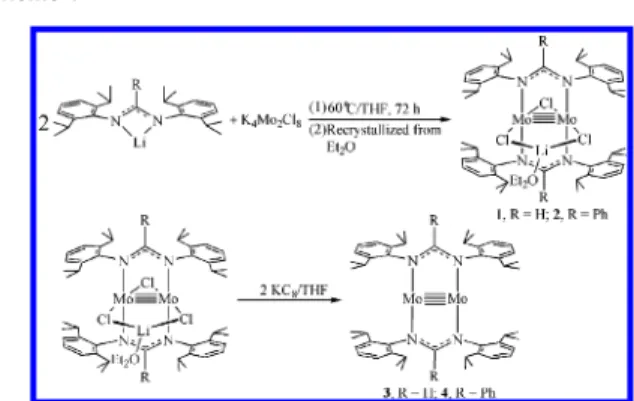
Similar to the access of the aforementioned Mo-Mo quadruple bonded compound Mo2[µ-η2-Me2Si(N-2,6-i-Pr2C6H3)2]2, our strat-egy to accomplish the preparation of complexes containing the Mo-Mo quintuple bonds started from the synthesis of compounds having the Mo-Mo quadruple bonds. As shown in Scheme 1, treatment of the red Mo-Mo quadruply bonded complex K4Mo2Cl812 with 2 equiv of the sterically hindered amidinates, Li[RC(N-2,6-i-Pr2C6H3)2] (R ) H, Ph), in THF engendered the formation of two Mo-Mo quadruply bonded complexes, Mo2 (µ-Cl)[Cl2Li(OEt2)][µ-η2-RC(N-2,6-i-Pr2C6H3)2]2(1, R ) H; 2, R ) Ph). The molecular structures of 1 and 2 were corroborated by X-ray crystallography (Supporting Information (SI) and Figure 1). Both
1 and 2 essentially adopt a paddlewheel structure supported by two encumbering amidinates, one bridging chloro ligand and the Cl-Li-Cl linkage spanning the Mo-Mo bond forming the “-ate” complexes. The Mo-Mo bond length of 2.0875(4) Å of 1 and 2.0756(8) Å of 2 indicates two typical Mo-Mo quadruple bonds.1 The slightly shorter Mo-Mo bond length in 2 is presumably ascribed to the more encumbering amidinato ligand.4a
Subsequent reduction of 1 and 2 with 2 equiv of KC8gave the desired quintuply bonded Mo2complexes, Mo2[µ-η2 -RC(N-2,6-i-Pr2C6H3)2]2(3, R ) H; 4, R ) Ph). The diamagnetic nature of 3 and 4 are confirmed by measuring their solid (<0.8 B. M.) and solution (Evans method13) magnetic moments. The1H NMR spectra of 3 in d8-THF and 4 in C6D6solution showed sharp one ligand set signals in the range δ 0-8 ppm, which are consistent with the high symmetry of 3 and 4.
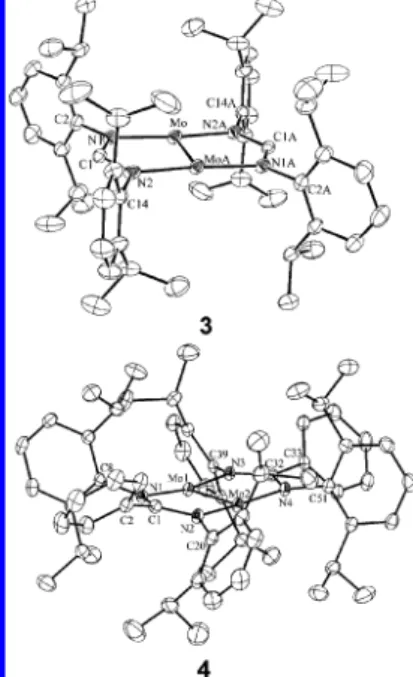
The molecular structures of 3 and 4 (Figure 2) were determined by X-ray crystallography. 3 and 4 contain two amidinato ligands spanning the Mo-Mo quintuple bond, and the two Mo atoms, the two N-C-N backbones, and the four ipso-carbon atoms of the phenyl rings of 3 are completely coplanar, while the N-Mo-Mo-N torsion angles of 4 are 2° and 172°. Therefore, 3 and 4 display approximately C2h symmetry.14 The amidinato ligands of the †
National Tsing Hua University.
‡
National Chiao Tung University.
§
National Taiwan University.
|National Taiwan Normal University.
Scheme 1
Figure 1. Molecular structure of 2 with thermal ellipsoids shown at the 35% probability level.
Published on Web 08/17/2009
10.1021/ja905035f CCC: $40.75 2009 American Chemical Society
complexes 1-4 remain intact due to the C-N bond lengths of their backbones being 1.32-1.35 Å.
Typically for most multiply bonded metal-metal complexes, the most interesting metrical parameter is the metal-metal bond length. The Mo-Mo quintuple bond lengths of 3 and 4 are 2.0187(9) and 2.0157(4) Å, respectively, dramatically shorter than those in 1 and 2. Though the X-ray determined the shortest Mo-Mo quadruple bond is 2.037(3) Å in the tetragonal dimolybdenum complex, Mo2(µ-η2-pyNC(O)CH3)4 (Cotton et al.),15 this unusually short quadruple bond was suggested to be unreliable. It is interesting to note that these values suggest that the Mo-Mo quintuple bond lengths do not or slightly correlate with the steric bulk of the ancillary ligands. It is also important to note that the Mo-Mo bond lengths in 3 and 4 are substantially shorter than the theoretically predicted Mo-Mo quintuple bond lengths of 2.03-2.10 Å.10 Conclusively, the ultrashort Mo-Mo quintuple bonds herein are unequivocally a consequence of the formations of 1 σ, 2 π, and 2 δ bonding interactions between two Mo atoms, although a δ bond contributes only slightly to the bond shortening.1In comparison, in terms of Cotton’s “formal shortness ratio” (FSR), 3 and 4 has an FSR of 0.776 and 0.775, while the FSR of N2is 0.786.1
To understand the electronic structures and bonding schemes of 3 and 4, we carried out computations using BP8616 density functional theory (DFT) with def2-TZVP and def2-TZVPP basis sets.17Geometry optimizations on diamagnetic 3 gave metrical parameters (Table S10 in SI) that are in excellent agreement with the X-ray structure. For example, the computed Mo-Mo bond lengths are 2.029 (def2-TZVP) and 2.021 Å (def2-TZVPP). As for the electronic structures, the calculations at BP86/def2-TZVP showed that there is no N-Mo π bonding interactions, and considerable metal-metal bonding characters can be found through HOMO to HOMO-2, HOMO-10, and HOMO-12 as shown in Figure S5 (SI). Those between HOMO-3 and HOMO-9 are primarily contributed from ligands. Of these five Mo-Mo bonding orbitals, HOMO-10 (dxz+ dxz) and HOMO-12 (dyz+ dyz) represent
two Mo-Mo π bonds, while the Mo-Mo σ character is found at HOMO-2 (dz2+ dz2). HOMO (dxy+ dxy) and HOMO-1 (dx2-y2 + dx2-y2) clearly indicate a pair of Mo-Mo δ bonds. Note that HOMO-1, the side-on sd δ bond, results from hybridization of s (36.7%) and d (63.3%) orbitals, oriented such that the main hybrid orbital
axes are parallel to one another. As a result, computations unambiguously support that 3 and 4 possess a Mo-Mo quintuple bond, and these two extremely short Mo-Mo bonds are due to strong interactions between two d5Mo(I) centers.
Note also that the Cr-Cr quintuple bond lengths4 can be successfully predicted by the semiempirical pyramidality effect.18 However, the estimated Mo-Mo quintuple bond lengths for 3 and 4 by the pyramidality effect are 2.053 and 2.044 Å, respectively, which significantly deviate from the experimental values 2.0187(9) and 2.0157(4) Å, respectively. This discrepancy has also occurred to most of the Mo-Mo quadruply bonded tetragonal complexes.17 In summary, we have demonstrated a method to construct the Mo-Mo quintuple bonds. The second Mo-Mo δ bonds of the quintuple bonded dimolybdenum compounds 3 and 4 were devel-oped from reduction of their respective quadruply bonded Mo2 precursors 1 and 2. Both 3 and 4 possess an extremely short Mo-Mo quintuple bond of 2.02 Å. The bonding schemes, 2 δ, 2 π, and 1 σ, of the Mo-Mo quintuple bonds of 3 and 4 were corroborated by sophisticated DFT calculations. Owing to the low-coordinate and -valent Mo-Mo centers, 3 and 4 provide a good platform to explore their chemistry. Reactivity studies of 3 and 4 are currently underway.
Acknowledgment. We are indebted to the National Science Council, Taiwan for support under Grant NSC 96-2113-M-007-019-MY3 and 97-2113-M-009-001-MY2. The computational facil-ity is supported by NCTU under the grant from MoE ATU Plan.
Supporting Information Available: Experimental details for syn-thesis, X-ray crystallographic data of 1-4 with tables and CIF files. This material is available free of charge via the Internet at http:// pubs.acs.org.
References
(1) Cotton, F. A.; Murillo, L. A.; Walton, R. A. Multiple Bonds Between Metal Atoms, 3rd ed.; Springer: 2005.
(2) Cotton, F. A.; Curtis, N. F.; Johnson, B. F. G.; Mague, J. T.; Wood, J. S.; Harris, C. B.; Robinson, W. R.; Lippard, S. J. Science 1964, 145, 1305. (3) Nguyen, T.; Sutton, A. D.; Brynda, S.; Fettinger, J. C.; Long, G. J.; Power,
P. P. Science 2005, 310, 844.
(4) (a) Hsu, C.-W.; Yu, J.-S. K.; Yen, C.-H.; Lee, G.-H.; Wang, Y.; Tsai, Y.-C. Angew. Chem., Int. Ed. 2008, 47, 9933. (b) Tsai, Y.-Y.-C.; Hsu, Y.-C.- W.; Yu, J.-S. K.; Lee, G.-H.; Wang, Y.; Kuo, T.-S. Angew. Chem., Int. Ed. 2008, 47, 7250.
(5) Wolf, R.; Ni, C.; Nguyen, T.; Brynda, M.; Long, G. J.; Sutton, A. D.; Fischer, R. C.; Fettinger, J. C.; Hellman, M.; Pu, L.; Power, P. P. Inorg. Chem. 2007, 46, 11277.
(6) Kreisel, K. A.; Yap, G. P. A.; Dmitrenko, O.; Landis, C. R.; Theopold, K. H. J. Am. Chem. Soc. 2007, 129, 14162.
(7) Noor, A.; Wagner, F. R.; Kempe, R. Angew. Chem., Int. Ed. 2008, 47, 7246. (8) (a) Kraus, D.; Lorenz, M.; Bondybey, V. E. PhysChemComm 2001, 4, 44.
(b) Pelin, M. J.; Foosnces, T.; Gruen, D. M. J. Chem. Phys. 1981, 74, 5547. (c) Bursten, B. E.; Cotton, F. A.; Hall, M. B. J. Am. Chem. Soc. 1980, 102, 6349. (d) Atha, P. M.; Hillier, I. H.; Guest, M. F. Chem. Phys. Lett. 1980, 75, 84.
(9) Efermov, Y. M.; Samoilova, A. N.; Kozhukhovsky, V. B.; Gurvich, L. V. J. Mol. Spectrosc. 1978, 73, 430.
(10) (a) Merino, G.; Donald, K. L.; D’Acchioli, J. S.; Hoffmann, R. J. Am. Chem. Soc. 2007, 129, 15295. (b) Weinhold, F.; Landis, C. R. Valency and Bonding: A Natural Bond Orbital Donor-Acceptor PerspectiVe; Cambridge Univ. Press: Cambridge, 2005; pp 555-559.
(11) Tsai, Y.-C.; Lin, Y.-M.; Yu, J.-S. K.; Hwang, J.-K. J. Am. Chem. Soc. 2006, 128, 13980.
(12) Brencic, J. V.; Cotton, F. A. Inorg. Chem. 1970, 9, 351.
(13) (a) Schubert, E. M. J. Chem. Educ. 1992, 69, 62. (b) Baker, M. V.; Field, L. D.; Hambley, T. W. Inorg. Chem. 1988, 27, 7. (c) Evans, D. F. J. Chem. Soc. 1959, 2003.
(14) Geometry optimizations of 3 indicated that it is more stable with C2h
symmetry than with D2hsymmetry.
(15) Cotton, F. A.; Daniels, L. M.; Hillard, E. A.; Murillo, C. A. Inorg. Chem. 2002, 41, 2466.
(16) (a) Becke, A. D. Phys. ReV. A 1988, 38, 3098–3100. (b) Perdew, J. P. Phys. ReV. B 1986, 33, 8822.
(17) Weigend, F.; Ahlrichs, R. Phys. Chem. Chem. Phys. 2005, 7, 3297. (18) Mota, F.; Novoa, J. J.; Losada, J.; Alvarez, S.; Hoffmann, R.; Silvestre, J.
J. Am. Chem. Soc. 1993, 115, 6216. JA905035F
Figure 2. Molecular structures of 3 (top) and 4 (bottom) with thermal ellipsoids shown at the 35% probability level.
J. AM. CHEM. SOC.9VOL. 131, NO. 35, 2009 12535