
從專利技術分析探討台灣軟性印刷電路板產業發展—以台郡與嘉聯益為例
207
0
0
全文
(2) i.
(3) 誌謝. 首先,非常感謝指導教授. 張文騰博士。先前因工作忙碌,無法隨時與教授. 討論,後來又因派駐海外,更是幾乎斷絕了教授所召開的會議。然而,教授除了 即時回應電子郵件中的種種提問外,更釋出私人的即時通訊軟體,使得即便在海 外的我,也能及時與教授隔空討論。此外,也感謝口試委員龐一心與陳春僥博士, 特地挪出時間,使我在返台期間完成口試,並給予寶貴之建議與方向,使得論文 能順利完成。 感謝鉦祐專利事務所林季緒學長、台郡科技藍紫堂特助以及臻鼎科技翁林瑩 經理。身為我的主管,均能毫不保留且無私地分享其工作經驗及處事之道予我, 亦會在緊要關頭及時提點、糾正我的錯誤觀念與行為。 感謝相識十九年的知己,更於今年六月三日正式登記成為內人的葛欣堯小 姐。除了利用電話適時給予鼓勵與協助外,更不厭煩地回應我任何天馬行空的想 法與疑惑。雖然欣堯對於專利一竅不通,但藉由與她討論的過程中,著實產出了 各式各樣的靈感與佈局方向。也感謝欣堯能義無反顧地利用其英美教育的專長, 替我的論文進行校稿與修飾。我將永遠記得,隔著台灣海峽陪伴著我熬夜到天亮, 卻不透露出半點睡意的妳。 最後,感謝爸媽不求回報且適時地及時給予經濟上的支持。之前,因為需要 兼顧事業與課業,犧牲了許多與你們相處的時間,而你們總是能無怨無悔地支持 著我,並時時提醒著我:「學業為重」。如今,終於順利取得了碩士學位,謝謝你 們一路的扶持,今後我將更努力!. 2012 年 冬 深圳 威碩 書. ii.
(4) 從專利技術分析探討台灣軟性印刷電路板產業發展 —以台郡與嘉聯益為例. 指導教授:張文騰 博士 國立高雄大學電機工程研究所. 學生:蘇威碩 國立高雄大學電機工程研究所. 摘要 隨著蘋果熱潮,帶動了台灣軟性印刷電路板(Flexible Printed Circuit, FPC)產業 的蓬勃發展。各大 FPC 供應商除了維持產能與品質外,更要能增加自我競爭力, 投入更多的心力心血於開創性研究,以提高 FPC 的附加價值。如此一來,才能跟 上蘋果瞬息萬變的嶄新科技。藉由分析台灣主要 FPC 供應商台郡與嘉聯益之專 利,並與世界最大供應商美克多龍在台申請專利相比較,以建立能代表台灣 FPC 產業的專利地圖,進而了解目前產業的研發技術及趨勢。本研究之專利分析著重 於 FPC 的技術手段,並設計一技術含量評估公式,使台灣 FPC 產業能快速地了解 專利現況與技術能力,以期與 FPC 產業相關之研發工程師與專利工程師能開發專 屬於台灣的 FPC 技術,進而開創具備競爭力的產品與專利。. 關鍵字:軟性印刷電路板、國際專利分類、專利佈局、專利分析、技術與功效矩 陣. iii.
(5) Study on Development of Taiwan Flexible Printed Circuit Industry by Patent Technology Analysis –Case Study of FLEXium and Carrier Advisor: Dr. Wen-Teng Chang Institute of Electrical Engineering National University of Kaohsiung. Student: Wei-Shuo Su Institute of Electrical Engineering National University of Kaohsiung. ABSTRACT Flexible Printed Circuit (FPC) has been triggering off its application in Taiwan with the sale surge of Apple's related products. The major FPC suppliers need not only to enhance the quality and quantity of their products but self-competitiveness. The inventive research is essential to promote value added product in order to catch up the newest and fast mutative technology of Apple. This thesis first uses technical approaches to analyze and evaluate FPC related patens rather than statistics that most of literatures use. A formula of technical quantity can easily present the patent condition and technological value. Accordingly, the thesis establishes a new patent map of Taiwan’s FPC industry by analyzing the main FPC suppliers in Taiwan- FLEXium and Carrier and comparing with the biggest supplier in the world- Mektron.. Keywords: Flexible printed circuit (FPC), International patent classification (IPC), Patent Portfolio, Patent analysis, Technology and function matrix. iv.
(6) Contents 口試委員會審定書 ........................................................................................................... i 誌謝. .......................................................................................................................... ii. 摘要. ......................................................................................................................... iii. Abstract ......................................................................................................................... iv Contents .......................................................................................................................... v List of Figures ................................................................................................................. vii List of Tables ................................................................................................................. viii Chapter 1 Introduction .................................................................................................. 1 1.1 Literature review......................................................................................... 2 1.2 Motivation .................................................................................................. 5 1.3 Purpose ....................................................................................................... 6 1.4 Methodology............................................................................................... 8 1.4.1 Proposed classification .......................................................................11 1.4.2 Evaluation of technical quantity ........................................................ 13 Chapter 2 Introduction of Flexible Printed Circuit .................................................. 16 2.1 Single-sided board .................................................................................... 16 2.2 Pre-punch board ........................................................................................ 18 2.3 Double-sided board .................................................................................. 18 2.4 Multi-layer board ...................................................................................... 20 2.5 Application of FPC ................................................................................... 22 Chapter 3 Patent ........................................................................................................... 25 3.1 Introduction .............................................................................................. 25 3.1.1 Type of patent .................................................................................... 26 3.1.2 Patentability of inventions ................................................................. 27. v.
(7) 3.1.3 Application ........................................................................................ 28 3.1.4 Patent engineering ............................................................................. 32 3.2 Patent map ................................................................................................ 33 3.2.1 Patent search ...................................................................................... 34 3.2.2 Patent classification ........................................................................... 36 3.2.3 Patent map analysis ........................................................................... 37 Chapter 4 Patent Portfolio of Flexible Printed Circuit ............................................. 39 4.1 Management chart analysis ...................................................................... 39 4.1.1 Patent activity analysis ...................................................................... 39 4.1.2 Main company analysis ..................................................................... 40 4.1.3 International patent classification analysis ........................................ 41 4.1.4 Citation rate analysis ......................................................................... 44 4.2 Technology chart analysis......................................................................... 45 4.2.1 Technology cycle time ....................................................................... 45 4.2.2 Patent analysis ................................................................................... 46 4.2.3 Technology and function matrix ........................................................ 51 Chapter 5 Discussion .................................................................................................... 53 Chapter 6 Conclusion ................................................................................................... 58 Reference ....................................................................................................................... 62 Appendix 1 .....................................................................................................................64 Appendix 2 .....................................................................................................................70. vi.
(8) List of Figures Figure 1 Flow chart of study ............................................................................................ 8 Figure 2 Tree form of patent effect ................................................................................. 14 Figure 3 Single-sided board with adhesive..................................................................... 17 Figure 4 Single-sided board without adhesive ............................................................... 17 Figure 5 Pre-punch board ............................................................................................... 18 Figure 6 Double-sided board with adhesive ................................................................... 19 Figure 7 Double-sided board without adhesive .............................................................. 19 Figure 8 Multi-layer board with adhesive ...................................................................... 21 Figure 9 Multi-layer board without adhesive ................................................................. 21 Figure 10 Flow chart of invention examination and administrative remedy.................. 30 Figure 11 Flow chart of utility model examination and administrative remedy ............ 31 Figure 12 Flow chart of design examination and administrative remedy ...................... 32 Figure 13 Trend of patent application in the studied manufactures ............................... 39 Figure 14 Trend of issued patent in the studied manufactures ....................................... 41 Figure 15 Classification rule........................................................................................... 42 Figure 16 International patent classification of FPC patents in Taiwan ......................... 43 Figure 17 Ratio of the top 4 classification ...................................................................... 44 Figure 18 Technology cycle time ................................................................................... 45 Figure 19 Technology cycle time of FLEXium, Carrier and Mektron ........................... 46. vii.
(9) List of Tables Table 1 Patent analysis form ........................................................................................... 10 Table 2 Proposed classification ...................................................................................... 12 Table 3 Classification of application field ...................................................................... 24 Table 4 Patent category of Taiwan and America ............................................................ 27 Table 5 International patent classification ...................................................................... 42 Table 6 Top 4 three level classification .......................................................................... 43 Table 7 Statistical chart of technical quantity ................................................................. 47 Table 8 Function code and definition ............................................................................. 51 Table 9 Technology and function matrix ........................................................................ 52 Table 10 Technical quantity score list of FLEXium, Carrier and Mektron .................... 53. viii.
(10) Chapter 1 Introduction. In recent years, the 3C market trend intends to have the “small, short, light and thin” such design. Flexible Printed Circuit (FPC) can provide this demand due to its flexibility and bendability. The strong demands of FPC causes many FPC manufactures in Taiwan to spring up, such as FLEXium, Carrier, Ichia, etc. FLEXium and Carrier have become the main suppliers in Taiwan. The FPC industry was originated from the operation base – Mektec, set in Taiwan by Nippon Mektron in 1986 [22]. In the meantime, the FPC technology has been brought into Taiwan by Mektron, which also led to some factories to build up and follow up. Although the FPC industry has developed for twenty years in Taiwan, there are only few patent activities related with FPC. Right now, it is what we called “Knowledge Explosion Age” and many inventions are progressed day by day. Each country presents specifically the knowledge of the inventions through the patents. The high-tech industry, such as semiconductor industry, values its own patents more than others do because those patents are regarded as an important and necessary weapon in this competitive market. Both government organizations and non-governmental groups pay attention to the value of the patent. Lately, the patent management has become more and more important and the operating point for each enterprise, even affected the development direction. In the past, the traditional law focused on protecting the raw material property. However, people have gradually focused the immaterial invention due to improvement of our technology. They start to realize and request a more effective and perfect protection, and that is “Patent”. As the above, patent has been the weapon to curb and fight with competitors in the domain of the industry contest, wherein the patent litigation is the most common strategy. Thus, if we cannot analyze the related. 1.
(11) patents and technologies, we might pay the unexpected cost after other companies claim the royalty income from us. Therefore, to understand the value of patent is important.. The patent value seems very abstract; but if a company can develop an original technology, it could monopolize the specific technology and benefit from the royalty income, improving the competitiveness and image of the company. On the other hand, “Patent Umbrella” can decrease the litigation risk and royalty expense. As the result of the above, each big company in the world is very positive to apply for patents. For example, Foxconn applied for 3968 patents, which includes 3417 invention patents, 433 utility model patents and 118 design patents in 2011 [23]. And this achievement makes Foxconn is the champion of patent application in Taiwan. Furthermore, Foxconn has also performed patent portfolio for all related patents. Patent portfolio means that it is planned and positive to apply for the patents worldwide to protect the company’s invention achievements. To be more specific, patent portfolio can be differentiated between the positive and the negative sides. The pros is to control the competitors’ technology development and trend in order to ensure the competitive advantage and prevent the technology form copying by the competitors, and further monopolize the market. The cons is to focus on guaranteeing the manufacture and sale of the products or the freedom of the technology transfer, so that it can effectively decrease the risk of the claim due to the tort.. 1.1. Literature review. Chien mentioned how to analyze the patent value and make a proper analysis form in his paper “The Assessment of Patent Assert”. He indicated that the analysis form and method should be depended on the different purpose and the technical field. For 2.
(12) industry, company or business, they usually focus on a specific research and development direction, for example, TSMC focus on semi-conductor technology. Therefore, different technic field should have its own analysis form.. Refer to the analysis form sample in the paper; it is not quite easy to understand. The result came from the statics data instead of the real analysis and study. In other words, this kind of analyzing method could not accurately present the technology of each patent. Thus, Chien stated a point that a usable and useful patent evaluation and analysis standard should be built on some basic pre-conditions. First of all, to build up the standard is to require a precisely goal. And this goal should be decided by the managers who have patent property concept. However, the managers are usually not the professionals of patent; hence, all the standards have to be as simple as they can be. A simple standard can be a real goal, and easy to be understood and accepted [2].. Then, according to Pan’s perspective in his paper “The Evaluation Method of Patent Quality and Value – Centre on the Industry of TFT-LCD”, the value of the patent is depended on enterprise’s patent portfolio, which means the operation of the patent has to cooperate with practical technic, product, service, and industrial style side by side, otherwise, the value of the patent will not be existed. In other words, when we evaluate the patent, it still needs to combine with its product usage and industry, which can mostly stand out its value.. He also mentioned the two patent evaluation methods, one is using the general patent search system, and the other one is analyzing the patent with industrial perspective. Using the general patent search will only focus on the patent information and reference, which will be uneasily to apply in practical usage. But if the patent can be analyzed by 3.
(13) industrial perspective, which can truly assist the industry to get improvement and have a well-planned patent map. Therefore, the second method is actually requiring people who understand the patent’s technic and the industry it belong to. Besides, it requires a throughout reading of the patent reference completely in order to analyze and classify it. Only with this method, we can indeed link up the patent with product, technical structure and profit, then understand the produce, sell, and usage of the intellectual right for higher creation value [16].. In “Overall of Patent Value” by Chen, he also mentioned that a good patent should focus on the patent quality rather than quantity. To increase self- competitiveness, it is important to observe and understand the application behind the patent in order to present the real value and technology of the patent. A good research and development needs a good intellectual property protection; a good intellectual property protection also needs a good practical application of the patent [3].. 4.
(14) 1.2. Motivation. As a R&D and patent engineer in FPC industry, I have to know the development of this industry is more important than before. I always keep the concept “Patent is the industry competitiveness” in mind. Therefore, I hope to analyze and study the patents of Taiwan’s FPC industry.. To control more detailed patent data can make the direction of development and patent are easier to be focused on. Thus, in the beginning of development, we must do the complete analysis and plan for the related patents due to make the appropriate tactic and disposition. Especially, under the battle between the high-tech industries, one company can success or not, its investment and plan of the patents are the key. For instance, ChipMos ever applied the litigation of the patent infringement to district court in Kaohsiung, wherein ChipMos considered Walton infringed upon the molding patent right of wBGA and FBGA used in DDR2 SDRAM, and claimed fifteen million dollars. But ChipMos failed because Walton had the related patents and knowledge to contradict. In this case, Walton would be the meat in the chopping board if it did not have the patent to protect itself [10].. Many companies usually regard the patent as a trade secret and disclose to the public. But, patent and trade secret are actually different. These companies also think nothing of the real technology because they do not know how to distinguish the patent from the trade secret. Here is one of the most famous worldwide companies, Coca-Cola, it has a case to explain the difference. This is started from 1886 that Coca-Cola first got their recipe which they have successfully kept for 120 years. Many experts tried to analyze the recipe but no one succeeded. A lot of companies wanted to follow and copy the public recipe to produce the same drink as well. However, all they fail because they 5.
(15) cannot find the 1% secret composition in the recipe. The 1% secret composition in the recipe can be regarded as trade secret. In more detail, the elements of the trade secret are secrecy level, value and reasonable secrecy measure. Therefore, if one technology is related with these three elements, the technology is suitable to be regarded as trade secret rather than patent.. The patent can be differentiated in two kinds: one is to prevent the patentee from copy; the other is to be an important data for technical management, which the effective patents are considered as the important source of competition superiority. Using patent data to estimate technical quantity is easy to get without research and development data. Technical quantity is estimated by useful patents in the company. The patent data includes the country, company, technical area, and inventor, etc. Besides, we also make the specific technology analysis more complete according to international patent code (IPC). Furthermore, patent data can be displayed in visualization way, so it can describe the condition of the industry through minimum words and simplify and express the information in the short time. The visualization way is called “Patent Map”, which can point out the analyzed technical information effectively.. 1.3. Purpose. In the book “Patent is industry competitiveness”, Lee has mentioned, “The company with more investment in the field of patent usually owns the more extensive and deeper technology, so their products usually have more improvements and functions than others. Although many new companies are established in the industry with fierce competition, only those companies with more technology development, more quantity of patent application and better quality can maintain the competitiveness for the longer time. The basic functions of the 3C products are similar to others, but if they can have 6.
(16) their own improvement and innovation, they will hold the key of success. And there are many cases about patent and authorization in recent years, so that obtaining the intellectual property and patent right seems become a popular doctrine advocated by many industries.” [11]. In fact, acting the patent fight is very common between lots of high-tech industries. Especially, a company will become an obvious target of litigation after growing to be a bigger company with above ten billion capitalizations. Lately, Taiwan’s FPC industries like the sun at high noon, but few of them own the originality and patent of technology. Once they confront the real litigation, how to provide the powerful patents to protect themselves has become a serious question. Therefore, under this difficult situation, we should come forward to study the technology development and the patent analysis in order to prepare complete and enough defense mechanism, even assume to fight actively one day. As the famous homemade movie “Monga” mentions “Today you do not kill him, tomorrow he will kill you”.. Specifically speaking, in the beginning of the innovative development, we can master the technology and be inspired the invention by analyzing the patent information; so it is helpful to produce new thoughts. Simultaneously, it can also estimate the practicability of technology and forecast the future trend of technology in order to increase the probability of obtaining the patent right, even to avoid the tort from other companies. Meanwhile, analyzing the patent information can decrease repeating same research and development; and refer to the prior arts to amend the development plan step by step. As the result of the above, this study will focus on the Taiwan’s FPC industry, especially the main FPC suppliers. Furthermore, this study will compare the main FPC suppliers of Taiwan with the biggest supplier of the world in order to make the patent map and perform the patent portfolio.. 7.
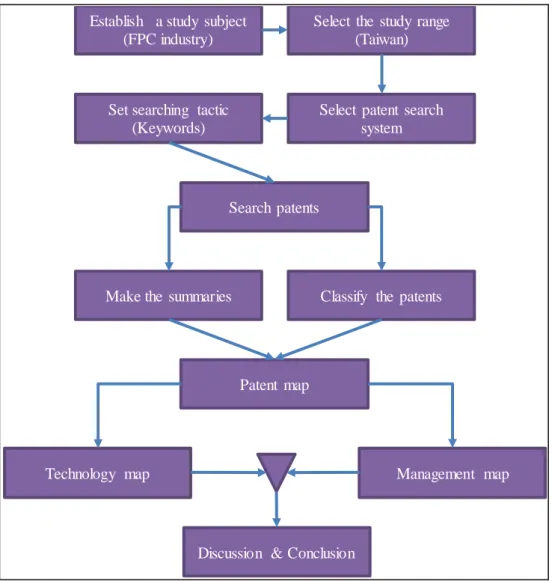
(17) 1.4. Methodology. The first step is to establish a study subject and select the range. The study subject and range are set in Taiwan’s FPC industry. The second step is to select patent search system and set searching tactic which is the keyword defining. This study will search the suitable patents via the Taiwan Patent Search System of Taiwan Intellectual Property Office (TIPO). In the third step is to search all related patents based on the keywords. Then, the fourth step is to make the summaries for all patents I search and classify them. The fifth step is to make the patent map, which includes a management chart and a technology chart. The final step is to state the discussion and conclusion. This study’s flow chart is as Figure 1. Establish a study subject (FPC industry). Select the study range (Taiwan). Set searching tactic (Keywords). Select patent search system. Search patents. Make the summaries. Classify the patents. Patent map. Technology map. Management map. Discussion & Conclusion. Figure 1 Flow chart of study. 8.
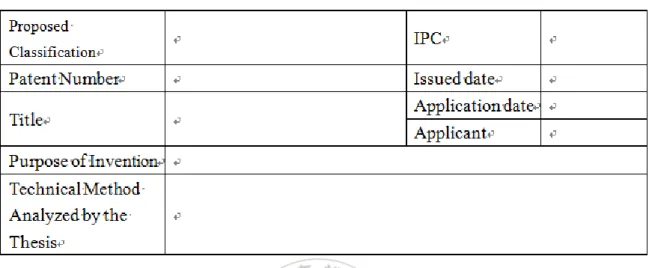
(18) The study steps in Figure 1 are specifically described as the followings: 1. Establish a study subject and select the range. The main FPC suppliers are FLEXium, Carrier and Zhen Ding in Taiwan [17]. And this study will choose FLEXium, Carrier as the main study subject and limit the study range in Taiwan, due to Zhen Ding does not produce FPC only but also other electronic products. 2. Select patent search system and set searching tactic. This study focused on Taiwan’s FPC industry; so the Taiwan Patent Search System of TIPO is my best choice. Then, this study used the “Field Search” of the “Patent Search System” [21], wherein the keywords are set as “FLEXium”, “Carrier Technology” and “Mektron”. The reason why this study selects these three companies is because FLEXium and Carrier are the top 2 FPC suppliers in Taiwan, and Mektron is the biggest FPC supplier worldwide. Meanwhile, this study set the patent type in “Granted Inventions”, “Utility Models” and “Designs”. My main objects of this study are FLEXium and Carrier in Taiwan because they represent Taiwan’s FPC industry. Then, this study used Mektron to be the comparison since Mektron has the advanced manufacturing ability for a long time. 3. Search all related patents based on the keywords. The keywords will be keyed into the “Applicant or Patentee/Country” column and set the searching date till 2012/09/30 [21]. Then, this study got three lists from Taiwan Intellectual Property Office as Appendix 1, which displays that FLEXium has 88 patents, Carrier has 41 patents and Mektron has 45 patents. 4. Make the summaries for all patents I search and classify them. A form was used for analysis record made as Table 1. There are proposed classification, international patent classification (IPC), patent number, title, 9.
(19) issued date, application date, applicant, purpose of invention and technical method.. Table 1 Patent analysis form. International patent classification is established by World Intellectual Property Organization (WIPO); however, this classification is not usually defined with enough details. Thus, this study will establish a patent classification based on FPC technology, such as manufacturing method, structure and equipment. 5. Make the patent map. The management chart is composed of the relation of the years and patents, the relation of the companies and patents, and the relation of the IPC and patents. The technology chart is composed of technology cycle time, patent analysis and technology, and function matrix. 6. State the discussion and conclusion. Finally, this study shall summarize the key conclusions of this dissertation and make suggestions for the further study.. 10.
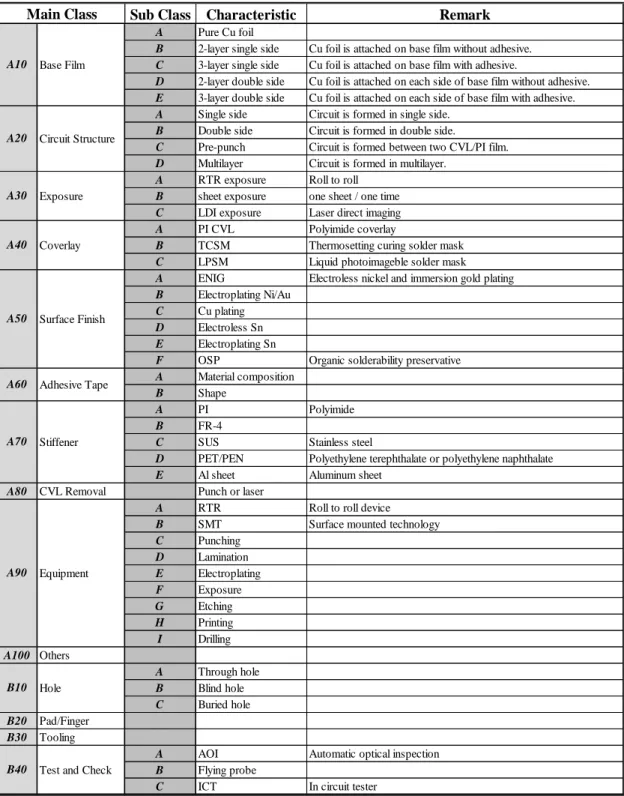
(20) 1.4.1. Proposed classification. Proposed classification was established as far as we know in FPC industry. There are two units A and B in the classification. The unit A is related with FPC technology, which includes ten main classes; there are base film, circuit structure, exposure, coverlay, surface finish, adhesive tape, stiffener, CVL removal, equipment, and others. The unit B is related with general technology, including four classes: hole, pad and finger, tooling, test and check. The classification form is shown as Table 2 in the following page.. The code is used in both main and sub class code. For example, if a patent is one kind of FPC structures which is 2-layer single side, this study will classify this patent in “A10B”. There is another example. If another patent is related with improved pads of FPC, which classify say if in “B20”. In Table 2, you can see the sub class code is related with the characteristic. The purpose to use tens digit is more convenient to expand the classification code in the future if there is a need.. 11.
(21) Table 2 Proposed classification Main Class A10. Base Film. A20. Circuit Structure. A30. Exposure. A40. Coverlay. A50. Surface Finish. A60. Adhesive Tape. A70. Stiffener. A80. CVL Removal. A90. Equipment. Sub Class A B C D E A B C D A B C A B C A B C D E F A B A B C D E. Characteristic. A B C D E F G H I. Pure Cu foil 2-layer single side 3-layer single side 2-layer double side 3-layer double side Single side Double side Pre-punch Multilayer RTR exposure sheet exposure LDI exposure PI CVL TCSM LPSM ENIG Electroplating Ni/Au Cu plating Electroless Sn Electroplating Sn OSP Material composition Shape PI FR-4 SUS PET/PEN Al sheet Punch or laser RTR SMT Punching Lamination Electroplating Exposure Etching Printing Drilling. A B C. Through hole Blind hole Buried hole. A B C. AOI Flying probe ICT. Remark Cu foil is attached on base film without adhesive. Cu foil is attached on base film with adhesive. Cu foil is attached on each side of base film without adhesive. Cu foil is attached on each side of base film with adhesive. Circuit is formed in single side. Circuit is formed in double side. Circuit is formed between two CVL/PI film. Circuit is formed in multilayer. Roll to roll one sheet / one time Laser direct imaging Polyimide coverlay Thermosetting curing solder mask Liquid photoimageble solder mask Electroless nickel and immersion gold plating. Organic solderability preservative. Polyimide Stainless steel Polyethylene terephthalate or polyethylene naphthalate Aluminum sheet Roll to roll device Surface mounted technology. A100 Others B10. Hole. B20 B30. Pad/Finger Tooling. B40. Test and Check. Automatic optical inspection In circuit tester. 12.
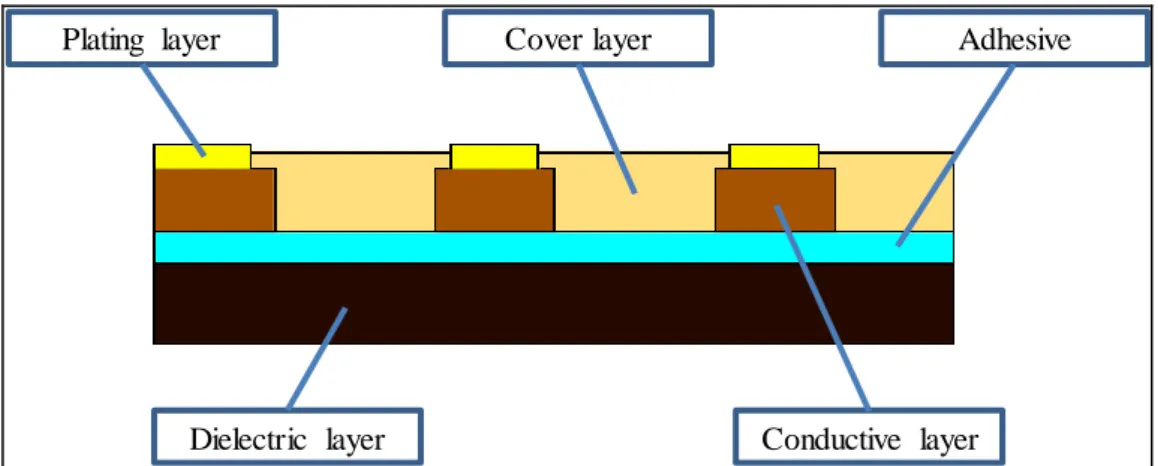
(22) 1.4.2 Evaluation of technical quantity After patent analyzing, a formula to evaluate a patent is displayed: TQ = {0.5 × (Ci + Tr + Ct) + 1 × PE} TQ is Technical Quantity which presents the value level of the patent to judge all patent I analyze. Ci stands for citation which presents the examiner use how many citations to examine the patent. In general, citation is usually searched during granted invention patent examination, so granted invention patent is often better than utility model patent. Tr stands for technical report which exists in utility model patent examination because there is no substantial examination in utility model patent application. According to the 104th article of Taiwan Patent Act, if the patentee wants to exercise a utility model patent right, the patentee have to present the technical report regarding the utility model patent for the purpose of warning. Moreover, anyone can apply for the technical report to realize if the utility model patent has the patentability of inventions. Therefore, the technical report only exists in utility model patent examination. Finally, Ct is cited time which means how many times the patent is cited. A high Ct usually represents the patent has a high reference value. In the view of patent management, if one patent is of a little worth, this patent must have at least the three parameters Ci, Tr and Ct. Actually, in viewpoint of industry, estimating Ci, Tr and Ct is the common way to evaluate a patent but not enough accurate as mentioned in the literature review. For this reason, this study creates a new parameter named PE. PE is Patent Effect which means the patent can produce how much influence on the competitors and PE is more suitable and reasonable to estimate patent value. During estimating PE, there are two very important indices. One is “restorability” and the other is “presentability”. Specifically, if a patent can be restored on a product and proved by examination, this patent will be provided for commercial actions. In other words, a useful patent can be both weapon and shield against a company’s competitors. 13.
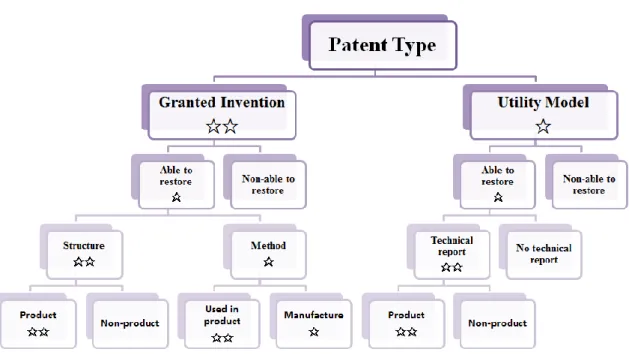
(23) Therefore, before estimating the PE of a patent, we have to read and study the patent first to realize the main technology in the patent. Finally, in order to distinguish the importance of PE more than the three conditions add-up, this study use coefficient 0.5 and 1 to give them obviously different score. Thus, Ci, Tr and Ct are multiplied by 0.5 and PE is multiplied by 1 in the formula. Figure 2 explains the approach to estimate PE as the following.. Figure 2 Tree form of patent effect. In Figure 2, we can see Patent Effect is defined based on the patent type. And there are only granted invention and utility model but no design. That is because the design patent just prevents the product appearance from being copied, and does not affect anything in FPC industry. The number of star in the blocks stands for the grade at every stage in Figure 2. Specifically, using the stars is to present the importance of the content in each block. For example, if the structure of the patent is easier to be restored on the product itself than method, and it will be defined as two starts and get more. 14.
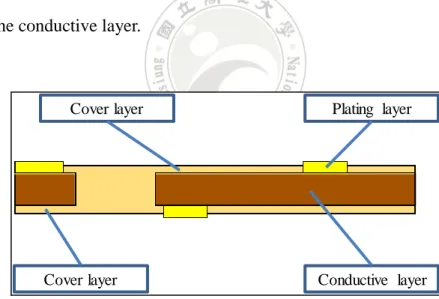
(24) stars than the method. Therefore, if a granted invention patent which can be restored in the product’s structure, this patent gets seven stars. That PE of this patent is seven; and thus, TQ score is obtained.. 15.
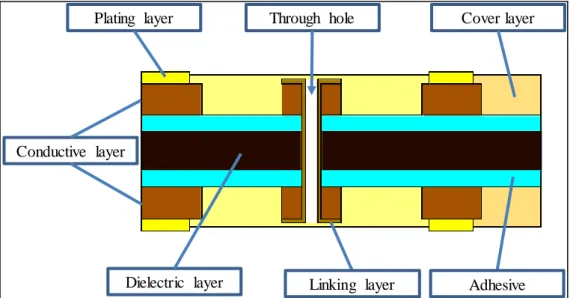
(25) Chapter 2 Introduction of Flexible Printed Circuit. The Institute for Interconnecting and Packaging Electronic Circuits (IPC) describes that flexible printed circuit is a patterned arrangement of printed circuitry and components that utilizes flexible base material with or without flexible cover lay in IPC-T-50 “TERMS AND DEFINITIONS”. On the other hand, FPC is a board and plays a bridge for electrical connection, for example, a cable. Specific speaking, a normal FPC includes at least three layers: a dielectric layer, a conductive layer and a cover layer. There is adhesive disposed between the dielectric layer and the conductive layer. Besides, there is another adhesive between the conductive layer and the cover layer. The cover layer has many openings to disclose the terminals or pads. Furthermore, the material of the dielectric layer is usually polyimide, polyethylene naphthalate or polyethylene terephthalate, and the material of the cover layer can be the same as the dielectric layer. The adhesive is usually polyester resin, acryl, epoxy resin, polyimide, novolac resin or PTFE [12]. In the following sections, I will introduce different kinds of FPC structures.. 2.1. Single-sided board. The single-sided board is the easiest application and the most general design in FPC. As the result of that, it is also the cheapest FPC. In the single-sided board, there are two different structures. One is the single-sided board with adhesive and the other has no adhesive. The single-sided board without adhesive is thinner than the single-sided board with adhesive. Therefore, the single-sided board without adhesive is more suitable to the design needs “small, short, light and thin” but its cost is higher. Please refer to Figure 3 and 4 as the following page, which respectively display the structures. 16.
(26) of the single-sided board with adhesive and without adhesive. Is there any difference?. Plating layer. Cover layer. Dielectric layer. Adhesive. Conductive layer. Figure 3 Single-sided board with adhesive. Plating layer. Cover layer. Dielectric layer. Adhesive. Conductive layer. Figure 4 Single-sided board without adhesive. In fact, “no adhesive” means there still remains a little adhesive between conductive layer and dielectric layer. In general, thickness of adhesive is between 13 μm and 25 μm. But, the adhesive in the structure of the single-sided board without adhesive is too tiny to be noticed. For this reason, most FPC manufacturers do not regard and control its thickness in stackup design. Besides, in Figure 3 and 4, we can realize only one surface of the conductive layer is exposed between the cover layer and the dielectric layer.. 17.
(27) 2.2. Pre-punch board. The pre-punch board is one kind of the single-sided board. Please refer to Figure 5. “Pre-punch” means the cover layer is punched to form some openings and adhered to the conductive layer before etching, so both surfaces of the conductive layer are partially exposed. In this structure, the conductive layer is disposed between two cover layers or between one cover layer and one dielectric layer. According to product’s need, the corresponding openings of the cover layer or the dielectric layer will disclose the parts of the conductive layer to be pads or fingers. Meanwhile, the both surfaces of the conductive layer can be exposed through the openings for future plating, such as gold plating, copper plating, tin plating, etc. Therefore, the pre-punch board can be applied for electrically connecting at least two components through one surface to the opposite surface of the conductive layer.. Cover layer. Plating layer. Cover layer. Conductive layer. Figure 5 Pre-punch board. 2.3. Double-sided board. Another structure can achieve electrically connecting via one surface to the opposite surface of the conductive layer is the double-sided board. The structures also have one with adhesive and the other one does not. Besides, because of the extra conductive layer, the double-sided board needs more processes and longer manufacturing time.. 18.
(28) For example, if we want to print some texts on the double-sided board, we have to print one side and then print the other side. However, the double-sided board has more complicated layout and more widespread application due to the more conductive layers. To be more details, the double-sided board is not only used to connect, but also used to carry some components, such as passive components, connectors, and even chips, etc. Please refer to Figure 6 and 7 as below.. Plating layer. Through hole. Cover layer. Conductive layer. Dielectric layer. Linking layer. Adhesive. Figure 6 Double-sided board with adhesive. Plating layer. Through hole. Cover layer. Conductive layer. Linking layer. Dielectric layer. Figure 7 Double-sided board without adhesive. 19. Adhesive.
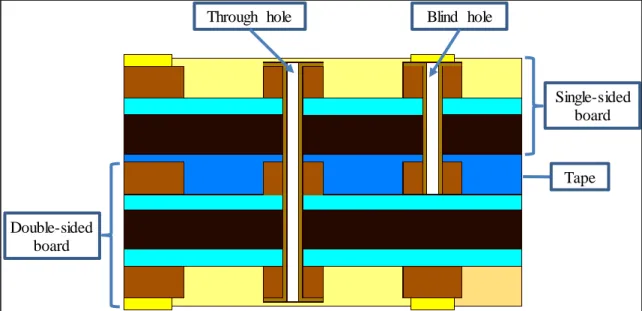
(29) We can find the double-sided board is penetrated by the through holes, and the linking layer is disposed along the through holes. In fact, the linking layer can be formed by copper plating. And then, the two conductive layers can get the electrical connection by the linking layer along the through holes. Therefore, we can layout two different circuits within the same area but different sides to increase the layout availability.. So far, no matter the single-sided board, the pre-punch board or the double-sided board all play an important role to accomplish the electrical relationship due to their wonderful flexibility and dimensional stability. However, this study will introduce another FPC structure has the worse FPC characteristic but it is necessary for FPC industry in the following section.. 2.4. Multi-layer board. Compared to the boards mentioned above, the multi-layer board could be the worst design. This design is complicated stackup and can be applied for the high level electronic products since the high level electronic products always request fine-pitch. On the other hand, the electronic components disposed in the present products have the smaller dimension, so more and more surface mount technology (SMT) is performed on FPC in order to carry the tiny components. As the result of above, the need of the multi-layer board with high density circuit is greatly raised. Please refer to Figure 8 and 8 as the next page.. 20.
(30) Through hole. Blind hole. Single-sided board. Tape Double-sided board. Figure 8 Multi-layer board with adhesive. Through hole. Blind hole. Single-sided board. Tape Double-sided board. Figure 9 Multi-layer board without adhesive. The multi-layer board is the thickest structure in all FPC, so most manufacturers usually select the multi-layer board without adhesive as Figure 9 to decrease the total thickness. For this reason, this study will use this structure of Figure 9 to explain the detail about the multi-layer board.. 21.
(31) There are many combining ways to fabricate the multi-layer board. For instance, as Figure 9, one single-sided board is adhered to one double-sided board to form one multi-layer board with three conductive layers; or one double-sided board is adhered to the other double-sided board to form another structure with four conductive layers. In the similar way, we can make the multi-layer board have more layers. The adhering process seems easy to do, but in fact, there is a difficult problem during the process, that is, the alignment between every conductive layer. If the alignment is not enough accurate, the electrical relationship between the conductive layers might fail, which causes the signal will be not transmitted properly. The through hole is a common method to electrically connect the stacked layers. In the multi-layer structure, there is another method, which is called “blind hole” to be performed. As implied in the name, the blind hole means the hole does not penetrate the whole structure. For example, in Figure 9, the blind hole just goes through the single-sided board downward but stop in the double-sided board.. Frankly speaking, the general multi-layer board still has the thinner total thickness than the rigid printed circuit board (RPCB), but has denser circuit layout. Therefore, in order to achieve the present need “small, short, light and thin”, the multi-layer board progressively becomes the better choice.. 2.5. Application of FPC. As shown above, we have realized that FPC has a lot of different structures. But, what makes the FPC become a trend now? Advantages of FPC are as the followings: 1. Reduce the layout mistake, and number of component and connector, and also decrease the assembly encumbrance. 2. Make the bending area easier to operate, and more steady to assemble the 22.
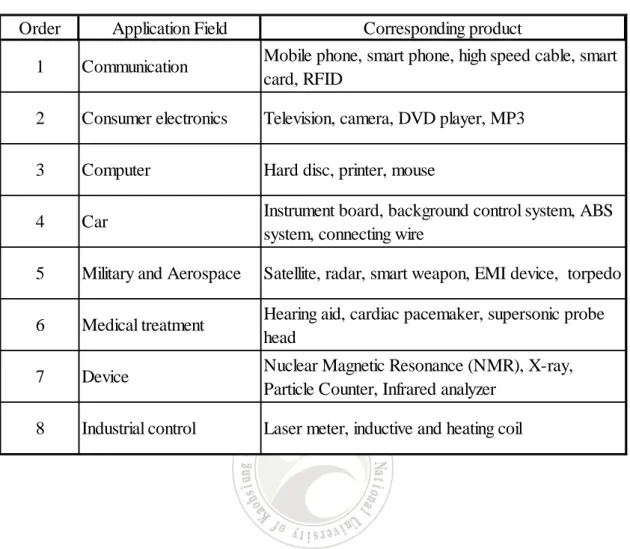
(32) components on the substrate by simplifying the assembly structure. 3. Make the product design lighter. 4. Utilize the space well and make the 3D connecting design possible. 5. Provide the flexible structure, and the best way for assembly. 6. Reduce the contacts to decrease the operation, which can also reduce the stress of the contacts to improve the connecting reliability. 7. The material is good for thermal transmission. And if using metal for supportive structure, it is good for high wattage product design. 8. Improve the assembly efficiency. 9. Improve the heat dispersion. 10. Improve the appearance of the product. 11. Improve signal integration. 12. Make the circuits coherent in order to shrink the assembly size. 13. Apply for SMT corresponding to the need of the substrate. 14. It is good for SMT shrinkage balance; and reduces the damage caused by the heat. 15. It can have 3D assembly design.. Because of these advantages, we can apply FPC in many fields, such as surface mount technology (SMT), chip on flex (COF), intermediary of IC assembly (as CSP of Tessera), Z-axis interconnect technology for LCD and LED, etc. In fact, FPC has so many kinds of applications for the electronics field [19]. Table 3 lists the FPC applications for each field in the next page.. 23.
(33) Table 3 Classification of application field Order. Application Field. Corresponding product. 1. Communication. Mobile phone, smart phone, high speed cable, smart card, RFID. 2. Consumer electronics. Television, camera, DVD player, MP3. 3. Computer. Hard disc, printer, mouse. 4. Car. Instrument board, background control system, ABS system, connecting wire. 5. Military and Aerospace. Satellite, radar, smart weapon, EMI device, torpedo. 6. Medical treatment. Hearing aid, cardiac pacemaker, supersonic probe head. 7. Device. Nuclear Magnetic Resonance (NMR), X-ray, Particle Counter, Infrared analyzer. 8. Industrial control. Laser meter, inductive and heating coil. 24.
(34) Chapter 3 Patent. 3.1. Introduction. The major purpose of patent is to encourage and protect invention and creation which can improve industry improvement [13]. Therefore, corporation can use technology research and development to apply patent to obtain the protection of its own technology and intellectual property in order to build its competition advantage. Nowadays, corporations and common people have more sense about intellectual property protection; thus, the quantity of the patent is fast growing year by year around the world. In this high attention on technology generation, technology is much more important to a corporation’s continuous development and competition advantage than before. Hence, corporation not only needs to study and analyze new technique constantly, but also apply more patents to gain more protection for its own technology benefit.. As the first statement of the first chapter in Taiwan Patent Act, it states, for encouraging, protecting invention and creation usage, to establish this law. Patent, this word, comes from Latin “Litterae Patents”, which means “Public document”. It is the kind of document which the king uses for awarding rights and privilege. The first approved English patent by Elizabeth I, United of Kingdom (1533, Sep. 7th to 1603, Mar. 24th) is to stimulate income and encourage new business development using the privilege of possessing the invention patent [1].. Taiwan Intellectual Property Office of Ministry of Economic Affairs explains, “when we have an invention or creation, for protecting its own right, to submit the application. 25.
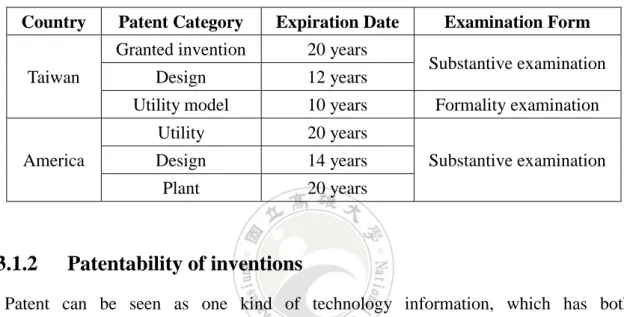
(35) to claim the ownership. After verification and approval by the Intellectual Property Office, the applicant will exclusively possess the right of use, commerce and produce the invention or creation, which means other people except the applicant cannot use commerce and produce it without applicant’s permission. And this is what we called, Patent Right.”. In the 56th article of Patent Act, the major purpose of this law is that the government uses the power to protect intellectual property and entitle the patent applicant to possess the authority of use, commerce and produce.. Patent needs to be entitled to the inventor by the government. It is an authority given by the government, which means the inventor cannot claim then get the right by him or herself. The present meaning of the patent system is to grant the inventor a period of technology monopolization though the nation law in order to exchange the publication of technology. According to World Intellectual Property Organization, WIPO, there is a statistic which shows 90% to 95% worldwide research and development result are included in the patents; and the other 5% to 10% worldwide research and study result are existed in other paper. Therefore, if we can use patent information properly, this will help to shorten 60% research time and 40% research budget [14].. 3.1.1. Type of Patent. The patent category is variety due to it is depended on each country’s Patent Act. The Patent Act is also different based on the country its own development. Generally, there are German, U.K, French, U.S.A and Russia, five systems. However, due to the several patent-related agreements, such as Paris Convention for the Protection of Industrial Property, Patent Cooperation Treaty (PCT) and European Patent Convention (EPC), each country’s Patent Act has adjusted to conform the international agreement trend. The article 2nd of Taiwan Patent Act states three kinds of patents that are granted 26.
(36) invention, utility model, and design. And for the united states, refer to article 35 U.S.C §101, §161, and §171, the patent can be defined as Utility Patent, Plant Patent and Design patent these three kinds [24]. Table 4 compares patent category of Taiwan and America.. Table 4 Patent category of Taiwan and America Country Taiwan. America. 3.1.2. Patent Category. Expiration Date. Granted invention. 20 years. Design. 12 years. Utility model. 10 years. Utility. 20 years. Design. 14 years. Plant. 20 years. Examination Form Substantive examination Formality examination Substantive examination. Patentability of inventions. Patent can be seen as one kind of technology information, which has both characteristics of law and technique. In the patent examination process, there is a process to check if the invention has met the three patentability requirements which we called “Patentability of inventions”. The rules governing what is "patentable" vary slightly from one country to another. Therefore, this study introduced what these three requirements are according to the 19th article in Taiwan Patent Act as the followings: 1. Industrial applicability: the invention is capable to be applied or made by some kind of industry. 2. Novelty: the invention must never have been made in public in any way and anywhere, before the date on which the application for a patent is filed. 3. Inventive steps: this kind of invention must not be obvious to others with good knowledge and experience of the subject of the invention. In other word, it has to be seen as progressiveness. 27.
(37) Besides, patent has the following characteristics: 1. Exclusiveness: In terms of this characteristic, people who want to use the filed-patent need to get the permission from the patent owner and pay for it. Otherwise, it will be seem as a violation which contains an enactment responsibility. 2. Prescribed period: the patent right has a limited time restriction. When the period is ended, people can use the patent freely, because the patent right has been terminated. 3. Territorial right: The grant and enforcement of patents are governed by national laws, and also by international treaties, where those treaties have been given effect in national laws. Therefore, if there is no any international treaty, this patent is only effective in its nation of application. The inventor who wants to get protection in different country will need to submit application in each country.. 3.1.3. Application. The application process will be different based on what kind of patent to apply, but still, it has to comply with its country’s Patent Act and requirement. Please see the Figure 10~12 about the application process in Taiwan in the following pages. Most of countries use verification process. There will be a patent verification committee for application investigation; and this committee will compare with the findings see if this patent application matches novelty and inventive steps these two requirements. The result will be used to decide rejecting the patent or not. The strict level of verification will be different in terms of country.. 28.
(38) Most of countries apply first-to-file system, which means when there is a same invention or product applied by different inventors within different application dates, the patent authority will be given to the first inventor. Except the United of States, they administer first-to-invent system. However, according to the United of States Patent and Trademark Office (USPTO) reported that President Barack Obama had signed the American Invention Act and switched the first-to-invent to first-to-file on September 16th, 2011. And this act will be started on March 16th, 2013 [24].. According to Taiwan Patent Act, the 16th and 45th articles, the patent verification committee and its office have the obligation to protect the invention and make sure its technology and idea will not leak out before public announcement released. Nevertheless, anyone who wants to read, photocopy, and record the patent document which includes figures, manual, and affidavit, etc, can apply for it after public announcement released.. 29.
(39) Application. Dismissal disposition 30 days. Procedure examination. Examination before disclose. Disclose. Within 90 days from the date examination decision is served No public disposition 30 days. No paid. Preliminary examination Substantive examination. Pay issue fee and annuity. No existing ab initio. Reject 30 days RCE Substantive examination. Dissatisfaction with decision 30 days. Reject 30 days Ministry of Economy. Publish and issue thereto. Opposition action. Appeal. Final rejection 60 days Administrative litigation First instance. Intellectual property court. Final rejection 60 days Supreme administrative court. Administrative litigation Appeal. Figure 10 Flow chart of invention examination and administrative remedy [20]. As Figure 10, the most different step of the granted invention examination is to have examination before disclose. Based on Taiwanese Patent Act, after receipt of the documents of a granted invention patent application, if the Patent Authority considers, through examination, that nothing is contrary to the formality requirements and should not be disclosed, the Patent Authority shall disclose such application after a period of eighteen months from the filing date of such patent application. Moreover, the key point is the substantive examination, which includes preliminary examination and request for continued examination (RCE). The substantive examination means the. 30.
(40) application needs to be verified by the examiner; and the examiner will search some references such as the related patents, papers and writings, etc.. Application. Procedure examination Within 90 days from the date examination decision is served Dismissal disposition 30 days. No paid Formality examination. Pay issue fee and annuity. No existing ab initio. Publish and issue thereto. Technical report. Reject 30 days Ministry of Economy. Appeal. Final rejection 60 days. Dissatisfaction with decision 30 days. Administrative litigation First instance. Intellectual property court. Opposition action. Final rejection 60 days Supreme administrative court. Administrative litigation Appeal. Figure 11 Flow chart of utility model examination and administrative remedy [20]. In Figure 11, the utility model examination is the easiest in these three examinations due to no need to have the substantive examination, which means an issued utility model patent has no real and powerful right at first. Therefore, we have to apply for the technical report to prove the utility model patent with the patentability. In fact, the term “utility model” shall refer to any creation of technical concepts by utilizing the acts of nature, in respect of the form, construction or installation of an article without any substantive examination, so there is usually no technical quantity in the utility model patent.. 31.
(41) Application. Procedure examination. Within 90 days from the date examination decision is served Dismissal disposition 30 days. Preliminary examination Substantive examination. No paid Pay issue fee and annuity. No existing ab initio. Reject 30 days RCE Substantive examination. Dissatisfaction with decision 30 days. Reject 30 days Ministry of Economy. Publish and issue thereto. Opposition action. Appeal. Final rejection 60 days Administrative litigation First instance. Intellectual property court. Final rejection 60 days Supreme administrative court. Administrative litigation Appeal. Figure 12 Flow chart of design examination and administrative remedy [20]. The design examination also needs the substantive examination as the granted invention examination, but there is a little difference between them. Because the term “design” shall refer to any creation made in respect of the shape, pattern, color, or combination thereof of an article through eye appeal, so the design examination is very subjective according to the direct view of the examiner. However, if a design patent is issued, the design patent will affect the powerful right to other competitors.. 3.1.4. Patent engineering. Patent engineering can be seen as three steps in the patent examination process. First step, it is to make the patent. In this step, the inventor will need to do the preparation. 32.
(42) which is to find related reference; moreover, he or she can have a patent map in order to understand the technology development trend. Therefore, the inventor can decide how to turn his or her invention or creation into a patent and avoid plagiarism. In this kind of case, the patent usually has patentability and usable.. Second step, it is to apply the patent. In this stage, the inventor needs to submit the application to the government and reply the request or amend the patent. In this step, time control is very important due to there is usually a lots documents come and go procedure within deadline.. Third step, it is the patent litigation and authorization granted. The major contents are prosecuting and authorization, which include patent violation identification, avoided-design, litigation and authorization granted. This is what we called “Final battle”, especially for the new product development, this can be counted when people decide how much resource they need to put into this research and development of the product. Even more, this could be happened to the existing product and filed-patent.. 3.2 Patent map A patent map is a graphical model of patent visualisation via patent search system and its skill. It also applies statics and analysis to emphasis the patent’s information and value. The major functions are as bellows [7]. 1. Find out the blind side of technology development. 2. Sort patent related information. 3. Know well about the technology development trend. 4. Understand the development difference between companies. 5. Detect other companies’ development strategies. 33.
(43) 6. Monitor technology research and development department and its outcome quality. 7. Know well the marketing trend. 8. A training material for freshmen.. Nowadays, to protect intellectual property is a general concept in people’s mind. One of the easy examples is that, business war in this era of knowledge economy is actually the war of intellectual property right. Thus, only the one who owns patens and related information can overlook and monitor the particular industry and market; and win in the end. To make the patent map needs to depend on the user’s need, which will be varied. Basically, patent map analysis needs to include at least two major parts. One is to provide general users to understand the information from the patent within simple graph; the other is to reveal related patent technical data and its protection range, and provide the information how to avoid the same idea.. 3.2.1. Patent search. In the process of making patent map, it is all begun with decision of topic and its scope; and follows up with patent research. Patent research aims to find out the special data for using in such massive patent data. The level of the result integrity determines the whole patent map’s accuracy. Hence, the skill of patent search occupies a very important portion in patent map making.. Patent search can be two types. One is that already know the topic or its related information/data, for example, application number, patent name, inventor, such information. This is usually happened when the searchers only focus on one or couple particular patents, which is easier to obtain the data they need. However, if the 34.
(44) searchers intend to do study and research in order to realize the current technical development; or estimate the possibility of some related patents application acceptance, and make sure there will not have violation, which will be the topic search [1]. Topic search requires complete search range and quantity. Therefore, people who execute topic search need to have a good search skill and strategy to gain a full result. The type of search methods is as the followings. 1. Key word search. 2. Patent classification code search. 3. Patent related case search. 4. Patent inventor/assignee search.. Different search method will lead to different result; however, they all can be arranged to use at the same time. When user applies key word for searching, the problem is usually how to define the key word. If the key word was not defined clearly enough, the result could be too much or too less which might cause difficulty in the following study. Therefore, it is necessary to consider not only the technical vocabulary, but also its context and terminology. And classification code is that the government will file the patent with a code depends on its characteristics; and people can use this kind of code to search the related patent they want. Although this kind of classification does not have a very high accuracy, it still has a proper standard. The classification code we use currently has IPC, UPC, F-term and FI term, etc. When using key word for search and comes too many results, searcher can use the classification code to narrow down the search range and filter unrelated result. Patent related case search is that searcher usually has already known the specific patent, and uses this patent’s examination information to obtain the related patents which is not able to be found via key word or classification code searching. And search can use this method to check the related 35.
(45) patents after search, which is “circulating search”. And the last one is Patent inventor/assignee search, which is suitable when searcher has already known which patent case. It can be co-worked with key word search, but it usually does not get an enough results.. Nevertheless, there is no “100% patent search all the time” such thing. Although there are many methods to use, there still comes unexpected situation sometimes. The main cause is because most of patent applications are done by engineers in private “Patent Office” who often use different term from the actual technical word. Besides, in order to be too narrowed down the patent range, engineers are usually used to apply the words they create, which make patent search more difficult. Therefore, it is important to know when should stop the search as well.. 3.2.2. Patent classification. Due to patent data has been increased constantly, and the range has almost covered all the technology fields, it is very important to construct a system which can organize patent data and have a very simple way for future search. Patent classification is the one which can be used efficiently for arranging these patent data. The followings are the purpose of patent classification [1]. 1. Easy to manage, organize, and file patent data. 2. Divide technology field based on patent content. 3. Convenient for search and use. 4. As a reference to judge patent relativity.. Besides of IPC, there are also patent classification systems designed by America, Japan and Europe. Except of America, Japanese and European systems are both based 36.
(46) on IPC structure for design. Therefore, if we can use patent classification system well and appropriately, it can help us to reduce quite a lots time for patent search; and filter unrelated data. For more detailed introduction of patent classification, please check the book “Patent Classification” written by Sie, Siao-Guang [8].. 3.2.3. Patent map analysis. Patent map analysis is to turn fragmentary patent data into a systematic marketing and technical information; and analyze data within management, technology and authority levels [4]. If we use patent map analysis in research and development strategy, marketing strategy, authorization strategy, and study for competitors’ research and development direction, then we can call this “Patent Portfolio”. Due to every company is working hard on protecting its own intellectual property, it will include submitting patent application internationally; and this information is freely for search in public. Thus, as mentioned above, if these patent data can be analyzed and then realize its patent portfolio, related technology and development trend of the company, it will become very useful for future blue print of research and development; even more, product and marketing strategy arrangement. Patent map and its analysis can be varied depends on users’ requirement, especially patent map is usually alongside with technology development. So, patent map has been integrated with technology roadmap and market information, which makes it become an advanced norm for industry. Of course, patent map analysis can be applied to country’s industry or development competiveness. To sum up, the functions of patent map are as the following. 1. Well-known current technology status and observe competitors’ marketing direction. 2. Predict technology trend and research and plan development direction. 3. Set up research and development blue print. 37.
(47) 4. Build up overall patent strategy.. Because the functions of patent map are such varied and important, there is quite a lots study on this area. Basically, there are four graphs to present patent map analysis, which are management charts, technical charts, citation charts, and claim charts. The way to present these graphs can be adjusted based on the original requirement or final goal. The presentation can be modified, but the request has to be clear; and the goal cannot be vacillated [4].. 38.
(48) Chapter 4 Patent Portfolio of Flexible Printed Circuit. 4.1. Management chart analysis. This study will perform the management chart analysis based on the patents I search as Appendix 1. There are 174 patents in all, which includes 51 granted inventions and 123 utility models. The management chart analysis involves the patent activity analysis, main company analysis, citation analysis, cited times analysis and international patent classification analysis. Each analysis will be illustrated as the following sections.. 4.1.1 Patent activity analysis Figure 13 displays the number of patent application in Taiwan. This study ignores the data of 2012 because of incompletion.. Figure 13 Trend of patent application in the studied manufactures. In Figure 13, we can see Carrier and Mektron have begun the patent activity earlier than FLEXium. Afterward FLEXium and Carrier are more positive than Mektron to. 39.
(49) apply the patents starts from 2009, especially FLEXium. FLEXium puts the effort on the patent application year by year, which makes its patent activity is increasing more obvious than others. On the other hand, Mektron focuses on the patent activity between 2004 and 2007 in Taiwan.. 4.1.2 Main company analysis Figure 14 stands for how many the competitors have the issued patents over years, so Figure 14 displays number of issued patents the competitors have over years in Taiwan. We can see FLEXium owns the most patents in Taiwan until now. If I only refer to Figure 13 and 14, I can still get at least two conclusions. One is the patent activity of Mektron during 2004 to 2007 principally focuses on applying the granted invention patents; another is Mektron has the most granted invention patents compared with other two so far. According to the 36th article of Taiwan Patent Act: “After receipt of the documents of a granted invention patent application, if the Patent Authority considers, through examination, that nothing is contrary to the formality requirements and should not be laid-open, the Patent Authority shall have such application laid-open after a period of 18 months from the filing date of such patent application.”. So, we can know the granted invention patent application needs a long time to be examined. As the result and definition of the above, when the patents are applied between 2004 and 2007, they might be issued during 2006 to 2009, even 2010 to 2012. That is why this study can get the above two conclusions based on these two figures.. 40.
(50) Figure 14 Trend of issued patent in the studied manufactures. 4.1.3 International patent classification analysis The international patent classification (IPC), established by the Strasbourg Agreement 1971, provides for a hierarchical system of language independent symbols for the classification of granted inventions and utility models according to the different areas of technology to which they pertain. The Committee on WIPO Standards (CWS) adopted this revision of Standard ST.8 at its first session on October 29, 2010. This revision of Standard ST.8 incorporates amendments made necessary by certain modifications of the IPC structure as adopted by the Committee of Experts of the IPC Union at its 41st session in March 2009. To be more specific, international patent classification has five levels, which includes sections, classes, subclasses, main groups and subgroups. Please refer to the following Table 5 as the below which presents the eight sections of IPC [25].. 41.
(51) Table 5 International patent classification [25]. Section A B C D E F G H. Contents Human necessities Performing operations; transporting Chemistry; metallurgy Textiles; paper Fixed constructions Mechanical engineering; lighting; heating; weapons; blasting Physics Electricity. This study uses the top 3 levels to analyze the patents I searched which are the sections, classes and subclasses. Please refer to Appendix 1. There are 26 three-level classifications in all, which includes A01G, B05C, B08B, B23B, B23C, B23Q, B24B, B26D, B26F, B32B, B65G, B65H, C08G, C09J, C23C, C25D, G01D, G01F, G01N, G01R, G02F, G03F, H01L, H01R, H04N, H05K. The classification rule is explained in Figure 15 as below:. Section. Class. Subclass. A 01 G Figure 15 Classification rule. Please look at the Figure 15 as an example. In section A of IPC, keep going to look for class A01, and then we can find subclass A01G, which refer to "Horticulture;. 42.
(52) cultivation of vegetables, flowers, rice, fruit, vines, hops, or seaweed; forestry; watering". Therefore, I use the same idea for this study’s classification. Please see the Figure 6 as made by classification code of FLEXium, Carrie and Mektron.. Figure 16 International patent classification of FPC patents in Taiwan. In Figure 16, we can see all these three companies focus on H05K, H01L, C25D and B65H, especially H05K. Table 6 displays the top 4 three level classification and their contents.. Table 6 Top 4 three level classification [25] IPC (Three level). Contents. Number of patents. H05K. Printed circuits; casings or constructional details of electric apparatus; manufacture of assemblages of electrical components. 114. H01L. Semiconductor devices; electric solid state devices not otherwise provided for. 10. C25D. Processes for the electrolytic or electrophoretic production of coatings; electroforming; joining workpieces by electrolysis; apparatus therefor. 9. B65H. Handling thin or filamentary material, e.g. sheets, webs, cables. 3. 43.
(53) Please see the Figure 17 which is the ratio of the top 4 classification. “H05K” gains the championship overall. That means the top 3 companies do not broaden the R&D’s horizons yet these years. Although FPC is widely applied for a variety of products in the world, their patents are still centralized. This situation signifies that Taiwan’s FPC industry is too closed to break the technical bottleneck.. Figure 17 Ratio of the top 4 classification. 4.1.4 Citation rate analysis Citation rate is equal to cited times divided by number of patents. In patent world, if one patent is cited for many times, it usually represents that the technology recorded in this patent belongs to basic or lead technology. In other words, the citation rate is higher, which means the technology is more important and regarded as a core one. But, each citation rate of the three companies is zero in Taiwan. Actually, this situation can make at least three descriptions as the followings: one is the patent activity of FPC is developing right now, so there is no obvious citation but it will be better in the future; two is the present FPC patent prefers to cite from the prior arts of the prime FPC. 44.
(54) technology rather than other FPC patents; three is the worst description, that is, there is no technology content in the every patent they owned.. 4.2. Technology chart analysis. The Technology chart analysis is based on the patents I search as Appendix 1. In this study, the Technology chart analysis involves the analysis of the technology cycle time, the patent analysis and the technology and function matrix based on the patent analysis. There will be more detailed interpretation as the following sections.. 4.2.1 Technology cycle time For a product, its technology has the corresponding cycle time. There are different development periods in the process of the technology evolution. In general, the technology cycle time is sorted into three periods according to years or research expenditure: the first is a beginning period; the second is a growing period; and the third is a saturated period [5, 6, 9, 15]. Please see the Figure 18 as following.. Number of patents or technology performance parameters. II III. I. Years or research expenditure. Figure 18 Technology cycle time [15]. 45.
(55) This study will select the issued date of the patents to be x-axis and the number of accumulated patents to be y-axis. Please see the technology cycle time of FLEXium, Carrier and Mektron in Figure 19.. Figure 19 Technology cycle time of FLEXium, Carrier and Mektron. In Figure 19, because the data of 2012 is not complete, this study has ignored them. Then, we can see FLEXium and Carrier are both in the growing period. Although Mektron has fewer patents than FLEXium and Carrier, Mektron approaches to the three levels of technology cycle time better than the two companies.. 4.2.2 Patent analysis This study will analyze all patents I searched and judge them according to my designed formula as the mentioned in section 4.3. In this section, it will present the patent analysis placed in Appendix 2, and estimate the technical quantity of those patents as Table 7 in the following pages. In Appendix 2, there are three parts: the part. 46.
數據
+7
Outline
相關文件
• The start node representing the initial configuration has zero in degree.... The Reachability
After the Opium War, Britain occupied Hong Kong and began its colonial administration. Hong Kong has also developed into an important commercial and trading port. In a society
Promote project learning, mathematical modeling, and problem-based learning to strengthen the ability to integrate and apply knowledge and skills, and make. calculated
The engineering team shall complete the ventilation assessment report in a specified form in Appendix 1 [Please refer to Annex III of EDB’s letter to private schools dated 1
Using this formalism we derive an exact differential equation for the partition function of two-dimensional gravity as a function of the string coupling constant that governs the
This kind of algorithm has also been a powerful tool for solving many other optimization problems, including symmetric cone complementarity problems [15, 16, 20–22], symmetric
Estimated resident population by age and sex in statistical local areas, New South Wales, June 1990 (No. Canberra, Australian Capital
Since the assets in a pool are not affected by only one common factor, and each asset has different degrees of influence over that common factor, we generalize the one-factor
