Optical characterization of CO
2-laser-ablated Si-rich SiO
x Gong-Ru Lina兲Graduate Institute of Electro-Optical Engineering and Department of Electrical Engineering, National Taiwan University, No. 1, Sec. 4, Roosevelt Road, Taipei, Taiwan 106, Republic of China
Chun-Jung Lin
Department of Photonics and Institute of Electro-Optical Engineering, National Chiao Tung University, 1001 Ta Hsueh Road, Hsinchu, Taiwan 300, Republic of China
Yia-Chung Chang
Research Center for Applied Sciences, Academia Sinica, 128 Academia Road, Sec. 2, Nankang, Taipei, Taiwan 115, Republic of China
共Received 28 November 2006; accepted 9 March 2007; published online 9 April 2007兲
Anomalous absorption and the corresponding change in the optical band gap of a CO2-laser-ablated
Si-rich SiO2 共SiOx兲 film are studied. The optical band gap energy of as-grown nonstoichiometric SiOx is slightly reduced by increasing Si–Si bonds as compared to quartz. After rapid thermal annealing using a CO2laser, the dehydrogenation of SiOxfilm further increases the Si–Si bonding states and redshifts the optical band gap by 1 eV. Laser ablation is initiated at a laser intensity of ⬎7.5 kW/cm2, leaving numerous luminescent centers that are related to neutral oxygen vacancy
defects, increasing the absorption coefficient and related optical band gap energy, and reducing the refractive index in partially annealed SiOx. © 2007 American Institute of Physics.
关DOI:10.1063/1.2721141兴
The optical properties of Si-rich SiO2共SiOx兲 film grown by plasma-enhanced chemical vapor deposition 共PECVD兲 are of great interest because of its extensive applications in Si-based photonics.1Self-aggregation of Si nanocrystals 共nc-Si兲 can typically be obtained in SiOx layer after a high-temperature furnace annealing over 1000 ° C. However, the high annealing temperature used to induce the formation of nc-Si may exceed the thermal budget in complementary metal-oxide-semiconductor processes. Since SiOxexhibits an absorption coefficient of 1.2⫻103cm−1 at a wavelength of
10.6m,2a CO2laser annealing technology for synthesizing nc-Si in SiOx共Refs.3–5兲 has recently emerged to overcome the concern about heat-induced damage of nearby integrated circuits. CO2 laser rapid thermal annealing共RTA兲 thus
pro-vides a convenient approach for the in situ precipitation of nc-Si in SiOx. However, ablation occurs at a laser intensity of ⬎6 kW/cm2. The evolution of optical characteristics of the
CO2-laser-ablated SiOx film is not yet well understood. In this work, an ultraviolet-visible-near infrared共UV-VIS-NIR兲 transmission/reflection spectroscopic diagnosis is adopted to analyze anomalous absorption spectra, corresponding changes in optical band gap energy, and reciprocal band edge absorption of a CO2-laser-ablated PECVD-grown SiOxfilm. Structural damage induced luminescent centers embedded in CO2-laser-ablated PECVD-grown SiOxfilms were also char-acterized.
A 280 nm SiOx film was grown on a 1-mm-thick pol-ished quartz substrate共GE, Type 219兲. The PECVD was op-erated at a N2O / SiH4fluence ratio of 6 under an inductively
coupling plasma power of 45 W and a chamber pressure of 120 mtorr. The N2O fluence was maintained at 120 SCCM
共SCCM denotes cubic centimeter per minute at STP兲 during 5 min of growth. The composition of SiOxwas analyzed by
Rutherford backscattering spectrometry, which yielded a cal-culated O / Si ratio of 1.25 and a total Si concentration of 44.44 at. %. After deposition, a continuous-wave CO2 laser
共LTT Corp., ILS-II兲 was adopted to perform annealing in ambient atmosphere for 1 ms with intensities from 1.5 to 13.5 kW/ cm2. Photoluminescence 共PL兲 of the CO2-laser-treated SiO1.25 film was excited by a HeCd laser with a laser intensity 共Plaser兲 of 5 W/cm2 at 325 nm. The
beam spot sizes of the CO2laser for RTA and the HeCd laser for PL are about 500 and 30m, respectively. The transmit-tance and reflectransmit-tance of the SiO1.25 films between 190 and 850 nm共with 0.1 nm resolution兲 were analyzed using a UV-VIS-NIR spectrophotometer共Shimadzu, UV-2401PC兲.
Several mechanisms related to the redshift in the absorp-tion spectrum of CO2laser RTA SiO1.25film are considered,
including an increase in the number of Si–Si bonding states, dehydrogenation, precipitation of nc-Si, generation of oxygen-related defects, and variation in the composition of the SiO1.25 film. After deposition, a slight redshift of the
as-grown SiO1.25 at a transmission of 50% increases from
300 to 320 nm in comparison with that of quartz substrate, as shown in the inset of Fig. 1. The absorption peak is at 300 nm with a full width at half maximum of 68 nm, which reveals the decrease in the optical band gap energy of the as-grown SiO1.25. As the mole ratio x decreases from 2.0 to
1.25, the valence and conduction band edges of the SiOx tailor into its forbidden region; the increased number of Si–Si bonding states is gradually overlaid with the oxygen nonbonding states and finally spread out into the Si valence band. As a result, the band gap energy of the PECVD-grown SiOxfilm declines because of the increase in the number of Si–Si bonds in the nonstoichiometric SiOx, which becomes more significant when nc-Si precipitates in the CO2 laser
RTA SiOx. Electron-energy-loss spectroscopy also yields evi-dence of the decrease in the excitation energy of the inner-shell electrons of the Si atom in the CO2laser RTA SiOx. The
a兲Author to whom correspondence should be addressed; Fax:
⫹886-2-33669598; electronic mail: [email protected]
APPLIED PHYSICS LETTERS 90, 151903共2007兲
0003-6951/2007/90共15兲/151903/3/$23.00 90, 151903-1 © 2007 American Institute of Physics
modification on the absorption band edge as well as the op-tical band gap by detuning stoichiometry during growth or by self-assembling Si nanocrystals after CO2laser RTA was thus confirmed. Therefore, the slight redshift in the transmis-sion of as-grown SiO1.25 in comparison with that of quartz
substrate is caused by the increasing number of Si–Si bonds in SiO1.25near the valence and conduction band edges.
The wavelength of 50% transmission of annealed SiO1.25 after CO2laser RTA at Plaser= 6 kW/ cm2is greatly increased
from 320 to 457 nm in comparison with that of as-grown SiO1.25. The peak of the change in the transmission of the
annealed sample is significantly redshifted from 300 to 356 nm, associated with an increase in the peak ab-sorption by a factor of 4, as presented in Fig. 1. At a CO2
laser RTA intensity below the ablation threshold, the effect of increasing Si–Si bonding states on the clearly tuned blue-green absorption edge is thus stronger than any other effect. The near-band-edge absorption coefficient is further under-stood by decomposing the absorption coefficient 共␣兲 from the transmission and reflection spectra according to the fol-lowing equation:6
␣= −1 d ln
冉
冑
共1 − R兲4+ 4T2R2−共1 − R兲22TR2
冊
, 共1兲where d is the thickness of the film, T is the transmission, and R is the reflectance. CO2laser RTA at 6 kW/ cm2caused
a redshift of nearly 1 eV on the absorption band edge of the SiO1.25 共see Fig.2兲. Since the reactants are SiH4 and N2O,
the as-PECVD-grown SiO1.25film contains a high
concentra-tion of hydrogen. Hydrogen passivaconcentra-tion can be released from SiO1.25 during CO2 laser annealing. The loss of hydrogen
causes compaction of SiO1.25, a decrease in the thickness of SiO1.25 during annealing, and a variation in the composition
of SiO1.25 film. The absorption spectra of
hydrogen-passivated Si clusters were calculated by solving the many-body Bethe-Salpeter equation7 with a symmetrized plane wave basis, while the ab initio nonseparable pseudopotential code that was based on the linear augmented Slater-type or-bital共LASTO by Brookhaven National Laboratory兲 model8 was adopted to accelerate computation efficiency. The calcu-lated absorption band edge was also redshifted by almost 1 eV as the number of surrounding hydrogen atoms de-creased from 36 to 24. Dehydrogenation not only reduces the thickness of the PECVD-grown SiOxfilm but also increases the number of Si–Si bonding states, contributing to the red-shift of the optical band gap. Figure3plots the evolution on the optical band gap energy of the SiO1.25 with increasing
CO2 laser RTA intensity, which is mainly attributed to
non-stoichiometric growth, dehydrogenation, and Si precipitation in PECVD-grown SiO1.25 under the ablation threshold. The
slope of the laser-intensity-dependent change in the optical band gap is −0.148 eV/ kW/ cm2.
In contrast, the optical band gap energy of the PECVD-grown SiO1.25increases from 2.43 to 2.76 eV at a CO2laser
RTA intensity of⬎6 kW/cm2共see Fig.3兲, because the
struc-tural defects were generated under high-power CO2 laser RTA induced ablation. Such CO2 laser ablation at Plaser
FIG. 2.共Color online兲 Absorption spectra of as-grown SiO1.25and CO2laser annealed SiO1.25at Plaser= 6 kW/ cm2. Inset: The calculated absorption
spec-tra of Si29H24and Si29H36.
FIG. 3.共Color online兲 Optical band gap of CO2laser annealed SiO1.25as a
function of laser intensity. Inset: Tauc plot,共␣h兲1/2as a function of photon
energy共h兲 for as-grown SiO1.25sample and CO2laser RTA SiO1.25samples
at Plaserfrom 6 to 12 kW/ cm2.
FIG. 4.共Color online兲 PL spectrum of PECVD-grown SiO1.25annealed at CO2Plaserof 7.5 kW/ cm2and transmission change of as-grown SiO1.25and
CO2laser annealed SiO1.25at Plaserof 6 and 7.5 kW/ cm2.
FIG. 1. 共Color online兲 Transmission change of as-grown SiO1.25and CO2
laser annealed SiO1.25 at Plaser= 6 kW/ cm2. Inset: Transmission spectra of
pure quartz, as-grown SiO1.25, and CO2 laser annealed SiO1.25 at Plaser = 6 kW/ cm2.
151903-2 Lin, Lin, and Chang Appl. Phys. Lett. 90, 151903共2007兲
⬎7.5 kW/cm2 not only sputters the SiO
1.25 film out of the
substrate but also damages the surface structure without any regrowth. Therefore, the oxygen-defect-related PL at 455 nm is inevitably increased, as shown in Fig.4. The SiO1.25
ma-trix is rapidly compressed during such rapid laser ablation, where numerous oxygen-dependent defects such as weak oxygen bond,9neutral oxygen vacancy共NOV兲,10and ionized oxygen共O2−兲 共Ref.11兲 with PL wavelengths at 410–455 nm are generated by the damaged bonds of the SiO2matrix. The
NOV defect may have an important role in the anomalous absorption because the PECVD-grown SiO1.25 matrix is
originally in an oxygen-deficient environment. Obviously, the adsorption rate of O ions will be much smaller than that of Si ions at a high-temperature and in an oxygen-deficient environment provided by the CO2laser RTA of the SiO1.25in
ambient atmosphere. Such a phenomenon has never been observed on a SiOxfilm that was entirely annealed in a fur-nace under similar conditions, as furfur-nace annealing usually causes a gradual but complete recovery on the compressing strain of the SiO2 matrix close to nc-Si. Notably, the
trans-mission change profile of the CO2-laser-ablated SiO1.25 at Plaser⬎7.5 kW/cm2 is highly consistent with the
NOV-defect-related blue-green PL spectrum at a peak wavelength of 450– 455 nm共see Fig.4兲. Such a blue-green PL spectrum has never been observed in the CO2laser annealed SiO1.25at
⬍6 kW/cm2, which result clearly confirms the contribution
of NOV defects generated during CO2 laser ablation.
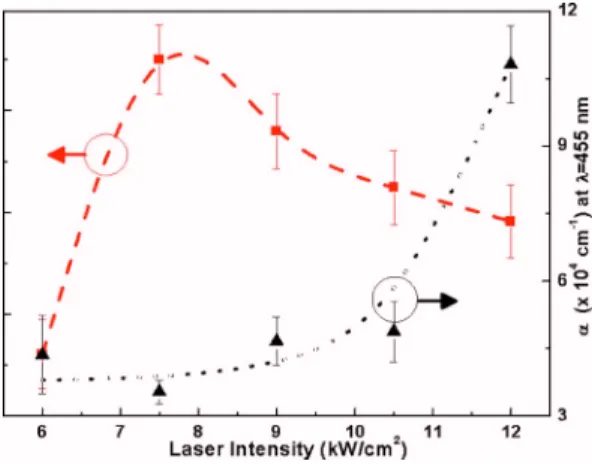
Addi-tionally, the absorption coefficient of the SiO1.25 film at a
wavelength of 455 nm increases by three times as the CO2
laser intensity enlarges from 7.5 to 12 kW/ cm2共see Fig.5兲.
This result again verifies the contribution of ablation-induced surface damage and structural defects at higher laser intensi-ties. The incompletely annealed SiO1.25 with many
oxygen-dependent defects also suffers from a slight decrease in the refractive indices from 1.87 to 1.79 as Plaserincreases from
7.5 to 12 kW/ cm2. In Fig.5, the threshold CO
2laser
inten-sity required to initiate the ablation of the SiO1.25film can be
clearly obtained from the evolution of both the refractive index and the absorption coefficient.
In conclusion, the anomalous absorption spectra and cor-responding changes in optical band gap energy, band edge absorption, and structurally damaged related luminescent centers of the CO2-laser-ablated PECVD-grown SiO1.25film were characterized using UV-VIS-NIR transmission/ reflection and PL spectroscopies. After PECVD deposition, a slight redshift in the transmission and the lower optical band gap energy of as-grown SiO1.25in comparison with those of
quartz substrate are due to the increase in the Si–Si bonding state in SiO1.25near the valence and conduction band edges.
Since the as-grown SiO1.25film contains a high concentration
of hydrogen, dehydrogenation not only reduces the thickness of the PECVD-grown SiO1.25 film but also enhances the
number of Si–Si bonding states under CO2 laser RTA below
the ablation threshold共6 kW/cm2兲, hence contributing to a
redshift of the optical band gap from 3.32 to 2.43 eV. As the CO2 laser RTA intensity increases to⬎6 kW/cm2, the
opti-cal band gap energy of the PECVD-grown SiO1.25increases
oppositely from 2.43 to 2.76 eV due to the ablation-induced damage to the surface and the generated NOV defects. The absorption coefficient of the SiO1.25film at a wavelength of
455 nm is increased by a factor of 3 as the CO2laser
inten-sity is increased from 7.5 to 12 kW/ cm2. During ablation, the incompletely annealed SiO1.25 with numerous oxygen-dependent defects also suffers from a slight decrease in the refractive indices from 1.87 to 1.79 when Plaser increases
from 7.5 to 12 kW/ cm2.
This work was supported in part by the National Science Council 共NSC兲 of the Republic of China under Grant Nos. NSC95-2221-E-002-448 and NSC95-2120-M-009-006.
1L. Pavesi, L. Dal Negro, C. Mazzoleni, G. Franzò, and F. Priolo, Nature
共London兲 408, 440 共2000兲.
2E. D. Palik, Handbook of Optical Constants of Solids共Academic, New
York, 1985兲, Vol. 1, p. 762.
3C. J. Lin, G.-R. Lin, Y. L. Chueh, and L. J. Chou, Electrochem. Solid-State
Lett. 8, D43共2005兲.
4G.-R. Lin, C. J. Lin, L. J. Chou, and Y. L. Chueh, IEEE Trans.
Nanotech-nol. 5, 511共2006兲.
5A. Tewary, R. D. Kekatpure, and M. L. Brongersma, Appl. Phys. Lett. 88,
093114共2006兲.
6D. K. Schroder, Semiconductor Material and Device Characterization
共Wiley, New York, 1998兲, Vol. 2, p. 597.
7V. Garbuio, M. Cascella, L. Reining, R. Del Sole, and O. Pulci, Phys. Rev.
Lett. 97, 137402共2006兲.
8Y.-C. Chang, R. B. James, and J. W. Davenport, Phys. Rev. B 73, 035211
共2006兲.
9J. C. Cheang-Wong, A. Oliver, J. Roiz, and J. M. Hernanaez, Nucl.
In-strum. Methods Phys. Res. B 175, 490共2001兲.
10G.-R. Lin, C. J. Lin, and K. C. Yu, J. Appl. Phys. 96, 3025共2004兲. 11C. Itoh, T. Suzuki, and N. Itoh, Phys. Rev. B 41, 3794共1990兲.
FIG. 5.共Color online兲 Refractive index and absorption coefficient of CO2
laser RTA SiO1.25as a function of laser intensity.
151903-3 Lin, Lin, and Chang Appl. Phys. Lett. 90, 151903共2007兲