IEEE TRANSACTIONS ON MAGNETICS, VOL. 43, NO. 2, FEBRUARY 2007 793
Optimization of the Lens Holder and Yoke
for a Near-Field Optical Pickup Actuator
to Enhance Frequency Response
Ming-Tsan Peng
1, Hai-Jo Huang
1, Chun-Te Wu
1, Kwen-Jin Lee
1, Lei-Ming Yang
1, Chi-Shen Chang
1;2,
Chau-Yuan Ke
1, Shyh-Jier Wang
1, Tzuan-Ren Jeng
1, and Jau-Jiu Ju
1EOL, Industrial Technology Research Institute, Hsinchu, 310 Taiwan, R.O.C.
Department of Mechanical Engineering, National Chiao Tung University, Hsinchu, 300 Taiwan, R.O.C.
A four-wire voice-coil actuator is designed and optimized for use in a near-field optical drive. The first objective was to design a lens holder which could accommodate a large-size lens module while possessing a strong mechanical structure. The second objective was to optimize the yoke so that the magnetic field would be uniform within the stroke range of the voice coils. These improvements eventually helped to improve the bandwidth of the frequency response of the actuator.
Index Terms—Actuator, near-field, optical drive.
I. INTRODUCTION
A
FOUR-WIRE voice-coil actuator is used for optical pickup head (PUH) in a near-field optical storage system [1], [2]. The actuator is required to have a wide operating spectrum in both focusing and tracking directions so that the frequency response of the near-field gap servo satisfies the required specification. Compared to an actuator used in a current optical PUH, such as in a DVD, the lens module containing a SIL may be heavy compared with the lens holder. The requirement of the near distance between the SIL and the disc surface further shifts the mass center of the lens holder toward its upper surface, which results in the undesired rolling mode in the tracking movement. This paper will demonstrate the use of a weighting mass to balance the mass center with the actuation center so that the rolling mode is diminished. In addition, the optimization method is applied to modify the yoke in order to create a uniform magnetic field distribution over the tracking coils; thus, the undesirable rolling mode is not easy to excite when tracking and focusing movements are coupled.II. OPTIMIZATION OF THELENSHOLDER
The objective lens module includes several lens components, including a semi-sphere SIL lens. The spacing between lenses is tuned by using a plastic adapter, which is embodied in a lens holder and to which some of the lenses are affixed. In our case, the lenses generally had a diameter of about 5 mm. The height of the lens holder was about 5 mm, whereas the depth of space given to the lens was 2 mm. Compared to other conventional lens
Digital Object Identifier 10.1109/TMAG.2006.888415
Color versions of one or more of the figures in this paper are available online at http://ieeexplore.ieee.org.
holders used in a DVD, the particularly large space to accom-modate the lens module has to be carefully designed in order to maintain a sufficient mechanical strength of the lens holder. The structural finite-element (FE) method and topological opti-mization method [3] are then used to provide a guideline for the design.
A lens holder of a primitive shape able to accommodate the lens module and the adapter, as shown in Fig. 1, is fed into the optimization scheme. The objective of the optimization is to ex-plore various shapes of the holder while achieving the highest first mechanical resonance after the six rigid-body modes. The variation of optimization is constrained by allowing the reduc-tion of the original volume by 50% at most. Fig. 1 shows the optimization outcome by the color scale which corresponds to the mass density scale. The design of the lens holder is done with reference to the scale map, such as by mainly trimming the mass on the four corners, where the optimization result in-dicates very little density. The actuator with the optimized lens holder is shown in Fig. 2. Numerical modal analysis shows that the first two mechanical resonances of the new lens holder are well above 27 kHz, respectively, which will be shown later in the experimental result.
III. OPTIMIZATION OF THEMAGNETICCIRCUIT
In the tracking motion, a uniform magnetic flux distribution on the tracking coils is important in that with the coupled focusing stroke, the tracking actuation center has to maintain about the mass center position of the lens holder [4].
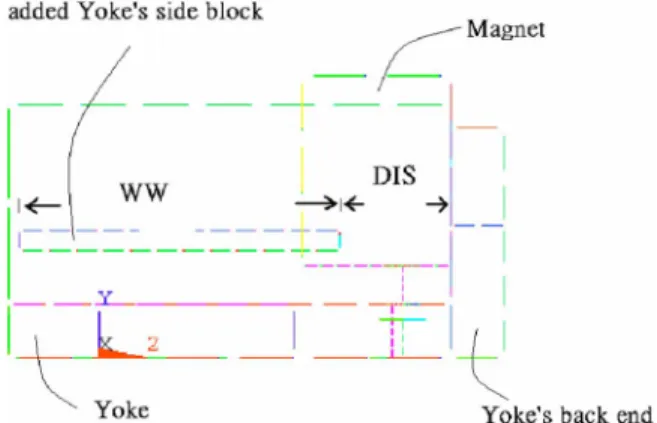
The size of the actuator is 24 mm long, 22 mm wide, and 6 mm high. Figs. 3 and 4 show the front-view and side-view diagrams of a half-size actuator with its yoke and magnet to be modified by the optimization scheme, respectively. Tracking is in the direction. The tracking coils are also plotted here. Several parameters are used to optimize the yoke.
1) The magnet is lifted by a pair of pins below to prevent flux from concentrating near the bottom yoke plate since the
794 IEEE TRANSACTIONS ON MAGNETICS, VOL. 43, NO. 2, FEBRUARY 2007
Fig. 1. Primitive Lens holder and its optimization result.
Fig. 2. Schematic diagram of the four-wire actuator with the new lens holder.
desired flux is in the direction. The height of a pin is denoted by “mh” in Fig. 3.
2) Two extended blocks on the side walls of the yoke are sup-posed to attract magnetic flux in order to smooth the flux distribution on the tracking coils. The dimensions of a side block are denoted by “h,” “d,” and “ww,” and its position with respect to the yoke is denoted by “dis” and “disy” in Figs. 3 and 4.
3) The width ( direction) and the depth ( direction) of the magnet are fixed by other design considerations. The height “my” ( direction) is allowed to vary.
The optimization objective function is a signal-to-noise ratio (S/N) [5] such that the flux fluctuation can be minimized and its average magnitude measured over the tracking coils maximized. The S/N function is defined as
(1) where and are the mean and standard deviation of the mag-netic flux component measured at sampling points over the effective stroke range of the tracking coils, respectively.
The values of the optimization variables are all constrained within a reasonable range, mainly in consideration of possible
Fig. 3. Added yoke’s side blocks, magnet’s lifting pins, and variable magnet’s height, viewed from the front of the yoke.
Fig. 4. Added yoke’s side blocks and their positions, viewed from the side of the yoke.
TABLE I
OPTIMIZEDPARAMETERVALUES
geometric interference among different components. The sub-problem optimization method combined with the magnetic FE analysis is used. Optimization results are shown in Table I.
Figs. 5 and 6 show the component (Bz) of the magnetic flux over the tracking stroke range of the original and optimized ac-tuator, respectively. In the original acac-tuator, there are no side blocks, the height of the lifting pins under the magnet is orig-inally set at 0.5 mm, and the height of the magnets is set arbi-trarily at 5 mm.
IV. EXPERIMENTALRESULTS
Figs. 7 and 8 show Bode plots in the focusing and tracking di-rections, respectively. First, it can be noted that the first nonrigid resonance in both Bode plots is about above 27 kHz, indicating the optimized lens holder had a quite strong structure. In the tracking Bode plot, as discussed above, the upward position of the mass center of the lens holder gave rise to the rolling-mode
PENG et al.: OPTIMIZATION OF THE LENS HOLDER AND YOKE 795
Fig. 5. Magnitude of Bz over the tracking stroke of the original actuator.
Fig. 6. Magnitude of Bz over tracking stroke of the optimized actuator.
Fig. 7. Focusing Bode plot.
resonance at around 80 Hz. Fig. 9 shows the rolling mode has been depressed after a proper weighting mass was added to the bottom of the lens holder.
V. CONCLUSION
The optimization methods used herein have been applied to the lens holder design to successfully improve its mechanical
Fig. 8. Tracking Bode plot.
Fig. 9. Zoomed tracking Bode plot near 100 Hz with the rolling mode depressed.
strength. The rolling mode due to four-wire resonance is tackled by rebalancing the mass in the lens holder. The optimization for the magnetic circuit has numerically demonstrated that a much more uniform flux density over the tracking coil can be obtained through the design of a new yoke, which could also improve the frequency response of the actuator.
REFERENCES
[1] M. Shinoda, “High density near field readout over 100 GB capacity using solid immersion lens with NA of 2.05,” Proc. SPIE, vol. 5069, pp. 306–311.
[2] T. Ishimoto, “Near field readout system for a high density optical ROM disc,” Proc. SPIE, vol. 4342, pp. 294–303.
[3] F. Vogel, “Topological optimization of linear-elastic structures with ANSYS 5.4.,” presented at the NAFEMS Conf. Topological Optimiza-tion, 1997.
[4] K. Park, “Flux leakage effect on subsidiary resonance of optical disk drives,” IEEE Trans. Magn., vol. 35, no. 5, pp. 3676–3678, May 1999. [5] C. Y. Ke, “Optimizing a radial tilt controllable slim actuator with a PCB lens holder,” IEEE Trans. Magn., vol. 40, no. 4, pp. 2071–2073, Jul. 2004.