Catalytic Degradation of Dichloroethane Using Cu Nanoparticles Under Reducing Conditions
Shin-Mu Tsai and Hsing-Lung Lien
Department of Civil and Environmental Engineering National University of Kaohsiung, Kaohsiung 811, Taiwan
(E-mail: [email protected])
Abstract
Dichloroethane is a raw material used for the manufacture of vinyl chloride monomer (VCM) and therefore has very often been detected as a contaminant in the groundwater nearby the VCM manufacturing plant. Zero-valent iron is capable of degrading a wide array of chlorinated contaminants in groundwater such as trichloroethylene, vinyl chloride, carbon tetrachloride, and tetrachloroethane. However, it has no reaction with dichloroethane, which has been categorized as a very recalcitrant groundwater contaminant. In this study, zero-valent copper nanoparticles have been synthesized for effective dechlorination of 1,2-dichloroethane under reducing conditions. Cu nanoparticles have the surface areas of about 19.0 m2/g and an average diameter of 70 nm. Batch experiments were conducted to test the effectiveness of Cu nanoparticles for 1,2-dichloroethane degradation using sodium borohydride as electron donors where the ORP was measured at -1000 mV. It was found that more than 80% of 1,2-dichloroethane (initial concentration of 30 mg/L) was rapidly degraded within 2 hours in the presence of both Cu nanoparticles (2.5 g/L) and NaBH4 (1 g/L). No reaction was observed when the system contained either Cu nanoparticles alone or NaBH4 alone. The degradation intermediates included ethane and ethylene accounting for 79% and ~1.5% of the 1,2-dichloroethane lost, respectively.
Keywords
Cupper, 1,2-dichloethane, dechlorination, groundwater remediation, nanoparticles, nanotechnology
INTRODUCTION
1,2-Dichloroethane (DCA) is a one of the chlorinated aliphatic hydrocarbons frequently found in surface and ground water sources. It is used in vinyl chloride monomer (VCM) and polyvinyl chloride (PVC) manufacturing processes [1]. Because of improper handling, storage or disposal practices, a widespread contamination of groundwater by DCA has been reported at a concentration in a range of ug/L to mg/L. DCA causes circulatory and respiratory failure associated with neurological disorders in human being [2] and is a suspected carcinogen.
Zero-valent iron (ZVI) has been widely used a reactive reagent for groundwater remediation. It has been demonstrated capable of treating various contaminants including chlorinated organics [3-5], nitrate [6], and heavy metals [7-8]. Nanoscale zero-valent iron (NZVI) represents an advance in the technology of ZVI [9]. It has large surface areas and the small particle size. Thus, the use of NZVI tends to increase the degradation rate of chlorinated organics by 1-2 orders of magnitude [10]. Among many chlorinated organics, however, it was found that neither ZVI nor NZVI is capable of degrading dichloroethanes [9].
In this study, we present the use of Cu nanoparticles for effective degradation of 1,2-DCA under reducing conditions. Copper is known as a mild hydrogenation catalyst [11] (Satterfield,
1991). It is effective for most of the elementary reactions that are required in catalytic dehalogenation [12] (Yang et al., 1997). Copper coated bimetallic particles have exhibited their ability for the dechlorination of dichloromethane, another recalcitrant contaminant undegradable by NZVI in groundwater [13]. The objectives of this study included to synthesize the copper nanoparticles, to examine the reaction rate and analyze the product distribution, and to investigate the dose effect of electron donors and Cu nanoparticles on the effectiveness of 1,2-DCA degradation.
EXPERIMENTAL METHODS
Synthesis of copper nanoparticles
Synthesis of Cu nanoparticles was achieved by adding 1:1 volume ratio of NaBH4 (0.13 M)
into CuSO4 (0.04 M).The solution was mixed vigorously under room temperature for 1 min (22 ± 1
°C). The synthesized metal particles were then washed with large volume (1000 mL) of Milli-Q water for at least three times.
Batch experiments
Batch tests were conducted in 165 mL glass vials containing 30 mg/L of 1,2-dichloroethane in a 100-mL aqueous solution. Prior to the reaction, each vial was loaded with various amounts of Cu nanoparticles and sodium borohydride as a catalyst and reductant, respectively. Batch bottles were mixed on an orbital shaker (175 rpm) at room temperature (22 ± 1 °C). The batch vials were periodically sampled by transferring sample aliquots (0.5 mL) into 2 mL n-hexane. The extraction was performed for 30 min on the orbital shaker (175 rpm).
Analytical methods
Volatile organic compounds were measured by GC (HP 6890) equipped an electron capture detector (ECD) and a DB-624 capillary column. Concentrations of hydrocarbons were measured by a HP4890 GC-FID equipped with a GS-GASPRO capillary column (J&W, 30 m × 0.32 mm). Analysis was generally performed in triplicate with relative differences less than 15%.
Chloride were analyzed on a Metrohm 861 Advanced Compact ion chromatograph equipped with a Metrosep A Supp 5-100/4.0 column. Eluent contained 9 mM Na2CO3 / 2.8 mM NaHCO3 was
used. The eluent flow was set at 0.7 mL/min. The experiments were conducted in triplicate.
Solid phase characterization
Morphological and elemental analyses of Cu nanoparticles were performed by a scanning electron microscope (SEM) (Hitachi S-4300, Hitachi Science Systems, Ltd.) equipped with energy-dispersive X-ray (EDX) at 10 kV. A surface area analyzer (Beckman Coulter SA3100) was used to determine surface areas of copper nanoparticles.
RESULTS AND DISCUSSION
Characterization of Cu nanoparticles
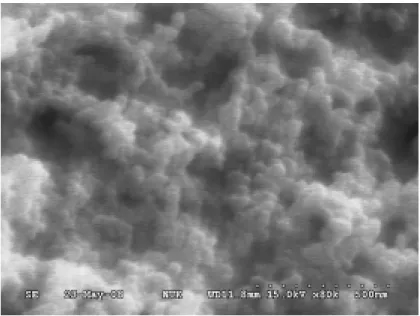
Figure 1 shows the SEM image of the Cu nanoparticles. It was found that Cu nanoparticles agglomerated with an average diameter on the order of 70 nm. The composition of the nanoparticles was analyzed by SEM-EDX and Figure 2 shows the EDX spectrum of typical Cu nanoparticles. It was found that copper was the major species accounting for 96 % of the mass of nanoparticles. A specific surface area of Cu nanoparticles was in an average of 19 ± 1.1 m2
/g as measured by a BET surface analyzer.
Figure 1. A SEM image of Cu nanoparticles
Figure 2. The SEM-EDX spectrum of typical Cu nanoparticles
Degradation of 1,2-DCA
Degradation of 1,2-DCA using Cu nanoparticles under BH4- reducing conditions is shown in
Figure 3. Approximately 85% of 1,2-DCA was rapidly reduced within 5 h. No further reduction was found after 5 h. Reduction of 1,2-DCA was also found in the presence microscale copper powders;
however, the 1,2-DCA degradation rate was significantly lower compared to Cu nanoparticles. This can be attributed to the large difference at the surface area for these two types of copper particles. In addition, it was found that 1,2-DCA can not be reduced either in the presence of Cu nanoparticles alone or under BH4- reducing conditions alone.
Time (hr) 0 5 10 15 20 25 30 C/ C0 0.0 0.2 0.4 0.6 0.8 1.0 1.2 0.25 g nano Cu 0.1 g NaBH4
0.25 g nano Cu+ 0.1 g NaBH4 0.25 g Cu powder+ 0.1 g NaBH4
Figure 3. Reductive degradation of 1,2-DCA under various conditions
Degradation of 1,2-DCA takes place via two different reaction pathways under reducing conditions (14). 1,2-DCA was transformed to ethylene in a single step via reductive dihaloelimination (eq.1) while two consecutive hydrogenolysis reactions yielding chloroethane (eq.2) and ethane (eq.3).
− − → = + +2e CH CH 2Cl Cl CH -C ClH2 2 2 2 (1) − − + + → − + +H 2e CH CH Cl Cl Cl CH -C ClH2 2 3 2 (2) − − ++ → − + +H 2e CH CH Cl Cl CH -C H3 2 3 3 (3)
In this study, product analysis indicated 1,2-DCA was mainly reductive degraded to ethane accounting for 79% of the 1,2-DCA lost. This suggested 1,2-DCA underwent two consecutive hydrogenolysis reactions with copper nanoparticles. Ethylene was detected in a trace amount (~1%) suggesting that dihaloelimination is a minor reaction pathway. The carbon mass balance was determined to be about 70% of the initial 1,2-DCA concentration that is also consistent with the chlorine mass balance.
Dosage Effects of electron donors and Cu nanoparticles
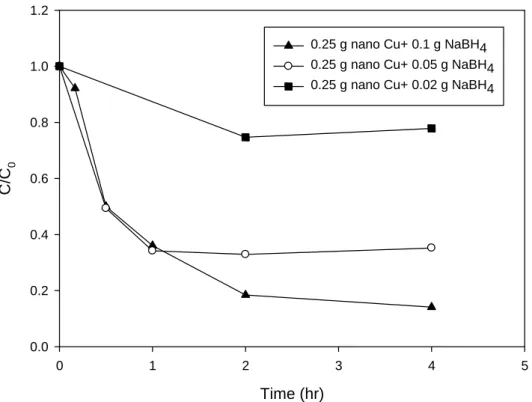
Effects of the reductant concentration on the effectiveness of 1,2-DCA degradation is illustrated in Figure 4. As shown in Figure 4, an increase in sodium borohydride concentrations tends to increase the 1,2-DCA degradation rate in the presence of same metal loading of Cu nanoparticles at 2.5 g/L. Measurements of the oxidation-reduction potential (ORP) revealed a corresponding increase in ORP values with increasing sodium borohydride concentrations. The ORP values increased from 0, -600, to -1100 mV as sodium borohydride concentrations increased from 0, 13, to 26 mM, respectively. This suggested that the 1,2-DCA degradation rate is a function of the reducing power.
Time (hr) 0 1 2 3 4 5 C/ C0 0.0 0.2 0.4 0.6 0.8 1.0 1.2
0.25 g nano Cu+ 0.1 g NaBH4 0.25 g nano Cu+ 0.05 g NaBH4 0.25 g nano Cu+ 0.02 g NaBH4
Figure 4. 1,2-DCA degradation under various reducing conditions in the presence of 0.25 g Cu nanoparticles
The significance of the reductant was further confirmed by repetitive experiments with sodium borohydride addition. As shown in Figure 5 no reduction of 1,2-DCA was found in the presence of Cu nanoparticles alone for 24 hours while a rapid reduction occurred after the addition of sodium borohydride. Similar results were also observed in the presence of both Cu nanoparticles and reductant where the efficiency of the 1,2-DCA degradation was increased from 80% to nearly 100% after sodium borohydride was added at 24 hour.
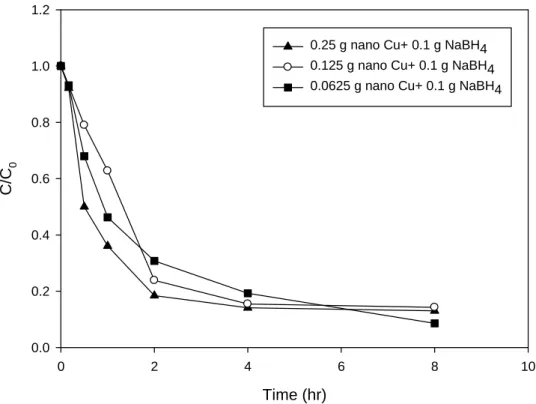
Figure 6 shows the metal dose effect of Cu nanoparticles on the 1,2-DCA degradation rate under the same reducing conditions (26 mM NaBH4). Unlike the effect of the reductant, the metal
attributed to the agglomeration of Cu nanoparticles that reduced the available surface for the degradation of 1,2-DCA. Time (hr) 0 10 20 30 40 C/C 0 0.0 0.2 0.4 0.6 0.8 1.0 1.2
0.25 g nano Cu+ 0.1 g NaBH4 0.25 g nano Cu
Figure 5. Addition of sodium borohydride after 24 h during the experiment
Time (hr) 0 2 4 6 8 10 C/C 0 0.0 0.2 0.4 0.6 0.8 1.0 1.2
0.25 g nano Cu+ 0.1 g NaBH4 0.125 g nano Cu+ 0.1 g NaBH4 0.0625 g nano Cu+ 0.1 g NaBH4
Figure 6. The metal dose effect of Cu nanoparticles on the 1,2-DCA degradation rate Addition of 0.1 g
CONCLUSIONS
1,2-Dichloeoethane is a very recalcitrant groundwater contaminant unable to be remediated by zero-valent iron. In this study, we demonstrated that Cu nanoparticles can effectively degrade 1,2-DCA under reducing conditions. Based on the results of this study, the following conclusions can be drawn:
z Cu nanoparticles have a particle size on the order of 70 nm and an average surface areas of 19 ± 1.1 m2
/g. The major composition is copper accounting for 96 % of the total mass of nanoparticles.
z Ethane was the major product during the 1,2-DCA degradation accounting for 79% of the 1,2-DAC lost. This suggested 1,2-DCA underwent two consecutive hydrogenolysis reactions with Cu nanoparticles. Ethylene was detected in a trace amount (~1%) suggesting that dihaloelimination is a minor reaction pathway.
z The 1,2-DCA degradation rate is a function of reductant concentrations whereas an increase in the dosage of Cu nanoparticles did not result in a corresponding increase in 1,2-DCA degradation rate. The latter may be attributed to the agglomeration of Cu nanoparticles that reduced the available surface for the degradation of 1,2-DCA.
ACKNOWLEDGEMENTS
The authors would like to thank National Science Council (NSC), Taiwan ROC for the financial support through NSC Grants (NSC 95-2221-E-390-014-MY2 and 96-2815-C-390-017-E).
REFERENCES
[1] Carroll Jr., W. F., Berger, T. C., Borrelli, P. J., Garrity, R. A., Jacobs, R. A., Lewis, J. W., McCreedy, R. L., Tuhovak, D. R., and Weston, A. F. (1998). Characterization of emissions of dioxins and furans from ethylene dichloride (DCE), vinyl chloride (VCM) and polyvinyl chloride (PVC). Chemosphere, 37, 1957–1972.
[2] IARC (1999). 1,2-dichloroethane. In: IARC Monographs on the Evaluation of the Carcinogenic Risk of Chemicals to Humans. Re-evaluation of Some Organic Chemicals, Hydrazine and Hydrogen Peroxide (Part Two). International Agency for Research on Cancer, Lyson, France, pp. 501–529.
[3] Campbell, T. J., Burris, D. R., Roberts, A. L., and Wells, J. R. (1997). Trichloroethylene and tetrachloroethylene reduction in a metallic iron-water-vapor batch system. Environ. Toxic. Chem., 16, 625-630.
[4] Gillham, R. W., and O’Hannesin, S. F. (1994). Enhanced degradation of halogenated aliphtics by zero-valent iron. Ground Water, 32, 958-967.
[5] Matheson, L. J., and Tratnyek, P. G. (1994). Reductive dehalogenation of chlorinated methanes by iron metal. Environ. Sci. Technol., 28, 2045-2053.
[6] Cheng, I. F., Muftikian, R., Fernando, Q., and Korte, N. (1997). Reduction of nitrate to ammonia by zero-valent iron. Chemosphere, 35, 2689-2695.
[7] Alowitz, M. J., and Scherer, M. M. (2002). Kinetics of nitrate, nitrite, and Cr(VI) reduction by iron metal. Environ. Sci. Technol., 36, 299-306.
[8] Lien, H. L., and Wilkin, R. T. (2005). High-level arsenite removal from groundwater by zero-valent iron. Chemosphere, 59, 377-386.
[9] Zhang, W. -X. (2003). Nanoscale iron particles for environmental remediation: An overview. J. Nanopart. Res., 5, 323-332.
[10] Lien, H-L.; and Zhang, W-X. (2001). Nanoscale iron particles for complete reduction of chlorinated ethenes. Colloids and Surfaces A: Physicochemical and Engineering Aspects. 191, 97-106.
[11] Satterfield, C. N. (1991) Heterogeneous Catalysis in Industrial Practice, second ed. McGraw-Hill, Inc., New York, NY.
[12] Yang, M. X., Sarkar, S., and Bent, B. E. (1997). Degradation of multiply-chlorinated hydrocarbons on Cu(100). Langmuir, 13, 229-242.
[13] Lien, H. L., and Zhang, W. -X. (2002). Enhanced dehalogenation of halogenated methanes by bimetallic Cu/Al. Chemosphere, 49, 371-378.
[14] Vogel, T. M., Criddle, C. S., and McCarty, P. L. (1987). Transformation of halogenated aliphatic compounds. Environ. Sci. Technol., 21, 722-736.