Effect of Bagging with Black Paper on Coloration
and Fruit Quality of ‘Ruby’ Grapefruit
1
A-Shiarn Hwang
2,5
, Kuang-Liang Huang
3
and Shin-Hsuan Hsu
4
ABSTRACT
Hwang, A. S., K. L. Huang, and S. H. Hsu. 2004. Effect of bagging with black paper on coloration and fruit quality of ‘Ruby’ grapefruit. J. Agric. Res. China 53:229-238.
'Ruby' grapefruit (Citrus paradisi Macf.) were covered with black paper bags in late May or early June (early bagging) or early July (late bagging), and changes in the peel and flesh color were measured by spectrophotometer in regular intervals till harvest in late November. Bagging increased chroma and lightness but decreased hue angle gradually on peel, thus resulting in a light reddish orange color during maturation period, while control fruits were bright yellow. The most intense color on peel of bagged fruit occurred in late October. The peel color of early-bagged fruit was redder (smaller hue angle) than that of late-bagged fruit. Compared to controls, bagging only slightly enhanced flesh color during maturation period, and there was no significant different between the two different bagging treatments at harvest. Bagging had limited effect on fruit quality.
Key words: Grapefruit, Peel color, Flesh color, Bagging, Fruit quality.
INTRODUCTION
Rind color influences consumer acceptance of fresh citrus. Based on rind and flesh color, grapefruit (Citrus paradisi Macf.) cultivars can be grouped as (1) white rind with white flesh, (2) white rind with pink flesh, (3) pink rind with red flesh and (4) red rind with red flesh (Cameron et al. 1964). Most grapefruit cultivars, other than the deep red ones such as 'Rio Red' and 'Star Ruby', do not exhibit obvious external color difference in the field (Porras et al. 1996). Their rind usually exhibit yellow or greenish yellow at
1. Contribution No.2206 from Agricultural Research Institute, Council of Agriculture. Accepted: November 2, 2004.
2. Associate Horticulturist, Department of Horticulture, Chiayi Agricultural Experiment Station, ARI, Chiayi, Taiwan, ROC.
3. Professor, Department of Horticulture, National Chiayi University, Chiayi, Taiwan , ROC. 4. Master, Institute of Horticulture, National Chiayi University, Chiayi, Taiwan, ROC. 5. Corresponding author, e-mail: [email protected];Fax: (05)2773630.
mature stage. In the researches of grapefruit color, many reports focused primarily on factors affecting pulp and juice color. The color in red grapefruit is related to the variety, rootstock, interstock, age of tree, size of fruit and the seasonal climate (Issa & Mielke 1980; Lee 2000; Lime et al. 1954; Oberbacker et al. 1960; Purcell & Scheltz 1964; Rouseff et al. 1992; Ting & Deszyck 1958).
Lycopene and β−carotene are the main pigments in pink and red grapefruits (Curl & Bailey 1957; Khan & MacKinney 1953; Rouseff et al. 1992), and there is a significant correlation between color index and lycopene content in flesh or juice of these cultivars (Lee & Coats 1999; Lee 2000; Ting & Deszyck 1958). ‘Marsh’ grapefruit, a typical white cultivar, normally contained only trace colored-carotenoid pigments in peel (Yokohama & White 1967) and pulp (Khan & MacKinney 1953). However, intense red color can be induced in the peel of developing fruit by chemical spray (Yokohama & DeBenedict 1972).
Many kinds of fruits are covered with paper bags in Taiwan to protect them from oriental fruit fly (Dacus doralis) damage. In addition, bagging with black paper also improves external color of red grapefruits. The purpose of this study was to investigate the effects of bagging with black paper at various developmental stages on the coloration of ‘Ruby’ grapefruit for obtaining a more intense and pleasing color, which is preferred in the market. The effect of bagging on fruit quality was also investigated.
MATERIALS AND METHODS
The experiments were conducted for two consecutive years in an 8-year-old 'Ruby' grapefruit orchard located in Gukeng, Yurn-Lin. A complete randomized design with 6 replicates, 1 tree per replicate, was used. Trees were grafted on ‘Bitter’ pummelo seedlings and planted in 1991 with a spacing of 6 x 5 m. The orchard was managed using common commercial practices with micro sprinkler irrigation. Black paper bags (Dah-Shehng Co., Yurn-Lin, Taiwan) were placed over fruits either on 26 May (early bagging) or 1 July (late bagging) in 1999 and 3 June (early bagging) or 2 July (late bagging) in 2000. Fruits in control trees were not bagged. The bags measured 27.5 x 16.0 cm, had a weight of 40.32 g/m2,a thickness of 0.068mm, a ventilation rate of 13.9 cc/sec, and two 4 cm opening at each bottom corner. Measurement of rind color began from early September (1999) or late June (2000) till harvest, and 12 fruits per tree were randomly sampled from the outer canopy (1999) or inner canopy receiving little or no direct sunlight (2000).
The colors of peel and flesh were measured as CIE L*, a*, and b* values using a spectrophotometer (Color-Guide, BYK-Gardner, Maryland, USA ) with illuminant D65 and observer angle 100. Chroma ﹝C*=(a*2+b*2)1/2﹞ and hue angle﹝ho=tan-1(b*/a*)﹞were calculated from the parameters (McGuire 1992). Total color difference (△E*) between the treatments defined by (△L*2+△a*2+△b*2)1/2. Four equidistant measurements were taken around the equator of each fruit. Measurement of flesh color began in July when the fruit reached the size that was measurable to the spectrophotometer (measurement aperture 20 mm). Fruits were cut transversely into halves, and 4 readings were taken at equidistant locations near the albedo on the top-end half of each fruit.
Fruits were harvested on 18 Nov. in 1999 and 21 Nov. in 2000. For quality analysis, juice was extracted with a electrical citrus juicer (model MPZ 6, Braun, USA). Acidity was determined by titrating
with 0.1N NaOH solution. Sugar content was measured with handy refractometer (Atago, N1). Means separation was performed using Duncan's Multiple Range Test.
RESULTS AND DISCUSSION
Changes in peel color
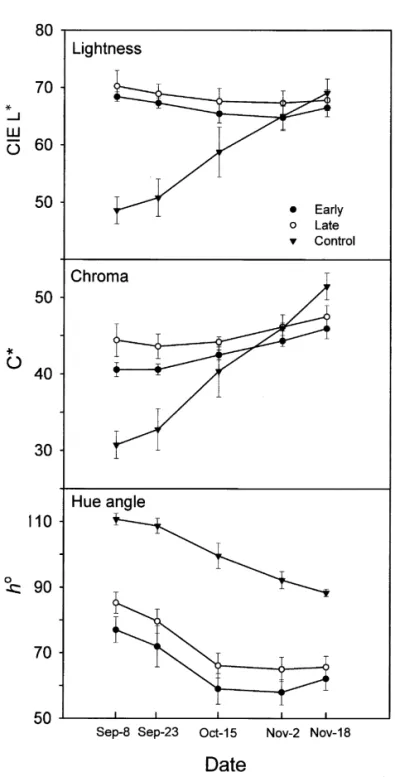
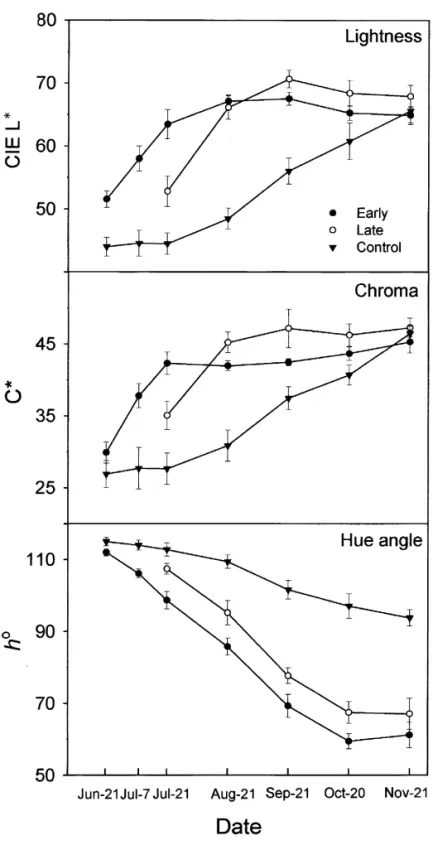
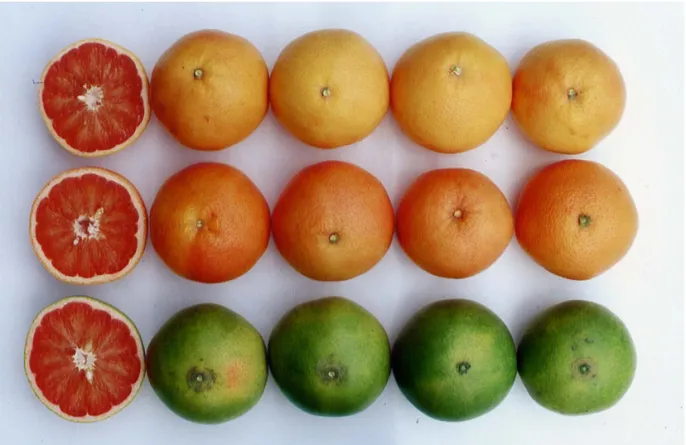
Changes in peel color expressed by lightness ( CIE L*), chroma (C*) and hue angle (ho) were similar in two years as shown in Fig. 1 and Fig. 2, although fruits were sampled from different positions (outer canopy in 1999 or inner canopy in 2000). After bagging, the peel color of both bagged fruits changed consistently toward a deepest color of hue angle 60 (reddish orange) in late-October and followed by a small increase, and that of control fruit decreased toward 90 (yellow color) at harvest. By 8 Sept. 1999, the peel of early-bagged fruits had become orange yellow with CIE L*, C* and ho values of 68.4, 40.6 and 77.0, respectively. Fruits of late bagging were bright yellow with CIE L*, C* and ho values of 70.2, 44.4 and 85.3, respectively, while that of control fruits remained greenish yellow with CIE L*, C* and ho values of 48.6, 30.7 and 110.7, respectively. Lightness and chroma values of the bagged fruit increased rapidly after bagging as compared to the control fruit in the same developmental stage. These two color parameters of control fruit didn’t increase until maturation period, and only the C* value at harvest in 1999 was significantly higher than the bagged fruits. Early-bagged fruits had smaller hue angle, higher lightness and higher chroma in peel than late-bagged ones did during maturation period, which reflected a brighter redder color (Fig. 3).
Francis & Clydesdale (1975) indicated that a total color difference of 2 would be noticeable different for most products. The peel color of both bagged fruit can be described as reddish orange at harvest, however the difference was perceived with total color differences △E* =3.5 in 1999 and △E* =6.0 in 2000 (Table 1). As season progressed, the peel color of control fruit changed from green, light yellow green toward bright yellow, a hue angle of 88.4 in 1999 and 93.8 in 2000 at harvest. The total color differences on peel between control and bagged fruit in the two years were higher than 19 (Table 1).
Changes in flesh color
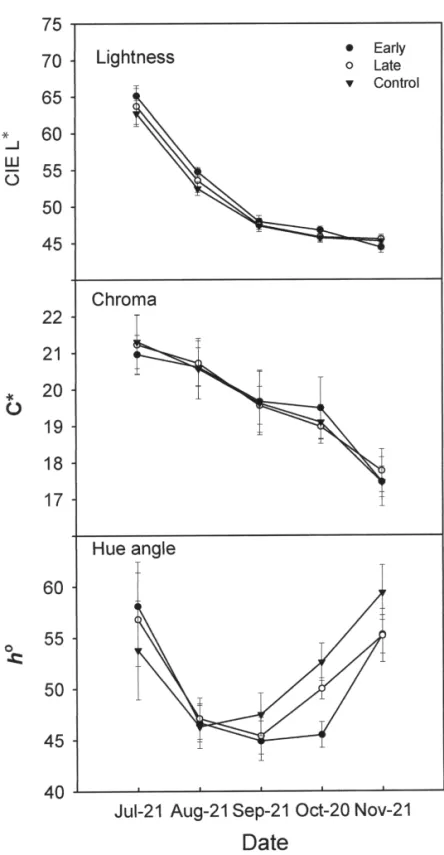
The CIE L* and C* values in flesh of the whole 3 treatments declined consistently throughout the investigation period as shown in Fig. 4. The main difference in flesh was that the control fruits had larger hue angle (p<0.05) as compared to the bagged fruits since late September. Although the differences of CIE L* Table 1. Effect of bagging periods on total color difference between treatment in peel and flesh of ‘Ruby’ grapefruit
Peel Flesh △E*z between treatmentsy
1999 2000 1999 2000 Early and control 22.9 25.7 2.0 0.3
Late and control 19.9 21.8 2.6 1.4 Early and late 3.5 6.0 0.8 1.3
z Total color difference △E*= (△L*2+△a*2+△b*2)1/2.
y Early: bagged with black paper on 26 May 1999 or 3 June 2000; Late: bagged on 1 July 1999 or 2 July 2000; Control: not
Fig. 1. Changes of color parameters in the peel of ‘Ruby’ grapefruit bagged with black paper during mature season in 1999
(mean±se, treatments, as Table 1). The color was measured using CIE Lab system.CIE L* value indicates lightness, black=0 to white =100. Chroma ﹝C*=(a*2+b*2)1/2﹞is an index of color intensity, and color intensifies with greater
value. Hue angle﹝ho=tan-1(b*/a*)﹞represents different color, 0o = red-purple, 45o = orange, 90o = yellow, 180o
Fig. 2. Changes of color parameters in the peel of ‘Ruby’ grapefruit after bagging with black paper in 2000 (mean±se).
Fig. 3. Effect of Bagging periods with black paper on coloration of ‘Ruby’ Grapefruit. Fruit were bagged on 3 June (early
bagging, middle row) produced redder color on peel during maturation period than those bagged on 2 July (late bagging, upper row), and control fruits (lower row) were greenish. Fruits were picked and photographed 5 November 2000.
value among treatments were small, the difference showed with 5% significant different level. The hue angle declined to the lowest level of 46.3 for control fruit on 21 Aug. and that was 44.9, 45.4 for early- and late-bagged fruits on 21 Sept., respectively. Then, they increased slightly with maturity till harvest in late November. This color change in flesh agreed to the previous reports (Lee 2000; Lime et al. 1954; Oberbacher et al. 1960; Porras et al. 1996; Ting et al. 1980). There was no significant difference in hue angle of flesh between early and late bagging at harvest and both were slight smaller than that of the control. The total color difference (△E*) in flesh among the treatments (<3.0) were quite small than those in the peel (Table 1.).
As lycopene with a lesser extent of β−carotene are the major pigments in red grapefruit cultivars (Curl & Bailey 1957; Khan & MacKinney 1953; Rouseff et al. 1992) and their concentrations have a significant relationship with the color (Lee & Coats 1999; Lee 2000; Ting & Deszyck 1958), the color changes in this study might also relate to these pigments.
Fig. 4. Changes of color parameters in the flesh of ‘Ruby’ grapefruit bagged with black paper in 2000. (mean±se). Treatments
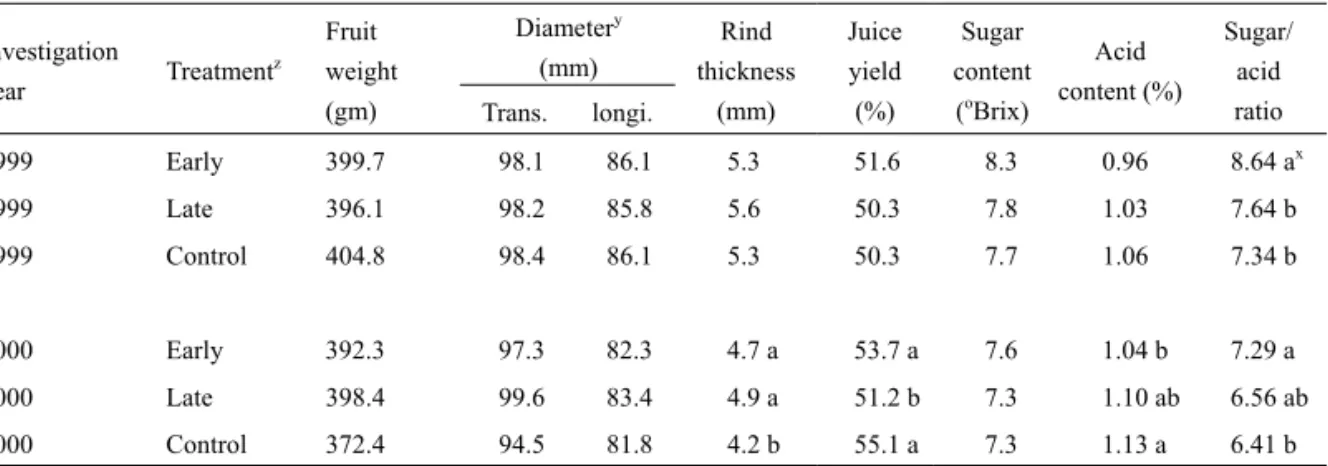
Table 2. Influences of bagging with black paper on fruit quality of 'Ruby' grapefruit in two consecutive years Diametery (mm) Investigation year Treatment z Fruit weight (gm) Trans. longi. Rind thickness (mm) Juice yield (%) Sugar content (oBrix) Acid content (%) Sugar/ acid ratio 1999 Early 399.7 98.1 86.1 5.3 51.6 8.3 0.96 8.64 ax 1999 Late 396.1 98.2 85.8 5.6 50.3 7.8 1.03 7.64 b 1999 Control 404.8 98.4 86.1 5.3 50.3 7.7 1.06 7.34 b 2000 Early 392.3 97.3 82.3 4.7 a 53.7 a 7.6 1.04 b 7.29 a 2000 Late 398.4 99.6 83.4 4.9 a 51.2 b 7.3 1.10 ab 6.56 ab 2000 Control 372.4 94.5 81.8 4.2 b 55.1 a 7.3 1.13 a 6.41 b z As in Table 1.
y trans.: transversal; longi.: longitudinal.
x Means followed by the same letter are not significantly different by Duncan's multiple rang test (p=0.05).
Influence of bagging on fruit internal quality
Table 2 shows the 2-years’ fruit quality analysis results. The main difference among the treatments was that fruits of early bagging had higher sugar/acid ratio than the control. This was due to the higher sugar and lower acid content of early bagging fruits in both years, whereas only acid content in the latter year was significantly different between treatments. The rind thickness and juice yield showed a significant difference among treatments in the latter year. The other major characteristics of fruit quality including fruit weight, longitudinal and transverse diameter and sugar content were not significantly different in both years.
Citrus fruits are non-climacteric and undergo slow and gradual development in both external and internal quality (Spiegel-Roy & Goldschmidt 1996). In this study, bagging ‘Ruby’ grapefruit with black paper altered the peel color from bright yellow to reddish orange gradually with limited effect on major characteristics of fruit quality. In order to obtain a redder peel color, ‘Ruby’ and probably all the red cultivars of grapefruit should be bagged with black paper at an earlier stage and harvested in late October.
LITERATURE CITED
Cameron, J. W., R. K. Soost, and F. O. Olson. 1964. Chimeral basis for color in pink and red grapefruit. J. Hered. 55:23-28.
Curl, A. I. and G. F. Bailey. 1957. The carotenoids of Ruby Red grapefruit. Food Res. 22:63-68.
Francis F. J. and F. M. Clydesdale. 1975. Food colormetry: Theory and Applications. The AVI Publishing Co., Inc., Westport, CT. USA.
Issa, J. and E. A. Mielke. 1980. Influence of certain citrus interstocks on β–carotene and lycopene levels in 10-year-old ‘Redblush’ grapefruit. J. Am. Soc. Hortic. Sci. 105(6):807-809.
Khan, M. U. D. and G. MacKinney. 1953. Carotenoids in grapefruit, Citrus paradisi. J. Plant Physiol. 28:550-552.
Lee, H. S. 2000. Objective measurement of red grapefruit juice color. J. Agric. Food Chem. 48:1507-1511. Lee, H. S. and G. A. Coates. 1999. Thermal pasteurization effects on color of red grapefruit juices. J. Food
Sci. 64(4):663-666.
Lime, B. J., T. S. Stephens, and F. P. Griffiths. 1954. Processing characteristics of colored Texas grapefruit. I. Color and maturity studies of Ruby Red grapefruit. Food Technol. 8(12):566-569.
McGuire, R. G. 1992. Reporting of objective color measurements. Hortscience 27(12):1254-1255.
Oberbacher, M. F., S. V. Ting, and E. J. Deszyck. 1960. Internal color and carotenoid pigments of Burgundy grapefruit. Proc. Am. Soc. Hortic. Sci. 75:262-265.
Porras, I., A. Garcia, C. Egea, A. Conesa, M. F. Garcia-Legaz, and J. M. Ortiz. 1996. Internal and external color changes in different grapefruit varieties. Proc. Int. Soc. Citriculture 1113-1116.
Purcell, A. E. and E. F. Schultz, Jr. 1964. Influence of fruit age on lycopene concentration in colored grapefruit. Proc. Am. Soc. Hortic. Sci. 85:183-188.
Rouseff, R. L., G. D. Sadler, T. J. Putnam, and J. E. Davis. 1992. Determination of β-carotene and other hydrocarbon carotenoids in red grapefruit cultivars. J. Agric. Food Chem. 40:47-51.
Spiegel-Roy, P. and E. E. Goldschmidt. 1996. Biology of Citrus. Cambridge University Press. New York. 230 pp.
Ting, S. V. and E. J. Deszyck. 1958. The internal color carotenoid pigments of Florida red and pink grapefruit. Proc. Am. Soc. Hortic. Sci. 71:271-277.
Ting, S. V., R. L. Huggart, and M. A. Ismail. 1980. Color and processing characteristics of ‘Star Ruby’ grapefruit. Proc. Fla. State Hortic. Soc. 93:293-295.
Yokoyama, H. and C. DeBenedict. 1972. Induced color change in grapefruit and orange. Phytochem. 11:1721-1724.
Yokoyama, H. and M. J. White. 1967. Carotenoids in the peel of seedless grapefruit. J. Agric. Food Chem. 15(4):693-696.
套黑色紙袋對 'Ruby' 葡萄柚果實色澤轉變與
品質的影響
1
黃阿賢
2,5
黃光亮
3
許世弦
4
摘 要
黃阿賢、黃光亮、許世弦。2004。套黑色紙袋對’Ruby’葡萄柚果實色澤轉變與品質的影 響。中華農業研究53:229-238。’Ruby’葡萄柚(Citrus paradisi Macf.)果實於五月下旬或六月上旬(早期套袋)或 七月上旬(晚期套袋)套以黑色紙袋,處理後至採收期間用色差儀定期測量果皮與果肉 之顏色變化,以色相角度(hue angle)、明度(lightness)、彩度(chroma)表示之。 套袋後果皮之明度與彩度漸增加、但色相角度漸減少。至11 月下旬採收時,套袋者果 皮已轉成淡橙紅色,不套袋者為較明亮之黃色。套袋者果皮色澤最深之時期為10 月下 旬,早期套帶之果皮顏色較晚期套帶者紅。套袋僅稍影響果肉之色相角度,成熟期間兩 套袋者色相角度均較不套袋者略小(偏紅色),至採收時兩套袋者間已無差異。套袋對 果實品質之影響有限。 關鍵詞:葡萄柚、果皮顏色、果肉顏色、套袋、果實品質。 1. 行政院農業委員會農業試驗所研究報告第 2206 號。接受日期:93 年 11 月 2 日。 2. 本所嘉義分所園藝系副研究員。臺灣 嘉義市。 3. 國立嘉義大學園藝學系教授。臺灣 嘉義市。 4. 國立嘉義大學園藝研究所碩士。臺灣 嘉義市。 5. 通訊作者,電子郵件:[email protected];傳真機:(05)2773630。